Call for Papers: AAH Student Symposium

AAH Summer Symposium 2012 Art and Science: Knowledge, Creation and Discovery
The Linnean Society of London, Burlington House, 28-29 June 2012
Proposals due by 29 April 2012
Though their academic paradigms may at first seem diametrically opposed, the association between the arts and the sciences has survived renaissances, revolutions and beyond. This intellectual conjunction has motivated artistic practice and production throughout history, forming the conceptual nucleus of some of the most stimulating forms of creative expression. By engaging with this inter-relationship, we hope to address the assumed divisions that have kept the arts and sciences as separate areas of academic enquiry, whilst at the same time questioning if such an alliance is necessary or profitable for either discipline.
As well as considering general ideas of artistic and scientific collaboration, this year’s Summer Symposium will investigate the interaction between art and science throughout artistic practice, theory and history. Topics for papers could include, but are not limited to:
- Artists who work directly or indirectly with science
- Medical and anatomical images, diagrams, and the art of science
- Architecture and the body
- Histories of collection, taxonomies, display and acquisition in the arts and sciences
- The role of the science of perception in the development of perspective, figuration and abstraction
- The idea of the modern as related to science and technology
- The figure of the polymath
- Neuroscience and histories of vision
- Photography between science and art
- Mathematics and beauty – the Golden Section
- Technology and the evolving dissemination of art history
- Science in art historical conservation and research
Papers should be 20 minutes in length and abstracts of no more than 300 words should be submitted with a brief biography to: aah.art.science@gmail.com by 29 April 2012. The conference is open to all but speakers need to be student AAH members.
Symposium Organisers
Arlene Leis, University of York, acl914@interfree.it
Rebecca Norris, University of Cambridge, rn290@cam.ac.uk
Freya Gowrley, University of Edinburgh, f.l.gowrley@gmail.com
Call for Papers: Third Annual Feminist Art History Conference
Third Annual Feminist Art History Conference
American University, Washington D.C., 9-11 November 2012
Proposals due 15 May 2012
This conference builds on the legacy of feminist art-historical scholarship and pedagogy initiated by Norma Broude and Mary D. Garrard at American University. To further the inclusive spirit of their groundbreaking anthologies, we invite papers on subjects spanning the chronological and geographic spectrum to foster a broad dialogue on feminist art-historical practice. Speakers may address such topics as: artists, movements, and works of art and architecture; cultural institutions and critical discourses; practices of collecting, patronage, and display; the gendering of objects, spaces, and media; the reception of images; and issues of power, agency, gender, and sexuality within visual cultures.
Sessions and keynote will be held on AU’s campus with additional events at the National Museum of Women in the Arts in conjunction with its 25th Anniversary celebration
Keynote address
“Guess Who’s Coming to Dinner? Feminism, Art History and the Story of a Book”
Whitney Chadwick, Professor Emerita of Art History, San Francisco State University
Please submit via email a one-page, single-spaced proposal and two-page curriculum vita by May 15, 2012 to fahc3.cfp@gmail.com. Notification of acceptance by July 1, 2012
Sponsored by the Art History Program, Department of Art, College of Arts and Sciences at American University
Organizing committee: Kathe Albrecht, Juliet Bellow, Norma Broude, Kim Butler, Mary D. Garrard, Namiko Kunimoto, Helen Langa, and Andrea Pearson
Call for Papers: Undergraduate Symposium on the Body
The Body in Visual Culture: An Undergraduate Student Symposium
University of Massachusetts Dartmouth, 4 May 2012
Proposals due by 1 April 2012
Keynote Speaker: Gregory Williams, Assistant Professor of Art History at Boston University and author of Permission to Laugh: Humor and Politics in Contemporary German Art (University of Chicago Press, 2012)
Bodies function as indicators of identity. A toned and muscular body indicates a laborer, or someone who is concerned with their health whereas a frail or emaciated body may indicate trauma or an eating disorder. An obese body could indicate sloth or illness, although historically it has been a sign of wealth and even beauty. A body plastered in tattoos could designate gall, a passionate form of expression, one who loves art, or one who has lost a lot of bets. Based on cultural “standards,” some bodies, such as those of women and minorities, have at times indicated inferiority, while others, such as those of Aryan men, have stood for superiority. However, the practice of identifying someone by their body is nothing more than assumption, which is rarely accurate in comparison to the way one defines their own identity. Throughout history, this disparity has resulted in detrimental action in society including stereotyping, discrimination, oppression, and in extreme cases, genocide.
The College of Visual and Performing Arts (CVPA) Art History Club at the University of Massachusetts Dartmouth seeks proposals for an undergraduate student symposium on the topic of the body in visual culture. We are interested in projects that address the role of the sexuality, oppression, gender, identity in the representation of the body as well as the transformation of the body at the hands of technology. (more…)
Call for Papers: Le Salon de l’Académie Royale de Peinture et Sculpture
From Fabula:
The Salon of the Royal Academy of Painting and Sculpture: Archaeology of an Institution
National Museum of Fine Arts, Quebec, 13-15 September 2012
Proposals due by 15 March 2012
International Symposium by Centre Interuniversitaire d’étude sur la République des lettres (CIERL), under the direction of Dr Isabelle Pichet
The historiography of the Salon of the Royal Academy of Painting and Sculpture in Paris is often bereft of a key part of its history: how the Salon itself became an art institution. Originally integrated into the fêtes de l’Académie, over time the Salon came to be best known in the form of a temporary, independent, and recurrent exhibition. This event developed little by little, reimagining itself through and eventually blossoming as the popular biennal exhibition. The unique character of the Salon was established through the regular repetition of the exhibition cycle, a sequence that helped to root the event’s particular characteristics in the minds of the public and in the regard of other institutions. In creating this rhythm within Parisians’ horizon of expectation, the Salon provided a habitus for their audience; moreover, the Salon inspired curiosity and desire in the provinces and nations that sought to imitate it.
This conference seeks to define and better understand the trajectory followed by the Salon from its emergence in the late 17th century to its full maturity in the second half of the 18th century. This symposium aims also to identify the diverse parameters and conditions that contributed to the development and helped to affirm the singularity of the Salon. This call for papers solicits proposals that will increase our understanding of the foundations and limits that shaped the form and content of the Salon as well as help us to survey the influence and impact of these exhibitions on various aspects of French and European society. As a multidisciplinary event, this conference is a laboratory and reflection on current research and scholarly approaches that consider the Salon and its place in the “art worlds,” as well as literature, philosophy, politics, and history.
New, unpublished papers shall not exceed the twenty minutes allocated to each participant. Proposals for papers (title and abstract of 250 words, institutional affiliation) should be sent to the committee before March 15, 2012 at the following address: colloque.salon@lit.ulaval.ca
Plenary lecture by Dr. Kim de Beaumont, Adjunct professor at Hunter College, Art Historian specialist of Gabriel de Saint-Aubin
Call for Papers: Emblems of Nationhood, Britishness
From the conference website:
Emblems of Nationhood: Britishness, 1707-1901
University of St Andrews, 10-12 August 2012
Proposals due by 1 March 2012
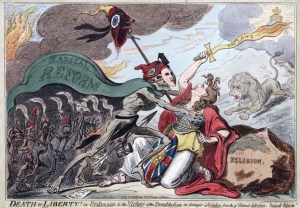
George Cruikshank, "Death or Liberty!" 1819 ( The Lewis Walpole Library, Yale University)
National identity is a central point of enquiry that is repeatedly called upon in contemporary social and political rhetoric. Our conference, ‘Emblems of Nationhood, 1707–1901’, will address the roots of this theme by discussing depictions of Britain and Britishness in literature, philosophy, and art between the Act of Union in 1707 and the death of Queen Victoria in 1901. Over the course of this multidisciplinary conference, we aim to explore how expressions of nationalism have moulded both critical perspectives on national identity and their creative products.
Discussing emblems of nationhood in 2012 is a fitting way to mark the twentieth anniversary of Linda Colley’s seminal account of Britishness, Britons: Forging the Nation, and coincides with the Queen’s Diamond Jubilee. Several broad questions could potentially be explored in the course of the conference: What did Britishness mean in the eighteenth and nineteenth centuries, and how was it represented and perceived? To what extent is nationalism tied with military events and empire building? How “British” was Britain before the launch of the Empire? (more…)
Call for Papers: Grand Tour Studies in Rome
Grand Tour del Terzo Millenio (V edizione)
Ricerche di Storia dell’Architettura dei Borsisti e Artiste e Artisti Stranieri a Roma
La facoltà di Ingegneria dell’Università di Roma – Tor Vergata, 20 April 2012
Proposals due by 23 March 2011
In vista della V edizione della giornata di studio intitolata Grand Tour del Terzo Millenio (V edizione) Ricerche di Storia dell’Architettura dei Borsisti e Artiste e Artisti Stranieri a Roma, che si terrà presso la facoltà di Ingegneria dell’Università di Roma – Tor Vergata il 20 aprile 2012, viene lanciato un call for paper (con scadenza 23 marzo 2012) indirizzato a tutti i borsisti, studiosi e professori stranieri attualmente in Italia che vogliono partecipare alla giornata di studio attraverso una breve relazione di circa 10-12 minuti che presenti i risultati delle loro ricerche relative a Roma: architettura e rappresentazione della città. La giornata di studio vuole favorire lo scambio tra le Istituzioni culturali straniere e l’Università di Tor Vergata, tradizionale luogo di confronto internazionale sulla cultura architettonica.
La giornata di studi apre un dialogo permanente tra l’Università di Roma Tor Vergata e le istituzioni culturali straniere di Roma, attraverso incontri periodici con cadenza annuale. La cattedra di Storia dell’architettura invita gli studiosi delle Accademie straniere a presentare le loro ricerche sulla storia dell’architettura, della costruzione e delle arti a Roma. Questi incontri, che hanno cadenza annuale, sono aperti agli studenti, dottorandi, docenti e a quanti sono interessati allo scambio tra studiosi di scuole e nazionalità diverse.
La giornata di studi è divisa in quattro sessioni:
1- architettura contemporanea (secc. XIX-XXI)
2- architettura dell’evo moderno (secc. XV-XVIII)
3- rapporti tra archeologia e architettura
4- ricerche su architettura e paesaggio
Una discussione finale concluderà la giornata.
Le proposte, riferite esclusivamente ai temi sopra indicati, possono essere inviate sotto forma di un breve abstract (600 caratteri o 100 parole), il cui titolo faccia riferimento a un’area tematica. Esse dovranno essere inviate entro il 23 marzo 2012, all’indirizzo del coordinatore Giuseppe Bonaccorso (bonaccorso@ing.uniroma2.it). Entro il 27 marzo sarà comunicato il calendario definitivo della giornata di studio. La lingua ufficiale del convegno è l’italiano; potranno essere presentati testi e relazioni anche in inglese, francese e spagnolo.
Call for Papers: Color between Science, Art, & Technology
Colour in the 17th and 18th Centuries: Connexions between Science, Art, and Technology
Technische Universität, Berlin, 28-30 June 2012
Proposals due by 27 February 2012
Organized by Magdalena Bushart, Reinhold Reith, and Friedrich Steinle
Knowledge of how to use, combine, analyse, and understand colour has always been widely distributed, if not dispersed. Painters and architects, dyers and printers, pigment producers and merchants, physicists and chemists, natural historians and physiologist, among others, have been dealing with colour, its properties, mixtures, harmonies, meanings and uses. For long periods, different communities that were concerned with colour and the knowledge about it did not interact? at least so it appears.
One of the first to come up with fundamental claims concerning colour in full generality was Newton whose 1704 Opticks indeed quickly became a common reference point for most of those who reflected on colour. Throughout the 18th century, however, the reactions to Newton remained wildly controversial, from unrestricted appraisal via indifference to open and fierce opposition. Several attempts to reconcile Newton’s account with practitioner’s knowledge remained unsuccessful, and this was still the case in early 19th century, when the physiology of colour perception opened yet another field of colour research.
The central aim of the conference is to bring together scholars who are interested in how the various strands of colour use and knowledge were interwoven and connected. We invite contributions that address those connexions: between traditions and specific accounts in experimental philosophy, painting, natural history, chemistry, dyeing, trading, producing, standardizing, etc. While the period covered is restricted to 17th and 18th centuries, the geographic frame is as open as possible and encompasses European and non-European cultures likewise. The conference will not have parallel sessions, since we aim at a truly transdisciplinary discussion. There will be four keynote lectures by Jenny Balfour-Paul (Exeter University), Ulrike Boskamp (Freie Universität Berlin), Sarah Lowengard (The Cooper Union, New York), and Alan Shapiro (University of Minnesota), and a larger number of contributed papers.
The conference is organized by Magdalena Bushart (History of Art, TU Berlin), Reinhold Reith (History of Technology, Salzburg University), and Friedrich Steinle (History of Science, TU Berlin).
Accepted presentations will have a time slot of a 25-minute talk plus a 15-minute discussion. An application for external funding has been submitted: in case it will be successful, we shall be able to support every accepted proposal with travel and accommodation. Submissions should enclose an abstract of no more than 500 words and information about name, institutional affiliation and e-mail address of the author, plus a biographical note of no more than 100 words. They should be sent by e-mail (preferably in pdf format) to: nina.krampitz@tu-berlin.de and arrive not later than 27 February 2012. Proposals will be reviewed, and notification of the result will be given by end of March 2012. For further information, please contact friedrich.steinle@tu-berlin.de
Call for Papers: NORDIK Conference, Art Theory & Visual Epistemology
This is one panel at the NORDIK conference. Conference organizers welcome paper proposals for the 21 sessions spanning a wide range of topics. More information: http://nordicarthistory.org/conference
Art History Conference NORDIK 2012
Stockholm, Sweden, 24-27 October 2012
Proposals due by 15 January 2012
Call for Papers: Art Theory as Visual Epistemology
How can we know? What does knowledge mean? These were the fundamental questions of epistemology in the 17th century. In response to continental rationalism the British empiricist John Locke proposed that the only knowledge humans can have is acquired a posterior. In a discussion of the human mind, he argues, the source of knowledge is sensual experience – mostly vision. With the central claim of epistemology, art became a question of truth and sound knowledge: Is the artist able to identify truth just like a scientist does? How can the artist contribute to a collective search for truth? Can pictures and statues represent knowledge about the world? Joshua Reynolds, the president of the Royal Academy in London, answered clearly: Yes, it is the task of the artist to see and compare nature in order to abstract the idea behind the mere visual. He stated that this “mental labour” is central to the artist’s occupation. Moreover, the artist is able to give those seen and imagined truths a representation on canvas and, thus, communicate ideas and add to the collective knowledge by visual means. (more…)
Call for Papers: Two Study Days on Montfaucon
As noted at Le Blog de l’ApAhAu:
L’Antiquité expliquée et représentée en figures de Montfaucon : genèse et réception
Bibliothèque Carré d’Art de Nîmes, 12 October 2012
Médiathèque du Grand Narbonne, 22 March 2013
Proposals due 15 April 2012

This second edition of Montfaucon's "L’Antiquité expliquée et représentée en figures" is available from the Manhattan Rare Book Company for $13,000. Click on the photo for more information and images from the plates.
La publication à Paris en 1719 des 10 volumes de L’Antiquité expliquée et représentée en figuresa constitué un véritable événement éditorial, avec un chiffre de tirage imposant au regard de l’histoire du livre, et plus particulièrement du livre illustré – dans sa version finale, augmentée de 5 volumes de suppléments, l’ouvrage intègre plus de 1300 planches reproduisant œuvres d’art, monnaies, objets et monuments de l’Antiquité. Ce succès en concrétise un autre : celui, intellectuel, du long travail de collecte et d’érudition mené par le bénédictin dom Bernard de Montfaucon pour rassembler dans un monumental « musée de papier » les connaissances de l’époque sur l’Antiquité.
 La place remarquable occupée par cette « histoire visuelle » dans l’évolution de l’antiquarisme et de ses réseaux en Europe est indiscutable : au xviiie siècle comme au xixe encore, nombreux sont ceux qui citent le languedocien Montfaucon et s’y réfèrent, explicitement ou implicitement, pour construire et étayer leur propre regard sur le passé, soit au travers d’une filiation soit en se démarquant de leur modèle. Dans le même temps, l’influence de l’ouvrage déborde le champ de l’histoire, infléchi par les deux disciplines émergentes de l’archéologie et de l’histoire de l’art, pour s’exercer aussi dans le domaine littéraire, une part de son rayonnement aujourd’hui encore sous-estimée.
Les deux journées d’études envisagées se donnent pour objectif de réévaluer la place de l’œuvre de Montfaucon dans l’histoire des idées et des savoirs, à la croisée des champs de l’histoire, de l’archéologie, de l’histoire de l’art et de la littérature ; elles proposent de mener une réflexion sur la genèse et les réceptions de l’AERF depuis sa parution. La première de ces deux journées, qui portera sur l’élaboration et la publication de l’œuvre, se déroulera à la Bibliothèque Carré d’Art de Nîmes le vendredi 12 octobre 2012 : il s’agira de contextualiser l’entreprise de Montfaucon en clarifiant son arrière-plan intellectuel (vie culturelle, littéraire et savante au début du xviiie siècle ; Montfaucon et la congrégation de Saint-Maur ; sources et références de l’AERF) et en examinant l’ouvrage en lui-même (intentions, genre, démarche scientifique, méthodes à l’œuvre, représentation véhiculée de l’Antiquité). La seconde de ces journées, qui s’intéressera aux réceptions, jusqu’à nos jours, de l’AERF, se déroulera à la Médiathèque du Grand Narbonne le vendredi 22 mars 2013 : y seront précisées les influences directes ou obliques de l’œuvre sur des ouvrages et/ou démarches ultérieures, à partir d’une réévaluation de son audience (public visé/public réel, réception critique, « autorité » de l’auteur, etc.).
Les propositions de contribution (300 mots environ) sont à adresser avant le 15 avril 2012 à Véronique Krings, Université de Toulouse, PLH ERASME (vkrings@mail.com) et Magali Soulatges, Université d’Avignon, IRCL Montpellier III (magali.soulatges@univ-avignon.fr).
Le souci de favoriser une approche pluridisciplinaire du sujet (par les historiens, archéologues, historiens de l’art et littéraires) guidera le choix des communications retenues.
Call for Articles: Eating Together
I’m afraid there’s not much time for this one, but interesting enough that I wanted to pass it along. -CH.
Special Issue of Museums & Social Issues on Eating Together
Articles or Prospectuses due by 20 December 2011

Hanoverian Table Setting (Photo from M. Ford Creech Antiques, click on the image to visit the site)
The deadline is approaching for submitting articles or reviews for the next issue of the journal Museums & Social Issues (published by Left Coast Press, Inc). Tentatively titled Eating Together, the issue will examine the intersection of museum practice and access to and changing traditions associated with food. We would like to highlight programing and exhibits exploring food access, eating practices, sustainability, preservation of heritage seeds, traditional cuisines, culinary science and other creative uses of food. We are also interested in articles from outside the museum field, dealing with research, theory or innovative projects that connect people and communities to practices of eating.
Please submit full articles (ideal) or well developed prospectuses to http://mc.manuscriptcentral.com:80/msi by December 20, 2011. For more information, contact the editor at MSIuw@uw.edu or Morriss8@uw.edu.
Stefania Van Dyke
Museum Studies & Practice
Left Coast Press, Inc.
museums@lcoastpress.com










leave a comment