Call for Essays: Rhetoric of Violence
The Rhetoric of Violence in the Early Modern Era
Special Issue of Cahiers Shakespeare en devenir-Shakespearean Afterlives
Abstracts due by 30 November 2010
We invite submissions for the 2011 issue of Cahiers Shakespeare en devenir-Shakespearean Afterlives. These might include essays (6000-7000 words including notes) for the issue proper, and review-essays (2-3000 words) or reviews of plays or exhibitions (1000-1500 words) for the issue’s supplement L’Oeil du spectateur.
The 2011 issue of the journal is dedicated to interdisciplinary and monodisciplinary approaches to the theme of violence against body and soul in literature and the arts, from the Renaissance to the Long Eighteenth Century. Focusing on the theme of the tormented body, this issue will offer a different insight on verbal and visual representations of violence in both theoretical and practical terms. It will concentrate on the analysis of how violence was presented to the early modern public and also on the iconoclastic consequences of both violence and its representations: “Of course violence at once shocked and repelled people by its brutality. But it also fascinated many because it so contradicted religious precepts and social norms” (Ruff, 2001: 28). Violence needs to be considered as a means of constraint, and as a form of political and aesthetic subversion and resistance to the excessive forms of regulation of which it was the instrument. We will consider papers on Shakespeare and/or his contemporaries (literature and performance studies), on early modern literature and the arts in England, Europe, The East and the New World, on the paragone of violence in Early Modern works of art, and on the representations of Renaissance violence and violent topics in subsequent eras. Targeted disciplines: English Literature, Comparative Literature, Theatre studies, Performance studies, Cinema studies, History of Ideas, History of Arts, Philology. Topics might include (non exclusive list): (more…)
Call for Papers: Mutiny and Maritime Radicalism
Mutiny and Maritime Radicalism in the Age of Revolution: A Global Survey
International Institute of Social History, Amsterdam, 17-18 June 2011
Proposals due by 1 September 2010
We announce a conference to be held June 17-18, 2011 at the International Institute of Social History in Amsterdam (NL). The conference will explore the transnational dimensions of mutiny and maritime radicalism during the great cycle of war and revolution beginning in the mid-1750s, progressing through the eras of the American, French, and Haitian Revolutions, into the period of the South American Wars for Liberation, and concluding with the revolutionary movements of the 1830s-40s.
Our central theme will be mutiny – its causes, frequency, forms, patterns, and outcomes – as we chart, link, and compare maritime insurrections in the Atlantic and beyond, on warships, merchant and fishing vessels, on privateers, slavers, convict ships, troop transports, hulks, galleys, and other vessels plying their trade on the seas. We will also concentrate on the mutineers themselves: their individual and collective biographies, social composition, self-organization, objectives, and ideas. We also include unrest in port cities, sites of international exchange between maritime and landed forms of resistance. Sailors did not live only on ships. They spent significant amounts of time in port, sometimes connecting shipboard unrest and radical movements on land in personal, political, and social ways. (more…)
Call for Papers: Writing Irish Art History
Writing Irish Art History
Trinity Irish Art Research Centre at Trinity College Dublin, 20 November 2010
Proposals due by 19 July 2010
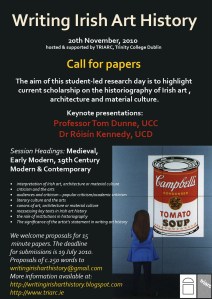 The aim of this student-led research day is to highlight current scholarship on the historiography of Irish art, architecture and material culture. Keynote presentations will be given by Professor Tom Dunne, U.C.C., and Dr. Roisin Kennedy, U.C.D. The event is hosted and supported by TRIARC, the Irish Art Research Centre, University of Dublin, Trinity College, Ireland
We welcome proposals from researchers working in a broad range of areas, including painting, sculpture, architecture, material culture, design, film, literature, cultural geography and print cultures. Please send proposals of 250 words (for 15-minute papers) to writingirisharthistory@gmail.com or to Caroline McGee and Niamh NicGhabhann, TRIARC – Trinity Irish Art Research Centre, Department of History of Art and Architecture, Provost’s House Stables, Trinity College Dublin, Dublin 2.
Announcing a New Series from Ashgate Publishing
The Histories of Material Culture and Collecting, 1700–1950
Series Editor: Michael Yonan, University of Missouri
 The Histories of Material Culture and Collecting, 1700–1950, provides a forum for the broad study of object acquisition and collecting practices in their global dimensions from the eighteenth through the mid-twentieth centuries. The series seeks to illuminate the intersections between material culture studies, art history, and the history of collecting. HMCC takes as its starting point the idea that objects both contributed to the formation of knowledge in the past and likewise contribute to our understanding of the past today. The human relationship to objects has proven a rich field of scholarly inquiry, with much recent scholarship either anthropological or sociological rather than art historical in perspective. Underpinning this series is the idea that the physical nature of objects contributes substantially to their social meanings, and therefore that the visual, tactile, and sensual dimensions of objects are critical to their interpretation. HMCC therefore seeks to bridge anthropology and art history, sociology and aesthetics. It encompasses the following areas of concern:
- Material culture in its broadest dimension, including the high arts of painting and sculpture, the decorative arts (furniture, ceramics, metalwork, etc.), and everyday objects of all kinds.
- Collecting practices, be they institutionalized activities associated with museums, governmental authorities, and religious entities, or collecting done by individuals and social groups.
- The role of objects in defining self, community, and difference in an increasingly international and globalized world, with cross-cultural exchange and travel the central modes of object transfer.
- Objects as constitutive of historical narratives, be they devised by historical figures seeking to understand their past or in the form of modern scholarly narratives.
The series publishes interdisciplinary and comparative research on objects that addresses one or more of these perspectives and includes monographs, thematic studies, and edited volumes of essays.
Proposals should take the form of either:
- a preliminary letter of inquiry, briefly describing the project; or
- a formal prospectus including: abstract, brief statement of your critical methodology, table of contents, sample chapter, estimated word count, estimate of the number and type of illustrations to be included, and a c.v.
Please send a copy of either type of proposal to the series editor and to the publisher:
Professor Michael Yonan, yonanm@missouri.edu
Meredith Norwich, Commissioning Editor, mnorwich@ashgate.com
Call for Papers: ASECS in Vancouver
2011 American Society for Eighteenth-Century Studies Conference
Vancouver, British Columbia, 17-20 March 2011
Proposals due by 15 September 2010
The 2011 ASECS conference takes place in Vancouver, British Columbia, March 17-20, at the Sheraton Vancouver Wall Centre. Along with our annual luncheon and business meeting, HECAA will be represented by two panels chaired by Douglas Fordham and David Ehrenpreis and Kevin Justus. In addition to these, a wide selection of sessions are also included below. For the full CFPs, see the ASECS website.
◊ ◊ ◊ ◊ ◊
Art Before Nationalism (Historians of Eighteenth-Century Art and Architecture)
Douglas Fordham and David Ehrenpreis, U. of Virginia, McIntire Dept. of Art, PO Box 400130, Charlottesville, VA 22904-4130; Tel: (434)243-2285 (Douglas work); Fax: (434) 924-3647 (Douglas work); E-mail: fordham@virginia.edu, EHRENPDH@jmu.edu
The concept of nationalism is often associated exclusively with modern state formation and the push for popular sovereignty that accompanied the American and French revolutions during the last quarter of the eighteenth century. But how are we to interpret the shifting attitudes toward the state in other periods and/or in other places? This session seeks papers that explore the relationship between visual art and the concept of nationhood at a variety of moments and geographic locations throughout the long eighteenth century. Papers could address this relationship through a focused examination of individual works of art, aesthetic theories, or broader frames of inquiry. Relevant questions might include: Has there been a tendency to read 19th century notions of nationhood and nationalism back onto the eighteenth century? Were there aspects of either art production or aesthetic writing that failed to cross national boundaries? Is there a difference between patriotism and nationalism during this period? Have British and/or French conceptions of nationhood been imported uncritically into our understanding of other ‘national’ artistic traditions? These are the types of questions that we encourage contributors to pose through the lens of their own regional and interpretative specializations.
◊ ◊ ◊ ◊ ◊
Looking Forward, Looking Back: HECAA’s New Scholars Session (Historians of Eighteenth-Century Art and Architecture)
Kevin Justus, 4134 E Hayne Street, Tucson, AZ 85711; Tel: (520) 327-8407; E-mail: kevinjustus@yahoo.com
This session seeks to present works by new scholars who are members of HECAA. A diverse subject matter is encouraged and welcomed.
◊ ◊ ◊ ◊ ◊
The Beginnings and Ends of Cultural Studies (Roundtable) (Cultural Studies Caucus)
Laura Rosenthal, U. of Maryland, College Park, English Dept., College Park, MD 20742; Tel: (301) 405-1408; E-mail: lrosent1@umd.edu
This roundtable takes up two related issues around cultural studies with a pre-1800’s focus: (1) The ends: Has cultural studies become overly predictable? Has it run its course? If so, what might be on the horizon next? Has it left behind valuable traditional concerns or, alternatively, has it failed to detach itself from them? (2) The beginning: Can there be a productive “early modern cultural studies,” or has “early modern” ceased to include the long eighteenth century? Does (or should) cultural studies defy or reinscribe traditional periodization?
◊ ◊ ◊ ◊ ◊
Animal Studies: New Perspectives on the Enlightenment (Cultural Studies Caucus)
Lucinda Cole, Dept. of English, U. of Southern Maine, Portland ME; Tel: (207) 780-4093; E-mail: lcole@maine.rr.com
We seek theoretically informed papers on how the field of animal studies has–or has not–altered traditional views of the long eighteenth century, literature and culture.
◊ ◊ ◊ ◊ ◊
Evaluating Digital Projects: A Roundtable Discussion of New Forms of Grading and Peer Review (Digital Humanities Caucus)
Lisa Maruca, 5057 Woodward, Dept. of English, Wayne State U., Detroit, MI 48202; Tel: (248) 890-5177; E-mail: lisa.maruca@wayne.edu AND gwilliams@uscupstate.edu
As new media projects begin to supplement or in some cases replace the print essay, research paper, scholarly article or monograph, what modes of evaluation should we expect or demand of students (undergrads and graduate students), colleagues, and ourselves? In recent times groups like HASTAC and the MLA begin discussion on evaluating digital work—the latter appropriately enough on a wiki (http://wiki.mla.org/index.php/Evaluation_Wiki) –while the president of the MLA has even advised that more digital dissertations be produced. Similarly, the American Historical Association and the Center for History and New Media at George Mason University announced in 2008 a new annual prize for “an innovative and freely available new media project that reflects thoughtful, critical, and rigorous engagement with technology and the practice of history.” Since our students now might ask to produce a YouTube video instead of a paper, and our colleagues go up for tenure with a digital archive instead of a book, it behooves the member of ASECS to join this discussion and reflect on both methods and criteria for judging specifically historical work.
The organizers welcome descriptions of your own or others’ classroom or institutional experiments; policies that you or others have authored; ideas for future criteria, rubrics, methods and standards for evaluation; as well as theoretical examinations of evaluation as a concept. Panelists might reflect on the following, applied to both students and faculty:
- Which standards should we preserve and which reject as we move from evaluating print work to digital projects?
- What are the digital equivalents to (or replacements for) familiar print products such as (for undergrads) the interpretive essay or research paper; (for graduate students) the seminar paper or dissertation; (for faculty) the journal article, chapter or book?
- How do we transfer such criteria as length and depth to innovative projects?
- How do we account for the new skills that may need to be acquired to produce works in new media?
- How do we fairly assess forms requiring multiple team members?
- How can we import crowdsourcing as a method into the classroom or for examining scholarly work?
- How do we allow for citation and account for influence in the digital realm?
- What is the relationship between methods of evaluation for students and that for faculty?
- How do new media projects de- and re-construct print-based concepts we bring to evaluation, such as periodicity, authorship, originality, knowledge, and intellectual property?
- How might digital pedagogy and service be reconceived as valuable and quantifiable forms of scholarly work?
◊ ◊ ◊ ◊ ◊
The Eighteenth Century in the Twenty-First: The Impact of the Digital Humanities (Digital Humanities Caucus) (Roundtable)
Lisa Maruca AND George Williams, Williams, LLC Dept., USC Upstate, Spartanburg, SC 29303; Tel: (864) 529-1950; E-mail: lisa.maruca@wayne.edu; gwilliams@uscupstate.edu
“The digital humanities comprise the study of what happens at the intersection of computing tools with cultural artifacts of all kinds. This study begins where basic familiarity with standard software ends. It probes how these common tools may be used to make new knowledge from our cultural inheritance and from the contemporary world.”
—Centre for Computing in the Humanities, King’s College London1
“It isn’t a matter of getting things done more quickly; rather it is about getting things done that couldn’t be done before. That’s the game-changing aspect of technology.”
—Brett Bobley, Director, Office of Digital Humanities, National Endowment for the Humanities2
This roundtable will consider how digital tools and digital methodologies are shaping eighteenth-century studies. Participants might reflect on the following questions, applied to both students and faculty:
- What sorts of new research and teaching models are emerging in the digital age?
- What drawbacks should scholars and teachers be wary of as we are confronted with these new possibilities?
- How are collaborative, interdisciplinary projects affected by the digital humanities?
- What lessons might we learn for our use of twenty-first-century technologies from eighteenth-century observations about print technology’s influence upon learning, knowledge, and communication?
- Conversely, in what ways does the media culture of the twenty-first century shape our understanding of the eighteenth?
1. Brett Bobley, “Why the Digital Humanities?” Office of Digital Humanities. National Endowment for the Humanities, 2008. Web. 1 May 2010. <http://www.neh.gov/whoweare/cio/odhfiles/Why.The.Digital.Humanities.pdf>
2. “Introduction to the Digital Humanities” Center for Computing in the Humanities. King’s College London, 2006. Web. 1 May 2010. <http://www.kcl.ac.uk/schools/humanities/depts/cch/digihum/>
◊ ◊ ◊ ◊ ◊
Surrounded by Bodies: Contact, Corporeality, and the Long Eighteenth Century (Graduate Student Caucus)
Nicholas E. Miller, Washington U. in St. Louis, Dept. of English, One Brookings Drive, CB 1122, Saint Louis, MO 63130; Tel: (314) 750-8185; E-mail: n.e.miller@go.wustl.edu
Much has been said about bodies, yet the body still remains one of the most contested concepts in fields such as anthropology, art, history, literature, medicine, philosophy, religion, and gender/sexuality. In An Essay Concerning Human Understanding (1689), John Locke noted that all “are born into the world, being surrounded by bodies that perpetually and diversely affect them.” By conceptualizing the world as one of bodies in contact, his assertion prefaced a growing eighteenth-century preoccupation with corporeality. This panel seeks to explore such investigations of the body by examining how these figures wrote about and experienced bodies, health, illness, contagion, mixture, and death. We welcome interdisciplinary approaches to understanding the eighteenth-century body and invite submissions from graduate students and junior scholars across disciplines. Possible topics include, but are not limited to: the medical body, sentimentality and the emotional body, discourses of corporeality, the legible body, animal bodies, travel narratives and the body in transit, representations of pathology in literature and art, the grotesque, the sciences aesthetically imagined, the body in pain, the politics of contagion, corpses, and theories of embodiment.
◊ ◊ ◊ ◊ ◊
Queer Materiality (Gay & Lesbian Caucus)
Paul Kelleher, Dept. of English, Emory U., Atlanta, GA 30322; Tel: (404) 727-2223; Fax: (404) 727-2605; E-mail: pkelleh@emory.edu
We invite paper proposals that offer queer perspectives on eighteenth-century materiality, broadly conceived. Possible topics include: the queer life of eighteenth-century objects, things, commodities, ruins, remainders, keepsakes, collectibles, portraits, landscapes, dwellings, etc.; queering empiricism; queer (re)visions of the mind-body split; the sacred, the profane, and the queer; theories of materiality (e.g., Marx, Althusser, Foucault, Deleuze, Butler) and their relevance to eighteenth-century queer cultures, practices, and pleasures. We are eager to receive proposals from scholars working in a variety of disciplines. Email submissions preferred.
◊ ◊ ◊ ◊ ◊
New Media In the Eighteenth Century (New Lights Forum: Contemporary Perspectives on the Enlightenment)
Lee Morrissey, Dept. of English, 801 Strode Tower, Box 340523, Clemson U., Clemson, SC 29634-0523; Tel: (864) 656-3151; Fax: (864) 656-1345; E-mail: lmorris@clemson.edu
Developments in new media are putting pressures on and also changing the humanities. This panel is focused on a different, but related question: what about new media in an earlier period? What can changes in print technologies from the late seventeenth to the early eighteenth centuries tell us about the change from print to digitization today?
◊ ◊ ◊ ◊ ◊
Will Tomorrow’s University Be Able to Afford the Eighteenth Century? If So, How and Why? (Roundtable) (New Lights Forum: Contemporary Perspectives on the Enlightenment)
Lee Morrissey, Dept. of English, 801 Strode Tower, Box 340523, Clemson U., Clemson, SC 29634-0523; Tel: (864) 656-3151; Fax: (864) 656-1345; E-mail: lmorris@clemson.edu
Given the various pressures on the humanities generally, and on historical/chronological specializations in particular, this panel worries that the university of the future will decide it cannot afford to fund researching and teaching the eighteenth century. We ask, therefore, not only whether tomorrow’s university will be able, but, more importantly, on what grounds we might explain and defend such an investment.
◊ ◊ ◊ ◊ ◊
The Eighteenth Century on Film (Northeast American Society for Eighteenth-Century Studies)
John H. O’Neill, Dept. of English, Hamilton College, Clinton, NY 13323; Tel: (315) 859-4463; Fax: (315) 859-4390; E-Mail: joneill@hamilton.edu
The session welcomes and encourages proposals for papers on any aspect of this topic, including film adaptations of eighteenth century narratives (for example, “The Castaway, “Tom Jones”), films set in the period (e.g., “Stage Beauty,” “Amazing Grace”), and film exploration of eighteenth-century history (e.g., Peter Watkins’s “Culloden,” Sofia Coppola’s “Marie Antoinette”).
◊ ◊ ◊ ◊ ◊
Prayer: Renderings, Interpretations, and Representations, Whether in Literature or Art or Philosophy and Whether Sober or Satiric (South Central Society for Eighteenth-Century Studies)
Kevin L. Cope, Dept. of English, Louisiana State U., Baton Rouge, Louisiana 70803; Tel: (225) 578-2864: Fax: (225) 751-3161; E-mail: jovialintelligence@cox.net or encope@lsu.edu
◊ ◊ ◊ ◊ ◊
Race et Couleur au 18e siècle (Society for Eighteenth-Century French Studies)
Christine Clark-Evans, Dept. of French & Francophone Studies, 211 Burrowes Building, Pennsylvania State U., PA 16802; Tel: (814) 865-1960; Fax: (814) 863-1103; E-mail: cxc22@psu.edu
Le concept moderne de « race » voit le jour au 18e siècle. La « couleur » devient aussi bien une caractéristique intrinsèque et transmissible, qu’un élément inséparable de la « race » dans la catégorisation hiérarchique des variétés de l’espèce humaine. Cette séance a pour but d’explorer la signification du concept de « race » sous tous ses aspects, et d’en élaborer les implications pour le concept de « couleur » tant au physique qu’au moral. On espère examiner dans le système de représentation les débats entre philosophes de tous bords, artistes et écrivains, et leurs conséquences pour l’individu et la société. On encourage des propositions de communication en science, en droit, en art, en littérature, en politique, entre autres cadres esthétiques et éthiques.
◊ ◊ ◊ ◊ ◊
Women and Popular Culture (Southeastern American Society for Eighteenth-Century Studies)
Tiffany Potter, Dept. of English, U. of British Columbia, Vancouver, BC; V6T 1Z1 CANADA; Tel: (604) 822-5651; Fax: (604) 822-6906; E-mail: tpotter@interchange.ubc.ca
This panel seeks to bring together four scholars from divergent fields of study to present papers that illuminate the ways in which modern theories of popular culture and eighteenth-century cultural theory can be used together to consider the experience of women in eighteenth-century Europe. Recent studies of contemporary popular culture have illuminated the complex relationships that individuals and groups maintain with the larger artistic, political, and social movements around them. Such methodologies, however, have rarely been applied historically, and even more rarely to the eighteenth century. Though historical ideas of the popular are indeed complex, the papers in this panel will provide analysis of representations of women’s engagements of popular culture, illuminating the relationships among high culture, women’s culture, and popular culture, and the ways in which the conventional masculinization of high culture creates the feminine as the popular. I seek complementary papers from among the following areas: theatre and actresses, fiction, art and portraiture, and the domestic arts.
◊ ◊ ◊ ◊ ◊
From Dissertation to Publication (Women’s Caucus) (Roundtable)
Misty G. Anderson, Dept. of English, U. University of Tennessee; e-mail: manderson@utk.edu
This roundtable will bring together editors, published authors, and dissertation writers for a discussion about how to turn the dissertation into a book manuscript or a series of articles.
◊ ◊ ◊ ◊ ◊
Women and Networks: Local and Transnational (Roundtable) (Women’s Caucus)
Katherine Binhammer, English, U. of Alberta AND Julie Hayes, U. of Massachusetts Amherst; Katherine Binhammer: Dept. of English, U of Alberta, Edmonton, AB, Canada, T6G 2E5; Julie Hayes: Dept. of Languages, Literatures, and Cultures, U. of Massachusetts, Amherst, MA 01003; Tel: (780) 428-9279; Fax: (780) 492-8142; E-mail: katherine.binhammer@ualberta.ca and jhayes@llc.umass.edu
This panel will examine the ways in which women connected with other women, whether via larger communities such as salons and literary circles, patronage relationships, epistolary circuits and other networks of information exchange, or by supporting activities such as publication or travel by other women. Papers may examine a particular figure or network, or offer theoretical models for the study of networking relationships. Comparative international perspectives are particularly encouraged.
◊ ◊ ◊ ◊ ◊
The Royal Society
Cynthia Wall, Dept. of English, U. of Virginia, 219 Bryan Hall, P. O. Box 400121, Charlottesville, VA 22904-4121; Tel: (434) 924-7015 or 434-924-6615; Fax: (434) 924-1478; E-mail: wall@virginia.edu
Four 15-minute papers; the idea comes from the fact that my 2011 MLA divisional session, “The Royal Society,” got so many excellent contributions that I couldn’t take! But for the record: The Royal Society is the longest-running scientific society in the world, and as we all know, it’s a seventeenth – eighteenth century production. The body attracted architects, playwrights, artists, musicians, novelists, historians, and clergy, as well as natural philosophers, mathematicians, and those sorts. It also inspired a vast amount of literary production—poetic, dramatic, satiric—and popular culture. Papers are welcomed on any aspect of the Seventeenth – Eighteenth Century Royal Society, its agenda, members, production, or critics.
◊ ◊ ◊ ◊ ◊
Celebrity and Fame in the Enlightenment
Ourida Mostefai, Romance Languages & Literatures Dept., Boston College, Lyons Hall, 140 Commonwealth Ave., Chestnut Hill, MA 02467-3804; Tel: (617) 552-3518; Fax: (617) 552-2064; E-mail: mostefai@bc.edu
This panel invites papers dealing with the changing notions of fame in the Enlightenment in literature and the arts, focusing especially on the rise of a modern form of celebrity.
◊ ◊ ◊ ◊ ◊
Aesthetics, Ethics, and Economics in Late Eighteenth-Century Art and Literature
Catherine Labio, Dept. of English, U. of Colorado at Boulder, Hellems 118, UCB 226, Boulder, CO 80309; Tel: (303 ) 492-6321; Fax: (303 ) 492-8904; E-mail: catherine.labio@colorado.edu
The goal of this interdisciplinary panel is to test two propositions: a) that aesthetics and economics were in disciplinary conflict soon after their contemporaneous conception and b) that works of art and literature of the late eighteenth- and early nineteenth-centuries furthered this distinction by modeling a series of practical conflicts between moral and economic value, in which the former tends to get the upper hand. I welcome proposals that deal with intellectual or disciplinary history or that study specific manifestations of this “conflict of the faculties” at play in works of art and/or literature in Britain or the continent.
◊ ◊ ◊ ◊ ◊
Looking at Disability in the Eighteenth Century
Chris Mounsey, U. of Winchester, Sparkford Road, Winchester, SO22 4NR, UK; Tel: (+44) 7981 883815; E-mail: cmouns@aol.com
Disability studies is a new and vibrant area of academic study, but is under represented in eighteenth-century studies. There were as many disabled people in that century as there are in this, but we don’t hear much if anything about them. This panel will begin to open up the field, and is interested in papers on any form of disability: blindness, deafness, physical disability or any others. The expectation is to receive papers on both the representation of disabled people (in images or in words) as well as personal accounts of disability, so we can explore the intersection between the views of disability, the medicalization of disability and the life stories of the disabled, a problematic which is as relevant today as it was in the eighteenth century.
◊ ◊ ◊ ◊ ◊
Eighteenth-Century Reception Studies
Marta Kvande, Dept. of English, Texas Tech U., Lubbock, TX 79409; Tel: (806) 742-2500; Fax: (806) 742-0989; E-mail: marta.kvande@ttu.edu
This panel seeks papers on any and all aspects of reception study as it pertains to the eighteenth century, including (though of course not limited to): the reception of specific works, authors, or artists; literary criticism and/or art criticism during the eighteenth century; the emergence of an audience for the ‘literary’; the audience for particular genres or subgenres; the role of anthologies and republication in shaping an audience; the development of a national and/or transnational audience; the relations between the marketplace and audiences/readers; specific readers’ and/or viewers’ responses to texts/works of art; class, race, gender and audiences/readers; how particular texts/works of art constructed and instructed their audiences; and the history of the book.
◊ ◊ ◊ ◊ ◊
Body Parts
Sonja Boon, Dept. of Women’s Studies, Science Building SN4080, Memorial U. of Newfoundland, St. John’s NL, Canada A1C 5S7; Tel: (709) 737-2551; Fax: (709) 737-2067; E-mail: sonja.boon@gmail.com
This panel considers body parts as imagined, constructed, theorized and lived during the eighteenth century. From debates around premature burial, to Boerhaave’s embalmed baby’s arm, the virility of the calves, the glowing bottoms of Boucher’s odalisques, and the seemingly endless debate around the social and moral function of the lactating breast, the body was central to eighteenth-century debates about the nature of the human and the relationship between the mind and the body. What role did the body serve in the eighteenth-century’s cultural imagination? How was it experienced? How was it lived? What might we learn from a consideration of individual body parts? This panel invites papers considering moral, aesthetic, medical, philosophical and auto/biographical aspects of the body and its parts in the eighteenth century.
◊ ◊ ◊ ◊ ◊
Rethinking William and Mary
Linda Zionkowski, Dept. of English, Ellis Hall, Ohio U., Athens, OH 45701; Tel: 740-597-2749; Fax: 740-593-2832; Email: zionkows@ohio.edu
In Going Dutch: How England Plundered Holland’s Glory, Lisa Jardine argues that the Dutch had a transformative influence on English culture and society in the seventeenth century, an influence that paved the way for the relatively peaceful military invasion of William of Orange in 1688. In the years leading up to the Glorious Revolution, Dutch scholars, investors, artists, and landscape architects deeply affected the intellectual and cultural climate of England by becoming fellows of the Royal Society, financing the Bank of England, contributing to debates on religion and political economy, and initiating popular innovations in painting and design. Yet the Anglo-Dutch connection was not uniformly comfortable: the two nations occasionally fought over the possession of colonial territories, with tensions continuing well into the late eighteenth century, and satire of the Dutch was a common feature of Tory discourse. This session will examine how the relationship between the English and the Dutch was represented in seventeenth- and eighteenth-century texts, material culture, and visual arts. Papers might consider the effect of Dutch institutions and customs on English life; conflicts engendered by the acceptance of or opposition to Williamite rule; and the portrayal of the English in contemporary accounts by Dutch writers.
◊ ◊ ◊ ◊ ◊
Magic and Religion in the Enlightenment
Mary Helen McMurran, 5858 SW Riveridge Lane #27 Portland, OR 97239; Tel: (206) 372-5053; E-mail: mmcmurr2@uwo.ca
The standard view that Enlightenment secularism caused a precipitous decline in magic, superstition, and religion has been called into question by several scholars. The broad question for this panel is: How did magical and religious thought survive and thrive in the eighteenth century? Papers may address any aspect of the non-secular eighteenth century including the role of such supposedly secular phenomena as popular entertainments, aesthetic pleasure, and the Enlightenment’s rationalizing theories of apparitions, of shamanism, or of the material magic of the fetish may have played. We welcome new research and new perspectives on the spiritual arts in the Enlightenment era with a special interest in African, Native American, and other non-Christian manifestations of belief.
◊ ◊ ◊ ◊ ◊
Imagining Iberia
Judith Broome, Dept. of English, William Paterson U., 300 Pompton Rd., Wayne NJ 07040; Tel: (973) 720-3065; E-mail: broomej1@wpunj.edu
This panel will explore the ways Spain and Portugal were “imagined” in Britain, the Americas, the Caribbean, or other cultures from which the Iberian peninsula was geographically isolated. Papers may approach the topic from a variety of disciplines, calling on resources such as travel narratives and journals by individuals, accounts in periodicals, or commentary on law, religion, or medicine. The working question is, how was Iberia imagined outside the peninsula?
◊ ◊ ◊ ◊ ◊
The Alps, the Pyrenees, the Andes: Literature and Arts
Theodore E. D. Braun, French and Comparative Literature, U. of Delaware, E-mail: TEDBraun@comcast.net, nuarb@myway.com
These three mountain chains, so important in Western letters and thought in the long eighteenth century (1650-1850), are featured in countless works of literature, painting, music, and other arts. In the surrounding countries and even from farther away (the Shelleys, Byron, etc.) creative people drew inspiration from the mountains themselves, from the people who lived in these often foreboding areas in Europe and South America, and from their history and culture. I invite scholars to suggest ways in which they might explore the role of the mountains in the writing and arts of the time.
◊ ◊ ◊ ◊ ◊
Circulating Politeness in the Eighteenth Century
Catherine Jaffe, Dept. Modern Languages, Texas State U., San Marcos, TX 78666; Tel: (512) 245-2360; Fax: (512) 245-8298; E-mail: cj10@txstate.edu
Politeness was a set of cultural and social norms whose basic codes were shared in eighteenth-century Europe, in a context of accelerated circulation of fashion, of international development of polite sociability, travel, and translations and adaptations (often unacknowledged) of texts. However, the alleged cosmopolitanism of politeness, justified as expressions of natural inclination to sociability, was controversial. On one hand, politeness was considered as one of the signs of civilization, which could be identified and measured in different societies in order to establish their position in a scale of progress. On the other hand, polite codes were often perceived as foreign (usually, French) intrusions and as a menace to emerging notions of national identity. This session aims at bringing together research on notions and practices of politeness in different countries, focusing on the tensions between the definition of common standards and the effort to define national identities through stress on particular types or degrees of politeness.
◊ ◊ ◊ ◊ ◊
Food and Eating in the Long Eighteenth Century
Anita Guerrini, History Dept., Oregon State U., 306 Milam Hall, Corvallis OR 97331-5104; Tel: (541) 737-1308; Fax: (541) 737-1257; E-mail: anita.guerrini@oregonstate.edu
Food and eating have become increasingly important topics in cultural history, the history of medicine, the history of science, and cultural studies. I hope in this session to bring together people working on the many and varied aspects of food, diet, and eating in the eighteenth century from a number of disciplinary perspectives.
◊ ◊ ◊ ◊ ◊
Confluences and Continuities in Eighteenth-Century French Literary, Visual and Musical Arts: A Seminar in Memory of Ted Rex
Mary Sheriff, Dorothy Johnson, Downing Thomas, Address: Mary Sheriff Dept. of Art, CB 3405 Hanes Art Center, U. of North Carolina at Chapel Hill, Chapel Hill, NC 27599 3405; Tel: (919) 967-2647; Fax: (919) 962-0722; E-mail: msheriff@earthlink.net
This seminar is linked to another seminar taking as its topic the literary and visual arts and held in memory of Ted Rex. This seminar invites papers that explore the intersections of the literary and musical arts, on the philosophical, aesthetic and cultural levels in a multiplicity of contexts. In particular, we are looking for papers the question the received ideas of eighteenth-century French literary and musical studies in the spirit of the work of Ted Rex. This seminar is held in his memory.
◊ ◊ ◊ ◊ ◊
Histories of Love (Roundtable)
George E Boulukos, Dept. of English, Southern Illinois U. Carbondale, Mailcode 4503, Carbondale, Illinois 62901-4503; Tel: (618) 453-6810; Fax: (618) 453-8224; E-mail: boulukos@siu.edu
This roundtable seeks to investigate the how the history–even the histories–of love are being conceived in current studies of eighteenth-century literature and culture. Does love change and develop over the long eighteenth century? Are representations of love configured to reflect other newly emergent cultural phenomena? Do new and unprecedented forms and objects of love appear, or achieve new significance, in the century? How do new academic approaches, such as affect studies, change our understanding of love in the century?
◊ ◊ ◊ ◊ ◊
Class and Sociability: The Art of Dancing in the Iberian World of the Eighteenth Century
Gloria Eive, 1814 Marineview Drive, San Leandro, California 94577; Tel: ( 510) 895-9118; Fax: (510) 895-5960; E-mail: gloriaeive@gmail.com
Dance in its many forms was an integral component of seventeenth- and eighteenth- society, on the village green, at court, in court-supported formal entertainments, and in theatrical productions. In European society, the ability to dance well was both a requisite demonstration of one’s social standing, and an essential skill in the politicized contexts of court ballets and spectacles. The diffusion of French, Italian, and English dance forms in Europe and the New World during the eighteenth century, and the intersections of their musical and artistic idioms with regional traditions produced reciprocal stylistic and musical changes in their respective traditions. Papers are invited on the art of dancing and its significance in the Iberian world of the eighteenth century.
◊ ◊ ◊ ◊ ◊
Globalizing the Enlightenment through the Representations of Asia
Naoki Yoshida, 5-22-9 Irifune, Otaru 047-0021 JAPAN; Fax: 81-134-29-5030; E-mail: yoshida@res.otaru-uc.ac.jp
This panel will assess how the Enlightenment was prepared, realized, and developed through the representations of Asia. All presentations will include comparative readings of individual works or groups of works from the long eighteenth century. How does Sinophobia in The Further Adventures of Robinson Crusoe lead to the later construction of nation state? What intercultural negotiation can we find in Gulliver’s encounter with Japanese emperor? At ASECS in Vancouver current ideas about the center and the periphery will be problematized. By redrawing the national boundaries of the Enlightenment the panel will begin to interrogate and define new meanings of the globalization for future ASECS meetings and for eighteenth-century studies more broadly.
◊ ◊ ◊ ◊ ◊
The Culture of Diagram (Roundtable)
John Richetti, 276 Riverside Drive (9E), New York, NY 10025; Tel: (212) 865 2967; E-mail: jrichett@english.upenn.edu
Roundtable discussion of John Bender and Michael Marrinan’s new book, The Culture of Diagram: its implications for eighteenth-century studies, art history, literary studies, and cultural history. Scholars from all disciplines invited to participate.
◊ ◊ ◊ ◊ ◊
Transfers and Transformations: The Visual Arts in the Iberian Peninsula and the New World
Anne-Louise. G. Fonseca, 1954, rue Masson, Montréal, Qc, H2H 1A4, Canada; Tel: (514) 523-2589; E-mail: annelouise.g.fonsesca@gmail.com
The visual arts were a very effective means for the circulation of ideas between one continent and another. Transfers of ideas and knowledge from Europe to the New World were often made through the arts, and at the same time, transformations occurred as the artists of the New World reinterpreted and adapted European models. This seminar invites papers focusing on the artistic relationships between the Old and New Worlds during the eighteenth century.
◊ ◊ ◊ ◊ ◊
Climates of the Eighteenth Century
Tobias Menely, Willamette U., Salem OR 97301; Tel: (503) 562 9893; E-mail: tmenely@gmail.com
Papers are invited on the epistemic and symbolic meanings of “climate” in the long eighteenth century, particularly insofar as such meanings developed in relation to the unsettled weather of the Little Ice Age and/or the growing awareness of the human influence on climate through industrialization and urban pollution, deforestation, and global commerce. Topics may include Hippocratic theory, climatic determinism, and national character; climate change and empire; meteors and the development of Enlightenment meteorology; the time of weather and the time of history; climate, crisis, and eschatology. I am particularly interested in papers that attend to the conceptual and methodological implications of eighteenth-century ways of understanding, and not understanding, climate for our current climate crisis.
◊ ◊ ◊ ◊ ◊
Prints: Past and Present in the Eighteenth Century
Craig Ashley Hanson, Calvin College, Art & Art History Dept., 3201 Burton Street SE, Grand Rapids, MI 49546; Tel: (616) 526-7544; E-mail: CraigAshleyHanson@gmail.com
Eighteenth-century prints provided unprecedented amounts of visual information, ranging in subject matter from ancient works of art to contemporary fashions. This panel invites papers on any aspects of print culture that explore issues of temporal orientation as expressed visually. In what ways did prints establish historical or period orientations? To what extent did prints forge strategies for making the past visible or for establishing an appropriate ‘look’ for the present? Papers might explore the production, marketing, circulation, or collecting of prints. Interchanges between multiple moments in time, between prints and other media, and between multiple audiences may be especially fruitful for the panel. In addition to papers dealing with single-sheet prints, proposals addressing illustrated books, frontispieces, and popular forms of imagery are also most welcome.
◊ ◊ ◊ ◊ ◊
Focus and the Eighteenth-Century Mind
Natalie Phillips, English Dept., Stanford U., Margaret Jacks Hall, Bldg. 460, Stanford, CA 94305-2087; Tel: (650) 722-1264; Fax: (650) 725-0755, E-mail: nmp@stanford.edu
Both Ephraim Chambers’ Cyclopedia (1728) and Samuel Johnson’s Dictionary (1755) still define “focus” in terms of mathematics, not attention. In optics, Chambers tells us, focus describes “a point where several Rays concur and are collected,” associated with convex lenses. “Focus,” for Johnson, is a term applied to graphs and parabolas. In the 1760s, however, writers began to draw on the scientific language of focus to make witty references to visual and literary attention. Oliver Goldsmith is the first to use the term, focus, to address the period’s interest in attention. In The Citizen of the World (1762), he satirizes a middle-class couple at a pleasure garden who, hoping to be the center of attention, search for a place “where they might see and be seen; one in the very focus of public view.” In his poem “Conversation” (1781), William Cowper employs this new vocabulary to offer advice on how to create narrative focus:
Tell not as new, what ev’ry body knows,
And new or old, still hasten to a close,
There cent’ring in a focus, round and neat,
Let all your rays of information meet.
What is the relationship between scientific and literary focus in the eighteenth century? Where does the language of focus fit within the Enlightenment’s larger science of mind?
This panel at ASECS 2011 will bring scholars from multiple disciplines together to explore the connections between literary, cognitive, and scientific forms of focus in the long eighteenth century. Papers might address any of the following questions: How do philosophical and scientific works in the Enlightenment describe the mind’s ability (or inability) to focus? What formal strategies did artists and musicians use to describe, or to solicit, attention? How did scientific conversations about focus in mathematics, or concentrated substances in chemistry, influence the period’s discussions of attention and distraction? Topics could range from discussions of attention in Richardson’s Clarissa to portrayals of distraction in Diderot’s Jacques le Fataliste, from investigations of focus in Locke and Hume to the scientific literature surrounding the microscope. Panelists could consider debates over focus in music, mathematics, drama, art, literature, theology, science, philosophy, children’s literature, medicine, or rhetoric.
◊ ◊ ◊ ◊ ◊
Games People Play: Manifestations of Enlightenment Entertainments
Kathleen Fueger, Dept. of Modern & Classical Languages, Saint Louis U., 1063 Shallowbrook Drive, St Peters MO 63376; Tel: (314) 977-3662; E-mail: kfueger@slu.edu
The eighteenth century saw an astonishing variety of pastimes, from theatre-going, card and board games and conversations in coffee houses to gambling, horseracing, and even blood sports like cock-fighting and bull-baiting. “Electrical parties” focusing on experiments with sparks and shocks became increasingly popular social gatherings. Residents of rural areas flocked to fairs and “freak shows”.
This panel seeks to explore the manifestations of “entertainment” in the eighteenth century and to consider the following questions: How are these games and pastimes interwoven in the century’s literary and artistic expressions? Was their purpose solely recreational? How do these pastimes intersect with social and economic class and gender? How do such activities advance or undermine the Enlightenment’s notions of utility, tolerance, and rationality? The panel welcomes and encourages proposals from all disciplines such as literature, art history, history, and musicology.
◊ ◊ ◊ ◊ ◊
Aesthetics of Fitting: Measurement in the Theory and Social Practices of the Enlightenment
Anne Maurseth, Dept. of French and Italian, 5317 Phelps Hall, U. of California, Santa Barbara, Santa Barbara, CA 93106-4140; Tel: (805) 893-3111; Fax: (805) 893-8826; Email: amaurseth@french-ital.ucsb.edu AND Jocelyn Holland, Dept. of Germanic, Slavic, and Semitic Studies, U. of California, Santa Barbara, Santa Barbara, CA 93106-4130; Tel: (805) 893-2131; Fax: (805) 893-2374; Email: Holland@gss.ucsb.edu
Theories of eighteenth-century aesthetics have often relied on a few key features with which to navigate an era that began with a heavy reliance on Aristotelian schemes of classification and ended with radical claims to originality. These features include, among others, an insistence on the singularity of the aesthetic object, a growing fascination for the artistic genius who transcends rule-governed modes of production, and, especially with the advent of German Romanticism, a call for the complete autonomy of the artist and the aesthetic sphere with regard to other cultural practices.
Yet the eighteenth century also bears witness to other developments throughout Europe which, though less emphasized, have left their own mark on the history of aesthetic theory. One such development reaches from the construction of individual artifacts to the algorithms informing social aesthetic practices (such as game-playing), through the social practice of parlor games as a source of literary creativity, to the emergence of a discourse on technology and theories of the mechanical arts. With a focus on the French and German contexts, our panel proposes to explore this tendency under the name of a “quantifiable aesthetics” or “aesthetics of fitting” which reflects the understanding of the world as measurable, functional, and calculable.
◊ ◊ ◊ ◊ ◊
Everyday Objects
Paula Radisich, Dept of Art and Art History, Whittier College, Whittier, California 90608; Fax: (562) 464-4551; E-mail: pradisich@whittier.edu
In her essay “Marketing the Counter-Reformation, Religious Objects and Consumerism in Early Modern France (1997),” Cissie Fairchilds standardized the category “new household goods” by defining it as the presence of four or more of the following items—window curtains, mirrors, new types of furniture such as tea tables and bookcases, earthenware, porcelain, crystal, clocks, and accessories for tea, coffee, or cocoa. According to her research, over seventy-eight percent of all inventories taken in Paris dating from 1771-1789 possessed “new household goods” thus defined. This session invites papers reflecting upon how these new everyday objects of eighteenth-century modern life appeared in texts and images and the meanings attached to their representation. Papers focusing upon the agency of the material objects themselves to produce meaning are also welcomed.
◊ ◊ ◊ ◊ ◊
Clothing/Costume/Fashion
William W. Clark, Queens College and the Graduate Center, City U. of New York AND Vivian Cameron, Independent Scholar, 19 Edgehill Road, New Haven, Ct. 06511; Tel: (203) 773-1354; E-mail: wwclark@comcast.net OR vpcameron@snet.net
Following Aileen Ribera’s Dress in Eighteenth Century Europe 1715-1789, Daniel Roche’s La Culture des Apparences (1989) broadened the theoretical questions about clothing and costume. Many of the issues raised in these books on the culture of clothes and fashion are still current in studies of clothing in eighteenth-century social history, witness Jennifer Jone’s Sexing la Mode. This session proposes to deal with the long eighteenth century in European cultures with papers exploring problems revolving around the social signification of clothes, both real and imaginary, in literature; in visual images such as fashion plates, portraits, history paintings; in theatrical performances; in royal ceremonies; and the like. Other topics might focus on aspects of the production of clothing and the economics of dress.
◊ ◊ ◊ ◊ ◊
Daily Rituals
Heather MacDonald, 1717 N Harwood Street, Dallas TX 75201; Tel: (214) 922-1852; Fax: (214) 720-0862; E-mail: hmacdonald@dm-art.org
This panel investigates the practice and representation of the daily rituals that organized time, space, and subjectivity during the long eighteenth century. The rituals addressed in this session could include both private and public activities, as well as those, such as the toilette, that straddle the border between these two spheres. Papers are invited from any discipline, treating either the specific practice of a given daily ritual or the representation of such rituals in the literary, visual, or dramatic arts.
◊ ◊ ◊ ◊ ◊
Naples Reconsidered
Heidi Strobel AND Amber Ludwig, Strobel: (home: 5901 S. Posey County Line Rd., Evansville, IN 47712); (work: Dept. of Archaeology and Art History, the U. of Evansville, Olmsted Hall, Evansville, IN, 47722); Tel: (812) 746-9711; Fax: (812) 488-2430; E-mail: hs40@evansville.edu AND Ludwig: 59 East Main Street, First Floor, Mystic, CT 06355; E-mail: amludwig@bu.edu
One of the oldest cities in the Western world, Naples has been the subject of contemporary scholarly attention as the focal point of recent exhibitions such as Pompeii and the Roman Villa: Art and Culture around the Bay of Naples (2009). From its conception as a Greek colony in the 8th century BCE to the Italian unification in 1861, Naples experienced dramatic cultural renaissances and tragic political transformations. In the eighteenth century, Naples became an important stop on the Grand Tour, offering visitors the chance to view ancient history in the form of the newly discovered ruins of Herculaneum and Pompeii. The city also witnessed important cultural developments during the eighteenth century, such as six eruptions of Mt. Vesuvius, the opening of Europe’s grandest opera house, antiquarianism, and Napoleonic invasions. This session seeks papers from a variety of fields that consider the history and culture of Naples and the ways in which this vibrant city contributed to the extraordinary events of the eighteenth century.
The geographic framework of the session encourages inter-disciplinary participation. Ideally, the session would attract papers on music, history, literature, art, and architecture and present the audience with an impression of the breadth of activities occurring in Naples throughout the eighteenth century.
◊ ◊ ◊ ◊ ◊
Paris diurne, Paris nocturne (Paris by Day, Paris by Night)
Michael J Mulryan, 12656 Nettles Dr Unit D Newport News, VA 23606; Tel: (217) 722-4700; Fax: (757) 594-7577; E-mail: Michael.Mulryan@cnu.edu
Les représentations de la ville de Paris chez les écrivains et les artistes du siècle des lumières sont diverses et presque innombrables, mais celles qui dévoilent un côté caché de la ville, soit pour intriguer le lecteur ou le spectateur, soit pour le réveiller et ainsi l’éclairer porteront un intérêt particulier pour cette session. Qu’il soit réaliste, dystopique, utopique, futuriste, ou bien nostalgique, le Paris que représentent les génies des lumières était toujours un objet de fascination pour leurs contemporains. Cette session sera donc une enquête pluridisciplinaire des deux Paris du dix-huitième siècle, la ville qui est visible, et celle que l’on fait voir. Des communications en français et en anglais sont les bienvenues.
Artistic and literary representations of Paris in the eighteenth century are diverse and practically limitless, but the ones that are of particular interest for this session reveal a hidden side to the city of lights, either to intrigue or to enlighten the spectator or reader. Whether it be realistic, utopian, futuristic, or nostalgic the Paris that the geniuses of the Enlightenment represented was always a source of fascination for their contemporaries. This session will thus be an interdisciplinary investigation of the two Paris’s of the eighteenth-century, the visible city, and the one that has to be unveiled. Papers in French and English are welcome.
◊ ◊ ◊ ◊ ◊
Dogs and Cats, Monkeys and Birds: Pets and Pet Keeping in the Eighteenth Century
Julie-Anne Plax, School of Art, P.O. Box 210002, U. of Arizona, Tucson, AZ 85721-0002; Tel: (520) 626-4864; Fax: (520) 621-1202; E-mail: jplax@email.arizona.edu
This session will explore the representation and implications of pets and pet keeping in the eighteenth century. Topics to be explored could include but is not limited to: the varieties of representation of pets in the visual arts; pets as characters in literature; celebrated pets in the eighteenth century; the “nature” of animals kept as pets and the human-animal relationship; the affective and emblematic function of pets; pets as luxury items and the breeding of pets; pets and the exotic; the care of pets in the eighteenth century; and pets and pedagogy.
◊ ◊ ◊ ◊ ◊
To be Found and to be Had: Provoking Spaces of Pleasure
Enid Valle, 1200 Academy St., Kalamazoo College, Kalamazoo, MI 49006; Tel: (269) 337-7121; Fax: (269) 337-5740; E-mail: valle@kzoo.edu
Whether it is natural or “unnatural,” legal or illegal, moral or immoral, punishable or rewarded, most human beings gravitate toward pleasure, enjoyment, amusement, and diversion. Pictorial and literary representations of spaces of pleasure abound, be they houses, palaces, churches, jails, bordellos, places which in turn contain other subunits devoted to pleasures of one kind or another. “Reserved”, “available”, “contained” are some markers for those spaces. How was space conceived/created/designed as it related to pleasure in the eighteenth century? Which ones defied gender and class divisions, and why or why not? Which modes of pleasures depended on space? on what kind of space? spaces such as the separation of words on the printed page? spaces such as the images on the canvas? spaces such as intervals in music? Space such as the homosexual, lesbian or bisexual body? Could any space be a space of pleasure in the eighteenth century? This panel seeks submissions in fields as varied as architecture, history, art history, religion, literature, visual arts, music, history of ideas, medicine, law, performance arts, sciences and any other field of inquiry interested in the topic of “spaces of pleasure.”
◊ ◊ ◊ ◊ ◊
The Art of Distribution in Eighteenth-Century Architecture
Diana Cheng, McGill U., School of Architecture, #104 – 5638 Parc Ave, Montreal, QC, Canada, H2V 4H1; Tel: (514)279-1652; Fax: (514) 398-7372; E-mail: diana.cheng@mail.mcgill.ca
The art of the distribution of rooms, according to eighteenth-century architect J.F. Blondel, developed to its maturity in French architecture. Having their own character and function, rooms were experienced not as autonomous spaces but rather as a sequence of experiences, creating narratives for the inhabitants. This panel seeks papers which examine the experience of the interior organization and decoration of the spaces. Papers may address the inhabitant’s experience or the effect of the interior promenade in a range of various kinds of abodes such as the hôtel, maison de plaisance, bourgeois house, convent or hospital. Papers from an art, architectural, decorative, literary or social history perspective are welcomed.
◊ ◊ ◊ ◊ ◊
The Dutch Connection in European Visual Arts
JoLynn Edwards, P. O. Box 286, Medina, WA 98039; Tel: (425) 352-5358/(425) 455-1364; E-mail: JEdwards@uwb.edu, jolynn@u.washington.edu
European visual arts benefited from a wealth of images produced in Holland or objects produced and exported from Holland. One only has to think of Chardin, Fragonard, Hogarth, or Constable, prints after Dutch masters, or “old masters” exported from Holland flooding the European art market to recognize the Dutch Connection. This seminar would provide a place to assess and re-assess the ever-present reservoir of Dutch influences throughout the eighteenth century. Interdisciplinary papers linking the Dutch art to literature, music, or other performance traditions would be welcome.
Call for Papers: Waking the Dead after the Revolution
Waking the Dead: Sublime Poetics and Popular Culture in the Aftermath of the French Revolution
Académie de France in Rome and the Royal Dutch Institute in Rome, 28-29 January 2011
Proposals due by 1 July 2010
One of the oldest claims of art is that it can bring back the dead. Leon Battista Alberti, for instance, included this claim in his praise of the Painter’s art in De Pictura, where it is part of the humanist interest in the rhetorical concept of enargeia, a representation, be it in words or images, that is so lifelike, so vivid, that it seems to dissolve the representation into what it represents. But what happens when this endeavour to animate the inanimate matter of the work of art is applied not to the high art of the Renaissance and the Baroque, in the accepted contexts and genres of religion and politics, where it is anchored in generally accepted poetics, artistic canons and aesthetic traditions, but in periods of profound upheaval, such as the French Revolution? To those who lived through the events of 1789-98, it seemed as if an irreparable gap had opened between the past of the Ancien Régime and the present times which were completely out of joint. The way artists and writers have tried to cope with this sense of loss (in many cases compounded by very real personal loss of relatives and friends who had died under the guillotine) has often been studied, and recently the concept of the sublime has been evoked, for instance, by the philosopher of history Frank Ankersmit to define the undefinable experience of a complete break with the past. In this conference we want to take a close look at one particular artistic variety of dealing with the French Revolution: the rise of new genres of popular culture such as the panorama, the tableau vivant or phantasmagoria to bring back events such as the execution of the King and Queen of France, the storming of the Bastille, or dead persons. These performances or installations drew on all the arts, drew huge crowds, and were often so effective in creating the illusion that the dead had returned from the grave that viewers fainted or became hysterical with terror. If, as David Freedberg observed on the closing page of The Power of Images, “we think we can escape bad dreams by talking about art,” these terrifying performances, fraught with loss and guilt, propose a particular challenge for art history. In this conference we welcome reconstructions of such performances, considerations of the role the various arts, and in particular architecture and acting played in them; but we are also interested in investigations of some more general themes:
- The shift from extreme vividness as a humanist concern with enargeia and life to a coupling of such vividness with death, loss, terror and the abject; how, in other words, did the poetics of suggesting life evolve into a technique of terror?
- Shifts in the relation between high and low art: how, for instance, did the high art of architectural and archaeological reconstructions of ancient monuments feed into the staging of tableaux vivants and panoramas?
- What do these performances tell us about the rise of new aesthetic categories such as the sublime and the uncanny; or the development of new artistic and aesthetic experiences such as the Gothic frisson or Ruinenlust?
- Can we identify particular objects, works of art or buildings as particularly significant for such attempts to bring back the dead? (more…)
Call for Papers: British Scholar Conference
British Scholar Annual Conference
University of Texas at Austin, 31 March — 2 April 2011
Proposals due by 12 July 2010
The conference will be held in Austin, Texas from Thursday, 31 March through Saturday, 2 April, 2011 at the Harry Ransom Center on the University of Texas at Austin campus. The conference, which is organized by The British Scholar Society and British Studies at the University of Texas, focuses on British history from 1688 to the present. The purpose of the British Scholar Conference is to highlight the importance of British history from varied perspectives. Established scholars, scholars at the beginning of their careers, and graduate students are welcome to apply and present at the conference. (more…)
Call for Papers: ‘Studies in Eighteenth-Century Culture’ & CAA Panel
Dear HECAA Members,
I want to remind everyone that the deadline for submitting an article to Studies in Eighteenth-Century Culture is August 21, 2010. I urge our members to consider submitting. Details are available at the ASECS website under publications.
Also, in August I will be asked to recommend a “long” (2.5 hours) panel for the 2011 CAA. If you would like to propose a session, please send me the proposal by July 15. This will give the membership time to vote on the proposals. I hope you are all having a productive and enjoyable summer.
Best,
Julie-Anne Plax
HECAA President
jplax@email.arizona.edu
Call for Papers: Maritime History
New Horizons in Maritime History
King’s College, University of Cambridge, 15-16 October 2010
Paper proposals due by 16 July 2010
New Horizons in Maritime History aims to explore the broader possibilities of maritime and oceanic history as a burgeoning field of research, bringing together researchers working in disparate areas of history with different topical and methodological allegiances in order to facilitate a discussion on the ways these fields relate to and inform maritime history, and what looking at the sea can offer the historical discipline more broadly. The conference seeks to challenge received notions about the remit of maritime history and to interrogate the ways in which it has been traditionally practiced. In particular, it seeks to move beyond nautical antiquarianism performed at or below the level of the nation-state, and highlight the intersection of maritime history with novel currents in the discipline that emphasize global continuity and transnational relationships.
Panels will be structured around fields and approaches in historical scholarship and their relationship to maritime history, exploring the problems and possibilities of these connections. Papers might highlight the maritime applications or contributions of a specific sub-field, such as economic, political, religious or intellectual history. Alternately, they might focus on specialist topics or area studies, such as the intersection of maritime history with imperial history, slavery and abolition, the Caribbean, navies and violence at sea, gender and sexuality, colonialism and decolonization, to name but a few.
To present a paper, please send a proposed title and abstract (of no more than 300 words) with a short CV to the conference organizing committee at cambridgemaritimehistory@gmail.com. Submissions from postgraduates and early- career researchers are especially welcome. The deadline for submissions is Friday, 16 July 2010. Successful applicants will be notified the following week. Those wishing to attend the conference without giving a paper are invited to register their interest with the committee. Conference organizers: Joshua Newton, Richard Blakemore, Simon Layton.
Call for Articles: ‘JHNA’
The Journal of Historians of Netherlandish Art (JHNA) announces the submission deadline for its winter issue, August 1, 2010. Articles submitted by this date will be considered for publication in Winter 2010. For details, please consult the journal’s Submission Guidelines.
JHNA is an open-access, peer-reviewed journal published twice per year. Articles focus on art produced in the Netherlands (north and south) during the early modern period (c. 1400-c.1750), and in other countries and later periods as they relate to this earlier art. This includes studies of painting, sculpture, graphic arts, tapestry, architecture, and decoration, from the perspectives of art history, art conservation, museum studies, historiography, technical studies, and collecting history. Book and exhibition reviews, however, will continue to be published in the HNA Newsletter.










leave a comment