Call for Essays | Miniature Painting and Recipes, 1500–1800
From ArtHist.net:
Miniature Painting and Its Recipes in the Early Modern Period, 1500–1800: The Transmission of Technical Knowledge in the East and West
Volume edited by Mandana Barkeshli and Matthieu Lett
Proposals due by 15 January 2025; completed essays due by 15 November 2025
Peer-reviewed volume edited by Mandana Barkeshli (UCSI University) and Matthieu Lett (Université de Bourgogne/LIR3S, Institut Universitaire de France), to be published in Brill’s book series Studies in Art & Materiality (Editor-in-Chief: Ann-Sophie Lehmann).
In art history, the practice of miniature painting raises unique challenges in terms of definition. This is partly due to its material hybridity—both in terms of supports and pictorial layers (pigments, binders)—but also because of its size and the variety of objects it encompasses. The term miniature covers a wide range of techniques, including painting on paper, vellum, or ivory, as well as enamel and illumination.
In both the East and the West, the early modern period marked a pivotal moment of technical experimentation, coinciding with the development of both professional and amateur practices of miniature painting. During this time, miniature painting was practiced by professionals but also by high-ranking figures such as Shah Tahmasp I and the Spanish queen Marie Louise d’Orléans. The distinctive properties of miniature paints—such as the lack of staining or odor, unlike oil paints—along with the ease of copying compositions, may have encouraged its adoption in courtly settings.
The simultaneous emergence of practical treatises in both the East and West—notably the Qanun us-Suvar by Sadiqi Bek (ca. 1570–1600) and A Treatise Concerning the Arte of Limning by Nicholas Hilliard (ca. 1600)—reflects this phenomenon. These treatises provided recipes for mixing colors, advice on representing certain motifs, and instructions for preparing various supports. They signaled a major shift in how the knowledge and techniques of miniature painting were transmitted. While these texts could not entirely replace the traditional master-apprentice model, some manuscripts and books enabled students to grasp the basics independently. Independent learning was especially encouraged for women, who increasingly pursued miniature painting in Europe from the second half of the 17th century onward. Similarly, Persian women artists made notable, though less documented, contributions to miniature painting during the Safavid and Qajar periods. However, professional training primarily took place within workshops, where the secrets of the craft were closely guarded.
This volume, building on discussions initiated during the 36th CIHA Congress (Lyon, 23–28 June 2024), seeks to study the technical recipes and transmission methods of miniature painting in the East and West from a comparative perspective. By doing so, it aims to illuminate the material hybridity of miniature painting and provide new insights into the conditions of its production.
We invite contributions from academics, museum and library professionals responsible for Eastern or Western miniature collections, and conservation scientists specializing in materials analysis. Topics of interest include, but are not limited to:
1 Materials used in miniature painting (supports, paper colors, sizing, dyes, pigments, inks, binding mediums).
2 Rediscovery of technical knowledge and practices based on historical recipes and/or scientific analysis.
3 The conditions of transmission through oral traditions or written sources, especially recipes.
4 The social (workshops, courts) and/or gendered contexts of transmission.
5 Terminology in historical manuals and recipes, including challenges in translation and understanding the historical context of recipes through modern chemistry.
Comparative approaches are especially encouraged.
The selected contributions will be published in Brill’s Studies in Art & Materiality, a peer-reviewed series dedicated to innovative scholarship on the intersections of art, materials, and making (Editor-in-Chief: Ann-Sophie Lehmann). Authors will be required to submit a full manuscript of up to 50,000 characters (including spaces and references) by 15 November 2025. Each article may include up to 12 images, which should be provided as JPG or TIFF files at 300 DPI resolution. All submissions will undergo a double-blind peer review.
To submit a proposal, please email Mandana Barkeshli (mandana@ucsiuniversity.edu.my) and Matthieu Lett (matthieu.lett@u-bourgogne.fr) by 15 January 2025 with the following documents:
• Title of the proposed paper (concise and reflective of the paper’s content)
• Abstract (350–500 words in English), including 4–6 keywords and a brief bibliography
• Short Curriculum Vitae
Call for Papers | Interspecies Interactions in the Visual Arts, 1550–1914
From ArtHist.net:
Interspecies Interactions in the Visual Arts, 1550–1914: Collaborations, Experimentations, Oppositions
Lyon, 21–23 May 2025
Organized by Oriane Poret, Clara Langer, and Laurent Baridon
Proposals due by 10 January 2025
While representations of animals abound in Western art, often invoked by iconography to support symbolic interpretations of works, they are, however, rarely considered for their own sake by academic research, despite numerous calls to “look at animals” (Berger, 1980). Over the last forty years, the role of animals has attracted increasing interest from historians and art historians, particularly in the Anglophone world, and is gradually gaining ground in other regions, notably in French research. This renewed attention is part of a broader movement to reconsider the relationships between humans and other-than-humans, illuminating the multiple ways in which animals have been represented, perceived, and involved throughout history. While Éric Baratay reconstructs animal lives (Baratay, 2017) and Katie Hornstein investigates the reasons behind the disappearance of felines from 19th-century art (Hornstein, 2024), Sean Kheraj and Jennifer Bonnell (Kheraj & Bonnell, 2022) undertake the challenging task of reading animal traces in archives. A similar trend can be observed in museums. For instance, the curators of the exhibition Les Animaux du Roi at the Château de Versailles (2021) endeavoured to reconstruct a royal menagerie through artworks. In 2023, the British Library highlighted its sound archives of the animal kingdom in the exhibition Animals: Art, Science and Sound. Inspired by various natural habitats, the exhibition documented the lives of species while preserving their voices. Broader research projects are also being conducted by research institutions, such as the Moving Animals project led by Raf de Bont at Maastricht University since 2019. Others have focused on specific families of animals and their long-term history, including the New History of Fishes project conducted by the LUCAS centre at Leiden University between 2015 and 2019 (Smith & Egmond, 2024).
The proposed symposium aligns with this dynamic and aims to analyse the interspecies interactions between humans and other animals visible in the visual arts. It spans the era commonly known as the ‘scientific revolution’ to the industrial/industrious revolution, covering a period from the mid-16th century to the early 20th century. The second half of the 16th century witnessed a renewal of thought regarding animals: this was expressed, on the one hand, in the field of natural history, which moved away from the ancient writings that had served as models until then, revised by authors such as Pierre Belon and Ulysse Aldrovandi; and on the other hand, in the renewed reflection on the human-animal relationship, brought to the forefront by figures such as Michel de Montaigne and Pierre Gassendi, or, in opposition, René Descartes. These evolving ideas are perceptible in art, which renders this new philosophy of the human-animal relationship tangible (Cohen in Enenkel/Smith, 2007), and embeds these representations within the process of scientific development. The long 19th century marks a turning point in the understanding and exploitation of animals. As animal protection movements institutionalised at the beginning of the century, with the establishment of societies dedicated to animal welfare and the introduction of the first laws against cruelty, a new perspective emerged, focusing on the animal-machine concept. This notion, already present in Descartes’ modern thought, was exacerbated by the development of mechanisation and mass production, embodied by the advent of assembly lines, notably in slaughterhouses. From then on, the animal was perceived not only as a cog in an economic system but also as a participant in the modern war machine (Baratay, 2014).
This symposium proposes to study how artists have not only observed animals and, in some cases, lived alongside them, but have also sometimes attributed agency to them. The idea of an active relationship between the artist and the animal raises fundamental questions about the role of animals in artistic production. Are they merely objects of study, partners in creation, or autonomous agents in a larger process? How does the making of artworks define or blur boundaries between humans and other-than-humans? The analysis of artistic practices allows for questioning the nature of the bond between humans and other animals, and examining how, in certain works, the animal can be perceived as a protagonist capable of resisting attempts at reification. Rather than being a mere reflection of power relations between humans and animals, artistic creation thus becomes a site of negotiation, even contestation, of these relationships.
The ambition of this symposium is to offer a transversal and innovative reflection on artistic modes of appropriation of animals, without limiting itself to domesticated animals and mammals. It is also to transcend traditional frameworks of art history by examining the relationship between Western artists and animals, perceived both as companions in life, partners in creation, and as social and cultural actors. By focusing on the restricted cultural area of the West, it will allow for the exploration of particular modes of relations with animals, situating them in relation to other ontologies (Descola, 2021), and recontextualising them within broader discussions on issues of circulation and domination. In doing so, it will seek to examine how artists have echoed, or not, the profound changes in the relationships between humans and animals.
The symposium seeks interdisciplinary approaches as well as contributions from different disciplines. In the hope to encourage those various attitudes, four main sections can be considered. Proposals for presentations may align with one or more of these sections, as they are indicative and not exclusive, aiming to provoke diverse reflections on the place of animals in art and in the humanities/social sciences. The committee will also appreciate proposals that include reflections on the methodologies of art history in addressing animal-related questions.
Section 1 | (Re)viewing and (Re)reading Animal Behaviours
Animals are inherently active, animated, and mobile beings with their own will. While this understanding is accepted today (Harchi, 2024), a portion of modern authors, particularly those within Cartesian thought, has questioned this capacity. The perception of animal behaviours is fluctuating, prompting an inquiry into how artists represent these behaviours across different historical periods. To what extent do these representations reflect contemporary veterinary, naturalistic, or zootechnical discourses? Are certain animals endowed with human traits, or are they depicted as autonomous entities with their own behaviours? What of representations that reify animals, transforming the entirety of the creature or its substance? With the ‘scientific revolution’, modes of representation and appropriation of fauna have evolved, coinciding with the proliferation of menageries. Surpassing mere symbolism or decorative accessory, animals have become subjects in visual culture. Iconographic codes borrowed from scientific literature have been integrated into visual arts by figures such as Paulus Potter or George Stubbs, progressively individualising animals into genuine ‘portraits’. Does the portrait then reflect actual relationships with the animal? This section aims, first, to examine how artists translate discoveries regarding animal behaviour into their works and how these evocations fit within successive scientific debates. It will then explore potential interspecies affinities detectable in visual or textual archives.
Section 2 | Animal Experience, Between Beliefs and Sciences
Experience is understood here in a deliberately multifaceted sense: the experience by the animal, the experience of the animal, and the experience on the animal. The animal’s body is the field for experiments, both scientific and more esoteric, exploiting the animal’s substance. This is evidenced from the 16th century by nature casts from the German artists Wenzel Jamnitzer and Bernard Palissy, followed in the 18th century by paintings such as An Experiment on a Bird in the Air Pump by Joseph Wright of Derby (1768). For a long time, animals were associated with belief systems and superstitions, embodying supernatural forces or polysemous symbols. Alchemy gave them pride of place, echoing other beliefs with pagan origins. Scientific and industrial developments changed these paradigms, turning the animal body into a source of knowledge and production. What are the material traces of experiments and experiences conducted with/on the animal body in works of art and artistic objects? How do artists position themselves in relation to the experiments of their contemporaries?
Section 3 | From Extraction to Artistic Exploitation
From the dawn of sedentarisation, animals have been integrated into human economic systems, playing a central role in exploitation through farming, hunting, transportation, and the trade of so-called ‘exotic’ species. This extractivist dimension (Pouillard, 2019)—which encompasses capture, forced domestication, and mass movements of animals—is often overlooked by art history, despite its profound impact on artistic representations. This section seeks to interrogate the strategies employed to benefit from animal resources and the networks available to artists. Artists were actors in circuits of appropriation and transmission of animals akin to amateur collectors. Who were then the intermediaries (merchants, caretakers, transporters, etc.) between animals and artists? How did the forced circulation of animals, their commodification, and practices of domestication influence their treatment in visual representations? This section proposes to expand the reflection to include animals that have been reified post-mortem through taxidermy and used as artistic models. Extractivist practices invite a reconsideration of the forms of governance exerted by humans over animals (Piazzesi, 2023). In this sense, can artistic work be seen as a form of domination or collaboration? What is the extent of the violence present in the imagery?
Section 4 | Resistances, Negotiations, and Oppositions
In light of the affinities between artists and animals, this last section offers an opportunity to explore forms of ‘animal resistances’ visible in works of art, discernible in historical testimonies, or perceptible in the material evolutions of objects. Given the diversity of discussions on this issue and the risk of anthropomorphism, this section seeks to reclaim the term ‘resistances’ to encompass more subtle forms that imply “a conscious and intentional decision to oppose” (Pearson, 2015) authority and oppression. Beyond escape attempts, flights, or bites that defy constraints, how can we identify signs of boredom or weariness within the works? What non-human communications are detectable in the sources? What do animal reactions teach us about their exploitation as models? What do textual and visual archives (notably photography) reveal about the reality of the treatment of animals? Many researchers, for instance, interpret the cracking of ivory objects as manifestations of the animal material’s memory of its exploitation or reification. Thus, this section, as well as the previous one, also encourages papers looking at animals as art materials.
Numerous academic works invite the humanities and social sciences to question their methods and underscore the necessity of a paradigm shift. This call aspires to foster a convergence between sciences and to summon knowledge from various research fields and plural horizons, conditions deemed essential today to comprehend animal existence (Baratay, 2010) and interspecies issues in images. By gathering knowledge and expertise, the symposium aims to deliberately open the perspectives of art history to collaborations with other scientific fields.
Proposals
We invite scholars in art history and animal history, as well as those from the fields of animal sciences and ethology, to submit proposals that address these questions and open new avenues of reflection on the relationship between animals and artistic creation. Proposals, whether individual or collaborative, are welcome for case studies, comparative approaches, and ongoing research. Aware of the structural challenges in working with both visual and textual archives to recover animal traces, the scientific committee will pay particular attention to methodologies and to innovative proposals.
Proposals (around 300 words), accompanied by a short bio-bibliography, should be sent by 10 January 2025 to clara.langer2@univ-lyon2.fr and riane.poret@univ-lyon2.fr. Notification should follow by 21 February.
Presentations, lasting 15 to 20 minutes, will be followed by discussions with the audience. Travel costs for speakers to Lyon may be covered by the organization, subject to available funding (doctoral students and speakers with no affiliation as a priority). The symposium may be the subject of a publication, the form of which remains to be defined. For any questions or additional information, please contact: clara.langer2@univ-lyon2.fr and oriane.poret@univ-lyon2.fr.
Organising Committee
Oriane Poret, Université Lyon 2 / LARHRA
Clara Langer, Université Lyon 2 – Universität Konstanz / LARHRA
Laurent Baridon, Université Lyon 2 / LARHRA
Scientific Committee
Prof. Dr. Guillaume Cassegrain, Université Grenoble-Alpes / LARHRA
Dr. Kate Nichols, The Barber Institute of Fine Arts, University of Birmingham
Dr. Amandine Péquignot, Muséum national d’histoire naturelle / PALOC
Dr. Violette Pouillard, CNRS / LARHRA
Prof. Dr. Maurice Saß, Alanus Hochschule für Kunst und Gesellschaft, Alfter
Dr. Silvia Sebastiani, EHESS / CRH-GEHM
Call for Papers | French Sacred Sculpture, 1700–1850
From ArtHist.net, which includes the German version:
Productive Crisis: French Sacred Sculpture on the Threshold of Modernity, 1700–1850
Produktive Krise: Französische Sakralskulptur an der Schwelle zur Moderne, 1700–1850
Martin-Luther-Universität Halle-Wittenberg, Halle, 27–29 November 2025
Organized by Julie Laval and Angelika Marinovic
Proposals due by 31 January 2025
With the start of the 18th century, Parisian churches emerged as a testing ground for new sculptural concepts. Critical discourses on religion, institutions, and art—increasingly conducted in public forums such as Salons, literary magazines, and other editorial formats—demanded updated artistic approaches. There is no doubt that the French Revolution, with its tendencies toward secularisation, marked a significant turning point with regard to the modernisation programmes within the church. Nevertheless, sculptural concepts in the first half of the 19th century up to the end of French monarchy continued to be characterised by the search of convincing and authentic solutions in response to the crisis of the sacred space, while still considering the political and institutional continuity of royal and ecclesiastical patrons.
As part of the DFG-funded project Sculpture and the Sacred: Sculptural Reconceptions of Religious Spaces of Visuality in Paris during the Transition to the Modern Period (1700 to circa 1850), this conference will be held at the IZEA in Halle (Saale) from November 27 to 29, 2025. It focuses on innovations in previously underrated French religious sculpture from the Siècle des Lumières to the end of the French monarchy. The focus is on religious spaces of visuality fundamentally shaped by sculpture, not only in Paris but also beyond. In addition to French religious sculpture—with a particular emphasis on its liturgical and architectural context—this conference will also consider possible correlations with secular sculpture and comparable themes in sculptural production in neighbouring European countries.
Proposals may consider, but are not limited to, the topics suggested below. Submissions offering further perspectives are explicitly encouraged.
• Significance of social and cultural upheavals arising throughout the Siècle des Lumières—especially during the French Revolution and the July Revolution of 1830—as well as the reconsolidation measures of the Restoration for (French) religious sculpture
• Political intentionality in the conception of religious sculptural ensembles, e.g. as an expression of continuity and in response to social change
• Reassessment of the relationship between religious sculpture and an increasingly ‘enlightened’ and self-aware audience, e.g. new didactic expectations regarding religious sculpture as well as a re-evaluation of sculptural illusion as reflected in contemporary magazines and other publications
• Post-Tridentine liturgical reforms during the Siècle des Lumières and the debate on the renewal of Christian art and architecture as articulated by, among others, François-René de Chateaubriand and Charles de Montalembert as impetus for sculptural invention
• Relevance of aesthetic demands shaped by Neoclassical ideals and formulated in art theoretical writings and Salon critiques (such as the ‘beau idéal’ coined by Quatremère de Quincy or the rejection of realistic detail) for religious sculpture
• Influence of the redefinition of religious sculpture on secular sculptural practices
• Artistic innovation in religious sculpture in neighbouring European countries
The conference languages are German, English, and French. Travel and accommodation expenses will be fully covered by the German Research Foundation (DFG). A conference volume is planned for 2026. Please submit an abstract (up to 500 words) for a 20-minute presentation along with a brief biographical note by 31 January 2025, to sakralskulptur@kunstgesch.uni-halle.de. Question are also welcome.
Head of the DFG-funded project Productive Crisis: French Sacred Sculpture on the Threshold of Modernity, 1700–1850: Prof. Dr. Wiebke Windorf (Martin-Luther-Universität Halle-Wittenberg).
Conference development and coordination:
Julie Laval M.A. (Martin-Luther-Universität Halle-Wittenberg)
Dr. Angelika Marinovic (Martin-Luther-Universität Halle-Wittenberg)
Call for Papers | Disabilities and American Art Histories
From the Call for Papers:
Disabilities and American Art Histories
Commentaries for American Art, 2026
Organized by Laurel Daen and Jennifer Van Horn
Manuscripts (1500–2000 words) due by 1 April 2025
American Art, the peer-reviewed journal co-published by the Smithsonian American Art Museum and the University of Chicago Press, seeks to publish papers that explore the intersections of disability studies and the histories of American art, architecture, and design. What perspectives, insights, and forms of redress does disability studies bring to American art history? Where does disability surface in American art and visual culture, and where do absences persist? How has art enacted ableism, spurred practices that challenge and move beyond exclusion and oppression, or combined divergent tendencies in complicated and generative ways? What are the responsibilities of art historians to advance disability justice in their scholarship, teaching, and museum practice? How do the histories of American art change when new ways of making or experiencing art are included?
We invite essays that center disability in American art history in compelling and innovative ways. We encourage authors to foreground critical disability studies methodologies and conceptualize disability broadly, recognizing that the meanings and terminologies of disability can vary across disciplines, experiences, identities, and histories. We welcome essays about how disability has been represented, conceptualized, and constructed via visual and material practices; how individual artists as well as communities, including those that reject the identity of disability, have defined themselves alongside and beyond changing understandings of abled-ness. We encourage authors to approach disability intersectionally and to center the histories of understudied peoples. We also invite reflection on how the discipline of American art and practices of extractive looking have perpetuated ableism.
Collectively these commentaries aim to reveal the centrality of disability and disability studies to our understanding of American art history, considering how such approaches can advance multiple fields and contribute to anti-ableist future practices. Please submit manuscripts of 1,500 to 2,000 words (including notes) with 3–5 images, to AmericanArtJournal@si.edu by 1 April 2025. We invite submissions from authors in and beyond art history, including crip studies, Deaf studies, design history, disability history, disability studies, Mad studies, material culture studies, the history of the body, the history of the senses, the history of technology, medical humanities, and visual culture/practices of looking.
The journal’s guidelines on originality, quality, and submission format apply; visit journals.uchicago.edu/journals/amart/instruct for details. Pre-submission inquiries may be directed to organizers Laurel Daen, University of Notre Dame, and Jennifer Van Horn, University of Delaware, at ldaen@nd.edu and jvanhorn@udel.edu. American Art will facilitate fully anonymized peer reviews and final decisions. Accepted manuscripts will be workshopped, rigorously edited, and published in American Art in 2026.
Call for Papers | Artists’ International Social Networks, 1750–1914
From ArtHist.net:
(Re)searching Connections: Artists’ International Social Networks, 1750–1914
Academia Belgica, Rome, 30 September — 1 October 2025
Proposals due by 15 February 2025
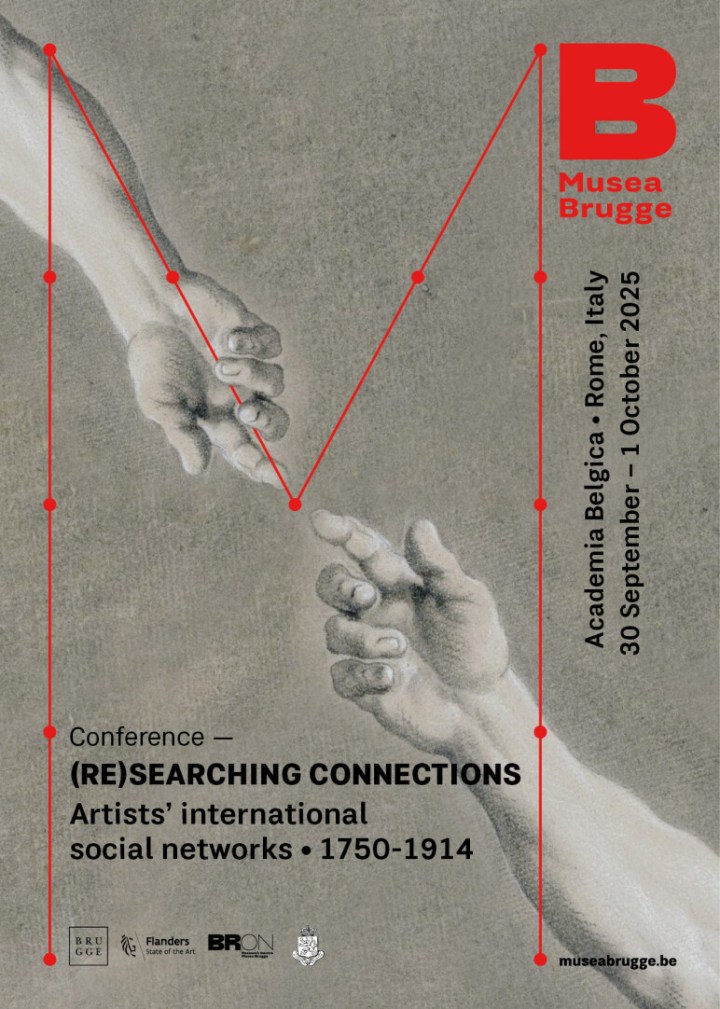 Musea Brugge and the Academia Belgica are pleased to announce the conference (Re)searching Connections: Artists’ International Social Networks, 1750–1914, to be held at the Academia Belgica in Rome on 30 September and 1 October 2025. This two-day conference will examine the formation and function of artists’ transnational social networks, while also exploring new research possibilities enabled by digital methodologies. Embracing a broad chronological and geographical scope, we invite insights spanning the long nineteenth century and various contexts worldwide. We are excited to confirm two esteemed keynote speakers: France Nerlich (Musée d’Orsay) and Giovanna Ceserani (Stanford University).
Possible topics for consideration include, but are not limited to:
• The impact of artists’ networks on educational and professional development, with a focus on artistic training abroad, intergenerational exchanges, mentorship, patronage, and/or the role of academies and other institutions.
• The complex interplay of identity and community in artists’ networks, which can encompass émigré artists, artist’s colonies, the influence of gender, social class and family ties, the physical spaces of sociability, and interpersonal dynamics such as collaboration, competition, emulation, and a sense of belonging.
• Processes of artistic exchange and adaptation in artist’s networks, whether influenced by cross-cultural interaction or by historical shifts and events such as the rise of nationalistic ideologies, regime change, warfare, and colonialism.
• The representation and documentation of artist’s networks, with attention to contemporary artworks, visual media, and written historical source material, as well as the digital approaches that enable the visualization and analysis of social networks today.
Please visit our website for the conference details, including the full Call for Papers and the submission form. We invite proposals for 20-minute papers in English or French. If presenting in French, please provide accompanying materials in English. Please fill out the submission form on our website by 15 February 2025 (notification of acceptance expected to arrive by the end of March 2025). Proposals should include a single PDF file with the following components:
• A 100-word biography of the author
• A 300-word abstract
• 1 or 2 relevant images (e.g. artworks, archival documents, data visualization)
Proposals will be evaluated based on relevance, clarity, novelty, and contribution to the field. We seek papers that reflect critically on the source material and methodologies employed. For more information, please contact Marie Vandeghinste at marie.vandeghinste@brugge.be.
Call for Papers | On the Use and Abuse of Antiquity in 18th-C. Life
From the Call for Papers:
On the Use and Abuse of Antiquity in 18th-Century Life: Classical References and Their Subversion in the Age of Enlightenment
University of Chicago John W. Boyer Center in Paris, 22–23 May 2025
Proposals due by 15 December 2024

Ingres, The Apotheosis of Homer, 1827, oil on canvas, 386 cm × 512 cm (Paris: Musée du Louvre).
It is a well-established fact, frequently analysed by literary critics, that Greek and Roman Antiquity lies at the heart of 18th-century culture. The significance attributed to ancient authors in 18th-century collèges is often acknowledged, but references to classical figures in fact permeate all forms of the literary and visual arts, whether in the light-hearted forms of Baroque and Rococo or the austere severity of Neoclassicism. Scholars have often highlighted the idealisation of ancient socio-political models, which served as counterpoints to contemporary reflections and critiques, extending from the writings of philosophers to the proclamations and imagination of Revolutionary thinkers. The classical world was imbued with an exemplary value, conceived as an alternative framework through which to contemplate and categorise a frequently problematic present, or to advocate for political, social, and aesthetic reforms. Antiquity offered ideas and images that constituted a kind of second language through which the world of the Enlightenment could be reimagined.
However, any process of re-functionalisation and re-valorisation is inevitably accompanied by subversions, instrumentalization, and alterations. For a reference to be productive and applicable to a new and changing context, it must undergo modification that renders it relevant and exploitable, allowing it to bear meanings beyond the scope of its original formulation. In all cultural domains, ancient texts were either faithfully reproduced, critically commented upon, or openly reinterpreted according to the argumentative needs of writers, who, whether intentionally or not, projected their worldview and concerns onto these works. Precisely because Antiquity functioned as a ‘second language’, its words could only serve as instruments for the description and analysis of reality to the extent that they lost their original meaning and took on new ‘semantic’ valences, enabling them to convey content more attuned to the concerns of the time.
This colloquium aims to analyse and explore these deviations, shedding light on the highly productive dialectical play that takes place between an increasingly historicist and proto-scientific reception of the ancient world (with the emergence of disciplines such as archaeology, philology, etc.) and the still very free and fertile use of classical heritage, which was often employed with little constraint to support any and all ethical, political, or aesthetic arguments. Our goal is to identify the misunderstandings or ‘subverted’ reuses of classical texts, histories, and figures. Whether these fluctuations occur in the literal but reoriented reproduction of phrases, maxims, or passages from ancient texts, or more broadly in the reception of classical models in which new symbolic potentialities are detected, we wish to delve deeper into the qualities and purposes of these transformations of ancient material, analysing their pathways and dead ends, their distortions and their reconfigurations.
Why refer to Antiquity, and with what specific objectives or purposes? How were maxims, historical or philosophical texts, and the pantheon of ancient heroes and gods reinterpreted in the Age of Enlightenment, and how were they integrated into the contemporary cultural discourse? What demands for fidelity, and what modernising distortions were imposed upon Greek and Roman treatises and literature? How did any reappropriation of ancient discourse and its imagery ultimately prove suitable for the new expressive and ideological needs of the philosophes, and how could these same images also lead to their condemnation?
Presentations, in French or English, must not exceed 30 minutes. The conference organizers will cover travel and accommodation expenses for all invited speakers. A publication of the conference proceedings is planned.
Proposals for papers, in French or English, consisting of 250–300 words, accompanied by a brief bio-bibliography including institutional affiliations, should be submitted by 15 December 2024, to glenn.roe@sorbonne-universite.fr and dario.nicolosi.92@gmail.com. Acceptance decisions will be communicated to the authors by 15 January 2025.
Colloquium | Seeing Her: Where Women Wrote Architecture, 1700–1900
From the conference website:
Seeing Her: Where Women Wrote Architecture, 1700–1900
Sie Sehen: Wo Frauen Architektur Schrieben, 1700–1900
ETH Zurich Hönggerberg, 29 November 2024
 The 5th WoWA Workshop and Colloquium is entitled Seeing Her / Sie Sehen and will take place on 29 November 2024 at ETH Zurich. Featuring a private bilingual reading workshop followed by public talks in the afternoon, it brings together a diverse group of scholars in terms of seniority, period, background, and expertise.
Talks by Emma Cheatle (Sheffield), Sonja Dümpelmann (Munich), and Isabel Karremann (Zurich) will centre around specific sites ranging from maternity spaces to the literary country house and gendered landscapes. Together with the respondents, Anna-Maria Meister (Florence/Karlsruhe) and Anne Hultzsch (Zurich), speakers will complicate architectural histories of the 18th and 19th centuries with the question where women wrote architecture. Join us for the in-person colloquium: all are welcome!
Call for Papers | Objects in Early Modern Latin America
From ArtHist.net:
Objects and Everyday Life in Early Modern Latin America: Art, Crafts, and Material Culture in Light of the Encounter with European Travellers
Centre de recherche et de restauration des musées de France, Paris, 12 February 2024
Organized by Maddalena Bellavitis, Corinne Mencé-Caster, and José Manuel Santos Pérez
Proposals due by 15 November 2024
Colonial studies in recent years are increasingly bringing attention to topics that go beyond purely historical, geographical, or ethical issues. There is also a desire to focus on aspects of everyday life, on the elements that constituted moments of family routine, the rituals of cult activities, the spheres of work, like handicrafts, agriculture, and commerce, or personal affairs. In this field, research from a variety of disciplines is mixed, collaborating with each other to search for sources from which information can be drawn, and to analyse their contents in order to reconstruct contexts and narratives that can give us glimpses of the reality of that time.
This workshop intends to explore precisely this reality, and investigate the objects that were part of the private and everyday—but also public and religious—moments in the lives of the peoples of Latin America between the 16th and 18th centuries. Consideration will be given not only to items produced, constructed, and preserved in situ, but also to those that travelled to Europe with the ships that returned there, collected by travellers as curiosities or trophies. Particular attention will then be paid to objects that were derived from the encounter with European culture, through technical, practical, or aesthetic inspiration. Therefore, all proposals that deal with the world of objects, both craft and artistic, and material culture related to colonial Latin America and its encounter with Europe are welcome.
Please submit a one-page PDF with abstract for an unpublished contribution and short bio by 15 November 2024 to the following address: maddalena.bellavitis@gmail.com. Presentations will be in English, French, Spanish, or Portuguese and will last a maximum of 20 minutes. The organizers, Maddalena Bellavitis, Corinne Mencé-Caster, and José Manuel Santos Pérez, will notify the selected proposals by the end of November 2024.
Call for Papers | Sex and Art
From ArtHist.net:
What Is Sex? Special Issue of Frame[less] Magazin
Proposals due by 8 December 2024
In der Kunstgeschichte ist Sexualität seit jeher ein facettenreiches und kontroverses Thema, das sich sowohl in subtilen Andeutungen als auch in expliziten Darstellungen widerspiegelt und eine breite Spannweite an Imagination und Interpretation bietet.
Klassische Darstellungen wie Tizians Zeus und Danae oder Berninis Apoll und Daphne zeigen, wie sexuelle Themen in mythologischen Kontexten verarbeitet wurden und bieten, wie die Erzählung der unbefleckten Empfängnis, die ikonografisch besonders in religiösen Darstellungen verankert ist, reiches Material für eine kritische Auseinandersetzung.
Auch Stillleben beinhalten oft subtile Anspielungen auf Erotik und Sexualität, erzählen von verborgenen Begehren und reflektieren das Verhältnis von künstlerischer Darstellung und gesellschaftlichen Normen, das sich weniger offensichtlich auch in den Werken Fragonards widerspiegelt.
Wie haben sich diese Erzählungen über die Jahrhunderte verändert und welche Bedeutung haben sie noch heute?
Die Enttabuisierung sexueller Themen in der Kunst, insbesondere seit den 1960er Jahren, bietet Ansatzpunkte für die Betrachtung, wie Künstler*innen den Diskurs über Sexualität und Feminismus revolutioniert haben und welche Tabus heute noch herausgefordert werden.
Gender, Diversität und LGBTQ+-Themen sind von zentraler Bedeutung, wenn es um die Frage geht, wie Kunst die Komplexität sexueller Identitäten und Vielfalt sichtbar macht und reflektiert.
Künstlerinnen wie Sarah Lucas und Nan Goldin setzen sich in ihren Arbeiten explizit mit der Darstellung von Geschlechtsteilen und sexuellen Handlungen auseinander. Auch im Performativen findet sich diese Auseinandersetzung mit Sexualität—wie zuletzt in Florentina Holzingers Opernperformance Sancta, die weltweit Schlagzeilen machte. Direkte Konfrontation—erotische Fotografie—künstlerisch inspirierte Form der Pornografie: Welche Grenzen werden zwischen Kunst und Konsum gezogen und wie fungiert der Körper dabei als Medium?
Im digitalen Zeitalter erweitert sich dieser Diskurs um neue Dimensionen: Cybererotik und die Erforschung von Körperlichkeit im Virtuellen schaffen innovative Formen der Sexualität, die physische Grenzen verschwimmen lassen und den erotischen Ausdruck in bisher unerforschte digitale Räume verlagern. So entstehen neuartige Verbindungen zwischen Körper, Sexualität und Technologie, die den Umgang mit Intimität auf radikal neue Weise gestalten.
Nach Foucault ist Sex Macht und das Bild Verhandlungsebene zwischen Gesagtem und Gesehenen. Doch welche Rolle spielt Kunst in der Auseinandersetzung mit problematischen Machtverhältnissen, mit Missbrauch und Übergriffen? Kann Kunst wirklich aufklären und ist Sex in all seinen Facetten und sozialen Implikationen überhaupt darstellbar?
frame[less]—das digitale Magazin für Kunst in Theorie und Praxis ist auf der Suche nach euren Beiträgen. Für das Issue #8 schreiben wir den Open Call zum Thema SEX aus. Die Form wird den Beitragenden freigestellt. Wir freuen uns über vielfältige Formate wie theoretische, kritische und wissenschaftliche Annäherungen an das Thema, genauso wie praktische, projektbezogene Beiträge. Ebenso heißen wir interdisziplinäre und hybride Formen willkommen. Es gibt keine formalen und personenbezogenen Kriterien für die Auswahl der Beiträge. Einzig die Qualität der Abstracts und Proposals entscheidet.
Wir ermöglichen einen interdisziplinären Diskurs im Bereich Kunst, wobei wir einen offenen Kunstbegriff propagieren, der unter anderem Disziplinen wie Architektur und Design mit einbezieht. Besonders Menschen, die sich als FLINTA definieren und beziehungsweise oder BIPoC möchten wir ermutigen, sich zu bewerben.
Sende uns dein Abstract oder Projektvorhaben (maximal eine Seite) zu, in dem du kurz deine Idee beschreibst. Bis zum 08.12.2024 hast du Zeit, dich unter redaktion@framelessmagazin.de zu bewerben. Wir geben dir dann schnellstmöglich eine Rückmeldung (ca. eine Woche) und informieren dich über alle weiteren Vorgänge.
frame[less] ist ein digitales Magazin für Kunst in Theorie und Praxis. frame[less] ist ein unabhängiges und nicht kommerzielles Online- Magazin, das Studierenden, Wissenschaftler:innen sowie Künstler:innen eine Plattform bietet, wissenschaftliche Beiträge, Essays, Kritiken, Kommentare, künstlerische Arbeiten und weitere Formen zu veröffentlichen.
Call for Papers | Religion, Ancestry, and Identity
From ArtHist.net:
Religion, Ancestry, and Identity: On the Relationship between Theology, Genealogy, and Heraldry in the Early Modern Period
Warburg-Haus, Hamburg, 3–4 April 2025
Proposals due by 13 December 2024
In early modernity, genealogy was a topic of major religious and theological relevance. During the Reformation, genealogical thinking helped to shape new confessional identities, significantly influencing perceptions of family and kinship. References to ancestry served to illustrate religious continuities and the transmission of the ‘true’ faith across generations. Thus, genealogy not only contributed to establishing religious authority, but also shaped confessional identities and served as a tool for resolving theological issues. This interdisciplinary conference proposes to discuss the various interconnections between questions of origin or ancestry and confessional contexts.
The conference takes as its starting point the seemingly surprising observation that numerous theologians were simultaneously active in the fields of genealogy or heraldry. On the Protestant side, Cyriacus Spangenberg (1528–1604), Philipp Jakob Spener (1635–1705), and Johann Ulrich Pregitzer IV (1673–1730) can serve as examples. On the Catholic side, the pronounced engagement of Jesuits in genealogy and heraldry is particularly striking, with Philibert Monet (1566–1643) and Claude-Francois Menestrier (1631–1705) being prominent examples in France.
This phenomenon can be explained through the numerous intersections between the fields of genealogy, heraldry, and theology. Genealogical and heraldic practices served theologians as tools for addressing theological issues, such as resolving the conflicting genealogies of Jesus in the Gospels of Matthew and Luke. Additionally, the merging of secular and sacred fields of knowledge generated iconographic innovations for illustrating and conveying these topics, for instance in the form of printed family trees, which differed from earlier representations. In heraldic literature, there was cross-confessional discussion up until the seventeenth century about the extent to which the origins of coats of arms could be traced back to the 12 tribes of Israel or even to Adam. Christian symbols, such as depictions of saints, were widely used in early modern city coats of arms—a tradition whose traces can still be seen today. At the same time, Jesuits were particularly active in princely genealogy and heraldry. Their studies were initially connected to the education of young nobles in these subjects at their colleges, but they also resulted in extensive heraldic and genealogical compendia.
At least on the Protestant side, theologians engaged in genealogical and heraldic activities often faced pressure to justify their work. Contemporary criticism of genealogical and heraldic studies as vanity or a waste of time must be understood within the context of a broader moral-theological debate about the Christian valuation of family, ancestry, and birth. A central reference point in this debate was Paul’s (seemingly) critical view of the genealogies of ancient Judaism (1 Timothy 1:4 and especially Titus 3:9), around which an antiquarian-theological dispute unfolded in the sixteenth and seventeenth centuries. The influence of this criticism can be traced from Spangenberg to Spener.
While there has been some initial research into the complex and sometimes tense relationship between genealogy, heraldry, and theology during the early modern period, the majority of the field remains largely unexplored. This is especially true regarding Christian discourses on genealogy and heraldry, the use of theological arguments in both fields, and changing perspectives on the family as a result of the Reformation, as well as possible confessional differences regarding these topics. The aim of the conference is to illuminate and discuss the early modern relationship between religion and ancestry in an interdisciplinary way.
Possible topics include:
1 What confessional differences can be identified in the use and discussion of genealogical concepts? How did genealogical concepts help to support or clarify biblical/confessional narratives? To what extent do genealogy and heraldry, as secular fields of knowledge, offer a ‘common ground’ for understanding between different confessions?
2 What media and narrative forms of expressing ancestry can be identified in religious contexts? What temporal and confessional developments can be observed?
3 In what ways and contexts were theological concepts and arguments applied and incorporated in genealogy and heraldry? To what extent did these applications vary according to region or confession within Christianity? What specific theological challenges could be addressed through genealogical and heraldic approaches?
4 How did the contemporary moral pressure to justify their work affect theologians who engaged with genealogy and heraldry? Can confessional differences in these debates be identified? To what extent did societal expectations and norms influence theologians’ approaches to genealogical and heraldic studies? Are there specific examples of conflicts between the outcomes of their research and the doctrinal mandates of the church? What strategies did theologians develop to deal with this pressure and present their research as morally justifiable?
5 How do genealogy and heraldry integrate into the biographies of theological scholars? What motivated theologians to engage in these studies? Was it a matter of personal interest, an exploration of their own family history, a didactic endeavour (for instance, as tutors to princes), or a serious alternative career option?
Contributions from cultural and literary studies, history, art history, and theology are warmly invited. If interested, please send a (working) title and a brief abstract by 13 December 2024, to Kai.Hendrik.Schwahn@uni-hamburg.de.










 Enfilade
leave a comment