Call for Papers | Early Modern State Descriptions
From ArtHist.net:
Early Modern State Descriptions in an Interdisciplinary Perspective
Münster, 10–11 April 2025
Organized by Karl Enenkel and Lukas Reddemann
Proposals due by 21 July 2024
From the 16th through to the 18th century, state descriptions were a vital part of European literary production and book markets. Such publications covered an enormous range of topics including geography, economics, cities, military, political constitutions, and numerous other aspects of early modern political formations. State descriptions were written in Latin and vernacular languages alike. They could be composed as single descriptions or as collections and were often published in numerous editions and translations. Such ‘bestsellers’ on the early modern book market included several well-known works. For example, one can call to mind Lodovico Guicciardini’s description of the Low Countries (Descrittione di tutti i paesi bassi, 1567), William Camden’s description of Britain (Britannia, 1586), and the collections in Giovanni Botero’s Relationi universali (1590s), Pierre d’Avity’s Les estats, empires, et principautez du monde (1613), and the ‘Republics’, a series of Latin state descriptions printed by Elzevir and other Dutch publishers in the 1620s and 1630s. In the course of the 17th century, the production of state descriptions gained new momentum through the formal establishment of statistics as an academic discipline, in Protestant universities in Germany in particular. This development resulted in the famous “Göttinger Schule” of statistics that is associated with Gottfried Achenwall and August Ludwig von Schlözer.
It is paramount that we attain a clearer picture of the place of state descriptions in the larger context of early modern academic and non-academic learning, as well as their connections to other, non-textual media. For instance, what role did state descriptions play in the development of early modern political theory, the education of and communication between diplomats, and the knowledge networks of merchants? How did they intersect with fields such as cartography or other media concerned with the pictorial representation of geographical and political aspects of early modern states?
Our conference aims to bring together multiple interdisciplinary perspectives on early modern state descriptions to address the abovementioned areas and similar fields. Rather than investigating state descriptions as a single literary genre or form of printed publication, we want to shed light on the early modern interest in different forms of literary and non-literary representations of contemporary political formations as a broader cultural phenomenon. Contributions might address, but are not limited to, the following research questions:
• On what methodical basis can we identify target audiences and actual readers of early modern state descriptions? Which academic and non-academic factors stimulated the huge interest in such publications?
• How can we describe the relationship between state descriptions in Latin and in the vernacular languages? Are there certain focal points related to time or region? Can we recognize specific connections between the language and the target audiences of such publications? What role do translations play?
• How did the authors and editors of state descriptions systematize and manage the vast amount of potentially relevant information? How do their different forms of information management interact with the literary and academic purposes of a work?
• How can we describe these often-complicated use of literary sources more specifically, rather than applying general concepts such as ‘compilation’ or ‘anthology’ (cf. e.g. Reddemann, Staatenkunde als Weltbeschreibung, 2024)?
• How do state descriptions, as ‘factual’ representations of concrete political formations, respond to and interact with writings and trends in the field of political theory?
• How does book-historical evidence help us shape clearer ideas about the dissemination, readerships, and practical use of state descriptions? What can we say about their presence in early modern libraries and book collections and how may this reveal more about domain-specific practices of book collecting?
• Which non-literary forms of representing, illustrating, and describing early modern states can we identify? Do they interact with or react to textual state descriptions and, if so, in what specific ways?
We look forward to receiving contributions from researchers in the entire breadth of disciplines within the field of early modern studies. We plan to publish the revised papers in the series Intersections: Interdisciplinary Studies in Early Modern Culture (Brill).
The conference will take place 10–11 April 2025 in Münster. The University of Münster will take care of travel costs for speakers and provide their hotel accommodation for the duration of the conference. The language of contributions and discussion is English. The deadline for submissions is 21 July 2024. Please send an abstract of your contribution (ca. 250 words) and a preliminary title to both organisers, Karl Enenkel (kenen_01@uni-muenster.de) and Lukas Reddemann (lukas.reddemann@uni-muenster.de).
Call for Papers | Jewish Art and Museums in Latin America
From ArtHist.net:
Jewish Museums and Professionals in Jewish Art and Material Culture in Latin America
Museos Judíos y Profesionales del Arte y Cultura Material Judía en América Latina
Sociedad Hebraica Argentina, Buenos Aires, 19–21 November 2024
Proposals due by 15 August 2024
Organized by Sociedad Hebraica Argentina with support from the World Union for Jewish Studies and the Latin American Jewish Studies Association
We invite proposals for papers to be presented at the first seminar for Jewish Museums and Professionals in Jewish Art and Material Culture in Latin America, to be held at Sociedad Hebraica Argentina, Buenos Aires, in November 2024. We welcome proposals from curators, conservators, educators, art historians, artists, and researchers in Jewish studies.
The seminar aims to bring together a small group of professionals in Jewish museums and art to explore the question of Jewish art and museums in Latin America. Over three days, participants will give short presentations on their individual experiences, research, and institutions, engaging in discussions on sources, methodology, and theory to evaluate current and future trends, as well as common challenges, at the intersection of museums and art related to the Jewish experience in Latin America. Additionally, participants will engage in practical workshops and visits to relevant local museums and collections.
Jewish museums have existed in Latin America since the mid-20th century. However, the region lacks a network to connect and share experiences among museums that can enrich museum activities: education, visitor centers, provenance research, collection management, preservation, and research. Understanding that Latin American Jewish museums are underrepresented in both museum studies and Jewish studies, the purpose of this seminar is to bring together professionals in Jewish art, collectors, professionals from museums of Jewish history and material culture, archivists, librarians, educators, and scholars in Jewish studies to develop a program of exchange and debate on the current situation of the field in the Latin American region.
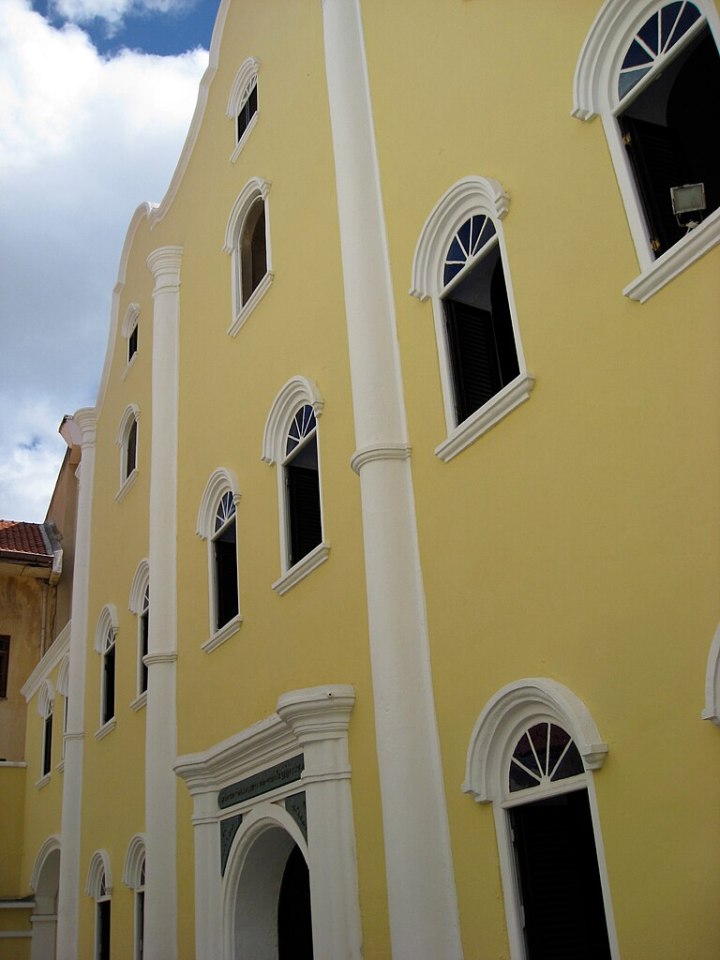
The Mikvé Israel-Emanuel Synagogue (The Hope of Israel-Emanuel Synagogue) in Willemstad, Curaçao is, according to Wikipedia, “the oldest surviving synagogue in the Americas. . . . The community (congregation Mikvé Israel) dates from the 1650s, and consisted of Spanish and Portuguese Jews from the Netherlands and Brazil. . . . The first synagogue building was purchased in 1674; the current building dates from 1730.” Photo from January 2008, Wikimedia Commons. Image added to the Call for Papers at Enfilade by Craig Hanson
Based on case studies of experiences in producing Jewish art and presenting Jewish history and experiences through exhibitions, as well as the conservation and dissemination of museum and archival material, we seek to identify different approaches and key themes of the field in relation to our region. The focus areas may include, but are not limited to:
• Exhibition of Jewish history and culture: Jewish history and culture in general and in Latin America. Jewish immigration and presence in Latin American countries.
• Exhibition spaces: Jewish sections in historical museums, in synagogues, and in art museums.
• Jewish art: contemporary art, Jewish art salons, Latin American Jewish artists.
• Holocaust and memory: Holocaust museums and memory spaces.
• Education and accessibility: education programs in museums and interaction with the community.
• Digitization and technology: digital and online museums, digitization projects, and collections of Jewish material culture in archives and libraries.
• Conservation and collection management: provenance research and management of art, archive, and Jewish material culture collections. Management of donations.
• Methodology and research: research methodologies in museums, research on Jewish material culture, and research on the Jewish presence in Latin America.
The seminar will be conducted in Spanish, but presentations in English and Portuguese will also be accepted. Submit short proposals (maximum of 500 words) and a one-page CV to Tammy Kohn (tammykohn@gmail.com) and Hebraica (cultura@hebraica.org.ar) by August 15. Selected applicants will be notified in September. Participants and their institutions are responsible for covering travel and accommodation expenses, but limited financial assistance is available upon request. Requests for financial aid must be submitted by August 1. Full papers must be submitted by November 1 for circulation in advance.
Important Dates
Submission of proposals: by 15 August 2024
Request for financial aid: by 1 August 2024
Notification of acceptance to participants: September 2024
Submission of papers: by 1 November 2024
Seminar date: 19–21 November 2024
Call for Papers | Portraiture in a Trans-Asian Context
From ArtHist.net:
Making the Subject of Portraiture in a Trans-Asian Context, ca. 1500–Present Day
SOAS University of London, 5–6 December 2024
Organized by Mariana Zegianini and Conan Cheong
Proposals due by 29 July 2024
Portraits have commonly been understood as naturalistic likenesses of human beings, centred on the face. The work of scholars such as Jean Borgatti, Richard Brilliant (1990), and Joanna Woodall (1997) opened the field in conceptualising portraiture as a truly multi-local genre, foregrounding relational and performative processes. Following their research, this symposium defines portraiture as a process where subjectivities are constructed as a result of the collaboration between artists, patrons, sitters, and viewers living in a specific time and space, This call for papers therefore is addressed to scholars of art, cultural, visual, and material culture at any career level who explore how notions of subjectivity are constructed in text and images created between the sixteenth century and the present day in Asia and its diasporas. The symposium organisers will consider papers analysing literary and pictorial processes of embodiment through the production of objects and artefacts such as paintings, photographs, prints, sculptures, ceramics, jewellery, and currency; and of designed spaces including gardens and architecture.
Portraits have long been studied as documents or biographies of a person that once existed. Without denying the capacity of a portrait to index a living person, the symposium wishes to address the varied performative elements that portraits display in the Asian context. These performances reveal the enactment of class, gender and race of specific societies and cultures of Asia and its diasporas. Understanding the performative function of portraiture in Asia, we argue, reveals cultural, social, religious, and philosophical ideas that are important to understanding the region.
This two-day in-person symposium focuses on the portraiture of Asia with two specific purposes in mind. First, to decenter studies of Asian portraiture from Eurocentric conceptions of subjecthood and thus to expand the field of portraiture studies; second, to foreground the connections, transfers and tensions articulated by portraiture within the trans-Asian context. The focus on Asia should not be read as exclusionary, but rather as the intent to initiate a dialogue with existing research on the portraiture of other regions such as Africa and Europe. Thirty-five years after Borgatti, Brilliant, and Woodall’s contributions to the field of portraiture studies, the symposium Making the Subject of Portraiture in a Trans-Asian Context, ca. 1500–Present Day proposes to take stock of a changing field by contributing the scholarship of art, cultural and literary historians, anthropologists, and specialists in gender and critical race theory whose research interests focus on the embodiment of selfhood in portraiture from Asia.
We therefore invite papers which develop our core concern with ‘Making the Subject’ and with the performative dimensions of portraiture in Asia. Suggested topics (but not limited to):
• Dimensions of reality in portraiture
• Issues of re-/presentation
• Issues of materiality, style, and making
• Portraiture and authority: imperial, monastic, patriarchal, or cultural
• Cults of personality
• Portraiture and changing notions of beauty
• Religious and philosophical dimensions of portraiture, including rituals and ceremonies
• Issues of display and viewing: notions of theatricality and performance
• Gendered dimensions of portraiture, including theorisations of gender performance
• Self-portraiture of female and male artists
• Race and ethnicity in portraiture
• Portraiture as currency and commodities
• Fashion and material culture in embodied images
• Non-anthropomorphic portraiture: sacred geographies, depictions of nature, non-human subjects, and gardens
• Cross cultural exchange, i.e. portraits of Asians by non-Asians and vice versa, and similarly within the Asian region
To be considered as a presenter, please send a 300-word abstract plus a short biography (150 words max) for 20-minute presentations to the organisers, Dr Mariana Zegianini (mz15@soas.ac.uk) and Conan Cheong (656531@soas.ac.uk), by Monday, 29 July 2024. A selection of the conference papers will be included in a proposal for an edited volume to be considered for publication.
Call for Papers | Puritan Picture
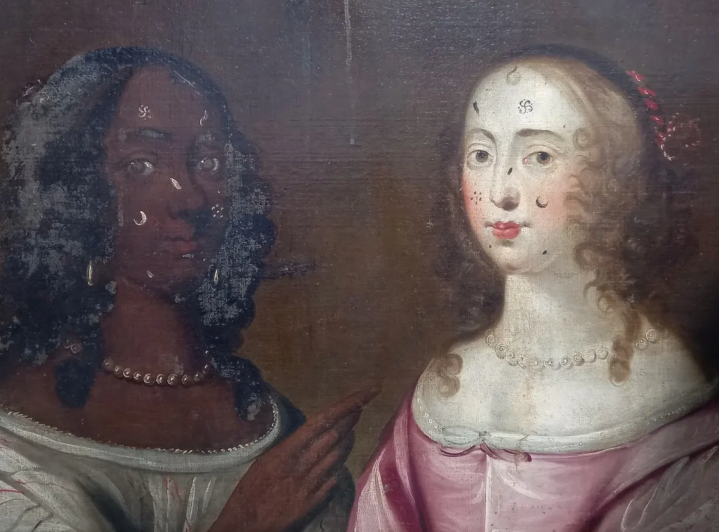
Unidentified painter (British School), Allegorical Painting of Two Ladies Wearing Beauty Patches, detail, ca. 1650s, oil on canvas, 64 × 75 cm. The painting sold at Trevanion, Fine Art and Antiques sale on 23 June 2021 (lot 564).
◊ ◊ ◊ ◊ ◊
This extraordinary painting predates even the long 18th century, but I imagine many Enfilade readers are as intrigued with it as I am. –CH. From ArtHist.net:
Puritan Picture: Vanity, Morality, and Race in Seventeenth-Century Britain
Yale University, New Haven, 27–28 September 2024
Proposals due by 17 June 2024
The middle decades of the seventeenth century in Britain were characterized by radical political, religious, and social change. In this period, an unknown artist created a remarkable painting that spoke to fears and anxieties crystallizing around a perceived increase in moral laxity, gender transgression, and the insidious influence of foreigners. The painting depicts two women side by side, each wearing a conspicuous array of beauty patches. The woman on the left reprimands her companion with the words “I black with white bespott: y[o]u white w[i]th blacke this Evill / proceeds from thy proud hart, then take her: Devill.” Text and image combine to inveigh against the sins of pride, vanity, and worldly excess. The painting reminds the viewer that sinful behavior leads to the devil and exhorts them to seek salvation.
Purchased by the Yale Center for British Art (YCBA) at auction in June 2021, the painting was recognized as a work of outstanding significance to the study of early modern race and gender. After an export stop, it was acquired by Compton Verney, an art gallery in Warwickshire that is housed in a Grade I–listed eighteenth-century manor surrounded by 120 acres of parkland, landscaped by Lancelot ‘Capability’ Brown. Compton Verney has loaned the painting to the YCBA for inclusion in the museum’s ongoing technical study of the theory and practice of painting skin tones. It will go on view at Compton Verney in November 2024. This enigmatic painting has never been subject to sustained research, and much about it remains uncertain. We do not know the identity of the artist or patron, or the original location of the painting, and it is not clear whether the two women are real or imagined figures.
The YCBA, in partnership with Compton Verney, will host a two-day symposium to increase understanding of this significant object in the history of British art and culture. We welcome proposals from established and emerging scholars and encourage participants to be imaginative in their approach. Themes for consideration include but are not limited to:
• artist circles and modes of production
• color symbolism and its connection to racial formation
• contemporary attitudes to piety and morality
• cosmetics, clothing, and accessories
• female sexuality and gender roles
• pigments and processes used by early modern artists for painting skin tones
• religious and ethnic minorities in early modern Britain
• the role of print culture and prescriptive literature
The symposium will be held at Hastings Hall, Yale School of Architecture on September 27 and 28, 2024. Please submit an abstract of no more than 250 words and a short biography to Sarah Leonard (sarah.leonard@yale.edu) by Monday, 17 June 2024. Final presentations should not exceed twenty minutes in length. The YCBA will provide travel and accommodations for successful applicants.
Call for Papers | Baroque Times: The Table’s Scenography
From ArtHist.net:
Baroque Times: The Table’s Scenography
Vila Nova de Foz Côa, Portugal, 14–16 November 2024
Proposals due by 15 July 2024
When discussing the table or the act of being at the table, our immediate thoughts go to the act of eating, the company present, and the food to be shared. However, the table transcends its practical function to become a richly layered symbol, both materially and conceptually, embodying sociability in myriad ways throughout history. During the modern era (17th–18th centuries), the table’s significance unfolded across diverse contexts and environments, from the opulent settings of palaces to the humble abodes of common citizens. Regardless of setting, the table served as a focal point, drawing together a spectrum of personalities and activities, thus assuming a central role in daily life. In palatial settings, the table symbolized power and sophistication, showcasing culinary refinement and adherence to social etiquette. The table epitomizes socialization, serving as a nexus for fundamental human experiences—the nourishment of the body and the establishment of communal identity within society. As such, it acts as a microcosm of cultural norms and interpersonal dynamics, revealing insights into societal values and individuals’ relationships with one another and with themselves.
Inspired by Christian traditions, the Western table echoes the teachings of Christ, who in the Gospels elevated the table to a sacred space for gatherings, sharing, inclusion and teaching. Depicted in various biblical scenes, such as the Wedding at Cana, the home of Martha, the Emmaus supper, and the Last Supper, the table emerges as a locus of truth and reverence, where communal sharing imbues food with deeper meaning.
At the table, physical proximity, and eye contact foster connections, yet may also give rise to discord. It is a space where alliances are forged, love and friendship blossom, and adversaries may surface. In its multifaceted nature, the table serves as a catalyst for a myriad of human activities, offering profound insights into the essence of human existence, whether amidst moments of serenity or the complexities of social interaction.
The following themes are proposed, although other related topics may also be accepted:
• The Table as Object: consideration of the table as a piece of furniture, in its various functions, such as dining, campaign, gaming.
• The Everyday Table: a space for daily gatherings, where routines and eating habits intertwine.
• Table and Power: dynamics of power and social hierarchy that manifest through table arrangement and associated rituals.
• Dressing the Table: the importance of porcelain, glassware, cutlery, textiles, and other elements in the aesthetic and functional composition of the table.
• Etiquette: the norms and social conventions that govern behavior at the table across different cultures and historical contexts.
• Food: the relationship between the table and the culinary space, including kitchens and food preparation areas.
• Celebration: how the table becomes the centrepiece of festive celebrations (attire, theatre, dance, fireworks, music, and ephemeral art in general).
• The Table in Literature: representations and symbolism associated with the table in literary works.
• Cross-Cultural Perspectives: Investigating intercultural practices related to the table and their mutual influences.
• Representations in the Visual Arts: how artists depict the table in painting, sculpture, tiles, textiles, and other decorative arts.
• Virtualizations of the Table: how the table is reinterpreted and recreated in virtual and digital environments.
• The Table in Cinema: representation and role of the table in neo-baroque movies of different genres.
• The Neo-Baroque Table: How the aesthetic and cultural principles of the Baroque continue to influence contemporary representations of the table.
To submit a proposal, send an abstract (a maximum of 300 words) addressing the objectives, methodology, and relevance of the work to the themes of the congress, along with a biographical note (maximum of 150 words) to temposdobarroco@gmail.com by 15 July 2024.
Scientific Committee
Carla Sofia Ferreira Queirós (ESEPP; CITCEM/FLUP)
Margarida Rebocho (ARS LUMINAE)
Maria João Pereira Coutinho (IHA – NOVA FCSH / IN2PAST)
Rui De Luna (Associação Cultural Castilho e Távora)
Sílvia Ferreira (IHA – NOVA FCSH / IN2PAST)
Scientific Committee
Ana Isabel Buescu (CHAM – NOVA FCSH)
Caroline Heering (Université catholique de Louvain)
Fátima Eusébio (Secretariado Nacional para os Bens Culturais da Igreja)
Fernando Quiles García (Universidad Pablo Olavide)
Gonçalo Vasconcelos e Sousa (Universidade Católica Portuguesa-Porto)
Inês de Ornelas e Castro (IELT – NOVA FCSH)
Isabel Drumond Braga (FLUL, CIDEHUS-UÉ; CH-UL)
Jaromir Olsovsky (University of Ostrava, Czech Republic)
Luis Javier Cuesta Hernández (Universidad Iberoamericana, Ciudad de México)
Ricardo Bernardes (Fundação Casa de Mateus)
Call for Articles | Anachronisms in Art History
From the Call for Papers / Appel à contributions:
Anachronisms in Art History / Anachronismes en histoire de l’art
Special issue of Perspective: Actualité en histoire de l’art
Edited by Thomas Golsenne, Hélène Leroy, and Hélène Valance
Proposals due by 17 June 2024, with finished articles due by 1 December 2024
Perspective will explore, in its 2025.2 issue—co-edited by Thomas Golsenne (INHA), Hélène Leroy (Musée d’Art Moderne de Paris), and Hélène Valance (université Bourgogne-Franche-Comté/InVisu)—the question of anachronisms in art history.
Since at least the 1960s, a number of critical approaches have emerged with regard to sweeping Western approaches that classified artworks and artists in successive stylistic periods, and even based the discipline on these temporal and formal categories. They made it possible to call into question the 19th-century ‘historism’ that confused the scholars’ temporal categories with the historical phenomena themselves, just as they have redefined periods as designations of time, objects of history. In practice, however, it is clear that the period remains more than ever the temporal unit within which we conceive art history and study it. Even if the subject of anachronism in art history emerged much earlier, for reasons that merit further consideration, it genuinely became worthy of interest for the epistemology of the historical sciences at the turn of the 21st century. What about art history?
To this end, three main topics emerge for proposed articles:
1 Disciplinary Anachronisms
2 Methodological Anachronisms
3 Historical Anachronisms
Additional information (including a bibliography) is available from the full Call for Papers»
Taking care to ground reflections in a historiographic, methodological, or epistemological perspective, please send your proposals (an abstract of 2,000 to 3,000 characters/350 to 500 words, a working title, a short bibliography on the subject, and a biography limited to a few lines) to the editorial email address (revue-perspective@inha.fr) no later than 17 June 2024.
Perspective handles translations; projects will be considered by the committee regardless of language. Authors whose proposals are accepted will be informed of the decision by the editorial committee in July 2024, while articles will be due on 1 December 2024. Submitted texts (between 25,000 and 45,000 characters/ 4,500 or 7,500 words, depending on the intended project) will be formally accepted following an anonymous peer review process.
Published by the Institut national d’histoire de l’art (INHA) since 2006, Perspective is a biannual journal which aims to bring out the diversity of current research in art history, highly situated and explicitly aware of its own historicity.
Call for Papers | A Legacy of Landscape Study
From ArtHist.net:
A Legacy of Landscape Study
Yale Center for British Art, New Haven, 5–6 December 2024
Proposals due by 1 July 2024
The Yale Center for British Art (YCBA) and Oak Spring Garden Foundation (OSGF) share a legacy of landscape study rooted in the collections of Paul and Rachel Lambert ‘Bunny’ Mellon. While the Mellons’ collecting practices differed, they both gathered significant materials in the history of British environments, horticulture, and landscapes. Notable examples include Paul Mellon’s paintings and prints by George Stubbs and J. M. W. Turner and Bunny Mellon’s garden treatises and Humphrey Repton Red Books. From these origins, the YCBA’s extensive collection of British art has encouraged generations of new scholarship on British landscape art, while OSGF has become a leading research institution for the global histories and futures of gardens, landscapes, and plants. Inspired by this legacy of collecting and scholarship, the YCBA and OSGF are hosting a symposium at Yale to bring together new interdisciplinary research on British landscape studies.
By commingling the diversity of approaches to the histories and depictions of landscapes and environments represented by the two institutions, this symposium aims to generate new scholarly conversation about the intersections of British culture, ecology, and land. We invite papers exploring new topics in the study of British landscapes, from art history to cultural geography to environmental studies, and we particularly welcome work exploring the relationship of cultural output to physical landscapes and ecologies. We encourage broad definitions of ‘landscape’ and ‘British’ to open the potential for discussions of the global context of Britain and its former empire, and to consider an international exchange of landscape art, design, and horticulture.
Proposed subjects might include, but are not limited to:
• Extractive, industrial, urban, and neglected landscapes
• Histories of collecting and display (whether art or plants)
• Interconnections of landscape and garden history and art history
• New critical approaches to environments, landscapes, and British identity
• Plant history and humanities broadly, including related subjects such as food history and agrarian history
Please submit an abstract of no more than 250 words and a short biography by 1 July 2024, 5pm (ET). The YCBA will provide travel and accommodations for successful applicants.
Call for Papers | The Shape of Things: Still Life in Britain
From ArtHist.net:
The Shape of Things: Still Life in Britain
Pallant House Gallery, Chichester, 27–28 September 2024
Proposals due by 31 May 2024
This summer, Pallant House Gallery presents The Shape of Things: Still Life in Britain (11 May – 20 October), a major exhibition exploring the continuing and fundamental relevance of the genre of still life to British art and art history. Historically still life has been viewed as the lowest genre of art, but in fact it has been employed by leading British artists to grapple with some of the most profound themes relating to the human condition, and as a vehicle for experimentation with new forms and ideas. In keeping with Pallant House Gallery’s mission to explore new perspectives on British art from 1900 to now, the exhibition demonstrates how artists working in the 20th and 21st centuries have continually reimagined traditional still life. It questions how still life has been used to explore themes such as mortality and loss, fecundity and love, the uncanny and subconscious, the domestic environment and questions of gender, abundance and waste. Today these themes also extend to climate change and to the legacy of colonialism and empire.
Starting with the introduction of still life in Britain by émigré artists in the 17th century, the exhibition reveals how modern and contemporary artists have engaged with and reinterpreted traditional art history. It then presents a history of modern and contemporary British art as understood through the lens of the still life, showing how the genre sits at the heart of groups and movements including the Bloomsbury Group, Scottish Colourists, Seven & Five Society, Unit One, Surrealism, St Ives and post-war abstraction, Neo-romanticism, pop art, post-war figurative art, conceptual art, and the YBAs. Encompassing painting, prints, photography, sculpture, and installation, The Shape of Things: Still Life in Britain includes over 150 works by more than 100 leading artists working in Britain. The exhibition is accompanied by a site-specific installation by Phoebe Cummings.
This symposium will seek to draw out connections between historic and contemporary art, and will provide an opportunity to further explore key themes in the exhibition. The keynote lecture will be delivered by a leading British artist. The two sessions will include papers by art historians and curators concerning artists and themes in historic, modern, and contemporary British art, and artists talking about themes in their work.
We seek contributions that investigate, though are not limited to:
• the reinterpretation and renewal of this traditional genre
• the exploration of gender identity through still life
• how the world’s underlying uncertainties are expressed through a genre traditionally perceived as domestic
• still life as an art form that goes beyond reality to explore symbolism, the sub-conscious, and the uncanny
• the connections between still life and global commerce and its connections to colonialism and the British Empire
• the contribution of émigré and Diaspora artists to the enduring significance of the genre
• still life as a site for the exploration of materiality
To be considered as a speaker, please send an abstract of up to 400 words to curatorial@pallant.org.uk, including your name, affiliation, contact details (phone number and email address), and a short biography with details of any recent publications. The deadline for submissions is 31 May 2024 (12pm). We will aim to contact successful candidates by Monday, 1 July.
The symposium has been generously supported by the Paul Mellon Centre for Studies in British Art. Speakers will be paid a fee of £150. Speakers will be able to claim travel expenses (up to £100) and accommodation costs (up to £100) for the Friday evening. There will be no delegate fee for speakers. Delegate tickets will be £50 full price (£30 for students) and will include refreshments and lunch. Tickets will go on sale via the Pallant House Gallery website nearer the time of the conference.
Call for Articles | Fall 2025 Issue of J18: Clean
From the Call for Papers:
Journal18, Issue #20 (Fall 2025) — Clean
Issue edited by Maarten Delbeke, Noémie Etienne, and Nikos Magouliotis
Proposals due by 1 October 2024; finished articles will be due by 1 April 2025
This issue of Journal18 asks: what we might see if we regard the eighteenth century as possessed by a cleaning frenzy? Cleaning, as a process of removing excess matter to get to the essential or the original, engaged an eighteenth-century obsession with origins and etiology. This type of removal took place in a time of formulations and nebulous debates about race, class, and ethnicity and intersected with attempts to ‘purify’ the urban and rural environment as well as society itself. Cleanliness suggested a particular aesthetic that resonated with the tenets of neoclassicism but also with racialized notions of whiteness, as the opposite of ‘impure’, non-white races, cultures, and objects. In the increasingly disenchanted worldview of elites, cleaning artworks was also a way to annihilate any living presence connected to these objects, from bugs and microorganisms to ancestral spirits to immanent beliefs.
In eighteenth-century Europe, political, cultural, and religious authorities sought to clean artworks and monuments from anything that ‘soiled’ them, whether that was actual dirt, natural traces of use and time, or (hu)man-made ephemera, immaterial rituals, and ideological beliefs. These actions were symptoms of a power struggle between religious institutions and the state and between different cultures and countries, but also between local populations and an increasingly centralized administration. Even when presented as neutral measures of maintenance, such acts of cleaning often led to conflict. This was the case, for example, in late eighteenth-century Naples, when the German painter Jacob Philip Hackert was accused by local artists of disrespecting a number of Italian paintings he had cleaned. What for one cultural milieu diminished artistic value could be, for another, an integral part of the artwork.
This issue of Journal18 invites essays on acts of and discourses around cleaning in the long eighteenth century, particularly cases that address issues of authority and ownership. Who was entitled to touch, handle, modify, or clean an artwork, relic, building, or monument? What/who was allowed to reside within such buildings and objects, and what/who had to be erased or exterminated? What was the significance of defining the ‘pure’ or ‘original’ state of such artworks? What line of separation did actors draw between cleaning and destruction? Was cleaning gendered, and, if so, how? Who was expected to do the cleaning, and who was allowed to produce dirt? What are the connections between racialized ideologies that led to the devastations of ethnic cleansing and eighteenth-century aesthetics of cleaning and cleanliness? Is there a way to contrast the ‘messiness’ of the early modern multi-modal ‘entangled’ historiography with the streamlined ‘cleanliness’ of eighteenth-century historical writing?
Proposals for issue #20 Clean are now being accepted. The deadline for proposals is 1 October 2024. To submit a proposal, please send an abstract (250 words) and brief biography to editor@journal18.org and nikolaos.magouliotis@gta.arch.ethz.ch. Articles should not exceed 6000 words (including footnotes) and will be due by 1 April 2025. For further details on submission and Journal18 house style, see Information for Authors.
Issue Editors
• Maarten Delbeke, ETH, Zurich
• Noémie Etienne, University of Vienna
• Nikos Magouliotis, ETH, Zurich
Call for Papers | The Secularization of Religious Assets
From the Call for Papers, which includes the French Appel à communication:
The Secularization of Religious Assets in Enlightenment Europe: Urban Development, Architecture, and Art Works
La sécularisation des établissements religieux dans l’Europe des lumières: Ville, architecture et œuvres d’art
Institut National d’Histoire de l’Art, Paris, 27 November 2024
Organized by Ronan Bouttier, Gernot Mayer, and Raluca Muresan
Proposals due by 30 June 2024
The suppression of the Society of Jesus in 1773 marks the last step of the Order’s progressive dissolution initiated fifteen years earlier, in Europe and in its colonies. This act of suppression was the culmination of a broader secularisation movement concerning religious congregations across Europe, from the 1760s to the French Revolution. In most cases, the State intended to take over the management of properties belonging to religious congregations described as useless for the common interest. Whether driven by reformatory or by economic interests, all acts of suppression and secularisation had the same consequences: a large number of movable assets and real property, estates and art works were either reallocated to other religious congregations or put on sale, when not confiscated altogether.
Several studies have already investigated the dispersal of abolished congregations’ assets in different parts of Enlightened Europe, but a broader overview is yet to be drawn. Furthermore, it is necessary to define common characteristics of confiscation procedures and real properties’ functional transformations during the three decades before the nationalisation of Church property undertaken in France in 1789. Besides, change of religious buildings’ ownership often led to their reconversion, and eventually to their architectural transformation. Rehabilitation, dispersal or destruction procedures of seized properties also must be taken into consideration. It is also important to broaden this inquiry to the transformation of the surroundings of these former religious properties because this process precipitated changes in the overall urban fabric as well as in the appropriation of urban space. Eventually, these changes of ownership involved movable assets and art works of the dissolved religious congregations. In this regard, one need also pay attention to works’ functional alterations, as they were attributed to other religious communities or to secular institutions and individuals. Therefore, our inquiry extends to the consequences of the largescale sales of art works on the collecting market.
We welcome proposals on following themes:
• Issues and procedures of architectural property confiscation in Europe and in its overseas territories
• Inhabiting and exploiting seized religious properties
• Dismantling seized properties and movable assets: procedures of architectural dismantling, networks and procedures of sale
Each paper should be 20 minutes long; the accepted languages are French and English. The conference will take place on 27th November in Paris, at the INHA (Institut National d’Histoire de l’Art). We look forward to reading your submissions of a maximum of 250 words, along with a CV and publications list. We require the contributors to send their submissions to secularisations@gmx.fr, and to entitle their submitted files as following: NAME_FORNAME_prop secularisations and NAME_FORNAME_CV. The submission deadline is 30 June 2024.
Organizers
• Ronan Bouttier, Paris 1 Panthéon-Sorbonne
• Gernot Mayer, University of Vienna
• Raluca Muresan, Sorbonne Université
Scientific Committee
• Jean-Philippe Garric, Professor, Université Panthéon-Sorbonne, HiCSA
• Richard Kurdiovsky, Interim Director of the Department of Art History, Austrian Academy of Sciences, Vienna
• Olga Medvedkova, Director of Research, CNRS, Centre André Chastel
• Émilie d’Orgeix, Director of Research, École Pratique des Hautes Études (EPHE)










 Enfilade
leave a comment