Call for Essays | Museum Media(ting)
From ArtHist.net:
Museum Media(ting): Emerging Technologies and Difficult Heritage
Edited by Theopisti Stylianou-Lambert, Antigone Heraclidou, and Alexandra Bounia
Abstracts due by 15 July 2019; finished essays due by 15 January 2020
This edited volume with the working title Museum Media(ting): Emerging Technologies and Difficult Heritage examines theoretical approaches and case studies that demonstrate how emerging technologies can display, reveal, and negotiate difficult, dissonant, negative, or undesirable heritage. We are particularly interested in how emerging technologies in museums have the potential to reveal unheard or silenced stories, challenge preconceptions, encourage emotional responses, introduce the unexpected, and overall provide alternative experiences. By emerging technologies, we refer to contemporary advances and innovations in technology such as virtual reality, augmented reality, mixed reality, holograms, artificial intelligence, gamification, smart systems, etc.
How can museums, with the help of technology, manage to tell unheard stories, touch upon issues of difficult heritage, and narrate stories of unprivileged groups of people such as minorities, women, LGBT, immigrants, etc.? How can museums explore alternative sides of history, different from the political/ diplomatic/ military history which is the norm, such as social history, history of education, history of migration, etc., giving therefore emphasis not so much on the knowledge/ collection of information, but to multiperspectivity, inclusiveness, tolerance and social cohesion? How and to what extent the use of technology in museums/ art spaces, facilitates the understanding of issues dealing with contested history? How can emerging technologies provide not only cognitive experiences but also affective ones?
The volume may include chapters that deal with the following themes:
• Emerging technologies in museums
• Innovative interactive media/ installations
• Art and technology for difficult heritage
• Crowdsourcing/ participatory methods
• Oral histories and emerging technologies
• Deep mapping approaches
• Affective responses
• Cultural tourism and difficult or dark heritage
• Alternative experiences
• Evaluation studies of specific applications of emerging technologies applied to difficult heritage in museums
• Other themes related to the key questions of the call
The papers can be theoretical in nature or/ and explore specific case studies. We encourage proposals that demonstrate specific uses of emerging technologies in museums and other cultural sites as well as evaluation studies.
The volume will be edited by Theopisti Stylianou-Lambert (Cyprus University of Technology/ Research Centre on Interactive Media, Smart Systems and Emerging Technologies – RISE), Antigone Heraclidou (Research Centre on Interactive Media, Smart Systems and Emerging Technologies – RISE) and Alexandra Bounia (UCL Qatar/ University of the Aegean) and will be published by a well-known academic publisher.
To submit an abstract, please send a 500-word abstract (including references) and a short bio for each author (up to 70 words each) to theopisti.stylianou@cut.ac.cy and a.heraclidou@rise.org.cy by July 15th 2019. Applicants will receive a response within a month’s time. The selected authors will be expected to deliver a full paper (6000–8000 words) by January 15th 2020.
Call for Papers | Palaces for Rent: Real Estate in 18th-Century Rome

From the Call for Papers (which includes the Spanish version):
Palaces for Rent: Real Estate in 18th-Century Rome
Palacios en alquiler: Patrimonio inmobiliario en la Roma del siglo XVIII
Departamento de Historia del Arte, UNED, Madrid, 14–15 November 2019
Organized by Pilar Diez del Corral
Proposals due by 31 July 2019
This conference is developed within the frame of the research project Ramón y Cajal (2017-22131) devoted to “Artistic Academies, Diplomacy, and Identity of Spain and Portugal in Rome during the First Half of the 18th Century” (“Academias artísticas, diplomacia e identidad de España y Portugal en la Roma de la primera mitad del siglo XVIII”) by Dr Pilar Diez del Corral. The secondary aspect of the aforementioned project to be addressed is the accommodation problem that representatives of foreign countries encountered in Rome. The impact of this issue goes beyond the mere anecdote to affect diplomatic and logistical aspects of visitors’ time in Rome. From an art historical perspective this approach allows for the study of the economic investment made by those people, the composition of their household from the staff to the material display, issues regarding restoration, construction plans, and other works in the palaces.
The conference aims to bring together scholars specializing in architecture, social history, decorative arts, and so on to explore the topic of Rome as a city of foreigners, who usually came to the city for church positions or to develop diplomatic or commercial missions that forced them to stay for long periods. The conference seeks to address the supply of palaces in Rome and the problems derived from the influence of high-ranking foreigners, who looked for accommodations fitting their dignity, and who in so many cases were forced to undertake significant works to prepare their new residences. Potential topics for discussion could include but are not limited to
• Roman palaces, construction aspects
• Internal organization of the palaces, spaces, and etiquette
• Decoration and internal design, magnificence, and display
• Roman households
• Ambassadors, legates, cardinals, and other representatives in Roman residences
• Topography of power and diplomacy
• Private and public spaces for the artistic creation within the palaces: academies, libraries, collections, intellectual gathering, theaters, etc.
• Economic issues such as problems relating to rents, non-payments, etc.
Please submit a one-page proposal (Word format) in Spanish or English (other European languages could be accepted) comprising title, abstract, and a short biographical note to palaciosromanos@gmail.com no later than 31 July 2019. The selected participants will be notified by 1 September. The conference outcomes might be followed by the publication of a collective work, subject to peer-review and selection depending on the quality and innovation of the papers.
Scientific Direction
Pilar Diez del Corral Corredoira (UNED, Madrid)
Scientific committee
Diana Carrió-Invernizzi (Dpto. Historia del Arte, UNED, Madrid)
Angela Cipriani (former director of the Archivio Storico di San Luca, Rome)
Almudena Negrete Plano (Europaschule Friedensburg Oberschule, Berlin)
Álvaro Pascual Molina (Dpto. Historia del Arte, UNED, Madrid)
Carlos Pena Buján (independent scholar, Madrid)
Call for Articles | Africa: Trade, Traffic, and Collections
From H-ArtHist:
Journal for Art Market Studies, Special Issue on “Africa: Trade, Traffic and Collections,” Guest Edited by Felicity Bodenstein
Planned for December 2019
Abstracts due by 7 June 2019; accepted articles due by 15 September 2019
Felicity Bodenstein will be guest editor of our upcoming issue on the subject of “Africa: Trade, Traffic and Collections,” provisional publication date December 2019. We would like to explore the history of trade in artefacts from Africa, including mechanisms controlling the movement of objects, campaigns against illegal transfers, and the role of provenance in the creation of market value.
The following research subjects may serve as impulses for contributions to the issue:
• The early history of trade in African objects from the eighteenth century onwards
• Concepts of value and price development in the market for ‘ethnographic’ objects from Africa
• Trade, theft, and trophy enterprises in African objects (for example through analysis of market types, acquisitions, and provenance)
• Campaigns against illegal trade and transfers from a historical perspective
• The role of the art trade in creating diasporas of objects from Africa
• The formation of African artefact collections, be it private or public
• The relationship between museum collections and the market for African objects, with special focus on actors, agents, and networks of the trade in African artefacts
• Research into the history of collecting African objects that arrived in the West through trade intermediaries, triggered by economic, political, or war-related events
• Case studies that highlight trade actors and networks in African objects
Since 2017 the Institute for Art History and Historical Urban Studies at Technische Universität Berlin has been publishing the Open Access Journal for Art Market Studies (JAMS). Under the auspices of the Institute’s well-established Forum Kunst und Markt / Centre for Art Market Studies, the publication presents interdisciplinary research results on past and present art markets. The Journal conforms to Open Access standards including website submission and peer reviews. It is also registered on the DOAJ database. Articles are published both as pdf and in HTML format, they are DOI-registered and usually subject to a CC BY-NC copyright license.
Please submit your abstract for an article by 7 June 2019 to s.meyer-abich@tu-berlin.de.
Deadline abstract (2,000 characters/ 400 words): 7 June 2019
Deadline article (30,000 characters/ 6,000 words): 15 September 2019
Call for Papers | Power Couples: The Pendant Format
Symposium | Power Couples: The Pendant Format in Art
Utah Museum of Fine Arts, University of Utah, Salt Lake City, 4 October 2019
Organized by Leslie Anderson
Proposals due by 15 June 2019
The Utah Museum of Fine Arts at the University of Utah will host an interdisciplinary symposium to coincide with the upcoming special exhibition Power Couples: The Pendant Format in Art (11 July — 8 December 2019), which will examine ideas imparted by two interdependent works (called pendants) from the fifteenth century until the present day. Papers that consider works conceived as pairs in the visual arts, literature, and music are invited, and new research related to pairs in other disciplines is encouraged. What are the artistic strategies at play in the creation of companion pieces? How do the format and display (or experience) of pendants communicate meaning?
Advanced graduate students, as well as established and emerging scholars, are invited to apply. Please submit an abstract of 250–300 words and a CV to both leslie.anderson@umfa.utah.edu and iris.moulton@umfa.utah.edu by 15 June 2019. Selected participants will be notified on or before 15 July 2019.
This symposium is organized by Leslie Anderson, Curator of European, American, and Regional Art, and Iris Moulton, Coordinator of Campus Engagement, at the Utah Museum of Fine Arts, University of Utah.
Keynote Speaker
Wendy N. E. Ikemoto is Associate Curator of American Art at the New-York Historical Society. She served as organizing curator for Rockwell, Roosevelt & the Four Freedoms (2018), Betye Saar: Keepin’ It Clean (2018–19), Bettina von Zwehl: Meditations in an Emergency (2018–19), and Augusta Savage: Renaissance Woman (2019), and as curator for Panoramic Perspectives (2019–20). She is planning an upcoming exhibition on the American romantic artist John Quidor. Prior to joining the New-York Historical Society, Ikemoto worked in academia at The Courtauld Institute of Art in London and Vassar College in New York and in secondary education at a school for Native Hawaiian students. She holds a BA in Art History from Stanford University and an AM and PhD in the History of Art and Architecture from Harvard University. Her publications include Antebellum American Pendant Paintings: New Ways of Looking (Routledge, 2017) and articles in American Art and The Burlington Magazine.
Call for Papers | Art Academies and Their Networks
 A useful introduction to ACA-RES, including a summary of its wide array of online resources, is available from J18: Émilie Roffidal and Anne Perrin Khelissa, “French Academies in the Age of Enlightenment: An Interdisciplinary Research Network,” Journal18 (February 2019), available here.
From the Call for Papers:
Art Academies and Their Networks in the Age of Enlightenment
Institut national d’histoire de l’art, Paris, 26–28 March 2020
Organized by Anne Perrin Khelissa and Émilie Roffidal, with Markus Castor
Proposals due by 6 September 2019
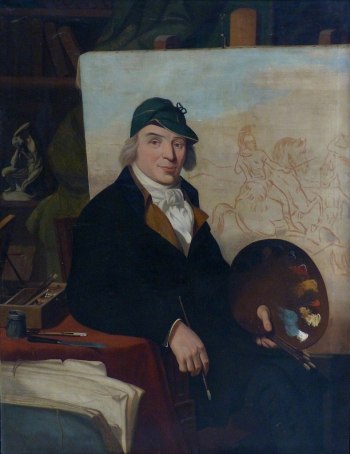
Attributed to Guillaume-Joseph Roques, Portrait of Jacques Gamelin, ca. 1777–85, oil on canvas (Cathédrale Saint-Michel de Carcassonne).
This colloquium is the culmination of three years of research under the aegis of the ACA-RES research programme on art academies and their networks in pre-industrial France (Les académies d’art et leurs réseaux dans la France préindustrielle). It aims to provide new perspectives and build upon this research and collaborative initiatives. Since 2016 the ACA-RES research programme has worked towards shedding further light on art academies and drawing schools in the French provinces between 1740 and the early 19th century. It has built on previous studies by art historians and historians, by focusing on networks and networking across France and beyond. This approach was based on the belief that these fifty or so educational institutions were the expression of a town’s culture as well as a node where men, objects and knowledge functioned on different levels. The objective was to investigate the role of these institutions in Enlightenment society, not only locally, but also within the context of European and international movements.
Three study days, whose proceedings are now on the Hypothèses programme webpage, led to reflections around the following three themes: the human, social and legal circumstances, workings, and establishment of art academies and drawing schools; the importance of movement whether through travel, migration, correspondence, or the circulation of artistic and literary works; and, finally, the often multidisciplinary character of meetings and teaching, which viewed artistic production in the provinces through the lens of utility, fine arts, craft, science, and literature (belles-lettres) being believed to stimulate each other. Collaboration with researchers in Sociology and in Digital Humanities structured and enhanced these reflections. The other issue for the research programme was to challenge the reality of our subject through new ways of doing research. Guided by the philosophy of open access, the purpose of ACA-RES is to offer the academic community all research data and results: digitised archives, digitised library, Zotero bibliography, potted institutional histories, new online articles, relational database, virtual exhibition, etc. All this material is available at the ACA-RES website and can be used by researchers to feed their proposals and future research.
This colloquium invites the rethinking of the role of provincial academies in the administration of the arts in the 18th century and in the formulation of ideas about them. Its ambition is to study this aspect of the history of the French regions in the context of a wider history of France and Europe and to do so by harnessing micro-historical and macro-historical methods. To what extent did artistic careers depend on academies for skills and/or reputation? What did art as an epistemological field gain in practice and thought in these places? What role did these institutions hold outside or in close association with academies in capital cities, given their institutional organisations, forms of sociability, and role as conduits for theoretical and practical knowledge? How did they interact with each other and with other geographical areas and other social circles (literary salons, Freemason gatherings, and agricultural societies)? At heart, the colloquium aims to question whether art academies and drawing schools were sensitive conduits for the diffusion and circulation of artistic and cultural knowledge in Europe, or whether their function was purely honorific. The great academies of Europe’s capitals—a subject for which there is a considerable bibliography—should only be broached in colloquium papers in terms of their relationships with provincial academies.
We welcome proposals for papers exploring the following four themes:
The first theme will focus on approaches that embrace several comparative examples, rather than on a single town, a single school of design or academy, thus permitting reinterpretation of known case studies. Papers might focus, for example, on the teaching of architecture, sculpture, etc., on the link between fine arts, crafts and manufacturing, on the link between art and literature (belles-lettres) or science, on women’s or members’ position in provincial academies, on exchanges between the ‘great’ European academies in capital cities and less important institutions in the provinces, etc., and on the circulation of models and teaching aids between different institutions.
The second theme will consider noteworthy case studies by examining pioneering institutions or personalities that stood out in provincial academies and among their adherents. These actors could comprise an artist who headed an institution, or a member affiliated to several academies, or an amateur whose actions had a significant impact on an academy and its history. The purpose is not simply to trace the biography of an individual but also to capture his or her actions and impact on his/her contemporaries, and to underline his/her links with his/her peers etc.
The third theme will allow for both a detailed and comparative view, highlighting cases and situations which our three-year project has not explored so fully, but which will be developed in our future work. It looks towards international exchanges, in particular with Spain, Portugal, the Italian and German states, transatlantic colonies, etc. Comparisons between the 17th and later centuries will be welcomed, and from the 19th century to the present day.
The fourth focus will be on methodology, in particular new developments in research in art history. The three themes outlined already offer the opportunity to propose a paper on current research tools and methods and on the use of data. We invite research programmes that have worked on the digital publication of primary sources, on building relational databases, on creating virtual exhibitions, or researchers who have a particular resource to highlight among ACA-RES resources (a corpus of texts and pictures, digital archives, etc.) to contribute.
Calendar
Submission of one-page proposal in French or English comprising title, abstract, and biographical note for speaker: 6 September 2019 to programme.acares@gmail.com. Response of the scientific committee: mid-October 2019. Date of the colloquium: 26–28 March 2020 in Paris, INHA.
Publication
The colloquium will be followed by the publication of a collective work, which will subject to scrutiny and selection by the scientific committee. Final submission texts for publication: end of August 2020.
Organising Committee
Anne Perrin Khelissa, Émilie Roffidal, Laboratoire Framespa UMR 5136 CNRS, Université Toulouse-Jean Jaurès, with the collaboration of Markus Castor, Centre allemand d’histoire de l’art, Paris.
Scientific Committee
Nicolas ADELL, maître de conférence en anthropologie, UMR 5193, LISST, UT2J; Sylvain AMIC, conservateur en chef, Musée des beaux-arts de Rouen; Martine AZAM, maître de conférence en sociologie, UMR 5193, LISST, UT2J; Basile BAUDEZ, maître de conférence en histoire de l’art moderne, Princeton University; Pascal BERTRAND, professeur d’histoire de l’art moderne, EA 538, Centre François-Georges Pariset, Bordeaux-Montaigne; Olivier BONFAIT, professeur d’histoire de l’art moderne, UMR 7366, Centre Georges Chevrier, Dijon; Charlotte GUICHARD, chargée de recherche CNRS, ENS; Michel GROSSETTI, directeur de recherche CNRS, UMR 5193, LISST, UT2J; Michèle-Caroline HECK, professeur d’histoire de l’art moderne, EA 4424, CRISES, Montpellier 3; Nathalie HEINICH, directeur de recherche CNRS, UMR 8566, CRAL; Pascal JULIEN, professeur d’histoire de l’art moderne, UMR 5136, FRAMESPA, UT2J; Thomas KIRCHNER, directeur du Centre allemand d’histoire de l’art, Paris; Gaëtane MAËS, maître de conférence HDR en histoire de l’art moderne, UMR 8529, IRHIS, Université de Lille; Véronique MEYER, professeur d’histoire de l’art moderne, Université de Poitiers; Christian MICHEL, professeur d’histoire de l’art moderne, UNIL, Lausanne; Lesley MILLER, Senior Curator of Textiles and Fashion, Victoria & Albert Museum, Professor of Dress and Textile History, University of Glasgow; Olivier RAVEUX, chargé de recherche CNRS, UMR 7303, TELEMME, Aix-Marseille 1; Martine REGOURD, professeur en sciences de l’information et de la communication, EA 785, IDETCOM, UT1 Capitole; Daniel ROCHE, professeur, Collège de France.
Call for Papers | Public Good(s)
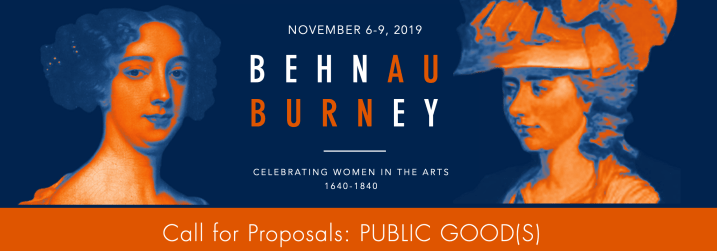
Public Good(s)
Biennial Conference of the Aphra Behn Society and the Frances Burney Society
Caroline Marshall Draughon Center for Arts & Humanities, Auburn University, 5–9 November 2019
Proposals due by 15 May 2019
Auburn University College of Liberal Arts will host the biennial joint meeting of the Aphra Behn and Frances Burney Societies November 5–9, 2019 at the Caroline Marshall Draughon Center for Arts & Humanities, located at historic Pebble Hill in Auburn, Alabama. In the spirit of the College’s work supporting humanities outreach to the public, we seek papers, roundtables, and workshops that engage with the idea of public good(s). As Behn and Burney both knew, public action is both vital and fraught, and working towards a better world can take many forms. We seek presentations and workshops that engage with the questions around public engagement and advocacy, historically and practically.
• How do we share what we know about the long tradition of women’s work in the arts in new ways to new audiences?
• What strategies do we have when faced with apathy or even hostility?
• How do the lives and work of women from the long eighteenth-century (1660–1840) speak to our current concerns?
• How do we grapple with misinformation, archival absences, and other challenges?
• Most importantly and most urgently: how do we decolonize the study of women writers and artists in keeping with the principles of #BIPOC18, #Bigger6 and #LitPOC values?
Formats
• Individual Papers: Traditional (12–15 minute) papers, to be delivered on panels.
• Roundtables: Groups of 4–5 speakers, each speaking for no more than 5 minutes, on a shared topic. Roundtable organizers are encouraged to solicit contributors publicly prior to submission, and to contact the organizers if they would like assistance.
• Workshops: Dedicated small (12 person) room will be set aside from workshops introducing interested attendees to a new method of research, teaching, or outreach. Participants will sign up at registration, and every attempt will be made to ensure that, and materials will be available after the conference. Leaders are sought for sessions on journal article submission, starting a digital project, new pedagogical techniques, managing a social media presence, outreach projects, and the like.
Keynote address by Dr. Patricia Matthew (Montclair State University), Thursday, 7 November 2019
More information is available here»
Call for Papers | Art and the Sea
From H-ArtHist:
Art and the Sea
Centre for Port and Maritime History Annual Conference
Liverpool John Moores University, 13 September 2019
Proposals due by 1 July 2019
Interest in maritime art and its role in art history has reignited in recent years, and this conference provides an opportunity for examination and reassessment of this field. The theme of Art and the Sea lends itself to interdisciplinary approaches and subject matter. It is anticipated that interest will arise from those working in art history, transport history, sociology, maritime studies, natural history, engineering, biology, and other areas. Submissions for conference papers on the theme of Art and the Sea from these and other disciplines are welcome.
The sea and maritime travel are subjects of universal fascination. For centuries, the sea inspired both fear and fascination and, unsurprisingly, these emotions fuelled artists and craftspeople to create work in response. Traversing the sea was often laborious which led to sailors developing new crafts or to vessels being decorated to entertain or provide interest. For the 2019 CPMH Conference, we consider these themes and aim to discover what current, cutting-edge research is revealing about the role of art and design in relation to the sea. We encourage the discussion of previous debates in the light of new evidence or approaches and the introduction of entirely new subject matter and methods. The conference theme is deliberately broad in scope, but potential themes / topics for discussion could include (but are not limited to)
• Maritime vessels as sites for art or art making
• The depiction of ships / ports / sea conditions in art
• Ship figureheads (significance / symbolism / creation)
• Art under the surface of the sea
• Maritime artists and their role in art history
• Museology of maritime art
• The intersection of natural history and maritime art
• Interior design of vessels
• Use of images of the sea for commercial purposes
Registration fees are £10 for non-concessions or free for concessions. There will be a conference reception during the evening of Friday, 13 September. Details will be circulated to delegates in due course. To submit an abstract for this year’s conference, please email a 250-word abstract to Dr Emma Roberts, CPMH Committee (e.e.roberts@ljmu.ac.uk) by the 1st of July 2019.
The Centre for Port and Maritime History—a collaborative venture between The University of Liverpool, Liverpool John Moores University, and Merseyside Maritime Museum—exists to further and facilitate historical research on port cities and their relationship to maritime endeavour and enterprise. Launched in 1996, the Centre builds on two Liverpool-based traditions. The School of History at The University of Liverpool has long been a respected centre for research and teaching in maritime history, particularly through the work of Francis Hyde, Peter Davies, and Sheila Mariner. Equally, curatorial staff at the Museum have established a strong record of research in the field, and of making their collections accessible to the scholarly community. The Centre is intended as an enabling forum, offering a focus for existing activity and a vehicle for launching new initiatives.
Call for Panel Proposals | ASECS 2020, St. Louis
2020 American Society for Eighteenth-Century Studies Conference
Hyatt Regency at the Arch in St. Louis, 19–21 March 2020
Session proposals due by 15 May 2019
 The 51st annual meeting of the American Society for Eighteenth-Century Studies takes place at the Hyatt Regency at the Arch in St. Louis, 19–21 March 2020. Proposals for panels, roundtables, and other sessions are now being accepted. The online submission form is available here. The deadline for proposal submissions is Wednesday, 15 May 2019.
The Program Committee also invites proposals for sessions in other formats, as well as for pre-conference workshops. In addition to explaining what the session would contribute to the annual meeting, special proposals should include a detailed description of the format and logistical requirements (e.g., technology, type of meeting space, particular days/times); an estimate of additional costs to participants or to ASECS (if any); and an explanation of how people would be chosen to participate (if it is not open to all conference attendees). If the event is a workshop that would have a facilitator or main presenter(s), provide a brief description of their expertise. The Program Committee may contact proposers for additional information before deciding on whether special sessions will be included on the Annual Meeting program. Proposals that cannot be accommodated in St. Louis may be considered for later annual meetings. If you have any questions, please contact the ASECS Business Office at asecsoffice@gmail.com.
Call for Papers | Un-Fair Trades
From the Call for Papers:
Un-Fair Trades: Artistic Intersections with Social and Environmental Injustices in the Atlantic World, 1500–Present
The Graduate Center, CUNY, New York, 10–11 October 2019
Hosted by the Art History Department, The Graduate Center, CUNY
Proposals due by 15 May 2019
Artists have engaged with issues of oppression and exploitation—byproducts of colonialist and capitalist systems—throughout the history of transatlantic encounters: from slavery and resource extraction; to exploitative labor practices and the environmental consequences of industrialization; and human rights movements and climate change anxieties of the past century. This conference will examine a multitude of artistic responses to increasing global connections, which could include plantation scenes, images of the Middle Passage, social reform photography, industrialized cityscapes, and images of workers and employment. When examined through the lens of our contemporary social and environmental concerns, artworks whose motifs intersect with these imbalances of power compel us to analyze the visualizations of oppression and environmental degradation from a new perspective. Amid the 21st-century activist revival (with movements like Occupy Wall Street, #BlackLivesMatter, #NODAPL, and #MeToo) it is more prescient than ever to acknowledge, examine, and reflect upon both historic and perpetuating inequalities.
Un-Fair Trades seeks to establish a forum for intersectionality, Pan-American approaches, and transnational perspectives. We welcome paper abstracts that utilize an array of theoretical approaches to the visual culture of the Americas, Europe, and Africa and intersect with the issues of equity, equality, and environmentalism. We invite proposals for papers that critically engage with, but are not limited to, depictions of
• Native artists and indigenous populations amid forced migration and assimilation
• Harvested land and the plantation economy.
• Forced labor, the Middle Passage, and the Triangle trade
• The visual, economic, and social treatment of minority populations
• Scientific expeditions, expansionism, and extractive industries in the American West
• Exploitative labor practices, trades, and environmental damage caused by the Industrial Revolution
• Women’s work, expanding economic independence, and the suffrage movement
• Immigration, xenophobia, and the ‘melting pot’
• African Diaspora, the Harlem Renaissance, and Pan-Africanism
• Social Reform initiatives
Keynote Speakers: Dr. Alan C. Braddock and Dr. Charmaine A. Nelson
Proposals should be submitted to Caroline L. Gillaspie and Alice J. Walkiewicz at unfairtradesconference@gmail.com by 15 May 2019. Please include a 300-word abstract and a current CV. Applicants will be notified of acceptance by mid-June.
Call for Papers | Goldsmiths and Bankers as Collectors
From the Call for Papers:
Goldsmiths and Bankers as Collectors
Goldsmiths’ Hall, London, 28 October 2019
Proposals due by 10 May 2019

Francis Harding and Michael Dahl, Portrait of Henry Hoare I (1677–1725), oil on canvas (National Trust, Stourhead).
2019 will see the return to Osterley Park of one of the many remarkable Old Master paintings acquired by the Child family in the throes of Britain’s late 17th-century financial revolution. The Childs are part of a long line of goldsmiths and bankers who have collected and patronised the fine and decorative arts, from the Medici in Florence to the present-day Rothschilds who continue to be highly active across the cultural sphere. As these financial dynasties interacted and integrated with ruling elites, collecting and associated displays of taste, sophistication and magnificence became a much favoured and often extremely effective route to social and cultural distinction. Financiers may be most obviously associated with an urban context, from the medieval livery company to the modern hedge fund, but the country house was and is an important venue for the display of their patronage and collecting. Among the holdings of the National Trust alone examples of estates with connections to goldsmithing and banking abound including, in addition to Osterley, Chirk Castle, Erddig, Trelissick, Stourhead, Mottisfont, Studley Royal, Waddesdon, and Ascott.
This conference will bring together academics and curators to seek patterns of patronage across this influential and diverse social grouping. It will identify the range of social, economic and political motivations for their participation in high material culture and explore case studies of particular individuals, objects and places to illustrate the sheer variety of manifestations of the goldsmith and banker as collector and patron. Papers are invited on, but by no means limited to, the following topics:
• Goldsmiths and bankers as collectors and their collections from medieval to modern
• Trends in collecting and patronage amongst goldsmiths and bankers
• Case studies of individual patrons, collectors, makers, or suppliers
• Case studies of individual objects or places
• Comparisons with collectors from other social or economic groupings
• Consumption and social mobility in banking and goldsmithing dynasties
• Perspectives of modern collectors
The conference programme will be comprised of a keynote address and a series of 20-minute papers. Proposals for panels will be accepted. We hope to publish a selection of revised conference papers in a peer-reviewed journal or as an edited collection after the conference. Please send abstracts of between 200 and 300 words along with short biographies to richard.ashbourne@nationaltrust.org.uk by Friday, 10th May 2019.
This conference is organised by the National Trust with support from the Goldsmiths’ Company. Conference convenors: James Rothwell, NT Adviser on Silver; Lucy Porten, NT Curator for Osterley; John Chu, NT Assistant Curator of Pictures & Sculpture; Pippa Shirley, Head of Collections, Waddesdon Manor (Rothschild Foundation).
Find out more about the National Trust’s research strategy here. Click here for more information about Osterley Park.










leave a comment