Call for Panel Proposals | ASECS 2020, St. Louis
2020 American Society for Eighteenth-Century Studies Conference
Hyatt Regency at the Arch in St. Louis, 19–21 March 2020
Session proposals due by 15 May 2019
 The 51st annual meeting of the American Society for Eighteenth-Century Studies takes place at the Hyatt Regency at the Arch in St. Louis, 19–21 March 2020. Proposals for panels, roundtables, and other sessions are now being accepted. The online submission form is available here. The deadline for proposal submissions is Wednesday, 15 May 2019.
The Program Committee also invites proposals for sessions in other formats, as well as for pre-conference workshops. In addition to explaining what the session would contribute to the annual meeting, special proposals should include a detailed description of the format and logistical requirements (e.g., technology, type of meeting space, particular days/times); an estimate of additional costs to participants or to ASECS (if any); and an explanation of how people would be chosen to participate (if it is not open to all conference attendees). If the event is a workshop that would have a facilitator or main presenter(s), provide a brief description of their expertise. The Program Committee may contact proposers for additional information before deciding on whether special sessions will be included on the Annual Meeting program. Proposals that cannot be accommodated in St. Louis may be considered for later annual meetings. If you have any questions, please contact the ASECS Business Office at asecsoffice@gmail.com.
Call for Papers | Un-Fair Trades
From the Call for Papers:
Un-Fair Trades: Artistic Intersections with Social and Environmental Injustices in the Atlantic World, 1500–Present
The Graduate Center, CUNY, New York, 10–11 October 2019
Hosted by the Art History Department, The Graduate Center, CUNY
Proposals due by 15 May 2019
Artists have engaged with issues of oppression and exploitation—byproducts of colonialist and capitalist systems—throughout the history of transatlantic encounters: from slavery and resource extraction; to exploitative labor practices and the environmental consequences of industrialization; and human rights movements and climate change anxieties of the past century. This conference will examine a multitude of artistic responses to increasing global connections, which could include plantation scenes, images of the Middle Passage, social reform photography, industrialized cityscapes, and images of workers and employment. When examined through the lens of our contemporary social and environmental concerns, artworks whose motifs intersect with these imbalances of power compel us to analyze the visualizations of oppression and environmental degradation from a new perspective. Amid the 21st-century activist revival (with movements like Occupy Wall Street, #BlackLivesMatter, #NODAPL, and #MeToo) it is more prescient than ever to acknowledge, examine, and reflect upon both historic and perpetuating inequalities.
Un-Fair Trades seeks to establish a forum for intersectionality, Pan-American approaches, and transnational perspectives. We welcome paper abstracts that utilize an array of theoretical approaches to the visual culture of the Americas, Europe, and Africa and intersect with the issues of equity, equality, and environmentalism. We invite proposals for papers that critically engage with, but are not limited to, depictions of
• Native artists and indigenous populations amid forced migration and assimilation
• Harvested land and the plantation economy.
• Forced labor, the Middle Passage, and the Triangle trade
• The visual, economic, and social treatment of minority populations
• Scientific expeditions, expansionism, and extractive industries in the American West
• Exploitative labor practices, trades, and environmental damage caused by the Industrial Revolution
• Women’s work, expanding economic independence, and the suffrage movement
• Immigration, xenophobia, and the ‘melting pot’
• African Diaspora, the Harlem Renaissance, and Pan-Africanism
• Social Reform initiatives
Keynote Speakers: Dr. Alan C. Braddock and Dr. Charmaine A. Nelson
Proposals should be submitted to Caroline L. Gillaspie and Alice J. Walkiewicz at unfairtradesconference@gmail.com by 15 May 2019. Please include a 300-word abstract and a current CV. Applicants will be notified of acceptance by mid-June.
Call for Papers | Goldsmiths and Bankers as Collectors
From the Call for Papers:
Goldsmiths and Bankers as Collectors
Goldsmiths’ Hall, London, 28 October 2019
Proposals due by 10 May 2019

Francis Harding and Michael Dahl, Portrait of Henry Hoare I (1677–1725), oil on canvas (National Trust, Stourhead).
2019 will see the return to Osterley Park of one of the many remarkable Old Master paintings acquired by the Child family in the throes of Britain’s late 17th-century financial revolution. The Childs are part of a long line of goldsmiths and bankers who have collected and patronised the fine and decorative arts, from the Medici in Florence to the present-day Rothschilds who continue to be highly active across the cultural sphere. As these financial dynasties interacted and integrated with ruling elites, collecting and associated displays of taste, sophistication and magnificence became a much favoured and often extremely effective route to social and cultural distinction. Financiers may be most obviously associated with an urban context, from the medieval livery company to the modern hedge fund, but the country house was and is an important venue for the display of their patronage and collecting. Among the holdings of the National Trust alone examples of estates with connections to goldsmithing and banking abound including, in addition to Osterley, Chirk Castle, Erddig, Trelissick, Stourhead, Mottisfont, Studley Royal, Waddesdon, and Ascott.
This conference will bring together academics and curators to seek patterns of patronage across this influential and diverse social grouping. It will identify the range of social, economic and political motivations for their participation in high material culture and explore case studies of particular individuals, objects and places to illustrate the sheer variety of manifestations of the goldsmith and banker as collector and patron. Papers are invited on, but by no means limited to, the following topics:
• Goldsmiths and bankers as collectors and their collections from medieval to modern
• Trends in collecting and patronage amongst goldsmiths and bankers
• Case studies of individual patrons, collectors, makers, or suppliers
• Case studies of individual objects or places
• Comparisons with collectors from other social or economic groupings
• Consumption and social mobility in banking and goldsmithing dynasties
• Perspectives of modern collectors
The conference programme will be comprised of a keynote address and a series of 20-minute papers. Proposals for panels will be accepted. We hope to publish a selection of revised conference papers in a peer-reviewed journal or as an edited collection after the conference. Please send abstracts of between 200 and 300 words along with short biographies to richard.ashbourne@nationaltrust.org.uk by Friday, 10th May 2019.
This conference is organised by the National Trust with support from the Goldsmiths’ Company. Conference convenors: James Rothwell, NT Adviser on Silver; Lucy Porten, NT Curator for Osterley; John Chu, NT Assistant Curator of Pictures & Sculpture; Pippa Shirley, Head of Collections, Waddesdon Manor (Rothschild Foundation).
Find out more about the National Trust’s research strategy here. Click here for more information about Osterley Park.
Call for Papers | At CAA 2020, Historic Libraries & Art Historiography
Dr. Musto plans to submit this proposal to CAA as a fully-formed, ‘complete session’, and she welcomes eighteenth-century submissions:
Historic Libraries and Art Historiography
College Art Association Conference, Hilton Chicago, 12–15 February 2020
Organized by Jeanne-Marie Musto
Proposals due by 22 April 2019
Currently seeking papers for a session exploring the potential of historic libraries to deepen and broaden our understanding of art historiography and its relationship to social, intellectual and geo-political currents. Such libraries include those not specifically intended for the study of art. This session will build on a theme introduced at CAA 2019, where a wide range of art-historical themes emerged from diverse libraries. These libraries range from early modern through twentieth century, across several continents, and survive intact or through inventories. Xu Bo’s library inventory, for example, offers a view into the role of art history in Ming dynasty regionalism, while the history of an individual Mexican codex within the National Library of Spain tells of the shifting winds of colonial and post-colonial cultural authority. But these libraries also tell of more than geopolitical concerns. They underline efforts to define the inchoate discipline of art history through a wide spectrum of materials. At the same time, they demonstrate active participation in art historical debates, and connections with artists and arts administrators. Papers that examine any aspect of the historiography of art emerging from the analysis of historic libraries will be welcomed. Please send proposals for a paper including title, abstract (250 words) and CV to Dr. Jeanne-Marie Musto, musto.jeannemarie@gmail.com. Additional information concerning the 2020 conference is available here.
Call for Panel Chair(s) | HECAA at ASECS, 2020
HECAA New Scholars Session at ASECS 2020
American Society for Eighteenth-Century Studies Conference, St. Louis, 24–28 March 2020
Chair nominations due by 20 April 2019
As part of its long-standing commitment to supporting the work of graduate students and younger scholars, HECAA has for many years used its panel at ASECS as a New Scholars Session. Since 2013, the session has been named in honor of Anne Schroder (1954–2010), a former HECAA president who was especially known for the interest she took in graduate students’ research. As we continue the tradition into 2020, the HECAA panel committee invites nominations (including self-nominations) for someone to chair the session (co-chairs are welcome). Please send a note of interest and a CV to Michael Yonan, convener of the HECAA panel committee, at yonanm@missouri.edu, by 20 April 2019. Questions may be directed to either Michael or Amelia Rauser at arauser@fandm.edu.
Call for Panel Proposals | HECAA at CAA, 2020
HECAA Panel and ASECS Panel at College Art Association, 2020
College Art Association Conference, Chicago, 12–15 February 2020
Proposals due by 10 April 2019
HECAA will submit two panels for the annual meeting of the College Art Association in 2020 (one panel belongs to ASECS but is delegated to us), and the panel committee now welcomes your proposals. Please send the title, a brief description (150–200 words), and a CV to Michael Yonan, convener of the HECAA panel committee, at yonanm@missouri.edu, by 10 April 2019. Please note if you have a preference for whether the session is assigned to HECAA or ASECS (in terms of the affiliate label); the ASECS session should—in keeping with the organization’s mission—open up broad, interdisciplinary possibilities. Questions may be directed to either Michael or Amelia Rauser at arauser@fandm.edu.
Details for submitting panel proposals for CAA 2020 as individuals (rather than with the support of an affiliate society) are available here; the due date is 30 April 2019.
◊ ◊ ◊ ◊ ◊
Note (added 1 April 2019) — The original posting did not include the note regarding the interdisciplinary scope of the ASECS panel.
Call for Papers | Above and Beyond: Ceiling Painting in the History of Art
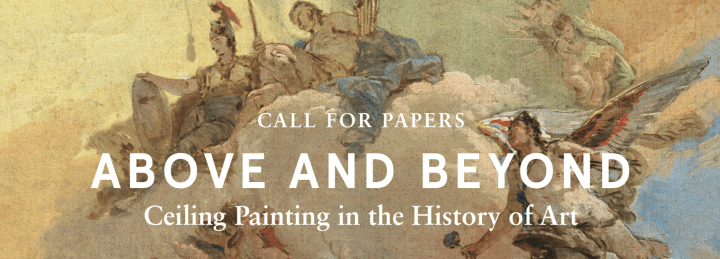
From the Call for Papers:
Above and Beyond: Ceiling Painting in the History of Art
The Frick Collection, New York, 27 June 2019
Proposals due by 2 May 2019
The Frick Collection is pleased to invite submissions for Above and Beyond: Ceiling Painting in the History of Art, a public symposium organized in conjunction with the special exhibition Tiepolo in Milan: The Lost Frescoes of Palazzo Archinto (April 16 to July 14, 2019). Tragically destroyed during World War II, Giambattista Tiepolo’s ceiling paintings for Palazzo Archinto (1730–31) represented allegorical and mythological scenes in magnificent, light-filled skies. The in situ effects of these grand frescoes may forever be lost, but the related oil sketches and drawings assembled for the exhibition provide insight into the absent originals—and into the particular challenges the ceiling poses as a site for painting.
Ceiling paintings tested early modern artists’ abilities to realize complex projects, demanding collaboration among painters, architects, carpenters, and legions of assistants on some of the largest paintings ever created. Seen from below, subjects such as triumphs and apotheoses required artists to resolve tensions between naturalism and abstraction in picturing the firmament, and to engage space in ways wholly foreign to easel painting.
An heir to the illusionistic tradition of Correggio, Charles Le Brun, and Baciccio, Tiepolo has long been recognized for his ‘pictorial intelligence’. Yet the practice of ceiling painting has an even longer history—from the miniaturist figuration of the Alhambra’s Sala de los Reyes to the historiated ceiling of the ex-monastery at Tecamachalco in Puebla to Yoko Ono’s Ceiling Painting, Yes Painting of 1966. Inspired by this expansive history, we welcome proposals for twenty-minute papers on the making and reception of ceiling paintings across time and place. Please send a CV and 250-word abstract by Thursday, 2 May 2019, to academic@frick.org. Submissions from emerging scholars, including early-career university and museum professionals and advanced doctoral students, are encouraged.
Possible topics and lines of inquiry include, but are not limited to:
• Issues of site and execution, from technologies of transfer to the collaborations and workshop models that facilitated projects of such a large scale and long duration
• Often-vexed connections between ceiling painting and theatricality, trompe l’oeil and architecture
• Modes of spectatorship; the impact of light and movement and liturgical or court activities on the viewer’s perception and circulation
• The sky as subject in both ecclesiastic and secular contexts
• Ceiling sculpture, particularly the role of stuccowork and coffering
• Ceiling painting’s place in art-critical discourse and treatises (Bosse, Lomazzo, de Piles); its status vs. that of easel painting
• Perspectival theories and techniques
• Ceiling paintings as vehicles for glorification of absolute rule, familial pride, the divine
• Challenges to the critical fortune of ceiling paintings, such as the difficulty of reproduction
Call for Papers | Ceramics as Sculpture

Pierre Giovanni Volpato, Personification of the River Nile, ca. 1785–95, hard-paste biscuit porcelain, Giovanni Volpato’s Factory Rome, 30 × 59 × 30 cm (New York: The Metropolitan Museum of Art; Purchase, The Isak and Rose Weinman Foundation Inc. Gift, 2001.456).
◊ ◊ ◊ ◊ ◊
From the Call for Papers:
Ceramics as Sculpture, French Porcelain Society
Study Day, with Journal Issue to Follow
Masterpiece London, 28 June 2019
Abstracts for the Study Day due by 1 May 2019
Article Proposals for the Journal due by 24 May 2019, with finished drafts due by 30 September 2019
The French Porcelain Society is pleased to announce that it will be holding a study day entitled Ceramics as Sculpture, celebrating figurative art, at this year’s Masterpiece London, on Friday, 28 June 2019, 10:00–1:30. This conference aims to open up wider discussion about the contemporary and historical contexts for ceramic sculpture and its place within art history. It also seeks to underline the primacy of sculpture in all the decorative arts, bringing together scholars, curators, artists, and dealers working in the interconnected fields of ceramics and sculpture. The subject will be explored in more depth in The French Porcelain Society’s 2020 journal, the leading academic, peer-reviewed English-language publication on European ceramics and their histories, illustrated in full colour.
The Society invites submissions for 20-minute conference papers and/or 6,000-word journal articles. Topics for consideration may include, but are not limited to the following:
• Replication as a craft strategy
• Intersections between ceramics and sculpture
• Sculptors: Della Robbia, Kaendler, Bustelli, Falconet, Willems, Gricci, Carrier-Belleuse, Scheurich, et al.
• Collectors of porcelain sculpture and methods of display
• Curation and museum presentations or exhibitions of ceramic sculpture
• Impact of material on sculpture, i.e. biscuit porcelain
• Production techniques
• Silver, porcelain, and gilt bronze: a joined-up art
• Contemporary ceramics as sculpture, including practice-led approaches
• Sculpture in the digital age
Call for Papers for Study Day
Deadline: 1 May 2019, with successful notification by 7 May 2019
Please submit a summary of no more than 300 words with a short biography to Caroline McCaffrey-Howarth c.mccaffrey-howarth@leeds.ac.uk.
Call for Articles for Journal
Deadline: 24 May 2019, with successful notification by 7 June 2019
Submissions in the first instance should be a summary of no more than 500 words, with a brief description of the argument, a historiography and a note of the research tools and sources used. Please include a brief biography. The journal accepts articles in French as well as in English. The volume will comprise about 15 articles which will be peer reviewed by the editorial board and the FPS council of academic and museum specialists which includes: Dame Rosalind Savill, DBE, FBA, FSA (Curator Emeritus, The Wallace Collection, London); Oliver Fairclough, FSA; John Whitehead, FSA; Errol Manners, FSA; Patricia Ferguson; Dr. Diana Davis; and Caroline McCaffrey-Howarth (University of Leeds). Articles should be no more than 6,000 words in length excluding endnotes. Up to 15 high-resolution images per article will be accepted. Please send abstracts as an email attachment to Patricia Ferguson patricia.f.ferguson@gmail.com, Caroline McCaffrey-Howarth c.mccaffrey-howarth@leeds.ac.uk, and Diana Davis diana_davis@hotmail.co.uk, by 24 May 2019. If your abstract is accepted, articles and images will be due by 30 September 2019.
For more details about the Study Day and to book a place at £45, please visit the Society’s website.
Call for Papers | Embodying Romanticism

From the conference website:
Embodying Romanticism: Romantic Studies Association of Australia 2019 Conference
University of New South Wales Canberra, 21–23 November 2019
Proposals due by 30 June 2019
Although the body has preoccupied literary scholarship for some time, there has been a renewed attention in Romantic studies to the complex ways in which literature encodes and reproduces our awareness of embodied experience. Challenging views of Romanticism as bounded by visionary and idealist expression, such work reflects a reorientation of criticism around the materiality of Romantic culture, whether configured as part of the age of sensibility or in relation to the era’s natural and social sciences. The Romantic period was, moreover, a time when control of the body emerged as a key political issue in workshops, homes, battlefields and colonies, when bodies were subject to rapidly evolving ideas of gender, class and race, while new bodies of knowledge and corporate political bodies emerged to regulate the affairs of nations and empires. This was a period when bodies were subject to ever more intensive modes of analysis and management, at the same time that bodies imposed their transgressive physicality through new understandings of environments, vitalism, trauma, slavery, disease and taste. Attentive to such developments, Romantic studies in turn dovetails with a broader materialist emphasis that explores how bodies are shaped in relation to affect, biopolitics, speculative realism, post-humanism and eco-criticism. Alain Badiou has recently proposed that our modern, liberal ideology can today only perceive two objects: bodies and language. Aligning itself at the conjuncture of these two terms, this conference invites papers that broadly consider how embodiment was evoked, challenged and understood in Romantic cultural life.
We invite proposals for 20-minute papers on any aspects of Romanticism and embodiment. Proposals may be for individual papers or for panels of 3–4 papers. Papers might consider such topics as:
• Affects and embodied emotions
• Sensibility and materialist epistemologies
• Materials, objects, things
• Life, organicism, vitality
• Theatre, bodies on stage, celebrities
• Spaces, environments, atmospheres
• Architecture, buildings and the body
• Medicine, surgery
• Slavery and transportation
• Biopolitics/biopower and the body politic
• Labour, work, maternity
• Sexuality and gender
• Corpses, death, graves
• Race, empire, colonialism
• Disabled bodies, monsters, illness
• Planetary bodies, heavenly bodies, cosmology
• Texts and paratexts
• Bodies of knowledge
• Animals and humans
• Organisations and institutions
Abstracts of approximately 250 words are due by 30 June 2019. Please send abstracts to the conference convenor, Neil Ramsey, at n.ramsey@unsw.edu.au. Postgraduate bursaries are available. See the conference website for details.
Call for Essays | Enslavement and Material Culture
From the Amart-l listserv:
Special Issue of Winterthur Portfolio: Enslavement and Material Culture
Edited by Jennifer Van Horn and Catharine Dann Roeber
Proposal due by 15 April 2019; draft manuscripts due summer 2019
Twenty years ago, Winterthur Portfolio published a special issue: Race and Ethnicity in American Material Life, which has become a standard source for scholars and students. In the decades since, race—in particular slavery—has emerged as an ever more vital subject of inquiry. Scholars have recognized slavery as a fundamental force in shaping not only North America’s past, but also its present and future.
We seek essays that examine how materiality was critical in the development, spread, and rejection of enslavement, as well as the vital role artifacts played for enslaved people of African and/or indigenous descent. We ask how material and visual artifacts used or produced in North America, including the Caribbean, have been instrumental in forging slavery and its afterlives. We question how objects participated in the rejection of slavery and the material expression of freedom. We are also interested in articles about object interpretation by museums, archives, and historical sites and in archaeological collections, buildings, or spaces associated with enslavement.
Our goal is to explore how slavery informs American material culture study today. We will consider essays that are case studies of individual artifacts, buildings, or makers, studies of collections of artifacts, or historiographical pieces, but are especially eager to see work that engages with current theoretical perspectives on materiality and slavery. We are also interested in research that responds to a broad notion of ‘America’, the Atlantic World, and the African Diaspora.
250–500 word proposals are due by April 15, 2019. Proposals should be submitted to guest editors Jennifer Van Horn and Catharine Dann Roeber at jvanhorn@udel.edu. Please also direct inquiries to jvanhorn@udel.edu. Draft manuscripts of approximately 10,000 words from selected authors will be due late summer 2019. Guest editors will provide comments for authors, and the resulting revised essays will be submitted by guest editors for peer review as a proposed special issue of Winterthur Portfolio.
Additional information is available here»










3 comments