Call for Papers | Rome and Lisbon in the 18th Century
From the Call for Papers:
Rome and Lisbon in the 18th Century: Music, Visual Arts, and Cultural Transfers
National Library of Portugal, Lisbon, 28–29 March 2019
Proposals due by 10 January 2019

Jean Ranc, Portrait of John (João) V, King of Portugal, 1729, oil on canvas, 109 × 91 cm (Madrid: The Prado).
Political, diplomatic, cultural, and artistic relations—including music and the visual arts—between Rome and Lisbon in the 18th century have, at different times, aroused the interest of several scholars. However, these research fields have often been approached in parallel paths within the traditions of each of the disciplines, without establishing in most cases a true dialogue between the different areas of knowledge and disregarding cross-cutting issues. On the other hand, the study of artistic relations and cultural transfers presupposes an in-depth and up-to-date view of the historical and social context of each city in their own peculiarities. This international conference intends to promote new approaches to the history of music and the arts through multidisciplinary dialogue involving different points of view. We invite researchers at any stage of their career, with backgrounds ranging from different fields (such as political, economic, cultural and art history, musicology, literature, and philosophy, among others) to send us a proposal.
We encourage submissions on the following topics, but other related issues might also be considered:
• Politics and diplomacy
• Arts, music, and diplomacy
• Royal, aristocratic, and cardinalic patronage
• Circulation of people between Rome and Lisbon (in political, religious, scientific, intellectual, and artistic spheres)
• Portuguese in Rome and Italians in Lisbon
• Foreign communities in Rome
• Circulation of musical repertoires, works of art, books, or scientific instruments
• Formal and informal training of musicians and artists
• Professional careers in the field of visual and performing arts
• Artistic, intellectual and sociability networks
• Spaces and institutions linked to music and the arts
• Stylistic issues and performance practices
Scholars are invited to submit proposals for individual papers with a maximum length of 20 minutes, as well as thematic panels with three or four communications (maximum duration: 1h30). Proposals should be submitted in English but presentations in Portuguese, Spanish, French, and Italian are also accepted. Please include complete contact information (name, email, and phone number), institutional affiliation, an abstract (300 words maximum), and a brief biographical note (150 words max). Proposals should be submitted no later than 10 January 2019, and sent to romeandlisbon@gmail.com.
Parallel with the symposium, the National Library of Lisbon will host the exhibition From the Tagus to the Tiber: Portuguese Musicians and Artists in 18th-Century Rome, curated by Pilar Diez del Corral and Cristina Fernandes.
Organization
• Research group ‘Historical and Cultural Studies in Music’ from INET-md, Instituto de Etnomusicologia – Centro de Estudos em Música e Dança, Faculdade de Ciências Sociais e Humanas da Universidade Nova de Lisboa (NOVA FCSH)
• Department of Art History, Universidad Nacional de Educación a Distancia (UNED), Madrid
Board of Directors
• Pilar Diez del Corral Corredoira
• Cristina Fernandes
Scientific Committee
• Manuel Carlos de Brito (NOVA FCSH, Lisboa)
• Elisa Camboni (Accademia Nazionale di San Luca, Roma)
• Pilar Diez del Corral Corredoira (UNED, Madrid)
• Cristina Fernandes (INET-md, NOVA FCSH, Lisboa)
• Anne-Madeleine Goulet (CNRS, Projecto Performart-Roma)
• Teresa Leonor M. Vale (ARTIS, Universidade de Lisboa)
• Rui Vieira Nery (INET-md, NOVA FCSH/Fundação Gulbenkian, Lisboa)
Call for Papers | World-Making, 1500–1800
From the Early Modern Center at the University of California, Santa Barbara:
World-Making, 1500–1800
University of California, Santa Barbara, 22–23 February 2019
Proposals due by 7 December 2018 (extended from 20 November 2018)

Frans II Francken, Allégorie de l’Occasion, detail, 1628 (Musée d’art et d’archéologie du Périgord).
The Early Modern Center at the University of California, Santa Barbara invites proposals for our annual conference, World-Making, 1500–1800, to be held on February 22 and 23, 2019. We are happy to announce our two keynote speakers: Su Fang Ng (Clifford A. Cutchins III Professor and Associate Professor of English, Virginia Tech) and Daniel O’Quinn (Professor in the School of English and Theatre Studies, University of Guelph).
Worldmaking, 1500–1800 will explore the ways in which worlds—large and small, local and global, conjectural and experiential—were conceived and created in early modern England. We invite conversations that address and interrogate the concept of ‘world’ broadly construed, as well as conversations that attend to the ‘making’ of worlds in social, institutional, and political frames and by and through various media. How is a world—or the world—represented, portrayed, and evoked? How do such representations, portrayals, and evocations create worlds? What are the possible interactions between fictive world-making and lived experiences of the world?
Topics for panels and roundtables may include, but are not limited to
• the global early modern
• worldmakers
• gender, sexuality, trans, and queer studies in the global early modern
• critical race studies
• global mobilities
• travel narratives / narratives of exploration
• mapping and making
• worlds of writing and print
• global media and technology
• translation and mediation
• currency, capital, and trade
• fictive worlds and their makers
• religious worlds
• utopias, dystopias, apocalypses, and imagined futures
• creating and representing worlds on stage
• early modern embodiment and the body’s relation to world
• worlds shaped by affect, emotions, and mind
• the phenomenal world and ‘world’ in phenomenology
• historiography
• making and conjuring worlds of the archive
We invite abstracts of 150 to 200 words and a one-page CV to be sent to emcfellow@gmail.com by December 7, 2018. We envision and invite both twenty-minute panel presentations and ten-minute roundtable presentations; we will also consider complete panel or roundtable proposals. If you have further questions, please feel free to contact the conference organizer, Unita Ahdifard, at emcfellow@gmail.com.
Call for Papers | Cultural Transfer and Competition: German Courts
From the Call for Papers, which includes the full French version:
Konkurrenzkultur und Kulturtransfer: Höfische Repräsentationsstrategien im Alten Reich, 1650–1800
Transfert culturel et culture de concurrence: Stratégies de représentation des cours de l’ancien Empire germanique, 1650–1800
Westfälische Wilhelms-Universität Münster, 30 September — 4 October 2019
Proposals due by 6 January 2019
Veranstaltet vom Institut für Kunstgeschichte der Westfälischen Wilhelms-Universität Münster in Zusammenarbeit mit der École Pratique des Hautes Études, PSL (Équipe HISTARA 7347), Paris, und dem LWL-Museumsamt für Westfalen in Münster
Das Forschungsatelier widmet sich höfischen Repräsentationsstrategien im Alten Reich von 1650-1800. Es richtet sich an internationale Nachwuchswissenschaftler*innen, die zur europäischen Hofkunst arbeiten. Dabei liegt der Fokus auf der Konkurrenzsituation der Reichsfürsten und dem vor diesem Hintergrund erfolgten Kulturtransfer zwischen Deutschland und Frankreich.
Angesichts der jeweils spezifischen Situation der einzelnen deutschen Höfe konnten französische Kunstformen nur bedingt modellhaft wirken, waren jedoch wegen ihrer künstlerischen Qualität und Aktualität in höchstem Maße attraktiv. Deshalb wurden bestimmte Elemente aufgegriffen und für die eigenen Strukturen fruchtbar gemacht. Die interhöfische Konkurrenzsituation im Alten Reich potenzierte diesen Vorgang und förderte zugleich – so die grundlegende These – innovative künstlerische Lösungen. Die hierbei wirksamen Mechanismen, Agenten, Produkte, aber auch die entstehenden Konflikte, Brüche und Widerstände stehen im Blickpunkt des deutsch-französischen Forschungsateliers.
Dem stellt sich die Situation im zentralistisch regierten Frankreich entgegen: Welche Konkurrenzen sind hier festzustellen? Wie präsentiert sich der Adel im Verhältnis zum König? Unterscheiden sich die Repräsentationsstrategien von jenen im Alten Reich und welche Modelle lassen sich im europäischen Vergleich ausmachen? Gerade im Vergleich mit der Machtstruktur der französischen Monarchie und anderer europäischer Hofkulturen werden die Dynamiken der Konkurrenzsituation deutscher Höfe umso plastischer – und umgekehrt. Aktuelle Tendenzen der Residenzforschung aufgreifend, widmen wir uns nicht nur den Paraderäumen, sondern auch den Rückzugsorten, um zu einem umfassenderen Verständnis von Herrschaftsrepräsentation zu gelangen. Zu dieser Ganzheitlichkeit gehört auch die Vielgestalt der Medien: Berücksichtigung finden neben Architektur und Raumausstattungen jeglicher Art (wandfeste Teile und Mobiliar, Innenräume sowie Gartenkunst), Porträtkultur, Sammlungen oder ephemere Kunstformen (Feste, Aufführungen, Tafelkultur) usw. Mit dem LWL-Museumsamt für Westfalen als Partnerinstitution erweitert sich der wissenschaftliche Austausch um eine praktische Komponente durch die direkte Einbindung verschiedener musealer Einrichtungen. Museumsvertreter*innen übernehmen die Moderation bestimmter Sektionen bzw. empfangen uns in ihren jeweiligen Wirkungsstätten. Die Umsetzung universitärer Forschung im Museumsbetrieb wird so gezielt in die Diskussion eingebunden.
Das fünftägige Forschungsatelier wird finanziell unterstützt durch die Deutsch-Französische Hochschule. Es richtet sich an Nachwuchswissenschaftler*innen, die an einer deutschen oder französischen Institution eine Promotion oder eine Habilitation im Bereich der kunsthistorischen Forschung zur Hofkultur anstreben oder ein Postdoc-Projekt zu dieser Thematik durchführen (die Promotion darf nicht länger als vier Jahre zurückliegen). Insgesamt sind 18 Plätze zu besetzen. Die ausgewählten Teilnehmer*innen halten jeweils einen dreißigminütigen Vortrag aus dem Bereich ihrer Forschungen im oben beschriebenen Themenspektrum, woran sich jeweils eine fünfzehnminütige Diskussion anschließen wird. Wir bitten um die Einreichung Ihrer Bewerbung (ein einziges pdf-Dokument!) bis zum 6. Januar 2019 an kristina.deutsch@uni-muenster.de. Einzureichen sind ein tabellarischer Lebenslauf mit Publikationsliste und ein kurzes Exposé (max. 3000 Zeichen inkl. Leerzeichen) über das geplante Referat. Die Auswahl erfolgt nach wissenschaftlicher Qualifikation und Eignung des Themas.
Leitung
Prof. Dr. Eva-Bettina Krems (WWU Münster); Prof. Dr. Sabine Frommel (EPHE, Paris)
Organisation
Dr. Kristina Deutsch (WWU Münster); Dr. Ute-Christina Koch (LWL-Museumsamt für Westfalen, Münster/ Service muséal du LWL pour la Westphalie, Münster)
Call for Essays | Forms and Genres of Book Illustration
From the Call for Essays:
Forms and Genres of Eighteenth-Century Book Illustration
Edited by Leigh G. Dillard and Christina Ionescu
Proposals due by 1 December 2018; completed chapters due in January 2020
 Proposals are invited for a collection of essays designed for students and established researchers seeking an introduction to the field of eighteenth-century illustration, with special attention to its forms and genres. We invite proposals on a wide variety of topics, with particular interest in the following to fill gaps in our existing commitments:
• ballads
• broadsides
• children’s books
• criminal histories
• ephemera
• the epistolary tale
• funerary elegies
• the fantastic
• the historical romance
• literary almanacs
• literary galleries
• the philosophical tale
• songbooks
When possible, examples should be chosen from more than one national tradition. Please send 300–500 word proposals to Christina Ionescu (cionescu@mta.ca) and Leigh Dillard (leigh.dillard@ung.edu) by 1 December 2018. The deadline for the submission of completed chapters will be January 2020.
Call for Essays | Terra Foundation for American Art Essay Prize
Terra Foundation for American Art International Essay Prize
Submissions due by 15 January 2019
The Terra Foundation for American Art International Essay Prize recognizes excellent scholarship by a non-U.S. citizen working in the field of historical American art. Manuscripts should advance the understanding of American art by demonstrating new findings and original perspectives. The prize winner will be given the opportunity to work toward publication in American Art, the peer-reviewed journal copublished by the Smithsonian American Art Museum and the University of Chicago Press. The winner will receive a $1,000 cash award and a travel stipend of up to $3,500 to give a presentation in Washington, D.C., and meet with museum staff and research fellows.
Authors must be non-U.S. citizens who have achieved doctoral candidacy or completed a doctoral degree (or the equivalent), and have not previously had a manuscript accepted for publication in American Art. Essays may focus on any aspect of historical (pre-1980) American art and visual culture; however, architecture and film studies are not eligible. Essays may be submitted in any language; abstracts must be submitted in English.
Submissions for the 2019 prize must be sent to TerraEssayPrize@si.edu by January 15, 2019. For information on the prize, available in Chinese, English, French, German, Italian, and Spanish, please consult AmericanArt.si.edu/research/awards/terra.
Call for Papers | MAHS 2019, Cincinnati
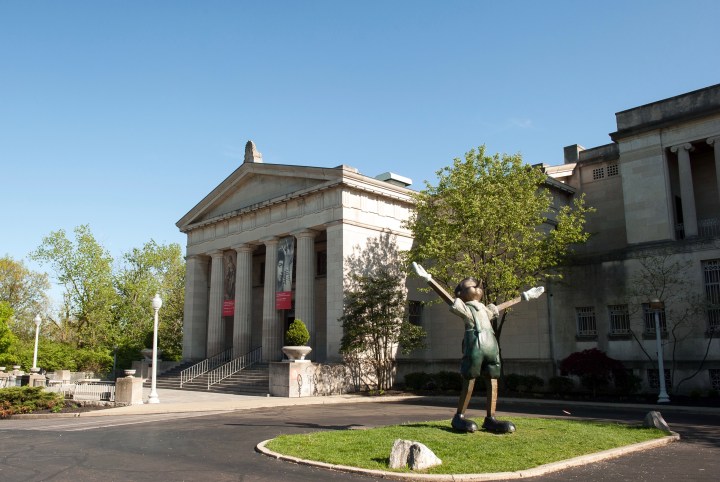
Cincinnati Art Museum, with Pinocchio (Emotional) by Jim Dine.
◊ ◊ ◊ ◊ ◊
From the MAHS Fall 2018 Newsletter:
46th Annual Conference of the Midwest Art History Society
Cincinnati Art Museum and Taft Museum of Art, 21–23 March 2019
Proposals due by 14 December 2018
The Midwest Art History Society (MAHS) will hold its 46th Annual Conference in Cincinnati, Ohio 21–23 March 2019, with sessions hosted by the Cincinnati Art Museum (CAM) and Taft Museum of Art and with a reception hosted by the Contemporary Arts Center.
This year’s keynote lecture will be given by Dr. S. Hollis Clayson, Bergen Evans Professor in the Humanities at Northwestern University, in association with CAM’s exhibition Paris 1900: City of Entertainment. Special behind-the-scenes programs at partner museums will make this conference a particularly memorable experience, including tours of the newly renovated Union Terminal, an iconic Art Deco train station now home to the Cincinnati Museum Center.
The following is a selection of sessions potentially relevant for eighteenth-century studies; please see the newsletter for the full listing.
◊ ◊ ◊ ◊ ◊
Does Size Matter?
Chair: Marjorie Wieseman (Paul J. and Edith Ingalls Vignos Curator of European Paintings and Sculpture, 1500-1800, Cleveland Museum of Art), bwieseman@clevelandart.org
This session invites papers that consider issues of scale in a work of art. How does the relative size of a work of art impact our understanding of it and our response to it? What are the artist’s considerations in determining the scale of a particular work? Proposals from all eras, media and cultures will be considered.
◊ ◊ ◊ ◊ ◊
In a New Context: The Movement and Reinterpretation of South and Southeast Asian Art
Chair: Kimberly Masteller (Jeanne McCray Beals Curator of South and Southeast Asian Art, The Nelson-Atkins Museum of Art), kmasteller@nelson-atkins.org
This session examines shifting functions and meanings of works of art and architecture from South and Southeast Asia. Papers may address the re-contextualizing of works of art and architecture in many ways, such as explorations of works that have shifted collections or are now in museum settings, to studies of architectural structures that were repurposed to serve di erent communities and functions. Paper proposals from students as well as from junior and senior scholars and museum professionals are encouraged.
◊ ◊ ◊ ◊ ◊
It’s All Academic: Reassessing Academies and Their Place in the Ecology of Art
Chair: Cheryl Snay (Curator of European Art, Snite Museum, University of Notre Dame), csnay@nd.edu
This session invites papers that investigate historical, pedagogical or theoretical aspects of art academies from their inception in the Renaissance through today in an effort to further the discussion on their (continued?) relevance and role in forming artists and producing art.
◊ ◊ ◊ ◊ ◊
Revising Architectural History in the Age of Globalization
Chair: Edson Cabalfin (Associate Professor, University of Cincinnati), edson.cabalfin@uc.edu
This panel explores new approaches in the historiography of architecture particularly in the age of globalization and neoliberalization. The panel seeks papers that address challenges and issues brought about by recent discussions on the engagement of local and regional histories with global architecture histories especially within the context of transnational flows and exchanges. Some possible questions that can be addressed include: How are local and regional architectural histories positioned in relation to larger global stories? What are possible new approaches in addressing diversity in architectural histories? How do you incorporate interdisciplinary and transnational approaches in architecture histories? How do you teach local architecture histories in relation to larger global architectural history surveys?
◊ ◊ ◊ ◊ ◊
Black Visual Networks: African American and Diasporic Art
Chair: Theresa Leininger-Miller (Professor of Art History, University of Cincinnati), theresa.leininger@uc.edu
Linking to ‘Spaces of Exchange’, this session concerns art by people of African descent that expresses connectivity. Papers might examine collaboration between artists, patronage, or work inspired by specific sites, concepts, visual images, or people. In what ways are artists of the African diaspora connected to each other or places outside the spaces where they live? How does that art serve/speak to varied communities? Topics from all periods are welcome.
◊ ◊ ◊ ◊ ◊
Textiles and Trade
Chair: Erica Warren (Assistant Curator of Textiles, Art Institute of Chicago), ewarren2@artic.edu
This session invites papers from all areas and periods of art history and will consider textiles as objects of global trade. Presentations might examine textiles and their role in transmitting information about design and technology between cultures or the way in which imported textiles informed domestic production.
◊ ◊ ◊ ◊ ◊
Europe in the 17th and 18th Centuries
Chair: Emily Everhart (Assistant Professor of Art History, Art Academy of Cincinnati), eeverhart@artacademy.edu
This session seeks papers on any topic in the history of art, architecture, and visual culture in seventeenth- or eighteenth-century Europe. Papers addressing intersections and exchanges between European and global art also are welcome.
◊ ◊ ◊ ◊ ◊
Decorative Arts and Design
Chair: Amy Dehan (Curator of Decorative Arts and Design, Cincinnati Art Museum), amy.dehan@cincyart.org
This session invites papers on topics of American or European decorative arts and design ranging from the eighteenth century to the present.
◊ ◊ ◊ ◊ ◊
East Asian Art
Chair: Miki Hirayama (Associate Professor, University of Cincinnati), miki.hirayama@uc.edu
This session welcomes papers on East Asian art from any time period in any medium.
◊ ◊ ◊ ◊ ◊
Gender and Identity in Art and Art History
Chair: Cynthia Amneus (Chief Curator/Curator of Fashion Arts and Textiles,
Cincinnati Art Museum), cynthia.amneus@cincyart.org
Gender and identity issues are top-of-mind today but certainly relate to art of the past as well. This session invites new research that explores gender and identity in a historical context or as these concepts relate to present social discussions. Papers addressing LGBTQ concerns including dress, male/female equality, sexuality or related topics are welcome.
◊ ◊ ◊ ◊ ◊
New Research on Midwestern Collections
Chair: Tamera Lenz Muente (Associate Curator, Taft Museum of Art), tmuente@taftmuseum.org
This session will feature research that sheds new light on objects in Midwestern public or private collections. Papers may focus on specific works in a collection, examine a collection in its entirety, or explore the collecting habits or history of an institution or individual.
◊ ◊ ◊ ◊ ◊
Prints and Drawings
Chair: Kristin Spangenberg (Curator of Prints, Cincinnati Art Museum), kristin.spangenberg@cincyart.org
This session invites new research or perspectives on American and European prints and drawings from the fifteenth century to the present. A focus on Midwestern artists, collectors, or collections is welcome.
Call for Articles | Boletín de Arte, Special Issue on Animals
From H-ArtHist:
Boletín de Arte 40 (2019), Special Issue: Animals and Art History
Edited by Reyes Escalera Pérez and Concepción Cortés Zulueta
Articles due by 28 February 2019 (in Spanish, English, French, or Italian)
As humans, we live surrounded by animals that we often ignore, or that we tend to substitute with or filter through our meanings, perceptions and symbolism. However, in recent decades animals have been increasingly present among the concerns and interests of our societies not just through their representations, but also as subjects and agents whose perspectives are worth considering. In parallel, animal studies (or human-animal studies) have reclaimed animals as a field of inquiry of the humanities and social sciences, including art history. This transversal approach is usually acquainted with biology and other related disciplines, interacts with other area studies (gender, postcolonial, queer, etc.), and is reinforced and may be accompanied by frameworks like posthumanism, or by environmental concerns.
This Animals and Art History issue of Boletín de Arte is open to address the subject of non-human animals from all periods, methodologies and approaches of art history. Possible topics include, but are by no means limited to, the following:
• Representations of animals (portraits, photographs, scientific illustrations, etc.)
• Biographies of historical or artistic animals
• Emblems and treaties on animals
• Museums and animals, animals inside the white cube
• Nature and symbology of animals
• Artistic genres or topics about animals
• Artists and their animals
• Artists who collaborate with other animals
• Animals as creators or artistic agents
• Cinema and animals
• Videos of animals on the Internet
• Animals, art and gender
• Animal activism and art
• Eco-art and animals
• Art or designs for other animals
• Animals and aesthetics
In order to be accepted for consideration and double blind peer reviewed evaluation, the articles have to address the topic of Animals and Art History with a maximum of 31,500 characters (including spaces) and with no more than 10 images. The submission has to be made on-line, by registering through the on-line platform of the Boletin. Please find detailed submission guidelines at the Boletín’s website (scroll down for the guidelines’ English version).
Boletín de Arte, an open access journal edited since 1980 by the Department of Art History, University of Málaga, proposes a special thematic issue commemorating its 40th anniversary. This special issue will focus on the representation, presence, and agency of non-human animals in art history and visual culture.
Please note that this CFP and special thematic issue affects only the ‘Articles’ and ‘Varia’ sections, not the sections of ‘Book Reviews’ and ‘Exhibition Criticism’. For any queries, contact Reyes Escalera (drescalera@uma.es) and Concepción Cortés (ccorteszulueta@uma.es).
Call for Session Proposals | EAHN 2020, Edinburgh
From EAHN:
European Architectural History Network Sixth International Meeting
University of Edinburgh, 10–13 June 2020
Proposals due by 31 December 2018
 EAHN2020 takes place at the University of Edinburgh. The call for sessions and roundtable proposals is now open, with details available here.
A UNESCO World Heritage Site since 1995, Edinburgh has a well-preserved Medieval Old Town, a New Town built in the early 19th century on Enlightenment principles, and some of the UK’s best examples of post-war modernism. Edinburgh is also the seat of the remarkable Scottish Parliament designed by Miralles Tagliabue EMBT, which opened in 2004. Edinburgh is a city in which questions of architectural history are unusually live: What to build, what not to build, and what to preserve are questions at the centre of both local and national political debate. EAHN2020 will be based in the central George Square campus and will make use of the extraordinary Playfair Library, amongst other notable buildings. Join us for an extensive programme of architectural tours, of the city and the region. EAHN2020 promises to be an outstanding conference. It will be accompanied by an exhibition at the Talbot Rice Gallery, with four specially commissioned works of art on an architectural theme.
Proposals are sought in two basic formats: (1) a session and (2) a roundtable debate. A session should consist of 4–5 paper presentations, with a respondent and time for dialogue and discussion at the end. A roundtable debate should be an organised as a discussion between panel members, and the format would suit topics of particular urgency or contemporary relevance. Roundtables should also aim to activate audience discussion as far as possible. Sessions and roundtables may be chaired by more than one person.
Anyone wishing to chair a session or a roundtable debate is invited to submit proposals by 31 December 2018. Chairs should make clear whether their proposal is a session or a roundtable. Please note that EAHN is self-funding, and chairs are expected to provide all their conference expenses, including travel and accommodation.
Key Dates
September 2018 Call for Sessions and Round Table Proposals opens
December 2018 Call for Sessions and Round Table Proposals closes
April 2019 Final selection of sessions and round tables
May 2019 Call for Papers opens
September 2019 Call for Papers closes
October 2019 Final selection of abstracts by chairs
December 2019 Draft Programme Available
January 2020 Early bird registration opens
February 2020 Registration Deadline for all chairs and speakers
March 2020 Comments on papers by chairs
April 2020 Submission of final version of papers
10–13 June 2020 EAHN International Conference
Call for Papers | Period Rooms as Hubs of Cultural Transfer
From H-ArtHist:
Period Rooms as Hubs of Cultural Transfer
Kunstgeschichtliches Institut, Ruhr-Universität Bochum, 23 May 2019
Proposals due by 25 November 2018
“Und gewiss wird man museologische Selbstverständlichkeiten und Tabus infrage stellen müssen […].” [1]
The period room is an international phenomenon that originated in 19th-century European museums and came to the USA at the beginning of the 20th century. The installation and furnishing of these “theaters of memory” [2] is possible only through networks of museum directors, curators, collectors, art dealers, and monument conservators. After a long time of neglect, the period room has recently regained its popularity among curators and artists due to its immersive and narrative potential.
As furnished interiors that combine the most diverse object types creating seemingly inhabited living rooms, period rooms provide an illusion of the lifestyle, the taste and thus the culture of an epoch or region. The demand to visually reconnect the exhibit to its history and origin—especially in terms of displaced cultural artifacts—entails a critical debate on established forms of museum presentation. Concerning the period room, the challenge of reconstructing the circumstances of the displacement of objects and the question how these objects are displayed arises in a special way. The object’s biography is neglected in favor of a homogenous image. How can this immersive display strategy meet the recently increasing demand to reveal the provenance of the single object?
This one-day workshop in Bochum is dedicated to these networks and the various forms of cultural exchange and transfers, particularly regarding the period room. The workshop will explore the structures and actors within the museum networks and the connections to the art market as well as the displaced objects, their provenance and their display. Workshop papers can deal with the following aspects, but do not have to be limited to them:
• Under which conditions does the displacement of objects (both national and international) take place?
• How can the museum networks and their connections to the art market be described? How are the networks organized and who has authority?
• Which arguments (e.g. by monument conservators) are put forward against the displacement of objects?
• What challenges do museums with period room collections face today with regard to uncertain provenance?
• To what extent is the presentation of period rooms used to stage ‘the familiar’ and ‘the foreign’? Which concepts of ‘the familiar’ and ‘the foreign’ are transported by period rooms?
• What concept of culture or cultural identity is pursued with the installation of period rooms?
• What are the conditions of acquiring and installing modern period rooms today?
The workshop is part of the research project Period Rooms: Between Exhibition Space and Living Room, Negotiating Past and Present (Period Rooms: Museale Verhandlungsräume zwischen Gegenwart und Vergangenheit, Ausstellen und Wohnen) funded by the German Research Foundation (DFG) and it is organized in cooperation with Dr. Andrea Meyer (Technische Universität Berlin).
Participants are asked to give a paper of about 30 minutes that will serve as the basis for the discussion in Bochum on 23 May. Please send an abstract (300 words) and a short CV by 25 November 2018 to Stefan Krämer (stefan.kraemer-b1c@rub.de), subject: Workshop Period Room. Travel and accommodation costs will be covered.
Notes
1 Bénédicte Savoy, Die Provenienz der Kultur: Von der Trauer des Verlusts zum universalen Menschheitserbe (Berlin 2018), 58.
2 Dominique Poulot, Abstract zum Aufsatz, “Asmodée au musée: Exposer les décors de l’intimité,” in Sandra Costa, Dominique Poulot, Marcedes Volait, eds., The Period Rooms: Allestimenti storici tra arte, collezionismo e museologia (Bologna 2016), 294.
Call for Papers | Social Technologies and Global Knowledge Economies
From Lichtenberg-Kolleg, the Göttingen Institute for Advanced Study:
Social Technologies and Global Knowledge Economies, 1750–1850
Lichtenberg-Kolleg, Göttingen, 4–6 April 2019
Proposals due by 15 November 2018
The remarkable density of connections that characterized knowledge production between 1750 and 1850 has long figured in definitions of the ‘rise of modernity’. The commerce of ideas through correspondence networks and print as well as manuscript circulation in salons, learned societies, and other institutions has been celebrated as foundational to modernity’s more conspicuous highlights, from the Scientific Revolution and the Enlightenment to the political articulation of universal human rights. Indeed, the circulation of ‘useful knowledge’—or, in today’s phraseology, the ‘knowledge economy’—remains integral to the modern concept of progress, formulated and adopted during the brief period between 1750 and 1850.
This interdisciplinary workshop, organized by Lichtenberg-Kolleg, the Göttingen Institute for Advanced Study, will focus on interrogating these narratives of modernity in the context of the emergence of an array of ‘social technologies’ that enhanced networks of knowledge production and circulation at the turn of the nineteenth century. From communication, transmission, and circulation, to innovations that enabled, impinged upon, or otherwise shaped social relations, we welcome papers on all aspects of socio-technological change and their relation to the development of global economies of knowledge production and circulation from 1750 to 1850.
Topics of interest include (but are not restricted to) the role of media (including paper, ink), technologies (including manuscript, print, electric impulses), and practices (including translation and taxonomy) in knowledge production; the role of collaboration and infrastructure in the circulation of knowledge; the changing roles of institutions (including schools, hospitals, prisons, universities, libraries, collections and gardens) in the wider knowledge economy; social environments and their relation to bodily technologies; and the development of revolutionary technology and radical media in this period.
We invite proposals for 20-minute presentations in English. To apply please email a title and abstract (no more than 300 words) along with a one-page CV in either MS Word or PDF format to the conference organizers (lichtenbergkolleg@zvw.uni-goettingen.de). Please include ‘Social Technologies’ in the subject line. Applications are due 15 November 2018. Applicants will be notified by 15 December 2018. Accommodation and travel will be provided to all confirmed participants. Please contact the conference organizer with any questions.










leave a comment