Call for Articles | Printing Things, 1400–1900
From the Abstract Submission Form:
Printing Things: Blocks, Plates, and Stones, 1400–1900
Edited by Giles Bergel and Elizabeth Savage
Abstracts due by 1 November 2018 (extended from 15 October); completed chapters due by 15 May 2019
In all fields based on historical printed material, research conventionally focuses on the text, images, and other information that was printed. The objects used to produce that information (including cut woodblocks, engraved metal plates, and cast metal sorts) have been neglected. Many hundreds of thousands of these historical printing surfaces survive today. The vast majority are inaccessible to researchers because they are uncatalogued and often considered ‘uncatalogue-able’. However, as individual objects and as an untapped category of cultural heritage, these artefacts of printing offer a great deal of information that the finished prints, books, fabrics, and other printed materials do not.
As relics of historical crafts and industry, these objects fall outside the modern disciplines. This edited volume will respond to the need for a multidisciplinary introduction to what image-based fields calls ‘print matrices’ and text-based fields call ‘printing surfaces’. Following from the conference Blocks Plates Stones (London, 2017), the first facilitated discussion of the use of such objects in research, Printing Things will represent the state of research in this new and developing field. It will bring together object-based research, collection-level surveys, historical printing practices, ethical considerations of their storage and use (or non-use) today, methods for multiplying the originals (e.g. dabs, stereos, electros), and methodological studies. By doing so, it will offer frameworks for describing, conserving, curating, presenting and understanding these objects using new and existing paradigms. It aims to facilitate their introduction into historical research across the disciplines.
Contributions are sought from art historians, book historians, cultural historians, musicologists, science and medicine historians, typographers, and researchers in other fields based on historical printed material; material scientists and conservators; historically informed printers and printmakers; curators, cataloguers, librarians, and printing museum managers who care for these objects; and digital humanities specialists who are creating a new generation of tools for culling information from these objects. The book will focus on handpress work.
In addition to object- and collection-based case studies, theoretical perspectives might include:
• What can print matrices/printing surfaces teach us that printed materials cannot, and vice versa?
• How should they be regarded: as artists’ tools, intermediary states of works of art, or works of art in themselves?
• Is there a value in considering woodblocks, metal plates, and litho stones together as a single category?
• What lies behind the sudden and recent increase in interest in these objects, and how can these objects inform those emerging research trends?
• How are they to be conserved, curated, presented, and understood?
• Does the recent turn to object-centered cultural criticism (‘thing theory’) provide useful paradigms for their study?
• What are the ethical and critical issues around bringing them back into use as printing surfaces?
• What is their place within the systems of digital remediation and knowledge within which art and book history is increasingly practiced?
Abstracts must be submitted by 15 October 2018. Chapters of 4,000–5,000 words (*including notes and captions*) with up to 10 illustrations will be due 15 May 2019 for publication in mid-2020. The book will be peer-reviewed and published in full colour. Contributors will be responsible for sourcing images and copyright for their contributions, but they will qualify for fee waivers from many heritage collections because the publisher is a charitable academic press. Please send queries to Gemma Cornetti at printingcolourproject@gmail.com.
Editors
Giles Bergel (Oxford), Elizabeth Savage (Institute of English Studies)
Advisory Board
Sven Dupré (Utrecht), Caroline Duroselle-Melish (Folger), Maria Goldoni (‘Xilografie modenesi’), Paul Nash (Printing Historical Society), Marco Mozzo (Polo museale della Toscana)
Call for Papers | Printmaking in Sulzbach
From the Book History and Print Culture Network:
Printmaking in the Residential Town of Sulzbach in Historical Context
Sulzbach-Rosenberg, 5–6 July 2019
Proposals due by 31 October 2018
The history of printing and bookselling in the 17th century is a first-rate research desideratum. While the Reformation as an incubation period and the 18th century as a turning point towards books as a mass medium can be regarded as fundamentally researched, especially from the point of view of economic history, little attention has been paid to the time in between. The specific situation in the Pfalzgrafschaft Sulzbach in the second half of the 17th century can be an impulse to examine the printing press guided by current approaches of cultural studies in media historiography and the history of science.
In the last third of the 17th century several printers worked in the residence town of Sulzbach, which—favoured by the tolerance policy of Palatine Count Christian August—produced books and other printed products of all kinds, partly in cooperation with publishers in Nuremberg, but also beyond that. Notable printshops included those of Abraham Lichtenthaler (1621–1704, from 1664 in Sulzbach), Georg Abraham Lichtenthaler (1684–1736), and Georg Abraham Lorenz Lichtenthaler (1711–1780), as well as that of Johann Holst (1648–1726). Above all, however, the founding of a Hebrew printing house in 1684, led by Moses Bloch, was based on the sovereign’s interest in Jewish culture on the one hand and can be regarded as a mercantilist project on the other—the success of which can be seen from the fact that it quickly became one of the leading Jewish printing houses in Europe.
There are some general remarks on the history of book printing in Sulzbach, but they do not take a closer look at the publisher’s programmes or address special features such as cooperation among publishers. For this reason, the Christian Knorr von Rosenroth Society is focusing its 2019 Annual Conference on letterpress printing in the residential town of Sulzbach in a historical context. The Society invites interested scholars from the fields of book science, history of science, theology, medicine, law and history, but also from philology, to participate in its interdisciplinary orientation. Contributions are welcome which help to classify the Sulzbach printshops and the printed products produced there historically, but also those which place the regional events in a larger context.
Already a first bibliographical indexing shows that the printers in Sulzbach did not least fall back on successful titles whose sales seemed to be secured. There are indications that the ‘Simultaneum’ decreed by the sovereign offered ideal conditions for the printing trade at the intersection between the Protestant territories of the imperial city of Nuremberg and the Franconian margraves on the one hand and the Catholic Amberg on the other. Finally, the establishment of the Hebrew printshop is the result of a sovereign intervention, from which synergies resulted; the Sulzbach printshops were obviously able to produce even complex and extensive prints. Blochsche Druckerei achieved a leading position in the production of Hebrew prints, which was preserved well into the 18th century, but Lichtenthaler Druckerei also continued to flourish among the following generations, so that the printing trade remained of great importance for the city even after the extinction of the dynasty and the associated loss of the residence until the 19th century (the history, however, of the Sulzbach printing works after the early modern period will not be the subject of the conference).
Based on the indexing of the preserved books from Sulzbach printing works in VD 17 (printing place: Sulzbach, Sultzbac*, Sulzbac*, Sulbac*, Solisbac*, Zûlṣbʾaḵ) and partly also in VD 18, potential subjects of lectures are:
• Book censorship in Sulzbach in historical comparison, the Sulzbach renewed censorship order 1669
• The relations of the Nuremberg publishers Endter and Hoffmann with printers in Sulzbach
• Questions on Hebrew printing
• Catholics in the printing house of a Protestant (e.g. Florentius Schilling, Georg Mentzius)
• Legal manuals, guides and case collections (Franz Friedrich von Andlern, Octavio Pisani)
• Travel literature, country descriptions, especially Turcica (Johann Sigmund Wurffbain, Johann Heinrich Seyfried, Caspar Bruschius)
• Medical literature (including publications by Georg Bartisch, Elias Beynon, Jan Baptista van Helmont)
• Individual authors (Michael Münchmeyer, Andreas Lazarus von Imhof, Johann Hieronymus Imhof, Adam Contzen, Clamerus Florinus)
• The equipment of the books (numerous prints contain copper)
• The card game as a medium (Andreas Strobl)
• Sulzbach calendars
The above topics are not meant to be exhaustive. The organisers are happy to receive suggestions for contributions with some characterising remarks on the subject of the study until 31.10.2018. Please email ernst.rohmer@ur.de or rosmarie.zeller@unibas.ch. The conference takes place in Sulzbach-Rosenberg on 5./6.7.2019. The conference papers will be published in Morgen-Glantz. Yearbook of the Christian Knorr von Rosenroth Society for the year 2020.
For speakers, the Society will raise subsidies to cover the costs of travel and accommodation in Sulzbach-Rosenberg. The conference starts on Friday at 2pm and ends on Saturday at 6pm. Sulzbach-Rosenberg is located on the A 6 (Nuremberg-Prague) or can be reached from Nuremberg and Regensburg by regional express trains every hour.
Prof. Dr. Ernst Rohmer
Universität Regensburg
Institut für Germanistik
Universitätsstraße 31
D-93053 Regensburg
Prof. Dr. Rosmarie Zeller
Universität Basel
Deutsches Seminar
Nadelberg 4
CH – 4051 Basel
Call for Papers | After the Grand Tour
From H-ArtHist:
After the Grand Tour: References, Revisions, Returns
Accademia Nazionale di San Luca, Rome, 12 April 2019
Proposals due by 15 November 2018
Ninth edition of the international symposium Grand Tour del Terzo Millennio: Researches on Art and Architectural History by Foreign Scholars and Artists in Rome. Previous editions were held at the University of Rome – Tor Vergata; this year’s symposium will be curated by the Rome Art History Network (RAHN) with the generous support of the Accademia Nazionale di San Luca and the Bibliotheca Hertziana – Max Planck Institute for Art History (Rome). It is organized by Iacopo Benincampi and Arianna Carannante, in collaboration with Anne Scheinhardt.
Between the eighteenth and the first half of the nineteenth century, Rome represented the main international cultural center of Europe. Consequently, many young and passionate ‘amateurs’ continued to go there, just to get closer to art as well as to specialize in their profession as artists. However, due to the political weakness of the Papal government, travelers did not set a permanent base in the city. They went back home with the certainty that their acquired knowledge would confer them a favorable advantage in the exercise of their profession. After all, the repertory of Roman sources remained an essential point of cultural reference for the construction, completion, and legitimation of modern identities in Europe. These were translated in an open-air catalogue of themes, formal models, and technical solutions with the power to inspire innovative elaborations, and to catalyze new compositional and constructional experiments.
Rome’s distinctiveness in this regard fostered its international significance and acted as an incentive for the foundation of foreign academies. To this day these institutions are a cultural compass for the scientific and artistic exploration of the city of Rome. The objective of this conference is to reflect on the inheritance of the experience of the Grand Tour, especially within the realm of the figurative arts and architecture. Our aim is to create a platform for comparing and reflecting on models of research by foreigners and Italian scholars in Rome.
Which instances of Rome’s artistic output—from contemporary and/or previous times—captured the interest of visitors and artists between the eighteenth and nineteenth centuries? What were the privileged mediums of their documentation (sketches, drawings, and so forth)? Once they returned home, which Roman works did Grand Tourists take as models for local experimentation, and how did these references come to be developed? What role did religious and lay patrons play in this regard? What social networks did they form during their Roman sojourn? What contacts did they maintain? Did anyone stay or return at a later point?
These themes will be addressed during the conference which will be held on 12th of April. Especially fellows, doctoral students, postdoctoral scholars, and professors in history of art and architecture from foreign institutions are invited to send proposals related to these themes.
Please send an abstract in Italian or English of 2,500 characters max (spaces included) and a bio of 1,500 characters max (spaces included) to convegno.grandtour@gmail.com by the 15th of November 2018. We will consider the possibility of publishing the conference proceedings.
Call for Papers | Performance, Royalty, and the Court, 1500–1800
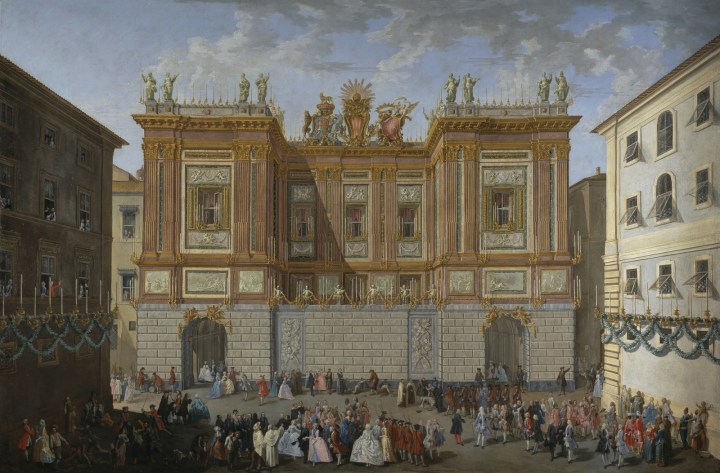
Paolo Monaldi, Prince James Receiving his Son Prince Henry in front of the Palazzo del Re, ca. 1747–48, oil on canvas, 196 × 297 cm (National Galleries of Scotland). The Palazzo del Re was home to the exiled Jacobite court in Rome. Owned by the Muti family, it was rented by the Papacy for the Old Pretender, James.
◊ ◊ ◊ ◊ ◊
From the Call for Papers:
Performance, Royalty, and the Court, 1500–1800
Society for Court Studies Conference
Paul Mellon Centre for Studies in British Art, London, 11–12 April 2019
Proposals due by 7 December 2018
Next year is the 400th anniversary of the death of Anne of Denmark (1574–1619), a queen consort of the king of Scotland, England, and Ireland, who is well known for her patronage of art, architecture, and court entertainments, in particular masques devised by Ben Jonson and Inigo Jones. To mark this important anniversary, The Society for Court Studies, with the support of the Paul Mellon Centre for Studies in British Art and Birkbeck College School of Arts, is organizing a two-day conference focusing on performance and the courts of the British Isles and continental Europe during the early modern period, with the opportunity to explore the networks and encounters between courts, both within and beyond Europe. The interdisciplinary nature of the topic necessarily embraces cultural, political and economic history, literature, and the visual and performing arts.
Performance was at the heart of the early modern period, with the court itself forming a stage for the construction, communication, and display of power and privilege—a world in which the social relationships that circulated around rulers, their families, and supporters took shape and found expression. Men and women played out a variety of important social, political, military, and governmental roles as well as participating in dramatic events, with court rituals and ceremonies providing occasions for demonstrations of authority, prowess, and magnificence. The architecture and decoration that surrounded the court, whether permanent or temporary, not only provided a physical setting but reinforced objectives and allegiances, as did dress, accoutrements, and entourage. The court also formed a rich source of inspiration for composers, playwrights, and actors—whether representing courts in their dramas, playing before the court, or devising masques and ballets with courtiers as performers. Equally, art and artistic patronage were of central importance, not only through the direct participation of painters, designers and craftsmen in ceremonies, dramas and other occasions, but also through portraiture and other forms of representation. Indeed, a work of art was often perceived and described as a performance.
In all its senses, performance represented opportunities for individuals and groups to find ways of expressing their ideals, their ambitions and aspirations, their frustrations and hostilities. This conference aims to bring this sense of opportunity to the study of the early-modern court, thinking in the broadest possible terms about how we can define our approaches and how, by taking the theme of performance as our guide, we can open up the study of the courtly world and its peoples to new scholarship and new audiences.
Suggested themes include, but are not restricted to:
• Political ritual and gift-giving
• Diplomacy, power play, and hospitality
• Gender and modes of performance
• Loyalties and affiliations
• Control and freedom
• Identity and values
• Court rituals and traditions
• Ceremonies, receptions, progresses and processions
• Reception, audience, and commentary
• Drama, dance, music, and speeches/addresses
• Cultural and social patronage
• Chivalric, sportive and martial performance (tournaments, barriers, manège)
• Trade, commerce, and entrepreneurship
• Visual arts as performance
• Architecture, interiors, settings and locations
Please send proposals of no more than 300 words along with a short biography to courtstudiesconference@gmail.com by Friday, 7 December 2018.
Convenors: Dr Janet Dickinson (Conference Secretary SCS and Oxford University) and Dr Jacqueline Riding (Committee Member SCS and Birkbeck College)
Call for Papers | Russia: Courtly Gifts and Cultural Diplomacy
From H-ArtHist:
Russia: Courtly Gifts and Cultural Diplomacy
The Queen’s Gallery, London, 22 March 2019
Proposals due by 15 October 2018
A collaboration between Royal Collection Trust, Cambridge Courtauld Russian Art Centre, and The Burlington Magazine, this one-day international academic conference takes its cue from the exhibition Russia: Royalty and the Romanovs, to be held at The Queen’s Gallery, Buckingham Palace, London, from 9 November 2018 to 28 April 2019.
The conference Russia: Courtly Gifts and Cultural Diplomacy will explore themes of courtly gift-giving and cultural diplomacy between Russia and the West, a history that sits within the broader framework of the history of British-Russian state and cultural relations [ca. 1698–1950s]. Scholarly research in these areas has flourished over the past few decades, and continues to generate debate and activity as the discipline of history itself has developed to encompass the study of material culture, sensory history and the history of emotions, domestic history, histories of power, ceremony and ritual, and internationalism and cross-cultural exchange. Increasing access to archives and the availability of new methodologies, not least the advent of the ‘digital’ humanities, have provided further opportunities for cutting-edge research. This conference accordingly embraces innovative methodologies from disciplines including history, art history, literature, area studies, and anthropology to explore ways in which Russia’s international relations have been forged, fermented, and fractured by the exchange of material objects in the social, cultural, and political spheres.
Papers are invited on the following themes:
• practices of gift-giving between the British and Russian monarchies and governments
• British-Russian cultural exchange at state and diplomatic level
• interactions between cultural diplomacy, art and politics
• cultural diplomacy and nationalism/imperialism
• gift-exchange in the formation of royal collections
• royal portraits as gifts
• the exchange of court artists, craftsmen and other cultural producers
• the role of ambassadors and cultural mediators
• royal photographs, photographs of royalty
• royal patronage in the cross-cultural context
• gift-giving and domestic court life
• family, marriage, and dynastic ties
• material culture and gift-giving
• the material accompaniments of royal travel and state visits
• transcultural ritual and ceremony
• custom, convention and protocol
• societies promoting cultural exchange between governments
• the forging of cultural links between state departments
• British artists and makers and Russian royal patronage (e.g., Godfrey Kneller, Christopher Galloway, George Dawe, Christina Robertson, Charles Cameron)
• Russian artists and makers and British royal patronage (e.g., Carl Fabergé, Savely Sorine)
Paper topics should relate to a British-Russian or British-Soviet context and, to complement the exhibition, may address any period from the late seventeenth to the mid twentieth century. Papers shall be twenty minutes long and will be organised into panels of two to four papers, with time allocated for questions on all papers at the end of each session.
Participation in the conference for both speakers and delegates will include an opportunity to visit the exhibition and an early evening drinks reception. In accordance with the event policy for conferences held at The Queen’s Gallery, the organisers will not be able to reimburse travel expenses or arrange accommodation for speakers. Some limited funding may become available as a result of grant applications that are in progress; if you wish to be considered for this, please provide an estimate of costs as part of your proposal.
Abstracts of up to 300 words should be submitted to Dr Louise Hardiman (Cambridge Courtauld Russian Art Centre) at courtlygifts2019@gmail.com. Please include a paper title, your name, institution (if applicable), brief biography, and full contact information (address, phone number, and email). Any questions about the conference may also be sent to the above email address.
Cambridge Courtauld Russian Art Centre (CCRAC) is an academic collaboration between the Department of History of Art at the University of Cambridge and The Courtauld Institute of Art. CCRAC promotes research, collaboration and scholarly debate on all aspects of the visual arts, architecture, design, and exhibitions in Russia and the Soviet Union.
Organising Committee
Caroline de Guitaut (Royal Collection Trust), Dr Louise Hardiman (CCRAC), Professor Rosalind P. Blakesley (University of Cambridge and CCRAC), Professor John Milner (The Courtauld Institute of Art and CCRAC), and Michael Hall (Editor, The Burlington Magazine).
Call for Papers | Perceiving Processions, 1500–1800
From The Courtauld:
Eighth Early Modern Symposium: Perceiving Processions
The Courtauld Institute of Art, London, 24 November 2018
Proposals due by 24 September 2018
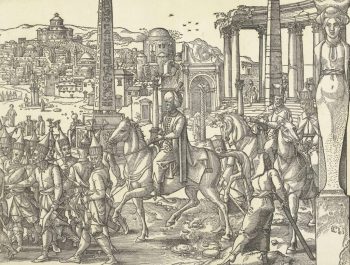
Procession of Süleyman I, from ‘Customs and Fashions of the Turks’, Pieter Coecke van Aelst, woodcut print, 30 × 39 cm, 1553 (Amsterdam: Rijksmuseum, RP-P-OB-2304L).
In recent years, a renewed interest in early modern rituals, festivals, and performances has prompted a reconsideration of ceremonious processions with a particular focus on their impact on social, cultural, artistic, and political structures and practices. Simultaneously, scholars have increasingly acknowledged the mobility of early modern artists across geographical, religious, and cultural borders. Although processions were witnessed by natives and visitors alike and were therefore prime instances of cross-cultural encounters, their depictions by artists both local and foreign remain a lesser-studied body of visual material. This symposium proposes to explore the visual representations of processions that took place within cross-cultural encounters both within and outside of Europe.
A procession was an act of movement that was particularly charged with meaning; an ambulatory mode of celebration, it had a global resonance in the early modern period. Processionals impressed foreign dignitaries, established modes of rule, communicated traditions, and negotiated power balances and were highly sensory occasions—as such they lent themselves readily to visual representation and were enthusiastically recorded in literature. Pageantries, military processions, and Joyous Entries (Blijde Inkomsten) were recorded in a variety of media, as exemplified by the festival books celebrating the ephemeral constructions orchestrated for Cardinal-Infante Ferdinand’s arrival in Antwerp (1635) or the eighteenth-century paintings depicting Venice’s dazzling boat parades in honour of foreign dignitaries. Furthermore, ceremonial processions conceived for births, weddings, circumcision feasts, and funerals occasioned visual representations such as the colourful Mughal miniature Wedding Procession of Dara Shikoh in Presence of Shah Jahan (1740). In addition, the notion of procession can be expanded to encompass various expressions of mobility that could be understood and were often depicted as a procession. Both Jan van Scorel’s frieze-like painting of the knightly brotherhood commemorating their Holy Land pilgrimage (c. 1530) and the depiction of ambassadors travelling with their retinue to foreign courts and cities can be perceived as a form of procession. Thus, the structure of a procession was increasingly adopted in the Early Modern period to depict moments of exchange and motion propelled by the quest for knowledge, as much as diplomatic concerns and religious piety. Well-known examples include The Voyage to Calicut tapestry series (1504) as well as the highly detailed printed frieze of a merchant endeavour by Hans Burgkmair (The King of Cochin, 1508).
We welcome proposals for papers that engage with processions in the early modern period (c. 1500–1800) in the context of cross-cultural encounters, with the locations of cross-cultural interaction defined here as both inter or extra-European and beyond the ‘East meets West’ dynamic. Participants are invited to explore artistic exchanges across geopolitical, cultural and disciplinary divides, and to examine drawings, prints, alba amicorum, painting, sculpture, decorative arts, architecture, and the intersections between them. Contributions from other disciplines, such as the history of science and conservation, are welcome.
We invite 20-minute papers that explore, but are not limited to, the following questions:
• How is the format of the procession used to structure visual representations of early modern ceremonial occasions and cultural difference?
• How were processions perceived visually both by local and foreign artists?
• Moreover, what audiences were interested in these visual representations and what scope did such a broad and diverse range of visual material serve? It is widely acknowledged, for instance, that Festival Books were not only designed for the audience of the spectacle, but also for armchair readers who could thus experience the procession as if they had been present.
• In what way does the visual representation of a procession signify a means of negotiating between one’s own identity, heritage and outlook whilst in dialogue with another culture?
• How did diplomatic encounters encourage the production of procession scenes both during and after the diplomatic mission, such as the depiction of gift-giving ceremonies? We strongly encourage speakers to also consider less conventional modes of processions. Could, for instance, the sequential depiction of costumes in costume albums also be interpreted as a procession of some sorts?
• Through which visual strategies and spatial arrangements did the ephemeral decorations and arches erected on the occasion of glorious entries orchestrate a procession through the urban space, or thematise the idea of cross-cultural encounter?
• What are the effects (both ephemeral and lasting) of these processions that sometimes involve the construction of specific architectural constructions and temporary settings (e.g. the Field of the Cloth of Gold, 1520)?
The Early Modern Symposium offers an opportunity for research students from universities both in the UK and abroad to present, discuss and promote their research. We invite proposals from graduate students, early career researchers, conservators, and curators. Talks that draw upon technical analysis and other theoretical approaches are equally welcome. Please send proposals of no more than 300 words along with a short biography by 24th September 2018 to talitha.schepers@courtauld.ac.uk and alice.zamboni@courtauld.ac.uk.
The aim of this postgraduate symposium is to provide a platform for early career researchers and postgraduate students to their share research with peers. We may be able to provide a subsidy for travel and accommodation costs, but please be aware that this may not cover all of your expenses. We prioritise candidates from the UK and Europe. We will notify successful candidates by Monday, 1st October 2018.
Call for Papers | The Orléans Collection
From the CFP:
The Orléans Collection: Tastemaking, Networks, and Legacy
New Orleans Museum of Art, 11–13 January 2019
Proposals due by 30 September 2018

Attributed to Guy Noël Aubry, Portrait of Philippe II, Duke of Orléans, 1715–23, oil on canvas, 248 × 160 cm (Orléans: Musée des Beaux Arts d’Orléans, François Lauginie).
The New Orleans Museum of Art and the Frick Center for the History of Collecting will host a
symposium in conjunction with The Orléans Collection exhibition dedicated to the collecting and collection of Philippe II duc d’Orléans (1674–1723) on view at the New Orleans Museum of Art 26 October 2018 through 27 January 2019.
Collecting over just over two decades, Philippe II d’Orléans amassed one of the most important collections of European paintings in the history of art, which he displayed in his Palais-Royal in Paris. This celebrated collection assembled over 500 masterpieces of European Art and this landmark exhibition reunites a representative group of forty works to tell the complex story of the collection’s formation and character and the impact of the sales of the collection in London during the French revolution, a watershed event in the history of collecting.
The Orléans Collection exhibition catalogue essays offer an overview of the collection, Philippe’s relationship with his court painter Antoine Coypel, the refurbishment of the Palais-Royal during the regency, his collecting of Venetian, Dutch and Flemish and Bolognese Art, contemporary artists studying the collection, and a review of the circumstances of the collection’s dispersal. The catalogue’s extensive Appendix transcribes the earliest 1727 publication of the collection tracing picture to their current locations.
The symposium seeks to expand beyond the scope of the catalogue and consider a wider range of relationships concerning Philippe d’Orléans’s taste and the impact the collection had for generations of collectors and artists, and an increasingly wider public throughout the eighteenth century. Subjects of interest might include: Philippe II’s patronage network; fellow collectors and trends in collecting in Paris; dealers and the art market in eighteenth-century Paris; connections with contemporary collections in the German principalities; the ‘Orléans Effect’ in Great Britain and later entrance in public collections.
Travel can be provided to a limited number of applicants. To propose a paper, please submit a message of interest and 300-word abstract by 30 September 2018 to: nomasymposium@noma.org.
Call for Articles | The Indigenous Eighteenth Century

The Indigenous Eighteenth Century
Special Issue of Eighteenth-Century Fiction, edited by Robbie Richardson
Manuscripts due 15 July 2019
The editor of this special issue of ECF, Robbie Richardson (University of Kent), invites manuscripts that consider the roles and representations of Indigenous peoples from the Americas, Australia, and New Zealand during the long eighteenth century. In what ways did In peoples shape European literature and knowledge? How can we recover sites of agency and response, and how do we read alternative strategies of representation outside of the written word? How were European writers who encountered ‘Indians’ and ‘savages’ influenced by these exchanges? How was Indigenous material culture collected and understood by Europeans? This special issue seeks to bring the interdisciplinary approaches of Indigenous Studies to bear on the eighteenth century, and to continue the work of decolonizing the period as we know it. Publication is scheduled for Autumn 2020. Submissions should be 6000–8000 words. For more information, please write to ecf@mcmaster.ca.
Call for Papers | Rethinking the Genius of Grinling Gibbons
◊ ◊ ◊ ◊ ◊
From the Call for Papers:
2018 Fairfax House Georgian Studies Symposium
Rethinking the Genius of Grinling Gibbons
Fairfax House, York, 19 October 2018
Proposals due by 31 August 2018
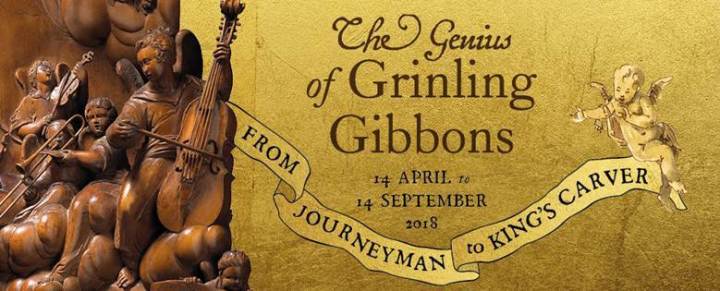
The sixth Fairfax House Symposium in Georgian Studies, held in conjunction with the exhibition The Genius of Grinling Gibbons at Fairfax House, and in partnership with the History of Art department at the University of York, aims to stimulate new thinking and new perspectives on the life, work, legacy, and significance of Grinling Gibbons (1648–1721), master carver of Restoration England.
Gibbons is a celebrated figure, yet much about his life and work remains obscure and contentious: not least, the difficulties of attribution have meant that the exact extent, chronology, and character of his oeuvre remain unclear. Similarly, as a ‘great figure’ of the Restoration, he has tended to be considered in isolation rather than placed in his social, political, scientific, architectural, and artistic contexts, while his position within the marginalized field of decorative arts has distorted the scholarly and antiquarian perspectives through which he has been viewed. Questions of patronage, politics, artistic influence, and the collaborative and workshop cultures of creation, as well as the national identity ascribed to this ‘English genius’ who was born and trained in the Netherlands, may all require reassessment. The 370th anniversary of Gibbons’ birth (and the 350th anniversary of his arrival in York) provide an opportune moment to draw together the knowledge gained from previous generations of scholarship, to stimulate new ideas and perspectives, and to rethink the perception and reality of ‘England’s Master Carver’.
Proposals for papers dealing with ‘rethinking’ Grinling Gibbons are enthusiastically invited for potential inclusion in a one-day interdisciplinary symposium. We are keen to encourage participation from people from a wide range of disciplines and career profiles: museum professionals and volunteers, early career and distinguished scholars, curators and teachers in higher education, as well as artists, craftspeople and other practitioners.
We are seeking (1) more formal 20-minutes papers to be presented in panels organised around relevant themes, and (2) 10-minute object-based presentations and discussions which can be informal or formal in nature, focused on a particular work by or relevant to Gibbons. Please send proposals for either section 1 (formal 20-minute papers) or section 2 (10-minute object-based presentations), accompanied by a brief biography, to fairfaxhousesymposium@gmail.com by 31 August 2018. Any queries about the symposium should be sent to the same address.
◊ ◊ ◊ ◊ ◊
Note (added 8 November 2018) — I’m sorry to have not added the conference programme before the event took place, but for anyone who may have stumbled upon this page for information purposes after the fact, the programme is available as a Word file here. –CH
Call for Articles | Special Issue of ‘Perspective’ on Multiples

Utagawa Kunisada (1786–1864), Shokunin (Artisans), 1857, woodblock, triptych, mitate
(London: The British Museum, 1907,0531,0.204)
◊ ◊ ◊ ◊ ◊
From the English Call for Papers (with the French version available here). . .
Perspective: actualité en histoire de l’art 2019.2
Special Issue on Multiples
Proposals due by 24 September 2018; full texts due by 30 April 2019
Using the notion of multiples, the next thematic issue of Perspective: actualité en histoire de l’art (2019.2) will examine the issue of mechanical reproduction. Though the phrasing inevitably refers to Walter Benjamin and his famous essay “The Work of Art in the Age of Mechanical Reproduction” (1935–36), this call for papers does not intend to limit the scope of contributions to the mass reproduction pertaining to the advent of photography and cinema, but to embrace all the means of reproduction, ranging from the most traditional, such as bronzes, terracottas, and coins, to the most contemporary related to the rise of new technologies, while not neglecting engraving, screen printing, or lithography. The aim is to analyze the ways in which reproductive techniques influence the production of works of art, while disturbing ontological presuppositions that oppose the original to its copy, the aura to inauthenticity, ritual value to exhibition value.
Starting from Walter Benjamin’s statement that “in principle the work of art has always been reproducible,” this propensity for multiplication, which may appear to be a work of art’s vital principle, does not signify the same reality in different geo-cultural periods and areas. Furthermore, is the distinction between the original and its copy a fact of modern Western culture which, since the eighteenth century and the rise of the art market, has celebrated the gure of the author and invented the notion of genius? A series of questions emerges and among them, to list just a few at random: To what needs—aesthetic, historical, anthropological, political, economic, etc.—does this propensity for multiplication that is a characteristic of artworks respond? What are the different modalities of the dialectical relationship between the original and its reproduction? Can we distinguish different phases within the history of reproduction? In what way does the advent of mass reproduction techniques constitute a turning point in the production and dissemination of artworks? Does the successive appearance of different techniques that rely on an increasingly complex apparatus which downgrades the hand in favor of the eye necessarily lead to the disappearance of the craft? Can we imagine the very existence of the aura outside of techniques of mass reproduction?
Furthermore, this issue will focus on all possible forms of multiples produced by means of mechanical reproduction processes, from the most rudimentary to the most elaborate, within a broader theoretical and geographical perspective that will give full weight to the periods preceding our own, as well as non-Western production. Though the journal is dedicated to artworks, heritage, history of architecture and urbanism, archeology, or museography, it also welcomes articles on photography, cinema, performance, dance, design, music, theater, and all forms of hybridization that the encounters of these different media can produce, provided that they are considered through the lens of visual history. Regardless of the subject proposed, contributions should follow the editorial guidelines of Perspective which publishes articles (25,000 or 45,000 characters) offering historiographical surveys of fundamental questions and/or which embody current trends in the discipline within the proposed topic.
Please submit your proposals (2,000–3,000 character summary and a 2–3 line biography) to the editorial address (revue-perspective@inha.fr) by Monday, 24 September 2018. The journal will take responsibility for translations if necessary. Proposals will be examined by the editorial committee of the issue, regardless of the language of submission. Authors of selected articles will be informed of the committee’s decision in October 2018 while full texts of accepted contributions will be due by the end of April 2019.










leave a comment