Call for Papers | The Roman Art World and the Academy in Britain
From the Call for Papers:
The Roman Art World in the 18th Century and the Birth of the Art Academy in Britain
The Accademia di San Luca and the British School at Rome, Rome, 10–11 December 2018
Proposals due by 12 March 2018
The Accademia di San Luca and the British School at Rome (BSR) invite submissions for papers for the conference The Roman Art World in the 18th Century and the Birth of the Art Academy in Britain, to be held in Rome between 10 and 11 December 2018. The conference will focus on the role of the Roman pedagogical model in the formation of the British academic art world in the long 18th century.
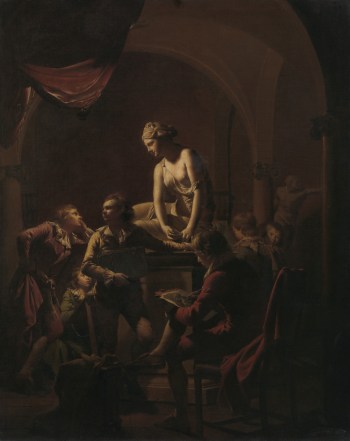
Joseph Wright of Derby, Academy by Lamplight, 1769, oil on canvas (New Haven: Yale Center for British Art, Paul Mellon Collection).
Even as Paris progressively dominated the modern art world during the 18th century, Rome retained its status as the ‘academy’ of Europe, attracting a vibrant international community of artists and architects. Their exposure to the Antique and the Renaissance masters was supported by a complex pedagogical system. The Accademia di San Luca, the Capitoline Accademia del Nudo, the Concorsi Clementini, and numerous studios and offices, provided a network of institutions and a whole theoretical and educational model for the relatively young British art world, which was still striving to create its own modern system for the arts. Reverberations of the Roman academy system were felt back in Britain through initiatives in London such as the Great Queen Street Academy, the Duke of Richmond’s Academy, the Saint Martin’s Lane Academy, and the Royal Society of Arts. But it was a broader national phenomenon too, inspiring the likes of the Foulis Academy in Glasgow and the Liverpool Society of Artists. The foundation of the Royal Academy of Arts in London in 1768 officially sanctioned the affirmation of the Roman model.
If past scholarship has concentrated mainly on the activities of British artists while in Rome, this conference wishes to address the process of intellectual migration, adaptation and reinterpretation of academic, theoretical and pedagogical principles from Rome back into 18th-century Britain. It responds to the rise of intellectual history, building on prevalent trends in the genealogy of knowledge and the history of disciplines, as well as the mobility and exchange of ideas and cultural translation across borders.
The conference welcomes diverse approaches to investigating the dissemination of the academic ideal from Rome to Britain. These might address, but are by no means limited to, the following topics:
• The impact of the Roman academic structure, theory and pedagogy on British art academies, artists’ studios and architects’ offices.
• The impact of art and architectural theory in Rome on the formation of a public discourse on art and architecture in Britain.
• The process of adaptation and reinterpretation of Roman theoretical and pedagogical principles to the British artistic and architectural context, and the extent to which British art academies developed new principles, absorbed the Roman model, or derived them from elsewhere.
• The role played by Roman and Italian artists and architects in the formation and structuring of the 18th-century British art academies and, in particular, of the Royal Academy of Arts.
• The presence and activities of British artists and architects in Roman studios, offices and academies and the presence of Italian artists in British academies.
• The role played by other relevant academies—such as those at Parma and Florence—on the formation of British artists and architects in relationship/opposition to the Roman model.
This conference will conclude a series of events celebrating the 250th anniversary of the foundation of the Royal Academy of Arts in London. It will also be part of a series of conferences and exhibitions focusing on the role of the Accademia di San Luca in the spread of the academic ideal in Europe and beyond, inaugurated in 2016 with an exhibition and conference on the relationship between Rome and the French academy, held at the Accademia di San Luca and at the Académie de France à Rome.
Please provide a concise title and abstract (250 words maximum) for a 20-minute paper. Send your proposal, with a current CV of no more than two pages, to humanities@bsrome.it. Proposals must be received by midnight, Monday 12 March 2018. Speakers will be notified of the committee’s decision in mid-April 2018. Travel grants will be available.
Adriano Aymonino
Carolina Brook
Gian Paolo Consoli
Thomas-Leo True
Call for Papers | Museums, Collections, and Conflict, 1500–2010
From the Museums and Galleries History Group:
MGHG Biennial Conference | Museums, Collections, and Conflict, 1500–2010
National Maritime Museum, Greenwich, 13–14 July 2018
Proposals due by 1 March 2018
Museums have been profoundly shaped by war and armed conflict, and have also played a significant part in shaping understandings and memories about them. Yet there has been little sustained examination of the way museums in war and war in museums has played out. Since Gaynor Kavanagh’s foundational study Museums and the First World War in 1994 and with the publication this year of Catherine Pearson’s similarly ground-breaking Museums in the Second World War, it is clear that museums have played and can play an important role in helping society address such crisis situations. On the home front, for example, museums have helped society prepare for war and armed conflict. In leading commemoration in the aftermath of war and armed conflict, museums have helped society come to terms with what happened, understand why it happened, and remember sacrifices. Yet museums have equally served as arenas where issues such as commemoration have been contested and negotiated and where particular narratives legitimising war and conflict have been developed. This conference hopes to address a broad range of questions, including on collecting (in) war and armed conflict, on the deliberate targeting and destruction or safeguarding of museums and cultural property, and the broader range of institutions brought forth or which are strongly influenced by war and armed conflict.
Keynote speaker: Annie Coombes, Professor of Material and Visual Culture, Birkbeck, University of London
We seek papers which particularly address but are not restricted to the following questions over a period from the early modern to the end of the twentieth century:
• What have museums done during periods of conflict and what has happened to them? Have they been responsible for morale, have they been targets of attack, have they physically moved and how has their staffing been affected?
• How have museums and collections acted to commemorate conflict?
• In what ways have wars and other conflicts affected museums’ and collectors’ collecting activities, positively or negatively? How have wars and conflicts been collected, and by whom?
• How have museums represented war, civil war and other conflicts such as rebellions? Have museums promoted peace by interpreting war?
• How have museums OF conflict, of the armed forces and of weaponry/armouries developed historically?
We welcome proposals for papers which deal with the history of museums and collecting in a British, European, or wider context or which address the relationships between different geographical areas.
Paper proposals should be for papers of 20 minutes’ length. Proposals should be 250 words max and include the name, contact details and affiliation (if applicable) of the speaker. Panel proposals are strongly encouraged and should consist of a panel title, proposals for 3 papers, along with a rationale for the panel theme, and contact details and affiliations (if applicable) of all participants. Please indicate whether you will provide a chair for your session or not (it does not matter which). Poster proposals are also welcomed. Please contact Kate Hill (khill@lincoln.ac.uk) for more information. All proposals should be sent to contact@mghg.info by 1 March 2018. Please note that all speakers and poster presenters will be expected to pay the conference registration fee.
The Museums and Galleries History Group (MGHG) was founded in 2002 and inaugurated in 2003 with the symposium Museums and their Histories, held at the National Gallery in London. The MGHG provides a platform for debate and contact among all those who seek to understand museums and galleries from historical and theoretical perspectives. The interests represented are wide-ranging, interdisciplinary and international and the Group also acts as a forum for considerations of the place of museum history within academic discourse and its importance for current museum practice.
Call for Papers | British Art and the Global
From the Call for Papers:
British Art and the Global
University of California, Berkeley, 17–18 September 2018
Organized by Imogen Hart and David Peters Corbett
Proposals due by 15 April 2018
What is the role of art history in the Brexit era? In the wake of the UK’s decision to leave the European Union, the history of Britain’s relationships with the rest of the world takes on renewed significance. This conference explores how art history today can shed light on the history of Britain’s interaction with other countries and cultures. Among other questions, the conference asks: How have institutions of display and education provided frameworks that have articulated and/or obscured global contexts for British art? How can the traditions of art history, including concepts of national schools, movements, modernisms, periods, originality and imitation, aesthetic judgment, and hierarchies of media be exploited and/or critiqued by scholars of British art and the global?
We invite papers that illuminate global contexts for the history of British art by considering works of art (including painting, sculpture, architecture, the decorative arts, photography, and other forms of visual and material culture) as sites and tools of international cooperation, conflict, and exchange. Potential papers may address the global history of British art in relation to topics that include, but are not limited to:
• International artistic collaborations and organizations
• Artistic movements and their international legacies
• International modernisms
• Aesthetic theory across national boundaries
• Contexts of display including museums, collections, and exhibitions
• Institutions of artistic training and education
• The international art market
• Reproduction and circulation
• Periodicals
• Art and empire
• Travel and tourism
• Immigration
• Art and war
Keynote speakers: Tim Barringer (Yale University), Dorothy Price (University of Bristol), and Mary Roberts (University of Sydney).
This two-day, international conference is sponsored by the Center for British Studies at the University of California, Berkeley. The conference is co-organized by Imogen Hart (History of Art Department, UC Berkeley) and David Peters Corbett (Courtauld Institute of Art, London). Please submit abstracts of no more than 250 words plus a brief biographical note to imogenhart@berkeley.edu by April 15, 2018. Limited funds may be available to assist with travel expenses for speakers who do not have institutional funding.
Call for Papers | HECAA at 25
While HECAA has historically had a sizable presence only at meetings of the College Art Association and the American Society of Eighteenth-Century Studies, for the first time, the organization will convene its own conference this fall in Dallas. We would love to have you join us! –Craig Hanson
From the Meadows School of the Arts at SMU:
Art and Architecture in the Long Eighteenth Century: HECAA at 25
Southern Methodist University, Dallas, 1–4 November 2018
Proposals due by 7 February 2018
We invite proposals for participation in the HECAA at 25 conference, to be held November 1–4, 2018, at Southern Methodist University in Dallas, Texas. There are many ways to participate as a presenter: by submitting a paper abstract for a research panel or the early-career scholarship showcase, a proposal for a roundtable, or an application to serve as facilitator for a breakout session.
Guidelines for how to apply can be found under each individual session description. Proposals due to session chairs by February 7, 2018. Applicants may apply to more than one session, or for more than one role; please notify chairs of your parallel applications. Questions about the conference? Contact us at hecaa25@gmail.com.
Keynote Speakers
Melissa Hyde, University of Florida
Daniela Bleichmar, University of Southern California
Local Organizing Committee
Elizabeth Bacon Eager, Southern Methodist University; Denise Baxter, University of North Texas; Kelly Donahue-Wallace, University of North Texas; Lindsay Dunn, Texas Christian University; Amy Freund, Southern Methodist University; Jessica Fripp, Texas Christian University; Nicky Myers, Dallas Museum of Art
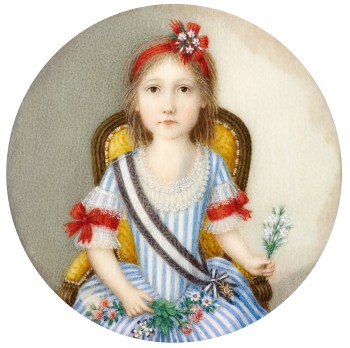
Image: Francisca Efigenia Meléndez y Durazzo, Portrait of a a Seated Girl Holding Flowers, ca. 1795, tempera on ivory, 5 × 5 cm (Dallas: Meadows Museum, SMU, MM.08.01.20).
◊ ◊ ◊ ◊ ◊
R O U N D T A B L E S
The History of Studying Eighteenth-Century Art, the Belgium of Art History
Chair: Michael Yonan, University of Missouri, yonanm@missouri.edu
With Barbara Maria Stafford’s now famous 1988 phrase to guide us, this roundtable seeks to discuss eighteenth-century art history’s historiography. The subject was an infrequently studied one in North America prior to the 1970s, and even into the 1990s its community of adherents was remarkably small, very much in contrast to its current prominence. How has this unusual history shaped the discourse of eighteenth-century art, and what are the challenges it creates for our future? Please send a CV and a 300-word proposal for a brief presentation (5–10 minutes) intended to spur further conversation to Michael Yonan.
Engaging Twenty-First-Century Publics: Innovations in Teaching, Advising, Exhibiting, and Curating
Chair: Amelia Rauser, Franklin and Marshall College, arauser@fandm.edu
In these times it is more important than ever to make the case for art, and for understanding the cultural productions of our own and other cultures. What new approaches to pedagogy or museology are you using to engage students or broader publics in the aesthetics and ideas of eighteenth-century art and architecture? What projects, ideas, and initiatives are the most promising for sustaining and renewing the understanding of our period among a twenty-first-century public? Please send a CV and a 300-word proposal for a brief presentation (5–10 minutes) intended to spur further conversation to Amelia Rauser.
The Future of Studying Eighteenth-Century Art: HECAA at 50?
Chair: Amy Freund, Southern Methodist University, afreund@smu.edu
Where will—or should—our field go next? Or, conversely, what should we avoid or abandon? This roundtable will examine the current state of eighteenth-century art history and foster debate about new modes of inquiry. Propositions, critiques, utopian projects welcome from scholars at all career stages. Please send a CV and a 300-word proposal for a brief presentation (5–10 minutes) intended to spur further conversation to Amy Freund.
How to Art History
Chair: Elizabeth Bacon Eager, Southern Methodist University, eeager@mail.smu.edu
Share your professional experience polishing job applications, publishing, teaching, administrating, and maintaining life-work balance as part of a roundtable aimed at early-career scholars. Please send a CV and a short (100 words or less) statement of interest to Elizabeth Bacon Eager.
F A C I L I T A T O R S
Breakout Session Facilitators
Chair: Jessica Fripp, Texas Christian University, j.fripp@tcu.edu
We are seeking scholars at all career stages to facilitate breakout sessions discussing the keynote addresses and the conference proceedings more generally. We anticipate appointing approximately 20 facilitators to lead groups of 10–15 people; facilitators will formulate initial questions and guide discussion. Please send a CV and a short (100 words or less) statement of interest to Jessica Fripp.
R E S E A R C H P A N E L S
Research by Emerging Scholars
Chair: Christopher Johns, Vanderbilt University, christopher.johns@vanderbilt.edu
This session will showcase short (10 minute) presentations of outstanding research by early-career scholars — graduate students and recent PhDs in non-tenure-stream positions. Please send a CV and a 300-word proposal to Christopher Johns.
Things Change
Chairs: Wendy Bellion, University of Delaware, wbellion@udel.edu; and Kristel Smentek, Massachusetts Institute of Technology, smentek@mit.edu
Objects seldom survive in their original states. Broken and restored, lost and found, reused and displaced, material things transcend their earliest uses, sites, and appearances. We invite proposals for papers that explore reinvention, relocation, and related issues in eighteenth-century decorative arts and material culture. Please send a CV and a 300-word proposal to both chairs.
People, Places, and Things in the Global Eighteenth Century
Chair: Nancy Um, Binghamton University, nancyum@binghamton.edu
Increasingly broad in its definition, the ‘global eighteenth century’ is often used to point to the widened geographic scope of the field, particularly in instances of visual exchange that push past perceived cultural boundaries or hinge upon the movement of artists, art objects, and visual practices across extended distances. This panel aspires to a more rigorous notion of the global eighteenth century: one that questions stable and enduring associations between people, places, and things; examines interactions, movements, and exchanges that are multi-sited rather than binary; and/or takes into account the structures and institutions that facilitated, but also encumbered, eighteenth-century travel, trade, and exchange. Please submit a proposal using this form.
Art and Political Authority in the Long Eighteenth Century
Chairs: Meredith Martin, New York University, msm240@nyu.edu; and Aaron Wile, University of Southern California, awile@usc.edu.
The transition from the seventeenth to the eighteenth century is often seen as marking a crucial transformation in the relation between art and political authority in Europe and around the globe. During the seventeenth century, absolute rulers pressed art into the service of the state, using painting, sculpture, architecture, and spectacle to reinforce their power and instill obedience in their subjects. But the emergence of new political and cultural regimes in the next century, along with new publics, institutions, markets, and aesthetic discourses, put the alliance between art and statecraft under strain. This panel seeks both to enrich and complicate this familiar story. How did art function as a political agent during the long eighteenth century? How did rulers use visual media as a tool of government, and what were the limits to that approach? How was art used to undermine or resist authority? Please send a CV and a 300-word proposal to both chairs.
Apprehending the Spatial: Methods and Approaches
Chair: Christopher Drew Armstrong, University of Pittsburgh, cda68@pitt.edu
The panel invites scholars to present scholarly projects (research or teaching) that are fundamentally spatial in character (such as architecture and urbanism, travel and collecting). We particularly encourage proposals that integrate digital applications or computer methods into the study of eighteenth-century culture, or that otherwise extend or challenge established scholarship and conventional approaches to instruction (undergraduate or graduate levels). How do new methods and areas of inquiry reveal knowledge, provide insights, or open paths of inquiry? Please send a CV and a 300-word proposal to Christopher Drew Armstrong.
Carte Blanche
Chair: Denise Baxter, University of North Texas, Denise.Baxter@unt.edu
Your work doesn’t fit the categories above? This panel will present research on any topic in the visual arts in the long eighteenth century. Surprise us. Please send a CV and a 300-word proposal to Denise Baxter.
Call for Papers | CSECS 2018, Niagara Falls
From the Call for Papers, which includes the full French version:
CSECS, 2018: Wonder / L’émerveillement
Four Points Sheraton, Niagara Falls, Canada, 10–13 October 2018
Organized by Christina Ionescu and Christina Smylitopoulos
Proposals due by 15 April [extended from 20 February]
 The 2018 annual meeting of the Canadian Society for Eighteenth-Century Studies will take place at Niagara Falls, Ontario. Comprised of three distinct cascades that monumentally culminate to drain Lake Erie into Lake Ontario, Niagara Falls occupies a significant place in eighteenth-century contemplations of natural wonder. When confronted with the unparalleled sight of a “vast and prodigious cadence of water,” the mesmerised Franciscan missionary Louis Hennepin (1626–1704) attempted to capture “this wonderful downfall” with both text and image in his travelogue, and his account had a long-lasting effect on how Niagara Falls was perceived in the following centuries. Niagara Falls, today considered one of the most spectacular natural wonders of the world, was more often imagined than visited during the Enlightenment years, when wonder-seekers relied upon the accounts of travellers who had experienced firsthand this natural masterpiece. During the Enlightenment, this preoccupation with the wonder of nature can be tied to engagements with wonder more generally. Despite Samuel Johnson’s disdain for wonder as “the effect of novelty upon ignorance,” contemporaneous writers, artists, thinkers, historians, travellers, and scientists sought to seize and understand this feeling of surprise mixed with admiration, caused by something beautiful, unexpected, unfamiliar, or inexplicable, which manifested itself across a broad spectrum of human experience and creative output.
This conference organizers invite papers that consider wonder as deployed, depicted, and discussed in a range of contexts: Enlightenment thought, natural science treatises, religious works, cultures of collecting, historical accounts, literary texts, visual production, as well as travel narratives. Possible topics include, but are not limited to the following:
• the theorisation of wonder as a concept
• the wonder of everyday life and material culture
• the cultivation of (or scepticism toward) wonder in Enlightenment thought
• spectacle and spectatorship in visual representation and culture
• artistry and wonder
• narrative strategies and rhetorical devices for producing wonder
• wonder as an affective response or aesthetic experience
• wonder and scientific knowledge
• wonder and its miraculous manifestations
• collections displaying wondrous thing
In keeping with CSECS tradition, proposals for papers devoted to elements of the long eighteenth century not directly related to the general theme of the conference are also welcome. Individual proposals should include a 150-word abstract of the paper and its title, as well as a biographical statement including the presenter’s name, academic status, institutional affiliation, and e-mail address. Panel proposals should include the above, as well as a brief description of the panel itself. Participants can present in either English or French. An issue of the Society’s bilingual journal, Lumen, will feature a selection of revised proceedings from this conference. Deadline to submit proposals for panels and integrated workshops: January 5, 2018. Deadline to submit individual proposals: February 20, 2018. Proposals should be emailed to csecs2018@yahoo.com.
Invited Speakers
Nathalie Ferrand (École Normale Supérieure / Institut des Textes et Manuscrits Modernes, Paris)
Sandro Jung (Herzog August Bibliothek, Wolfenbüttel)
Sarah Tindal Kareem (University of California, Los Angeles)
Call for Articles | Stay Still: Tableau Vivant
From the Call for Papers:
Stay Still: Past, Present, and Practice of the Tableau Vivant
RACAR Special Issue, October 2019
Guest Edited by Mélanie Boucher and Ersy Contogouris
Proposals due by 1 February 2018; final essays will be due by 15 August 2018

Jules-Ernest Livernois, Mrs. Ed Foley’s Statuary Group, 1893 © Jules-Ernest Livernois/Library and Archives Canada/PA-024050.
While the conceptualization and modern incarnation of the tableau vivant are rooted in eighteenth-century Europe, its origins can be traced back to antique pantomime and to royal entrances in the early modern period. Presented first at the theatre, and then in private settings, for the pleasure and education of the aristocracy and bourgeoisie, the tableau vivant quickly migrated to other areas of the world, including North America. It decisively marked the beginning of photography and was fundamental to pictorialism and early cinema. Its practice was abandoned during the first half of the twentieth century, then re- emerged in 1960s experimental cinema, while its mise-en-scène and its exploration of immobility were exploited in contemporary art during this same period. The use of the term ‘tableau vivant’ to refer to contemporary artistic performances appeared in the mid-1990s, and probably stemmed from the interest then shown for Vanessa Becroft’s practice. In the early 2000s, the markedly growing engagement with the tableau vivant, the re-enactment of performances, and their presentation over long periods of time, in turn deeply impacted on museum practices. If it is in literature studies that reflexive analyses of the tableau vivant first appeared, recent scholarship—whether informed by literature, theatre, cinema, the visual arts, museology, or other fields of knowledge—is contributing to the rediscovery of the tableau vivant and to its recognition as a hybrid practice, the study of which can be productive in different areas.
The tableau vivant raises various issues that relate to its mechanisms of presentation as a performance, among them, theatrical, narrative, spatial, pictorial, and temporal. It also engages with social and political issues such as gender, race, sexuality, class, and the relationship of the subject to the material world. As an object that is collected and exhibited, it is inscribed in the history of analogical museography, but also raises present-day issues linked to conservation and exhibition. As an artistic practice today, it enters into dialogue with other forms of appropriation and relates to practices of re-enactment, reconstitution, remake, citation, and remixing that are particularly popular in contemporary art as well as in other areas of art and culture. What sets it apart from these other practices, its characteristic of immobility, in turn brings into play its own set of theoretical and interpretative questions.
By looking at the tableau vivant from a variety of standpoints, this special issue of RACAR aims to contribute to the knowledge and to the current thinking on this subject. We welcome historical or theoretical pieces that address either specific works or more general concerns relating to the tableau vivant; accounts of artistic and museological practices; as well as portfolios. The call is open to topics relating to all historical periods, all geographical and cultural areas, and all artistic media.
To this end, we are soliciting three types of proposals, in either French or English: articles (maximum 7,500 words, including notes), accounts of practices (maximum 3,500 words, including notes), and portfolios (maximum 10 images and 1,000 words, including notes). The articles and accounts of practices will be submitted to double-blind peer review. Please submit your proposals of a maximum of 250 words and a short CV before February 1, 2018, to Mélanie Boucher, Université du Québec, (melanie.boucher@uqo.ca) and Ersy Contogouris, Université de Montréal (ersy.contogouris@umontreal.ca).
Call for Articles | Spring 2019 Issue of J18: Animal
From J18:
Journal18, Issue #7 (Spring 2019) — Animal
Edited by Katie Hornstein
Proposals due by 1 April 2018; finished articles will be due by 15 October 2018
Recently scholars across the humanities have been examining the role animals play in representations across media, cultures, and historical moments. While art historians have begun to turn their attention to animality, the most intensive efforts on the part of humanities scholars have been located in literary disciplines and have tended to embrace activist and theoretically-based approaches. Why has art history been slower than other humanities disciplines to contend with animality? Has art history’s traditional humanistic focus precluded critical and theoretical thinking about animals as more than just symbols and subject matter within visual representation, especially with regard to art made before the nineteenth century? In devising his theory of humanistic art history, for example, Erwin Panofsky enacted a series of exclusions and disavowals that celebrated the uniqueness of human object-making and ideation, with a sharp separation between nature and culture. In response to a history of art that has traditionally celebrated and elevated works of art as the highest of human achievements, animal studies presents a potentially destabilizing challenge: how do animals structure our understanding of what it is to be human?
The Spring 2019 issue for Journal18 seeks contributions from scholars who work at the intersections of art history, visual and material culture, and animal studies. Articles should use the historical frame of the long-eighteenth century (c. 1660–1830) to address the animal as an actor, agent, and formative presence within art’s histories. Contributions might address how the figure of the animal and ideas about animality contest the preeminence of human-based subjectivities that have traditionally (and perhaps necessarily) structured art historical approaches to visual representation. Authors might also ask questions that revolve around the circulation and exchange of animal-based products in the burgeoning global economy of the eighteenth century. Articles that address the unique signifying power of visual representations of animals across media and consider how images depict animals as responsive subjects are equally welcome. Submissions may take the form of an article (up to 6000 words) or a shorter vignette (no more than 2,500 words).
For authors who have their submissions selected, there will be a study day held in New York City in early September 2018, ahead of the due date of October 15, 2018 for completed texts. This will be an opportunity to present research, share ideas, and receive feedback before handing in your final articles. For any contributors unable to travel to New York, we aim to make remote participation possible via weblinks.
Proposals for #7 ANIMAL are now being accepted. Deadline for proposals: 1 April 2018. To submit a proposal, please specify whether you intend to write an article (6,000 words) or a shorter vignette (2,500 words). Send an abstract (200 words) and a brief CV to editor@journal18.org and katherine.s.hornstein@dartmouth.edu.
Issue editor
Katie Hornstein, Dartmouth College
Call for Papers | Fashioning the Early Modern Courtier
From the Call for Papers:
Fashioning the Early Modern Courtier
St John’s College, Cambridge, 16 May 2018
Proposals due by 22 January 2018
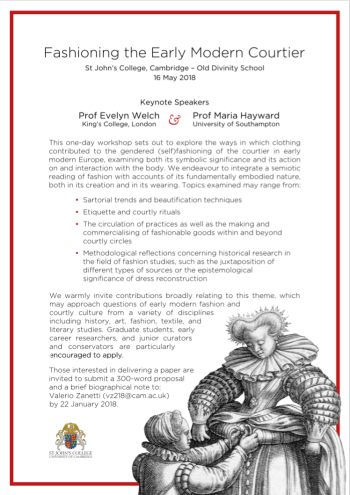 Early modern courts were crucial sites for the elaboration and diffusion of specific corporeal models aspiring to shape the ideal man and woman. Fashion, then as now, provides a very material setting that has the power to promote specific patterns of thought and action. This one-day workshop sets out to explore the ways in which clothing contributed to the gendered (self)fashioning of the courtier in early modern Europe (ca. 1500–1750), examining both its symbolic significance and its action on and interaction with the body.
Embracing a corporealist perspective, we endeavour to integrate a semiotic reading of fashion with accounts of its fundamentally embodied nature, both in its creation and in its wearing. Topics examined may range from sartorial trends and beautification techniques to issues related to etiquette and courtly rituals more broadly. The circulation of such practices as well as the making and commercialising of fashionable goods within and beyond courtly circles will also be investigated. Methodological reflections concerning historical research in the field of fashion studies are also welcome, such as the juxtaposition of different types of sources or the epistemological significance of dress reconstruction.
We are delighted to announce two keynote lectures to be delivered by leading scholars, Evelyn Welch (King’s College, London) and Maria Hayward (University of Southampton).
We warmly invite contributions broadly relating to this theme, which may approach questions of early modern fashion and courtly culture from a variety of disciplines including history, art, fashion, textile, and literary studies. Graduate students, early career researchers, and junior curators and conservators are particularly encouraged to apply. Those interested in delivering a paper are invited to submit a proposal of up to 300 words and a brief biographical note to Valerio Zanetti (vz218@cam.ac.uk) by 22nd January 2018.
Call for Essays | American Art and Economics
Special Issue of American Art: Economics, Money, and the Art Market
Edited by John Ott and Robin Veder
Proposals due by 1 February 2018; final MSS will be due 1 September 2018
American Art, the peer-reviewed journal co-published by the Smithsonian American Art Museum and the University of Chicago Press, invites historians of American art to answer the question, “What do we talk about when we talk about economics, money, and the art market?” In the spirit of the October Visual Culture questionnaire, replies may address any or all of the following questions and should take the form of brief position papers rather than intensive case studies. In the historiography of American art history, what shifts have we seen in ways of thinking about artistic production, the art market, and the visual cultures of economics? When we study financial systems, institutions, instruments, and objects, do we examine them in relation to economic power and social class, or in relation to other social phenomena, and why? To what extent have economic forces such as the art market and institutional funding shaped the field of American art, whether in terms of the objects and inquiries we pursue and neglect, or with regard to the vocabulary we use and avoid?
For consideration, submit abstracts of 250–500 words by February 1, 2018. The organizers, John Ott, professor of art history at James Madison University, and Robin Veder, executive editor of American Art at the Smithsonian American Art Museum, will review submissions and encourage selected authors to submit full manuscripts for further consideration. These should be 1,500–2,500 words including endnotes, with 1–4 images, and will be due by September 1, 2018. The journal will evaluate the manuscripts and select some for publication in a 2019 issue of American Art. Accepted authors will workshop the manuscripts together before final revision. Submit abstracts to americanartjournal@si.edu. For other inquiries, contact John Ott at ottjw@jmu.edu.
Call for Papers | Fashion and Clothing in European Museums
From H-ArtHist:
Fashion and Clothing in European Museums: Collection, Research, Exhibition
Musée Alsacien, Strasbourg/Haguenau, 17–19 May 2018
Proposals due by 19 December 2017

Courtyard of the Alsatian Museum in Strasbourg (Photo: Wikimedia Commons, June 2009).
This interdisciplinary international conference Fashion and Clothing in European Museums: Collection, Research, Exhibition is organised by the European Research Interest Group Appearances, Bodies and Societies / Apparences, Corps et Sociétés (ACorSo). With the intent of reflecting the current museum landscape and of developing debate on future directions for museums of art, dress and textiles, ethnography and history, members of the Research Interest Group welcome papers that respond closely to the following issues:
• What fundamental themes and debates have museums attached to their collections of textiles, dress, and fashion?
• What ambitions have been attached to the development of dress, fashion, and textile collections? How are these collections integrated within the global project of museums and the museum itinerary?
• How can we overcome the status of differences that exist between (high) fashion and everyday and ethnographical dress and their museum display?
• Should the promulgators of the new museologies of the study of fashion and dress—so far mostly applied to analysis of museums of international standing or to specialised museums—take an interest in the work of small and medium sized museums?
• In what ways is digitization a challenge or a potential to the museum?
• Where should small and medium sized museums seek professional advice? What professional skills are needed for these museums? Is there a preferred work methodology?
• What links to established research can museums initiate and set in place, precisely because of their specificities? What has already been initiated?
• The situation of some of some small local museums with collections including dress, textiles, and their related industries is now so perilous that some have been, and are being, closed. What positive proposals have been set in place that have already addressed this problem or are currently dealing with it?
We are interested in receiving discussion papers from colleagues working with collections, be they curators, collectors, researchers, managers, museographers, etc. The languages of the conference will be French, German, and English. In view of the trans-European character of this conference, we ask you to submit your abstract in two languages—in any combination of French, German, and English (i.e. French and German, French and English, or English and German). Your submission should be 300 words long, with the translation bringing it to a total of 600 words. Abstracts must be relevant to the issues detailed in this Call for Papers and should clearly highlight the specific themes your paper will address. You will be informed in January on the status of your submission.
Abstracts should be submitted to
• Lou Taylor, Prof. Emerita (lt73@brighton.ac.uk); Dr. Charlotte Nicklas (c.nicklas@brighton.ac.uk). School of Humanities, University of Brighton, 10/11, Pavilion Parade, Brighton, BN 2 1RA, UK.
• Jean-Pierre Lethuillier (jean-pierre.lethuillier@univ-rennes2.fr). Université Rennes 2, Département d’Histoire, Place du recteur Henri Le Moal, CS 24307, 35043 Rennes cedex, France.










leave a comment