Call for Papers | Things Left Behind
From the University of Missouri-Columbia:
Things Left Behind: Material Culture, Disaster, and the Human Experience
University of Missouri Art History and Archaeology Graduate Student Association Symposium
University of Missouri-Columbia, 9–10 March 2018
Proposals due by 20 January 2018
The Art History and Archaeology Graduate Student Association at the University of Missouri-Columbia invites submissions from graduate students that investigate topics that research the material culture of disaster and abandonment and discuss how such topics inform the human experience. Topics may include (but are not limited to):
• Disasters of personal, man-made, or natural character
• War and conflict
• Forced migrations
• Plague, illness, and other pandemics
• Abandonment
• Recovery and revitalization
We are seeking papers that explore various approaches to these topics, such as representations of disasters, artists influenced by war and disaster, art or crafts produced by displaced populations, the archaeological record of destruction and rebuilding, or archaeologically based narratives of disasters. Topics from any historical period of Art History, Archaeology, Classics, History, Anthropology, Sociology, Religious Studies, and other fields related to visual and material culture will be considered for twenty-minute presentations. The keynote lecture by Dr. Steven L. Tuck, Professor of Classics at Miami University, will take place on Friday evening, March 9, and student presentations will be held on Saturday, March 10. Proposals should consist of a 250–500 word abstract and a CV. Please submit proposals electronically to mu.ahagrads@gmail.com no later than January 20, 2018.
Call for Papers | MAHS 2018, Indianapolis
From the MAHS Fall 2017 Newsletter:
45th Annual Conference of the Midwest Art History Society
Indianapolis, 5–7 April 2018
Proposals due by 15 December 2017

Indianapolis Museum of Art (Wikimedia Commons, 15 January 2012).
The Midwest Art History Society (MAHS) will hold its 45th Annual Conference in Indianapolis, Indiana, 5–7 April 2018. Sessions on Thursday, April 5th and Friday, April 6th will be held at the Indianapolis Museum of Art at Newfields. Friday’s program will conclude with a bus trip to the celebrated showcase of 20th–century architecture, Columbus, Indiana, with a tour of the Miller House and Garden, designed by Eero Saarinen. Sessions on Saturday, April 7th will be held at the Eiteljorg Museum of American Indians and Western Art. This year’s keynote speaker will be Erika Doss, Professor of American Studies at the University of Notre Dame. Her talk will be related to her 2010 book Memorial Mania: Public Feeling in America, a topic with particular relevance in light of the current re-evaluation of public monuments. We welcome your participation. In most cases, conference presentations are expected to be under twenty minutes long. Proposals of no more than 250 words and a two-page CV should be emailed (preferably as Word documents) to the chairs of individual sessions by Friday, 15 December 2017.
The following is a selection of sessions potentially relevant for eighteenth-century studies; please see the newsletter for the full listing.
◊ ◊ ◊ ◊ ◊
Monumental Troubles: Rethinking What Monuments Mean Today
Chair: Erika Doss (University of Notre Dame), doss.2@nd.edu
Papers are sought that contribute to contemporary conversations about monuments, broadly defined as commemorative objects, images, and spaces. The recent removal, and call for removal, of monuments and memorials throughout the United States and around the globe—in South Africa, England, Taiwan, India, Hungary, and Canada, among other countries—suggests a generative rethinking about why they are made, how their meanings change over time, and issues regarding their removal, relocation, and destruction.
Textiles and Intimacy
Chair: Erica Warren (Art Institute of Chicago), ewarren2@artic.edu
This panel invites papers that explore and examine the ways in which costume and/or textiles are involved in intimate aspects of human life. Papers might consider everyday, familiar objects, such as quilts, or less quotidian items, such as fetish couture, exploring the close relationship between textiles and/or costume and the body. Papers are welcome on any period and specialization.
Women in Art and Art History
Chair: Marilyn Dunn (Loyola University Chicago), mdunn@luc.edu
This session invites papers representing new research or approaches to the examination of women as artists, patrons, or subjects in art. Topics that consider how women’s agency is manifested in art within specific cultural or political contexts are especially encouraged. Papers focused in any chronological period or geographic area will be considered.
Undergraduate Research Session
Co-chairs: Paula Wisotzki (Loyola University Chicago), pwisots@luc.edu; and Mark Pohlad (DePaul University), mpohlad@depaul.edu
Faculty members who have received outstanding research papers from undergraduate students within the past two academic years are invited to submit them for inclusion in our sixth annual Undergraduate Research Session. These papers should explore specific art historical research questions. In all cases, a faculty member (usually the submitter) must serve as a mentor and accompany the undergraduate student to the annual conference. Submissions should include the complete paper—no more than 2500 words—a 250-word abstract, and the student’s resume (as Word documents). In the event that the paper is accepted, undergraduate student presenters and faculty mentors are expected to pay membership and conference fees.
Past and Present in Latin American Art
Chair: Jorge Rivas (Denver Art Museum), jrivas@denverartmuseum.org
In today’s polarized political and social climate where the future for Latino and Latin American artists in the U.S. is becoming more uncertain and daunting, the art from the past is ever present. From Aztec archaisms to present- day references to mid-century avant-garde movements among contemporary artists, revivalism has become central to Latino/ Latin American artistic practices during periods of change and doubt. This session seeks papers that explore how such ideas of the past inform and shape the present.
Art History and Civic Engagement
Chair: Laura Holzman (Indiana University–Purdue University, Indianapolis), holzmanl@iupui.edu
At a time when museums and universities are emphasizing their public responsibility through activities described as audience engagement, service learning, and community partnerships, this session will examine how art historians approach their work as a public practice. Of particular interest are submissions from those who share scholarship and research methods in informal learning contexts such as exhibits, public programs, or op-eds; create scholarship in collaboration with partners from outside of the university or the museum; or use their art historical practice to strengthen communities in other ways. Presentations may discuss practical, ethical, or theoretical matters related to connecting art history with current events, social responsibility, or civic engagement.
Writing Indigenous Art Histories
Chair: Polly Nordstrand (Colorado Springs Fine Arts Center, Colorado College), pnordstrand@coloradocollege.edu
This session welcomes papers that address methods in shaping the future of Indigenous art history. Topics may include, but are not limited to: Indigenous art history as American art history, museum collection scholarship, academic journals, critical historiography, and collaborative and interdisciplinary research, as well as current research that aims to form art histories. While the field has long recognized the difficulty of critical and scholarly writing around Indigenous art as blocked from canonized art history, this session seeks to also address successful avenues so that a meaningful discussion beyond the obstacles may lead participants to strategies in producing art histories.
Rethinking Museum Collections of African Art and Art of the African Diaspora
Chair: Elizabeth Morton (Wabash College), mortone@wabash.edu
This session invites papers on current trends of all aspects of exhibitions and reinstallations of the arts of Africa and the Atlantic world.
Asian Art
Chair: Miki Hirayama (University of Cincinnati), hirayam@ucmail.uc.edu
This session invites papers on all aspects of East and South Asian art.
British Art
Chair: Catherine Goebel (Augustana College), catherinegoebel@augustana.edu
This session invites papers on any aspect of British art. All periods and media are welcome. Eminent architectural historian, Sir Nikolaus Pevsner, questioned whether one could discern national character via the geography of art (The Englishness of English Art, 1955). Might we effectively examine this question today if extended to the Britishness of British art? Creative approaches are encouraged.
Art of the Baroque/Europe in the Seventeenth and Eighteenth Centuries
Chair: Rebecca Brienen (Oklahoma State University), rebecca.brienen@okstate.edu
This session invites papers that investigate the art, architecture, and general visual culture in Europe during the seventeenth and eighteenth centuries.
Prints and Drawings in the West
Co-Chairs: Robert Randolf Coleman (University of Notre Dame, Emeritus) rcoleman@nd.edu; and Cheryl Snay (Snite Museum of Art, University of Notre Dame), csnay@nd.edu
This session is open to topics concerning any aspect—technical, iconographical, functional, historical, social, political, scientific, etc.—of American or European prints and drawings from any time period, medieval through contemporary.
Islamic Art
Chair: Margaret Graves (Indiana University, Bloomington), marggrav@indiana.edu
This session invites historically specific papers within any area of the broad field of Islamic art.
Technical Art History
Chair: Greg D. Smith (Indianapolis Museum of Art at Newfields), gdsmith@imamuseum.org
This session invites submissions dealing with the technical or scientific investigation of artworks, authenticity studies rooted in materials analysis, or the development of new approaches to the physical examination of artworks.
American Art
Chair: Nicole Woods (University of Notre Dame), nwoods@nd.edu
This session invites papers on all aspects of American art and visual culture from the eighteenth through the twentieth centuries.
Call for Papers | American Art Symposium, [Un]making Empires
From H-ArtHist:
Fourteenth Annual Yale University American Art Graduate Symposium, [Un]making Empires
Yale University, New Haven, 7 April 2018
Proposals due by 26 January 2018

Portrait of Chief Hendrick, engraving, ca. 1755.
The history and experience of immigration, colonization, and nation-building in the Americas have contributed to a complex artistic legacy. From Incan quero vessels to Kara Walker’s A Subtlety, or the Marvelous Sugar Baby, the arts of North, Central, and South America and the Caribbean have engaged and served different imperial visions. A means of both consolidating and challenging state power, material and visual cultures of empire have also shaped the identities of individuals, larger communities, and entire countries alike.
The Fourteenth Annual Yale University American Art Graduate Symposium invites papers that present new ways of thinking about art’s relationships to colonialism and empire. We invite submissions from graduate students working on American art across all time periods and media. Papers of an interdisciplinary and cross-cultural nature are especially encouraged.
Possible topics include, but are not limited to:
• Artistic expressions of confederation, empire, or sovereignty by indigenous American peoples
• Early modern colonial art and architecture, including relationships between colonies and their respective metropoles, inter-imperial exchange, and global currents
• Colonial subjects and artists as agents of empire
• Slavery and diaspora
• Questions of artistic agency, appropriation, authenticity, and hybridity in colonial art
• Colonial tropes and allegorical representations of the Americas and ‘Americans’
• Arts of exploration, conquest, and Manifest Destiny
• Colonial ‘afterlives’, heritage, and memory (ex. the Colonial Revival, museums such as Colonial Williamsburg, etc.)
• Post-colonialism, independence, and decolonization
• Art of non-political empires (ex. religious or commercial empires)
• Neo-colonialism and modern imperialism
Interested graduate students are invited to submit an abstract of no more than 350 words along with a CV by January 26, 2018. All submissions and questions should be directed to americanist.symposium@gmail.com. Accepted participants will be notified in early February. Accommodations will be provided in New Haven, Connecticut.
Keynote Speaker: Zara Anishanslin, Assistant Professor of History and Art History, University of Delaware
Call for Papers | A Farewell to Critique?
From H-ArtHist:
A Farewell to Critique? Reconsidering Critique as Art Historical Method
University of Copenhagen, NORDIK conference, 25–27 October 2018
Proposals due by 23 March 2018
Session convenors: Sara Callahan (PhD Candidate, Stockholm University), sara.callahan@arthistory.su.se; Anna-Maria Hällgren (PhD, Stockholm University), anna-maria.hallgren@arthistory.su.se; Charlotta Krispinsson (PhD, Humboldt University), charlotta.krispinsson@culture.hu-berlin.de
Since the advent of so-called New Art History, critique has been an omnipresent as well as welcomed part of the discipline. Critical perspectives on traditions and methods proved previous discourses of objectivity and neutrality to be inherently ideological. This new, critical art history enabled methodological approaches that questioned taken-for-granted assumptions of the discipline. Further, it brought attention to underlying social and structural aspects of art production and opened up new, exciting avenues of knowledge. In hindsight, thinking critically has resulted in some of the most ground-breaking research over the last few decades.
But when did thinking critically become the only way of thinking? Within the humanities, critique has turned into a default-mode, near synonymous with what is regarded as good research. This situation has of late come under scrutiny, most notably by Bruno Latour and Rita Felski. While Latour has argued that critique simply has “run out of steam” (Latour 2004), Felski stresses the importance of regarding critique as one method amongst others. In The Limits of Critique (2015) Felski argues that critique—like all methods—comes with its own tropes, narratives, and blind spots. What, exactly, are we doing while engaging in critique? What is the cost of habitually “reading against the grain”? Of continually deconstructing, denaturalizing and demystifying the world as we know it? What could we do otherwise? Felski does not offer a ready-to-use methodological alternative to critique—her concern is to examine what we do when we engage in critique and to challenge the view that it is the only game in town.
The aim of this session is to invite a discussion on critique in art history. We invite paper proposals that may include, but are not limited to, replies to the following questions:
• What are the challenges and/or benefits of critique and post-critique?
• What, specifically, would post critical methods look like within Art History?
• What are the geographical and cultural variations when it comes to the historiography as well as present state of critique?
• In addition to research practices, the academic profession involves teaching, participating in seminars and conferences, writing proposals and supervising students and junior researchers; can the discussion of post-critique be useful in developing these practices in some ways?
Please submit your proposal via a form on the conference website, where you will need to fill in personal information, an abstract no more than 1800 characters, a brief c.v. of no more than 360 characters, and full contact information by 23 March 2018.
In all, there are 19 panels now accepting proposals:
1 Post Democratic Culture and Culture in Post Democracy
2 Art and Design in Translation: The Circulation of Objects, People, and Approaches
3 A Farewell to Critique? Reconsidering Critique as Art Historical Method
4 (In)hospitalities
5 Medieval Nordic Art and the Un-nameable
6 Queer Art, Artists, and Identity: Nordic and Global Contexts
7 Futures from the Past? Nordic Exhibition Histories
8 Mixed Media
9 Nature, Non-Human and Ecology in Modern Art, Architecture, and Environmental Planning
10 Networks and Collaborations in Nordic Architectural Culture
11 A Whiter Shade of Pale: Whiteness Perspective on Nordic Visual Culture
12 Art, Artists, and Art Institutions in Times of War and Conflicts
13 Showing Not eTlling: Art Institutional Practices of Inclusions/Exclusions
14 Art and Spirituality in a Secular Society
15 Remembering: Art History and Curatorial Practices in Nordic Post-War Exhibition Studies
16 Life: On Art, Animation, and Biology
17 Decolonial Aesthetics: A View from the North
18 To Be [Titled], or Not To Be [Titled]? Art History and Its ‘Well-(un)Known’ Masters…
19 Untitled Spaces: Scenography and Nordic Art History
Call for Papers | Visual and Material Culture Exchange across the Baltic
From H-ArtHist:
Visual and Material Culture Exchange across the Baltic Sea Region, 1750–1850
Berlin, 22–24 March 2018
Proposals due by 1 December 2017
Although one of the world’s greatest cultural crossroads, the Baltic Sea has often been overlooked by scholars as a site of cultural exchange in favor of exploring national and regional identities. Since the 1990s, the concept of a Baltic Sea Region encompassing the sea and its surrounding land has fostered transnational thinking about the region, transcending Cold War binaries of ‘East’ and ‘West’ in an effort to view the area more holistically. Still, common terminology such as ‘Scandinavia’ and ‘the Baltic States’, suggests these cultures are mutually exclusive, or, as the case with ‘Central and Eastern Europe’, ambiguously monolithic.
While historians have been examining the Baltic Sea Region—present-day Denmark, Estonia, Finland, Germany, Latvia, Lithuania, Poland, Russia, and Sweden—as an important center of cross-cultural interaction, the area’s visual and material culture, one of the most important avenues of exchange, is often reduced to illustrative examples of historical phenomena. Art historical narratives continue to be tethered to national and ethnocentric approaches, a bias this conference seeks to complicate.
This project (three conferences—Greifswald 2017, Berlin 2018, and Tallinn 2019—and an anticipated edited volume) emerges from these twin desires: to study the Baltic Sea Region as a cultural crossroads and to depart from isolated, national/regional narratives. By foregrounding visual and material exchanges and the ideological or pragmatic factors that motivated them, we seek to establish common ground for viewing the Baltic Sea as a nexus of intertwined, fluctuating individuals and cultures always in conversation. We invite papers that engage material/visual culture as conceptual lenses through which to reevaluate the history, meaning, and significance of the Baltic Sea Region.
The 2018 conference focuses on the period 1750–1850. We invite proposals on any relevant topic; possibilities include:
• art education: students/professors at foreign academies
• itinerant artists/craftsmen
• foreign artists at royal courts
• art commerce: agents, dealers, collectors, advisors
• visual and material culture of race, slavery, colonialism, imperialism, Enlightenment theories regarding the ‘noble savage’
• relationship between art and science, constructions of ‘visual epistemologies’
• impact of print media/books
• artists’ travel
Proposals must include (in English):
a) an abstract of maximum 150 words summarizing your argument
b) academic resume
c) full contact information including email
Papers will be 20 minutes in length and will be followed by discussion. The language of the conference is English. Contributions should be sent to Michelle Facos (mfacos@indiana.edu) and Bart Pushaw (bcpushaw@gmail.com) by 1 December 2017. Notification of acceptance will be by 15 December. This conference is sponsored by Indiana University-Bloomington and will be held at IU’s Berlin Gateway in Kreuzberg.
Call for Papers | Frenemies in British Art, 1769–2018
From the Paul Mellon Centre:
Frenemies: Friendship, Enmity, and Rivalry in British Art, 1769–2018
Paul Mellon Centre for Studies in British Art, London, 19–20 July 2018
Proposals due by 14 December 2017
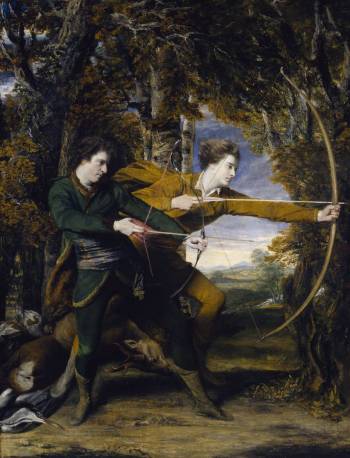
Joshua Reynolds, Colonel Acland and Lord Sydney: The Archers, 1769, oil paint on canvas, 236 × 180 cm (London: Collection of Tate, T12033).
From the earliest histories of art, the friendships and rivalries of artists have been the subject of anecdote and gossip. For that reason they have been associated with the popular storylines of art, rather than with the scholarly discourse of art history. However, the wide-ranging re-evaluation of affect and emotion that is taking place in the humanities, and the increasing recognition of a synchronic, network model of understanding rather than a diachronic, emulative one in art history, have suggested that artistic friendships and rivalries are key agents in the production and reception of works of art. This methodological shift has helped art historians perceive the significance of interpersonal relationships to art-making. It has drawn attention to the sociability of artists, and to the entwining of their personal and professional networks. Meanwhile, across other disciplines, the impact of friendship, personal networks and communities of rivalry upon cultural production have been the subject of important studies. Furthermore, the idea of productive or inhibiting enmities (a more awkward but still profoundly important category of affective relationship) is also becoming a fruitful avenue of exploration.
The long history of British art furnishes many examples of complex and productive friendships and bitter, crushing rivalries. The Royal Academy, from its foundation to today, is one major locus of such complex affective networks, as has been its annual summer exhibition. In conjunction with the exhibition The Great Spectacle: 250 Years of the Summer Exhibition, to be held at the Royal Academy between June and August of 2018, and curated by the Paul Mellon Centre’s Mark Hallett and Sarah Victoria Turner, this conference seeks to explore the impact of friendships and enmities on subject matter and artistic method, as well as on the formation of artistic careers and on the reception of works of art. We aim to re-evaluate and elevate these relationships, shifting them from the peripheral status of cultural gossip to central aspects of making and meaning.
We seek applications for 20-minute papers that address these questions in imaginative ways, and which focus on the history of British art in an international context, from 1769 to today. Whilst proposals that look to the Royal Academy as a locus of interpersonal artistic exchange are welcome, we also invite papers on other relevant topics. Please submit titles, 300-word abstracts and a brief professional biography and c.v. to Ella Fleming on efleming@paul-mellon-centre.ac.uk by December 14 at 5.00pm 2017.
The symposium is funded by the Paul Mellon Centre for Studies in British Art and convened by Georgina Cole (The National Art School, Sydney), Mark Hallett, Mark Ledbury (The Power Institute, University of Sydney), and Sarah Victoria Turner.
Call for Papers | Women Inventors in Architecture, 1700–2000
From SAH:
Women Inventors in Architecture, 1700–2000
International Archive of Women in Architecture 2018 Symposium
School of Architecture + Design, Virginia Tech, Blacksburg, Virginia, 28–30 March 2018
Proposals due by 15 December 2017
For centuries, women in architecture have been involved in pushing the boundaries of architecture and architectural practice. Whether as registered architects, members and leaders of architectural firms, academics and scholars, or in any of the less conventional capacities, women have helped transform the discipline of architecture and the related design fields shaping the built environment. The 2018 IAWA Symposium invites abstracts that address specific women or gendered natures of architectural invention. We welcome papers that tackle subjects or inventions generated between the years 1700-2000, and that are international or domestic in scope. We seek papers that conceptualize architectural invention in its many guises, including (but not limited to) ideas, technology, form-making, modes of professional practice that present views into and histories of practices of women in architecture. We encourage abstracts that address how women’s practices have been expanded through invention, as well as how architectural practice has been expanded or impacted by inventions by women.
Please email 300-word abstract and a one-page CV to Donna Dunay, Chair, Board of Advisors, International Archive of Women in Architecture Center (ddunay@vt.edu) with the subject heading ‘2018 IAWA Symposium’.
The International Archive of Women in Architecture (IAWA) was established in 1985 as a joint program of the College of Architecture and Urban Studies and the University Libraries at Virginia Tech. The purpose of the Archive is to document the history of women’s contributions to the built environment by collecting, preserving, and providing access to the records of women’s architectural organizations and the professional papers of women architects, landscape architects, designers, architectural historians and critics, and urban planners as well as the records of women’s architectural organizations, from around the world.
Call for Papers | Public Agency in Private Spaces, Female Agency
Public Agency in Private Spaces: Politics, Painting, and Patronage in the Long Eighteenth Century
Christie’s Education Symposium 2018: Celebrating Female Agency in the Arts
New York, Christie’s, 26–27 June 2018
Proposals due by 10 January 2018
Scholars across disciplines have long probed the relationship between politics and art in the public sphere in the long eighteenth century—the tumultuous, seminal historical period that saw the rise of the Enlightenment, modern systems of representative democracy, and, eventually, the Industrial Revolution. Yet, to date, scholarship of this period has largely failed to notice female artists and patrons, despite their omnipresence in public shows and frequent initiation of substantial commissions. Similarly, political history has overlooked non-royal women, despite their strong influence as the wives, mothers, and sisters of politicians.
This interdisciplinary panel explores ways in which elite women wielded power through the active fusion of politics and art. Domestic and other private spaces often provided fertile ground for the cultivation of wide-ranging artistic production. In these spaces, women made decisions that both mirrored and diverged from the (often public) actions of their male contemporaries. They exercised their own, distinct agency to establish relationships with male and female artists and designers, to initiate commissions, and to oversee these projects, most of which were undeniably infused with cultural, social, national, and even international politics.
We seek papers that work to reveal women’s central role as patrons and artists at this key moment in time, when the nature of politics itself was changing—and, with it, the production of art. Contributors might consider a wide range of female patrons and artists, and the historical context of their activities. Topics might include: the ways in which female sitters fashioned political personae through portraiture; the commissioning of original artworks or the production of copies for domestic interiors; gendered dynamics of the art market; or elite women’s growing engagement with methods of print artistry. We see this topic as a transnational story, and encourage approaches that upend prevailing narratives regarding individual works of art.
Organized by Laurel O. Peterson (Yale University) and Paris Spies-Gans (Princeton University)
Proposals for 20-minute papers, consisting of an abstract of 250–300 words and a brief bio of the presenter, should be submitted by January 10, 2018, to laurel.peterson@yale.edu and spies@princeton.edu.
Additional information on the symposium is available here»
Call for Papers | Kings & Queens Conference #7, Ruling Sexualities
From the call for papers, via the Royal Studies Network:
Kings & Queens Conference 7, Ruling Sexualities
Hampton Court Palace and the University of Winchester, 9–12 July 2018
Proposals due by 31 December 2017
The Kings & Queens conference series will be hosted by Historic Royal Palaces and the University of Winchester for its seventh edition on 9–12 July 2018. The first day will be held at Hampton Court Palace with the remaining days at the University of Winchester. We aim to connect scholars across the world whose research focuses on topics related to royal history, diplomacy, art history, political history, biographical studies or any other issues included in the scope of royal studies. This edition of the Kings and Queens conference will have a particular focus on gender and sexuality as central themes. We are especially interested in studies relating to Lesbian, Gay, Bisexual, Trans, and Queer (LGBTQ) identities and the role of sexuality and gender to royal histories.
We look to gain an understanding of the perceptions, practices, and legacies of gender and sexual identities relating to monarchs, royals and their courts, realising that these may have been very different in historic periods to our contemporary understandings. All topics related to these issues will be welcomed, from diverse chronological periods and parts of the world. We hope that interpretation of these topics for the public in heritage contexts will form a particular focus of the day at Hampton Court Palace. We also welcome papers which are unrelated to our central theme and subtopics but contribute more widely to the field of royal studies.
The following list includes potential topics for papers, panels or posters, which are suggested as inspiration. Proposers should not feel limited by these topics and we welcome a broad range of ideas and interpretations.
Perceptions and Performance
• The self-representation of monarchs, royals, and courtiers
• Royal and court fashion, including cross-dressing
• The construction and definition of royal sexual and gender identities, including LGBTQ identities, heterosexuality, and straight identities
• Asexuality and virgin monarchs
Practices
• The lives and roles of companions and influencers, including concubines, mistresses, and same-sex favourites
• The biographies of LGBTQ monarchs, royals, and courtiers
• Propaganda around sexuality and gender identity, whether positive or negative
• Concealed, illicit, or hidden royal relationships
• Close same-sex friendships
Legacies
• The posthumous perception and representation of royal sexuality and gender identity, and how this defines legacy and dynasty
• The changing historiography and perception of royal sexuality, gender identity, and LGBTQ histories
• The interpretation of royal gender and sexuality in museum and heritage contexts
The conference will include both paper sessions and a poster session at Hampton Court Palace to highlight the developing research of students and early career scholars. Please note that postgraduate students and early career scholars are welcome to give either posters at the Hampton Court session or papers in the general sessions at Winchester, depending on their preference.
Individual proposals should indicate whether it is for a poster or paper and include a title, institutional affiliation, an abstract of 250–300 words, and a one-page CV or biography. For panels, the proposal should include a maximum of four different papers accompanied by the same information required for individual proposals and a short rationale of approximately 100 words for the panel. If the panel has an institutional or societal sponsor, please include this with the panel proposal. All proposals should be submitted by 31 December 2017, to kq7winchester@gmail.com, and any queries about the conference can also be directed to this address.
Call for Papers | Femmes artistes à l’âge classique
From the Call for Papers:
Femmes artistes à l’âge classique: arts du dessin – peinture, sculpture, gravure
Musée / École du Louvre, Paris, 31 May — 1 June 2018
Proposals due by 20 December 2017
Université Paris Nanterre, Université Bordeaux Montaigne, et avec le soutien de l’université Paris VIII et du musée du Louvre
L’art au féminin n’est plus regardé comme une anomalie. Plusieurs expositions ont récemment mis à l’honneur des peintres femmes du XVIIIe siècle. Une première rétrospective française consacrée à Élisabeth Louise Vigée-Le Brun a été présentée en 2015–2016 au Grand Palais à Paris, au Metropolitan Museum of Art de New York et au Musée des Beaux-Arts du Canada à Ottawa1 et ses Souvenirs ont été à cette occasion réédités2. Longtemps restée dans l’ombre de son maître et beau-frère Fragonard, Marguerite Gérard est aujourd’hui révélée, notamment grâce à une exposition tenue en 2009 au musée Cognacq-Jay3. La nouvelle acquisition par la Neue Pinakothek de Munich du tableau de Marie-Gabrielle Capet représentant Adélaïde Labille-Guiard dans son atelier (Salon de 1808), les recherches menées autour de cette œuvre ainsi qu’une exposition au musée des Beaux-Arts de Caen en 20144 ont attiré l’attention sur cette artiste méconnue. Elle apparaît pourtant avec Marie-Marguerite Carreaux de Rosemond dans L’Autoportrait avec deux élèves5 de Labille-Guiard dévoilé au Salon de 1785 et conservé aujourd’hui dans les collections du Metropolitan Museum of Art, tableau qui s’apparente à une véritable défense et illustration de la place des femmes en peinture. En 2015, le Portrait d’une violoniste, chef- d’œuvre d’Anne Vallayer-Coster, a été adjugé à 903 000 euros pour le Nationalmuseum de Stockholm, l’un des musées européens les plus actifs en matière d’acquisitions, en particulier pour l’art français du XVIIIe siècle6. Dans le sillage d’un accrochage thématique du Centre Pompidou, une exposition retraçait en 2011 le parcours des sculpteurs femmes du XVIIIe siècle à nos jours7.
Les exemples pourraient être multipliés, en France et en Europe. Certaines artistes de la période classique sont de nos jours admirées et des listes fleurissent, qui recensent des peintres et des sculpteurs célèbres, et que retient la postérité : les peintres italiennes Artemisia Gentileschi (1593–1652) et Elisabetta Sirani (1638–1665), l’Espagnole et Lusitanienne Josefa de Óbidos (1630–1684), la Suissesse Angelika Kauffmann (1741–1807), les Françaises Catherine Duchemin (1630–1698), Geneviève (1645–1708) et Madeleine (1646–1710) de Boullogne, et Élisabeth-Sophie Chéron (1648–1711), les quatre premières femmes peintres à être admises à l’Académie royale, la Vénitienne Rosalba Giovanna Carriera (1675–1757), ou encore les sculpteurs françaises Marie-Anne Collot (1748–1821), Clémence de Sermezy (1767–1850) et Julie Charpentier (1770–1845), et la liste pourrait continuer. Dans le domaine de la peinture surtout, mais aussi dans celui, réputé plus « viril » et austère, de la sculpture, des artistes femmes se sont toujours illustrées. D’emblée, elles sont observées, scrutées, remarquées. Diderot surnommait Marie-Anne Collot, sculpteur surdouée, élève de Falconet, « Mademoiselle Victoire », en écho peut-être à « l’illustre Mademoiselle Chéron », ainsi baptisée. Malgré les louanges, la plupart ont payé de leur existence personnelle le prix fort, rançon du succès. Le public de jadis se délectait des esclandres, réels ou inventés, de leur vie privée, traquant les intrigues qui devaient nécessairement entourer leur carrière. Notre époque leur rend hommage, distinguant certaines destinées et brandissant l’étendard de leur modernité. Ces artistes femmes travaillent, apprennent et souhaitent se perfectionner, préfèrent fréquemment signer leurs œuvres de leur nom de naissance ou de leur double nom, tissent des liens avec d’autres artistes, gagnent de l’argent et parfois même de coquettes pensions, aspirent à la reconnaissance – artistique, sociale, économique – et à la renommée.
Mais ces femmes peintres et sculpteurs célèbres éclipsent les autres, artistes de l’ombre. Mises à part quelques figures emblématiques, que savons-nous de ces nombreuses peintres de natures mortes, de fleurs et de fruits, de portraits et de scènes de genre, souvent en miniature, de celles qui manient, taillent et sculptent la pierre et le marbre, inventent des techniques pour la gravure en pierres fines et sur médaillons, illustrent des ouvrages littéraires ou savants, et se piquent encore de collectionner et de vendre un art qu’elles apprécient, en amateurs éclairées et avisées ? Comment leur choix est-il motivé ? Par qui sont-elles guidées ? Quels réseaux de sociabilité artistique sont créés ? Et surtout, quelle fut la vraie vie, concrète, de ces artistes multiples ? L’idée de ce colloque est de sonder leurs intentions et d’explorer ces pistes, afin d’examiner à la fois la place et le rôle des artistes femmes dans le monde de l’art du XVIIIe siècle.
On se propose d’examiner 4 axes en particulier :
« Femmes artistes », « artistes femmes »
Comment ces artistes sont-elles désignées, et de quelle manière préfèrent-elles se nommer ? Le siècle hésite à se saisir d’expressions pour les qualifier. « Peintre » (des deux genres), « femme peintre », ou encore « peintresse8 » dans les écoles professionnelles de Paris, semblent conjointement être employés, mais avec quelles connotations possibles et quelles revendications éventuelles ? Quels vocables sont utilisés dans les dictionnaires d’art, les textes des théoriciens, les écoles et les Académies, les manuels ou encore dans Les Vies qui tentent de dresser l’inventaire des artistes, dans leurs Mémoires et Souvenirs, et même dans les fictions littéraires ? Quand et sous quelles plumes apparaissent les expressions «femme sculpteur» et «sculptrice», «graveur» et «graveuse», «dessinateur» et «dessinatrice», «amateur» et «amatrice» et même «collectionneur» et « collectionneuse » ? À la fin du siècle, dans son Dictionnaire critique, Féraud enregistre le terme amatrice, « mot nouveau » jugé utile, et signale des usages divers et parfois contraires – « on dit, cette femme est Auteur, Poète, Philosophe, Médecin, Peintre, etc., et non pas Autrice, Poétesse, Philosophesse, médecine, Peintresse » – tout en précisant : « Peintre est de deux genres. Mlle de… peintre en miniatûre9 ». À l’orée d’une nouvelle ère, Mercier discute longuement dans sa Néologie les querelles liées au mot « amatrice » pour conclure à sa nécessité, tandis qu’il se moque, amusé, et avec sous-entendus sensuels, du terme « peintresse10 ». On s’interrogera ainsi sur la querelle du genre des mots, plus subtile qu’il n’y paraît.
Portrait de l’artiste en (jeune) femme : les conditions de vie
Quelles sont les conditions de travail et de vie de ces artistes ? De quelles façons apprennent-elles leur art, où peuvent-elles l’exercer et l’exposer, avec qui à leurs côtés ? Comment pensent-elles la théorie et la pratique de leur métier ? Quels sont leurs arts et leurs sujets de prédilection, favoris ou imposés, et théorisés ou non dans cette obligation ? On sait que la très grande majorité de ces artistes sont filles, sœurs ou femmes de peintres, sculpteurs, graveurs et marchands d’art ou collectionneurs et dépendent ainsi du bon vouloir des hommes, heureusement fort nombreux, qui les ont volontiers formées, aidées et considérées. Néanmoins, ces artistes sont cantonnées à certains arts et à certains genres. Plusieurs femmes s’adonnent ainsi à la gravure, telles Maria de Wilde – graveur et dramaturge néerlandaise, réputée notamment pour avoir gravé la collection d’art de son père – les sœurs Horthemels – Louise-Magdeleine épouse de Charles-Nicolas Cochin père, Marie-Anne Hyacinthe du graveur Nicolas-Henri Tardieu et Marie-Nicole du peintre Alexis Simon Belle, toutes trois professionnelles – ou encore Marie Fontaine – épouse de Bonnart, qui apprend le commerce de l’estampe aux côtés de son mari et décide à la mort de ce dernier de poursuivre l’activité de la boutique, non sans essuyer plusieurs revers professionnels. Relativement simplement acceptée, la pratique de la gravure est assimilée à une activité artistique modeste, orientée du côté de la reproduction et de la « traduction » entre les arts, donc convenable à la gent féminine11. Mais ces artistes femmes sont également reléguées à certains sujets, situés en bas de la hiérarchie des genres. Artistes du petit, elles sont privées de réalisations monumentales. Elles ne peuvent ni peindre ni sculpter d’après nature ou d’après des modèles nus, ne suivent aucun cours d’anatomie – n’en déplaise à Marie Biheron, qui tentera habilement d’y remédier – et sont ainsi empêchées de tout accès au succès et à la gloire. L’art du portrait, sous toutes ses formes – pictural, sculptural, miniature, médaillon – leur est dévolu, ainsi que celui de l’autoportrait. Fait significatif : l’art du portrait se situe précisément à la frontière, poreuse, entre grand style et scène de genre, manière à peine détournée de pratiquer une peinture d’histoire. Il hésite entre idéal mythologique – en vogue parmi la noblesse – et intimisme – plutôt prôné par la bourgeoisie montante. À côté de la dimension dynastique et familiale – femmes et mères, lignée – s’ajoute bientôt la veine culturelle et sociale – femmes au travail, ou lisant, écrivant, conversant. Or ces deux types de représentations obéissent à une même logique d’émancipation et appartiennent chacune à leur manière à une stratégie de communication, concertée avec leurs modèles. L’un des aspects essentiels de leur art est justement le lien qu’elles établissent entre théorie et pratique, dont l’autoportrait est le signe manifeste. Certaines deviennent maîtres à leur tour, et même théoriciennes, telle Catherine Perrot par exemple qui rédige déjà à la fin du XVIIe siècle Les Leçons royales ou la manière de peindre en miniature. Leurs réflexions sur leur art et sur l’art se transmettent. Et c’est à travers leur style, leur touche et leur technique qu’en véritables artistes elles disent le plus à la fois de leur vision de l’art et d’elles-mêmes. On cherchera à comprendre ces créatrices, autant de femmes peintres, sculpteurs, graveurs, et peut-être architectes, et encore amateurs et collectionneurs.
Ambition et pouvoir au féminin : l’étude ou la gloire12
Quelle est la réception de leur art dans les Salons et les journaux de l’époque, en France et en Europe ? En quelle réputation – nationale et internationale, bonne ou mauvaise – sont-elles ? Comment leurs œuvres ont-elles été reçues et comparées (dans les Salons de peinture, mais aussi dans les gazettes, journaux, etc., et même dans les fictions littéraires) ? Y a-t-il une trace de leur présence dans les salons littéraires et artistiques, ainsi que dans la littérature pamphlétaire13 ? Comment circulent leurs œuvres ? Et quels sont les échanges – réels avec les voyages, ou intellectuels et épistoliers – qui existent entre elles et d’autres artistes ? Quels sont les discours tenus sur elles – satires, caricatures, éloges – et sont-elles nécessairement jugées au prisme de leur sexe ? Comment réagissent-elles dans leurs écrits, notamment autobiographiques ?
À quelles conditions et selon quelles modalités sont-elles reçues à l’Académie ? Constate-t-on une évolution à la fin du XVIIIe siècle et durant la période révolutionnaire ? Combien gagnent aisément leur vie et combien deviennent célèbres ? À quel point s’en soucient-elles ? Ces femmes artistes concourent à des Prix et pénètrent au sein des Académies, très souvent alors qu’elles ont entre 20 et 35 ans. Reçues à titre dérogatoire, elles ne sont pas autorisées à prêter serment, ni à enseigner dans les Académies ou à y voter. Quinze ans après la fondation de l’Académie royale de peinture et de sculpture, Catherine Duchemin, épouse du sculpteur François Girardon, est la première femme à entrer à l’Académie royale. Geneviève et Madeleine de Boullogne lui succèderont – sur présentation de leur père, l’un des fondateurs de l’Académie royale – ainsi qu’Élisabeth- Sophie Chéron – sur recommandation de Charles Le Brun – toutes comme peintres de fleurs ou portraitistes. Elles exposent aux Salons, reçoivent une pension du Roi et même une gratification. Dorothée Massé, veuve Godequin, est la première à être admise en tant que sculpteur en bois. À la fin du XVIIe siècle, quelques femmes sont donc agréées, mais un décret du début du XVIIIe siècle, resté sans suite, vise à réduire leur nombre. Le mouvement s’amplifie malgré tout et devient même international avec les admissions de la Vénitienne Rosalba Carriera, la Hollandaise Marguerite Havermann, la française Marie-Thérèse Reboul qui épousera Vien, la Prussienne Anna Dorothea Therbusch ainsi qu’Anne Vallayer-Coster et Marie Suzanne Giroust qui se mariera à Roslin. Admises ensemble, Adélaïde Labille-Guiard et Élisabeth Louise Vigée-Le Brun sont immédiatement évaluées à l’aune de leurs différences et leur style – jugé respectivement « masculin » et « féminin » – aussitôt confronté, voire caricaturé.
Mais pour l’une de ces femmes de génie, combien demeurent ignorées, goûtant et pratiquant les arts sans la moindre formation artistique, éloignées des circuits d’exposition ? L’Académie de Saint Luc autorise en son giron des femmes, moyennant des frais d’inscription. Quel rôle jouent également les Académies étrangères et les Académies de province ainsi que les Écoles particulières, seules à ouvrir peut-être plus facilement leurs portes à ces artistes en germe ? Si elles conjuguent au talent la chance de suivre des leçons ou la formation d’un parent, de jeunes artistes réussissent à devenir élève de peintres réputés. Tous n’envisagent pas de les instruire, mais elles sauront gré à ceux, parmi les plus renommés, qui acceptent de les guider – Chardin, Bachelier, Greuze, Vernet et David, en peinture notamment, et pour ne citer qu’eux. Certaines femmes deviennent professeurs et enseignent leur art à leurs jeunes consœurs, ainsi Élisabeth Vigée-Le Brun et Adélaïde Labille- Guiard. Des femmes artistes exposent Place Dauphine, au Salon de la Jeunesse ou de la Correspondance, se font connaître par les journaux. Le Salon Officiel de la Révolution permet à tous les artistes français ou étrangers, membres de l’Académie ou non, de dévoiler leurs ouvrages au Louvre. Extraordinaire aubaine, pour toutes ces artistes anonymes qui peinent à étudier comme elles le voudraient.
La gloire revient à un tout petit nombre d’entre elles, surtout alliées à des femmes de pouvoir ou à des mécènes. Marie-Anne Collot quitte la France pour la Russie avec son maître Étienne Falconet, reçoit une pension importante, une gratification et un traitement conséquents, en sus de la valeur de ses œuvres. En 1767, à 19 ans, elle devient la première femme à être agréée à l’Académie impériale des Beaux-Arts de Saint- Pétersbourg, puis elle est nommée portraitiste de Catherine II. Son travail avec Étienne Falconet en vue de la réalisation du monument de Pierre le Grand excite la polémique et déclenche des rumeurs sur la nature des liens entre le maître et sa très jeune élève. Élisabeth Vigée-Le-Brun fait scandale au Salon de 1783 avec un tableau de Marie-Antoinette en robe « de gaulle », œuvre d’une artiste imposée aux académiciens par le monarque, et provocation lancée au public qui regarde la reine devenue jolie femme en tenue d’intérieur. Adélaïde Labille-Guiard sera nommée à la fin du siècle « Premier Peintre de Mesdames », autant de preuves s’il en est des fonctions éminemment politiques de ces portraits.
Liberté, précarité
Entre ces femmes artistes, aux profils divers, quelles constantes apparaissent ? Liens familiaux et conjugaux, problèmes de la signature, du nom et du renom, dimensions privé et public : tels semblent être les invariants. À plus de trois siècles de distance, ces femmes artistes sont à maints égards nos contemporaines, étonnamment modernes. En reliant certaines oppositions – artistes et femmes, élèves et maîtres, tirant leur force de leur faiblesse – elles dénouent les contradictions et rapprochent les êtres. Il s’agit alors surtout pour elles d’être artiste, ce qui impose indépendamment des sexes un rapport à des pratiques et un certain regard sur le monde. Ces artistes femmes déchaînent les haines. Des hommes s’en méfient et les rejettent ; mais d’autres les estiment, les protègent et les aident. Des femmes mûres et au pouvoir soutiennent ces jeunes artistes ; d’autres, leurs aînées, les empêchent, entre elles règnent rivalité ou émulation, selon les natures humaines. Et la misogynie artistique est loin de se trouver toujours là où l’on s’y attendrait. La barrière qui s’élève est peut-être surtout sociale. Puisqu’à de rares exceptions près, ce sont les femmes de la bourgeoisie et de la noblesse qui vivent de leur travail ou cultivent leur don, jamais les femmes du peuple, les grandes oubliées de l’art. Il revient aux recherches critiques actuelles de devenir les tombeaux de l’artiste inconnue. Dans ce parcours de carrière artistique, combien – devenues mères ou artisans – sont contraintes à l’abandon ?
On pourrait penser que ces artistes, à tout le moins celles qui parviennent à être reconnues telles – mérite, statut, argent – ont consenti à la hiérarchie sélective, la course aux prix et à la reconnaissance, et même entériné cet état de faits. Nul doute en effet que leurs traces ne dessinent un parcours de la combattante en art réservé à une élite. Mais n’y a-t-il pas parmi elles, en nombre, des artistes qui choisissent de se fondre délibérément dans ce système des arts pour mieux en saper de l’intérieur, et avec l’aide de certains hommes artistes, à la fois l’autorité et les fondements ? Et promouvoir ainsi une raison artistique nouvelle, qui met en son centre le corps et le renouvellement non des formes mais des pratiques.
Reste à saisir ce qui distingue, ou non, ces femmes artistes, célèbres ou ignorées, de leurs homologues masculins, non pas tant une vision ou une pratique de l’art, possiblement communes, mais la conscience peut- être plus aigue d’une liberté artistique précaire, et dont il faut user, et profiter, de peur qu’elle ne s’éteigne.
1 L’exposition « Élisabeth Louise Vigée-Le Brun. 1755–1842 » a été organisée par la Réunion des Musées Nationaux et le Grand Palais, le Metropolitan Museum of Art de New York et le Musée des Beaux-Arts du Canada (à Paris, du 23/09/2015 au 11/01/2016, New York du 9/02 au 15/05/2016 et Ottawa du 10/06 au 12/09/2016).
2 Les nombreuses éditions ainsi que les traductions témoignent de l’engouement que suscita très rapidement les mémoires de Vigée- Le Brun, voir notamment leur parution chez les éditeurs Fournier (1835–1837) et Charpentier (Paris, 1869) et les éditions de Claudine Hermann, Pierre de Nohlac et récemment Didier Masseau (Paris, Tallandier, 2015), Geneviève Haroche-Bouzinac (Paris, Champion, rééd. 2015) et Patrick Wald Lasowski (Paris, Citadelles & Mazenod, 2015).
3 « Marguerite Gérard (1761–1837). Artiste en 1789, dans l’atelier de Fragonard », Paris, Musée Cognacq-Jay, du 10/09 au 6/12/2009.
4 Marie-Gabrielle Capet (1761–1818). Une virtuose de la miniature, Catalogue de l’exposition présentée au musée des Beaux-arts de Caen (14/06–21/09/2014), Snoeck, Heule, 2014.
5 Le tableau est conservé depuis 1953 dans les collections du Metropolitan Museum of Art de New York.
6 http://www.latribunedelart.com/le-portrait-de-violoniste-d-anne-vallayer-coster-a-ete-acquis-par-stockholm.
7 « elles@centrepompidou. Artistes femmes dans les collections du Musée national d’art moderne » accrochage thématique des collections permanentes du Musée National d’Art Moderne du 27/05/2009 au 21/02/2011, Centre Georges Pompidou. Le Seattle Art Museum a prolongé cette manifestation avec l’accrochage « elles : sam » du 11/10/2012 au 17/02/2013. Dans ce sillage, l’exposition « Sculpture’Elles. Sculpteurs femmes du XVIIIe siècle à nos jours » a eu lieu au Musée des Années 30, espace Landowski, Boulogne-Billancourt, du 12/05 au 2/10/2011.
8 Voir notamment Arlette Farge, La Révolte de Mme Montjean – L’Histoire d’un couple d’artisans au siècle des Lumières, Paris, Albin Michel, 2016, chapitre « La “pintresse” », p. 47–53.
9 Dictionnaire critique de la langue française, par M. l’abbé Féraud, auteur du Dictionaire gramatical (sic), Marseille, Mossy, 1787–1788, articles AMATRICE, I, p. 94 : « *AMATRICE, s. f. J. J. Rousseau et M. Linguet ont employé ce mot. Un inconu (sic) prétend que c’est un mot nouveau et inutile, et qu’on doit dire une femme amateur comme on dit une femme auteur. Il est certain qu’amatrice est un mot nouveau, mais il n’est rien moins qu’inutile aujourd’hui que les femmes se piquent de goût pour les arts, autant et plus que les hommes. Pour la femme amateur, que l’inconu veut qu’on emploie au lieu d’amatrice, et à l’imitation de la femme auteur ; c’est aussi une nouveauté, et moins autorisée, et qui choque bien plus l’oreille qu’amatrice. », FEMME, II, p. 231 et PEINTRE, III, p. 115.
10 Louis Sébastien Mercier, Néologie, ou Vocabulaire des mots nouveaux, à renouveler ou pris dans des acceptions nouvelles, Paris, Moussard/Maradan, 1801, AMATRICE, I, p. 24–31 et PEINTRESSE, I, p. 173–174.
11 Voir l’article « Gravure » rédigé par Martial Guédron, Dictionnaires des femmes des Lumières, Huguette Krief et Valérie André (dir.), Paris, Champion, « Dictionnaire et références », 2015. Sur le thème des femmes artistes, cf. également les articles « Femme auteur » par Vicki Mitacco, « Gloire » par Huguette Krief, « Images picturales de la femme » par Martial Guédron, « Maternité (scène de genre) » par Lesley Walker, « Peintre » par Martial Guédron, « Portrait » par Catriona Seth, « Querelle de la langue » par Éliane Viennot, «Représentation politique» par Anne Verjus et «Sensibilité» par Geneviève Goubier ainsi que les monographies synthétiques sur chacune des artistes.
12 En référence aux propos d’Émilie du Châtelet, Discours sur le bonheur (1706–1749), Robert Mauzi (éd.), Paris, Les Belles Lettres, 1961, p. 21 : « Il est certain que l’amour de l’étude est bien moins nécessaire au bonheur des hommes qu’à celui des femmes. Les hommes ont une infinité de ressources pour être heureux, qui manquent entièrement aux femmes. Ils ont bien d’autres moyens d’arriver à la gloire, & il est sûr que l’ambition de rendre ses talents utiles à son pays & de servir ses concitoyens, soit par son habileté dans l’art de la guerre, ou par ses talents pour le gouvernement, ou les négociations, est fort au-dessus de [celle] qu’on peut se proposer pour l’étude ; mais les femmes sont exclues, par leur état, de toute espèce de gloire, & quand, par hasard, il s’en trouve quelqu’une qui est née avec une âme assez élevée, il ne lui reste que l’étude pour la consoler de toutes les exclusions & de toutes les dépendances auxquelles elle se trouve condamnée par état. »
13 Voir notamment Thomas Crow, Painters and Public Life in Eighteenth-Century Paris, Yale University, 1985 et Richard Wrigley, The Origins of French Art Criticism. From the Ancien Régime to the Restoration, Oxford, Clarendon Press, 1993.
Comité scientifique
Michel Delon, Université Paris Sorbonne
Guillaume Faroult, Musée du Louvre
Dena Goodman, University of Michigan
Huguette Krief, Université de Provence
Élisabeth Lavezzi, Université Rennes II
Christophe Martin, Université Paris Sorbonne Madeleine Pinault Sorensen, Musée du Louvre Catriona Seth, University of Oxford, All Souls College Richard Wrigley, University of Nottingham
Calendrier
Remise des propositions (titre, présentation d’une page et bio-bibliographie) avant le 20 décembre 2017. Validation par le comité scientifique : 30 janvier 2018. Colloque : jeudi 31 mai et vendredi 1er juin 2018.
Organisation et contacts
• Les propositions de communication (titre et présentation d’une page) ainsi qu’une courte bio-bibliographie (500 signes, espaces incluses) sont à envoyer avant le 20 décembre 2017 à Stéphane Pujol, stephane.pujol@parisnanterre.fr, et Élise Pavy-Guilbert, elise.pavy@u-bordeaux-montaigne.fr
• Stéphane Pujol, université Paris Nanterre, CSLF (EA 1586, Centre des Sciences de la Littérature Française), stephane.pujol@parisnanterre.fr
• Élise Pavy-Guilbert, université Bordeaux Montaigne, CLARE (EA 4593, Cultures, Littératures, Arts, Représentations, Esthétiques)/ CEREC (Centre de Recherche sur l’Europe Classique), elise.pavy@u-bordeaux-montaigne.fr










leave a comment