Call for Papers | Entangled Urbanisms
From H-ArtHist:
Entangled Urbanisms: History, Place, and the Shaping of Cities
Northwestern University, Evanston, 17–18 May 2018
Proposals due by 18 September 2017
The Department of Art History at Northwestern University will hold a symposium on Thursday and Friday, May 17–18, 2018, on the topic of entangled urbanisms. The scholarly gathering seeks to examine methodological challenges and opportunities presented by the study of the interconnectedness of cities via comparative analyses and approaches. We are especially interested in research that links places in a global perspective, and we will lean toward studies of particular cases rather than papers that are historiographical in nature. Papers can touch upon all historical periods, though special consideration will be given to topics on the built environment since the year 1400. The symposium takes as its inspiration the innovative research on Paris and Chicago by David Van Zanten, who will provide a response to the symposium at its end.
Symposium speakers who do not reside locally will receive round-trip, economy airfare to Chicago/Evanston, two night’s accommodation in Evanston (three nights for international travelers), an honorarium of $500, and a travel stipend intended to cover ground transportation and some meals not provided during the symposium. Local speakers will receive the honorarium and symposium meals. Please email proposals to Jesús Escobar (j-escobar@northwestern.edu) by September 18, 2017. Include in your proposal: name and affiliation, paper title, 200-word abstract, and a brief CV, all in a single PDF file. Applications will be reviewed by the symposium organizers—Jesús Escobar, Jun Hu, and Ayala Levin—and speakers will be notified of their acceptance by October 11.
Call for Papers | Printing Colour, 1700–1830

Jacob Christoph Le Blon, after Hyacinthe Rigaud, Cardinal André-Hercule de Fleury, 1738, mezzotint with colour separatons.
◊ ◊ ◊ ◊ ◊
From the Institute of English Studies at the University of London:
Printing Colour, 1700–1830: Discoveries, Rediscoveries, and Innovations
Senate House, London, 10–12 April 2018
Proposals due by 1 October 2017
Eighteenth-century book and print cultures are considered to be black and white (with a little red). Colour-printed material, like William Blake’s visionary books and French decorative art, is considered rare and exceptional. However, recent discoveries in archives, libraries and museums are revealing that bright inks were not extraordinary. Artistic and commercial possibilities were transformed between rapid technical advances around 1700 (when Johannes Teyler and Jacob Christoff Le Blon invented new colour printing techniques) and 1830 (when the Industrial Revolution mechanised printing and chromolithography was patented). These innovations added commercial value and didactic meaning to material including advertising, books, brocade paper, cartography, decorative art, fashion, fine art, illustrations, medicine, trade cards, scientific imagery, texts, textiles and wallpaper.
The saturation of some markets with colour may have contributed to the conclusion that only black-and-white was suitable for fine books and artistic prints. As a result, this printed colour has been traditionally recorded only for well-known ‘rarities’. The rest remains largely invisible to scholarship. Thus, some producers are known as elite ‘artists’ in one field but prolific ‘mere illustrators’ in another, and antecedents of celebrated ‘experiments’ and ‘inventions’ are rarely acknowledged. When these artworks, books, domestic objects and ephemera are considered together, alongside the materials and techniques that enabled their production, the implications overturn assumptions from the historical humanities to conservation science. A new, interdisciplinary approach is now required.
Following from Printing Colour 1400–1700, this conference will be the first interdisciplinary assessment of Western color printmaking in the long eighteenth century, 1700–1830. It is intended to lead to the publication of the first handbook colour printmaking in the late hand-press period, creating a new, interdisciplinary paradigm for the history of printed material.
Abstracts for papers or posters are encouraged from historians of all kinds of printed materials (including historians of art, books, botany, design, fashion, meteorology, music and science), conservators, curators, rare book librarians, practising printers and printmakers, and historians of collecting. Transport and accommodation offered to speakers. Please submit abstracts for papers (20 minutes) and posters (A1 portrait/vertical) by 1 October 2017.
Keynote: Margaret Graselli (National Gallery of Art, D.C.)
Convenors: Elizabeth Savage (Institute of English Studies) and Ad Stijnman (Leiden University)
Call for Papers | ASECS 2018, Orlando

2018 American Society for Eighteenth-Century Studies Conference
Hilton Orlando Buena Vista Palace, 22–25 March 2018
Proposals due by 15 September 2017
Proposals for papers at the at the 49th annual meeting of the American Society for Eighteenth-Century Studies, at the Hilton Orlando Buena Vista Palace, are now being accepted. Proposals should be sent directly to the session chairs no later than 15 September 2017. Along with our annual luncheon and business meeting, HECAA will be represented with the Anne Schroder New Scholars’ Session, chaired by David Pullins. The conference will also see the return of the Women’s Caucus Masquerade Ball, start working on your costumes now! A selection of additional sessions that might be relevant for HECAA members is included below. A full list of panels is available as a PDF file here.
◊ ◊ ◊ ◊ ◊
Anne Schroder New Scholars’ Session
David Pullins (The Frick Collection), dpullins@gmail.com
This is an open session intended for advanced graduate students and early career scholars in the art and
architectural history of the eighteenth century.
◊ ◊ ◊ ◊ ◊
Mesmer Now
Michael Yonan (University of Missouri), yonanm@missouri.edu
2018 is the fiftieth anniversary of the publication of Robert Darnton’s important study Mesmerism and the End of the Enlightenment in France (Harvard, 1968), a book that has defined Mesmerism’s significance for eighteenth-century scholarship ever since. 2018 also marks the 240th anniversary of Franz Anton Mesmer’s arrival in Paris, a pivotal moment in the German-born animal magnetist’s career and the beginning of his most influential and controversial decade. This double anniversary offers an opportunity for rethinking, revising, or otherwise newly understanding the place of Mesmer and Mesmerism in our collective picture of the late eighteenth century. What does Mesmer mean to scholarship now? Should our view of him be updated in light of new developments in eighteenth-century studies? How do his ideas correlate with recent concerns in the broader history of science and theorizations of immateriality? The panel especially seeks interdisciplinary papers and papers that explore understudied aspects of Mesmer’s career.
◊ ◊ ◊ ◊ ◊
Currents of Empire: Toward a Global Material Culture
Douglas Fordham (University of Virginia), Monica Anke Hahn (Temple University), and Emily Casey (University of Delaware), currentsofempire@gmail.com
This panel calls for papers that consider how the material turn can or should inflect the global turn in early modern cultural history. In art history, scholars have increasingly embraced the importance of things and their materiality to questions of cultural construction and exchange. Together, paintings, prints, and sculpture, alongside other types of visual and material culture, can be used as evidence to reconstruct complex networks of power, exchange, and identity performance that freshly illuminate the geographies and time periods of art historical study. “Currents of Empire” asks contributors to consider how the transoceanic movement of objects enlarges our understanding of the entangled histories of the empires of Britain, Spain, and France, and first nation communities in the Americas, Oceania, and the Pacific Rim. How do things support and trouble the performance of imperial and native colonial identities in a global world? Especially encouraged are proposals that expand traditional boundaries—geopolitical, cultural, art historical—in order to reexamine and enrich the growing interdisciplinary conversation around material culture and global exchange in the Age of Empires.
◊ ◊ ◊ ◊ ◊
Anatomical Instruction in the Netherlands
Andrew Graciano (University of South Carolina), graciano@mailbox.sc.edu
This panel seeks proposals from a variety of disciplines (history, history of science/medicine, art history, cultural history, etc.) around the central subject of anatomical instruction in the Netherlands (especially in Amsterdam and The Hague) in the long eighteenth century. Priority will be given to papers concerned with the very late eighteenth century until c.1815—that is, from the end of the Dutch Republic through the Batavian and Bonapartist periods. Of interest are papers that discuss the processes and/or curricula of anatomical instruction (including dissection) at universities, medical schools/institutions, private academies and other learned groups, art academies/societies, etc. Papers might treat political/ethical/legal/social issues surrounding anatomical instruction; the role of anatomical instruction in anatomical/medical professionalization and training; artistic training; amateur curiosity; medical research/innovation; artistic representation; medical texts; etc. Art historical analyses should connect such instruction to the development of artistic instruction, taste, style, and/or a move beyond (or perhaps a continued) emulation of the Golden Age.
◊ ◊ ◊ ◊ ◊
Words and Images
David Taylor (University of Warwick), d.f.taylor@warwick.ac.uk
W. J. T. Mitchell alerted us some time ago to the implicit antipictorialism of much Enlightenment thought. For the likes of Edmund Burke and G. E. Lessing, words were always to be preferred to images. But the eighteenth century was also the period in which new text-image imbrications began to circulate: book illustrations, satirical prints, broadsides, advertisements, and Blake’s illuminated works, to name but a few. This panel invites papers that consider any aspect of text-image relations in the period. Papers might broach philosophical negotiations of the distinction between the verbal and visual, especially in the fields of aesthetics or theology, or consider the play of word and image in specific texts, pictures, or sites of cultural exchange (playhouses, coffeehouses, art galleries, the city street). Equally, contributions are welcomed from those wishing to explore the interactions between text and image that prevail in our own scholarship or pedagogy.
◊ ◊ ◊ ◊ ◊
The Imprint of Women: Printmakers, Printsellers, and Print Publishers
Cynthia Roman (Yale University) and Cristina S. Martinez (University of Ottawa), cynthia.roman@yale.edu and martinezcsm@gmail.com
Significant women printmakers and publishers have long been relegated to footnotes or secondary status in national biography and academic canons. The organizers of this panel seek to recover the achievements of women in graphic culture. We invite papers on the role of women in the creation, production and circulation of prints in the long eighteenth century. We encourage interdisciplinary and global perspectives. Topics might address professional and amateur status, implications of genre and aesthetics or of technique and medium, and questions of legality, including libel and censorship among others.
◊ ◊ ◊ ◊ ◊
Modes of Play in Eighteenth-Century France
Fayçal Falaky (Tulane University) and Reginald McGinnis (University of Arizona), ffalaky@tulane.edu and rjm@email.arizona.edu
We are seeking papers on various forms or aspects of play in the eighteenth century. What are the dominant, or alternative, theories on this subject? How is play related to serious pursuits? When, or how, is play deployed for transgressive or subversive purposes, and how is this interplay of the serious and the trivial, enchantment and disenchantment, represented in the literature of the period? We welcome proposals for papers about any eighteenth-century genre that reflect on how parody, frivolity, mockery, or irony are used to divert not just the public, but meaning itself. Interdisciplinary and comparative papers are encouraged.
◊ ◊ ◊ ◊ ◊
Biblical Painting in Eighteenth-Century Britain
Naomi Billingsley (University of Manchester), naomi.billingsley@manchester.ac.uk
This panel seeks to explore the place of biblical painting in the British art world throughout the eighteenth century. It is well recognized that there was a proliferation of painting in this genre in the latter part of the century, but there are also important examples earlier in the century, such as William Hogarth’s work for the Foundling and St. Bartholomew’s Hospitals. While the work of scholars such as Nigel Aston and Clare Haynes have examined certain aspects of this topic, it remains under-explored. The panel seeks to bring together new work to consider the importance and varieties of biblical painting in Britain in the eighteenth century. It invites papers from historians, historians of Christianity, and art historians. Possible topics include: the work of individual artists engaged in biblical painting, such as Benjamin West and William Blake; patronage of biblical painting from the church and individuals; the spaces in which biblical paintings were exhibited and displayed in the period, including the Royal Academy and venues such as the Macklin Gallery, as well as in churches and chapels; audience responses to biblical painting; commentary on biblical painting in religious discourse such as sermons.
◊ ◊ ◊ ◊ ◊
Art, Alchemy, and Royal Rivalry: The Eighteenth-Century Manufactory
Tara Zanardi (Hunter College, City University of New York), tzanardi@hunter.cuny.edu
The long eighteenth century witnessed the foundation of countless royally-sponsored manufactories, including porcelain, tapestry, and glass. The majority of the objects produced were destined for royal consumption to decorate palatial residences in the crafting of fashionable interiors or to stage grand performances of royal prowess and taste. Many of these goods were used as diplomatic gifts, from individual works to large sets. The dissemination of these objects contributed to the intense rivalry that was inherent in the factories as one monarch attempted to outdo another. Thus, scientific experimentation, secrecy, artistic collaboration, and emulation were key components of these institutions as kings and queens fostered technical ingenuity. What were the different modes of production employed by royals to generate innovation? How did such manufacture suggest a monarch’s command over natural or man-made materials and help to forge a particular royal identity? What problems existed within the factories, such as the lack of commercial viability, the shortage of appropriate materials, and power struggles with guilds and non-royally sponsored manufactories? How did the production of these objects participate in economic debates or in broader geopolitical conflicts? Papers should engage with these or related issues surrounding the eighteenth-century manufactory.
◊ ◊ ◊ ◊ ◊
Changing Markets for Art, Theater, and Literature in France at the End of the Old Regime
Marie-Claude Felton (McGill University) and Andrei Pesic (Stanford University), marie-claude.felton@mail.mcgill.ca and andreip@stanford.edu
During the twenty years before the Revolution, the French market for books, music, the visual arts, and theater underwent significant changes. Some of these were linked to new laws, such as one that allowed greater freedom for self-publishing in the book trade. Other relaxations of monopoly privilege were more de facto than de jure, witnessed by the multiplication of public entertainments in Paris, the city that remained the most structured by exclusive laws. This interdisciplinary panel seeks to bring together recent research on the changing markets for different art forms in order to identify commonalities and divergences during these crucial decades. By exploring multiple genres together in a comparative framework, we intend to bring into contact the vibrant recent work on commercial culture with renewed attention to the institutional and commercial history of the arts.
◊ ◊ ◊ ◊ ◊
All the World’s a Stage-Coach: Carriages in the Eighteenth Century
Danielle Bobker (Concordia University) and Bridget Donnelly (The University of North Carolina at Chapel Hill), Danielle.bobker@condordia.ca and bdonnell@live.unc.edu
This session welcomes proposals for papers on the carriage and other modes of transport in relation to eighteenth-century politics, culture, literature, philosophy, science, technology, geography, visual art and/or design, and from within or across various national perspectives. Revolutions in the coaching industry throughout the eighteenth century meant that more people could travel greater distances at a lower cost and had many more opportunities to explore both the local and the remote. Papers might focus on travel literature, carriages as material objects, visual or literary representations of vehicles, carriages as sites of narration, tourism, or sociability, roads and the turnpike system, the stagecoach and postal coach industries, cultures of driving, or theories of motion. We hope to foster a robust multidisciplinary discussion of the vehicular transformations of the eighteenth century.
◊ ◊ ◊ ◊ ◊
Tracking Changes in the Eighteenth-Century: Bibliographical Methods for Studying Ephemeral Printed Materials
Megan Peiser (Oakland University) and Neal Curtis (University of Virginia), meganlea.peiser@gmail.com and ndc2fb@virginia.edu
While the innovative printed layouts of Sterne’s Tristram Shandy and type ornaments in Samuel Richardson’s Clarissa have received ample attention, charting evolving typographical strategies across the eighteenth- century reveals nuanced innovations that inform these strategies and how readers would have used the look of a book. Pamphlets, periodicals, playbooks, broadsides all vary widely but aim for a sort of ‘crystal goblet’ of typography that changes little in a year but greatly over decades—tracking bibliographical and typographical changes in these genres over time explains what ‘normal’ print would look like, finds strategies that faltered, and can pinpoint early attempts that became mainstream practices for eighteenth-century printed materials. This panel welcomes papers that consider change over time using bibliographical methods including but not limited to collation, considerations of typeface, paper, engravings, pagination, and ornaments. Papers should have a historical as well as a theoretical contribution—not only what is happening in one case, but how does that change how we can look at eighteenth-century books?
◊ ◊ ◊ ◊ ◊
Data Visualization (Roundtable)
Ileana Baird (Zayed University), ileana.baird@zu.ac.ae
This roundtable discussion will introduce to the public new research that involves the use of visualizations in approaching eighteenth-century texts and cultural phenomena (graphs, maps, geospatial representations, social networks, data mapping, and/or any patterns of intellectual exchange presented in a visual format). The panelists will be invited to briefly present their work and then discuss the challenges and the benefits of using visualizations in both their research and teaching. Panelists may address such questions as: What kind of insights does data visualization give? How do such visualizations help make sense of and communicate (big) data? What kind of information becomes visible when using such exploratory tools? What visualization tools are most useful in the humanistic field? Last but not least, what are the issues one must consider when thinking about representing data visually?
◊ ◊ ◊ ◊ ◊
Material Culture Studies and Eighteenth Century Germany
Karin A. Wurst (Michigan State University), wurst@msu.edu
Things loom large in eighteenth-century culture. We see the emergence of the lifestyle magazine such as the Journal des Luxus und der Moden that introduces and depicts fashionable furniture, decorative objects and dress to a broad readership. Household books allow glimpses at coveted objects and their place in the household economy. Collecting was no longer limited to elites. Toys and picture books entered the nursery. Not only writers saw themselves in “conversation with things” (Goethe 1786), but the general interest in objects of material culture including the visual arts reshapes the relationship between self and environment. British material culture studies and visual studies engage in vibrant theoretical discussions that could further stimulate the discussion in the German contexts. We seek contributions that explore the theoretical debates or the role of things in literary or theoretical texts, in periodicals, inventories, autobiographical writings, and letters. Questions could explore the implications of the new material landscape on the domestic sphere, on our understanding of gender roles, or on our view of childhood. How does the interest in things shape the relationship between everyday culture and high-culture? How does it influence consumption practices? We also welcome papers on comparative aspects in methodology and material cultural practice.
◊ ◊ ◊ ◊ ◊
Defending the Humanities: Making a Case for Eighteenth-Century Studies (Roundtable)
Peggy Thompson (Agnes Scott College), pthompson@agnesscott.edu
In the current anti-intellectual climate, the humanities have been attacked with special vigor. A presidential candidate announced that the country needed “less philosophers.” The NEH is in danger of defunding. Humanities faculty are caricatured as both useless and dangerous. Humanities departments and programs have suffered disproportionate reductions in recent years. Even within our ranks, we point out marketable skills in communication and critical thinking rather than voice a full-throated defense of studying literature, history, art, music, and philosophy. This session will be a roundtable discussion of contemporary threats to the humanities with a focus on eighteenth-century studies. What is the particular situation of eighteenth-century studies? Are we especially vulnerable? Do we have distinctive ways to defend our work? How can we support each other? Participants are welcome to address these questions from a variety of perspectives that might include public discourse, cultural and critical theory, history, pedagogy, course design, administrative actions and options, academic presses and organizations, and/or one’s own professional experiences. We will start with five ten-minute presentations and then move to a general discussion with the possibility of articulating action items. Scholars from all disciplines and at all stages of their careers are encouraged to participate.
◊ ◊ ◊ ◊ ◊
Isolated Bodies
Melissa Hyde (University of Florida), mhyde@arts.ufl.edu
To numerous Enlightenment thinkers, the body mattered as much as reason: physical, intellectual, and moral realms were seen to be closely related. Some theorists, (Locke, Diderot) claimed that the interrelation between body, mind, and morality promised human and social perfectibility; others (Lavater), read the body as a sign of interior truth; still others, (Tissot), insisted this interrelation was fraught with the dangers of imbalance. An individual who fails to care properly for the body imperils mind and morality. These theorists sought to regulate the body either to ensure its optimal functioning or to cure it of imbalances in order to (re)integrate the individual into society. However, the trouble with embodiment was that one’s corporeal experience is impossible to know by others and revealed only in mediations–metaphor, imagery. Where concepts like sympathy aim to bridge the gap between observer and sufferer, such concepts often isolate certain bodies by splitting experience off from sympathetic perception, including bodies of intellectuals, women, non-Europeans, and the disabled. This seminar invites contributions that examine theories and/ or representations of the isolated, even lonely, body. What accounts for the portrayal or theorization of a body that is one of a kind, an example of extreme singularity?
◊ ◊ ◊ ◊ ◊
The Visual Text and the Textual Visual
Leah Orr (University of Louisiana, Lafayette), Leah.Orr@louisiana.edu
From the use of title pages to advertise and summarize books to the inclusion of author portraits, maps, and illustrations, eighteenth-century writers and publishers experimented widely with the visual appearance and apparatus of verbal text. How do we read an image? Or visualize a text? At the intersection of book history, art history, literary criticism, and material studies, the visual additions and appearance of eighteenth-century books highlight the changing role of the book as both a physical object and a repository for ideas and information. This session invites contributions of papers on any aspect of the intersection of the visual and the textual in the eighteenth century. Papers might consider a single work, author, publisher, or artist; a type of visual motif; the role of the visual and textual in creating meaning; or a methodological or theoretical approach. This topic is by nature interdisciplinary and papers from any national literature are welcome.
◊ ◊ ◊ ◊ ◊
The Making of the Eighteenth Century: Explorations in Applied Art and Material Culture
Mallory Anne Porch (Auburn University), map0030@auburn.edu
This panel seeks to create an opportunity for scholars interested in eighteenth-century material culture to combine scholarly research with material explorations. Jennie Batchelor’s Lady’s Magazine project, with its public engagement element The Great Lady’s Magazine Stitch-Off, revealed an enthusiastic interest in both the scholarly and the lay community for re-creating and experiencing eighteenth-century material culture in as historically accurate a way as possible. The 2018 conference in Orlando will also host another iteration of the Women’s Caucus Masquerade Ball, for which many conference-goers will acquire eighteenth-century costume. This provides an opportunity to rent, buy, or, most excitingly, make various pieces of eighteenth-century apparel and/or accoutrement. The purpose of this panel is to provide an arena for scholarly inquiry into the materials, construction, methods, skills, and techniques of the making of eighteenth-century objects. This panel invites scholarly presentations that interrogate an aspect of eighteenth-century dress, accessory, architecture, furnishing, or other material object or objects. Panelists are encouraged to include audio/visual artifacts or material items for exhibition, although traditional papers will also be considered. The Great Lady’s Magazine Stitch-Off link is available here.
◊ ◊ ◊ ◊ ◊
Women, Portraiture, and Place
Heidi Strobel (University of Evansville) and Christina Lindeman (University of South Alabama), hs40@evansville.edu and clindeman@southalabama.edu
The eighteenth century is home to a variety of seemingly contradictory categories: public and private, professional and amateur, and urban and rural, among others. In “Women, Portraiture, and Place,” we consider how textual and visual representations of women and women’s agency operate in and around the city. Literary and visual portraits of women are often set in domestic or private settings. Yet women frequently crossed the boundary between private and public as agents moving in and around the city, occupying space in decidedly non-retiring or transgressive ways. This panel will consider women’s ‘place’ via their representations and the ways in which these images conformed to or challenged assumptions regarding gender, space, and social status in the eighteenth century. We invite proposals from a range of fields, including art history, history, literary and music history, and gender studies.
◊ ◊ ◊ ◊ ◊
The Aesthetics of Land Use
Erin Drew (University of Mississippi) and Christopher Loar (Western Washington University), cfloar@gmail.com and eedrew@olemiss.edu
Eighteenth century thinkers are fascinated by land: its utility, its habitability, its aesthetic merits. Land offers resistance and potential; it can be put to use by farmers, settlers, projectors, improvers, miners, foresters. What role do aestheticized forms of representation (visual, poetic, prosaic) play in the imagining of land use? What work do aesthetic categories do in discourses of land use? How does eighteenth-century writing or art respond to changes in the way land is conceptualized, valued, evaluated, and transformed? How do verse, narrative, or painting (for example) understand the difference between waste and useful land? Possible topics might include pastoral and georgic verse; landscape poetry or painting; visual aesthetics of land; spatialization and natural history; poetics and economics; agrarian aesthetics; poetics of urban space; soil, landscape, agriculture, drainage, and improvement. Papers in English treating topics from Britain, Ireland, the European continent, the Caribbean, and the Americas are welcome.
◊ ◊ ◊ ◊ ◊
The Post-Critical Eighteenth Century (Roundtable)
Joseph Drury (Villanova University), joseph.drury@villanova.edu
Has critique run out of steam in the eighteenth century? Or does it still have a place in our reading and scholarly practice? This panel invites responses to Rita Felski’s provocative argument that literary study today is and ought to be increasingly “post-critical.” Instead of the “hermeneutics of suspicion,” critics now practice “weak theory”; rather than trying to debunk and undermine texts, they focus on what texts build and what they make possible; and instead of attributing their workings to a singular ideology or discourse, they focus on the variety of pleasures they afford and effects they produce. Is this a helpful description of how eighteenth-century studies has evolved in the last two decades? Did critique ever dominate our field in the way it did others? Does it matter that, according to Simon During, the machinery of critique has its origins in the eighteenth century? Pedagogical reflections are also welcome: Does critique still have a place in the classroom in the age of fake news? Or do students no longer respond to the “charisma” of critique as they once did?
◊ ◊ ◊ ◊ ◊
The Aesthetics of Time
Sarah Eron (University of Rhode Island) and David Alvarez (DePauw University), sarah_eron@uri.edu and davidalvarez@depauw.edu
This panel explores aesthetic conceptions of time in eighteenth-century literature and philosophy. We are particularly interested in work that touches on haptic (e.g., anti-representational) models of aesthetic perception, that addresses the temporal construction of aesthetic experience, or that engages with new materialism criticism in eighteenth-century studies.
◊ ◊ ◊ ◊ ◊
Soft Materials
Timothy Campbell (University of Chicago), campbellt@uchicago.edu
This session will focus on the large question of materiality in eighteenth-century studies with specific reference to the place of soft materials within this broader landscape. In place of our usual outsized attention to the readier remainders of the hard—porcelain, architecture, metal ware, sculpture, etc.—we will foreground the alternate material landscape of the soft—the delicate and ephemeral states of the liquid, the granular, the organic, the consumable, etc. Proposals problematizing this binary division, exploring the liminal ground between hard and soft (as with materials like paper, paints, and textiles), or taking up the other side of the equation (i.e., by imagining hard materialities that might be productively juxtaposed to soft materialities) are all welcome. This session will be organized either as a roundtable or as a traditional panel depending on the nature of the proposals received; and all submissions will receive full consideration.
◊ ◊ ◊ ◊ ◊
Goethe and the Visual Arts
Matthew Feminella (University of Alabama), mfeminella@ua.edu
Goethe’s fascination with and commitment to the visual arts remains an enduring feature of his oeuvre. From painting and sculpture to architecture and the performing arts, Goethe’s theoretical works engage with a remarkably wide array of visual media, and these art forms also make frequent appearances in his novels and plays. This panel seeks new responses to Goethe’s intervention in discourses on the visual arts. While we invite contributions from scholars working within German Studies, we particularly welcome contributions that address this topic comparatively, as well as from the perspective of other disciplines (including but not limited to history, art history, philosophy, design, etc.) With this panel, we seek to expand upon the discussion initiated by the Goethe Society of North America in a recent special section of the Goethe Yearbook.
◊ ◊ ◊ ◊ ◊
Cultural Materialism, Materialism, and Culture
Julia Simon (University of California, Davis), jsimon@ucdavis.edu
Philosophical materialism in the eighteenth century has ramifications for metaphysics, epistemology, social and political theory and ethics, to name a few of the most important areas that have received significant scholarly attention. This session seeks to explore the implications of materialism for cultural productions, including the realms of aesthetics and material culture broadly understood. How does philosophical materialism influence the understanding of objects in the cultural world of the eighteenth century? Submissions are invited from all national traditions and a variety of disciplinary backgrounds, including but not limited to literature, art history, museum studies, music, theatre, and history.
◊ ◊ ◊ ◊ ◊
Maker’s Knowledge
Ruth Mack (SUNY Buffalo) and Sean Silver (University of Michigan, Ann Arbor), ruthmack@buffalo.edu and srsilver@umich.edu
“Knowledge is of two kinds,” Samuel Johnson once opined. “We know a subject ourselves, or we know where we can find information upon it.” To be sure, the eighteenth century witnessed the organization of knowledge into content held by institutions like libraries, encyclopedias, museums, and modern universities. But what of Johnson’s first kind: How do we “know a subject ourselves”? This panel focuses on what the Renaissance knew as “maker’s knowledge” in its eighteenth-century incarnations. We aim to address the state of the field during the broad current realignment sometimes called the “re-enactive turn,” the recent emphasis on knowledge as something done rather than something created, stored, or distributed. What room did the Age of Reason leave for modes of knowledge that are centered in doing rather than thinking, acting rather than reasoning? And how was this knowledge denigrated or privileged in the new empiricist worldview? Proposals on philosophical texts are welcome, as are those that address these ideas as they make their way into other forms of writing.
◊ ◊ ◊ ◊ ◊
The Age of Artfulness: Intersections of Representation and Ethics
Margaret Tucker (Washington University in St. Louis), mltucker@wustl.edu
In the eighteenth-century, the term artful—defined by the OED as both “dexterous, clever” and “cunning, crafty, deceitful”—steadily rose in popularity. An n-gram diagram reveals that it reached a peak saturation in printed books in 1788 before falling out of favor. This panel seeks to ponder this phenomenon and to situate it both within and against ongoing conversations about the nature and ethics of aesthetic representation during the period. Catherine Gallagher’s “The Rise of Fictionality” (2006) identifies a mid-century divergence between the aesthetic and the deceptive, arguing that the realist novel only arose when the term fiction ceased to be synonymous with “lie.” Edmund Burke’s assertion that “No work of art can be great, but as it deceives,” however, implies that eighteenth-century thinkers, writers, and artists remained aware of the beguiling power of the aesthetic. This panel welcomes submissions that speak to the eighteenth century as an ‘age of artfulness’—one in which the aesthetic and the deceptive were simultaneously entangled and pulled apart. What developments, in addition to the rise of realist fiction, seem implicated in this concern for the deceitful qualities of art? How did artists, across forms and media, imagine the ethical stakes of their work?
◊ ◊ ◊ ◊ ◊
Objects of Pleasure or The Pleasure of Objects
Enid Valle (Kalamazoo College), valle@kzoo.edu
Notions of decoration, order, taste, imagination, meaning, commerce, and cultural exchanges, may be gleaned from objects that provide pleasure to all of society whether they be from the aristocracy or from the merchant classes. Material objects that can be found in royalty’s quarters, commercial outfits, and private residences, may reveal cultural appropriations, and creative designs such as the chinoiserie. Objects of pleasure can also be found in textual and visual representations, such as those that appear in newspapers, commercial documents, traveler logs, testaments and wills, letters, biographies, diaries, narratives and paintings. In both the public and private spheres, objects of pleasure are displayed, collected, hidden, bought, sold, exchanged, but most importantly are acquired and consumed. This session welcomes interdisciplinary proposals that weave together notions of aesthetics, business, consumerism, history, narratives and politics in order to explore the impact of these objects of pleasure.
◊ ◊ ◊ ◊ ◊
Letting the Cat out of the Bag: The Cultural Work of Eighteenth-Century Pets
Joanna M. Gohmann (The Walters Art Museum) and Karissa Bushman (University of Alabama Huntsville), jgohmann@thewalters.org and keb0025@uah.edu
Despite scientific, philosophic, and social efforts to define and preserve a clear boundary between humans and animals, eighteenth-century pets, like our modern-day companions, defied this categorization. Madame du Deffand’s cats, William Hogarth’s pug, and the Duchess of Alba’s bichon frise were integral to expressions of their owner’s identity. Owners indulged their creatures in human luxuries like miniaturized human furnitures, porcelain dishware, fancy outfits, and pricy jewelry, which firmly embedded the creature within the owner world. In Histoire Naturelle, Buffon explains that animals embody their masters’ traits, stating: “the dog is … haughty with the great and rustic with the peasant.” But, what do animals do for the owner? Do masters adopt traits of the pet? What cultural work do pets perform? Responding to such works as Martin Kemp’s The Human Animal in Western Art and Science (2007), Jacques Berchtold and Jean-Luc Guichet’s edited volume L’animal des Lumières (2010), and Louise Robbins’s Elephant Slaves and Pampered Pets (2002), this panel seeks to deepen the dialogue of Animal Studies by considering pets’ agency and impact on the material and historical world. This panel seeks to address a diverse array of domesticated, companion animals from many cultures and invites participants from all disciplines.
◊ ◊ ◊ ◊ ◊
Visualizing Travel
Lacy Marschalk (University of Alabama in Huntsville), lsm0015@uah.edu
In recent decades, scholars have become increasingly interested in analyzing and recovering eighteenth- century travel writing, but the visual side of travel texts is often ignored. By the time the word scrapbook entered the English lexicon in the 1820s, personal, visual travel records had long existed and circulated in other forms, including the album, the illustrated journal, and the commonplace book. These forms typically contained less of a chronological narrative than written travelogues, but they presented a highly curated, interactive, and, in some cases, tactile experience for their viewers. Many published travel narratives also sought to make the reading experience—and armchair traveling—more authentic and immersive by including illustrations of the places described. This session invites participants to consider what happens when we decenter writing and instead contemplate the visual side of travel texts. Do travel albums present a more complicated vision of eighteenth-century travel than published travelogues? Does including illustrations in a published travel book enrich, contradict, or problematize the author’s narrative in unexpected ways? Papers on obscure scrap albums by unknown women and on engraved illustrations by well-known artists are equally welcome.
◊ ◊ ◊ ◊ ◊
Innovative Course Design Competition
ASECSoffice@gmail.com
ASECS invites proposals for a new approach to teaching a unit within a course on the eighteenth century, covering perhaps one to four weeks of instruction, or for an entire new course. For example, participants may offer a new approach to a specific work or theme, a comparison of two related works from different fields (music and history, art and theology), an interdisciplinary approach to a particular social or historical event, new uses of instructional technology (e.g., web sites, internet resources and activities), or a new course that has never been taught or has been taught only very recently for the first time. Participants are encourage to include why books and topics were selected and how they worked. Applicants should submit five (5) copies of a 3–5 page proposal (double-spaced) and should focus sharply on the leading ideas distinguishing the unit to be developed. Where relevant, a syllabus draft of the course should also be provided. Only submissions by ASECS members will be accepted. A $500 award will be presented to each of the participants, and they will be invited to submit a twelve-page account of the unit or course, with a syllabus or other supplementary materials, for publication on the website.
◊ ◊ ◊ ◊ ◊
Description d’une personne… ou de toutes sortes d’objets: Portraits in the Eighteenth Century (Society for Eighteenth-Century French Studies)
Elise Urbain Ruano, elise.urbain@outlook.com
The eighteenth century is passionate about portraits, the depiction of physical and moral features, of feelings and actions, whether in visual arts or in literature. These genres are intimately bound: in the Encyclopédie, the name of portrait is said to be common to Poetry and Painting. But the art of portraiture is subjected to tensions. Painted portraits are torn between the nobility of academic painting and their economic purpose. Moreover, whereas individuality should define it, it is often a serial practice. Literary portraits raise the issue of how accurate and personal a portrait can be. Marmontel says that comedy is the portrait, not of one man, but of a species of men in society. So where does the individuality lie, from the introspection of memoirs and self- portraits to the celebration of the ‘great men’ and the collections of portraits? Is it possible to redefine portraiture through the century? This panel seeks interdisciplinary papers that explore this highly creative genre, and especially the links between pictures and texts, for example in the study of engravings, or portraits of the authors used as ornament in their books. The panel welcomes papers on all aspects of portraits and in all artistic media.
◊ ◊ ◊ ◊ ◊
Back to Black: Goya and Color (Ibero-American Society on Eighteenth-Century Studies)
Elena Deanda (Washington College), edeanda2@washcoll.edu
Taking the Black Paintings by Francisco de Goya as a point of departure, this panel will investigate the role played by color (or its lack thereof) in his work and/or the works of other eighteenth century painters and artists. From darkness to lightness passing through the whole gamut of colors, we welcome papers that explore the intersections of philosophy and color; morals, ethics, and color; psychology and color; and color and other disciplines, as they were expressed primarily in eighteenth century painting but also in other artistic expressions. As light became the central trope that defined a whole century, emanating from the seminal work by Sir Isaac Newton called Opticks, written in 1704, to the Theory of Color by Goethe in 1810, we will ponder the value and performance of light and darkness, chromaticism and perception, with the goal to better understand a unique dimension of el Siglo de las Luces.
Call for Papers | The Africa of European Scholars
From the Call for Papers:
The Africa of European Scholars, 17th–20th Centuries
Cheikh Anta Diop University, Dakar (Senegal), 5–7 February 2018
Proposals due by 30 August 2017
The production of knowledge about Africa was not left to the sole initiative of merchants, missionaries, soldiers, or editors of travel narratives. Contrary to what one might think, Africa and Africans were at the heart of scholarly concerns in the 17th and 18th centuries. The scholars of the great European Academies were also constructing their own Africa. Although this Africa did not represent a split from the common contemporary prejudices of the time on Africans, it could fashion its own existence, borne out of the epistemological demands of scholarly disciplines. Thus, from the Maupertuis’s Dissertation physique à l’occasion du nègre blanc (1744) to Buffon’s theories on the color of Blacks (A. Curran), Africa and the Africans inspired all sorts of intellectual constructs animated by a certain « will to truth » (Foucault).
Nevertheless, although the issue of skin color was the main focus of attention (the nature of which to be scientifically explained), preoccupations about Africa began to shift. The imagined and theorized Africa of the past would gradually be replaced by an Africa drawn from exploration and in situ scientific investigation, in direct contact with the African environment. Detailed memories of learned travelers trained in the methods of scientific observation were added to the preliminary data reported by the ‘surgeons’—who were the best qualified, among those travelling with the commercial Companies, for such work of erudition.
In its simplest sense, the Africa of scholars refers to a tradition of writing that claims to break with an imaginary Africa to propose a “concrete” Africa. Within the framework of a “reorientation of the scientific esprit” (Gusdorf, Foucault), it tends to build upon the African experience of scholarly travelers, and it confers an increasing importance to African societies. No part of the fauna, the flora, nothing relating to the peoples, their languages, their customs, their religious beliefs and rites, was neglected by these “explorers of the unknown” (A. Bailly).
This Africa at the crossroads of western scientific theory and practice is the proposed object of our study. Depending on a periodization structured both by scientific mutations and the evolution of historical contexts, the Africa of European scholars is not one but many. Be they Michel Adanson (1727–1806), considered in the French milieu as the first scientist of formation to have traveled in Africa and to be interested in all fields of knowledge, or Theodore Monod (1902–2000), considered by the French as the first educated naturalist, motivations and the results of scientific research continue to be influenced by political and ideological contexts.
Although initiated by GRREA 17/18, a research group dedicated to the study of European representations of Africa in the 17th and 18th centuries [Groupe de Recherche sur les Représentations Européennes de l’Afrique aux 17e et 18e siècles], this interdisciplinary reflection will be open to researchers in the sciences and in the humanities specialized in the subsequent two centuries (19th and 20th centuries). The geographical areas studied will cover the Francophone, Anglophone, and Lusophone fields.
Paper proposals may include one of the following four areas of study:
I. Training of European scientists
• What kind of scholars contributed to the construction of knowledge on Africa?
• What were their main motivations?
II. Information channels of scholars
• First hand information: letters and field notes of the scholarly traveler
• Second-hand information: printed or informal travel accounts (reports, lectures, and handwritten communications)
• Third-hand information: collections of travel stories
III. Channels of diffusion of learned knowledge
• Academies of sciences in Europe
• Scholarly journals
• Museums (Natural history museums and cabinets of curiosities)
• Obstacles to the diffusion of knowledge
• Science and colonization
IV. What knowledge of Africa can we learn from this past scholarly literature?
• In natural history (fauna, flora…)
• Cultural history (languages, manners…)
• History of religions (religious and cultural practices, polytheisms and monotheisms)
• Political and economic history (evolution and dissolution of great empires, wars of succession, wars and economic co-operation)
Paper proposals (in English or French), of a length not exceeding 500 words, and followed by a short Curriculum Vitae, are to be sent before August 30, 2017, to David Diop diop.david@wanadoo.fr and Ousmane Seydi oumane.seydi@unibas.ch.
Scientific Committee for L’Afrique des savants européens
Sylviane Albertan-Coppola (Université d’Amiens, France), Mamadou Ba (Université Cheikh Anta Diop, Sénégal), Alia Baccar (Académie Beït El Hekma, Tunisie), Isabelle Charlatte Fels (Université de Bâle, Suisse), Andrew Curran (Wesleyan University, Etats-Unis), Hélène Cussac (Université de Toulouse, France), Catherine Gallouët (Hobart and Willliam Smith Colleges, États-Unis), Patrick Graille (Wesleyan University, Paris, France) Françoise Le Borgne (Université de Clermont-Auvergne, France), Jean Moomou (Université des Antilles, France), Claudia Opitz-Belakhal (Université de Bâle, Suisse), Ibrahima Thioub (Recteur de l’Université Cheikh Anta Diop de Dakar, Sénégal) Izabella Zatorska (Université de Varsovie, Pologne), Roberto Zaugg (Université de Bâle, Suisse).
A day of preliminary work to the conference in Dakar gathering the members of the scientific committee is planned for November 7, 2017, at the Université de Pau et des Pays de l’Adour.
Call for Papers | Recasting Reproduction, 1500–1800
From The Courtauld:
Recasting Reproduction, 1500–1800
The Courtauld Institute of Art, London, 18 November 2017
Proposals due by 6 July 2017
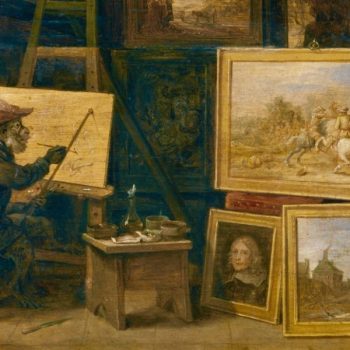
David Teniers, The Monkey Painter (detail), ca.1660, oil on panel (Madrid: Museo del Prado).
The contested concept of ‘reproduction’ stands at a critical nexus of the conceptualisation of early modern artistic thought. The early modern period has been characterised by the development of novel and efficient reproduction technologies, as well as the emergence of global empires, growing interconnectedness through trade, warfare and conquest, and the rise of new markets and cultures of collecting. This ethos of innovation and exchange was, however, contextualised against myriad contemporary ideologies still rooted in the values and legends of past narratives. Reproduction stood at the centre of this dichotomy. Set against the context of changing cultural tastes and the increasingly overlapping public and private spheres, ‘reproductions’ were involved within changing viewing practices, artistic pedagogy, acts of homage, and collecting.
The idea of reproduction connotes a number of tensions: between authenticity and counterfeit; consumption and production; innovation and imitation; the establishment of archetype and the creation of replica; the conceptual value of the original and the worth of the reproduction as a novel work of art; the display of contextualised knowledge and the de-contextualisation of the prototype. At the same time, production is shaped historically through practices and discourses and has figured as a key site for analysis in the work of, for example, Walter Benjamin, Richard Wolin, Richard Etlin, Ian Knizek, and Yvonne Sheratt. Participants are invited to explore reproduction ‘beyond Benjamin’, investigating both the technical and philosophical implications of reproducing a work of art and seeking, where possible, a local anchoring for the physical and conceptual processes involved.
We welcome proposals for papers that investigate the theme of reproduction from the early modern period (c.1500–1800), including painting, print making, sculpture, decorative arts, architecture, graphic arts, and the intersections between them. Papers can explore artistic exchanges across geopolitical, cultural and disciplinary divides and contributions from other disciplines, such as the history of science and conservation, are welcome. Topics for discussion may include, but are not limited to
• The conceptualisation and processes of reproduction and reproduction technologies before and at the advent of ‘the mechanical’
• Reproduction in artistic traditions beyond ‘the West’
• The slippage between innovation and imitation
• Part-reproduction and the changing, manipulation and developments of certain motifs
• Problematizing the aura of ‘authenticity’ and the ‘value’ of the original, copies and collecting
• Fakes and the de-contextualisation of a work through its reproduction
• Reproduction within non-object based study e.g. architecture
• Theoretical alternatives and the vocabulary used to describe the process and results of reproduction in contemporary texts
Please send proposals of no more than 300 words along with a 150 word biography by 6th July 2017 to kyle.leyden@courtauld.ac.uk and natasha.morris@courtauld.ac.uk.
Organised by Kyle Leyden, Natasha Morris, and Angela Benza
Call for Papers | Libraries and Museums in Switzerland
From H-ArtHist:
Bibliothèques et Musées en Suisse: Histoires Croisées, 18e-19e siècles
Musée historique de Lausanne, 24–25 May 2018
Proposals due by 31 August 2017
La présence d’objets, voire de véritables cabinets de curiosités, dans l’enceinte des bibliothèques caractérise bon nombre de bibliothèques d’Ancien Régime. Depuis le XVIIe siècle, l’interaction entre livres et objets est en effet thématisée comme un enjeu bibliothéconomique primordial : monnaies, médailles, instruments scientifiques, échantillons naturels et artéfacts exotiques sont appelés à dialoguer avec les livres afin de nourrir le projet de connaissance encyclopédique de la bibliothèque. À la fois ornements et compléments du savoir livresque, ils mettent en scène une confrontation entre le discours et la dimension matérielle, voire palpable de ce même discours.
À la suite de la Révolution française, qui décrète le musée espace public aux fins didactique, patrimoniale et civique, ces objets se voient cependant progressivement expulsés de l’enceinte des bibliothèques et soutiennent, dans de nombreux cas, la naissance d’institutions muséales. Entre la fin du XVIIIe siècle et tout au long du siècle suivant, innombrables sont en effet les musées qui se créent sur la base de collections « éjectées » de l’espace de la bibliothèque. Les causes de cette autonomisation forcée sont souvent pratiques, ces collections ayant atteint une ampleur qui ne leur permet plus de demeurer intégrées aux surfaces prévues pour les livres. Mais des raisons d’ordre politique, scientifique voire épistémologique entrent également en ligne de compte. Il n’en reste pas moins que, dans cette perspective, les bibliothèques, et notamment les bibliothèques publiques, apparaissent comme des antichambres des musées et la condition sine qua non de l’émergence d’un panorama muséal régional et national.
La Suisse et ses villes illustrent clairement la fécondité de cette articulation. Les collections des cabinets de la bibliothèque de Genève, de la bibliothèque de l’Académie de Lausanne ou encore de la Bibliothèque de la Bourgeoisie de Berne, pour n’en mentionner que quelques-unes, provoquent et alimentent dans un premier temps la création des muséums d’histoire naturelle de leurs villes respectives, puis dans un second temps celles des musées d’art, d’histoire et d’ethnographie de ces lieux.
Malgré son importance, cette interdépendance ne semble pas avoir stimulé l’intérêt des chercheurs. Au contraire, un certain cloisonnement disciplinaire persiste entre les spécialistes de l’histoire des bibliothèques et de l’histoire des musées. Si les premiers attribuent aux cabinets un rôle fondamentalement mineur dans le programme de connaissance de la bibliothèque des Lumières, les seconds ne concentrent leur regard que sur le musée dès le moment où celui-ci acquiert une existence autonome. C’est cette lacune que le colloque propose de combler. Dans le but d’élaborer une réflexion interdisciplinaire, la rencontre souhaite réunir historiens des collections et professionnels du monde des bibliothèques et des musées pour présenter une série de cas d’étude. Le colloque se focalisera essentiellement sur la Suisse afin de faciliter la délimitation géographique de la problématique. Cependant, des propositions concernant d’autres territoires nationaux seront les bienvenues dans la mesure où elles contribueront à la formulation de principes méthodologiques.
Quatre axes de réflexion structureront les échanges
1. il s’agira d’abord de problématiser le statut des collections d’objets de bibliothèques pour saisir les modalités sous-jacentes de leur arrivée et de leur arrangement. De même, nous chercherons à comprendre comment ces objets négocient leur cohabitation avec les collections livresques.
2. nous soulèverons également la question de leur émancipation par rapport aux livres : qu’est-ce qui motive cette émancipation ? Qui en sont les acteurs ? Qu’est-ce que ces remaniements impliquent au sein même de la bibliothèque ? Comment le rapport entre le musée naissant et la bibliothèque se pense-t-il ? Comment s’entretient-il ? Pourquoi se dégrade-t-il ?
3. nous aborderons ensuite le problème de la perte de sens souvent provoquée par la répartition des objets dans des collections spécialisées, perte qui se répercute sur les politiques de gestion des collections.
4. des questions méthodologiques retiendront enfin notre attention : est-ce qu’une histoire croisée des bibliothèques et des musées est véritablement réalisable ? Quels types de sources peuvent la soutenir ? Et qu’en est-il aujourd’hui de l’articulation bibliothèques/musées dans la gestion d’institutions culturelles ? Conditionne-t-elle les politiques patrimoniales contemporaines ?
La période prise en compte est celle allant du XVIIIe siècle à la fin du XIXe siècle ; des communications portant sur le XXe seront toutefois acceptées si elles dialoguent avec des pratiques ou des discours hérités des siècles précédents.
Les communications individuelles seront limitées à 25 minutes, celles en tandem à 40 minutes. Les propositions, en français, en allemand, en italien ou en anglais comprendront environ 300 mots. Elles sont à adresser à Rossella Baldi (rossella.baldi@unine.ch) et à Valérie Kobi (valerie.kobi@uni-bielefeld.de). Délai pour l’envoi des propositions : 31 août 2017. Les réponses seront envoyées dans le courant du mois d’octobre 2017.
Comité scientifique
Rossella Baldi, Danielle Buyssens, Valérie Kobi, Claude-Alain Kuenzi, Matthias Oberli, Michel Schlup, Martin Schultz.
Call for Papers | Fans as Images, Accessories, and Instruments of Gesture
From H-ArtHist:
‘Num’rous Uses, Motions, Charms, and Arts’: Fans as Images,
Accessories, and Instruments of Gesture in the 17th and 18th Centuries
University of Zurich, 30 November — 1 December 2017
Proposals due by 30 June 2017
This interdisciplinary conference discusses the cultural role of fans in art, fashion, and material culture in the seventeenth and eighteenth centuries. Taking the visual and material diversity of fans as a point of departure, it aims at gaining new insights into the various interrelations between fans, paintings, and printed artworks in this period.
The conference takes painted and printed folding fans as its main focus in order to take a closer view of the pictorial and intermedial interplay of ornamental patterns, figurative elements, and artistic subject matters. From the late seventeenth century onwards, fan depictions were often inspired by or based on Renaissance and contemporary paintings. In the course of the eighteenth century, fan leaves displayed an increasing variety of cultural themes, thereby also functioning as souvenirs as well as conveyors of political and social messages.
Furthermore, the conference seeks to examine fans as gender-specific instruments of gesture and communication. In eighteenth-century Europe, fans became important fashion accessories across the social classes and were almost omnipresent in social interaction. In 1711, Joseph Addison, satirizing social etiquette, describes fans as “modish machines” and powerful “weapons” of their female owners. Later visual and written sources enhanced this attribution of meaning, particularly emphasizing the fan’s expressive movements of opening and closing, of displaying and not displaying, which could hide their owners’ faces while at the same time rendering visible their emotions. On the other hand, painted and printed fans presented a wide variety of social knowledge in fast and fleeting pictures, in this way conveying personal statements of those who carried them.
The conference aims to bring together different perspectives on the cultural importance of fans in order to consider issues such as their production, their material qualities, the visual elements and subject matters in fan painting, as well as the various social uses and the reception of fans in art and literature. We invite discussions of both individual fans as well as visual and written sources which reveal the cultural role of the fan in the seventeenth and eighteenth centuries.
This call addresses art historians, fashion historians, and researchers from related disciplines. Possible topics may include, but are not limited to
• painted and printed fans as conveyors of (political and cultural) information
• fans as souvenirs and conveyors of memory
• the reception of artworks in fan depictions
• fans as/within the context of fashion accessories, dress norms and gender-specific body cultures
• fans in cultures of communication and cultures of feeling
• fans in the visual arts (portraits, genre painting, caricatures, etc.) and in literature
• the manufacture and (global) trade of fans
• case studies in the conservation and restoration of fans
Please send your proposal (max. 300 words, in English, German or French), for a paper (20 minutes), a short CV and a short list of keywords (max 6) no later than June 30, 2017 to Dr Miriam Volmert (miriam.volmert@khist.uzh.ch) and lic. phil. Danijela Bucher (danijela.bucher@uzh.ch). Notification of authors: July 7, 2017. Travel reimbursement depends on the availability of funds.
Call for Papers | Landscape Now
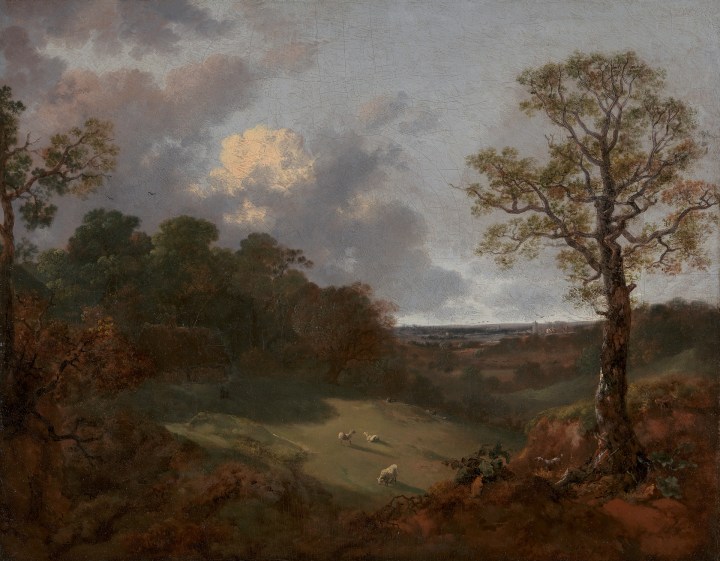
Thomas Gainsborough, Wooded Landscape with a Cottage and Shepherd, 1748–50, oil on canvas, 43.2 × 54.3 cm (New Haven: Yale Center for British Art, Paul Mellon Collection, B1976.2.1).
◊ ◊ ◊ ◊ ◊
From the Paul Mellon Centre:
Landscape Now
Paul Mellon Centre for Studies in British Art, London, 30 November – 1 December 2017
Proposals due by 30 June 2017
The pictorial representation of the landscape has long played an important role in the history of British art. It has been central to writers from Gilpin and Ruskin onwards, and was the subject of sustained scholarly attention in the 1980s and 1990s with the emergence of a social history of art. Writers such as John Barrell, Anne Bermingham, Stephen Daniels, Christiana Payne, Michael Rosenthal and David Solkin not only helped transform interpretations of British landscape painting, but made the study of such imagery seem essential to a proper understanding of British art itself.
Over the past two decades the centre of gravity of British art studies has shifted. An imperial turn has characterized some of the most ambitious scholarship in the field; a raft of powerful new voices have shifted attention to the Victorian and modern periods, and to the imagery of urban life; and there has been a dramatic growth of interest in such topics as print culture, exhibition culture, and the material culture of the work of art. With these developments, existing approaches to the study of landscape pictures lost some of their urgency and relevance.
However, this same period has seen the growth of a broader interest in landscape images in adjacent disciplines, driven in part by political and environmental imperatives. A newly energised category of ‘nature writing’, associated with authors such as Robert Mcfarlane and Helen MacDonald, has gained widespread currency beyond the purely academic arena. Cultural geographers such as David Matless and film-makers such as Patrick Keillor have offered nuanced investigations of the British landscape in their work, asking us to think afresh about its relationship to national identity, memory and post-imperial decline. And while many scholars in the humanities, in an age of globalisation and deepening ecological concern, have felt compelled to think about landscape on a vastly expanded basis, others have been driven to offer a new and suggestive focus on the local.
The moment thus seems ripe for a major art-historical reassessment of the image of the British landscape, taking account these and other emergent concerns. This international conference—the third in an annual series organised collaboratively by the Paul Mellon Centre, the Yale Center for British Art, and the Huntington Library, Art Collections, and Botanical Gardens—is designed to offer an opportunity for such a reassessment.
We seek proposals for 20-minute papers that offer new perspectives on the visual representation of the British landscape of any period. We equally welcome papers that focus on canonical landscape artists and paintings, and those that deal with lesser-known figures and objects, as well as those that investigate the topic in relation to drawing, printmaking, photography, film and television. Themes that might be addressed include:
• Landscape imagery and national identity
• Local/global histories of British landscape art
• The production of landscape images – in the field and in the studio
• Alternative landscapes: urban, suburban, rural, wild, touristic, agricultural
• The landscape image in a wider visual culture
• The pictorial logic of the landscape image
• The landscape image in an age of erosion
Please send proposals of 400 words maximum together with a short biography of no more than 100 words to events@paul-mellon-centre.ac.uk by 30 June 2017.
Call for Papers | Natures and Spaces of Enlightenment
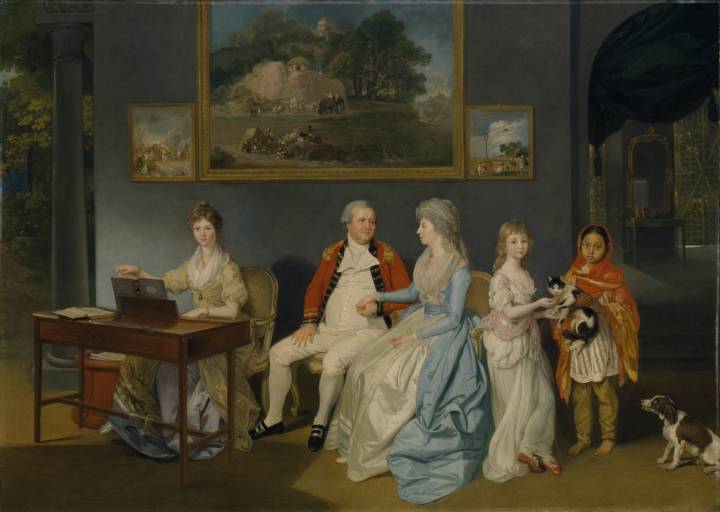
Johan Zoffany, Colonel Blair with His Family and an Indian Ayah, 1786
(London: Tate)
◊ ◊ ◊ ◊ ◊
From ANZSECS:
Natures and Spaces of Enlightenment
Griffith University and the University of Queensland, Brisbane, 13–15 December 2017
Proposals due by 1 August 2017
The Australian and New Zealand Society for Eighteenth-Century Studies (ANZSECS) is pleased to announce that the sixteenth David Nichol Smith Seminar, Natures and Spaces of Enlightenment, will be held in Brisbane, Australia, at Griffith University and the University of Queensland on the 13th to 15th December 2017. We welcome proposals for papers or panels on the theme ‘Natures and Spaces of Enlightenment’, broadly conceived as referring to the plurality of Enlightenments as well as the ideas and uses of nature which they endorsed, and the spaces in which they developed.
In the inclusive spirit of the David Nichol Smith Seminar, proposals may address any aspect of the long eighteenth century. Especially relevant topics include
• Enlightenment and religion, science, empire, or gender
• Popular, moderate, and radical enlightenments
• Regional, national, and global enlightenments
• Climate, the environment, and the Anthropocene
• Emotion, sentimentalism, and the language of feeling
• Theories of human nature and civil society
• Improvement and social utility
• Travel, exploration, and discovery
• Trade and commerce
• Philanthropy and the culture of moral/social reform
• Spaces of sociability such as clubs, salons, coffeehouses, and taverns
• Urban and rural spaces
• Ideas of landscape and forms of land use
• Nature in art, literature, and music
• Natural history, natural philosophy, natural law, and natural theology
• Nature in economic and political writing
• Nature, medicine, sexuality, and the body
• Botany, geology, and geography
• Representations and uses of animals
• Work, leisure, technology, and industrialisation
We welcome proposals for 20-minute papers and panels comprising 3 x papers. Please submit an abstract of 250 words (maximum) and a 2-page CV, as PDF documents, to the following email address by 1 August 2017: dnsconferenceqld@gmail.com. Participants must be current members of ANZSECS. If you have any questions about the conference, please contact one of the organisers: Peter Denney (p.denney@griffith.edu.au) or Lisa O’Connell (l.oconnell@uq.edu.au).
Keynote Speakers
• Deidre Lynch (Harvard University)
• Jan Golinski (University of New Hampshire)
• Georgia Cowart (Case Western Reserve University)
• Sujit Sivasundaram (University of Cambridge)
Call for Papers | European Lacquer in Context
From H-ArtHist:
European Lacquer in Context
Jubelpark, Brussels, 18–19 January 2018
Proposals due by 4 June 2017
The Royal Institute for Cultural Heritage (KIK-IRPA, Brussels, Belgium), the University of Antwerp (UA, Antwerp, Belgium) and the Royal Museums of Art and History (KMKG-MRAH, Brussels, Belgium) invite you to participate in our two-day conference European Lacquer in Context. The theme of this conference is European lacquers in a broad sense: theoretical and practical work concerning conservation and restoration, art historical, technological and chemical research will be highlighted.
We encourage students, young and established professionals to submit an abstract for either a poster or a paper presentation. Both theory and practice-oriented contributions from professionals working with European lacquers are considered (among others curators, conservators, restorers, art historians, analytical scientists and anyone with an interest in European lacquers). Presentations of collaboration projects between different professions are strongly encouraged.
For more information about the conference, please visit the ELinC-conference website. Please submit the abstract before 4 June 2017 through the conference online abstract form.










leave a comment