Call for Papers | Moral Cultures
From H-ArtHist:
Moral Cultures / Kulturen der Moral
Deutsche Gesellschaft für die Erforschung des 18. Jahrhunderts Annual Conference
Paderborn, 19–22 September 2018
Proposals due by 30 June 2017
Hardly any term is as ubiquitous during the 18th century as the term ‘morale’. For Niklas Luhmann the “universalization of moral demands” is a pivotal trigger in the ongoing transformation of society from stratified to functional differentiation: It forces back religion’s dominance, gives way to those new pedagogical (e. g. Pestalozzi, Weiße), psychological (Erfahrungseelenkunde), and political or juridical concepts (democracy, theories of penalty) that modern societies are based on. Furthermore, the omnipresence of morale is intertwined with the way an aspiring bourgeoisie defines itself and its educational values in opposition to nobility (see Carl Friedrich Bahrdts Handbuch der Moral für den Bürgerstand, 1790).
In addition to these social developments, morale is also the key element of the 18th-century aesthetic discussion since arts and literature aim at transforming uneducated masses into responsible and mature citizens who are able to tell right from wrong, and therefore make useful members of society. This is even true of concepts like that of Autonomieästhetik around 1800. Schiller’s classical approach still sees theatre as an institution of morale (moralische Anstalt), although the aesthetic ideals of both Weimarer Klassik and Romanticism have often been set apart from those of the Enlightenment.
Morale’s domination of both academic discourse and everyday life during the 18th century, its forms, and consequences need to be studied thoroughly in order to truly understand the culture of the time. In fact, contemporary debates show that there is no simple answer to the question of morale in the 18th century itself. On the contrary, the need to include morale into every aspect of life causes a number of problems. For example, it remains unclear what specific measures are to be taken in order to facilitate the moral education of the people. In the early 18th century, most scholars choose a rational approach. Such an approach leads to the ascent of literary genres that offer an explicit lesson or advice to the reader, just like the ‘morale’ of the fable, one of the most popular genres at the time. During the 18th century this rational approach draws more and more criticism. The philosophy of moral sense, as an alternative, establishes the ideal of an integral education that enables individuals to judge for themselves, not having to rely on a set of ‘lessons’ they were given by an academic elite. Now, having an explicit morale at the end of a literary text is even considered hurtful to the goal of making the reader a better person—not only because reality is too complex to capture everything a person has to know in a single sentence, but also because a mature audience, the one the Enlightenment wants to create, will not appreciate being spoken to as children who know nothing of the world. Once the discussion reaches this point, of course, even more attempts are made to solve the conflict. As long as giving up the goal of moral education altogether is not an option, which it finally will be around 1800, the ‘problem of morale’ remains central giving way to what can be called the different ‘moral cultures’ the conference would like to explore.
The term ‘moral culture’ refers, on the one hand, to the fact that the question of morale in the 18th century is not just an academic or aesthetic problem, but defines large parts of everyday life. People read moral weeklies and find joy in extending and constantly questioning their faculties of judgment. Behaving morally is a requirement for anyone who wants to be part of society; critique becomes a matter of public interest. Bon ton requires a certain amount of display of one’s morality, which is truly to be lived through joined enjoyment and critical assessment of art—whether in the direct personal contact of family life or reading societies or, at more distance, in writing (letters, public journals etc.). Using the term ‘culture’ also implies that morale is an essential requirement for cultivated existence and the progress of civilization—a crucial general idea of the Enlightenment’s worldview. For this reason moral judgment is seen to be a predicament of critical judgment as such, so aesthetic education becomes a relevant basis of moral schooling. Of course, there is the opposite point of view we can see in story of Inkle and Yariko about the ‘barbarian’ who has higher moral standards than the civilized European. This story illustrates that morality is something one is born with and faces the danger of being lost in the course of civilization. These opposite views both show how western societies use morale to define themselves in contrast to ‘naïve’ cultures that either existed in the past or that are found in other regions of the earth in the course of the discovery and the conquest of new continents.
On the other hand, we emphasize the plural of ‘morale cultures’ to accentuate that the central function of morale not only comes along with many different shapes on the numerous levels of social and aesthetic discourse but furthermore develops a plurality of distinct moral cultures. The reason for this is primarily that the 18th century aims to make access to moral discussion available for a great amount of people. Not only scholars get to voice their thoughts in moral weeklies but also ‘common’ folks and especially women, represented in dialogues and letters by authentic or fictional authors.
The 2018 Annual Conference of the German Society for Eighteenth Century Studies (DGEJ) wants to provide scholars in relevant fields with the opportunity to take the importance of morale during the 18th century seriously, and initiate an intense ongoing discussion about the complexity of the phenomena which we believe will prove to be extremely fruitful for future studies. The following eight sections offer suggestions and potential research questions to inspire proposals for the conference.
S E C T I O N S
1 Moral Cultures in the 18th Century
This section gives room for major theoretical reflection on morale, both on the term and its specific role in the 18th century. Papers can address the particular historical background which leads to the ascent of morale as a crucial concept of discourse or raise the question when, how and why this phase comes to an end. What other macro-level theoretical concepts are useful to describe or elaborate the individual potential outcomes of the other section (e. g. Luhmann’s differentiation of society, beginning of modernism, Sattelzeit). What does it mean to use the term ‘moral cultures’? Which distinct cultures of morale can be found? Which are the underlying similarities that suggest the existence of only one moral culture or a superstructure that brings the different versions of morale cultures together?
2 Morale, Ethics, and Religion
This section gives room to discuss works of philosophy and theology on morale from the 18th century and to highlight interdependences between moral philosophy, ethics and religion. Since the topic is vivid there are numerous reflections on the concept of morale and its role in society. While rationalistic approaches tend to claim that moral judgment can be taught and learned, the theories of moral sense see morale as something every individual has a natural understanding of which can only be cultivated or protected from disfiguration. The importance of religion is now based on its moral achievements (as in Lessings Nathan der Weise). An intimate practice of religion outside the church comes into practice (Pietism) in close relation to questions of morale. Both of these developments help overcome simplified theories of secularization during the Enlightenment.
3 Morale in Politics and Law
The leading function of morale results in a different relationship between individual and government, reflected in new political and juridical concepts. In opposition to absolutism, the most important form of government in the 17th century, the ruler now has to meet certain moral standards to be seen as a ‘good’ head of state. In other countries, the concept of monarchy is eliminated altogether—sometimes successfully like in the foundation of the United States, sometimes only temporarily like in France. The moment former subjects are considered humans, more humanitarian forms of punishment are discussed (the best-known example is, of course, the guillotine). We invite scholars to discuss the various aspects of morale and public welfare in all fields of political or legal reforms as well as constitutional aspects.
4 Moral Culture: Time and Place
This section wants to explore the nature of a western moral culture in comparison and in opposition to other moral cultures that can be situated in the past (Ancient Greek, Middle Ages) or on different continents the civilized world gets to read about in the accounts by travelers that flood the book market. Attention should be paid to how the ‘barbarian’ or ancient cultures are described in terms of morale: Are they immoral people or just the opposite representing an unadulterated way of living that is always superior to more progressive societies? What concepts lie in-between? In addition, we have to ask whether there really are uniform western moral cultures or if the same procedures of delineation can be found inside the western world, e. g. between different European countries or between Europe and the western societies on the American continent. On the one hand, Paul Hazard observes the emerge of a mutual European thinking around 1700 when the never-ending process of critical thinking, which is so crucial to questions of morality, comes put into motion. On the other hand, the philosophical discussions of morale during the 18th century alone each have a different focus that has to be taken into consideration. An important frontier of mentality (and there are certainly others that are less talked about) surely runs between the north and the south of Europe. There is, for instance, the specific aura of Italy where many artists go to get in touch with the Ancient World or the Renaissance.
5 Morality in Everyday Life
On the one hand, this section explores the establishment of strategies to secure moral’s place in everyone’s life and promote moral behavior on a daily basis, such as joined reading of moral weeklies and other publications of the sort but also common practices like living pictures or social gatherings in general. On the other hand, a growing individualization and internalization of morale takes place, e. g. in the sense that a virgin’s purity now includes her soul. Friendships between the sexes are made possible by the faith in every human’s natural moral sense; other research areas include the relation between morale and love, marriage and family. They have to be considered in the light of the various social classes for it is the bourgeoisie which plays an important part in initiating these altered concepts of family and friendship.
6 Immorality
As morale becomes an omnipresent and, seemingly, omnipotent factor, alternatives to this dominance gain importance. They are in part created in direct opposition to the discourse of morale but also intertwined with it. There is, for example, the culture of libertinage and gallantry, which has been heavily criticized from the bourgeois standpoint, or the erotically teasing artworks of Rococo (see the paintings by Fragonard and Baudouin) and Anacreontic that are no less stigmatized as immoral although their defenders, like Christoph Martin Wieland, deliberately see them as way of a more effective moral education that does not only build on denial and sanctions. Even pornography begins to bloom with the expansion of the book market and the loss of female virtues becomes a popular literary motif (Richardson, Choderlos de Laclos). Furthermore, there is the moral bandit as another example of how morale and immorality are brought together.
7 Communication and Morale
In the 18th century the rise of new media also established a new, more intimate, language to communicate in, which plays its own part in making morale a central discourse of the time. This section focuses on strategies of communication through the eyes of linguistics, cultural or media studies. How do people communicate about morale? Where and in what way does this communication take place? What is ‘moral communication’? Papers can also relate these concepts to questions of common sense, rationality, sentimentalism, honesty, thoroughness or decency, ask to what degree they aimed at specific groups (educated/non-educated, adults/children, men/women etc.) or highlight their role in public critique and (scholarly) polemics.
8 Moral Aesthetics
Art in the 18th century is often defended by the argument that it has a moral value, so one of the key goals of the Enlightenment is to make it available for a large number of people. But what exactly are the strategies artists, writers and thinkers come up with to ensure moral education by means of art really does succeed? Is a literary text supposed to make its goal visible or must it be hidden in order to reach reluctant readers? How does moral education work in the visual arts and in music? In addition to these general questions papers can also address genres or topics that become popular because of their acclaimed moral value.
Prof. Dr. Lothar van Laak, Dr. Kristin Eichhorn
Neuere deutsche Literatur und Allgemeine Literaturwissenschaft
Fakultät für Kulturwissenschaften
Universität Paderborn
Warburger Str. 100
D-33098 Paderborn
Please send your abstract (about 300 words) for a 20-minute paper, along with a short CV (1 page), until 30 June 2017 to: Lothar.van.Laak@uni-paderborn.de and keich@mail.uni-paderborn.de.
Call for Papers | Furniture and the Domestic Interior, 1500–1915
From the Call for Papers:
Furniture and the Domestic Interior, 1500–1915
The Frick Collection, New York, 27 October 2017
Proposals due by 18 June 2017
The Furniture History Society and The Frick Collection invite submissions from PhD students, post-doctorates, and emerging museum scholars for a symposium dedicated to the history of furniture and interiors in Europe, Britain, and the United States. Furniture and the Domestic Interior, 1500–1915 is the Furniture History Society’s fourth Research Seminar, following previous academic events at the Wallace Collection in London (2015, 2012) and the Metropolitan Museum of Art in New York (2014).
This event aims to present current research by scholars at an early stage of their career on subjects in European and British furniture history. Topics relevant to the Frick’s distinguished collection of European furniture or Gilded Age setting are encouraged, as are those that have a particular focus on the history and influence of European furniture in the United States, either through design, manufacture, commissions, or collecting. In addition to presenting their work, participants will have the opportunity to study furniture in the Frick’s permanent collection with curatorial and conservation staff and discuss ongoing research in a seminar setting.
Applicants are requested to send a current CV and 300-word abstract outlining the topic of a 20-minute paper to grants@furniturehistorysociety.org and academic@frick.org by June 18, 2017. Limited assistance with travel expenses may be available on an as-needed basis; please describe any requests in the abstract. All applicants will be notified by July 11, 2017. The symposium is free, but online registration is required.
Call for Papers | The Jewish Country House
From The Oxford Research Centre in the Humanities (TORCH) . . .
The Jewish Country House
University of Oxford, 5–6 March 2018
Proposals due by 12 June 2017
Organised by Abigail Green, David Rechter, and Oliver Cox (Oxford) and Juliet Carey (Waddesdon Manor)
This workshop aims to establish the Jewish country house both as a focus for scholarly research and as a site of European memory. By focusing on a hitherto unidentified group of country houses—those that were owned, renewed, and sometimes built by Jews—we aim to establish the importance of Jewish country houses like Port Lympne Mansion, Schloss Freienwalde, Villa Kerylos, and Castello Sonnino as variations of a pan-European phenomenon deserving serious consideration from an academic and a heritage viewpoint.
The workshop aims to bring scholars working on Jewish country houses, castelli, chateaux, Schlösser, and Villas together with curators, museum, and heritage professionals working either in ‘Jewish country houses’ themselves or in the area of European Jewish heritage more broadly. The two day workshop will be held at TORCH, University of Oxford, with a visit to Waddesdon Manor, the only surviving Rothschild house with its collections and interiors intact.
Jewish country houses have so far escaped systematic study because they do not fit existing paradigms either in modern Jewish history or country house studies. The historiography of European Jewish elites has tended to focus on the grande bourgeoisie in its urban setting and does not consider the role families like the Bischoffsheims, the Bleichröders, the Péreires, and the Sonninos assumed through their rural estates, nor the role of Jewish country houses in the self-fashioning of many leading Jewish figures such as Benjamin Disraeli, Ferdinand de Rothschild, and Philip Sassoon in the UK, Leopoldo Franchetti in Italy, Walter Rathenau in Germany, and Théodor Reinach in France. Conversely, the literature on country houses, which typically focuses on the landed aristocracy, has paid little or no attention to the existence of country houses and rural estates in Jewish hands, or to the particular challenges this posed in a rural landscape and social context so powerfully shaped by Christianity.
We are seeking proposals for two types of contributions:
1) Scholarly contributions exploring Jewish country houses in the UK and continental Europe, their architecture, furnishing, collections and social functioning, and their cultural and political role in the self-presentation and perception of European Jewish elites.
2) Case studies of specific country house museums presented by country house and heritage professionals, which will allow us to consider the Jewish country house as a site of European memory and a significant aspect of European Jewish heritage and material culture. These case studies are designed to illuminate more generally the issues of presentation and display presented by specific Jewish country houses.
Particular questions likely to arise in either or both strands of the programme include:
• What, if anything, was Jewish about these properties besides their owners?
• What can be gained from comparing Jewish country houses with each other, both within and between national contexts?
• Is it possible to identify personal, artistic, or political connections between them, both nationally and internationally?
• How do these houses and their rural estates relate to and/or challenge paradigms either of Jewish cosmopolitanism/ exoticism or of landed, aristocratic rootedness?
• What was the relationship between these country houses and their urban counterparts?
• How far, if at all, did these houses figure as ‘Jewish’ in public discussions of their owners, architecture, collections and preservation?
• What particular issues of presentation and display do Jewish country house museums raise for curators and heritage professionals both in general, and perhaps in relation to the ruptures of the Nazi era?
• How can we engage these issues sensitively without generalizing or over-simplifying the many different ways in which the Jewishness of individual estate owners both did and did not find expression in their properties and collections?
We anticipate that the British dimension of this workshop will be disproportionately important both in terms of scholarship and for heritage professionals, partly because of the cultural significance of the country house in Britain, but also because without a National Trust similar properties (and the archival record) have been less well preserved elsewhere, while the depredations of the Nazi era had a devastating effect on Jewish houses and their collections in continental Europe. Given this reality, we would particularly welcome contributions from scholars and heritage professionals related to Jewish country houses in continental Europe that will enable us to make scholarly connections between the Anglo-Jewish country house and its continental counterparts, and to promote ties between heritage professionals working in this area both in the UK and in continental Europe.
Confirmed speakers: Leora Auslander, Todd Endelman, Paolo Pellegrini, Thomas Stammers.
Please submit your proposal with title, abstract of no more than 300 words, and a short bio/CV in one pdf or doc to JCHconference@humanities.ox.ac.uk by Monday, 12 June 2017.
We are grateful for the funding and resources towards this event provided by the Arts and Humanities Research Council, Brasenose College, the Paul Mellon Centre for British Art, and the University of Oxford John Fell Fund.
Call for Papers | Pictures of Exotic Animals
From H-ArtHist:
Bilder exotischer Tiere zwischen wissenschaftlicher
Erfassung und gesellschaftlicher Normierung, 1500–1800
Augsburg, 10–11 October 2017
Proposals due by 30 June 2017
Die Darstellung exotischer Tiere zählte zu den besonderen Herausforderungen an Künstler der Frühen Neuzeit. Ihr Innovationsbedarf war zweifach, da neben der textlichen Überlieferung der antiken Naturgeschichte die im Zuge der überseeischen Expansion rapide zunehmenden Kenntnisse außereuropäischer Fauna einer visuellen Fixierung bedurften: Im methodischen Spannungsfeld von humanistischer Textrevision und sammelnd-empirischer Erfassung avancierte das Bild zu einem primären Erkenntnisträger der vormodernen Zoologie. Epochale Forscher wie Ulisse Aldrovandi engagierten etwa Künstler, um ihr Wissen anhand der Visualisierung sowohl externer Bildvorlagen als auch lebender und präparierter Tiere aus den eigenen Sammlungen zu schärfen.
Ihre Erkenntnisse wurden jenseits der Naturkunde in zahlreichen Fällen in illustrierten Flugblättern popularisiert; umgekehrt konnten Flugblätter mit kommentierten Bilddarstellungen unbekannter Arten als Belege für die Forscher dienen. Analog dazu blieb auch die Betrachtung lebender oder präparierter Exoten nicht auf eine elitäre Sphäre begrenzt, sondern zählte zum Repertoire wandernder Schausteller in der frühneuzeitlichen Populärkultur. Zugleich wurden Motive exotischer Tiere im Bereich der repräsentativen Kunst adaptiert, indem sie in Embleme und Allegorien eingesetzt wurden. Neben dem weit verbreiteten Thema der vier Erdteile, für die Exoten zur Markierung insbesondere Afrikas und Amerikas dienten, sei etwa auf die Symbola et Emblemata des Joachim Camerarius verwiesen, die ausschließlich Motive der weltweiten Flora und Fauna beinhalten. Ihnen allen gemein war der Klassifikationsbedarf in einer von Mythen und Legenden geprägten Naturvorstellung sowie der Skala der Naturreiche.
Unter der Annahme, dass der Blick auf einen unbekannten Bereich der Natur mit der Prüfung des eigenen kulturellen Selbstverständnisses verbunden ist, stellt der projektierte Workshop die Frage nach Momenten sozialer und kultureller Normstiftungen in frühneuzeitlichen Bilddiskursen exotischer Fauna. Sie erweist sich dort als besonders triftig, wo Exoten in wertebestimmende Repräsentationssysteme aufgenommen und wo tradierte Ordnungsvorstellungen der Naturgeschichte und des Rangs des Menschen in der Natur durch die Zunahme neuer Erkenntnisse überlastet wurden.
Methodisch-theoretisch reagiert die Veranstaltung damit auf die Herausforderung der Human-Animal Studies: Das Verhältnis vom Menschen zum Tier (oder genauer: zu den anderen Tieren) ist in den vergangenen Jahren zu einem interdisziplinär diskutierten Thema geworden, zu dem die Kunstgeschichte Grundlagen einer historisierenden Perspektive beizutragen vermag. Auffällig ist allerdings, dass der Diskurs der Human-Animal-Studies bislang hauptsächlich domestizierte Tiere fokussiert, die als Nutz- und Haustiere in einer künstlich geprägten Sphäre zwischen natürlichem und vom Menschen bestimmtem Verhalten leben. In der Konzentration auf Exoten sollen nicht zuletzt besonders menschenferne und kaum zu domestizierende Tiere wie Haie, Schlangen und Krokodile thematisiert werden, deren Lebensraum gleichwohl infolge der europäischen Expansion beeinträchtigt wurde und die gerade in ihrer Fremdheit als besonderes Faszinosum auf die frühneuzeitliche Gesellschaft wirkten.
Als kunsthistorischer Workshop mit interdisziplinären Anschlussmöglichkeiten richtet sich die Veranstaltung an den wissenschaftlichen Nachwuchs (Doktorandinnen und Doktoranden sowie Post-Docs) der Kunstgeschichte und Bildwissenschaft ebenso wie benachbarter Disziplinen (Ethnologie, Literaturwissenschaft, Geschichte und insbesondere Wissenschaftsgeschichte sowie Philosophie). Beiträge sollten in Fallstudien auf die folgenden Fragestellungen reagieren:
• Wie begegneten Augenzeugen der außereuropäischen Fauna auf Reisen? Können an Bild- und Textdokumenten Stereotype und Projektionen bestimmt werden, die auf eine gesellschaftliche bzw. kulturelle Selbstverortung der Autoren schließen lassen?
• Welche Rolle kam Tierdarstellungen in der Rezeption außereuropäischer Kunst zu? Lieferten außereuropäische Tierdarstellungen einen Beitrag zur europäischen Fremdwahrnehmung?
• Welche Bildpraktiken waren signifikant für die wissenschaftliche Erfassung exotischer Tiere? In welchem Zusammenhang standen Bilder etwa mit den Sammlungsstücken von Kunstkammern und Naturalienkabinetten?
• Wie wurden neu entstehende Motive exotischer Fauna in die Muster der Ikonographie eingefügt? Vermochten Exoten abstrakte Begriffe und moralische Vorstellungen zu versinnbildlichen?
• Welchen Zwecken dienten Darstellungen außereuropäischer Fauna im repräsentativen Apparat der Höfe? Können aus Bildern exotischer Tiere Rückschlüsse auf Herrschaftsansprüche und Herrschaftspraxis gezogen werden? Gab es bürgerliche Strategien zur gesellschaftlichen Distinktion vermittels der Darstellung exotischer Tiere?
• Welche Deutungen erfuhren exotische Tiere im populären Bereich? Vermochten z.B. Sensationsnachrichten über exotische Tiere Ängste und Bedürfnisse einer breiten Gesellschaftsschicht zu reflektieren? Welche Rolle kam dem Bild im Bereich von Schaustellern und Wandermenagerien zu?
Die Konferenzsprachen sind Deutsch und Englisch. Beiträge sollen eine Vortragsdauer von 30 Minuten nicht überschreiten. Um aussagekräftige Abstracts von rund 300 Wörtern nebst einem kurzen Lebenslauf wird bis zum 30. Juni 2017 gebeten:
Dr. Robert Bauernfeind: robert.bauernfeind@philhist.uni-augsburg.de
Pia Rudolph: pia.rudolph@dlma.badw.de
Für Vortragende werden die Kosten für die Anreise bezuschusst, jene für die Übernachtung während des Workshops übernommen. Eine Publikation der Beiträge wird angestrebt.
Call for Papers | HECAA Session at UAAC, 2017
Thanks to Christina Smylitopoulos, who is again coordinating a HECAA session at this year’s UAAC Conference! Details and a full list of panels (57 in all) are available here»
◊ ◊ ◊ ◊ ◊
Universities Art Association of Canada / l’association d’art des universités du Canada
Banff Centre for Arts and Creativity, Banff, Alberta, 12–15 October 2017
Proposals due by 12 May 2017
 HECAA Open Session
The objective of this society is to stimulate, foster, and disseminate knowledge of all aspects of visual culture in the long eighteenth century. This HECAA open session welcomes papers that examine any aspect of art and visual culture from the 1680s to the 1830s. Special consideration will be given to proposals that demonstrate theoretical or methodological innovations. Please email proposals for 20-minute papers to Dr. Christina Smylitopoulos (University of Guelph), csmylito@uoguelph.ca.
Call for Papers | The Histories of Loans
From H-ArtHist:
The Histories of Loans: Memories and Challenges of Museum Loans
Histoires de prêts, mémoire et enjeux des prêts dans les musées
École du Louvre, Paris, 28-29 September 2017
Proposals due by 5 June 2017
Since the end of the 19th century, the expansion of temporary exhibitions has determined the emergence of an international system for museums, based on the circulation of artworks and objects. For museums, sharing pieces from their collection has become crucial to ensure that they in turn get the loans they need to organise their own exhibitions. Lending artworks to prestigious institutions, particularly foreign ones, also enables curators to guarantee a heightened visibility to their own collections. Where to exhibit, how often, and which pieces can be obtained from which partners: nowadays, these are the fundamental criteria of a museum’s positioning within the international hierarchy of cultural heritage prestige. But loan policy does simply affect an institution’s image: it acts directly on the definition of the objects. The acceptation or refusal of a loan is the result of complex transactions, formulated or not, during which the value of an artwork is negotiated and reviewed. It also reflects the importance and rank of institutions, sometimes even of towns and nations. This international symposium intends to question the policy for loaning works of art, both from the angle of the mobility of museum artworks and objects, and that of the reconfigurations of their status. The aim of this colloquium will be to explore the ways in which, historically, loan procedure has defined itself to the point of becoming a crucial challenge for museums.
The economic, political and legal dimensions are also at the heart of this discussion. The suggested themes, which are not meant as limitations but as possible avenues for reflection, include the following:
• The History of loans
• The memory of loans
• The museographical constraints of loans
• Loans and restorations
• Loans as tools for art history
• The geopolitics of loans
• The temporality of loans
• The economy of loans
• The principle of free admission in museums and its exceptions
• Loans and their legal framework
• Notions of public and private in museum loans
The field of study for this symposium also covers the pre-history of loans (such as the translation of relics in the Middle Ages). Alongside artworks and objects, all artefacts are liable to be retained, as long as they shed more light on the theme. The very contemporary period acts as the opposite time limit for the symposium, and can be addressed from a historical viewpoint or as an anthropology of scholarly practices. While it is often difficult to distinguish both notions, the symposium will focus on the question of loans, excluding the question of long-term deposits, which has been studied specifically in the past few years.
Researchers who wish to take part in the symposium must send their paper proposals as well as a CV (one page) to the organisers (colloques@ecoledulouvre.fr) before Monday 5 June 2017. Proposals must be no longer than 2000 characters or 300 words and can be written in French, English, German, or Italian. The organisers will establish the definitive programme along with the members of the scientific committee. The final selection of participants will be announced on 15 June 2017.
Scientific Direction
François-René Martin, ENSBA et Ecole du Louvre
Michela Passini, CNRS (IHMC-ENS) et Ecole du Louvre
Neville Rowley, Staatliche Museen zu Berlin
Scientific Committee
Claire Barbillon, Université de Poitiers, Ecole du Louvre
Françoise Blanc, Ecole du Louvre
Cécilia Griener-Hurley, Ecole du Louvre et Université de Neuchâtel
Violaine Jeammet, Musée du Louvre et Ecole du Louvre
François-René Martin, ENSBA et Ecole du Louvre
Sophie Mouquin, Université Charles-de-Gaulle, Lille
Michela Passini, CNRS (IHMC-ENS) et Ecole du Louvre
Natacha Pernac, Ecole du Louvre et Université Paris-Nanterre
Neville Rowley, Staatliche Museen zu Berlin
Call for Session Proposals | ASECS 2018, Orlando
Panel proposals are due soon:
2018 American Society for Eighteenth-Century Studies Conference
Hilton Orlando Buena Vista Palace, 22–25 March 2018
Session Proposals due by 15 May 2017
Proposals for panels at the at the 49th annual meeting of the American Society for Eighteenth-Century Studies, to take place in Orlando, are now being accepted. Please complete the session proposal form (available as a Word document) and email it to asecs@wfu.edu.

Call for Papers | L’art du diorama, 1700–2000
From H-ArtHist:
L’art du diorama, 1700–2000
Culture & Musées: Appel à proposition d’article pour un numéro thématique
Sous la direction de Noémie Etienne et Nadia Radwan
Proposals due by 30 June 2017
Entendu comme un dispositif d’exposition multidimensionnel et multimédia, le diorama est à la frontière de différentes disciplines et catégories d’institutions muséales. Ce dispositif intéresse les anthropologues, les sémiologues, les géographes, mais aussi les chercheurs en histoire naturelle, les préhistoriens, les historiens et historiens d’art. Il interroge également les artistes contemporains, comme le montre la persistance de ce que l’on peut appeler une esthétique du diorama chez des artistes tels que Marcel Duchamp, Edward Kienholz, Marc Dion, ou Thomas Hirschorn.
Les dioramas ont été étudiés comme précurseurs du cinéma (Griffiths, 2002), ou comme dispositifs singuliers dans les domaines des sciences naturelles et de l’anthropologie (Rader, Cain, 2014). Les études postcoloniales, dans le sillage de l’article de Donna Haraway, ont porté un regard critique sur ces installations (Haraway, 1984 ; Mitchell, 1988 ; Çelik, 1992). Pourtant, ces études n’ont considéré que les exemples réalisés en Europe et aux États-Unis, tandis que ces dispositifs sont largement répandus en Amérique latine, en Asie ou au Moyen Orient.
Vingt ans après le numéro consacré aux dioramas par la revue Public & Musées sous la direction de Bernard Schiele (1996) qui questionnait le statut du diorama en muséologie, il importe de réinterroger ces installations. Ce numéro propose de remettre le diorama au centre d’une étude des institutions muséales, en insistant d’une part, sur la matérialité de ces dispositifs (Bennett, Joyce, 2010), et, d’autre part, sur l’identité de ceux qui les fabriquent. Il examinera également les questions liées à l’opérativité symbolique et sociale des dioramas et à leur réception par les publics. Enfin, l’authenticité des espaces ainsi créés sera au cœur des interrogations. Cette question est d’autant plus urgente que de nombreux musées discutent aujourd’hui de la conservation de ces dispositifs qui appartiennent à l’histoire des musées, mais aussi à son futur.
L’objectif de ce numéro est de réunir une série de recherches sur les dioramas entendus comme dispositifs muséographiques singuliers en allant de leur conception à leur réception par différentes catégories de publics. Trois entrées sont proposées :
Sémiotique et Matérialité
Les dioramas donnent une place aux fragments en les organisant dans un système et requalifient la culture matérielle (Kirschenblatt, 1998). Peut-on avec profit les aborder comme des assemblages (Bennett, 2010), des agencements (Bennett et alii, 2017), ou encore, pour reprendre un terme de l’art contemporain, des installations ? Nous nous intéresserons ici aux caractéristiques formelles de ces dispositifs : peut-on établir une grammaire des dioramas ? Quels en seraient les éléments, vu l’hétérogénéité des matériaux (cire, plâtre, bois), des médiums (peinture, sculpture, taxidermie), mais aussi des registres (réalistes, poétiques, etc.)? Enfin, comment les différentes échelles (maquette, mini-diorama, taille réelle, dispositifs monumentaux) déterminent-elles l’usage et la pratique des dioramas ?
Acteurs
On accordera une attention soutenue aux acteurs de ces dispositifs — qu’ils soient artistes, scientifiques, artisans, identifiés ou non. La carrière des sculpteurs, peintres, taxidermistes, photographes, décorateurs ou anthropologues, leur statut en tant que praticiens à la croisée de diverses disciplines, le rôle qu’ils ont joué dans la définition de leur pratique ainsi que les enjeux de la conception des dioramas, retiendront notre attention. En dehors des trajectoires individuelles et collectives, il sera possible d’examiner les réseaux transnationaux par lesquels s’effectue la transmission de savoirs à la croisée des approches scientifiques et artistiques : de plus, du point de vue d’une histoire sociale des métiers, on mettra en évidence les négociations et redéfinitions des identités professionnelles que ces projets collectifs et interdisciplinaires engendrent.
Réceptions
Les dioramas sont des lieux privilégiés de transmission, mais aussi d’élaboration — et parfois de contestation — des discours scientifiques et historiques, en marge d’autres espaces de production des savoirs (foires, université, livre, etc.). Quel est l’impact des dioramas sur les publics et comment saisir la réception de cette forme dans divers musées à une échelle globale ? Réciproquement, quelle est la portée des publics sur la transformation de ces dispositifs ? Les dioramas ont aussi une dimension esthétique, qui semble avoir inspiré de nombreux artistes. On s’interrogera enfin sur les récits ou encore les images que suscitent ces installations, pour questionner leur portée sensorielle et cognitive sur les imaginaires.
Références
Jane Bennett. Vibrant Matter: A Political Ecology of Things. Durham : Duke University Press, 2010.
Tony Bennett et Patrick Joyce. Material Powers: Cultural Studies, History, and the Material Turn. London : Routledge, 2010.
Tony Bennett, Fiona Cameron, Nélia Dias, et alii. Collecting, Ordering, Governing: Anthropology, Museums, and Liberal Government. Durham : Duke University Press, 2017.
Zeynep Çelik. Displaying the Orient: Architecture of Islam at Nineteenth-Century World’s Fairs. Berkeley : University of California Press, 1992.
Alison Griffiths. Wondrous Difference: Cinema, Anthropology & Turn-of-the-century Visual Culture. New York : Columbia University Press, 2002.
Donna Haraway. « Teddy Bear Patriarchy: Taxidermy in the Garden Even, 1908–1936 ». Social Text 11 (1984–85): 19–64.
Barbar Kirschenblatt-Gimblett. Destination Culture: Tourism, Museums, and Heritage. Berkeley : University of California Press, 1998.
Timothy Mitchell. Colonizing Egypt. New York : Cambridge University Press, 1988.
Karen Rader et Victoria E. M. Cain. Life on Display: Revolutionizing U.S. Museums of Science and Natural History in the Twentieth Century. Chicago : The University of Chicago Press, 2014.
Envoi des résumés
Merci d’adresser vos propositions d’articles sous la forme de résumés (environ 5000 signes) par courriel avant le 30 juin 2017 à Noémie Etienne (noemie.etienne@ikg.unibe.ch), Nadia Radwan (nadia.radwan@ikg.unibe.ch) et Marie-Christine Bordeaux (mc.bordeaux@wanadoo.fr).
Les résumés comporteront :
• La revue Culture & Musées un titre
• 5 références bibliographiques
• les noms, adresse électronique, qualité et rattachement institutionnel (Université, laboratoire) de leur auteur.e.
Calendrier
Fin juin 2017 : réception des propositions (résumés)
Début juillet 2017 : réponse aux auteurs et commande des textes aux auteurs retenus
Fin octobre 2017 : réception des textes
Janvier 2018 : réponses définitives aux auteurs et propositions éventuelles de modifications
Avril 2018 : réception des textes modifiés et navettes éditoriales
Décembre 2018 : publication
Contact
Noémie Etienne
noemie.etienne@ikg.unibe.ch
Université de Berne
Institut für Kunstgeschichte
Hodlerstrasse 8, CH-3011 Bern
La revue Culture & Musées
Culture & Musées est une revue scientifique transdisciplinaire à comité de lecture. Ses publications sont orientées vers des travaux de recherche inédits sur les publics, les institutions et les médiations de la culture. Depuis 2010, elle possède une dimension internationale car elle est indexée à l’INIST et sur les bases Arts and Humanities Citation Index (Thomson Reuters). Les contributions, regroupées autour d’un thème, font de chaque livraison un ouvrage collectif chargé d’approfondir un thème ou une question. La revue est co-éditée par l’Université d’Avignon et les éditions Actes Sud.
Directeurs de la rédaction
• Frédéric Gimello-Mesplomb, directeur de publication, Université d’Avignon et des Pays de Vaucluse
• Eric Triquet, directeur adjoint de publication, Université d’Avignon et des Pays de Vaucluse
• Yves Winkin, directeur de rédaction, Musée des arts et métiers, CNAM
• Marie-Christine Bordeaux, directrice de rédaction, Université Grenoble Alpes
Call for Papers | Building the Scottish Diaspora
From the conference website:
Building the Scottish Diaspora: Scots and the Colonial Built Environment, 1700–1920
University of Edinburgh, 17–18 November 2017
Proposals due by 24 July 2017
This symposium takes as a point of departure, colonial cultures of Scottish entrepreneurship operating and building in the hemispheres of the Atlantic and the India-Pacific from the eighteenth to the twentieth centuries. It seeks contributions that explore Scottish traders, merchants, agents, missionaries and others influential in colonial arenas of the Atlantic and India-Pacific ‘worlds’, especially within the analytical frameworks of regional, oceanic, and World/Global historiography, methods of cultural and historical geography, as well as economic and business history. We are interested in research that maps diasporic networks—familial, professional, entrepreneurial, religious etc.—and their material presence with a view to better understanding the significance of Scottish modes of operation, particularly (but not exclusively) those that demonstrate their achievement as entrepreneurs in a networked, international environment. In sum, we seek a range of disciplinary perspectives on the spatial and material dimensions of Scottish entrepreneurship in the colonial arena.
Related questions include (but are not limited to): how do we begin to understand the particular Scottish contribution to the colonial built environment, and why is it important? Does reference to a ‘British’ empire in this context too readily encourage coagulation, even confusion, especially where clear ethnic predominance was seen to occur? And how might architecture have been used to forge, or even dissolve, distinctive forms of Scottishness within the wider limits of British identity? Please send paper abstracts of no more than 300 words, plus a brief bio of 150 words, to buildscotdiaspora@gmail.com by 24 July 2017.
Call for Papers | Saint-Cloud to Bernardaud: French Porcelain
Saint-Cloud to Bernardaud: New Horizons in French Porcelain, 1690–2000
The French Porcelain Society Symposium
The Wallace Collection, London, 20–21 October 2017
Proposals due by 15 June 2017
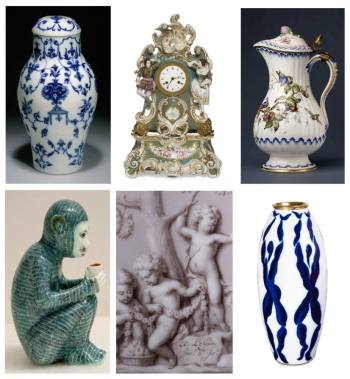
From top left: Saint-Cloud Vase, 1695–1710 (New York: The Metropolitan Museum of Art); Bastien & Bugeard Clock, 1848–58 (Paris: Musée des Arts décoratifs); Mennecy Jug, 1760 (London: Victoria and Albert Museum); Villeroy Monkey, 1745 (New York: The Metropolitan Museum of Art); Guérhard & Dihl Vase, 1797–1804 (Clandon Park, National Trust); and Bernardaud Vase, 2015, by Hervé Van Der Straeten.
The French Porcelain Society is pleased to announce this year’s two-day symposium, entitled Saint-Cloud to Bernardaud: New Horizons in French Porcelain, 1690–2000. It will be chaired by Dr Aileen Dawson, former Curator, The British Museum, London, and will take place on 20–21 October 2017 at The Wallace Collection, London. The symposium will present new research on French porcelain factories outside royal or state control. At times unjustly neglected in favour of the royal manufactory at Sèvres, these earliest factories operated from the late seventeenth century; many continue in production today. They include, but are not limited, to Saint–Cloud, Villeroy, Mennecy, Niderviller, the Paris factories, such as Dihl, Schoelcher and Dagoty, and Limoges factories operating during the 19th century and up to the present day. Subjects for consideration include: locations, size, capitalisation, techniques of manufacture, employment of artists and designers, marketing, and clientele, each deserving of greater scholarly attention.
The French Porcelain Society encourages networking between academic researchers and museum professionals. Proposals are welcomed from doctoral candidates in art history as well as curators, collectors, and researchers; we are also pleased to receive papers from colleagues working in literature, philosophy, and history. Speakers confirmed to date include Sonia Banting, Howard Coutts, Aileen Dawson, Virginie Desrante, Nicole Duchon, Cyrille Froissart, Errol Manners, Audrey Gay-Mazuel, Hélène Huret, Tamara Préaud, and John Whitehead.
Themes for papers may include
• History of collecting (public and private) and connoisseurship
• Historical, political and socio-economic background to French porcelain production
• Design sources, production trends, fashion
• Cross-cultural influences
• Porcelain used as diplomatic gifts
• Domestic uses, tablewares and the history of dining
• Literary and theatrical themes, especially in figure production
• Porcelain as sculpture at Niderviller and other factories
• The art market
Papers should be between 20 and 50 minutes in length and fully illustrated. They may be presented in English or French. Please send a 300-word abstract with a short CV in the form of a PDF file to Aileen Dawson at aileendawson@hotmail.com by 15th June 2017.










leave a comment