Call for Papers | The Image of the Multitude in Art and Philosophy
From H-ArtHist:
Imago Multitudinis: The Image of the Multitude in Art and Philosophy
The Courtauld Institute of Art, London, 10 March 2018
Proposals due by 15 September 2017
The Courtauld Institute of Art, The British Academy and the Collège International de Philosophie are pleased to announce a one-day interdisciplinary conference focusing on the philosophical representation and the artistic conceptualisation of the multitude and its associated concepts: the many, the masses, the crowd, the mob, and the commonality.
A spectre is haunting our times: the spectre of the multitude. Uprisings, popular unrests, mass migrations, revolutions—the past ten years have been marked by unprecedented quests for freedom, embodied by unconventional political subjects pointing to the possibility of alternative outcomes of the crisis of both authoritarian regimes and representative democracies. Through the masterful drawing of Abraham Bosse, Hobbes attempted to tame the multitude forever. Constrained within the body politic of the monstrous Leviathan (1651), the multitude was transfigured into an obedient people and its potentia was (apparently) usurped. Yet, the multitude resisted—and still resists—this movement, challenging the predominant definitions of sovereignty. Following the collapse of modern master narratives, such as in the nascent seventeenth century, the multitude has returned.
Our investigation revolves around the political and aesthetic meanings of this omnipresent, if elusive, collective being. In particular, we would like to ask the following questions: how do philosophers represent the multitude and translate their concepts into cogent images? How do artists think about the multitude and its agency? This enquiry, which spans from the Middle Ages to the present, concentrates on the way in which images and iconographic motifs are elaborated in philosophy, as well as how political concepts are articulated in the visual arts. In order to understand the images pervading, and the concepts informing, recent collective political action (from Tahrir Square to the streets of Tunis, New York, Madrid, Ferguson via Rojava and Lampedusa), we intend to focus on their modern and contemporary genealogies. This is not only a historical enquiry. The history of the multitude can help us better understand the present. The aesthetic, agency and ambitions of this political subject do not only survive in books and museums, they also live on among us. The multitude resists, and if this is the conflict that characterises political modernity, then modernity has begun again.
Invited speakers: Horst Bredekamp (Humboldt-Universität); Claire Fontaine (artist); Sandro Mezzadra (Università di Bologna).
We invite submissions on the following topics including, but not limited to
• Political iconography (from the Revolt of the Ciompi to the Arab Spring via the German Peasants’ War)
• Feminism and the multitude
• The multitude in the USSR
• The multitude and the English Civil Wars
• Hobbes’ Behemoth
• Spinoza’s, Machiavelli’s, Negri’s, Deleuze’s and Schmitt’s depictions of the multitude
• The ‘popular hydra’ in nineteenth-century Paris
• Baroque and the multitude
• The multitude and migrations in contemporary art
Please send a title and an abstract of no more than 500 words together with a short CV to jacopo.galimberti@manchester.ac.uk by the 15th of September. Successful candidates will be notified in early October. Papers should not exceed 25 minutes in length.
Call for Papers | The Tools of the Architect
From the conference website:
European Architectural History Network: The Tools of the Architect
Delft and Rotterdam, 22–24 November 2017
Proposals due by 15 May 2017
The European Architectural History Network (EAHN) is pleased to announce the EAHN’s fifth thematic conference The Tools of the Architect, to be held at Delft University of Technology and Het Nieuwe Instituut HNI (Delft and Rotterdam, The Netherlands) 22–24 November 2017.
Architects have for their activities of drawing, writing, and building always depended upon the potential of particular tools—ranging from practical instruments such as straight edges, French curves, compasses, rulers, and pencils to conceptual tools such as working drawings, collages, photographic surveys, infographics, diagrams, casts, and mass models.
As technologies advanced, the toolbox of architects has changed and expanded. Today architects have an extraordinary array of sophisticated tools at their disposal but also rely on many of same tools as their 18th- and 19th-century peers. Working drawings, pencils, and tracing paper continue to appear in the designer’s studio while their role and potential is being redefined.
Time and time again, architects have engaged with new tools. The quest to find the most appropriate and adequate tools to articulate, test and communicate design ideas has never ended, and in this pursuit architects have appropriated tools from other disciplines, such as art, historiography, sociology, philosophy, computer sciences and engineering. Out of this perspective the tools of the architect have become a field of intense exploration of the encounter of architecture with other disciplinary perspectives.
Inventions and innovations of tools throughout history have not only provided better answers to questions of analyzing and representing the built environment, but they have also pointed to new ways of conceiving and intervening. Ellipsographs made it possible to precisely draw an elliptical space in the 19th century and computer-aided drafting software has allowed for a new conception and construction of complex geometries in the 20th and 21st century. New tools have continuously affected the imagination, character and qualities of architectural projects.
This conference wants to focus on the changing practical and conceptual tools of the architect and their effect on the logos and praxis of architecture. The conference will be structured along three thematic lines:
• The Instruments of the Architect (i.e. the apparata and equipment of the architect)
• The Tools of Analysis (i.e. the devices to study architecture and the built environment in general)
• The Tools of Intervention (i.e. the devices to intervene in the built environment)
We welcome papers that consider the tools of the architect from this threefold perspective. Papers should be based on well-documented research that is primarily analytical and interpretative rather than descriptive in nature. Abstracts (of 500 words) can be registered and uploaded. Please click here to register.
Time Frame
15 May 2017: Deadline Submission of abstracts
15 June 2017: Notification of Acceptance
1 September 2017: Full papers
Keynote Speakers
Mari Lending (Professor of architectural theory and history, Oslo School of Architecture and Design/ OCCAS: the Oslo Center for Critical Architectural Studies)
Michiel Riedijk (Professor at Chair of Public Building, Delft University of Technology/ Neutelings Riedijk Architects, Rotterdam)
Conference Chairs
Tom Avermaete, Delft University of Technology
Merlijn Hurx, Utrecht University
Organising Committee
Carola Hein, Delft University of Technology
Marie-Terese van Thoor, Delft University of Technology
Koen Ottenheym, Utrecht University
Petra Brouwer, University of Amsterdam
Dirk van den Heuvel, Jaap Bakema Study Centre/ Het Nieuwe Instituut
Scientific Committee
Tom Avermaete, Delft University of Technology
Merlijn Hurx, Utrecht University
Alona Nitzan-Shiftan, Technion – Israel Institute of Technology, Haifa
Maristella Casciatio, Getty Research Institute, Los Angeles
Anthony Gerbino, University of Manchester
Sebastian Fitzner, Freie Universität Berlin
Wolfgang Lefevre, Max Planck Institute, Berlin
Call for Papers | Fluctuating Alliances: Art, Politics, and Diplomacy
From the conference website:
Fluctuating Alliances: Art, Politics, and Diplomacy in the Modern Era, 16th–18th Centuries
Technische Universität, Berlin, 21–22 September 2017
Proposals due by 20 May 2017
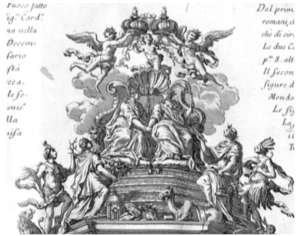
Macchina per le nozze de il Principe di Asturias e Isabel d’Orleans, Domenico Paradisi, Roma, 1721.
In January 1722 after a few days of heavy rain in Rome the ephemeral ‘macchina d’artificio’ built to celebrate the wedding between the Prince of Asturias and Isabel d’Orleans was finally burnt before the palazzo di Spagna. The machine, designed by Domenico Paradisi, showcased a clear message of unity and power between the former enemies: France and Spain. At the summit, allegories of both countries shook hands before the representation of the Four Continents. This functioned as a gentle reminder to their enemies after the years of turmoil surrounding the War of Spanish Succession, which had deeply affected the balance of power in Europe.
This symposium, Fluctuating Alliances: Art, Politics and Diplomacy in the Modern Era, seeks to explore the role played by prints, drawings, and any kind of artistic production, such as music and literature, which represented the changing alliances among kings, rulers and countries in the fluctuating early modern political environment.. Taking as an example the War of Spanish Succession, but not limited to it, we encourage researchers to explore the uses of art for that purpose.
We invite scholars at all stages of their careers to propose 20-minute presentations, preferably focused on case studies. We encourage proposals that deal with particularly tricky diplomatic encounters and which explain how art helped or, indeed, hindered these negotiations. There is no official language for the conference (we accept English, German, Spanish, Portuguese, Italian, and French), but for the sake of clarity all the communications, as well as the proposals, should be in English.
Candidates are invited to submit their proposals by 20 May 2017 to Pilar Diez del Corral diezdelcorralcorredoira@tu-berlin.de. They should include an abstract (up to 500 words) and a brief CV with recent publications (max. 1 page). Unfortunately, it will not be possible to cover travel and accommodation costs for participants. The scientific committee will inform all the applicants of the final selection by 31 May 2017.
Call for Papers | Celebrating Female Agency in the Arts
From H-ArtHist:
Celebrating Female Agency in the Arts
Christie’s Education New York, 26–27 June 2018
Proposals due by 15 July 2017
Following the success of the 250-anniversary conference held in London in July 2016, Christie’s Education is organizing its second academic conference on the theme of women in the arts. The conference will take place at Christie’s, 20 Rockefeller Plaza in New York on Tuesday June 26th and Wednesday June 27th 2018.
From Antiquity to today, women have always played a significant role in the arts and their markets. With this call for sessions, we welcome proposals coming from a wide range of disciplines that would consider women’s diverse contributions to the arts from a transnational and transhistorical perspective. We hope that the sessions will reflect the global and historical diversity of the issues at stake.
This conference is not advocating for a separate history nor an alternative history of art and its markets, but rather we want to look at the central role played by women in the creation, development, support and preservation of the arts and, also how their contribution has changed over time. Sessions should consider globally and throughout history women as artists, patrons and collectors of art and architecture, dealers and brokers, art historians and art critics as well as curators and preservers of culture. From the presence of women in emerging and established art centers to historical aristocratic patronage and back in time to the medieval period and antiquity we hope that the sessions will investigate a diverse range of topics.
We encourage academics across disciplines and art professionals to submit proposals for individual sessions. Sessions will be 115 (4 x 20 minute papers) or 90 minutes (3 x 20 minute papers) in length. Please send a 250/300-word abstract to Dr. Cecily Hennessy (chennessy@christies.com) and Dr. Véronique Chagnon-Burke (vchagnon-burke@christies.edu) by July 15th 2017. We look forward to receiving your proposal.
Call for Papers | Enlightened Princesses: Britain and Europe, 1700–1820
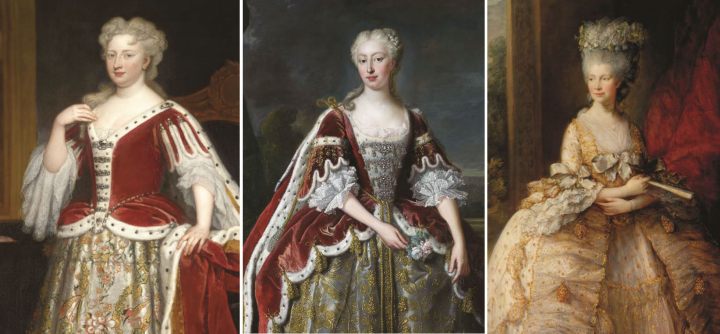
Left to right: Sir Godfrey Kneller, Queen Caroline of Ansbach, when Princess of Wales, 1716, oil on canvas, Royal Collection Trust; Jean-Baptiste van Loo, Augusta, Princess of Wales, 1742, oil on canvas, Royal Collection Trust; Thomas Gainsborough, Queen Charlotte, 1781, oil on canvas, Royal Collection Trust.
◊ ◊ ◊ ◊ ◊
From the Yale Center for British Art:
Enlightened Princesses: Britain and Europe, 1700–1820
Kensington Palace, Hampton Court Palace, and the Tower of London, 29–31 October 2017
Proposals due by 15 May 2017
Co-organized by Historic Royal Palaces, the Yale Center for British Art, and the Paul Mellon Centre for Studies in British Art, London, in association with the exhibition Enlightened Princesses: Caroline, Augusta, Charlotte, and the Shaping of the Modern World, on view at Kensington Palace, June 22–November 12, 2017
Caroline of Ansbach (1683–1737), Augusta of Saxe Gotha (1719–1772), and Charlotte of Mecklenburg-Strelitz (1744–1818), three Protestant German princesses, became variously Princess of Wales, Queen Consort, and Princess Dowager of Great Britain. Recent research has explored how in fulfilling these roles they made major contributions to the arts; the development of new models of philanthropy and social welfare; the promotion and support of advances in science and medicine, as well as trade and industry; and the furthering of imperial ambition. While local contexts may have conditioned the forms such initiatives took, their objectives were rooted in a European tradition of elite female empowerment.
This symposium, Enlightened Princesses: Britain and Europe, 1700–1820, seeks to investigate the role played by royal women—electresses, princesses, queens consort, reigning queens, and empresses—in the shaping of court culture and politics in Europe of the long eighteenth century. Papers that explore some of the following themes are invited:
• Royal women as political agents
• Royal women: networks and conversations
• Royal women: education, charity, and health
• Royal women as patrons of art and architecture
• Royal women and science
• Royal women: mercantile culture and the wider world
• Royal women as political gardeners
The conference will take place October 29–31, 2017, at Kensington Palace, Hampton Court Palace, and the Tower of London. Please send proposals of 400 words maximum, for papers of 25 minutes, together with a short biography of 100 words maximum to samantha.howard@hrp.org.uk.
Call for Papers | Plaster as an Art Material
From H-ArtHist:
Uniqueness and Multiplication: Plaster as an Art Material
Royal Institute for Cultural Heritage, Brussels, 10–11 October 2017
Proposals due by 5 May 2017
The study of plaster objects is experiencing a true revival, amongst others attested by the scientific conferences of the past years. Plaster, a material of low value often used for reproductions, has been part of sculpture practice for centuries. The conferences and publications of the past years have discussed a wide range of subjects related to plasters, from the restoration and valorisation of plaster collections to the study and possible implementation of conservation and restoration campaigns.
The Royal Institute for Cultural Heritage (KIK-IRPA, Brussels), is the Belgian federal institution committed to the inventory, scientific study, conservation and promotion of the country’s cultural heritage. The Institute, whose chief mission is research and public service, represents a unique instrument for the Belgian heritage, both movable and immovable. Amongst others active in the historical study, conservation and restoration of these objects, KIK-IRPA has partnered up with Epitaaf. Since 1989, this non-profit volunteer organization manages the former sculptor’s and mason’s studio of the Ernest Salu dynasty, active in Laeken (near Brussels) between 1872 and 1983. As a funerary art museum they have a substantial collection of plaster moulds and models that were manufactured in the studio. The wide range of approaches presented on this international conference will allow us to study different aspects of plaster objects.
The conference will take place at the KIK-IRPA in Brussels 10–11 October 2017 and consists of three sessions:
Session 1 Plaster (and plaster moulds), their role and signification within the studio
This session will focus on the role of plaster (as a material for sculpture or architecture), plaster moulds (casts) and plaster models in art history. The following topics could be addressed: plaster for which use, the use and or role of plaster in the artist’s training, in an institutional context (academy, art education) or in that of the studio? The authenticity and position (status) of plaster in the artistic process (design, intermediary state, model, art work)? The added value of plasters, prints and photos in the artist’s studio? The representation or the role of plasters in the practice of the artist’s studio, and more particularly their position within an artist’s oeuvre and its diffusion? The significance or status of plasters as autonomous objects?
Session 2 Plaster collections, their origins, aim, and future
The aim of this session is to put together a survey of existing plaster collections as museum collections, not in the form of an exhaustive inventory, but in order to get a broad and general view of the wide range of differences (and significations) of the collections to get insight in the collection building and composition of the different plaster collections. The lines of approach are the collections’ history and objective. How should one go about their presentation (museology) and what is the status of plaster collections within a public (museum), semi-public (university, academy) or private context (artist’s collection).
Session 3 Conservation and restoration of plasters (and plaster moulds)
This session is the logical continuation of session 2. Due to a renewed interest in plaster objects, regardless of their context, repairing them has once again become a priority. Which conservation and restoration techniques are best suited for plaster and plaster objects? Should a different approach be adopted with regards to their presentation and status (within art history or as an educational tool)? Can the material or technique used tell us more about the period, place of origin or author of the plaster? These topics are preferably evoked through case studies and examples of best practices, by choice concerning so-called masterpieces. The official language of the conference is English (submissions in French or Dutch are also accepted).
Candidates are invited to submit their proposals to Géraldine Patigny (geraldine.patigny@kikirpa.be) by May 5th 2017. This should include an abstract (up to 300 words) and a brief CV (max. 1 page). The conference organizers are unable to cover travel and accommodation costs for speakers. Interested parties are encouraged to apply for aid from their respective institutions. The Scientific Committee will inform all the applicants of the final selection on June 16th 2017.
Scientific direction
Géraldine Patigny (KIK-IRPA)
Tom Verhofstadt (vzw Epitaaf)
Call for Papers | Baroque Parish Churches and Their Decoration
From H-ArtHist:
Die Barocken Pfarrkirchen und ihre Dekoration
Österreichische Akademie der Wissenschaften, Vienna, 23–25 October 2017
Proposals due by 30 April 2017
Im Rahmen der Forschungsgruppe „Baroque Ceilling Painting in Central Europe (BCPCE)“ veranstaltet das Institut für Kunst- und Musikhistorische Forschungen der ÖAW gemeinsam mit dem Institute of Art History of the Czech Academy of Sciences, dem Königgrätzer Landkreis und dem Verein Omnium von 23. bis 25. Oktober 2017 in Wien ein Symposium zu den malerischen Ausstattungen von Pfarrkirchen katholischer und lutherischer Konfession. Die Veranstaltung greift damit ein in der kunsthistorischen Forschung sehr stiefmütterlich behandeltes Thema auf, standen doch bisher vor allem die zum Teil weitgespannten Dekorationen der Kloster- und Wallfahrtskirchen im Zentrum des Interesses.
Die Analyse der wandfesten Malereiausstattungen—gleichsam als Kerngeschäft der BCPCE—macht in diesem Fall nur im Rahmen einer breiten historischen Kontextualisierung Sinn. Allgemeinhistorische und kirchenhistorische Rahmenbedingungen sind als Voraussetzung ebenso zu diskutieren wie theologische und liturgische Aspekte. Der Zeitraum ist durch die Konfessionalisierung im 16. Jahrhundert einerseits und die josephinischen Reformen im späten 18. Jahrhundert vorgegeben; der geographische Raum mit dem zum Großteil habsburgisch regierten Mitteleuropa sowie mit Mitteldeutschland—also mit wesentlichen Teilen des Alten Reichs.
I Rechtliche Situation und institutionelle Organisation
Grundlegend ist hier die Frage nach der kirchenrechtlichen Entwicklung der Pfarrkirche und ihrer Funktion im Laufe der Zeit. Die katholische Kirche macht einen Unterschied zwischen den (den Stiften inkorporierten) Klosterpfarren und den bischöflichen Pfarren. Gab es zwischen Bistum und Stift Auffassungsunterschiede und Konflikte (etwa in Bezug auf Kirchensteuer, Pfründe, Stolgebühren)? Anders liegen die Verhältnisse bei protestantischen Pfarrkirchen: Es gibt lediglich Kirchen mit Gemeinde und solche ohne Gemeinde. Eine kirchenrechtliche Unterscheidung existiert zwischen den Bauten nicht. Der weltliche Landesherr ist gleichzeitig oberster Bischof, von ihm getroffene Regelungen sind nur für seine Landeskirche verbindlich. Welche Rolle spielten die Landesfürsten in der Organisation des Pfarrkirchenwesens? Welche Auswirkungen hat die Organisation des religiösen Lebens in den Pfarren (Bruderschaften und die von ihnen vorgenommenen Stiftungen) auf Architektur und Ausstattung der Pfarrkirchen bei Katholiken, Lutheranern und Reformierten?
II Räume der Herrschaft
Der funktionelle Radius und damit die angesprochene Öffentlichkeit von Pfarrkirchen sind im katholischen Bereich wesentlich weiter gefasst als bei Schlosskapellen, Bischofs- oder Ordenskirchen. Dies führt zur prinzipiellen Annahme, dass die Pfarrkirchen in vielleicht höherem Ausmaß als die anderen Kirchentypen Orte von Überlagerung vielfältiger Ansprüche auf Herrschaft gewesen sein könnten. Auf dieser Annahme basierend ergibt sich eine Reihe von Fragen: Existieren Herrschaftsinteressen und entsprechende Strategien von Seiten der Orden, der bischöflichen Kanzleien bzw. der protestantischen Patronatsherren in Bezug auf die Pfarren und der mit ihnen verbundenen
Rechte? Welche Rolle spielt katholischerseits die Pfarrkirche in der fein abgestimmten Hierarchie der Kirchenbauten von der Bischofskirche bis zur kleinen Filialkirche. Welche Auswirkungen haben Interessen der kommunalen Verwaltung, aber auch der Landesherren für Architektur und Ausstattung, im Besonderen der Deckenmalerei? Werden von der Obrigkeit andere Interessen kommuniziert als in den großen Wallfahrts- und Klosterkirchen? Im lutherischen Bereich stellt sich die Frage nach der Einflussnahme auf die Kirche und ihre Ausstattung durch die Gemeinde, den Patronatsherrn oder auch den Landesherrn.
III Räume der Theologie
Gerade mit dem Medium der Decken- und Wandmalerei sollten im Rahmen der Tagung an Hand ausgewählter Fallstudien zu katholischen und lutherischen Pfarrkirchen die theologischen, liturgischen und territorialen Konfessionsspezifika und ihre künstlerischen Reflexe beleuchtet werden. Etwa: Hat die unterschiedliche Auffassung von der Heiligkeit des katholischen bzw. protestantischen Sakralraums Auswirkung auf die formale Beschaffenheit der Pfarrkirchen? Ergeben sich daraus Tendenzen einer Normierung oder Typisierung von Architektur und Ausstattung? Man weiß, dass das lutherische Bekenntnis zur Realpräsenz Christi am Altar ihren (katholisch anmutenden) Niederschlag im Altarbau der lutherischen Pfarrkirche gefunden hat. Ist diese göttliche Realpräsenz auch in der Deckenmalerei reflektiert? Oder bleibt letztere didaktisch der Auslegung des Wortes verpflichtet? Öffnet sich in der lutherischen Pfarrkirche die Decke in den Himmel gleich der katholischen, oder findet man dort lediglich ein Bild des Göttlichen? Gibt es in den katholischen Pfarrkirchen spezifische, an der Deckenmalerei manifeste Programme oder entsprechen sie weitestgehend den Themenbereichen in den Ordens- und Bischofskirchen? Ist die jeweilige Ordensspiritualität in den Ausstattungen der Pfarrkirchen fassbar?
IV Räume der Vergangenheit und ihre Neuausstattung
Ein spezifisches Problem der barocken Ausstattung von Pfarrkirchen mit Malerei und Skulptur besteht im signifikanten Umstand, dass es im 17. und 18. Jahrhundert keineswegs flächendeckend zu Neubauten von Pfarrkirchen gekommen ist. Aus verschiedenen Motiven heraus wurden ältere, vorwiegend spätmittelalterliche Bauten weiter als Pfarrkirchen benutzt und barock ausgestaltet. Dabei konnte sich die Neuausstattung nur auf Bereiche konzentrieren, die nicht in direkten Konflikt mit der mittelalterlichen Substanz gerieten: Die Wand- und Deckenmalerei spielt deshalb im Verhältnis zu Hoch- und Seitenaltären eine nur geringe Rolle. Diese Reduktion erforderte zugleich eine Konzentration auf bestimmte Themen. Die entsprechenden Forschungsfragen und Fallbeispiele sollten sich hier auf die Konflikte und Synergien richten, die sich aus der Koexistenz von Mittelalter und Barock ergaben. Dieser Koexistenz verschiedener Ausstattungen setzt der josephinische Kirchenbau mit seiner strikten Normierung von außen und innen ein deutliches Ende.
Abstracts für Vorträge, nicht länger als eine halbe Seite, gemeinsam mit einem kurzen Curriculum, bis spätestens 30. April 2017 zu senden an Herbert Karner, Herbert.Karner@oeaw.ac.at, und Martin Mádl, madl@udu.cas.cz.
Call for Papers | Naples and the Capodimonte
From the Call for Papers:
Naples and the Museo e Real Bosco di Capodimonte in a Global Context
Naples, 12–14 October 2017
Proposals due by 24 April 2017

‘Transport des Antiquités d’Herculanum du Museum de Portici au Palais des Etudes à Naples’, in J. C. R. de Saint-Non, Voyage pittoresque, ou Description des Royaumes de Naples et de Sicile, vol. II (Paris, 1782). J. Duplessi-Bertaux after L.-J. Desprez. Included in Arturo Fittipaldi, “Museums, Safeguarding and Artistic Heritage in Naples in the Eighteenth Eentury: Some Reflections,” Journal of the History of Collections 19 (2007): 191–202.
One of the world’s oldest cultural centers and one of the largest ports in Europe, the city of Naples is a node in a cultural and economic network that spans the Mediterranean and beyond. The story of art in Naples is one of encounter and exchange, of rupture and unexpected convergence. It is above all a story of movement: of people, artworks, and forms, of technologies, traditions, and ideas. Naples thus challenges us to envision a new history of art that ranges across geography, chronology, and medium. Art in Naples has long been marginalized or misunderstood. Instead, we take Naples as a laboratory for new art historical research with global implications.
To launch a new collaboration between the Edith O’Donnell Institute of Art History and the Museo e Real Bosco di Capodimonte dedicated to innovative research on art in Naples and on the cultural histories of port cities, this symposium brings together an international group of scholars for two days of on-site presentations that will set Naples and the Capodimonte in a global context. After a public keynote lecture and celebratory reception on the evening of Thursday, October 12, a group of around 30 scholars will spend the next two days participating in a series of presentations in the form of gallery talks and site visits that will focus on individual artworks in the Capodimonte collections and on sites within its surrounding gardens. Each presentation will be followed by discussion. Moderated roundtables and shared meals will provide further opportunities for participants to respond to each other’s presentations and to engage with broader themes.
We invite scholars at all professional stages (including advanced graduate students) to propose 20-minute presentations that focus either on individual artworks at the Capodimonte or on specific sites in the Bosco. Through these individual objects and sites, presentations should open onto larger questions related to Naples and the Capodimonte in a global context: for example, the formation of the Capodimonte’s collections and gardens, the cultural history of Naples as a port city, the mobility of objects and people, and processes of circulation, encounter, and exchange. Presentations may be made in Italian or English. To propose a presentation on a specific artwork or site at the Capodimonte, please submit via email attachment a proposal of under 350 words and a short CV to Elizabeth Ranieri, The Edith O’Donnell Institute of Art History (enr101020@utdallas.edu), by April 24, 2017. Proposals will be reviewed by collaborators at the O’Donnell Institute and the Capodimonte. A certain number of presenters not based in Naples will be offered a small grant to contribute toward the cost of travel.
Call for Proposals | Swiss Art and the Grand Tour
From H-ArtHist:
Special Issue of the Zeitschrift für Schweizerische Archäologie und Kunst (ZAK) for 2018
Travelling People, Travelling Objects: The Reception of Swiss Art in the Context of the Eighteenth-Century European Grand Tour
Menschen und Objekte auf Reisen: Die Rezeption Schweizer Kunst im Kontext der europäischen Grand Tour des 18. Jahrhunderts
Proposals due by 1 May 2017; finished articles are due by 31 January 2018
In 2018, a special issue of the Zeitschrift für Schweizerische Archäologie und Kunst (ZAK) will be dedicated to Swiss art in the eighteenth century. Focusing on the context of European travel culture, the issue will address the various ways in which Grand Tourists perceived, purchased, and collected Swiss art objects during and after their travels. This perspective will help to gain new insight into the distribution and reception of Swiss art in eighteenth-century Europe.
It has often been claimed that the so-called Swiss Kleinmeister, printmakers of small genre and landscape scenes between 1750 and 1850, sold their artworks to Grand Tour travellers, thus contributing to the construction and popularization of a new ‘image of Switzerland’ in Europe. However, little is known about the travelling art buyers and the specific ways in which these small Swiss art objects were distributed, collected, and displayed abroad. Taking this question as a starting point, we welcome contributions which investigate the reception and distribution of these traveling images of Switzerland. Special priority will be given to topics which focus on the materiality of specific objects as well as topics which centre on the role and the meaning of Swiss artworks at their places of destination.
Proposals might address the following issues, among others:
1 Images, media, materialities
It is a widespread opinion that the small format and low price of the graphic art of the Swiss Kleinmeister contributed to the medium’s popularity among European travellers. Does a close view on European collections allow another, more complex perspective on the reception and distribution of Swiss art and the related role of its specific medial and material characteristics? What can be said about the collection-specific relations of graphics, watercolors, paintings, and decorative art objects of Switzerland?
2 Paths and destinations of Swiss graphic art
Kleinmeister graphic art was traded in single sheets, within illustrated books but also in literary works such as travel descriptions. Can individual trade routes be traced within this context of travel culture? Which European collections (libraries, print rooms etc.) owned (Kleinmeister) graphic art works, in which forms were they held and what role did they play within the formation of a specific
collection?
3 Swiss landscape images—identities and memories
The graphic images of the Swiss Kleinmeister are often said to have played an important role in shaping the identity of Switzerland by constructing a typical image of the country’s ‘national landscape’. What was the meaning and function of these graphic landscapes in European collections? Which role did Swiss landscapes play in other objects, for example decorative art, that were purchased by travellers?
4 Switzerland—Italy—Europe
Grand Tour travellers often purchased a great number of art objects which can be considered as conventionalized souvenirs of the places of their production along the travel routes. How were these imaginary sites of memory perceived and represented in European collections? What kinds of medial, material, and semantic relations are constructed between these collection objects on a transregional level, and which position did the objects from Switzerland occupy?
This call addresses art historians and researchers from related disciplines. Please send your proposal (max. 300 words in English, German, French, or Italian), a short CV, and a short list of keywords (max 6) no later than May 1st, 2017 to Danijela Bucher (danijela.bucher@uzh.ch) and Miriam Volmert (miriam.volmert@khist.uzh.ch). Final selection and notification to authors will be announced no later than July 31st, 2017. Finished articles (ca. 30,000–40,000 characters including spaces and ca. 12–15 illustrations) should be submitted by 31st January 2018. No royalty will be paid for any article. Authors are responsible for all reproduction right fees.
Call for Papers | The Unique Copy: Extra-Illustration

First page of text in an illustrated edition of A Midsummer Night’s Dream, 1908 (Folger Digital Image 81266), exhibited in the Folger’s 2010 exhibition Extending the Book: the Art of Extra-Illustration.
◊ ◊ ◊ ◊ ◊
From the Call for Papers:
The Unique Copy: Extra-Illustration, Word and Image, and Print Culture
Herzog August Library, Wolfenbüttel, Germany, 24–25 May 2018
Proposals due by 30 May 2017
Organized by Christina Ionescu and Sandro Jung
Is extra-illustration an ornamental art or does it add layers of significance and nuance to the accompanying text? How does it shed light on authorship, the act of reading, book history, and print culture? How does text-image interaction manifest itself in the extra-illustrated book-object? Is extra-illustration the equivalent of grangerising or are there other means of materially expanding the text? Is it a creative act or a form of customised reproduction or reuse of print matter? Who are the artists, readers, collectors, publishers, and curators who are responsible for the creation of extra-illustrated objects?
In his study of the history, symptoms, and cure of a fatal disease caused by the unrestrained desire to possess printed works, Thomas Frognall Dibdin (1776–1847) observes that “[a] passion for a book which has any peculiarity about it,” as a result of grangerising by means of collected prints, transcriptions, or various cutouts, “or which is remarkable for its size, beauty, and condition—is indicative of a rage for unique copies, and is unquestionably a strong prevailing symptom of the Bibliomania.” Extra-illustration as a practice did not emerge during bibliomaniac Dibdin’s birth century, which witnessed the publication of James Granger’s Biographical History of England (1769) and a widespread rage for unique copies of books, nor has it been extinguished in our digital era by modern technology. Whether it manifests materially as a published work that is supplemented verbally (with interleaved or pasted autograph letters, handwritten notes, or print matter either directly or tangentially linked to its content), or visually (with additional drawings, prints, maps, watercolours, photographs, or other forms of artwork that are similarly connected to a variable degree of closeness to the text), an extra-illustrated copy is important not only for its uniqueness as an original artefact and its commercial value as a desired commodity. As emblematic of an artistic, bibliographic, and cultural practice, it sheds light on its creator, the context of its production, and the reception of a text. As a form of personalised book design, it is moreover significant as a means of creative expression, an outlet of reader empowerment, and an archival repository of historical or cultural insight. Some of the popular targets of extra-illustration through time have been the Bible, biographies, historical treatises, topographical surveys, travel narratives, and popular plays.
A plethora of monographs and special journal issues dealing with book illustration from various theoretical and (inter)disciplinary perspectives have been published in recent years, but the subfield of extra-illustration remains largely unstudied. It is important to note, however, the contribution to the field by Luisa Calè, Lucy Peltz, and Stuart Sillars, who have proposed useful in-depth reflections on extra-illustration and grangerising as a practice. To address this gap in current scholarship, we invite papers that engage with extra-illustration through the conceptual lenses of book history, print and visual culture studies, and word and image theory. Contributions that focus on original artwork contained in extra-illustrated copies from the perspective of word and image studies are of particular interest to the co-editors, as are studies of extra-illustration as a link between text, book-object, and context, as approached through the prism of the book arts and reception theory. Other possibilities include contributions investigating extra-illustration diachronically or cross-culturally, and case studies dealing with a special copy, a collection of extra-illustrated books, or an individual collector, publisher, curator, or artist responsible for the creation of such unique artefacts.
Possible themes include but are not limited to:
· grangerising as a biblio-cultural practice
· grangerising as a form of material repurposing in relation to print culture
· grangerising as a fashionable and biblioclastic pastime
· grangerising as an act of authorship
· the Grangerite, bookscrapping, and collecting practices
· illustrative responses to the text in the form of unique infra-textual images
· marginal illustration and text-image interaction
· extra-illustration as interactive and engaged reading
· extra-illustration as emblematic of institutional/curatorial collecting practices
· extra-illustration as personalised book design
· extra-illustration as a window into history and intellectual thought
· extra-illustration as a book customisation response to mass production
· digital imports of extra-illustration as a means of expression
500-word abstracts, along with the author’s contact information and bio-bibliographical note, should be sent to the co-editors (cionescu@mta.ca / prof.s.jung@gmail.com) by 30 May 2017. A publication on the topic, either a journal issue or a collection of essays, is envisaged.










leave a comment