Call for Papers | CAA in Los Angeles, 2018

From CAA News (27 February 2017) . . .
106th Annual Conference of the College Art Association
Los Angeles, 21–24 February 2018
Proposals due by 17 or 24 April 2017 (depending upon type of proposal)
CAA’s Annual Conference Committee invites proposals of interest to its members and varied audiences. Submissions that cover the breadth of current thought and research in art and art practice, art and architectural history, theory and criticism, studio art, pedagogical issues, museum and curatorial practice, conservation, design, new media, and developments in technology are encouraged.
To submit a proposal, individuals must be current CAA members. All session participants, including presenters, chairs, moderators, and discussants, must also be current individual CAA members. Please have your CAA Member ID handy as well as the member IDs of any and all participants as this is a required field on the submission form. Please note that institutional member IDs cannot be used to submit proposals. If you are not a current individual member, please renew your membership or join CAA.
All session participants must also register for the conference. Online registration for CAA 2018 will begin October 2, 2017. Early conference registration will end December 15, 2017 and advance conference registration will end on February 7, 2018. Early and advance conference registration fees will not change from CAA 2017, New York.
The Annual Conference Committee will accept the following proposals for review: Complete Sessions, Sessions Soliciting Contributors, and Individual Paper/Project proposals. All sessions will be 90 minutes in length at CAA 2018. Please plan accordingly. For full details on the submission process for the conference, please review the information below and on the individual submission pages.
P R O P O S A L S U B M I S S I O N T Y P E S
Session Soliciting Contributors
Proposals due by 17 April 2017
The Session Soliciting Contributors option allows a submission for a full session (90 minutes in length) with yet-to-be identified speakers and papers/projects. If selected, such sessions will be included in the call for participation (CFP) which opens June 30.
Individual Paper/Project
Proposals due by 17 April 2017
Individual Paper/Project proposals (15 minutes in presentation length) may be submitted for review. No specific theme is required. The Annual Conference Committee will review and select paper/project proposals based on merit and group approved submissions into Composed Sessions of up to four participants. A liaison from the Annual Conference Committee will be identified for each Composed Session to assist with the format and to help identify a session chair or moderator.
Complete Session
Proposals due by 24 April 2017
The Complete Session option allows a submission for a complete panel (90 minutes in length) pre-formed with participants and papers/projects chosen in advance by session chairs. This session requires advance planning and information gathering by the chair(s).
Affiliated Societies
Proposals due by 24 April 2017
Each Affiliated Society may submit either one Complete Session proposal (90 minutes in length) pre-formed with participants and papers/projects chosen in advance or one Session Soliciting Contributors proposal (90 minutes in length) to be included in the CFP which opens June 30. A note of approval from the Affiliated Society chair must accompany the submission. This session will be guaranteed and will be identified as an Affiliated Society session in all CAA publications. Subsequent proposals by Affiliated Society members may be submitted separately by individuals, but are subject to peer review by the Annual Conference Committee and must be submitted via the Complete Session, Session Soliciting Contributors, or Individual Paper/Project submissions forms described above. These submissions are not guaranteed and, if selected, will not be labeled or identified as Affiliated Society sessions in CAA publications.
CAA PIPS Committees
Proposals due by 24 April 2017
CAA PIPS [Professional Interests, Practices, and Standards] committees may submit either one Complete Session proposal (90 minutes in length) pre-formed with participants and papers/projects chosen in advance or one Session Soliciting Contributors proposal (90 minutes in length) to be included in the CFP which opens June 30. A note of approval from the committee chair must accompany the submission. This session will be identified as a committee session in all CAA publications. Subsequent proposals by committee members may be submitted separately by individuals, but are subject to peer review by the Annual Conference Committee and must be submitted via the Complete Session, Session Soliciting Contributors, or Individual Paper/Project submissions forms described above. These submissions are not guaranteed and, if selected, will not be labeled or identified as committee sessions in CAA publications.
New Book Series | The Material Culture of Art
New Bloomsbury Academic Book Series: The Material Culture of Art
Series Editor: Michael Yonan, University of Missouri
The Material Culture of Art is devoted to scholarship that brings art history into dialogue with interdisciplinary material culture studies. The material components of an object—its medium and physicality—are key to understanding its cultural significance. Material culture has stretched the boundaries of art history and emphasized new points of contact with other disciplines, including anthropology, archaeology, consumer and mass culture studies, the literary movement called ‘Thing Theory’, and materialist philosophy. The Material Culture of Art seeks to publish studies that explore the relationship between art and material culture in all of its complexity. The series is a venue for scholars to explore specific object histories (or object biographies, as the term has developed), studies of medium, and the procedures for making works of art and investigations of art’s relationship to the broader material world that comprises society. It seeks to be the premiere venue for publishing the growing scholarship about works of art as exemplifications of material culture.
 The series encompasses material culture in its broadest dimensions, including the decorative arts (furniture, ceramics, metalwork, textiles), everyday objects of all kinds (toys, machines, musical instruments), and studies of the familiar high arts of painting and sculpture. The series welcomes proposals for monographs, thematic studies, and edited collections.
Please direct inquiries and proposals to both Michael Yonan, series editor, yonanm@missouri.edu, and Margaret Michniewicz, Visual Arts Acquisitions Editor, Margaret.Michniewicz@bloomsbury.com.
Series Advisory Board
Wendy Bellion, University of Delaware
Claire Jones, University of Birmingham
Stephen McDowall, University of Edinburgh
Amanda Phillips, University of Virginia
John Potvin, Concordia University, Canada
Stacey Sloboda, Southern Illinois University
Kristel Smentek, MIT
Robert Wellington, Australian National University
Annual Workshop of the Women’s Studies Group, 1558–1837
From the Women’s Studies Group website:
Annual Workshop of the Women’s Studies Group, 1558–1837
The Fruitful Body: Gender and Image
The Foundling Museum, London, 6 May 2017
The Women’s Studies Group, 1558–1837 annual workshop takes place every spring at The Foundling Museum in London. A distinguished invited speaker provides the keynote in the morning, followed by discussion and lunch; in the afternoon, participants each give a 5-minute presentation on a subject relevant to the theme of the keynote, followed by discussion. Previous speakers have included Jacqueline Labbe of the University of Sheffield and Laura Gowing of King’s College London. This year’s speaker is Karen Hearn of University College London, presenting “Women, Agency, and Fertility in Early Modern British Portraits.”
Cost (including lunch and refreshments): £18 (WSG members), £15 (students/unwaged), £22 (non-WSG members). To register, please complete the registration form available here. All attendees should bring a 5-minute presentation, from any discipline and any period covered by the Group, exploring the workshop theme. Topics might include
• caricature
• texts
• novels
• conduct manuals
• medicine
• philosophy
• motherhood
• women artists
Call for Papers | Kings and Queens 6
From The Royal Studies Network:
Kings and Queens 6: In the Shadow of the Throne
Madrid, 12–15 September 2017
Proposals due by 30 March 2017
The Kings & Queens conference series will travel to Madrid in 2017 for its sixth edition. On this occasion, we aim to connect scholars across the world whose research focuses on topics related to royal history, diplomacy, art history, political history, biographical studies, or any other issues included in the scope of royal studies. In particular, this edition of the Kings and Queens congress will focus on the secondary members of royal families, such as siblings, spouses, cousins, as well as the people closest to the king, like lovers, favourites, members of the royal entourage, etc. We especially invite studies related to figures with family ties to a monarch who were not kings or queens in their own right but had a significant influence in spheres such as international politics, the court, the arts, the society, or dynastic strategies during their time—with the objective of obtaining a better understanding of figures who are usually in the shadow of the throne. All kind of topics related to these issues will be welcomed, from diverse chronological periods and parts of the world. In the potential topics for papers or panels we may include, but are not limited to, the following:
• Biographical, dynastical, and political studies of different members of the royal families who were not kings or queens on their own right
• Power, role, and importance of different people close to the monarch, like favorites, lovers, relatives with military, diplomatic or dynastic posts, ambassadors or diverse members of their entourage
• The relationship between power and art; patronage, collecting, and diplomatic exchanges
• Monarchy, high nobility, and the representation of status, power, and influence through art, culture, and image
• The importance of the dynasty and the ‘dynastic mirror’
• Informal power, royal favour, and disfavour
Proposals should include a title, institutional affiliation, an abstract of around 500 words, and a one-page CV. In the case of panels, the proposal should include a maximum of three different papers accompanied by the same information required for individual proposals along with the name, affiliation, and one-page CV of the sponsor (if they are not presenting a paper in the same panel). All the proposals should be submitted by March 30, 2017, to Kq6Madrid@gmail.com. Please remember that English will be the official language of the congress.
Also, we are pleased to announce that we offer 20 bursaries for young researchers to help them with the costs. Those interested in said bursaries should write to the aforementioned email to obtain more details about them and what they cover. Those who want to apply must send us the title of the proposal, an abstract of around 500 words, institutional affiliation, a one-page CV, and one-page report focusing on why this congress is relevant for them and how their research could improve the field of royal studies.
Call for Papers | Full Circle: The Medal in Art History
From H-ArtHist:
Full Circle: The Medal in Art History
The Frick Collection, New York, 8–9 September 2017
Proposals due by 1 March 2017
An invention of the Italian Renaissance inspired by ancient coins, medals were first created to commemorate individuals and significant events. Over time and as the art form flourished across Europe, they came to be made and to function in new ways, including to celebrate the éclat of the ruling class (and ascendance of the bourgeoisie), document achievements in the arts and sciences, and serve as a resource for the study of the distant past. The study of medals—too often overlooked in narratives of western art history—illuminates the aesthetic landscape of the five centuries in which they enjoyed wide popularity and provides vital insights into the social and political history of Europe. Medalists were celebrated members of the arts community, and medal making was not an isolated practice. Artists from Pisanello to Dürer to David d’Angers designed and/or produced medals alongside their paintings, prints, and sculptures. The medal has long been held to bridge these disciplines, and recent scholarship has begun to probe the rich intersections between medals and other arts.
On the occasion of the exhibition The Pursuit of Immortality: Masterpieces from the Scher Collection of Portrait Medals—which celebrates an initial gift to The Frick from the unparalleled collection of Stephen K. and Janie Woo Scher—and in honor of Stephen Scher’s contributions to the study of medals as a collector, curator, and scholar, The Frick Collection is organizing Full Circle: The Medal in Art History. This symposium builds upon the work of Scher and others who have sought to re-center the medal in art-historical discourse and to bring this important class of object to the attention of the broader scholarly community and the public.
We invite proposals for 20-minute papers focusing on any aspect of the production, collection, and interpretation of commemorative medals made from the fifteenth to the nineteenth century that situate them in relation to a broader artistic and cultural context. We strongly encourage submissions by emerging scholars to promote future research in this field. Please send an abstract (max. 250 words) and CV by Wednesday, 1 March 2017, to the conveners:
• Aimee Ng, Associate Curator, The Frick Collection, ang@frick.org
• Robert Wellington, Lecturer, Centre for Art History and Art Theory, Australian National University, robert.wellington@anu.edu.au
• Melanie Vandenbrouck, Curator of Art, Royal Museums Greenwich, MVandenbrouck@rmg.co.uk
Please include ‘The Medal in Art History: Proposal’ in the subject line.
Call for Papers | The Room Where It Happens
From the Call for Papers:
The Room Where It Happens: On the Agency of Interior Spaces
The Harvard Art Museums, Cambridge, 13–14 October 2017
Proposals due by 15 April 2017
Keynote Speaker: Louis Nelson, University of Virginia
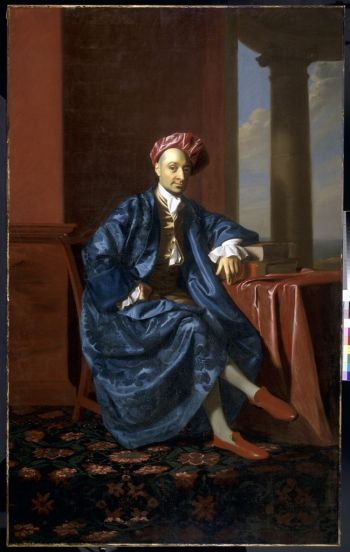
John Singleton Copley, Portrait of Nicholas Boylston, 1773, oil on canvas (The Harvard Art Museums, Painted at the request of the Harvard Corporation, 1773, H20).
This symposium, held in conjunction with the Harvard Art Museum’s forthcoming exhibition, The Philosophy Chamber: Art and Science in Harvard’s Teaching Cabinet, 1766–1820, seeks papers that investigate spaces of artistic, artisanal, and intellectual production throughout global history. From artist’s studios to experimental laboratories, from offices to political chambers, rooms and their contents have long impacted history and transformed their inhabitants. We invite case studies that address questions like the following: How might an assemblage of objects within a given space intersect or clash with ideological narratives? How have secret or privileged rooms, or rooms to which access is limited, served to obfuscate and facilitate the generation and dissemination of ideas? As historians and critics, how should we interpret and recreate such spaces—many of which no longer exist?
The Philosophy Chamber exhibition, on view at the Harvard Art Museums from May 19 to December 31, 2017, will explore the history and collections of one of the most unusual rooms in early America. Between 1766 and 1820, the Philosophy Chamber, a grand room adjacent to the College Library on Harvard’s Campus, was home to more than one thousand artifacts, images and specimens. Named for the discipline of Natural Philosophy, a cornerstone of the college’s Enlightenment-era curriculum that wove together astronomy, mathematics, physics, and other sciences interrogating natural objects and physical phenomena, the Philosophy Chamber served as a lecture hall, experimental lab, picture gallery and convening space. Frequented by an array of artists, scientists, travelers, and revolutionaries, the room and its collections stood at the center of artistic and scholarly life at Harvard and the New England region for more than fifty years. The exhibition considers the wide-ranging conversations, debates, and ideas that animated this grand room and the objects and architectural elements that shaped, supported or unintentionally undermined these discourses.
Potential case study ‘rooms’ include:
• Teaching cabinets
• Workshops
• Civic spaces
• Laboratories
• Domestic spaces
• Toxic rooms
• Secret rooms
• Studies or offices
• Artist studios
• Theaters
• Classrooms or lecture halls
• Chatrooms or other digital ‘rooms’ and platforms
• Museum and gallery installations
• Exchanges
• Train Stations
• Ruins, war-torn rooms
Due the interdisciplinary nature of this symposium, we welcome proposals from a variety of fields, including art history, architectural history, material culture studies, history, English and literature studies, American studies, anthropology, and archaeology, as well as the fine arts. To apply, please submit a 300-word abstract and two-page CV to laura_igoe@harvard.edu by April 15, 2017.
Call for Papers | Fashion and Textiles between France and England


Matthew Darly, The Flower Garden, etching and engraving with watercolor, London, 1 May 1777 (New York: The Metropolitan Museum of Art); and wool sampler embroidered with silk, by Elizabeth Hawkins, Miss Powell’s Boarding School, Plymouth, England, 1797 (London: V&A).
◊ ◊ ◊ ◊ ◊
From the conference website:
Moving Beyond Paris and London: Influences, Circulation, and Rivalries
in Fashion and Textiles between France and England, 1700–1914
Au-delà de Paris – Londres: influences, circulations, rivalités
dans la mode et le textile. France-Angleterre, 1700–1914
Paris, 13–14 October 2017
Proposals due by 28 February 2017
The Séminaire Histoire de la mode (IHTP/CNRS) and the LARCA (Université Paris Diderot) are organizing a joint international conference in Paris, 13–14 October 2017: Moving Beyond Paris-London: Circulation and Exchange in Fashion and Textiles between France and England, 1700–1914. This conference is the latest in a series on cultural exchanges in fashion, which have included Haute Couture: Fashion and Consumption, France and England, 1947–1957 (11 April 2014), Franco-American Exchanges in Fashion (15 April 2016), and Franco-German Exchanges in Fashion (10–12 October 2016).
By looking closely at the relationship—at times friendly, at times not—between France and England through fashion and textiles between 1700 and 1914, this conference will touch on a number of topics, including: the circulation (lawful or illicit) of knowledge, individuals, and objects; the diffusion—and cross-fertilization—of design models between the two countries via press, engravings, or fashion dolls; the importation of textiles and clothing; the phenomena of copying, espionage, and counterfeits; the pursuit of protectionist policies which aimed to limit imports from the rival nation. Particular attention will be given to the different temporalities of industrialization of the two countries as a way to understand innovation and the progressive organization of professions in each. The comparison between the evolution of the two countries will also take into account examples of transfers across them such as with Charles Frederick Worth, the British designer who came to France in 1858 to open a couture house that rapidly became the symbol of haute couture in Paris.
These questions seek to examine the myriad ways in which fashion and textiles strengthened or frayed the political, economic, commercial, industrial, and cultural ties between the two countries. The conference also aims to shed new light on the geography of fashion by looking at capitals and production centers (Paris-London / Manchester-Rouen/ Lyon-Spitalfields), as well as by considering the more global context at a time of intense colonial rivalry between the two countries. Please send your paper proposals (200 words and a short biography) before February 28, 2017 to FrancoBritishFashion@gmail.com.
Scientific Committee / Comité Scientifique
Dr. Maude Bass-Krueger (Associated Researcher, IHTP/CNRS)
Dr. Ariane Fennetaux (MCF, LARCA [UMR 8225], Université Paris Diderot)
Dr. Sophie Kurkdjian (Associated Researcher, IHTP/CNRS)
Images: Matthew Darly, The Flower Garden, etching and engraving with watercolor, London, 1 May 1777 (New York: The Metropolitan Museum of Art); and wool sampler embroidered with silk, by Elizabeth Hawkins, Miss Powell’s Boarding School, Plymouth, England, 1797 (London: V&A).
Call for Papers | The Street and the City: Thresholds
From the conference website:
The Street and the City: Thresholds
University of Lisbon, 5–7 April 2017
The Street and the City: Thresholds is the second of a series of multidisciplinary conferences with special emphasis on cities and the life that has evolved around them through time. Although English studies play a central role in this conference series from both cultural and geographical points of view, other fields of study relating to the conference theme are welcome. The first International Conference The Street and the City: Awakenings drew participants from a wide array of disciplines, such as literature, architecture, sociology, tourism or gender studies, to name but a few. This second conference aims for a comprehensive view of the street and the city focusing on its streets and people as well as on its less known spaces and hidden gems.
Throughout the centuries cities have been hubs of cultural experience and exchange, bringing people together time and again. The streets have been the public space where peoples and individuals both merge in a web and are isolated in the crowd. Cities have also channelled the voices of unsatisfied or rebellious citizens in periods of crises, or become a platform for gathering collective support in dire moments. In times of such conflicts, cities open up spaces for hope and multicultural dialogue. Such dynamics and challenges of an urban milieu constantly pose new questions to researchers concerning, for example, aspects of aesthetic and political representation, and the ways they are interpreted and experienced. Thus, studies of such currents and challenges have become highly diversified, promoting a variety of perspectives of the space we identify ourselves with.
Lisbon is the 2017 Ibero-American Capital of Culture, in the words of the City Council, an “event [which] will be the catalyst for a year of artistic innovation, in which there will be recognition of the historical processes and exchanges of ideas that underpin the relationships between European and American cities, and an acknowledgement of current artistic production, which is unique and intrinsically diverse.” In this sense, we wish to welcome everyone to share this urban atmosphere, which goes beyond the boundaries of Europe and connects the city in a global way.
The Second International Conference The Street and the City: Thresholds will take place at the School of Arts and Humanities, University of Lisbon, and at the Estoril Higher Institute for Tourism and Hotel Studies from 5 to 7 April 2017.
This scholarly meeting keeps its primary goal of fostering an interdisciplinary debate within English studies and of serving as a productive space for disseminating the most recent academic research alongside the studies of culture, urban studies and other fields of interest in relation to cities, their spaces and cultures. While encouraging the interchange of different academic perspectives, the Organising Committee also aims to promote informal networking gatherings among its participants. As such, topics and themes of interest—related to the Street and/or the City—include, but are not restricted to, the following:
• Aesthetic Representations of the City
• Cities as Havens of Hope or Despair
• Streets and Cities as Hives of Negotiation
• Gendered Urban Spaces
• Imagined Cities
• Literary Cities
• Mobility in the City and Urban Flows
• Streets, Consumerism and Fashion
• Sustainable Cities
• The City and Community Expressions
• The City and the Commons
• The Street and the Senses
• The Political Street
• The Tourist and the Flâneur
• Urban Cultural Heritage
• Urban Rhythms
We welcome suggestions for papers, pre-organised panels, and roundtables (20 minutes per speaker) by 28th February 2017, to be submitted on the conference webpage. Abstracts of 300 words for individual papers of twenty-minute duration. Please include the full title of your paper, name, institutional affiliation, contact information (postal address and e-mail address) and a bionote (max. 100 words).
Call for Papers | Source: Notes in the History of Art
Source: Notes in the History of Art
We welcome essays on art from any period or geographical area of interest. Our concise format—up to 2500 words and 3 illustrations—is perfect for introducing fresh interpretations, discoveries, and speculations, resolving old points of dispute, and bringing new ones to light.
Source was founded in 1981 as a scholarly journal in art history. Its mission is to publish articles of 2500 words or less, accompanied by a maximum of three illustrations. The range of articles spans antiquity to the present and includes western and non-western art. The original premise has been borne out: there is an audience for scholarly articles in art history that are clearly written, adequately illustrated, and above all, succinct. Furthermore, scholars welcome having a forum to present ideas and speculations that don’t warrant a major treatise but might nevertheless make interesting ‘notes’ for specialists and non-specialists alike.
Manuscripts may be submitted in English, French, or German. Please note that French, German, or other foreign-language submissions take more time to review, and so even a draft English translation is preferable.
More information is available here»
Editor: John Cunnally
Sponsored by the Bard Graduate Center, New York
Call for Papers | Water, Gods, and the Iconography of Power

Design for a Carriage Built by Andrea Cornely after a design by Ciro Ferri, engraving published in An Account of His Excellence, Roger Earl of Castelmaine’s Embassy from His Sacred Majesty James the II King of England, Scotland, France and Ireland &c. To His Holiness Innocent XI (London, ca. 1687). London: V&A 19393. Inscriptions read: “The Tritons behind support two Majestic figures of Neptune & Britannia who extend each / an Arm & rear up the Imperial Crown of England’ and in the lower center of the plate, “A Marine Lion with two Genii each curbing ye Lion & Unicorn, one next Neptune holds his Trident”
◊ ◊ ◊ ◊ ◊
A donde Neptuno reina: Water, Gods and the Iconography
of Early Modern Power (16th–18th Centuries)
CHAM Conference—Oceans and Shores: Heritage, People, and Environments
Lisbon, 12–15 July 2017
Proposals due by 1 February 2017
Since Antiquity, the personification of water—rivers or seas—has been a recurrent elements in the iconography related to power. From the Tigris to the Ganges, from the Mare Nostrum to the Atlantic Sea, water seems to have been an essential element in the visual display of powerful monarchies and empires. After the European discovery of the Americas, oceans started also to play an extraordinary role in allegorical representations, especially in Spain and Portugal, though elsewhere, too. This panel approaches water iconography, especially as related to oceans, as a mode of representation of power during the early modern period, addressing its role in politics and culture. We are interested in arts, music, and literature, and how they relate to the iconography of water and its relationship with power. Especially welcome are cross-disciplinary contributions, proposals that address different cases studies in a comparative way, and studies focused on ephemeral architecture and theatrical contexts. Topics may include, but are not limited to:
• Ephemeral art: Celebrations of victories, kings’ birthdays, or even religious events were the perfect context for the representation of water as the image of rulers.
• Prints, emblems, and propaganda: How does the topic relate to rulers’ propaganda?
• European powers and the new geography: How did sovereigns employ discoveries into their own images of power?
• Odes, poetry, and epic: How did literature use the image of oceans and rivers to glorify rulers, and what were the implications for the visual arts?
More information is available at the CHAM conference website, and please direct any questions to Dr. Pilar Diez del Corral Corredoira, diezdelcorralcorredoira@tu-berlin.de. Proposals are due by 1 February 2017.










leave a comment