Call for Papers | On the Materiality of Scent
From the conference website and the Call for Papers, which include the French and a bibliography:
The Odorous Object: On the Materiality of Scent
L’objet et son sillage: Penser la matérialité des odeurs
Brown University, Providence, Rhode Island, 27–28 February 2026
Proposals due by 15 September 2025
Organized by Chanelle Dupuis, Jasmine Laraki, and Clara May
Perfumed letters, colorful flasks, scented ceramics, fragrant glass vases, scented jewelry, fragrant wooden boxes, vaporizers, scratch and sniff stickers, soaps, bio-noses, imaginary smell devices; all of these are examples of odorous objects. From the intricate textures and shapes of perfume flasks to the aromatic clays and glass containers of past eras, the materials used to hold scent have changed over time and acquired various cultural and social significance.
Sensory studies approaches have revitalized the study of material culture by reorienting attention towards the life of “sensori-social” things (Howes, 2022) and bringing to light the types of agentivity, exchanges, and experiences that emerge out of interactions between objects, the senses, and socio-cultural contexts. What becomes of perfume and smell when we cease to consider it as a simple emanation or pure olfactory experience and interrogate the materiality itself—that of shapes, gestures, and mediums that render it perceptible?
The receptacle exists in a strange relationship to its contents; while it itself is visible, the scent it holds, the perfume it cherishes, is invisible. The play on presence and absence is central to the perfume, as the liquid we see does not indicate the notes of the perfume we are about to smell. It is this ephemeral quality to smell that creates interesting relationships to materials. A privileged interface—opaque or transparent, open or sealed—the flask represents both visible materiality and the volatile essence of perfume, it condenses an ambivalence where presence and absence coexist (Stamelman, 2006, 2022).
Profoundly complex, the way that smell works has long been misunderstood, leading to centuries of beliefs that belittle the importance of smell. Culturally situated and raising social, moral, political, scientific, religious, or aesthetic questions, these objects today represent useful mediums through which to think about smell. As tools for power and social distinction, as prophylactic instruments, and as routes to other dimensions, perfumes and their contents are inscribed in the history of art, in the history of perfumery, but also in the history of medicine and chemistry. Furthermore, while the usage and purpose of perfume changes from one time period to another, and one region to another, the odorant substances that make up these odorous objects come from around the world: a study of smells, thus, cannot exclude a large geographic coverage, and must address, in our present moment especially, colonial and ecological impacts.
Whether real or imagined, objects contribute to the atmosphere of a place and participate in the creation of a particular ambience. The ecological implications of the storage and disposal of olfactory objects bring to question the atmospheric, material qualities of these and their impacts on bodies. Olfactory objects can be tangible, real-world items, but also invented, imaginary, objects. In literary texts, for example, authors invent olfactory objects that have creative functions. In the dystopia Tè Mawon (2022) by Michael Roch, individuals wear headsets that can simulate “fake food” smells to satiate one’s hunger and mask the bad smells in one’s neighborhood. Smell and taste, the two chemical senses, are closely linked and evoked in unison throughout this dystopia. The evocation of food necessarily comes with smells and flavors, thus showing how odorous objects often involve important multimodal associations.
Due to their immersive and multisensorial nature, perfumes and odors evoke an ensemble of interlinked perceptions that go beyond the sense of smell alone. Synesthesia, an initially physiological phenomenon, has inspired creative initiatives ranging from branding and marketing stories to the creation of immersive environments. For example, a fragrance is often anticipated, prolonged, or translated using a color, a sound, a texture, or movement. The senses that are more difficult to represent—such as taste, touch, or smell—are thus mobilised through metaphors and linguistic slips in a multisensorial logic of correspondences.
To reflect the vastness and complexity of this topic, we invite propositions focused on any time period and any geographic location. While the focus of this conference is research in the humanities and social sciences, we welcome presentations from science, technology, engineering, and mathematics (STEM) researchers in order to foster interdisciplinary conversations on the topic. Research on smell has been shaped by a variety of disciplines and necessitates a variety of perspectives. Likewise, olfactory aids (perfumes, scented objects, etc.) are welcome at the conference: we encourage presenters to not only talk about smell but also bring scents to be smelled when possible.
As part of our hybrid format we welcome both formal research presentations and creative expositions related to olfactory objects and devices.
1) Formal Research Presentations
Research participants will present their work for 20 minutes in organized panels, followed by a Q&A session. Presentations can be in French or English. We welcome papers related (but not limited) to the following topics:
Odor, object, and:
• Spirituality
• Medicine
• Imagination
• Environment
• Emotions
• Memory
• Gestures
• Agency
• Taste
• Aesthetics
• Art
• Genre(s)
• Materiality
• Technique and know-how
• Storage and conservation
• Economy
• Commerce, colonialism
• Linguistics
• Synesthesia
• Decomposition
2) Creative Expositions
As part of this conference, there will be an open exposition space for those wishing to present a creative research project, a new olfactory design, a perfume sample, or other. Each participant in this space will be offered a table where they can expose their work and talk freely with attendees who will explore the space during a set time in the conference program. Our hope is to encourage artists, designers, perfumers, artisans, and researchers to consider experimental, embodied, ways of researching olfaction.
The expositions may include, but are not limited to:
• Olfactory devices or installations
• Olfactory objects or artifacts accompanied by a scientific or theoretical research proposal
• Olfactory design prototypes
• Artworks that mobilize the medium of olfaction
• Performances, sensory archives, or sensory narratives
For research presentations (option 1), we ask participants to submit an abstract of no more than 400 words including a title, description of your research project, and a bibliography. Please also include a short biography containing your name, research discipline, contact information, and University or laboratory affiliation.
For creative expositions (option 2), we ask participants to submit a description of your project or sample of no more than 400 words, including a title for your exposition and a description of the nature of the object or research exposition, the modality of your presentation, dimensions, and specifics regarding the installation of your project (if you need access to a power plug, ventilation, etc.). Please also include a biography containing your name, contact information, and description of past works and past engagements.
To participate, all proposals, written in French or English, must be sent by 15 September 2025, to theodorousobject@gmail.com.
Keynote Speaker
Prof. Érika Wicky (Université Grenoble Alpes-UFR ARSH, France)
Organizers
Chanelle Dupuis (Brown University, USA), Jasmine Laraki (Université Libre de Bruxelles, Belgium, Paris 1 Panthéon-Sorbonne, France), Clara May (Université de Neuchâtel, Switzerland)
Call for Papers | Design Collection Displays
From ArtHist.net and ICOM Design:
Design Collection Displays Reassessed
International Committee for Decorative Arts and Design Symposium
National Museum of Art, Architecture, and Design, Oslo, 28 October — 1 November 2025
Proposals due by 29 July 2025
The Design Collection Displays Reassessed symposium will discuss collection displays as sites of knowledge exchange and active engagement. From a traditionally linear, encyclopedic display, to today’s more narrative approaches, in the last decades, historical and contemporary displays of decorative arts and design have changed dramatically, in response to a variety of forces, including reassessments of institutional priorities, foregrounding of audiences, and the inclusion of different voices. The symposium will interrogate how design objects and interiors are displayed, discussed, and interpreted, and for whom. What does curating these kinds of collection displays represent and mean today? And how might this practice look in the future? What new museological approaches are needed?
The new National Museum of Art, Architecture, and Design, Oslo—a merger of four previously independent museums—is a fitting venue for a symposium with this theme. It opened its new, large-scale collection display in 2022, including decorative arts, design, interiors, fashion, and studio crafts from the 1100s to the present. This permanent collection reinstallation, the first since 2005, provided an opportunity to re-think the curation of the design and decorative arts display.
Some of the questions raised in the curatorial process at the National Museum have inspired and will inform this symposium, including
• How might we curate critically meaningful displays that communicate the distinctiveness of design objects and which reach beyond heroization of the maker?
• What are the specific challenges of exhibiting historic decorative arts for contemporary audiences and how might we meet those challenges?
• How do historic and contemporary objects interact in collection displays, if at all?
• Museum collections have traditionally often reinforced hegemonic and dominant histories. How might collection displays instead convey more inclusive and nuanced narratives?
• How might collection displays be more accessible to new and diverse audiences?
• How might we use the collection display to address societal and global issues?
• How might a design object that is interactive—physically and digitally—have its own presence and be successfully displayed within a collection installation?
• How do collection displays change within house museums?
We welcome submissions that touch on any of the questions above, as well as explorations that go beyond these topics. We also invite contributions that look towards possible futures of collection displays. We look forward to meeting in person to discuss and debate an ever-changing field—a conversation between scholars and practitioners across borders, institutions, and disciplines. An international anthology based on the conference presentations is planned.
Keynote Speakers
• Corinna Gardner (Senior Curator, Design and Digital, Victoria and Albert Museum, London)
• Sebastian Hackenschmidt (Curator of Furniture and Woodwork, MAK – Museum für angewandte Kunst, Vienna)
• Marco Magni (founder and chief architect, and Maria Cristina Rizzello, architect and partner, Guicciardini & Magni Architetti, Florence)
• Leena Svinhufvud (Leading Researcher, Architecture & Design Museum, Helsinki)
Please submit an abstract of 300–400 words for a 20-minute presentation, including a title and a 50-word biography, to denise.hagstroemer@nasjonalmuseet.no. All selected speakers must be ICOM members at the time of the symposium.
Symposium Convener
Dr Denise Hagströmer (Senior Curator, National Museum of Art, Architecture and Design, Oslo), denise.hagstroemer@nasjonalmuseet.no
Call for Papers | Turner 250
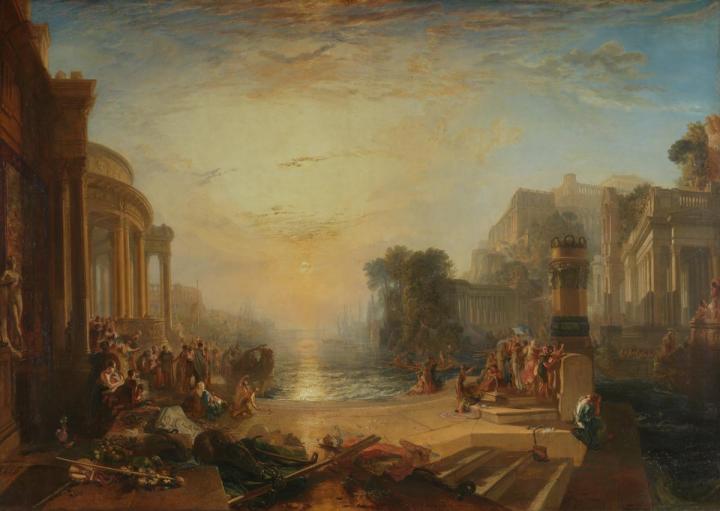
J.M.W. Turner, The Decline of the Carthaginian Empire, exhibited in 1817, oil on canvas, 170 × 239 cm
(London: Tate, Accepted by the nation as part of the Turner Bequest 1856, N00499)
◊ ◊ ◊ ◊ ◊
From the Call for Papers:
Turner 250
Tate Britain, London, 4–5 December 2025
Proposals due by 31 July 2025
2025 marks two hundred and fifty years since the birth of Romantic painter J.M.W. Turner (1775–1851). Conscious of the future, he took care to secure his legacy. But what is that legacy? Timed to coincide with the Turner and Constable exhibition at Tate Britain and to help bring celebrations of Turner’s 250th anniversary year to a close, this conference will take Turner’s art and life as a starting point for exploring what it means to research Turner and to curate his work today.
Thanks in part to the gift of the Turner Bequest, Turner is one of the most highly documented artists, and his life and work have inspired extensive scholarship, exhibitions, and creative responses across a range of art forms. We want to open up discussions about how we tell his story in 2025, how we display and respond to his work, and how singular works—such as The Slave Ship—or entire bodies of work have generated their own afterlives. What new contexts can we use to read and reinterpret his work? How much does our focus on Turner through a monographic lens help or hinder fresh perspectives? Where will studies of Turner take us next?
Reflecting Turner’s own approach to his art, the event will encourage dialogue between historical and contemporary perspectives, and across different disciplines, to consider Turner in his own time and the resonances and interpretations of his vision today. We welcome presentations in a variety of forms—such as illustrated talks or short videos. Each presentation should last around fifteen minutes, whether it is a spoken paper or another form of contribution.
We invite proposals on any topic, but are particularly interested in the following themes:
• Curating Turner now: What do audiences want? What do they already know about Turner? What impact does staging a Turner exhibition have on public engagement and attendance?
• Turner’s contemporaries: Who were his peers, and who has been overshadowed?
• Turner contemporary: Artists inspired by Turner or responding to his legacy in their own work.
• Researching Turner in an age of climate crisis / eco-critical turn.
• The artist’s bequest / the monograph: What opportunities and challenges come with an artist’s bequest or a concentrated focus on a single figure?
Please submit the following by 12 midnight (BST) on 31 July, with ‘Turner 250’ as the subject line, to pmc.events@paul-mellon-centre.ac.uk
• A 250-word abstract describing your proposed contribution
• A 250-word biography
Please combine your abstract and biography into a single Word document and send it as an email attachment. Incomplete or late submissions will not be considered. We will provide a speaker’s fee of £150 and cover reasonable travel and accommodation costs. If you have any access requirements or need adjustments, please let us know and we will do our best to accommodate them.
Organised by Tate Britain in collaboration with the Paul Mellon Centre for Studies in British Art and supported by The Manton Foundation Fund for Historic British Art.
Call for Papers | A History of Textile Cleanliness
From ArtHist.net:
A History of Textile Cleanliness
Washing and Perfuming Fabrics from the Medieval to the Modern Period
Institute of Art History, University of Bern, Switzerland, 28–29 May 2026
Organized by Moïra Dato and Érika Wicky
Proposals due by 30 September 2025
The exhibition Sleeping Beauties: Reawakening Fashion, on view at The Met in 2024, engaged visitors in the museum experience by recreating the displayed dresses’ scents—identified through chromatographic analysis—to illuminate their history and relationship to bodily senses. The analyses and interpretations published in the catalogue reveal not only the presence of perfumes but also traces of cosmetics, sebum, polluted air, and wine, among other aromas. While the poetic resonance of these sensory traces may evoke the ephemeral existence of these garments, their scents have not always been perceived as desirable. On the contrary, the history of textiles and clothing is deeply intertwined with practices of washing, stain removal, deodorisation, and perfuming, all of which were designed to ensure their longevity and reusability. This international conference seeks to explore these practices and their significance in textile history.
The historical study of textile cleaning has emerged at the intersection of cultural history, material culture studies, sensory studies, economic history, and archaeology. While textile production, trade, and consumption have been well-documented, research into the maintenance and cleaning of textiles—both as part of everyday domestic practices and in the care of symbolically significant textiles (such as liturgical garments and ceremonial fabrics)—has only recently gained scholarly attention.
Studies on hygiene underlined the role of textiles in approaches to and conceptions of bodily cleanliness, especially through the relationship between undergarments and the body. As noted by Georges Vigarello in his book Le propre et le sale, white clothing has long been associated with personal hygiene. Researchers have particularly focused on the laundering of linens and their symbolic role as indicators of health, moral, and spiritual virtues (Vigarello, 1985; Roche, 1989). Subsequently, the study of cleanliness and the purity of linens has been extended to colonial contexts, where these notions were intertwined with concepts of race and whiteness while also highlighting regional differences in perceptions of cleanliness and body care (Brown, 2009; White, 2012). Concepts connected to health, bodily hygiene, and clean textiles are also closely linked with questions of smells and techniques for scenting fabrics, an area that has been explored by historians and art historians specializing in the senses (Dospěl Williams, 2019; Schlinzig, 2021).
The inception and evolution of cleaning materials and technologies, from the use of soap to spot-removal recipes and chemical innovations, have also attracted the interest of historians (Leed, 2006). For example, some studies have shown how cleaning methods were adapted based on fibre type and colour stability, as well as how the manufacturing of undergarments itself was conditioned by their future washing (North, 2020). These practices of cleanliness have also been addressed through the lens of social actors, particularly in relation to gendered labour. The work of laundresses, who are rarely documented in written records, has been discussed as a form of embodied knowledge and skills (Morera and Le Roux, 2018; Robinson, 2021). Advertising imagery has also served to explore the dynamic between collective perceptions of clean laundry and its commercial dimensions (Kelley 2010).
Building upon this previous research, this international conference seeks to explore textile cleaning from a global perspective and its interplay with hygiene, olfaction, social opinion, aesthetic preferences, quality expectations, ecological issues, and economic imperatives, all of which are inherent to fabrics. The conference aims to investigate these various practices and their part in the everyday experience of life in the past. Who were the people involved in the daily or extraordinary cleaning of fabrics, and which ingredients and tools were used? What knowledge about textiles and their care was shared at the time, and how was it transmitted? How did these practices evolve during the 18th and 19th centuries, a period of intense development in chemistry and industrial science?
The question of care and cleaning becomes even more significant when considering the many lives of textile objects. Cleaning and maintenance certainly varied not only by fabric type but also by purpose and context of use. Household linens and work clothes were used to the last thread—mended, transformed, and repurposed. More expensive and refined garments and textile decorations were used more sparingly; some were eventually passed down—and even preserved until today. This aspect prompts an exploration of the wide variety of textiles and the differing care practices for under and outer garments, furnishings, and domestic fabrics. Were undergarments the primary focus of cleaning routines? How were sartorial and furnishing fabrics with complex patterning techniques and precious materials (from silk to metal threads) cared for? How was the shape of specific garments, such as ruffs, maintained through washing? How did the intended use of a textile—ranging from menstrual cloths to ceremonial gowns—influence the choice of cleaning methods? Additionally, given that fabric itself was often used as a cleaning tool, what were the interactions between textiles of varying value?
Conceived as a bodily experience, the cleanliness of fabrics carries significant implications tied to the senses. Indeed, integrating sensory studies with the history of cleanliness enables an exploration not only of the sensory experiences associated with washing or wearing clean linen or clothes but also of the sensory knowledge that developed around it. Thus, it becomes possible to examine which notions of pleasantness or discomfort were associated with textile washing or with specific practices such as drying laundry outdoors. How were the smells associated with cleanliness and the thresholds of sensory perception defined? How was the temperature of the washing water evaluated? In what ways were textural changes in fabric during washing assessed? Moreover, attention to sensorial experiences invites us to consider the significant tradition of perfuming laundry, whether placing sachets in linen drawers or sewing them into the hems of garments.
This conference will encompass geographical regions from the Atlantic world to Europe, Africa, the Islamic world and Asia. Adopting this approach raises numerous questions about cultural differences as well as the circulation of cleaning practices and techniques. It enables an examination of the differences and evolutions in conceptions of hygiene and their relationship to textiles across countries and cultures. Moreover, it highlights how these practices were influenced by factors such as available resources, climate, and social norms, shaping distinct traditions of textile care across different societies. Similarly, a longue durée perspective (from the medieval to the modern period) provides an opportunity to explore both changes and continuities in cleaning habits, shaped by advancements in technologies, evolving medical theories, socio-philosophical morals, and shifts in cosmetic and aesthetic preferences. This approach invites us to map out conceptions of cleanliness and identify thresholds of sensitivity: What is considered clean? What criteria are applied in making this assessment? When do clothes become unwearable? What scents are associated with cleanliness? In this regard, the study of representations—such as those found in art and fiction—can offer valuable insights into historical perceptions of cleanliness and its limits.
The conference will take place at the University of Bern’s Department of History of Textile Arts (Institute of Art History) on 28–29 May 2026. We invite proposals from all researchers, particularly doctoral students and early career scholars, on topics ranging from the medieval to the modern period and across all geographical regions. Proposals (300 words), along with a short biography (150 words max), should be sent to Moïra Dato (moira.dato@unibe.ch) and Érika Wicky (erika.wicky@univ-grenoble-alpes.fr) by 30 September 2025.
Conference Organizers
Moïra Dato (University of Bern) and Érika Wicky (Université Grenoble-Alpes / LARHRA)
Scientific Committee
Olivier David (Institut Lavoisier / Paris Saclay), Aziza Gril-Mariotte (Musée des Tissus, Lyon / Université Aix), Raphaël Morera (CNRS-EHESS), Corinne Mühlemann (University of Bern), and Helen Wyld (National Museum Scotland)
s e l e c t e d b i b l i o g r a p h y
• Biow, Douglas. The Culture of Cleanliness in Renaissance Italy. Ithaca, NY: Cornell University Press, 2018.
• Brennan, Julia M. and Magali An Berthon. “Threads of Evidence: Textile and Clothing Remains at Tuol Sleng.” In Tuol Sleng Genocide Museum: A Multifaceted History of Khmer Rouge Crimes, edited by Stéphanie Benzaquen-Gautier and Anne-Laure Porée, 163–178. Leiden: Brill, 2024.
• Brown, Kathleen. Foul Bodies: Cleanliness in Early America. New Haven: Yale University Press, 2009.
• Corbin, Alain. Le Miasme et la Jonquille : odorat et imaginaire social. Paris: Aubier, 1982.
• Delaunay, Quynh. Histoire de la machine à laver. Rennes: Presses universitaires de Rennes, 1994.
• Dospěl Williams, Elizabeth. “Appealing to the Senses: Experiencing Adornment in the Early Medieval Eastern Mediterranean.” In Sensory Reflections: Traces of Experience in Medieval Artifacts, edited by Fiona Griffiths and Kathryn Starkey, 77–96. Berlin: De Gruyter, 2019.
• David, Olivier and Catherine Ganahl. “Rituels de la lessive, odeur du linge propre”, Odeurs et parfums : pratiques quotidiennes et usages rituels, Osmothèque / Musée du quai Branly, 12.04.2023.
• Kelley, Victoria. Soap and Water: Cleanliness, Dirt and the Working Classes in Victorian and Edwardian Britain. London: I.B. Tauris, 2010.
• Leed, Drea. “’Ye Shall Have It Cleane’. Textile Cleaning Techniques in Renaissance Europe”. Medieval Clothing and Textiles, vol. 2, n°2 (2006), 101–119.
• Morera, Raphaël and Thomas Le Roux. “Blanchisseuses du propre, blanchisseurs du pur. Les mutations genrées de l’art du linge à l’âge des révolutions textiles et chimiques (1750–1820).” Genre & Histoire [Online], n°22 (2018).
• Nicole Robinson, Michele. “Dirty Laundry: Caring for Clothing in Early Modern Italy.” Costume, vol. 55, n°1 (2021), 3–23.
• North, Susan. Sweet and Clean? Bodies and Clothes in Early Modern England. Oxford: Oxford University Press, 2020.
• Rawcliffe, Carole. “A Marginal Occupation? The Medieval Laundress and Her Work.” Gender & History, vol. 21., n°1 (2009), 147–69.
• Roche, Daniel. La Culture des apparences : une histoire du vêtement (XVIIe–XVIIIe siècle). Paris: Fayard, 1989.
• Schlinzig, Tino. “Odor as a medium of cohesion and belonging.” Recherches sociologiques et anthropologiques, vol. 52, n°1 (2021), 47–69.
• Tuckett, Sally. Transatlantic Threads: Scottish Linen and Society, c. 1707–1780. Edinburgh: Edinburgh University Press, 2025.
• Ungerer, Catherine. “Les valeurs urbaines du propre: Blanchissage et hygiène à Paris au XVIIIe siècle,” Ethnologie française, vol. 16, n°3 (1986), 295–298.
• Vigarello, Georges. Le propre et le sale : l’hygiène du corps depuis le Moyen Âge. Paris: Editions du Seuil, 1985.
• Wang, Joan S. “Race, Gender, and Laundry Work: The Roles of Chinese Laundrymen and American Women in the United States, 1850–1950.” Journal of American Ethnic History, vol. 24, n°1 (2004), pp. 58–99.
• Ward, William Peter. The Clean Body: A Modern History. Montreal: McGill-Queen’s University Press, 2019.
• Welch, Evelyn. “Scented Buttons and Perfumed Gloves: Smelling Things in Renaissance Italy.” In Ornamentalism: The Art of Renaissance Accessories, edited by Bella Mirabella, 13–39. Ann Arbor: University of Michigan Press, 2012.
• White, Sophie. Wild Frenchmen and Frenchified Indians: Material Culture and Race in Colonial Louisiana. Philadelphia: University of Pennsylvania Press, 2012.
• Zdatny, Steven. A History of Hygiene in Modern France: The Threshold of Disgust. London: Bloomsbury, 2024.
Call for Papers | Posterity and Fortunes of 17th- and 18th- C. Artists
From Le blog de l’ApAhAu::
Create and After? / Créer et après?
Posterity and Critical Fortunes of 17th- and 18th- Century European Artists
Postérité et fortune critique des artistes européens des XVIIᵉ et XVIIIᵉ siècles
Salle Vasari, Galerie Colbert, 2 rue Vivienne, Paris, 7–8 November 2025
Proposals due by 28 June 2025
According to Antoine Schnapper, one of the tasks of the art historian is to “go against the tide of neglect and oblivion.” Art history has been built on a selection of works and events deemed worthy of remembrance. Conversely, artists, artefacts, and other objects deemed unworthy of an era, a trend, or a discourse have been neglected or obscured. The notions of ‘critical fortune’, ‘posterity’ and ‘reception’ highlight this dynamic. The artists of the 17th and 18th centuries who enjoy lasting recognition escape oblivion, while others, less valued, disappear from the narrative. These contrasting fates are rooted in a variety of factors: changing aesthetic sensibilities, the material nature of the works, historical upheavals, and their visibility in museum collections.
The history of European art has its origins in the writing of artists’ biographies, from Vasari to Félibien to Dezallier d’Argenville. It is based not only on the objective appreciation of works, but also on the judgements made by artists, the public, critics, historians, and the art market, which can alter or reinforce an artist’s position. Since the end of the 19th century and the birth of art history as a discipline, historians such as Henry Jouin (1878; 1888; 1890), Jules Guiffrey (1877), Pierre Marcel (1914; 1924), and Jean Locquin (1912; 1933) have set out to fill these gaps by shedding light on the mechanisms that led to certain artists being forgotten. However, these early studies, which were often based on specific cases, did not provide an overall analysis of the oblivion or marginalisation of artists. Since the 1960s, many artists of the 17th and 18th centuries have been rediscovered or reassessed thanks to monographs accompanied by catalogues raisonnés. New methodologies and easier access to sources have enriched this research, thanks to digital technologies that bring to light previously unpublished information on artists’ careers and their influences. The rise of social history and gender studies has made it possible to place artists in broader contexts, and the study of materials and techniques offers new perspectives on artistic creation. These tools have considerably renewed the approach to monographs, providing a more nuanced reading of artists’ careers. However, the traditional monograph, even when accompanied by a catalogue raisonné, is not always sufficient to provide a comprehensive overview of the critical fortunes of artists.
While there are still many forgotten or neglected artists, the wealth of publications in recent decades provides fertile material for new general reflections, fleshed out by new approaches to the discipline, such as studies. This colloquium therefore proposes to question the notion of posterity, reception, and critical fortune, not only from the point of view of the artist, but also from that of the amateur, cultural institutions, and the public in the 17th and 18th centuries. It will look at the factors and mechanisms that contributed to the rise or fall of certain artists. It is therefore intended to be a reflection on the test that all artists must overcome: time. What role have critics, academies, Salons, the public, and cultural institutions played in this dynamic? What influence have the art market and collectors had on the recognition of artists? In addition, this symposium will look at the challenges faced by art historians when faced with material gaps: how do we deal with an artist or a work for which sources are rare or absent?
◊ ◊ ◊ ◊ ◊
The first theme of this colloquium will focus on the notion of posterity. In his Salon of 1765, Diderot stated: “The artist, in his studio, must feel around him the gaze of a severe and incorruptible posterity.” In so doing, he emphasised the need for artists not to work ‘for their own century’, but to create a future legacy. Taken from the Latin posteritas, posterity refers to the time that comes after, the future. As early as the 17th century, Furetière’s dictionary bears witness to this conception that it is the artist’s responsibility to look after his posterity. It was up to him to ensure that he would be remembered. Many artists in the 17th and 18th centuries directed their careers in this direction. This focus of the symposium will therefore seek to explore the means put in place by artists to ensure their posterity. How did artists’ personal strategies—whether in terms of constructing their image or managing their relations with patrons, critics or institutions—influence their posterity ? In addition, we would like to encourage papers on the material resources that certain artists have deployed to guarantee the longevity of their works. This includes, for example, a certain technical mastery to ensure the longevity and transmission of their works.
Preferred topics
• The use of writing in the construction of posterity : analysis of artists’ memory strategies
• Analysis of the use of prints to promote and disseminate a work of art
• Building a legacy: transmission within families and artists’ studios
• Absence, indifference and refusal of posterity
• The impact of the materiality of works of art on posterity: ephemeral creations, time-tested techniques, etc.
◊ ◊ ◊ ◊ ◊
The second theme of the colloquium will be reception. This term refers to the way in which a work or an artist is perceived and appreciated by the public, who are the main players here. Reception is subjective, sensitive and dependent on the tastes of an era, as well as the social and political influences of the time. By ensuring that his work is well received during his lifetime, the artist takes a step towards success and immortality. Tastes evolve regularly, and works are constantly re-evaluated in the light of one artist’s, one audience’s and one era’s view of another. Criteria differ according to time and place and can therefore be received differently by each century and each new generation. Sometimes it is the works themselves that fall victim to this process, particularly when restoration work alters the original appearance of the objects. This constant questioning of taste can be damaging for some artists, but beneficial for others. The aim is to study how these contexts have influenced artistic criticism and the fortunes of artists. How have political and social events altered the criteria by which works are judged? How does the material state of a work affect its reception?
Preferred topics
• The use and role of the written work in the reception of artists and their works : press articles, critical reviews of the Salons, Academy lectures, treatises, etc.
• The influence of taste on the reception of artists according to the context of space and time
• Lack of interest in an artist, a factor in the destruction of works
• The disappearance of works, a factor in the oblivion of artists
• Consequences of the emergence of the concept of genius in the 18th century on the reception of artists and their works
◊ ◊ ◊ ◊ ◊
The final theme of this symposium will be the notion of critical fortune. This methodical examination of an artist’s reception reflects not only the aesthetic and intellectual judgements made about their work, but also the evolution of their reputation and influence in art history. Critical fortune thus acts as a selective memory, determining which artists are preserved in history and which others sink into oblivion. It influences not only the individual trajectories of artists, but also our understanding of the evolution of styles and aesthetic debates over time. In this sense, critical fortune becomes an essential filter in the writing of art history, structured by the choices of what is valued and what is omitted. Favourable critical fortune can propel an artist to the rank of ‘master’, while unfavourable fortune can condemn him or her to indifference. However, such fortunes are often unstable, subject to fluctuations in trends, social contexts and power dynamics in the art world. This focus will explore transformations in the perception of artists : how were certain artists revalued in the 19th and 20th centuries? What are the reasons for these critical revisions, and how have these reassessments altered their place in art history ? In this way, writing the critical fortune will renew the discourse on an artist for generations to come.
Preferred topics
• The role played by monographs in building the critical fortunes of artists past and present.
• The importance of the vocabulary used to describe artists: ‘master’, ‘small’, ‘great’, ‘minor artist’, ‘major artist’, etc.
• The influence of museums (museography, exhibitions, etc.), universities (conferences, seminars, publications, etc.), the art market and the press.
• New methodologies: what contribution can they make to the writing of critical fortune ?
• Regimes of historicity: the influence of the socio-historical context on the writing of art history and on heritage issues.
Presentations will last twenty minutes and will take the form of individual and collective case studies, focusing, among other things, on the themes listed in the call for papers. Proposals (600–700 words) must be submitted, along with a short biography, to fortunecritique@gmail.com by 28 June 2025. A publication will be considered after the conference.
Organizing Committee
• Élisa Bérard, PhD candidate in Art History, Sorbonne University, Centre André-Chastel
• Romane Delsinne, PhD candidate in Art History, Sorbonne University, Centre André-Chastel
• Enzo Menuge, PhD candidate in Art History, Sorbonne University, CNRS, Centre André-Chastel
Scientific Committee
• Christine Gouzi, Professor of Modern Art History, Sorbonne University, Centre André-Chastel
• Étienne Jollet, Professor of Modern Art History, Paris I Panthéon-Sorbonne
◊ ◊ ◊ ◊ ◊
b i b l i o g r a p h y
BARBILLON, Claire, CHEVILLOT Catherine, MARTIN, François-René, Histoire de l’art du XIXe siècle, 1848–1914 : bilans et perspectives, actes du colloque École du Louvre-musée d’Orsay, 13–15 septembre 2007, Paris, École du Louvre, 2012.
BARTHES Roland, « La mort de l’auteur », In : Manteia, n°5, 4e trimestre, 1968, p. 12–17.
BONFAIT Olivier, « Réception et diffusion. Orientations de la recherche sur les artistes de la période moderne », In: Histoire de l’art, n°35–36, 1996, p. 101–114.
BONFAIT Olivier, « Conclusion : une génération La Fosse ? Nouveaux lieux et paradigmes de la peinture en France autour de 1700 », In : Bulletin du Centre de recherche du château de Versailles [en ligne], 15, 2018.
BRISAC Anne-Laure (dir.), Perspective : la monographie d’artiste. 4/2006, [revue], Paris, Armand Colin – La revue de l’INHA, 2007.
BOURDIEU Pierre, « L’illusion biographique », In : Actes de la recherche en sciences sociales, n°66–67, 1987, p. 95–104.
CHASTAGNOL, Karen, « Charles de La Fosse et la peinture d’histoire autour de 1700 », In : Bulletin du Centre de recherche du château de Versailles [en ligne], 15, 2018.
DIDEROT Denist, Salons, vol. 1 (1759–1761–1763), texte établi et présenté par J. Seznec et J. Adhémar, 2nde édition, Londres, Oxford Clarendon Press, [1957] 1975.
DIMIER Louis, Histoire de la peinture française du retour de Vouet à la mort de Le Brun, Paris et Bruxelles, 2 vol., 1926–1927.
DOSSE François, Le Pari biographique. Écrire une vie, Paris, La Découverte, 2005.
FEBVRE Lucien, « Penser l’histoire de l’art », In : Annales, économies, sociétés, civilisations, n°5/1, janvier-mars 1950, p. 134–136.
FEBVRE Lucien, « Résurrection d’un peintre : à propos de Georges de La Tour », In : Annales. Économies, sociétés, civilisations, t. 5, 1950, n°1, p. 129–134 ; rééd. Par Brigitte Mazon dans Lucien Febvre. Vivre l’histoire, Paris, R. Lafont/A. Colin, coll. « Bouquins », 2009, p. 260–265.
GOUZI Christine, « L’histoire de l’art selon Antoine Schnapper », in Commentaire, Numéro 129 (1), 2010, p. 151–158.
GOUZI Christine, « Préface », In : Antoine Schnapper, Jean Jouvenet 1644–1717 et la peinture d’histoire à Paris, Paris, Arthena, [1974] 2010.
GOUZI Christine, « L’histoire dans les règles de l’art : la monographie », In : actes du colloque Artistes, collections et musées : hommage à Antoine Schnapper, Paris, INHA, 2009, Paris, Presses de l’Université Paris-Sorbonne, 2016.
GOUZI Christine, « Préface », In : Nicolas-Guy Brenet. 1728–1792, Paris, ARTHENA, 2023.
JOLLET Etienne, « La temporalité dans les arts visuels : l’exemple des Temps modernes », in Revue de l’art, N° 178(4), 2012, p. 49–64.
JOUIN Henry, Charles Le Brun et les Arts sous Louis XIV, Paris, Imprimerie nationale, 1889.
LOCQUIN Jean, La peinture d’Histoire en France de 1747 à 1785, Paris, 1912 (rééd. 1978).
MARCEL Pierre, La Peinture Française au début du XVIIIᵉ siècle. 1690–1721, Paris, Ancienne maison Quantin, 1906.
PASSINI, Michela, L’oeil et l’archive : une histoire de l’histoire de l’art, Paris, La Découverte, 2017.
RIS (de) CLÉMENT, Les Amateurs d’autrefois, Paris, E. Plon & Cie, 1877.
ROSENBERG, Pierre, « Roberto Longhi et le XVIIᵉ siècle français », In : De Raphaël à la Révolution, les relations artistiques entre l’Italie et la France, Paris, Skira, 2005, p. 27–36 (1ère éd. dans G. Previtali [dir.], L’Arte di scrivere sull’arte. Roberto Longhi nella cultura del nostro tempo, Roma, Editori riuniti, 1982).
SCHNAPPER Antoine, « Les tâches de l’historien de l’art. », In : Contrepoint, n°2, 1973, p. 161–172.
SHAFTESBURY, Characteristics of Men, Manners, Opinions, Times, réédité par Lawrence E. Klein, University of Nevada, Las Vegas, [1711], 2000.
THUILLIER Jacques, CHÂTELET, Albert, La peinture française. De Le Nain à Fragonard, Genève, Skira, 1964.
THUILLIER Jacques, La peinture française au XVIIe siècle, vol. 2., Genève, Skira, 1992.
VAISSE Pierre, « Du rôle de la réception dans l’histoire de l’art », in Histoire de l’art, n°35-36, 1996, p. 3–8.
WARESQUIEL (de) Emmanuel, Il nous fallait des mythes : La Révolution et ses imaginaires de 1789 à nos jours, Paris, Tallandier, 2024.
WOOD, Christopher, A History of Art History, Princeton, University Press, 2019.
e x h i b i t i o n s
• Dunkerque, Lille, Valenciennes, 1980 : La Peinture française aux XVIIe et XVIIIe siècles, Dunkerque, musée des Beaux-Arts, Valenciennes, musée des Beaux-Arts, Lille, Palais des Beaux-Arts, 1980, Dunkerque, musée des Beaux-Arts, 1980 (dir. Jacques Kuhnmünche et Hervé Oursel).
• Ottawa, 1976 : Le siècle de Louis XV : peinture française de 1710 à 1774, Ottawa, musée des Beaux-Arts du Canada, 19 mars – 2 mai 1976, Ottawa, Galerie nationale du Canada, 1976 (dir. Pierre Rosenberg).
• Sceaux, 2013 : 1704, Le Salon, les Arts et le Roi, Sceaux, domaine départemental, musée de l’Île-de-France, 22 mars – 30 juin 2013, Milan, Silvana Editoriale, 2013 (dir. Dominique Brême et Frédérique Lanoë).
• Tours, Toulouse, 2000 : Les Peintres du roi, 1648–1783, Tours, musée des Beaux-Arts, 18 mars – 18 juin 2000 ; Toulouse, musée des Augustins, 30 juin – 2 octobre 2000, Paris, Réunion des musées nationaux, 2000.
Call for Papers | Interrogating the Female Gaze
From ArtHist.net:
Spectacle and Spectatorship: Interrogating the Female Gaze
Fifth Annual International Women in the Arts Conference
Online and in-person, University of Arkansas Rome Center, Rome, 4–6 November 2025
Convened by Consuelo Lollobrigida and Adelina Modesti
Proposals due by 14 July 2025
Laura Mulvey in her pioneering analysis of visual pleasure (“Visual Pleasure and Narrative Cinema,” 1973) posited filmic creation, artistic practice, and cultural representation as the projection of patriarchal fantasy and product of a male gaze that objectifies the body of woman as spectacle. Similarly John Berger in his Ways of Seeing (1972) defined Western art history as primarily a history of the representation of women by men for the gratification of the male spectator. But what implications does this have for the female creator, viewer of art, or reader? What about the female gaze? Or the female body as represented by women, or even the male body for the female spectator? What about women’s visual pleasure?
AIWAC 5’s theme invites papers that interrogate the ‘look’ for women as makers (artistic practitioners, writers, performers, musicians), as patrons of art, and as spectators. The historical time frame and geographical area is open, including up to contemporary times.
Possible topics include
• Female visual (and other) pleasures in the arts
• The female ‘eye’: women as patrons and collectors of art
• Definitions of spectacle, including theatre (spettacolo), music and film, and women’s engagement as dramatists, filmmakers, actors, performers, scriptwriters, musicians, and composers
• Woman as spectacle
• The female gaze: women artists and makers; women and architecture
• Female spectatorship
• Writing and reading women
• Female models and agency
Conference papers will be published in the “AIWAC acta colloquia” postprint series in collaboration with Brepols Publishers, after a peer review process.
To submit a proposal
• Write an abstract in English in Word (max. 500 words, excluding authors name(s) and contact details)
• Include a short bio (150 words max)
• Save the proposal as: ‘AIWAC5_name and family name’
• Include a short CV
• Email to clollobr@uark.edu and amodesti@unimelb.edu.au
Proposals are due by 14 July 2025. Successful applicants will receive a notification by 31 July. A remote presentation might be considered, even if in-presence presentation will have priority. Talks should be no longer than 20 minutes. The organizers cannot contribute towards transport or accommodation costs of speakers or attendees. A registration fee will be communicated along with the acceptance of papers. Excluded papers won’t be notified. The conference will take place at University of Arkansas Rome Center and will combine selected paper presentations with keynote speakers. The final program will be communicated by the beginning of October 2025.
Call for Papers | Making Early Modern Materialisms, 16th–18th Centuries
From the Call for Papers, which includes the French:
Making Early Modern Materialism(s), 16th–18th Centuries
Fabriquer le(s) matérialisme(s), XVIe–XVIIIe siècles
ENS de Lyon, 30–31 January 2026
Organized by Isabelle Moreau and Jennifer Oliver
Proposals due by 15 June 2025

Bernard Palissy (atelier de) Brique à alvéoles multiples (RMN-Grand Palais, musée de la Renaissance, château d’Ecouen / René-Gabriel Ojéda).
This conference will investigate the contribution made by artisanal and technical practices to materialist thought in early modern scholarly contexts (16th–18th centuries).
Materialism is often presented as a “philosophical discourse produced ‘on the basis of’ or ‘in the name of’ a scientific practice” (Moreau and Wolfe, 2020, our translation), while the history of materialism itself has tended to overlook artisanal know-how, privileging the history of ideas. This situation might be accounted for in two ways. Firstly, any “formulation, from actual observed occurrences, of assertions that cannot be decided on through experimentation” (Andrault, 2017, our translation) thus involves a ‘speculative’ aspect. The role played by theorisation has tended to obscure the practical dimensions of the knowledge being mobilised. Our aim is to reverse this perspective, through attention to the shaping influence of artisanal knowledge and practice on early modern ways of thinking about materiality.
Secondly, the concept of a ‘scientific revolution’ has long been a central tenet in the history of science (Duris, 2016), along with a narrow definition of what ‘science’ is, and the foregrounding of major scholarly figures (Bret, 2016). Like the history of materialism, “the history of science, privileging the study of ideas, has ignored the role of artisans” (Hilaire-Pérez, 2016, translation ours). The recent reconsideration of the of the ‘scientific revolution’ among historians of science—in the field of the life sciences in particular—has opened up a new awareness of the interactions and hybridisations of knowledge between the theoretical and the practical (Hilaire-Pérez, 2016). Applying such a shift in perspective to our study of early modern materialisms is already beginning to bear fruit (see for example the ‘Experimenting the Early Modern Elements’ online conference organised by the Writing Technologies research network, 2021) allowing us to evaluate the impact of artisanal skills and techniques on the various debates on nature and the origins of life.
The role of literary and aesthetic productions in these interactions and hybridisations will also be in focus here. For example, as Frédérique Aït-Touati has recently shown (Théâtres du monde: fabrique de la nature en occident, 2024), real and conceptual theatres (the theatrum mundi and ‘theatre of nature’) were vital sites of exchange and experimentation that allowed for the evaluation and evolution of models of nature.
The period in question—from the 16th to the 18th centuries—is one of many significant scientific and technical discoveries. It also sees the coexistence of very different versions of materialism and even ‘different practices of materialism’ (Pépin, 2012, translation ours). Just as the evolution of science and technology is not linear, materialist discourse is not homogenous. On the other hand, ‘there are many research subjects (reflections on matter, atomism, magic and esotericism, Genesis and theories of the earth, biblical chronology…) that defy religious orthodoxy and draw on scientific research’ (Van Damme, 2016, translation ours). When we attend to know-how and technique, it is striking that the same experiment, the same observation, or the same manipulation of materials can lead to different conclusions and be made to serve diametrically opposed visions of the world. The insistence on empirical experience and autopsy (or seeing for oneself) is also, for that matter, accompanied by repeated warnings about the difficulty of these approaches. Even those with the sharpest eyes and the nimblest fingers will still find, in some cases, that they don’t know a thing, to borrow the expression of Niels Steensen on the anatomy of the brain. The same goes for the micro-anatomy of insects, whose delicate nature, according to Swammerdam, far outstrips the finest cutting edge of his blades. But these limitations on human handiwork do not dampen Swammerdam’s respect for the experience of artisans over scholarly speculations (Duris, 2019). The importance attributed to technical skill and the precision of instruments overturns received ideas of their relationship to knowledge, and calls into question the assumed division of expertise. In order to open up this field of enquiry, we will consider artisanal practices and techniques in their widest sense, in whatever domain (medicine, natural sciences, physics or astronomy).
We especially welcome contributions exploring the following themes:
• Artisanal epistemologies and practical intelligence: the contributions of artisans and practitioners to materialist thought. This theme could be approached from a sociology of sciences perspective, addressing the heterogeneity of actors brought together in experimental contexts and the diversity of practices over the long term of the 16th, 17th, and 18th centuries. One might also revisit the figure of the materialist philosopher with a focus on hybridisation and the mixing of skills, as seen in the ‘scholar-artisans’ brought to light in recent historiography (Hilaire-Pérez, 2016).
• Materialist practices / practices of materialism: anchoring materialist thought within a history of spaces and materials. What are the most important hybrid spaces of knowledge or ‘trading zones’ (Long, 2015) (anatomical theatres, salons, academies, cabinets of curiosity, gardens, etc.)? How are they subject to reappropriation or repurposing? One might also reflect on the textual circulation of materialist thought (from books of secrets to clandestine manuscripts), not least the apparent contradiction between a culture of secrecy and publications aimed at sharing know-how (the notion of ‘useful knowledge’, Berg, 2007; treatises on ‘reduction into art’, Dubourg-Glatigny and Vérin, 2008).
• The materialist tool-box. What practices and skills are most influential in feeding into materialist thought, or, on the contrary, are used by opponents of materialism? Contributions could also reflect on the double paradigm of ‘hand and eye’ in carrying out experiments to support a materialist reading of nature.
• The literary workshop of materialism. It might be productive to consider the incorporation of artisanal images and vocabulary in materialist thought; fictional adaptations of artisanship and artisanal instruments in philosophical fictions; the force of analogy in materialist texts and of literary form in the development of materialist thought.
Abstracts (300 words) should be sent, along with a short CV, to isabelle.moreau@ens-lyon.fr and jennifer_oliver@fas.harvard.edu by the 15th June 2025. Accepted contributors will be notified in July 2025. The conference proceedings are to be published in a special issue of Libertinage et philosophie à l’époque classique (XVIe–XVIIIe siècle).
Organisers
Isabelle Moreau (ENS Lyon) and Jennifer Oliver (Harvard)
Comité scientifique
Isabelle Moreau (ENS Lyon), Jennifer Oliver (Harvard), Kate Tunstall (Oxford), Caroline Warman (Oxford)
◊ ◊ ◊ ◊ ◊
Bibliographie Indicative / Indicative Bibliography
Adamson, Glenn. 2007. Thinking Through Craft, Oxford.
Aït-Touati, Frédérique. 2024. Théâtres du monde. Fabriques de la nature en Occident, Éditions La Découverte.
Andrault, Raphaële. 2017. « Leibniz et la connaissance du vivant », dir. Mogens Laerke, Christian Leduc, David Rabouin, Leibniz. Lectures et commentaires, Vrin, p. 171–190.
Berg, Maxine. 2007. « The Genesis of “Useful Knowledge” », History of Science, vol. 14, p. 123–133.
Bert, Jean-François et Lamy, Jérôme. 2021. Voir les savoirs. Lieux, objets et gestes de la science, Anamosa.
Bret, Patrice. 2016. « Figures du savant, XVe–XVIIIe siècle », dir. Liliane Hilaire-Pérez, Fabien Simon, Marie Thébaud-Sorger, L’Europe des sciences et des techniques. Un dialogue des savoirs, XVe–XVIIIe siècle, PUR, p. 95–102.
Charbonnat, Pascal. 2013. Histoire des philosophies matérialistes. Éditions Kimé.
Charbonnat, Pascal. 2006. « Matérialismes et naissance de la paléontologie au 18e siècle ». Matière Première, 1 (1), p. 31–54.
Dubourg-Glatigny, Pascal et Vérin Hélène (dir.). 2008. Réduire en art. La technologie de la Renaissance aux Lumières, Paris, MSH.
Duris, Pascal. 2016. Quelle révolution scientifique ? Les sciences de la vie dans la querelle des Anciens et des Modernes (XVIe–XVIIIe siècle), Éditions Hermann.
Duris, Pascal. 2019. « Changement et préformation. La métamorphose des insectes chez Swammerdam », dir. Juliette Azoulai, Azélie Fayolle & Gisèle Séginger, Les métamorphoses entre fiction et notion. Littérature et sciences (XVIe–XXIe siècle), LISAA éditeur, p. 43–54.
Halleux, Robert. 2009. Le Savoir de la main : savants et artisans dans l’Europe pré-industrielle, Armand Colin.
Hilaire-Pérez, Liliane. 2016. « L’artisan, les sciences et les techniques (XVIe–XVIIIe siècle) », dir. Liliane Hilaire-Pérez, Fabien Simon, Marie Thébaud-Sorger, L’Europe des sciences et des techniques. Un dialogue des savoirs, XVe–XVIIIe siècle, PUR, p. 103–110.
Jacob, Christian (dir.). 2011. Lieux de savoir 2. Les mains de l’intellect, Albin Michel.
Long, Pamela O. 2015. « Trading Zones in Early Modern Europe », Isis, 106–4, p. 840–847.
Mandressi Rafael. 2013. « Le corps des savants. Sciences, histoire, performance », Communications, 92, 2013. Performance – Le corps exposé. Numéro dirigé par Christian Biet et Sylvie Roques. p. 51–65.
Moreau, Pierre-François et Wolfe, Charles T. 2020. « Entretien sur l’histoire du matérialisme », Revue de synthèse, 141 (1-2), p. 107–129.
Mothu, Alain (dir.). 2000. Révolution scientifique et libertinage, Brepols.
Mothu, Alain. 2012. La pensée en cornue. Matérialisme, alchimie et savoirs secrets à l’âge classique, SÉHA/ARCHÉ.
Oosterhoff, Richard J., Marcaida, José Ramón, Marr, Alexander (dir.). 2021. Ingenuity in the Making. Matter and Technique in Early Modern Europe, University of Pittsburgh Press.
Pépin, François (dir.). 2012. Les matérialismes et la chimie. Perspectives philosophiques, historiques et scientifiques, Éditions Matériologiques.
Roberts, Lissa, Schaffer, Simon, Dear, Peter (dir.). 2007. The Mindful Hand: Inquiry and Invention from the Late Renaissance to Early Industrialisation, Amsterdam.
Smith, Pamela H., 2014–. The Making and Knowing Project, Columbia University, https://www.makingandknowing.org/.
Smith, Pamela H., Meyers, Amy R. W., Cook, Harold J. (dir.). 2014. Ways of Making and Knowing. The Material Culture of Empirical Knowledge, The University of Michigan Press.
Van Damme, Stéphane. 2016. « Les sciences à l’épreuve du libertinage », dir. Liliane Hilaire-Pérez, Fabien Simon, Marie Thébaud-Sorger, L’Europe des sciences et des techniques. Un dialogue des savoirs, XVe-XVIIIe siècle, PUR, p. 473–485.
Waquet, Françoise. 2015. L’ordre matériel du savoir. Comment les savants travaillent, XVIe–XXIe siècle, CNRS Éditions.
Call for Papers | Image and Text in Travel Narratives
From the Call for Papers:
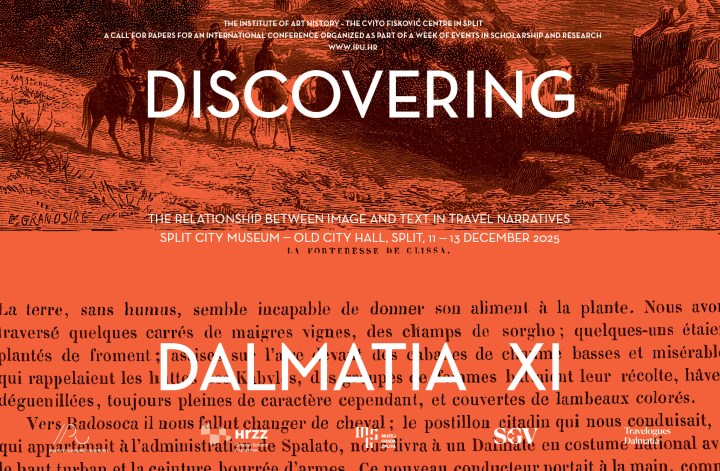
Discovering Dalmatia XI
The Relationship Between Image and Text in Travel Narratives
Split, 11–13 December 2025
Proposals due by 15 July 2025
Keynote Speaker: Heather Hyde Minor, Professor of Art History, Concurrent Professor of Romance Languages and Literatures, University of Notre Dame
Travelogues take shape through the wide range of travel experiences recorded in books, periodicals, diaries, letters, drawings, paintings, prints, and photographs. They represent invaluable historical and cultural sources in which textual and visual narratives are often intertwined in order to convey complex impressions of places, people, and cultural heritage in as much detail as possible. In forming such responses, artist-authors are engaged in an intense dialogue with place, often leaving behind experiences recorded in both text and image. These documents of experience strongly mark, in turn, the spaces they mediate, often becoming models themselves for future travel writers. Among those regions recorded in travel narratives, Dalmatia occupies a significant place: often depicted in this rich relationship between image and text, these together shape a layered perception of its complex identity.
This year’s Discovering Dalmatia conference in Split is specifically dedicated to exploring the ways in which these two forms of representation intertwine within the travel genre. The focus will be on the dynamic relationship between words and images: on the function of visual elements (illustrations, graphics, photographs) within, and alongside, the travel text, and on how—together—they shape the narrative tone of the travelogue and the perception of a particular place. We encourage presenters to think about diachronic perspectives—which follow changes in the relationship between image and text over time—as well as the dialogical nature of this interaction, and how this might raise questions about authorship, credibility, cultural translation, and intermediality in travel literature.
The visual component of the travelogue has often worked to confirm the credibility of the text or to attract a reading audience fascinated by the ‘exotic’ southeastern edge of Europe. At the same time, images bring their own visual rhetoric—sometimes supporting and sometimes replacing the written narrative. Theoretical approaches that consider image and text not as parallel, but as interdependent semiotic systems, are necessary for understanding the specifics of the travel genre. We therefore invite contributions that offer theoretical reflections on this relationship, or which discuss concrete case studies, particularly those concerning travel accounts about Dalmatia and within the intense period of study trips to the region from the eighteenth to the mid-twentieth century.
The conference aims to bring together scholars from different disciplines—the history of art, architecture, literature, visual culture, anthropology, and media studies—to reflect on how the interrelationship between image and text in travelogues contributes to the construction of meaning, memory, and cultural identity. Dalmatia, with its rich presence in the European travel writing tradition, offers particularly fertile ground for such research.
We ask participants to reflect on two central questions:
• How do visual and textual representations of places, particularly Dalmatia, work together in shaping perceptions of space, heritage, identity, and otherness?
• What historical and conceptual models help us understand the relationship between image and text in travel literature?
We welcome proposals that examine a wide range of travel material that combines text and image. It is our hope that the conference will contribute to a deeper understanding of various aspects of the interplay of image and text, to promote rich reflections on Dalmatia’s place in the European cultural imagination, as well as to defining the travelogue as an autonomous, multidisciplinary, and multimedia practice. Proposals for 20-minute papers, consisting of a 250-word abstract and a short CV in Croatian or English, should be sent via email as a PDF attachment to discoveringdalmatia@gmail.com by 15 July 2025.
Registration will take place on the evening of the 10th of December, the closing address will take place on the 13th of December, and the hosts will organise coffee and refreshments for conference participants during breaks. No participation fee will be charged for this conference. The organisers do not cover travel and accommodation costs. The organisers can help participants to find reasonably-priced accommodation in the historic city centre. Papers and discussions will be conducted in English. The duration of a spoken contribution should not exceed 20 minutes. Presentations will be followed by discussions. We propose to publish a collection of selected papers from the conference.
Scientific Committee
Joško Belamarić (Institute of Art History – Cvito Fisković Centre Split)
Davide Lacagnina (University of Siena, School of Specialization in Art History)
Tod Marder (Rutgers University, Department of Art History)
Katrina O’Loughlin (Brunel University London)
Cvijeta Pavlović (University of Zagreb, Faculty of Humanities and Social Sciences, Department of Comparative Literature)
Marko Špikić (University of Zagreb, Faculty of Humanities and Social Sciences, Department of Art History)
Ana Šverko (Institute of Art History – Cvito Fisković Centre Split)
Elke Katharina Wittich (Leibniz Universität Hannover)
Sanja Žaja Vrbica (University of Dubrovnik, Arts and Restoration Department)
Organizing Committee
Joško Belamarić (Institute of Art History – Cvito Fisković Centre Split)
Tomislav Bosnić (Institute of Art History – Cvito Fisković Centre Split)
Ana Ćurić (Institute of Art History)
Katrina O’Loughlin (Brunel University London)
Ana Šverko (Institute of Art History – Cvito Fisković Centre Split)
Sanja Žaja Vrbica (University of Dubrovnik, Arts and Restoration Department)
The conference is organized as part of the Croatian Science Foundation project Travelogues Dalmatia IP-2022-10-8676.
Call for Papers | The Ancient Mediterranean and the British Museum

Charles Roberts, At the British Museum — A Peripatetic Art Lecturer, wood-engraving, from the periodical The Graphic (5 November 1881), p. 476 (London: The British Museum, EPH-ME.705). Features a group of women listening to a female guide at the south end of the main sculpture gallery of the British Museum.
◊ ◊ ◊ ◊ ◊
From ArtHist.net:
The Ancient Mediterranean and the British Museum: Pasts and Futures
Senate House, Malet Street, London, 25–27 February 2026
Proposals due by 16 June 2025
The Department of Greece and Rome at the British Museum and the Institute of Classical Studies are inviting proposals for contributions to a conference exploring the past impact and future potential of the Museum’s collections from the ancient Mediterranean world. The conference is being organised in the context of the British Museum’s ‘Masterplan’, a once-in-a-century opportunity to redisplay and re-interpret the collections from the ancient Mediterranean, Egypt, Assyria, and the Middle East for twenty-first century publics. The Department of Greece and Rome is one of the Museum’s curatorial departments leading this work.
To avoid the repetition of old narratives and to ensure that the redisplay of the galleries is based on a comprehensive reimagining of the Museum’s collections, the Department considers it vital to explore the ways in which the Museum’s collections and displays have influenced (for better or worse) modern constructions of Mediterranean antiquity. We wish to invite the widest possible range of contributions and perspectives to inform this reflection. A dialogue has already begun, in a public seminar series co-organised with our neighbour, the Institute of Classical Studies (Revisiting the Ancient Mediterranean World at the British Museum). This conference, also in partnership with the ICS, aims to extend the conversation. Whether you engage with the Museum and its ancient Mediterranean collection academically, creatively, professionally, or in other ways, we invite you to help us investigate its history and plan for the future.
We will consider proposals for single or paired papers of 20–30 minutes each in length that reflect any line of research relevant to the ways in which the Museum’s ancient Mediterranean collections have shaped and been shaped by culture, politics and society, from the Museum’s foundation in 1753 to the present day. We particularly welcome papers on topics related to the three strands described below, which we have identified as particularly promising areas for exploration. While the focus of the conference will be on the British Museum and on the ancient Mediterranean, we also welcome proposals which introduce cross-institutional, comparative, or international perspectives. Proposals for alternative formats, such as panel discussions or creative workshops, are also encouraged.
Artistic Engagement
How have artists and other makers (including for example filmmakers and craftspeople) engaged with the British Museum’s collections from the ancient Mediterranean? What was the impact of the collection and its display on artistic practice, and vice-versa? The role of the Parthenon Sculptures in inspiring artists of the early nineteenth century is well-known, as is the extensive use of the Townley and later Graeco-Roman sculpture galleries for the training of artists (Jenkins 1992). There has been vibrant engagement with the classical world, in general, by modern and contemporary artists (Holmes 2017; Squire et al 2018). But there is much more to uncover about artistic engagement with the British Museum’s collection.
Literary Engagement
From Lord Byron to HD and beyond, the British Museum is well-known as a site of poetic inspiration and provides a setting and reference-point in numerous works of literature (Ellis 1981; Stallings 2023). What do literary receptions make of the British Museum’s ancient Mediterranean collection? Has attention been concentrated on certain objects or tropes, and which figures and receptions have been overlooked to date? In what ways do the Museum’s collections from the ancient Mediterranean continue to inspire and provoke contemporary literature?
Scholarship and Intellectual History
The role of museums in the evolution of academic disciplines is an established topic of study (Marchand 1996; Dyson 2006). We welcome papers that examine how the British Museum’s collections and galleries have been instrumental in shaping approaches to the material culture of the ancient Mediterranean, or to understandings of ancient societies more widely. How has their interrelation with academic disciplines such as Archaeology, Classics, and Art History changed over time? What have been the impacts of the British Museum’s approach to chronological, regional, and thematic display to the representation of different ethnicities or the division of material into different curatorial departments? Have the particular strengths and omissions of the British Museum collection directed or limited the field of study of the ancient Mediterranean world?
Through all these themes and throughout the conference will be threaded questions of the Museum’s relationship with social, political, and historical contexts, including colonialism, imperialism, nationalism, gender, race, and class. How and why did collections from the ancient Mediterranean take on such prominence in the British Museum? To what extent has the British Museum reinforced messages of power and control? What histories have been neglected and elided? Are there also narratives of subversion and resistance to be found?
The conference will be held in-person only at Senate House (Malet St, London WC1E 7HU) from Wednesday 25th to Friday 27th February 2026. Abstracts of maximum 300 words should be submitted by Monday 16th June 2025, together with a short (100 words) speaker biography. A limited number of travel bursaries will be available to help support attendance for speakers who cannot access alternative sources of funding. Please indicate in your submission if you would need to apply for a bursary and we will be in touch with details of the separate application process. Please send paper proposals to Dr Isobel MacDonald, IMacdonald@britishmuseum.org.
This conference is co-sponsored by the British Museum and the Institute of Classical Studies, University of London School of Advanced Study.
Call for Papers | England in Thuringia: Art, Sports, Gardens, Architecture
From ArtHist.net:
England in Thüringen: Kunst, Sport, Gärten, Architektur
Friedenstein Stiftung Gotha, 7–9 May 2026
Proposals due by 6 June 2025
Die historischen Verbindungen Englands nach Thüringen sind vielfältig und reichen weit in die Geschichte zurück. Ein Fundament dieser Beziehungen liegt in den dynastischen Allianzen des Thüringer Adels zum englischen Königshaus: 1736 heiratete Augusta von Sachsen-Gotha-Altenburg den englischen Prinzen Friedrich Ludwig von Wales. Ihr gemeinsamer Sohn bestieg als König George III. den englischen Thron. Adelheid von Sachsen-Meiningen wurde 1818 durch ihre Heirat mit Prinz William, Herzog von Clarence, dem späteren König William IV., Königin von Großbritannien und Irland. Weil das Paar keine überlebenden Kinder hatte, fiel die britische Krone 1837 an Adelheids Nichte Victoria, die 1840 ihren Cousin Albert von Sachsen-Coburg und Gotha heiratete. Mit deren Sohn Alfred und dem Neffen Carl Eduard regierten später ‘Engländer’ das Herzogtum Sachsen-Coburg und Gotha.
All diese dynastischen Verbindungen stärkten die politischen und kulturellen Beziehungen zwischen Großbritannien und Thüringen. Bislang kaum betrachtet wurde jedoch, wie weitreichend die damit einhergehenden kulturellen Impulse nach Thüringen waren, insbesondere im Bereich der Gärten, der Kunst, des Sports, und der Architektur. So inspirierten im 18. und 19. Jahrhundert englische Gärten maßgeblich die Gestaltung von Parks und Landschaften in Thüringen, zudem brachte die Industrialisierung englische Technologien und Geschäftsmodelle nach Thüringen, wodurch sich die Region wirtschaftlich weiterentwickelte. Literarisch und kulturell wirkten die Werke von William Shakespeare, sowie die Ideen der Aufklärung aus England auf deutsche Schriftsteller und Denker, insbesondere in Weimar.
Mit Schwerpunkt auf der Zeit zwischen der Mitte des 18. Jahrhunderts bis zum Ausgang des viktorianischen Zeitalters Anfang des 20. Jahrhunderts sollen in der Tagung die kulturellen Einflüsse Englands auf Thüringen wissenschaftlich beleuchtet werden. Inwiefern beförderten die dynastischen Beziehungen zwischen den beiden Ländern den kulturellen Transfer? Welche Persönlichkeiten traten besonders als Vermittler:innen der englischen Kultur hervor? Welche Objekte, Phänomene und Ideen wurden übernommen oder als nachahmenswert erachtet? Wie nahmen englische Gäste die Region und ihre Bevölkerung wahr? An welchen Orten in Thüringen lassen sich noch heute die Verbindungen der beiden Länder nachvollziehen?
Diesen und weiteren Fragen will die interdisziplinär angelegte Tagung nachgehen, um neue Erkenntnisse über die Spuren Englands in Thüringen zu gewinnen. Für die Tagung werden Beiträge der Fachrichtungen Geschichte, Kunstgeschichte, Sportgeschichte, Kultur- und Literaturwissenschaft sowie verwandter Fächer erbeten, die sich mit dem Thema befassen, wobei der Fokus der Tagung auf Thüringen, und nicht allgemein auf englisch-deutschen Kulturbeziehungen, liegt.
Die Ausschreibung richtet sich an etablierte Wissenschaftler:innen ebenso wie an Nachwuchswissenschaftler:innen. Die Vortragsdauer beträgt 30 Minuten (plus anschließende Diskussion von zirka 10 Minuten). Eine Publikation der Tagungsergebnisse wird angestrebt. Die Konferenzsprachen sind Deutsch und Englisch. Die Tagungsgebühr beträgt 50 Euro, für Nachwuchswissenschaftler:innen 25 Euro.
Die Tagung wird am Abend des 7. Mai 2026 mit einem Eröffnungsvortrag beginnen, die weiteren Vorträge sind für den 8. und 9. Mai vorgesehen. Geplant ist zudem ein vielseitiges Begleitprogramm mit Besichtigungen bedeutender Thüringer Kulturstätten, das optional wahrgenommen werden kann. Bitte senden Sie Ihren Beitragsvorschlag (1.500 – 2000 Zeichen inkl. Leerzeichen) sowie ihre Kurzbiografie (max. 500 Zeichen) an die Programmkoordinatorin, Frau Angelika Eder, unter: angelika.eder@friedenstein-stiftung.de. Bewerbungsschluss ist der 6. Juni 2025. Fragen richten Sie bitte an angelika.eder@friedenstein-stiftung.de.
Kontakt
Friedenstein Stiftung Gotha
Schlossplatz 1
D-99867 Gotha
angelika.eder@friedenstein-stiftung.de










 Enfilade
leave a comment