Call for Articles | Tribute to Francis Haskell
From the Call for Papers:
Special Issue of Studi di Memofonte in Tribute to Francis Haskell
Proposals due by 24 November 2013
Fondazione Memofonte is planning a tribute to the memory of Francis Haskell in the form of a special issue of its journal Studi di Memofonte, no. 12, due to appear by July 2014. Titles of proposed papers, together with an abstract of not more than 2000 characters (including spaces) and a CV not exceeding 1000 characters (including spaces), should be e-mailed to the journal’s editors (info@memofonte.it) by 24 November 2013.
Where an abstract is accepted, the editorial board will consider the complete paper by 28 February 2014. This should not exceed 40,000 characters, including spaces, and may be accompanied by up to 10 images at a resolution of 300 dpi. If protected by copyright, permission to reproduce images should already have been obtained.
The special issue will be divided into sections corresponding to the following subject areas:
1. Concerning Patrons and Painters: Patronage, collecting and the history of exhibitions.
2. Concerning Rediscoveries in Art: The visual, historiographical and literary reception of artworks and aspects of the history of taste.
3. Concerning Taste and the Antique: The rediscovery and reception of the antique and antiquarian studies.
4. Concerning History and its Images: The uses of images in historiographical research.
The editorial board, which will include specially invited experts, will give preference to those papers most closely reflecting the methodology adopted in Francis Haskell’s own writings, with their exemplary elucidation of the multidisciplinary links between the history of social institutions and that of the appreciation and interpretation of artworks.
Virtual Images of Sculpture in Time And Space
As noted at BARS:
VISTAS is an acronym for Virtual Images of Sculpture in Time And Space. Founded by Hester Diamond, Jon Landau and Fabrizio Moretti, VISTAS will subsidize the publication of new scholarship on European sculpture of the late Gothic, Renaissance and Baroque periods, 1250–1780.
VISTAS will combine old and new. We will marry the most innovative technology to the highest standard of traditional book publishing — all in support of sound, new scholarship. We will produce dual publications, one part in print, the other online. Each will supplement the other, not copy it.
Our target audience is the intelligent lay reader in addition to curators, art historians and students. One of our goals is to provide an enjoyable experience for the reader.
Each book will be paired with an online publication with remarkable digital graphic material. The text will be enhanced by very high-resolution photography and — most exceptionally — 360º photography, panoramic photography and video.
Our Editorial Board will approve books for publication by VISTAS. The books in print will be scholarly, well written and well produced. VISTAS’ books will be readable. VISTAS will emphasize serious original scholarship about visually significant works of art, rather than documents or theoretical analyses. The website will provide a more vivid experience of the sculpture than we have ever had before.
Call for Article Proposals | Arts of Display in the Netherlands
From CODART:
Arts of Display
Netherlands Yearbook for History of Art / Nederlands Kunsthistorisch Jaarboek 65
Proposals due by 1 January 2014
Works of art and their display have always been closely connected. Most art was and is created for exhibition in one form or another, and the history of the display of an art object often forms a meaningful part of its story. Exhibiting art involves strategies, techniques and devices that have much in common with other fields of presentation: theatre, advertising, interior design, book design, the display of goods in shops and shop windows. These display strategies use techniques that are partly culturally determined, and partly rooted in a biological determination of human perception, as Gombrich, among others, made clear. How we perceive patterns, prefer symmetry and note differences of scale between an object and its surroundings all have a direct bearing on the way art was and is shown. Moreover, changing modes of display and viewing conditions can create new narratives and can even lead to active or performative relationships between the displayed object and the viewer, resulting in playful (or sometimes aggressive) interactions. Finally, rules of decorum and rhetoric often play an important role in the art of display. (more…)
Call for Papers | Reshaping Sacred Space
Reshaping Sacred Space: Liturgy, Patronage and Design in Church Interiors
University of St. Andrews, 14 June 2014
Proposals due by 31 December 2013
The conference seeks to present original ideas relating to the design and construction of churches in Catholic Europe between 1500 and 1750. New religious demands, arising out of the Counter-Reformation, led to innovations in both the form and function of the interior space of churches. This conference will provide a forum for presentations on these changes, and for discussion among scholars engaged in similar research. We will consider proposals that may include but are not limited to:
· an art-historical or architectural analysis of the interior of a church built or renovated during this period, in both public and private contexts
· a study of church furnishings (e.g. altarpieces, pulpits, monuments, choir stalls), and their location and function within the church
· an investigation of patronage, both religious and secular; how the patron or donor may have influenced the construction of the church or parts of its interior.
Our plenary speaker will be Dr Martin Gaier, University of Basel, Switzerland. Representatives from the ‘Open-Access and Online Journal System’ of the University of St Andrews Library and the Scholarly Communications team at the University of Edinburgh will give brief presentations on the constantly changing state of online and open-access publishing. This will be followed by a workshop discussion of the implications of open-access for post-graduate scholarship. All students and staff are welcome.
The proceedings of this conference will be published in a special edition of North Street Review: Arts and Visual Culture, the postgraduate art history journal of the University of St Andrews. Submissions will follow the formatting and image copyright guidelines set by the North Street Review, as detailed here. We will also explore the possibility of forming a session, with presenters from our conference, to participate in the 2015 annual meeting of the Renaissance Society of America in Berlin. (Submissions for the 2015 RSA conference will not be open until spring 2014, so we cannot confirm this until then.)
Papers will be 20-minutes long, with 10 minutes for discussion afterwards. To submit a proposal, send an abstract of your paper (ca. 300 words) and a CV by 31 December 2013 to: rssconf@st-andrews.ac.uk
Meredith Crosbie and Emanuela Vai,
Conference Organisers and PhD Candidates at the University of St Andrews
Call for Papers | American Association for Italian Studies, 2014
From the Italian Art Society:
2014 American Association for Italian Studies Conference
University of Zürich, 23–25 May 2014
Proposals due by 5 December 2013
For the first time, the American Association for Italian Studies (AAIS) will hold its annual conference outside of North America and Italy. Switzerland is an ideal location: it is the only country, outside of the peninsula, where Italian is the national language. The Italian Art Society is glad to sponsor three sessions: two sessions treating photography and one treating early modern architecture. We welcome your paper abstracts.
◊ ◊ ◊ ◊ ◊
Maestri ticinesi, magistri grigioni: Swiss-Italian Architects and Craftsmen in Early Modern Europe
Organizer: Susan Klaiber (Winterthur, Switzerland)
The Italian-speaking regions of early modern Switzerland exported significant expertise in the building trades throughout Europe. These émigré architects, builders, and craftsmen such as stuccatori worked for courts, monasteries, and other patrons in present-day Germany, Austria, Italy, Poland, Czech Republic and elsewhere. While often well-studied by scholars in both Switzerland and the respective regions of migration, international awareness of such careers generally remains low, with notable exceptions such as Francesco Borromini. Taken
collectively, though, Swiss-Italian architects and craftsmen played important roles as agents of cultural transfer with their itinerant careers in early modern Europe. These figures include Domenico Fontana, Carlo Maderno, and Carlo Fontana in Rome; Enrico Zuccalli and Giovanni Antonio Viscardi in Bavaria; and Giovanni Battista Quadro in Poland.
The scholarly literature on such men is as rich yet dispersed as the architectural culture they embody. Representative publications include, in Italian, the exhibition catalogue Il giovane Borromini (1999), and books by Tommaso Manfredi (2008) and Marcello Fagiolo (ed., 2008); works in German by Sabine Heym (1984), Max Pfister (1991), and Michael Kühlenthal (ed., 1997); or several publications in Polish and Italian by Mariusz Karpowicz. Many of these studies are only available regionally. This session aims to break down these geographic and linguistic barriers and move toward a comprehensive view of the work of the ‘maestri ticinesi’ and ‘magistri grigioni’ with a comparative transnational approach. The session welcomes papers on any aspect of Swiss-Italian involvement in the building trades anywhere in Europe, ca. 1400-1800. Preference will be given to papers highlighting ties of workers (dynasties, networks), designs, techniques, or materials to Switzerland. Please send a 300-word abstract and a short bio to Susan Klaiber, sklaiber@bluewin.ch, by December 5, 2013.
Call for Papers | The English Urban Renaissance Revisited
From the Call for Papers:
The English Urban Renaissance Revisited
A Centre for Urban History, University of Leicester, 18 July 2014
Proposals due by 1 February 2014
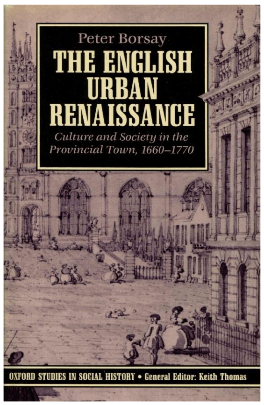 In 1989 OUP published Peter Borsay’s The English Urban Renaissance: Culture and Society in the Provincial Town 1600–1770. 2014 will therefore mark the 25th anniversary of this seminal text in urban cultural history. It inspired a new generation of researchers and developed some of the key themes that have since dominated the historiography of the ‘long’ eighteenth century:
• importance of provincial towns in the long eighteenth century as hubs of economic, cultural and political activity
• the strength and vitality of urban culture beyond the metropolis
• the transformation of the provincial urban townscape
This symposium is an opportunity to celebrate the anniversary and to:
• reflect on how eighteenth-century urban and cultural history has developed since 1989
• consider ‘urban renaissances’ in other European countries
• discuss new directions and possible collaborations
Papers (of 20 minutes’ duration) are invited on topics relevant to these themes. Please email proposals (300 words max) plus a brief biographical statement (60 words max) to John Hinks jh241@le.ac.uk and Roey Sweet rhs4@le.ac.uk by 1 February 2014.
Call for Papers | British Material Cultures in Global Contexts
Objects, Families, Homes: British Material Cultures in Global Contexts
University College London, 11–12 July 2014
Proposals due by 15 December 2013
Proposals are invited for 20-minute papers for Objects, Families, Homes: British Material Cultures in Global Contexts, an end-of-project conference organized by UCL History’s Leverhulme Trust-funded East India Company at Home team. Confirmed keynote speakers include Deborah Cohen, Professor of Modern British and European History at Northwestern University and author of Household Gods: The British and their Possessions (2006) and Family Secrets (2013), in dialogue with Marietta Crichton-Stuart, a descendant of the Marquess of Bute, who has researched how Margaret Bruce designed and furnished Falkland House in Fife in the 1830s and 1840s.
Since 2011, The East India Company at Home project has focused on country houses—and the families and objects that inhabited them—to explore how British material culture developed in a global context during the eighteenth and nineteenth century. The project’s goals have been twofold. First, we have sought to illuminate the broad-ranging ways in which the activities of the English East India Company shaped elite material cultures in Britain—and by doing so, shaped British identities in the Georgian and Victorian periods, and beyond. Second, we have sought to develop new ways of connecting diverse communities of historical researchers (archivists, curators, family historians, freelance historians, local historians, stately home volunteers and university-based historians) and in so doing have weaved otherwise dispersed studies into a transnational material narrative. At the same time, by disseminating research findings through our website we have made them available on an open-access basis.
For the end of project conference we welcome papers from all researchers engaged in investigating the themes and methodologies compatible with the core subjects of The East India Company at Home. These include:
· Distance, longing and return in the imperial family
· Race, gender, class and age: negotiating identities across imperial spaces
· Narratives of empire: colonial collecting, arrangement and display
· Meaningful objects: the role of Asian goods in British material culture
· Making histories: collaboration and engagement across historical research communities
· Building homes and houses in global contexts: research, interpretation and display
Individual papers or whole panel proposals are invited. Please send a 200-word abstract and a brief biographical note (for each paper) to EICathome@ucl.ac.uk by 15 December 2013. Please note in your email whether your paper is part of a panel or an individual submission: if proposing a full panel, indicate in 1–3 sentences its title and overarching theme (in addition to providing abstracts of each paper). The selection committee will notify applicants on its decisions by 31 January 2014. Further details about the conference can be found at http://www.blogs.ucl.ac.uk/eicah. Any queries about the call for papers or conference please email EICathome@ucl.ac.uk. It is hoped that a small number of bursaries will be available for the students and the unwaged.
Call for Papers | Material Culture Symposium: Consuming Objects
From The Center for Material Culture Studies at the University of Delaware:
Consuming Objects: Negotiating Relationships with the Material World
Winterthur Museum, Garden & Library, 12 April 2014
Proposals due by 2 December 2013
The Center for Material Culture Studies at the University of Delaware invites submissions for papers to be given at the Twelfth Annual Material Culture Symposium for Emerging Scholars.
“Consuming” is a multivalent word, fraught with provocative denotations and connotations. Whether we buy them, sell them, use them, or eat them, we all consume objects through a variety of channels. We seek papers that highlight the intersection between people and their things within this broad framework of consumption. This conference will consider how material culture can act as an extension of ourselves, provide repositories for memory, help stabilize identity, interrupt our sense of scale and space, give permanence to relationships, function as a semiotic marker, and enable human activities. Papers may also address how objects mediate human sensory experience and create aesthetic meaning. We encourage papers that reflect upon and promote an interdisciplinary discussion on the state of material culture studies today.
This conference is not bound by any temporal or geographical limits. Disciplines represented at past symposia include American studies, anthropology, archaeology, consumer studies, English, gender studies, history, museum studies, and the histories of art, architecture, design, and technology. We welcome proposals from graduate students, postdoctoral scholars, and those beginning their teaching or professional careers.
The symposium will consist of nine presentations divided into three panels. Each presentation is limited to eighteen minutes, and each panel is followed by comments from established scholars in the field. There will be two morning sessions and one afternoon session, with breaks for discussion following each session and during lunch. Participants will also have the opportunity to tour Winterthur’s unparalleled collection of early American decorative arts and to engage in a roundtable discussion on Friday, April 11, 2014. Travel grants will be available for presenters.
Proposals should be no more than 300 words. Please indicate the focus of your object¬based research, the critical approach that you take toward that research, and the significance of your research beyond the academy. We encourage the inclusion of relevant images with your abstracts.
While the audience for the symposium consists mainly of university faculty and graduate students, we encourage broader participation. In evaluating proposals, we will give preference to those papers that keep a more diverse audience in mind. Programs and paper abstracts from past symposia are posted here.
Send your proposal, with a current c.v. of no more than two pages, to emerging.scholars@gmail.com. Proposals must be received by 5 p.m. on Monday, December 2, 2013. Speakers will be notified of the vetting committee’s decision in January 2014. Confirmed speakers will be asked to provide symposium organizers with digital images for use in publicity and are required to submit a final draft of their papers by March 11, 2014.
2014 Emerging Scholars Co¬Chairs
Anastasia Day (Hagley Program in the History of Industrialization) and Philippe Halbert (Winterthur Program in American Material Culture), University of Delaware
Call for Papers | Perceptions of Pregnancy
From the conference website:
Perceptions of Pregnancy: From the Medieval to the Modern
University of Hertfordshire, 16 – 18 July 2014
Proposals due by 1 February 2014
This three-day conference aims to bring together scholars working across a range of disciplines, time periods and global perspectives to examine perceptions of pregnancy throughout history. Papers are welcomed on a range of issues, including, but not limited to:
· Pregnancy, including the pregnant body and the experience of pregnancy
· Unlawful pregnancy, including rape, incest and sexual abuse
· Fertility and infertility, including IVF, miscarriage and still-birth
· Abortion and contraception, including pro-life and pro-choice debate
· Parenthood, single parenthood, and infanticide
Potential themes for discussion are:
· Magic, ritual and religion
· Technology and medicine
· Gender, including male involvement and experiences
· Government policy and politics
· Work life, domesticity and childcare
The keynote speakers will be Professor Joanne Bailey (Oxford Brooks Univeristy) and Dr Elaine Farrell (Queen’s University Belfast). 300-word proposals for twenty-minute papers should be sent to the conference organisers by 1 February 2014. We welcome postgraduate papers. Informal enquiries can be directed to Dr Jennifer Evans (j.evans5@herts.ac.uk) and Dr Ciara Meehan (c.meehan2@herts.ac.uk).
Call for Papers | Tuscan Painting in the Eighteenth Century
Predella: Journal of Visual Arts | June 2014 Issue: Tuscan Painting in the Eighteenth Century
Proposals due by 15 December 2013
The Predella issue scheduled for June 2014 (no. 35) will be dedicated to Tuscan painting in the eighteenth century. It will be edited by Emanuele Pellegrini and Stefano Renzoni. This issue aims to bring new contributions on the activity of Tuscan painters in their homeland and abroad, and at the same time to shed light on foreign painters active in Tuscany throughout the Settecento. Furthermore, this Predella monograph intends to offer new evidences on less studied topics, both individual artists (like Luigi Garzi, Vincenzo Meucci, Giovanni Battista Tempesti), and general problems (the relationships of Tuscan artists with other capital cities like Rome or Venice, the diffusion of ‘popular painting’). Proposals of no more than 300 words should be submitted, with a cover letter or a 2 page CV, by December 15, 2013 to the attention of Emanuele Pellegrini and Stefano Renzoni to the following email address: emanuele.pellegrini@unive.it. Selected papers will be announced by January 15, 2014.










leave a comment