Newly Installed Galleries at Nuremberg
The newly installed galleries of the Germanischen Nationalmuseums in Nuremberg opened this past spring. A catalogue with 39 essays is now available from artbooks.com. From the museum’s website:
Renaissance, Barock, Aufklärung: Kunst und Kultur vom 16. bis zum 18. Jahrhundert
Germanischen Nationalmuseums, Nuremberg — The new galleries opened in March 2010
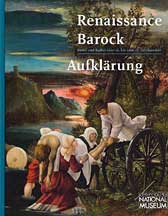
ISBN: 9783936688474 ($95)
Die neue Schausammlung lädt zu einem kulturhistorischen Gang durch drei Jahrhunderte ein. Er führt von der Entdeckung der neuen Welt um 1500 bis zur Entwicklung eines neuen Menschenbildes im 18. Jahrhundert. Rund tausend Objekte in 33 thematisch ausgerichteten Räumen erschließen zentrale Aspekte der Kunst- und Kulturgeschichte des 16. bis 18. Jahrhunderts im deutschen Sprachraum. Zu sehen sind neben Gemälden und Skulpturen auch Glasgemälde, Textilien, Kunsthandwerk, Schmuck, Medaillen, Möbel und Musikinstrumente sowie zwei historische Zimmer aus Nürnberger Bürgerhäusern der Renaissance. Meisterwerke von Albrecht Dürer, Peter Vischer, Rembrandt oder Franz Xaver Messerschmidt erscheinen in ihrem kulturgeschichtlichen Kontext. Im Dialog der Künste werden Themen wie Sammeln und Repräsentieren, Antikenrezeption und Naturstudium lebendig, wie auch die Wechselwirkung von Kunst und Glauben
sowie das sich wandelnde Bild vom Menschen.
Canaletto Exhibition To Open Soon in London
Press release from the National Gallery in London:
Venice: Canaletto and His Rivals
National Gallery, London, 13 October 2010 — 16 January 2011
National Gallery, Washington D.C., 20 February — 30 May 2011
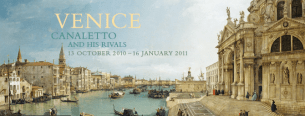 This exhibition presents the finest assembly of Venetian views, by Canaletto and all the major practitioners of the genre, to be held since the much-celebrated display in Venice in 1967. Remarkably, considering the dominant role of British patronage in this art form, Venice: Canaletto and His Rivals is also the first exhibition of its kind to be organised in the UK.
Additional information can be found here»
Exhibition: The Lake District
From the Wordsworth Museum:
Savage Grandeur and Noblest Thoughts, Discovering the Lake District, 1750 — 1820
The Wordsworth Museum & Art Gallery, Grasmere, England, 1 June 2010 — 12 July 2011
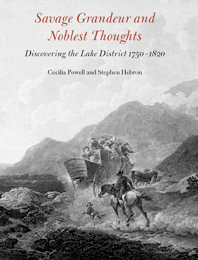
Catalogue by Cecilia Powell and Stephen Hebron, ISBN: 9781905256426, £19.95
From the mid 1700s until the early 1800s, British people who would normally have travelled abroad for recreation were confined to these shores. The French Revolution and the Napoleonic Wars made it dangerous for the British to travel in Europe and the conflicts created an upsurge in patriotic feeling. Artists and writers began to explore areas of natural beauty in Britain and their discoveries inspired a wide range of drawings, watercolours, oil paintings and engravings as well as prose and poetry of the highest quality. This work resulted in prints of the pictures and eventually what we might now call coffee table books, containing descriptions and pictures. These inspired more enthusiasm for the British landscape and an increasing number of people made their way to The Lake District.
Horrors like these at first alarm,
But soon with savage grandeur charm,
And raise to noblest thoughts the mind.
-from Dr John Dalton’s Descriptive Poem, first published in the 1750s
It became fashionable to travel through areas of wild and rugged scenery and visitors delighted in the thrilling experiences that the Lake District offered and its beauty and interest were ever more enthusiastically proclaimed. The Wordsworth Trust’s new exhibition explores the ways in which artists and writers discovered, portrayed and celebrated the Lake District in the years 1750-1820, a period of radical developments in both art and literature. The exhibition includes over 100 pictures and books from the period and shows how the British were inspired to invent the ‘staycation’. Savage Grandeur is the first exhibition which draws its content entirely from the Wordsworth Trust’s own collection. The exhibition will be complemented by a computer-generated guide to the scenery depicted in selected exhibits.
Vasi Exhibition Opens at the University of Oregon
The following is an edited version of the UO press release:
Giuseppe Vasi’s Rome: Lasting Impressions from the Age of the Grand Tour
Jordan Schnitzer Museum of Art, University of Oregon, Eugene, 25 September 2010 — 3 January 2011
Princeton University Art Museum, 2011
Curated by James Tice and James Harper
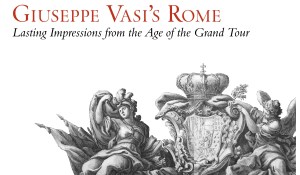 Giuseppe Vasi’s Rome: Lasting Impressions from the Age of the Grand Tour opens this fall at the Jordan Schnitzer Museum of Art at the University of Oregon. Vasi was an eighteenth-century Italian engraver and architect who is best known for his cityscapes of Rome. The exhibition is curated by UO faculty members James Tice and James Harper. Tice is an architecture professor and a research fellow at Studium Urbis, an international study center in Rome devoted to study of the city’s urban history. Harper is associate professor of art history. He worked at the Philadelphia Museum of Art, the National Gallery of Art and the Fogg Art Museum at Harvard University before joining the UO faculty in 2000.
Giuseppe Vasi’s Rome is the first major exhibition to be devoted solely to Vasi’s work. Coinciding with the 300th anniversary of his birth, the exhibition combines graphic imaging technology with new research on how he observed and documented his city. Vasi lived and worked in Rome, where he was a contemporary of such other notable vedutisti as Giovanni Paolo Panini, his student Giovanni Battista Piranesi, and cartographer Giovanni Battista Nolli.
The exhibition traces the emergence of Vasi’s graphic chronicles within their cartographic and artistic traditions, and explores their impact on ways of seeing and interpreting the city as a work of art. Also featured in the exhibition is a new media component that builds on two websites designed by Tice and Erik Steiner, who was assistant director of the InfoGraphics Lab in the UO Department of Geography at the time he worked on the sites. The exhibition invites viewers to use touch screens and iPads to view Vasi’s work, compare them to those of other artists of the period and explore Rome, then and now, through georeferencing.
A 200-page catalogue features essays from Mario Bevilacqua, Vincent Buonanno, Allan Ceen, Adrianne Hamilton, Read McFaddin, John Moore, John Pinto, and the curators. In conjunction with a series of educational programs, the museum will host a symposium on November 12; “Una Roma Visuale: New Research on Giuseppe Vasi and the Art, Architecture and Urbanism of Rome” will bring together scholars to address the topics of prints, painting, sculpture, architecture, urbanism and cartography. John Pinto will deliver the keynote address.
Following its presentation at the Schnitzer Museum, the exhibition will be on view at the Princeton University Art Museum.
Enlightenment Art in China
It’s interesting to see the politics of the Enlightenment play out two centuries later. From the the Staatliche Kunstsammlungen Dresden:
Art of the Enlightenment
National Museum of China, Beijing, 1 March 2011 — 31 March 2012
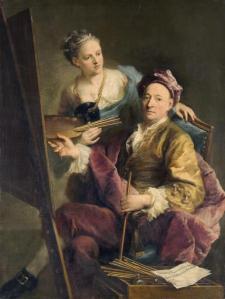
Georg Desmarées "The Artist with His Daughter, Antonia," 1750-1774 © Bayerische Staatsgemäldesammlungen München
The Staatliche Museen zu Berlin, the Staatliche Kunstsammlungen Dresden, and the Bayerische Staatsgemäldesammlungen Munich are to collaborate in presenting the largest exhibition on European art from the Enlightenment period ever to go on show in Asia. In the spring of 2011 the three museums will be exhibiting more than 350 works of art in an area covering 2,700 square metrers at the National Museum of China. The focus will be on major works of art which demonstrate the great ideas of this period, their influence on the fine arts and the history of their reception from the artistic revolutions of the 18th century down to the present day.
The exhibition presents the image world of a period on the threshold of modernity, the ideas of which are of programmatic significance for art today. Paintings, drawings, prints, costumes, furniture and spatial art, sculptures and books will bring all the various facets of the Enlightenment period and its reception history to life for a Chinese audience. Among the masterpieces on display will be works by Watteau, Boucher, Pesne, Piranesi, Chodowiecki, Hogarth and Goya, thus illustrating the wide range of works and the themes which informed the culture of this era, from the Ancien Régime to the Modern period.
The catalogue, which will be published in Chinese and English, will present the latest research findings concerning the art of the Enlightenment and other aspects of this period. This joint exhibition is being financed primarily by the German Foreign Office. It marks the high point of the programme of German-Chinese cultural exchange that was agreed in 2005.
The exhibition Art of the Enlightenment at the National Museum of China will be on display for 18 months. The National Museum on Tiananmen Square in Beijing is currently being refurbished and expanded according to plans drawn up by the Hamburg firm of architects Gerkan, Marg and Partners (gmp). When completed, it will have a total floor area of approximately 200,000 square metres. With its redesigned building, the museum is intended to become a centre for the world’s cultures, a venue in which outstanding guest exhibitions from all over the world will be presented.
◊ ◊ ◊ ◊ ◊
One hint of the politics at work surrounding the exhibition (at least on the German side) can be gleaned from the efforts of Stiftung Mercator (for information on the group, see below) . . .
Stiftung Mercator is currently planning a series of events to officially accompany the “Art in Enlightenment” exhibition which is to be shown in the National Museum of China in Beijing in 2011. In cooperation with the Berlin State Museums, the Dresden State Art Collections, the Bavarian State Painting Collections in Munich and the Federal Foreign Office, Stiftung Mercator will be organizing a series of events entitled “Enlightenment in Dialogue” within the framework of the National Museum of China exhibition “The Art in Enlightenment” in Beijing.
The events will comprise a number of dialogue blocks which will continue for the entire duration of the exhibition. The dialogue blocks will take place in parallel to the exhibition, addressing various facets of a contemporary examination of the subject of enlightenment. Each dialogue consists of a lecture and a panel discussion.
The objective of the series of events is to perceive enlightenment as part of a universal “global heritage of ideas” and to stimulate an open dialogue on the importance of enlightenment in modern times. Stiftung Mercator wishes to bring together Chinese and European scholars, writers and artists and, in particular, to highlight the value of enlightenment for key questions relating to identity and the future.
As described on the foundation’s website:
Stiftung Mercator is one of the largest private foundations in Germany. It pursues clearly defined objectives in its thematic clusters of integration, climate change and arts education and it achieves these objectives with a combination of socio-political advocacy and practical work. Stiftung Mercator implements its own projects and supports external projects in its centres for science and humanities, education and international affairs. It takes an entrepreneurial, professional and international approach to its work.
◊ ◊ ◊ ◊ ◊
This recap comes from ArtDaily.com (note added 1 April 2012) . . .
With a joint ceremony on March 25th 2012, Cornelia Pieper, Minister of State in the Foreign Office, and Zhao Shaohua, Deputy Minister of Culture for the People’s Republic of China, officially concluded the exhibition The Art of the Enlightenment at the National Museum of China. For the past year the exhibition has been on view in Beijing. So far, more than 450,000 visitors have attended. . . .
The full article is available here»
Lawrence Exhibition and Conference
Opening next month at the NPG in London is a major exhibition on Thomas Lawrence, which will then appear in New Haven in the first part of next year. As noted by The Art History Newsletter, Mark Brown of The Guardian offers a preview. As noted previously here at Enfilade, the Paul Mellon Centre will sponsor a two-day conference in conjunction with the show November 18-19.
◊ ◊ ◊ ◊ ◊
Thomas Lawrence: Regency Power and Brilliance
National Portrait Gallery, London, 20 October 2010 — 23 January 2011
Yale Center for British Art, New Haven, 24 February — 5 June 2011
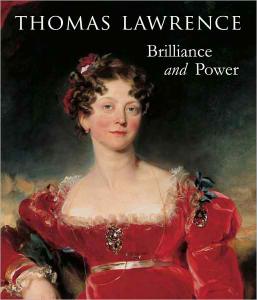 This will be the first exhibition in the United Kingdom since 1979 to examine Lawrence’s work and the first substantial presentation of this artist in the United States. It will present Lawrence as the most important British portrait painter of his generation and will explore his development as one of the most celebrated and influential European artists of the late eighteenth and early nineteenth centuries. By his untimely death in 1830, Lawrence had achieved the greatest international reach and reputation of any British artist. Based on new research and fresh perspectives, this exhibition will introduce Lawrence to a new generation of museum visitors and students. It will also contextualise his work in the light of recent scholarship on the art, politics and culture of the period. The exhibition will include the artist’s greatest paintings and drawings alongside lesser known works in order to provide a fresh understanding of Lawrence and his career. It will contrast his approach to sitters according to age and gender, juxtapose the power and impact of his public works with the intimacy and intensity of those portraits of his friends and family, trace his innovations as a draughtsman and painter, and place him within the broader contexts of the aesthetic debates, networks of patronage and international politics of his day.
Spanish Drawings at The Frick This Fall
Press release (PDF) from The Frick:
The Spanish Manner: Drawings from Ribera to Goya
The Frick Collection, New York, 5 October 2010 — 9 January 2011

Catalogue by Jonathan Brown, Lisa Banner, Susan Grace Galassi, Reva Wolf, and Andrew Schulz (Scala, 2010), ISBN: 9781857596519, $65
The greatest Spanish draftsmen from the seventeenth through the nineteenth century—Ribera, Murillo, and Goya, among them—created works of dazzling idiosyncrasy. These diverse drawings, which may be broadly characterized as possessing a specifically “Spanish manner,” will be the subject of an exclusive exhibition at The Frick Collection in the fall of 2010. The presentation will feature more than fifty of the finest Spanish drawings from public and private collections in the Northeast, among them The Metropolitan Museum of Art, The Hispanic Society of America, The Morgan Library & Museum, the Princeton University Art Museum, and the Philadelphia Museum of Art. Opening the show are rare sheets by the early seventeenth-century masters Francisco Pacheco and Vicente Carducho, followed by a number of spectacular red chalk drawings by the celebrated draftsman Jusepe de Ribera. The exhibition continues with rapid sketches and painting-like wash drawings from the rich oeuvre of the Andalusian master Bartolomé Esteban Murillo, along with lively drawings by Francisco de Herrera the Elder and his son and the Madrid court artist Juan Carreño de Miranda, among others.
The second part of the exhibition will present twenty-two sheets by the great draftsman Francisco de Goya, whose drawings are rarely studied in the illuminating context of the Spanish draftsmen who came before him. These works, mostly drawings from his private albums, attest to the continuity between his thematic interests and those of his Spanish forebears, as well as to Goya’s own enormously fertile imagination. The exhibition is organized by Jonathan Brown, Carroll and Milton Petrie Professor of Fine Arts, New York University; Lisa A. Banner, independent scholar; and Susan Grace Galassi, Senior Curator at The Frick Collection. It will be accompanied by a fully illustrated catalogue with entries by the show’s organizers and by Reva Wolf, Professor of Art History, State University of New York at New Paltz, and author of Goya and the Satirical Print in England and on the Continent, 1730–1850, and by Andrew Schulz, Associate Professor of Art History and Department Head at the University of Oregon and author of Goya’s Caprichos: Aesthetics, Perception, and the Body. The exhibition is made possible, in part, by the David L. Klein Jr. Foundation, Elizabeth and Jean-Marie Eveillard, and the Samuel H. Kress Foundation. The accompanying catalogue has been generously underwritten by the Center for Spain in America.
Grasmair Exhibition: Religious Painting in South Tyrol
From Südtirol.online:
Johann Georg Grasmair (1691–1751), Barockmaler in Tirol
Diözesanmuseum, Brixen, Italy 12 June — 31 October 2010

Johann Georg Grasmair, "König aus dem Aufsatzbild der Heiligen Drei Könige," 1729, (Brixen: Diözesanmuseum Hofburg)
Die Ausstellung in der Hofburg Brixen bietet erstmals einen repräsentativen Querschnitt durch die verschiedenen Werkgruppen von Johann Georg Grasmair, einem hervorragenden, aber wenig beachteten Meister der Tiroler Barockmalerei. Grasmair wurde 1691 als Sohn des Glockengießers Jörg Grasmair und seiner Ehefrau Anna Maria Maurer in Brixen geboren. Er erlernte zwar das Glockengießerhandwerk, widmete sich in weiterer Folge aber ganz der Malerei. Nach einer ersten Lehre bei Giuseppe Alberti in Cavalese begab er sich zunächst nach Venedig und dann weiter nach Rom, wo er von der Malerei Carlo Marattas und dessen Schule seine wichtigste künstlerische Prägung erhielt. Dem streng klassisch ausgerichteten römischen Barockstil in der Tradition Marattas blieb Grasmair zeitlebens verpflichtet.
Um 1721 kehrte er von seinem mehrjährigen Aufenthalt in Italien zurück, vermählte sich mit Anna Katharina Hueber aus Mauls und schuf erste Werke in Brixen, Klausen und Niederdorf. Von 1722–1724 war er als Hofmaler der Familie Fürstenberg in Donaueschigen (Baden-Württemberg) tätig.

ISBN: 9788888570143
1724 kehrte Grasmair nach Tirol zurück und ließ sich in Wilten bei Innsbruck nieder. Dort soll er, zeitgenössischen Berichten zufolge, still und anspruchslos bis zu seinem Tode am 28. Oktober 1751 gelebt haben, obwohl er mit den besten Künstlern seiner Zeit wetteifern konnte. Zu den wichtigsten Auftraggebern für Grasmair zählen die Klöster der Serviten und Jesuiten in Innsbruck sowie die Kirche im Allgemeinen, weshalb sein Werk vorwiegend religiöse Themen umfasst. Bekannt sind vor allem seine Altarbilder für renommierte Nordtiroler Kirchen wie den Dom von Innsbruck, die Basilika von Wilten, die Innsbrucker Landhauskapelle oder die Pfarrkirchen von Axams, Fulpmes und Schwaz. Auch in Südtirols Kirchen ist eine Reihe von Werken Grasmairs vorhanden, so etwa in Brixen in der Hofburgkapelle und in der Schutzengelkirche in Stufels, in Neustift, Bruneck, Sterzing, Klausen, Lajen, Lana, Untermais, Naturns und Montan. Einzelne Werke schuf Grasmair auch für das Trentino.
Neben sakralen Werken zeigt die Ausstellung auch wenig bekannte Landschaftsbilder und Darstellungen von allegorischen und mythologischen Themen, die Grasmair für adelige Auftraggeber schuf. Auch seine Ölskizzen und zahlreichen Zeichenstudien, die bisher kaum beachtet wurden, werden in der Ausstellung erstmals gewürdigt. Anders als viele Maler seiner Zeit widmete sich Grasmair ausschließlich der Ölmalerei und nicht auch der prestigeträchtigeren Freskomalerei. Trotzdem galt er bei seinen Zeitgenossen als hoch geschätzter Maler. Seine heute geringe Bekanntheit ist wohl hauptsächlich auf den begrenzten Schaffensraum (Tirol und Trentino) zurückzuführen. Von der künstlerischen Qualität seines Schaffens her ist Grasmair durchaus mit Paul Troger und Michael Angelo Unterberger zu vergleichen, auch wenn er deren überregionale Karriere nicht mitgemacht hat. Im Katalog zur Ausstellung ist erstmals das gesamte Schaffen des Künstlers berücksichtigt und mit einem umfassenden Werkverzeichnis dokumentiert.
Sino-French Relations in the Eighteenth & Ninteenth Centuries
From the museum’s website:
La Soie & le Canon, France-Chine (1700-1860)
Musée d’Histoire de Nantes, 26 June — 7 November 2010
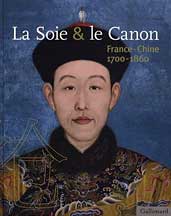
Catalogue ed. by Bertrand Guillet, ISBN: 9782070129492, $72.50
En octobre 1700, L’Amphitrite, premier navire français à commercer avec la Chine, revient en France et c’est à Nantes, grand port de commerce colonial, qu’il vend sa cargaison : thé, soie, porcelaine, nacre, ivoire, panneaux laqués… Cette première arrivée massive d’objets et produits nourrit une véritable fascination pour la culture chinoise. C’est ainsi que se développe en France « un goût pour la Chine » dont on a oublié l’ampleur. Il est alimenté par les Jésuites présents à la cour de Chine. L’Europe devient sinophile. Artistes et artisans produisent dans le goût chinois. Jusqu’à la fin du 18e siècle, ce commerce au volume marginal mais dont l’influence se révèle marquante, est dominé par les Chinois qui dictent leurs conditions aux Occidentaux. Ces derniers n’arrivent cependant pas à introduire en retour leurs produits commerciaux. La Chine attire de plus en plus les convoitises et peu à peu, « le mythe » s’écorne. Les guerres de l’Opium au 19e siècle, avec en point d’orgue le sac du Palais d’été à Pékin en 1860, achèvent la bascule du rapport économique au profit des Européens et participent au déclin de l’Empire du Milieu.
L’exposition La Soie & le Canon met en lumière les relations franco-chinoises entre ces deux dates – 1700/1860 – et montre l’évolution du regard porté sur cet Extrême-Orient lointain qui suscita tour à tour fascination et rejet, en s’appuyant sur la présentation d’objets et documents prestigieux prêtés par de grands musées dont le musée national des arts asiatiques Guimet, partenaire associé au projet. Avec cette exposition d’histoire, le musée d’histoire de Nantes propose une démarche inédite en montrant les différentes phases qui ont caractérisé dès l’origine les relations entre la France et la Chine. Plus largement, l’exposition contribue à faire mieux comprendre notre rapport à la Chine d’aujourd’hui, toujours fascinante, souvent critiquée, alors que s’amorce un nouvel équilibre mondial dans lequel ce géant qui rassemble un cinquième de l’humanité joue un rôle de premier plan.
Exhibition: Gainsborough and the Modern Woman
From Art Daily (19 July 2010) . . .
Thomas Gainsborough and the Modern Woman
Cincinnati Art Museum, 18 September 2010 — 2 January 2011
San Diego Museum of Art, 29 January — 1 May 2011
Curated by Benedict Leca
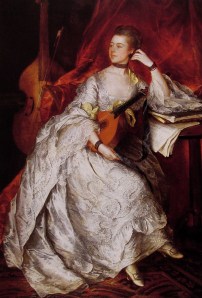
Thomas Gainsborough, "Portrait of Ann Ford" (later Mrs. Philip Thicknesse), 1760 (Cincinnati Art Museum)
The portraits of Thomas Gainsborough (1727-1788) made him perhaps the most famous British artist of the late eighteenth century. Nobles, statesmen, musicians and the range of men and women of the period’s merchant class all sat for him. But it is his portraits of notorious society women—widely considered among the greatest of the Western tradition—which attracted the most attention.
Eighteenth-century viewers appreciated these paintings differently than we do today. In his own time, Gainsborough’s portraits of actresses, performers and courtesans were seen as unconventional, if not radical, not only because of the type of woman they portrayed but also because of the unconventional way they were painted. “These stunning portraits not only give us a perspective on the history of portrait painting and celebrity, but also on the history of women’s progressive self-fashioning, which equally deserves art historical recognition. These are provocative women provocatively painted,” explains exhibition curator Benedict Leca.
Organized by the Cincinnati Art Museum in association with the San Diego Museum of Art, Thomas Gainsborough and the Modern Woman is the first exhibition devoted to Thomas Gainsborough’s feminine portraiture, and the first to focus specifically on modernity and femininity in Georgian England from the perspective of Gainsborough’s groundbreaking portraits of women. Coinciding with the comprehensive cleaning and restoration of the Cincinnati Art Museum’s iconic Ann Ford (Mrs. Thicknesse), this exhibition unites a choice selection of thirteen paintings from renowned museum collections in the United States and Britain to illuminate the role that Gainsborough ’s extraordinary portraiture played in defining new, progressive feminine identities. Among others on view at the Cincinnati Art Museum, September 18, 2010 – January 2, 2011 will be Mrs. Siddons (National Gallery, London), Mrs Richard Brinsley Sheridan (National Gallery, Washington), Giovanna Baccelli (Tate Britain), Grace Dalrymple (Metropolitan Museum of Art), Viscountess Ligonier (Huntington Library, Art Collections and Botanical Gardens). The exhibition will also feature a small selection of period dresses from the Cincinnati Art Museum’s rich fashion arts and textile collection, thereby further contextualizing Gainsborough’s portraits while affording visitors a view of the material accessories of the “modern woman.” . . .
The Art Daily article is available here»
◊ ◊ ◊ ◊ ◊
Exhibition catalogue: Benedict Leca, Aileen Ribeiro, and Amber Ludwig, Thomas Gainsborough and the Modern Woman (London: Giles, 2010), ISBN: 9781904832850, $49.95.
 This beautifully illustrated volume focuses specifically on Thomas Gainsborough’s portraits of well-known, “liberated,” society women, and the way in which the artist executed these special commissions. Thomas Gainsborough and the Modern Woman draws us away from his predominant reputation as a landscape painter, and shows how such portraits were both an affirmation by Gainsborough of his own position in the artistic world of Georgian England, and of the desire of his sitters (including leading artists, musicians, actresses and intellectuals) to be seen as self-assured progressive women.
Author Benedict Leca takes as his starting point the Cincinnati Art Museum’s famous and newly restored portrait of Ann Ford (1760), widely considered the finest of the masterpiece portraits created by Gainsborough at Bath in the early 1760s. He addresses this early portrait as typifying Gainsborough’s comparatively permissive attitude with regard to how notorious women should be presented, and offers a compelling view of Gainsborough’s peculiar manner of painting, one that established the artist as the foremost portraitist of modern life. Featuring portraits from international collections, including Tate Britain, the Metropolitan Museum of Art, the J Paul Getty Museum and the National Gallery, London, this ground-breaking new volume also includes an essay by Aileen Ribeiro examining the portrait of Ann Ford in detail, and by Amber Ludwig discussing the role of feminine identity in 18th-century London.










 Enfilade
leave a comment