Exhibition: Chardin in Madrid
The Chardin exhibition formerly on view in Ferrara recently opened at the Prado:
Chardin: The Painter of Silence
Ferrara, Palazzo dei Diamanti, Ferrara, 17 October 2010 — 30 January 2011
Museo Nacional del Prado, Madrid, 1 March — 29 May 2011
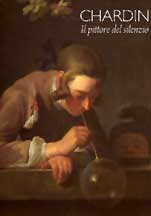 The Museo del Prado presents the exhibition Chardin, a comprehensive survey of the work of Jean Siméon Chardin (1699-1779). Chardin is one of the leading names in 18th-century French painting but has never been the subject of an exhibition in Spain, which only houses three of his paintings, all in the Museo Thyssen. After being shown at the Palazzo dei Diamante in Ferrara, the exhibition is presented in Madrid thanks to the sponsorship of Fundación AXA. It comprises 57 paintings by this great master of the still life and of genre painting, including some works not shown in the version of the exhibition seen in Italy.
Additional information is available here»
Exhibition: Pastel Portraits at the Met
Press release from the Met:
Pastel Portraits: Images of 18th-Century Europe
Metropolitan Museum of Art, New York, 17 May — 14 August 2011
Curated by Katharine Baetjer and Marjorie Shelley
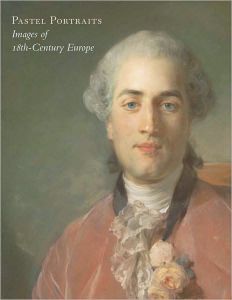 In the 18th century, pastel portraiture was so popular in Europe that by 1750 almost 2,500 artists and amateurs were working in pastel in Paris alone. Across Europe works were commissioned by royalty and courtiers, as well as the wealthy middle classes. Although pastel is a drawing material, 18th-century portraits are often highly finished, relatively large, brightly colored, elaborately framed, and hung in the same fashion as oil paintings. The powdery pastel crayons and slightly roughened paper are particularly suited to capturing the evanescent effects of expression that characterize the most life-like portraits. Pastel Portraits: Images of 18th-Century Europe will feature 40 pastel portraits from the collections of the Metropolitan Museum and other museums, and from private collections in New York, Princeton, and New Haven. At the core of the exhibition will be a group of French works, and the English, German, Italian, and Swiss schools will also represented.
Pastels are susceptible to fading if overexposed to light, and they are vulnerable to damage from excessive vibration, which can loosen the powder. As a practical consequence, they can only be shown three months of the year, rarely travel, and are not often exhibited in museums. Pastel Portraits will give visitors the rare opportunity to view these exquisite works in a museum exhibition, which will include generous loans from the Princeton University Art Museum, Yale Center for British Art, New Haven, Pierpont Morgan Library, New-York Historical Society, and Frick Collection, as well as several private collections.
Pastel Portraits will feature a number of fine works by Maurice Quentin de La Tour and Jean Baptiste Perronneau, two of the best known and outstanding artists who were working with this medium in mid-18th–century Paris. Highlights of the exhibition will include La Tour’s Jacques Dumont le Romain (1701-1781) Playing the Guitar; Perronneau’s Olivier Journu; Adélaïde Labille-Guiard’s portrait of the sister of Louis XVI, Madame Elisabeth de France (1764-1794), recently acquired by the Metropolitan Museum; Jean Étienne Liotard’s Young Woman in Turkish Costume with a Tambourine; John Russell’s John Collins of Devizes; and the beautiful Young Woman with Pearl Earrings by Venetian artist Rosalba Carriera, who became a favorite of Grand Tourists visiting Italy. The popularity and appeal of pastel in the 18th century reached as far as Boston, where John Singleton Copley, who was self-taught and had never seen an important European work in the medium, created exceptional portraits. Two of Copley’s portraits, also recently acquired by the Metropolitan Museum, will be on view in the exhibition.
Katharine Baetjer and Marjorie Shelley, Pastel Portraits: Images of 18th-Century Europe, exhibition catalogue (New Haven: Yale University Press, 2011), 9780300169812, 56 pages, $14.95.
Exhibition: Gardens in Perpetual Bloom
From the Ringling Museum:
Gardens in Perpetual Bloom: Botanical Illustration in Europe and America from 1600-1850
Nagoya/Boston Museum of Fine Arts, Nagoya, Japan, 12 December 2009 — 4 April 2010
John and Marble Ringling Museum of Art, Sarasota, 29 January — 24 April 2011
Museum of Fine Arts, Boston, 1 May 2011 — 1 May 2012
 Until the mid-nineteenth century, gardening was not the popular pastime of the average person that it is today. It was the occupation of the professional employed by royalty and the wealthy, the horticulturist who bred and cultivated new plants, and the botanist whose concern was the scientific classification of plant life. In this exhibition it will be possible to trace the transition of the study and appreciation of flowers and their cultivation from the world of monks and princes to the everyday gardener.
The earliest books depicting flowers were herbals, first illuminated manuscripts, then printed with woodcuts, dedicated to the medicinal, therapeutic properties of plants. In the early seventeenth-century, illustrated books were published to describe the contents of the gardens of the well-to-do. When Carl Linnaeus, the Swedish botanist, published his Systema naturae in 1735, which classified and gave order to our knowledge of the plant kingdom, the botanical book often took on a new purpose. Botanists endeavored to accurately illustrate all the varieties according to the new sexual system, whereby plants were organized and given nomenclature according to their numbers of stamens and pistils.
Explorers to the Americas, Asia, and Africa observed the native vegetation and brought back cuttings, seedlings, and bulbs to be cultivated, named, described and elaborately illustrated. The nursery business thrived. By the nineteenth century, as a result of this efflorescence of botanical publication, horticulture and gardening became a readily accessible hobby for the amateur. Artists and decorators were provided with immense new visual resources. Apart from their botanical interest, flower prints possess great variety and a visual appeal that can be bold and vibrant or delicate and refined. These plates almost always reveal the artist’s eye and hand in the rhythmic and graceful placement of the flower and its parts elegantly spread gracefully across the page. One of the earliest examples represented in this exhibition is the strikingly dramatic and monumental Large Sunflower, taken from Basil Besler’s Hortus Eystettensis…a florilegium (book describing a garden or flower collection), first published in 1613, which illustrated plants and flowers in the garden of the Bishop of Eichstätt in Bavaria. Besler, an apothecary and gardener for the Bishop, drew the flowers over many years and employed engravers to follow his designs and other artists to color them by hand.
Comprised of more than 100 flower prints, Gardens in Perpetual Bloom features the products of a fruitful collaboration of botanists, horticulturists, painters, and printmakers from the 17th to 19th centuries. Requiring technical virtuosity and complex techniques to achieve an amazing range of line and tone, these colorful works reveal the detail, structure, texture, tone, and lifelike appearance of a magnificent iris, an exotic lily, or a single elegant rose executed with an originality of design and composition.
Exhibition Catalogue: Nancy Keeler, Gardens in Perpetual Bloom: Botanical Illustration in Europe and America 1600-1850 (Boston: MFA, 2010), 136 pages, ISBN: 9780878467495, $24.95.
Exhibition: Four Hundred Years of French Drawings
Press release from The Frick in Pittsburgh:
Storied Past: Four Centuries of French Drawings from the Blanton Museum of Art
The Frick Art & Historical Center, Pittsburgh, 5 February — 17 April 2011
Blanton Museum of Art, The University of Texas, Austin, 18 September — 31 December 2011
Iris and B. Gerald Cantor Center for Visual Arts, Stanford University, 28 May — 24 August 2014
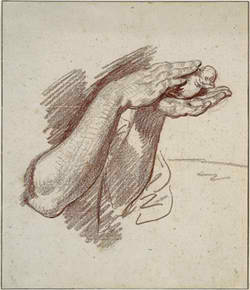
Jean-Baptiste Greuze, "The Arms of a Girl Holding a Bird," red chalk on cream paper, ca. 1765 (Austin: Blanton Museum of Art, The University of Texas)
Composed of 56 drawings made between 1500 and 1900, this exhibition chronicles the full range of artistic uses of the medium, from quick sketches to finished compositional studies, to drawing as an end in itself. The Blanton Museum at the University of Texas at Austin has organized the exhibition from their permanent collection, which was supplemented a bit more than a decade ago by a large gift of drawings. The French drawings from this gift had not received systematic academic study, nor had most of them been published. Especially rich in 17th- and 18th-century drawings, the exhibition illustrates the rise to dominance of the Académie royale de peinture et de sculpture as one of the most dominant cultural and political institutions in Europe. The exhibition includes works by François Boucher (1703–1770), Jean-Baptiste Greuze (1725–1805), and Nicolas Lancret (1690–1743), among others, with the nineteenth century represented by choice sheets from François-Marius Granet (1777–1849), Théodore Rousseau (1812–1867), Jean Forain (1852–1931), Théophile-Alexandre Steinlen (1859–1923), and others who reflect shifts in the approach to drawing
in the modern era.

Exhibition catalogue, ISBN: 9781555953560, $65
At the Frick, the exhibition will find a perfect counterpart in the museum’s permanent collection, which visitors will enter as they exit the traveling drawings show. Paintings by Jean-Marc Nattier (1685–1766), Lancret (1690–1743), Jean-Baptiste Pater (1695–1736), Boucher, Hubert Robert (1733–1808), and Nicolas-Bernard Lepicié (1735–1784), will be displayed with examples of decorative arts from the period, which will provide for a richer understanding of the 18th century in particular. . . .
The exhibition begins in a period of transition from the mannerism of the late Renaissance to the Baroque period. Two sheets showing designs for a powder flask made by an artist associated with the School of Fontainebleau show the sophisticated sense of decoration that prevailed among artists working around the court of Francis I. Two drawings attributed to seminal printmaker Jacques Callot (1592–1635) and his circle date to the period he spent in Florence, and show his interest in melding his observations of life around him into his expressive and inventive finished compositions. The fluid chalk Study of a Man with a Turban, c. 1617, attributed to Callot, is characteristic of his elegant figures and displays a masterful ability at controlling light and shade and swiftly capturing the spirit of a figure, as well as its contours. (more…)
Exhibition: Bronze Sculpture in Minneapolis
Notwithstanding the show’s title, there are significant eighteenth-century works included (the ‘long Baroque’). Press release from the MIA:
Beauty and Power: Renaissance and Baroque Bronzes from the Peter Marino Collection
The Wallace Collection, London, 29 April — 25 July 2010
The Huntington Library, San Marino, CA, 9 October 2010 — 24 January 2011
Minneapolis Institute of Arts, 6 February — 15 May 2011
Curated by Jeremy Warren
 An important international exhibition, Beauty and Power: Renaissance and Baroque Bronzes from the Peter Marino Collection opens at the Minneapolis Institute of Arts (MIA) February 6 and runs through May 15. Additionally, the MIA is presenting Lost Wax, Found Sculpture, an exhibition that explains the technique of making bronze sculpture according to the historically popular technique of lost-wax casting.
Beauty and Power is selected from Marino’s unparalleled private collection of 16th- to 18th-century Italian and French bronzes, and contains many pieces never publicly displayed before the show debuted in early 2010 at the Wallace Collection in London. It comes to the MIA from its only other U.S. venue, the Huntington Library, Art Collections and Botanical Gardens in San Marino, California.
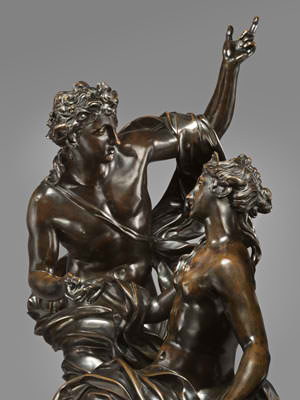
Corneille van Clève (1646-1732), "Bacchus and Ariadne," bronze, ca. 1703-04
“The MIA is fortunate to be able to show more about thirty bronzes statuettes from Mr. Marino’s exemplary collection that spans the golden age of the art form,” said Eike Schmidt, the James Ford Bell curator of Decorative Art and Sculpture at the MIA. “For three-and-a-half months we are the beneficiaries of his two-decade quest to assemble one of the strongest compilations of Renaissance and Baroque small bronzes in the nation.”
Beauty and Power coincides with and complements three other important MIA exhibitions from the same time period: Titian and the Golden Age of Venetian Paintings: Masterpieces from the National Galleries of Scotland, Venice on Paper, and The Mourners: Tomb Sculptures form the Court of Burgundy. . . .
Bronze statuettes became a serious art form in Renaissance Italy when interest in ancient Rome and Roman bronze-casting was revived, often using themes inspired by Greek and Roman mythology. Bronze has always been valued for its surface and molten qualities, which create complex and satisfying sculptural forms full of sensuality and emotion. Created on a scale that made them easy to collect and display, these bronzes were in demand, and sculptors across Europe created them to showcase their abilities. Included in the show are such works as the powerfully violent Samson and the Philistine (c. 1550–60), attributed to Baccio Bandinelli; the atypical depiction of an at-peace Diana (c. 1720–40) by Antonio Montauti; and Corneille van Cleve’s masterpiece Bacchus and Ariadne (c. 1703–4), showing the romantic encounter between the abandoned goddess and her rescuer. It also includes Florentine sculptor Giovanni Battista Foggini’s heroic David and Goliath (c. 1722), Ferdinando Tacca’s touching Hercules and Iole (c. 1640–50), and Robert Le Lorrain’s symbolically portrayed Andromeda (c. 1695–1700). (more…)
Exhibition: Canaletto in Washington
Venice: Canaletto and His Rivals
National Gallery, London, 13 October 2010 — 16 January 2011
National Gallery, Washington D.C., 20 February — 30 May 2011

Canaletto, "The Square of Saint Mark's, Venice," 1742/1744 (DC: National Gallery, Gift of Mrs. Barbara Hutton 1945.15.3)
As the Canaletto exhibition opens in Washington, it will be introduced with a lecture by Charles Beddington (guest curator) and David Alan Brown (curator of Italian and Spanish paintings, National Gallery of Art). The show runs through the end of May.
Additional information is available here»
Book Review: ‘Thomas Roberts’ Catalogue
From the February issue of Apollo Magazine:
William Laffa and Brendan Rooney, Thomas Roberts (1748-1777): Landscape and Patronage in Eighteenth-Century Ireland, exhibition catalogue (Tralee: Churchill House Press for the National Gallery of Ireland, 2009), 416 pages, ISBN: 9780955024634, $110.
Reviewed by Toby Barnard, Hertford College, Oxford University; posted 1 February 2011.
Thomas Roberts (1748–77) blazed briefly across the Irish skies in the 1770s. Little in Irish painting before that decade prepared for his sudden appearance on the scene. At that time in 18th-century Ireland, the techniques and subjects of Claude, Poussin and Salvator Rosa appealed to artists and collectors alike. A succession of painters – Willem van der Hagen, Robert Carver, John Lewis and Joseph Tudor – assimilated the conventions and demands of pastoral landscape painting, and created decorative but generalised images. Roberts, in contrast, applied these classical dressings to recognisable Irish scenes. The results, seen in a revelatory exhibition at the National Gallery in Dublin in 2009, encompass the mansions and demesnes of Protestant grandees and remoter views of the west, notably the modest townships of Ballyshannon and Belleek. . . .
The full review is available here»
Exhibition: The Tragic Muse in Chicago
From the Smart:
The Tragic Muse: Art and Emotion, 1700-1900
Smart Museum of Art, University of Chicago, 10 February — 5 June 2011
Curated by Anne Leonard

Noël Hallé, detail of "Joseph Accused by Potiphar’s Wife," c. 1740–44 (Chicago: Smart Museum of Art)
Art is often appreciated for its ability to delight our eyes and refresh our minds. But it can also serve as a powerful vehicle for exploring darker emotions, such as fear, sadness, and grief. And while these themes have a history dating back to the ancients, the ways in which they have been represented in art has changed dramatically over time.
This exhibition examines two centuries of works intertwined with emotion—from the sacrifice of classical heroines to the grief of ordinary people, from martyred saints to actors in tragic roles—and explores how art’s cathartic power grows or fades for new generations of viewers. With over forty paintings, sculptures, and prints, The Tragic Muse combines works from the Smart’s collection—both long-held treasures and new acquisitions—with important loans from the Art Institute of Chicago, Milwaukee Art Museum, National Gallery of Art, and Tate. Together with an accompanying catalogue, the exhibition draws on the scholarship of University of Chicago faculty to offer fresh insight into the visual representation of tragedy and art’s power to express and elicit intense emotions.
This exhibition is one in a series of projects at the Smart Museum of Art supported by an endowment from the Andrew W. Mellon Foundation that fosters interdisciplinary use of the Museum’s collections by University of Chicago faculty and students in both courses and special exhibitions. The Tragic Muse exhibition catalogue has received additional grant support from the Samuel H. Kress Foundation.
◊ ◊ ◊ ◊ ◊
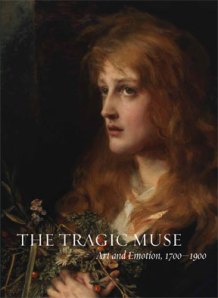 Anne Leonard with contributions by Joyce Suechen Cheng, Glenn W. Most, Erin Nerstad, Sarah Nooter, and Thomas Pavel, The Tragic Muse: Art and Emotion, 1700-1900, exhibition catalogue (Chicago: Smart Museum of Art, 2011), 128 pages, ISBN: 9780935573497, $30.
Published to coincide with the Smart Museum of Art’s exhibition The Tragic Muse, the publication draws on the work of several distinguished scholars to examine the richly varied representation of tragedy in the European artistic tradition over the course of two centuries. This catalogue is generously illustrated with full-color reproductions of all the works contained in the exhibition, and the fascinating contributions offer new insights into the approaches taken by the visual arts, as well as literature and drama, in expressing and eliciting strong emotions.
Exhibition: Baroque Ivory at the Court of Vienna
From the Liebieghaus Skulpturensammlung:
Ivory: Baroque Splendor at the Viennese Court / Elfenbein: Barocke Pracht am Wiener Hof
Liebieghaus Skulpturensammlung, Frankfurt am Main, 3 February — 26 June 2011
Curated by Maraike Bückling and Sabine Haag

Ignaz Bendl (1682–1730) "Medaillon commemorating the erection of the mercy columm," ca. 1692
Ivory has been one of the most popular materials since ancient times. Its origins in unknown faraway lands and its rarity account for its costliness. It was particularly the Baroque era that had an extraordinarily high demand for ivory. In the seventeenth century, ivory work reached its culmination in Vienna in the days of Prince Karl Eusebius of Liechtenstein and Emperor Leopold I. The shimmering appearance of the polished material served princely-imperial claims to prestige, as its possession testified to its owners’ power and wealth. The exhibition Ivory: Baroque Splendor at the Court of Vienna, presented in the Liebieghaus Skulpturensammlung from February 3 to June 26, 2011, will focus on this heyday of ivory art. It will feature thirty-six splendid, virtuoso carvings impressively documenting the artisans’ great skill, among them masterly executed statuettes, pitchers, goblets, tankards, and bowls of ivory, objects created for display in so-called cabinets of curiosities and not intended for any practical use. The show comprises works by the most famous ivory artists of the Baroque period, such as Adam Lenckhardt, Johann Caspar Schenck, and Matthias Steinl. It was prepared together with the Kunsthistorisches Museum in Vienna, whose world-renowned Cabinet of Wonders is closed for the time being because of comprehensive restoration measures. This presented the Liebieghaus with the unique opportunity to show a high-caliber selection of masterpieces from the Kunstkammer of the Kunsthistorisches Museum in Frankfurt before the items will be on display again on a permanent basis in Vienna after the Cabinet’s reopening in late 2012. Eight additional high-carat loans come from the Reiner Winkler Collection.

Matthias Steinl (1643/44–1727) "Allegory of the Elements of Water and Air," ca. 1688
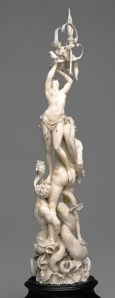
Matthias Steinl (1643/44–1727) "Allegory of the Elements of Water and Air," ca. 1688
In Ancient Greece, Phidias already created large statues of gods whose skin was executed in ivory, and the Bible describes Solomon’s throne as made up of ivory parts. It was above all in the Middle Ages and in the Baroque era that ivory was held in high esteem as a material. The great demand finally resulted in the emergence of new ports of entry in the seventeenth century; both the East India Company and the West India Company furthered the transport of African ivory in particular. The concentration on necessarily small-format ivory works fit in well with the fact that there were hardly any or no commissions at all conferred for large-size church or palace interiors during the Thirty Years’ War and the plague epidemics. Sculptors and their clients increasingly or entirely dedicated themselves to small mobile sculptures.
In the Renaissance and Mannerist periods, bronze was preferred for small sculptures. Yet, ivory outstripped the material in the course of the seventeenth century. People appreciated its combination of elasticity and hardness, as well as its gleaming transparency and delicate veining resembling the tone of flesh. The heyday of the production of ivory works in the seventeenth century was based on sixteenthcentury ivory turnery, on such early examples as those by the Master of the Furies. Besides the major bourgeois towns, the secular and ecclesiastical capitals became centers of ivory production from about 1650 on – a development that did not come to an end before the early eighteenth century. Ivory carvers were to be found mainly in Munich and Augsburg, but also in Schwäbisch Hall, Ulm, Mechlin, Amsterdam, Dresden, and Düsseldorf. (more…)
Furniture: ‘Inspired by Antiquity’ Highlights Thomas Hope
From a Carlton Hobbs press release:
Inspired by Antiquity: Classical Influences on 18th- and 19th-Century Furniture and Works of Art
Carlton Hobbs, New York, 20 January — 14 February 2011

One of a pair of wall lights in the form of a griffin, related to a design by Thomas Hope, bronze, ca. 1802
The opening night reception, on January 19th, benefited the Sir John Soane Museum Foundation. Tim Knox, the Soane Museum’s eminent director, lectured on the subject of the exhibition and elaborated on some of the highlights on view. “We are honored to have Sir John Soane’s Museum Foundation as the opening night beneficiary,” said Carlton Hobbs. “We are particularly enthusiastic to present forty magnificent pieces inspired by antiquity, including the important group of Thomas Hope pieces from the Philip Hewat-Jaboor collection of Regency furniture and works of art,” he said. “It is the single largest collection of Thomas Hope pieces to come onto the market since the Christie’s auction of the contents of Deepdene, Hope’s country estate, in 1917.” Thomas Hope, the fabulously successful banker, connoisseur collector and designer, revolutionized British taste of the late 18th, early 19th century with his radical, classically inspired design ideas and came to be one of the key figures shaping the Regency taste.
In the continuous effort to deepen our understanding of the decorative arts of the 18th and 19th centuries we wanted to further explore the visual and philosophical inspirations that gave rise to the multitude of fascinating designs, which are now broadly described as Neoclassical,” said Stefanie Rinza. “We are thrilled to collaborate with some of today’s leading academics in identifying the ancient design sources for our pieces and in interpreting the symbolism of the decorative devices used. We hope our clients, colleagues and friends will much enjoy the catalog accompanying the exhibition.
Carlton Hobbs is most grateful for the contributions and collaboration of some of today’s leading experts in the field of decorative arts and in the compilation of the catalog accompanying the exhibition, including Martin Levy, former chairman of the British Antiques Dealers Association, author and specialist in 19th-century furniture and works of art, Tim Knox, Director of the Sir John Soane Museum, Philip-Hewat Jaboor, the authority on Thomas Hope and independent art consultant to private and institutional collectors, and John Hardy, the long-time director of Osterley Park House Museum, who added his insights into the meaning of the symbolism of the classical design elements to every entry.










leave a comment