Canaletto’s Venice
From the Ringling Museum website:
Venice in the Age of Canaletto
John and Marble Ringling Museum of Art, Sarasota, 8 October 2009 — 10 January 2010
Brooks Museum of Art, Memphis, February 14 — 9 May 2010
Curated by Stanton Thomas and Alexandra Libby

Edited by Alexandra Libby and Stanton Thomas (Prestel) ISBN: 978-3791380001, $60
Venice in the Age of Canaletto is a collaborative project between The John and Mable Ringling Museum of Art and the Memphis Brooks Museum of Art that will consider Giovanni Antonio Canal, called Canaletto in a Venetian context. In particular, it focuses upon the contrast between the artist’s paintings and the works of his contemporaries also active in the city. Canaletto’s vedute, or view paintings, were arguably the most familiar artistic products of eighteenth-century Venice; yet, for all their ability to reproduce immediately recognizable views of the city, they are curiously devoid of the exuberance, sensuality, and rich coloring of most Venetian art of the period. When Canaletto’s paintings are compared with the works of Giambattista Tiepolo, Francesco Guardi, and Sebastiano Ricci, they are revealed as beautiful but rather anomalous creations. The exhibition explores the strange tension that exists between Canaletto’s austere, seemingly realistic cityscapes and the exuberant, pastelline fantasies, religious pictures, and historical dramas of the Venetian Rococo.
Venice in the Age of Canaletto considers a span of approximately 100 years, beginning in 1697, the year of the artist’s birth, and ending in 1797, the year that Napoleon invaded the city and brought the Venetian Republic to an end. This period captures the fascinating social, religious, political, and artistic evolution that precipitated the end of the Republic. The exhibition focuses upon a time when Venice, perhaps more than any other European city, cultivated an elusive civic image of pleasure, fantasy, and escapism. (more…)
Forthcoming: Book on the Met’s Wrightsman Galleries
A book detailing the Met’s recently renovated Wrightsman Galleries for French Decorative Arts is scheduled to appear this spring from Yale University Press:
Daniëlle Kisluk-Grosheide and Jeffrey Munger, The Wrightsman Galleries for French Decorative Arts (New Haven: Yale University Press, April 2010), 228 pages, ISBN: 9780300155204, $50

Photo from the blog, 'Marie Antoinette's Gossip Guide to the 18th Century' (click to visit)
The Metropolitan’s holdings of late 17th- and 18th-century French decorative arts, unrivaled outside Europe, are on display in nine magnificent paneled period rooms and three galleries. This suite of spaces is named for Mr. and Mrs. Charles Wrightsman, whose extraordinary generosity made the installations possible and who also donated many of the furnishings from their own celebrated collection. The first book on the Wrightsman Galleries since 1979, this beautifully illustrated volume presents detailed descriptions of the period rooms and 116 of the most important artworks on view, including wood paneling and furniture, chimneypieces and fireplace furnishings, textiles and leather, portraits, gilt bronze, porcelain, silver, and decorative boxes, many of which have a royal provenance. The text incorporates the results of recent research and conveys the illuminating comments of contemporaries as expressed in diaries, travel guides, craft manuals, and correspondence.
Daniëlle Kisluk-Grosheide and Jeffrey Munger are curators in the Metropolitan Museum’s Department of European Sculpture and Decorative Arts. (more…)
A Glimpse of Sun for the French Winter
From the website of Versailles:
Louis XIV: The Man and the King
Château de Versailles, 20 October 2009 — 7 February 2010
Curated by Nicolas Milovanovic and Alexandre Maral
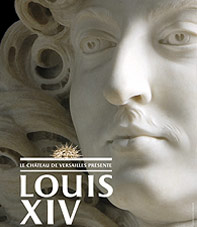 For the first time, a major exhibition is devoted to Louis XIV, the king’s personality, his personal tastes. This exhibition, Louis XIV: The Man and the King, brings together more than 300 exceptional works coming from collections all over the world and never shown together before. Paintings, sculptures, objets d’art and furniture will be exhibited. These masterpieces, some of which have never been presented in France since the days of the Ancien Régime, will enable visitors to get to know the famous monarch better in both his personal tastes and through his public image.
The King’s Public Image
The richness of the image of Louis XIV has no precedent in history: Louis XIV is the Sun King, i.e. Apollo as the sun god. Fashioned by the king himself and his counsellors, this image constantly evolved to convey emblematic figures of the royal power: the king of war leading his troops, the patron king and protector of the arts, the very Christian king and Defender of the Church, the king of glory, an image constructed for posterity. This visible glory, given mythical proportions, which was constructed during his lifetime, took shape thanks to the excellence of the artists chosen, such as Bernini, Girardon, Rigaud, Cucci, Gole, Van der Meulen and Coysevox who set out to sublimate the royal portrait, which the exhibition allows the visitors to rediscover.
The King’s Taste
He saw himself as a king who was the protector of the arts and a collector, competing with other sovereigns of Europe who were also genuine connoisseurs. Benefiting from the example of Mazarin, Louis XIV formed his taste in direct contact with artists, and through the personal relations that he established with them: Le Brun and Mignard in painting, Le Vau and Hardouin-Mansart in architecture, Le Nôtre in the art of gardens, Lully in music, and Molière in theatre. By assembling the works appreciated by the king, a genuine portrait emerges of a passionate lover of the arts and a man of good taste through the jewels, cameos, medals, miniatures and objets d’art, as well as the paintings and sculptures that he loved to surround himself within the Petit Appartement in Versailles.
Accompanying the show is a tapestry exhibition, Royal Pomp, Louis XIV’s Tapestry Collection, at the Gobelins Gallery in Paris.
◊ ◊ ◊ ◊ ◊
Reviews and notices of the exhibition can be found at Newsweek, the Telegraph, and The New York Times. The catalogue, Louis XIV, l’homme et le roi (Skira-Flammarion, 2009; ISBN: 9782081228108) is available through Michael Shamansky’s artbooks.com.
Looking Ahead: Art of the Austrian Table
From the Met’s website:
Vienna Circa 1780: An Imperial Silver Service Rediscovered
Metropolitan Museum of Art, New York, 13 April — 7 November 2010
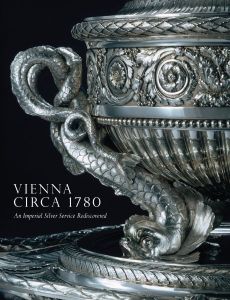
Wolfram Koeppe, ISBN-10: 0300155182 ($35)
Following the acquisition in 2002 of two Viennese silver wine coolers from the Sachsen-Teschen Service, most of the set’s surviving parts were discovered in a French private collection. This superb ensemble was last displayed at the beginning of the twentieth century. Wine coolers, tureens, cloches, sauceboats, candelabra, candlesticks, dozens of plates, porcelain-mounted cutlery, and other kinds of tableware totaling over 350 items, represent the splendor of princely dining during the ancien régime. It was made for Duke Albert Casimir of Sachsen-Teschen (1738-1822), and his consort, Archduchess Maria Christina of Austria (1742-1798) by the Imperial court goldsmith Ignaz Josef Würth. The Sachsen-Teschen Silver Service, an embodiment of Viennese neo-classicism, will be shown in the context of contemporary silver from other countries.
Accompanied by a catalogue to be published by the MMA.
Worth Talking About: Before and After Zoffany
Buckingham Palace offers an immensely satisfying show anchored by Zoffany (works include the The Academicians of the Royal Academy and The Tribuna of the Uffizi). From the website of the Royal Collection:
The Conversation Piece: Scenes of Fashionable Life
Palace of Holyroodhouse, Edinburgh, 27 March — 20 September 2009
Queen’s Gallery at Buckingham Palace, London, 30 October 2009 — 14 February 2010
 The Conversation Piece: Scenes of Fashionable Life is now on view at The Queen’s Gallery, Buckingham Palace. The exhibition presents a fascinating insight into high-society fashions, interiors and manners from the time of Charles I to the reign of Queen Victoria. While a portrait primarily records the sitter’s appearance, the Conversation Piece depicts their way of life, often conveying the impression that the subject has been caught off-guard. Typically a work shows a family group or a gathering of friends participating in informal activities. The genre was popular amongst Dutch painters in the seventeenth century and was subsequently developed in England. It is best known through the work of artists William Hogarth and George Stubbs during the eighteenth century and Sir Edwin Landseer in the nineteenth century. The exhibition brings together outstanding paintings by the greatest exponents of the Conversation Piece. The centrepiece is a remarkable series of portraits produced by Johan Zoffany for his royal patron George III, including the artist’s masterpiece The Tribuna of the Uffizi, 1772-7. The exhibition is accompanied by the catalogue The Conversation Piece: Scenes of Fashionable Life by Desmond Shawe-Taylor, the first publication on the subject for over 30 years.
◊ ◊ ◊ ◊ ◊
An informative exhibition microsite accompanies The Conversation Piece. In the London Times and Sunday Times, the show is reviewed by Anna Burnside, Rachel Campbell-Johnston, and Waldemar Januszczak, while Richard Cork supplies a summary for The Financial Times.
Paul Sandby’s Bicentenary
From the website of the National Gallery of Scotland:
Paul Sandby: Picturing Britain
Nottingham Castle Museum and Art Gallery, 25 July — 18 October 2009
National Gallery of Scotland, Edinburgh, 7 November 2009 — 7 February 2010
Royal Academy of Arts, London, 13 March — 13 June 2010
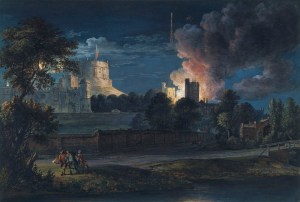
Paul Sandby, "Windsor Castle from Datchet Lane on a Rejoicing Night," Photograph: The Royal Collection © 2009 Her Majesty Queen Elizabeth II
Paul Sandby: Picturing Britain looks at all aspects of Sandby’s career and includes studies of rural and urban views, street scenes, royal parks and ancient castles. Sandby explored a broader range of subject matter than any previous artist in Britain and was integral in refining the use of watercolour. This exhibition features over one hundred loans, including oil paintings, watercolours, gouaches, prints and sketchbooks, coming from all the major collections which house his work: The Royal Collection, The British Museum, The British Library, The Victoria and Albert Museum, and The Yale Center for British Art. It also showcases outstanding works from private collections.
◊ ◊ ◊ ◊ ◊
Addressing the exhibition in The Gaurdian (7 November 2009), Linda Colley describes Sandby’s standing in British society, then and now:
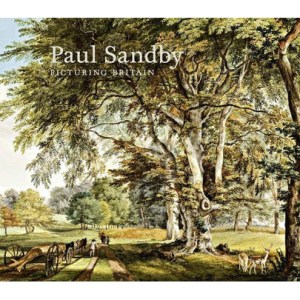
Stephen Daniels, et al (London: Royal Academy of Arts), ISBN: 978-1905711482, 216 pages, $55
. . . As George III’s remark illustrates, this view of him has always been coloured by varieties of snobbery. To this extent, the portrait of Sandby by Francis Cotes, showing him leaning out of a country house window, sketchbook in hand, can be seen as a calculated puff by a close friend. It accurately conveys Sandby’s good looks and pleasant temperament. But the portrait gives a flatteringly deceptive impression of a man as much at ease in polite and leisured interiors as he is with nature. In reality, Sandby’s family background was considerably more humble than that of Gainsborough or John Constable. Unlike his fellow academician Joshua Reynolds, Sandby was never a fashionable, expensive portrait painter. Nor was he a practitioner of academically prestigious history painting. And, crucially, unlike JMW Turner or Thomas Girtin, Sandby was not a metropolitan.
The son of a framework knitter, he was baptised in Nottingham in 1731; and this exhibition is very much a Nottingham achievement, where it was first displayed. The show, opening today at the National Gallery of Scotland in Edinburgh, and at the Royal Academy of Arts in London in March, was conceived by Stephen Daniels of Nottingham University. It is exactly the sort of deeply researched and ambitious regional art exhibition that is likely to be rendered increasingly impracticable because of government, municipal and corporate spending cuts. . . .
Sandby’s vision then is substantially (not entirely) loyalist and conventionally patriotic, and this may be another reason why his work is sometimes passed over. Morning, an extraordinary painting of a massive, venerable beech tree set firm in a Shropshire landscape, is, for instance, a powerfully loyalist testament. Exhibited at the Royal Academy in 1794, five years after the fall of the Bastille and in the midst of war, the painting would have been understood as an allusion to contemporary conservative celebrations of an ancient, organic British constitution as against the recent republican outgrowths of revolutionary France. As the exhibition catalogue argues, Sandby’s vision was also increasingly a Britannic one. Like Turner, Sandby made repeated tours throughout Wales and Scotland, representing not just their scenic and cultural differences, but also the ways in which these countries were undergoing change and becoming in some respects far more closely linked with England. . . .
For the full article, click here»
Newly Restored Dutch Panel Paintings
From the Museum Van Loon website:
Jurriaan Andriessen (1742-1819): A Beautiful View
Museum Van Loon, Amsterdam, 2 October 2009 — 4 January 2010

Jurriaan Andriessen, 1780
The exhibition Jurriaan Andriessen (1742-1819): een schoon vergezicht . . . is the very first solo exhibition of this famous eighteenth-century wall panel painter, with works from — amongst others — the Rijksmuseum, the City Archives, and the Archive of the Royal Household, many of which have not been on display earlier. The occasion of this exhibition is the . . . completed restoration of the six Andriessen wall panels in the collection of the Museum Van Loon. Andriessen manufactured the paintings in 1780 for Drakensteyn Castle, where Princess Beatrix lived before her accession to the throne. Professor Maurits van Loon acquired the panels in the 1970s as a result of the special relationship between Drakensteyn Castle and the Van Loon house. Since those days, they embellish the wall of the ‘Drakensteyn Room’ in the museum. It is the only Andriessen ensemble presently open to the public.
In the eighteenth century, wall panels were a true trend in Dutch interiors. Contrary to present day wallpaper, they were actual paintings, mostly landscapes with wall-to-wall displays that made people feel ‘outside on the inside’. Jurriaan Andriessen was particularly popular in his day and had many commissions both in Amsterdam and the country. With the exhibition comes a publication: Richard Harmanni, Tonko Grever, and Laura Smeets, Jurriaan Andriessen (1742-1819): A Beautiful View (Zwolle, Waanders, 2009), ISBN: 9789040076534, $29.
American Stories at the Met
From the Met’s press release:
American Stories: Paintings of Everyday Life, 1765-1915
Metropolitan Museum of Art, New York, 12 October 2009 – 24 January 2010
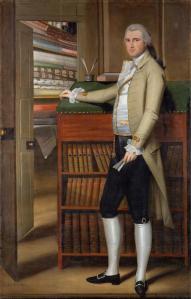
Ralph Earl, "Elijah Boardman," 1789 (NY: Met)
From the decade before the Revolution to the eve of World War I, many of America’s most acclaimed painters captured in their finest works the temperament of their respective eras. They recorded and defined the emerging character of Americans as individuals, citizens, and members of ever-widening communities. American Stories: Paintings of Everyday Life, 1765–1915 brings together for the first time more than 100 of these iconic pictures that tell compelling stories of life’s tasks and pleasures. The first overview of the subject in more than 35 years, the exhibition includes loans from leading museums and private lenders—and many paintings from the Metropolitan’s own distinguished collection. American Stories features masterpieces by John Singleton Copley, Charles Willson Peale, William Sidney Mount, George Caleb Bingham, Winslow Homer, Thomas Eakins, John Singer Sargent, Mary Cassatt, William Merritt Chase, John Sloan, and George Bellows, and notable works by some of their key colleagues.
The exhibition examines stories based on familiar experience and the means by which painters told their stories through their choices of settings, players, action, and various narrative devices. The artists’ responses to foreign prototypes, travel and training, changing exhibition venues, and audience expectations are examined, as are their evolving styles and standards of storytelling in relation to the themes of childhood, marriage, the family, and the community; the production and reinforcement of citizenship; attitudes towards race; the frontier as reality and myth; and the process and meaning of art making.
 The exhibition is arranged in four chronological sections. The first—Inventing American Stories, 1765–1830—begins with artists who told stories through portraits. Serving their sitters’ self-conscious interest in how they appeared in the eyes of others, American portraitists often emulated British compositions. Although these artists focused on individuals and particular locales and relationships, the cleverest of them responded to broader narrative agendas and to the natural impulse to tell stories. In his portrait of his colleague Paul Revere (1768, Museum of Fine Arts, Boston), John Singleton Copley embedded subtle narrative into a traditional single-figure format, with the silversmith’s gestures and gaze conveying volumes about the time in which he lived. As their patrons learned to read portraits for more than likeness and to appreciate artistic license, portraitists began to gratify their sitters by telling subtle personal stories in increasingly elaborate compositions. In his ingenious double-likeness of Benjamin and Eleanor Ridgely Laming (1788, National Gallery of Art, Washington), for instance, Charles Willson Peale implied the sexual bond that defined the Lamings’ marriage. Later in this period, some painters told grand stories in pictures produced for public exhibition, rather than purely for private enjoyment. In Gallery of the Louvre (1831–33, Terra Foundation for American Art, Chicago), Samuel F. B. Morse proposed that his compatriots must achieve cultural independence from Europe even while they learned from the Old World’s greatest artistic achievements.
◊ ◊ ◊ ◊ ◊
In addition to the materials contained at the Met’s website, there is an exhibition blog that’s updated regularly. The November 2009 issue of The Magazine Antiques includes an instructive article by Carrie Barratt and H. Barbara Weinberg, “American Artists as They Saw Themselves.”
Yinka Shonibare in DC
Yinka Shonibare, MBE
Smithsonian National Museum of African Art, Washington D.C., 10 November 2009 — 7 March 2010
Curated by Rachel Kent
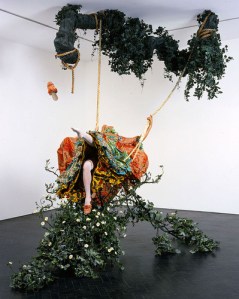
Yinka Shonibare, "The Swing (After Fragonard)," 2001
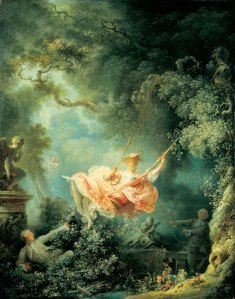
Jean-Honoré Fragonard, "The Swing," 1767 (London: Wallace Collection)
This morning on NPR’s Morning Edition, Susan Stamberg profiled the Yinka Shonibare exhibition now on display at the Smithsonian National Museum of African Art (it was organized by the Museum of Contemporary Art in Sydney). Writing in The New York Times (17 June 2009) of the show when it was at the Brooklyn Museum this past summer, Deborah Sontag described Shonibare as an “erudite and wide-ranging” artist, whom

Rachel Kent
at 47, is a senior figure in the British art world but one who intentionally eludes easy categorization. A disabled black artist who continuously challenges assumptions and stereotypes — “That’s the point of my work really,” he said — Mr. Shonibare makes art that is sumptuously aesthetic and often wickedly funny. When he deals with pithy matters like race, class, disability, colonialism and war, he does so deftly and often indirectly. “I don’t produce propaganda art,” he said. “I’m more interested in the poetic than the didactic.”
While many of the works address contemporary issues through Victorian conventions, there are intriguing eighteenth-century references, too — including this reworking of Fragonard’s Swing.
Etc, Etc.
 Umberto Eco served as guest-curator for the Louvre’s current exhibition Vertige de la Liste (Vertigo of Lists), on view until December 13. The scholar’s celebrity status has garnered lots of attention for the show (in addition to being taken up by the Associated Press, it’s been covered by Spiegel, Salon, and L’Express). The publisher’s description of the book accompanying the show, calls Eco “a modern-day Diderot,” explaining that here he “examines the Western mind’s predilection for list-making and the encyclopedic.” With material ranging from ancient and medieval lists (Homeric catalogues and lists of saints) to early modern “catalogues of plants [and] collections of art,” the eighteenth century would seem like a crucial period, and there is apparently at least one painting by Panini included. Still, for all of the talk of lists, one that seems to be missing (even from the Louvre’s site) is an exhibition checklist. Those of us who are unable to see the show should, however, have a better sense of its contents soon enough; the English edition of The Infinity of Lists: An Illustrated Essay is schedule for publication on November 17.
◊ ◊ ◊ ◊ ◊
Vertige de la Liste
Musée du Louvre, Paris, 2 November — 13 December 2009
The following account of the exhibition comes from Cristina Carrillo De Albornoz’s coverage in The Art Newspaper:
After Robert Badinter, Toni Morrison, Anselm Kiefer and Pierre Boulez, Umberto Eco is the next special guest curator of the Louvre. A noted historian and semiotician before he brought these sensibilities to bear on major novels such as The Name of the Rose and Foucault’s Pendulum, Eco has spent almost two years in residence at the Louvre. His chosen subject is “The Infinity of Lists”, a tour through art, literature and music based on the theme of lists and motivated by his fascination with numbers (until 13 December). “The subject of lists has been a theme of many writers from Homer onwards. My great challenge was to transfer it to painting and music and to see whether I could find equivalents in the Louvre, because frankly when I suggested the subject I had no idea how I would write about visual lists,” says Eco.
“The starting point for my ‘list of lists’ was Homer’s Iliad: firstly the creation of Achilles’ shield by Hephaestus, which not only symbolises perfect form but is in itself a work of art on which is engraved what is considered an allegory of the creation of the universe, an overall vision of Homer’s world. And secondly, the part where he lists all the ships leaving for the Trojan war.” Eco plays with these two opposing dimensions—perfect form and the list—in an attempt to rationalise the world. “The shield of Achilles is the epiphany of form, and every picture in an artist’s search for that form is a shield of Achilles,” concludes Eco. “Behind each list is the sense of ineffability.”
This impulse has recurred through the ages from music to literature to art. Eco refers to this obsession itself as a “giddiness of lists” but shows how in the right hands it can be a “poetics of catalogues.” From medieval reliquaries to Andy Warhol’s compulsive collecting, Umberto Eco reflects in his inimitably inspiring way on how such catalogues mirror the spirit of their times. . . .
For the full article, click here»










 Enfilade
leave a comment