Ricci Exhibition to Mark His 350th Birthday
Sebastiano Ricci: Il trionfo dell’invenzione nel Settecento veneziano
Fondazione Giorgio Cini, Venice, 24 April — 11 July 2010
 This exhibition is the principal event in the programme of celebrations for the 350th anniversary of the birth of Sebastiano Ricci, promoted by the Veneto Region and the Giorgio Cini Foundation through a specially created regional committee. On show will be paintings, sculptures and drawings connected to the problematic issue of the bozzetto (models for sculptures, and painted sketches and drawings for larger works). The exhibition will, thus, provide an opportunity to explore an original aspect of the multifaceted talent of the artist from Belluno. Specialist studies agree in attributing a key role to Sebastiano Ricci as a precursor and modern interpreter of the Rococo in Italy and the rest of Europe. In fact, thanks to his wide-ranging activities in European courts and centres of culture, he was able to develop his skills and an accomplished virtuoso language that catered to
changes in taste in the early 18th century.
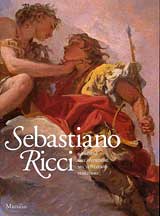
Catalogue edited by Giuseppe Pavanello ISBN: 9788831706377, $65
The main section of the exhibition will be dedicated to the art of the bozzetto and the modelletto (an initial small version of a proposed large work for presentation to patrons), in which Sebastiano Ricci was not only a supreme master, but also an ingenious innovator. Sebastiano’s letter to Giacomo Tassi of 14 November 1731 is usually considered to mark the starting point for a reversal of values that saw the aesthetic preeminence of the work of art pass from its “finished” version, conceived for public display, to the bozzetto, the preliminary work usually destined to remain in the studio. Sebastiano’s last sentence in the letter addressed to his patron – “moreover, this small work is the original and the altarpiece is the copy” – ushered in a view that was eventually so successful that it even influenced most 20th-century critics.
The exhibition will also provide the opportunity for comparisons with the bozzetti of other major artists in the Venetian school. These artists include Antonio Pellegrini, the young Giambattista Tiepolo, Gaspare Diziani, Giambattista Pittoni and Jacopo Amigoni. There will also be a special focus on Ricci’s graphic works, now mainly kept in the Drawing and Prints Cabinet of the Accademia, Venice, and in the royal collections of Windsor Castle. Ricci’s swirling exploratory graphic technique lends itself to precise comparisons with his own modelletti and with the work of the sculptor Giovanni Maria Morlaiter. In fact, the exhibition will also include some terracotta models and bozzetti from the workshop “remainders” of Giovanni Maria Morlaiter – Sebastiano Ricci’s alter ego in sculpture – now in storage in the Ca’ Rezzonico Museum of Eighteenth-Century Venetian Art, Venice.
Jean Barbault Exhibition in Strasbourg
Jean Barbault: Le théâtre de la vie italienne / The Theater of Italian Life
Strasbourg, Musée des Beaux-Arts, 22 May — 22 August 2010

Catalogue by Pierre Rosenberg et al. (ISBN: 9782351250815)
This year the Musée des Beaux-Arts, Strasbourg will present an exhibition focused around the painter Jean Barbault (Val-d’Oise, 1718 — Rome, 1762). This seemed an opportune moment to spotlight such an enticing artist since the museum acquired one of his masterpieces just a few short months ago. The exhibition thus unveils a complete, eloquent panorama of his work. Barbault is renowned for whimsical figures painted with virtuosity and refined color as well as canvases treating “Mascarades” organized by residents at the Academy of France in Rome. He also signed landscapes of ruins and considered himself a “painter of History.” As an added feature the exhibition is showing a series representing his French contemporaries working in Rome at the same period, including Fragonard, who, like him were deeply attracted to Ancient (fascinating) and modern (picturesque) Rome and dazzled by Italian light.
Last year the Musée des Beaux-Arts further enriched its collection (thanks to a purchase made possible by the City of Strasbourg and by the Fonds Régional d’Acquisition des Musées / Regional Fund for Museum Acquisitions) with a major painting entitled Neapolitan Shepard and Buffalo Cow Leaving the Grotto by Jean Barbault. This is one of the mid-18th century’s most attractive works of French (and Italian) painting. Its subject matter and spiritual treatment personify the very essence of the Age of Enlightenment. The painting is a masterpiece done in Italy circa 1750 by an artist who largely remains in the shadows despite exhibitions previously shown at the Museums of Beauvais, Angers and Valence, 1974-1975.
The exhibit – and its catalog – gives an overview of his painted work. Barbault settled in Rome in 1747, remaining in this fascinating city and fully integrating himself into Italian life until his death. He was an original artist, the author of characters in typical Italian costume and exotic figures for Mascarade, who also undertook the register of ruins. Despite a rather dramatic existence, he considered himself an artist-in-full. Besides an extraordinary collection of engravings by the Italian Piranesi, the exhibition also exposes the unique milieu of residents at the Academy of France in Rome. Barbault was the contemporary of Jean-Honoré Fragonard and belonged to an exciting generation, between Boucher and David, Rocaille and Neo-Classicism.
Catalogue: Pierre Rosenberg et al., Jean Barbault: Le théâtre de la vie italienne (Strasbourg: Editions des Musées de la Ville de Strasbourg, 2010), 160 pages (ISBN: 9782351250815), $53.50, available at artbooks.com.
◊ ◊ ◊ ◊ ◊
Didier Rykner’s review of the exhibition for La Tribune de l’Art (5 June 2010) can be found here»
Delaroche Exhibition
Painting History: Delaroche and Lady Jane Grey
National Gallery, London, 24 February — 23 May 2010
 Although primarily a nineteenth-century exhibition, the Delaroche show that just closed at the National Gallery offered plenty of jewels for thinking about the eighteenth century, too, especially in light of the aftermath of the French Revolution. A review of the exhibition by David Howarth can be found at Apollo Magazine:
. . . The “Execution [of Lady Jane Grey]” is the centrepiece of a beautifully crafted show, as meticulously prepared as the smooth finish of Delaroche’s vast canvases. Although a limited number of paintings are on display in the exhibition, the range extends beyond the confines of a notorious basement which has ill-served so many exhibitions. The accompanying catalogue, by Stephen Bann and Linda Whiteley, includes important new thinking on the relationship between art and the stage. . .
The full review is here»
Old Master Drawings in Grenoble
From the evene.fr site:
De chair et d’esprit: Les dessins italiens du musée de Grenoble (XVe — XVIIIe siècles)
Musée de Grenoble, 6 March – 30 May 2010

Giovanni Battista Piazzetta (1682-1754), "Bust of a Young Woman," Black chalk and charcoal, heightened with white gouache - 37.6 x 30.4 cm (Grenoble: Musée de Grenoble)
Le musée de Grenoble a entrepris d’étudier et de publier les 3500 dessins anciens (du XVe au XVIIIe siècle) conservés dans ses collections, en présentant chaque année, sur trois ans, une sélection des oeuvres les plus représentatives de ce fonds. Un fonds qui était demeuré jusqu’alors largement inexploité et pour l’essentiel inédit. En 2010, la première étape de cette démarche sera consacrée à l’Italie et permettra de découvrir près de 120 dessins issus des différents foyers artistiques de la péninsule. L’étude et la mise en valeur de ses collections sont parmi les missions premières d’un musée. A Grenoble, alors que la majeure partie des peintures et sculptures ont été publiées, les équipes travaillent depuis plusieurs années sur le fonds d’art graphique.
◊ ◊ ◊ ◊ ◊
A review of the exhibition by Didier Rykner from The Art Tribune is available in English here»
. . . . We were struck during our visit to this exhibition in Grenoble by the quality of the works which nonetheless remained totally unknown until now, even to specialists. Furthermore, we would like to commend the museum for its determination to explore and catalogue all of its collections, an undertaking begun many years ago and which its current director, Guy Tossato, continues to pursue. Next year, after the Italian drawings, the museum will highlight French drawings before the 19th century, then will present Northern European sheets. Let us hope that the entire collection will soon be published, a feat not yet achieved, to our knowledge, by any of the other provincial museums.
 The accompanying catalogue is available through Michael Shamansky’s artbooks.com. Eric Pagliano, Catherine Monbeig Goguel, and Philippe Costamagna, De chair et d’esprit, dessins italiens du musée de Grenoble XVe –XVIIIe siecle (Paris: Somogy, 2010), ISBN: 9782757203057, $65.
Old Master Drawings at the Met
Press release from the Met:
An Italian Journey: Drawings from the Tobey Collection, Correggio to Tiepolo
Metropolitan Museum of Art, New York, 12 May — 15 August 2010

Giovanni Battista Tiepolo, "A Family Group," 1750s. Pen and brown ink, brush and brown wash, over black chalk. Sheet: 9 1/2 x 13 7/16 in. (24.1 x 34.2 cm) The Metropolitan Museum of Art, Promised Gift of David M. Tobey (TR.331.50.2007).
An Italian Journey: Drawings from the Tobey Collection, Correggio to Tiepolo presents 72 extraordinary works of the 16th through 18th centuries, from one of the preeminent collections of Italian Old Master drawings in private hands. It features masterpieces by gifted and historically important draftsmen—principally Italian masters but also artists whose careers brought them south of the Alps—among them Correggio, Parmigianino, Bernini, Poussin, Guercino, Canaletto, and Tiepolo. The drawings represent the principal centers of Italian art: Florence, Rome, Naples, Bologna, Parma, Venice, Genoa, and Milan. Their strikingly broad range of subject matter includes figure studies, historical and mythological narratives, landscapes, vedute, botanical drawings, motifs copied from or inspired by classical antiquity,
and designs for painted compositions.

Catalogue by Linda Wolk-Simon and Carmen Bambach, ISBN: 9780300155242, $50
The 16th-century Italian painter and biographer Giorgio Vasari has been credited with formulating the concept of Renaissance art in his celebrated Lives of the Most Eminent Painters, Sculptors, and Architects (1550). He also invented the practice of systematically collecting Italian drawings in compiling his Libro dei disegni, a volume comprising examples by many of the artists whose biographies he authored. From Vasari’s time until the present, such works—intimate glimpses of an artist’s imagination and creative powers at work—have held a seductive allure and an intellectual appeal for collectors and connoisseurs alike. An Italian Journey offers a unique glimpse of the myriad riches of this exceptional collection, presented to the public for the first time.
Among the many treasures of the collection on view are a recently discovered, magnificent red chalk drawing of the head of Julius Caesar by Andrea del Sarto, the leading Florentine painter of the first decades of the 16th century; a luminous study by Correggio for the figure of Eve in his great masterpiece, the painted dome of the cathedral of Parma; a sprightly pen drawing by his younger contemporary Parmigianino—hailed in his day as the spirit of the divine Raphael reborn—for one of his most important painted portraits; brilliantly rendered colored studies by the Florentine artist Jacopo Ligozzi, one depicting, with poetry and scientific precision, a plant, and another an exotic Oriental theme; a powerful study of a recumbent nude man by the towering genius of Baroque Rome, Gianlorenzo Bernini, and of a fanciful ship by his contemporary, the sculptor Alessandro Algardi, made for the pope; a rich concentration of drawings by some of the leading Bolognese painters of the 17th century, notably Guercino (who is represented by three masterful studies), Guido Reni, and Domenichino; and fine examples by the great Venetian draftsmen of the 18th century, among them Canaletto, Guardi, Piranesi, and the greatest artistic luminary of the age, Giambattista Tiepolo. (more…)
Grangerized Books
Extending the Book: The Art of Extra-Illustration
Folger Shakespeare Library, Washington D.C., 28 January – 25 May 2010
Curated by Erin Blake (Folger Shakespeare Library) and Stuart Sillars (University of Bergen) with LuEllen DeHaven (Folger Shakespeare Library)
 Texts are never static objects, but it is rare that readers’ interactions with them are as physically evident as they are in extra-illustrated books. The concept is simple: identify significant people, places, and things in a printed text, collect pictures of them, then insert the pictures as visual annotations to the text. Extra-illustration came to prominence after the 1769 publication of James Granger’s Biographical history of England. Granger’s un-illustrated book combined thumbnail biographies with lists of portraits, and readers began to supplement their copies with actual examples of the portraits. The practice spread to other texts, and the great era of extra-illustration, or “grangerizing,” began. At its most extreme, a single volume could grow to dozens.
Shakespeare proved especially attractive to grangerizers thanks to the variety of editions available and the many portraits of historical figures, fictitious characters, and well-known actors that could be added. Many extra-illustrators went beyond portraiture to include playbills, scenic views, and even entire books; others inserted manuscript letters, original watercolors, and rare engravings, thus preserving a treasure-trove of unique material. Finished volumes range from the skilled work of professional inlayers and binders hired by wealthy collectors to self-made books of inexpensive clippings pasted onto cheap inserts. Any book owner could be an extra-illustrator.
From the beginning, extra-illustrators had to defend their “exquisite handicraft” (in the words of an 1890 proponent) against accusations of “breaking up a good book to illustrate a worse one” (in the words of an 1892 critic). This exhibition examines the art and the practice of extra-illustration, from crudely altered books to beautiful new creations.
◊ ◊ ◊ ◊ ◊
The Folger’s exhibition site includes more information and an intriguing sampling of images»
At the Getty: The Grand Manner on Paper
Press release from the Getty:
Printing the Grand Manner: Charles Le Brun and Monumental Prints in the Age of Louis XIV
The Getty Research Institute at the Getty Center, Los Angeles, 18 May — 17 October 2010
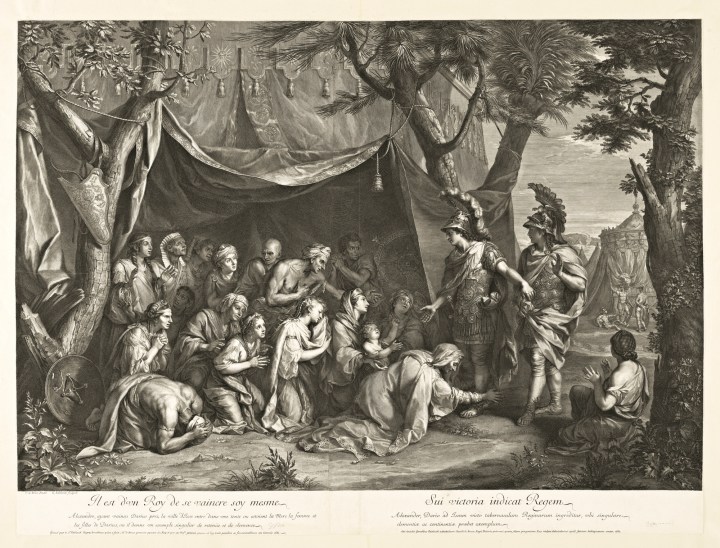
Gérard Edelinck (1640–1707), after Charles Le Brun (1619–1690), "Queens of Persia at the Feet of Alexander from the Battles of Alexander," ca. 1675 Etching and engraving 26 9/16 x 35 5/16 in. Research Library, The Getty Research Institute, Los Angeles, California (2003.PR.42)
◊ ◊ ◊ ◊ ◊
Printing the Grand Manner: Charles Le Brun and Monumental Prints in the Age of Louis XIV explores a little-known facet of late 17th-century reproductive engravings. The exhibition examines the prints’ rich vocabulary and illuminates the context in which they were made between the mid-1660s and the mid-1680s. While it focuses on the relationship between Charles Le Brun (French, 1619–90) and the printmakers who reproduced his compositions, the exhibition also interprets the prints and their inscriptions in light of Le Brun’s ambitions and struggles as a court painter, designer, and print publisher in the highly competitive atmosphere surrounding Louis XIV.

Catalogue by Louis Marchesano and Christian Michel (Getty Research Institute, 2010) ISBN: 978-0892369805, $50
The works in this exhibition and related catalog reproduce Le Brun’s narrative compositions in the Grand Manner, the genre in which a heroic protagonist engages in a morally significant action—a battle to be won, a victory to be celebrated, or a vice to be avoided. By disseminating these subjects in printed form, Le Brun presented to both collectors and artists his mastery of the most complex type of art. In turn, the quality and size of these prints allowed him to demonstrate the unprecedented authority over the fine arts in France.
The eleven large prints featured in Printing the Grand Manner were clearly intended to evoke the grandeur of Le Brun’s large-scale paintings and tapestry designs that illustrate events from the exemplary lives of ancient rulers such as Alexander the Great and Constantine the Great. A prodigious artist and designer, now best known for his work at Versailles, Le Brun was Louis XIV’s principal painter, leader of the Académie royale de peinture et de sculpture, and director of the huge royal manufactory at the Hôtel des Gobelins, the integrated workshops where hundreds of artists and craftsmen produced the fine objects that gave the age of Louis XIV its veneer of splendor and grandeur.

Gérard Edelinck (1640–1707), after Charles Le Brun (1619–1690), "Queens of Persia at the Feet of Alexander from the Battles of Alexander," detail, ca. 1675
“Le Brun used prints strategically to promote his agenda. Naturally, he wanted the best printmakers to reproduce his compositions and to disseminate them in the best possible light. As a painter and leader of the arts who experienced the power of prints in his own career, he was able to encourage the development of printmaking in France,” says Louis Marchesano, the Getty Research Institute’s curator of prints and drawings. “In retrospect, we know Le Brun’s own interventions in the field of prints paid off because the material and stylistic excellence of the large prints whet the appetites of collectors and critics well into the 19th-century.”
Le Brun was most successful at the height of his power in the 1670s, when he oversaw the publication of the Battles of Alexander, a suite of five images comprising his Persian and Indian campaigns. With his reputation and authority at stake, he convinced the Crown to spare no expense on the quality of the paper and the size of the impressions. Pulled from 15 copper plates, large printed sheets had to be assembled into a suite of five separate images. The Alexander suite was made by two of the best artists at Le Brun’s disposal, Gérard Edelinck and Gérard Audran. Showcasing Audran’s astonishing mixed etching and engraving technique, the four prints by him were judged to be the epitome of printmaking, in part because they appeared to improve upon Le Brun’s original paintings, a rather unusual judgment in favor of prints. (more…)
Quilts at the V&A
From the V&A’s website:
Quilts: 1700-2010
The Victoria & Albert Museum, London, 20 March — 4 July 2010

Bishops Court quilt, 1690-1700 (V&A no. T.201-1984)
The V&A will present its first ever exhibition of British quilts, with examples dating from 1700 to the present day — a unique opportunity to view the V&A’s unseen quilt collection as well as key national loans. The exhibition will show 65 beautifully crafted quilts, predominantly from the V&A’s own collection but also including a number of important loans and new works by contemporary artists, many of which have been commissioned especially for the show.
Earliest examples include a sumptuous silk and velvet bedcover, with an oral narrative that links it to King Charles II’s visit to an Exeter manor house in the late 17th century. Recent examples will include works by leading artists such as Grayson Perry and Tracey Emin and commissions for the exhibition by a number of contemporary artists including Sue Stockwell and Caren Garfen.

Catalogue by Sue Prichard, ISBN: 978-1851775958 ($60)
The curators have unravelled some of the complex personal narratives and broader historical events documented in the quilts. Examples by both named and unnamed makers will be shown with objects relating to their subject matter and makers including paintings and prints, as well as needlework tools and personal keepsakes. One example is a cot quilt made at Deal castle, displayed for the first time alongside the maker’s diary and portraits of the two grandchildren who slept under it.
There will also be bedcovers that commemorate the lives of prominent figures including Admiral Lord Nelson, Charles II and the Duke of Wellington and important events such as the coronation of Queen Victoria and the Duke of Wellington’s battle at Vittoria. The exhibition will end with Tracey Emin’s To Meet My Past (2002), a confessional installation which follows the tradition of quilts used as vessels for personal and
collective memories. (more…)
Richard Wilson Exhibition in New York
From a press release from Richard Feigen:
Richard Wilson and the British Arcadia
Richard L. Feigen & Co., New York, 29 April – 25 June 2010

Richard Wilson, "View of Caernarvon Castle, Wales," 1744-45 (Detroit Institute of Arts)
Richard L. Feigen & Co. will present Richard Wilson and the British Arcadia, a loan exhibition dedicated to the first great British landscape artist, Richard Wilson (c.1713-1782). This will be the first exhibition to be devoted to the artist in North America in over 25 years.
Richard Wilson and the British Arcadia will feature approximately a dozen of the painter’s works from both public and private US collections. One of the highlights of the exhibition will be the great Destruction of the Children of Niobe, the key picture of Wilson’s career and a landmark in the history of British landscape paintings, which is being loaned by the Yale Center for British Art. Also included will be Wilson’s earliest known view of his native Wales, Caernarvon Castle, on loan from the Detroit Institute of Arts, as well as several seminal pictures painted during the artist’s sojourn in Italy, among them, The Temple of Clitumnus from a private US collection.
Wilson’s second English period will be represented by his perhaps most famous landscape, The White Monk, loaned by the Toledo Museum of Art, and a magnificent view of Tivoli from the Kimbell Art Museum. The exhibition will also feature several pictures by some of the seventeenth-century landscape masters whose work influenced Wilson’s. Claude Lorrain’s exquisite Pastoral Landscape, a small copper being lent by the Yale University Art Gallery, and Aelbert Cuyp’s idyllic Landscape with the Flight into Egypt from the Metropolitan Museum will be among the pictures shown in this context.
The exhibition will be accompanied by a fully illustrated catalogue, to which the distinguished scholar of British art, Andrew Wilton, has contributed the introductory essay. Mr. Wilton is Visiting Research Fellow at Tate Britain, having formerly been Keeper of the British Collection and Curator of the Turner Collection in the Clore Gallery. The most recent of his many publications are Turner in His Time, Turner as Draughtsman, and Five Centuries of British Painting: From Holbein to Hodgkin. All proceeds from the sale of the catalogue will be donated to the Richard Wilson catalogue raisonné project, which is being undertaken by Dr. Paul-Spencer-Longhurst on behalf of the Paul Mellon Centre for Studies in British Art in London, the sister institution to the Yale Center for British Art in New Haven.
Palladio and His Legacy at the Morgan
From The Morgan’s website:
Palladio and His Legacy: A Transatlantic Journey
The Morgan Library and Museum, New York, 2 April — 1 August 2010

Villa Rotunda, from “The Architecture of A. Palladio,” 1715-20 (RIBA Library)
Palladio and His Legacy: A Transatlantic Journey features thirty-one original Palladio drawings from the Royal Institute of British Architects. These exquisite drawings, which were exhibited only once before in America and never in New York, will be on view to the public for the first time in over thirty years. They are being presented with rare architectural texts to illustrate the journey from Italy to North America of Palladio’s design principles of proportion, harmony, and beauty.
Palladio’s work has significantly influenced American architecture from colonial times to the present day. Focusing on the artist’s original drawings and following the trajectory of his ideas, the show also traces the story of American Palladianism. The drawings are supported by numerous architectural models. Three large examples—the Pantheon, Villa Rotunda, and Jefferson’s unrealized design for the White House—programmatically illustrate the journey from Rome to America. Smaller models, along with rare architectural texts and pattern books through which Palladio’s ideas were primarily transmitted, reinforce the themes of the exhibition.
◊ ◊ ◊ ◊ ◊
 This book has been written to accompany the exhibition Palladio and His Legacy: A Transatlantic Journey and shows drawings, books and images from the peerless Palladio collections of the Royal Institute of British Architects. It shows how Palladio studied and reinterpreted the architecture of antiquity, how he developed his ideas, how his message spread, and how Palladianism developed and spread across America, where Palladio’s legacy has remained longest and most widespread. Andrea Palladio lived and worked some 500 years ago in the Veneto. Yet his international influence, and particularly his impact on American architecture, has been greater than that of any architect since. Simplicity and proportion formed the basis of his idea of architecture; the villas he created in the Veneto around Venice, together with his writings, which were widely disseminated after his death, have helped shape European and American buildings for more than 400 years.
◊ ◊ ◊ ◊ ◊
As noted by The Art History Newsletter, the exhibition was reviewed in The New York Times by Nicolai Ouroussoff on 8 April 2010. There’s also an interview by Suzanne Stephens and William Hanley at Architectural Record.










leave a comment