Enamels at the Hermitage
Enamels of the World 1700-2000 from the Khalili Collections
Hermitage, St Petersburg, 8 December 2009 – 18 April 2010

Throne table Guangzhou (Canton), 1736-1795 Gilt copper, painted enamel, 37 x 90.5 x 42 cm
Due to popular demand Enamels of the World 1700-2000 from the Khalili Collections, being exhibited at the State Hermitage Museum, St Petersburg, has been extended until 18 April. This is the inaugural presentation of a remarkable new facet of the Khalili Collections, perhaps best known for the their unparalleled Islamic and Japanese art. The exhibition features some 320 pieces selected from approximately 1,200 works in the enamel collection.
Enamelling has been an essential accomplishment of the virtuoso jeweller for more than 3,000 years, and many ancient works rank among the treasures of European and Asian art – to the extent, perhaps, that it tends to be popularly, though
misleadingly, identified with ancient and mediaeval art.

Novelty scent spray, attributed to Mouliné, Bautte & Co. or Moulinié & Bautte, Geneva, circa 1805 Gold, translucent and painted enamel, agate and seed pearls, 11 x 5.5 x 1.4 cm
Partly because of this, its history since 1700 or so has become the province of highly specialised scholars often working in ignorance of their colleagues’ work in closely related fields, which is especially paradoxical since enamellers themselves have always been highly mobile. The rapidity of travel and the ease with which motifs and techniques could be transferred, virtually from one end of the industrialised world to the other, in the 18th and 19th centuries, has given their work a truly international dimension. Many of their names are little known to the general public. Professor Nasser D Khalili’s achievement has been not just to present their work but to show them working in a global environment and, whether European or Asian, transcending the boundaries of national frontiers or individual enterprise. The historicist taste of the 19th century, imbued by the conviction that the traditions of the past dynamically influenced the arts of a nation, went hand in hand with the conviction that exotic art could be exploited to revive them. This was as true of Meiji Japan and Qing China, as of Tsarist Russia, Victorian Britain and Ottoman Turkey.

Drawn by the most humble Muhsin known as ‘The Aleppan’, Iran, ca. 1800
The exhibition includes splendid enamelling by the most prestigious European masters. The firm of Fabergé is represented by twenty-six works including a combined timepiece and photograph frame, while the work of Feodor Rückert, a workmaster who regularly supplied Fabergé, is seen in three items dating from different periods of his career including one of his great masterworks, the Ol’sen kovsh. The eminent French master Jean-Valentin Morel is also represented by three works, among them the very last that he made. The genius of René Lalique, which was so fêted at the Paris Exposition Universelle of 1900, may be appreciated both on a small scale with a corsage ornament and on a large scale with a remarkable surtout de table. At the same Exposition, the firm of Cartier also enjoyed great critical acclaim and the exhibition features fifteen works by Cartier, among them clocks, cigarette cases and vanity cases. Much of the enamelling produced in the Islamic lands is the work of anonymous craftsmen. However, the exhibition includes a rare signed example, a gold box signed by Muhsin, known as ‘the Aleppan’, an artist working at the court of Fath ‘Ali Shah.

Timepiece Laurent, Paris, 1793-1794 Painted marble and gilt-metal, copper with opaque, translucent and painted enamel with paillons, 40.8 x 26 x 16 cm
As a whole the collection magnificently displays the great variety of work produced by enamellers ranging from precious personal accessories such as jewellery to clocks, vases, and even pieces of furniture. Similarly striking is the element of fantasy employed in their creation, for example the scent spray formed as a pistol, the scent issuing from a flower that emerges from the muzzle when the trigger is pulled, or the evening bag made by Aloisia Rucellai in 1968, where the folds and ‘watering’ of moiré silk have been extravagantly replicated in engraved gold and enamel. Equally remarkable is the variety of techniques used to decorate these pieces including cloisonné, painted and plique à jour enamel. At the same time fascinating differences may be noted in the use of the same technique in different locations such as China and Japan.
The impact of patronage is well illustrated by many works in the exhibition. Specific commissions include the small almanac made for the Empress Marie-Louise, second consort of Napoleon I, to commemorate the birth of their son, the King of Rome, and the casket made for Elisabeth, Queen of Roumania, which she gave to the French painter Jean Lecomte de Nouÿ. Other works were made to order for royal and imperial households; among these are the Russian cigarette case by Hahn with a diamond-set imperial eagle and the pair of Japanese vases by Hattori Tadasaburo which incorporate the Imperial kikumon. In other instances enamelled works of art were used to commemorate an event such as the spectacular charger by Pavel Ovchinnikov that was presented by the city of Moscow to Emile Loubet, President of the French Republic, during his state visit to Russia in 1902.

Edited by Haydn Williams
Historical revivalism is a major theme covered by the Collection. The rise of nationalism during the 19th century encouraged artists to study the past in the hope of defining national identity. In northern Europe the Gothic era was thoroughly reviewed while in Russia interest focused upon the art made before Peter the Great’s policy of westernisation. Filigree enamelling, a traditional technique practised in the cities of Moscow, Velikii Ustiug and Solvychegodsk, was revived. One of the leading exponents of this was Pavel Ovchinnikov, the maker of the imposing double-handled kovsh. Widespread interest in the past also stimulated collectors to seek antiques for their collections. The scarcity of authentic examples, combined with great demand, soon led to the production of imitations that made good the shortfall. One of the most noted makers of such work was Reinhold Vasters and the exhibition includes three spectacular examples by him, among them the large covered bowl applied with jewelled gold and enamel mounts. Other masters drew on the past in a more informal and fanciful way as can be seen in the charger by Herman Ratzersdorfer or the timepiece by Vever frères which was exhibited at the Paris Exposition Universelle in 1889.
The importance of the Khalili Collection and the number of wonderful pieces made by Russian craftsmen make its unveiling in one of the world’s greatest museums, the State Hermitage Museum, entirely appropriate and in keeping with Professor Khalili’s wish to share his collections with the world and to promote greater understanding between people of different cultures.
Exhibition catalogue: Haydn Williams, ed., Enamels of the World, 1700-2000 : The Khalili Collections (London: The Khalili Family Trust, 2009), 450 pages, ISBN: 9781874780175, $75
Jean Raoux Retrospective
Jean Raoux, virtuose et sensuel (1677-1734)
Musée Fabre de Montpellier, 28 November 2009 – 11 April 2010
 Jean Raoux est avec Sébastien Bourdon, Joseph-Marie Vien, François-Xavier Fabre et Frédéric Bazille, l’un des grands artistes français originaires du Languedoc. Ce peintre, contemporain d’Antoine Watteau, participa de manière active au renouvellement de la peinture française au temps de la Régence. Virtuose, sensuel, élégant, Jean Raoux mérite que sa ville natale lui consacre une exposition d’envergure.
Cette première rétrospective réunit les plus beaux chefs-d’oeuvre de l’artiste provenant des grands musées français, mais aussi de collections allemandes, autrichiennes, italiennes, anglaises, américaines et russes. De provenance prestigieuse, rarement montrés, les tableaux de cette exposition dévoilent l’étendue de son talent de portraitiste de l’aristocratie, du monde du spectacle, de peintre de sujets historiques et religieux, mais aussi de scènes de genre à la manière hollandaise. Sa poésie exalte la beauté de la femme, qu’elle soit héroïne de la mythologie ou coquette vaquant à ses occupations quotidiennes. Cette sélection permet de mettre en lumière les multiples facettes de cet artiste célèbre en son temps et estimé de Voltaire.
Qui est Jean Raoux ?
Né à Montpellier en 1677, Raoux a continué sa formation à Paris dans le grand atelier de Bon Boullongne. De 1705 à 1714, il séjourne à Rome, Padoue et Venise où il répond à d’importantes commandes de peintures mythologique et religieuse. De retour à Paris en 1714, il entre à l’Académie et reçoit la protection du Grand Prieur de l’Ordre de Malte, le libertin Philippe de Vendôme et travaille aussi pour le régent Philippe d’Orléans. Ses portraits, ses scènes de genre très poétiques et d’une exécution virtuose témoignent de l’esprit de ce milieu qu’il fréquente, à la fois léger, féminin et parfois mélancolique.
Exhibition Catalogue: Michel Hilaire and Olivier Zeder, Jean Raoux, 1677-1734 (Paris: Somogy, 2009), ISBN: 9782757202876, $58.95 (for an English description and a link to purchase the catalogue, click here»)
Homecoming for Reynolds
From the City of Plymouth’s exhibition website:
Sir Joshua Reynolds: The Acquisition of Genius
Plymouth City Museum and Art Gallery, 21 November 2009 — 20 February 2010

Exhibition catalogue edited by Sam Smiles, ISBN: 9781906593407
Sir Joshua Reynolds: The Acquisition of Genius is a major art exhibition that celebrates the life and work of a man who was born in Plympton in 1723 and went on to become one of Britain’s finest and most fashionable portrait painters. This, the largest exhibition on Reynolds ever held outside London, showcases new research by the University of Plymouth as well as works of art from Plymouth City Museum and Art Gallery’s own collections, major loan items from regional, national, public and private collections and fascinating personal objects.
Learn about Reynolds’s career from his earliest commissions in and around Plymouth to his pre-eminence in the London art world of the late 18th century. Re-discover his significance to Plymouth and the South West. Find out about his
achievements as both an artist and a collector.
◊ ◊ ◊ ◊ ◊
Hugh Belsey reviews the exhibition for Apollo Magazine (February 2010). Coverage can also be found at the BBC.
Amber Exhibition in Scotland
As noted at Artdaily.org:
Amber: Treasures from Poland
Hunterian Art Gallery, University of Glasgow, 5 February — 17 April 2010
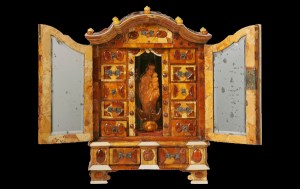
Amber cabinet of King Stanisław August Poniatowski (the last king of Poland). Made in Gdańsk after 1771. Donated by Lady Barbara Carmont of Edinburgh to the Malbork Castle Museum collections in 1979. © Malbork Castle Museum.
From the earliest times, the southern shores of the Baltic Sea have been associated with the gathering, trading and working of amber – a natural substance which has been long valued by man. Featuring some of the finest items from the Polish national collection, this new exhibition, Amber: Treasures from Poland offers a unique chance to see some fascinating and beautiful artefacts which represent both natural history and northern European craftsmanship. This is the first time that these items have been exhibited in the UK.
Most are from the famous Malbork Castle collection in Poland which has an important national collection of Baltic amber artefacts. Also included is the famous Gierłowska lizard from the Gdańsk Amber Museum, as well as a collection of insects trapped in amber and some historical amber artefacts from the Hunterian collection.
 Amber is found in many varieties of colours and forms and amber from the Baltic region of Europe is one of the most abundant in the world. It is used around the world for medical or spiritual wellbeing, for adornment or decoration, and for scientific reasons.
This exhibition introduces amber from prehistory to natural history; it looks at how people related to amber from the Stone Age onwards and at the incredible techniques and skill of the amber craftsmen who created some of the finest examples of amber art ever seen.
The launch of a new book Amber: Tears of the Gods (Dunedin Academic Press) will coincide with the opening of the exhibition. It has been written by Dr Neil DL Clark, Curator of Palaeontology at the Hunterian.
European Romanticism on Paper
Varieties of Romantic Experience: Drawings from the Collection of Charles Ryskamp
New Haven, Yale Center for British Art, 4 February — 25 April 2010

ISBN: 0300152922 (Yale University Press), $75
In 1824, the Scottish painter David Wilkie wrote to the director of the French Royal Museums, “It is time to show that the arts are cosmopolitan and that all national prejudice is foreign to them.” In spite of Wilkie’s fine sentiment, drawings by British artists from the Romantic period have rarely been considered alongside those produced across the Channel. In response, this remarkable exhibition will take up the challenge of treating Romanticism as an international phenomenon by bringing together nearly two hundred British, French, German, Danish, and Dutch drawings from the outstanding collection of Charles Ryskamp (MA ’51, PhD ’56), Professor Emeritus, Princeton University, and Director Emeritus of the Pierpont Morgan Library and The Frick Collection in New York. The first exhibition of this scope dedicated to northern European drawings, it will consider the place of British art in a European milieu.
Varieties of Romantic Experience: Drawings from the Collection of Charles Ryskamp will explore the direct relationship between British and Continental artists during the Romantic period (here defined as the period between the French Revolution in 1789 and the revolutions of 1848). Despite the very different circumstances in which artists across Europe were working, and the diverse modes of representation they employed, they shared common concerns and frequently explored similar themes. The exhibition and accompanying book will focus on Romanticism’s novel exploration of two worlds in particular: nature and the imagination. (more…)
Courtly Frames in Munich
From The Art Newspaper:
The Art of the Frame: Exploring the Holdings of the Alte Pinakothek
Alte Pinakothek, Munich, 28 January — 18 April 2010

Johann Christian Sperling, "Markgraf Karl Wilhelm Friedrich von Brandenburg-Ansbach as a 13-year-old Boy," 1726, frame by Cuvilliés, 1755
The Alte Pinakothek was a pioneer in exhibitions devoted to picture frames and framing when it showed Italian Frames from the 14th to the 18th Centuries in 1976. Now the museum resumes its investigations with this more closely focused exhibition that presents ‘court’ frames dating from between 1600 and 1850. In the baroque period, frames were made by cabinetmakers rather than woodcarvers or sculptors as was the case elsewhere.
The majority of frames were made of ebony or ebonised wood with wave and ripple ornaments referred to as flammleisten—flame moulding—alluding to the effect caused by the flickerings of candlelight on the broad, black surfaces. The most significant change came with the return of the Elector Maximilian II Emanuel from exile in the Netherlands and France in 1715, with his architect Joseph Effner. Vast, three-dimensional sculptural frames with a range of gold leaf were used for the display of ceremonial scenes, portraits and old masters.
Effner was succeeded as court architect by François de Cuvilliés, the central figure in Munich of the pan-German enthusiasm for the rococo, the taste for which lasted up to 1780 (shown here, Johann Christian Sperling, Markgraf Karl Wilhelm Friedrich von Brandenburg-Ansbach as a 13-year-old Boy, 1726; frame by Cuvilliés, 1755).
 In 1779 Carl Albert von Lespilliez was commissioned to frame the Electoral picture collection in the Hofgarten Galerie which he did using the up-to-date neo-classical frame, with leaf, frieze, beading and scotia. The Napoleonic wars spelled the end of the craftsman-made frame along with other luxury items, and the Industrial Revolution ushered in the period of mass-produced products. . .
For the full article click here»
◊ ◊ ◊ ◊ ◊
As noted in a press release for the exhibition, there is an accompanying catalogue, edited by the show’s curator, Helge Siefert, Rahmenkunst: Auf Spurensuche in der Alten Pinakothek (Munich: Prestel, 2010), ISBN: 9783775726061
Built by Numbers
This exhibition was on view at Oxford’s Museum of the History of Science last summer; it opens at the YCBA in February. The following description comes from the latter’s website:
Compass & Rule: Architecture as Mathematical Practice in England, 1500-1750
Museum of the History of Science, Oxford, 16 June — 6 September 2009
Yale Center for British Art, New Haven, 18 February — 30 May 2010

Catalogue edited by Anthony Gerbino and Stephen Johnston (New Haven: Yale University Press, 2009)
The spread of Renaissance culture in England coincided with the birth of architecture as a profession. Identified as a branch of practical mathematics, architecture became the most artistic of the sciences and the most scientific of the arts. During this time, new concepts of design based on geometry changed how architects worked and what they built, as well as the intellectual status and social standing of their discipline.
Compass & Rule examines the role of mathematics in architectural design and building technology, highlighting the dramatic transformation of English architecture between the sixteenth and eighteenth centuries. The exhibition brings together some of the finest architectural and scientific material from the early modern period, including drawings of St. Paul’s Cathedral, an astrolabe commissioned for Queen Elizabeth I, and architectural drawings by King George III. Also on view will be nearly one hundred drawings, paintings, printed books and manuscripts, maps, and other unique mathematical instruments that illustrate the changing role of both the architect and the profession 1500 to 1750.
An illustrated catalogue edited by exhibition curators Anthony Gerbino, architectural historian and Senior Research Fellow of Worcester College, University of Oxford, and Stephen Johnston, Assistant Keeper at the Museum of the History of Science, University of Oxford, will accompany the exhibition.
Canaletto’s Venice
From the Ringling Museum website:
Venice in the Age of Canaletto
John and Marble Ringling Museum of Art, Sarasota, 8 October 2009 — 10 January 2010
Brooks Museum of Art, Memphis, February 14 — 9 May 2010
Curated by Stanton Thomas and Alexandra Libby

Edited by Alexandra Libby and Stanton Thomas (Prestel) ISBN: 978-3791380001, $60
Venice in the Age of Canaletto is a collaborative project between The John and Mable Ringling Museum of Art and the Memphis Brooks Museum of Art that will consider Giovanni Antonio Canal, called Canaletto in a Venetian context. In particular, it focuses upon the contrast between the artist’s paintings and the works of his contemporaries also active in the city. Canaletto’s vedute, or view paintings, were arguably the most familiar artistic products of eighteenth-century Venice; yet, for all their ability to reproduce immediately recognizable views of the city, they are curiously devoid of the exuberance, sensuality, and rich coloring of most Venetian art of the period. When Canaletto’s paintings are compared with the works of Giambattista Tiepolo, Francesco Guardi, and Sebastiano Ricci, they are revealed as beautiful but rather anomalous creations. The exhibition explores the strange tension that exists between Canaletto’s austere, seemingly realistic cityscapes and the exuberant, pastelline fantasies, religious pictures, and historical dramas of the Venetian Rococo.
Venice in the Age of Canaletto considers a span of approximately 100 years, beginning in 1697, the year of the artist’s birth, and ending in 1797, the year that Napoleon invaded the city and brought the Venetian Republic to an end. This period captures the fascinating social, religious, political, and artistic evolution that precipitated the end of the Republic. The exhibition focuses upon a time when Venice, perhaps more than any other European city, cultivated an elusive civic image of pleasure, fantasy, and escapism. (more…)
Forthcoming: Book on the Met’s Wrightsman Galleries
A book detailing the Met’s recently renovated Wrightsman Galleries for French Decorative Arts is scheduled to appear this spring from Yale University Press:
Daniëlle Kisluk-Grosheide and Jeffrey Munger, The Wrightsman Galleries for French Decorative Arts (New Haven: Yale University Press, April 2010), 228 pages, ISBN: 9780300155204, $50

Photo from the blog, 'Marie Antoinette's Gossip Guide to the 18th Century' (click to visit)
The Metropolitan’s holdings of late 17th- and 18th-century French decorative arts, unrivaled outside Europe, are on display in nine magnificent paneled period rooms and three galleries. This suite of spaces is named for Mr. and Mrs. Charles Wrightsman, whose extraordinary generosity made the installations possible and who also donated many of the furnishings from their own celebrated collection. The first book on the Wrightsman Galleries since 1979, this beautifully illustrated volume presents detailed descriptions of the period rooms and 116 of the most important artworks on view, including wood paneling and furniture, chimneypieces and fireplace furnishings, textiles and leather, portraits, gilt bronze, porcelain, silver, and decorative boxes, many of which have a royal provenance. The text incorporates the results of recent research and conveys the illuminating comments of contemporaries as expressed in diaries, travel guides, craft manuals, and correspondence.
Daniëlle Kisluk-Grosheide and Jeffrey Munger are curators in the Metropolitan Museum’s Department of European Sculpture and Decorative Arts. (more…)
A Glimpse of Sun for the French Winter
From the website of Versailles:
Louis XIV: The Man and the King
Château de Versailles, 20 October 2009 — 7 February 2010
Curated by Nicolas Milovanovic and Alexandre Maral
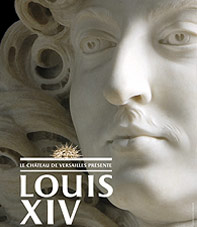 For the first time, a major exhibition is devoted to Louis XIV, the king’s personality, his personal tastes. This exhibition, Louis XIV: The Man and the King, brings together more than 300 exceptional works coming from collections all over the world and never shown together before. Paintings, sculptures, objets d’art and furniture will be exhibited. These masterpieces, some of which have never been presented in France since the days of the Ancien Régime, will enable visitors to get to know the famous monarch better in both his personal tastes and through his public image.
The King’s Public Image
The richness of the image of Louis XIV has no precedent in history: Louis XIV is the Sun King, i.e. Apollo as the sun god. Fashioned by the king himself and his counsellors, this image constantly evolved to convey emblematic figures of the royal power: the king of war leading his troops, the patron king and protector of the arts, the very Christian king and Defender of the Church, the king of glory, an image constructed for posterity. This visible glory, given mythical proportions, which was constructed during his lifetime, took shape thanks to the excellence of the artists chosen, such as Bernini, Girardon, Rigaud, Cucci, Gole, Van der Meulen and Coysevox who set out to sublimate the royal portrait, which the exhibition allows the visitors to rediscover.
The King’s Taste
He saw himself as a king who was the protector of the arts and a collector, competing with other sovereigns of Europe who were also genuine connoisseurs. Benefiting from the example of Mazarin, Louis XIV formed his taste in direct contact with artists, and through the personal relations that he established with them: Le Brun and Mignard in painting, Le Vau and Hardouin-Mansart in architecture, Le Nôtre in the art of gardens, Lully in music, and Molière in theatre. By assembling the works appreciated by the king, a genuine portrait emerges of a passionate lover of the arts and a man of good taste through the jewels, cameos, medals, miniatures and objets d’art, as well as the paintings and sculptures that he loved to surround himself within the Petit Appartement in Versailles.
Accompanying the show is a tapestry exhibition, Royal Pomp, Louis XIV’s Tapestry Collection, at the Gobelins Gallery in Paris.
◊ ◊ ◊ ◊ ◊
Reviews and notices of the exhibition can be found at Newsweek, the Telegraph, and The New York Times. The catalogue, Louis XIV, l’homme et le roi (Skira-Flammarion, 2009; ISBN: 9782081228108) is available through Michael Shamansky’s artbooks.com.










leave a comment