Print Quarterly, December 2022
The long eighteenth century in the latest issue of Print Quarterly:
Print Quarterly 39.4 (December 2022)
A R T I C L E S • Antony Griffiths and Giorgio Marini, “Some Italian Importers of British Prints in the 1780s,” pp. 412–22. “There is little evidence of interest or awareness of British printmaking in Italy before the last quarter of the eighteenth century. In those years, however, things began to change with remarkable speed. The purpose of this article is to draw attention to five importers of British prints—Molini in Florence, Micali in Livorno (Leghorn), Montagnani in Rome, and Viero and Wagner, both in Venice—all of whom produced catalogues of their imported stock within the five years between 1785 and 1789. When considered as a group, these catalogues give evidence of how quickly dealers were able to import newly published stock and how varied tastes were in these years” (412). N O T E S A N D R E V I E W S
• Giorgio Marini, Note of the exhibition catalogue Delfín Rodríguez Ruiz and Helena Pérez Gallardo, eds., Giovanni Battista Piranesi en la Biblioteca Nacional de España (Biblioteca Nacional de España, Madrid, 2019), pp. 444–46.
• Laurence Lhinares, Note on the Print Collection of Horace His de La Salle (1795–1878), occasioned by the exhibition Officier et Gentleman: La Collection Horace His de La Salle (Louvre, 2019–20) and the recent purchase by the Fondation Custodia of a copy of the 1856 sale catalogue of the collector’s prints, pp. 446–50.
• Paul Coldwell, Note on Elizabeth Jacklin, The Art of Print: Three Hundred Years of Printmaking (Tate, 2021), pp. 450–51.
• Rachel Sloan, Note on Kinga Bódi and Kata Bodor, eds., The Paper Side of Art: Eight Centuries of Drawings and Prints in the Collections of the Museum of Fine Arts – Hungarian National Gallery, Budapest (2021), pp. 451–52.
• Anne Leonard, Review of the exhibition catalogue, Rena Hoisington, Aquatint: From Its Origins to Goya (National Gallery of Art / Princeton University Press, 2021), pp. 466–71. The catalogue won the 2022 IFPDA book award and discusses many notable innovators in the aquatint medium, including Giovanni David and Maria Catharina Prestel.
N O T E S A N D R E V I E W S
• Giorgio Marini, Note of the exhibition catalogue Delfín Rodríguez Ruiz and Helena Pérez Gallardo, eds., Giovanni Battista Piranesi en la Biblioteca Nacional de España (Biblioteca Nacional de España, Madrid, 2019), pp. 444–46.
• Laurence Lhinares, Note on the Print Collection of Horace His de La Salle (1795–1878), occasioned by the exhibition Officier et Gentleman: La Collection Horace His de La Salle (Louvre, 2019–20) and the recent purchase by the Fondation Custodia of a copy of the 1856 sale catalogue of the collector’s prints, pp. 446–50.
• Paul Coldwell, Note on Elizabeth Jacklin, The Art of Print: Three Hundred Years of Printmaking (Tate, 2021), pp. 450–51.
• Rachel Sloan, Note on Kinga Bódi and Kata Bodor, eds., The Paper Side of Art: Eight Centuries of Drawings and Prints in the Collections of the Museum of Fine Arts – Hungarian National Gallery, Budapest (2021), pp. 451–52.
• Anne Leonard, Review of the exhibition catalogue, Rena Hoisington, Aquatint: From Its Origins to Goya (National Gallery of Art / Princeton University Press, 2021), pp. 466–71. The catalogue won the 2022 IFPDA book award and discusses many notable innovators in the aquatint medium, including Giovanni David and Maria Catharina Prestel.
The Burlington Magazine, November 2022
The eighteenth century in the November issue of The Burlington . . .
The Burlington Magazine 164 (November 2022) — Sculpture

Massimiliano Soldani Benzi, Lamentation over the Dead Christ, 1690–92(?), gilded bronze, 57 × 40 cm (Córdoba Cathedral).
E D I T O R I A L
• The Parthenon Sculptures, p. 1063.
A R T I C L E S
• Fernando Loffredo, “Soldani’s Lamentation in Córdoba,” pp. 1118–22.
R E V I E W S
• Colin Bailey, Review of the exhibition catalogue, Renoir: Rococo Revival (Städel Museum, Frankfurt am Main, 2022), pp. 1150–53.
• Joseph Connors, Review of Livio Pestilli, Bernini and His World: Sculpture and Sculptors in Early Modern Rome (Lund Humphries, 2022), pp. 1160–62. [Pestilli “mines the correspondence of the directors of the Académie de France and sorts through student drawings in the Accademia de San Luca to find that well into the eighteenth century Bernini was copied more than any other artist” (1162).]
• Jamie Mulherron, Review of Alexandre Maral and Valérie Carpentier-Vanhaberbeke, Antoine Coysevox (1640–1720): Le sculpteur du Grand Siècle (Arthena, 2020), pp. 1165–66.
• Hugo Chapman, Review of Carel van Tuyll van Serooskerken, The Italian Drawings of the Seventeenth and Eighteenth Centuries in the Teyler Museum (Primavera Pers, 2021), pp. 1166–67.
• Christopher Martin Vogtherr, Review of Sarah Salomon, Die Kunst der Außenseiter: Ausstellungen und Künstlerkarrieren im absolutistischen Paris jenseits der Akademie (Wallstein Verlag, 2021), pp. 1167–68. [Salomon’s book focuses on four institutions: the Académie de Saint-Luc, the Colisée, the Salon de la Correspondence, and the Exposition de la Jeunesse.]
• Stephen Lloyd, Review of Magnus Olausson, Miniature Painting in the Nationalmuseum: A World-Class Collection (Nationalmuseum Stockholm, 2021), pp. 1168–70.
O B I T U A R I E S
• Michael Hall, Obituary for Mark Girouard (1931–2022), pp. 1171–72.
Exhibition | Promenades on Paper: 18th-C. French Drawings
From The Clark:
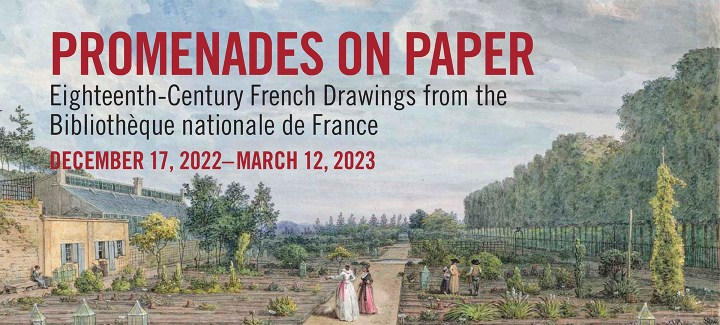
Promenades on Paper: 18th-Century French Drawings from the Bibliothèque Nationale de France
Promenades de papier: Les collections de dessins du 18e siècle de la BnF
The Clark Art Institute, Williamstown, MA, 17 December 2022 — 12 March 2023
Musée des Beaux-Arts de Tours, 13 May — 28 August 2023
Curated by Esther Bell, Sarah Grandin, Anne Leonard, Corinne Le Bitouzé, Pauline Chougnet, and Chloé Perrot
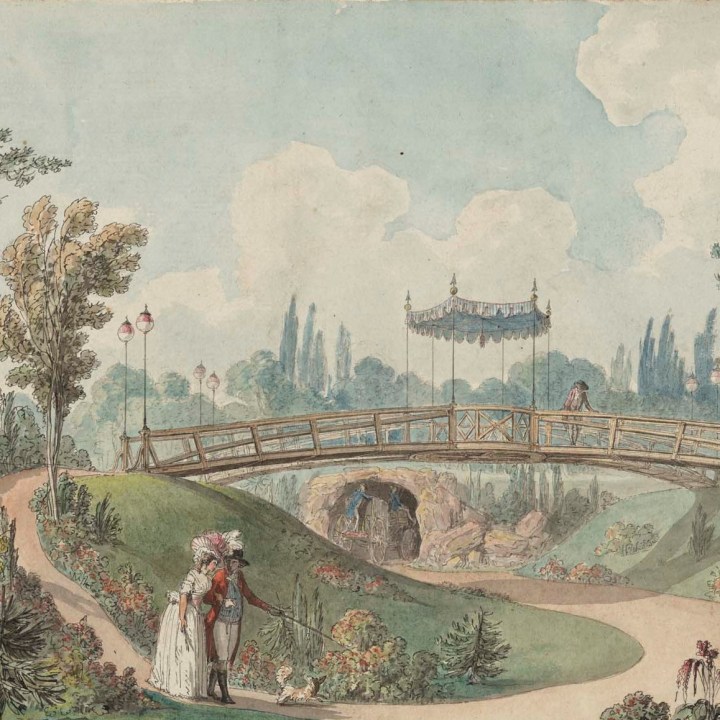
François-Joseph Bélanger, The Garden of Beaumarchais, 1788, watercolor and pen and ink (Bibliothèque nationale de France).
In partnership with the Bibliothèque nationale de France (BnF), the Clark is organizing the first exhibition of the library’s eighteenth-century French drawings. The selection of eighty-six enchanting studies, architectural plans, albums, sketchbooks, prints, and optical devices expands our understanding of drawing as a tool of documentation and creation in the age of Enlightenment, spanning the domains of natural history, current events, theater design, landscape, and portraiture. Displayed together, these objects immerse audiences in the world of eighteenth-century France—a world shaped by invention, erudition, and spectacle. Works by celebrated artists of the period such as François Boucher (1703–1770) and Gabriel de Saint-Aubin (1724–1780) are featured alongside exquisite drawings by lesser-known practitioners, including talented women, royal children, and visionary architects.
Promenades on Paper: Eighteenth-Century French Drawings from the Bibliothèque nationale de France is co-organized by the Clark Art Institute, Williamstown, Massachusetts, and the Bibliothèque nationale de France, Paris. It is curated by Esther Bell, Deputy Director and Robert and Martha Berman Lipp Chief Curator; Sarah Grandin, Clark-Getty Curatorial Fellow; and Anne Leonard, Manton Curator of Prints, Drawings, and Photographs from the Clark, and by Corinne Le Bitouze, Conservateur général; Pauline Chougnet, Conservateur en charge des dessins; and Chloé Perrot, Conservateur des bibliothèques from the Bibliothèque nationale.
This exhibition is made possible by Jessie and Charles Price. Major funding is provided by Elizabeth M. and Jean-Marie Eveillard, the Getty Foundation through its Paper Project initiative, and the Samuel H. Kress Foundation. The exhibition catalogue is made possible by Denise Littlefield Sobel.
Esther Bell, Pauline Chougnet, Sarah Grandin, Charlotte Guichard, Corinne Le Bitouzé, Anne Leonard, and Meredith Martin, Promenades on Paper: Eighteenth-Century French Drawings from the Bibliotheque nationale de France (Williamstown: Clark Art Institute, 2023), 272 pages, ISBN: 978-0300266931, $50.
◊ ◊ ◊ ◊ ◊
Note (added 12 June 2023) — The posting was updated to include the Tours venue.
Exhibition | Clara the Rhinoceros
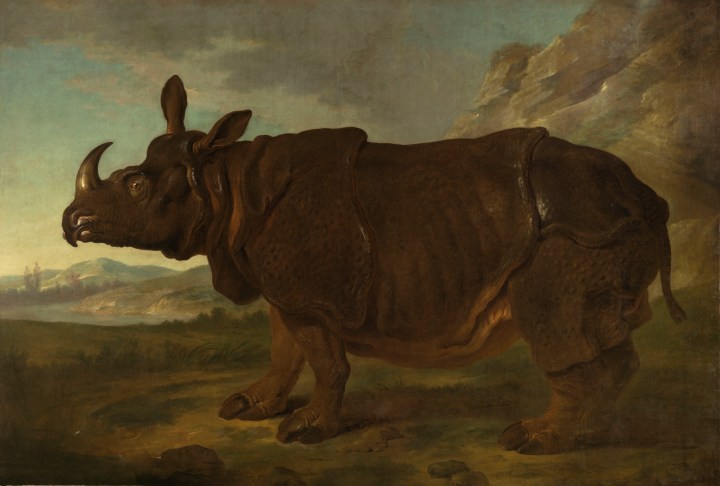
Jean-Baptiste Oudry, Clara, the Rhinoceros, 1749, oil on canvas, 306 × 453 cm
(Staatliches Museum Schwerin)
◊ ◊ ◊ ◊ ◊
From the press release (11 July 2022) for the exhibition:
Clara the Rhinoceros: Superstar of the 18th Century / Clara de Neushoorn: Superster van de 18e eeuw
Rijksmuseum, Amsterdam, 30 September 2022 — 15 January 2023
Curated by Gijs van der Ham
Clara was strange and new, huge and awe-inspiring—she was utterly unlike any other known animal. This fall, the Rijksmuseum presents Clara the Rhinoceros, an exhibition about an animal who travelled far from her native land of India and became the most famous rhinoceros in the world.
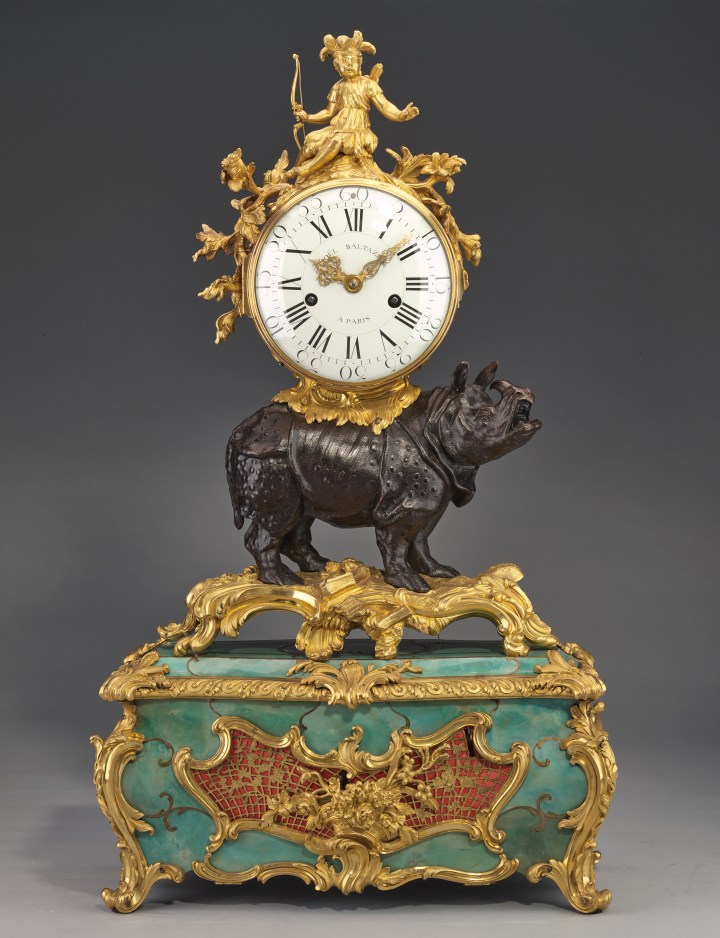
Saint-Germain, J.J., and F. Viger, Clock with Rhinoceros as Carrier, 1755 (Parnassia Collection).
The exhibition shows how new knowledge changed perceptions of the rhinoceros, and how art played its part in this process. The 60 objects on display include paintings, drawings, medals, statues, books, clocks, and a goblet. Very few of these artworks have been displayed before in the Netherlands, and never before have so many exceptional objects devoted to Clara the rhinoceros being presented together. They range from the first-ever European print depicting a rhinoceros—made in 1515 by Albrecht Dürer—to a life-size, full-length portrait of Clara by Jean-Baptiste Oudry dating from 1749. Clara the Rhinoceros runs from 30 September 2022 to 15 January 2023 in the Phillips Wing of the Rijksmuseum.
Clara may not have been the first rhinoceros to come to Europe, but she did become the most famous one. After her long voyage from India, in 1741 she arrived in Amsterdam. Her owner, Douwe Mout van der Meer, was soon showing her to anyone who would pay for the pleasure, whether at fairs, markets, carnivals, or royal courts. For the next 17 years she travelled around Europe in a custom-made cart, accompanied by her entourage. She travelled far and wide: to Vienna and Paris, and to Naples and Copenhagen. Upon her return to the Netherlands, she lived in a field in the North district of Amsterdam. Eventually, Clara died in London in 1758.
People touched, teased, admired, and studied Clara. She prompted this sensational level of interest because no one in Europe had ever been able to see a real live rhinoceros. She was a hyped up, must-see cultural phenomenon, and Mout used print advertising and medals to pump that hype to the max. Until Clara’s arrival, all that Europeans knew of her species was from a print made by Dürer in 1515. He based his drawing on a sketch of a rhinoceros that was briefly in Lisbon, though the sketch wasn’t entirely accurate: it depicted the rhinoceros with an extra horn on its back, for example, and skin that resembled a suit of armour.
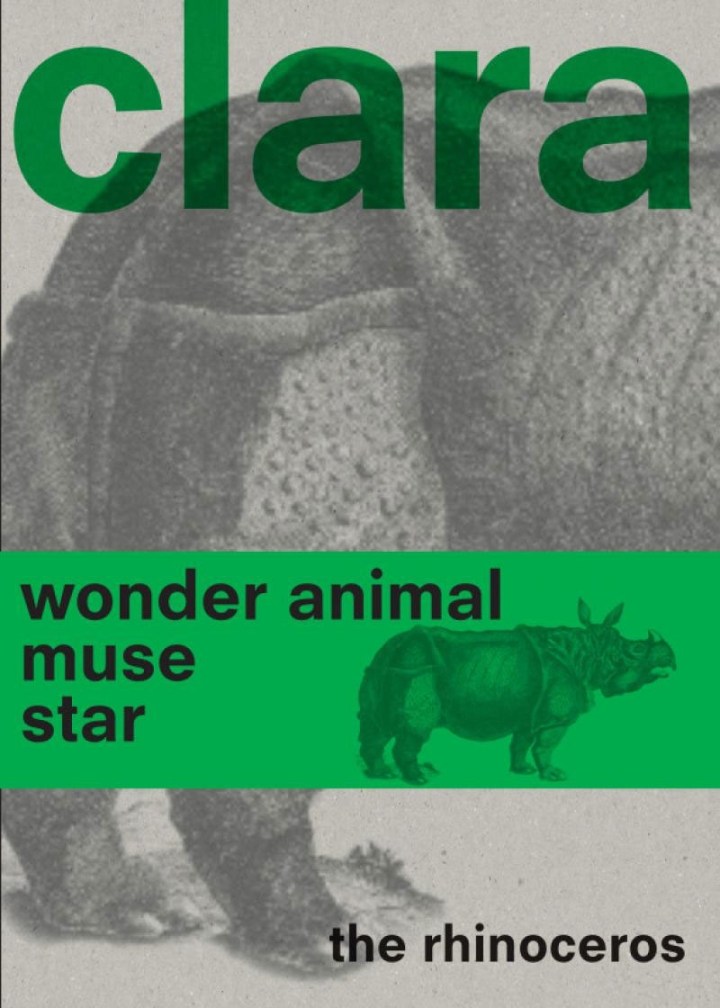 Clara’s appearance on the scene changed all this, leaing to a better understanding of the rhinoceros and to more accurate portrayals. Scholars studied her in minute detail, from head to tail, and artists became fascinated by every fold of her skin. A remarkable number of likenesses were made of Clara, in many forms and using many different materials. This exhibition presents an outstanding selection of these objects, including an impressive life-size portrait painted in Paris in 1749 by Oudry (on loan from Staatliches Museum Schwerin), a painting by Pietro Longhi showing Clara standing in front of her audience in Venice (from Ca’ Rezzonico, Venice), a large marble statue by the Flemish artist Pieter Anton Verschaffelt (from the Rothschild collection at Waddesdon Manor), and an exceptionally rare clock mounted on a Clara figure (from a private Dutch collection) made by the Parisian bronzier and clockmaker Jean-Joseph de Saint-Germain.
Clara was almost never free to walk or run. She depended on humans for her survival, and was rarely able to display natural behaviours—except for example the occasions when she needed to cross a river by swimming, and clearly enjoyed the water. In 1750 the Neurenberg biographer Christoph Gottlieb Richter published a conversation between a rhinoceros and a grasshopper, in which the rhinoceros bemoans the way people treat her and stare at her. This book presents a role-reversal, with the rhinoceros appraising and studying people rather than the other way around. And in her 2016 installation Clara, the contemporary artist Rossella Biscotti uses the rhinoceros’s story to interrogate the relationship between humans and animals. The installation, which is also part of the exhibition, shows that Clara’s story is also about colonialism, exoticism, and globalisation, as well as exploitation and power.
The exhibition design for Clara the Rhinoceros and Crawly Creatures is by stage designer Theun Mosk | Ruimtetijd. Graphic design for the exhibition is by Irma Boom.
Gijs van der Ham, Clara the Rhinoceros (Rotterdam: nai101, 2023), 208 pages, ISBN: 978-9462087477, $40.
Exhibition | Process: Design Drawings, 1500–1900
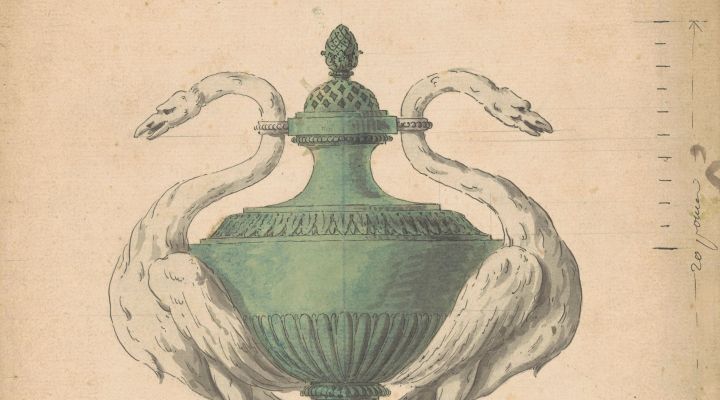
Design drawing for a patinated bronze vase, anonymous, ca. 1780
(Amsterdam: Rijksmuseum)
◊ ◊ ◊ ◊ ◊
From the museum:
Process: Design Drawings from the Rijksmuseum, 1500–1900
Créer: Dessiner pour les arts décoratifs, 1500–1900
Design Museum Den Bosch, Rijksmuseum, Amsterdam, 5 November 2022 — 12 February 2023
Fondation Custodia / Collection Frits Lugt, Paris, 25 February — 14 May 2023
Curated by Reinier Baarsen
This pioneering exhibition is an opportunity to discover a collection of extraordinary design drawings from the Rijksmuseum. The drawings, which date from the period 1500–1900, have been brought together for the first time and are arranged according to the successive stages of the design process.
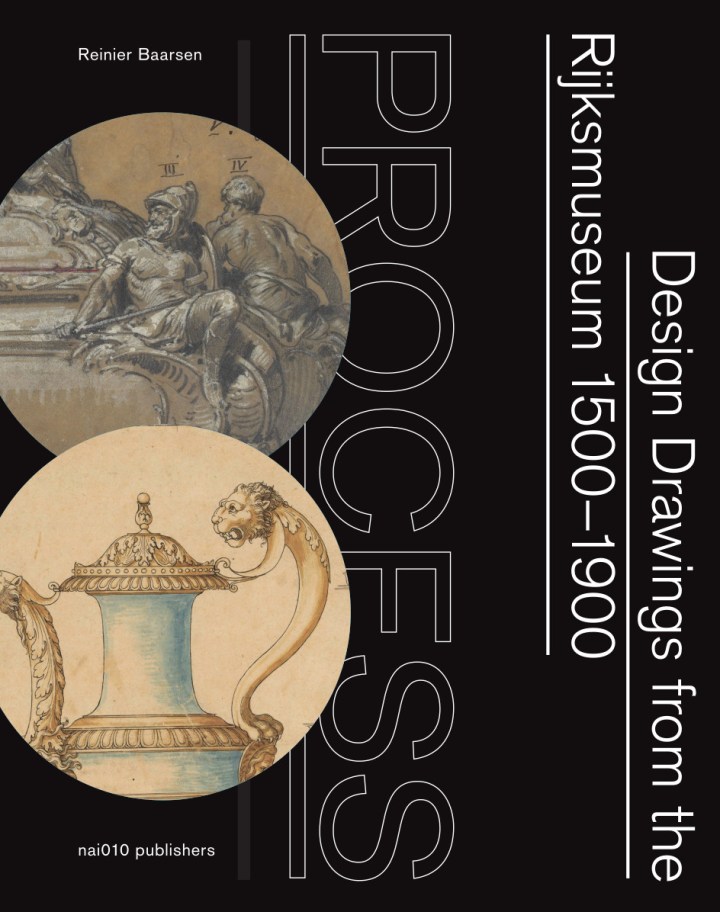 The focus here is not on big artistic names, but on the crucial role that drawings have played in design. We watch from close-by as the ideas for all sorts of items are formed and we also get to meet their inventors, makers, and patrons. Drawings of vases, chairs and clocks, stoves, sledges, and carriages are shown, from the first rough pencil sketches to beautifully worked-up and colourful presentations. The drawings in this exhibition were recently acquired by the Rijksmuseum in Amsterdam, where they belong to a special collection established by Senior Curator Reinier Baarsen. He offers us a unique insight here into the role that drawing has played in the design process, as well as the superb drawings it has produced.
Reinier Baarsen, Process: Design Drawings from the Rijksmuseum, 1500–1900 (Rotterdam: nai101, 2022), 464 pages, SBN 978-9462087354, €60 / $70.
◊ ◊ ◊ ◊ ◊
Note (added 28 February 2023) — The posting was updated to include the Fondation Custodia as a second venue.
Exhibition | Silver City: 500 Years of Portsmouth’s History
Now on view at the Portsmouth Museum and Art Gallery:
Silver City: 500 Years of Portsmouth’s History
Portsmouth Museum and Art Gallery, 28 May 2022 — 26 February 2023
Curated by James Daly and Susan Ward
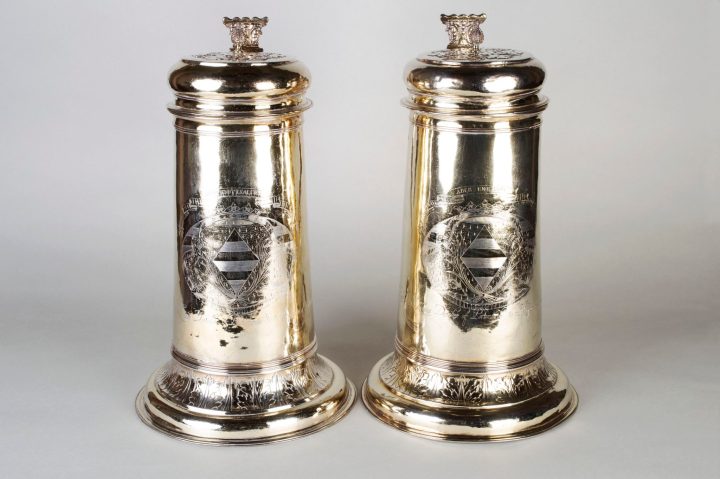
Portsmouth Flagons, made in 1683 by Wolfgang Howzer and presented to Portsmouth by Louise de Kéroualle, the Duchess of Portsmouth. She was one of Charles II’s mistresses and presented the Flagons to Portsmouth when she was made duchess, although there is no record of her having visited the town.
Silver City: 500 Years of Portsmouth’s History is a major exhibition at Portsmouth Museum and Art Gallery, telling the story of the city through amazing silver treasures. It showcases many precious objects that have never been on public display before. Most come from the city’s civic collection, but others have been loaned from the Royal Navy, the city’s Anglican cathedral, and the Goldsmiths’ Company Charity. Objects include a model of HMS Victory presented to the city when the Portsmouth Command of the Royal Navy was awarded the Freedom of the City in 1965. It is made from copper taken from the ship and plated in silver.
James Daly and Susan Ward, Silver City: 500 Years of Portsmouth’s History (Portsmouth: Tricorn Books, 2022), 161 pages, ISBN: 978-914615276, £27.
◊ ◊ ◊ ◊ ◊
Frances Parton’s review of the exhibition appeared in October issue of The Burlington Magazine, pp. 1015–17.
Exhibition | ‘Without Hands’: The Art of Sarah Biffin
Now on view at Philip Mould in London:
‘Without Hands’: The Art of Sarah Biffin
Philip Mould & Company, London, 1 November — 21 December 2022
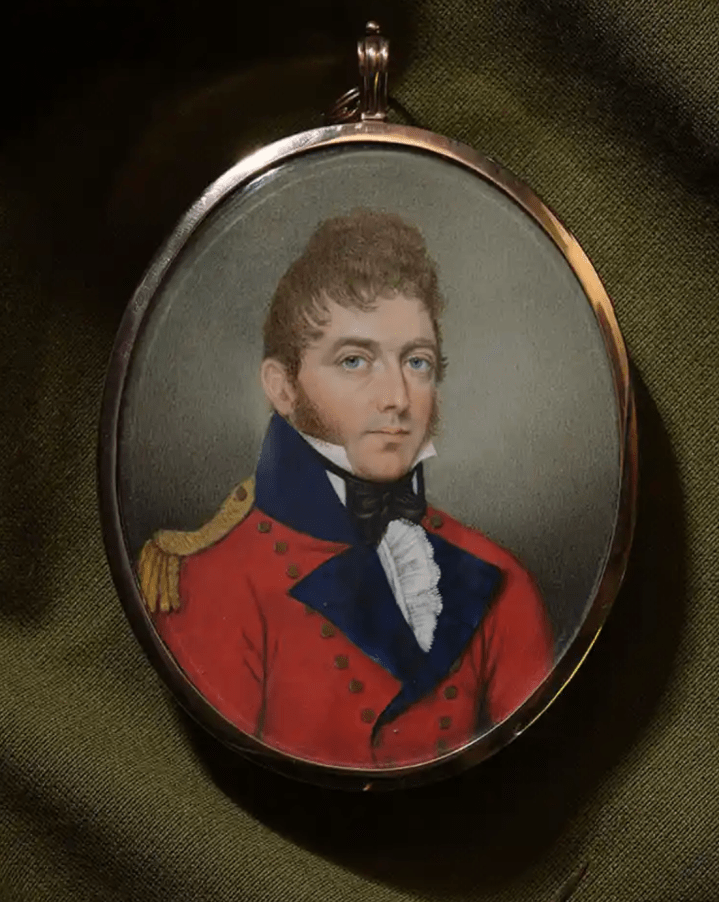
Sarah Biffin, A miniature watercolour of subaltern or captain of a British ‘royal’ regiment of line infantry by, ca. 1815–20.
The remarkable story of Sarah Biffin (1784–1850), has been largely overlooked by historians. Those who have attempted to illustrate her life have often perpetuated misconceptions, and Biffin’s artistic reputation has suffered as a result. This exhibition, established upon ground-breaking primary research, is the first of its kind to present Biffin’s artistic achievements and represent her history.
Sarah Biffin (or Beffin) was born into a farming family in Somerset in 1784, where her baptism records state that she was “born without arms and legs.” Teaching herself to write and draw from a young age, Biffin rose to fame as an artist and established a professional career as a portrait painter. Throughout her long and successful career, she travelled extensively, took commissions from royalty, and recorded her own likeness through exquisitely detailed self-portraits. Her artworks—many proudly signed “Without Hands”—are a testament to her talent and accomplishment.
Around the age of twenty, Biffin left home. She contracted herself to a ‘Mr Dukes’ who toured the country with Biffin, visiting county fairs where she was described as the “Eighth Wonder.” Using her mouth and shoulder, Biffin would sew, write, and paint watercolours and portrait miniatures in front of crowds who turned up and left with a sample of her writing included in the cost of their ticket. One such spectator was the wealthy and well-connected Earl of Morton, who supported her in her quest to finesse her artistic skills. In her mid-twenties she began formal tuition with a miniature painter, William Marshall Craig. From 1816 she set herself up as an independent artist and later took commissions from nobility and royalty.
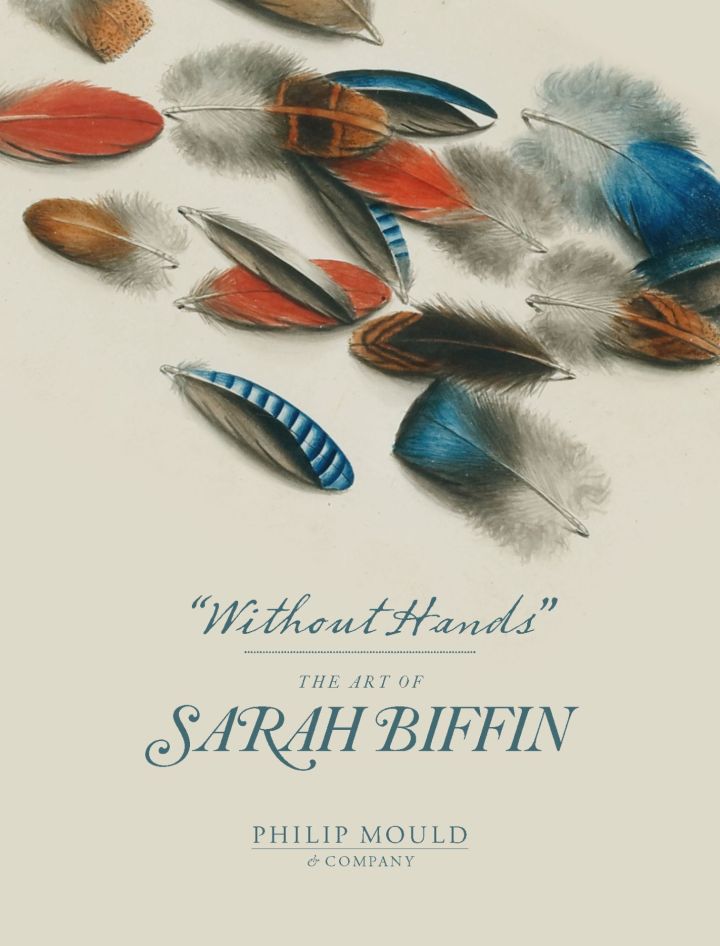 Biffin travelled extensively, exhibiting her artwork and taking commissions all over the country and abroad. She took studios in cities including London, Brighton, Birmingham, Cheltenham, and Liverpool. In each of these cities, she taught the art of miniature painting and was a champion of women students in particular. Continuously recording her own image throughout her lifetime, Biffin’s self-portraits evidence the artistic aptitude, self-respect, and skill of this tenacious artist.
Following the story of her life, the exhibition includes original handbills and broadsides from Biffin’s time in travelling fairs, along with the samples of her writing included in the cost of the entry tickets. Visitors to the exhibition will also be able to see examples of the art from her professional career, including portraits, landscapes, and highly-skilled still lifes. More personal exhibits include private letters (including one to her mother) and almost every self-portrait she ever painted. With advisor, artist Alison Lapper MBE (born 180 years later with the same condition); consultant and contributor, Professor Essaka Joshua (specialist in Disability Studies at the University of Notre Dame, Indiana); and loans from national institutions, the exhibition will celebrate Biffin as a disabled artist who challenged attitudes to disability.
The catalogue is published by PHP and distributed by The University of Chicago Press:
Emma Rutherford and Ellie Smith, eds., with contributions by Essaka Joshua, Alison Lapper, and Elle Sushan, ‘Without Hands’: The Art of Sarah Biffin (London: Paul Holberton, 2022), 80 pages, ISBN: 978-1913645366, £18 / $25.
Emma Rutherford is a portrait miniatures consultant at Philip Mould & Company in London. Ellie Smith is a researcher at Philip Mould & Company. Professor Essaka Joshua is a specialist in disability studies at the University of Notre Dame, Indiana. Based in Brighton, Alison Lapper is an artist, television presenter, speaker, and Gig-Arts Charity patron. Elle Shushan is a specialist, author, lecturer, and museum consultant in Philadelphia.
Exhibition | Archive of the World: Spanish America, 1500–1800
The exhibition closes at LACMA this weekend, but the catalogue remains available, and a version of the show will open at Nashville’s Frist Art Museum this time next year and then in Saint Louis in 2024.
Archive of the World: Art and Imagination in Spanish America, 1500–1800
Los Angeles County Museum of Art, 12 June — 30 October 2022
Frist Art Museum, Nashville, 20 October 2023 — 28 January 2024
Saint Louis Art Museum, 22 June — 1 September 2024
Curated by Ilona Katzew
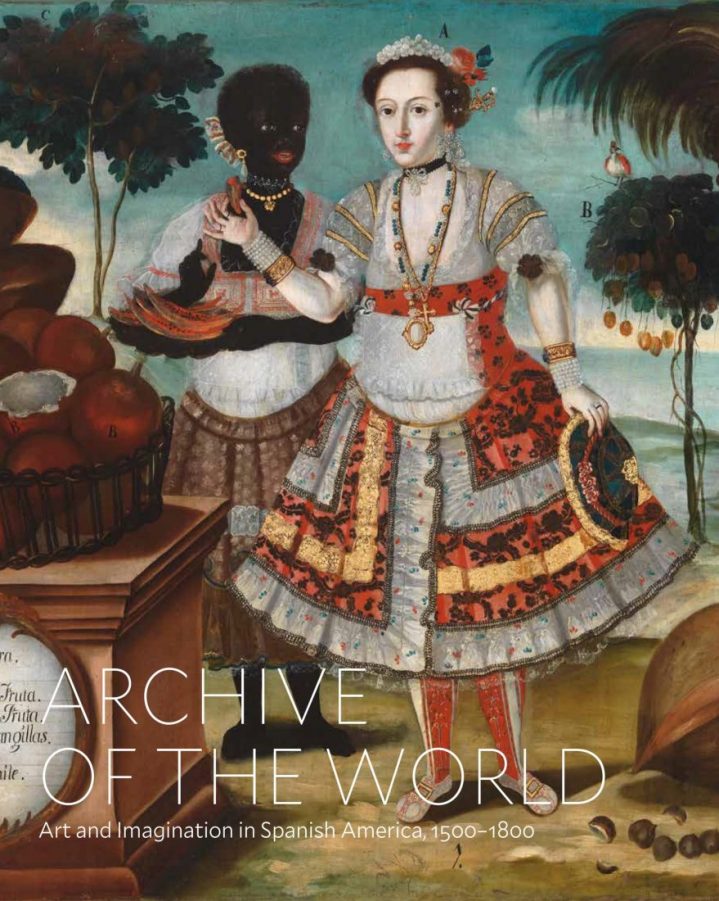 Archive of the World: Art and Imagination in Spanish America, 1500–1800 is the first exhibition of LACMA’s notable holdings of Spanish American art. Following the arrival of the Spaniards in the Americas in the 15th century, the region developed complex artistic traditions that drew on Indigenous, European, Asian, and African art. The Spanish conquest of the Philippines in 1565 inaugurated a commercial route that connected Asia, Europe, and the Americas. Private homes and civic and ecclesiastic institutions in Spanish America were filled with imported and locally made objects. Many local objects also traveled across the globe, attesting to their wide appeal. This confluence of riches signaled the status of the Americas as a major emporium—what one author described as “the archive of the world.” Featuring approximately 90 works, including several recent acquisitions, the exhibition emphasizes the creative power of Spanish America.
Following its presentation at LACMA, Archive of the World: Art and Imagination in Spanish America, 1500–1800 will be on view at the Frist Art Museum, Nashville, from 20 October 2023 through 28 January 2024.
The press release is available as a PDF file here»
Ilona Katzew, ed., Archive of the World: Art and Imagination in Spanish America, 1500–1800, Highlights from LACMA’s Collection (New York: DelMonico Books, 2022), 391 pages, ISBN: 978-1636810201, $85. With contributions by Ilona Katzew, Pablo F. Amador Marrero, Rafael Barrientos Martínez, Patricia Díaz Cayeros, Carlos F. Duarte, Clarissa M. Esguerra, Cristina Esteras Martín, Alejandra Mayela Flores Enríquez, Aaron M. Hyman, Rachel Kaplan, Paula Mues Orts, Jeanette Favrot Peterson, Elena Phipps, JoAnna M. Reyes, Maya Stanfield-Mazzi, Edward J. Sullivan, and Luis Eduardo Wuffarden. Designed by Lorraine Wild and Xiaoqing Wang, Green Dragon Office.
◊ ◊ ◊ ◊ ◊
Note (added 13 June 2024)— The posting was updated to include the Saint Louis Art Museum as a venue; there, the exhibition is entitled simply Art and Imagination in Spanish America, 1500–1800, Highlights from LACMA’s Collection.
The Burlington Magazine, September 2022
The eighteenth century in the September issue of The Burlington . . .
The Burlington Magazine 164 (September 2022)
 E D I T O R I A L
• “A Practical Guide to Restitution,” p. 835.
A R T I C L E S
• Rahul Kulka, “Counter-Reformation Ambers: Friedrich Schmidt’s Workshop in Kretinga, Lithuania,” pp. 839–53.
On the basis of a unique signed and dated domestic altarpiece it has been possible to attribute a significant body of work to the amber workshop of Friedrich Schmiddt, who worked in Kretinga in the seventeenth century. They include a reliquary of St Casimir given in 1678 with other works in amber to Grand Duke Cosimo III of Tuscany by the Bishop-Elect of Vilnius, Mikolajus Steponas Pacas.
• Aurora Laurenti, “Nicolas Pineau as a Designer of Ornament Prints,” pp. 864–73.
Although designs by the woodcarver Nicolas Pineau in publication by Jean Mariette and Jacques-François Blondel played a significant role in the creation and dissemination of the Rococo style in the first half of the eighteenth century, they have never been studied in detail and their sequence and chronology have remained uncertain.
R E V I E W S
• Alison Wright, Review of the exhibition Gold (British Library, 2022), pp. 910–12.
• Philippe Bordes, Review of the exhibition Le Voyage en Italie de Louis Gauffier (Montpellier, 2022) and the catalogue raisonné by Anna Ottani Cavina and Emilia Calbi, Louis Gauffier: Un pittore francese in Italia (Silvana Editoriale, 2022), pp. 915–18.
• Ariane Varela Braga, Review of Dario Gamboni, Jessica Richardson, and Gerhard Wolf, The Aesthetics of Marble: From Late Antiquity to the Present (Hirmer, 2021), p. 934.
• Celia Curnow, Review of J.V.G. Mallet and Elisa Sani, eds., Maiolica in Italy and Beyond: Papers of a Symposium held at Oxford in Celebration of Timothy Wilson’s Catalogue of Maiolica in the Ashmolean Museum (Ashmolean Museum, 2021), pp. 937–38.
• François Marandet, Review of Delphine Bastet, Les Mays de Notre-Dame de Paris, 1630–1707 (Arthena, 2021), pp. 938–40.
• John Bold, Review of Christina Strunck, Britain and the Continent 1660–1727: Political Crisis and Conflict Resolution in Mural Paintings at Windsor, Chelsea, Chatsworth, Hampton Court and Greenwich (De Gruyter, 2021), pp. 940–41.
• Mark Stocker, Review of Matthew Potter, Representing the Past in the Art of the Long Nineteenth Century: Historicism, Postmodernism, and Internationalism (Routledge, 2021), pp. 941–42.
• Yuriko Jackall, Review of Alan Hollinghurst and Xavier F. Salomon, Fragonard’s Progress of Love (Frick Collection, 2022), pp. 945–46.
O B I T U A R I E S
• Tim Knox, Obituary for John Harris (1931–2022), pp. 950–52.
Symposium | Early Modern Global Political Art
From the Krannert Art Museum:
Early Modern Global Political Art
In-person and online, Krannert Art Museum, University of Illinois, Urbana-Champaign, 20–21 October 2022
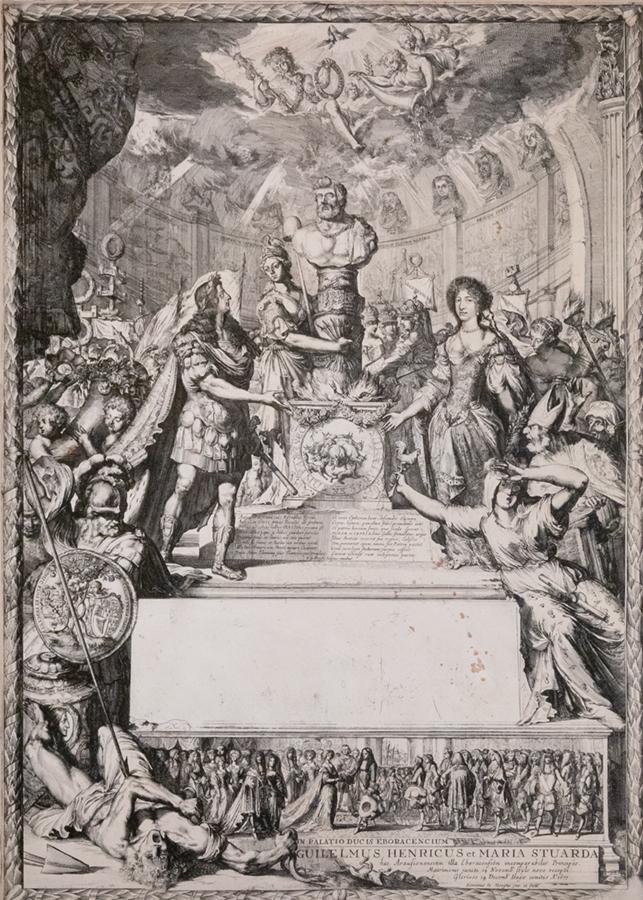
Romeyn de Hooghe, Marriage of William and Mary, 1677, etching (Krannert Art Museum, 2019.7.7).
Featuring emerging scholarship on the art of this period against the backdrop of the exhibition Fake News & Lying Pictures: Political Prints in the Dutch Republic, Krannert Art Museum hosts a symposium on Early Modern Global Political Art.
In the early modern period, nations, nobles, corporations, religious groups, and others found dynamic and innovative ways to use the visual arts for a wide range of political purposes. Nations dispatched elaborate diplomatic gifts to initiate and consolidate alliances. Aristocratic powers and individual collectors alike amassed collections to convey and enhance their political and economic power. Courts and cities produced ephemeral decorations to assert and display ideal political relations between nobility and their subjects, and between regional and outside authorities. Broadsheets addressing factional conflicts within and among institutions proliferated with the expansion of affordable print media. This symposium will investigate visual media that communicated political ideas, arguments, positions, and forms of resistance in the early modern period.
The event will be hybrid, blending in person presentations with online presentations via Zoom to facilitate greater accessibility and wider participation. All virtual components will be live captioned in English via Zoom. If you have a question or an accessibility request, please email us at kam-accessibility@illinois.edu. Registration is required for virtual and in-person components of the symposium.
Keynote Speakers
Dawn Odell (Lewis & Clark College) — Dr. Odell studies artistic exchange between China and northern Europe in the 17th and 18th centuries. She is currently writing a book on Andreas Everardus van Braam Houckgeest, an 18th-century Dutch Immigrant to the newly formed United States whose travelogues and Chinese porcelain collection were leveraged for social and political power.
Liza Oliver (Wellesley College) — Dr. Oliver’s research focuses on 18th- and 19th-century India, Europe, and the West Indies. Her current projects include the book Empire of Hunger: Representing Famine, Land, and Labor in Colonial India and work about British prints about abolition and the Haitian Revolution.
T H U R S D A Y , 2 0 O C T O B E R 2 0 2 2
9.00 Catholic Rulership around the World, Part One
• Moyun Zhou (PhD Candidate, University of Hong Kong), Can You Feel Me? The Global Space of St. Paul’s in Macao, 1592–1644
• Maria Vittoria Spissu (Senior Assistant Professor, University of Bologna and Marie Skłodowska-Curie Global Fellow), Bonds and Tenets in the Wider Iberian Catholic Universe: Fostering Political Unanimity by Means of Early Modern Altarpieces and Books
• Małgorzata Biłozór-Salwa (Curator of Old Master Drawings, University of Warsaw Library), Let’s Make A Crusade! Power of Images Under Louis XIII
10.20 Fashion, Part One
• Isabel Escalera (PhD Candidate, University of Valladolid), Jewelry as A Political Instrument: Renaissance Women and the Transmission of Their Power
• Diana Lucía Gómez-Chacón (Faculty, Complutense University of Madrid), Fashion as A Political Art: Gender, Monarchy, and Spectacle in Early Modern Castile
11.15 Negotiating Political Power in Republics
• Răzvan-Iulian Rusu (Graduate Student, Utrecht University), Global Gifts of Johan Maurits: Patronage, Image-Formation, Art & Material Culture
• Laura Blom (Postdoctoral Fellow, Dutch University Institute for Art History, Florence), Death as Dissent: The Macabre and the Medici in Renaissance Florence
5.30 Keynote Lecture
• Liza Oliver (Associate Professor of Art, Wellesley College), An Economy of Sentiment: The Shared Language of Abolitionists and the West India Interest in Late 18th-Century British Print Culture link»
This talk considers how spectatorial sympathy, a governing principle of 18th-century British art and literature, was deployed by opposing sides of the debate on Britain’s slave trade in the decades preceding its abolition. Considering broadsides, travel narratives, and caricatures, it argues for the ways in which sentiment became a common visual currency among both abolitionists and the pro-slavery lobby, with each side respectively seeking to sever or reaffirm the connection between morality on the one hand and self-interest and economic prosperity on the other.
F R I D A Y , 2 1 O C T O B E R 2 0 2 2
9.30 Coffee
10.00 Catholic Rulership around the World, Part Two
• Rachel Wise (2020 PhD in Art History, University of Pennsylvania), A Royal Devotion: Printed Habsburg Propaganda and the 80 Years’ War
• Angela Ho (Associate Professor, George Madison University), Risks and Payoffs: Ferdinand Verbiest’s World Map for Kangxi in Political Context
11.00 Fashion, Part Two
• Heather Hughes (Curator of Prints, Philadelphia Museum of Art), Recognizing the Enemy: The Spaniard in Dutch and Flemish Costume Prints
• Nancy Karrels (2022 PhD in Art History, University of Illinois Urbana-Champaign), Women for Bonaparte: Political Prints and Female Self-Fashioning in France’s Cultural Conquests
12.00 Lunch Break
1.30 Keynote
• Dawn Odell (Associate Professor of Art History, Lewis & Clark College), The Politics of Personhood in A.E. Van Braam Houckgeest’s China Memoir link»
Following his participation in the Dutch East India Company’s last embassy to the Chinese court (1794–95), A.E. van Braam Houckgeest moved to Philadelphia with an enormous personal collection of Chinese art. This talk explores van Braam’s self-fashioning through his collaboration with two unnamed Guangzhou artists and the French émigré printer and defender of race-based slavery, M.L.E. Moreau de Saint-Méry. The illustrated memoir these men produced places van Braam’s textual narrative within an expansive visual environment of Chinese landscape paintings and other works of Asian art, conjuring artistic presences as testaments to the author’s self-proclaimed virtue, prestige, and republican ideals.
3.00 Tour of Fake News and Lying Pictures: Political Prints in the Dutch Republic
◊ ◊ ◊ ◊ ◊
From the Krannert:
Fake News & Lying Pictures: Political Prints in the Dutch Republic
Krannert Art Museum, University of Illinois, Urbana-Champaign, 25 August — 17 December 2022
Curated by Maureen Warren
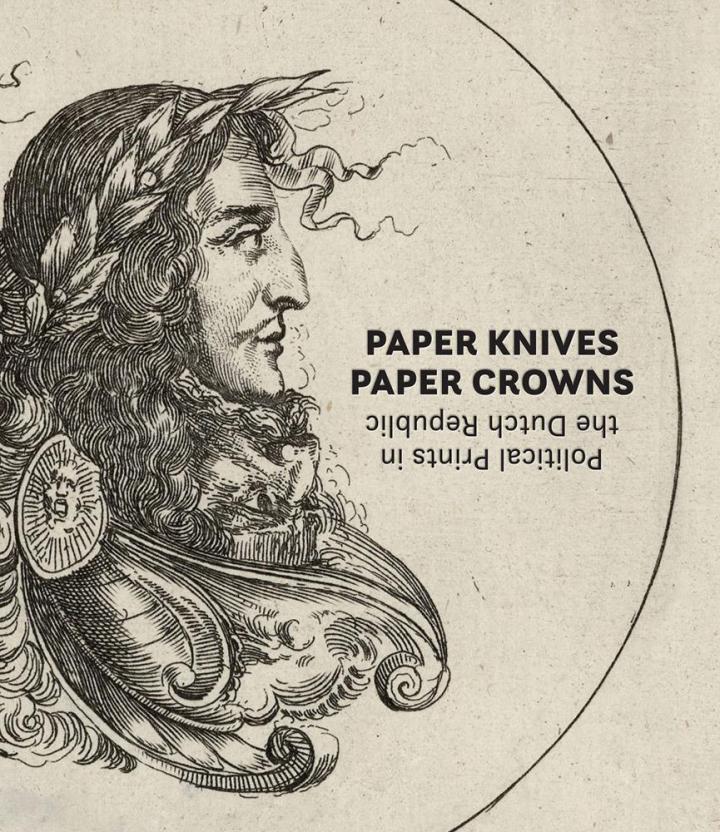 Comedians, editorial cartoons, and memes harness the power of satire, parody, and hyperbole to provoke laughter, indignation—even action. These forms of expression are usually traced to eighteenth-century artists, such as William Hogarth, but they are grounded in the unprecedented freedom of artistic expression in the seventeenth-century Dutch Republic.
Maureen Warren, ed., with contributions by Wolfgang Cillessen, Meredith McNeill Hale, Daniel Horst, Maureen Warren, and Ilja Veldman, Paper Knives, Paper Crowns: Political Prints in the Dutch Republic (Champaign: Krannert Art Museum, 2022), 184 pages, ISBN: 978-1646570294, $40.










leave a comment