Exhibition | Johann Gottfried Schadow: Embracing Forms

Johann Gottfried Schadow, Double Portrait Statue of Princesses Luise and Friederike of Prussia, detail, 1795–97, marble
(Staatliche Museen zu Berlin, Nationalgalerie)
◊ ◊ ◊ ◊ ◊
From the Staatliche Museen zu Berlin:
Johann Gottfried Schadow: Embracing Forms / Berührende Formen
Alte Nationalgalerie, Berlin, 21 October 2022 — 19 February 2023
Curated by Yvette Deseyve
The life-size double statue of Princesses Louise and Frederica of Prussia, known as the Princess Group, is the magnum opus of Johann Gottfried Schadow (1764–1850). Seen as the founder of the Berlin School of sculpture, Schadow came to epitomize German neoclassicism, with this work being emblematic of the movement. As the first sculpture depicting two female historical figures, this work wrote art history, and continues to be a highlight for visitors to Berlin from around the world. The first retrospective in some 30 years, this exhibition presents Schadow’s major sculptural, graphic, and art-theoretical works, arranged into 11 thematic sections. Following extensive conservation and restoration work, the original plaster model of the Princess Group (from 1795) is exhibited alongside the original marble rendering (1797) for the first time ever.
 With more than 150 works, the collection of the Nationalgalerie is home to the world’s largest selection of Schadow’s sculptural works, including both originals of the Princess Group. Since the last retrospective almost 30 years ago (which was first exhibited at the Alte Nationalgalerie), a great deal has been uncovered about the artist, his oeuvre, the functioning of his workshop, and his working methods. This knowledge comes in large part from the major research and restoration project focused on the original plaster model of the Princess Group, the findings of which are here presented to the public for the first time. Numerous international loans of sculptures, paintings, and graphic works, as well as art-theoretical writings, offer insights into the genesis and critical reception of the Princess Group. The exhibition also features works by some of Schadow’s contemporaries, including Gainsborough, Tischbein, Weitsch, Chodowiecki, and Begas.
Johann Gottfried Schadow: Embracing Forms is curated by Yvette Deseyve and is accompanied by catalogues in both English and German. The exhibition was made possible by the Freunde der Nationalgalerie, the Ernst von Siemens Kunststiftung, and the Cultural Foundation of the German Federal States. The three-year conservation and restoration project on the original plaster model of the Princess Group was funded by the Hermann Reemstma Stiftung, the Rudolf-August Oetker-Stiftung, and the Cultural Foundation of the German Federal States. The Bern University of Applied Sciences and the Bern Academy of the Arts supported the project as cooperation partners.
Yvette Deseyve, ed., with contributions by Sintje Guericke, Johann Gottfried Schadow: Embracing Forms (Munich: Hirmer Verlag, 2023), 304 pages, ISBN: 978-3777440873, $65.
Exhibition | Fortune and Folly in 1720

Installation view of Fortune and Folly in 1720
The New York Public Library, 2022
◊ ◊ ◊ ◊ ◊
At the NYPL (and on view during this year’s CAA conference) . . .
Fortune and Folly in 1720
New York Public Library, 23 September 2022 — 19 February 2023
Curated by Nina Dubin, Meredith Martin, and Madeleine Viljoen
In 1720, everyday citizens converged on the banking streets of Paris, London, and Amsterdam, speculating in New World trading companies and other maritime ventures. By the close of that year, an unprecedented bull market would culminate in the world’s first international financial crash. Orchestrated by the insolvent governments of France and England, and fueled by illusions of colonial wealth, these investment bonanzas—henceforth known as the Mississippi and South Sea Bubbles—have remained synonymous with the temptations of get-rich-quick schemes and the dangers of herd behavior. Three centuries and many booms and busts later, their imprint is indelible. Not only did the bubbles accelerate the growth of a financial system overflowing with stock shares, newly created banknotes, and other mysterious paper devices imbued with financial alchemy—they also illustrated the power of trust and dread, faith and fear, as drivers of market volatility.
The works on display draw from the collections of The New York Public Library and include a trove of caricatures from a Dutch volume known as The Great Mirror of Folly (Het groote tafereel der dwaasheid). Published as the crisis was unfolding, these prints portray the bewildering forces of modern economic life. Loaded with jokes, often of a scatological nature, The Great Mirror of Folly lifts the curtain on a farcical political theater whose stars include bankers and statesmen—and that’s just for starters. Offering tragicomic depictions of malevolent traders, hoodwinked investors, and villainous seductresses, the prints hold up a mirror to our own age, with its ever more complex monetary instruments and periodic meltdowns. They also reflect on the intersections between art and finance, reminding us that both are products of human imaginings.
Madeleine Viljoen, Nina Dubin and Meredith Martin, Meltdown! Picturing the World’s First Bubble Economy (Turnhout: Harvey Miller, 2020), 157 pages, ISBN: 978-1912554515, $65 / €50.
Exhibition | A Japanese Bestiary
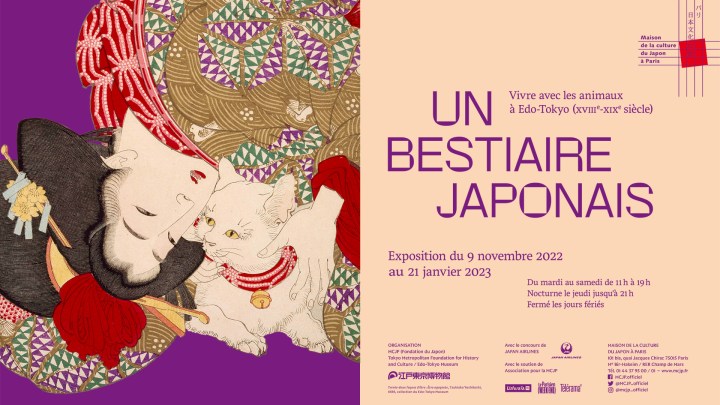
Co-organized with the Edo-Tokyo Museum, this exhibition brings together more than a hundred ukiyo-e prints, paintings, and everyday objects to explore the relationship between humans and animals in Japan during the eighteenth and nineteenth centuries.
Un bestiaire japonais: Vivre avec les animaux à Edo-Tokyo, XVIIIe–XIXe siècle
Maison de la culture du Japon, Paris, 9 November 2022 — 21 January 2023
La gentillesse avec laquelle les Japonais traitent les animaux surprend les premiers Occidentaux qui se rendent dans l’archipel. Les liens entre les humains et le monde animal sont cependant plus complexes comme en témoigne une remarquable réplique d’une paire de paravents de 1634 représentant un panorama détaillé d’Edo et de ses faubourgs. Outre des scènes avec le shogun poursuivant cerfs et sangliers, ou chassant au faucon, on y remarque des montreurs de singes, des chiens errants, des bœufs de labour, des chevaux sacrés…
Dans la section suivante sont présentés les différents rôles des animaux, en lien avec la vie de la noblesse guerrière, des paysans et des commerçants. L’établissement d’Edo comme capitale des guerriers explique une forte présence de chevaux militaires dans les premiers temps. Avec la paix durable, le nombre de chevaux de trait, soutien de la vie citadine, se met à croître. Les bœufs sont utilisés pour le transport des marchandises à Edo ainsi que pour le labour dans les zones rurales à l’extérieur de la ville. Les activités culturelles connaissent un essor important et on s’entoure volontiers d’animaux de compagnie : petits chiens et chats, rossignols et cailles, poissons rouges, ou encore grillons et criquets dont on apprécie le chant. Nombre d’estampes et d’ouvrages sur la façon de s’en occuper sont publiés.
Dans les zones périphériques d’Edo où vit une abondante faune sauvage, la noblesse guerrière pratique régulièrement la chasse. On chasse au faucon des grues, des oies et des canards. Organisées par le shogun, les grandes chasses au cerf visent les cervidés, sangliers, lièvres et faisans. Certains animaux sauvages sont associés à des croyances religieuses, tel le renard, connu pour être le messager d’Inari, dieu des moissons. Les habitants d’Edo, ville riche en collines, rivières, et ouverte sur la mer, vivent profondément en lien avec la nature.La vie des animaux sauvages est un élément familier, étroitement lié aux croyances religieuses et aux rites saisonniers.
À partir du début du XVIIe siècle, Edo s’urbanise rapidement et la population devient friande de nouvelles attractions. Des animaux rares, notamment les paons et perroquets provenant de Chine ou de Hollande, sont exposés dans des lieux spécifiques, ancêtres des zoos, avec des boutiques proposant nourriture et boissons. Très vite, la mode des animaux exotiques connaît un boom sans précédent. Avec l’entrée dans l’ère Meiji (1868–1912), période de modernisation et d’ouverture à l’Occident, le Japon construit des installations sur le modèle occidental, tels que zoos et hippodromes.
À l’époque Edo, la puissance financière nouvelle de la classe commerçante stimule la naissance d’une véritable culture citadine et le raffinement des objets du quotidien: les motifs décoratifs représentant des animaux évoluent vers une plus grande liberté de conception et des variations plus riches. Vers la fin du XIXe siècle, la symbolique des motifs animaliers commence à s’estomper et l’accent est mis de plus en plus sur le côté «kawaii» des animaux de compagnie.
Exhibition | Jean Bardin (1732–1809)
Jean Bardin, Tullia Driving Her Chariot over the Body of Her Father, detail, 1765, oil on canvas, 114 × 146 cm
(Landesmuseum Mainz)
◊ ◊ ◊ ◊ ◊
Now on view at the Museum of Fine Arts in Orléans:
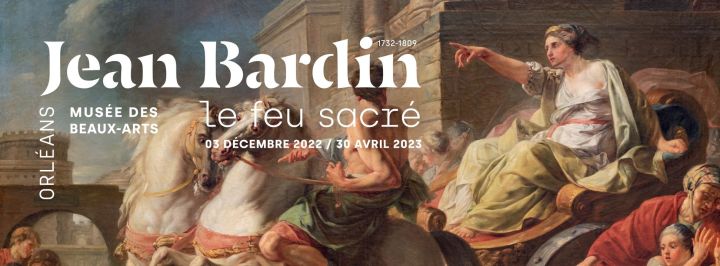
Jean Bardin (1732–1809), le feu sacré
Le musée des Beaux-Arts d’Orléans, 3 December 2022 — 30 April 2023
Curated by Frédéric Jimeno
Le musée des Beaux-Arts d’Orléans présente la première exposition rétrospective consacrée à l’un de ses grands hommes : le peintre Jean Bardin (1732–1809).
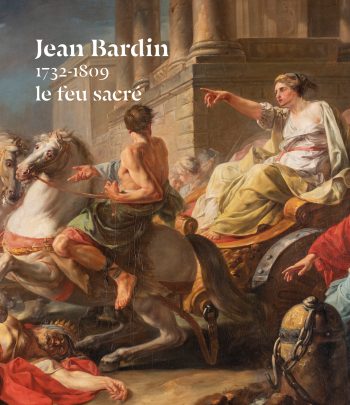 L’exposition Jean Bardin (1732–1809), le feu sacré réunit pour la première fois le corpus de l’artiste. Des tableaux provenant de cathédrales et églises françaises (Bayonne, Mesnil-le-Roi, Charmentray…), récemment restaurés, seront présentés aux côtés d’œuvres provenant des grands musées français (Louvre, Nancy…) et européens (Albertina à Vienne, Mayence…) ainsi que de collections particulières. L’un des temps forts sera le cycle monumental des Sept sacrements, réalisé entre 1780 et 1791 pour la chartreuse de Valbonne et aujourd’hui conservée à la chartreuse d’Aula Dei à Saragosse. Cette série monumentale est exposée en France pour la première fois.
Cette exposition, initiée en 2016 avec Frédéric Jimeno, spécialiste de l’artiste et commissaire scientifique de l’exposition, est le fruit de plusieurs années de recherches. Elle révèle un artiste parmi les principaux de son temps, dans les premières lueurs du néoclassicisme. Le catalogue de l’exposition constitue la première monographie du peintre et propose également une synthèse sur la naissance des institutions artistiques orléanaises sous son égide. Jean Bardin (1732–1809), le feu sacré déploie ainsi un parcours allant de ses débuts dans l’atelier de Jean-Baptiste- Marie Pierre jusqu’à sa mort, qui laisse en héritage les fondements du musée des Beaux-Arts actuel qui ouvrira en 1825. Cette exposition est par ailleurs l’occasion d’évoquer l’entourage familial du peintre, à commencer par la figure de sa fille, Ambroise- Marguerite (1768–1842), artiste formée par son père, seconde femme peintre orléanaise connue après Thérèse Laperche (1743–1814), elle-même révélée au public en 2020 dans le cadre de l’exposition Jean- Marie Delaperche.
Mehdi Korchane, ed., Jean Bardin (1732–1809), le feu sacré (Paris: Les éditions Le Passage, 2023), 304 pages, ISBN: 978-2847424973, €38.
Additional information and more images can be found here»
Exhibition | Hieroglyphs: Unlocking Ancient Egypt

Mummy bandage of Aberuait, linen, Egypt, Ptolemaic Period 332–30 BC (Paris: Musée du Louvre / photo: Georges Poncet). This bandage was a souvenir from one of the earliest ‘mummy unwrapping events’ in the late seventeenth century, where attendees would witness a mummy’s unwrapping and receive a piece of the wrapping linen, preferably inscribed with hieroglyphs.
◊ ◊ ◊ ◊ ◊
From the press release (July 2022) for the exhibition:
Hieroglyphs: Unlocking Ancient Egypt
The British Museum, London, 13 October 2022 — 19 February 2023
Curated by Ilona Regulski
Hieroglyphs: Unlocking Ancient Egypt, a major exhibition at the British Museum, marks one of the most important moments in our understanding of ancient history: the decipherment of Egyptian hieroglyphs. The exhibition explores the inscriptions and objects that helped scholars unlock one of the world’s oldest civilisations 200 years ago.
At the exhibition’s heart is the Rosetta Stone, amongst the world’s most famous ancient objects and one of the British Museum’s most popular exhibits. Before hieroglyphs could be deciphered, life in ancient Egypt had been a mystery for centuries with only tantalising glimpses into this forgotten world. The discovery of the Rosetta Stone in 1799, with its decree written in hieroglyphs, demotic, and the known language of ancient Greek, provided the key to decoding hieroglyphs in 1822—a breakthrough that expanded the modern world’s knowledge of Egypt’s history by some 3,000 years.
 This immersive exhibition brings together over 240 objects, including loans from national and international collections, many of which will be shown for the first time. It will chart the race to decipherment, from initial efforts by medieval Arab travellers and Renaissance scholars to more focussed progress by French scholar Jean-François Champollion (1790–1832) and England’s Thomas Young (1773–1829). The Rosetta Stone is on view alongside the very inscriptions that Champollion and other scholars studied in their quest to understand the ancient past. The exhibition also features stunning objects that highlight the impact of that breakthrough.
Star objects include ‘the Enchanted Basin’, a large black granite sarcophagus from about 600 BCE, covered with hieroglyphs and images of gods. The hieroglyphs were believed to have magical powers and that bathing in the basin could offer relief from the torments of love. The reused ritual bath was discovered near a mosque in Cairo, in an area still known as al-Hawd al-Marsud—‘the enchanted basin’. It has since been identified as the sarcophagus of Hapmen, a nobleman of the 26th Dynasty.
Rarely on public display, the richly illustrated Book of the Dead papyrus of Queen Nedjmet is over 3,000 years old and more than four metres long. A recitation of the texts demonstrates the power of the spoken word, with ritual spells there to be pronounced. The papyrus is presented alongside a set of four canopic vessels that preserved the organs of the deceased. These were dispersed over French and British collections after discovery, and this is the first time this set of jars has been reunited since the mid-1700s.
Among the exceptional loans to the exhibition is the mummy bandage of Aberuait from the Musée du Louvre, which has never been shown in the UK. It was a souvenir from one of the earliest ‘mummy unwrapping events’ in the 1600s where attendees received a piece of the linen, preferably inscribed with hieroglyphs. The exhibition also brings together personal notes by Champollion from the Bibliothèque nationale de France, and by Young from the British Library. A 3,000-year-old measuring rod from the Museo Egizio in Turin was an essential clue for Champollion to unravel Egyptian mathematics, discovering that the Egyptians used units inspired by the human body.
The striking cartonnage and mummy of the lady Baketenhor, on loan from the Natural History Society of Northumbria, was studied by Champollion in the 1820s. In correspondence with colleagues in Newcastle, Champollion correctly identified the inscription on the mummy cover as a prayer addressed to several deities for the soul of the deceased only a few years after he cracked the hieroglyphic writing system. Baketenhor lived to about 25–30 years of age, sometime between 945 and 715 BCE.
From love poetry and international treaties, to shopping lists and tax returns, the exhibition reveals fascinating stories of life in ancient Egypt. As well as an unshakeable belief in the power of the pharaohs and the promise of the afterlife, ancient Egyptians enjoyed good food, writing letters, and making jokes.
Many people in ancient Egypt could not read or write so language was enjoyed through readings, recitations, and performances. The exhibition includes digital media and audio to bring the language to life alongside the objects on display. As part of the interpretation, the British Museum has worked with Egyptian colleagues and citizens from Rashid (modern day Rosetta), with their voices featured throughout the exhibition.
Ilona Regulski, Curator of Egyptian Written Culture at the British Museum, said: “The decipherment of hieroglyphs marked the turning point in a study that continues today to reveal secrets of the past. The field of Egyptology is as active as ever in providing access to the ancient world. Building on 200 years of continuous work by scholars around the globe, the exhibition celebrates new research and shows how Egyptologists continue to shape our dialogue with the past.”
Hartwig Fischer, Director of the British Museum, said: “Hieroglyphs: Unlocking Ancient Egypt marks 200 years since the remarkable breakthrough to decipher a long-lost language. For the first time in millennia the ancient Egyptians could speak directly to us. By breaking the code, our understanding of this incredible civilisation has given us an unprecedented window onto the people of the past and their way of life. I would like to express my gratitude to our long-term exhibition partner BP. Without their support, the British Museum would not be able to present such exhibitions, allowing visitors to discover the art, culture and language of ancient Egypt through the eyes of the pioneering scholars who unlocked those ancient secrets.”
Ilona Regulski, Hieroglyphs: Unlocking Ancient Egypt (London: The British Museum, 2022), 272 pages, ISBN: 978-0714191287 (hardback), £35 / ISBN: 978-0714191294 (paperback), £20.
Exhibition | Kimono Style
From the press release (1 June 2022) for the exhibition:
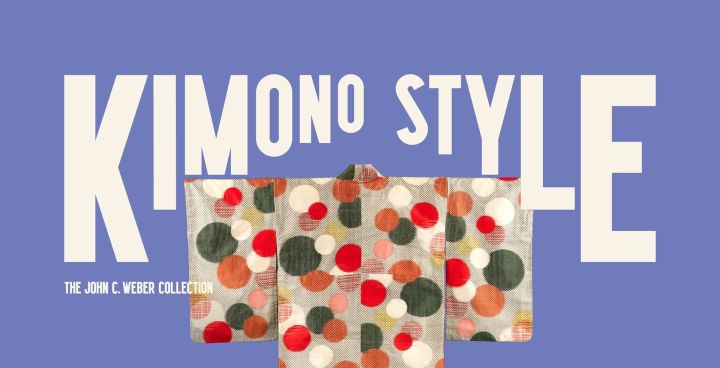
Kimono Style: The John C. Weber Collection
The Metropolitan Museum of Art, New York, 7 June 2022 — 20 February 2023
Curated by Monika Bincsik, with Karen Van Godtsenhoven
Kimono Style: The John C. Weber Collection traces the transformation of the kimono from the late 18th through the early 20th century, as the T-shaped garment was adapted to suit the lifestyle of modern Japanese women. The exhibition features a remarkable selection of works, including a promised gift of numerous modern kimonos from the renowned John C. Weber Collection of Japanese art, as well as highlights from The Costume Institute’s collection. More than 60 kimonos, including men’s and children’s wear, are displayed alongside Western garments, Japanese paintings, prints, and decorative art objects.
“This outstanding exhibition presents the kimono from a transnational perspective, highlighting the artistic conversations between Japan and the West, and the garment’s continued impact on designers around the world,” said Max Hollein, Marina Kellen French Director of The Metropolitan Museum of Art. “We are extremely grateful to John C. Weber for his promised gift, his loans to this exhibition, and his long-term support of Asian art at The Met.”

青竹色地輪宝瑞雲模様唐織, Noh Costume (Karaori) with Dharma Wheels and Clouds, Edo period (1615–1868), mid-18th century, twill-weave silk with silk supplementary weft patterning, 158 × 136 cm (John C. Weber Collection).
Monika Bincsik, the Diane and Arthur Abbey Associate Curator for Japanese Decorative Arts, said, “The kimono has served for centuries as a tableau on which to describe and record the histories of women. The variety of patterns and colors and the often-changing trends reveal much about Japanese culture and society when we shed light on the circumstances of the owners of these intricate garments and their production techniques. For many Western couturiers and designers, the kimono was a catalyst to inspire new motifs and novel cuts and to provide freedom to the wearer by creating space between the body and the clothes. At the same time, Western manufacturing techniques and materials along with artistic trends contributed to the modernization of the T-shaped garments and helped to create fresh styles.”
The weaving, dyeing, and embroidery techniques for which Japan is so well known reached their peak of artistic sophistication during the Edo period (1615–1868). Members of the ruling military class were the primary consumers of sumptuous kimonos, each one being custom made. At the same time, a dynamic urban culture emerged, and the merchant class used its wealth to acquire material luxuries. One of the most visible art forms in daily life, kimonos provided a way for townspeople to proclaim their aesthetic sensibility. The kimono-pattern books and ukiyo-e woodblock prints used during that time are comparable to modern fashion magazines and provide evidence of a sophisticated system of production, distribution, and consumption.
Depictions of kimonos in Japanese woodblock prints were widely studied by Western couturiers in the late 19th century who were first inspired by the garment’s decorative motifs. Later, the kimono’s comparatively loose, enveloping silhouette and its rectilinear cut would have a most profound and lasting influence on Western fashion, with couturiers like Madeleine Vionnet and Cristóbal Balenciaga taking inspiration for their avant-garde creations from the kimono’s construction and geometric lines.
In the Meiji period (1868–1912), Western clothing was introduced to Japan. Simultaneously, modernization and social changes enabled more women to gain access to silk kimonos than ever before. Later, some of the kimono motifs were even inspired by Western art. Around the 1920s, affordable ready-to-wear kimonos (meisen) became very popular and reflected a more Westernized lifestyle. These were sold in department stores modeled on Western retailers, following Western-style marketing strategies.
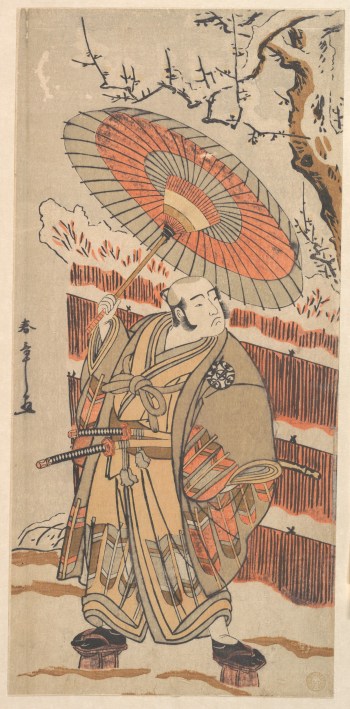
Katsukawa Shunshō (Japanese, 1726–1792), 勝川春章画 二代目中村傳九郎, Kabuki Actor Nakamura Denkurō II, Edo period (1615–1868), ca. 1770s, woodblock print (nishiki-e); ink and color on paper, 29 × 14 cm (New York: The Metropolitan Museum of Art, Rogers Fund, 1914, JP125).
Kimono Style is organized thematically and largely chronologically across 10 galleries. A number of the textiles were rotated in October. The exhibition begins with a look at the costumes worn for Japan’s traditional forms of theater, Noh and Kyōgen, to highlight earlier traditions of clothing from which these elaborate costumes derive. While the two theater forms share roots, they grew from different stage conventions: Noh is solemn drama, while Kyōgen is comic and emphasizes dialogue. They developed together in the 14th century, with Kyōgen pieces performed during interludes or between acts of the main Noh play. The costumes—ornately decorated silk weaves, often made in the Nishijin district of Kyoto, for Noh, and simpler dyed fabrics for Kyōgen, such as the Kyōgen suit with rabbits jumping over waves—were integral to distinguishing the age, social status, and gender of the different characters, all played by male actors. Deriving from actual garments, these costumes preserved past traditions of apparel and shed light on Japanese textile history.
In the early days of Noh theater, during the Muromachi period (1392–1573), audience members often gave their own richly decorated clothing to actors in appreciation. These precious gifts subsequently were transformed into costumes, a tradition that likely led to the creation of exquisite garments specifically for the stage, such as the elegant Noh costume (nuihaku) with orchids and interlinked circles on view in the exhibition, decorated with refined gold foil and silk embroidery patterns
During the Edo period (1615–1868), the military government’s strict control of society meant that dress was not an entirely free or personal choice. Many aspects of clothing, such as the use of gold and expensive techniques, were regulated by the Tokugawa shogunate. At the top of the social hierarchy were the samurai. On the rare official occasions when elite samurai women were seen in public, they wore finely crafted silk garments rooted in conservative traditions, like the Summer robe (hito-e) with court carriage and waterside scene from the late Edo period, made for a woman in the Tokugawa shogun family. Of the three tiers of commoners who followed the samurai in the social order—farmers, artisans, and merchants—merchant-class women had the most freedom in deciding what to wear. Although their choices were supposed to reflect their class position and conform to sumptuary laws, they often disregarded such rules in order to be fashionable and to show off their families’ wealth. Their distinct looks will be illustrated through a number of Edo-period woodblock prints and fashion books depicting the patterns and dye techniques.

茶緑段蘭七宝模様縫箔, Noh Costume (Nuihaku) with Orchids and Interlinked Circles, Edo period (1615–1868), 18th century, plain-weave silk with gold- and silver-leaf application and silk embroidery, 168 × 136 cm (John C. Weber Collection).
Specialized apparel worn to conduct dangerous tasks—whether fighting enemy warriors or battling fires—exemplified the fusion of function and fashion in Japanese textiles. High-ranking samurai had access to the finest materials, including wool imported from Europe, and used boldly decorated battle surcoats (jinbaori) to project status and individual taste. Jinbaori, produced from about the 15th through the mid-19th century, were sleeveless garments originally worn over armor as protection from the weather that eventually became ceremonial wear, such as the Battle surcoat with tattered fan. Firefighters also enjoyed respect in Japan, especially in Edo (present-day Tokyo), where wood architecture led to frequent outbreaks of fire. Samurai firefighters wore expensive garments made of imported wool. The townsmen’s coats were reversible and made of thick, quilted cotton with a plain indigo-dyed exterior and an elaborately decorated interior, usually depicting warrior heroes and mythical creatures that instill bravery or are related to water. One example portrays a legendary warrior, Tarō Yoshikado, who acquired magical skills to be able to morph into a toad.
Access to cotton for commoners, especially those living in the north, increased in the late 17th century with the establishment of the kitamaesen, a commercial shipping route between northern and central Japan, which enabled the secondhand clothing trade to flourish. Castoff cotton clothing was brought from Edo to Osaka and dispersed to the north. Nothing was wasted. The respect for and ingenious use of scarce materials led to the emergence of regional folk textile traditions. On view will be sturdy working clothes for farmers and fishermen as well as lightweight indigo-dyed cotton kimonos for women intended for summertime.
After the collapse of the Tokugawa shogunate in 1868 and the abolition of the class structure, the modernization of the Japanese fashion system occurred first in textile production. Global trade and industrialization in the second half of the 19th century vastly expanded Japan’s access to expensive or restricted wool, cotton, and machine-spun silk. Kimono patterns in the early to mid-20th century increasingly drew from Western art movements, including the organic style characteristic of Art Nouveau and the bold, geometric forms of Art Deco, as can be seen in the Summer kimono (hito-e) with swirls. At the same time, Western couturiers looked to Japanese art and clothing. Kimonos were first reinterpreted as dressing gowns, and later, primarily their fabrics, became a source of inspiration for the creations of couture houses such as Worth. By the early decades of the 20th century, the garment’s rectilinear form and loose shape revolutionized Western fashion: couturiers gave up the S-shaped, corseted bodice for a flat, straighter, modern line. Parisian innovators such as Paul Poiret, Callot Soeurs, and Madeleine Vionnet borrowed Japanese ideas and draped their garments from the shoulder, rather than tailoring the fabric to follow the shape of the body. For example, Poiret’s modernist ‘Paris’ coat from 1919, one of the highlights from The Costume Institute’s collection, was constructed using a single 15-foot length of silk velvet with minimal cutting, recalling the concept of creating a kimono from a single bolt of fabric without any waste and using only rectilinear elements.
 In the Edo period, dry-goods stores or fabric merchants (gofukuten) sold high-quality, made-to-order kosode (the predecessor of the kimono, with small sleeve openings) of silk or fine hemp to men and women of the samurai and wealthy merchant classes. Precursors to the department store, the best-known gofukuten all had branches in multiple cities, including Kyoto, from where they ordered the fabrics. Around the early 20th century, these gofukuten gradually transitioned into modern department stores, adopted Western retail practices, and promoted a modernized lifestyle.
Affordable, stylish kimonos made from meisen, an inexpensive silk woven from predyed yarns, a technique known as ikat (kasuri), became popular in the early 20th century. By the 1920s and 1930s, working- and middle-class women from high-school students to shop assistants could buy these casual, bright-colored, ready-to-wear modern kimonos with bold, graphic patterns. Department stores frequently released new designs to spark trends and inspire purchases. Many meisen kimono patterns were inspired by avant-garde art movements, such as Italian Futurism and the Dutch ‘De Stijl’. Piet Mondrian’s compositions were particularly influential, as demonstrated by a large ikat (ōgasuri) kimono in bright yellow, teal, and raspberry red.
Since the second half of the 20th century, the kimono’s iconic structure has been a source of inspiration in both Japanese and Western fashion. Some modern designers use its shape as a starting point for architecturally constructed garments, as seen in the work of Issey Miyake and Cristobal Balenciaga, whose Evening wrap from 1951 will be on view. Others play with the kimono’s symbolic associations. Remixed and reinterpreted by Japanese designers active in the West, including Yohji Yamamoto and Rei Kawakubo, the kimono dynamically reflects Japanese culture both to the world and back onto itself as evident in Rei Kawakubo’s Ensemble for Comme des Garçons featuring a manga figure. Through all these iterations, the kimono has gestured toward a future beyond fashion trends, cultural boundaries, and gender norms.
Kimono Style: The John C. Weber Collection is curated by Monika Bincsik, Diane and Arthur Abbey Associate Curator for Japanese Decorative Arts, with guest co-curator Karen Van Godtsenhovenk. The exhibition is made possible by the Mary Livingston Griggs and Mary Griggs Burke Foundation Fund, 2015. A fully illustrated catalogue accompanies the exhibition. Published by The Metropolitan Museum of Art and distributed by Yale University Press, it is made possible by the Florence and Herbert Irving Fund for Asian Art Publications. Additional support is provided by the Richard and Geneva Hofheimer Memorial Fund.
Monika Bincsik, Karen van Godtsenhoven, and Masanao Arai, Kimono Style: Edo Traditions to Modern Design (New York: The Metropolitan Museum of Art, 2022), 176 pages, ISBN: 978-1588397522, $35.
Monika Bincsik is the Diane and Arthur Abbey Associate Curator for Japanese Decorative Arts in the Asian Art Department at The Metropolitan Museum of Art, New York. Karen Van Godtsenhoven is an independent curator based in Belgium. Arai Masanao is a textile historian based in Japan.
Online Catalogue | The Nelson-Atkins Museum of Art, French Paintings

From The Nelson-Atkins:
The Nelson-Atkins Museum of Art
French Paintings Catalogue
Learn more about the remarkable French paintings and pastels at the Nelson-Atkins Museum of Art. View the entire collection online, delve into recent scholarly insights and technical discoveries, or read about the history of collecting French art in Kansas City. Art historians and conservators provide fresh perspectives on the French collection, and comprehensive research sheds new light on the provenance (ownership history), exhibition history, and publication history of each work. Whether you are seeking a quick overview or deep dive, the French Paintings Catalogue is the perfect place to explore and learn more.
The French Paintings Catalogue is generously supported by The Marion and Henry Bloch Family Foundation, The National Endowment for the Humanities, Adelaide Cobb Ward in honor of Donald J. Hall’s retirement, The Mellon Endowment for Scientific Research, The National Endowment for the Arts, The James Sight Fund, and The Samuel H. Kress Foundation.
C O N T E N T S
Publication Installments
Director’s Foreword — Julián Zugazagoitia
Preface and Acknowledgments — Aimee Marcereau DeGalan
Timeline — Meghan L. Gray and Glynnis Stevenson
The Collecting of French Paintings in Kansas City — Aimee Marcereau DeGalan
Conservation Introductory Essay — Mary Schafer, Rachel Freeman, and John Twilley
Notes to Reader
Seventeenth Century, 1600–1699
Eighteenth Century and Pre-Revolution, 1700–1789
Neoclassicism and Romanticism, 1790–1860
Nineteenth Century, Realism, Barbizon, 1830–1890
Impressionism, 1860–1900s
Post-Impressionism, 1886–1900s
A Modern World, 1900–1945
Appendix I: Other Works in the Bloch Collection of The Nelson-Atkins Museum of Art
Appendix II: Other French Works in the Collection of The Nelson-Atkins Museum of Art
Glossary
About
Contributors
Photograph Credits
Exhibition Catalogue | Dare to Know
Now available for purchase, the catalogue for the exhibition is one of The New York Times’ ‘best art books of 2022’. Congratulations to everyone involved! The show is on view until 15 January 2023.
Edouard Kopp, Elizabeth Rudy, and Kristel Smentek, eds., Dare to Know: Prints and Drawings in the Age of Enlightenment (Cambridge: Harvard Art Museums, 2022), 334 pages, ISBN: 978-0300266726, $50.
 Are volcanoes punishment from God? What do a fly and a mulberry have in common? What utopias await in unexplored corners of the earth and beyond? During the Enlightenment, questions like these were brought to life through an astonishing array of prints and drawings, helping shape public opinion and stir political change. Dare to Know overturns common assumptions about the age, using the era’s proliferation of works on paper to tell a more nuanced story. Echoing the structure and sweep of Diderot’s Encyclopédie, the book contains 26 thematic essays, organized A to Z, providing an unprecedented perspective on more than 50 artists, including Henry Fuseli, Jean-Honoré Fragonard, Francisco Goya, Jean-Baptiste Greuze, William Hogarth, Giovanni Battista Piranesi, and Giambattista Tiepolo. With a multidisciplinary approach, the book probes developments in the natural sciences, technology, economics, and more—all through the lens of the graphic arts.
Edouard Kopp is the John R. Eckel, Jr., Foundation Chief Curator at the Menil Drawing Institute in Houston; Elizabeth M. Rudy is the Carl A. Weyerhaeuser Curator of Prints at the Harvard Art Museums, Cambridge, MA; and Kristel Smentek is associate professor of art history in the Department of Architecture at the Massachusetts Institute of Technology, Cambridge, MA.
With contributions by J. Cabelle Ahn, Elizabeth Saari Browne, Rachel Burke, Alvin L. Clark, Jr., Anne Driesse, Paul Friedland, Thea Goldring, Margaret Morgan Grasselli, Ashley Hannebrink, Joachim Homann, Kéla Jackson, Penley Knipe, Edouard Kopp, Ewa Lajer-Burcharth, Heather Linton, Austėja Mackelaitė, Tamar Mayer, Elizabeth Mitchell, Elizabeth M. Rudy, Brandon O. Scott, Kristel Smentek, Phoebe Springstubb, Gabriella Szalay, and Christina Taylor.
Exhibition | The Secret of Colours: Ceramics in China and Europe
Now on view at the Baur Foundation, Museum of Far Eastern Art:
The Secret of Colours: Ceramics in China and Europe from the 18th Century to the Present
Le secret des couleurs: Céramiques de Chine et d’Europe du XVIIIe siècle à nos jours
Fondation Baur, Musée des arts d’Extrême-Orient, Geneva, 14 September 2022 — 12 February 2023
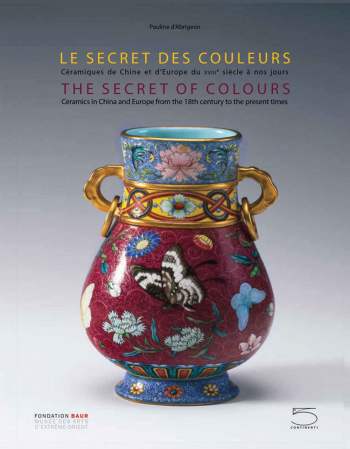 This exhibition tells the often turbulent story of the quest for colour on porcelain in China and France. It contrasts two crucial moments in the history of porcelain driven by the desire to extend the range of enamels. They occurred at the turn of the 18th century in China and during the 19th century in France, two periods during which the interactions between Europe and China, whether cultural or belligerent, were particularly intense.
The first room in the exhibition introduces visitors to enamelling techniques, the notions of translucent and opaque enamels, and to the famille verte and famille rose. This is followed by a presentation of Chinese enamelled porcelain, principally from the reigns of Kangxi (1662–1722), Yongzheng (1723–35), and Qianlong (1736–95), which are among the jewels of Alfred Baur’s collection and which exemplify the use of colour on porcelain over a period of more than a century. The new palette developed in the imperial workshops was soon exported from the port of Canton on porcelain and copper-enamel wares on that had been specially designed for the Western market.
The second section of the exhibition takes place a century later in France, at the Sèvres manufactory, where Chinese colors, long coveted for their brilliance, were keenly researched. Missionaries, chemists, and French consuls in China all contributed to bringing back samples to France where the mysteries of Chinese manufacturing techniques could be fathomed.
The last part of the exhibition introduces more contemporary research on the use of color, first of all by Fance Franck (1927–2008), who from the late 1960s worked with the Sèvres factory to recreate the famous ‘fresh red’ (‘rouge frais‘) or ‘sacrificial red’ (‘rouge sacrificiel‘) that had been mastered by the potters in Jingdezhen several centuries earlier. The exhibition’s investigation into this endless chromatic quest is brought to a close by the pure and gleamingly colourful works of Thomas Bohle (b. 1958).
Pauline d’Abrigeon, Le secret des couleurs: Céramiques de Chine et d’Europe du XVIIIe siècle à nos jours (Milan: 5 Continents Editions, 2022), 170 pages, ISBN: 979-1254600054, €45. Bilingual edition (French and English).
Cover image: Vase with handles, porcelain and polychrome enamels on glaze, China, Jingdezhen, Qing Dynasty, mark and reign of Qianlong (1736–1795) (Geneva: Fondation Baur).
Exhibition | François Boucher, du théâtre à l’Opéra
Now on view at the Musée des Beaux-Arts in Tours:
L’amour en scène! François Boucher, du théâtre à l’Opéra
Musée des Beaux-Arts, Tours, 5 November 2022 — 30 January 2023
Curated by Jessica Degain and Guillaume Kazerouni
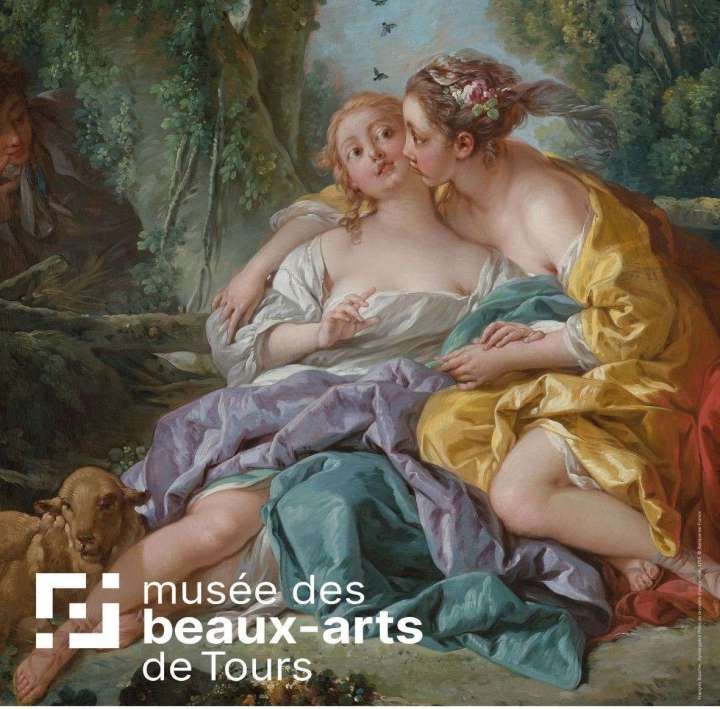
François Boucher, Sylvie Cures Philis of a Bee Sting, 1755, oil on canvas, 103 × 138 cm (Paris: Banque de France).
Le musée des Beaux-arts de Tours propose de mettre en lumière un pan méconnu de la carrière de François Boucher (1703–1770), peintre majeur du 18ᵉ siècle au service de Louis XV et de Madame de Pompadour : sa passion pour le théâtre et l’opéra. Actif à l’Opéra de Paris, à l’Opéra-Comique et au théâtre des Petits Cabinets à Versailles, François Boucher oeuvre tout au long de sa vie à près d’une centaine de spectacles. Qu’il conçoive ou supervise les décors et les costumes de scène, aucun autre peintre de son temps ne fut autant investi dans le monde théâtral.
Point de départ de l’exposition et restaurés à cette occasion, les quatre tableaux du musée de Tours, chefs-d’oeuvre de l’art rocaille, témoignent de l’engouement de l’artiste pour les arts de la scène. Aux côtés de l’esquisse d’Apollon couronnant les arts, réputée être un projet de rideau de scène pour l’Opéra, les trois peintures d’Apollon et Issé et de Sylvie et Aminte mettent à l’honneur les opéras baroques d’Issé et de Silvie. Apollon révélant sa divinité à la bergère Issé est en effet peint par Boucher en 1750 pour la marquise de Pompadour, en souvenir de ses représentations théâtrales à Versailles dans le rôle d’Issé. De même, les tableaux de Sylvie fuyant le loup et Aminte revenant à la vie dans les bras de Sylvie rappellent son apparition théâtrale dans le rôle de la nymphe. Conçus à l’origine pour former un ensemble de quatre tableaux, la série de l’histoire de Sylvie et Aminte sera réunie pour la première fois depuis le 18ᵉ siècle, grâce aux prêts exceptionnels de la Banque nationale de France (qui conserve aujourd’hui Sylvie guérit Philis de la piqûre d’une abeille et Sylvie délivrée par Aminte). OEuvres de maturité, ces tableaux constituent un magnifique témoignage du talent de François Boucher à dépeindre des univers bucoliques, merveilleux et théâtraux.
 Complétés par une soixantaine d’oeuvres, en particulier de la Bibliothèque nationale de France et du Musée du Louvre, l’exposition permettra par ailleurs d’illustrer d’autres contributions de Boucher aux arts de la scène. De ses gravures de jeunesse pour illustrer les OEuvres de Molière, dont on célèbre cette année le quatre centième anniversaire de la naissance, aux décors et costumes conçus pour divers opéras tels Armide ou Aline, reine de Golconde, les oeuvres rassemblées éclairent la vitalité de sa création.
Déployés autour des tableaux du musée, estampes, tapisseries et objets d’art décoratifs s’accompagneront d’oeuvres d’art moderne et contemporain, de Berthe Morisot à Cindy Sherman. La contribution du créateur de mode Sami Nouri révélera enfin comment Boucher et le rococo continuent à inspirer les artistes du 21e siècle.
L’exposition est à découvrir du 5 novembre 2022 au 30 janvier 2023, grâce aux prêts prestigieux de nombreuses institutions : Bibliothèque national de France / Musée du Louvre / Musée national des Châteaux de Versailles et de Trianon / Moulins, Centre national du costume de scène / Narbonne, musée d’art et d’histoire / Paris, Mobilier national / Paris, musée Marmottan-Monet / Centre National des Arts Plastiques / Paris, Banque de France / Sèvres, Cité de la Céramique / Paris, musée des Arts décoratifs / Paris, musée Cognacq-Jay / Paris, Petit Palais / Agen, musée des Beaux-Arts.
Love on Stage! Francois Boucher, from the Theater to the Opera
Commissariat de l’exposition
• Jessica Degain, conservatrice du patrimoine chargée des collections XVIIᵉ–XIXᵉ siècles du musée des Beaux-Arts de Tours
• Guillaume Kazerouni, conservateur, chargé des collections anciennes du musée des Beaux-Arts de Rennes
Jessica Degain, L’amour en scène! François Boucher, du théâtre à l’Opéra (Paris: Éditions Snoeck, 2022), 239 pages, ISBN: 978-9461617200, €29.










leave a comment