Exhibition | French Taste in Spain, 17th–19th Centuries
Now on view at the Fundacion MAPFRE:
The French Taste and Its Presence in Spain, 17th–19th Centuries
El gusto francés y su presencia en España, siglos XVII–XIX
Fundación MAPFRE, Madrid, 11 February — 8 May 2022
Curated by Amaya Alzaga Ruíz with Gloria Martínez Leiva
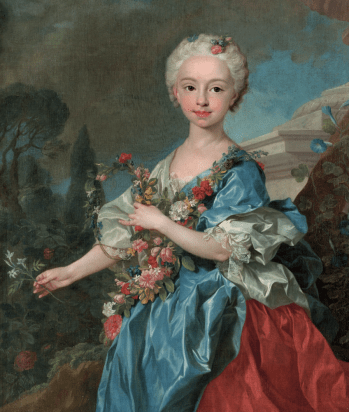
Louis-Michel Van Loo, María Antonia Fernanda de Borbón, Infanta of Spain, detail, ca. 1737, oil on canvas, 88 × 71 cm (Museo de Bellas Artes de Asturias, Repository of the Collection of the IX Count of Villagonzalo; photo by Marcos Morilla).
Through numerous paintings, sculptures, textiles, sumptuary arts, and everyday objects, the exhibition El gusto francés y su presencia en España, siglos XVII–XIX delves into the evolution of French taste in Spain, which until now has been studied only on an ad hoc basis. A cross-cutting project that covers such an extensive historical period cannot be understood without its historical context. In this sense, the exhibition also addresses aspects that make this evolution possible, such as diplomatic relations, the history of collecting, and the construction of national identities. The nearly 110 works on display are from both public and private collections and are all pieces of national heritage. The project commences at the moment when French artworks began to arrive in Spain, as France emerged as a model of European taste, and it concludes when the opposite phenomenon occurred, when Spain became the focus of attraction for French culture, due to the image constructed around its diversity and exoticism throughout the 19th century.
17th Century | Difficult Relations: Portraits, Exchanges, and Gifts
The 1630s and 1640s, under the reign of Louis XIII, who for a time managed to stabilize the power of the crown, witnessed a golden age for French painting. Both Louis XIII and his advisor, Cardinal Richelieu, launched an extremely active artistic policy and commissions proliferated, which encouraged the art market.
Towards 1650, Spain was irrevocably losing its primacy as a world power to the France of Louis XIV, the Sun King. One of the strategies used to seal the peace was to establish alliances through marriages with the Spanish royal house. In this context, it was common for gifts of a very different nature to be exchanged between the two: horses, sumptuary arts, small pieces of furniture and above all portraits. From 1660 onwards, thanks to his marriage to Maria Teresa of Austria, daughter of Philip IV, known as the Planet King—a union that brought the Thirty Years’ War to an end— the exchange of gifts became even more frequent. The queen was portrayed on numerous occasions alone or accompanied by her son Louis, known as the Grand Dauphin of France, as can be seen in María Teresa de Austria y el Gran Delfín de Francia (Maria Theresa of Austria and the Grand Dauphin of France), ca. 1664, by cousins Charles and Henri Beaubrun.
18th Century | The Arrival of French Artists in Bourbon Spain, the Emergence of French Taste
In 1700, with the accession to the throne of Philip V, the Bourbon dynasty, of French origin, was established in Spain, and in the early years of his reign, the king wanted to bring everything he had known in Versailles and Paris to the Spanish court. He commissioned the work on the Buen Retiro, as well as the interior renovation of the Alcázar, and undertook the construction of the Granja de San Ildefonso, in Segovia. In addition, all kinds of furniture, jewelry, and clothing were imported. In 1715, the painter Michel-Ange Houasse came to the Spanish court from France, later being succeeded by Jean Ranc. In 1735, Louis-Michel Van Loo replaced Ranc, and became the King’s principal painter, as well as the director of painting at the Real Academia de Bellas Artes de San Fernando, founded in 1752. From his hand came the portrait María Antonia Fernanda de Borbón, infanta de España (María Antonia Fernanda de Borbón, Infanta of Spain), ca. 1737.
 During this period, artistic transfers between France and Spain were sometimes made by way of Italy, which was home to an important French community fostered by the presence of the Académie de France in Rome, founded by Louis XIV in 1666. Spanish artists traveled to Rome more and more frequently, which gave them the opportunity to become familiar with French art without the need to travel to Paris. This was the case of Francisco Goya, who was able to become acquainted with the work of Nicolas Poussin and Pierre Subleyras during his documented stay in the Italian capital.
The blossoming of French culture and taste in Spain reached its pinnacle during the reign of Charles IV, grandson of Philip V. Born in Portici during the reign of his father Charles III in Naples and Sicily, Charles Anthony of Bourbon (1748–1819) arrived in Spain as a teenager. He was first named Prince of Asturias and then crowned King of Spain and the Indies in 1788. In 1808 he was dethroned, exiled first in France and then in Rome, until his death in Naples. His interest in the sumptuary arts, furniture, painting, and sculpture became apparent at an early age and the best example of this is the Platinum Cabinet in the Casa del Labrador in Aranjuez, which was made entirely by French artists. On the occasion of his marriage to Maria Luisa Teresa of Parma in 1765, Louis XV gave the couple a table service from the porcelain company Manufactura Real de Porcelana de Sèvres, and his cousin Louis XVI, presented them with two paintings by Claude Joseph Vernet.
19th Century | The Romantic Vision of Spain
With the Napoleonic invasion that led to the War of Independence (1808–1814), Spain became the new destination to be explored by the French who, together with other foreign travelers and intellectuals, created what is known today as the ‘romantic image of Spain’. Some of those who contributed to this creation were the writer Victor Hugo and the painter Eugène Delacroix. We can see more specific examples in the exhibition, in the figures of Antonio de Orleans, Duke of Montpensier and Galliera, and Eugenia de Montijo.
The Duke of Montepensier married the sister of Queen Isabella II, the Infanta Luisa Fernanda. After the revolution of 1848 the couple left France, settling in Seville in 1849. Their stay led to a boom in culture and popular events in the city, to the point that Seville came to be nicknamed the ‘Small Court’. Eugenia de Montijo, the daughter of the Duke of Peñaranda, was born in Granada, but spent most of her life in France. Wife of Louis Napoleon Bonaparte, thanks to her education and refinement, she was one of those responsible for exporting the ‘Empire style’ to the Spanish court.
At the end of the 18th century, France and Spain became official allies and a change began to take place with respect to the foreign view of the latter. Spain, which was at peace, proved to be the perfect alternative for more inquisitive spirits, since it was home to magnificent remains from the Roman and Arab civilizations. In this context, Alexandre de Laborde (1773–1842), an officer, scholar and traveler, taking advantage of his diplomatic posting in Madrid, in 1800 penned the story of his travels, in the Voyage pittoresque et historique de l’Espagne. In 1808, he finally published a shorter version, entitled Itinéraire descriptif de l’Espagne, which led a considerable number of artists to Spain, including François Ligier.
In 1826, in Paris, Baron Isidore Justin Taylor began the publication of a Voyage pittoresque en Espagne, en Portugal et sur la Côte d’Afrique, de Tanger à Tétouan. In Paris, where he held the post of Royal Commissioner of French Theater, Taylor promoted the production of Hernani, Victor Hugo’s 1830 play set in the Spanish Golden Age, further catalyzing the Romantic enthusiasm for the Peninsula. At the same time, his involvement in governmental mechanisms allowed him to present himself as the connoisseur par excellence of Spain: in 1835, he was commissioned to assemble a collection of Spanish paintings for the Louvre Museum, a campaign personally financed by King Louis-Philippe, who was eager to acquire a Galérie espagnole, taking advantage of the imminent confiscations of Mendizábal. The two French artists most involved in illustrating the Baron’s work were Adrien Dauzats and Pharamond Blanchard, who also helped to locate the paintings destined for Louis Philippe’s Spanish gallery.
Although the perception of ‘Spanishness’ in France varied throughout the 19th century, after the 1848 Revolution, it became increasingly frequent to associate Spanish culture with the image of an archaic and free people, in contrast with the rigid rules of bourgeois society. Starting in 1850, several artists, among them Gustave Doré, Jean-Baptiste Achille Zo, and Édouard Manet, began to exhibit paintings in French salons featuring gypsies, beggars, vagabonds and working class ‘majos’. Made after their respective trips to Spain, in most cases they tried to exalt the Spanish Golden Age with the figures of Velázquez and Ribera at the forefront.
Amaya Alzaga Ruíz, ed., El Gusto francés y su presencia en España, siglos XVII–XIX (Madrid: Fundación MAPFRE, 2022), 331 pages, ISBN 978-8498447972, 50€.
The Burlington Magazine, February 2022
The eighteenth century in February’s issue of The Burlington . . .
The Burlington Magazine 164 (February 2022) — Northern European Art
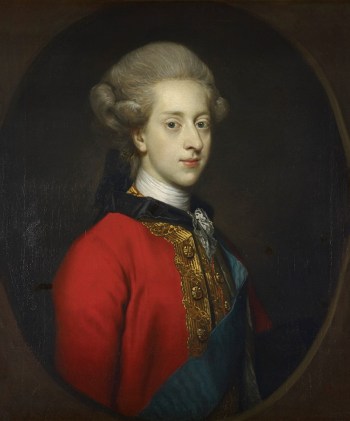
Nathaniel Dance Holland, Portrait of Christian VII, King of Denmark, 1768, oil on canvas, 77 × 63 cm (Royal Collection Trust).
A R T I C L E S
• Sara Ayres, “Christian VII of Denmark’s Lost British Portraits,” pp. 155–63. In 1768–69 the young Christian VII of Denmark visited London and Paris, where several portraits of him were painted. Three were by artists born or working in Britain—Angelica Kauffmann, Edward Cunningham, known as Calze, and Matthew Peters. All are now lost, but evidence about the comissions survives in copies and prints, contemporary descriptions and documents in the Danish State Archives.
• Lars Hendrikman, “The Finding of the Infant Bacchus,” pp. 180–83.
R E V I E W S
• Camilla Pietrabissa, Review of the exhibition Venetia 1600: Births and Rebirths (Venice: Palazza Ducale, 2021–22), pp. 190–92.
• Ivan Gaskell, Review of the new galleries of Dutch and Flemish art at the MFA Boston (open from November 2021), pp. 195–98.
• Richard Stemp, Review of the exhibition Hogarth and Europe (London: Tate Britain, 2021–22), pp. 198–200.
• Maryl Gensheimer, Review of Fabio Barry, Painting in Stone: Architecture and the Poetics of Marble from Antiquity to the Enlightenment (Yale UP, 2020), pp. 216–17.
• Clare Hornsby, Review of Ortwin Dally, Maria Gazzetti, and Arnold Nesselrath, eds., Johann Joachim Winckelmann (1717–1768): Ein Europ isches Rezeptionsph nomen / Fenomeno Europeo della Ricezione (Michael Imhof Verlag, 2021), pp. 217–18.
• Robert Skwirblies, Review of Lea Kuhn, Gemalte Kunstgeschichte: Bildgenealogien in der Malerei um 1800 (Wilhelm Fink Verlag, 2020), pp. 218–19.
• Thomas Stammers, Review of Stacey Boldrick, Iconoclasm and the Museum (Routledge, 2020), p. 222.
O B I T U A R I E S
• Marjorie Trusted, “Christian Theuerkauff (1936–2021),” pp. 223–24. For many years Deputy Director of the sculpture collection at the Bode Museum, Berlin, and honorary professor at the city’s Free University, Christian Theuerkauff was a leading scholar of Baroque ivories, whose expert connosseurship and archival research definitively shaped our understanding of many of the outstanding sculptors in the medium.
New Book | Lover’s Eyes
This is an updated and expanded version of the 2012 exhibition catalogue. From Giles:
Elle Shushan, ed., with additional contributions by Graham Boettcher and Stephen Lloyd, Lover’s Eyes: Eye Miniatures from the Skier Collection (London: Giles, 2022), 280 pages, ISBN: 978-1911282938, £40 / $50.
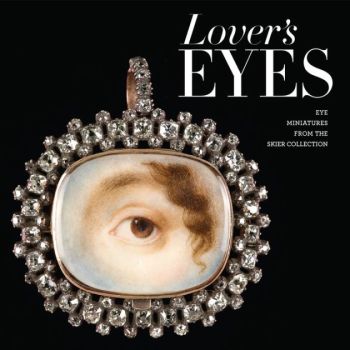 Until the early 2000s, little had been written about eye miniatures, or ‘Lover’s Eyes’, and their short-lived popularity at the end of the 18th and early 19th centuries, when hand-painted portraits of single human eyes were set in jewellery, or created to memorialize a deceased loved one. This new expanded and updated edition of the 2012 volume The Look of Love examines their role in the broader context of Georgian and early Victorian portrait miniatures; and looks in detail at the creation, and appeal, of these extraordinary objects.
Dr. and Mrs. David A. Skier’s collection of eye miniatures is one of the most complete such collections of this genre of miniature painting anywhere in existence. This volume features over 130 pieces from the Skier Collection, with 36 extraordinary newly acquired pieces, including two of the three known existing ‘lovers’ lips’, and six examples of a delightful sub-category known as ‘Flower Eyes’. There are four new illustrated essays: on forgeries and fakes of lovers’ eyes, on ‘Flower Eyes’, on the persistence of the eye image which continues the tradition of lovers’ eyes, and an essay on the eye miniatures created by Richard Cosway.
Elle Shushan is a specialist dealer, author, lecturer, and museum consultant. She is a member of the Antiques Dealers’ Association of America, the British Antique Dealers’ Association, CINOA, the Private Art Dealers Association, and the Association of Historians of American Art.
Stephen Lloyd is curator of the Derby Collection at Knowsley Hall, Merseyside. From 1993 to 2009 he was Assistant Keeper and then Senior Curator at the Scottish National Portrait Gallery, where he co-curated the exhibition The Intimate Portrait: Drawings, Miniatures, and Pastels from Ramsay to Lawrence.
Graham Corray Boettcher is the director of the Birmingham Museum of Art in Birmingham, Alabama.
C O N T E N T S
Collectors’ Preface
Acknowledgements
The Artist’s Eye by Elle Shushan
Eye Miniatures by Richard Cosway by Stephen Lloyd
Symbol & Sentiment: Lover’s Eyes and the Language of Gemstones by Graham Boettcher
Floriography by Elle Shushan
Fake of Fashion by Elle Shushan
Love Never Dies by Graham Boettcher
Catalogue of the Exhibition by Graham Boettcher, Nan Skier, and Elle Shushan, with the assistance of Laura Wallace and Maggie Keenan
Index
Author biographies
Exhibition | Flora Yukhnovich: Thirst Trap

Flora Yukhnovich, I’ll Have What She’s Having, 2020, oil on linen, 170 × 220 cm. Estimated to sell for £60,000–£80,000, the painting sold for £2,253,500 (Sotheby’s London, 14 October 2021).
◊ ◊ ◊ ◊ ◊
After only a handful of solo exhibitions, beginning in 2017, the British artist Flora Yukhnovich (b. Norwich 1990) has recently emerged as a leading contemporary painter, receiving coverage in both visual arts media and the popular press. The New York Times recently included her in a piece about speculators hoping to to ‘flip’ art at auction (in October, her painting I’ll Have What She’s Having sold at Sotheby’s for $3.1million).
I note Yukhnovich here at Enfilade because of her engagement with eighteenth-century painting, an engagement she attributes to Mary Sheriff. In a 2020 interivew with Immediations, published by The Courtauld, Yukhnovich references both Fragonard: Art and Eroticism (University of Chicago Press, 1990) and Enchanted Islands: Picturing the Allure of Conquest in Eighteenth-Century France (University of Chicago Press, 2018).
As Yukhnovich describes her artistic development during the interview:
“I then began looking at decorative design. At first it was about the very flatness of it, which I really enjoyed. Then it became about the ways in which paint itself can do things, like create drop shadows, or the different ways in which paint can be used to construct space. It became apparent to me that I was gravitating toward these things because they were related to femininity in a way, but they also all happened to be derived from a Rococo aesthetic. When I found [Sheriff’s] book on Fragonard, I realised that a lot of the Rococo seemed to tap into all these different elements that I had been looking at. The aesthetic of the Rococo feels very familiar to me, and there are lots of things that I, as a woman and also as a girl growing up, interacted with which seem to have a Rococo sensibility to them. I do not feel like that about many other art historical movements. That is why I landed on it. It was about a lot of different interests coming together.”
–CH

Flora Yukhnovich, Siren Song, 2022.
◊ ◊ ◊ ◊ ◊
From the press release for the the exhibition now on view in London at Victoria Miro:
Flora Yukhnovich: Thirst Trap
Victoria Miro, London, 1–26 March 2022
Flora Yukhnovich is acclaimed for paintings that, fluctuating between abstraction and figuration, transcend painterly traditions to fuse high art with popular culture and intellect with intuition. While in the past she has adopted the language of Rococo, dynamically reimagining aspects of works by eighteenth-century artists such as Tiepolo, Boucher, Lancret, and Watteau, new paintings draw upon various depictions of the Roman goddess Venus in mythology, art history, and contemporary culture. Rather than focus on individual points of reference, each work synthesises a multitude of influences that convey the shifting representations and significations of Venus herself. Here the Venus who embodies idealised female form and is goddess of love, maternal care, sexual reproduction, and erotic desire, meets the Venus of violent origin and hybrid gender—promiscuous and vengeful.
In Greco-Roman mythology, Venus emerges fully formed when Cronus throws Uranus’s dismembered testicles into the sea; she is carried to land from the boiling spume in a shell. The artist says, “I was immediately drawn to the idea of her body being made of water… this fluidity of form feels like a very painterly concept to me, a bit like creating seemingly solid figures out of wet paint. There is a tendency for water and the sea to be spoken about as female—fluid and soft but also capricious and destructive. I like the potential for strength or force in that association and it’s something I try and bring to these paintings.”
Travelling back and forth through art, mythology and philosophy, and echoing Venus’s storied representations through time, Yukhnovich’s references are revealed to be equally as fluid. One influence is Rubens’s The Feast of Venus, 1636–37, in the collection of the Kunsthistorisches Museum, Vienna, which depicts the festivities of Veneralia—the ancient Roman festival celebrated on 1 April to honour Venus Verticordia, an epithet that alludes to the goddess’s ability to change hearts from lustful to chaste. Venus as an embodiment of propriety contrasts with her promiscuity in another source painting, Boucher’s Mars and Venus Surprised by Vulcan, c.1754, in the Wallace Collection, which captures the moment when Vulcan, on hearing of his wife’s infidelity with Mars, ensnares the adulterous couple in a golden net, inviting other gods to enjoy their humiliation.
Such divergent attributes are enfolded with allusions in contemporary culture, from Federico Fellini’s La Dolce Vita to Doja Cat, which demonstrate the enduring potency of Venus as symbol and spirit. In Yukhnovich’s paintings these references are never revealed explicitly. Rather, they are conveyed compositionally or chromatically: variation is a driving force, her virtuosic mark-making—ranging from delicate flourishes to dramatic and muscular brushstrokes—heightens a sense of rhythmic sensuality. Bubbles—by definition one substance contained by another—are a recurring motif in these works; effervescent, capricious, unstable, or transformative, they denote changing states that mirror Venus’s turbulent arrival in mythology and her ever-shifting presence in culture thereafter. Paint, in Yukhnovich’s hands, becomes the perfect vehicle to conjure the multiplicity of a subject which, characterised by flux and transformation, is as elusive as it is seductive.
Born in 1990, Flora Yukhnovich completed her MA at the City & Guilds of London Art School in 2017. She had her first solo exhibition at Brocket, London, in December 2017 and has recently exhibited at Parafin, London, GASK, the Gallery of the Central Bohemian Region, Czech Republic, the Jerwood Gallery Hastings, and at Blenheim Walk Gallery, Leeds Arts University, UK. Previous solo exhibitions with Victoria Miro include The Venice Paintings and Barcarole, both held in 2020. Collections include Government Art Collection and The David Roberts Art Foundation. In 2018 she completed The Great Women Artists Residency at Palazzo Monti, Brescia. Work by the artist will feature in the survey exhibition Impressionism: A World View; Yukhnovich’s painting will be exhibited in galleries dedicated to ‘Contemporary Neo-Impressionists’, on view at The Nassau County Museum of Art, NY, from 19 March to 10 July 2022. In 2023 Yukhnovich will be the first artist to take part in a new series of solo exhibitions responding to the collections of The Ashmolean, Oxford, titled Ashmolean NOW.
Print Quarterly, March 2022
The long eighteenth century in the latest issue of Print Quarterly:
Print Quarterly 39.1 (March 2022) . .
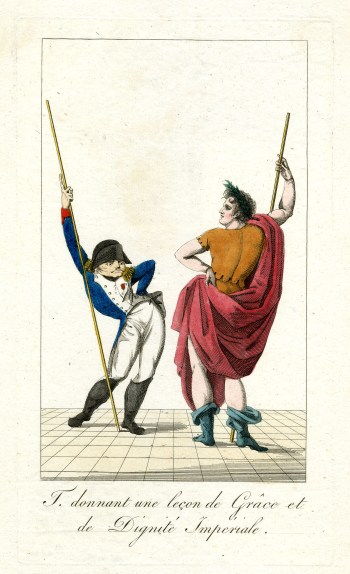
Charles Elie, T[alma] donnant une leçon de grâce et de dignité impériale (T[alma] giving a lesson in grace and imperial dignity), 1814, hand-coloured etching, 244 x 142 mm (London: British Museum).
A R T I C L E S
Antony Griffiths, “The Publication of Caricatures in Paris in 1814 and 1815, Part I: The Established Printsellers, Genty and Martinet,” pp. 31ff.
Two articles by Antony Griffiths on ‘The Publication of Caricatures in Paris in 1814 and 1815’—Part 1 in the March 2022 issue and Part 2 forthcoming—discuss the publication of caricatures in Paris during two years in which there were four regimes in power, and two occupations by foreign armies—a period which led to an unprecedented outpouring of social and political satire. Many works of great quality were produced, but most have only a title and do not reveal the names of the producers. The articles discuss how publishers and artists dealt with the political upheavals and identify some of the many participants who entered the field in these years. Part 1 deals with the caricatures published by members of the established print trade in Paris, and in particular Aaron Martinet and the newcomer Genty, who has previously been misidentified.
R E V I E W S
• Mark McDonald, Review of Juan Agustín Ceán Bermúdez, El Churriguerismo: discurso inédito (Alicante: Biblioteca Virtual Miguel de Cervantes, 2019), p. 79.
• Diana Greenwald, Review of Madeleine Viljoen, Nina Dubin and Meredith Martin, Meltdown! Picturing the World’s First Bubble Economy (Turnhout: Harvey Miller, 2020), p. 80.
• Ann V. Gunn, Review of John Bonehill, Anne Dulau Beveridge, and Nigel Leask, eds., Old Ways New Roads: Travels in Scotland 1720–1832 (Edinburgh: Birlinn, 2021), p. 81.
• Marcia Reed, Review of Troy Bickham, Eating the Empire: Food and Society in Eighteenth-Century Britain (London: Reaktion, 2020), p. 84.
• Nigel Tattersfield, Review of Graham Williams, Thomas Bewick Engraver & the Performance of Woodblocks (Kent: Florin Press, 2021), p. 86.
• Janis A. Tomlinson, Review of Mark McDonald et al., Goya’s Graphic Imagination (New York: The Metropolitan Museum of Art, 2021), p. 102.
Exhibition | A Shared Passion for Drawing
From:
Le partage d’une passion pour le dessin
Palais des Beaux-Arts, Paris, 22 March — 30 April 2022

Jean-Baptiste Greuze, Head of a Frightened Child, red chalk on beige paper (Beaux-Arts de Paris, acquired in 2013).
L’exposition dévoile un ensemble de 90 dessins, entrés dans les collections de l’École grâce à la générosité de l’association « Le Cabinet des amateurs de dessins des Beaux-Arts de Paris ». Le parcours, organisé à l’occasion des 15 ans de l’association, est présenté par écoles (italienne, nordique et française) à travers les siècles. Des œuvres d’Eugène Delacroix, Jean-Honoré Fragonard, Jean-Baptiste Greuze, Gerrit Van Honthorst, Giuseppe Penone ou encore Simone Peterzano sont ainsi à découvrir.
Les Beaux-Arts de Paris conservent la plus belle collection de dessins de France, après celle du musée du Louvre. Cette collection continue aujourd’hui encore de s’enrichir grâce à une politique d’acquisitions conçue à des fins pédagogiques ; ainsi que par des dons de professeurs, de jeunes artistes, et de l’association « Le Cabinet des amateurs de dessins des Beaux-Arts de Paris ».
Le partage d’une passion pour le dessin (ENSBA, 2017), 282 pages, ISBN: 978-2840565093, 39€.
Exhibition | Antoine Coypel and the Theater of Troy
Now on view at the Musée des Beaux-Arts de Tours:
Le Théâtre de Troie: Antoine Coypel, d’Homère à Virgile
Musée des Beaux-Arts de Tours, 22 January — 17 April 2022
 L’exposition, présentée au musée des Beaux-Arts de Tours, en partenariat avec la Bibliothèque nationale de France, est une invitation à redécouvrir Antoine Coypel (1661–1722), peintre du roi Louis XIV et du régent Philippe d’Orléans. Aucune exposition monographique concernant Coypel n’a vu le jour jusqu’à présent, mais la connaissance de l’artiste a été récemment enrichie grâce à l’apparition sur le marché de l’art d’oeuvres inédites, à la redécouverte de tableaux que l’on croyait perdus et à la restauration de décors monumentaux, tel le plafond de l’hôtel d’Argenson, sur le point d’être révélé au public aux Archives Nationales. Sans prétendre à l’exhaustivité, l’exposition est une invitation à redécouvrir la personnalité attachante et la carrière prolifique d’Antoine Coypel, ainsi que les grands textes de l’Antiquité, d’Homère et de Virgile, ayant nourri son inspiration.
Autour de La Colère d’Achille et des Adieux d’Hector et Andromaque de Tours, une cinquantaine d’oeuvres des XVIIIᵉ et XIXᵉ siècles (tableaux, estampes, dessins, sculptures, objets d’art et planches gravées) sont réunies, grâce au prêt exceptionnel de la Bibliothèque nationale de France, du château de Versailles, des musées du Louvre, de Rennes, d’Angers, d’Arles, du Mobilier national et de l’École des Beaux-Arts de Paris.
Point d’orgue de l’exposition, la galerie d’Énée du Palais-Royal, chef-d’oeuvre d’Antoine Coypel aujourd’hui disparu, renaît au travers d’estampes spectaculaires de la Bibliothèque nationale de France. Les recherches approfondies menées pour reconstituer ce grand décor ont également permis de concevoir une maquette numérique de la galerie, en partenariat avec le musée Fabre de Montpellier, qui offre pour la première fois une proposition de reconstitution virtuelle en 3D très aboutie.
Une riche programmation culturelle (cycle de conférences, visites, spectacles de danse, musique, théâtre, cycle de péplums à la cinémathèque de Tours, cours d’histoire de l’art tout public, etc.) accompagnera toute la durée de cette exposition.
Le théâtre de Troie: Antoine Coypel, d’Homère à Virgile (Paris: Lienart éditions, 2022), 192 pages, ISBN: 978-2359063547, 23€.
Exhibition | From Afar: Travelling Materials and Objects

Now on view at the Louvre, a wide-ranging exhibition (geographically and temporally) that includes eighteenth-century objects:
From Afar: Travelling Materials and Objects
Musée du Louvre, Paris, 22 September 2021 — 4 July 2022
Organized by Philippe Malgouyres and Jean-Luc Martinez

Ivory Statuette of a Peddler, German, 1702–03, elephant tusk, diamond, silver gilt, and enamel, 8.4 cm high (Paris: Musée du Louvre). More information, with additional views, can be found here.
For its sixth season, the Petite Galerie offers a journey through time and around the world with the exhibition From Afar: Traveling Materials and Objects—complementing a cycle of exhibitions at the museum dedicated to discoveries and explorations of lands near and far: Paris–Athens: The Birth of Modern Greece, 1675–1919 in September and Pharaoh of the Two Lands: The African Story of the Kings of Napata in the spring.
Through materials and objects, the exhibition describes exchanges between distant worlds—including ancient exchanges often more extensive than explorations in the 16th century. From deepest antiquity, carnelian, lapis lazuli, ebony, and ivory circulated along trade routes, and these materials were even more precious because they came from afar. Their value was enriched by the myths surrounding their origins. Not only stones, shells and plants travelled between continents; so did live animals, often for political ends. The populace as well as artists discovered ostriches, giraffes, and elephants. Man-made objects followed the same routes. Beyond Europeans’ well-known yen for the exotic, the exhibition shows that these multiple round trips wove a more complex history: forms, techniques, and themes intertwined to create new objects, reflecting all the complexity of our world as it could be perceived in Europe from the late Middle Ages on.
The exhibition was organized by Philippe Malgouyres, curator at the Department of Decorative Arts, Musée du Louvre, and Jean-Luc Martinez, honorary president of the Musée du Louvre.
Philippe Malgouyres and Jean-Luc Martinez, with Florence Dinet, Venus d’ailleurs: Matériaux et objets voyageurs (Paris: Musée du Louvre / Éditions du Seuil, 2021), 192 pages, ISBN: 978-2021456264, €32.
Exhibition | Jacques Louis David: Radical Draftsman
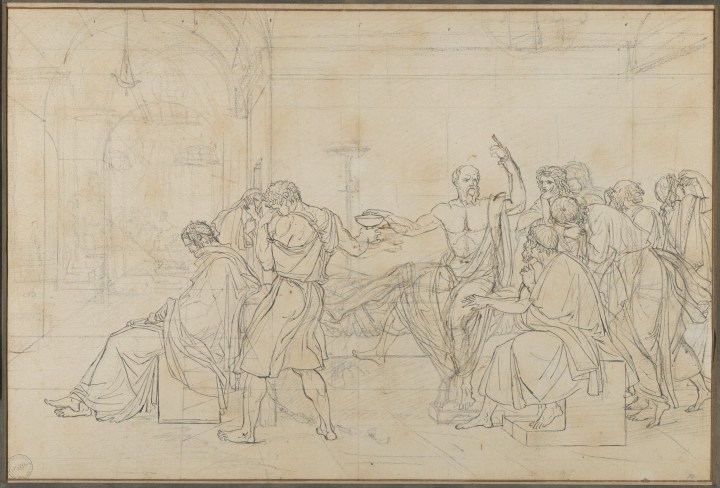
Jacques Louis David, The Death of Socrates, ca. 1786, pen and black ink, over black chalk, touches of brown ink, squared in black chalk, sheet: 11 × 16 inches (New York: The Metropolitan Museum of Art, 2015.149).
◊ ◊ ◊ ◊ ◊
From the press release for the exhibition:
Jacques Louis David: Radical Draftsman
The Metropolitan Museum of Art, New York, 17 February — 15 May 2022
Organized by Perrin Stein
Regarded in his time as the most important painter in France, Jacques Louis David (1748–1825) produced major canvases that shaped the public’s perceptions of historical events in the years before, during, and after the French Revolution. Drawings were the primary vehicle by which he devised and refined his groundbreaking compositions. Jacques Louis David: Radical Draftsman is the first exhibition devoted to works on paper by this celebrated and influential artist. Through some 80 drawings and sketches from the collections of The Met and numerous private and institutional lenders from the United States and abroad—including rarely loaned or newly discovered works—visitors will see the progress of his ideas as he worked to create his masterful paintings. A highlight of the exhibition will be a work in The Met collection, The Death of Socrates (1787)—David’s most important painting in America—which will be displayed along with preparatory drawings that reveal his years-long thought process and planning.
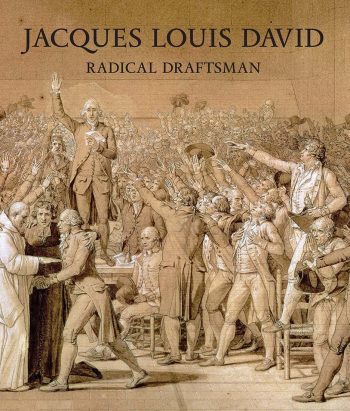 The exhibition—the first to focus on David’s preparatory studies—looks beyond his public successes to chart the moments of inspiration and the progress of ideas, both artistic and psychological. The works will be presented chronologically, starting with David’s early training in Rome. Sketches from this period represent the vast store of motifs that he mined for decades thereafter, including for his most famous paintings.
The works David submitted to the Salons after returning to France heralded a powerful new neoclassical style that drew its inspiration from classical antiquity. Paintings like The Oath of the Horatii (1784) and The Death of Socrates (1787) won instant acclaim and buttressed his growing reputation as leader of the French school. Several drawings on view demonstrate the artist’s struggles to heighten the psychological impact and create a more powerful overall composition.
Rebelling against the constraints of France’s centralized monarchy in its waning days, David embraced the changes wrought by the Revolution of 1789. His most ambitious project—a depiction of the Oath of the Tennis Court, the event in which representatives of different classes of French society pledged to draft a constitution to counterbalance the absolute authority of the king—was never completed. The exhibition will feature a large presentation drawing that is one of David’s supreme achievements, deftly redeploying the language of the classical past to imbue a contemporary event with the drama and gravitas of a history painting.
David’s support of the more radical faction of the fledgling Republic led to his imprisonment. After his release, he attempted to regain dominance of the French school by exploring themes of national reconciliation through historical subjects like The Intervention of the Sabine Women (1799). Eventually, David reclaimed the spotlight through his support of Napoleon Bonaparte. David’s magisterial canvas memorialized the glittering spectacle in Notre Dame cathedral that marked Napoleon’s ascent from successful general to crowned emperor of France in 1804.
After a string of military defeats led to Napoleon’s downfall and the restoration of the Bourbon monarchy in 1816, David—a former regicide who had lent his talents to gilding the emperor’s image—was banished. He went into exile and spent his final decade working in Brussels.
Jacques Louis David: Radical Draftsman was organized by Perrin Stein, Curator in the Department of Drawings and Prints. The exhibition is accompanied by a catalogue, published by The Metropolitan Museum of Art and distributed by Yale University Press. A related installation, In the Orbit of Jacques Louis David: Selections from the Department of Drawings and Prints, on view 20 January – 10 May 2022, focuses on David’s legacy through works by his pupils and contemporaries (Gallery 690).
Perrin Stein, with contributions by Daniella Berman, Philippe Bordes, Mehdi Korchane, Louis-Antoine Prat, Benjamin Peronnet, and Juliette Trey, Jacques Louis David: Radical Draftsman (New Haven: Yale University Press, 2022), 308 pages, ISBN: 978-1588397461, $65.
Exhibition | Flesh and Bones: The Art of Anatomy
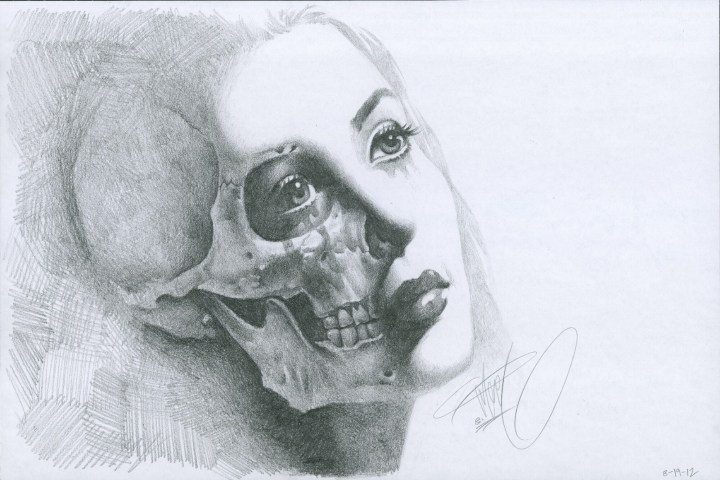
Love & Hate, 19 August 2012, OG Abel (Abel Izaguirre), graphite on paper, 12 1/2 × 19 1/2 × 3 inches (Los Angeles: Getty Research Institute, 2013.M.8. Gift of Ed and Brandy Sweeney © OG Abel).
◊ ◊ ◊ ◊ ◊
From the press release for the exhibition opening this month at The Getty:
Flesh and Bones: The Art of Anatomy
Getty Research Institute, Getty Center, 22 February — 10 July 2022
Curated by Monique Kornell
Featuring works of art from the 16th century to today, the Getty Research Institute exhibition Flesh and Bones: The Art of Anatomy explores the theme of anatomy and art and the impact of anatomy on the study of art.
“Flesh and Bones celebrates the connection between art and science and the role of art in learning,” said Mary Miller, director of the Getty Research Institute. “This exhibition draws on the Getty Research Institute’s rich and varied holdings to tell the story of two disciplines that have long been intertwined. I believe visitors will find meaningful connections with the way artists and scientists have inspired one another for centuries.”
 From spectacular life-size illustrations to delicate paper flaps that lift to reveal the body’s interior, the body is represented through a range of media. In Europe, the first printed anatomical atlases, introduced during the Renaissance, provided new visual maps to the body, often composed of striking images. Landmarks of anatomical illustration such as the revolutionary publications of Vesalius in the 16th century and Albinus in the 18th century are represented as well as little-known rarities such as a pocket-size book of anatomy for artists from over 200 years ago. The exhibition, which explores important trends in the depiction of human anatomy and reflects the shared interest in the structure of human body by medical practitioners and artists, is organized by six themes: Anatomy for Artists; Anatomy and the Antique; Lifesize; Surface Anatomy; Three Dimensionality; and The Living Dead. The last looks at the motif of the representation of the dead as living, with skeletons and anatomized cadavers capable of motion rather than inert on a dissecting table.
“Artists not only helped create these images but were part of the market for them, as anatomy was a basic component of artistic training for centuries,” said exhibition curator Monique Kornell. “Featuring selections from the GRI’s impressive collection of anatomy books for artists as well as prints, drawings, and other works, this exhibition looks at the shared vocabulary of anatomical images and at the different methods used to reveal the body through a wide range of media, from woodcut to neon.”
For artists of the modern era, anatomy is often a medium of expression and a signifier of the body itself, rather than purely an object of study. Robert Rauschenberg’s Booster (1967) and Tavares Strachan’s Robert (2018) are two life-size anatomical portraits as well as symbols of the passing nature of life. Echoing the composite prints of Antonio Cattani’s remarkable life-size anatomical figures from the 1700s in the exhibition, Booster is a fractured self-portrait based on X-rays of the artist that have been joined together.
Strachan’s Robert is not an exact likeness of the man it immortalizes, Major Robert Henry Lawrence Jr., the first African American astronaut, who tragically died in a training accident. In choosing to represent the hidden interior of the body in neon and glass, Strachan, a former GRI artist in residence, makes visible the unique history of Lawrence, while demonstrating an inner structure that equalizes all people.
Anatomists and artists have approached the problem of how best to describe the body’s complex and invisible interior with a variety of representational strategies, ranging from the graphic to the sculptural and, recently, the virtual. From paper-flap constructions that allow viewers to lift and peer under layers of flesh to stereoscopic photographs that mimic binocular perception and project anatomical structures into space, three-dimensionality was inventively pursued in the pre-digital age to cultivate an understanding of anatomy as a synthetic whole.
The exhibition is curated by Monique Kornell, guest curator; guest assistant professor, Program in the History of Medicine, Cedars-Sinai Hospital, Los Angeles, and is accompanied by a richly illustrated publication.
Monique Kornell, with contributions by Thisbe Gensler, Naoko Takahatake, and Erin Travers, Flesh and Bones: The Art of Anatomy (Los Angeles: Getty Research Institute, 2022), 249 pages, ISBN 978-1606067697, $50.










 Enfilade
leave a comment