Print Quarterly, March 2022
The long eighteenth century in the latest issue of Print Quarterly:
Print Quarterly 39.1 (March 2022) . .
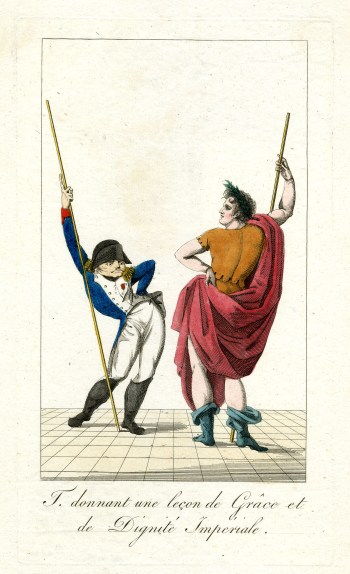
Charles Elie, T[alma] donnant une leçon de grâce et de dignité impériale (T[alma] giving a lesson in grace and imperial dignity), 1814, hand-coloured etching, 244 x 142 mm (London: British Museum).
A R T I C L E S
Antony Griffiths, “The Publication of Caricatures in Paris in 1814 and 1815, Part I: The Established Printsellers, Genty and Martinet,” pp. 31ff.
Two articles by Antony Griffiths on ‘The Publication of Caricatures in Paris in 1814 and 1815’—Part 1 in the March 2022 issue and Part 2 forthcoming—discuss the publication of caricatures in Paris during two years in which there were four regimes in power, and two occupations by foreign armies—a period which led to an unprecedented outpouring of social and political satire. Many works of great quality were produced, but most have only a title and do not reveal the names of the producers. The articles discuss how publishers and artists dealt with the political upheavals and identify some of the many participants who entered the field in these years. Part 1 deals with the caricatures published by members of the established print trade in Paris, and in particular Aaron Martinet and the newcomer Genty, who has previously been misidentified.
R E V I E W S
• Mark McDonald, Review of Juan Agustín Ceán Bermúdez, El Churriguerismo: discurso inédito (Alicante: Biblioteca Virtual Miguel de Cervantes, 2019), p. 79.
• Diana Greenwald, Review of Madeleine Viljoen, Nina Dubin and Meredith Martin, Meltdown! Picturing the World’s First Bubble Economy (Turnhout: Harvey Miller, 2020), p. 80.
• Ann V. Gunn, Review of John Bonehill, Anne Dulau Beveridge, and Nigel Leask, eds., Old Ways New Roads: Travels in Scotland 1720–1832 (Edinburgh: Birlinn, 2021), p. 81.
• Marcia Reed, Review of Troy Bickham, Eating the Empire: Food and Society in Eighteenth-Century Britain (London: Reaktion, 2020), p. 84.
• Nigel Tattersfield, Review of Graham Williams, Thomas Bewick Engraver & the Performance of Woodblocks (Kent: Florin Press, 2021), p. 86.
• Janis A. Tomlinson, Review of Mark McDonald et al., Goya’s Graphic Imagination (New York: The Metropolitan Museum of Art, 2021), p. 102.
Exhibition | A Shared Passion for Drawing
From:
Le partage d’une passion pour le dessin
Palais des Beaux-Arts, Paris, 22 March — 30 April 2022

Jean-Baptiste Greuze, Head of a Frightened Child, red chalk on beige paper (Beaux-Arts de Paris, acquired in 2013).
L’exposition dévoile un ensemble de 90 dessins, entrés dans les collections de l’École grâce à la générosité de l’association « Le Cabinet des amateurs de dessins des Beaux-Arts de Paris ». Le parcours, organisé à l’occasion des 15 ans de l’association, est présenté par écoles (italienne, nordique et française) à travers les siècles. Des œuvres d’Eugène Delacroix, Jean-Honoré Fragonard, Jean-Baptiste Greuze, Gerrit Van Honthorst, Giuseppe Penone ou encore Simone Peterzano sont ainsi à découvrir.
Les Beaux-Arts de Paris conservent la plus belle collection de dessins de France, après celle du musée du Louvre. Cette collection continue aujourd’hui encore de s’enrichir grâce à une politique d’acquisitions conçue à des fins pédagogiques ; ainsi que par des dons de professeurs, de jeunes artistes, et de l’association « Le Cabinet des amateurs de dessins des Beaux-Arts de Paris ».
Le partage d’une passion pour le dessin (ENSBA, 2017), 282 pages, ISBN: 978-2840565093, 39€.
Exhibition | Antoine Coypel and the Theater of Troy
Now on view at the Musée des Beaux-Arts de Tours:
Le Théâtre de Troie: Antoine Coypel, d’Homère à Virgile
Musée des Beaux-Arts de Tours, 22 January — 17 April 2022
 L’exposition, présentée au musée des Beaux-Arts de Tours, en partenariat avec la Bibliothèque nationale de France, est une invitation à redécouvrir Antoine Coypel (1661–1722), peintre du roi Louis XIV et du régent Philippe d’Orléans. Aucune exposition monographique concernant Coypel n’a vu le jour jusqu’à présent, mais la connaissance de l’artiste a été récemment enrichie grâce à l’apparition sur le marché de l’art d’oeuvres inédites, à la redécouverte de tableaux que l’on croyait perdus et à la restauration de décors monumentaux, tel le plafond de l’hôtel d’Argenson, sur le point d’être révélé au public aux Archives Nationales. Sans prétendre à l’exhaustivité, l’exposition est une invitation à redécouvrir la personnalité attachante et la carrière prolifique d’Antoine Coypel, ainsi que les grands textes de l’Antiquité, d’Homère et de Virgile, ayant nourri son inspiration.
Autour de La Colère d’Achille et des Adieux d’Hector et Andromaque de Tours, une cinquantaine d’oeuvres des XVIIIᵉ et XIXᵉ siècles (tableaux, estampes, dessins, sculptures, objets d’art et planches gravées) sont réunies, grâce au prêt exceptionnel de la Bibliothèque nationale de France, du château de Versailles, des musées du Louvre, de Rennes, d’Angers, d’Arles, du Mobilier national et de l’École des Beaux-Arts de Paris.
Point d’orgue de l’exposition, la galerie d’Énée du Palais-Royal, chef-d’oeuvre d’Antoine Coypel aujourd’hui disparu, renaît au travers d’estampes spectaculaires de la Bibliothèque nationale de France. Les recherches approfondies menées pour reconstituer ce grand décor ont également permis de concevoir une maquette numérique de la galerie, en partenariat avec le musée Fabre de Montpellier, qui offre pour la première fois une proposition de reconstitution virtuelle en 3D très aboutie.
Une riche programmation culturelle (cycle de conférences, visites, spectacles de danse, musique, théâtre, cycle de péplums à la cinémathèque de Tours, cours d’histoire de l’art tout public, etc.) accompagnera toute la durée de cette exposition.
Le théâtre de Troie: Antoine Coypel, d’Homère à Virgile (Paris: Lienart éditions, 2022), 192 pages, ISBN: 978-2359063547, 23€.
Exhibition | From Afar: Travelling Materials and Objects

Now on view at the Louvre, a wide-ranging exhibition (geographically and temporally) that includes eighteenth-century objects:
From Afar: Travelling Materials and Objects
Musée du Louvre, Paris, 22 September 2021 — 4 July 2022
Organized by Philippe Malgouyres and Jean-Luc Martinez

Ivory Statuette of a Peddler, German, 1702–03, elephant tusk, diamond, silver gilt, and enamel, 8.4 cm high (Paris: Musée du Louvre). More information, with additional views, can be found here.
For its sixth season, the Petite Galerie offers a journey through time and around the world with the exhibition From Afar: Traveling Materials and Objects—complementing a cycle of exhibitions at the museum dedicated to discoveries and explorations of lands near and far: Paris–Athens: The Birth of Modern Greece, 1675–1919 in September and Pharaoh of the Two Lands: The African Story of the Kings of Napata in the spring.
Through materials and objects, the exhibition describes exchanges between distant worlds—including ancient exchanges often more extensive than explorations in the 16th century. From deepest antiquity, carnelian, lapis lazuli, ebony, and ivory circulated along trade routes, and these materials were even more precious because they came from afar. Their value was enriched by the myths surrounding their origins. Not only stones, shells and plants travelled between continents; so did live animals, often for political ends. The populace as well as artists discovered ostriches, giraffes, and elephants. Man-made objects followed the same routes. Beyond Europeans’ well-known yen for the exotic, the exhibition shows that these multiple round trips wove a more complex history: forms, techniques, and themes intertwined to create new objects, reflecting all the complexity of our world as it could be perceived in Europe from the late Middle Ages on.
The exhibition was organized by Philippe Malgouyres, curator at the Department of Decorative Arts, Musée du Louvre, and Jean-Luc Martinez, honorary president of the Musée du Louvre.
Philippe Malgouyres and Jean-Luc Martinez, with Florence Dinet, Venus d’ailleurs: Matériaux et objets voyageurs (Paris: Musée du Louvre / Éditions du Seuil, 2021), 192 pages, ISBN: 978-2021456264, €32.
Exhibition | Jacques Louis David: Radical Draftsman
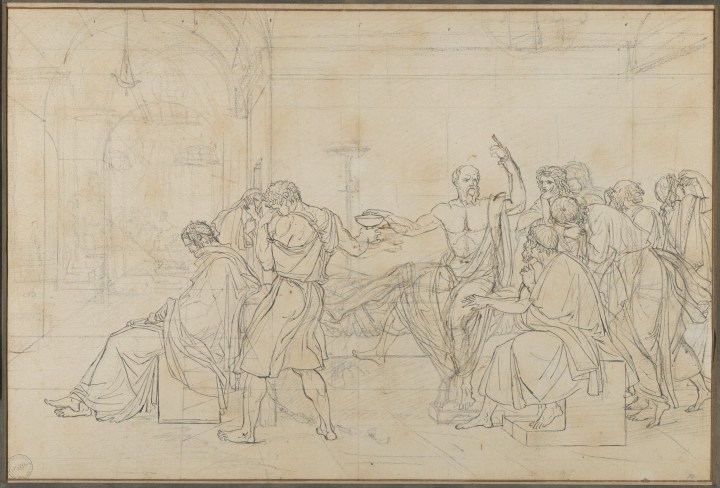
Jacques Louis David, The Death of Socrates, ca. 1786, pen and black ink, over black chalk, touches of brown ink, squared in black chalk, sheet: 11 × 16 inches (New York: The Metropolitan Museum of Art, 2015.149).
◊ ◊ ◊ ◊ ◊
From the press release for the exhibition:
Jacques Louis David: Radical Draftsman
The Metropolitan Museum of Art, New York, 17 February — 15 May 2022
Organized by Perrin Stein
Regarded in his time as the most important painter in France, Jacques Louis David (1748–1825) produced major canvases that shaped the public’s perceptions of historical events in the years before, during, and after the French Revolution. Drawings were the primary vehicle by which he devised and refined his groundbreaking compositions. Jacques Louis David: Radical Draftsman is the first exhibition devoted to works on paper by this celebrated and influential artist. Through some 80 drawings and sketches from the collections of The Met and numerous private and institutional lenders from the United States and abroad—including rarely loaned or newly discovered works—visitors will see the progress of his ideas as he worked to create his masterful paintings. A highlight of the exhibition will be a work in The Met collection, The Death of Socrates (1787)—David’s most important painting in America—which will be displayed along with preparatory drawings that reveal his years-long thought process and planning.
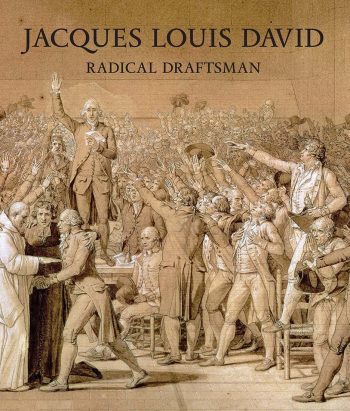 The exhibition—the first to focus on David’s preparatory studies—looks beyond his public successes to chart the moments of inspiration and the progress of ideas, both artistic and psychological. The works will be presented chronologically, starting with David’s early training in Rome. Sketches from this period represent the vast store of motifs that he mined for decades thereafter, including for his most famous paintings.
The works David submitted to the Salons after returning to France heralded a powerful new neoclassical style that drew its inspiration from classical antiquity. Paintings like The Oath of the Horatii (1784) and The Death of Socrates (1787) won instant acclaim and buttressed his growing reputation as leader of the French school. Several drawings on view demonstrate the artist’s struggles to heighten the psychological impact and create a more powerful overall composition.
Rebelling against the constraints of France’s centralized monarchy in its waning days, David embraced the changes wrought by the Revolution of 1789. His most ambitious project—a depiction of the Oath of the Tennis Court, the event in which representatives of different classes of French society pledged to draft a constitution to counterbalance the absolute authority of the king—was never completed. The exhibition will feature a large presentation drawing that is one of David’s supreme achievements, deftly redeploying the language of the classical past to imbue a contemporary event with the drama and gravitas of a history painting.
David’s support of the more radical faction of the fledgling Republic led to his imprisonment. After his release, he attempted to regain dominance of the French school by exploring themes of national reconciliation through historical subjects like The Intervention of the Sabine Women (1799). Eventually, David reclaimed the spotlight through his support of Napoleon Bonaparte. David’s magisterial canvas memorialized the glittering spectacle in Notre Dame cathedral that marked Napoleon’s ascent from successful general to crowned emperor of France in 1804.
After a string of military defeats led to Napoleon’s downfall and the restoration of the Bourbon monarchy in 1816, David—a former regicide who had lent his talents to gilding the emperor’s image—was banished. He went into exile and spent his final decade working in Brussels.
Jacques Louis David: Radical Draftsman was organized by Perrin Stein, Curator in the Department of Drawings and Prints. The exhibition is accompanied by a catalogue, published by The Metropolitan Museum of Art and distributed by Yale University Press. A related installation, In the Orbit of Jacques Louis David: Selections from the Department of Drawings and Prints, on view 20 January – 10 May 2022, focuses on David’s legacy through works by his pupils and contemporaries (Gallery 690).
Perrin Stein, with contributions by Daniella Berman, Philippe Bordes, Mehdi Korchane, Louis-Antoine Prat, Benjamin Peronnet, and Juliette Trey, Jacques Louis David: Radical Draftsman (New Haven: Yale University Press, 2022), 308 pages, ISBN: 978-1588397461, $65.
Exhibition | Flesh and Bones: The Art of Anatomy
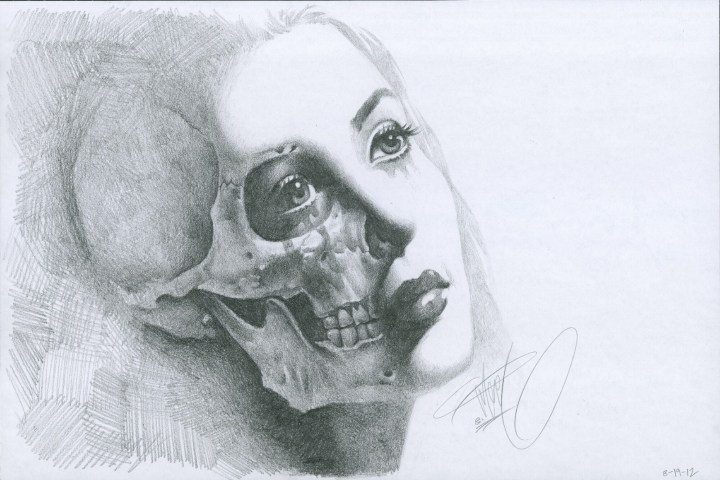
Love & Hate, 19 August 2012, OG Abel (Abel Izaguirre), graphite on paper, 12 1/2 × 19 1/2 × 3 inches (Los Angeles: Getty Research Institute, 2013.M.8. Gift of Ed and Brandy Sweeney © OG Abel).
◊ ◊ ◊ ◊ ◊
From the press release for the exhibition opening this month at The Getty:
Flesh and Bones: The Art of Anatomy
Getty Research Institute, Getty Center, 22 February — 10 July 2022
Curated by Monique Kornell
Featuring works of art from the 16th century to today, the Getty Research Institute exhibition Flesh and Bones: The Art of Anatomy explores the theme of anatomy and art and the impact of anatomy on the study of art.
“Flesh and Bones celebrates the connection between art and science and the role of art in learning,” said Mary Miller, director of the Getty Research Institute. “This exhibition draws on the Getty Research Institute’s rich and varied holdings to tell the story of two disciplines that have long been intertwined. I believe visitors will find meaningful connections with the way artists and scientists have inspired one another for centuries.”
 From spectacular life-size illustrations to delicate paper flaps that lift to reveal the body’s interior, the body is represented through a range of media. In Europe, the first printed anatomical atlases, introduced during the Renaissance, provided new visual maps to the body, often composed of striking images. Landmarks of anatomical illustration such as the revolutionary publications of Vesalius in the 16th century and Albinus in the 18th century are represented as well as little-known rarities such as a pocket-size book of anatomy for artists from over 200 years ago. The exhibition, which explores important trends in the depiction of human anatomy and reflects the shared interest in the structure of human body by medical practitioners and artists, is organized by six themes: Anatomy for Artists; Anatomy and the Antique; Lifesize; Surface Anatomy; Three Dimensionality; and The Living Dead. The last looks at the motif of the representation of the dead as living, with skeletons and anatomized cadavers capable of motion rather than inert on a dissecting table.
“Artists not only helped create these images but were part of the market for them, as anatomy was a basic component of artistic training for centuries,” said exhibition curator Monique Kornell. “Featuring selections from the GRI’s impressive collection of anatomy books for artists as well as prints, drawings, and other works, this exhibition looks at the shared vocabulary of anatomical images and at the different methods used to reveal the body through a wide range of media, from woodcut to neon.”
For artists of the modern era, anatomy is often a medium of expression and a signifier of the body itself, rather than purely an object of study. Robert Rauschenberg’s Booster (1967) and Tavares Strachan’s Robert (2018) are two life-size anatomical portraits as well as symbols of the passing nature of life. Echoing the composite prints of Antonio Cattani’s remarkable life-size anatomical figures from the 1700s in the exhibition, Booster is a fractured self-portrait based on X-rays of the artist that have been joined together.
Strachan’s Robert is not an exact likeness of the man it immortalizes, Major Robert Henry Lawrence Jr., the first African American astronaut, who tragically died in a training accident. In choosing to represent the hidden interior of the body in neon and glass, Strachan, a former GRI artist in residence, makes visible the unique history of Lawrence, while demonstrating an inner structure that equalizes all people.
Anatomists and artists have approached the problem of how best to describe the body’s complex and invisible interior with a variety of representational strategies, ranging from the graphic to the sculptural and, recently, the virtual. From paper-flap constructions that allow viewers to lift and peer under layers of flesh to stereoscopic photographs that mimic binocular perception and project anatomical structures into space, three-dimensionality was inventively pursued in the pre-digital age to cultivate an understanding of anatomy as a synthetic whole.
The exhibition is curated by Monique Kornell, guest curator; guest assistant professor, Program in the History of Medicine, Cedars-Sinai Hospital, Los Angeles, and is accompanied by a richly illustrated publication.
Monique Kornell, with contributions by Thisbe Gensler, Naoko Takahatake, and Erin Travers, Flesh and Bones: The Art of Anatomy (Los Angeles: Getty Research Institute, 2022), 249 pages, ISBN 978-1606067697, $50.
Exhibition | Ingres avant Ingres
The exhibition, on view at the Musée des Beaux-arts, Orléans, closed January 9. Philip Bordes’s review of the show appeared in the January issue of The Burlington. Here’s the information for the catalogue, published by Le Passage.
Mehdi Korchane, ed., Ingres avant Ingres: Dessiner pour peindre (Paris: Le Passage, 2021), 240 pages, ISBN: 978-2847424638, 35€.
 Catalogue d’exposition sous la direction de Mehdi Korchane, responsable des arts graphiques des musées d’Orléans, avec une préface d’Adrien Goetz et des contributions de Laurence Clivet, Yvan Coquinot, Sidonie Lemeux-Fraitot, François-René Martin, Éric Pagliano, Louis-Antoine Prat, Alice Thomine-Berrada et Florence Viguier-Dutheil.
Ce livre examine la production graphique du jeune Ingres et, ce faisant, propose de suivre l’éclosion progressive de son génie, de l’enfance jusqu’à son départ pour Rome, en 1806. La maestria éblouissante du peintre du XIXe siècle est telle que ses premières années retiennent rarement l’attention. Or, elles constituent une aventure artistique en soi, au cours de laquelle la singularité de l’artiste se manifeste principalement dans l’exercice du dessin. Si la formation académique se fonde depuis toujours sur cette pratique, premier moyen de connaissance et de perfectionnement dans l’imitation de la nature, son expérimentation par Ingres prend une dimension exhaustive révélatrice de son ambition. Première œuvre de virtuosité, le portrait de Jean Charles Auguste Simon (1802-1803), conservé au musée des Beaux-Arts d’Orléans, montre comment l’élève de David se prépare à être peintre au moyen du crayon. Mais le dessin est aussi accompli comme une discipline autonome aux finalités multiples et dans laquelle la modernité se fait jour jusque dans les plus insignifiantes expressions. En analysant ce parcours, l’ouvrage tente de redonner une cohérence à un corpus souvent parasité par les attributions abusives et le dilemme des datations. Il examine aussi les fonctions du dessin dans la pratique du peintre en devenir.
Exhibition | À la mode

Installation view of the exhibition À la mode: L’art de paraître au 18e siècle at the Musée d’arts de Nantes.
◊ ◊ ◊ ◊ ◊
Now on view at the Musée d’arts de Nantes; see particularly the ‘Exhibition in Pictures’:
À la mode: L’art de paraître au 18e siècle
À la mode: The Art of Appearance in the 18th Century
Musée d’arts de Nantes, 26 November 2021 — 6 March 2022
Musée des Beaux-arts de Dijon, 13 May — 22 August 2022
Curated by Sophie Lévy
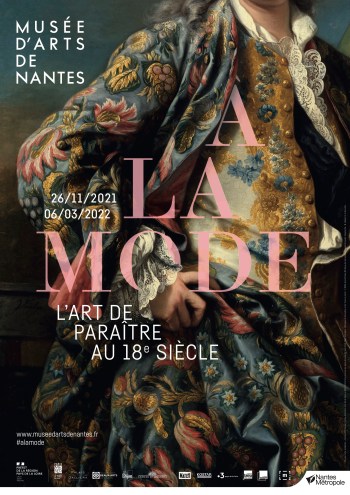 The exhibition À la mode: The Art of Appearance in the 18th Century juxtaposes iconic textile and pictorial items to reveal the reciprocal influences at play between the world of art and the birth of fashion in the 18th century. The exhibition brings together over 200 objects dating from the 18th century from major textile and fine art museums. Iconic paintings are displayed alongside precious textiles, never previously seen drawings, garments, and accessories, some of which have been restored especially for the exhibition.
The exhibition is a special collaboration with the Palais Galliera, musée de la Mode de la Ville de Paris, Paris Musées, and co-produced with the Musée des Beaux-arts de Dijon, which will host the exhibition from 13 May to 22 August 2022.
Chief Curator
• Sophie Lévy, Director and Curator of the Musée d’arts de Nantes
Scientific Curators
• Adeline Collange-Perugi, Curator of early art collections, Musée d’arts de Nantes
• Pascale Gorguet Ballesteros, Chief curator, 18th-Century Fashion and Dolls Department, Palais Galliera, musée de la Mode de la Ville de Paris
• Sandrine Champion-Balan, Chief curator, Collections Development Centre manager, Collections manager, head of modern collections for the curatorial team of the exhibition at the Musée des Beaux-Arts de Dijon
À la mode: L’art de paraître au 18e siècle (Ghent: Éditions Snoeck, 2021), 327 pages, ISBN: 978-9461617101, €35.

Exhibition | 100 Great British Drawings

William Blake, Hecate or The Night of Enitharmon’s Joy, 1795, planographic color print with pen and ink and watercolor on wove paper, 16 3/8 × 22 inches (San Marino: The Huntington Library, Art Museum, and Botanical Gardens).
◊ ◊ ◊ ◊ ◊
The exhibition opens this summer; the catalogue is scheduled to appear this month from Lund Humphries. From the press release (13 December 2021) . . .
100 Great British Drawings
The Huntington Library, Art Museum, and Botanical Gardens, San Marino, 18 June — 5 September 2022
Curated by Melinda McCurdy
Rarely seen highlights from The Huntington’s premier collection of British drawings and watercolors spotlight top artists working in the medium from the 17th to the mid-20th century.
100 Great British Drawings, a major exhibition at The Huntington Library, Art Museum, and Botanical Gardens, will trace the practice of drawing in Britain from the 17th through the mid-20th century, spotlighting The Huntington’s important collection of more than 12,000 works that represent the great masters of the medium. On view from June 18 until September 5, 2022, in the MaryLou and George Boone Gallery, the exhibition will feature rarely seen treasures, including works by William Blake, John Constable, Thomas Gainsborough, and J. M. W. Turner, as well as examples by artists associated with the Pre-Raphaelite Brotherhood and early 20th-century modernism. A fully illustrated catalog accompanies the exhibition, examining for the first time the strength and diversity of The Huntington’s British drawings collection, a significant portion of which has never been published before. The Huntington is the sole venue for the exhibition.
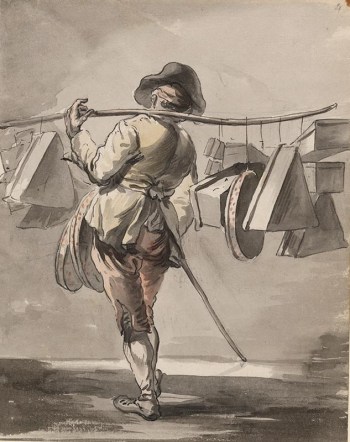
Paul Sandby, Band Box Seller, ca. 1760, brush and black ink and wash with red and yellow watercolor over traces of graphite on laid paper, 8 × 6 1/4 inches (San Marino: The Huntington Library, Art Museum, and Botanical Gardens).
“The Huntington is renowned for its incomparable collection of British art, ranging from 15th-century silver to the graphic art of Henry Moore, with the most famous works being, of course, our grand manner paintings,” said Christina Nielsen, Hannah and Russel Kully Director of the Art Museum at The Huntington. “Thomas Gainsborough’s Blue Boy and Thomas Lawrence’s Pinkie often serve as the poster boy and poster girl for the whole institution. But what most visitors do not realize is that The Huntington is also home to an extensive and remarkable collection of British drawings. This exhibition and catalog, the first to show the range of our British works on paper on such a scale, seek to fill that knowledge gap.”
Most of The Huntington’s British drawings collection, with a few notable exceptions, was established after the time of the institution’s founders, Henry and Arabella Huntington. Henry was an avid collector of rare books and manuscripts, and his wife, Arabella, was the force behind their collection of paintings and decorative art, but drawings did not factor largely into their art purchases. It was Robert R. Wark, curator of the art collections from 1956 to 1990, whose vision and tenacity established The Huntington as an outstanding repository of drawings made in Britain, where the art form was especially well developed, particularly in the late 18th to mid-19th century.
“Drawing is the most spontaneous and intimate of art forms, revealing the thoughts and mood of the artist through the stroke of a pen or touch of a brush dipped in watercolor,” said Melinda McCurdy, curator of British art, curator of the exhibition, and author of the catalog. “It is a practice especially associated with British artists, whose serious engagement with the medium is on vibrant display in the works we highlight in this exhibition.”

Matilda Conyers, Wallflower and Tulip, 1767, watercolor and opaque watercolor over traces of graphite with brown ink (est. iron gall) inscriptions on vellum, 9 × 6 1/4 inches (San Marino: The Huntington Library, Art Museum, and Botanical Gardens).
Organized chronologically, 100 Great British Drawings will explore portraiture, historical subjects, landscape, still life, botanical illustration, and caricature. The works on view will represent a full range of styles, including quick pencil sketches that candidly reveal artists’ creative processes, fluid pen-and-ink studies that approach the quality of finished works, and highly refined watercolor paintings.
The art of drawing first flourished in Britain in the late 17th century with an influx of artists coming from continental Europe, where the practice was commonly a part of artistic training. British artists also traveled abroad to view and copy the works of Europe’s old masters and contemporary artists. While portraiture was the most popular British art form at the time (as polished works by John Greenhill and Edmund Ashfield demonstrate in the exhibition), British artists eventually embraced a wide range of subjects, from landscape painting to history painting, a genre that appealed to such 18th-century titans as Thomas Gainsborough and George Romney.
Romney was unique among his peers in that he saw drawing as an end in and of itself, rather than merely a tool in preparation for oil painting. His Cimon and Iphigenia (early 1780s) was inspired by a tale from Boccaccio’s Decameron, and it captures the moment at which shepherd Cimon first spies his love, Iphigenia, asleep with two other women. Romney chose to depict Iphigenia in a sensual embrace with one of the women, using sweeping strokes of ink to imbue the scene with energy and passion. Cimon is barely present—cut off on the left of the frame—adding a suggestion of erotic voyeurism to Romney’s interpretation.
Even William Blake, famous for his unique imagination, betrays his European influences in Hecate or The Night of Enitharmon’s Joy (1795). Made by using a complex mix of printing techniques, drawing, and watercolor, Hecate depicts the witchlike mythological figure with musculature that recalls Michelangelo’s female forms, which were sketched from male nudes. By applying Michelangelo’s approach, Blake gives Hecate a powerful physique that suggests an unnatural, occult strength. The large-scale work is drawn from The Huntington’s William Blake collection, which was established by Henry Huntington himself and easily ranks among the most important Blake collections in the world.
 Most of the works in The Huntington’s British drawings collection are from the 18th and 19th centuries, when drawings and watercolors became popular commodities. Watercolors, though less forgiving than oil, allow artists to create luminous effects and are well suited to capturing the misty English climate. J. M. W. Turner was a master of these atmospheric effects. His Beaumaris Castle, Anglesey (ca. 1825–36) uses layered washes of color to create a soft fog that obscures people, horses, buildings, and ships, blending the line between sea and land. In its exploration of artistic techniques, the exhibition will look at the pigments and paper that artists used. Turner, for example, required a strong paper that could withstand his method, described by an eyewitness as first saturating the paper with wet paint. Then, “he tore … scratched … scrabbled at it in a kind of frenzy” until the image emerged as if by “magic … with all its exquisite minutia.”
By the mid-19th century, transparent watercolor technique gave way to an interest in opaque pigments or gouache, in keeping with a Victorian-era taste for sharp-focus realism. Many of the Victorian works in the exhibition were created as illustrations to poems or stories, including Samuel Palmer’s watercolor and gouache Lonely Tower (ca. 1881), which was inspired by John Milton’s Il Penseroso, and popular children’s book illustrator Kate Greenaway’s watercolor and graphite Now All of You Come Listen (ca. 1879). Some works from this period—such as those by artist Edward Burne-Jones, who was associated with the Pre-Raphaelites and collaborated with designer William Morris—demonstrate a turn away from realism toward pure “art for art’s sake,” a notion affiliated with the Aesthetic movement.
Drawings from the first half of the 20th century reveal the extraordinarily wide array of artistic styles that were emerging at the time. Many of The Huntington’s works from the period are by artists from the Slade School of Fine Art in London, where students studied abstraction, French Impressionism, Fauvism, Expressionism, Cubism, and Surrealism. A highlight of this group is Gwen John’s Two Hatted Women in Church (1920s), a work in water-based transparent paint that she made when living in France. John attended church there regularly, where she would draw the congregation, focusing less on the individuals and more on the shapes she saw in their clothing, their varying postures, and the chairs they sat on. John asserts her modernism in the painting, said McCurdy, as she “wittily juxtaposes two differently shaped hats, abbreviating such descriptive details as facial features and composing the image with bold black outlines and broad washes of muted tones.” The exhibition includes several other arresting 20th-century works on paper in various styles by such artists as David Bomberg, Paul Nash, and John Piper.
The 20th-century works combine with the others in 100 Great British Drawings to create a display that reveals the infinitely diverse aspects of “mark making,” said Ann Bermingham, professor emeritus of the history of art and architecture at the University of California, Santa Barbara, in her essay for the exhibition catalog. She concludes, “If The Huntington drawings speak to us over the distances of time and space, it is because they still hold in their linear grasp the thrill and promise of endless creativity.”
Originally part of The Huntington’s Centennial Celebration, this exhibition has been made possible by the generous support of Avery and Andrew Barth, Terri and Jerry Kohl, and Lisa and Tim Sloan. Support for this exhibition is provided by the Gladys Krieble Delmas Foundation. Support for the catalog is provided by Furthermore: a program of the J. M. Kaplan Fund.
Melinda McCurdy, Ann Bermingham, and Christina Nielson, Excursions of Imagination: 100 Great British Drawings from The Huntington’s Collection (London: Lund Humphries, 2022), 256 pages, ISBN: 978-1848224483, $45.
Exhibition | Alison Watt: A Portrait without Likeness

Alison Watt, Centifolia, detail, 2019, oil on canvas, 76 × 62cm
(Collection of the Artist, © Alison Watt)
◊ ◊ ◊ ◊ ◊
Closing this month at the Scottish National Portrait Gallery:
Alison Watt: A Portrait without Likeness
Scottish National Portrait Gallery, Edinburgh, 17 July 2021 — 9 January 2022
Curated by Julie Lawson
Alison Watt (born 1965) is widely regarded as one of the leading painters working in the UK today. This significant body of new work consists of sixteen paintings made in response to the practice of the celebrated eighteenth-century portrait artist Allan Ramsay (1713–1784) and are on show for the first time.
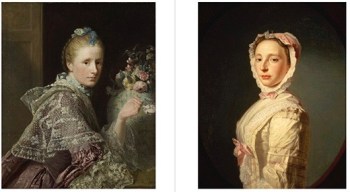
Left: Allan Ramsay, Portrait of the Artist’s Wife, Margaret Lindsay of Evelick, 1758–60, 74 × 62 cm (National Galleries of Scotland). Right: Allan Ramsay, Portrait of the Artist’s Wife, Anne Bayne, ca.1739, 68 × 55 cm (National Galleries of Scotland).
Alison Watt | A Portrait Without Likeness explores the artist’s continuing fascination with Ramsay’s portraits. Watt, most known for her beautiful and intricate large-scale paintings of drapery and folds, has long been an admirer of Ramsay’s portraits of women, in particular the intensely personal images of his first and second wives, Anne Bayne (died 1743) and Margaret Lindsay of Evelick (1726–1782). Both portraits reside in the Gallery’s collection and will be shown alongside Watt’s new work.
The exhibition is the fruit of a long period of study of Ramsay paintings, in addition to the drawings and sketchbooks from his extensive archive held by National Galleries of Scotland. Watt has said, “Looking into an artist’s archive is to view the struggle that takes place to make a work of art. A painting is a visual record of the inside of the artist’s mind. A painting is something that takes place over time; it is not static. To look at a work of art is to engage with an idea, and that is not a one sided activity. It’s more of a conversation.”
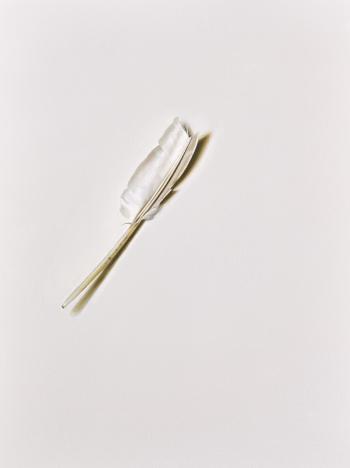
Alison Watt, Fortrose, 2019, oil on canvas, 61 × 46 cm (Collection of the Artist © Alison Watt).
A Portrait Without Likeness is accompanied by a publication featuring conversations between the artist and Julie Lawson, the Chief Curator of European, Scottish Art, and Portraiture at National Galleries of Scotland, who has curated the exhibition, as well as an essay from art historian Dr Tom Normand and a new work of short fiction by Booker Prize-nominated novelist Andrew O’Hagan.
Normand writes: “The fascination with flowers is uncommon within Watt’s oeuvre, but she has recently been engaged with the works of Allan Ramsay held in the Scottish National Portrait Gallery. Most particularly she has reflected upon his painting The Artist’s Wife, Margaret Lindsay of Evelick, painted between 1758 and 1760. This is an exquisite and mysterious portrait. At one level a tender study of his second wife, some thirteen years younger than the artist, at another a poignant essay on the enigma of human passion.”
Alison Watt, Julie Lawson, Tom Normand, and Andrew O’Hagan, Alison Watt: A Portrait without Likeness (Edinburgh: National Galleries of Scotland, 2021), 96 pages, ISBN: 978-1911054450, £20.










leave a comment