Exhibition | By Her Hand, Women Artists in Italy, 1500–1800
From the press release (30 July 2021) for the exhibition:
By Her Hand: Artemisia Gentileschi and Women Artists in Italy, 1500–1800
Wadsworth Atheneum Museum of Art, Hartford, 30 September 2021 — 9 January 2022
Detroit Institute of Arts, 6 February — 29 May 2022
Curated by Eve Straussman-Pflanzer and Oliver Tostmann
 The first exhibition solely dedicated to Italian women artists at the Wadsworth Atheneum Museum of Art, By Her Hand: Artemisia Gentileschi and Women Artists in Italy, 1500–1800 explores how women succeeded in the male-dominated art world of the time. From the group of eighteen artists presented, Artemisia Gentileschi (1593–1654 or later), takes center stage with outstanding portraits and images of heroines. This exhibition recognizes and celebrates the vital contributions of women to the history of art in Italy through rarely seen works, recent scholarship, and introductions to virtually unknown artists.
“Sofonisba Anguissola, Artemisia Gentileschi, and Rosalba Carriera, among others, created pathbreaking works of art, simultaneously subverting expectations and challenging norms,” said Oliver Tostmann, Susan Morse Hilles Curator of European Art at the Wadsworth. “Their works and careers are often distinguished by alternative choices and idiosyncratic methods employed within the context of the male dominated art world of the time. By Her Hand brings together a wide spectrum of works by these artists—many on view for the first time—inviting visitors to explore, reassess, and celebrate the achievements of Italian women artists.”
The exhibition features a wide array of paintings, miniatures, and works on paper from institutional and private collections in the United States, Canada, and Europe. The artists take on a range of subjects from portraiture and still life, to historical and religious stories. Many works are being shown publicly for the first time or are making their U.S. debut such as Artemisia Gentileschi’s ravishing Mary Magdalene. By Her Hand reweaves history by examining women artists’ work and careers from the 1550s to the 1750s. Despite the fundamental differences and challenges women artists faced, some achieved notable success in their lifetime. The accomplishments of this diverse and dynamic group are introduced, discussed, and reassessed. Until recently, many of these Italian women artists were overlooked by critics, scholars, collectors, and institutions alike.
Artemisia Gentileschi is arguably the best-known artist included in the exhibition. Gentileschi’s talents were widely recognized by her contemporaries, many elite patrons of her day knew of and desired her work. Important works by Gentileschi highlight her innovative ideas, use of sensuous colors, and command of the brush. The Wadsworth’s Self-Portrait as a Lute Player is compared with the recently discovered Self-Portrait as Saint Catherine of Alexandria from the National Gallery, London, as well as Portrait of Saint Catherine from the Uffizi Galleries, Florence. This will be the first opportunity to see these three celebrated paintings side by side in the United States. Additional examples of Gentileschi’s pioneering depictions of strong women, such as Judith and Her Maidservant with the Head of Holofernes from the Detroit Institute of Arts, will also be on view.
The compelling works of art on view in By Her Hand coupled with stories of their pioneering makers reveals a nuanced picture of the role Italian women artists played from the Renaissance to the Rococo. By Her Hand celebrates their long-overlooked contributions, and aims to inspire continued reexaminations of the role women artists have played throughout the history of art.
“Never before in its long history has the Wadsworth devoted an exhibition to the work of professional women artists in sixteenth through eighteenth-century Italy, despite the fame of our Italian Baroque painting collection” said Jeffrey N. Brown, Interim Director & CEO of the Wadsworth Atheneum. “By Her Hand is the first exhibition in any encyclopedic museum in the United States to focus on this subject. This ground-breaking exhibition provides our audiences with a chance to encounter the outstanding art produced by these women artists in early modern Italy and to appreciate the far-reaching consequences of Artemisia Gentileschi’s illustrious career.”
By Her Hand is a collaboration between the Wadsworth and the Detroit Institute of Arts. Curated by Eve Straussman-Pflanzer former curator at the Detroit Institute of Arts now Curator and Head of Italian and Spanish paintings at The National Gallery of Art, Washington and Oliver Tostmann, Susan Morse Hilles Curator of European Art at the Wadsworth. After its debut at the Wadsworth, it will travel to Detroit where it will be on view February 6–May 29, 2022.

Rosalba Carriera, Allegory of Grammar, ca. 1715, pastel on paper (Private Collection).
Artists in the exhibition
Sofonisba Anguissola (c. 1535–1625)
Diana Scultori (c. 1547–1612)
Lavinia Fontana (1552–1614)
Fede Galizia (c. 1574–c. 1630)
Isabella Catanea Parasole (active 1585–1625)
Artemisia Gentileschi (1593–1654 or later)
Orsola Maddalena Caccia (1596–1676)
Giovanna Garzoni (1600–1670)
Virginia da Vezzo (1600–1638)*
Anna Maria Vaiani (1604–1655)
Elisabetta Sirani (1638–1665)
Ginevra Cantofoli (1618–1672)
Caterina de Julianis (c. 1670–c. 1742)
Rosalba Carriera (1673–1757)
Marianna Carlevarijs (1703–after 1750)
Maria Felice Tibaldi (1707–1770)*
Veronica Stern Telli (1717–1801)
Anna Bacherini Piattoli (1720–1788)
* Virginia da Vezzo and Maria Felice Tibaldi are represented in portraits painted by their husbands Simon Vouet (1590–1649) and Pierre Subleyras (1699–1749).
Eve Straussman-Pflanzer and Oliver Tostmann, with contributions by Sheila Barker, Babette Bohn, C. D. Dickerson, Jamie Gabbarelli, Hilliard T. Goldfarb, Joaneath Spicer, and Lara Roney, By Her Hand: Artemisia Gentileschi and Women Artists in Italy, 1500–1800 (New Haven: Yale University Press, 2021), 192 pages, ISBN: 978-0300256369, $40.
Exhibition | Table Delights: Historical Linen Damasks
Press release for the exhibition, via the European Textile Network (‘Tafelfreuden’ is my new favorite word! -CH).
Tafelfreuden: Historische Leinendamaste / The Delights of Dining: Historical Linen Damasks
Abegg-Stiftung, Riggisberg, 25 April — 7 November 2021

Linen Damask with Grapevines, United Provinces, 1660–80 (Abegg-Stiftung, inv. no. 3573; photograph by Christoph von Viràg). White-in-white patterned table linen was generally more expensive than fine glassware, exquisite porcelain, and cutlery in the seventeenth century.
Patterned table linen has adorned festive dining tables since the Late Middle Ages. These pure white tablecloths, napkins, and hand towels are patterned with discreet, artfully-drawn pictorial compositions and coats of arms. Used in conjunction with fine silverware, linen damasks served as a status symbol in both princely and bourgeois households. The textiles that have survived are valuable testimony to historical dining culture. Among the many pleasures of dining, besides indulging the palate, is the spectacle of fine glassware, exquisite porcelain, and silver. And since the early sixteenth century, table linen made of white linen damasks has also been a common part of festive banquets. Often it was the most expensive item on the table.
White-in-white patterned table linen? Is there anything to see at all? Most definitely. For concealed within these seemingly plain white cloths are hitherto unimagined visual worlds and experiences. Their subtlety prompts us to ponder our sense of sight and optical phenomena generally, since depending on the fall of light—and unlike on perfectly illuminated photographs—the woven designs are not always clearly visible. But anyone ready to engage with them will soon discover motifs drawn from seafaring or everyday life, mythological and Biblical scenes, portraits of rulers, historical events, and the patrons’ coats of arms. The Abegg-Stiftung in Riggisberg possesses one of the world’s most important collections of historical linen damasks. These monumental tablecloths, napkins, and hand towels are normally kept in storage. This year’s special exhibition, however, will feature a selection of exceptionally fine examples dating from the sixteenth to eighteenth century. These will be flanked by texts and short films explaining their manufacture, place of origin, and use.
Related publication from the museum:
Cornelis A. Burgers, White Linen Damasks: Heraldic Motifs from the Sixteenth Century to circa 1830 (Riggisberg: Abegg-Stiftung, 2014), 2 vols, 564 pages, ISBN: 978-3905014563, CHF 280.
The Abegg-Stiftung’s collection of white linen damasks ranks amongst the foremost in the world. With tablecloths, banquet napkins, handtowels, and napkins, it covers a wide range of patterns, including heraldic and historical motifs, biblical and mythological stories, flowers, hunting scenes, views of towns, etc. With emphasis on heraldic motifs all such patterns feature in this catalogue. Occasionally clients also had their names and a date woven in. Most of this napery originates from weaving centres in the Southern and Northern Netherlands, Germany, Scotland, Ireland, and Russia.
Exhibition | Iron Men: The Artistry of Iron in Samurai Armor

From the press release for the exhibition:
Iron Men: The Artistry of Iron in Samurai Armor
The Ann & Gabriel Barbier-Mueller Museum, The Samurai Collection, Dallas, 1 May — 3 October 2021
Curated by Jessica Liu Beasley
On May 1, The Ann & Gabriel Barbier-Mueller Museum: The Samurai Collection will unveil its newest exhibition, Iron Men: The Artistry of Iron in Samurai Armor. The exhibition will be on display through October 3. The show examines the vital role that iron played in Japanese warrior culture and technology from the third century, when the knowledge of ironworking arrived in Japan, to the end of the samurai era in the nineteenth century. Over eighty artworks, including several masterpieces and many objects that have never before been on display, will be showcased in Iron Men. An array of samurai ironworks—full suits of armor, helmets, accessories, weapons, and horse tack—have been assembled to highlight the ways in which this seemingly unyielding metal gave way to works of protective art.
“It’s interesting to think about the common uses of iron and how, with the samurai and our collection, iron is the medium the Japanese artisans used to create the amazing pieces on display,” said Niña Barbier-Mueller Tollett, Director of Cultural Affairs for The Samurai Collection. “In the new exhibition, I think Iron Men is really referring to the craftsmen, as well as the samurai. We are excited to be bringing this aspect of samurai history to light.”
Samurai were the warriors of premodern Japan who shaped the country’s history for centuries. Their culture was one of pageantry, violence, beauty, and honor, and their spectacular armor was worn during epic battles and glorious ceremonies. The exhibition is a testament to the peerless craftsmanship of the metalworkers and reveals how they mined, smelted, and ultimately forged iron into lifesaving armor. Transcending utility, components were often meticulously inlaid with gold and silver, adorning high-ranking samurai, the daimyo, in wearable art that skillfully merged artistic form and protective function. Suits of armor from the powerful Ikeda and Date families show how these expertly crafted iron suits gave the warriors a distinguished identity and prominent appearance.
“It is remarkable to see these masterworks of iron from the collection presented together,” said Jessica Liu Beasley, curator of Iron Men and curator of The Samurai Collection. “Samurai armor is often coated in layers of lacquer that conceal the quality of the iron beneath, hiding any flaws, mistakes, or carelessness. In Iron Men, the plates are exposed, revealing every texture and lustrous finish. The virtuosity of the armorers is clearly displayed for the visitors to experience.”
The sections of the exhibition follow the story of Japanese ironworking from its introduction throughout the age of the samurai. Armorers harnessed the protective powers of iron technology to formulate their own distinct type of armor. Examples of medieval samurai armor from the thirteenth to fifteenth centuries illustrate the innovative construction that used hundreds of tiny scales (sane), which enabled superior flexibility and range of motion. Schools of armorers emerged, and the exhibition presents the work of several master armorers, providing an opportunity for side-by-side comparisons of some of the finest ironwork produced for the samurai.
Following further evolution of Japanese armor, the exhibition looks at how the introduction of firearms in the sixteenth century influenced armor fabrication. The country was in the midst of large-scale civil warfare and, in response to the new weapons, larger, more solid plates of iron had to be incorporated into the armor to protect warriors from bullets. Several components in Iron Men were bullet tested (tameshi teppo) to prove that the iron structure was strong enough to take the impact. Later, during the Edo period (1615–1868), to accommodate the changing roles of the samurai, another innovative style of armor emerged that was created with chainmail and smaller plates of iron. In this section, visitors will learn how this streamlined armor was built for ease of wear, transport, and storage.
The final sections of the exhibition show additional works from the Edo period, a time of relative peace in Japan that occurred under the unification imposed by the Tokugawa family. No longer embroiled in constant warfare, the need for battle armor decreased, and armorers had the opportunity to elevate their craft to new heights. Sumptuous creations gleam with fine metal details and decorative fittings. Sculptural iron helmets and masks were molded into fantastic three-dimensional shapes of creatures and deities. Objects of this caliber were greatly important during the many ceremonies and processions where the daimyo used the armor to demonstrate their wealth and status. Though the armor grew in beauty and refinement, the armorers to the samurai were mindful that conflict could arise again at any time. Balance had to be maintained between the elegance of their craft and the responsibility they burdened to protect the fates of their clients.
◊ ◊ ◊ ◊ ◊
The Ann & Gabriel Barbier-Mueller Museum: The Samurai Collection presents armor that once protected and adorned these fierce warriors. Established in Dallas’s Harwood District in 2012, The Samurai Collection is the only museum of its kind in the U.S. and is now one of the largest in the world. Ann and Gabriel Barbier-Mueller began acquiring art of the samurai over thirty years ago. The family has selectively built the collection with an intense focus on artistic detail and sculptural quality. The objects, which range in date from the fifth to nineteenth century, are presented in a variety of rotating exhibitions—each exploring an intriguing aspect of Japanese warrior culture. Additionally, a large exhibition of the samurai armor is currently touring through the U.S., Canada, South America, and Europe. Its upcoming exhibition at Bernisches Historisches Museum will debut 4 November 2021. The Samurai Collection is housed in the historic St. Ann’s School building, originally constructed in 1927.
Exhibition | Samurai: Armor from the Barbier-Mueller Collection
Touring since 2011 when it opened in Paris, the exhibition opens this November in Bern—its twelfth venue. Writing about the collection in 2017 for Apollo, Susan Moore noted that it then had been seen by 1.3million visitors.
Samurai: Armor from The Ann and Gabriel Barbier-Mueller Collection
Musée du quai Branly – Jacques Chirac, Paris, 8 November 2011 — 29 January 2012
Musée de la civilisation, Québec City, 4 April 2012 — 17 February 2013
Museum of Fine Arts, Boston, 14 April — 4 August 2013
Portland Art Museum, 5 October 2013 — 12 January 2014
Kimbell Art Museum, Fort Worth, 16 February — 17 August 2014
Los Angeles County Museum of Art, 19 October 2014 — 1 February 2015
Centro Cultural La Moneda, Santiago, 13 October 2015 — 8 February 2016
Denver Art Museum, 6 March — 5 June 2016
Phoenix Art Museum, 1 March — 16 July 2017
Bellagio Gallery of Fine Arts, Las Vegas, 3 November 2017 — 29 April 2018
Kunsthalle München, Munich, 1 February — 30 June 2019
Bernisches Historisches Museum, Bern, 4 November 2021 — 5 June 2022
Visitors are immersed in the multifaceted history and culture of the Japanese samurai. The exhibition presents spectacular armour, helmets, and masks from the renowned private collection of Ann and Gabriel Barbier-Mueller, along with priceless weapons from the collection of the Bernisches Historisches Museum. In addition to the familiar figure of the mythical fighter, the samurai manifest themselves as civil servants and scholars whose aesthetics, philosophy, and values endure to the present day.
J. Gabriel-Mueller, ed., with essays by Morihiro Ogawa, John Stevenson, Sachiko Hori, Stephen Turnbull, John Anderson, Ian Bottomely, Thom Richardson, Gregory Irvine, and Eric Meulien, catalogue text by Bernard Fournier-Bourdier, Art of Armor: Samurai Armor from the Ann and Gabriel Barbier-Mueller Collection (New Haven: Yale University Press, 2011), 360 pages, ISBN: 978-0300176360, $65.
 This extraordinary publication presents, for the first time, the samurai armor collection of the Ann and Gabriel Barbier-Mueller Museum in Dallas. The Barbier-Mueller has selectively amassed these pieces of armor over the past twenty-five years, ultimately forming one of the largest and most important collections of its kind in the world. It is composed of nearly three hundred objects, several of which are considered masterpieces, including suits of armor, helmets, masks, horse armor, and weaponry. The objects date from the 12th to the 19th century, with a particularly strong focus on Edo-period armor. Offering an exciting look into the world of the samurai warrior, the book begins with an introduction by Morihiro Ogawa. Essays by prominent scholars in the field highlight topics such as the phenomenon of the warrior in Japan, the development of the samurai helmet, castle architecture, women in samurai culture, and Japanese horse armor. The book’s final section consists of an extensive catalogue of objects, concentrating on 120 significant works in the collection. Lavishly illustrated in full color, each object is accompanied by an entry written by a scholar of Japanese armor.
L. John Anderson is an independent scholar and collector of samurai armor. Sachiko Hori is vice president of Sotheby’s Japanese Works of Art department in New York. Morihiro Ogawa is special consultant for Japanese arms and armor in the Department of Arms and Armor at The Metropolitan Museum of Art. Thom Richardson is keeper of armour and Oriental collections at the Royal Armouries in Leeds. John Stevenson is lecturer on Japanese art and history at the University of Washington. Stephen Turnbull is visiting lecturer in South East Asian religious studies at the University of Leeds.
Exhibition | 1821: Before and After

Kozis Desyllas, Portrait of Athanasios Diakos, detail, ca. 1870
(Athens: Benaki Museum)
◊ ◊ ◊ ◊ ◊
Now on view at the Benaki Museum:
1821: Before and After
Benaki Museum, Athens, 3 March — 7 November 2021
Curated by Maria Dimitriadou and Tassos Sakellaropoulos
The Benaki Museum—in cooperation with the Bank of Greece, the National Bank of Greece, and Alpha Bank—presents a major anniversary exhibition to celebrate the bicentenary of the pivotal year in modern Greek history, 1821, the year when the revolution which resulted in the country’s independence was declared. 1200 objects unfold more than a century of history, from the 1770 ‘Orlov Revolt’ until the 1880s.

Map of Greece, late 17th or early 18th century, tempera on wood (Athens: Benaki Museum)
Paintings, sculpture, personal items belonging to key revolutionaries, historic documents, and heirlooms are arranged in three sections. The first part (1770–1821) brings to life the progress towards a national revolution. Section two (1821–1831) showcases the events of the War of Independence and its conclusion, and section three (1831–1870) addresses the creation of the modern Greek state and its development during its first half-century.
The show presents objects held in the collections of the three banks and the Benaki Museum, itself a rich repository created on bonds of trust with the families of those who held centre-stage in the Greek Revolution. Loans have also been secured from important museums and private collections in Greece, France, and the United Kingdom.
The exhibition is included in the National Program of Bicentennial Celebrations coordinated by the ‘Greece 2021’ Committee.
An online preview is available here»
Maria Dimitriadou and Tassos Sakellaropoulos, eds., 1821 Πριν και Μετά / 1821 Before and After (Athens: Benaki Museum, 2021), 1218 pages, ISBN: 978-9604762828 (Greek) / ISBN: 978-964762835 (English), 45€.
 More than 1200 objects gathered in the exhibition and spread across the 1218 pages of the accompanying catalogue showcase one hundred years of modern Greek history, between 1770 and 1870. The period begins with the moral and economic preparations for the liberation of the Greeks, reaches an apex with the 1821 Revolution, and concludes with the first decades of the operation and development of the new Greek state. The catalogue offer a fascinating journey of history and art, revealing why this adventurous century remains so deeply engaging, even now. These works create a meaningful assemblage that traces the enchanting story of modern Greeks and brings to the fore the reasons of their very existence, their perseverance, and how far they have travelled: all the positive elements that have shaped modern Hellenism.
Copies are available here»
Exhibition | Vivre à l’antique: From Marie-Antoinette to Napoléon
The catalogue for the exhibition is published by Éditions Monelle Hayot:
Vivre à l’antique: de Marie-Antoinette à Napoléon 1er
Château de Rambouillet, 19 June — 9 August 2021
Curated by Gabriel Wick
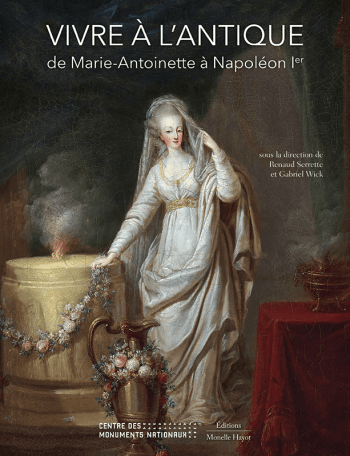 In the last three decades of the 18th century, the elites of Europe were enthralled by the constant flow of discoveries issuing forth from the excavations of buried cities, Etruscan tombs, and imperial villas in Italy. The distant past suddenly surged into the present, and architecture, furniture, and the accessories of daily life were re-imagined in its image. Nowhere in France could recount this aesthetic and cultural revolution more aptly than Rambouillet, the hunting estate and intimate retreat of the courts of Louis XVI and Napoléon I. Over the course of three months, the staterooms, intimate apartments, and dairy of Rambouillet will once again be filled with artifacts, models, and drawings from the Grand Tour and the Italian excavations, paintings by Hubert Robert, 18th– and 19th-century furnishings and decors by Jacob and Percier, and precious ceramics by Sèvres and Wedgwood. Through loans from the château of Versailles, the cité de la céramique de Sèvres, the École nationale supérieure des Beaux-Arts, the Bibliothèque des Arts décoratifs, and a number of private collections, the exhibition will explore how and why at the threshold of the modern era, distant antiquity so completely captured the imagination of the sovereigns and their courts.
Renaud Serrette and Gabriel Wick, eds., Vivre à l’antique, de Marie-Antoinette à Napoléon 1er (Saint-Remy-en-l’Eau: Éditions d’art Monelle Hayot, 2021), 200 pages, ISBN: 979-1096561315, 39€.
Exhibition | Flags and Founding Documents

13-star flag featuring a ‘Great Star’ pattern, ca. 1800–25, one of the earliest American flags known to survive
(Jeff Bridgman, American Antiques)
◊ ◊ ◊ ◊ ◊
Now on view at the Museum of the American Revolution:
Flags and Founding Documents, 1776–Today
Museum of the American Revolution, Philadelphia, 11 June — 6 September 2021
The summer exhibition Flags and Founding Documents, 1776–Today showcases dozens of rare American flags alongside historic early state constitutions and the first printing of the proposed U.S. Constitution of 1787.
The flags—many of which have never been exhibited before—trace the evolution of the Stars and Stripes through the addition and subtraction of stars as new states joined the Union and the nation battled through the Civil War. The flags serve as a visual narrative of America’s national story. The flags are showcased alongside historic documents including early printings of more than 16 different state constitutions and the Choctaw Nation Constitution of 1838 to shed light on the triumphs and tensions that the United States faced as it expanded and worked toward creating a ‘more perfect Union’. By telling stories from the nation’s revolutionary roots to its continuing struggle over equal rights, Flags and Founding Documents, 1776–Today encourages visitors to consider their role in the ongoing effort to fulfill the promise of the American Revolution.
The collection of historic flags is on loan from Jeff R. Bridgman, a leading dealer of antique flags and political textiles. The documents are on loan from the Dorothy Tapper Goldman Foundation following their presentation at the New-York Historical Society in the exhibition Colonists, Citizens, Constitutions: Creating the American Republic (February 2020 — Mary 2021), curated by Dr. James F. Hrdlicka.
James Hrdlicka, with Robert McD. Parker and a foreword by Ruth Bader Ginsburg, Colonists, Citizens, Constitutions: Creating the American Republic (London: Scala Arts Publishers, 2020), 208 pages, ISBN: 978-1785512070, $45.
Exhibition | Inspiring Walt Disney

Thanks to Kimberly Chrisman-Campbell for noting via Twitter this exhibition. In addition to the general information from The Met, see coverage at D23. . .
Inspiring Walt Disney: The Animation of French Decorative Arts
The Metropolitan Museum of Art, New York, 10 December 2021 — 6 March 2022
The Wallace Collection, London, 6 April — 16 October 20222
The Huntington Library, Art Museum, and Botanical Garden, San Marino, 10 December 2022 — 27 March 2023
Curated by Wolf Burchard
Pink castles, talking sofas, and a prince transformed into a teapot: what sounds like fantasies from Walt Disney Animation Studios’ pioneering animations were in fact the figments of the colorful salons of Rococo Paris. The Met’s first-ever exhibition exploring the work of Walt Disney and the Walt Disney Animation Studios’ hand-drawn animation will examine Disney’s personal fascination with European art and the use of French motifs in his films and theme parks, drawing new parallels between the studios’ magical creations and their artistic models.
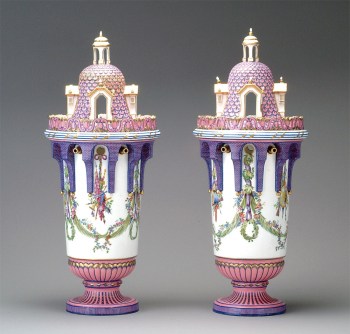
Sèvres Manufactory, pair of covered pots pourris vases in the form of towers (vases entourrés), ca. 1762; soft-paste porcelain (San Marino: The Huntington Library, Art Museum, and Botanical Gardens).
Forty works of 18th-century European decorative arts and design—from tapestries and furniture to Boulle clocks and Sèvres porcelain—will be featured alongside 150 production artworks and works on paper from the Walt Disney Animation Research Library, Walt Disney Archives, Walt Disney Imagineering Collection, and The Walt Disney Family Museum. Selected film footage illustrating the extraordinary technological and artistic developments of the studios during Disney’s lifetime and beyond will also be shown.
The exhibition will highlight references to European visual culture in Disney animated films, including nods to Gothic Revival architecture in Cinderella (1950), medieval influences on Sleeping Beauty (1959), and Rococo-inspired objects brought to life in Beauty and the Beast (1991). Marking the 30th anniversary of Beauty and the Beast’s animated theatrical release, the exhibition is organized by The Metropolitan Museum of Art and The Wallace Collection. The catalogue is distributed by Yale University Press.
The press release is available here»
Wolf Burchard, Inspiring Walt Disney: The Animation of French Decorative Arts (New York: The Metropolitan Museum of Art, 2021), 240 pages, ISBN: 978-1588397416, $50.
◊ ◊ ◊ ◊ ◊
Note (added (9 December 2021) — The posting was updated to include information for the catalogue, London dates, and the link to the press release.
Note (added 6 June 2022) — The posting was updated to include The Huntington as a venue.
The Burlington Magazine, June 2021

Charles-Louis Clérisseau, Traou en Dalmathia, 1757
(Paris: Bibliothèque nationale de France)
◊ ◊ ◊ ◊ ◊
The eighteenth century in this month’s issue of The Burlington . . .
The Burlington Magazine 163 (June 2021) — Works of Art on Paper
A R T I C L E S
• Ana Šverko, “Clérisseau’s Journey to Dalmatia: A Newly Attributed Collection of Drawings,” pp. 492–502.
A collection of 136 hitherto anonymous drawings of Italy, Istria and Dalmatia in the Bibliothèque nationale de France, Paris, is here attributed to Charles-Louis Clérisseau. The drawings, which include a group made during his journey from Venice to Diocletian’s Palace in Split with Robert Adam in 1757, further expand our understanding of Clérisseau as the forerunner of a new generation of traveller-painters.
• Tony Barnard, “Trading in Art: Antonio Cesare di Poggi (1744–1836),” pp. 492–502.
With the help of his English wife, Hester, the Italian artist A.C. Poggi forged a career in London as a portrait painter, a retailer of fans, a dealer principally in drawings and publisher of prints. Poggi’s successes and failures reflect changing fashions and fortunes in the capital’s competitive art world between his arrival in England c.1770 and departure for the Continent in 1801.
• Christopher White, “Reminiscences of the British Museum Print Room, 1954–65,” pp. 492–502.
The author’s first job, as Assistant Keeper with responsibility for the Northern schools in the Department of Prints and Drawings at the British Museum, London, introduced him to a distinguished group of curators and an occasionally eccentric band of visitors. The department’s focus was emphatically on drawings, where major acquisitions could be made by sharp-eyed scholars in the salesrooms.

Fan portraying George III and his family at the Royal Academy of Arts exhibition in 1788, made by A.C. Poggi incorporating a print by Pietro Antonio Martini after J. H. Ramberg, ca. 1790, engraved and hand-coloured paper with carved and pierced ivory sticks and guards, width when open 38.4 cm (London: Victoria and Albert Museum, T.56-1933).
◊ ◊ ◊ ◊ ◊
R E V I E W S
• Elizabeth Pergam, “The Frick Reframed,” pp. 536–39. On the plain, grey walls of the Modernist Breuer building, New York, some of the most famous works from the Frick Collection shine in a new light.
• Yuriko Jackall, Review of the exhibition catalogue Une des Provinces du Rococo: La Chine Rêvée de François Boucher, ed. by Yohan Rimaud and Alastair Laing (In Fine éditions d’art and Musée des beaux-arts et d’archéologie de Besançon, 2019), pp. 539–41.
• Jonathan Yarker, Review of the exhibition Turner’s Modern World (Tate Britain, 2020–21), pp. 541–44.
• Amanda Dotseth, Review of the exhibition publication Museo del Prado 1819–2019: Un lugar de memoria, ed. by Javier Portús et al (Prado, 2018), pp. 546–49.
• Simonetta Prosperi Valenti Rodinò, Review of Les dessins de la collection Mariette: Écoles italienne et espagnole, by Pierre Rosenberg et al, 4 vols., (Somogy, 2019), pp. 550–51.
• Oliver Tostmann, Review of Die Zeichnungen des Giovan Battista Beinaschi aus der Sammlung der Kunstakademie Düsseldorf am Kunstpalast, ed. by Sonja Brink and Francesco Grisolia (Imhof Verlag, 2020), pp. 556–57. [Beinaschi lived between 1636 and 1688, but Tostmann notes in passing points of his eighteenth-century reception.]
• Christoph Martin Vogtherr, Review of L’ Art et la manière: Dessins français du XVIIIesiècle des musées de Marseille, ed. by Luc Georget and Gérard Fabre (Silvana Editoriale, 2019), pp. 557–58.
Exhibition | Turner’s Modern World
Now on view at Tate Britain (with versions of the exhibition soon coming to Fort Worth and Boston). . .
Turner’s Modern World
Tate Britain, London, 28 October 2020 — 12 September 2021
Kimbell Art Museum, Fort Worth, 17 October 2021 — 6 February 2022
Museum of Fine Arts, Boston, 2022
 One of Britain’s greatest artists, J.M.W. Turner (1775–1851), lived and worked at the peak of the industrial revolution. Steam replaced sail; machine-power replaced manpower; political and social reforms transformed society. Many artists ignored these changes, but Turner faced up to these new challenges. This exhibition will show how he transformed the way he painted to better capture this new world.
Beginning in the 1790s, when Turner first observed the effects of modern life, the exhibition follows his fascination with the impact of industrialisation. It shows how he became involved in the big political questions of the time: campaigning against slavery and making paintings that expressed the horrors of the Napoleonic Wars.
This landmark exhibition will bring together major works by Turner from Tate and other collections, including The Fighting Temeraire (1839) and Rain, Steam and Speed (1844). It will explore what it meant to be a modern artist in his lifetime and present an exciting new perspective on his work and life.
David Blayney Brown, Amy Concannon, and Sam Smiles, eds., Turner’s Modern World (New York: Rizzoli Electa, 2021), 240 pages, 978-1849767132 (hardcover), £40, $55 / ISBN: 978-1849767125 (paperback) £25.
This monograph is tied to the first exhibition to highlight Turner’s contemporary imagery—the most exceptional and distinctive aspect of his work. Rather than making claims for Turner as a proto-modernist, it explores what constituted modernity during his lifetime and what it meant to be a modern artist. Turner’s career spanned the Napoleonic Wars, the rise of the British Empire, the birth of finance capitalism and modern industrialization, as well as political, scientific, and cultural advances that transformed society and shaped the modern world. While historians have long recognized that the industrial and political revolutions of the late eighteenth century inaugurated far-reaching change and modernization, these were often ignored by artists as they did not fit into established categories of pictorial representation. This publication shows Turner updating the language of art and transforming his style and practice to produce revelatory, definitive interpretations of modern subjects.
David Blayney Brown is Senior Curator, Tate Britain. Amy Concannon is Curator, Tate Britain. Sam Smiles is Emeritus Professor of Art History, University of Plymouth, and Programme Director, Art History and Visual Culture, University of Exeter.










 Enfilade
leave a comment