Lecture | Frédéric Ogée, Pleasures of the Senses and the Imagination
From the conference series Sociabilité et libertinage au siècle des Lumières, organized at the Cognacq-Jay Museum in conjunction with this year’s summer exhibition Realm of the Senses, from Boucher to Greuze / L’ Empire des sens, de Boucher à Greuze (19 May — 18 July 2021), curated by Annick Lemoine . . .
Frédéric Ogée | Plaisirs des sens, plaisirs de l’imagination dans l’art et la littérature anglaise du 18ème siècle
Online and In-Person, Musée Cognacq-Jay, Paris, 26 November 2021, 17.00
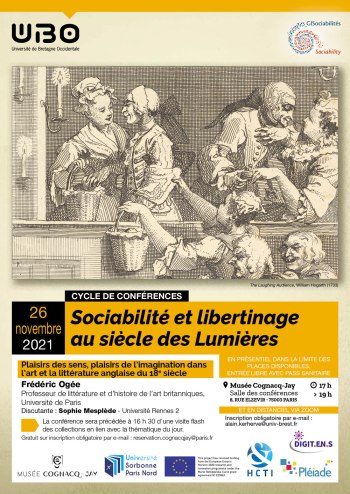 Dans le sillage de sa « Glorieuse Révolution » de 1688, l’Angleterre inaugura le siècle des Lumières en découvrant le plaisir d’un certain nombre de libertés : « régler le pouvoir des rois en leur résistant » (Voltaire), publier sans entrave, ré-évaluer l’héritage des Anciens, regarder la Nature à travers le prisme de Newton plutôt que celui des prêtres, entreprendre à crédit, célébrer la sensibilité et l’imagination. Les Anglais ont ainsi cherché de nouveaux équilibres entre la liberté de l’individu—son goût, sa subjectivité, sa perception du monde, son « progrès » —et les nécessités de la sphère collective, qu’elle soit publique ou privée. Ecrivains et artistes se sont vite employés à représenter cette nouvelle sociabilité, pour la modéliser et la polir autant que pour la promouvoir, au travers de remarquables expériences littéraires et picturales où les personnages se meuvent et s’émeuvent sous l’œil complice du spectateur-lecteur. Influencés par la philosophie empiriste ils font l’expérience du plaisir des sens pour accéder à la connaissance, d’eux-mêmes et du monde. La présente conférence permettra d’évoquer cette remarquable période de créativité qui, de Daniel Defoe et William Hogarth à Jane Austen et Thomas Lawrence, contribua au triomphe de la Grande-Bretagne sur la scène du monde.
Discutante: Sophie Mesplède (Université Rennes 2)
Frederic Ogee est professeur de littérature et d’histoire de l’art britanniques à l’Université de Paris. Ses principaux domaines de recherche sont l’esthétique, la littérature et l’art au cours du long 18ème siècle (1660–1815), sur lesquels il a souvent donné des conférences dans des universités européennes, nord-américaines et asiatiques. Commissaire de l’exposition sur le peintre anglais William Hogarth au Musée du Louvre en 2006, il est l’auteur de plusieurs ouvrages, notamment Diderot and European Culture, un recueil d’essais (Oxford: 2006, réédité 2009), J.M.W. Turner : Les paysages absolus (Hazan, 2010), et Jardins et Civilisations (Valenciennes, 2019), suite à une conférence organisée à l’Institut Européen des Jardins et Paysages de Caen. Il écrit actuellement une série de quatre monographies sur quelques grands artistes anglais (Thomas Lawrence, J.M.W. Turner, Thomas Gainsborough et William Hogarth) pour les éditions Cohen & Cohen (Paris), à paraître entre 2022 et 2025. De 2014 à 2017, il a été membre du conseil scientifique du musée Tate Britain à Londres et, depuis 2014, est membre du Conseil Scientifique de la Ville de Paris.
Conférence en présentiel dans la limite des places disponibles, entrée libre avec pass sanitaire ET en distanciel via Zoom. Participation libre sur inscription obligatoire: reservation.cognacqjay@paris.fr et alain.kerherve@univ-brest.fr. La conférence sera précédée à 16h30 d’une visite flash des collections en lien avec la thématique du jour.
Emmanuelle Brugerolles, Marine Carcanague, Marie-Anne Dupuy-Vachey, Guillaume Faroult, Yuriko Jackall, F. Joulie, É. Kerner, A. Laing, C. Le Bitouzé, A. Le Brun, A. Lemoine, N. Lesur, H. Meyer, L-A. Prat, S. de Saint-Léger, M. Szanto, L’ Empire des sens, de Boucher à Greuze (Paris Musées / Musée Cognac-Jay, 2020), 152 pages, ISBN: 978-2759605002, €30.
Exhibition | The Way Sisters: Miniaturists of the Early Republic

Attributed to Mary Way, Dressed miniature portraits of a husband and wife of the Deshon family, ca. 1800, mixed media with fabrics and painted paper (Lyman Allyn Art Museum: Gift of Ursula and Gertrude Grosvenor, 1949.122 a & b).
◊ ◊ ◊ ◊ ◊
From the press release (28 October 2021) for the exhibition:
The Way Sisters: Miniaturists of the Early Republic
Lyman Allyn Art Museum, New London, Connecticut, 30 October 2021 — 23 January 2022
Curated by Tanya Pohrt with Brian Ehrlich
The Lyman Allyn Art Museum is pleased to mount a major new exhibition that presents the story and art of May Way (1769–1833) and Elizabeth (Way) Champlain (1771–1825), two sisters and artists from New London, Connecticut. The sisters were among the earliest professional women artists working in the United States. Opening 30 October 2021, The Way Sisters: Miniaturists of the Early Republic will be on view until 23 January 2022.
“This is the first museum exhibition to focus on the Way sisters, and it includes objects that have never been publicly exhibited,” said Dr. Tanya Pohrt, the exhibition’s curator. “These two women made important and lasting contributions to the art and history of Connecticut and a young nation. Their work deepens our understanding of early American art with objects and stories from the past that still resonate today.”
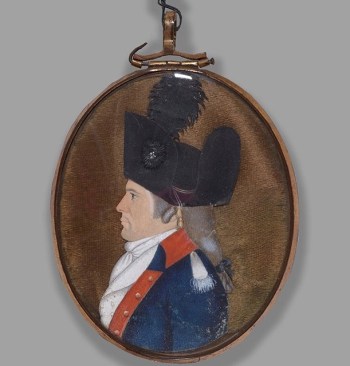
Mary Way, Portrait of Charles Holt (1772–1852), 1800, signed on verso, watercolor and fabric on paper applied to fabric (Private Collection, courtesy of Nathan Liverant & Son, LLC).
The women adapted their schoolgirl training in textiles to create collaged and painted portraits that pushed the boundaries of miniatures as an art form, while serving to expand gender roles for women. Mary Way began her career as a miniaturist around 1789 or 1790, producing painted and unique ’dressed’ portrait miniatures in profile with sewn and adhered fabric clothing that were unlike anything else made in America at the time.
Evidence suggests that Elizabeth (Way) Champlain, known as Betsey, also produced dressed and painted miniatures in roughly the same period. She remained in New London throughout her life and was active as a miniaturist until her sudden illness and death in 1825. Mary Way, who never married, moved to New York City in 1811, seeking new patrons and hoping to expand her artistic sphere. Facing stiff competition, she managed to eke out a living until she went blind in 1820 and was forced to return to New London, where her family supported her until her death in 1833.
Over the course of their careers, the Way sisters portrayed friends, relatives, and acquaintances, as well as a larger network of the mercantile elite from southeastern Connecticut. Telling a story of struggle and accomplishment, this exhibition traces what is known of the sisters’ artistic production, celebrating their stylistic and material innovations. It also examines the identities of their sitters, exploring New London’s history in the decades following the American Revolution.
On November 10, Pohrt and Brian Ehrlich, M.D., advisor to the exhibition, will give an in-person gallery talk. The lecture and reception begin at 5.30. The exhibition is made possible with support from Connecticut Humanities; the Department of Economic and Community Development, Office of the Arts; and an anonymous foundation.
The Lyman Allyn Art Museum welcomes visitors from New London, southeastern Connecticut, and all over the world. Established in 1926 by a gift from Harriet Allyn in memory of her seafaring father, the Museum opened the doors of its beautiful neo-classical building surrounded by 12 acres of green space in 1932. Today, it presents a number of changing exhibitions each year and houses a fascinating collection of over 17,000 objects from ancient times to the present: artworks from Africa, Asia, the Americas, and Europe, with particularly strong collections of American paintings, decorative arts, and Victorian toys and doll houses.
Brian Ehrlich, Catherine Kelly, D. Samuel Quigley, and Elle Shushan, The Way Sisters: Miniaturists of the Early Republic (New London: Lyman Allyn Art Museum, 2021), 100 pages, ISBN: 978-1878541086.
Exhibition | La Ménagerie de Chantilly
Now on view at the Château de Chantilly:
La Ménagerie de Chantilly
Château de Chantilly, 8 September 2021 — 3 January 2022
Curated by Florent Picouleau
 Archive material, books, plans, prints, and drawings provide a glimpse into a less well-known aspect of the history of the Château de Chantilly. The remarkable menagerie at Chantilly, with its collection of exotic animals, was one of the largest of its kind in the 17th and 18th centuries, rivaled only by that of Versailles.
À partir du Moyen Âge, posséder des animaux étrangers est un marqueur de richesse auquel prétendent, dès la Renaissance, les seigneurs de Chantilly. De la fin du XVIe siècle à celle du XVIIIe, le domaine appartient aux familles des Montmorency et des Bourbon-Condé. Pour se divertir et satisfaire leur curiosité, ils introduisent, d’abord dans le parc du château, puis dans l’une des plus extraordinaires ménageries du royaume, des animaux exotiques ou autochtones qui embellissent les jardins et valorisent l’image des propriétaires.
Les cheptels s’accroissent à tel point qu’à la fin du XVIIe siècle il apparaît indispensable de leur construire un lieu spécifique, une ménagerie au moins digne de celle de Louis XIV à Versailles. Point de convergence de la zoologie, de l’architecture animalière, de l’art, de la curiosité scientifique, elle s’inscrit pleinement, jusqu’à sa disparition amorcée en 1792, dans la vie culturelle et mondaine des XVIIe et XVIIIe siècles.
Dans le prolongement de l’exposition sur l’Orangerie de Chantilly proposée en 2017, le service des archives ressuscite désormais, au croisement de l’histoire, de l’histoire naturelle et de l’architecture, une autre partie du parc qui a, elle aussi, grandement contribué à la renommée du château et de ses propriétaires du XVIe au XVIIIe siècle.
Les visiteurs découvrent ainsi des documents rares ou inédits issus des archives et de la bibliothèque de Chantilly, du musée Condé, ou prêtés par la Bibliothèque de l’Institut de France et le Muséum national d’histoire naturelle. L’exposition leur dévoile les multiples sources du travail historique et la difficulté de la reconstitution.
Commissariat
Florent Picouleau, Chargé d’archives au musée Condé
The press packet (in French) is available as a PDF file here»
Florent Picouleau, La Ménagerie de Chantilly, XVIe–XIXe siècles (Dijon: Éditions Faton, 2021), 160 pages, ISBN: 978-2878443059, €35.
Exhibition | The King’s Animals

Now on view at Versailles:
Les Animaux du Roi / The King’s Animals
Château de Versailles, 12 October 2021 — 13 February 2022
Curated by Alexandre Maral and Nicolas Milovanovic
From its location in the heart of a vast forest in the Île-de-France region, the Palace of Versailles has always fostered a dynamic relationship with the animal kingdom. From animals as objects to be studied or collected to those used as political attributes and symbols of power, the exhibition explores the bond between the court of Versailles and animals—whether ‘companion animals’ (primarily dogs, cats, and birds), exotic beasts, or ‘wild’ creatures. It also brings two long-lost areas of the estate back to life: the Royal Menagerie and the Maze. Once the pride and joy of Louis XIV’s gardens, they can still be admired today in drawings, paintings and testimonies from the period.
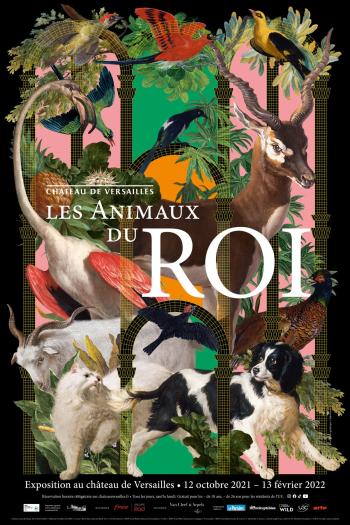 The Royal Menagerie, which the Sun King had installed close to the Grand Canal, was home to the rarest and most exotic animals—from coatis to quaggas, cassowaries to black-crowned cranes (nicknamed the ‘royal bird’)—constituting an extraordinary collection in which the king took ever greater pride. The animals in the menagerie were also a great source of inspiration for the artists of the time: they helped Claude Perrault with his Histoire naturelle, as well as serving the Royal Academy of Sciences as subjects for dissections and, later, Louis XV and Louis XVI, in their naturalism pursuits.
In addition to decorative items from the interior of the menagerie—particularly the paintings by Nicasius Bernaerts—on display are well-known garden sculptures, such as those in the Latona Fountain and the Maze. The latter comprised no fewer than 300 animals made from lead, arranged into a scene from Aesop’s fables and depicting a vision of the world in which animals make political, often moralising, always educational, pronouncements. In all, 37 sculptures recovered from the erstwhile grove will be on display.
More information about the Labyrinth (in French) is available here»
As well as the actual animals that were collected and studied, animal symbolism was used to represent power. The exhibition illustrates the link between the establishment of Versailles as a seat of power—from the construction of the palace itself on the site of Louis XIII’s old hunting lodge—and animal symbolism. Part of the exhibition is devoted to the daily hunt—a key activity pursued by warrior kings in times of peace as a form of training and demonstration of power. The hunt, consequently, features prominently in royal iconography.
 The animals themselves will return in droves to Versailles, because they never disappeared completely. They live on in the work of the king’s top painters; from Bernaerts, Boel and Le Brun, to Desportes and Oudry, many artists produced portraits of these exotic, wild and more familiar animals. As well as paintings, on view are portraits woven by the Gobelins Manufactory plus animals that were dissected, engraved, then preserved at the Academy of Sciences and in the King’s Garden, which is now the National Museum of Natural History. The exhibition also includes the skin of the Asian elephant gifted to Louis XV, which was donated to the Pavia Museum by Napoleon, and the skeleton of the very first elephant at Versailles, which was presented to Louis XIV by the king of Portugal and lived at Versailles for 13 years.
Finally, the exhibition addresses the role at court of companion animals for both the royal family and courtiers. As is evident from many portraits, companion animals were present everywhere, enlivening the royal apartments and brightening up the daily lives of children and adults alike. Many of the sovereigns, such as Marie Lesczcynska, wife of Louis XV, chose to surround themselves with their favourite animals. The court’s interest in the animal world led to greater sensitivity towards animals, in direct contrast to the Cartesian theory of animal-machines. Madame Palatine and, later, Madame de Pompadour, were particularly passionate about them.
Exhibition Curators
• Alexandre Maral, Curator General, Head of the Sculpture Department of the Musée National des Châteaux de Versailles et de Trianon
• Nicolas Milovanovic, Head Curator of the Paintings Department of the Louvre Museum
Alexandre Maral and Nicolas Milovanovic, eds., Les Animaux du Roi (Paris: Lienart éditions / musée national des châteaux de Versailles et de Trianon, 2021), 464 pages, ISBN: 978-2359063455, 49€.
Exhibition | Simon Watson: Portrait of a House

From Dublin’s Kevin Kavanagh gallery and Dürer Editions:
Simon Watson: Portrait of a House
Kevin Kavanagh, Dublin, 14–30 October 2021
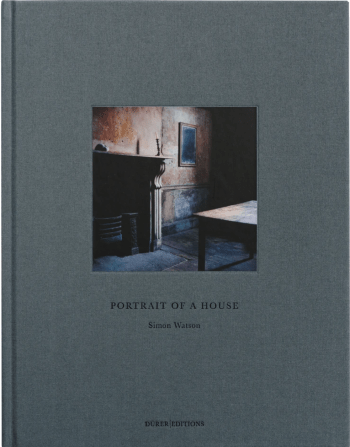
In Portrait of a House, Watson explores an eighteenth-century Georgian house on Dublin’s storied Henrietta Street. The house (Number Twelve) has a history of transformation, from the grand city home of wealthy merchants to the inner-city tenement dwelling for the poverty stricken. In a gentle Proustian fashion, the house reveals a quiet melancholy and the slow passing of time. The photographs were made over several years. The work is intended to be a poetic and intimate portrait.
 For over 30 years Simon Watson has exhibited his photographs in Europe and the U.S. including solo shows at the late Richard Anderson Gallery in New York and the Auschwitz Museum in Poland. More recently he has shown his paintings at the Galerie Rideau de Fer in France. His work is included in museums and in public and private collections worldwide. Watson has been a regular contributor to The New York Times T Magazine, W Magazine, Vogue, and Vanity Fair. His recent book The Lives of Others was published by Rizzoli in 2020.
Simon Watson, Portrait of a House (Dürer Editions, 2021 ), 64 pages, ISBN: 978-1838314309 , first edition of 1000 copies, €45; special edition of 50, €350; limited edition of 10, €750; collector edition of 5, €1850.
Exhibition | On Stage! Costume Designs
From the press release for the exhibition:
On Stage! Costume Designs from the Edmond de Rothschild Collection
Louvre, Paris, 28 October 2021 – 31 January 2022
Curated by Jérôme de La Gorce, Mickaël Bouffard, and Victoria Fernández Masaguer
 The Edmond de Rothschild Collection boasts 1,644 sumptuous costume designs for balls, ballets, masquerades, and operas given in France from the reign of François I to that of Louis XIV. Acquired in the late 19th century by Baron de Rothschild, they constitute an extraordinary resource for understanding the world of spectacle during the Ancien Régime. The exhibition showcases a hundred of the finest pieces from this unique corpus.
Cette exposition réunit une sélection d’une centaine de feuilles provenant de l’un des plus importants fonds de dessins d’habits de spectacle, celui des volumes de Costumes de fêtes, de ballets et de théâtre au temps de Louis XIV offerts par le baron Edmond de Rothschild (1845–1934) au musée du Louvre. Leur richesse permet de dévoiler la diversité d’invention des artistes qui habillèrent les divertissements montés à la Cour de France et de Lorraine du milieu du XVIe siècle à l’aube du XVIIIe siècle : le Primatice, Jacques Bellange, Daniel Rabel, Henri Gissey et Jean Berain notamment. Les véritables ouvrages textiles ayant disparu pour la plupart, ces dessins sont des sources inestimables pour l’histoire du costume, de la danse, de la musique et des spectacles en France durant cette période.
Divisée en quatre sections, cette exposition consacre une première salle à l’atelier du dessinateur de costumes qui entend explorer la transmission de modèles entre les différentes générations d’artistes et les spécificités techniques propres à ce type de dessin. Le parcours propose ensuite de suivre les principaux genres spectaculaires représentés dans ces recueils, qui correspondent aux intérêts de l’un des plus grands collectionneurs de dessins de fêtes et divertissements de la fin du XVIIe et du début du XVIIIe siècle, Claude Pioche, sieur Du Rondray (1660/1665–1733), à qui une partie des feuilles assemblées dans ces volumes aurait appartenu :
Les divertissements équestres : les costumes des cavaliers et des chevaux deviennent l’un des attraits majeurs de ces compétitions destinées tant à prouver la valeur que la galanterie des concurrents dans la lice. Par leur magnificence et l’émerveillement qu’ils suscitent, ils contribuent à l’affirmation du pouvoir.
Les bals, ballets et mascarades : dans la seconde moitié du XVIe siècle, un caractère à la fois bizarre et poétique guide les artistes qui produisent des « habits de masques » pour les bals et mascarades. Au temps de Louis XIII, le sérieux et le grotesque se mêlent aux influences mythologiques, exotiques et bucoliques, codes que le ballet de Cour et la comédie-ballet se réapproprient au cours du XVIIe siècle.
Les tragédies en musique : ce nouveau genre musical français réunit une multitude de chanteurs, danseurs, musiciens et acrobates qu’il est nécessaire d’habiller harmonieusement. C’est le défi que relève le créateur des Menus Plaisirs Jean Berain, en faisant preuve d’une invention sans pareil dans la variation des coupes, des couleurs et des ornements.
Grâce à une campagne de restauration conduite par l’atelier de restauration du département des Arts graphiques du musée du Louvre, l’ensemble du corpus de dessins de costumes, soit 1644 feuilles, a été restauré et remonté dans des papiers de conservation neutre.
Commissaires de l’exposition
• Mickaël Bouffard, chargé de recherche, Centre d’Étude de la Langue et des Littératures Françaises (CELLF)
• Jérôme de La Gorce, directeur de recherche émérite, CNRS
• Victoria Fernández Masaguer, chargée d’études documentaires, département des Arts graphiques, musée du Louvre
Jérôme de La Gorce, Mickaël Bouffard, et Victoria Fernández Masaguer, En scène! Dessins de costumes de la collection Edmond de Rothschild (Paris: Louvre éditions / Lienart, 2021), 232 pages, ISBN: 978-2359063240, 29€.
Exhibition | La Surprise: Watteau in Los Angeles
Opening next month at the The Getty:
La Surprise: Watteau in Los Angeles
The Getty Center, Los Angeles, 23 November 2021 — 20 February 2022
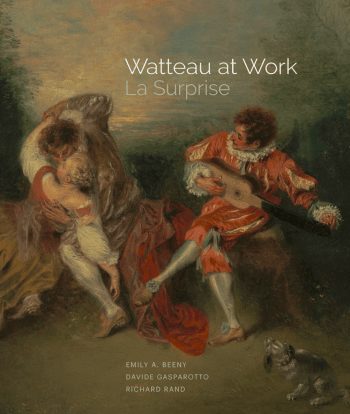 Graceful scenes of courtship, music and dance, strolling lovers and theatrical characters: this is the imaginary world conjured by the greatest French painter and draftsman of the 18th century, Antoine Watteau (1684–1721). Los Angeles is home to an extraordinary group of Watteau’s works. This focused exhibition, marking the 300th anniversary of the artist’s death, brings together a dozen of them from public and private collections and celebrates the Getty’s recent acquisition of an exquisite example: the painting La Surprise. The picture belongs to what was a new genre of painting invented by the artist himself—the fête galante. These works do not so much tell a story as set a mood: one of playful, wistful, nostalgic reverie. Esteemed by collectors in Watteau’s day as a work that showed the artist at the height of his skill and success, La Surprise vanished from public view in 1848, reemerging only in 2007. The Getty Museum acquired the painting in 2017.
Emily Beeny, Davide Gasparotto, and Richard Rand, Watteau at Work: La Surprise (Los Angeles: J. Paul Getty Museum, 2021), 88 pages, ISBN: 978-1606067352, $25.
La Surprise by Antoine Watteau has never before been the subject of a dedicated publication. Marking the three hundredth anniversary of Watteau’s death, this book considers the painting within the context of the artist’s oeuvre and discusses the surprising history of collecting works by the artist in Los Angeles.
Emily A. Beeny, former associate curator of drawings at the J. Paul Getty Museum, is curator in charge of European paintings at the Fine Arts Museums of San Francisco. Davide Gasparotto is senior curator of paintings and chair, curatorial affairs, at the J. Paul Getty Museum. Richard Rand is associate director for collections at the J. Paul Getty Museum.
C O N T E N T S
Timothy Potts, Director’s Foreword
Acknowledgments
Richard Rand, Jean Antoine Watteau, Three Hundred Years Later
Davide Gasparotto, Rediscovering a Masterpiece: Watteau’s La Surprise
Emily Beeny, Quelle Surprise! Watteau in Los Angeles
Plates
Works in the Exhibition
References
Index
New Book | Nicolas Party: Pastel
The catalogue for the exhibition is now available:
Nicolas Party, ed., Pastel (New York: The FLAG Art Foundation, 2021), 216 pages, ISBN: 978-1949172522, $50. Contributions by Nicolas Party and Dodie Kazanjian; conversation with artists Louis Fratino, Loie Hollowell, Billy Sullivan, Robin F. Williams, moderated by FLAG Founder Glenn Fuhrman; essay by Melissa Hyde, “‘Dust From a Butterfly’s Wing’: The Gentle Art of Pastel, A Short History.”
 In 2019, Nicolas Party transformed The FLAG Art Foundation in New York into a rose-colored stage set for a suite of soft pastel, Rococo-inspired murals that serve as a foil to, and occasional backdrop for, a selection of pastels from the 18th century to the present. Pastel commemorates the exhibition, its celebration of the pastel medium, and the range of contemporary artists who are giving new energy to this uniquely fragile medium. Artists in the exhibition included Rosalba Carriera, Mary Cassatt, Edgar Degas, Louis Fratino, Marsden Hartley, Loie Hollowell, Julian Martin, Toyin Ojih Odutola, Chris Ofili, Jean-Baptiste Perronneau, Billy Sullivan, Wayne Thiebaud, and Robin F. Williams.
Nicolas Party (b. 1980, Lausanne, Switzerland) is an artist living and working in Brussels and New York. He earned a BA in Fine Art at the Lausanne School of Art in 2004 and an MA at The Glasgow School of Art in 2009. More information is available here.
Print Market | Mad about Mezzotint at the Court of George III
From Isaac and Ede:
Mad about Mezzotint at the Court of George III
Reindeer Antiques, London, 6 October — 5 November 2021
 This exhibition organized by David Isaac of Isaac and Ede celebrates the bicentenary of the 60-year reign of King George III (1738–1820) through one mezzotint portrait for each year of his reign. Meet the movers and shakers, the courtiers and courtesans, the duchesses and dandies of the period. Each mezzotint was printed in the year it represents, so there are 61 prints to cover the years 1760–1820 with a couple of extras thrown in for good measure. Royalty and aristocracy dominate throughout the opening decades, but as the country finds itself increasingly at war with America, France, Spain (and practically everyone else), we see a predominance of naval and military heroes taking centre stage. Towards the end of our period, we begin to see the emergence of the self-made man, and the entrepreneurial spirit of that would come to symbolize the Victorian era. To be held at Reindeer Antiques, 81, Kensington Church Street, London W8 4BG.
Printed catalogues are available: UK £30 including P&P / USA £47 including P&P. View a PDF of the catalogue on Issuu. The catalogue is also distributed by Paul Holberton Publishing:
David Isaac, Mad about Mezzotint at the Court of George III (London: Isaac and Ede, 2022), 148 pages, ISBN 978-1913645359, £30.
◊ ◊ ◊ ◊ ◊
Note (added 6 July 2022) — The original posting did not include catalogue details from PHP.
Exhibition | Aquatint: From Its Origins to Goya
From the NGA:
Aquatint: From Its Origins to Goya
National Gallery of Art, Washington, D.C., 24 October 2021 — 21 February 2022
Curated by Rena Hoisington
 A new printmaking technique—aquatint—swept through 18th-century Europe, yielding an extraordinary range of works, from images of erupting volcanoes, amorous couples, and mysterious tombs, to Russian exotica, biting caricatures, and moonlit vistas. The first American exhibition to survey the medium’s development in France, England, Italy, Germany, the Netherlands, and Spain, Aquatint: From Its Origins to Goya presents some 100 early and exceptional impressions, many of which have recently been acquired by the National Gallery of Art. By supplementing the line work of etching, aquatint offered an exciting method for multiplying ink-and-wash drawings that render tone in subtle ways.
Aquatint flourished outside the official circles of European art academies in the hands of three kinds of artists—professional printmakers, amateurs (art lovers), and peintre-graveurs (painter-printmakers). Each played a distinctive and significant role in publicizing, disseminating, and advancing the aquatint medium. Professional printmakers combined it with other intaglio printmaking techniques to reproduce highly prized drawings by old master and contemporary artists. Amateurs, an elite group of like-minded collectors, embraced drawing, etching, and aquatint to not only expand their art-historical and connoisseurial knowledge, but also cultivate relationships with artists. Peintre-graveurs revisited, re-created, and circulated their designs through aquatint to build their reputations and broaden their audiences, dramatically expanding the formal vocabulary and expressive potential of the medium.
Rena Hoisington, Aquatint: From Its Origins to Goya (Princeton: Princeton University Press, 2021), 288 pages, ISBN: 978-0691229799, $60.
Supported by the Eugene V. and Clare E. Thaw Charitable Trust and written by Rena M. Hoisington, curator and head of old master prints at the National Gallery of Art, a book illustrated with rare works from the National Gallery’s collection of early aquatints accompanies the exhibition. It provides an engaging narrative about the medium’s flourishing as a cross-cultural and cosmopolitan phenomenon that contributed to the rise of art publishing, connoisseurship, leisure travel, and drawing instruction as well as the spread of neoclassicism.










leave a comment