New Book | Venetian Drawings
On this day (12 May) in 1797, Ludovico Manin, the last doge of Venice—in response to Napoleonic aggression—formally abolished La Serenissima after 1,100 years of existence. Notice of this SMK catalogue seems like a fine way to mark the anniversary. I didn’t provide a posting here at Enfilade when it was initially published in 2018, but copies are still available. Thomas Dalla Costa’s review of it appears in the current issue of Master Drawings (2021, volume 59, issue 1); it also was reviewed by Jörg Zutter for The Burlington in December 2019. –CH
Chris Fischer, Venetian Drawings: The Royal Collection of Graphic Art (Copenhagen: Statens Museum for Kunst, 2018), 339 pages, ISBN 978-8775510719, 300 Danish Kroner (DKK), or about $50.
 This catalogue is the first publication of all the Venetian drawings in the Royal Collection of Graphic Art at the National Gallery of Denmark (Statens Museum for Kunst). Few of these drawings have ever been published, and only a handful has been shown to the public within living memory. Research in connection with this catalogue has revealed that not only is the number of drawings from this geographic area surprisingly high, but the quality of the drawings is stupendous, counting some of the most beautiful sheets in the collection. Furthermore, the comprehensiveness of this part of the collection has proved extraordinary with very even coverage of the development of draughtsmanship in Venice and the Venetian mainland from the 1480s, when sketching on paper became common, through the lesser-known 17th century to the fall of the Venetian republic in 1797. The catalogue presents more than 200 fine drawings by Vittore Carpaccio, Moretto da Brescia, Domenico Campagnola, Jacopo Bassano, Paolo Farinati and Paolo Veronese, large groups of studies by Palma Giovane and Antonio Vassilacchi called Aliense, as well as sheets by 18th-century draughtsmen such as Giovanni Antonio Pellegrini, Gaspare Diziani, Giovanni Battista Tiepolo and his son Domenico, Francesco Fontebasso, Francesco Guardi, and Giovanni Battista Piranesi.
It is available at the SMK Shop, and can be ordered in Danish bookstores and webshops such as Academic Books, Bog & Idé, Bogreolen, Buuks, Gucca, I Music, Plusbog og Saxo.
Napoleon Two Centuries Later

Two centuries after his death (the anniversary of which arrived last week on May 5), Napoleon’s legacy remains combustible. From the Musée de l’Armée:
Napoléon n’est plus / Napoleon Is No Nore
Musée de l’Armée Invalides, Paris, 31 March — 31 October 2021
The death of Napoleon I on 5 May 1821—although it went relatively unnoticed in the eyes of the world—was extremely well documented by his companions in exile. Despite the abundance of memories, letters, sketches, relics, and stories, this history nevertheless includes grey areas, uncertainties, contradictions. In this exhibition, we examine the major themes surrounding the death of Napoleon by changing the perspectives. By calling in new scientific disciplines (archaeology, medicine, chemistry) in order to complete already known historical sources and material evidence of this history, the musée de l’Armée provides visitors with all the necessary elements to enable them to conduct the investigation by themselves.
This exhibition is part of the 2021 Napoleon Season organised to celebrate the bicentenary of the Emperor’s death. The musée de l’Armée will present a rich and varied cultural offering evoking the end of Napoleon’s personal adventure, while opening up to the topicality and the current reality of his legacy to the world. . . .
Napoléon n’est plus (Paris: Gallimard, 2021), 296 pages, ISBN: 978-2072931604, 35€.
From the Musée de l’Armée:
Napoleon? Encore!
Musée de l’Armée Invalides, Paris, 7 May 2021 — 13 February 2022
Curated by Éric de Chassey and Julien Voinot
This contemporary art tour evokes the figure of Napoleon as well as his legacy. Thirty contemporary artists received carte blanche to question this symbolic and historical figure.
Echoing the commemorations of the bicentenary of the death of the Emperor, the musée de l’Armée is presenting, for the first time in its history, a contemporary art tour at Les Invalides. The presentation of pre-existing works and specially commissioned orders entrusted to renowned or emerging artists, from France and abroad, evokes the figure of Napoleon as well as the impact of his action in today’s world. Presented in conjunction with the exhibition Napoleon Is No More, the curation of this contemporary tour was entrusted to Éric de Chassey, Director of the Institut National d’Histoire de l’Art, and Julien Voinot, Collections Manager in the Department of 19th-Century and Symbolic Art of the musée de l’Armée.
◊ ◊ ◊ ◊ ◊
From The New York Times:
Roger Cohen, “France Battles over Whether to Cancel or Celebrate Napoleon,” The New York Times (5 May 2021). President Emmanuel Macron laid a wreath at the emperor’s tomb on the 200th anniversary of his death, stepping into a national debate over the legacy of Napoleon.
Jacques Chirac couldn’t stand him. Nicolas Sarkozy kept his distance. François Hollande shunned him. But on the 200th anniversary this week of Napoleon Bonaparte’s death, Emmanuel Macron has chosen to do what most recent presidents of France have avoided: honor the man who in 1799 destroyed the nascent French Republic in a putsch.
By choosing to lay a wreath Wednesday at Napoleon’s tomb under the golden dome of Les Invalides, Mr. Macron stepped into the heart of France’s culture wars. Napoleon, always a contested figure, has become a Rorschach test for the French at a moment of tense cultural confrontation.
Was Napoleon a modernizing reformer whose legal code, lycée school system, central bank and centralized administrative framework laid the basis for post-revolutionary France? Or was he a retrograde racist, imperialist, and misogynist?
By paying his respects to Napoleon, Mr. Macron will please a restive French right dreaming of lost glory and of a moment when, under its turbulent emperor, France stood at the center of the world. The French obsession with the romantic epic of Napoleon’s rise and fall is undying, as countless magazine covers and talk shows have underscored in recent weeks. But in the current zeitgeist, Napoleon’s decisive role as founder of the modern French state tends to pale beside his record as colonizer, warmonger and enslaver. . . .
The full article is available here»
◊ ◊ ◊ ◊ ◊

Rendering from Pascal Convert of his Memento Marengo as envisioned at Les Invalides in Paris.
◊ ◊ ◊ ◊ ◊
From Apollo Magazine:
Laura O’Brien, “The Celebrity Horse That’s Putting Napoleon in the Shade,” Apollo Magazine (6 May 2021).
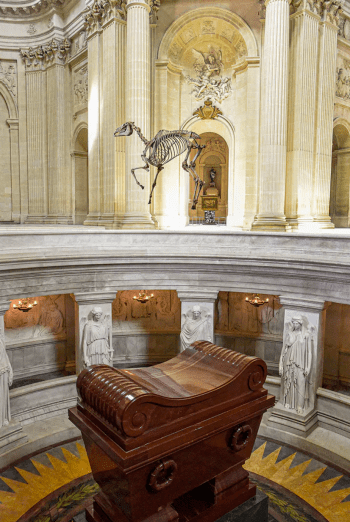 On a cold December day in 1840, Napoleon Bonaparte’s body made its final journey through the streets of Paris for reburial at the Dôme church at Les Invalides. Nineteen years after his death on Saint Helena, on 5 May 1821, the former emperor’s remains had been repatriated to France. The procession to Les Invalides included a lone, riderless white horse. In the emotionally charged atmosphere of that day, some witnesses even believed for a moment that this was the emperor’s most famous mount: Marengo.
Now, 200 years after Napoleon’s death, Bonaparte and Marengo are to be reunited, albeit temporarily. As part of Napoleon? Encore!, an exhibition of contemporary art responding to Napoleon’s image and complex legacies [on view from 7 May 2021 to 13 February 2022], the French multimedia artist Pascal Convert has created Memento Marengo: a life-sized, 3D-printed copy of the skeleton of the Arab horse said to have been Napoleon’s favourite—or one of his favourites, at least. Convert had originally hoped to use the real skeleton, which is usually on display at London’s National Army Museum, but its fragility made this impossible. Memento Marengo will hang from the ceiling of the Dôme church, the equine skeleton suspended a few metres above the enormous red quartzite tomb of its ex-master. On 5 May, President Emmanuel Macron placed a wreath of red, white, and blue flowers at the foot of the tomb, as part of the official commemorations—not celebrations, as the Élysée Palace has carefully insisted—of Napoleon’s death. Memento Marengo was not in place during the solemn ceremonies at Les Invalides, but with these now completed, the artwork can be installed ahead of the planned reopening of the museum later this month. . . .
The full article is available here»
Exhibition | Vicereines of Ireland
Opening at the end of this month in the State Apartment Galleries at Dublin Castle:
Vicereines of Ireland: Portraits of Forgotten Women
Dublin Castle, 31 May – 5 September 2021 (dates subject to Covid-19 restrictions)
Curated by Myles Campbell
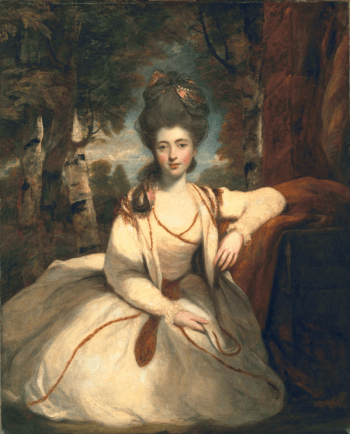
Joshua Reyolds, Frances Molesworth, later Marchioness Camden, 1777, oil on canvas, 56 × 45 inches (San Marino: The Huntington Library, Art Museum, and Botanical Gardens).
Fabrics shimmer, flowers blossom, and pearls glint in the painted world of the vicereines of Ireland. But who were the women behind these genteel portraits? Discover their untold story in this landmark exhibition.
As the wives of Ireland’s viceroys, the vicereines were once the fashionable figureheads of social and cultural life at Dublin Castle. Often sympathetic but sometimes apathetic, their attitudes and activities offer fresh insights into the workings of the British administration in Ireland. Campaigns to develop hospitals, relieve poverty, promote Irish fashions, and, in some cases, mitigate what they described as the injustices of British rule in Ireland, are just some of their overlooked initiatives. Featuring works by masters such as Sir Joshua Reynolds, Thomas Gainsborough, John Singer Sargent, and Sir John Lavery, together with intimate personal objects, this exhibition shines a light on these activities to create new and illuminating portraits of forgotten women.
The exhibition is curated by Dr Myles Campbell, Research and Interpretation Officer, Dublin Castle. Lending institutions include the National Gallery of Ireland, National Trust, Royal Collection Trust, Trinity College Dublin, and Chatsworth House.
◊ ◊ ◊ ◊ ◊
From the Irish Academic Press:
Myles Campbell, ed., Vicereines of Ireland: Portraits of Forgotten Women (Dublin: Irish Academic Press, 2021), 328 pages, ISBN: 978-1788551335, €35 / $45.
 By exploring previously unknown or rarely seen artworks by prominent Irish and British artists of the eighteenth and nineteenth centuries, Vicereines of Ireland tells the untold story of the women who were the faces of the British administration in Ireland. Featuring essays by leading scholars and based on original sources, including diaries and letters, this beautifully illustrated book brings together text and image to create new and illuminating portraits of forgotten women.
Myles Campbell is now Research and Interpretation Officer (Curator) for the Office of Public Works at Dublin Castle, where he has curated several exhibitions. In 2017 he was co-editor of Making Majesty: The Throne Room at Dublin Castle, A Cultural History (Irish Academic Press), research for which earned him the inaugural George B. Clarke Prize.
C O N T E N T S
Foreword by Mary Heffernan, OPW
Editor’s Introduction
1 ‘The Goverment of the Familie’: The First Duchess of Ormonde’s Understanding of the Role of Vicereine ~ Naomi McAreavey
2 ‘That Caballing Humour, which has Very Ill Effects’: Frances Talbot, Jacobite Duchess of Tyrconnell and Vicereine of Ireland ~ Frances Nolan
3 ‘She Made Charity and Benevolence Fashionable’: Mary, Marchioness of Buckingham, Vicereine of Ireland ~ Janice Morris
4 ‘An Admirable Vice-Queen’: The Duchess of Rutland in Ireland, 1784–87 ~ Rachel Wilson
5 ‘A Subject for History’: Maria, Marchioness of Normanby as Vicereine of Ireland, 1835–39 ~ Myles Campbell
6 Lacing Together the Union: How Theresa, Marchioness of Londonderry’s Unionist Endeavours were at the Heart of her Viceregal Tenure in Ireland, 1886–89 ~ Neil Watt
7 ‘One of the Sincerest Democrats of her Caste’: Lady Ishbel Aberdeen’s Crusade against Tuberculosis in Ireland ~ Éimear O’Connor
Online Talk | Alec Cobbe, Birds, Bugs and Butterflies
Tomorrow, from The Decorative Arts Trust:
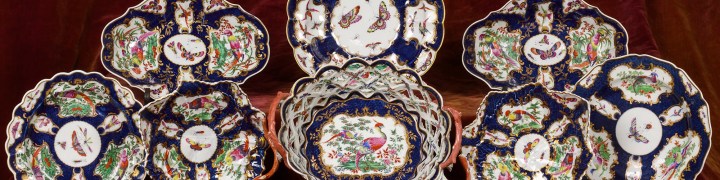
Recounting the Life of the ‘Peacock’ Worcester Service (1763)
Alec Cobbe, joined with Leslie Fitzpatrick
Online, Monday, 10 May 2021, 1.00pm (ET)
Join us as we learn about some incredible ceramics from Ireland with artist, designer, and collector Alec Cobbe. Alec will share an illustrated talk about the creation, dispersal, and recovery of the ‘Peacock’ Worcester service of 1763, the largest mid-18th-century service recorded from any British porcelain manufacturer. Thomas and Lady Betty Cobbe of Newbridge House, County Dublin, acquired the service after becoming acquainted with Dr. Wall’s porcelain factory in Worcester as they traveled from Dublin to Bath.
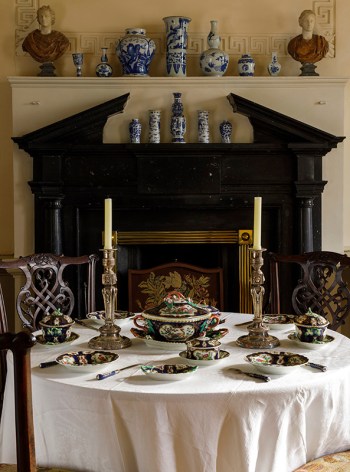 This lecture features scholarship that is part of a recent publication and exhibition Birds, Bugs and Butterflies: Lady Betty Cobbe’s ‘Peacock’ Worcester Porcelain composed by Alec and shown at Dublin Castle (October 2019 to February 2020).
After his presentation, Alec will be joined in conversation with Leslie Fitzpatrick, who previously served as the Samuel and M. Patricia Grober Associate Curator of European Decorative Arts at the Art Institute of Chicago.
This program is dedicated in memory of Christopher Monkhouse, a recipient of the Decorative Trust’s Award of Merit, whose extraordinary 2015 exhibition and publication Ireland: Crossroads of Art and Design, 1690–1840 continue to serve as a testament to the incredible material culture of Ireland.
Participants will receive an email with the event link after registering. If you have any questions about this or other programs, please email carrie@decorativeartstrust.org.
Registration is available here (pay what you can)
◊ ◊ ◊ ◊ ◊
From Boydell and Brewer:
Alec Cobbe, Birds, Bugs and Butterflies: Lady Betty Cobbe’s ‘Peacock’ China: A Biography of an Irish Service of Worcester Porcelain (London: Boydel Press, 2019), 143 pages, ISBN: 9781783274727, £45 / $80.
A major contribution to our knowledge of the Worcester porcelain factory in its early years, based on a single large and elaborate dinner service commissioned by an Irish family.
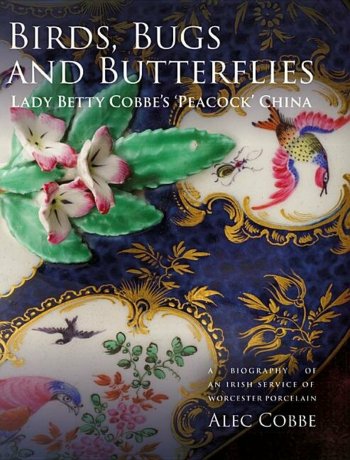 2020 Winner of the American Ceramic Circle Book Award
The early years of the famous Worcester porcelain factory established by Dr Wall have always been a little mysterious, owing to the destruction of the records of the business for this period. Alec Cobbe’s discovery of family papers listing the purchases over a period of years of a particularly beautiful and ornate table set have enabled him to give a vivid glimpse of how the factory interacted with its customers. He is able to describe the commissioning of perhaps the largest service of first period Worcester porcelain on record by Thomas and Lady Betty Cobbe for Newbridge House Co. Dublin. It was bought in stages from 1763 as the family travelled from Dublin to Bath each year, stopping at Worcester en route, as other Irish gentry did. The Cobbe service, uniquely in the context of British porcelain, was accompanied by a full set of Irish silver and steel cutlery fitted with Worcester porcelain handles matching the service. The various pieces of porcelain and their historical context are described as well as their painted decoration, and the sources for it. The later history of the service is outlined and its gradual dispersal in the nineteenth century, culminating in a final sale of the remaining pieces lot by lot in a Christie’s sale in 1920. This book celebrates Cobbe’s reassembly of more than 160 pieces of the original service over a period of more than thirty years and their return to Newbridge following their exhibition in the State Apartments at Dublin Castle. Overall, the book gives an important insight into Irish social life and patronage in the mid-eighteenth century.
Alec Cobbe was born in Ireland and still resides in Newbridge House, Co. Dublin, where his ancestors have lived since it was built in the middle of the eighteenth century. He practises as an artist and designer. As a passionate collector, he added to his family’s historic collections and assembled the world’s largest group of composer-owned keyboard instruments.
C O N T E N T S
Foreword
Preface and Acknowledgements
Beginnings
‘Snuff for Dr Walls’: The Cobbes in Worcester and London
Plans for Collecting and Entertaining
The Peacock Service and Its Cutlery
The Decoration of the Original Peacock Service
The Service through Later Centuries, Sale, and Reassembly
Appendices
I. Transcripts from Worcester and Cobbe archives, accounts, and inventories
II. Hypothetical tally of the original Peacock Service
III. Transcript of Christie’s 1920 sale catalogue
IV. Known destinations of Cobbe pieces
V. A note on the nomenclature of Worcester porcelain pieces
VI. Inventory of Worcester blue-scale porcelain from the original service and re-assembled pieces in Lady Betty’s pattern of birds, insects, and butterflies
Exhibition | In Sparkling Company: Glass and Social Life

Pair of covered green vases, ca. 1765 and a pair of vases, 1750–75, probably from the workshop of James Giles, London, gilded copper-green lead glass (Corning, New York: Corning Museum of Glass, 2003.2.4 A-B, 54.2.4 A-B).
◊ ◊ ◊ ◊ ◊
Notice of the exhibition appeared here in February 2020, but I note it again since the show is scheduled to open (with new dates) later this month. –CH
Press release (30 October 2019) for the exhibition:
In Sparkling Company: Glass and the Costs of Social Life in Britain during the 1700s
Corning Museum of Glass, Corning, New York, 22 May 2021 — 2 January 2022
Curated by Christopher Maxwell
The Museum’s spring exhibition, In Sparkling Company: Glass and Social Life in Britain during the 1700s, will open May 9, 2020. With exhibition design by Selldorf Architects, In Sparkling Company will present the glittering costume and jewelry, elaborate tableware, polished mirrors, and dazzling lighting devices that delighted the British elite, and helped define social rituals and cultural values of the period. Through a lens of glass, this exhibition will show visitors what it meant to be ‘modern’ in the 1700s, and what it cost.
The exhibition will also include a specially created virtual reality reconstruction of the remarkable and innovative spangled-glass drawing room completed in 1775 for Hugh Percy, 1st Duke of Northumberland (1714–1786), and designed by Robert Adam (1728–1792), one of the leading architects and designers in Britain at the time. An original section of the room (which was dismantled in the 1870s), on loan from the Victoria and Albert Museum in London, will be on view in North America for the first time as part of the exhibition. It will be accompanied by Adam’s original colored design drawings for the interior, on loan from the Sir John Soane’s Museum, London.
“One medium that is often overlooked in scholarly discussions of 18th-century art, design, and material culture is glass,” said Christopher L. Maxwell, Curator of European Glass at CMoG, who has organized the exhibition. “In Britain, developments in glass formulas and manufacturing techniques resulted in new and better types of glass, from windowpanes and mirrors to heavy, clear ‘crystal’ tableware, perfectly suited to the tastes and needs of Britain’s growing urban elite whose wealth derived from new enterprises in finance, manufacture, international trade and colonial expansion. In Sparkling Company will demonstrate the many functions and meanings of glass in the exuberant social life of the 1700s.”
The smooth, ‘polished’ and reflective properties of glass perfectly embodied 18th-century ideals of sociability, in what is considered by many as the ‘age of politeness.’ As urban centers grew in size and prosperity, sociability became ever more sophisticated. The terms ‘polite’ and ‘polished’ were often used interchangeably in the numerous etiquette manuals eagerly read by those wishing to take their place in the polite world. Examples of such literature will be displayed alongside fashionable glass of the period, including embroidered costume, mirrors, a chandelier, cut glass lighting and tableware, and paste jewelry that accessorized and defined the lives of the ‘polished’ elite.
In the 1700s Britain was a prosperous and commercial nation. Its growing cities were hubs of industry, scientific advancement, trade and finance, and its colonies were expanding. British merchants navigated the globe carrying a multitude of cargoes: consumable, material, and human. Underpinning Britain’s prosperity was a far-reaching economy of enslavement, the profits of which funded the pleasures and innovations of the fashionable world, among them luxury glass. Alongside the beauty and innovation of glass during this period, the exhibition will consider the role of the material as a witness to colonization and slavery. Using artifacts and documents relating to the slave trade, it will reveal a connection that permeated all levels of British society.
From glittering costume and elaborately presented confectionery, to polished mirrors and dazzling chandeliers, glass helped define the social rituals and cultural values of the period. While it delighted the eyes of the wealthy, glass also bore witness to the horrors of slavery. Glass beads were traded for human lives while elegant glass dishes, baskets and bowls held sweet delicacies made with sugar produced by enslaved labor.
In Sparkling Company: Glass and Social Life in Britain during the 1700s will include important examples of 18th-century British glass, including:
• Glass embroidered costume: a spectacular men’s coat intricately decorated with glass ‘jewels’ made around 1780; a pair of women’s shoes covered in glass beads; shoe buckles set with glass paste jewels; jewelry and other accessories.
• Cut glass lighting and tableware, all made possible through the perfection of British lead ‘crystal’ in the late 1600s and exported throughout Europe and the British colonies in America and beyond.
• A number of large mirrors, which became the tell-tale sign of a fashionable interior, and reverse-painted glass meticulously decorated in China for the British luxury market.
• Opulent glass dressing room accessories, including a magnificent gilded silver dressing table set, with a looking glass as its centerpiece, made in about 1700 for the 1st Countess of Portland; perfume bottles, patch boxes, a dazzling cut glass washing basin and pitcher and an exquisite blue glass casket richly mounted in gilded metal, used in the ‘toilette’ a semi-public ritual of dressing which was adopted from France for men and women alike and became a feature of British aristocratic life in the 18th century.

Robert Adam, Design for the end wall of the drawing room at Northumberland House, 1770–73, pen, pencil, and colored washes, including pink, verdigris, and Indian yellow on laid paper, 52 × 102 cm (London: Sir John Soane’s Museum, SM Adam, volume 39/7; photo by Ardon Bar Hama).
◊ ◊ ◊ ◊ ◊
Glass Drawing Room for the Duke of Northumberland
Over the course of the 18th century, domestic interiors were transformed by the increasing presence of clear and smooth plate glass. A remarkable example is the lavish drawing room designed by the celebrated British architect Robert Adam for Hugh Percy, 1st Duke of Northumberland (1714–1786) and his wife, the Duchess Elizabeth Percy (1716–1776), and completed in 1775. This unique room, measuring 36 by 22 feet, was paneled between dado rail and architrave with red glass panels sprinkled on the reverse with flakes of metal foil, like large-scale glitter. Similarly spangled green glass pilasters, large French looking glasses, and intricate neo-classical ornament in gilded lead completed the dazzling scheme. The room was altered in the 1820s and finally dismantled in the 1870s, when Northumberland House was demolished. Many of the panels were acquired by the V&A Museum in the 1950s, but their poor condition meant that they could only be partially displayed. The panels on display at The Corning Museum of Glass incorporate newly-conserved elements from the V&A’s stores.
In Sparkling Company will feature a virtual reality reconstruction of the drawing room, created by Irish production house Noho. Visitors to the exhibition will be transported into the interior, experiencing the original design scheme—last seen almost 200 years ago. This will be the first virtual-reality experience ever offered at CMoG. Visitors will also be able to see Robert Adam’s design drawings, on loan from the Sir John Soane’s Museum, London, and a section of the original Northumberland House Glass Drawing Room on loan from the V&A Museum, which has never been on view in North America.
In Sparkling Company: Glass and Social Life in Britain during the 1700s will include loans from the Victoria and Albert Museum; Sir John Soane’s Museum; the Museum of London; the Fashion Museum, Bath; Royal Museums Greenwich; Los Angeles County Museum of Art (LACMA); Penn State University Library; Cleveland Museum of Art; and The Museum of Fine Arts in Boston.
The exhibition is accompanied by a catalogue, In Sparkling Company: Reflections on Glass in the 18th-Century British World (The Corning Museum of Glass, 2020). Publication contributors include Marvin Bolt, Kimberly Chrisman Campbell, Jennifer Chuong, Melanie Doderer Winkler, Christopher Maxwell, Anna Moran, Marcia Pointon, and Kerry Sinanan.
◊ ◊ ◊ ◊ ◊
Note (added 16 September 2021) — The posting has been updated to include the revised title; the original title was In Sparkling Company: Glass and Social Life in Britain during the 1700s.
The Burlington Magazine, March 2021
The eighteenth century in The Burlington (I’m catching up, gradually!) . . . –CH
The Burlington Magazine 163 (March 2021)
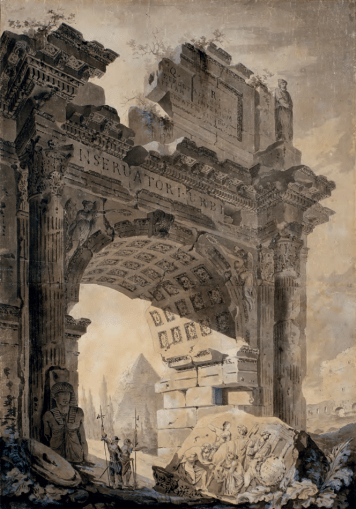
Hubert Robert, Arch of Septimius Severus, 1756; pen with grey and beige washes, 73 × 52 cm (Musée de Valence).
A R T I C L E S
• Pedro Luengo, “Spatial Rhetoric: Echoes of Madrid’s Alcázar in Palaces Overseas,” pp. 236–43.
Several key features of the Alcazar in Madrid—including the twin-courtyard plan, double staircase, and layout of the royal chapel—were replicated in royal palaces in Spain and elsewhere and in the viceregal palaces in Spain’s American empire as part of a desire to project a unified imperial image.
• Yuriko Jackall and Kari Rayner, “Becoming Hubert Robert: Some New Suggestions,” pp. 244–53.
The thin documentation of Hubert Robert’s early years makes it difficult to understand how the largely untrained student who went to Rome in 1754 emerged as a leading talent in Paris in the mid 1760s. Close examination of his art suggests that his rapid development was due to a rigorous course of study of perspective and life drawing, probably in response to criticisms of his abilities by the secretary of the Académie Royale, Charles-Nicolas Cochin.
R E V I E W S
 • Michael Hall, Review of Matthew Reeve, Gothic Architecture and Sexuality in the Circle of Horace Walpole (Pennsylvania State University Press, 2020), pp. 264–69.
• Antonio Mazzotta, Review of the exhibition Tiepolo: Venezia, Milano, l’Europa (Milan: Gallerie d’Italia, 2020–21), pp. 273–75.
• Christoph Stiegemann, Review of the exhibition Passion, Leidenschaft: Die Kunst der großen Gefühle (Münster: LWL-Museum für Kunst und Kultur, 2020–21), pp. 275–78.
• Stephen Leach, Review of Matthew Craske, Joseph Wright of Derby: Painter of Darkness (Paul Mellon Centre for Studies in British Art, 2020), pp. 297–98.
• Philippe Malgouyres, Review of Suzanne Higgott, ‘The Most Fortunate Man of his Day’: Sir Richard Wallace: Connoisseur, Collector, and Philanthropist (Wallace Collection, 2018), pp. 298–99.
• Elena Almirall Arnal, Review of Carolina Naya Franco, El joyero de la Virgen del Pilar: Historia de una colección de alhajas europeas y americanas (Institución Fernando El Católico, 2019), pp. 302–03.
• Gauvin Alexander Bailey, Review of Laura Windisch, Kunst, Macht, Image: Anna Maria Luisa de’ Medici (1667–1743) im Spiegel ihrer Bildnisse und Herrschaftsräume (Böhlau Verlag, 2019), p. 303.
O B I T U A R I E S
• Peter Cherry, Obituary of Carmen Garrido (1947–2020), pp. 305–06.
Director of the Gabinete de Documentación Técnica at the Prado for thirty years, Carmen Garrido made major contributions to the technical study of Spanish painting, in particular with her publications on Diego Velázquez.
• Ger Luijten, Obituary of David Scrase (1949–2020), pp. 306–08.
In a career spent almost entirely at the Fitzwilliam Museum, Cambridge, David Scrase was responsible for numerous significant acquisitions and exhibitions. His magnum opus his his catalogue for the museum’s Italian drawings, published in 2011.
Exhibition | American Weathervanes
This summer at the American Folk Art Museum (with the catalogue already available from Rizzoli). . .
American Weathervanes: The Art of the Winds
American Folk Art Museum, New York, 23 June 2021 — 2 January 2022
Organized by Robert Shaw and Emelie Gevalt
 American Weathervanes: The Art of the Winds is the first exhibition in more than four decades to highlight the beauty, historical significance, and technical virtuosity of American vanes fashioned between the late seventeenth and early twentieth centuries. The exhibition includes the graceful figure of Fame blowing a trumpet and standing en pointe like a celestial ballerina, attributed to well-known manufactory E.G. Washburne & Co. in New York City; a Dove of Peace designed by George Washington for his home in Mount Vernon; and an eagle possibly made in the foundry of revolutionary patrior Paul Revere. In addition to weathervanes, the exhibition will also include beautifully articulated wood sculptures by Harry Leach that functioned as patterns for weathevane molds for the Cushing & White and L.W. & Sons manufactories in Waltham, MA., watercolors of historic weathervanes painted for the Index of American Design, and rare archival materials that illuminate the development of the weathervane in the United States of America.
Robert Shaw is a critically acclaimed author, curator, and art historian who has written and lectured extensively on many aspects of American folk art. He has curated exhibitions at the Dallas Museum of Natural History, the Fenimore Art Museum, the National Gallery of Art, and the Shelburne Museum, where he served as curator from 1981 to 1994.
Robert Shaw, American Weathervanes: The Art of the Winds (New York: Rizzoli Electa, 2021), 256 pages, ISBN: 978-0847863907, $75.
Exhibition | À Table!
This summer at the National Museum of Ceramics at Sèvres, with an online version available here:
À Table! Le repas, tout un art / The Meal, a Whole Art
Sèvres — Manufacture et Musée Nationaux, 18 November 2020 — 16 May 2021 [original dates to be extended]
Organized by Anaïs Boucher and Viviane Mesqui
 The exhibition À Table! Le repas, tout un art explores the historical and cultural aspects of the art of the table and the art of French gastronomy. It reveals how the opulent and elegant banquets of the Ancien Régime became part of French culture by constituting an ideal of happiness and by transforming everyday lunches and dinners into extraordinary social occasions.
With a chronological approach, the exhibition explains the origins of popular French delicacies and how dining etiquette has evolved from antiquity to today. The selection of a variety of plates, forks, and other objects—functional or of pure fantasy—narrates the amazing stories behind familiar food customs. Sèvres porcelain is in the spotlight as it plays an important role in setting exquisite tables. This feast of Sèvres cups, plates, and glacières is our way to celebrate the 280th anniversary of the Sèvres Manufacture.
Anaïs Boucher and Viviane Mesqui, À Table! Le repas, tout un art (Montreuil: Gourcuff Gradenigo, 2020), 240 pages, ISBN: 978-2353403257, €39.
Exhibition | Joshua Johnson: Portraitist of Early American Baltimore

The exhibition opens this Saturday; from the press release:
Joshua Johnson: Portraitist of Early American Baltimore
Washington County Museum of Fine Arts, Hagerstown, Maryland, 17 April 2021 — 23 January 2022
Curated by Daniel Fulco
This exciting exhibition, organized by the Washington County Museum of Fine Arts and curated by Daniel Fulco, Agnita M. Stine Schreiber Curator, is the first monographic look at the work of the enigmatic and compelling African American artist Joshua Johnson (ca. 1763–1824) since 1988. Often considered the first professional Black artist in America, Johnson was a freed slave who achieved a remarkable degree of success as a portraitist in his lifetime by painting affluent patrons in his native Baltimore. Johnson’s subjects consisted of politicians, doctors, clergymen, merchants, and sea captains.
Joshua Johnson: Portraitist of Early American Baltimore contextualizes Johnson both historically and culturally and explores further the key forms of natural symbolism represented in his paintings. Featuring works by Johnson and his contemporaries, key loans come from the Maryland Center for History & Culture, the Baltimore Museum of Art, the Archdiocese of Baltimore, and the Bowdoin College Museum of Art. This exhibition also will include a fully illustrated scholarly interpretive catalogue and a diverse range of related educational programs. Museum Director Sarah J. Hall says, “This exhibition has been in planning for three years, and has ended up being a particularly timely investigation of both art history and Black history. Additionally, it adds to our understanding of regional history in terms of both the practice of portraiture and our understanding of those who made and commissioned portraits. Happily, the exhibition will be on view for a full six months in order to allow as many people as possible to enjoy Johnson’s work and the wide variety of related public programs scheduled.”
An artist whose ancestry was both African and European, Johnson was primarily a self-taught painter. He was especially adept at capturing his sitters’ features and the details of their clothing, which offered subtle insights into their personalities. Johnson’s attention to detail and extensive inclusion of moths, fruits, and flowers in his paintings indicate that he carefully absorbed techniques and motifs from traditional European portraiture to create symbolic meaning. Furthermore, Johnson combined these elements with the latest trends in his genre, responding closely to work of the Peales, Charles Peale Polk, and Mid-Atlantic limners such as Frederick Kemmelmeyer and Caleb Boyle.
Given his background and the era in which he lived, Johnson was impelled to overcome many racial and social hurdles in pursuing his profession and he persevered remarkably in that endeavor. As described in an advertisement in the Baltimore Intelligencer from 1798, Johnson referred to himself in the third person as “A self-taught genius, deriving from nature and industry his knowledge of the Art; and having experienced many insuperable obstacles in the pursuit of his studies, it is highly gratifying to him to make assurances of his ability to execute all commands with an effect, and in a style, which must give satisfaction.”
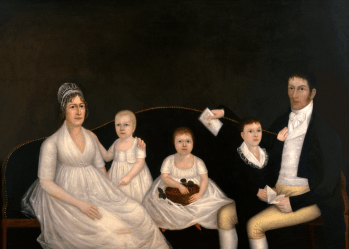
Joshua Johnson, Portrait of the James McCormick Family, 1804–05, oil on canvas, 51 × 69 inches (Collection of Maryland Center for History and Culture, Baltimore, gift of Dr. Thomas C. McCormick, 1920.6.1).
Such issues of race in Early American society still remain relevant and while a compelling and important theme to consider in relation to Johnson’s life and work, the exhibition also examines how his work engages with key developments in Maryland’s artistic heritage from approximately 1760 until 1840. Joshua Johnson: Portraitist of Early American Baltimore also explores issues related to politics, slavery, abolitionism, and society in antebellum Maryland.
As a complement to the Joshua Johnson: Portraitist of Early American Baltimore, the Museum will be installing a companion exhibition. Face to Face: Portraits from the 18th and 19th Centuries (April–October 2021), featuring European and American portraits from the permanent collection. These works expand the context of the Johnson exhibition and allow for a deeper understanding of the artist’s portraiture both before and during his lifetime.
Joshua Johnson: Portraitist of Early American Baltimore is organized by the Washington County Museum of Fine Arts. This exhibition is generously supported by grants from the National Endowment for the Arts, the Art Dealers Association of America Foundation, Heart of the Civil War Heritage Area, Maryland Marketing Partnership, and Community Foundation of Washington County Maryland, Inc. This exhibition also is made possible with the support of an anonymous donor, Mr. and Mrs. James N. Holzapfel, Dr. & Mrs. George E. Manger, Dr. and Mrs. Robert S. Strauch, and Mr. & Mrs. Thomas B. Riford.
Daniel Fulco, ed., with David Taft Terry and Mark B. Letzer, Joshua Johnson: Portraitist of Early American Baltimore (Hagerstown, MD: Washington County Museum of Fine Arts, 2021), 106 pages, ISBN: 978-09144950301 (paperback), $25 / ISBN: 978-09144950408 (ebook), $10.
Daniel Fulco is Agnita M. Stine Schreiber Curator at the Washington County Museum of Fine Arts. David Taft Terry is Associate Professor in the Department of History and Geography and Coordinator, Museum Studies & Historical Preservation Program at Morgan State University. Mark B. Letzer is President & CEO of the Maryland Center for History and Culture.
A variety of engaging complementary on-line programs are scheduled to enhance enjoyment of the exhibition, including discussions, lectures, and lesson-plans for use in classroom or at home. Check wcmfa.org, or the Museum’s social media pages for more information on registration and access.
About the Museum
Located in beautiful City Park, Hagerstown, Maryland, the Washington County Museum of Fine Arts was founded in 1931, the legacy of Hagerstown native Anna Brugh Singer and her husband, Pittsburgh-born artist William Henry Singer, Jr. Featuring a collection of more than 6,000 objects, the Museum has important holdings of American painting, Old Masters, decorative arts, and sculpture. The Museum schedules an ambitious program of exhibitions, lectures, concerts, tours, and talks featuring national and international artists, and annually organizes and hosts the Cumberland Valley Artists and Cumberland Valley Photographers exhibitions, as well as a yearly showcase of the art of K-12 students in Washington County Public Schools. Its free youth art education programs have served four generations of local families. The Washington County Museum of Fine Arts has been free to the public since 1931.
◊ ◊ ◊ ◊ ◊
Note (added 7 January 2022) — The posting was updated with the extended date; the exhibition was originally scheduled to close 24 October 2021.
Exhibition | Bibiena Drawings from the Jules Fisher Collection
Opening in May at The Morgan:
Architecture, Theater, and Fantasy: Bibiena Drawings from the Jules Fisher Collection
The Morgan Library & Museum, New York, 28 May — 12 September 2021
 For nearly a century, members of three generations of the Bibiena family were the most highly sought theater designers in Europe. Their elaborate stage designs were used for operas, festivals, and courtly performances across Europe: from their native Italy to cites as far afield as Vienna, Prague, Stockholm, St. Petersburg, and Lisbon. Beyond these performances, the distinctive Bibiena style survives through their remarkable drawings. This exhibition is the first in the United States in over thirty years to celebrate these talented draftsmen and marks the promised gift to the Morgan of a group of Bibiena drawings from the collection of Jules Fisher, the Tony-winning lighting designer. These drawings demonstrate the range of the Bibienas’ output, from energetic sketches to highly finished watercolors. With representations of imagined palace interiors and lavish illusionistic architecture, this group of drawings will highlight the visual splendor of the baroque stage.
Arnold Aronson, Diane Kelder, John Marciari, and Laurel Peterson, Architecture, Theater, and Fantasy: Bibiena Drawings from the Jules Fisher Collection (London: Paul Holberton, 2021), 96 pages, ISBN: 978-1913645045, £17 / $25.
Arnold Aronson is professor of theatre in the MFA Theatre Program at the Columbia University School of the Arts. Diane Kelder is professor emerita of art history at the Graduate Center, CUNY, and consulting curator of the Fisher collection. John Marciari is the Charles W. Engelhard Curator of Drawings and Prints and curatorial chair at the Morgan Library & Museum. Laurel Peterson, formerly the Moore Curatorial Fellow at the Morgan Library & Museum, is an independent scholar.










leave a comment