Exhibition | 1821: Before and After

Kozis Desyllas, Portrait of Athanasios Diakos, detail, ca. 1870
(Athens: Benaki Museum)
◊ ◊ ◊ ◊ ◊
Now on view at the Benaki Museum:
1821: Before and After
Benaki Museum, Athens, 3 March — 7 November 2021
Curated by Maria Dimitriadou and Tassos Sakellaropoulos
The Benaki Museum—in cooperation with the Bank of Greece, the National Bank of Greece, and Alpha Bank—presents a major anniversary exhibition to celebrate the bicentenary of the pivotal year in modern Greek history, 1821, the year when the revolution which resulted in the country’s independence was declared. 1200 objects unfold more than a century of history, from the 1770 ‘Orlov Revolt’ until the 1880s.

Map of Greece, late 17th or early 18th century, tempera on wood (Athens: Benaki Museum)
Paintings, sculpture, personal items belonging to key revolutionaries, historic documents, and heirlooms are arranged in three sections. The first part (1770–1821) brings to life the progress towards a national revolution. Section two (1821–1831) showcases the events of the War of Independence and its conclusion, and section three (1831–1870) addresses the creation of the modern Greek state and its development during its first half-century.
The show presents objects held in the collections of the three banks and the Benaki Museum, itself a rich repository created on bonds of trust with the families of those who held centre-stage in the Greek Revolution. Loans have also been secured from important museums and private collections in Greece, France, and the United Kingdom.
The exhibition is included in the National Program of Bicentennial Celebrations coordinated by the ‘Greece 2021’ Committee.
An online preview is available here»
Maria Dimitriadou and Tassos Sakellaropoulos, eds., 1821 Πριν και Μετά / 1821 Before and After (Athens: Benaki Museum, 2021), 1218 pages, ISBN: 978-9604762828 (Greek) / ISBN: 978-964762835 (English), 45€.
 More than 1200 objects gathered in the exhibition and spread across the 1218 pages of the accompanying catalogue showcase one hundred years of modern Greek history, between 1770 and 1870. The period begins with the moral and economic preparations for the liberation of the Greeks, reaches an apex with the 1821 Revolution, and concludes with the first decades of the operation and development of the new Greek state. The catalogue offer a fascinating journey of history and art, revealing why this adventurous century remains so deeply engaging, even now. These works create a meaningful assemblage that traces the enchanting story of modern Greeks and brings to the fore the reasons of their very existence, their perseverance, and how far they have travelled: all the positive elements that have shaped modern Hellenism.
Copies are available here»
Exhibition | Vivre à l’antique: From Marie-Antoinette to Napoléon
The catalogue for the exhibition is published by Éditions Monelle Hayot:
Vivre à l’antique: de Marie-Antoinette à Napoléon 1er
Château de Rambouillet, 19 June — 9 August 2021
Curated by Gabriel Wick
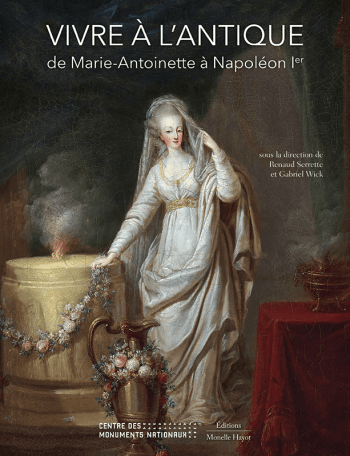 In the last three decades of the 18th century, the elites of Europe were enthralled by the constant flow of discoveries issuing forth from the excavations of buried cities, Etruscan tombs, and imperial villas in Italy. The distant past suddenly surged into the present, and architecture, furniture, and the accessories of daily life were re-imagined in its image. Nowhere in France could recount this aesthetic and cultural revolution more aptly than Rambouillet, the hunting estate and intimate retreat of the courts of Louis XVI and Napoléon I. Over the course of three months, the staterooms, intimate apartments, and dairy of Rambouillet will once again be filled with artifacts, models, and drawings from the Grand Tour and the Italian excavations, paintings by Hubert Robert, 18th– and 19th-century furnishings and decors by Jacob and Percier, and precious ceramics by Sèvres and Wedgwood. Through loans from the château of Versailles, the cité de la céramique de Sèvres, the École nationale supérieure des Beaux-Arts, the Bibliothèque des Arts décoratifs, and a number of private collections, the exhibition will explore how and why at the threshold of the modern era, distant antiquity so completely captured the imagination of the sovereigns and their courts.
Renaud Serrette and Gabriel Wick, eds., Vivre à l’antique, de Marie-Antoinette à Napoléon 1er (Saint-Remy-en-l’Eau: Éditions d’art Monelle Hayot, 2021), 200 pages, ISBN: 979-1096561315, 39€.
Exhibition | Flags and Founding Documents

13-star flag featuring a ‘Great Star’ pattern, ca. 1800–25, one of the earliest American flags known to survive
(Jeff Bridgman, American Antiques)
◊ ◊ ◊ ◊ ◊
Now on view at the Museum of the American Revolution:
Flags and Founding Documents, 1776–Today
Museum of the American Revolution, Philadelphia, 11 June — 6 September 2021
The summer exhibition Flags and Founding Documents, 1776–Today showcases dozens of rare American flags alongside historic early state constitutions and the first printing of the proposed U.S. Constitution of 1787.
The flags—many of which have never been exhibited before—trace the evolution of the Stars and Stripes through the addition and subtraction of stars as new states joined the Union and the nation battled through the Civil War. The flags serve as a visual narrative of America’s national story. The flags are showcased alongside historic documents including early printings of more than 16 different state constitutions and the Choctaw Nation Constitution of 1838 to shed light on the triumphs and tensions that the United States faced as it expanded and worked toward creating a ‘more perfect Union’. By telling stories from the nation’s revolutionary roots to its continuing struggle over equal rights, Flags and Founding Documents, 1776–Today encourages visitors to consider their role in the ongoing effort to fulfill the promise of the American Revolution.
The collection of historic flags is on loan from Jeff R. Bridgman, a leading dealer of antique flags and political textiles. The documents are on loan from the Dorothy Tapper Goldman Foundation following their presentation at the New-York Historical Society in the exhibition Colonists, Citizens, Constitutions: Creating the American Republic (February 2020 — Mary 2021), curated by Dr. James F. Hrdlicka.
James Hrdlicka, with Robert McD. Parker and a foreword by Ruth Bader Ginsburg, Colonists, Citizens, Constitutions: Creating the American Republic (London: Scala Arts Publishers, 2020), 208 pages, ISBN: 978-1785512070, $45.
Exhibition | Inspiring Walt Disney

Thanks to Kimberly Chrisman-Campbell for noting via Twitter this exhibition. In addition to the general information from The Met, see coverage at D23. . .
Inspiring Walt Disney: The Animation of French Decorative Arts
The Metropolitan Museum of Art, New York, 10 December 2021 — 6 March 2022
The Wallace Collection, London, 6 April — 16 October 20222
The Huntington Library, Art Museum, and Botanical Garden, San Marino, 10 December 2022 — 27 March 2023
Curated by Wolf Burchard
Pink castles, talking sofas, and a prince transformed into a teapot: what sounds like fantasies from Walt Disney Animation Studios’ pioneering animations were in fact the figments of the colorful salons of Rococo Paris. The Met’s first-ever exhibition exploring the work of Walt Disney and the Walt Disney Animation Studios’ hand-drawn animation will examine Disney’s personal fascination with European art and the use of French motifs in his films and theme parks, drawing new parallels between the studios’ magical creations and their artistic models.
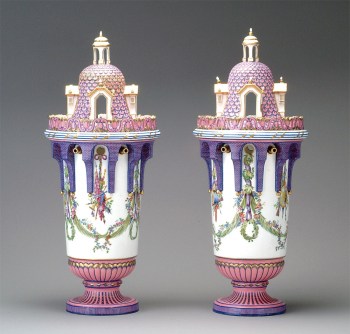
Sèvres Manufactory, pair of covered pots pourris vases in the form of towers (vases entourrés), ca. 1762; soft-paste porcelain (San Marino: The Huntington Library, Art Museum, and Botanical Gardens).
Forty works of 18th-century European decorative arts and design—from tapestries and furniture to Boulle clocks and Sèvres porcelain—will be featured alongside 150 production artworks and works on paper from the Walt Disney Animation Research Library, Walt Disney Archives, Walt Disney Imagineering Collection, and The Walt Disney Family Museum. Selected film footage illustrating the extraordinary technological and artistic developments of the studios during Disney’s lifetime and beyond will also be shown.
The exhibition will highlight references to European visual culture in Disney animated films, including nods to Gothic Revival architecture in Cinderella (1950), medieval influences on Sleeping Beauty (1959), and Rococo-inspired objects brought to life in Beauty and the Beast (1991). Marking the 30th anniversary of Beauty and the Beast’s animated theatrical release, the exhibition is organized by The Metropolitan Museum of Art and The Wallace Collection. The catalogue is distributed by Yale University Press.
The press release is available here»
Wolf Burchard, Inspiring Walt Disney: The Animation of French Decorative Arts (New York: The Metropolitan Museum of Art, 2021), 240 pages, ISBN: 978-1588397416, $50.
◊ ◊ ◊ ◊ ◊
Note (added (9 December 2021) — The posting was updated to include information for the catalogue, London dates, and the link to the press release.
Note (added 6 June 2022) — The posting was updated to include The Huntington as a venue.
The Burlington Magazine, June 2021

Charles-Louis Clérisseau, Traou en Dalmathia, 1757
(Paris: Bibliothèque nationale de France)
◊ ◊ ◊ ◊ ◊
The eighteenth century in this month’s issue of The Burlington . . .
The Burlington Magazine 163 (June 2021) — Works of Art on Paper
A R T I C L E S
• Ana Šverko, “Clérisseau’s Journey to Dalmatia: A Newly Attributed Collection of Drawings,” pp. 492–502.
A collection of 136 hitherto anonymous drawings of Italy, Istria and Dalmatia in the Bibliothèque nationale de France, Paris, is here attributed to Charles-Louis Clérisseau. The drawings, which include a group made during his journey from Venice to Diocletian’s Palace in Split with Robert Adam in 1757, further expand our understanding of Clérisseau as the forerunner of a new generation of traveller-painters.
• Tony Barnard, “Trading in Art: Antonio Cesare di Poggi (1744–1836),” pp. 492–502.
With the help of his English wife, Hester, the Italian artist A.C. Poggi forged a career in London as a portrait painter, a retailer of fans, a dealer principally in drawings and publisher of prints. Poggi’s successes and failures reflect changing fashions and fortunes in the capital’s competitive art world between his arrival in England c.1770 and departure for the Continent in 1801.
• Christopher White, “Reminiscences of the British Museum Print Room, 1954–65,” pp. 492–502.
The author’s first job, as Assistant Keeper with responsibility for the Northern schools in the Department of Prints and Drawings at the British Museum, London, introduced him to a distinguished group of curators and an occasionally eccentric band of visitors. The department’s focus was emphatically on drawings, where major acquisitions could be made by sharp-eyed scholars in the salesrooms.

Fan portraying George III and his family at the Royal Academy of Arts exhibition in 1788, made by A.C. Poggi incorporating a print by Pietro Antonio Martini after J. H. Ramberg, ca. 1790, engraved and hand-coloured paper with carved and pierced ivory sticks and guards, width when open 38.4 cm (London: Victoria and Albert Museum, T.56-1933).
◊ ◊ ◊ ◊ ◊
R E V I E W S
• Elizabeth Pergam, “The Frick Reframed,” pp. 536–39. On the plain, grey walls of the Modernist Breuer building, New York, some of the most famous works from the Frick Collection shine in a new light.
• Yuriko Jackall, Review of the exhibition catalogue Une des Provinces du Rococo: La Chine Rêvée de François Boucher, ed. by Yohan Rimaud and Alastair Laing (In Fine éditions d’art and Musée des beaux-arts et d’archéologie de Besançon, 2019), pp. 539–41.
• Jonathan Yarker, Review of the exhibition Turner’s Modern World (Tate Britain, 2020–21), pp. 541–44.
• Amanda Dotseth, Review of the exhibition publication Museo del Prado 1819–2019: Un lugar de memoria, ed. by Javier Portús et al (Prado, 2018), pp. 546–49.
• Simonetta Prosperi Valenti Rodinò, Review of Les dessins de la collection Mariette: Écoles italienne et espagnole, by Pierre Rosenberg et al, 4 vols., (Somogy, 2019), pp. 550–51.
• Oliver Tostmann, Review of Die Zeichnungen des Giovan Battista Beinaschi aus der Sammlung der Kunstakademie Düsseldorf am Kunstpalast, ed. by Sonja Brink and Francesco Grisolia (Imhof Verlag, 2020), pp. 556–57. [Beinaschi lived between 1636 and 1688, but Tostmann notes in passing points of his eighteenth-century reception.]
• Christoph Martin Vogtherr, Review of L’ Art et la manière: Dessins français du XVIIIesiècle des musées de Marseille, ed. by Luc Georget and Gérard Fabre (Silvana Editoriale, 2019), pp. 557–58.
Exhibition | Turner’s Modern World
Now on view at Tate Britain (with versions of the exhibition soon coming to Fort Worth and Boston). . .
Turner’s Modern World
Tate Britain, London, 28 October 2020 — 12 September 2021
Kimbell Art Museum, Fort Worth, 17 October 2021 — 6 February 2022
Museum of Fine Arts, Boston, 2022
 One of Britain’s greatest artists, J.M.W. Turner (1775–1851), lived and worked at the peak of the industrial revolution. Steam replaced sail; machine-power replaced manpower; political and social reforms transformed society. Many artists ignored these changes, but Turner faced up to these new challenges. This exhibition will show how he transformed the way he painted to better capture this new world.
Beginning in the 1790s, when Turner first observed the effects of modern life, the exhibition follows his fascination with the impact of industrialisation. It shows how he became involved in the big political questions of the time: campaigning against slavery and making paintings that expressed the horrors of the Napoleonic Wars.
This landmark exhibition will bring together major works by Turner from Tate and other collections, including The Fighting Temeraire (1839) and Rain, Steam and Speed (1844). It will explore what it meant to be a modern artist in his lifetime and present an exciting new perspective on his work and life.
David Blayney Brown, Amy Concannon, and Sam Smiles, eds., Turner’s Modern World (New York: Rizzoli Electa, 2021), 240 pages, 978-1849767132 (hardcover), £40, $55 / ISBN: 978-1849767125 (paperback) £25.
This monograph is tied to the first exhibition to highlight Turner’s contemporary imagery—the most exceptional and distinctive aspect of his work. Rather than making claims for Turner as a proto-modernist, it explores what constituted modernity during his lifetime and what it meant to be a modern artist. Turner’s career spanned the Napoleonic Wars, the rise of the British Empire, the birth of finance capitalism and modern industrialization, as well as political, scientific, and cultural advances that transformed society and shaped the modern world. While historians have long recognized that the industrial and political revolutions of the late eighteenth century inaugurated far-reaching change and modernization, these were often ignored by artists as they did not fit into established categories of pictorial representation. This publication shows Turner updating the language of art and transforming his style and practice to produce revelatory, definitive interpretations of modern subjects.
David Blayney Brown is Senior Curator, Tate Britain. Amy Concannon is Curator, Tate Britain. Sam Smiles is Emeritus Professor of Art History, University of Plymouth, and Programme Director, Art History and Visual Culture, University of Exeter.
Woman’s Art Journal, Spring / Summer 2021
The eighteenth century in the latest issue of WAJ:
Woman’s Art Journal 42.1 (Spring / Summer 2021)

Marguerite Gérard, Portrait of a Man and Woman in an Interior, 1818 (Tulsa: Philbrook Museum of Art; Taber Art Fund, 2019.9). The painting sold at Christie’s in Paris on 28 October 2019, Sale 17655, Lot 751.
A R T I C L E S
• Sarah Lees, “Marguerite Gérard’s Portrait of a Man and a Woman in an Interior: Portraiture, Landscape, and Social Networks,” pp. 19–26.
• Alison M. Kettering, “Watercolor and Women in the Early Modern Netherlands: Between Mirror and Comb,” pp. 27–35.
R E V I E W S
• Rosie Razzall, Review of Angela Oberer, The Life and Work of Rosalba Carriera (1673–1757): The Queen of Pastel (Amsterdam University Press, 2020), pp. 44–46.
• Wendy Wassyng Roworth, Review of the exhibition catalogue, Angelica Kauffman, edited by Bettina Baumgärtel (Hirmer, 2020), pp. 46–48.
Exhibition | British Stories

Johan Zoffany, The Triumph of Venus (Vénus sur les eaux), ca. 1760, oil on canvas
(Musée des Beaux-Arts de Bordeaux). More information is available here.
◊ ◊ ◊ ◊ ◊
This summer the Musée des Beaux-Arts in Bordeaux, as part of ‘A British Year at the Museum’, presents two exhibitions: British Stories and Absolutely Bizarre! Strange Tales from the Bristol School of Artists, 1800–1840.
British Stories
Musée des Beaux-Arts de Bordeaux, 19 May — 19 September 2021
Organized by Sophie Barthélémy, Sandra Buratti-Hasan, and Guillaume Faroult
The British art collections held by the Bordeaux Museum of Fine Arts form a coherent corpus of thirty paintings, drawings, prints, and sculptures. This exhibition is an occasion to admire them all and compare them with works loaned by the Louvre.
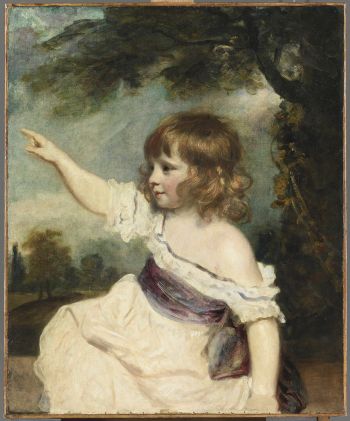
Joshua Reynolds, Portrait of Francis George Hare (1786–1842), ‘Master Hare’, ca. 1788–89, oil on canvas (Paris: Musée du Louvre, RF 1580).
A significant portion of the exhibition is dedicated to portraiture, a genre in which British painters excelled. In the 17th century, Flemish painter Anthony van Dyck was invited to stay at the Court of Charles I of England during the last decade of his career, a period that was a pivotal moment in the development of European portrait art whose conventions van Dyck reinvented (modello of the Double Portrait of the Palatinate Princes Charles Louis I and Prince Rupert, Museum of Fine Arts, Bordeaux). Among his most famous heirs we can mention Sir Joshua Reynolds, represented by his celebrated ‘Master Hare’ (Louvre) and his Portrait of Richard Robinson, Archbishop of Armagh (Museum of Fine Arts, Bordeaux). This survey of British portraiture culminates with the Portrait of John Hunter by Sir Thomas Lawrence (Museum of Fine Arts, Bordeaux).
In the history painting genre, the exhibition gives a special place to artists under-represented in French public collections, namely James Ward, with his superb Baptism of Christ (Louvre), Benjamin West (Phaeton Asking Apollo to Drive the Sun Chariot, Louvre), and Johan Zoffany (The Triumph of Venus and Venus and Adonis, Museum of Fine Arts, Bordeaux). The typically British genre, the conversation piece, is also represented, along with landscape, the latter dominated by the dramatic canvas by John Martin of Macbeth and the Three Witches (Museum of Fine Arts, Bordeaux).
The Museum of Fine Arts and its close partner the Louvre look forward to taking viewers on a fascinating journey of paintings from across the Channel, on an itinerary through the most significant works of art by generations of innovative, inquisitive, and daring artists.
Sandra Buratti-Hasan and Guillaume Faroult, British Stories: Conversations entre le musée du Louvre et des Beaux-Arts de Bordeaux (Paris: Snoeck Édition, 2021), 32 pages, ISBN: 978-9461616302, 10€.
Exhibition | Tables of Power: A History of Prestigious Meals

Jacques Roëttiers, Ornamental Centerpiece, Surtout de table, 1736 (Paris: Musée du Louvre). Additional information and exceptional details are available here.
◊ ◊ ◊ ◊ ◊
Comprised of five sections, the exhibition traces the history of elite dining conventions from ancient Mesopotamia and Egypt to the present. The fourth section focuses on eighteenth-century France.
Les tables du pouvoir: Une histoire des repas de prestige
Musée du Louvre-Lens, 19 May — 26 July 2021
Organized by Zeev Gourarier with Michèle Bimbenet-Privat, Hélène Bouillon, Alexandre Estaquet-Legrand, Christine Germain-Donnat, and Marie Lavandier
Chapitre 4 : du service à la française au service à la russe
 Le 18e inaugure de nouvelles manières d’envisager les plaisirs de la table. La forme trop protocolaire du Grand Couvert laisse si peu de place à la convivialité que, pour y échapper, on invente au sein des « petits appartements » à Versailles et dans les résidences privées du roi, la salle à manger puis la table à manger, de forme ronde. Dans le cadre des Soupers fins, on peut alors s’adonner en toute liberté et en bonne compagnie aux plaisirs d’une gastronomie en pleine effervescence. Le service offert par l’Impératrice Marie-Thérèse d’Autriche à Madame Geoffrin, qui tient l’un des plus célèbres salons artistiques et littéraires parisiens d’alors, rappelle l’atmosphère raffinée des repas consommés dans les toutes premières salles à manger au temps des Lumières.
À partir de 1740, la fabrique de Vincennes—transférée à Sèvres en 1756—met au point un procédé complexe de double cuisson qui permet d’obtenir une pâte onctueuse et translucide, la porcelaine tendre. L’exposition présente l’un des premiers services de table réalisés, à fond bleu céleste et décor de fleurs, offert à Louis XV. Ces pièces exceptionnelles font la renommée de la France dans toute l’Europe et créent une véritable diplomatie des services de Sèvres, abondamment offerts en cadeaux par le roi. Dès son instauration en 1804, le Premier Empire en devient un commanditaire majeur. Le Service Olympique fait partie des premiers services en porcelaine livrés à Napoléon. Il décore la table de fête au palais des Tuileries à l’occasion du mariage de son frère, Jérôme Bonaparte. La table du Cardinal Fesch, oncle de Napoléon, se déploie également au milieu du parcours. Sur un fond bleu lapis, imitant la pierre dure, le décor de portraits d’empereurs antiques à la manière des camées est un hommage subtil à Napoléon lui-même, qui lui offre ce service.
Au gré des régimes, la Manufacture de Sèvres habille les tables du pouvoir. À l’instar de la Présidence de la République, les ministères d’État disposent de leur propre vaisselle, passant commande aujourd’hui encore. Une table en miroir fait ainsi dialoguer le service des Départements (19e siècle) et son décor floral, au service Diane du ministère de la Culture, conçu vers 1960 et dont le décor est renouvelé en 2007 par l’artiste Fabrice Hyber.
 À sa création à la fin du 18e siècle, la manufacture royale du Danemark rejoint la prestigieuse compétition que se livrent les différentes manufactures de porcelaine d’Europe. Elle réalise l’un des plus surprenants et opulents services de table de cette époque, le Flora Danica. Composé de plus de 1800 pièces à l’origine, il aurait été initialement destiné à l’impératrice de Russie Catherine II, grande amatrice de porcelaine, mais n’est jamais livré. Les motifs s’inspirent directement des planches illustrées du Flora Danica (« Flore du Danemark »), et forment comme un grand atlas botanique, avec plantes, champignons et autres lichens. Le service est aujourd’hui encore utilisé à la cour du Danemark lors des grandes occasions.
Dans le cadre de la pièce désormais réservée aux repas, la salle à manger, l’ordonnance du repas continue d’évoluer pour aboutir en un siècle à notre service actuel, dit « service à la russe ». Ce nouveau dispositif témoigne des transformations des modes de vie et de la culture alimentaire au début du 19e siècle. Il implique un nouvel ordonnancement des mets. Les plats ne sont plus présentés de manière harmonieuse et foisonnante en services successifs, mais sont désormais servis individuellement, simultanément à tous les convives. Ces dispositions permettent notamment à tous de manger chaud et réduisent le nombre de domestiques autour de la table. Les verres se multiplient et ne sont plus disposés sur des dessertes mais sur la table, et les couverts individuels s’alignent autour de l’assiette—tels que nous les connaissons aujourd’hui.
Zeev Gourarier, ed., Les tables du pouvoir: Une histoire des repas de prestige (Paris: Réunion des musées nationaux, 2021), 320 pages, ISBN: 978-2711878635, 40€.
A list of contents is available here»
New Book | Dandy Style
The related exhibition is scheduled to open later at the Manchester Art Gallery, but the publication, from Yale UP, is available now:
Shaun Cole and Miles Lambert, Dandy Style: 250 Years of British Men’s Fashion (New Have: Yale University Press, 2021), 168 pages, ISBN: 978-0300254136, $35.
 Celebrating 250 years of male self-expression, investigating the portraiture and wardrobe of the fashionable British man
The style of the dandy is elegant but bold—dedicated to the perfection of taste. This meticulously choreographed look has a vibrant history; the legacy of Beau Brummell, the original dandy of Regency England, can be traced in the clothing of urban dandies today. Dandy Style celebrates 250 years of male self-expression, investigating the portraiture and wardrobe of the fashionable British man. Combining fashion, art, and photography, the historic and the contemporary, the provocative and the respectable, it considers key themes in the development of male style and identity, including elegance, uniformity, and spectacle. Various types of dandy are represented by iconic figures such as Oscar Wilde, Edward VIII as Prince of Wales, and Gilbert & George. They appear alongside the seminal designs of Vivienne Westwood, Ozwald Boateng, and Alexander McQueen; and portraits by Thomas Gainsborough and David Hockney.
Shaun Cole is associate professor in fashion at Winchester School of Art, University of Southampton. Miles Lambert is curator of costume at Manchester Art Gallery.
C O N T E N T S
Christopher Breward — Foreword: Dandy Style
Alistair Hudson — Director’s Preface
Shaun Cole and Miles Lambert — Introduction
1 Miles Lambert — Creative Collecting: How Museums Acquire Men’s Fashion
2 Ben Whyman — The Life Stories of Men’s Clothes
3 Joshua M. Bluteau — The Devil Is in the Detail: Why Men Still Wear Suits
4 Shaun Cole, Miles Lambert, and Rebecca Milner — Painting Men’s Style: Portraying an Image
5 Kate Dorney — Performing the Dandy
6 Miles Lambert — Extravagance and Flamboyance: Decorated Men’s Fashion
7 Shaun Cole — Casual Subversion
8 Jay McCauley Bowstead — Contemporary British Menswear: Hybridity, Flux, and Globalisation
Notes
Select Bibliography
Index
Acknowledgments
List of Contributors










leave a comment