Exhibition | Éloge du sentiment et de la sensibilité
From the Musée des Beaux-Arts de Rennes:
Éloge du sentiment et de la sensibilité: Peintures françaises du xviiie siècle des collections de Bretagne
Musée des Beaux-Arts de Rennes et le Musée d’Arts de Nantes, 15 February — 12 May 2019
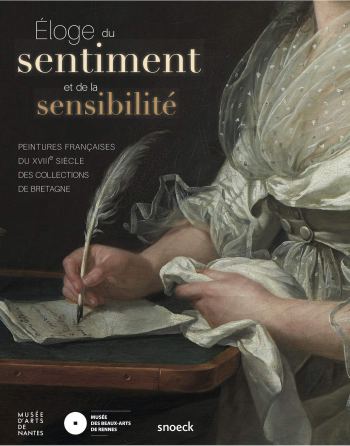 Dans le cadre des collaborations entre musées du Grand-Ouest, le Musée des Beaux-Arts de Rennes et le Musée d’Arts de Nantes présentent de février à mai 2019 une exposition en coproduction intitulée Éloge du sentiment et de la sensibilité: Peintures françaises du xviiie siècle des collections de Bretagne. Cet événement présente l’originalité de se dérouler simultanément dans les deux institutions avec un catalogue commun.
Le propos général de l’exposition est une découverte de l’ensemble de la production picturale du Siècle des Lumières à travers le prisme du sentiment et de la sensibilité. Dans la seconde moitié de ce siècle, littérature et peinture reflètent une nouvelle vision de l’Homme et de son environnement. Sentiment et sensibilité deviennent de nouvelles qualités de l’âme, donnant une liberté inédite de ressentir le monde. Diderot s’interroge sur le sentiment dans la peinture et au théâtre, Rousseau porte aux nues la sensibilité dans la Nouvelle Héloïse et théorise une nouvelle forme d’éducation dans l’Émile, Voltaire s’émerveille de l’impact de la nature sur ses sens et son âme… La peinture offre un écho enthousiaste et inspiré à ces préoccupations inédites.
Le choix des oeuvres a été réalisé essentiellement dans les riches collections conservées aux musées de Brest, Nantes, Quimper et Rennes avec des compléments apportés par les collections publiques (musées, églises, bâtiments municipaux) de Morlaix et de Lamballe. La réunion de ces collections permet de représenter l’ensemble des grands artistes du siècle tels qu’Antoine Watteau, François Boucher, Carle Vanloo, Charles Joseph Natoire, Jean Siméon Chardin, Hubert Robert, Jean-Baptiste Greuze ou Jean Honoré Fragonard.
L’exposition en deux parties organisée à Rennes et à Nantes, Éloge du sentiment et Éloge de la sensibilité, permet d’embrasser l’évolution de la peinture française sur un siècle, depuis Antoine Watteau jusqu’au début du xixe siècle. À Rennes s’expose la grande histoire, antique, religieuse et mythologique. Nantes met à l’honneur les différents genres, du grand portrait d’apparat aux sensibles natures mortes. Ce partage des oeuvres s’appuie sur une division ancienne bien connue, que les hasards des collections semblent avoir reproduite dans nos musées : Rennes conserve davantage de peintures d’histoire que Nantes, qui s’illustre plus dans la peinture de genres.
Un premier ensemble d’environ 70 tableaux, réuni à Rennes autour de la notion de sentiment, évoquera en quatre sections l’évolution de la peinture à sujet historique (biblique, mythologique, antique et contemporaine).
Un second ensemble d’environ 70 oeuvres présente en six sections au Musée d’arts de Nantes un parcours autour de la notion de sensibilité à travers la peinture de genre (portraits, scènes galantes, paysage, natures mortes…).
Cet événement inédit fait suite à l’organisation en 2013, par les musées de Quimper et de Rennes, de l’exposition De Véronèse à Casanova, qui, selon le même principe faisait le bilan des richesses des musées bretons dans le domaine de la peinture italienne. Les restaurations et les recherches menées à l’occasion de cet événement ont permis d’apporter un éclairage nouveau sur de nombreuses oeuvres et quelques découvertes importantes dans les réserves de certains musées.
Guillaume Kazerouni and Adeline Collange-Perugi, Éloge du sentiment et de la sensibilité: Peintures françaises du xviiie siècle des collections de Bretagne (Paris: Snoeck, 2019), 367 pages, ISBN: 978-9461615138, 35€.
Exhibition | Bernard Picart (1673–1723)
Now on view at the Musée National de Port-Royal des Champs, near Versailles:
Bernard Picart (1673–1723), Dessinateur, de Paris à Amsterdam
Musée National de Port-Royal des Champs, Magny-les-Hameaux, 21 March — 23 June 2019
Curated by Corentin Dury and Philippe Luez
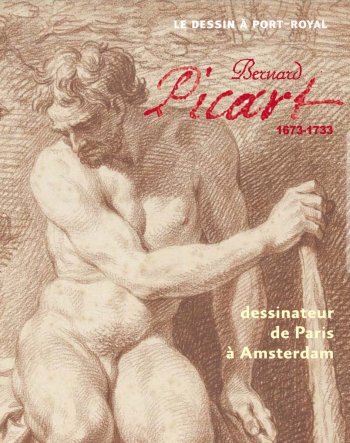 Bernard Picart (1673–1723), issu d’une famille janséniste, s’installe à Amsterdam en 1710 et y occupe une place majeure dans l’édition hollandaise illustrée. Mais on le connaît moins comme dessinateur. La présente exposition permet de découvrir ce pan inconnu de son activité et lui rend sa place parmi les grands dessinateurs des débuts du règne de Louis XV.
En collaboration avec le Salon international du dessin de Paris et avec la participation du Rijksmuseum d’Amsterdam
Commissaires
Corentin Dury, conservateur du patrimoine, musée des Beaux-arts d’Orléan, et Philippe Luez, conservateur général du patrimoine, directeur du musée national de Port-Royal des Champs
Corentin Dury and Philippe Luez, Bernard Picart (1673–1723), Dessinateur, de Paris à Amsterdam (Paris: Snoeck, 2019), 175 pages, ISBN: 978-9461615459, €25.
Exhibition | Tiepolo in Milan
Press release from The Frick:
Tiepolo in Milan: The Lost Frescoes of Palazzo Archinto
The Frick Collection, New York, 16 April — 14 July 2019
Curated by Xavier Salomon, with Andrea Tomezzoli and Denis Ton
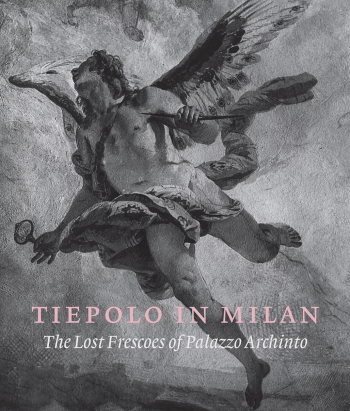 This spring and summer, The Frick Collection presents paintings, drawings, prints, and photographs related to Giambattista Tiepolo’s (1696–1770) first significant project outside of Venice, a series of ceiling frescoes painted in 1730–31 for Palazzo Archinto in Milan. Commissioned by Count Carlo Archinto, one of the city’s most influential patrons and intellectuals, the frescoes were tragically destroyed when the palazzo was bombed by the Allies during World War II. Tiepolo in Milan: The Lost Frescoes of Palazzo Archinto brings together more than fifty works from collections in the United States and Europe to tell the story of this important commission. Five preparatory paintings and drawings are featured, among them the oil sketch Perseus and Andromeda, acquired by Henry Clay Frick in 1916. As the Frick does not loan objects purchased by the institution’s founder, the New York museum is the only place where these works can be displayed together. Several complementary drawings and books illustrated by Tiepolo are included, alongside documentary photographs, taken between 1897 and the early 1940s, which are the only surviving records of the finished frescoes. The exhibition is organized by The Frick Collection in collaboration with the Azienda di Servizi alla Persona Golgi-Redaelli, Milan, and curated by Xavier F. Salomon, the Frick’s Peter Jay Sharp Chief Curator, with Andrea Tomezzoli, Professor at the University of Padua, and Denis Ton, Curator of the Musei Civici in Belluno.
Comments Salomon, “At a moment in history when wars are destroying art and culture in many parts of the world, it is worth pausing to consider, through an exhibition like this, the tragic, irreparable effects caused by violence throughout the centuries on great works of human creativity.”
Tiepolo and the Archinto Family
Palazzo Archinto belonged to one of Milan’s most prominent aristocratic families, documented in the city since at least the twelfth century. In the eighteenth century, the Archinto were described as one of those Milanese families who had always owned “highly admired treasures.” In addition to Tiepolo’s frescoes, the palazzo contained extensive collections of artworks and a renowned library. Carlo Archinto (1670–1732), Tiepolo’s patron, was at the center of Milan’s intellectual circles and was especially recognized for his interest in philosophy, mathematics, and science. During the mid-eighteenth century, he lived in the family palazzo, located on Via Olmetto, near Porta Ticinese, in one of the oldest parts of the city.
The palazzo’s library, overseen by librarian Filippo Argelati, filled five rooms and was open to scholars. Together with Carlo Archinto and other patrons, Argelati founded the Società Palatina, a publishing enterprise. Between 1723 and 1751, the Società published Ludovico Antonio Muratori’s Rerum Italicarum Scriptores. Archinto financed the project and contributed notes to one of the volumes. Tiepolo provided a number of designs for books published by the Società Palatina (five are included in the exhibition) and thus became acquainted with the aristocratic family. About 1730, when Archinto decided to redecorate his palazzo, he commissioned eight frescoed ceilings: five from Tiepolo and three from the Bolognese painter Vittorio Maria Bigari (1692–1776).
The Commission
The substantial commission was Tiepolo’s first outside the Veneto, and it marked the beginning of his international career. According to the Tiepolo scholar, Michael Levey, the frescoes at Palazzo Archinto “must have been sumptuously rich and impressive. Tiepolo never received a commission for a private palace of comparable extent and rarely of such splendour.” The ceilings, in part to celebrate the wedding of Carlo’s son Filippo to Giulia Borromeo, were meant to underscore the status of the Archinto family and were Carlo’s spiritual and visual testament, blending allegorical and mythological scenes.
Of the preparatory works that survive from the commission, three painted sketches on canvas provide the most important visual record of the lost frescoes: Triumph of Arts and Sciences (Museu Nacional de Arte Antiga, Lisbon), Perseus and Andromeda (The Frick Collection), and Apollo and Phaëton (Los Angeles County Museum of Art).
The largest and most elaborate fresco at Palazzo Archinto was the Triumph of the Arts and Sciences, which decorated one of the main rooms on the palace’s principal floor, or piano nobile. In it, Tiepolo depicted a resplendent sky with an assembly of allegorical figures, including Architecture, Painting, Sculpture, Music, and Mathematics, under the aegis of Apollo and Minerva. The ceiling’s decoration surely related to Carlo’s intellectual pursuits and to his library. When Tiepolo created the sketch (modello) for the ceiling, the fictive architectural scheme (quadratura) that was to frame the fresco had not yet be finalized; he therefore depicted his figures hovering in a cloudy sky, surrounded only by an area of brown ocher. In preparation for his fresco cycles, Tiepolo executed numerous drawings. Two surviving drawings related to Triumph of the Arts and Sciences are included in the exhibition, together with the related Lisbon modello and black-and-white photographs of the finished fresco in situ.

Giambattista Tiepolo, Perseus and Andromeda, ca. 1730–31, oil on canvas (New York: The Frick Collection).
The fresco of Perseus and Andromeda was likely envisioned as a celebration of the wedding of Filippo Archinto and Giulia Borromeo. Book IV of Ovid’s Metamorphoses recounts the tale of the young and beautiful Andromeda, daughter of the Aethiopian king Cepheus and Cassiopeia. Boasting that Andromeda is more beautiful than the Nereids, Cassiopeia angers Neptune, who, in revenge, sends a monster to ravage the cost of Aethiopia. Told that the only way to save their country is to sacrifice their daughter to the monster, Andromeda’s parents chain her to a rock by the sea. The hero Perseus, son of Jupiter and Danaë, sees Andromeda while flying over Aethiopia and falls in love with her. He asks her parents for permission to marry her if he is able to save her; he subsequently kills the sea monster and rescues Andromeda. Tiepolo took liberties with Ovid’s Metamorphoses in showing Perseus riding the winged horse Pegasus instead of flying by way of a pair of winged sandals. As evidenced in the archival photographs, the overall configuration of the Perseus and Andromeda fresco in Palazzo Archinto was almost identical to the one visible in the oil sketch (page one), which was likely presented to Carlo Archinto for approval.
Tiepolo faithfully followed another passage from Ovid’s Metamorphoses in the fresco depicting Phaëton, the son of Apollo and Clymene. Uncertain about his divine origins, the youth questions Clymene about the identity of his father, and Clymene encourages him to visit Apollo in his heavenly palace. To prove his paternity, Apollo grants Phaëton a single wish, which is to drive the sun god’s chariot for a day. Apollo provides the exact course he should take across the sky and warns his son about the dangers of such a trip, particularly from specific constellations such as Scorpio. Once guiding the chariot, however, Phaëton is terrified by Scorpio and quickly loses control. Despite Apollo’s instructions and warnings, Phaëton flies too close to earth and scorches it. Incensed, Jupiter hits him with a thunderbolt, hurling him out of the chariot and to his death in the river Po. In the modello for the fresco, the artist set the scene in the dwelling of the Sun, described by Ovid as decorated with columns and bathed in golden light. Carlo’s choice of this father-son myth as the fresco’s subject may have been meant to serve as a warning to his children—Filippo especially—about life’s dangers. The exhibition provides a unique opportunity to compare the Los Angeles modello and related archival photographs of the original fresco with three other works previously associated with Palazzo Archinto: two paintings by Tiepolo (now at the Akademie in Vienna and the Bowes Museum) and a drawing from the British Museum, all of which depict Apollo and Phaëton.
Tiepolo’s other two ceilings in the palazzo represented Juno, Venus, and Fortune, probably painted for Giulia Borromeo’s private apartments, and an allegory of Nobility, which most likely decorated the ceiling of a relatively small room. Unfortunately, no related preparatory drawings or modelli have been identified. The two frescoes are represented in the exhibition by archival photographs.
The Fate of Palazzo Archinto
The palazzo belonged to the Archinto family for more than a century, until 1825, when the family sold it. In 1853, it was purchased by the current owner, Luoghi Pii Elemosinieri, a charitable institution (now called the Azienda di Servizi alla Persona Golgi-Redaelli). On the night of August 13, 1943, Allied bombs hit Palazzo Archinto, destroying its interior, including Tiepolo’s frescoes. (The interior was rebuilt between 1955 and 1967, following the general structure of its previous architectural form.) During World War II, sixty-five percent of Milan’s historic monuments were damaged or destroyed. Tiepolo’s frescoes at Palazzo Archinto were among the most tragic losses.
Fortunately, a number of black-and-white photographs were taken in Palazzo Archinto at different points before 1943. In 1897, Attilio Centelli and Gerardo Molfese published a large volume dedicated to Tiepolo’s frescoes in Lombardy. The book includes a series of fifty photographs of frescoes by—or attributed at the time to—Tiepolo. These photographs are the oldest surviving images of the Palazzo Archinto frescoes and remain vital documents of their original appearance. Only three copies of the book survive (one in Milan, one in Rome, and one in Venice). The Milan copy is preserved, unbound, in the archive of the Azienda di Servizi alla Persona Golgi-Redaelli. The exhibition includes ten plates from this copy, as well as twenty photographs documenting the palace before the war, Tiepolo’s finished frescoes, and the ruins of the palace after 1943.
Major support for the exhibition is provided by an anonymous gift in memory of Melvin R. Seiden and by Margot and Jerry Bogert. Additional funding is generously provided by the David L. Klein, Jr. Foundation, Julie and David Tobey, an anonymous gift in memory of Charles Ryskamp, Dr. Tai-Heng Cheng and Cole Harrell, Mr. and Mrs. Hubert L. Goldschmidt, and The Krugman Family Foundation.
Xavier Salomon, Andrea Tomezzoli, and Denis Ton with Alessandra Kluzer, Tiepolo in Milan: The Lost Frescoes of Palazzo Archinto (London: Paul Holberton, 2019), 224 pages, ISBN: 978-1911300526, £45 / $50.
The Frick Collection, in association with Paul Holberton Publishing, has produced a fully illustrated catalogue to accompany the exhibition. Included are essays about Tiepolo’s work in Palazzo Archinto (Xavier F. Salomon), the architectural history of the palace (Alessandra Kluzer), the role of the Archinto frescoes in Tiepolo’s career (Andrea Tomezzoli), and the intellectual world of the Archinto family (Denis Ton).
Exhibition | The Tale of Genji

Press release (26 February 2019) from The Met:
The Tale of Genji: A Japanese Classic Illuminated
The Metropolitan Museum of Art, New York, 5 March — 16 June 2019
Curated by John Carpenter and Melissa McCormick with Monika Bincsik and Kyoko Kinoshita
A major international loan exhibition focusing on the artistic tradition inspired by Japan’s most celebrated work of literature will go on view at The Metropolitan Museum of Art beginning March 5, 2019. Bringing together more than 120 works of art from 32 public and private collections in Japan and the United States—including National Treasures and Important Cultural Properties, most of which have never left Japan—The Tale of Genji: A Japanese Classic Illuminated explores the tale’s continuing influence on Japanese art since it was written around the year 1000 by the noblewoman Murasaki Shikibu (ca. 978–ca. 1014). Often referred to as the world’s first novel, The Tale of Genji has captivated readers for centuries through its sophisticated narrative style, humor and wit, and unforgettable characters, beginning with the ‘radiant prince’ Genji, whose life and loves are the focus of the story.

Tosa Mitsunari (Japanese, 1646–1710), ‘Murasaki Shikibu’, late 17th–early 18th century, one of a triptych of hanging scrolls, ink and color on silk (Ishiyamadera Temple).
“The Tale of Genji has inspired generations of artists over centuries, and ours is the first exhibition to explore this phenomenon in such a comprehensive way,” said Max Hollein, Director of The Met. “The magnificent works of art in the show will also offer a view into the development of Japanese art, a testament to the prevalence and impact of the renowned story.”
The exhibition is organized by The Metropolitan Museum of Art and The Japan Foundation, with the cooperation of the Tokyo National Museum and Ishiyamadera Temple. It is made possible by the Mary Livingston Griggs and Mary Griggs Burke Foundation Fund, 2015; the Estate of Brooke Astor; the E. Rhodes and Leona B. Carpenter Foundation; and Ann M. Spruill and Daniel H. Cantwell.
The exhibition presents the most extensive introduction to the visual world of Genji ever shown outside Japan. It features nearly one thousand years of Genji-related art—an astonishing range of works including paintings, calligraphy, silk robes, lacquerware, a palanquin for a shogun’s bride, and popular art such as ukiyo-e prints and contemporary manga—and provide viewers with a window into the alluring world of the Heian imperial court (794–1185) that was created by the legendary authoress.
Comprising 54 chapters, The Tale of Genji describes the life of the prince, from the amorous escapades of his youth to his death, as well as the lives of his descendants, introducing along the way some of the most iconic female characters in the history of Japanese literature. Organized thematically in eight sections, the exhibition pays special attention to the Buddhist reception of the tale, while also giving prominence to Genji’s female readership and important works by female artists.
Among the works on view, highlights include two of Japan’s National Treasures. The first, on loan from Seikado Bunko Art Museum, is a pair of screens by the Rinpa master Tawaraya Sotatsu (ca. 1570-ca. 1640)—Channel Markers and The Barrier Gate—depicting two chance encounters between Genji and a former lover. The second is the breathtaking Heian-period Lotus Sutra with Each Character on a Lotus, from the Museum Yamato Bunkakan. These works will be on view for six weeks and then rotated with other masterpieces over the course of the exhibition. A number of works recognized as Important Cultural Properties will be on view throughout the exhibition, including beautifully preserved album leaves by Tosa Mitsuyoshi (1539–1613), from the Kuboso Memorial Museum of Arts, Izumi, which will be shown together with rare Tosa School album paintings from the Harvard Art Museums and The Met’s own collection.
The exhibition also includes a section featuring important works of art from Ishiyamadera Temple whose hall contains a ‘Genji Room’ that commemorates the legend that Murasaki started writing the novel within the temple precincts. And the final section of the exhibition features a series of original manga drawings by Yamato Waki that were inspired by The Tale of Genji. She translated Genji into the comic book idiom, making Murasaki’s tale accessible to a whole new generation of readers.
A site-specific opera entitled Murasaki’s Moon—commissioned by MetLiveArts, On Site Opera, and American Lyric Theater in conjunction with the exhibition—will be presented in The Met’s Astor Court on May 17, 18, and 19.
This exhibition will be the opening highlight of Japan 2019, a series of events organized by The Japan Foundation to introduce Japanese arts and culture in the United States throughout 2019.
The Tale of Genji: A Japanese Classic Illuminated will be accompanied by a fully illustrated catalogue, made possible by The Andrew W. Mellon Foundation; the Florence and Herbert Irving Fund for Asian Art Publications; the Charles A. Greenfield Fund; The Miriam and Ira D. Wallach Foundation; the Mary Livingston Griggs and Mary Griggs Burke Foundation Fund, 2015; the Parnassus Foundation; and Richard and Geneva Hofheimer Memorial Fund.
The exhibition is curated by John T. Carpenter, Mary Griggs Burke Curator of Japanese Art in the Department of Asian Art at The Met; and guest curator Melissa McCormick, Professor of Japanese Art and Culture at Harvard University; with Monika Bincsik, Diane and Arthur Abbey Assistant Curator for Japanese Decorative Arts at The Met; and Kyoko Kinoshita, Professor of Japanese Art History at Tama Art University.
John Carpenter and Melissa McCormick, The Tale of Genji: A Japanese Classic Illuminated (New York: The Metropolitan Museum of Art, 2019), 368 pages, ISBN: 978-1588396655, $65.
Exhibition | Making Time: The Art of the Kentucky Tall Case Clock
Now on view at the Speed Art Museum:
Making Time: The Art of the Kentucky Tall Case Clock, 1790–1850
Speed Art Museum, Louisville, 2 February — 16 June 2019
Curated by Scott Erbes

Case attributed to Daniel Spencer (American, about 1741–1796), Lexington, Fayette County, Kentucky, Tall Case Clock, 1793–96; cherry, poplar, chestnut, walnut; eight-day brass and steel movement, 98 inches high (Cox Collection).
Making Time: The Art of the Kentucky Tall Case Clock, 1790–1850 is a first-of-its-kind exhibition devoted to early Kentucky tall case, ‘grandfather’ clocks. The exhibition showcases twenty-seven clocks made across a wide swath of Kentucky from the 1790s through the 1840s. The majority of the clocks come from family and private collections and have rarely, if ever, been shared with the public. The exhibition is accompanied by a fully illustrated scholarly catalog that presents significant new research on early Kentucky cabinetmaking and the state’s watch and clock trade.
When shown side-by-side, the clocks reveal the expert hands of many Kentucky artisans; illustrate the hidden world of gears, bells, weights, and pendulums that kept the clocks running and chiming; and record the complex webs of craft, taste, trade, and technology needed to make these practical works of art. Throughout the exhibition, the clock cases illustrate the talents of early Kentucky cabinetmakers, both native-born and those who came to the state in search of success. These artisans transformed local woods like cherry and walnut into towering cases that frequently incorporate flourishes like inlaid decoration, carved ornament, and richly figured veneers. The results range from urbane, Federal-style creations to more idiosyncratic, often boldly inlaid forms. Numerous Kentucky silversmiths are associated with the intricate movements housed within the various clocks.
Just in Time: Exploring Kentucky Tall Case Clocks
Speed Art Museum, Louisville, 18 May, 9:00–3:00
Come join us for a study day exploring the backstories behind early Kentucky tall case clocks with the experts who created the exhibition Making Time: The Art of the Kentucky Tall Case Clock, 1790–1850. Enjoy a morning of presentations focused on the art, history, and technology of these Kentucky treasures; an opportunity to purchase signed copies of the exhibition’s accompanying catalog; and an afternoon tour of the exhibition with its creators. $75.
Scott Erbes (Curator of Decorative Arts and Design, Speed Art Museum), From the Beginning: An Introduction to Kentucky Tall Case Clocks
Early Kentucky tall case clocks tell many stories: of the talented artisans who created them, of local and regional practices, of fashionable taste, of international trade, of the nature of time and timekeeping in Federal America, and of family memory. This overview will touch on these themes and others, setting the stage for the day’s conversations.
Mack Cox (independent researcher and collector), Making the Case for the Art in Kentucky Tall Case Clocks
Kentucky tall case clocks consist of locally made cases mated with clock movements, dials, and other components often made elsewhere. While the latter are often well documented, the Kentucky-made portions and artistic expressions of early Kentucky craftsmen are nearly unknown. Based on over a decade of serious study of Kentucky furniture, this lecture will shed light on the art and Kentucky parts of the Kentucky tall case clock.
Bob Burton (independent researcher and collector), What Makes It Tick: Inside Kentucky Tall Case Clocks
The movements and related parts in Kentucky tall case clocks vary widely in type, materials, and origins. This discussion will reveal these secrets, exploring the time-keeping mechanisms, painted dials, and other components that marked the time in early Kentucky clocks.
Greg Black (independent researcher and collector), Will the Real Elijah Warner Please Stand Up?
Over the past decades, much has been written about Elijah Warner of Lexington, Kentucky, especially that he was a cabinetmaker and clockmaker. The recent discovery of nineteenth-century documents and advertisements cast new light on Warner’s training and occupation and the goods he produced and sold. This presentation will review this information to bring the real Elijah Warner into better focus.
Exhibition | Heaven and Earth in Chinese Art

Square curiosity box with multiple treasures, Qianlong 1736–95, Qing Dynasty (1644–1911); wood, jade, bronze, amber, agate, and ink on paper; 20 × 25 × 25 cm (Taipei: National Palace Museum).
◊ ◊ ◊ ◊ ◊
Press release (via Art Daily) for the exhibition:
Heaven and Earth in Chinese Art: Treasures from the National Palace Museum, Taipei
Art Gallery of New South Wales, Sydney, 2 February — 5 May 2019
Curated by Cao Yin
The Art Gallery of New South Wales presents Heaven and Earth in Chinese Art: Treasures from the National Palace Museum, Taipei. The exhibition is a rare opportunity to encounter some of the highest artistic achievements in Chinese history. Featuring 87 masterworks, the exhibition explores the extraordinary creativity of Chinese artists over the centuries, with objects dating from 5000 years ago in the Neolithic period to the nineteenth century.
 Director of the Art Gallery of NSW, Dr Michael Brand said the National Palace Museum holds one of the world’s finest collections of Chinese art with the majority of its holdings originating from the imperial collections of the Qing dynasty (1644–1911). “One of the most-visited museums in the world, the National Palace Museum in Taipei has a collection of outstanding beauty and historical importance.”
“Heaven and Earth in Chinese Art presents the ancient Chinese philosophical concept of tian ren he yi, the harmonious coexistence of nature and humans within the cosmos, which holds particular relevance today as we face the environmental challenges of contemporary life,” Dr Brand said. “The Art Gallery of NSW is the first cultural institution to host these extraordinary objects in Australia providing local audiences an exclusive opportunity to see how Chinese art speaks to the modern world,” Dr Brand added.
Dr Chen, Chi-nan, Director of the National Palace Museum, Taipei, said the museum has had a long-term commitment to international cultural exchange and has successfully curated a large number of exhibitions in Europe, America, and Asia from its collection. “Despite this impressive record, the National Palace Museum, Taipei, has not exhibited in the southern hemisphere, until now,” Dr Chen said. “Major highlights from the National Palace Museum collection travelling to Sydney include one of its most popular treasures: the Meat-shaped stone—a Qing dynasty masterpiece. This is only the third time it has been seen outside Taipei,” Dr Chen said.

Meat-shaped stone, Qing dynasty, 1644–1911 (Taipei: National Palace Museum).
The Meat-shaped stone, carved from jasper and set in a decorative gold stand, draws thousands of admirers a day. The stone most closely resembles the dish dongpo rou which is believed to have been invented by Su Dongpo (also known as Su Shi), an 11th-century Chinese poet and artist.
Art Gallery of NSW exhibition curator and curator of Chinese art, Yin Cao said Heaven and Earth in Chinese Art showcases the many ways in which Chinese artists have represented the trinity of heaven, earth, and humanity. “Since the earliest times, the Chinese have created imaginative stories and rich symbols to explain the unfathomable aspects of the world around them. Each work in Heaven and earth in Chinese art tells a unique story of the society in which it is created and bears a broader cultural and philosophical meaning,” Cao said.
“From the miniature carving of an olive pit to one of the longest paintings in Chinese history, this exhibition presents the highest level of artistic skill and advances in technology over the different eras, and shows the aspiration of Chinese artists as they try to capture the essence of nature and the world around them,” Cao added.
Heaven and Earth in Chinese Art presents paintings, calligraphy, illustrated books, bronzes, ceramics, jade, and wood carvings divided into five thematic sections: Heaven and Earth, Seasons, Places, Landscape, and Humanity.
The exhibition is accompanied by a book Heaven & Earth in Chinese Art: Treasures from the National Palace Museum, Taipei edited and written by exhibition curator Yin Cao with Dr Karyn Lai, associate professor of Philosophy in the School of Humanities and Languages at the University of NSW. It includes catalogue entries by National Palace Museum curators.
Cao Yin with Karyn Lai, Heaven & Earth in Chinese Art: Treasures from the National Palace Museum, Taipei (Sydney: Art Gallery of NSW, 2019), 236 pages, ISBN: 978-1741741438, $40.
Exhibition | Boilly: Scenes of Parisian Life

Opening this month at the National Gallery:
Boilly: Scenes of Parisian Life
National Gallery, London, 28 February – 19 May 2019
Curated by Francesca Whitlum-Cooper
Working in a politically turbulent Paris, Louis-Léopold Boilly (1761–1845) witnessed the French Revolution, the rise and fall of Napoleon, and the Restoration of the French Monarchy. From controversially seductive interior scenes, which saw him get into trouble with the authorities, to ‘first-of-their-kind’ everyday street scenes and clever trompe l’oeils, this exhibition shows Boilly’s daring responses to the changing political environment and art market he encountered, and highlights his sharp powers of observation and wry sense of humour.
Focusing on 20 works from a British private collection never previously displayed or published, this exhibition—the first of its kind in the UK—celebrates an artist who is little known in Britain and provides unparalleled context for our Boilly, A Girl at a Window.
The catalogue is distributed by Yale UP:
Francesca Whitlum-Cooper, Boilly: Scenes of Parisian Life (London: National Gallery Company, 2019), 96 pages, ISBN: 978-1857096439, £17 / $25.
 Louis-Leopold Boilly lived a long life in the most turbulent times. From 1785 he spent half a century at the heart of the Parisian art world, throughout the turmoil of the Revolution, the rise and fall of Napoleon and the restoration of the monarchy. This first English-language publication on Boilly in over twenty years brings together portraiture, interiors on the theme of seduction, and vivid and groundbreaking scenes of raucous Parisian street life. The majority of these pictures have never been published before. The book introduces readers to Boilly’s richly detailed paintings and drawings, emphasising his technical brilliance, his acute powers of observation and his wry sense of humour, and illustrates Boilly’s daring responses to France’s changing political environment and burgeoning art market. It offers an alternative to the accepted view of Revolutionary French art as the purview of grand history painters such as Jacques-Louis David. Boilly popularised trompe l’oeil paintings—he invented the term—and by depicting daily life on the streets of Paris for the very first time, he turned the accepted hierarchies of art on their head.
Francesca Whitlum-Cooper is the Myojin-Nadar Associate Curator of Paintings, 1600–1800 at the National Gallery, London.
Exhibition | Futuruins
Now on view at the Palazzo Fortuny:
Futuruins
Palazzo Fortuny, Venice, 19 December 2018 — 24 March 2019
Curated by Daniela Ferretti and Dimitri Ozerkov with Dario Dalla Lana
Over 250 works from the Venetian Civic Museums and the State Hermitage Museum, as well as from other Italian and international public and private collections, illustrate the multiple meanings attributed to ruins through the centuries: from the architectural and sculptural remains of the Greco-Roman, Egyptian, Assyrian-Babylonian and Syrian civilisations, to contemporary art that looks at the physical and moral ruins of today’s society—ruins of its architecture, cities and suburbs, but also of men and ideas, as the result of time, negligence, degeneration, natural or political tragedies such as war and terrorism.

Giovanni Battista Piranesi, View of the Foundations of the Theater of Marcellus, detail, from Antichità Romane, volume 4, 1756–57 (Venice: Fondazione Musei Civici di Venezia, Museo Fortuny).
As a result of the collaboration between the City of Venice, the Fondazione Musei Civici di Venezia, and the State Hermitage Museum of St. Petersburg—strengthened by the agreements signed in recent years and the presence of ‘Ermitage Italia’ in the lagoon city—and following Dimitri Ozerkov’s proposal, Palazzo Fortuny will host the exhibition Futuruins from 19 December 2018 to 24 March 2019.
The exhibition reflects on the theme of ruins: an allegory for the inexorable passage of time, always uncertain and changeable, disputed between past and future, life and death, destruction and creation, nature and culture. The aesthetics of ruins is a crucial element in the history of Western civilisation. The ruin as concept symbolises the presence of the past but at the same time contains within itself the potential of the fragment: a fragment that comes from antiquity, covered by the patina of time, which with its cultural and symbolic implications also becomes a valid ‘foundation stone’ for building the future. It comes from the past, confers a wealth of meaning on the present, and offers an awareness to future projects.
 The contemporary itinerary opens with the extraordinary environmental installation by Anne and Patrick Poirier and is followed by works by Acconci Studio, Olivio Barbieri, Botto & Bruno, Alberto Burri, Sara Campesan, Ludovica Carbotta, Ugo Carmeni, Lawrence Carroll, Giulia Cenci, Giacomo Costa, Roberto Crippa, Lynn Davis, Giorgio de Chirico, Federico de Leonardis, Marco Del Re, Paola De Pietri, Jean Dubuffet, Tomas Ewald, Cleo Fariselli, Kay Fingerle, Maria Friberg, Luigi Ghirri, Gioberto Noro, John Gossage, Thomas Hirschhorn, Anselm Kiefer, Francesco Jodice, Wolfgang Laib, Hiroyuki Masuyama, Jonatah Manno, Mirco Marchelli, Steve McCurry, Ennio Morlotti, Sarah Moon, Margherita Muriti, Claudio Parmiggiani, Lorenzo Passi, Fabrizio Prevedello, Dmitri Prigov, Judit Reigl, Christian Retschlag, David Rickard, Mimmo Rotella, Anri Sala, Alberto Savinio and Elisa Sighicelli. In line with the tradition of exhibitions at the Fortuny, there are also a series of works specifically made for Futuruins that offer new stimuli for reflection on the present, works by Franco Guerzoni, Christian Fogarolli, Giuseppe Amato, Renato Leotta, and Renata De Bonis.
Between the two chronological extremes of the exhibition, there is a series of masterpieces in various media—paintings, sculptures, applied arts, graphic works—to suggest the major themes being examined. Many have been selected from Venetian collections—ranging from the jellyfish by Arturo Martini and Franz von Stuck to the fire-lit nocturnal ruins of Ippolito Caffi and Urbino-made ceramics bearing themes of genesis and death—while others come from museums and private collections. For its part, the State Hermitage Museum has loaned more than 80 works by such artists as Albrecht Dürer, Monsù Desiderio, Giovanni Paolo Pannini, Jacopo and Francesco Bassano, Parmigianino, Veronese, Jacob van Host the Elder, Arturo Nathan, and Alessandro Algardi.
The contemporary relevance of ruins has been made apparent in the light of recent history, characterised by wars in which iconic and symbolic aspects stand out (the collapse of the Twin Towers, the devastation of the Baghdad museum, Palmyra…) and of the increasingly extreme climate changes on our planet.
Dimitri Ozerkov, ed., with contributions by Dimitri Ozerkov, Mikhail Piotrovsky, and Gabriella Belli, Futuruins: The Future of Ruins and Ruins of the Future (Berlin: Hatje Cantz, 2019), 816 pages, ISBN 978-3775745413 (English edition), €50.
Exhibition | Anton Maria Zanetti and His Collections
The exhibition closed a few weeks ago, but the catalogue is available from ArtBooks.com:
A Life as a Work of Art: Anton Maria Zanetti and His Collections
Ca’ Rezzonico, Venice, 29 September 2018 — 7 January 2019
Curated by Alberto Craievich
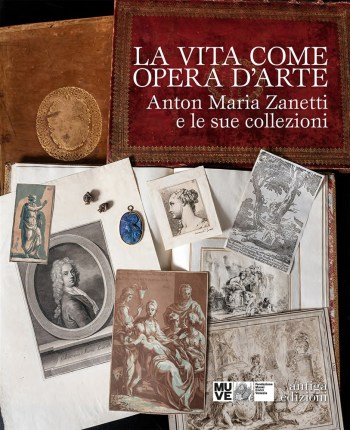 Anton Maria Zanetti (1679–1767) was a central figure in the eighteenth-century history of Venetian collecting and in the world’s endorsement of Venetian art. An art patron and influential intermediary on behalf of nobles and sovereigns, commissioning and purchasing works by Venice’s most famous artists, Zanetti was perhaps the most influential character in the Venetian art scene of the time. Known as ‘il Vecchio’, or ‘di Girolamo’—to distinguish him from his namesake younger cousin, a famous librarian at the Marciana Library in Venice—Zanetti was not only a passionate collector but also a talented draughtsman and skilled engraver.
After his father’s death in 1711, he was forced to provide for the rest of the family as an insurance agent, but despite difficulties, this did not prevent him from following his own inclinations. A friend to artists such as Canaletto, Rosalba Carriera, Sebastiano and Marco Ricci, and Giambattista Tiepolo, Zanetti was in close contact with the most important European collectors. He himself assembled an extraordinary collection of antique gems, drawings, and prints that was dispersed after his death. He also promoted splendid publishing initiatives, most notably two volumes on ancient sculpture, now conserved in the vestibule of the Marciana Library and one of the most beautiful and luxurious illustrated publications of the entire eighteenth century. An inexhaustible collection of letters, now spread among libraries and private collectors, documents his dense network of relationships and friendships and offers a rare insight into the cultural life of the period.
To commemorate this extraordinary figure, the Fondazione Musei Civici di Venezia presents an exhibition highlighting Zanetti’s activities as an artist and patron. Testimonies from his life in the form of books, letters, engravings, and drawings—none of which are usually exhibited for conservation reasons—will be shown together with art from his collection, including works by Tiepolo, Sebastiano and Marco Ricci, Palma il Giovane, and others, now preserved in the city’s museums, including the Gallerie dell’Accademia di Venezia, the Giorgio Cini Foundation, the Biblioteca Nazionale Marciana, and Venice’s civic museums, as well as in several private collections.
Alberto Craievich, La Vita Come Opera d’Arte: Anton Maria Zanetti e le sue collezioni (Antiga: Crocetta del Montello, 2018), 336 pages, ISBN: 978-8884351029, €38 / $60 (on sale for $42).
Exhibition | Maestro Van Wittel: Dutch Master of the Italian Cityscape

Caspar van Wittel, Piazza Navona, 1699, oil on canvas, 97 × 216 cm (Madrid: Carmen Thyssen-Bornemisza Collection on loan at the Museo Nacional Thyssen- Bornemisza).
◊ ◊ ◊ ◊ ◊
Now on view at the Kunsthal KAdE:
Maestro Van Wittel: Dutch Master of the Italian Cityscape / Hollandse meester van het Italiaanse stadsgezicht
Kunsthal KAdE, Amersfoort, 26 January — 5 May 2019
Kunsthal KAdE and Museum Flehite introduce the Netherlands to a world-renowned Dutch master who remained largely unknown in his country of birth, the Netherlands. Caspar Adriaensz van Wittel (1653–1736), also known as Gaspare Vanvitelli, became famous and revered in his adopted homeland of Italy. During the 17th and 18th century, he painted Rome, Naples, and Venice in minute detail, influencing famous Italian cityscape painters such as Canaletto and Bellotto. Van Wittel was born in Amersfoort, left around 1673 for Italy, earned a good reputation for himself there, and never returned to the Netherlands. Today, the vast majority of his works are in collections in Italy, England, and Spain. In the Netherlands, there are only a few drawings and a single gouache: View of Amersfoort in Museum Flehite. With the exhibition Maestro Van Wittel: Dutch Master of the Italian Cityscape, Museum Flehite and Kunsthal KAdE honour this master with a major retrospective from 26 January through 5 May 2019. It puts his extensive oeuvre in the context of his Dutch learning period and his influence on the later Italian vedutisti.
The exhibition at Kunsthal KAdE presents the entire Van Wittel story: the places he painted, the style he developed, his Dutch roots, his high-born patrons, and his undeniable influence in Italy. With this retrospective, Museum Flehite and Kunsthal KAdE want to give Caspar van Wittel his place in the canon of Dutch art history as maestro of the Italian cityscape.
Van Wittel’s Dutch Period
Caspar van Wittel was a student of Matthias Withoos, who had trained at Jacob van Campen’s painting school at the Randenbroek country estate in Amersfoort. Withoos’ masterpiece is his View of Amersfoort; commissioned in 1671 by the city government at the time, it was painted in the time that Van Wittel was training with him and therefore it is possible that the young student—he was 16 or 17 years old at the time—worked on it. Van Wittel relocated to Hoorn with Withoos in 1672. As a result of the move, he was neighbours with the painters Jan van der Heyden and Gerrit Berckheyde, who had developed a ‘pure’ rendering of the cityscape in Amsterdam and Haarlem. This ‘Dutch’ way of painting is conveyed in Van Wittel’s work.
Inventor of the Italian Cityscape
 Accompanied by a fellow young painter—Jacob van Staverden—Van Wittel travelled to Rome sometime around 1673. In Rome, he found himself in the Dutch Schildersbent (‘painters’ clique’) faction of the Bentvueghels (‘birds of a feather’), a group that had been an artists’ colony for decades in the eternal city. In Rome, he became acquainted with the work of Lieven Cruyl and Abraham Genoels, who made topographic drawings of the city. He also met Cornelis Meyer, a mechanical engineer who was striving to land an assignment from the Pope to build water works along the Tiber. Meyer asked the young Caspar—now in his mid-20s—to help with the illustrations for the manuscript. One of the subjects that Van Wittel drew was Piazza del Popolo, the square where Van Wittel arrived in Rome from the north. Ultimately, he would paint this square some 15 times in his career, always from the same perspective.
From that moment (around 1680), Van Wittel also began capturing other places in Rome with his signature precision: the Tiber with its bridges and the Castel Sant’Angelo on the banks, the Piazza Navona, the Colosseum, St. Peter’s Square, the Quirinal, Villa Borghese, churches, streets, and smaller squares. He often repeated these compositions numerous times, too, working from a single basic drawing. From Rome he travelled to Naples, the countryside surrounding Rome (Tivoli), Florence, and Venice. In the lagoon city of Venice, he captured the view of San Marco and the Doge’s Palace from the water. He painted the majestic La Salute church at the entrance to the Grand Canal. Nowadays it belongs to the standard repertoire of Venetian cityscape painting, but Van Wittel was the first to paint it.
Van Wittel Inspires Canaletto
Around 1719, the young Venetian painter Antonio Canal was in Rome to paint several decorative pieces with his father. It is highly likely that he met Van Wittel during this time and saw a number of his Venetian cityscapes. Filled with inspiration, Canal, who would quickly be called Canaletto, dedicated himself entirely to this subject. At the time, the Grand Tour—an educational trip for young members of the nobility—became incredibly popular and Canaletto, together with his cousin Bernardo Bellotto, became the go-to painters of Venetian cityscapes that were snapped up by the travellers. Incidentally, Van Wittel led the way here, too; he had provided Grand Tour travellers—including Thomas Coke—with these sorts of ‘picture postcards’. Upon his return to England, Coke built Holkham Hall in the north of Norfolk, which was inspired in part by his travels in Italy and the work of architect Palladio.
Once he arrived in Rome, Van Wittel established an extensive network of patrons that included not only Roman aristocracy such as the Sacchetti and Colonna families—in whose palaces he took up residence from time to time—but also the Spanish nobleman Medinaceli, who lived in Rome as an ambassador, became the viceroy of Naples in 1696 and commissioned a total of 35 paintings by Van Wittel, most of which were views of Naples and around the city.
Photographer Wilschut Follows in Van Wittel’s Footsteps
As part of the exhibition, Rotterdam photographer Hans Wilschut was asked to follow in Van Wittel’s footsteps and capture a number of the places in Rome, Naples, Venice, and Amersfoort that Van Wittel frequently painted. Some of these places have remained essentially the same; some have been completely transformed. Just as Van Wittel liked to capture the urban hustle and bustle in his cityscapes at the time, Wilschut shows people today in the iconic settings. Hans Wilschut is also featured in the exhibition Stadsbeelden (‘Cityscapes‘) at Museum Flehite, from 9 February through 19 May 2019.
Works from International Collections in Amersfoort
The exhibition presents around 45 paintings and gouaches and approximately 30 drawings by Van Wittel from Italian, English, Spanish, German, and French collections. In addition, there are about 30 paintings and drawings by Dutch and Italian masters.
An events programme to accompany the exhibition will be organised in cooperation with the Friends of Caspar van Wittel Foundation. Bekking & Blitz will publish an exhibition catalogue in Dutch and English. This is the first time that a monograph on the artist will be available in these languages. The catalogue costs €30.
The exhibition Maestro Van Wittel: Dutch Master of the Italian Cityscape is made possible by the generous support of the Turing Foundation, the Mondriaan Fund, Fonds 21, the Municipality of Amersfoort, the Cultural Heritage Agency, and the Province of Utrecht.










leave a comment