Exhibition | Chic Emprise: Art and Culture of Tobacco
Now on view at the Museum of the New World in La Rochelle, from the press release:
Chic emprise: Culture, usages et sociabilités du tabac du XVIe au XVIIIe siècle
Musée du Nouveau Monde, La Rochelle, 22 June — 23 September 2019
Curated by Maxime Georges Métraux and Annick Notter
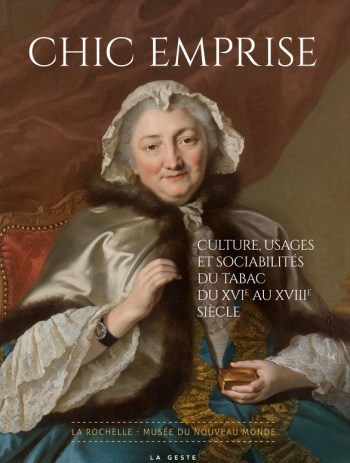 De l’Amérique du Nord en passant par les Caraïbes jusqu’au royaume du Kongo, le tabac est une plante incontournable de l’époque moderne (XVIe–XVIIIe siècle). À la fois produit de consommation, plaisir addictif et marqueur social, il s’est enraciné durablement dans l’ensemble des strates de la société en imprégnant aussi bien les mœurs aristocratiques et bourgeoises que populaires. Originaire d’Amérique, le tabac est rapidement importé avec succès en Europe où il a immédiatement entraîné de vifs débats entre ses défenseurs et ses opposants. Aujourd’hui discréditée et blâmée pour ses effets sur la santé, cette plante bénéficiait alors d’un statut différent, ses prétendues vertus curatives ont parfois été louées au point d’être l’objet de véritables discours de médicalisation. Le tabac véhicule un puissant imaginaire artistique et visuel comme en témoigne la vaste sélection d’œuvres présentées. Par ses multiples usages et son rôle éminemment social, la célèbre « herbe à Nicot » constitue un sujet idéal pour comprendre que l’époque moderne, et plus particulièrement le XVIIIe siècle, est l’un des moments de bascule d’une « civilisation de la rareté et de l’économie stationnaire à celle du développement et de l’abondance[1] ». Outre sa production et sa circulation, cette substance a engendré la fabrication de nombreux objets dédiés à ses diverses utilisations allant des pipes en pierre de Nouvelle-France jusqu’aux précieuses tabatières parisiennes. À l’instar du sucre et des boissons exotiques que sont le thé, le café et le chocolat, cette plante permet de saisir pleinement les processus coloniaux et leurs fonctionnements. L’essor de son commerce s’accompagne de la mise en place d’une imagerie promotionnelle massive dont les enseignes des marchands de tabacs constituent un précieux témoignage. À la croisée de l’histoire naturelle, de l’art et de la culture visuelle, cette exposition se propose d’étudier le tabac selon différentes approches afin d’en souligner son exceptionnelle richesse.
Cette exposition est l’occasion de présenter une grande sélection d’objets grâce à l’aide de plusieurs prêteurs publics (musée du Louvre, BnF, musée du Tabac de Bergerac, MAD Paris, Petit Palais, cité de la céramique de Sèvres, etc.) mais également du soutien de collectionneurs privés.
[1] Daniel Roche, Histoire des choses banales : naissance de la consommation dans les sociétés traditionnelles, XVIIe–XIXe siècle (Paris: Fayard, 1997), p. 14.
◊ ◊ ◊ ◊ ◊
Un catalogue a également été publié par les éditions La Geste:
Chic emprise: Culture, usages et sociabilités du tabac du XVIe au XVIIIe siècle (La Crèche: La Geste Editions, 2019), 256 pages, ISBN: 979-1035304669, €29.
L’ouvrage est richement illustré et composé d’une douzaine d’essais dont voici le sommaire :
1 La production de tabac en Amérique du Nord
• Elodie Peyrol-Kleiber, Les hommes aux pouces verts : cultiver le tabac dans la baie de Chesapeake
• Philippe Hrodej, Le cycle du tabac dans la partie française de Saint Domingue au XVIIe siècle
2 Les pratiques tabagiques
• Samir Boumediene, Du bon usage des choses. Les métamorphoses du tabac entre rites, savoir médicaux et pratiques de consommation
• Catherine Ferland, Usages du tabac au Canada, XVIe–XVIIIe siècle : la rencontre interculturelle
• Anton Serdeczny, De la fumée pour le mort : le tabac entre pratiques médicales et imaginaires culturels
3 Production et circulation des objets du fumeur
• Bernard Clist, Premières mondialisations de l’économie : témoignages par les pipes à fumer du royaume du Kongo de la fin du XVe siècle à la fin du XVIIIe siècle
• Marie-Hélène Daviau, Travailler la pierre pour faire naître la fumée : la pipe de pierre en Nouvelle-France
• Michèle Bimbenet-Privat, Les tabatières parisiennes : un luxe à la pointe de la mode
4 Le tabac et ses représentations
• Agnès Lugo-Ortiz, Des routes du démoniaque : tabac, commerce et culture visuelle aux Caraïbes et leurs axes transatlantiques
• Marianne Volle, La Nicotinia fait un tabac : du récit de voyage au livre botanique, XVIIe–XVIIIe siècles
• Pascale Cugy, ‘Agréable Tabac, charmant amuzement…’ Fumeurs, priseurs et râpeurs dans la gravure de mode sous Louis XIV
• Maxime Georges Métraux, Les enseignes des marchands de tabac au XVIIIe siècle : iconographie coloniale et culture visuelle de la consommation
Exhibition | Curieux Antiquaires: Les débuts de l’archéologie à Bavay
From the Forum Antique de Bavay:
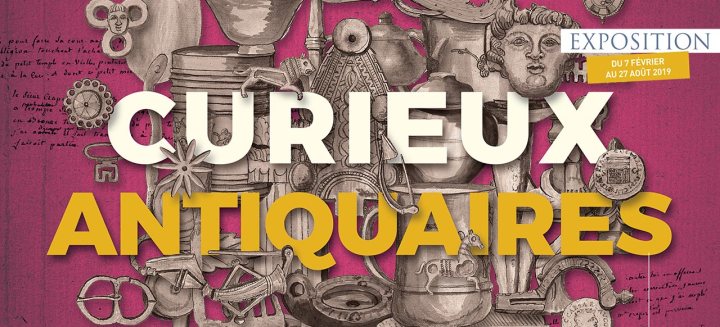
Curieux Antiquaires: The Origins of Archaeology in Bavay in the 18th and 19th Centuries
Forum Antique, Bavay (Nord), 7 February — 27 August 2019
L’antiquaire est par définition un grand collectionneur… Mais, celui que nous connaissons aujourd’hui et celui des XVIIIe et XIXe siècles sont bien différents. Un antiquaire dans les années 1700 et 1800 est en réalité un précurseur de l’archéologie, il se passionne pour la collection d’objets antiques et s’intéresse à leur passé pour raconter notre Histoire. Avec l’exposition Curieux antiquaires, les débuts de l’archéologie à Bavay aux XVIIle et XIXe siècles, pénétrez au coeur du passé antique de Bavay avec les yeux de ces amateurs éclairés. Découvrez des érudits hauts en couleurs à travers leurs méthodes de travail, réseaux, collections et dessins.
Cette exposition grand public a pour but de faire part aux visiteurs des avancées dans la connaissance de l’histoire de l’archéologie à Bavay en mettant d’une part en avant des portraits des acteurs de cette histoire (l’abbé Carlier, J.B. Lambiez, Antoine Niveleau, Parent) et d’autre part leurs publications (Recueil de dessins de Carlier, Histoire monumentaire du Nord des Gaules de Lambiez, Bavay ancien et nouveau de Niveleau …). Il est aussi question de faire prendre conscience au public du fait que la manière de construire l’image de l’Antiquité est conditionnée par l’époque.
Curieux Antiquaires: Les débuts de l’archéologie à Bavay aux XVIIIe et XIXe siècles (Paris: Snoeck, 2019), 200 pages, ISBN: 978-9461614711, 22€.
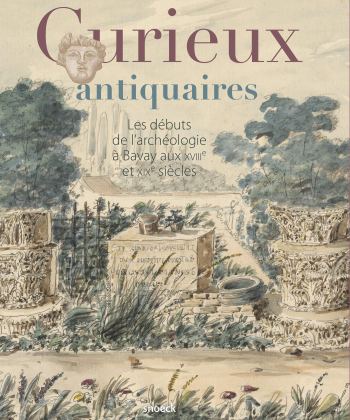 Si l’histoire de l’antique Bagacum est bien connue, la manière dont celle-ci s’est construite l’est moins. Curieux antiquaires, les débuts de l’archéologie à Bavay aux XVIIIe et XIXe siècles permet d’appréhender le patrimoine bavaisien sous un nouvel angle. Offrant une mise en perspective tant géographique que chronologique, ce catalogue apporte une vision nouvelle sur les premiers antiquaires bavaisiens. A travers les contributions d’Odile Parsis-Bazubé et d’Alain Schnapp, c’est la construction de l’antiquariate et de l’archéologie en France aux XVIIIe et XIXe siècles qui est mise en lumière. Plus loin, Véronique Beirnaert-Mary, Delphine Morana-Burlot et Véronique Krings détaillent l’exemple de Bavay. La première dresse le paysage bavaisien en présentant les acteurs locaux et leurs actions. Delphine Morana-Burlot propose ensuite une réflexion autour de la question du faux, Enfin, Véronique Krings ouvre une fenêtre sur la période du début du XXe siècle en s’attachant à relater la correspondance entre Franz Cumont et Raoul Warocqué autour des objets bavaisiens. Richement illustré, cet ouvrage rassemble toutes les pièces présentées à l’occasion de l’exposition. Des documents inédits sont ici publiés pour la première fois. La juxtaposition des objets archéologiques et de leur représentation dessinée est elle aussi inédite.
Exhibition | Romantic Germany
Now on view at the Petit Palais:
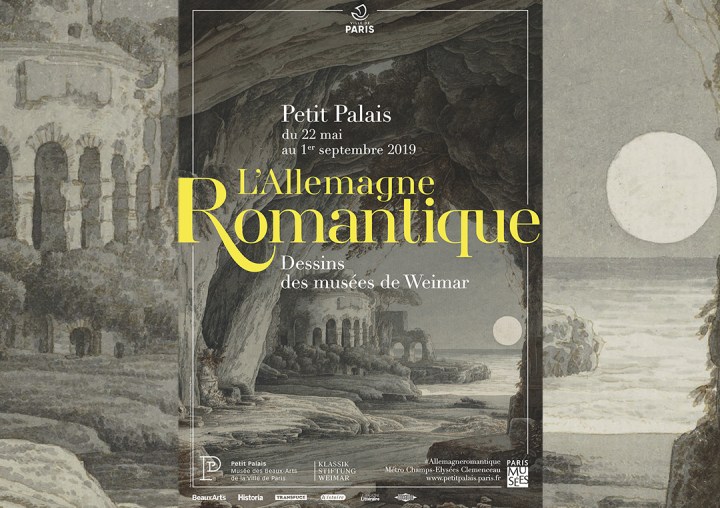
Romantic Germany: Drawings from the Museums of Weimar
Petit Palais, Paris, 22 May — 1 September 2019
Curated by Hermann Mildenberger, Gaëlle Rio, and Christophe Leribault
For the first time in France the Petit Palais is presenting a selection of 140 drawings from the lavish collections of Weimar’s museums. These remarkable images—initially chosen by Goethe (1749–1832) for the Grand Duke of Saxe-Weimar-Eisenach and his own collection—offer a spectacular overview of the golden age of German drawing (ca. 1780–1850).
In the late 18th century the city of Weimar, seat of the Dukes of Saxe-Weimar, was Germany’s intellectual hub. A key figure at this enlightened court, Goethe accumulated numerous posts of cultural responsibility, in addition to writing most of his works there. Himself a knowledgeable collector and draftsman, he built up for the Grand Duke a handsome collection representing every facet of German drawing.
At this time, literature, the visual arts, and music were undergoing profound upheavals in terms of their rules and practice. While the Romantic movement never had a leader as such, its artists unanimously stood for expression of the passions and subjectivity of vision; and in many cases this period saw a blossoming of drawing that made it the most innovative of the creative disciplines of the time.
Divided into seven sections, the exhibition combines the chronological and the aesthetic. As well as such emblematic figures as Caspar Friedrich, Philipp Runge, and Johann Füssli, visitors will discover some 35 artists who played vital parts in the history of drawing, among them Tischbein, Carstens, Fohr, Horny, von Schadow, Schinkel, von Schwind, Richter, and the Nazarenes Overbeck and Schnorr von Carolsfeld, driven by Christian spirituality and national feeling. Portraits and genre scenes, castles in ruins, compositions of biblical and medieval inspiration—but above all landscapes mingling idealism and naturalism in every imaginable media—offer viewers a sublime frisson in their illustration of the private, inner and sometimes flamboyant lives of the Romantic artists.
Curators
Hermann Mildenberger, professor and curator at Klassik Stiftung Weimar
Gaëlle Rio, director, Musée de la Vie romantique
Christophe Leribault, director, Petit Palais
L’Allemagne romantique: Les dessins du musée de Weimar (Paris: Éditions Paris Musées, 2019), 232 pages, ISBN: 978-2759604258, 40€.
Exhibition | Generation Revolution: French Drawings
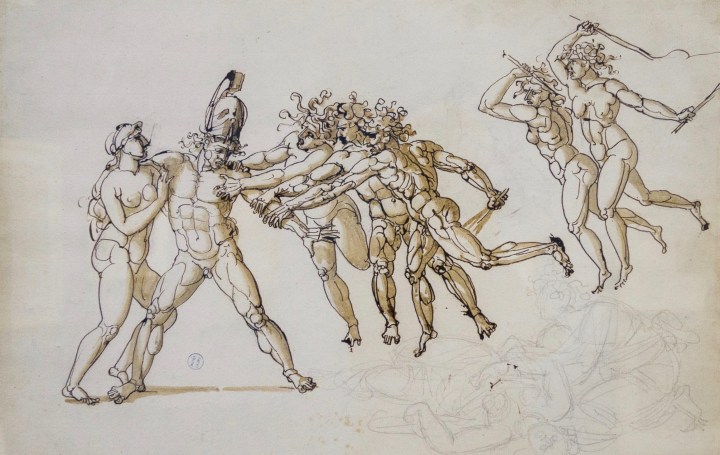
Philippe-Auguste Hennequin, Les Remords d’Oreste, ca. 1800
(Montpellier: Musée Fabre)
◊ ◊ ◊ ◊ ◊
Press release for the exhibition now on view at the Cognacq-Jay:
Generation Revolution: French Drawings from the Musée Fabre in Montpellier, 1770–1815
Musée Cognacq-Jay, Paris, 16 March — 14 July 2019
From 16 March through 14 July 2019, the Musée Cognacq-Jay explores the choices made by a generation of artists who were in their thirties during the French Revolution. The art world they had known was completely overthrown. How did they adapt? Where did they stand, and what coping strategies did they find? Artists were obliged to profoundly re-examine their practices and their opportunities, reconsidering even their subjects and their stylistic orientation, between Neoclassicism and Pre-Romanticism.
 The medium of intimacy par excellence, drawing reflects the richness and diversity of this transitional period. The exhibition brings together a selection of 80 exceptional drawings from the collection of the Musée Fabre in Montpellier. This unique group of drawings, never before shown in Paris, attests the acceleration of history and a prelude to modernity
The decades bridging the 18th and 19th centuries were a period of major political, economic, and social upheaval. The art world was by no means spared: royal commissions disappeared, the Académies were suppressed, and large projects cancelled. This exhibition, organised in collaboration with the Musée Fabre in Montpellier, speaks to the renewal of artistic techniques, styles, subjects, and sensibilities that emerged from these upheavals. While the birth of a republican patriotic ideal inspired artists to draw from the history of Antiquity, private and picturesque subjects also experienced an unprecedented success.
Focused on drawing, the exhibition presents a corpus of almost a hundred remarkable sheets, assembled by one of David’s favourite students, the painter François-Xavier Fabre, who was also a collector, art expert and art dealer. The collection he bequeathed to his native city was the basis for the Cabinet des arts graphiques at the Musée Fabre. The most famous artists of the time: David, Girodet, Vien, Fragonard and Prud’hon clustered around the personality of Fabre.
The exhibition plan is based on around four thematic sections presenting the different genres practiced by artists of the time, the development of artistic trends, and the emergence of individual personalities along with the diversity of graphic techniques employed.
Drawing to Learn
Until the end of the Ancien Regime, training at the Royal Academy was a requirement for any artist who hoped to obtain official commissions. Drawing instruction occupied a preeminent place in the curriculum and required a mastery of geometry, perspective, and anatomy. Figure drawing was considered the most noble exercise (and the most revelatory of youthful potential), so much so that the male nude was known as an ‘academy figure’. With the coming of the Revolution, the practice of drawing took off in an extraordinary way.
In Praise of the Individual
Although historical subjects continued to dominate the hierarchy of genres in painting, representations of daily life and its pleasures attracted an ever more substantial clientele. The portrait and the genre scene—less subject to political shifts and embraced by a growing bourgeoisie—expanded in an unprecedented way. Fragonard, for example, made a specialty of these types of painting.
The Virtues of History
The hegemony of history painting was exacerbated by the Revolution and took on a moralising role: the nascent Republic seized upon ancient Rome for its examples of virtue and heroism. Interest in subjects taken from the Bible and ancient history strengthened the dominance of Neoclassicism. Meanwhile, however, artists were fascinated by other imaginaries: the national past, especially the medieval past, and the Middle-East, revealed by scientific investigations and military campaigns, two points of reference which are at the source of later Neo-Gothic and Orientalism.
Travel and Nature

Antoine-Laurent Castellan, Etude de nuages, 1815 (Montpellier: Musée Fabre).
For the artists who chose exile, Italy remained a favoured destination. Attractive above all for its masterpieces of ancient and Renaissance art, Italy’s vast panoramas and striking light effects were also a draw. The French artists sojourning on the peninsula—in particular François-Xavier Fabre and his friends—went off into the countryside looking to immortalise grandiose sites where nature dominates the human figure.
Lead Curators
Michel Hilaire, Director, Musée Fabre
Annick Lemoine, Director, Musée Cognacq-Jay
Rose-Marie Herda-Mousseaux, chief curator for the modern era at the Louvre Abu Dhabi
Scientific Curators
Benjamin Couilleaux, Curator for cultural heritage, Director Musée Bonnat-Helleu
Florence Hudowicz, Curator for cultural heritage, Curator of drawings and decorative arts, Musée Fabre, Montpellier
Benjamin Couilleaux, Michel Hilaire, and Florence Hudowicz, Génération en Révolution: Dessins français du musée Fabre, 1770–1815 (Paris Musées, 2019), 174 pages, ISBN: 978-2759604197, 35€.
Catalogue cover Image: François-Xavier Fabre, Personnage nu saisissant un cube de pierre, 1789–92 (Montpellier: Musée Fabre).
Exhibition | Indian Painting for the East India Company
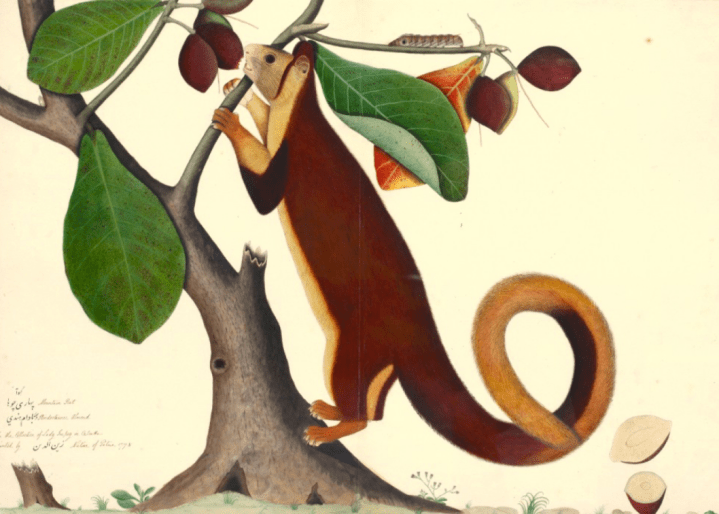
Shaikh Zain al–Din, Malabar Giant Squirrel, Eastern India, Calcutta, 1778
(Private Collection; photo by Margaret Nimkin)
◊ ◊ ◊ ◊ ◊
From the press release related to the exhibition:
Forgotten Masters: Indian Painting for the East India Company
The Wallace Collection, London, 4 December 2019 — 19 April 2020
Curated by William Dalrymple
In September 2019, the Wallace Collection presents Forgotten Masterpieces of Indian Painting for the East India Company. Curated by renowned writer and historian William Dalrymple, this is the first UK exhibition of Indian paintings commissioned by East India Company officials in the late eighteenth and nineteenth centuries. Reflecting both the beauty of the natural world and the social reality of the time, these dazzling and often surprising artworks offer a rare glimpse of the cultural fusion between British and Indian artistic styles during this period.
Comprising works from a wide variety of Indian traditions, the exhibition belatedly honours historically overlooked Mughal artists including Shaikh Zain al–Din, Bhawani Das, Shaikh Mohammad Amir of Karriah, Sita Ram, and Ghulam Ali Khan. It will shed light on a forgotten moment in Anglo-Indian history, recognising the vivid and highly original paintings it produced as among the greatest masterpieces of Indian painting.
William Dalrymple, ed., Forgotten Masters: Indian Painting for the East India Company (London: Philip Wilson Publishers, 2019), 192 pages, ISBN: 978-1781300978, $40.
Note (added 25 September 2019) — The original posting listed the exhibition as being open from September until December.
Note (added 22 October 2021) — The original posting listed the title as ‘Forgotten Masterpieces’, rather than ‘Forgotten Masters’.
Exhibition | Buried by Vesuvius: Treasures from the Villa dei Papiri

Press release (13 May 2019) from The Getty:
Buried by Vesuvius: Treasures from the Villa dei Papiri
Getty Villa, Pacific Palisades (Los Angeles), 26 June — 28 October 2019
Curated by Kenneth Lapatin
The Getty Villa is modeled on the Villa dei Papiri at Herculaneum, an ancient Roman villa buried by the eruption of Mount Vesuvius in AD 79. Rediscovered in the 1750s and explored further in the 1990s and early 2000s, the Villa dei Papiri has yielded spectacular colored marble and mosaic floors, frescoed walls, a large collection of bronze and marble statuary, and a unique library of more than a thousand papyrus scrolls (from which it gets its name). Buried by Vesuvius: Treasures from the Villa dei Papiri presents many of the most significant artifacts discovered in the 1750s, along with recent finds from the still active archeological site, and explores ongoing efforts to open and read the badly damaged papyri.
 “The Villa dei Papiri is one of the most luxurious private residences of the ancient classical world ever discovered and one which had an important role in the early history of archeology. Especially important are its unique collection of ancient bronze statuary and antiquity’s only surviving library of papyrus scrolls, which provide an unprecedented insight into the philosophical interests of its aristocratic Roman occupant—none other than the father-in-law of Julius Caesar,” says Timothy Potts, director of the J. Paul Getty Museum. “Among the most impressive of these finds is a rare bronze sculpture of a drunken satyr, which, as part of a collaborative conservation project with the Museo Archeologico Nazionale di Napoli (MANN), is undergoing analysis and conservation treatment in our conservation studios before going on display in the exhibition.”
Potts adds, “For several decades, we have worked closely with Italian colleagues and institutions in conserving, protecting, researching and celebrating Italy’s extraordinary cultural heritage. We are delighted now to be collaborating with MANN, the Parco Archeologico di Ercolano (PA-Erco), and the Biblioteca Nazionale “Vittorio Emanuele” di Napoli (BNN) in organizing this exhibition. We have had several successful collaborative conservation projects with MANN over the past few years including, most recently, their monumental funerary vessel (krater) from Altamura in 2018, and three of their splendid bronzes: the Ephebe (Youth) in 2009, the Apollo Saettante in 2011, and the over-life-size sculpture of Tiberius in 2013.”
The Villa dei Papiri was a sumptuous private residence on the Bay of Naples, just outside the Roman town of Herculaneum. Deeply buried by the eruption of Mount Vesuvius in AD 79, it was rediscovered in 1750 when well-diggers struck a spectacular circular multi-colored marble floor that belonged to the luxurious Roman villa (a full-scale replica of this floor decorates the Getty Villa’s Temple of Hercules gallery). Under the sponsorship of King Charles VII, Karl Weber, a Swiss military engineer in the royal guard, was entrusted with excavating the site. Weber directed a crew of conscripts and convicts to dig a series of shafts and tunnels to seek and remove the most impressive finds to augment the collections of the recently established Royal Herculanean Museum. Although his superiors were chiefly interested in recovering artifacts to enhance the royal collections, Weber carefully recorded their findspots and architectural contexts.
Weber’s excavation plan of the Villa dei Papiri, on display in the exhibition, provides detailed evidence for the layout and decoration of the building, including discovery dates and locations of sculptures, frescos, papyri, columns, pools, fountains, gutters, hinges, and other architectural features. In the early 1970s, when J. Paul Getty decided to replicate the Villa dei Papiri for his museum in Malibu, his architects relied on Karl Weber’s eighteenth-century plan, since the original building remained inaccessible underground. They also employed elements from other ancient structures discovered around the Bay of Naples.
“It is only fitting that the first major exhibition on the Villa dei Papiri takes place at the Getty Villa, which is a recreation of the famous villa in Herculaneum,” says Kenneth Lapatin, curator of antiquities at the J. Paul Getty Museum. “Recreating the Villa dei Papiri appealed to Mr. Getty because of its association with Julius Caesar through his father-in-law, Lucius Calpurnius Piso Caesoninus, the villa’s supposed owner. Getty often compared himself to ancient Roman rulers and particularly admired Julius Caesar and the emperor Hadrian, a fellow art collector and villa owner. Although Getty, unlike Hadrian, did not live in his villa, his reconstruction was a key component in his attempts to refashion himself from a Midwestern businessman into a European aristocrat.”

Drunken Satyr, 1st century BC – 1st century AD, bronze
(Naples: Museo Archeologico Nazionale di Napoli)
◊ ◊ ◊ ◊ ◊
One of the most significant finds recovered in the 1750s was a first-century bronze statue of a Drunken Satyr in dynamic motion. The middle-aged figure was praised by the eighteenth-century German scholar J. J. Winckelmann as one of the most beautiful bronze statues to survive from antiquity. The satyr, a mythical follower of the wine god Bacchus, wears a pine wreath with flower clusters and has pointed ears, small horns, wild hair, and wattles. He snaps his right thumb and middle finger in a gesture associated by ancient authors with Bacchic abandon. A replica of the satyr can be found in the Getty Villa’s Outer Peristyle pool.
The ancient Drunken Satyr, which is usually on view in Naples, arrived to the Getty early in October 2018 for conservation treatment and analysis as part of a collaborative project with MANN. The project aims to identify past interventions—what was done to the statue in both ancient and early modern times to repair it, stabilize it, or change its appearance. There will also be an investigation of any potential instabilities, including metal corrosion and the connection between the statue’s various parts, as well as their connections to its early modern stone base. In collaboration with their colleagues at MANN, Getty conservators will also evaluate possible aesthetic issues, considering how to best display the sculpture to enhance viewers’ appreciation of its artistry. How the statue was originally manufactured will also be explored through techniques such as X-radiography, endoscopy, technical imaging, and non-invasive analytical methods.
Another important discovery was the cache of approximately 1,100 papyrus scrolls recovered from the ancient villa in 1752–54, which constitute the only surviving library from the classical world. Camillo Paderni (ca. 1715–1781), the first director of the royal museum in Portici, was the first to attempt to open the carbonized scrolls by slicing the scrolls lengthwise, cutting through their charred outer ‘bark’ to expose the writing. The texts were copied for study and eventual publication, and then the papyri were scraped to reveal additional layers. In 1753, Father Antonio Piaggio, a curator of manuscripts at the Vatican, devised a more successful system, inventing and refining a series of unrolling machines, one of which is on view in the exhibition.
In the late 1900s and early 2000s, advanced imaging technologies enhanced the legibility of the previously opened papyri. Today, they offer the prospect of digital unrolling and decipherment of the hundreds that remain closed. An in-gallery video addressing recent attempts to virtually open and read the scrolls will also be part of the exhibition. In addition, a group of papyrus scrolls on loan from Bibiloteca Nazionale “Vittorio Emanuele” in Naples, which will be on display for the first time in the US, will undergo a major research project at UCLA of imaging and virtual unscrolling prior to being placed in the exhibition. The results of the project will be available later in the summer after the exhibition opens.
Most of the texts opened to date are Greek philosophical treatises, particularly by Philodemus of Gadara (about 110–30 BC), a follower of Epicurus. The Athenian philosopher Epicurus (341–270 BC) founded a popular school called the Garden, which recognized pleasure as the greatest good. Images of Greek intellectuals, including busts of Epicurus, and other artifacts, such as a bronze piglet and a portable sundial, recovered from the Villa dei Papiri, further reflects the owner’s interest in Epicurean philosophy and rhetoric.
The rooms and gardens of the Villa dei Papiri were enlivened by approximately 90 sculptures in bronze and marble depicting mythological figures, athletes, rulers, statesmen, poets, and philosophers. Portraits of eminent figures of the Hellenistic period (323–31 BC) predominate, which reflects the particular interests of the villa’s owners in Hellenistic philosophy and politics. The arrangement of the sculptures also appears to have been programmatic, presenting particular groupings that invited viewers to compare the accomplishments and failings of the subjects as well as the artistic styles of the works.

Runner, 1st century BC – 1st century AD, bronze, 119 inches high (Naples: Museo Archeologico Nazionale di Napoli; photo by Giorgio Albano).
For wealthy Romans, otium, or leisure, presented a chance to forget the concerns of urban life, abandon worry about politics or business (negotium). A seaside estate such as the Villa dei Papiri was the perfect place for an escape. Its owners could host elaborate banquets where guests were surrounded by art, sating both their gastronomic and aesthetic appetites. Gardens, baths, and athletic spaces, as well as long walkways for undistracted contemplation, invited visitors to pause and discuss the representations of mythological figures, men of letters, and famous statesmen. The exhibition will include many of these ancient bronze and marble representations, not far from their replicas on display throughout the Getty Villa’s gardens, including two famous figures of bronze runners.
Exploration of the Villa dei Papiri was abandoned in 1764 and remained entirely buried for more than two centuries until new excavations were undertaken in the 1990s and 2000s. Renewed interested brought to light a portion of the building’s atrium as well as lower levels that were unknown in the eighteenth century.
Among the new discoveries were rooms with colorful mosaic floors and spectacular frescoed walls and stuccoed ceilings. Finds also included a seaside pavilion and swimming pool, where archaeologists recovered two marble sculptures and luxurious wood and ivory furniture components, on view here for the first time. These recent excavations helped clarify the chronology of the villa, which is now thought to have been built around 40 BC, with the seaside pavilion added around AD 20. Ongoing research continues to advance our understanding of the initial finds from the site.
Buried by Vesuvius: Treasures from the Villa dei Papiri was organized in collaboration with the Museo Archeologico Nazionale di Napoli, Parco Archeologico di Ercolano, and Biblioteca Nazionale di Napoli “Vittorio Emanuele III”, and with the generous participation of the Bodleian Libraries of the University of Oxford and the Metropolitan Museum of Art New York. The exhibition is made possible with major support from Elizabeth and Bruce Dunlevie. It is generously supported by The Spogli Family Foundation. Additional support is provided by the J. Paul Getty Museum’s Villa Council and the Italian Cultural Institute.
The exhibition is curated by Kenneth Lapatin, curator of antiquities at the J. Paul Getty Museum. He is the author or coauthor of numerous books and articles on ancient art and its modern reception, including Guide to the Getty Villa (2018); The Last Days of Pompeii: Decadence, Apocalypse, Resurrection (2012); Luxus: The Sumptuous Arts of Greece and Rome (2015); and Power and Pathos: Bronze Sculpture of the Hellenistic World (2015).
Kenneth Lapatin, Buried by Vesuvius: The Villa dei Papiri at Herculaneum (Los Angeles: Getty Publications, 2019), 296 pages, ISBN: 978-1606065921, $65.
Exhibition | William Blake
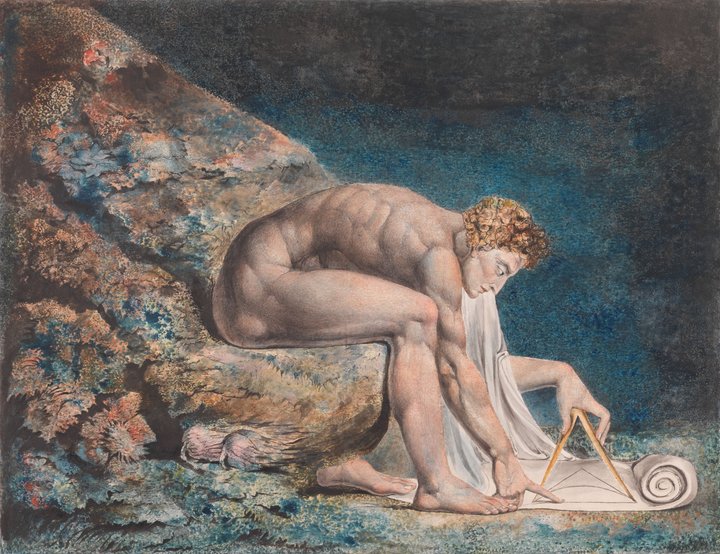
William Blake, Newton, 1795–c.1805, color print, ink and watercolour on paper
(London: Tate Britain)
◊ ◊ ◊ ◊ ◊
Press release (4 April 2019) for the exhibition:
William Blake
Tate Britain, London, 11 September 2019 — 2 February 2020
Curated by Martin Myrone and Amy Concannon
This autumn, Tate Britain will present the largest survey of work by William Blake (1757–1827) in the UK for a generation. A visionary painter, printmaker, and poet, Blake created some of the most iconic images in the history of British art and has remained an inspiration to artists, musicians, writers, and performers worldwide for over two centuries. This ambitious exhibition will bring together over 300 remarkable and rarely seen works and rediscover Blake as a visual artist for the 21st century.
 Tate Britain will reimagine the artist’s work as he intended it to be experienced. Blake’s art was a product of his tumultuous times, with revolution, war and progressive politics acting as the crucible of his unique imagination; yet he struggled to be understood and appreciated during his life. Now renowned as a poet, Blake also had grand ambitions as a visual artist and envisioned vast frescos that were never realised. For the first time, The Spiritual Form of Nelson Guiding Leviathan (c.1805–09) and The Spiritual Form of Pitt Guiding Behemoth (c.1805) will be digitally enlarged and projected onto the gallery wall on the huge scale that Blake imagined. The original artworks will be displayed nearby in a restaging of Blake’s ill-fated exhibition of 1809, the artist’s only significant attempt to create a public reputation for himself as a painter. Tate will recreate the domestic room above his family hosiery shop in which the show was held, allowing visitors to encounter the paintings exactly as people did in 1809.
The exhibition will provide a vivid biographical framework in which to consider Blake’s life and work. There will be a focus on London, the city in which he was born and lived for most of his life. The burgeoning metropolis was a constant inspiration for the artist, offering an environment in which harsh realities and pure imagination were woven together. His creative freedom was also dependent on the unwavering support of those closest to him, his friends, family, and patrons. Tate will highlight the vital presence of his wife Catherine who offered both practical assistance and became an unacknowledged hand in the production of his engravings and illuminated books. The exhibition will showcase a series of illustrations to Pilgrim’s Progress (1824–27) and a copy of the book The complaint, and the consolation Night Thoughts (1797), now thought to be coloured by Catherine.
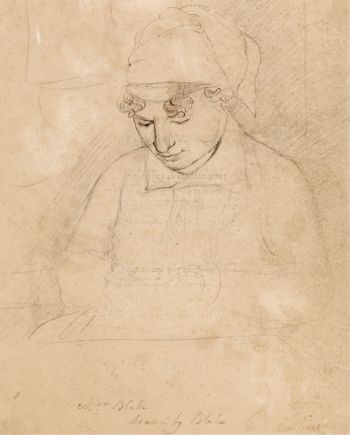
William Blake, Catherine Blake, 1805, graphite on paper (London: Tate Britain).
Blake was a staunch defender of the fundamental role of art in society and the importance of artistic freedom. Shaped by his personal struggles in a period of political terror and oppression, his technical innovation, and his political commitment, these beliefs have inspired the generations that followed and remain pertinent today. Tate Britain’s exhibition will open with Albion Rose (c.1793), an exuberant visualisation of the mythical founding of Britain, created in contrast to the commercialisation, austerity, and crass populism of the times. A section of the exhibition will also be dedicated to his illuminated books such as Songs of Innocence and of Experience (1794), his central achievement as a radical poet.
Additional highlights will include a selection of works from the Royal Collection and some of his best-known paintings including Newton (1795–c.1805) and Ghost of a Flea (c.1819–20). The latter work was inspired by a séance-induced vision and will be shown alongside a rarely seen preliminary sketch. The exhibition will close with The Ancient of Days (1827), a frontispiece for an edition of Europe: A Prophecy, completed only days before the artist’s death.
William Blake is curated by Martin Myrone, Lead Curator pre-1800 British Art, and Amy Concannon, Assistant Curator British Art 1790–1850. The exhibition will be accompanied by a catalogue from Tate Publishing (distributed by Princeton University Press), along with a programme of talks and events in the gallery.
Martin Myrone, ed., William Blake (London: Tate Publishing, 2019), 224 pages, ISBN: 978-0691198316, £43 / $55.
◊ ◊ ◊ ◊ ◊
Note (added 30 November 2019) — The original posting used the exhibition’s initial working title, William Blake: The Artist.
Exhibition | Madame de Maintenon
Now on view at Versailles:
Madame de Maintenon: In the Corridors of Power
Château de Versailles, 16 April — 21 July 2019
Curated by Alexandre Maral and Mathieu da Vinha
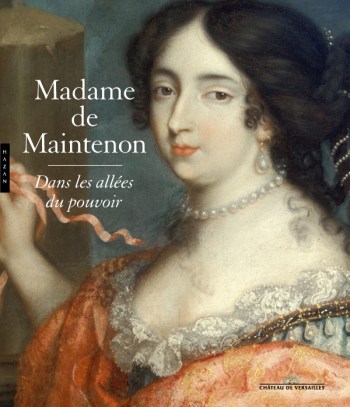 The first exhibition entirely devoted to the Marquise of Maintenon, on the tercentenary of her death on 15 April 1719, recounts the extraordinary life of Françoise d’Aubigné (1635–1719). She was born in a prison yet went on to become the Sun King’s wife in 1683.
The different stages of her life are shown in around 60 works from the collections of Versailles and other museums, including paintings, drawings, engravings, books, sculptures, medals, and so on. The visit passes through the four adjoining rooms of the apartment she lived in from 1682 until 1715, on the first floor of the Palace’s central section.
The scenography returns the walls to their original colours at the time. They are richly draped in alternating silk panels as described in the Furniture Store-House inventories from 1708: red damask, crimson damask, and red taffeta for the second antechamber; green and gold damask for the bedroom; and crimson and gold flower damask for the Chambers. This installation was made possible thanks to the restoration of these wall hangings by Tassinari et Chatel, the nation’s oldest silk manufacturer, founded in Lyon by Louis XIV.
The exhibition is curated by Alexandre Maral (Head Curator for Heritage and Director of the Centre de recherche du château de Versailles) and Mathieu da Vinha (Scientific Director of the Centre de recherche du château de Versailles), with scenography by Jérôme Dumoux.
Alexandre Maral and Mathieu da Vinha, Madame de Maintenon: Dans les allées du pouvoir (Paris: Hazan, 2019), 192 pages, ISBN: 978-2754110723, 35€.
The exhibition brochure (in French and English) is available as PDF file here
◊ ◊ ◊ ◊ ◊
Symposium | Madame de Maintenon, 1719–2019
Château de Versailles, 21–23 March 2019
This international symposium offered a fresh look at this multifaceted historical figure, reviewing the biographical aspects of the Marquise, as well as her correspondence and the literary and iconographic legend surrounding her.
Details along with audio recordings are available here.
Exhibition | A Return to the Grand Tour: Micromosaic Jewels
Opening this weekend at the VMFA:
A Return to the Grand Tour: Micromosaic Jewels from the Collection of Elizabeth Locke
Virginia Museum of Fine Arts, Richmond, 27 April — 2 September 2019
The Gibbes Museum of Art, Charleston, 2020
Curated by Susan Rawles
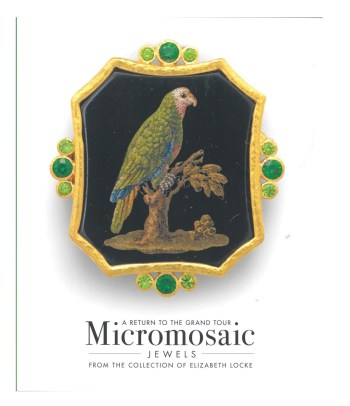 The wide range of subjects depicted in these 92 intricately crafted works of art—precious souvenirs designed for Grand Tour travelers of the mid-18th to late-19th centuries—include Renaissance paintings, architecture, birds, animals, historical sites, landscapes, and portraits. These micromosaic jewels reflect the sophisticated pursuits of elite Europeans for whom travel was a rite of passage.
Diminutive forms of ancient Roman, Grecian, and Byzantine mosaics, ‘micromosaics’—a term coined in the 1970s by collector Sir Arthur Gilbert—are made using a painstaking technique that involves tesserae, small pieces of opaque enamel glass. The tiny mosaics were first developed with regularity in the second half of the 18th century by the Vatican Mosaic Workshop. By the 19th century, numerous independent studios devoted to the production of these small keepsakes were established to meet travelers’ demands and to capitalize on the increasing popularity of micromosaics as symbols of status, sophistication, and social polish. For an English traveler to Rome, Venice, or Milan, for example, a micromosaic of an Italian Renaissance painting or ancient architectural monument captured the journey and today reflects that era’s fascination with the classics and societal requisite travel to the ‘cradle of western civilization’.
The works of art on view in this exhibition, which are predominantly stunning pieces of jewelry, are dazzling in their exquisite detail and craftsmanship. In addition to the tiny enameled glass that forms the mosaic, eye-catching designs include gold, precious stones, and diamonds. VMFA is pleased to present this decorative arts exhibition and to share these fine works of art from the Elizabeth Locke Collection of Micromosaics.
The exhibition is organized by the Virginia Museum of Fine Arts and curated by Dr. Susan J. Rawles, Associate Curator of American Painting and Decorative Arts, VMFA.
Susan Rawles, with a foreword by John Guare, A Return to the Grand Tour: Micromosaic Jewels from the Collection of Elizabeth Locke (Richmond: Virginia Museum of Fine Arts, 2019), 118 pages, ISBN: 978-1934351154, $25.
Exhibition | Canova and the Antique

Now on view in Naples at the MANN:
Canova and the Antique
Museo Archeologico Nazionale di Napoli, Naples, 28 March — 30 June 2019
Curated by Giuseppe Pavanello
The magnificent art of Antonio Canova (1757–1822) has rightly earned him praise as “the last of the ancients and the first of the moderns.” This exhibition focuses on Canova’s constant, intense, and fruitful relationship with classical antiquity, which made him known as “the new Phidias” among his contemporaries. Throughout the course of his artistic activity, Canova followed Winckelmann’s call “to imitate but not to copy the ancients” in order to “become inimitable.”

Antonio Canova, Dancer with Hands on Hips, 1811–12 (Saint Petersburg: State Hermitage Museum).
The exhibition is organised on two floors and displays over 110 works by Canova, including drawings, sketches, paintings, plaster casts, and marble sculptures. It showcases some of Canova’s greatest masterpieces, such as the famous group of The Graces on loan from the Hermitage State Museum in Saint Petersburg. The National Archaeological Museum of Naples is in a uniquely privileged position to present this complex and fascinating dialogue between Canova’s works and the great works of antiquity, with stunning pieces that can delight the modern spectator as thoroughly as they did Canova’s contemporaries.
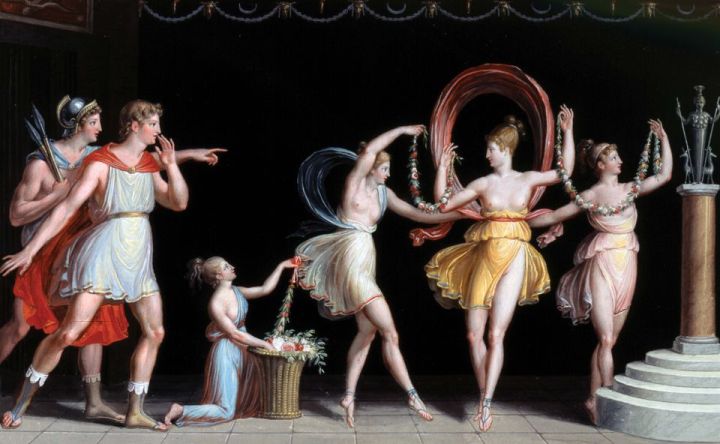
The two installations dedicated to Canova in the entrance hall of the Museum are hosted in theatre-like round structures with a six-metre diameter. The visual journey takes the visitor through virtual imagery and scientific study, going from a single detail to a bird’s eye view, from the butterfly of Cupid and Psyche, to Hercules hurling Lichas, the great myths sculpted in marble and the polychrome paintings on a dark background, dedicated to dance. Adriano Giannini’s voice and the original soundtrack by the cello-player Giovanni Sollima contribute to a show that mixes deep emotion and accurate knowledge.
Canova visited Naples in 1780 to admire the beauties of the city and the antiquities of Herculaneum and Paestum. In his second Quaderno di Viaggio he writes about Naples: “everywhere is like Heaven.” He also reports of his visits to the Sansevero Chapel—where he appreciated the Dead Christ (Veiled Christ) by Giuseppe Sammartino—to the Gallery of Capodimonte, and to the Museum of Portici, where all the antiquities from the Vesuvian area had been gathered. Among the bronzes from the Villa of Papyri of Herculaneum he praises the Seated Mercury for “its wonderful beauty.” Canova obtained permission to draw the nude at the Academy (of Fine Arts), then in the area of San Carlo alle Mortelle. Today, in the Academy’s Gipsoteca, it is possible to admire some of Canova’s plaster models. The master returned to Naples in 1787 and carved for Francesco Maria Berio the marble group Venus and Adonis, to be placed in a little temple in the garden of the marquis’ palace, along via Toledo. The work, inscribed in the genre “delicate and gentle,” is today in Geneva. For the Neapolitan Onorato Caetani he sculpted the group Hercules and Lichas, classified in the genre “strong” or “fierce,” taking inspiration from the ideal model of the Farnese Hercules and from the composition of Hector and Troilus—both on display at the MANN. The Herm of a Vestal, commissioned by the count Paolo Marulli d’Ascoli, would leave Naples for Switzerland first and for the Getty Museum of Los Angeles later. After the short life of the Parthenopean Republic, the Bourbon king Ferdinand IV asked Canova to sculpt for him a portrait-statue. In 1821, as suggested by the master himself, it was placed in the niche of the monumental staircase of the Royal Bourbon Museum, today Museo Archeologico Nazionale. During the French decade Canova carved the marble busts, today lost, of Caroline and Joachim Murat, known through their plaster models. In the same period, the king Joseph Bonaparte and his successor Joachim Murat commission an Equestrian Monument to Napoleon, but, with the French domination coming to an end, the work was never completed. When the Bourbon king of Naples Ferdinand I regained the throne as king of the two Sicilies, he asked Canova to complete the piece with the statue of his father, Charles III. The monument can be admired today in Piazza Plebiscito.
Blasco Pisapia and Valentina Moscon, Canova e l’Antico (Milan: Electa, 2019), 360 pages, ISBN: 978-8891825063.










leave a comment