Exhibition | Hogarth: Place and Progress
Press release (via Art Daily) for the exhibition:
Hogarth: Place and Progress
Sir John Soane’s Museum, London, 9 October 2019 — 5 January 2020
 Hogarth: Place and Progress unites all of the paintings and engravings in Hogarth’s series for the first time, displayed across the Georgian backdrop of Sir John Soane’s Museum. Through these works the exhibition will explore the artist’s complex stance on morality, society, and the city, and the enduring appeal of his satires.
• The concept of progress has positive connotations in the twenty-first century but was often construed negatively in Hogarth’s time. Hogarth’s complex and often darkly satirical narrative progresses move from moral abandon and social ostracism, to poverty, madness and death.
• New research pinpoints precise locations in London depicted in Hogarth’s works and examines the key role they play in a moral reading of Hogarth’s paintings.
• Hogarth’s ability to see beyond social conventions continues to resonate with 21st-century audiences, as he presented with wit and empathy the depictions of immorality and vice that he perceived in all classes of society.
The Soane Museum’s own Rake’s Progress and An Election will be joined by Marriage A-la-Mode from the National Gallery, The Four Times of Day from the National Trust and The Trustees of the Grimsthorpe and Drummond Castle Trust, as well as the three surviving paintings of The Happy Marriage from Tate and the Royal Cornwall Museum. The exhibition also includes engraved series of prints, lent by Andrew Edmunds, such as The Four Stages of Cruelty, Industry and Idleness, and Gin Lane and Beer Street. The works span Hogarth’s career as an engraver and painter and the exhibition will explore Hogarth’s increasing skill—or progress—in both fields, culminating in the masterly execution of An Election.
Hogarth’s concept of ‘progress’ was influenced by John Bunyan’s The Pilgrim’s Progress, where the word described a journey towards moral and spiritual redemption through dismal places: from the City of Destruction to the Slough of Despond and Valley of Humiliation. Hogarth: Place and Progress explores how Hogarth’s series depict this idea. Hogarth’s narratives move from moral abandon and social ostracism, to poverty, madness and death and are often presented as highlighting the follies of the upper classes.
The exhibition also examines the idea that Hogarth was not simply ‘the people’s champion,’ but increasingly his narrative series perceived immorality and impropriety at all levels of society. Those most likely to be safe from Hogarth’s satirical wit were those who knew their ‘place’ in the social order and lived up to the positive ideals of their class, high and low alike.
Hogarth’s self-titled ‘Modern Moral Subjects’ present detailed characters, plots and changes of scene, set in specific and recognisable locations. The idea of spiritual progress is shown through visible representations of London life. The key geographic contrast is between the City of London, with its winding alleys and crumbling houses, livery guilds, the Mansion House and Monument, associated with merchants, and the West End where the landed aristocracy live in spacious and orderly squares, physically nearer to the royal place of St James. Between the two, the area around Covent Garden is repeatedly presented as a hotbed of immorality. In A Rake’s Progress, the Rake moves from the City of London to an extravagant property in the West End, then a brothel in Covent Garden, and ultimately travels outside the City walls, ending up in Bedlam, where his dissolute life has led him to insanity and death. The exhibition demonstrates how Hogarth’s ‘Modern Moral Subjects’ married the idea of progress with the moral geography of London, in a dynamic and evolving way throughout his own progress as an artist.
Bruce Boucher, David Bindman, Frederic Ogee, and Jacqueline Riding, Hogarth: Place and Progress (London: Sir John Soane’s Museum, 2019), 144 pages, ISBN: 978-1999693213, £25.
Exhibition | Savour: Food Culture in the Age of Enlightenment
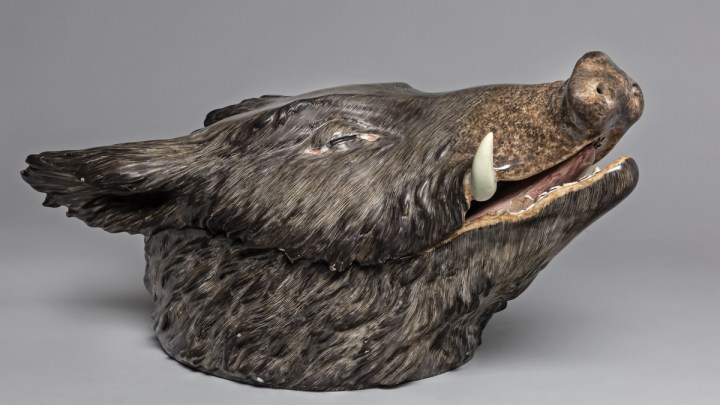
Boar’s Head Tureen, France, probably Strasbourg, ca. 1745; tin-glazed earthenware (faïence)
(Toronto: Gardiner Museum, anonymous loan; photo by Toni Hafkenscheid)
◊ ◊ ◊ ◊ ◊
Opening next month at the Gardiner Museum:
Savour: Food Culture in the Age of Enlightenment
Gardiner Museum, Toronto, 17 October 2019 — 19 January 2020
Wadsworth Atheneum Museum of Art, Hartford, CT, 29 February — 24 May 2020
Curated by Meredith Chilton
Food and dining were transformed in Europe during the age of Enlightenment by profound changes that still resonate today. What many of us eat, the way food is cooked, and how we dine continues to be influenced by radical changes that occurred in France from 1650 until the French Revolution in 1789.

Philippe Mercier, The Sense of Taste, 1744–47, oil on canvas, 132 × 154 cm (New Haven: Yale Center for British Art, Paul Mellon Collection, B1974.3.18).
Savour: Food Culture in the Age of Enlightenment explores the story of this transformation with rare objects, fascinating histories, and amusing stories. We start in the kitchen gardens at Versailles where advances in horticulture expanded the growing seasons of vegetables and fruits, making a greater selection of foods available year-round. Then we visit the steamy kitchens of cooks who advocated light, flavourful cuisine centuries before our time. Next, we discover surprisingly modern philosophies for healthy eating and vegetarianism, and join ardent foodies as they savour meals served on newly invented ceramic and silver wares, from sauceboats to tureens. Along the way, we explore how social changes were impacting eating then, just as now, as the grand formality of the past was abandoned in favour of informality and intimacy.
Savour: Food Culture in the Age of Enlightenment is organized by the Gardiner Museum and curated by Meredith Chilton, C.M., Curator Emerita. Works of art and objects from major North American museums and private collections, as well as key pieces of contemporary ceramics and knitted art, will come together in a delectable feast for the senses designed by Opera Atelier’s Resident Set Designer, Gerard Gauci.
After the Gardiner Museum, the exhibition will tour to the Wadsworth Atheneum Museum of Art, Hartford, Connecticut. The exhibition is accompanied by a cookbook titled The King’s Peas: Delectable Recipes and their Stories from the Age of Enlightenment by Meredith Chilton, with contributions by Markus Bestig, Executive Chef, The York Club, Toronto.

Children Shelling Peas, England, Chelsea, ca. 1759–70; soft-paste porcelain, enamels, and gilding
(Museum of Fine Arts, Boston)
◊ ◊ ◊ ◊ ◊
Meredith Chilton, The King’s Peas: Delectable Recipes and Their Stories from the Age of Enlightenment (Stuttgart: Arnoldsche Verlagsanstalt, 2019), 144 pages, ISBN: 978-3897905603, $50.
Food and dining were transformed in Europe during the Age of Enlightenment, and these profound changes continue to resonate today. What many of us now eat, the way our food is prepared and how we dine are the result of radical changes that occurred in France from 1650 until the French Revolution in 1789. Over thirty French and English recipes of the period are presented in this cookbook, offering readers a taste of the past. Amusing stories, culinary insights, and snippets of history outline the cultural milieu of the time. The King’s Peas is richly illustrated with pictures of paintings, books, silver, glass and ceramics to stimulate the imagination—and the appetite. You are cordially invited to take part in this delectable historical feast.
Exhibition | Cut and Paste
◊ ◊ ◊ ◊ ◊
Now on view at Edinburgh’s Modern Two; for the earlier period, see the catalogue essay by Freya Gowrley:
Cut and Paste: 400 Years of Collage
Scottish National Gallery Of Modern Art (Modern Two), Edinburgh, 29 June — 27 October 2019
 A huge range of approaches is on show, from sixteenth-century anatomical ‘flap prints’, to computer-based images; work by amateur, professional and unknown artists; collages by children and revolutionary cubist masterpieces by Pablo Picasso and Juan Gris; from nineteenth-century do-it-yourself collage kits to collage films of the 1960s. Highlights include a three-metre-long folding collage screen, purportedly made in part by Charles Dickens; a major group of Dada and Surrealist collages, by artists such as Kurt Schwitters, Joan Miró, Hannah Höch, and Max Ernst; and major postwar works by Henri Matisse, Robert Rauschenberg, and Peter Blake, including the only surviving original source photographs for Blake’s and Jann Haworth’s iconic, collaged cover for the Beatles’ album Sergeant Pepper’s Lonely Hearts Club Band.
The importance of collage as a form of protest in the 1960s and 70s will be shown in the work of feminist artists such as Carolee Schneemann, Linder, and Hannah Wilke; Punk artists, such as Jamie Reid, whose original collages for the Sex Pistols’ album and posters will feature; and the famously subversive collages of Monty Python founder Terry Gilliam. The exhibition also features the legendary library book covers which the playwright Joe Orton and his lover Kenneth Halliwell doctored with collages, and put back on Islington Library’s shelves—a move which landed them in prison for six months. In addition, the exhibition also demonstrates how collage remains important for the practice of many artists working today. Owing to the fragility of much of the work, the exhibition will not tour: it can only be seen at the Scottish National Gallery of Modern Art in Edinburgh.
Patrick Elliott, ed., with essays by Freya Gowrley and Yuval Etgar, Cut and Paste: 400 Years of Collage (Edinburgh: National Galleries of Scotland, 2019), 184 pages, ISBN: 978-1911054313, £25.
The Burlington Magazine, August 2019
The August issue of The Burlington was especially rich for the eighteenth century; apologies for not posting it much sooner, but it’s worth noting. –CH
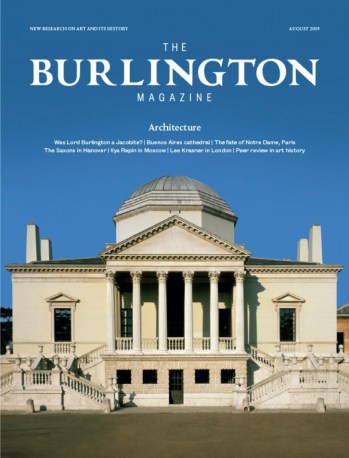
The Burlington Magazine 161 (August 2019)
 E D I T O R I A L
• “At the Yale Center for British Art,” p. 619. At the end of June Amy Meyers stepped down as Director of the Yale Center for British Art, New Haven, after seventeen years.
A R T I C L E S
• Sam Rose, “Peer Review in Art History,” pp. 621–25. A more recent development than is often realized, and historically imposed in a variety of ways, peer review is a fundamental but rarely discussed aspect of academic life. What impact does it have on publishing in art history?
• Alexander Echlin, “Was Lord Burlington a Jacobite?,” pp. 626–37. A thesis first put forward thirty years ago that Lord Burlington was a Jacobite, who used buildings and gardens to express his clandestine views, has won a measure of support. However, the biographical evidence is circumstantial and the architectural evidence is so ambiguous that it cannot sustain the argument.
• Gauvin Alexander Bailey, “Buenos Aires Cathedral in the Eighteenth Century,” pp. 638–47. Greatly altered in the early eighteenth century, the original appearance of the interior of Buenos Aires Cathedral, designed by Antonio Masella and completed by Manuel Álvarez de Rocha in 1771, is here reconstructed from newly identified visual sources, a watercolour of c.1830 and nineteenth-century photographs.
• Alexandra Gajewski and Michael Hall, “The Fate of Notre-Dame, Paris,” pp. 648–52. The first at Notre-Dame in April destroyed its largely medieval roof and the flèche designed by Violeet-le-Duc as well as badly damaging the vaults. Plans for repairs depend on an assessment of the long-term structural damage to the cathedral, despite which a five-year timetable for the restoration has been imposed by President Macron and a competition for a replacement flèche initiated.
• Giovan Battista Fidanza, “New Evidence for the ‘Barberini Apostles’ by Andrea Sacchi and Carlo Maratti,” pp. 653–59. Unpublished documents in the Barberini Archives in the Vatican Library clarify the patronage, authorship, and dating of a celebrated series of nine paintings of the Apostles commissioned from Andrea Sacchi and Carlo Maratti by Cardinals Antonio Barberini the Younger and Carlo Barberini.
R E V I E W S
• Simon Lee, Review of the exhibitions The Majesties’ Retiring Room and A Painting for a Nation: The Execution of Torrijos (Prado, 2019), pp. 673–76.
• John Bold, Review of Matthew Walker, Architects and Intellectual Culture in Post-Restoration England (Oxford University Press, 2017), pp. 688–89.
• Anthony Colantuono, Review of Claire Farago, Janis Bell and Carlo Vecce, The Fabrication of Leonardo da Vinci’s ‘Trattato della pittura’ (Brill, 2018), pp. 693–95.
• Sandra Miller, Review of Valerie Steele, ed., Pink: The History of a Punk, Pretty, Powerful Colour (Thames & Hudson, 2018), pp. 701–02.
Exhibition | George Stubbs: ‘All Done from Nature’
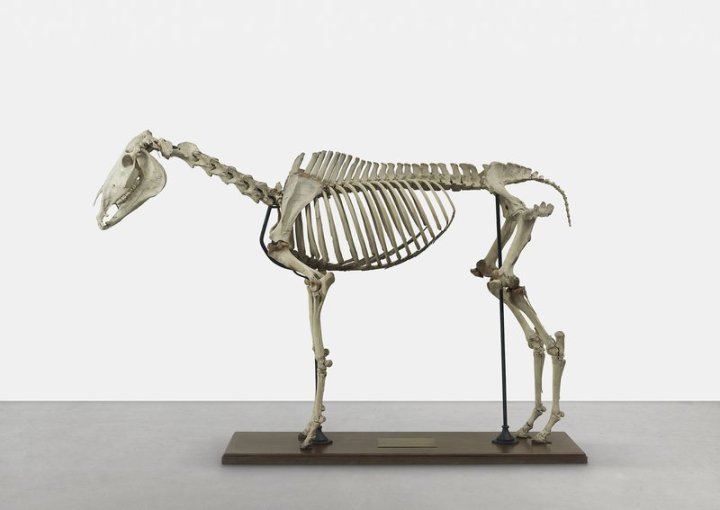
Skeleton of Eclipse (Collection of the Royal Veterinary College, University College London). Eclipse died in 1789 at the age of 25. The Veterinary College was built in 1791, with its first students enrolling in January of 1792.
◊ ◊ ◊ ◊ ◊
Opening next month at MK Gallery:
George Stubbs: ‘All Done from Nature’
MK Gallery, Milton Keynes, 12 October 2019 — 26 January 2020
Mauritshuis, The Hague, 20 February — 1 June 2020
George Stubbs: ‘All done from Nature’ presents the first significant overview of Stubbs’s work in Britain for more than 30 years and brings together 100 paintings, drawings, and publications—from the National Gallery’s Whistlejacket to pieces that have never been seen in public.
 Born in Liverpool in 1724, Stubbs was a quintessential product of the Enlightenment and embodied all of its core principles, questioning traditional authority and embracing the notion that humanity could be improved through the application of reason. Rather than trust to history and the untested example of his artistic and scientific precursors, Stubbs championed doing as a way of thinking and deployed pictorial representation as a form of knowledge and understanding. Today, he is recognised as one of the most original artists of the eighteenth century. His wide-ranging subjects included portraits, conversation pieces, and pictures of exotic and domestic animals—horses included—and his obsession with scientific exactitude has drawn comparison with the work of Leonardo da Vinci.
A major theme of the exhibition is anatomy. The show includes Stubbs’s contributions to a pioneering treatise on midwifery and his preliminary work on A Comparative Anatomical Exposition of the Structure of the Human Body with that of a Tiger and a Common Fowl. It also includes the detailed studies and drawings that led to The Anatomy of the Horse—the greatest coming together of art and science in British art—alongside the actual skeleton of the legendary racehorse Eclipse, which Stubbs depicted on several occasions.
A version of the show will tour to the Mauritshuis in The Hague where it will be the first-ever exhibition on the artist in the Netherlands. The exhibition is accompanied by a fully illustrated catalogue with major contributions from Alison Wright, Jenny Uglow, Martin Myrone, Martin Postle, and Nicholas Clee as well as new and existing poetry by Roger Robinson.
Anthony Spira, Martin Postle, and Paul Bonaventura, George Stubbs: ‘all done from Nature’ (London: Paul Holberton Publishing, 2019), 224 pages, ISBN: 978-1911300687, £35.
More information on the skeleton of Eclipse is available from this article by Mark Brown for The Guardian (6 July 2019).
Print Quarterly, September 2019

James Gillray, New Morality; – or – The Promis’d Installment of the High-Priest of the Theophilanthropes, with the Homage of Leviathan and his Suite, 1798, hand-colored etching, 8 × 24 inches (New Haven: Yale Center for British Art, Paul Mellon Collection, B1981.25.1001).
◊ ◊ ◊ ◊ ◊
The eighteenth century in the current issue of Print Quarterly:
Print Quarterly 36.3 (September 2019)
A R T I C L E S
Allison M. Stagg, “William Cobbett, James Gillray and the Market for Caricatures in 1790s Philadelphia,” pp. 263–74.
In the decades immediate following the American Revolution (1775–83), caricature prints were imported from London to cities along the east coast of North America. Evidence of a transatlantic transfer of British satirical imagery can be found in the numerous advertisements published in American newspapers from this period. Despite the frequency with which caricatures are mentioned in newspapers, few details can readily be discerned from them. The advertisements primarily reference the general arrival of collections of British caricature prints, usually as an addendum to other imported items such as books, stationery and even clocks, and provide little to no mention as to what specific caricatures crossed the Atlantic (263) . . . Details found in documents dating from the last decade of the eighteenth century, however, allow for a more thorough examination of the availability of and interest in imported and American caricatures in Philadelphia in the late 1790s. The primary source is an account book in the collection of the American Antiquarian Society in Worcester, MA, of the famous British radical, polemicist and publisher William Cobbett (1763–1835), who took refuge in American in 1793 (264).
N O T E S A N D R E V I E W S
 Truusje Goedings, Review of Wolf Eiermann, Claudia Steinhardt-Hirsch and Eckhard Leuschner, Prachtvoll illuminirt: Das Handkolorit in der Druckgrafik, 1493–1870 (Hirmer Verlag, 2018), pp. 304–06.
Neglected for a long time, the hand-colouring of prints, book illustrations and maps has been the subject of serious research during the last three decades, resulting in major exhibitions with comprehensive catalogues. . . [The present] catalogue, edited by Wolf Eiermann . . . is another effort to make the picture of 400 year of handcolouring more complete . . . The Sammlung Frank, a private collection in Stuttgart focused on German art and formed in the previous century, served as the main source, supplying about 110 of the 134 catalogued items (304) . . . The period from c. 1760 to 1880 is well represented with about one hundred items, mainly topographical, but also on costumes and natural history, including a rare example of Christian Gottlieb Ludwig’s Ectypa vegetabilium . . . / Nach der Nature verfertigte Abdrucke der Gewachse (nature-printed prints of plants; Halle and Leipzig, 1760–64) with 200 nature prints in contemporary colouring” (306).
Peter Fuhring, Review of Thomas Wilke, Innendekoration: Graphische Vorlagen und theoretische Vorgaben für die wandfeste Dekoration von Appartements im 17. und 18. Jahrhundert in Frankreich, 2 volumes (Scaneg Verlag, 2016), pp. 308–10.
The study of prints related to the decoration of secular interiors in France from the seventeenth and eighteenth centuries, in association with theoretical guidelines, . . . reveals an ambition that is difficult to fulfill. . . So far not a single catalogue or study encompasses the entire French print production of wall decorations, mantelpieces and ceilings made during both centuries. . . Further research is necessary to complete the still lacunar state of our knowledge. This is what Wilkie strives to do. His study is composed of two parts: the first volume offers a presentation of the issues as set out in the title, while the second consists of a catalogue of prints that form the basis of the author’s demonstration (308).
Véronique Meyer, Review of Katie Scott, Becoming Property: Art, Theory, and Law in Early Modern France (Yale University Press, 2018), pp. 313–15.
[Scott’s] recent book . . . examines the relationship between intellectual property and the visual arts in France from the sixteenth century to the beginning of the nineteenth . . . It traces the history of this relationship, highlighting key moments with exemplary case studies as well as citing regulations and legal texts, (313) and examines the role of the parties involved, including booksellers, publishers, engravers, draughtsmen and authors. Although the sixteenth and seventeenth centuries occupy and important place in the book, which shows how the definition of privilege and copyright evolved over the years, it is above all France of the Enlightenment and Revolution that lies at the heart of this study (314). . . [It] is a must for all who are interested in the history of printmaking, the decorative arts and artistic theories and institutions such as the Académie Royale (315).
David Bindman, Review of Cynthia Roman, ed., Hogarth’s Legacy (Yale University Press, 2016), pp. 315–16.
Hogarth’s enormous and long-lasting influence on art and popular imagery is the subject of a series of essays, largely by scholars of eighteenth-century art, including . . . Douglas Fordham, Dominic Hardy, Brian Maidment, Patricia Mainardi, Ronald Paulson, Mark Salber Philips, and Michael Printy. . . Collections of essays inevitably fall somewhere on the spectrum between the tightly focused, based on a close conversation between the authors, and the loose and baggy, in which the connections between the essays are more informal. Although the quality of the essays is uniformly excellent, this volume tends more toward the baggy . . . The main and entirely commendable purpose of the volume seems to have been to make scholarly use and draw further attention to the relatively little-known and underused, and in some areas quite spectacular, collections of Hogarth engravings and late eighteenth-century caricature in the Walpole Library (315).
Roger Paas, Review of Josef Biller, Calendaria Bambergensia: Bamberger Einblattkalender des 15. bis 19. Jahrhunderts von der Inkunabelzeit bis zur Säkularisation, 2 volumes (Anton H. Konrad Verlag, 2018), pp. 317–19.
Biller has dedicated over four decades to the collecting and studying of broadside (316) calendars published for the bishopric of Bamberg, and the results of his in-depth research have now been published in a detailed and richly illustrated two-volume catalogue (318).
Daniel Godfrey, Review of Anke Fröhlich-Schauseil, Schenau (1737–1806): Monografie und Werkverzeichnis der Gemälde, Handzeichnungen und Druckgrafik von Johann Eleazar Zeißig, gen. Schenau (Michael Imhof Verlag, 2018), pp. 319–23.
The son of a damask weaver from Großschönau in Saxony, Schenau fled the outbreak of the Seven Years’ War in 1756 to Paris. There he Frenchified his name and established a reputation as an artist of ‘society paintings’ focused on liaisons between the sexes, coiffure and the texture of material. The mentorship of Johann Georg Wille (1715–1808), engraver, print publisher and art dealer, must have motivated Schenau to execute a set of twelve etchings in 1765, six of children acting as adults and six of heads . . . These were to remain Schenau’s only autograph prints (319) . . . Yet, Schenau’s career developed in symbiosis with the print.
Mark Bills, Review of John Ford, Rudolph Ackermann and the Regency World (Warnham Books, 2018), pp. 323–25.
Although Ackermann belongs to and epitomizes the Regency Period (1788–1830), one cannot help but think that he would be a very useful figure in the art and design world of today (323) . . . John Ford has absorbed an enormous body of material and given us a fascinating chronological account of Ackermann as well as adding important new research and insights (324).
P U B L I C A T I O N S R E C E I V E D
• Joachim Jacoby, Guillaume Jean Constantin (1755–1816): A Drawings Dealer in Paris (Ad Ilissum for the Fondation Custodia, 2018), p. 339.
• Peter Stoll, Französische Buchillustration des 18. Jahrhunderts in der Oettingen-Wallersteinschen Bibliothek (Universität Augsburg Bibliothek, 2018), p. 339.
• Thora Brylowe, Romantic Art in Practice: Cultural Work and the Sister Arts, 1760–1820 (Cambridge University Press, 2019), p. 339.
• Helen Rosslyn, A Buyer’s Guide to Prints (The Royal Academy of Arts in association with the London Original Print Fair, 2018), p. 342.
Exhibition | Lansyer, Canaletto, & Piranesi
Now on view at the Lansyer House Museum:
Lansyer, Canaletto, and Piranesi: Images of Italy
Maison-Musée Lansyer, Loches, 1 May — 11 November 2019
 Après plus d’un an de travaux, la Maison-Musée Lansyer de Loches redevient le théâtre d’une exposition d’envergure mettant en évidence les richesses de ses collections. Du 1er mai au 11 novembre 2019, l‘exposition Lansyer, Canaletto & Piranèse : images d’Italie invite le visiteur au voyage en Italie, à Rome et à Venise, dans les pas du peintre paysagiste Emmanuel Lansyer (1835–1893). Ce circuit au temps du chemin de fer conduit sur les lieux de travail de l’artiste, dans la Rome Éternelle et au cœur de la Sérénissime Venise. Lansyer livre ses impressions sur ces deux villes, mais aussi les difficultés qu’il rencontre pour les représenter. Ainsi, les toiles de l’artiste font visiter la campagne romaine et les quartiers de Venise.
« Portraitiste de ville », Lansyer s’inscrit dans les pas de deux maîtres italiens du siècle précédent : Piranèse et Canaletto. Lansyer acquiert des séries exceptionnelles de gravures à l’eau-forte de ces grands védutistes qui célèbrent la grandeur de Rome et de Venise. Cette collection lochoise constitue l’un des ensembles les plus complets à l’échelle mondiale. Ces œuvres sont le résultat d’un travail artistique d’une extrême précision, dont on pourra admirer les détails, du tracé architectural de Piranèse au geste léger de Canaletto.
Enfin, Lansyer convie à un voyage au temps de la photographie naissante. Cet art en plein essor offre une autre image d’Italie, celle de son peuple et de ses richesses patrimoniales. Les photographies de Rome donnent à voir de très beaux points de vue sur la basilique Saint-Pierre et le forum romain. Celles de Venise s’intéressent aux lieux les plus emblématiques de la reine de la lagune : la place Saint-Marc, le Grand Canal et ses palais. On chemine également à travers des ruelles étroites et autour des puits dans lesquels s’approvisionnent Vénitiens et Vénitiennes en habits traditionnels. Autant de souvenirs de voyage et d’outils de travail pour l’artiste.Au total, une centaine d’œuvres, tableaux, photographies et gravures de la collection d’Emmanuel Lansyer, sont dévoilés au public de manière inédite. Une collection d’une richesse exceptionnelle, léguée à la Ville de Loches par l’artiste, pour l’agrément de tous. Guide de voyage en poche, montez dans le train et devenez un touriste du XIXe siècle le temps de la visite de l’exposition…
The catalogue is available from In Fine éditions d’art:
Lansyer, Canaletto & Piranèse : Images d’Italie (Paris: In Fine éditions d’art, 2019), 112 pages, ISBN: 978-2902302192, 18€.
Sous la direction de Véronique Lourme, responsable du Service Patrimoine de la Ville de Loches; Gilles Bertrand, professeur d’histoire moderne à l’Université de Grenoble; Manuel Royo, professeur d’archéologie et d’histoire de l’art à l’Université François-Rabelais de Tours; Annie Gilet, conservateur en chef honoraire du patrimoine; et Benjamin Bulte, étudiant en histoire de l’art, Université François-Rabelais de Tours.
S O M M A I R E
• Emmanuel Lansyer : un peintre paysagiste en Italie
Le Voyage en Italie au XIXe Siècle
• Lansyer et la tradition du voyage en Italie
• Les conditions et le temps du voyage
Le Voyage à Rome
• Lansyer à Rome ou l’histoire d’une déception
• Les vues de Rome par Piranèse
Le Voyage à Venise
• Le regard de Lansyer sur la Sérénissime
• Canaletto, graveur à l’eau-forte
Le Portrait de Ville
• Résonances entre Canaletto, Piranèse et Lansyer : trois portraitistes de villes
• La photographie : un nouvel outil de travail pour le portrait de ville
• Un voyage dans le temps, dans les pas d’un artiste collectionneur
Catalogue des Oeuvres
• La collection de peintures
• La collection de gravures
• La collection de photographies
Bibliographie
Exhibition | Wild and Majestic: Romantic Visions of Scotland

John Knox, Landscape with Tourists at Loch Katrine, 1815, oil on canvas
(Edinburgh: National Galleries of Scotland)
◊ ◊ ◊ ◊ ◊
From the press release (25 June 2019) for the exhibition:
Wild and Majestic: Romantic Visions of Scotland
National Museum of Scotland, Edinburgh, 26 June — 10 November 2019
Curated by Patrick Watt
A major exhibition at the National Museum of Scotland this summer tells the fascinating story of how tartan, bagpipes, and rugged, wild landscapes became established as enduring, internationally recognised symbols of Scottish identity and how Scotland became established in the popular imagination as a land of wilderness, heroism, and history. Wild and Majestic: Romantic Visions of Scotland spans the period from the final defeat of the Jacobites at the Battle of Culloden in 1746 to the death of Queen Victoria in 1901. The exhibition explores the efforts made to preserve and revive Highland traditions in the wake of post-Jacobite persecution, depopulation, and rapid socio-economic change. It shows how Scotland’s relationship with the European Romantic movement transformed external perceptions of the Highlands and was central to the birth of tourism in Scotland. These developments would in turn influence the relationship between the Hanoverian royal family and Scotland, particularly George IV and, later, Queen Victoria.

Pompeo Battoni, Portrait of Colonel William Gordon of Fyvie, 1766 (National Trust for Scotland, Fyvie Castle).
Over 300 objects will be on display, drawn from the collections of National Museums Scotland and 38 lenders across the UK. The objects tell a story with a stellar cast, including Queen Victoria and Prince Albert; King George IV; Sir Walter Scott; Robert Burns; J.M.W. Turner; Henry Raeburn; Felix Mendelssohn; William and Dorothy Wordsworth; Ludwig Van Beethoven; and Lord Byron, whose 1807 poem Lachin y Gair (Lochnagar) is quoted in the exhibition’s title. Prominent Highlanders featured include the Ossian author-translator James Macpherson, the soldier-historian David Stewart of Garth, the clan chief Mac Mhic Alasdair (Alasdair Macdonnel of Glengarry), and the folklorists Alasdair Gilleasbaig MacGilleMhìcheil (Alexander Carmichael) and Iain Òg Ìle (John Campbell of Islay).
Dr Patrick Watt, exhibition curator, said: “This is a contested, complex history, and also a fascinating one. There are competing claims, still, over the extent to which those symbols of Scotland we see today are Romantic inventions or authentic expressions of an ancient cultural identity. Using material evidence, we will examine the origins and development of the dress, music, and art which made up the Highland image. We will show how cultural traditions were preserved, idealised, and reshaped to suit contemporary tastes against a background of political agendas, and economic and social change.”
Through rich displays reflecting the colour and flamboyance of the Highland image, visitors will encounter key developments such as the Ossian controversy, the overturning of the ban on Highland dress, the pageantry around King George IV’s visit to Edinburgh in 1822, the Highland tourism boom, and the creation of a Romantic idyll for Queen Victoria at Balmoral.
National Museums Scotland has partnered with Sabhal Mòr Ostaig College on Skye, part of the University of the Highlands and Islands (UHI), on the production of content for the major summer exhibition. Throughout the exhibition, the influence of Gaelic language and culture, and the impact of these developments on it will be shown through objects, text, and film. The primary exhibition text will be presented in both English and Gaelic.
The Romantic period undoubtedly coloured perceptions, both at the time and to this day to the extent that the popular images of Highland culture are sometimes dismissed as a 19th-century fabrication. However, the exhibition will stress the deep historical roots underpinning the Romantic image. The heritage of clan tartans is introduced in portraiture in the extravagant dress of the Laird of Grant’s piper and champion painted by Richard Waitt in 1714. The bagpiping tradition is introduced by oldest known Scottish chanter, which belonged to Iain Dall Mackay, a piper and composer born on Skye in 1656.
Following the final defeat of the Jacobites in 1746 at the Battle of Culloden, there were reprisals across the Highlands. The power of the Clans was dismantled, male civilians were banned from wearing Highland dress, and Gaelic culture was disparaged. The ban on tartan did not apply to those men who enlisted in the newly raised Highland Regiments of the British Army. The heroic image of the tartan-clad Highland soldier went on to become an icon of the military power of the British Empire, and the ideal of the heroic Highland warrior would recur throughout the nineteenth century.
In the 1760s the literary culture of the Scottish Highlands and Islands was introduced to the world. Highland schoolmaster and poet, James Macpherson, claimed to have researched, collected and translated the fragments of ancient poetry of Ossian, a legendary 3rd-century Gaelic bard. Despite a raging controversy over its authenticity, MacPherson’s work was translated into multiple languages and admired by many influential European writers, artists, and composers. A first edition volume will be shown, as well as artwork inspired by Ossian, and the Red Book of Clanranald, one of the Gaelic manuscript sources Macpherson consulted. Robert Burns travelled the Highlands, looking for poetic inspiration. His publisher, George Thomson, commissioned major European composers to set Scottish songs to music, including a version of Burns’ Highland Harry scored in the original hand of Ludwig Van Beethoven.
From the late 18th century, visitors were drawn to Scotland in increasing numbers, attracted to locations depicted in romantic paintings, prints, and literature. Many artists, writers, and musicians visited, often on personal pilgrimages inspired by the lasting influence of Ossian, or the fame of Burns, Sir Walter Scott and others. Works by major figures, including Wordsworth, Turner and Mendelssohn—all of whom met with Scott during their travels—inspired more people to seek out the places evoked in music, art, and literature for themselves. Dorothy Wordsworth’s travel journal, Mendelssohn’s sketchbook and his original score of the Hebrides Overture, and a silver urn gifted from Byron to Scott after the two literary giants met in 1815 all feature in the exhibition.

Edwin Landseer, The Monarch of the Glen, ca. 1851 (Edinburgh: National Galleries of Scotland).
Seeing change all around them, influential Highlanders made efforts to preserve elements of traditional Gaelic culture, even as they promoted a new rural economy whose human impact we now know as the Highland Clearances. The exhibition will look at the early Highland societies, and their material legacies, including the standardisation of the Great Highland Bagpipe which we know today, and the codification of clan tartans, through the first gathered samples dating to 1815. The Highland Society of London championed the image of the Highland soldier, commemorating military exploits through the commissioning of medals and trophies, and successfully campaigned for the repeal of the legal ban on Highland dress in 1782. The Repeal of the Act of Proscription was issued in both English and Gaelic, and the Gaelic version will be shown.
With the Jacobite cause extinguished as a political and military threat, the Hanoverian Royalty began to embrace and champion their own Stuart lineage, and gestures were made towards healing the divisions of the previous century. This was shown most vividly in the Highland pageantry associated with the events stage-managed by Sir Walter Scott during King George IV’s visit to Edinburgh in 1822. A parade of ceremonial costume will give a flavour of this spectacular, if controversial, event along with contemporary accounts and the tartans and weaponry which Sir Walter Scott encouraged people to wear for the occasion.
It was the young Queen Victoria who took this royal fascination to new heights. Following a series of royal visits to the Highlands, the Queen and Prince Albert acquired the Balmoral estate. Later, with the death of Prince Albert, the estate became a Highland retreat from the realities of court and government for Queen Victoria. Balmoral helped to ensure that the ideal of the Scottish Highlands which emerged from the culture and politics of the late 18th century would endure, even as fashions and attitudes to history changed. Among the objects on display will be a tartan dress worn by a young Victoria, a brooch she gifted to famed piper John Ban Mackenzie and a mourning pin she had made to commemorate her Highland servant, friend, and confidant John Brown.
The exhibition is sponsored by Baillie Gifford Investment Managers. It will be supported by a publication and programme of public events. Sarah Pittman, Sponsorship Manager at Baillie Gifford said: “We are delighted to continue our successful association with National Museums Scotland by supporting Wild and Majestic: Romantic Visions of Scotland. The exhibition promises a unique and beautiful array of objects which together will tell a fascinating story of how the Romantic movement drew on the real traditions and history of Highland culture to form an enduring international image of Scotland.”
Wild and Majestic: Romantic Visions of Scotland is part of Edinburgh Art Festival, taking place between 25 July and 25 August 2019. edinburghartfestival.com @EdArtFest #EdArtFest.
Patrick Watt and Rosie Waine, Wild and Majestic: Romantic Visions of Scotland (Edinburgh: National Museum of Scotland, 2019), 80 pages, ISBN: 978-1910682241, £10.
Exhibition | Angelika Kauffmann: Unknown Treasures
On view last year in Wörlitz at Louise of Brandenburg-Schwedt’s Grey House, the exhibition is now split between two Austrian venues:
Angelika Kauffmann: Unknown Treasures from Vorarlberg Private Collections
Haus der Fürstin, Wörlitz, 8 July — 21 October 2018
Vorarlberg Museum, Bregenz, 15 June — 6 October 2019 [second venue, part 1]
Angelika Kauffmann Museum, Schwarzenberg, 16 June — 3 November 2019 [second venue, part 2]
Curated by Bettina Baumgärtel

Angelika Kauffmann, Portrait of Louise Herzogin von Anhalt-Dessau, 1796, oil on canvas (Kulturstiftung Dessau-Wörlitz).
Ist erstmals eine umfangreiche Ausstellung zur schweizerisch-österreichischen Malerin Angelika Kauffmann (1741–1807) im Haus der Fürstin in Wörlitz zu sehen. Die Präsentation zahlreicher Kunstwerke wie Ölgemälde, Zeichnungen, Druckgraphiken, Skulpturen und schriftlicher Dokumente verdeutlicht die Vielfalt ihres künstlerischen Wirkens und Lebens. Die Ausstellung ist Ergebnis der Kooperation zwischen zwei österreichischen Privatsammlungen aus Vorarlberg, dem UNESCO-Welterbe Gartenreich Dessau-Wörlitz in Sachsen-Anhalt, dem Bregenzer vorarlberg museum, dem Angelika Kauffmann Museum in Schwarzenberg im Bregenzerwald und dem Angelika Kauffmann Research Project (AKRP).
1741 im schweizerischen Chur geboren, wurde Angelika Kauffmann in Italien und in Vorarlberg im Bregenzerwald ausgebildet. Bereits in jungen Jahren knüpfte sie europaweit Kontakte bis in die höchsten Kreise und unterhielt zuerst ein erfolgreiches Atelier in London, später in Rom, wo sie ebenso einen vielbesuchten Salon führte.
Das Herausragende der Schau ist die besondere Beziehung der Künstlerin zum Gartenreich Dessau-Wörlitz und die Seelenverwandtschaft mit Fürstin Louise von Anhalt-Dessau (1750–1811). Diese begegnete der Malerin erstmals während ihrer Reise nach England mit Leopold III. Friedrich Franz von Anhalt-Dessau (1740–1817) im Jahr 1775. Im Schloss Luisium kam ihre Verehrung für Angelika Kauffmann durch die Präsentation zahlreicher Graphiken und eines bedeutenden Gemäldes bestens zum Ausdruck. Während die Kulturstiftung heute noch über das von Angelika Kauffmann gemalte Porträt der Fürstin verfügt, wurde das Bild Amor und Psyche vor rund 100 Jahren verkauft. Für die Dauer der Ausstellung kehrt dieses Gemälde aus dem Kunsthaus Zürich in das Gartenreich zurück.
 Eine Auswahl von hochkarätigen Leihgaben aus öffentlichen und weiteren privaten Sammlungen vertiefen die Auseinandersetzung mit Angelika Kauffmann. Nach der “Erstausgabe” der Ausstellung im Gartenreich wird sie 2019 bei den PartnerInnen des vorarlberg museums in Bregenz und des Angelika Kauffmann Museums in Schwarzenberg zu sehen sein. Kuratiert wird die Ausstellung von der international renommierten Kunsthistorikerin Dr. Bettina Baumgärtel. Sie ist Leiterin des Angelika Kauffmann Research Project (AKRP) sowie der Gemäldesammlung im Museum Kunstpalast Düsseldorf.
Gleichzeitig und gleichsam als Kontrapunkt zur Angelika-Kauffmann-Ausstellung wird vor dem Haus der Fürstin im Wörlitzer Kirchhof die von dem zeitgenössischen österreichischen Künstler Peter Baldinger gestaltete Garten-Installation Amor sucht Psyche präsentiert, die sich auf eines der Hauptwerke der Ausstellung bezieht. Ein weiterer Teil der Intervention des Künstlers ist im Park Luisium zu sehen.
Bettina Baumgärtel, Angelika Kauffmann: Unbekannte Schätze aus Vorarlberger Privatsammlungen (Munich: Hirmer Verlag, 2018), 304 pages, ISBN: 978-3777430843, 40€.
Exhibition | George IV: Art & Spectacle
Press release for the exhibition, opening this fall:
George IV: Art & Spectacle
The Queen’s Gallery, Buckingham Palace, London, 15 November 2019 — 4 May 2020

Sir Thomas Lawrence, Coronation Portrait of George IV, 1821, oil on canvas, 295 × 205 cm (Royal Collection Trust, RCIN 405918).
George IV (1762–1830) was the collector and commissioner of many of the finest works of art in the Royal Collection. He turned Buckingham House into a Palace, radically remodelled Windsor Castle inside and out, and built the Royal Pavilion at Brighton, an oriental-style pleasure palace by the sea. In London, his architectural vision extended to the laying out of Regent Street and Regent’s Park.
From 1811, George ruled as Regent, due to the decline in the mental health of his father, George III. By the time he came to the throne in 1820, aged 57, he was intensely disliked by a nation tired of his extravagant lifestyle. Today he is perhaps best known as the rotund, gout-ridden, drunken buffoon lampooned by the satirists of the day for his acrimonious marriage to Princess Caroline of Brunswick and his many mistresses.
Set against the backdrop of the French Revolution and Napoleonic Wars, and a period of unprecedented global exploration, George IV: Art & Spectacle considers the Monarch’s public image, taste for the theatrical and exotic, admiration of French style and all-consuming passion for collecting. It will present George as a man of extreme contrasts: on the one hand, a recklessly profligate showman, and on the other, a connoisseur with intellectual interests whose endless acquisitions made him one of the most important figures in the formation of the Royal Collection.
As Prince of Wales, George lived at Carlton House on London’s Pall Mall. Within ten years of taking possession of his residence, he had run up debts of around £400,000 (around £31 million today). He bought the best works available by the 17th-century Dutch and Flemish painters whose reputations had been established in French aristocratic circles. The walls of Carlton House were hung with luminous works by Aelbert Cuyp, the lively interiors of Adriaen van Ostade, intimate domestic scenes by Jan Steen, and David Teniers’s depictions of village life, which appealed to George’s taste for narrative subject matter. In 1811, George purchased Rembrandt’s The Shipbuilder and his Wife, 1633, for 5,000 guineas, the most expensive painting he ever acquired.
Upheavals on the Continent following the French Revolution flooded the market with works of art that had belonged to the French aristocracy. With the help of agents and friends, George acquired the finest examples of 18th-century French decorative arts, including bronzes and furniture mounted with pietra dura panels by André-Charles Boulle. He had a particular passion for Sèvres porcelain. His most important acquisition of works by the French factory was the Louis XVI service, 1783–92, the most costly service ever created by Sèvres and so extensive that it was delivered to George in batches over 23 years.
George IV’s coronation at Westminster Abbey was the greatest theatrical production of his life and came at a cost of £240,000. He personally oversaw the designs for his elaborate coronation robes and the Diamond Diadem, made for the occasion by the goldsmiths Rundell, Bridge & Rundell. At the coronation banquet in Westminster Hall, the great Shield of Achilles, 1821, designed by John Flaxman, was among many pieces of spectacular dining and buffet silver-gilt on display from the Grand Service.
The King was among the leading patrons of British artists of the day, favouring the work of Sir Thomas Lawrence, Sir Joshua Reynolds and Richard Cosway. In 1784, he commissioned Sir Thomas Gainsborough to paint his three eldest sisters, the Princesses Charlotte, Augusta and Elizabeth, and after the artist’s death purchased Gainsborough’s only surviving mythological painting, Diana and Actaeon, c.1785–88. George’s favourite pastimes were equestrian, as captured in George IV, when Prince of Wales, 1791, an elegant portrait by George Stubbs. The everyday subject matter of the painter David Wilkie appealed to the King as modern-day versions of the 17th-century Dutch genre paintings he so admired. In a vibrant sketch, Wilkie recorded the King’s arrival at the Palace of Holyroodhouse in 1822, the first visit to Scotland by a reigning monarch since Charles I.
George IV positioned himself at the forefront of the European political stage, in direct competition with Napoleon Bonaparte. Following the French Emperor’s abdication in April 1814, George invited several of the allied leaders and commanders to London, and commissioned Britain’s pre-eminent portraitist, Sir Thomas Lawrence, to paint them. After Napoleon’s final defeat at Waterloo, Lawrence travelled to the Congress of Peace at Aix-la-Chapelle, then to Vienna and Rome to complete the series. The paintings were later installed in the purpose-built Waterloo Chamber at Windsor Castle. In George’s mind he was one of this cast of heroes, as responsible for the victory over Napoleon as the Duke of Wellington.
As Prince Regent or Monarch, George never travelled beyond Europe, but amassed a large collection of artefacts from the wider world. Between 1800 and 1830, he assembled the most important group of Asian porcelain in Britain. To harmonise with the gilded interiors of his residences, these pieces were augmented by elaborate gilt-bronze mounts—converting a simple jar into an incense burner, candelabrum, or even a clock. His taste for the oriental found its greatest expression in the Royal Pavilion at Brighton, designed by John Nash in 1815–33.
Many of the finest non-Western pieces in George’s collection were received as diplomatic gifts, among them a red and yellow feather cape (‘ahu’ula) from King Kamehameha II and Queen Kamamalu of the Sandwich Islands (now Hawaii), and a First Nations coat of caribou skin. His collection of arms and armour covered almost every part of the world, from a Maori club brought from Hawaii by Captain Cook’s ship Resolution, to a Persian sabre and a samurai sword.
George’s IV’s print and book collection reveals a more measured side to the Monarch in the variety of his intellectual pursuits. The books that he acquired for his Carlton House library, including a copy of Emma sent to him by Jane Austen’s publisher following the writer’s visit to the royal residence, highlight his interest in literature, geography, theology, European history, and the antique.
Despite the King’s efforts to control his image, satirical artists of the day mocked him mercilessly in widely circulated prints. The caricatures of Thomas Rowlandson, John Doyle, and Robert Seymour share the recurring themes of George’s excesses in food, fashion, and sex. Although George collected some satirical prints of himself when Prince of Wales and King, these were of the gently comic kind. At the same time, he tried to suppress the more hostile images, threatening legal action and, through his agents, bribing publishers not to criticise him or his mistresses, with little success.
Kate Heard and Kathryn Jones, George IV: Art & Spectacle, ISBN: 978-1909741607 (London: Royal Collection Trust, 2019), £30.










leave a comment