Exhibition | The Golden Age of English Painting
Press release for the exhibition:
The Golden Age of English Painting: From Reynolds to Turner
L’âge d’or de la peinture anglaise: De Reynolds à Turner
Musée du Luxembourg, Paris, 11 September 2019 — 16 February 2020
Curated by Martin Myrone and Cécile Maisonneuve
This exhibition, showing a selection of masterpieces from Tate Britain, highlights a key period in the history of painting in England, from the 1760s to around 1820, capturing the originality and diversity of the period. It takes visitors from the founding of the Royal Academy, with artists such as Reynolds and Gainsborough, to the turning point in the early 19th century, notably with Turner. The public will rediscover the great classics of British art here, all too rarely exhibited in France.
 The reign of George III was preponderant for British art, with the founding of the Royal Academy of Arts, of which Joshua Reynolds (1723–1792), was the first president at the height of his career. This period also saw Thomas Gainsborough (1727–1788) join the Academy. In their own ways, Reynolds and Gainsborough, both masters of portraiture, brought novel visual and intellectual innovations to the genre, honouring the great masters while reinventing the wheel. With signs of an artistic golden age booming, this movement was also supported by major players in trade and industry, and then by the king himself.
The exhibition tackles the confrontation of the two portrait painters, through full-length paintings and intimate studies of members of the royal family or personalities of the day. Reynolds’s intellectual ambitions contrast with Gainsborough’s pictorial ease. Redefining British art alone, they raised the next generation to new heights. A selection of major portraits by their competitors and/or followers, such as John Hopper, William Beechey, and Thomas Lawrence, recall the influence of these two precursors. The exhibition also addresses the themes of lineage, family, and home with the genre painting that gave birth to a new approach to childhood. Reynolds’s extraordinary portrait The Archers puts the concept of wilderness at the service of a heroic representation of the British ruling class, while Gainsborough, George Stubbs, and George Morland focus their attention on the picturesque, through paintings depicting everyday life, especially in rural areas.
With the political and commercial exploitation of overseas territories as the basis for artistic progress, part of the exhibition addresses the presence of Great Britain in India and the Caribbean. Another section discusses the tremendous growth of watercolour, which allowed many artists to stand out by meeting the needs of a new amateur society. The last part of the exhibition shows how British artists such as Henri Fuseli, John Martin, P.J. de Loutherbourg, and J.M.W. Turner sublimated narrative figuration, paving the way for a new conception of art as a support for the imaginary.
Amandine Rabier, L’âge d’or de la peinture anglaise (Paris: Gallimard / Réunion des musées nationaux, 2019), 56 pages, ISBN: 978-2072859595, 10€.
Exhibition | The Torlonia Marbles
From the Fondazione Torlonia . . . (In 1866 the Torlonia family bought the Villa Albani and its collection):
The Torlonia Marbles: Collecting Masterpieces
Musei Capitolini at Palazzo Caffarelli, Rome, 25 March 2020 — 10 January 2021
Curated by Carlo Gasparri and Salvatore Settis
From 25 March 2020 to 10 January 2021, ninety-six marbles from the Torlonia Collection will be on view to the public at a major show in Rome, in the new exhibition venue of the Musei Capitolini at Palazzo Caffarelli. The exhibition The Torlonia Marbles: Collecting Masterpieces is the first step of the agreement signed the 15th of March 2016 between the Ministry for the Cultural Heritage Activities and Tourism and the Torlonia Foundation, and is a result of the institutional agreement signed by the Directorate General for Archaeology, Fine Arts and Landscape and the Special Superintendency of Rome with the Torlonia Foundation itself. The scientific project for enhancing the collection is entrusted to Salvatore Settis, who is curating the exhibition with Carlo Gasparri; both are archaeologists and academics of the Accademia dei Lincei. The exhibition is organized by Electa, publisher of the catalog. The sculptures selected have been restored thanks to the contribution of Bvlgari.
This will be the opportunity to inaugurate the new prestigious exhibition venue in Roma Capitale of the Musei Capitolini at Palazzo Caffarelli. The choice of the location was dictated by the intention to focus the exhibition on the history of collecting. In this respect, the history of the Torlonia Museum at the Lungara (founded by Prince Alessandro Torlonia in 1875), with its 620 catalogued works of art, appears of outstanding importance. This collection is the result of a long series of acquisitions and some significant shift of sculptures between the various residences of the family. We can even say that the Torlonia Marbles constitute a collection of collections or rather a highly representative and privileged cross-section of the history of the collecting of antiquities in Rome from the 15th to the 19th centuries. The items on display are not only outstanding examples of ancient sculpture (busts, reliefs, statues, sarcophagi, and decorative elements), but also a reflection of a cultural process—the beginnings of the collecting of antiquities and the crucially important transition from the collection to the Museum, a process where Rome and Italy have had an indisputable primacy. In this way the exhibition traces the formation of the Torlonia Collection. The last of its five sections eloquently relates to the adjacent exedra of bronzes and the statue of Marcus Aurelius in the Musei Capitolini, bringing out the ties between the beginnings of private collecting of antiquities and the significance of the donation of the Lateran bronzes to the city of Rome by Sixtus IV in 1471.
The project to organize the exhibition of the Torlonia Collection in the renovated spaces of the new venue of the Musei Capitolini at Palazzo Caffarelli, restored to life by David Chipperfield Architects Milan. The March 2020 event is the first stage of a traveling exhibition, for which agreements are in progress with major international museums and which will conclude with the identification of permanent exhibition spaces for the opening of a new Torlonia Museum.
Also see the article by Elisabetta Povoledo from The New York Times (28 October 2019).
Exhibition | Canova and Thorvaldsen

Antonio Canova, The Three Graces, 1813–16
(St. Petersburg: State Hermitage Museum)
◊ ◊ ◊ ◊ ◊
From the press release (via Art Daily) for the exhibition:
Canova and Thorvaldsen: The Birth of Modern Sculpture
The Gallerie d’Italia—Piazza Scala, Milan, 25 October 2019 — 15 March 2020
Curated by Stefano Grandesso and Fernando Mazzocca
The Gallerie d’Italia—Piazza Scala, Intesa Sanpaolo’s museum in Milan, presents Canova and Thorvaldsen: The Birth of Modern Sculpture, on display from 25 October 2019 to 15 March 2020. The exhibition tells the story of the two great sculptors, Italian Antonio Canova (1757–1822) and Danish Bertel Thorvaldsen (1770–1844), focusing on their rivalry and how they transformed the very idea of sculpture and its techniques to create works of art that inspired their contemporaries and generations of artists that followed. Italy played a central role to both sculptors’ lives, and careers and the exhibition brings over 150 works together from across Italy and further afield to Milan with key works from the Intesa Sanpaolo collection to be shown together for the first time.
 The city of Rome was particularly important to both artists. Canova arrived in 1781 and remained in the city until his death in 1822, while Thorvaldsen settled in the city in 1797, spending the next forty years there. It was in Rome that the two great masters began engaging in one of the most famous and fruitful instances of artistic competition in history, interpreting identical themes and subjects to create a number of masterpieces: classical mythological works, such as Psyche Revived by Cupid’s Kiss, Venus, Paride, Hebe, and The Three Graces—which embodied some of life’s great themes, from the brevity of youth, the enchantment of beauty, to temptation and heartbreak. Canova and Thorvaldsen brings together the fruits of this historic competition and ongoing rivalry for the first time, including Canova’s celebrated Graces from the State Hermitage Museum alongside Thorvaldsen’s Cupid and The Graces from the Thorvaldsen Museum, offering visitors the unique opportunity to compare each of these masters’ approach and style.
Both Canova and Thorvaldsen were celebrated by their contemporaries and by critics of the era for their appreciation for the classical world and ability to reinterpret classical themes through the lens of the modern day. Canova was seen as a revolutionary artist in Italy and abroad who gave sculpture precedence over all other forms of art by confronting ancient works and reinterpreting them for a contemporary audience. Keeping a close eye on the work and strategy of his rival, Thorvaldsen was inspired by a stricter and more conservative adherence to classical norms, beginning a new period of Nordic art inspired by Mediterranean civilisations.
 Both artists not only revolutionised an approach to classical ideals in sculpture but also advanced new techniques. Each established large studios the size of complex workshops with numerous colleagues, and students and were able to break free from the constraints that clients typically placed on sculpture due to the high costs of marble or bronze. Thanks to the technical innovations like the use of preparatory plaster models, introduced by Canova and used on a large scale by Thorvaldsen the sculptors had—for the very first time—the freedom to express their own poetic vision through statues designed without being commissioned.
The unprecedented pairing of these two great sculptors is made possible through Intesa Sanpaolo’s partnerships with the Thorvaldsen Museum in Copenhagen and the State Hermitage Museum in St. Petersburg, as well as the contribution of major works loaned by museums and private collections in Italy and abroad including the Vatican Library, the Uffizi Galleries in Florence, the J. Paul Getty Museum in Los Angeles, the Museo Nacional del Prado in Madrid, the Pinacoteca di Brera gallery and Pinacoteca gallery of the Ambrosian Library in Milan, the Metropolitan Museum in New York, the Museo e Gypsotheca Antonio Canova in Possagno, the National Gallery of Ancient Art in Rome, and the Gallerie dell’Accademia in Venice.
Stefano Grandesso and Fernando Mazzocca, Canova e Thorvaldsen: La nascita della scultura moderna (Milan: Skira, 2019), 408 pages, ISBN: 885724252, €42.
More information about the exhibition (in Italian) is available here»
Exhibition | Inspired by the East

Now on view at The British Museum:
Inspired by the East: How the Islamic World Influenced Western Art
The British Museum, London, 10 October 2019 — 26 January 2020
Islamic Arts Museum Malaysia, Kuala Lumpur, 20 June — 20 October 2020
Curated by Julia Tugwell and Olivia Threlkeld

Levni (active ca. 1703–1730), leading artist at the court of Sultan Ahmet III, A European Gentleman in a Red Coat, Ottoman School painting, Turkey, early eighteenth century (London: The British Museum, 1960,1112,0.2).
Charting the fascinating history of cultural and artistic interactions between East and West, this exhibition explores the impact the Islamic world has had on Western art for centuries. Artistic exchange between East and West has a long and intertwined history, and the exhibition picks these stories up from the 15th century, following cultural interactions that can still be felt today. Objects from Europe, North America, the Middle East, and North Africa highlight a centuries-old tradition of influence and exchange from East to West. The diverse selection of objects includes ceramics, photography, glass, jewellery, and clothing, as well as contemporary art, showcasing how artistic exchange influenced a variety of visual and decorative arts. The exhibition concludes with a 21st-century perspective, through the eyes of four female artists from the Middle East and North Africa who continue to question and subvert the idea of Orientalism in their work and explore the subject of Muslim female identity.
The show takes a deeper look at the art movement of Orientalism—specifically the way in which North Africa and the Middle East were represented as lands of beauty and intrigue, especially in European and North American art. Reaching its height during the 19th century, this genre often blurred the lines between fantasy and reality—and as Palestinian-American scholar Edward Said argued—often misrepresenting life in the so-called ‘Orient’. This exhibition seeks to demonstrate a longer, more complex history of influence and inspiration from 1500 through to present day. An exchange of art and ideas which may have been driven by interests such as pilgrimage, warfare, diplomatic encounters, colonial interests, or simply an interest in adapting artistic techniques.
 Conceived and developed in collaboration with the Islamic Arts Museum Malaysia, Inspired by the East: How the Islamic World Influenced Western Art includes generous loans from their extensive collection of Islamic and Orientalist art. The exhibition and collaboration highlight centuries of cultural exchange between East and West and its continuing importance today. It will be on display at the Islamic Arts Museum Malaysia (IAMM), Kuala Lumpur, from 20 June to 20 October 2020.
Curators Julia Tugwell and Olivia Threlkeld provide more information here»
William Greenwood and Lucien de Guise, eds., Inspired by the East: How the Islamic World Influenced Western Art (London: British Museum Press, 2019), 256 pages, ISBN: 978-0714111933, £30.
Exhibition | Flesh and Blood: Italian Masterpieces

Guido Reni, Atalanta and Hippomenes, ca. 1620–25, oil on canvas, 76 × 104 inches
(Naples: Museo e Real Bosco di Capodimonte)
◊ ◊ ◊ ◊ ◊
Press release (via Art Daily) for the exhibition:
Flesh and Blood: Italian Masterpieces from the Capodimonte Museum
Seattle Art Museum, 17 October 2019 — 26 January 2020
Kimbell Art Museum, Fort Worth, 1 March — 14 June 2020
The Seattle Art Museum presents Flesh and Blood: Italian Masterpieces from the Capodimonte Museum, featuring 40 Renaissance and Baroque works of art (39 paintings and one sculpture) drawn from the collection of one of the largest museums in Italy. Traveling from the Museo e Real Bosco di Capodimonte in Naples, the exhibition offers a rare opportunity to see works by significant Italian, French, and Spanish artists who worked in Italy including Artemisia Gentileschi, El Greco, Parmigianino, Raphael, Guido Reni, Jusepe de Ribera Titian, and more.
The Capodimonte Museum is a royal palace built in 1738 by Charles of Bourbon, King of Naples and Sicily (later King Charles III of Spain). The core of the collection is the illustrious Farnese collection of antiquities, painting, and sculpture, formed in the sixteenth and seventeenth centuries and inherited by Charles of Bourbon. Italian and Spanish masterpieces of the Baroque period, grounded in realism and produced in Naples, build on this foundation. The Farnese collection traces a century of creativity, inspiration, and a constant search for beauty, followed by masterpieces of the Baroque era characterized by grandeur, dramatic realism, and theatricality.
This exhibition marks the first time that this many works from the Capodimonte Museum will travel together at the same time. The New York Times called the museum an “under-visited treasure trove” with a “staggering collection of art,” and Conde Nast Traveler called it “the most underrated museum in Italy.”
The paintings in Flesh and Blood center on the human figure, whether featured in portraits or mythological and religious scenes. They explore the intersection of physical and spiritual existence, with an emphasis on the human body as a vehicle to express love and devotion, physical labor, and tragic suffering.
“I am thrilled that we have the rare opportunity to see these incredible works in Seattle,” says Chiyo Ishikawa, SAM’s Susan Brotman Deputy Director for Art and Curator of European Painting and Sculpture. “Epic and intimate, divine and brutally realistic, these paintings speak to the complexity of human experiences in a timeless way that will resonate with our visitors.”
A 160-page softcover exhibition catalogue will be available for purchase in SAM Shop ($30). It features essays by Sylvain Bellenger, General Director, Museo e Real Bosco di Capodimonte; James P. Anno, American Friends of Capodimonte Curatorial Fellow; and Christopher Bakke, American Friends of Capodimonte Curatorial Fellow.
H I G H L I G H T S
Flesh and Blood is presented chronologically, tracing a 200-year period from the 16th through the 18th centuries. Here are nine highlights:
Parmigianino, Antea, 1524–27
With the identity of the sitter a mystery, this striking portrait most likely represents a vision of idealized beauty typical of the Renaissance. Girolamo Francesco Maria Mazzola, known as Parmigianino (1503–1540), has his subject look directly out at the viewer, adorned with furs and jewelry that may have signified fertility or lust.
Titian, Pope Paul III, 1543
Titian (1488/90–1576) established strong ties with the powerful Farnese family, beginning with Pope Paul III. In this official portrait, Titian delivers a vivid likeness that conveys both the elderly human being and the shrewd statesman.
Titian, Danaë, 1544–45
This overtly erotic painting is one of the most celebrated nudes of the Renaissance. It depicts the mythological princess Danaë, whose father locked her in a chamber so that no man could reach her. The God Zeus gained access by transforming himself into a golden cloud, showering down upon her. Painted for Cardinal Alessandro Farnese, it probably portrays his mistress Angela as the goddess and was intended only for private viewing.

El Greco, Boy Blowing on an Ember, 1571–72, oil on canvas (Naples: Museo e Real Bosco di Capodimonte).
El Greco, Boy Blowing on an Ember, 1571–72
This painting by Doménikos Theotokópoulos (1541–1614), commonly known as El Greco, may reference an antique painting mentioned by the Roman writer Pliny the Elder. Depicting a boy blowing on an ember to light a candle, El Greco uses that as the work’s sole source of light, illuminating the concentrated face of the boy.
Annibale Carracci, Pietà, 1599–1600
Annibale Carracci (1560–1609) was one of the most influential painters and teachers in Bologna and Rome. This effective expression of maternal grief at the death of her son was inspired by Michelangelo’s Pietà in Saint Peter’s Basilica in the Vatican.
Artemisia Gentileschi, Judith and Holofernes, 1612–13
Artemisia Gentileschi (1593–1653 or later) may be the most celebrated female painter of the Baroque period. In her work, she often painted dramatic scenes featuring women subjects from the Bible and mythology. With this painting, she depicts the story of the Jewish heroine Judith slaying the Assyrian general Holofernes, who was threatening to destroy her village. Gentileschi’s decision to focus on the violent act has been associated with her traumatic experience in 1611, when she was raped by the painter Agostino Tassi.
Guido Reni, Atalanta and Hippomenes, ca. 1620–25
The influential Baroque painter Guido Reni (1575–1642) was known for both Biblical and mythological subjects. In this painting, he depicts the story of Atalanta, who had taken a vow of chastity. Under pressure from her father, she agreed to marry the first man who could outrun her in a footrace. Hippomenes won by distracting her with three irresistible golden apples given to him by Venus.
Jusepe de Ribera, Drunken Silenus, 1626
This unusual depiction of a classical bacchanal centers on Silenus, companion to the wine god Dionysus. Ribera (1591–1652) renders his rotund body with loaded, vital brushstrokes typical of his naturalistic style. Painted for a private collector, this reclining, unglamorous male nude seems to send up the physical beauty and erotic appeal of Renaissance Venuses.
Jusepe de Ribera, Saint Jerome, 1626
Saint Jerome is one of Ribera’s most frequently painted subjects. In this monumental altarpiece, the emaciated, aged hermit is startled by the angel that appears in the upper right blowing the trumpet of the Last Judgment. The saint’s withered body, which reflects the divine light above, dominates the composition and is as palpable as human flesh.
Exhibition | Thomas Jefferson, Architect

Model of Jefferson’s Design for the President’s House Competition, designed by Simone Baldissini and constructed by Ivan Simonato, 2015, scale 1:66, wood, resin, and tempera (Vicenza: Palladio Museum; photo by Lorenzo Ceretta).
◊ ◊ ◊ ◊ ◊
Press release (18 April 2019) for the exhibition:
Thomas Jefferson, Architect: Palladian Models, Democratic Principles, and the Conflict of Ideals
Chrysler Museum of Art, Norfolk, Virginia, 19 October 2019 — 19 January 2020
Curated by Erik Neil, Lloyd DeWitt, and Corey Piper
Thomas Jefferson (1743–1826) was Governor of Virginia, Secretary of State, President of the United States, and author of the Declaration of Independence. The most important architectural thinker of the young American republic, Jefferson conveyed ideals of liberty and democracy in his designs. He was also a slave owner. A new exhibition from the Chrysler Museum of Art titled Thomas Jefferson, Architect: Palladian Models, Democratic Principles and the Conflict of Ideals explores this divergence alongside his extraordinary architectural influence.
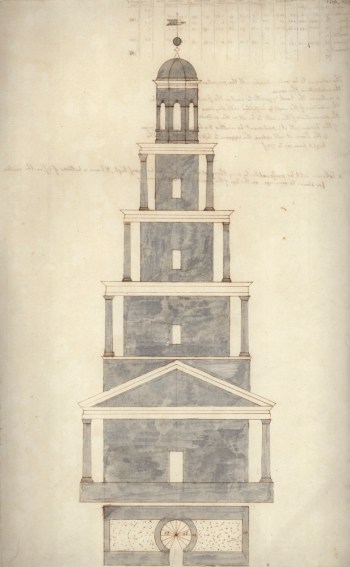
Thomas Jefferson, Monticello: Observation Tower, recto, ca. 1771, pen and Ink with gray wash (Boston: Massachusetts Historical Society, Coolidge Collection of Thomas Jefferson Manuscripts).
Organized by the Chrysler Museum of Art in collaboration with the Palladio Museum in Vicenza, Italy, the exhibition focuses on the ideas, formation, and key monuments of the Founding Father who dramatically influenced the architectural profile of the young republic. It will also confront the inherent conflict between Jefferson’s pursuit of contemporary ideals of liberty and democracy and his use of slave labor to construct his monuments.
The Chrysler Museum’s exhibition will follow Jefferson’s evolution as an architect with nearly 130 objects, including models, rare books, paintings, drawings, early photographs, and architectural elements. Visitors will see objects from the Chrysler’s rich collection, as well as loans from the Library of Congress, the National Gallery of Art, Jefferson’s residences at Monticello and Poplar Forest in Virginia, the University of Virginia, and other museums and libraries.
The Palladio Museum will provide 14 models, including 10 newly created models of Jefferson’s buildings and four models displaying the key architecture of Renaissance master Andrea Palladio (1508–1580). The exhibition will feature models of Monticello and Jefferson’s design for the U.S. president’s house, which was not selected, as well as numerous representations of the Pantheon that will highlight its architectural influence on the University of Virginia’s Rotunda. The Chrysler will also display the only autographed drawing by Palladio in an American collection as well as various editions of his treatise, The Four Books of Architecture.
Visitors will also see bricks, nails, and other components from Jefferson’s buildings that were created by enslaved laborers and craftsmen, as well as two rare images of enslaved and formerly enslaved people who can be linked directly to Jefferson and his buildings. These include Isaac Granger Jefferson, an artisan who was a tinsmith and blacksmith and labored in the nailery as an enslaved worker at Jefferson’s Monticello.
“Thomas Jefferson engaged with the most advanced ideas of architecture and city planning of his era. He was also a slave owner who failed to resolve his ideals about freedom and democracy with his reliance upon the institution of slavery. We will examine these facets of Jefferson’s architectural formation and practice to foster a new and fuller understanding of his accomplishments,” said Museum Director Erik H. Neil.
Through his education in Virginia, travels in the colonies and Europe and extensive library, Thomas Jefferson engaged with both classical and contemporary ideas about architecture. His projects frequently referenced ancient models or those of established authorities such as Palladio. He pursued forms that were both aesthetic models and expressive of the new republic’s democratic ideals. He employed those influences in his designs for the Virginia State Capitol, the University of Virginia, buildings in Washington, D.C. and his own residences, Monticello and Poplar Forest.
“For both Jefferson and Palladio, the architecture of the ancients was the key model with regard to functionality, style and meaning,” Neil said. “We see evidence of Thomas Jefferson’s influence in the architecture throughout our region, and we are excited to share the history and influence of these designs with our visitors to present important elements of Virginia’s history.”
Thomas Jefferson, Architect: Palladian Models, Democratic Principles and the Conflict of Ideals is curated by the Chrysler Museum’s Erik Neil, director; Lloyd DeWitt, chief curator and Irene Leache curator of European art; and Corey Piper, Brock curator of American art.
Lloyd DeWitt and Corey Piper, with an introduction by Erik Neil and contributions by Guido Beltramini, Barry Bergdoll, Howard Burns, Lloyd DeWitt, Louis P. Nelson, Mabel O. Wilson, and Richard Guy Wilson, Thomas Jefferson, Architect: Palladian Models, Democratic Principles, and the Conflict of Ideals (New Haven: Yale University Press, 2019), 208 pages, ISBN: 978-0300246209, $45.
 A richly illustrated catalog published by Yale University Press will accompany the exhibition. A team of leading international scholars will offer new scholarship and a fresh appraisal of Jefferson’s formation and career as an architect, engage the impact and legacy of his status as a slave owner and highlight the work and contributions of enslaved laborers and artisans. Contributors include Lloyd DeWitt, the Chrysler Museum’s chief curator, and Irene Leache, curator of European art; Howard Burns, president of the Centro Palladio, Scuola Normale Pisa; Guido Beltramini, director of the Palladio Museum; Richard Guy Wilson and Louis P. Nelson, both from the University of Virginia; and Barry Bergdoll and Mabel O. Wilson of Columbia University.
S E L E C T E D P R O G R A M M I N G
Mabel O. Wilson and Louis P. Nelson in Conversation
Saturday, 2pm, 26 October 2019
Renowned scholars Mabel O. Wilson and Louis P. Nelson will discuss the contributions and legacy of enslaved craftsman on the architecture of Thomas Jefferson. Wilson is a professor of architectural design at Columbia University Graduate School of Architecture, Planning and Preservation. She is also a Senior Fellow at the Institute for Research in African American Studies and co-directs Global Africa Lab. Nelson is the Vice Provost for Academic Outreach and Professor of Architectural History at the University of Virginia. Register at chrysler.org.
Travis McDonald, Thomas Jefferson’s Poplar Forest
Sunday, 2pm, 1 December 2019
Travis McDonald, the Director of Architectural Restoration at Poplar Forest, will offer insight into the restoration of Thomas Jefferson’s personal retreat and plantation and the work of enslaved craftspeople.
Exhibition | The Splendor of Germany: Eighteenth-century Drawings
From PHP and the Crocker Art Museum:
The Splendor of Germany: Eighteenth-century Drawings from the Crocker Art Museum
Crocker Art Museum, Sacramento, 16 February — 10 May 2020
The Crocker Art Museum has one of the finest and earliest German drawings collections in the United States. Featuring artists such as Johann Wolfgang Baumgartner, Anton Raphael Mengs, and Johann Heinrich Wilhelm Tischbein, The Splendor of Germany examines the major developments in German draughtsmanship over the course of the eighteenth century. Published to coincide with the collection’s 150th anniversary.
 In the twenty-first century, the collecting and study of eighteenth-century German drawings has become a major focus for American museums. One of the finest collections of them, however, has been in California for 150 years. The superb drawings at the Crocker Art Museum, from a Baroque altarpiece design by Johann Georg Bergmüller to a Neoclassical mythology by Johann Heinrich Wilhelm Tischbein, provide a panorama of German draughtsmen and draughtsmanship throughout the century.
Many of the drawings are remarkable for their modernity. A self-portrait by Johann Gottlieb Prestel bypasses convention to achieve a direct, unmediated likeness. Well-placed slashes with brush and black ink define the features below his peruke outlined in black chalk. Other drawings encapsulate specific developments and styles, such as Johann Wolfgang Baumgartner’s Lazarus and the Rich Man, which shows the florid dynamism of the Augsburg Rococo. A full range of eighteenth-century German artists are represented here, from the satirizing moralists Johann Elias Ridinger and Daniel Chodowiecki to the Classicist and friend of the art theorist Johann Joachim Winkelmann, Anton Raphael Mengs. Landscape artists are especially well represented, such as the key figure Johann Georg Wille, printmaker to the French king Louis XV, and generations of artists he taught and influenced all the way to the early Romantic landscapists.
The exhibition and catalogue gather together a variety of dynamic and sensitive portraits, charming scenes of daily life, and often humorous moralizing subjects, as well as narratives, both religious and mythological, from the late Baroque to Neoclassicism. In the realm of landscape, the depth of the collection allows the exhibition to trace schools and influences—in addition to Wille’s mentioned above—even in families such as that of Prestel, whose wife and daughter were both landscapists. It also allows it to demonstrate the great variety of works by single artists such as Christoph Nathe, represented by four landscapes in four different genres including a splendid scene near Görlitz. Some artists, in fact, work in several genres as in the case of Johann Christian Klengel, whose works include the scene of a family by candlelight, a farmstead landscape, and a sketchbook that he carried through the countryside to record picturesque views.
This is a rare opportunity for the public and for drawings enthusiasts. Two-thirds of the drawings in the exhibition have not been shown before; most of the exceptions have not been seen since 1989. Because of the drawings’ 150-year history of limited exposure, the state of preservation of the collection is exceptional, as is the condition of the new acquisitions included in the exhibition.
William Breazeale and Anke Fröhlich-Schauseil, The Splendor of Germany: Eighteenth-century Drawings from the Crocker Art Museum (London: Paul Holberton Publishing, 2020), 144 pages, ISBN: 978-1911300779, £40.
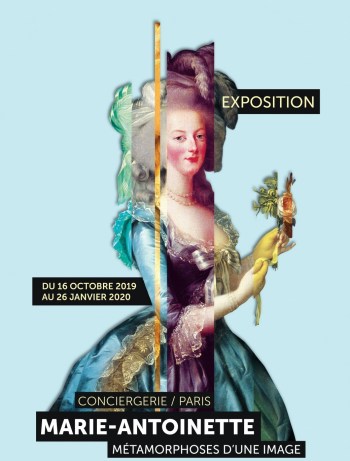
Exhibition | Marie-Antoinette: Metamorphosis of an Image
The exhibition opens today, 226 years after Marie-Antoinette was executed (the press release is available here). . .
Marie-Antoinette: Métamorphoses d’une Image
Conciergerie, Paris, 16 October 2019 — 26 January 2020
Only a handful of historic figures have been the subject of such an abundance of representations: Marie-Antoinette is one of these, both during her lifetime and more notably after her death on 16 October 1793. Even today, this queen-turned-icon is still a key emblem in popular culture. The exhibition illustrates the many representations of Marie-Antoinette through almost 200 works, artefacts, heritage and contemporary archives, never-before-seen interviews, film extracts, and fashion accessories—shining a light on this worldwide phenomenon of media overkill through both a historic approach and a critical and comparative examination of forms.
 Marie-Antoinette at the Conciergerie
This section illustrates the final ten weeks that saw the most dramatic moments experienced by the queen in the ‘corridor of death’, during her trial by the Revolutionary Tribunal. A number of memorial fetishes testify to this: shirt, shoe, belt, and archival documents from the trial and execution of the Queen
The Histories
Marie-Antoinette’s life has been transformed since her death through numerous accounts and biographies, as well as testimonies and memories, from the Restoration to the present day, and from all points of view. The exhibition illustrates twenty events, both public and private, in Marie-Antoinette’s life, from her birth to her death, and including her official funeral in 1814.
The Image of the Queen
The figure of Marie-Antoinette is a veritable ‘expanse of images’, which can quickly be packaged to suit an event, a commemoration, the latest cultural trend or fashionable motif. Thus, according to the era, this proliferation affected the official image of the queen, particularly the portraits of her by Elisabeth Louise Vigée Le Brun, the political images of the ‘martyred’ queen, the historical imagery, the character portrayed on-screen, and in Japanese manga.
Fetishes of the Queen
The relationship with Marie-Antoinette has often been passionate, creating cults, tributes, or, on the contrary, provoking violent attacks. Furthermore, it has often been subject to fantasy and imagination, on a level where intimacy can overlap with mythology. The exhibition here displays a selection of images and objects, based on three motifs, symbolising Marie-Antoinette throughout history and the world.
• The Hair
• The Body
• The Severed Head
The Return of the Queen
Marie-Antoinette is experiencing a surprising revival, due to the modernization of the character, who has become a young woman of hers, and our time. The revival is illustrated by Japanese manga, which reinvented Marie-Antoinette in Riyoko Ikeda’s The Rose of Versailles; the biography of the English writer Antonia Fraser, Marie-Antoinette: The Journey; and its Hollywood adaptation by Sofia Coppola. Fashion has also appropriated the phenomenon associating the queen with several contemporary supermodels. A fan cult has appropriated the figure of Marie-Antoinette, a phenomenon of globalised post-modernism, as commercial as it is cultural and ideological. The overriding style of this onslaught is a popularised form of pop art, and its diffusion affects all genres, every type of consumerism and every country. The exhibition highlights this great blend of genres and objects, while revealing its commercial aspect.
A cycle of Marie-Antoinette films will be screened at the Le Champo cinema from 5 November to 3 December.
◊ ◊ ◊ ◊ ◊
The catalogue is published by Éditions du Patrimoine:
Antoine de Baecque, ed., Marie-Antoinette: Métamorphoses d’une image (Paris: Éditions du Patrimoine, 2019), 215 pages, ISBN: 978-2757706817, 39€.
 Un très beau livre qui donne à voir et à comprendre les multiples visages de la figure historique française la plus connue à travers le monde. De la princesse idéale à la ‘reine scélérate’, de la traîtresse étrangère à la figure martyre, de l’héroïne adolescente à la mère bigote, de la femme de culture à l’icône de mode, l’image de la reine Marie-Antoinette, tour à tour adorée ou honnie, n’a cessé d’évoluer au cours des siècles.
En suivant le fil de l’exposition qui se tiendra à la Conciergerie du 16 octobre 2019 au 26 janvier 2020, cet ouvrage, à travers 14 essais et 16 notices, commentera les multiples représentations de la reine et montrera comment le rapport à Marie-Antoinette a souvent été passionnel, déterminant des cultes, des hommages, ou au contraire de violentes attaques.
Historien, spécialiste de la culture des Lumières et de la Révolution française, Antoine de Baecque a entre autres publié Le Corps de l’histoire. Métaphores et politique 1770–1800 (Calmann-Lévy, 1993), La Gloire et l’effroi (Grasset, 1996) sur la Terreur, puis Les Eclats du rire (Calmann-Lévy, 2000), sur la culture des rieurs au XVIIIe siècle. Il a également écrit le volume sur les Lumières de l’Histoire culturelle de la France en 1998 aux éditions du Seuil, et participé aux volumes collectifs, Histoire du corps, Histoire de la virilité, Histoire des émotions. Antoine de Baecque est également commissaire de nombreuses expositions, membre du comité de rédaction de la revue L’Histoire, du conseil scientifique de la BNF, président de la commission d’aide à l’écriture documentaire au CNC et professeur d’histoire du cinéma à l’École normale supérieure de la rue d’Ulm.
S O M M A I R E
La tradition royale
• Marie-Antoinette, reine de France, Fanny Cosandey
• Marie-Antoinette et ses soeurs : portrait de groupe, Mélanie Traversier
• La fabrique de la célébrité, Antoine Lilti
• La reine des modes, du chic au kitsch, Catriona Seth
> Notices : Les colliers de la reine. Gravures de mode royale
Face à la Révolution
• Une reine traînée dans la boue : les caricatures contre Marie-Antoinette, Annie Duprat
• Un fantasme de reine, entretien avec Chantal Thomas
> Notices : Une Autrichienne en goguette. Archives du procès et dernière lettre de Marie-Antoinette. La chemise de Marie-Antoinette. Soulier « à la Saint-Huberty » dit de Marie-Antoinette. Marie-Antoinette conduite à son exécution. Le peintre David dessinant Marie-Antoinette conduite au supplice.
Le culte de Marie-Antoinette
• « C’était là »… », l’ombre tutélaire de la Conciergerie, Guillaume Mazeau
• L’impératrice Eugénie et le culte visuel de Marie-Antoinette, Clémence Poupin
• Pierre de Nolhac, le chevalier servant des images, Baptiste Roger-Lacan
• Deux clés biographiques : des Goncourt à Stefan Zweig, Cécile Berly
> Notices : la cellule de la reine, oratoire de la Conciergerie. La châtelaine-reliquaire de la duchesse de Tourzel. La Chapelle expiatoire. Marie-Antoinette à la basilique-cathédrale de Saint-Denis.
Métamorphoses et revival
• Marie-Antoinette à l’écran, François Huzar
• Marie-Antoinette, héroïne manga-pop, fille d’Ikeda, Cyril Triolaire
• Effigie en série, trajectoire iconique d’une reine de France dans la pop culture internationale, Martial Poirson
• Marie-Antoinette en quelques clics…, Cécile Berly
> Notices : Les collections de la Cinémathèque française. Anne Seibel, chef décoratrice. Œuvres contemporaines. Michèle Lorin, collectionneuse passionnée.
Biographie des auteurs
Exhibition | The Moon
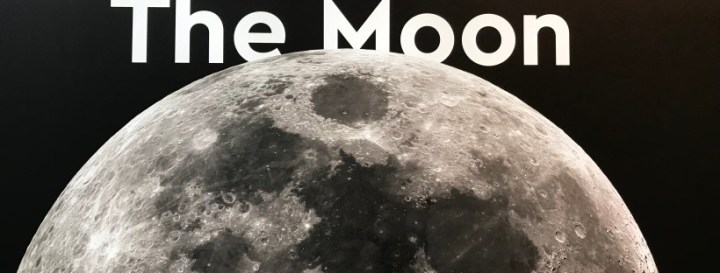
From the press release (4 April 2019) for the exhibition:
The Moon
National Maritime Museum, Greenwich (London), 19 July 2019 — 5 January 202
Curated by Melanie Vandenbrouck, Megan Barford, Louise Devoy, and Richard Dunn
To celebrate 50 years since NASA’s Apollo 11 mission landed the first humans on the Moon, the National Maritime Museum (NMM) stages The Moon, the UK’s biggest exhibition dedicated to Earth’s nearest celestial neighbour. Featuring over 180 objects from national and international museums and private collections, the exhibition presents a cultural and scientific story of our relationship with the Moon over time and across civilisations. Through artefacts, artworks and interactive moments, the exhibition will enable visitors to reconnect with the wonders of the Moon and discover how it has captivated and inspired us.
The exhibition will explore how humans have used, understood and observed the Moon from Earth. Visitors will get the chance to relive the momentous events of the Space Race and the Moon landings before discovering the motivations behind 21st-century lunar missions.
 Significant objects on display include Apollo mission artefacts that travelled to the Moon, loaned from the Smithsonian National Air and Space Museum in Washington D.C. The ‘Snoopy Cap’ Communications Carrier, worn by astronaut Edwin ‘Buzz’ Aldrin during Apollo 11, will be exhibited alongside the Hasselblad camera equipment that captured some of the most recognisable and iconic images of the 20th century.
Lunar samples collected from NASA’s Apollo missions and the Soviet Union’s Luna programme, will be accompanied by a rare lunar meteorite from the Natural History Museum’s collection. This will give visitors to the NMM’s exhibition a unique opportunity to get close to such a diverse range of moon rocks and discover how researching these specimens continues to advance our understanding of the Moon.
Historical and contemporary artworks will illustrate how the Moon has long inspired artists, acting as a metaphor for the human condition. Moonlit scenes by J.M.W. Turner and John Constable will be displayed alongside contemporary pieces by Katie Paterson, El Anatsui, Chris Ofili, and Leonid Tishkov. Artworks by Cristina De Middel, Aleksandra Mir, and Larissa Sansour will consider our relationship with the Moon through the lenses of gender and nationhood.
In the exhibition’s opening section, visitors will discover ways in which the Moon has been embedded in human culture, spiritually, practically, and artistically, with its changing phases used to mark time in religion, navigation, and medicine. The oldest object on display, a Mesopotamian Tablet from 172 BCE on loan from the British Museum, shows how lunar eclipses were considered to be bad omens. Detailed Islamic and Chinese calendars highlight the continuing importance of using the Moon to set the date for key festivals such as Chinese New Year and Ramadan. Examples of historic medical texts, such as a 1708 pamphlet by the English Doctor Richard Mead show how the position of the Moon was once believed to influence our physical and mental health.
The exhibition will explore how new technologies, such as 17th-century telescopes, 19th-century cameras and remote equipment for space photography and mapping in the 20th century brought increasing understanding of the lunar surface and the Moon’s origins. A selection of maps, paintings, photographs, models, and drawings from the 17th century to the present will emphasise humanity’s continuing desire to understand more about the Moon. Examples include the earliest-known drawing of the lunar surface made from telescopic observations by British astronomer Thomas Harriot in 1609 and the detailed pastel drawings of the Moon by 18th-century Royal Academician John Russell.
From classic science fiction through to the defining events of the Space Race, visitors will see how the Moon went from being a distant object of observation and place of imagination to a destination that was within human reach. The Moon looks at key moments within the Space Race, highlighting how a number of Soviet ‘firsts’ were ultimately overshadowed by Neil Armstrong’s century-defining ‘one small step’ in July 1969. Video artist Christian Stangl will show a new and exclusive version of his film ‘Lunar’, in which animated photographs from Apollo missions allow visitors to experience the Moon landings through the eyes of the astronauts. Apollo objects will sit alongside film posters, books, comics, and magazines that celebrated and questioned these momentous events.
In 1969, the Apollo 11 astronauts left a plaque on the Moon claiming, “we came in peace for all mankind.” Today, there is renewed drive to return to the Moon, reflected in future projects from China, Europe, India, Israel, Japan, Russia, and the United States. No longer the domain of superpowers, international space agencies, private companies, and entrepreneurs are all part of this 21st-century race for the Moon. Scientists, lawyers, artists, and architects are considering the practical, psychological, and ethical implications of human exploration and settlement on the Moon. The closing chapter of the exhibition will look at these contemporary motivations for Moon travel, leaving visitors to contemplate whether the Moon will become a theatre for exploitation and competition or remain a peaceful place for all humankind.
Melanie Vandenbrouck, Megan Barford, Louise Devoy, and Richard Dunn, eds., The Moon: A Celebration of Our Celestial Neighbour (London: Collins, 2019), 256 pages, ISBN: 978-0008282462, £20.
From ArtHist.net:
Art and Science of the Moon
Royal Museums Greenwich, London, 14–15 November 2019
With contributions from academics, artists, and curators exploring the interface between art, in its widest sense, and science, this conference will consider various creative responses to our cosmic companion. In keeping with RMG’s interest in interrogating the collision of science, history and art, The Art and Science of the Moon will explore how the Moon’s motions and phases have influenced human activities, beliefs, and behaviours; how sustained scrutiny of the lunar surface have enabled us to understand more about ourselves; how attempts, imaginary and real, to reach this other world have fostered creativity and technological progress; and how in the 21st century we are rethinking our relationship with the Moon.
The provisional programme is available here»
Exhibition | Making Marvels: Science & Splendor

From the press release (21 May 2019) for the exhibition:
Making Marvels: Science & Splendor at the Courts of Europe
The Metropolitan Museum of Art, New York, 25 November 2019 — 1 March 2020
Curated by Wolfram Koeppe
Between 1550 and 1750, nearly every royal family in Europe assembled vast collections of exquisite and entertaining objects. Lavish public spending and the display of precious metals were important expressions of power, and possessing artistic and technological innovations conveyed status. In fact, advancements in art, science, and technology were often prominently showcased in elaborate court entertainments that were characteristic of the period. Opening November 25, Making Marvels: Science and Splendor at the Courts of Europe will explore the complex ways in which the wondrous objects collected and displayed by early modern European monarchs expressed these rulers’ ability to govern.
The exhibition will feature approximately 170 objects—including clocks, automata, furniture, scientific instruments, jewelry, paintings, sculptures, print media, and more—from The Met collection and over 50 lenders. A number of these works have never been displayed in the United States. Among the many exceptional loans will be silver furniture from the Esterházy Treasury; the largest flawless natural green diamond in the world, weighing 41 carats and in its original 18th-century setting; the alchemistic table bell of Emperor Rudolf II; a large wire-drawing bench made for Elector Augustus of Saxony; a rare example of an early equation clock by Jost Bürgi; and a reconstruction of a late 18th-century semi-automaton chess player, known as The Turk, that once famously caught Napoleon Bonaparte cheating.
Making Marvels is the first exhibition in North America to highlight the important conjunction of art, science, and technology with entertainment and display that was essential to court culture. The exhibition will be divided into four sections dedicated to the main object types featured in these displays: precious metalwork, Kunstkammer objects, princely tools, and self-moving clockworks or automata.
In order to emphasize the scientific and technological content of these objects, the exhibition will begin by establishing the high level of material value and artisanal quality that princes had to meet in these displays of wealth and power. Visitors will encounter a set of superbly fashioned silver furniture that was considered the ultimate symbol of power, status, and money during the early modern period. The second section will be dedicated to the unusual objects of the Kunstkammer, as these collections were known in German-speaking provinces. These pieces were typically composed of newly discovered natural materials set in finely crafted mounts of silver or gold, whose highly inventive designs often embodied the most up-to-date knowledge of the natural world. Reflective of the multi-layered objects they housed, Kunstkammern functioned simultaneously as places of amusement, research retreats for the investigation of nature, and political showcases for magnificence.
Knowledge of subjects such as natural philosophy, artisanal craftsmanship, and technology was considered tantamount to the practical wisdom, self-mastery, and moral virtue integral to successful governance. Pursuits such as metalsmithing, surveying, horology, astronomy, and turning at the lathe were part of the education and entertainment of princes in courts across Europe. The exhibition’s third section will present the scientific instruments, artisanal tools, and experimental apparatus used by rulers as they developed the technical skills so important to their princely identity.
The exhibition will conclude with innovations in mechanical technology. Self-moving clockwork machines—perhaps the most well-known technological display objects—were also a rich source for allegories of rulership. Additionally, as courts competed for technical supremacy, many innovations in mechanical technology were developed at the urging of princely patrons. Automata represented the ultimate attempt to use mechanics to create life-like movement, and were extremely popular additions to princely collections from the Renaissance to the Enlightenment. One highlight will be The Draughtsman Writer, a late 18th-century writing automaton that inspired the book The Invention of Hugo Cabret and its movie adaptation. The advanced mechanism of this piece, which stored more information than any machines that came before it, was the forerunner of the computer, the most common technology used today.
Throughout each gallery, videos and digital models will vividly evoke the historical reality of the objects on view and emphasize the similarities between early modern objects and contemporary technological entertainments. Exhibition visitors will discover innovative marvels that engaged and delighted the senses of the past much like 21st-century technology holds our attention today—through suspense, surprise, and dramatic transformations.
Making Marvels is organized by Wolfram Koeppe, Marina Kellen French Curator in The Met’s Department of European Sculpture and Decorative Arts. The exhibition and accompanying catalogue, distributed by Yale University Press, are made possible by the Anna-Maria and Stephen Kellen Foundation.
Wolfram Koeppe, ed., Making Marvels: Science and Splendor at the Courts of Europe (New York: The Metropolitan Museum of Art, 2019), 320 pages, ISBN: 978-1588396778, $65.
Above Image: Gerhard Emmoser, Celestial Globe with Clockwork, 1579; partially gilded silver, gilded brass (case); brass, steel (movement); diameter of globe: 14 cm (New York: The Metropolitan Museum of Art, Gift of J. Pierpont Morgan, 1917).










leave a comment