Exhibition | Making Beauty: The Ginori Porcelain Manufactory
Now on view at the Bargello:
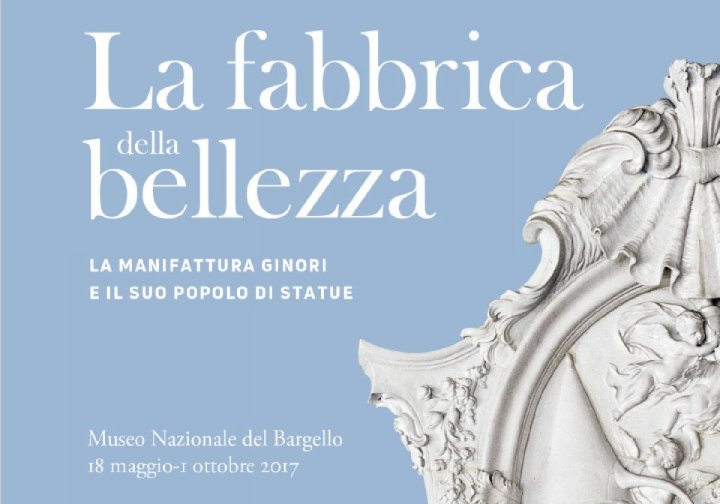
Making Beauty: The Ginori Porcelain Manufactory and Its Progeny of Statues
La Fabbrica della Bellezza: La manifattura Ginori e il suo popolo di statue
Museo Nazionale del Bargello, Florence, 8 May — 1 October 2017
The exhibition is divided into six thematic sections illustrating the transformation of sculptural invention into works of porcelain. The first section opens with an 18th-century life-size bronze Venus, a copy of the celebrated Medici Venus in the Uffizi Tribune. Sculpted by Massimo Soldani Benzi in 1702, the bronze was commissioned by Prince Johann Adam Andreas I of Liechtenstein and still forms part of the present prince’s collection, this exhibition marking its first return to Italy in over 350 years. It stands side by side with a large porcelain Venus made by Gasparo Bruschi in 1747–48, probably using the plaster moulds which Carlo Ginori purchased from Soldani Benzi’s workshop. The two Venuses are, in turn, displayed alongside a monumental porcelain Mercury based on another Classical statue in the Uffizi Tribune. The Mercury, now in the Ginori Lisci Collection, is on display for the very first time in this exhibition, not only with the Venus but also with the monumental Fireplace alongside which it stood in the old Museo di Doccia until 1962, because the Museo Ginori has kindly granted the loan of the two most important works in its entire collection: the Medici Venus reproducing the celebrated statue in the Uffizi Tribune, and the monumental Fireplace specially restored for the exhibition.

Tempietto Ginori, modeled by Gaspero Bruschi, 1750–51; glazed and painted porcelain, heigh 167 cm including ebony base (Museo dell’Academia Etrusca e della Città di Cortona).
The second section is devoted to the superlative Ginori Tempietto Ginori, a masterpiece by Gasparo Bruschi which Carlo Ginori himself donated to the Accademia Etrusca in Cortona. The Tempietto, of exceptional sophistication in terms of its technique and design and unique in terms of its size, summarises in concentrated form not only the artistic aims but also the political aspirations of the manufactory’s founder. Specially restored for the exhibition, it is returning to Florence for the first time since 1757. Alongside it we have Giambologna’s small bronze and wax models of Mercury, from the Bargello Collection and the Museo Ginori respectively, which inspired the Mercury atop Gaspare Bruschi’s Tempietto.
The next room hosts two large, complex bronze and porcelain versions of the Pietà. In 1708, Soldani made the model for the large Lamentation over the Dead Christ, of which numerous versions are known. Carlo Ginori purchased the plaster moulds—some of which are on display in the exhibition—which were used for the porcelain version that the Marchese Ginori gave to the influential Cardinal Neri Corsini around 1745. The group was made in fifty-nine different porcelain parts, individually fired and then assembled by the manufactory’s craftsmen in Sesto Fiorentino.
Somewhat smaller but equally sophisticated in terms of their execution are the groups of Judith with the Head of Holofernes that comprise the exhibition’s fourth thematic section. Gaspare Bruschi’s porcelain version, on loan from the Los Angeles County Museum, is displayed in an unprecedented dialogue with Agostino Cornacchini’s terracotta model, the first sculptural study for this popular group.

Lamentation over the Dead Christ, after Massimo Soldani Benzi, 1745–50, glazed porcelain, height 71.5 cm not including ebony base (Rome: Palazzo Corsini).
This is followed by Soldani’s precious bronze ‘pictorial’ relief depicting the Passing of St. Joseph and the wax model based on the bronze, from the Bargello Collection, which are on display alongside the preparatory study in unfired clay, it too in Italy for the very first time, testifying to the Ginori Manufactory’s plan to produce porcelain versions of it—none of which have, however, survived.
The exhibition’s ‘grand finale’ is the monumental porcelain Fireplace, an absolutely unique work, which may be attributed to Doccia’s chief modeller Gasparo Bruschi and to Domenico Stagi, a stage set designer and painter of quadrature. The piece is a veritable triumph of technical mastery and ornamental sophistication. Its upper part hosts porcelain versions of works by illustrious sculptors, the oval bas-relief with ‘putti distilling flowers’ after a bronze by Massimiliano Soldani Benzi and copies of Dawn and Dusk which Michelangelo carved for the tomb of Lorenzo de’ Medici in the Medici Chapels.
The exhibition is accompanied by a catalogue rich in new research, published by Mandragora in both Italian and English. The catalogue entries explore the manufactory’s artistic and political history, using essays focusing on the works on display to set Ginori’s porcelain sculpture, whether monumental or on a smaller scale, in the broader artistic and political context of the time, and presenting a number of important new attributions. The catalogue also contains fascinating input from experts in the manufacture of porcelain, not only reviewing the manufactory’s history but also illustrating previously unpublished material and highlighting the unique technical nature of Ginori’s inventions.
 La Fabbrica della bellezza has also served as a formative experience for two university students who have taken part in all of the various phases in the development of the exhibition project and drafted the catalogue entries on the basis of an apprenticeship agreement with Florence University’s SAGAS Department. The exhibition and catalogue have been designed and produced with a grant from the Fondazione Cassa di Risparmio di Firenze, with the sponsorship of Richard Ginori and with the collaboration of Firenze Musei; Opera Laboratori Fiorentini and Arteria have also contributed in their capacity as partners for the layout and transport respectively.
In addition to acquainting the general public with an exceptional chapter in the history of Florentine sculpture, the exhibition also sets out to draw the attention of Florentine and international public opinion to the fate of the Museo di Doccia. The generosity of international loans for the exhibition points to the intense interest in the the museum and the manufactory shown by numerous institutions both in Italy and abroad. In that connection, we would like to express our special gratitude to HRH Prince Hans-Adam II von und zu Liechtenstein for granting the exhibition his lofty patronage.
Tomaso Montanari and Dimitrios Zikos, eds., Making Beauty: The Ginori Porcelain Manufactory and Its Progeny of Statues (New York: ACC Publishing, 2017), 160 pages, ISBN: 978 88746 13496, $30. Also available in Italian.
◊ ◊ ◊ ◊ ◊
Note (added 17 September 2017) — Aileen Dawson provides a review of the exhibition in the current issue of The Burlington Magazine (September 2017), pp. 748–49.
Exhibition | Luigi Crespi
Now on view at the Museo Davia Bargellini in Bologna:
Luigi Crespi: Portraitist in the Age of Pope Lambertini
Museo Davia Bargellini, Bologna, 15 September — 3 December 2017
Curated by Mark Gregory d’Apuzzo and Irene Graziani
 The Musei Civici d’Arte Antica dell’Istituzione Bologna Musei, in collaboration with the Department of Arts at the University of Bologna, present Luigi Crespi: Portraitist in the Age of Pope Lambertini, the first exhibition dedicated to the painter and art dealer Luigi Crespi (1708–1779), the son of the famous painter Giuseppe Maria Crespi (1665–1747).
The exhibition is a tribute to this multifaceted figure—among the most interesting of the artistic and literary panorama of eighteenth-century Bologna—in relation to the climate of cultural renewal favored by the enlightened pastoral work of Cardinal Prospero Lambertini, who in 1740 became Pope Benedict XIV. The exhibition presents the most significant core of Crespi’s paintings here, together with other works from the Municipal Art Collections and loans from other important museums and private collectors. The exhibition is organized around seven thematic sections that chart the most important phases of the artist’s career.
◊ ◊ ◊ ◊ ◊
La mostra, a cura di Mark Gregory D’Apuzzo e Irene Graziani, è la prima dedicata al pittore, molte opere del quale sono esposte presso il Museo Davia Bargellini e le Collezioni Comunali d’Arte. Figura poliedrica fra le più interessanti del panorama artistico e letterario di Bologna durante l’episcopato del cardinale Prospero Lambertini (1731–54), e dunque nel periodo di apertura della città alle istanze di rinnovamento culturale sostenute dal vescovo e poi papa Benedetto XIV (1740–58), Luigi Crespi è protagonista della mostra realizzata grazie alla collaborazione di importanti Istituzioni museali cittadine e collezionisti privati.
Luigi, pur essendo soprattutto celebre come letterato e autore del terzo tomo della Felsina Pittrice, edita nel 1769, ha percorso con successo anche la carriera artistica, intrapresa sotto la guida del padre fra la fine degli anni venti e gli inizi degli anni trenta del Settecento. Un’attività che egli stesso, molti anni più tardi, nella biografia del padre (1769), sosterrà di aver svolto «per divertimento», per significare il privilegio accordato al prestigioso ruolo, assunto a partire dagli anni cinquanta, di scrittore e critico d’arte, che gli frutterà infatti l’aggregazione alle Accademie di Firenze (1770), di Parma (1774) e di Venezia (1776).
La sua produzione figurativa tuttavia, in particolar modo quella rappresentata dal più congeniale genere del ritratto, lo rivela sensibile al dialogo con la scienza moderna e con la libera circolazione delle idee dell’Europa cosmopolita. Nonostante l’impegno applicato anche all’ambito dell’arte sacra, cui Luigi si dedica almeno fino agli inizi degli anni sessanta, è soprattutto nella ritrattistica che raggiunge esiti di grande efficacia, molto apprezzati dalla committenza. «Ebbe un particolare dono di ritrarre le fisionomie degli Uomini, e ne fece una serie di Ritratti di Cavaglieri e Damme», scrive infatti Marcello Oretti (1760–80), celebrandone l’abilità nell’adattare la formula del codice ritrattistico alle esigenze della clientela.
Come dimostrano il Ritratto di giovane dama con il cagnolino, o i tre ritratti dei Principi Argonauti in origine nel collegio gesuitico di San Francesco Saverio, la pittura di Crespi junior, già addestrato dal genitore Giuseppe Maria ad un fare schietto, attento al naturale e al «vero», evolve verso un nitore della visione che risalta i dettagli, in un’analitica investigazione della realtà, memore di certi esempi (Balthasar Denner e Martin van Meytens) osservati durante un viaggio di sette mesi fra Austria e Germania, dove visita le Gallerie delle corti di Dresda e Vienna (1752). Così li commenterà infatti Gian Pietro Zanotti in una nota manoscritta: «Bisogna dire il vero che ora fa ritratti bellissimi, e di ottimo gusto, in un certo stile oltramontano».
Dal confronto con il «grande mondo»—per utilizzare un’espressione di Prospero Lambertini, che fu in stretti rapporti con Giuseppe Maria Crespi e fu in gran parte il responsabile della carriera ecclesiastica del figlio, conferendogli la carica di «segretario generale della visita della città e della diocesi», il canonicato di Santa Maria Maggiore (1748) ed ancora nominandolo suo cappellano segreto—Luigi deriva dunque la conferma della validità del codice del ritratto ufficiale, che gli consente di rappresentare i personaggi, qualificandone i gusti sofisticati, le abitudini raffinate, i comportamenti eleganti e disinvolti da assumere nella vita di società, dove si praticano i rituali di quella “civiltà della conversazione” che nella moderna Europa riunisce aristocratici e intellettuali in un dialogo paritario, dettato dalla condivisione di regole e valori comuni. Ma la prossimità con la cultura lambertiniana lo conduce anche a sperimentare, dapprima ancora con il sostegno del padre, poi autonomamente (Ritratto di fanciulla), nuove tipologie di ritratto, in cui lo sguardo incrocia i volti di individui del ceto borghese: talvolta sono gli oggetti a raccontare con la loro perspicuità di definizione la dignità del lavoro (Ritratto di Antonio Cartolari), altre volte sono invece i gesti caratteristici, l’inquadratura priva di infingimenti (Ritratto di fanciulla), la resa confidenziale del modello, quasi al limite della caricatura (Ritratto di Padre Corsini), a fare emergere il valore umano di quella parte della società, cui papa Lambertini riconosceva un ruolo fondamentale nel rinnovamento.
Irene Graziani and Mark Gregory d’Apuzzo, Luigi Crespi: Ritrattista nell’età di Papa Lambertini (Milan: Silvana, 2017), 144 pages, ISBN: 978 88366 37928, $35.
Exhibition | Becoming a Woman in the Age of Enlightenment
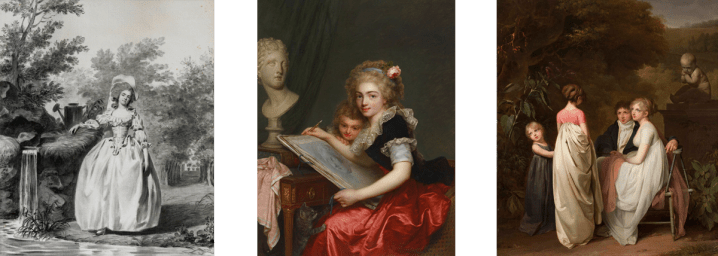
Jacques-Antoine-Marie Lemoine, Woman Standing in a Garden, 1783, black chalk and brush with gray wash on off-white laid paper; Antoine Vestier, Allegory of the Arts, 1788, oil on canvas; and Louis-Léopold Boilly, Conversation in a Park, oil on canvas. All on loan from The Horvitz Collection.
◊ ◊ ◊ ◊ ◊
From the Harn Museum of Art:
Becoming a Woman in the Age of Enlightenment: French Art from The Horvitz Collection
Harn Museum of Art, University of Florida, Gainesville, 6 October — 31 December 2017
Ackland Art Museum, The University of North Carolina at Chapel Hill, 26 January — 8 April 2018
Crocker Art Museum, Sacramento, 13 May — 19 August 2018
Smith College Museum of Art, Northampton, MA, dates TBA
Curated by Melissa Hyde and Mary D. Sheriff
Organized by Alvin Clark
Becoming a Woman in the Age of Enlightenment: French Art from the Horvitz Collection is primarily an exhibition of drawings but will include pastels, paintings, and sculptures selected from one of the world’s best private collections of French drawings. The exhibition will feature nearly 120 works by many of the most prominent artists of the eighteenth century, including Antoine Watteau, Nicolas Lancret, François Boucher, Jean-Honoré Fragonard, as well as lesser-known artists both male and female, such as Anne Vallayer-Coster, Gabrielle Capet, François-André Vincent, Philibert-Louis Debucourt. Ranging from spirited, improvisational sketches and figural studies, to highly finished drawings of exquisite beauty, the works included in the exhibition vary in terms of style, genre, and period.
Becoming a Woman will be organized into thematic sections that address some of the most important and defining questions of women’s lives in the eighteenth century. These include: how the stages of a woman’s life were measured; what cultural attitudes and conditions in France shaped how women were defined; what significant relations women formed with men; what social and familial rituals gave order to their lives; what pleasures they pursued; and what work they accomplished. The aim is to bring new insights to the questions of what it meant to be a woman in this period, by offering the first exhibition to focus specifically on representations of women of a broad range of ages and conditions.
The exhibition will offer fresh perspectives on a subject that still has direct relevance to our times but that has not been the focus of a significant exhibition for decades. Through its conceptual framework, thematic organization, and its emphasis on historical context, the exhibition will provide viewers opportunities to consider what issues pertaining to women’s lives seem to have changed or persisted through time and across space. Although the circumstances and the specifics have changed, many issues remain with us today and can still provoke contentious debates. Pay equity, reproductive rights, gender-discrimination, violence against women, work-family balance, the ‘plight’ of the alpha-female, and the devaluation of the stay-at-home mom, are but a few of the women’s issues that are still hotly contested in the media, in cultural production of all kinds, in politics, and in public and private life.
Becoming a Woman is curated by Melissa Hyde, Professor of Art History, University of Florida Research Foundation Professor, University of Florida, and the late Mary D. Sheriff, W.R. Kenan J. Distinguished Professor of Art History, University of North Carolina, Chapel Hill; the exhibition is organized by Alvin L. Clark, Jr, Curator, The Horvitz Collection and The J.E. Horvitz Research Curator, Harvard Art Museums/Fogg.
The catalogue is available from ArtBooks.com:
Melissa Hyde, Mary D. Sheriff, and Alvin Clark, Becoming a Woman in the Age of Enlightenment: French Art from The Horvitz Collection (Boston: The Horvitz Collection, 2017), 208 pages, ISBN: 978 099126 2526, $39.

François Boucher, Young Travelers, black chalk on cream antique laid paper, framing line in black ink, laid down on a decorated mount, 295 × 188 mm; Jacques-Louis David, Andromache Mourning the Death of Hector, pen with black ink and brush with gray wash over traces of black chalk on cream antique laid paper, 293 × 248 mm; Jean-Baptiste Greuze, The Chestnut Vendor, brush with gray and brown wash on cream antique laid paper, 385 × 460 mm. All works on loan from The Horvitz Collection.
◊ ◊ ◊ ◊ ◊
From the Lecture and Symposium Schedule:
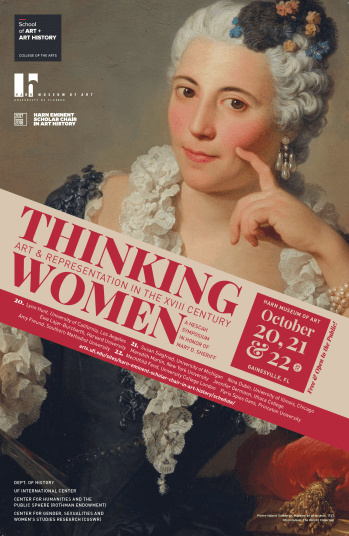
Thinking Women: Art and Representation in the Eighteenth Century
A Symposium in Honor of Mary D. Sheriff
Harn Museum of Art, University of Florida, Gainesville, 20–22 October 2017
• Keynote Address: “The Woman Artist and the Uncovering of the Social World,” Lynn Hunt, Distinguished Research Professor, University of California, Los Angeles
Art, women, and society came together in surprising ways at the end of the eighteenth century. ‘Society’ only began to be conceptualized as an object for study at the end of the 1700s, in particular in reaction to the French Revolution. Art, especially engraving and painting, helped make society visible to itself. Women could join the art world but rarely as fully fledged members, and as a consequence they occupied a kind of in-between position that made them especially attuned to social relations. The life and work of Marie-Gabrielle Capet will be highlighted to show how the social world could be uncovered.
 • “Fashion in Time: Visualizing Costume in the Eighteenth Century,” Susan Siegfried, Denise Riley Collegiate Professor of the History of Art and Women’s Studies, Department of Art History, University of Michigan
• “Beauty Is a Letter of Credit,” Nina Dubin, Associate Professor, Department of Art and Art History University of Illinois, Chicago
• “Chardin: Gender and Interiority,” Ewa Lajer-Burcharth, William Dorr Boardman Professor of Fine Arts, Department of History of Art and Architecture, Harvard University
• “The Global Allure of the Porcelain Room,” Meredith Martin, Department of Art History, New York University
• “Pictured Together? Questions of Gender, Race, and Social Rank in the Portrait of Dido Elizabeth Belle and Lady Elizabeth Murray,” Jennifer Germann, Associate Professor, Department of Art History, Ithaca College
• “Becoming an Animal in the Age of Enlightenment,” Amy Freund, Associate Professor & Kleinheinz Family Endowed Chair in Art History, Southern Methodist University
• “Marguerite Lecomte’s Smile: Portrait of a Woman Engraver,” Mechthild Fend, Reader in the History of Art, Department of History of Art, University College London
• “Exceptional, but not Exceptions: Women Artists in the Age of Revolution,” Paris Spies Gans, Doctoral Candidate, Department of History, Princeton University
The final program, with times, is available here»
At the Ackland Art Museum at UNC, Chapel Hill, there will be a sister symposium in Mary’s honor entitled “Taking Exception: Women, Gender, Representation in the Eighteenth Century,” 1–3 February 2018.
◊ ◊ ◊ ◊ ◊
Note (added 14 October 2017) — The posting has been updated with additional information, including details on the catalogue, venues, and the conferences.
New Book | Enchanted World of German Romantic Prints
The related exhibition was on display at the Philadelphia Museum of Art in the autumn of 2013. From Yale UP:
John Ittmann, ed., with essays by Warren Breckman, Mitchell B. Frank, Cordula Grewe, John Ittmann, Catriona MacLeod, and F. Carlo Schmid, Enchanted World of German Romantic Prints, 1770–1850 (New Haven: Yale University Press, 2017), 424 pages, ISBN: 978 03001 97624, $65.
 From the 1770s through the 1840s, German, Austrian, and Swiss artists used the medium of printmaking to create works that synthesized poetry, literature, music, and the visual arts in new and captivating ways. Finding an eager audience in the growing number of educated middle-class collectors, printmakers experimented with modern technologies, such as lithography, and drew on the contemporary interest in regional folklore and traditional fairy tales to produce innovative compositions that both contributed to and reflected the dramatic cultural and political upheavals of the Romantic era. Featuring the work of more than 120 artists, including Casper David Friedrich, Ludwig Emil Grimm, Joseph Anton Koch, Philipp Otto Runge, and Johann Gottfried Schadow, this authoritative book contains many unique and never-before-published examples of prints from the Philadelphia Museum of Art’s unrivaled collection.
John Ittmann is the Kathy and Ted Fernberger Curator of Prints at the Philadelphia Museum of Art.
Print Quarterly, September 2017
The eighteenth century in the current issue of Print Quarterly:
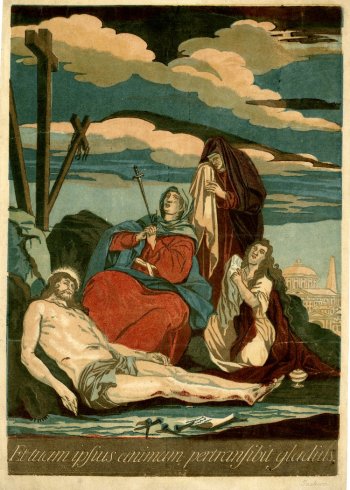
John Baptist Jackson, Lamentation over the Body of Christ, ca. 1740–44, woodcut with embossing (London: The British Museum).
Print Quarterly 34.3 (September 2017)
A R T I C L E S
• Evelyn Wöldicke, “John Baptist Jackson’s Woodcuts and the Question of Embossing,” pp. 298–310.
• Freyda Spira, “Micrographic Allegories by Johann Michael Püchler and Matthias Buchinger,” pp. 310–16.
R E V I E W S
• Adriano Aymonino, Review of the exhibition catalogue, Maria Rosaria Nappi, ed., Immagini per il Grand Tour: L’attività della Stamperia Reale Borbonica (Edizioni Scientifiche Italiane, 2015), pp. 328–31.
• Rolf Reichardt, Review of Philippe de Carbonnières, La Grande Aarmée de papier: Caricatures napoléoniennes (Presses Universitaires de Rouen et du Havre, 2015), pp. 331–33.
• Perrin Stein, Review of Kristel Smentek, Mariette and the Science of the Connoisseur in Eighteenth-Century Europe (Ashgate, 2014), pp. 340–44.
Exhibition | In Her Majesty’s Hands: Medals of Maria Theresa
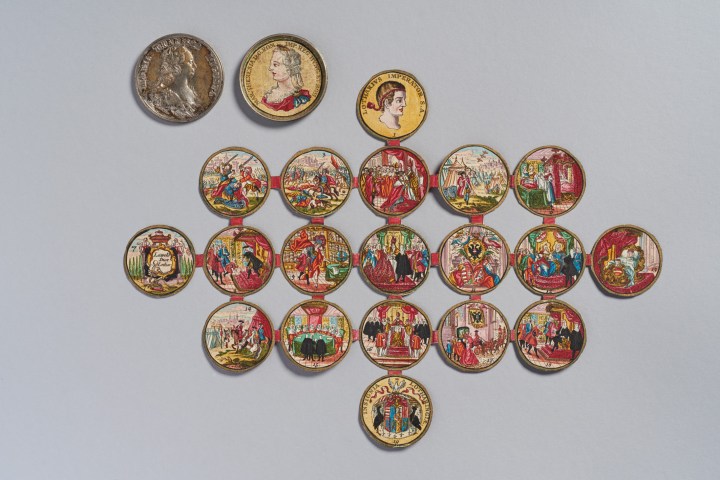
Matthäus Donner / Andreas Vestner, Maria Theresa Box Medal (Schraubmedaille) containing hand-coloured drawings; silver, hand-coloured drawing on paper inside the medal (Vienna, Kunsthistorisches Museum, Coin Collection, inv.no. 5955/1914B).
◊ ◊ ◊ ◊ ◊
Press release (via Art Daily) for the exhibition now on view at the KHM:
In Her Majesty’s Hands: Medals of Maria Theresa
Kunsthistorisches Museum, Vienna, 28 March 2017 — 18 February 2018
Curated by Anna Fabiankowitsch and Heinz Winter
The Kunsthistorisches Museum’s Coin Collection holds both the largest and by far the most important collection of coins minted under Maria Theresa; it is the best place, and now is the best time, to host an exhibition that presents the monarch’s life in medals to celebrate what would have been her 300th birthday.
 The exhibition focuses on the most important topoi in Maria Theresa’s private and public life. It presents her in the company of her large family, running the gamut of events from dynastic marriages to heart-breaking calamities. It showcases her role as a ruler forced to fight several wars for her inheritance and, together with her son and co-regent Joseph II, as a pioneering social reformer. The artefacts on show also illustrate the extent of Maria Theresa’s realm, which comprised many different ethnicities and cultures.
All these topoi are reflected in medals that emblematise historical events with the help of allegories. Maria Theresa was already widely glorified and celebrated during her lifetime, but the exhibition also documents how she was portrayed by her enemies. So-called satirical medals, which were passed around in private, turned Maria Theresa into an object of derision.
The exhibition focuses, too, on the historical background of medal production to illustrate the requisite technical skills, expenditure, and effort; introduce the most important protagonists; and document the range, purview, and media-value of Maria Theresa’s medals.
Maria Theresa (1717–1780) became a legend during her lifetime, and few female rulers were depicted more frequently or diversely. Her many likenesses—among them portraits, engravings, medals, and medallions—were designed to preserve her memory for posterity, turning her into an 18th-century media-star.
Medals played a central role in this propaganda effort controlled by the imperial court. Among the period’s foremost artistic mass media, medals were minted under the aegis of the court, and they continue to reflect the ruler’s political aims and the way she saw herself. Over three hundred different medals were produced during Maria Theresa’s reign to commemorate or celebrate either members of the imperial family or political events, both national and international.
Medals functioned as a way to commemorate important events of her reign, and as they were minted in large numbers, the material is noted for its longevity and their handy format made it easy to disseminate them, they were regarded as a historical record that would last forever. Contemporaries called these miniature memorials show- or commemorative coins, and they evolved into much sought-after and frequently exchanged collectors’ pieces. The monarch presented them as signs of imperial favour, in recognition of the recipient’s merits or achievements, or to strengthen diplomatic ties, and the majority of the medals produced in Vienna were destined for the court—ending up in Her Majesty’s hands.
Zuhanden Ihrer Majestät: Medaillen Maria Theresias (Vienna: Kunst Historisches Museum, 2017), 100 pages, 15€.

Curator Anna Fabiankowitsch during preparations for the exhibition
Photo by Lukas Beck
The Burlington Magazine, August 2017
The eighteenth century in The Burlington:
The Burlington Magazine 159 (August 2017)
 E D I T O R I A L
• “Reflected Glory: University Art Collections in Britain,” p. 599.
O B I T U A R I E S
• Simon Jervis, “Rudolf Hermann Wackernagel (1933–2017),” p. 639. His great article, “Carlton House Mews: The State Coach of the Prince of Wales and of the Later Kings of Hanover, A Study in the Late-Eighteenth-Century ‘Mystery’ of Coach-Building, in Furniture History 31 (1995) remains the most authoritative statement on London coach building in the late eighteenth century. But his crowning achievement was the massive two-volume Staats- und Galawagen der Wittelsbacher (Stuttgart, 2002). This is a catalogue of the wonderful collection of the Marstallmuseum at Schloss Nymphenburg, outside Munich, where he generously deposited part of his own extensive and systematic archive on coaches and carriages…
R E V I E W S
• Gauvin Alexander Bailey, Review of Christine Casey, Making Magnificence: Architects, Stuccatori and the Eighteenth-Century Interior (Yale University Press, 2017), pp. 642–43.
• Ayla Lepine, Review of Julian Holder and Elizabeth McKellar, eds., Neo-Georgian Architecture, 1880–1970: A Reappraisal (Historic England, 2016), pp. 643–44.
• Michael Hall, Review of Pauline Prévost-Marcilhacy, ed., Les Rothschild: une dynastie de mécènes en France, 1873–2016 (Somogy éditions d’Art, 2016), pp. 644–46.
• Francis Russell, Review of the exhibition Canaletto and the Art of Venice (London: The Queen’s Gallery, Buckingham Palace, 2017), pp. 651–52.
• Matthi Forrer, Review of the exhibition Hokusai: Beyond the Great Wave (London, The British Museum; and Osaka: Abeno Harukas Art Museum, 2017), pp. 652–53.
•Eric Zafran, Review of the exhibition America Collects Eighteenth-Century French Painting (Washington: D.C.: National Gallery of Art, 2017), pp. 669–70.
R E C E N T A C Q U I S I T I O N S
Recent acquisitions (2007–17) by regional university collections in Britain
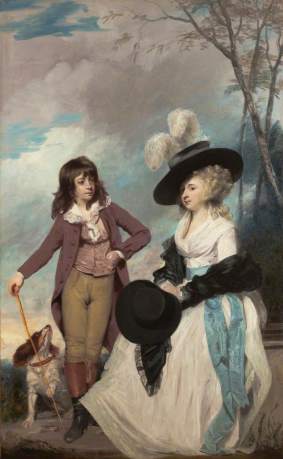
Joshua Reynolds, Maria Marow Gideon and Her Brother, William, 1786–87 (Birmingham: The Barber Institute of Fine Arts), January 2013.
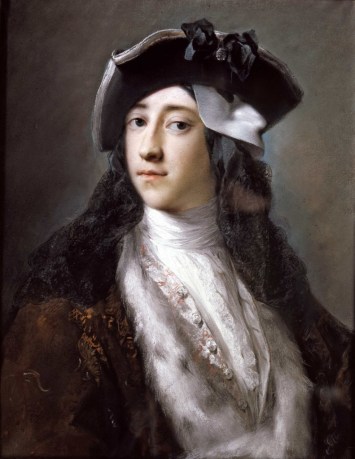
Rosalba Carriera, Portrait of Gustavus Hamilton, 2nd Viscount Boyne, ca. 1730–31; pastel, heightened with white bodycolour on paper (Birmingham: The Barber Institute of Fine Arts), 2009.
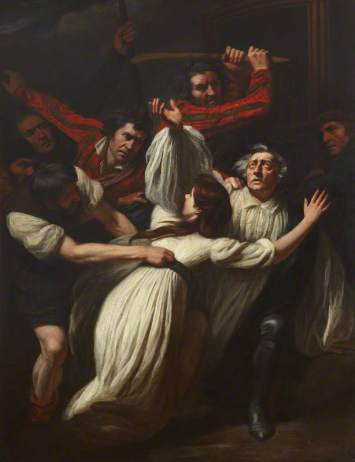
John Opie, The Death of Archbishop Sharpe, 1797; oil on canvas (University of St Andrews), 2008.
Exhibition | Basic Instincts

Joseph Highmore, The Angel of Mercy, ca. 1746; oil on canvas, 59.7 × 48.3 cm (New Haven: Yale Center for British Art, Paul Mellon Collection, B1981.25.362).
◊ ◊ ◊ ◊ ◊
Press release from The Foundling Museum:
Basic Instincts
The Founding Museum, London, 29 September 2017 — 7 January 2018
Curated by Jacqueline Riding
A highly successful artist and Governor of the Foundling Hospital, Joseph Highmore (1692–1780) is best known as a portrait painter of the Georgian middle class. However, during the 1740s Highmore’s art radically shifted as he turned his focus to societal attitudes towards women and sexuality. Curated by Highmore expert, Dr Jacqueline Riding, Basic Instincts explores this ten-year period and his disruptive commentary, reflecting his engagement with the work of the new Foundling Hospital and its mission to support desperate and abused women. On public display in the UK for the first time is a remarkable painting that still retains the power to shock.
In 1744 Highmore created a series of 12 paintings on his own initiative inspired by Samuel Richardson’s international bestseller, Pamela, or Virtue Rewarded. First published in 1740, the novel’s sixth edition of 1742 included illustrations by Hubert Gravelot and Francis Hayman. However, unlike the commissioned illustrations, Highmore’s paintings explicitly make reference to the abuse and sexual violence at the heart of Richardson’s story of a virtuous young maidservant fighting off the unwanted advances of her predatory master. Highmore and Richardson became friends, and Highmore subsequently illustrated Richardson’s masterpiece, Clarissa, or, the History of a Young Lady, whose tragic heroine avoids a forced marriage, but dies having been abandoned by her family, duped by an admirer, drugged and raped.
Unlike William Hogarth, Highmore’s representation of Georgian society favoured realism over broad humour and theatricality, so his nuanced articulation of social attitudes towards women and sexuality means that modern audiences can miss his challenging commentary. However, at the heart of Basic Instincts is a remarkable painting that has never before been publically displayed in the UK and which does not fail to shock. The Angel of Mercy (c.1746) depicts a desperate mother in the act of killing her baby, with the distant Foundling Hospital presented as an alternative solution. This painting is unique in western art for showing maternal infanticide as a contemporary reality. The fashionably dressed mother is free from direct biblical or mythological allusion, unlike Hagar and Ishmael (1746) the large canvas Highmore donated to the newly established Hospital, which represents an Old Testament story of maternal abandonment. Instead The Angel of Mercy confronts the ‘elephant in the room’ in terms of the Hospital’s campaign; that without Christian compassion and practical support, even respectable women will be driven to murder.
Basic Instincts curator Jacqueline Riding said: “This is the first major Highmore exhibition for 50 years and nowhere can his life and work have greater resonance than at the Foundling Museum: an organisation at the forefront of the public display, interpretation and appreciation of early-Georgian art. Setting The Angel of Mercy, the Pamela paintings and Hagar and Ishmael among Highmore’s most tender portraits of mothers and children, family and friends, uniquely demonstrates the artist’s depth and variety, while indicating the true breadth of British Art in a period still labelled ‘The Age of Hogarth’.”
Foundling Museum director Caro Howell said: “Basic Instincts demonstrates that in the eighteenth century, the Foundling Hospital’s impact on contemporary artists went far beyond a simple donation of art. For Joseph Highmore it sparked a radical engagement with the issue of women’s vulnerability to sexual assault and society’s unwillingness to support them, culminating in a work of quite exceptional power.”
Basic Instincts explores the limits and narratives around female respectability in Georgian society, and reveals the complexity of Highmore’s engagement with issues surrounding women’s vulnerability to male exploitation. The first major publication dedicated to Joseph Highmore and written by Dr Riding will be published by Paul Holberton publishing to coincide with the exhibition. The exhibition is supported by the Paul Mellon Centre for Studies in British Art.
On display in the Museum’s historic rooms, a series of nine previously unseen sculptures by acclaimed contemporary artist Rachel Kneebone provide a highly charged counterpoint to Basic Instincts. Exploiting porcelain’s history as a material of refinement and rococo exuberance, Kneebone subverts viewers’ expectations by creating works that are simultaneously delicate and visceral. Raft of the Medusa’s tumbling limbs and fractured swags are at once coquettish and sinister; their gleaming white surfaces and exquisite detail belie scenes of collapse and dismemberment. Displayed amongst the Museum’s historic Collection, these works distil and abstract the Foundling Hospital’s suppressed narratives of sexual desire, emotional damage, and female strength.
Jacqueline Riding specialises in Georgian history and art. She read History and Art History at the universities of Leicester, London, and York and has over twenty-five years’ experience working as a curator and consultant within a broad range of museums, galleries, and historic buildings, including the Guards Museum, Tate Britain, and Historic Royal Palaces. From 1993 until 1999 she was Assistant Curator of the Palace of Westminster and later founding Director of the Handel House Museum in London. She has published widely on early-Georgian art and history, including her major book Jacobites: A New History of the ’45 Rebellion (Bloomsbury 2016). She is currently writing a biography of William Hogarth (Head of Zeus). She was the consultant historian and art historian on Mike Leigh’s award-winning film Mr. Turner (2014) and is the consultant historian on his next feature film, Peterloo. Jacqueline Riding is Associate Research Fellow in the School of Arts, Birkbeck College, University of London and a Fellow of the Clore Leadership Programme.
Rachel Kneebone (b. 1973) lives and works in London. Recent solo exhibitions include Rachel Kneebone at the V&A, London (2017); 399 Days, White Cube Bermondsey (2014) and London; and Regarding Rodin, Brooklyn Museum, New York (2012). Group exhibitions include Obsession, Maison Particulière, Brussels and Flesh, York Art Gallery (2016); Lust for Life, Galleri Anderson Sandstrom, Stockholm and Ceramix at Bonnefantenmuseum, Maastricht (2015); 3am: Wonder, Paranoia and the Restless Night, The Bluecoat, Liverpool and Chapter, Cardi (2013–14); The Surreal House, Barbican Centre, London (2010); Summer Exhibition, Royal Academy of Arts, London (2008); and Mario Testino at Home, Yvon Lambert, New York (2007). In 2005, Kneebone was nominated for the MaxMara Art Prize and this year has been nominated for the breakthrough award for the 2017 South Bank Show Sky Arts Award.
The accompanying book is published by PHP:
Jacqueline Riding, Basic Instincts: Love, Passion, and Violence in the Art of Joseph Highmore (London: Paul Holberton Publishing, 2017), 120 pages, ISBN: 978 1911300 281, £25.
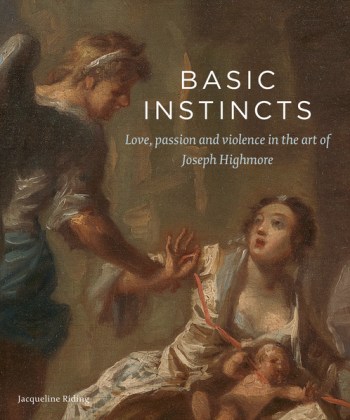 Published to coincide with the exhibition at the Foundling Museum in London, this fascinating book will re-introduce Joseph Highmore (1692–1780), an artist of status and substance in his day, who is now largely unknown. It takes as its focus Highmore’s small oil painting known as The Angel of Mercy (ca. 1746, Yale), one of the most shocking and controversial images in 18th-century British art.
The painting depicts a woman in fashionable mid-18th-century dress strangling the infant lying on her lap. A cloaked, barefooted figure cowers to the right as an angel intervenes, pointing towards the Foundling Hospital, the recently built refuge for abandoned infants, in the distance. The image attempts to address one of the most disturbing aspects of the Foundling Hospital story—certainly a subject that many (now as then) would consider beyond depiction. But if any artist of the period had attempted such a subject it would surely be William Hogarth, not the portrait painter Joseph Highmore? In fact, the painting was attributed to Hogarth for almost two centuries, until its reattribution in the 1990s. Even so, it is surprising that despite the wealth of scholarship associated with Hogarth and the ‘modern moral subject’ of the 1730s and 1740s, The Angel of Mercy has received little attention until now. The book and exhibition seeks to address this, while encouraging greater interest in, and appreciation for, this significant British artist.
Jacqueline Riding sets this extraordinary painting within the context of the artist’s life and work, as well as broader historical and artistic contexts. This includes exploration of superb examples of Highmore’s portraiture, such as his complex, monumental group portrait The Family of Sir Eldred Lancelot Lee and the exquisite small-scale ‘conversations’ The Vigor Family and The Artist and his Family, juxtaposed with analysis of key subject paintings, including the Foundling Museum’s Hagar and Ishmael and Highmore’s Pamela series, inspired by Samuel Richardson’s bestselling novel. Collectively they tackle relevant and highly contentious issues around the status and care of women and children, master/servant relations, motherhood, abuse, abandonment, infant death, and murder.
Exhibition | Visual Voyages: Images of Latin American Nature
Press release from The Huntington:
Visual Voyages: Images of Latin American Nature from Columbus to Darwin
The Huntington Art Gallery, San Marino, 16 September 2017 — 8 January 2018
Curated by Catherine Hess and Daniela Bleichmar
 A sweeping international loan exhibition at The Huntington Library, Art Collections, and Botanical Gardens will explore how the depiction of Latin American nature contributed to art and science between the late 1400s and the mid-1800s. Visual Voyages: Images of Latin American Nature from Columbus to Darwin, on view in the MaryLou and George Boone Gallery from September 16, 2017 to January 8, 2018, will feature more than 150 paintings, rare books, illustrated manuscripts, prints, and drawings from The Huntington’s holdings as well as from dozens of other collections. Many of these works will be on view for the first time in the United States.
Visual Voyages will be complemented by a richly illustrated book, along with an array of other programs and exhibitions, including a sound installation by Mexican experimental composer Guillermo Galindo. The exhibition is a part of the Getty’s Pacific Standard Time: LA/LA initiative, an exploration of Latin American and Latino art that involves more than 70 arts institutions across Southern California.
“Despite notorious depredation of people and resources during the period, the brilliant work of a number of Latin Americans and Europeans helped to illuminate our understanding of the natural world,” said Catherine Hess, chief curator of European art at The Huntington and co-curator of Visual Voyages. “We aim to shed light on this relatively unexamined piece of the story—to show how beautiful, surprising, and deeply captivating depictions of nature in Latin America reshaped our understanding of the region and, indeed, the world—essentially linking art and the natural sciences.”
Visual Voyages looks at how indigenous peoples, Europeans, Spanish Americans, and individuals of mixed-race descent depicted natural phenomena for a range of purposes and from a variety of perspectives: artistic, cultural, religious, commercial, medical, and scientific. The exhibition examines the period that falls roughly between Christopher Columbus’s first voyage in 1492 and Charles Darwin’s publication of On the Origin of Species in 1859, a work based largely on Darwin’s own voyage to the region in the 1830s.
“Information and materials circulated at an unprecedented rate as people transformed their relationship to the natural world and to each other,” said Daniela Bleichmar, associate professor of art history and history at the University of Southern California (USC) and co-curator of the exhibition. “Images served not only as artistic objects of great beauty but also as a means of experiencing, understanding, and possessing the natural world. These depictions circulated widely and allowed viewers—then and now—to embark on their own ‘visual voyages’.”
Bleichmar, who was born in Argentina and raised in Mexico, is an expert on the history of science, art, and cultural contact in the early modern period. Her publications include the prize-winning book Visible Empire: Botanical Expeditions and Visual Culture in the Hispanic Enlightenment (The University of Chicago Press, 2012).
The Huntington’s three collection areas—library, art, and botanical—all contribute to Visual Voyages. Its Library is one of the world’s greatest research institutions in the fields of British and American history, art, and the history of science, stretching from the 11th century to the present, and includes such riches as the first European depiction of a pineapple and a rare 16th-century manuscript atlas that includes three stunning maps of the Americas. From The Huntington’s art holdings, Frederic Edwin Church’s monumental painting Chimborazo (1864) will be on display, depicting a Latin American landscape both real and imaginary. The Huntington’s 120 acres of gardens include several thousand plant species from Latin America, including pineapple, vanilla, cacao, and various orchids and succulents.
Designed by Chu+Gooding Architects of Los Angeles, Visual Voyages engages visitors through an evocative installation that includes interactive media, display cases of specimens and rare materials, and two walls almost completely covered with grids of visually arresting depictions of botanical specimens and still lifes.
The exhibition opens with a playful display of taxidermy mounts to make vivid the rare animals that captured the imagination of Europeans and were avidly collected during the period. Visual Voyages then begins with a section on “Rewriting the Book of Nature,” in which manuscripts, maps, and publications show how nature came to be reconsidered in the first century of contact. This section includes a copy of the 1493 letter Christopher Columbus wrote to the King and Queen of Spain while on the return leg of his first voyage to the New World. He writes that the region is “so fertile that, even if I could describe it, one would have difficulty believing in its existence.” This section highlights the many contributions of indigenous Americans to the exploration of New World nature, among them two large-scale maps painted by indigenous artists in Mexico and Guatemala; a volume from the Florentine Codex, a 16th-century Mexican manuscript on loan from the Laurentian Library, Florence; and a spectacular feather cape created by the Tupinambá of Brazil.
Next, a gallery called “The Value of Nature” explores the intertwining of economic and spiritual approaches to Latin American nature. Commercial interests resulted in the investigation, depiction, and commercialization of such natural commodities as tobacco and chocolate. Indigenous religions considered the natural world to be infused with the divine, while Christian perspectives led observers to envision Latin American nature as both rich in signs of godliness as well as marked with signs of the devil—and needing eradication. Various depictions of the passion flower, a New World plant, show how the flower’s form recalled to missionaries the instruments of Christ’s Passion.
A third section, “Collecting: From Wonder to Order,” shows how the ‘wonder’ that European collectors held for the astonishing material coming from the New World became a desire to possess and, later, to “order” this material, following systems of taxonomy and classification. On view will be a spectacular set of large paintings depicting Brazilian fruits and vegetables by the Dutch painter Albert Eckhout (ca.1610–1665) as well as 30 artful, vivid, and detailed drawings of botanical specimens painted by artists from New Granada (present-day Colombia, Ecuador, Panama, Venezuela, Peru, northern Brazil, and western Guyana), never before seen in the United States.
The final section of the exhibition, called “New Landscapes,” examines scientific and artistic perspectives on Latin America created in the 19th century, a period when a new wave of voyagers explored the region and independence wars resulted in the emergence of new nations. The Romantic and imperial visions of artists and scientists from Europe and the U.S. are juxtaposed with the patriotic and modernizing visions of artists and scientists from Latin America, who envisioned nature as an integral part of national identity. This juxtaposition can be seen visually in the pairing of The Huntington’s monumental Chimborazo by Church with the equally monumental Valley of Mexico (1877) by Mexican painter José María Velasco, on loan from the Museo Nacional de Arte in Mexico City.
Gallery text is in Spanish and English.
Daniela Bleichmar, Visual Voyages: Images of Latin American Nature from Columbus to Darwin (New Haven: Yale University Press, 2017), 240 pages, ISBN: 978 030022 4023, $50.
Visual Voyages: Images of Latin American Nature from Columbus to Darwin is accompanied by a hardcover book of the same title written by Daniela Bleichmar, co-curator of the exhibition. In a narrative addressed to general audiences as well as students and scholars, Bleichmar reveals the fascinating story of the interrelationship of art and science in Latin America and Europe during the period.
More information is available from Yale UP.
◊ ◊ ◊ ◊ ◊
The Huntington will present an array of public programs to complement Visual Voyages, including a lecture, a curator tour, and focused exhibitions.
Guillermo Galindo Installation and Performance
16 September 2017 — 8 January 2018
Experimental composer, sonic architect, and performance artist Guillermo Galindo will create an outdoor sound installation and performance at The Huntington during the run of the exhibition. The program is part of USC Annenberg’s Musical Interventions, a series of public events organized for Pacific Standard Time: LA/LA by Josh Kun, historian of popular music and recently named a MacArthur Fellow.
Nuestro Mundo
16 September 2017 — 8 January 2018
About two dozen paintings by students of Art Division make up this installation of works inspired by Visual Voyages. Art Division is a non-profit organization dedicated to training and supporting underserved Los Angeles youth who are committed to studying the visual arts. Flora-Legium Gallery, Brody Botanical Center (weekends only).
In Pursuit of Flora: Eighteenth-Century Botanical Drawings
28 October 2017 — 19 February 2018
European exploration of other lands during the so-called Age of Discovery revealed a vast new world of plant life that required description, cataloging, and recording. By the 18th century, the practice of botanical illustration had become an essential tool of natural history, and botanical illustrators had developed strategies for presenting accurate information through exquisitely rendered images. From lusciously detailed drawings of fruit and flowers by Georg Dionysius Ehret (1708–1770), a collaborator of Linnaeus, to stunning depictions of more exotic examples by the talented amateur Matilda Conyers (1753–1803), In Pursuit of Flora reveals the 18th-century appreciation for the beauty of the natural world.
Symposium: Indigenous Knowledge and the Making of Colonial Latin America
The Getty Center, Los Angeles, 8-10 December 2017
This symposium will bring together an interdisciplinary group of scholars to explore the ways in which indigenous knowledge contributed to the making of colonial Latin America. A dozen talks will examine practices related to art, architecture, science, medicine, governance, and the study of the past, among other topics. Curator-led visits to two related exhibitions—Visual Voyages at The Huntington and Golden Kingdoms: Luxury and Legacy in the Ancient Americas at The J. Paul Getty Museum—will allow participants to view magnificent examples of work by indigenous artists and authors, including more than half a dozen rare pictorial manuscripts (codices). The symposium is organized by Daniela Bleichmar, co-curator of Visual Voyages and Kim Richter, co-curator of Golden Kingdoms and senior research specialist at the Getty Research Institute, with funding from the USC-Huntington Early Modern Studies Institute, the Seaver Institute, and the Getty Research Institute
The Burlington Magazine, July 2017
The eighteenth century in The Burlington:
The Burlington Magazine 159 (July 2017), Decorative Arts

E D I T O R I A L
• “Furniture History: The Digital Future,” p. 519.
On the eve of the 300th anniversary of the birth of Thomas Chippendale in 2018, the editorial addresses the British and Irish Furniture Makers Online Project (BIFMO), which updates the The Dictionary of English Furniture Makers 1660–1840, edited by Geoffrey Beard and Christopher Gilbert and published by the Furniture History Society in 1986. The BIFMO—a collaboration between the FHS and the Centre for Metropolitan History (CMH) at the Institute of Historical Research, University of London—is an open-access searchable database of all the entries from The Dictionary, together with the names of furniture makers from Laurie Lindey’s recent PhD thesis (Lindey, as a post-doctoral research fellow is overseeing the project at the IHR with Mark Merry of the CMH). The first phase of the BIFMO’s launch is scheduled for 30 September.
A R T I C L E S
• Koenraad Brosens and Astrid Slegten, “Creativity and Disruption in Brussels Tapestry, 1698–1706: New Data on Jan van Orley and Judocus de Vos,” pp. 528–35.
• Francesco Morena, “The Emperor of Mexico’s Screen: Maximilian I’s ‘Biombo’ in Trieste,” pp. 536–43.
R E V I E W S
• Simonetta Prosperi Valenti Rodinò, Review of Sabina de Cavi, ed., Dibujos y ornamento: Trazas y Dibujos de Artes decorativas entre Portugal, España, Italia, Malta y Grecia: Estudio en honor de Fuensanta García de la Torre (De Luca Editori d’Arte, 2015), pp. 559–60.
• Pierre Terjanian, Review of A. V. B. Norman and Ian Eaves, Arms & Armour in the Collection of Her Majesty The Queen, European Armour (Royal Collection Trust, 2016),” pp. 560–61.
• Robin Hildyard, Review of Brian Gallagher, Barbara Stone Perry, Letitia Roberts, Diana Edwards, Pat Halfpenny, Maurice Hillis and Margaret Ferris Zimmerman, British Ceramics, 1675–1825: The Mint Museum (D. Giles, 2015), pp. 561–62.
• Gauvin Alexander Bailey, Review of Christopher M.S. Johns, China and the Church: Chinoiserie in Global Context (University of California Press, 2016) and Marco Musillo, The Shining Inheritance: Italian Painters at the Qing Court, 1699–1812 (Getty Publications, 2016),” pp. 562–63.
• Philippa Glanville, Review of James Rothwell, Silver for Entertaining: The Ickworth Collection (Philip Wilson, 2017), pp. 563–64.
• Humphrey Wine, Review of the exhibition Le Baroque des Lumières: Chefs-d’œuvre des églises parisiennes au XVIIIe siècle (Paris: Petit Palais, 2017), pp. 572–73.
• Patrick Bade, Review of the exhibition La Quête de la ligne: Trois siècles de dessin en Allemagne (Hamburg: Kunsthalle, 2016 and Paris: Fondation Custodia, 2017), pp. 574–75.
• Jamie Mulherron, Review of the exhibition Marie Madeleine: La Passion révélée (Bourg-en-Bresse: Monastère Royal de Brou; Carcassonne: Musée des Beaux Arts; and Douai: Musée de la Chartreuse, 2017), pp. 577–79.
• Elsje van Kessel, Review of the newly refurbished gallery of Portuguese painting and sculpture at the Museu Nacional de Arte Antiga (MNAA), pp. 579–80.
• Philippe Bordes, Review of the exhibition Charles Percier: Architecture and Design in an Age of Revolutions (New York, Bard Graduate Center Gallery; and Château de Fontainebleau, 2016–17), pp. 583–84.
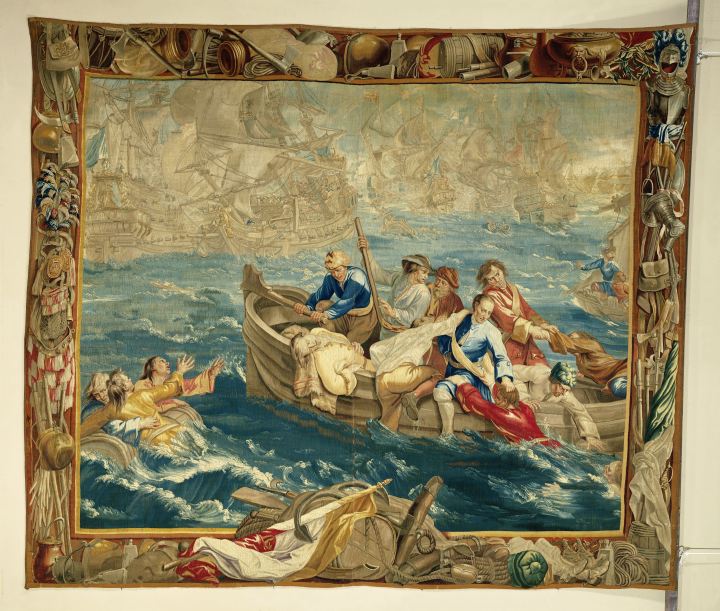
Judocus de Vos, after Lambert de Hondt, Lucas Achtschellinck, and Jan van Orley, Naval Battle from the Art of War series, ca. 1715–20; wool and silk, 344 × 400 cm (Amsterdam: Rijksmuseum).










leave a comment