Exhibition | Caroline, Sister of Napoleon, Queen of the Arts
Now on view at the Palais Fesch (as noted at Napoleon.org). . .
Caroline, Sister of Napoleon, Queen of the Arts
Palais Fesch, Musée des Beaux-Arts, Ajaccio, Corsica, 30 June — 2 October 2017
Curated by Jehanne Lazaj and Maria Teresa Caracciolo with Laëtitia Giannechini
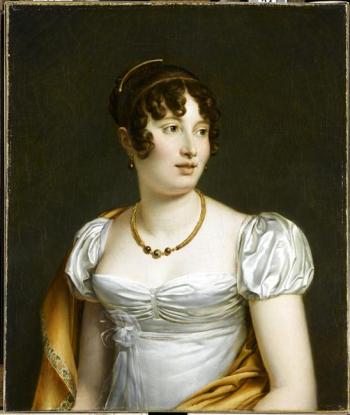
François Gérard, Portrait of Caroline Murat, Queen of Naples (Ajaccio: Palais Fesch, Musée des Beaux-Arts / Gérard Blot).
Caroline Bonaparte (1782–1839) was a woman of a complex and difficult temperament, yet she won over hearts by her beauty, culture, and spirit, along with a deep political intelligence that reflected her ambition. Napoleon affirmed in this respect: “Of all my family, she is the one that resembles me the most.” And while her political strategy has been much criticized, her keen intelligence, her great literary culture, her relationship with the artistic sphere, and her talents as a patron and collector have long been hidden.
If this exhibition intends to honour the younger sister of Napoleon, who has often been considered the ‘capricious’ one, its primary aim is to offer the widest possible panorama of the taste of an era and to give back to Caroline Murat the place which she deserves, that of a sovereign from both a political and artistic point of view. As a princess and later a dazzling queen, despite her almost tragic destiny, she embodied the giddy era in which she lived and which allowed her to encourage artistic creation as well as to enjoy the luxury, refinement, and strategies that power allowed her.
The exhibition is divided into five thematic sections presenting works and objects from the collections of the Palais Fesch and the Mobilier National, as well as loans from private collectors and large institutions including the Musée du Louvre, the Palace of Versailles, and the Museum of Capodimonte of Naples.
The press release is available here»
The catalogue is available from ArtBooks.com:
Maria Teresa Caracciolo and Jehanne Lazaj, Caroline, Soeur de Napoléon, Reine des Arts (Milan: Silvana, 2017), 300 pages, ISBN: 978 88366 36426, $45.
Exhibition | Homage to the Grand Duke
◊ ◊ ◊ ◊ ◊
Now on view at the Pitti Palace, with a catalogue published by Sillabe and available from ArtBooks.com:
Homage to the Grand Duke: Memories of Silver Plates for the Feast of St. John
Omaggio al Granduca: Memorie dei piatti d’argento per la festa di San Giovanni
Palazzo Pitti, Florence, 24 June — 24 September 2017
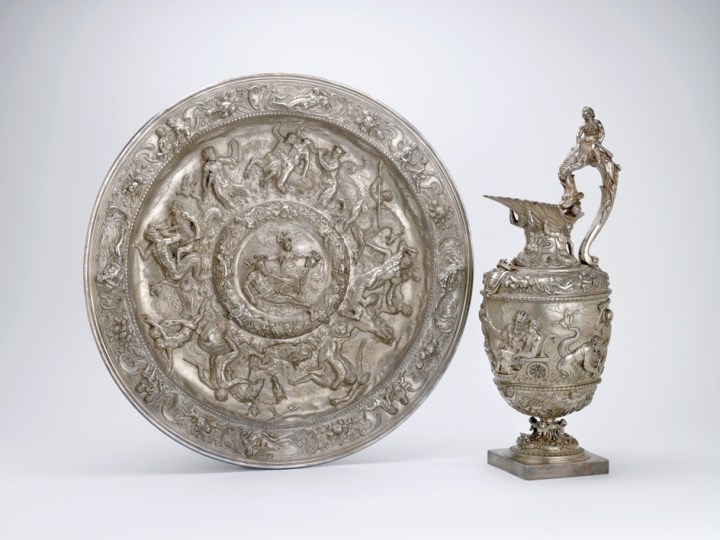
The precious items in the Tesoro dei Granduchi include a number of 18th-century moulds of the now lost ‘St. John’s plates’, a nostalgic echo of masterpieces of the Roman silversmith’s art in the age of the Baroque. The fifty-eight magnificent silver ewers were intended as a gift for Grand Duke Cosimo III (1642–1723) and, after him, for Gian Gastone (1671–1737), his successor on the throne of Tuscany. One ewer was presented every year on 24 June, the feast of St. John, from 1680 until the Medici dynasty became extinct in 1737.
 The silver ewers—weighing some fifteen pounds (or five kg) and worth 300 Roman scudi each—were meticulously embossed and chased with scenes celebrating the most illustrious members of the House of Medici from Lorenzo the Magnificent down to the reigning Grand Dukes. It was probably the fact that the ewers depicted the unusual subject of her family’s history that prompted the Electress Palatine Anna Maria Luisa (1667–1743) to do everything in her power to safeguard them from the threat of destruction at the hands of the House of Lorraine, who succeeded the Medici on the throne of Tuscany and whose military expenditure meant that they were regularly strapped for cash.
The ewers were jealously guarded in the Wardrobe in Palazzo Vecchio, leaving the premises only from 1789 to 1791 for display in the ‘Medal Room’ in the Galleria degli Uffizi. Sent back to the Wardrobe as their popularity declined, they set off down the path to oblivion. It is only thanks to casts commissioned by the Marchese Carlo Ginori and made in his Manufactory in Doccia between 1746 and 1748 that we can appreciate at least a pale reflection of their splendour today.
Rita Balleri and Maria Sframeli, eds., Omaggio al Granduca: Memorie dei piatti d’argento per la festa di San Giovanni (Livorno: Sillabe, 2017), 328 pages, ISBN: 978 8883 479595, 35€ / $60.
Exhibition | Sampled Lives

Press release for the exhibition now on view at The Fitzwilliam:
Sampled Lives: Samplers from the Fitzwilliam Museum
The Fitzwilliam Museum, Cambridge, 6 May 2017 — 8 April 2018
Coloured silks and metal threads, white-work, and needle lace… Over 120 beautifully embroidered samplers—some hundreds of years old—have gone on display in Cambridge in the exhibition Sampled Lives: Samplers from the Fitzwilliam Museum. Each one meticulously stitched by a girl or young woman, the samplers and accompanying book give a glimpse of past lives: from mid-17th-century English Quakers to early 20th-century school pupils. The skill employed in making them is remarkable—works by girls as young as nine years old are shown.
Very rarely seen due to their fragility and sensitivity to the light, several samplers have been newly conserved and cleaned for the show. This will be the first time so many fine examples from The Fitzwilliam’s outstanding collection of samplers have gone on display together.
The sampler was an essential part of a young woman’s education. It showed much more than just her ability with a needle and thread—it was a stitched CV, representing her competence to run a future home, or for seeking employment where such needle skills would be to her advantage. Samplers were also a work of creativity and pride, some containing hidden messages in the symbols and images used, referring to the girls’ political or religious beliefs. Many are stitched with names and ages. In some cases it is the only surviving document to record the existence of an ordinary young woman.
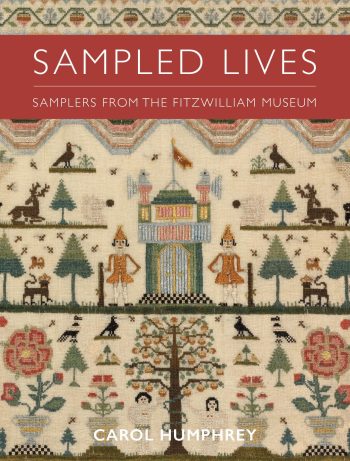 As the centuries progressed the sampler also became part of exercises towards literacy. Stitched prayers and odes to charity and faith adorned the fabric alongside alphabets and numerals. The displays highlight the importance of samplers as documentary evidence of past lives, revealing their education, employment, religion, family, societal status, and needlework skills. A fully- illustrated catalogue by Carol Humphrey, Honorary Keeper of Textiles, includes new high resolution photography to reveal the intricacy of the coloured silk stitches. It explores some of the personal stories that archival and genealogic research has revealed, as well as showing the evolution of different embroidery styles. It is hoped that the exhibition and book of Sampled Lives will stimulate further research, revealing more about the hidden histories of their makers.
Carol Humphrey commented: “The samplers are a stunning example of the needlework of the past and a masterclass for anyone interested in the changing fashions and styles of embroidery over the centuries. Much has changed in the study of samplers during the last thirty years or so. Now samplers can be seen as a valid means of studying the circumstances and material culture of their makers. When researched in depth, they can reveal not only personal details about an individual girl but also provide a key to family histories. We hope that visitors will enjoy discovering more about the techniques and past lives revealed in the exhibition and the book, and that further discoveries will come to light in the future.”
Carol Humphrey, Sampled Lives: Samplers from the Fitzwilliam Museum (Cambridge: The Fitzwilliam Museum, 2017), 242 pages, ISBN: 978 1910731 079, £20.
Exhibition | Paintings of the Abbés Desjardins
◊ ◊ ◊ ◊ ◊
Press release for the exhibition now on view at the MNBAQ:
The Fabulous Destiny of the Paintings of the Abbés Desjardins / Le Fabuleux Destin des Tableaux des Abbés Desjardins
Musée National des Beaux-Arts du Québec, 15 June — 4 September 2017
Musée des Beaux-Arts de Rennes, 14 October 2017 — 28 January 2018
Curated by Daniel Drouin and Guillaume Kazerouni
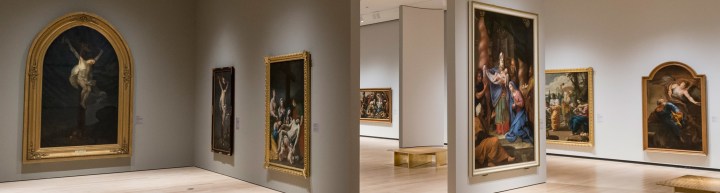
This exhibition highlights the bicentennial of the arrival in Canada of some 200 paintings initially done by renowned artists for churches in Paris in the 17th and 18th centuries. These paintings, confiscated during the French Revolution and reunited by clergyman Philippe-Jean-Louis Desjardins (1753–1833) , were shipped to Québec City to be sold to the rapidly growing parishes and religious congregations at the time. Fairly unfamiliar in France, this important body of religious paintings was researched recently. The history of the paintings is marked by two major periods—their use in France and their 19th-century use and impact in the Province of Québec. First, thanks to recent discoveries in France resulting in new attributions, more is known about the background for their creation. Several big names in French painting were involved—artists such as Claude Vignon, Simon and Aubin Vouet, Frère Luc, Charles-Michel-Ange Challes, Jean-Baptiste Corneille, Daniel Hallé, Pierre Puget, Michel Dorigny, Louis Boulogne le jeune, Joseph Christophe, Pierre Dulin, Samuel Massé, Jean-Jacques Lagrenée, François-Guillaume Ménageot, and Matthias Stomer—several of whom were French Court painters.
Philippe-Jean-Louis Desjardins, through his brother Louis-Joseph (1766–1848), chaplain to the Augustines de l’Hôtel-Dieu de Québec, was very aware of the situation of Québec churches. The clergy and religious communities were booming and did not have sufficient art of devotional calibre. In 1817 and 1820, nearly 200 paintings made the voyage to Quebec. They would go on to be reframed and sold on site before being placed in various churches and chapels. Alongside this, a new cohort of Canadian artists such as Jean-Baptiste Roy-Audy, Joseph Légaré, Antoine Plamondon and Théophile Hamel would get their training by restoring French works and copying them at the request of sponsors, thereby making up for the shortage of painters in the British colony. This period saw the birth of Canadian painting, but also the creation of the first art collections in Québec and the appearance of the first museum.
A selection of some 40 French paintings and 20-or-so Québec copies of French masterpieces that have disappeared, as well as of genuine Québec work, are on display in the Pierre Lassonde Pavilion using contemporary staging. Only the French paintings from the Québec exhibition will cross the ocean again in the fall of 2017, bound for the Musée des beaux-arts de Rennes, the MNBAQ’s partner in this great museological adventure.
Once Upon a Time… Philippe-Jean-Louis et Louis-Joseph Desjardins
Philippe-Jean-Louis and Louis-Joseph Desjardins were born in Messas, France. They both studied theology at the Seminary of Orléans, and then in Paris and Bayeux. The former was ordained in 1777 and the second in 1790. During the Revolution, the two brothers, faithful to their values, fled France to England. The elder arrived in Québec City in 1793—followed by his younger sibling the following year—and held various positions, including vicar general, Séminaire professor, and chaplain of the Augustines de l’Hôtel-Dieu and of the Ursulines. The youngest was initially a missionary in Baie-des-Chaleurs before becoming vicar, then pastor, of Notre-Dame de Québec, the chaplain of the Augustines and the Superior of the Ursulines.
Philippe returned to France in 1802. His interest in the Diocese of Québec and his experience made it clear to him that painters able to meet local demand were few and far between. On returning home, he also realized that the family business was in dire financial straits. It dawned on him that there was simple solution: combine both interests by selling paintings in Lower Canada and using the profits to help his family.
Between 1803 and 1810, he acquired paintings in circumstances that remain largely unknown. The first shipment was in 1816. Four rolls and a case totaling 120 paintings left the port of Brest bound for New York City. On site, the imports had to be cleared and transportation to Québec City arranged. In the winter of 1817, the works of art made the voyage to Québec City in a sleigh. Once there, the works were delivered to Louis-Joseph in the outer chapel of the Augustines, which was transformed into a workshop where several young artists remounted the pieces and restored them before the art was sold to various parishes and communities. The same scenario was repeated in 1820, but this time with some sixty paintings.
The 17th-Century Desjardins Paintings
Most of the Desjardins paintings are 17th-century French works and, with a few exceptions, work from Italian and Northern schools. The composition of this ensemble speaks volumes about the taste of the French at the time of the Revolution. It reflects the conservation choices made in separating the works that would be placed in the newly created museums from those destined to be sold and saved by amateurs like Philippe Desjardins. As a result, the generation of painters of the 1640s, appreciated for their classicism by the curators who formed the nucleus of French national collections, such as Jacques Stella, Laurent de La Hyre, Eustache Le Sueur, Philippe de Champaigne, Sébastien Bourdon and obviously, their model, Nicolas Poussin, is either totally absent or is represented by work incorrectly attributed even before it arrived in Québec City. Only a few paintings by Philippe de Champaigne and his studio are the exception to the rule.
The strength of the Desjardins paintings lies in the art from the opposite ends of the century. Christ in the Garden of Olives, a rare canvas by Quentin Varin, introduces a remarkable ensemble from the 1630s, with two paintings by Simon Vouet and several works by his pupils and followers such as Michel Dorigny and Jean Senelle. For the second half of the century—basically the years 1680 to 1690—there are some interesting anonymous paintings such as Angels and Shepherds Adoring the Child Jesus, but especially the great paintings by Daniel Hallé, Brother Luc, Jean-Baptiste Corneille and Louis de Boullogne, including The Presentation of Jesus in the Temple, one of the masterpieces of the exhibition.
Master Simon Vouet and His Entourage
Around 1630, a new generation of artists who had trained in Italy came back to France. The most notable return was that of Simon Vouet, in 1627. After a brilliant career primarily in Rome, the painter was recalled to Paris by Louis XIII. At that time, Philippe de Champaigne and Claude Vignon—whose works are exhibited in this gallery—were beginning their careers and the biggest workshop in the city was that of Georges Lallemant, which was soon surpassed by Vouet’s. Alongside private assignments, in which Vouet excelled, the artist received commissions for religious art throughout his career.
The Desjardins paintings feature a particularly important set of works by Vouet and his entourage. This is undeniably one of the strong points of the ensemble and of this exhibition. The master himself is represented by two canvases. Saint Francis of Paola Resuscitating a Child is one of the last commissions by Vouet before his death, while The Apparition of the Virgin and Child Jesus to Saint Anthony, revealed here after its de-restoration, is situated at the very beginning of the painter’s Parisian career, just after he returned from Italy. Around these two altarpieces are paintings in which Vouet’s influence and the propagation of his artistic manner are palpable.
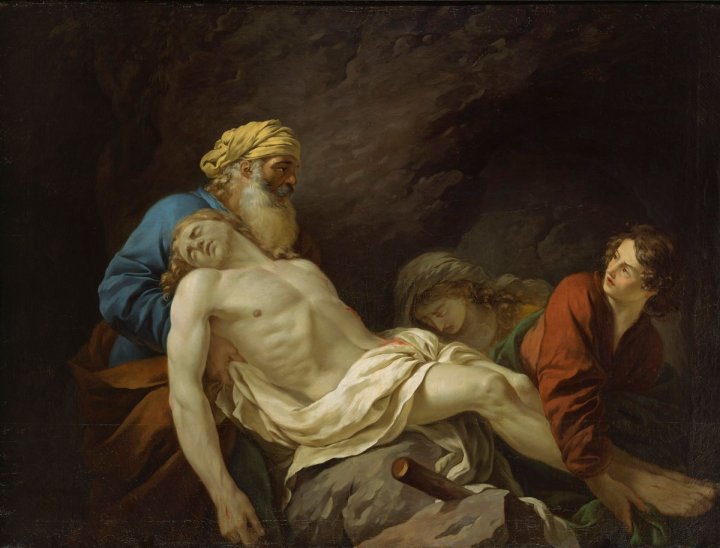
Jean-Jacques Lagrenée, The Entombment, 1770, oil on canvas, 155 × 205 cm
(Québec City, MNBAQ, 1970.115; photo: Patrick Altman)
◊ ◊ ◊ ◊ ◊
The 18th-Century Desjardins Paintings
The Desjardins paintings consist of fewer 18th-century works—mainly French—than 17th-century ones. However, chronologically, they cover the entire century. It comprises a body of work done for the churches of Paris by the most important artists of the time. At first there were originals or copies by all the big names (Collin de Vermont, Restout, Cazes, Massé or Vanloo), but several have disappeared since. The absence of a Boucher or a Fragonard is not surprising, since religious commissions occupied only a very minor place in their respective work.
The second half of the century, which marks a renewal of history painting and a gradual return to the antique model, is illustrated through Challe’s paintings for the Louvre Oratory, Lagrenée’s two masterpieces from the Abbey of Montmartre, and the large painting by Menageot. This work by well-known painters is complemented by paintings by less famous artists such as Godefroy and Preudhomme (Ursulines de Québec chapel). As a result, the paintings from the 18th century provide a far more exhaustive portrait of their era than their 17th-century counterparts. It must be borne in mind that the paintings of the Enlightenment were still very recent at the time when the Revolution broke out and did not always enjoy the same prestige as the works of the Grand Siècle.
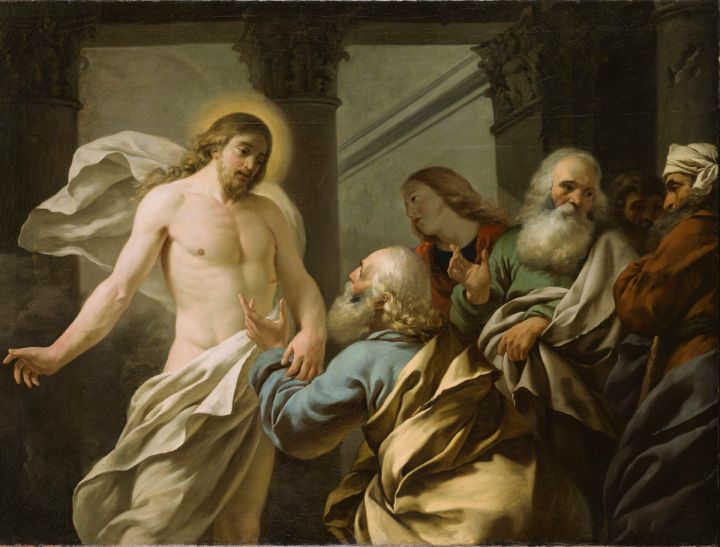
Jean-Jacques Lagrenée, The Incredulity of St Thomas, 1770, oil on canvas, 156 × 206 cm
(Québec City, MNBAQ, 1970.114; photo: Patrick Altman)
◊ ◊ ◊ ◊ ◊
The Desjardins Paintings, Joseph Légaré and Art Museums in Québec
Starting in the early 1820s, self-taught Québec painter Joseph Légaré purchased several canvases from among the Desjardins paintings, some of which were the inspiration for his numerous copies. His collection would pave the way for the creation of the first two art museums in Québec in the 19th century.
As early as 1829, Légaré exhibited his collection in the meeting room of the Literary and Historical Society of Quebec. In 1833, he moved it to his three-storey residence on Sainte-Angèle Street. In association with lawyer Thomas Amiot, he inaugurated the Québec Gallery of Paintings in 1838. However, Légaré’s ventures did not seem to spark much interest, and the gallery folded in 1840. Undaunted, in 1852 the painter opened the Quebec Gallery in his new home at the corner of Sainte-Ursule and McMahon Streets. Légaré died in 1855, but his widow kept the museum open until her death in 1874. Monseigneur Thomas-Étienne Hamel, Superior of the Séminaire de Québec and Rector of Laval University, bought the collection.
This acquisition laid the foundation for the Pinacotheque at Laval University as North America entered a period of museum-mania. Even before the inauguration of the first building of the Art Association of Montreal (the future Montréal Museum of Fine Arts) in 1879, the City of Québec had an art museum, thanks to Joseph Légaré’s determination. The Desjardins paintings imported some 60 years earlier formed the core of the museum’s collection.
The Augustines and Ursulines de Québec Paintings
As we have seen, the Abbés Desjardins had special ties with the Augustines de l’Hôtel-Dieu and the Ursulines de Québec, ties that went well beyond the paintings themselves. From the outset, the former were an integral part of the adventure by lending their buildings for the reception, uncrating and remounting of the paintings and by extending their hospitality to the painters involved and customers from everywhere in Québec. François-Guillaume Ménageot’s The Virgin Placing Saint Teresa under the Protection of Saint Joseph, usually found on the left lateral altarpiece of the exterior chapel of the Augustines, attests to this significant episode in the life of the paintings.
Several generations of Ursulines have venerated Christ Exposing his Sacred Heart to Margaret Mary Alacoque, by Pierre-Jacques Cazes, usually strategically placed in the exterior chapel, a place of worship which is the permanent home of the greatest number of Desjardins paintings. Seven paintings are displayed there, including Brother André’s The Meal at the House of Simon, the biggest of all the Desjardins paintings, at 3.66 metres high by 6.10 metres wide.
Copying and Distribution of the Desjardins Paintings
 The Desjardins paintings played a crucial role in the growth of painting in Lower Canada by stimulating the budding careers of artists who, after having done copies of certain works, diversified their output. Since at the time there were no fine arts academies or schools in Lower Canada, these painters were able to learn the basics by borrowing to various degrees from the French academic tradition made available through this pool of 17th- and 18th-century paintings.
The inventory of the copies—a little over 120 done in the 19th century—shows that one quarter of the Desjardins paintings were used as templates by Québec artists. The most of the copies were in the chapel of the Séminaire de Québec, at the Cathedral-Basilica of Notre-Dame-de-Québec and in Joseph Légaré’s collection. The copies found their way to nearly 70 parishes or collectors, the result being considerable visibility for these paintings in our churches.
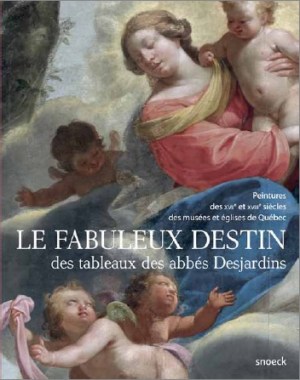
Laurier Lacroix, Guillaume Kazerouni, and Daniel Drouin, Le Fabuleux Destin des Tableaux des Abbés Desjardins: Peintures des XVIIe et XVIIIe siècles des musées et églises du Québec (Gent: Snoeck Publishers, 2017), 312 pages, ISBN: 978 94616 14162, 39€.
Exhibition | Fired by Passion: Masterpieces of Du Paquier Porcelain
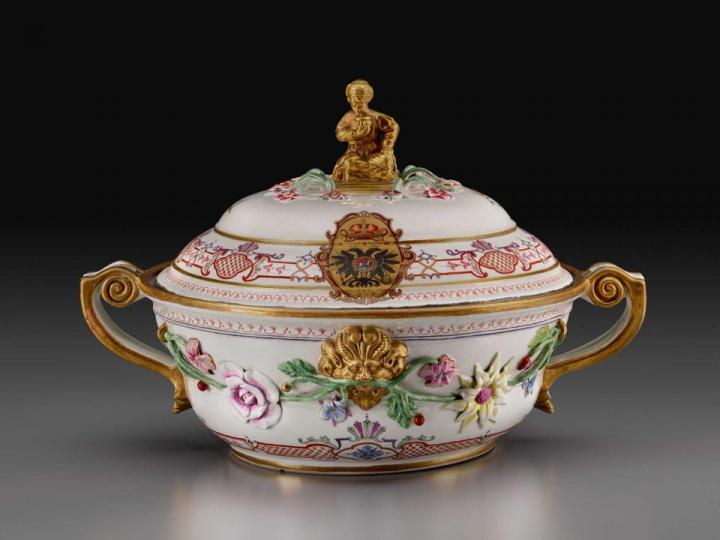
Du Paquier Manufactory, Tureen from the Service for Czarina Anna Ivanovna,; ca. 1735; hard-paste porcelain, 23.2 × 36.5 × 28.9 cm (The Frick Collection; gift of from the Melinda and Paul Sullivan Collection, 2016).
◊ ◊ ◊ ◊ ◊
Now on view at The Frick:
Fired by Passion: Masterpieces of Du Paquier Porcelain from the Sullivan Collection
The Frick Collection, New York, 8 June 2017 — 12 August 2018
Curated by Charlotte Vignon
The Frick Collection announces a new year-long installation in the Portico Gallery, Fired by Passion, inspired by the generous gift of fourteen pieces of Du Paquier porcelain made to the Frick in 2016 by Paul Sullivan and Trustee Melinda Martin Sullivan. The Du Paquier Manufactory was established in Vienna in 1718 by Claudius Innocentius du Paquier, an entrepreneur and official at the Viennese Court, and was only the second manufactory in Europe to produce true porcelain, after the Royal Meissen Manufactory, outside Dresden. Although in operation for only twenty-five years, Du Paquier left an impressive body of inventive and often whimsical work, forging a distinct identity in the history of European porcelain production.
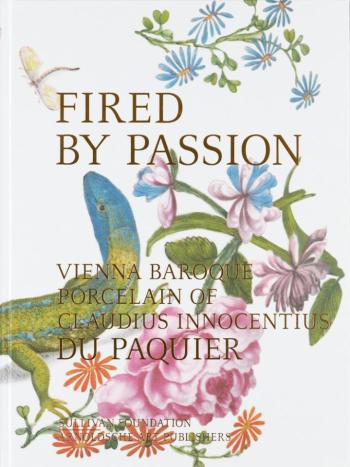 Fired by Passion presents about forty tureens, drinking vessels, platters, and other objects produced by Du Paquier between 1720 to 1740, which were coveted by aristocrats in Vienna and throughout Europe. In addition to exploring the rivalry between the Du Paquier and Meissen manufactories, the exhibition highlights the eclectic mix of references—many of them East Asian—that inspired Du Paquier porcelain. Splendid examples with coats of arms and heraldic symbols from commissions across Europe also illustrate the manufactory’s success and influence beyond Vienna. Fired By Passion is organized by Charlotte Vignon, Curator of Decorative Arts, The Frick Collection.
Meredith Chilton and Claudia Lehner-Jobst, Fired by Passion: Vienna Baroque Porcelain of Claudius Innocentius du Paquier (Stuttgart: Arnoldsche Art Publishers, 2009), 1432 pages, ISBN: 978 38979 03043 (English) / ISBN: 978 38979 03081 (German), $200.
The first comprehensive publication on this important porcelain manufactory, this work has been made possible through a five-year research program conducted by the Melinda and Paul Sullivan Foundation for the Decorative Arts. The objects shown, many of them for the first time here, are in major public and private collections. This 3-volume set presents the distinctive style and the exciting history of Du Paquier porcelain in the context of Baroque Vienna.
Extensive additional information, including photographs of all objects in the exhibition, is available here»
◊ ◊ ◊ ◊ ◊
Note (added 14 June 2017) — The original version of this posting mistakenly listed the date of the catalogue as 2017; in fact, it appeared in 2009.
Exhibition | Cristóbal de Villalpando: Mexican Painter of the Baroque
Press release from The Met:
Cristóbal de Villalpando: Mexican Painter of the Baroque
Palacio de Cultura Banamex – Palacio de Iturbide, Mexico City, 9 March — 4 June 2017
The Metropolitan Museum of Art, New York, 25 July — 15 October 2017
Curated by Ronda Kasl, Jonathan Brown, and Clara Bargellini
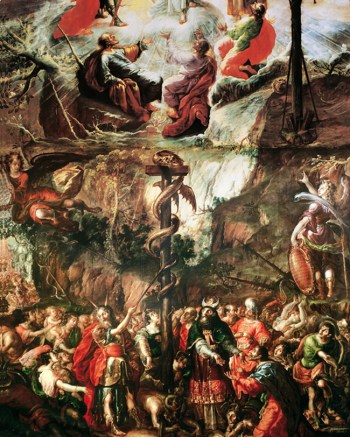
Cristóbal de Villalpando, Moses and the Brazen Serpent and the Transfiguration of Jesus (detail), 1683; oil on Canvas. Col. Propiedad de la Nación Mexicana, Secretaría de Cultura, Dirección General de Sitios y Monumentos del Patrimonio Cultural Acervo de la Catedral de Nuestra Señora de la Inmaculada Concepción, Puebla, Mexico.
Cristóbal de Villalpando (ca. 1649–1714) emerged in the 1680s not only as the leading painter in viceregal Mexico, but also as one of the most innovative and accomplished artists in the entire Spanish world. Opening July 25 at The Metropolitan Museum of Art, the exhibition Cristóbal de Villalpando: Mexican Painter of the Baroque features his earliest masterpiece, a monumental painting depicting the biblical accounts of Moses and the brazen serpent and the Transfiguration of Jesus that was painted in 1683 for a chapel in Puebla Cathedral. Newly conserved, this 28-foot-tall canvas has never been exhibited outside its place of origin. Ten additional works, most of which have never been shown in the United States, will also be exhibited. Highlights include Villalpando’s recently discovered Adoration of the Magi, on loan from Fordham University, and The Holy Name of Mary, from the Museum of the Basilica of Guadalupe.
Born in Mexico City around mid-century, Cristobal de Villalpando may have begun his career in the workshop of Baltasar de Echave Rioja (1632–1682). Villalpando’s rise to prominence coincided with the death of Echave Rioja in 1682, just one year before Villalpando painted his ambitious Moses and the Brazen Serpent and the Transfiguration of Jesus. Villalpando was celebrated in his lifetime, rewarded with prestigious commissions, and honored as an officer of the Mexico City painters’ guild.
The exhibition begins with Villalpando’s masterful Moses and the Brazen Serpent and the Transfiguration of Jesus, which was painted to decorate a chapel in Puebla Cathedral that was dedicated to a miracle-working image of Christ at the Column. In wealth and importance, Puebla Cathedral was second only to the Metropolitan Cathedral in Mexico City.
This painting—the first in a series of important ecclesiastical commissions—marks a breakthrough in Villalpando’s work, in terms of its grand scale and its audacious conception and execution. He signed it Villalpando inventor, an inscription that distinguishes the artist’s intellectual achievement from his manual skill and asserts his professional status as the learned practitioner of a noble art. In a bold and erudite arrangement, Villalpando juxtaposed the Old Testament story of Moses and the brazen serpent with the New Testament account of the Transfiguration—an unprecedented pairing of subjects. The two biblical events are staged within a single, continuous sacred landscape that encompasses the wilderness of Exodus and the holy mounts of Calvary and Tabor. Life-size figures of every age and gender, clothed and nude and in an astounding variety of poses and attitudes, populate the composition. The painting’s lower half features the story of Moses making and using the image of the brazen serpent according to God’s instructions to heal Israelites bitten by poisonous serpents. This episode provides a scriptural precedent for the making and use of images in worship, while also affirming the importance of art and artists. The upper half of the composition represents the transfiguration of Jesus’s corporeal body into light, a scene that demanded nothing less than the materialization of light in paint, which Villalpando attained through shimmering color and fluid brushwork.
Ten additional paintings by Villalpando will demonstrate his intense striving as an inventor; his great originality and skill; his ability to convey complex subject matter; and his capacity to envision the divine.
Catalogues in English and Spanish published by Fomento Cultural Banamex will accompany the exhibition. Essays address the major themes of the exhibition. The catalogues will be available for purchase in The Met book shop. A series of exhibition tours will complement the exhibition.
The exhibition was curated by Ronda Kasl, Curator of Latin American Art in The American Wing at The Met; Jonathan Brown, Carol and Milton Petrie Professor of Fine Arts, Institute of Fine Arts, New York University; and Clara Bargellini, Professor, Instituto de Investigaciones Estéticas, Universidad Nacional Autónoma de México. The work of Dr. Brown and Dr. Bargellini was commissioned by Fomento Cultural Banamex. At The Met, the exhibition is designed by Michael Langley, Exhibition Design Manager; graphics are by Mortimer Lebigre, Graphic Designer; and lighting is by Clint Ross Coller and Richard Lichte, Lighting Design Managers, all of the Museum’s Design Department.
Exhibition | Casanova: The Seduction of Europe
From the Kimbell Art Museum and Distributed Art Publishers (DAP) . . .
Casanova: The Seduction of Europe / Casanova’s Europe: Art, Pleasure, and Power
Kimbell Art Museum, Fort Worth, 27 August — 31 December 2017
The Legion of Honor, San Francisco, 10 February — 28 May 2018
Museum of Fine Arts, Boston, 1 July — 8 October 2018

Jean-Marc Nattier, Portrait of Manon Balletti, 1757, oil on canvas, 54 × 47.5 cm (London: National Gallery). Balletti was the fiancée (1757–60) of Giacomo Casanova and then wife (1760–74) of the architect Jacques-François Blondel.
Casanova: The Seduction of Europe explores the 18th century across Europe through the eyes of one of its most colorful characters, Giacomo Casanova (1725–1798). Renowned in modern times for his amorous pursuits, Casanova lived not only in Italy, but in France and England, and his travels took him to the Ottoman Empire and to meet Catherine the Great in Saint Petersburg. Bringing together paintings, sculpture, works on paper, furnishings, porcelains, silver, and period costume, Casanova will bring this world to life. Following its display in Fort Worth, the exhibition will be on view at the Fine Arts Museum of San Francisco and the Museum of Fine Arts, Boston.
Frederick Ilchman, Thomas Michie, C.D. Dickerson III, and Esther Bell, with texts by Meredith Chilton, Jeffrey Collins, Nina Dubin, Courtney Leigh Harris, James Johnson, Pamela Parmal, Malina Stefanovska, Susan Wager, and Michael Yonan, Casanova: The Seduction of Europe (Boston: MFA Publications, 2017), 344 pages, ISBN: 978 087846 8423, $45.
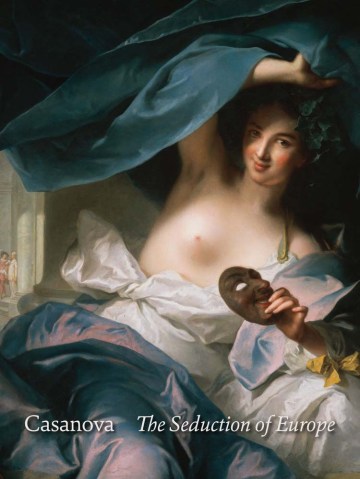 In 18th-century Europe, while the old order reveled in the luxurious excesses of the Rococo style and the Enlightenment sowed the seeds of revolution, the shapeshifting libertine Giacomo Casanova seduced his way across the continent. Although notorious for the scores of amorous conquests he recorded in his remarkably frank memoirs, Casanova was just as practiced at charming his way into the most elite social circles, through an inimitable mix of literary ambition, improvisational genius and outright fraud. In his travels across Europe and through every level of society from the theatrical demimonde to royal courts, he was also seduced by the visual splendors he encountered.
This volume accompanies the first major art exhibition outside Europe to lavishly recreate Casanova’s visual world, from his birthplace of Venice, city of masquerades, to the cultural capitals of Paris and London and the outposts of Eastern Europe. Summoning up the people he met and the cityscapes, highways, salons, theaters, masked balls, boudoirs, gambling halls and dining rooms he frequented, it provides a survey of important works of 18th-century European art by masters such as Canaletto, Fragonard, Boucher, Houdon, and Hogarth, along with exquisite decorative arts objects. Twelve essays by prominent scholars illuminate multiple facets of Casanova’s world as reflected in the arts of his time, providing a fascinating grand tour of Europe conducted by a quintessential figure of the 18th century as well as a splendid visual display of the spirit of the age.
◊ ◊ ◊ ◊ ◊
Note (added 20 August 2018) — This article might be of interest for anyone thinking about the exhibition and its reception within our own political/cultural context: Cynthia Durcanin, “Casanova as Case Study: How Should Art Museums Present Problematic Aspects of the Past?,” ArtNews (13 August 2018). As noted in the essay: “The MFA also changed the show’s title from the Legion of Honor’s, removing the word ‘seduction’ so that it became ‘Casanova’s Europe: Art, Pleasure and Power in the 18th Century’.” According to Katie Getchell, the chief brand officer and deputy director of the MFA Boston, “It’s an important nuance. The show is not about Casanova—it’s about Europe in Casanova’s time.”
2017 AAMC Awards Announced
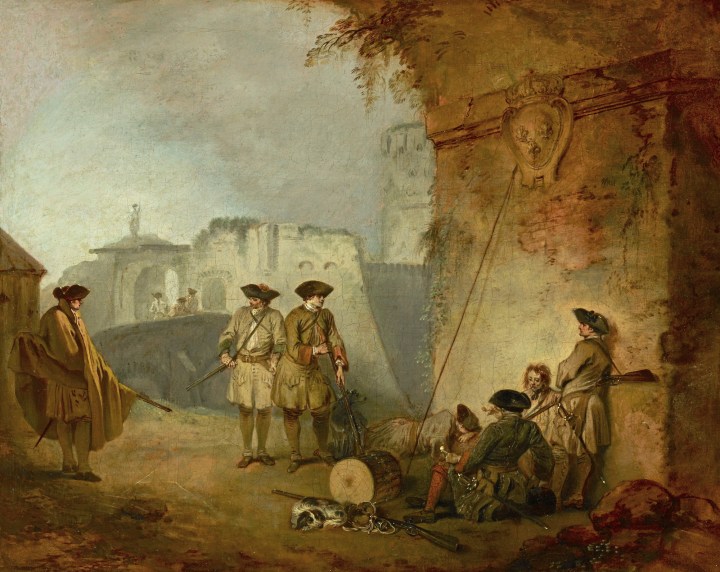
Jean-Antoine Watteau, The Portal of Valenciennes, ca. 1710–11, oil on canvas, 32.5 × 40.5 cm (New York: The Frick Collection, purchased with funds from the bequest of Arthemise Redpath, 91.1.173 / photo: Michael Bodycomb).
◊ ◊ ◊ ◊ ◊
Congratulations to Aaron Wile! His essay “Watteau and the Inner Life of War”—from the catalogue Watteau’s Soldiers: Scenes of Military Life in Eighteenth-Century France , published in conjunction with the exhibition that Wile also curated for The Frick Collection—was awarded the 2017 Prize for ‘Best Article, Essay, or Extended Catalogue Entry’ from the Association of Art Museum Curators (AAMC).
A full list of awards is available here»
Exhibition | Lives Bound Together: Slavery at Mount Vernon
◊ ◊ ◊ ◊ ◊
Now on view at Mount Vernon:
Lives Bound Together: Slavery at George Washington’s Mount Vernon
The Donald W. Reynolds Museum, Mount Vernon, 1 October 2016 –30 September 2017
Mount Vernon was George Washington’s home. It was also home to hundreds of enslaved people who lived and worked under Washington’s control: in 1799, there were 317 men, women, and children enslaved at Mount Vernon’s five farms, which covered 8,000 acres. They made up more than 90% of the population of the estate.
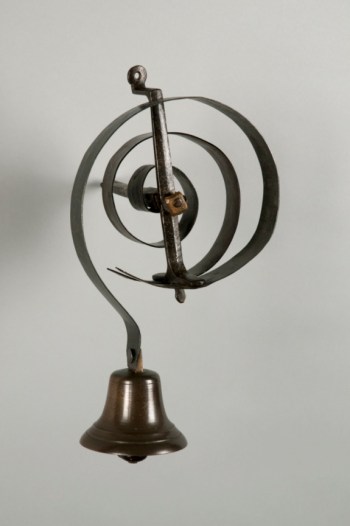
House Bell, ca. 1784–88; Copper alloy, iron (Mount Vernon).
Through household furnishings, art works, archaeological discoveries, documents, and interactive displays, the exhibition, which spans 4,400 square feet throughout all seven galleries of the Donald W. Reynolds Museum, demonstrates how closely intertwined the lives of the Washingtons were with those of the enslaved. Nineteen enslaved individuals are featured throughout the exhibit, represented with life-size silhouettes and interactive touchscreens providing biographical details.
More than 350 items are on view—seeds and animal bones, ceramic fragments, and metal buttons unearthed from archaeological excavations around the estate, as well as fine tablewares and furniture from the Washington household, providing insights into the enslaved community’s daily lives and work. Guests gain a better understanding of Washington’s changing views towards slavery, culminating in his landmark decision to include in his will a provision freeing the slaves that he owned. Visitors will have an opportunity to view original manuscript pages from George Washington’s will, written in July 1799, showing his decision to free the slaves he owned. The exhibition profiles 19 individuals enslaved at Mount Vernon, using George Washington’s extensive records to piece together what is known of their lives in interactive displays.
Susan P. Schoelwer, ed., with an introduction by Annette Gordon-Reed, Lives Bound Together: Slavery at George Washington’s Mount Vernon (2016), 172 pages, ISBN: 978 970931 9170, $20.
Lives Bound Together provides fresh research on this important topic, with brief biographies of 19 enslaved individuals, 10 essays, and 130 illustrations, including paintings, prints, and household furnishings from the Mansion, artifacts excavated by archaeologists from the slave quarters, documents, maps, and conjectural silhouettes that suggest the presence of the enslaved.
Exhibition | Peter the Great: A Tsar in France, 1717
Press release for the exhibition at Versailles, with thanks to Elizabeth Jane Timms for noting it:
Peter the Great: A Tsar in France, 1717
Grand Trianon, Château de Versailles, 30 May — 24 September 2017
Cuarated by Gwenola Firmin, Thierry Sarmant, and George Vilinbakhov
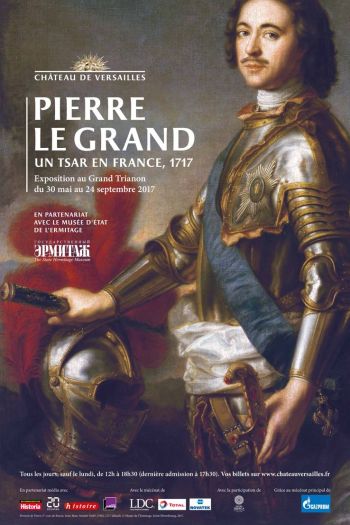 The exhibition Peter the Great: A Tsar in France, 1717 will be on display in the Grand Trianon from 30 May to 24 September 2017. It is dedicated to Tsar Peter the Great’s trip in and around Paris in May and June 1717 and will commemorate the 300th anniversary of this diplomatic visit. The fruit of exceptional collaboration between the Palace of Versailles and the Hermitage Museum, the exhibition will present over 150 works including paintings, sculptures, decorative artworks, and tapestries, as well as plans, medallions, scientific instruments, books and manuscripts, two thirds of which belong to the collections of the prestigious museum in Saint Petersburg.
A member of the house of Romanov and son of Tsar Alexis Mikhailovich (1645–1676) and Nataliya Naryshkina (1651–1694), Peter I (1672–1725) embarked on a second journey to the West twenty years after the Grand Embassy, which took him to Europe for the first time in 1697–98. He arrived in France on 21 April 1717 and remained until 21 June. He stayed at Versailles twice and was accommodated in the Grand Trianon, from 24 to 26 May and from 3 to 11 June. The exhibition will lead visitors step by step through the trip, which, although official, nonetheless allowed a certain amount of freedom since Peter I, being little accustomed to French etiquette and with his imposing figure and unpredictability, departed from protocol on multiple occasions. His encounter with Louis XV particularly shocked onlookers when, flouting the ceremonial custom of the court, he spontaneously took the young king, aged 7, in his arms. A number of memorialists, including Saint-Simon, the Marquis de Dangeau and Jean Buvat, left precious testimonies allowing us to retrace the journey.
Although there were political and economic aims to the stay—a project for an alliance with France against Sweden and the signature of a trade agreement—the reforming Tsar and founder of modern Russia most particularly wanted to see the finest of France in order to adapt certain models for his own empire. During the two months that Peter the Great spent in Regency Paris, his visits and discussions with French people provided him with food for thought and had an influence on the works he started in 1703 in Saint Petersburg and the surrounding area.
Pierre le Grand: Un Tsar en France, 1717 (Paris: 2017), 240 pages, ISBN: 978 23590 62014, 38€.
Curators
• Gwenola Firmin Curator in charge of paintings from the 18th century at the Palace of Versailles
• Thierry Sarmant Chief curator, head of the Archives historic Center, historic department of the Defence
• George Vilinbakhov Vice-director of the State Hermitage Museum in Saint Petersburg










leave a comment