Exhibition | The Lure of Italy: Artists’ Views
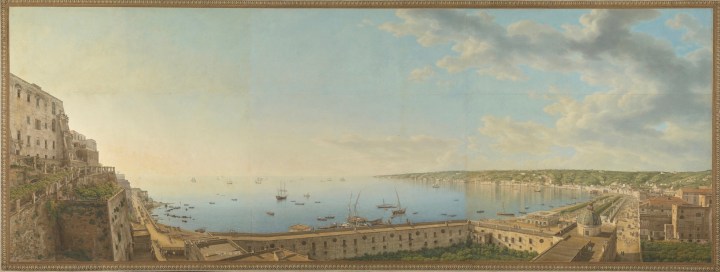
Giovanni Battista Lusieri, A View of the Bay of Naples, Looking Southwest from the Pizzofalcone towards Capo di Posilippo, 1791; watercolor, gouache, graphite, and pen and ink on six sheets of paper; unframed: 102 × 272 cm (Los Angeles: The J. Paul Getty Museum, 85.GC.281).
◊ ◊ ◊ ◊ ◊
Press release (20 April 2017) for the exhibition now on view at The Getty:
The Lure of Italy: Artists’ Views
The Getty Center, Los Angeles, 9 May — 30 July 2017
Curated by Julian Brooks with Annie Correll
For centuries, Italy has fascinated travelers and artists alike. From the crumbling ruins of ancient Rome to the crystal-clear light of Venice, artists have found inspiration not only in the cities but also in the countryside and in Italy’s rich history and culture. The Lure of Italy: Artists’ Views explores the numerous ways Italy’s topography, history, and culture have motivated artists to create works of extraordinary beauty and resonance. The exhibition, selected from the Getty Museum’s permanent collection of drawings and watercolors, includes several important recent acquisitions, including works by Francesco Guardi and Richard Parkes Bonington.
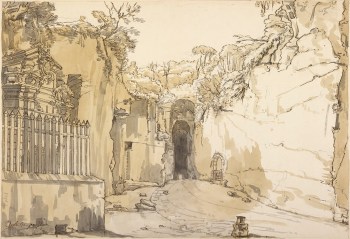
Claude-Joseph Vernet, The Entrance to the Grotto at Posillipo, ca. 1750; pen and brown ink with brown and gray wash over black chalk, 34 × 49 cm (Los Angeles: The J. Paul Getty Museum, 97.GG.53).
“For many, Italy represented—and still represents today—a stunningly lush treasure of scenic wonder, with picturesque ancient sculptures, historic buildings, and dramatic landscapes,” says Timothy Potts, director of the J. Paul Getty Museum. “This exhibition bears witness to the long-standing love affair that artists have had with the country of Italy.”
Italy—a collection of city-states until unification in the 1800s—has captured the imagination of artists for centuries, yet interest in the country peaked in the 1700s, when the region became a prime destination for wealthy travelers embarking on the Grand Tour from England, France, the Netherlands, Germany, and beyond. Artists journeying with them or working for them used pencil, ink, and watercolor to capture celebrated views and preserve vivid memories, creating works that encapsulate the essence and spirit of Italy.
Italian natives such as Guardi, Canaletto, and Giovanni Battista Lusieri responded to the tourist demand for souvenirs by crafting their own masterpieces. Guardi’s A Regatta on the Grand Canal (about 1778), a recent acquisition for the Getty, conveys with freshness and spontaneity the lively atmosphere of the annual gondola race (regatta) in Venice. The finish line is at left and spectators crowd the balconies of the nearby Palazzo Balbi, while the water bustles with decorated gondolas.
Further south, the Bay of Naples was another favorite destination of Grand Tourists. Lusieri’s huge, nearly nine-foot wide panorama, A View of the Bay of Naples (about 1791) is meticulously executed in tiny detail with watercolor. It was painted over a period of two years from the residence of Sir William Hamilton, the British envoy to the court of Naples, who commissioned it for his London home. The view looks towards the Capo di Posillipo and the so-called grotto there, a feat of ancient-Roman engineering.
Other highlights include sketches of enchanting sites with plunging perspectives through the rich Italian countryside, capriccio scenes caught between fantasy and reality, studies of ancient ruins, Roman landmarks and lauded works of art, and views of the most picturesque and awe-inspiring sights that Italy has to offer.
During his only visit to Venice, two years prior to his death at age 25 from tuberculosis, Richard Parkes Bonington made numerous pencil sketches and a handful of oil and watercolor studies of the city. The jewel-like Riva degli Schiavoni, from near San Biagio, Venice (1826) emphasizes his renowned ability to capture the effects of calm water and dramatic cloud formations in watercolor. This match of subject and media helped to make the magical atmosphere of the city the real subject of his work. “The extraordinary character of Italian cityscapes and landscapes pushed artists to the limits of their potential,” says Julian Brooks, senior curator of drawings at the J. Paul Getty Museum. “To render them effectively, the choices of media and technique became crucial.”
The Lure of Italy: Artists’ Views is curated by Brooks, with the assistance of Annie Correll, graduate intern in the Department of Drawings. The exhibition is presented in conjunction with Eyewitness Views: Making History in Eighteenth-Century Europe (9 May — 30 July 2017) on view in the Special Exhibitions Pavilion at the J. Paul Getty Museum.
The exhibition checklist is available as a PDF file here»
S E L E L E C T E D P R O G R A M M I N G
Peter Björn Kerber, Venice vs. Rome: A Capital Contest
Saturday, May 13, 3:00pm
Pitting gilded gondolas against sumptuous coaches, Venice and Rome sought to surpass each other in staging the eighteenth century’s most spectacular festivals and celebrations. Peter Bjorn Kerber, curator of the exhibition Eyewitness Views: Making History in Eighteenth-Century Europe, explores the pictures Canaletto, Panini, and other leading painters produced to record these dazzling occasions.
Julian Brooks, The Bumpy Road to Beautiful Italy
Sunday, June 4, 3:00pm
With one eye on the practicalities and perils of travel in Italy in past centuries, Julian Brooks, senior curator of drawings at the Getty, discusses some of the works of art made by visitors to the country, and how they responded to—and fueled—the lure of Italy.
From The Getty Shop:
Julian Brooks, The Lure of Italy: Artists’ Views (Los Angeles: Getty Publications, 2017), 96 pages, ISBN: 978 160606 5198, $20.
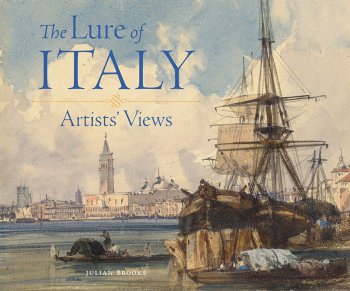 For centuries Italy has fascinated travelers and artists. From the crumbling ruins of ancient Rome to the crystal-clear light of Venice, artists have found inspiration not only in the cities but also in the countryside and in the deep history and culture. From as early as the 1500s, artists visiting from France, England, the Netherlands, and Germany drew sketches to preserve vivid memories, often creating work of extraordinary atmosphere and beauty in the process. A growing number of tourists in the subsequent centuries fueled a further demand for souvenir views, spurring local artists to craft their own masterpieces.
This lovely book is a narrated assemblage of some of these beautiful views, which transport the reader effortlessly to Italy, rekindling memories, setting intentions, or provoking curiosity. The text provides new insights into the topographical renditions of Italian scenes over the centuries, while compelling illustrations of works from the Getty collection by artists such as Richard Parkes Bonington, J. M. W. Turner, Claude Lorrain, Giovanni Battista Lusieri, Canaletto, and many more capture the essence and spirit of Italy.
Julian Brooks is senior curator and head of the Department of Drawings at the J. Paul Getty Museum, where he has organized and co-organized numerous exhibitions. Among his many publications are Andrea del Sarto: The Renaissance Workshop in Action (Getty Publications, 2015) and Master Drawings Close-Up (Getty Publications, 2010).
Exhibition | Eyewitness Views: Making History
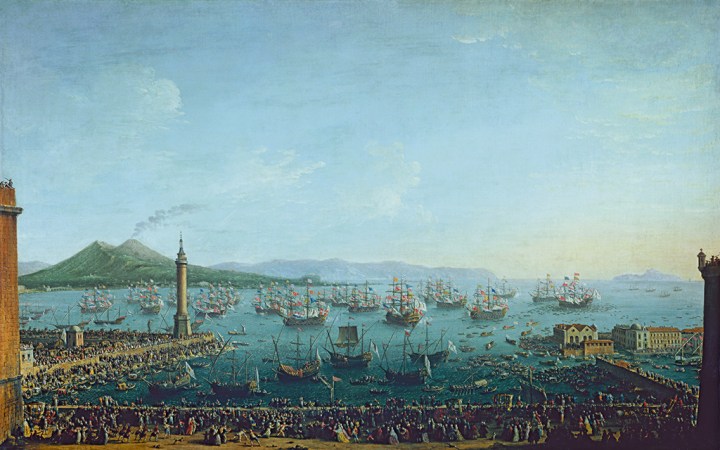
Antonio Joli, Departure of Charles III from Naples to Become King of Spain, 1759, oil on canvas
(Madrid: Museo Nacional del Prado)
◊ ◊ ◊ ◊ ◊
Opening tomorrow at The Getty:
Eyewitness Views: Making History in Eighteenth-Century Europe
The Getty Center, Los Angeles, 9 May — 30 July 2017
Minneapolis Institute of Art, 10 September — 31 December 2017
The Cleveland Museum of Art, 25 February — 20 May 2018
Curated by Peter Björn Kerber
From Paris to Venice to Rome, Europe’s most iconic cities have played host to magnificent ceremonies and dramatic events—and artists have been there to record them. During the eighteenth century, princes, popes, and ambassadors commissioned master painters such as Canaletto and Panini to record memorable moments, from the Venetian carnival to eruptions of Vesuvius, inspiring what became the golden age of view paintings.
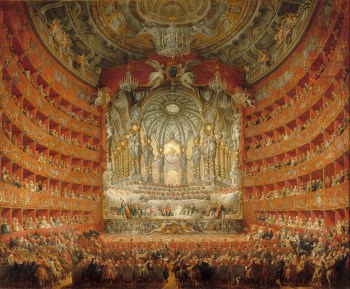
Giovanni Paolo Panini, The Musical Performance in the Teatro Argentina in Honor of the Marriage of the Dauphin, 1747, oil on canvas (Paris: Musée du Louvre)
This is the first exhibition to focus on view paintings as depictions of contemporary events. These reportorial works visually record occasions ranging from royal celebrations to state visits, religious ceremonies, sporting contests, and natural disasters. Their dates correspond to the golden age of European view painting from the beginning of the eighteenth century to the eve of the French Revolution. Through immersive compositions and a wealth of acutely observed detail, artists skillfully created the illusion that the viewer is present on the scene as history is made.
Memory & Manipulation
Members of the highest echelons of European society, from kings and popes to doges and ambassadors, commissioned view painters to commemorate the spectacular events staged at their command or for their benefit. In many cases, these noble patrons are themselves portrayed in the resulting canvases. While artists cultivated the impression that they were faithful chroniclers capturing an event on canvas just as they had witnessed it, they were in fact not above manipulating or ‘improving’ upon reality in order to meet the expectations of their status-conscious clientele.
Civic & Religious Ritual
In Europe’s major cities, the populace gathered throughout the year to commemorate local historic events, celebrate religious feast days, or participate in public rituals. Whether sacred or secular in character, these occasions were always imbued with civic pride. They were also among the few times when the different social classes interacted with each other and shared a common experience. Religious processions typically involved a revered object—such as the Blessed Sacrament, a relic, or a statue—that was carried through the streets with pomp and fanfare. A city’s deliverance from devastating epidemics of bubonic plague was commemorated with recurring festivals of thanksgiving and supplication, since the threat of a resurgence remained very real in the eighteenth century.
Festival & Spectacle
In eighteenth-century Europe, Venice was the undisputed capital of pageantry and entertainment. Undaunted by its political and economic decline, the Serene Republic and its aristocracy invested vast sums in maintaining its traditional ceremonies and dazzling its visitors—for example, by commissioning a new version of the Bucintoro, the lavishly gilded state barge used only on Ascension Day. Financial considerations were also brushed aside to provide extravagant entertainments for kings or princes staying in the city. The grandest of these special events was a ceremonial regatta. In Rome, a comparable level of opulence was seen in the French embassy’s celebrations of royal births and marriages.
Disaster & Destruction
Images of tragic events satisfied a desire for paintings that stimulated the imagination. Whether they showed devastation caused by warfare, fire, natural disaster, or political turmoil, these works offered viewers the thrill of witnessing a catastrophe. They stand apart from most other reportorial paintings in that they downplay the presence of rulers and nobility in favor of depicting the lower classes. Such figures were rarely intended to be recognizable likenesses of actual people. Instead, they serve as proxies through which viewers are able to funnel their own reactions to unfolding calamity.
From The Getty Store:
Peter Björn Kerber, Eyewitness Views: Making History in Eighteenth-Century Europe (Los Angeles: Getty Publications, 2017), 252 pages, ISBN: 978-160606 5259, $45.
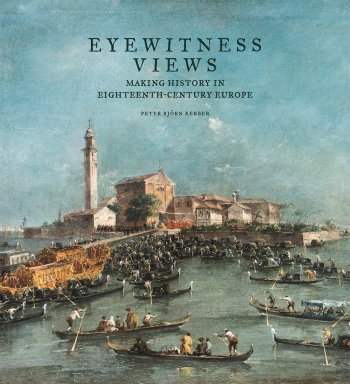 Canaletto, Bernardo Bellotto, Luca Carlevarijs, Giovanni Paolo Panini, Francesco Guardi, Hubert Robert—these renowned view painters are perhaps most famous for their expansive canvases depicting the ruins of Rome or the canals of Venice. Many of their most splendid paintings, however, feature important contemporary events. These occasions motivated some of the greatest artists of the era to produce their most exceptional work. Little explored by scholars, these paintings stand out by virtue of their extraordinary artistic quality, vibrant atmosphere, and historical interest. They are imbued with a sense of occasion, even drama, and were often commissioned by or for rulers, princes, and ambassadors as records of significant events in which they participated.
Lavishly illustrated and meticulously researched, this volume provides the first-ever comprehensive study—in any language—of this type of view painting. In examining these paintings alongside the historical events depicted in them, Peter Bjorn Kerber carefully reconstructs the meaning and context these paintings possessed for the artists who produced them and the patrons who commissioned them, as well as for their contemporary viewers.
Peter Björn Kerber is assistant curator of paintings at the J. Paul Getty Museum.
Exhibition | The Luther Effect
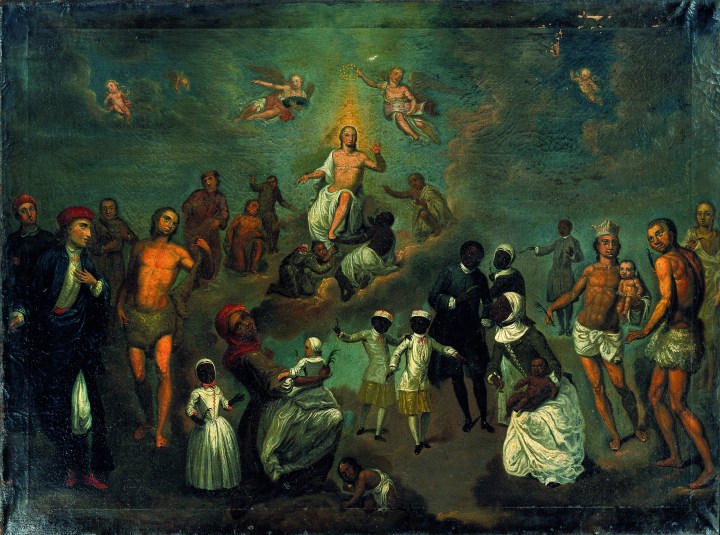
Johann Valentin Haidt, First Fruits (Erstlingsbild),1748
(Herrnhut: Unitätsarchiv der Evangelischen Brüder-Unität, GS 463)
◊ ◊ ◊ ◊ ◊
From the exhibition website:
The Luther Effect: Protestantism—500 Years in the World
Der Luthereffekt 500 Jahre Protestantismus in der Welt
Deutsches Historisches Museum at Martin-Gropius-Bau, Berlin, 12 April — 5 November 2017
The German Historical Museum (DHM) welcomes Martin-Gropius-Bau visitors on a trip through five centuries and across four continents. Marking the Reformation’s 500th anniversary, The Luther Effect shows the diversity and history, as well as the conflict potentials of Protestantism in the world. What impact has Protestantism had on other denominations and religions? How did Protestantism change through these encounters? And not least, how have people of different cultures adopted, shaped, and lived Protestant doctrine? Starting with Reformations in the 16th century, the exhibition highlights a global history of effect and counter-effect as seen in the examples of Sweden, the United States, South Korea, and Tanzania.
 An impressive display of around 500 original exhibits in an exhibition space measuring some 3,000 square meters (32,000 square feet), the exhibition includes exceptional artworks and compelling, meaningful everyday objects from the era. Many of these extraordinary exhibits are being shown in Germany for the first time, to mark the occasion of the 500th anniversary of the Reformation. Modern media is used to give background information, enriching the exhibition.
Reformations, 1450–1600
The Reformation was a European event. Since the 16th century, various paths of reform had been leading to a renewal of the Church and life in general. Martin Luther’s Reformation was one of these. However, from a global perspective, other paths such as the Reformed Church or the Anglican Church in England were more influential. The Catholic Church also underwent a process of reform.
Undisputed beliefs and centuries-old practices were called into question. Soon proponents and opponents of reform were fighting not only against each another but also among themselves. The more radical movements like the Anabaptists were persecuted and marginalised not only by Catholics, but by Lutherans and the Reformed as well. The competition forced Luther, the Reformed, Anabaptists, Anglicans, and Catholics to clarify their own positions and to set themselves apart from others. The different reform paths developed into denominations that continue to evolve dynamically to this day.
One Land, One Religion: Sweden as a Lutheran Great Power, 1500–1750
King Gustav Vasa of Sweden, influenced by the Lutheran Reformation, broke with the Pope in Rome in 1527. This contributed to the spread of various reformist ideas in the Swedish Empire. But it was the Synod and the Parliament of Uppsala in 1593 that first established the Lutheran Church as the binding confession of Sweden, resulting in a Lutheran State Church and a confessionally unified state in Sweden.
The Swedish State Church brought the evolution of a new religious culture. The community that emerged saw itself as the protective power of Lutheranism. Swedish rulers and their armies fought on Europe’s battlefields for Sweden’s great power status and Luther’s doctrines. At home in Sweden, the State Church became increasingly restrictive. Church discipline, and the conversion of the Sámi who lived in the north of the country, were intended to consolidate the Lutheran faith and foster a common identity.
The United States of America: The Promised Land?, 1600–1900
Protestantism was brought to the British colonies of North America, later the United States, through the immigration of various groups, churches, and confessions, which accounts for the diversity of American Protestantism. A state church does not exist in the United States; instead, there is a vast landscape of independent churches. Protestantism in the USA developed its unique profile under the influence of charismatic revivalist preachers beginning in the 18th century. This gave rise to new confessions and numerous social reform movements. The so-called Black Churches of African Americans also emerged in the course of this development. Protestantism contributed significantly to the creation of the American nation and the formation of its self-understanding. It shaped the notion of America as the Promised Land, and of Americans as the Chosen People. These concepts gave rise to ideas that continue to influence American society to the present day.
Korea: Boom Land of Protestantism, 1850–2000
In the Republic of Korea (South Korea), numerous religions lead a relatively peaceful coexistence. Almost 30 percent of South Koreans consider themselves Christian, and slightly fewer than two-thirds of them are Protestant. This makes South Korea the only East Asian country where a significant proportion of the population is Protestant.
Protestant missionaries could not settle permanently in Korea until the mid-1880s. At this time, the first Protestant communities, founded by Korean laypeople, already existed. Using the Korean alphabetic script Han’gul to translate the Bible proved to be an important instrument for the missions. After the division of the land and the Korean War 1950–53, most Christians fled the Democratic People’s Republic of Korea (North Korea) to the South. Since the 1960s, South Korea has developed rapidly into an industrialised state. At the same time, the religious landscape has changed drastically: in 1950, three percent of South Koreans were Protestant, and by 1995 the number had already risen to around 20 percent. The relation to North Korea, including the possible reunification of the country, is a key issue in South Korea, and for the Protestant churches as well. On such questions the churches take very diverse positions.
Tanzania: Mission and Self-Reliance Today
The country of Tanzania has been shaped by migration and by the more than 130 ethnic groups who coexist there in a largely peaceful atmosphere. Among the many forms of Tanzanian Protestantism, the Evangelical Lutheran Church in Tanzania (ELCT) plays a major role. With more than 6 million members in 24 dioceses, the ELCT is now the largest Lutheran Church in Africa and the second largest in the world. It traces its origins back to German, Scandinavian, and American missionary societies that were active in the region which had become the colony known as German East Africa (then encompassing today’s Tanzania, Burundi, Rwanda, and part of Mozambique). In addition, the Moravian Brethren, the Anglican Church, and charismatic movements were instrumental in the spread of Protestant faith communities.
A variety of Protestant churches rapidly developed, driven forward by devout Tanzanians. From the outset, the missions aimed to establish financially independent churches and parishes. Today, their influence extends beyond Tanzania’s borders. Missionaries from Tanzania work throughout the continent. With a heedful view of the European churches, they see themselves as preserving the original Lutheran ideals.
Transformation and Schism: Installation by Hans Peter Kuhn
Exclusively for the exhibition, the Berlin artist Hans Peter Kuhn transforms the atrium of the Martin-Gropius-Bau into a gigantic artwork out of aluminum tubing, light, and sound. The installation Transition approaches the worldwide effects of the Reformation from an artistic perspective and makes the processes of the transformation of the relationship of Man to God and the schism of the Church doctrines triggered by the Reformation palpable and perceptible.
◊ ◊ ◊ ◊ ◊
Published by Hirmer, the catalogue is distributed in North America and Japan by The University of Chicago Press:
The Luther Effect: Protestantism—500 Years in the World (Munich: Hirmer Verlag, 2017), 400 pages, ISBN: 978 37774 27225, $54.
To mark the occasion of the five-hundredth anniversary of the Protestant Reformation in 2017, The Luther Effect offers a vivid and rich journey across five centuries and four continents, detailing the visual history of the growth of Protestantism around the world. The book examines how Protestantism has affected—and been affected by—encounters with diverse denominations, cultures, and lifestyles throughout the centuries. It explores how Protestantism has adapted and transformed and how different people around the world have adopted, modified, and followed its doctrine. Including two hundred and fifty stunning color plates and looking specifically at the art and cultural objects created in response to and in celebration of the religious movement, The Luther Effect presents the first comprehensive global history of Protestantism’s influence, reverberations, and reception.
Exhibition | Treasures of the Hispanic Society of America
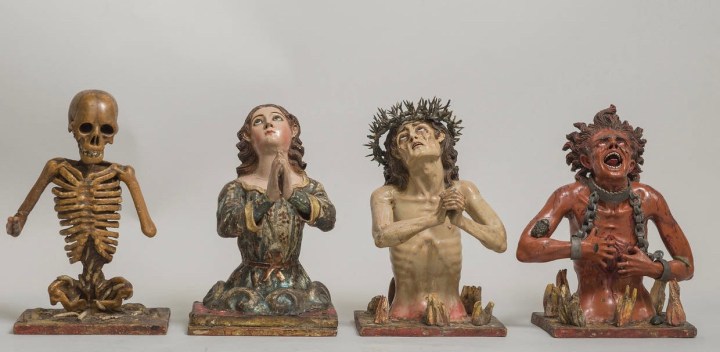
Manuel Chili, known as Caspicara, Four Fates of the Soul: Death, Soul in Heaven, Soul in Purgatory, and Soul in Hell, ca. 1775 (New York: The Hispanic Society of America).
◊ ◊ ◊ ◊ ◊
Press release (31 March 2017) for the exhibition:
Treasures of the Hispanic Society of America: Visions of the Hispanic World
Museo Nacional del Prado, Madrid, 4 April — 10 September 2017
Curated by Mitchell Codding
Through September 10, the Museo del Prado will present the treasures of the museum and library of the Hispanic Society, an institution located in Upper Manhattan in New York, founded in 1904 by Archer Milton Huntington (1870–1955), one of America’s greatest philanthropists. Huntington created an institution that reflected an appreciation of Spanish culture and the study of the literature and art of Spain, Portugal, and Latin America. Treasures of the Hispanic Society of America: Visions of the Hispanic World brings together more than two hundred works of art including paintings, drawings, and sculpture, archaeological artifacts, liturgical vestments, furniture, and books and manuscripts from the library, creating a fascinating chronological and thematic experience of the highlights of the Hispanic Society’s vast collections.
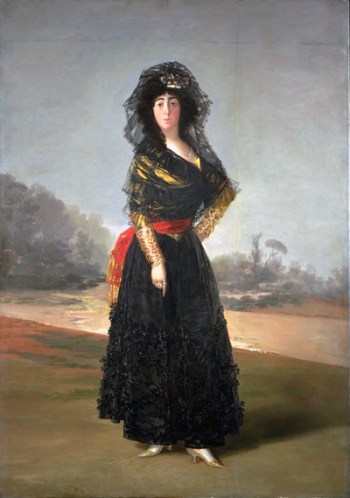
Francisco de Goya y Lucientes, The Duchess of Alba, 1796–97, oil on canvas, 210 × 149 cm (New York: The Hispanic Society of America).
With this exhibition—which occupies all of the temporary exhibition galleries in the new extension—the Museo del Prado offers its visitors the privilege of enjoying one museum within another, as it did in 2012 with the exhibition The Hermitage in the Prado. In this case, the renovation of the Hispanic Society’s galleries has allowed the treasures of their collections of Spanish and Latin American art, along with rare books and manuscripts, to travel to Spain. Many of the works of art that will be shown have not previously been exhibited or were unknown, including the reliquary busts of Santa Marta and Santa María Magdalena by Juan de Juni and the Fates of Man by Manuel Chili, known as Caspicara. Others have recently been identified, such as the Map of Tequaltiche, which was thought to be lost. Besides the individual value of each work of art, this exceptional grouping gives context to the magnitude of the rich history of Hispanic culture in the Iberian Peninsula, America, and Philippines. Spanning more than 3,000 years, the collection shows a quality of art works that no museum outside of Spain can compete with, demonstrating the passion of a unique collector who put his resources and knowledge towards creating a Spanish museum in America.
The extraordinary selection of paintings includes master works such as Portrait of a Little Girl, Camillo Astalli and Gaspar de Guzmán, Conde-Duque de Olivares by Velázquez, Pieta by El Greco, The Prodigal Son by Murillo, Santa Emerenciana by Zurbarán, and the emblematic Duchess of Alba by Goya, especially conserved for this occasion at the Museo del Prado with the collaboration of Fundación Iberdrola. Also represented are paintings by Post-Impressionists and modern artists, such as Zuloaga, Sorolla, and Santiago Rusiñol. The selection of sculpture includes, among others: the Efigie of Mencía Enríquez de Toledo from the Workshop of Gil de Siloé, the terracotta The Mystical Marriage of Saint Catherine by Luisa Roldán, and Fates of Man, a group of polychromed wood sculptures by Manuel Chili, known as Caspicara.
The exhibition also includes a selection of important archaeological artifacts, among them Celtiberian jewelry, Bell-Beaker vessels, and a Visigothic belt buckle. Completing the survey is a significant selection of decorative arts, with Renaissance and Baroque metalwork, ceramics from Manises, Talavera and Alcora, and an exquisite Pyxis made of ivory with gold plated hinges. Alongside these objects are textiles including a Fragment of the tunic of Prince Felipe de Castilla and a Nazrid silk textile.
An innovative mounting technique will allow the important holdings of the library of the Hispanic Society to be appreciated in all their splendor; works include A grant (Privilegio) issued by Alfonso VII, king of Castile and León, Biblia sacra iuxta versionem vulgata. Bible in Latin; unique letters such as Holograph instructions for his son Philip, the Letter to Phillip II of Spain from Elizabeth I, Queen of England, and the Holograph letter, signed “Diego de Silva Velazquez” to Damián Gotiens; and various maps including Portolan Atlas by Battista Agnese and the Mapamundi by Juan Vespucci.
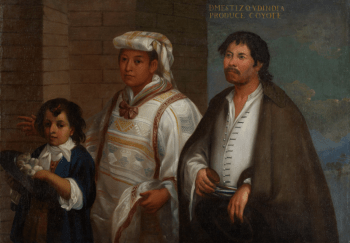
Juan Rodríguez Juárez, De Mestizo y de India produce Coyote, ca. 1716–20; Mexico, oil on canvas, 104 × 146 cm (New York: The Hispanic Society of America).
The first part of the exhibition (Galleries A and B) is organized chronologically and thematically by period in Spain and Latin America and comprises archaeological artifacts from sites on the Iberian Peninsula, Roman sculpture, magnificent ceramics, glass, furniture, textiles, silverworks, and Islamic and Medieval treasures as well as those from the Golden Age. Of particular relevance are Spanish paintings, in dialogue with the collections of the Prado, and colonial art closely related to the peninsula’s artistic legacy. Also included is a section dedicated to the library at the Hispanic Society, one of the most important in the world.
Gallery C offers a broad selection of the best Spanish painting from the 19th century through the early 20th century, including an exceptional collection of portraits of the leading Spanish scholars of that period, who worked closely with Huntington. After the First World War, Archer Huntington halted acquisitions, but maintained a close relationship with Spanish art and culture through his friendship with various painters, principally Joaquín Sorolla, who was commissioned to paint the famous series of large scale canvases depicting the regions of Spain for the Hispanic Society.
Accompanying the exhibition is a documentary projected in Gallery D, directed by Francesco Jodice, that transports the visitor to New York in the beginning of the twentieth century and narrates the history of the Hispanic Society and the passion of its founder, the philanthropist Archer Milton Huntington. The film contextualizes the origins of the early collecting practices of Huntington; the construction and inauguration of the headquarters of the Hispanic Society; Huntington’s collections and the fantastic holdings of the library; his relationship with Spain through Alfonso XII and the great Spanish intellectuals of the era; his friendship with Sorolla in New York; and the philanthropy of this great patron who wanted to remain anonymous during his entire life. The story is told by the director, Mitchell Codding, Chairman of the Board of Trustees, Philippe de Montebello, and the curators. The film, which runs for approximately 20 minutes, was filmed in New York and at the Prado Museum and is in English with Spanish subtitles.
Visions of the Hispanic World is the latest chapter in the decade-long collaboration between the Museo del Prado and the BBVA Foundation, involving the annual organization of a major exhibition event. This partnership has made possible such celebrated exhibitions as Passion for Renoir, The Hermitage in the Prado, El Greco and Modern Painting, and Bosch: The 5th Centenary Exhibition. Thanks to the Prado’s select network of relations with public and private lenders, these shows are the opportunity for an international public to view works that might otherwise never be seen under one roof. The exhibitions presented by the Prado and BBVA Foundation have met with an extraordinary response. In particular, those devoted to the Hermitage and Bosch successively broke the record of visits to the Madrid museum’s temporary exhibits, with over 580,000 spectators each.
Archer Milton Huntington, only son of one of the wealthiest families in The United States, from a young age possessed a profound interest in the Hispanic world. His education and numerous trips to Europe inspired an interest in collecting, always with the idea of creating a museum. In less than forty years, Huntington created a library and museum designed to elevate the study of Hispanic art through unparalleled collections in both scope and quality. At the same time, he published various facsimiles of important rare books and manuscripts. Huntington, in an effort to not deprive Spain of its artistic treasures, acquired most of his collection outside of the country. One can confirm, as did Jonathan Brown, that Huntington saw the Hispanic Society as an encyclopedic depository of Spanish art and literature. Huntington was one of the first Hispanists in the United States in the first half of the 20th century. For this reason he was awarded by numerous American universities. He was an active member of various Spanish museums and was invested as member of the Spanish Royal Academies. This exhibition pays homage to Huntington’s lifelong work for The Hispanic Society Museum & Library in the diffusion and study of Spanish culture in the United States of America.
Tesoros de la Hispanic Society of America (Madrid: Museo Nacional del Prado, 2017), 448 pages, ISBN: 978 84848 04079, 35€.
Exhibition | The Philosophy Chamber
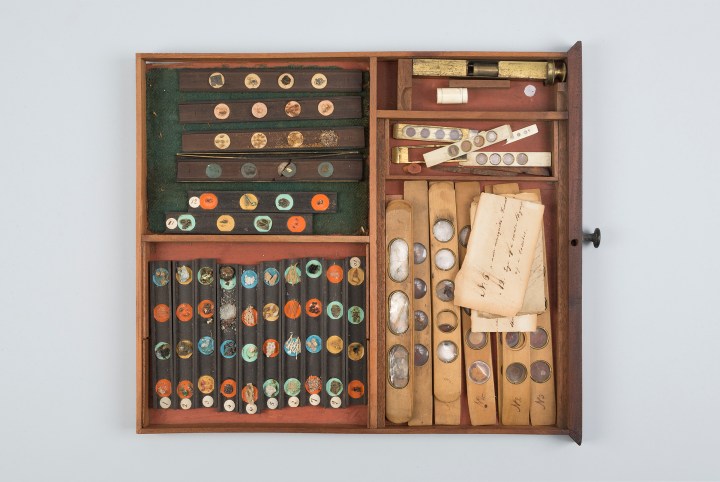
William and Samuel Jones, Jones’s Most Improved and Solar Compound Microscope, ca. 1798; drawer removed from box, displaying slides, mounted specimens, and accessories; brass, glass, and mahogany, with slides of paper and organic materials (Collection of Historical Scientific Instruments, Harvard University, 1184).
◊ ◊ ◊ ◊ ◊
Press release from Harvard Art Museums:
The Philosophy Chamber: Art and Science in Harvard’s Teaching Cabinet, 1766–1820
Harvard Art Museums, Cambridge, 19 May — 31 January 2017
The Hunterian, University of Glasgow, 23 March — 24 June 2018
Curated by Ethan Lasser
This spring, the Harvard Art Museums will present The Philosophy Chamber: Art and Science in Harvard’s Teaching Cabinet, 1766–1820, a special exhibition that brings together many long-forgotten icons of American culture. It will present new findings on this unique space—equal parts laboratory, picture gallery, and lecture hall—that stood at the center of artistic and intellectual life at Harvard and in New England for more than 50 years.
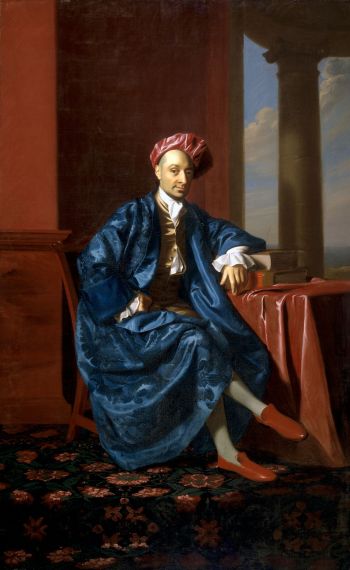
John Singleton Copley, Nicholas Boylston, 1773,oil on canvas (Harvard University Portrait Collection, H20, Harvard Art Museums).
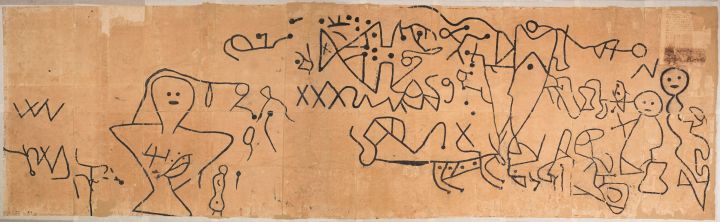
Celebrated at the time as one of the grandest spaces in America, the original Philosophy Chamber and its adjacent rooms housed an extraordinary collection of paintings, portraits, and prints; mineral, plant, and animal specimens; scientific instruments; indigenous American artifacts; and relics from the ancient world—all of which was used regularly for lectures, discussions, and demonstrations. Highlights include: full-length portraits by John Singleton Copley, Native Hawaiian feather work, carving by indigenous artists of the Northwest Coast, Stephen Sewall’s 1768 mural-sized copy of the Native American inscription on the famous Dighton Rock in southeastern Massachusetts, and the elaborately ornamented grand orrery (a model of the solar system) created by Joseph Pope between 1776 and 1787. Many of the objects in the exhibition have not been shown publicly since the collection was dispersed almost 200 years ago.
The reassembled Philosophy Chamber invites visitors to examine the role that images and objects play in building, organizing, and transmitting knowledge; and as a historical study, it deepens our understanding not only of Harvard’s past, but also the history of early American art and culture.
The exhibition presents more than 70 objects from the earliest days of Harvard’s collecting, shown together with a small group of objects with 18th-century American provenances that closely match the description of original pieces in the collection that have been lost or destroyed, or that survive but are too fragile for display. In addition, the show includes period representations of other teaching cabinets to contextualize the material on display. The exhibition’s accompanying catalogue expands on the research into the chamber’s collection, history, and uses, presenting information on the approximately 200 objects that have been tracked thus far—just one-fifth of the original collection once housed in Harvard Hall.
The exhibition and catalogue provide a 360-degree view of early American history through the examination of the artwork displayed in the Philosophy Chamber, the instruments and specimens handled by the students and faculty who met there, and the cultural artifacts dispatched to the college by foreign envoys and the nation’s first merchant explorers. The project considers what the convergence of these objects in a New World college can tell us about the transfer of knowledge, burgeoning trade, the role of collections, and New England’s emerging self-identity in the mid-18th to early 19th century.
“Rooted in deep research and fresh curatorial insight, this exhibition invites audiences—both American and international—to explore a cultural landmark of the 18th-century Atlantic World,” said Martha Tedeschi, the Elizabeth and John Moors Cabot Director of the Harvard Art Museums. “Our efforts to unearth this largely forgotten landmark of early American art and culture led us to map collections, library archives, herbaria, and other museums across campus, in addition to public and private institutions throughout the Northeast and abroad. Thanks to this exceptional cross-institutional collaboration, we can present an immersive interdisciplinary experience that brings an important period of history to life for all visitors.”
“Weaving together art and science, this exhibition considers one of the most vibrant spaces in early America and presents a veritable cross-section of the period’s art and material culture,” said Ethan W. Lasser, curator of the exhibition, and the Theodore E. Stebbins Jr. Curator of American Art and head of the Division of European and American Art at the Harvard Art Museums. “The Philosophy Chamber opens a window into a forgotten piece of American history; the story of this room intersects with some of the most admirable—and the most challenging—aspects of Harvard’s past.”
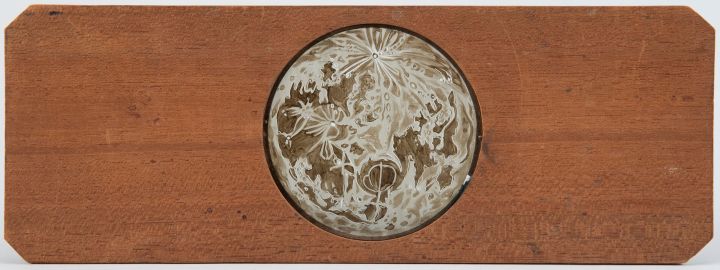
Unknown maker, possibly William and Samuel Jones, Lantern Slide of Painted Moon, late 18th century; painted glass and wood (Collection of Historical Scientific Instruments, Harvard University, 1998-1-1272).
◊ ◊ ◊ ◊ ◊
History of the Philosophy Chamber
Between 1766 and 1820, Harvard College assembled an extraordinary collection of specially commissioned scientific instruments and benefactor portraits, as well as donations from supporters around the globe. These objects were displayed in a set of three rooms adjacent to the college library in Harvard Hall, a large brick building that still stands at the center of campus today. The largest of these spaces, the Philosophy Chamber, was an ornately decorated room named for the discipline of natural philosophy, a field of study that wove together the sciences that sought to explain the natural world.
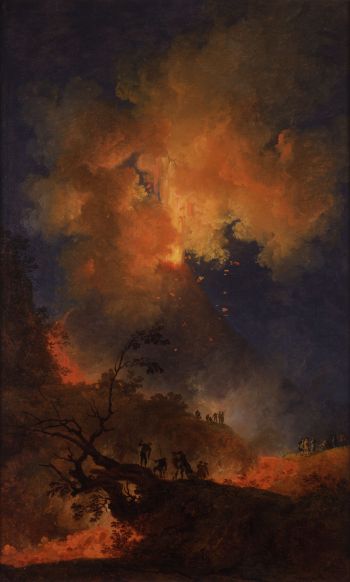
Pierre-Jacques Volaire, Vesuvius Erupting at Night, 1767, oil on canvas (Compton Verney Art Gallery and Park, Warwickshire).
The collection and the chamber, which came into existence when Harvard Hall was rebuilt after the Great Fire of 1764, played a vital role in teaching and research at Harvard, while also serving as the center of artistic and intellectual life in the greater New England region for over 50 years. Artists, scientists, students, and advocates of American Independence—including George Washington—came to the Philosophy Chamber to discover, discuss, and disseminate new knowledge. Students attended lectures and demonstrations there, and visitors from around the globe flocked to the space to see works by some of the Atlantic World’s greatest artists and artisans, including John Singleton Copley and John Trumbull.
The only repository of its kind in New England when it was established, the Philosophy Chamber was deeply connected to the network and ideology of other teaching cabinets established in Europe, the United States, and South America, such as the Ashmolean Museum at Oxford University, the Académie des Sciences in Paris, the American Philosophical Society in Philadelphia, and the University of Córdoba in Argentina. These teaching cabinets were offspring of the 17th-century Wunderkammer, or privately held cabinets of curiosities, and ultimately foreshadowed the beginnings of the modern museum.
While the chamber’s collection survived the Revolutionary War thanks to a temporary relocation (along with all of Harvard College) to Concord, Massachusetts, in 1775, an expansion of the college library in 1820 ultimately led to the dispersal of the collection to various university departments and local museums.
Research
The exhibition has its origins in curator Ethan Lasser’s early days at the Harvard Art Museums. While researching the Fogg Museum’s holdings of early American art, Lasser repeatedly came across references to the Philosophy Chamber. Intrigued, he initiated a campaign to locate the artifacts with a team of researchers at the museums. Lasser then expanded on the research by co-teaching a graduate seminar with Harvard professor Jennifer Roberts in Fall 2014. They enlisted their students to research the history of the chamber, the objects that were accessioned, and the people who visited. To date, the growing team of researchers—including curators, professors, conservators, scientists, and students from across the university—has tracked approximately 200 objects, or roughly one-fifth of the collection once housed in Harvard Hall. The whereabouts of the remaining four-fifths of the collection are unknown. Over the past 200 years, many objects have no doubt been lost, stolen, or destroyed, while some may be stored undetected in various campus and regional collections.
The Installation / Works on View
The Philosophy Chamber features more than 100 works displayed within four thematic sections.
The first section addresses how the collection was used in teaching and research, and includes tools and specimens that were regularly deployed for teaching in the 18th century. Included is the large-scale orrery, a dazzling astronomical model created by Joseph Pope. Labored over by Pope for 12 years, it was only the third orrery made in America, and was among the most celebrated objects to enter the chamber. Also included: one of two portable electrical machines for conducting demonstrations related to electricity (Benjamin Franklin advised on its purchase) and a group of six recently discovered drawings of skulls by Harvard professor and naturalist William Dandridge Peck, dated to around 1810. A projector installed in this gallery will show large-scale digitized images of solar microscope specimens and magic lantern slides.
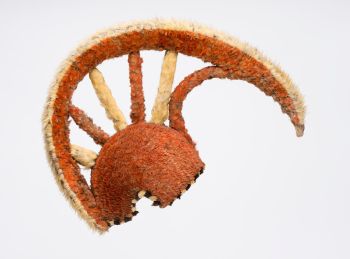
Unknown artist, Native Hawaiian, Mahiole (Crested Feathered Helmet), 18th century; ‘I’iwi (Vestiaria coccinea) and ‘ō’ō (Moho nobilis) feathers; and olonā (Touchardia latifolia) and ‘ie’ie (Freycinetia arborea) fibers (Peabody Museum of Archaeology and Ethnology, Harvard University, Gift of the Heirs of David Kimball, 99-12-70/53559).
A second gallery explores how the non-commissioned objects in the chamber’s collection arrived at Harvard and reflects on the collecting practices of wealthy alumni, entrepreneurial merchants, and scholars who sent objects from abroad. At the time, there was no curator of the collection, and very few objects were specifically solicited, resulting in a rather haphazard and idiosyncratic collection. This gallery features gifts sent to Harvard by five different donors or donor groups. In the late 18th century, as American ships began circumnavigating the globe, new courses were charted, and trade routes were established. An early 19th-century French map in this gallery shows the routes around North and South America that Captain James Cook and other explorers used. Shipmates on these missions brought back the exceptional examples of Native Hawaiian feather work on a colorful cape and a crested helmet seen in this space, as well as examples of carving by indigenous artists of the Northwest Coast. A touchscreen monitor in this gallery presents an animated map with points of origin of some of the objects in the collection, as well as demonstrations of two objects from Harvard’s Collection of Historical Scientific Instruments.
A third section addresses the entangled histories of the objects gathered in the chamber and the origin story of the United States after the Revolutionary War. Works here show how artists and scholars were actively writing American history. Included are engravings after paintings by John Trumbull, who gave a portrait of Cardinal Guido Bentivoglio to the college, which also hangs in this space. The gallery includes another celebrated object in the chamber’s history: Stephen Sewall’s mural-sized copy of the Native Americans’ inscriptions on the landmark known as Dighton Rock, an 11-foot boulder formerly located in the Taunton River, and now housed in a museum. Sewall was a professor at Harvard and his 1768 drawing is the only life-size representation of the monument known to exist. The rock was puzzled over by scholars from Harvard and around the world, and a variety of theories about the origin of the inscriptions were posited. Today, scholars attribute the inscriptions on the rock to the Algonquian-speaking peoples of the Eastern Woodlands, and more specifically to the Wampanoag who lived in the rock’s vicinity. By contrast, in the period when Sewall made his drawing, European interpreters actively disavowed the possibility of Native American authorship.
The final room is a loose reconstruction of the Philosophy Chamber itself, an experiential space complete with a re-created version of the red wallpaper that John Hancock had donated to the original room. Three early full-length portraits of Harvard benefactors by John Singleton Copley are included, as is a series of six mezzotints after Copley paintings that were given to Harvard by the artist’s heirs. Harvard was Copley’s first major patron, and plans to turn the Philosophy Chamber into a space dedicated to the artist’s life were never realized; the gift of mezzotints has never been shown until now. A bust of William Pitt the Elder, Earl of Chatham, given by Benjamin Franklin in 1769, was the first gift of sculpture the college received after the Great Fire consumed Harvard Hall in 1764. This gallery will be complemented by a digital tool, accessible on the museums’ website, that allows visitors to access recordings of present-day Harvard students reading from period sources, offering a sense of the kinds of conversations and debates that took place in the original chamber. The tool will also include deeper information about the objects displayed in the gallery.
Stephen Sewall, Copy of Inscription on Dighton Rock, 1768, black ink on paper (Peabody Museum of Archaeology and Ethnology, Harvard University, 967-28-10/45474, digital file 99270006).
◊ ◊ ◊ ◊ ◊
Conservation
The research and rediscovery of objects once belonging to the Philosophy Chamber collection has led to exciting research by conservators and conservation scientists in the museums’ Straus Center for Conservation and Technical Studies. Several members of the Straus Center staff contributed essays to the exhibition catalogue on the following topics:
• Conservators were able to examine two of the full-length portraits by John Singleton Copley. Use of X-radiography and infrared digital photography helped them determine earlier iterations of a portrait of Thomas Hancock, painted between 1764 and 1766, showing Copley had reworked the painting twice to arrive at the formal, dignified pose seen in the final portrait. By contrast, a painting of college benefactor Thomas Hollis III was shown to have very few changes.
• Joseph Wilton’s bust of William Pitt the Elder, Earl of Chatham—given to Harvard by Benjamin Franklin—underwent scientific, technical, and art historical research, allowing staff to assess how the ceramic sculpture was made and to document its alteration over the centuries at Harvard. Guided by this research, the conservation treatment included removal of later overpaint layers and cleaning to uncover the original white painted surface.
• A close examination of Stephen Sewall’s drawing of the inscription on Dighton Rock sheds light on his chosen materials and processes. Conservators believe Sewall directly traced the markings rather than using a rubbing or chalking method.
Publication
Ethan Lasser, ed., The Philosophy Chamber: Art and Science in Harvard’s Teaching Cabinet, 1766–1820 (Cambridge: Harvard University Press, 2017), 312 pages, ISBN 978 0300 225921, $55.
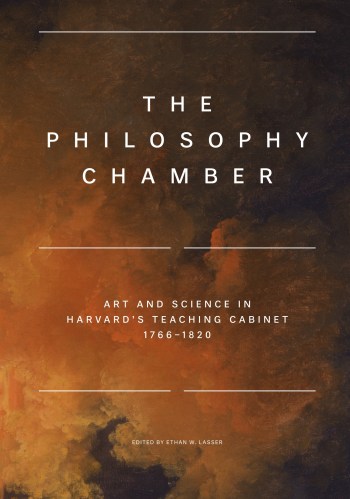 A catalogue, edited by Ethan Lasser, with essays by a mix of curators, professors, conservators, conservation scientists, and doctoral candidates, will be published in conjunction with the exhibition. The publication will advance new understandings of early American art history, and will serve as a rich resource for any reader interested in the art and culture of the Atlantic World. The catalogue is published by the Harvard Art Museums and distributed by Yale University Press. Contributors include Aleksandr Bierig, Anne Driesse, Katherine Eremin, Andrew Gelfand, Claire Grech, Teri Hensick, Jane Kamensky, Ethan W. Lasser, Georgina Rayner, Jennifer L. Roberts, Whitney Barlow Robles, María Dolores Sánchez-Jáuregui, Anthony Sigel, Kate Smith, Lucie Steinberg, and Oliver Wunsch.
Online Resources
Once the exhibition opens, supplementary digital content will be accessible via the exhibition page on the museums’ website. The digital tool complementing the room within the exhibition that loosely reconstructs the Philosophy Chamber will include “Voices of the Philosophy Chamber,” a group of audio recordings by present-day Harvard students reading from period sources. The recordings will give a sense of the conversation and debate that once filled the Philosophy Chamber. The tool will also provide additional information about the works on view.
The website will also include a series of audio recordings of gallery talks planned for the run of the exhibition. The robust series of talks by the students, staff, faculty, and scholars involved with the Philosophy Chamber research will explore the range of objects and themes in the exhibition as well as the history of the chamber. New recordings will be added on a regular basis.
Programming
A wide range of events, including lectures, a symposium, gallery talks, Materials Lab Workshops on Wampum jewelry making, and special member events, will be offered throughout the duration of the exhibition. Harvard professor Jane Kamensky will give a free public lecture, The Hungry Eye: Art and Ambition in Copley’s Boston, on Tuesday, May 23, at 3pm. Kamensky is the author of the recent biography A Revolution in Color: The World of John Singleton Copley, and also contributed to the Philosophy Chamber catalogue. During the fall semester, programming includes major lectures by artist Simon Starling and James Delbourgo (Rutgers University); The Room Where It Happens: On the Agency of Interior Spaces, a two-day public symposium featuring a keynote lecture by Louis Nelson (University of Virginia) and a full day of panel discussions; and a special late-night event for Harvard students. Detailed information about programs is forthcoming here.
Credits
The Philosophy Chamber: Art and Science in Harvard’s Teaching Cabinet, 1766–1820 is organized by the Harvard Art Museums. Curated by Ethan W. Lasser, the Theodore E. Stebbins Jr. Curator of American Art and Head of the Division of European and American Art at the Harvard Art Museums. The exhibition is supported in part by major grants from the Terra Foundation for American Art and the Henry Luce Foundation. The exhibition and catalogue also received support from the following endowed funds: the Bolton Fund for American Art, Gift of the Payne Fund; the Henry Luce Foundation Fund for the American Art Department; the William Amory Fund; and the Andrew W. Mellon Publication Funds, including the Henry P. McIlhenny Fund.
Lenders at Harvard University include: the Collection of Historical Scientific Instruments; the Harvard Map Collection, Pusey Library; the Harvard University Archives; Houghton Library; the Mineralogical and Geological Museum; the Museum of Comparative Zoology; the Peabody Museum of Archaeology & Ethnology; and the Warren Anatomical Museum, Countway Library of Medicine.
Other lenders from private, academic, and public collections in the United States and the United Kingdom include: the American Academy of Arts and Sciences, Cambridge, MA; the Richard Balzer Collection, Brookline, MA; Compton Verney Art Gallery and Park, Warwickshire, U.K.; The Library Company of Philadelphia; the Massachusetts Historical Society, Boston; Metropolitan Museum of Art, New York; Museum of Fine Arts, Boston; Peabody Essex Museum, Salem, MA; and a private collection in Boston.
Exhibition | America Collects Eighteenth-Century French Painting
From the NGA:
America Collects Eighteenth-Century French Painting
National Gallery of Art, Washington, D.C., 21 May — 20 August 2017

When Joseph Bonaparte, elder brother of Napoleon, arrived in the United States in 1815, he brought with him his exquisite collection of eighteenth-century French paintings. Put on public view, the works caused a sensation, and a new American taste for French art was born. Over the decades, appreciation of French eighteenth-century art has fluctuated between preference for the alluring decorative canvases of rococo artists such as François Boucher and Jean Honoré Fragonard to admiration for the sober neoclassicism championed by Jacques Louis David and his pupils. This exhibition brings together sixty-eight paintings that represent some of the best and most unusual examples of French art of that era held by American museums and tells their stories on a national stage: Who were the collectors, curators, museum directors and dealers responsible for bringing eighteenth-century French painting to America? Where are the paintings now?
The exhibition highlights smaller museum collections, less well-known paintings, and diverse locations across the United States, from Pittsburgh and Indianapolis to Birmingham and Phoenix. It considers eighteenth-century America’s very real fascination with France—a staunch ally in the American Revolution, an intellectual model for Benjamin Franklin, Thomas Jefferson, and other Americans abroad—and how the cultural ideal of eighteenth-century France has continued to endure in the American imagination to this day.
Image: Joseph Ducreux, Le Discret, ca. 1791, oil on aluminum, transferred from canvas (Lawrence: Spencer Museum of Art, University of Kansas).
◊ ◊ ◊ ◊ ◊
Note (added 28 May 2017) — A checklist for the exhibition is available here. Online, there’s also a useful chronology (condensed from the catalogue), establishing larger contexts and tracing the history of selected works in the exhibition.
Note (added 30 May 2017) — The catalogue is published by Lund Humphries:
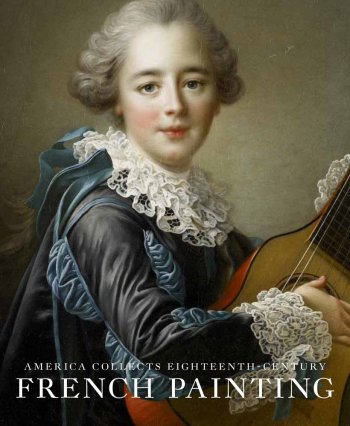
Yuriko Jackall, Philippe Bordes, Jack Hinton, Melissa Hyde, Joseph Rishel, and Pierre Rosenberg, with Joseph Baillio, Susan Earle, Christophe Leribault, Robert Schindler, and D. Dodge Thompson, America Collects Eighteenth-Century French Painting (London: Lund Humphries, 2017), 304 pages, ISBN: 978 18482 22342, £50 / $70.
 C O N T E N T S
Director’s Foreword
Acknowledgments
Lenders to the Exhibition
Essays
• Pierre Rosenberg, Only in America
• Yuriko Jackall, American Visions of Eighteenth-Century France
• Joseph Bailliom, Wildenstein in America
• Jack Hinton, Fiske Kimball and French Period Rooms in America
• Christophe Leribault, The Tuck Donation to the Petit Palais: A Mirror of American Taste
• Melissa Hyde, Femmes-Artistes and America from the Early Republic to the Gilded Age
• Robert Schindler, Eugenia Woodward Hitt Collects
• Philippe Bordes, Buying against the Grain: American Collections and French Neoclassical Paintings
• Susan Earle, Joseph Ducreux, John Maxon, and the Spencer Museum of Art
• D. Dodge Thompson, When the Eighteenth Century Was New: Joseph Bonaparte in America
• Joseph Rishel, Notes on the American Reception of Eighteenth-Century French Painting
Plates
Yuriko Jackall
• Collector’s Century: From the King’s Mistress to the Shores of San Francisco
• Sensual Century: Pursuit of Love
• Opulent Century: Douceur de Vivre
• Playful Century: Games and Pastimes
• Fanciful Century: Masquerade and the Pleasures of the Imagination
• Inspired Century: Artists and Artistic Practice
• Virtuous Century: Institutional Taste
• Enlightened Century: Science, Nature, and the Passage of Time
Checklist of the Exhibition
Chronology
Bibliography
Index
Exhibition | British Art: Ancient Landscapes
Opening next month at The Salisbury Museum:
British Art: Ancient Landscapes
The Salisbury Museum, 8 April — 3 September 2017
Curated by Sam Smiles
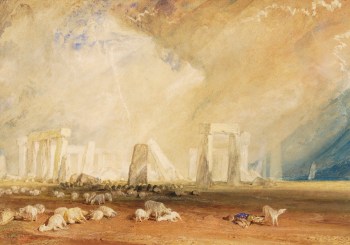
J.M.W. Turner, Stonehenge, ca. 1827–28, watercolour (The Salisbury Museum).
The British landscape has been a continual inspiration to artists across the centuries and particularly the landscapes shaped and marked by our distant ancestors. The megaliths, stone circles, and chalk-cut hill figures that survive from Neolithic and Bronze Age times have stimulated many artists to make a response. In this major new exhibition curated by Professor Sam Smiles, these unique artistic responses have been brought together to create a new discussion. Featuring the work of some of the greatest names in British art from the last 250 years—including John Constable, J.M.W. Turner, Eric Ravilious, John Piper, Barbara Hepworth, Henry Moore, Paul Nash, Richard Long, and Derek Jarman—the exhibition explores how this work records and reflects on some of Britain’s most treasured ancient landscapes.
The catalogue is published by Paul Holberton:
Sam Smiles, British Art: Ancient Landscapes (London: Paul Holberton Publishing, 2017), 120 pages, ISBN: 978 19113 00144, £25.
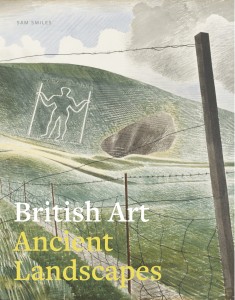 Published to accompany an exhibition at The Salisbury Museum and Art Gallery, this volume explores the most significant works of art engaged with prehistoric moments across Britain from the 18th century to the 21st. While some of the works in the earlier period may be familiar to readers—especially Turner and Constable’s famous watercolours of Stonehenge—the varied responses to British Antiquity since 1900 are much less well known and have never been grouped together.
The author aims to show the significance of antiquity for 20th-century artists, demonstrating how they responded to the observable features of prehistoric Britain and exploited their potential for imaginative re-interpretation. The classic phase of modernist interest in these sites and monuments was the 1930s, but a number of artists working after WWII developed this legacy or were stimulated to explore that landscape in new ways. Indeed, it continues to stimulate responses and the book concludes with an examination of works made within the last few years.
An introductory essay looks at the changing artistic approach to British prehistoric remains over the last 250 years, emphasizing the artistic significance of this body of work and examining the very different contexts that brought it into being. The cultural intersections between the prehistoric landscape, its representation by fine artists and the emergence of its most famous sites as familiar locations in public consciousness will also be examined. For example, engraved topographical illustrations from the 18th and 19th centuries and Shell advertising posters from the 20th century will be considered.
Artists represented include: J.M.W. Turner, John Constable, Thomas Hearne, William Blake, Samuel Prout, William Geller, Richard Tongue, Thomas Guest, John William Inchbold, George Shepherd, William Andrews Nesfield, Copley Fielding, Yoshijiro (Mokuchu) Urushibara, Alan Sorrell, Edward McKnight Kauffer, Frank Dobson, Paul Nash, Eric Ravilious, John Piper, Henry Moore, Barbara Hepworth, Ithell Colquhoun, Gertrude Hermes, Norman Stevens, Norman Ackroyd, Bill Brandt, Derek Jarman, Richard Long, Joe Tilson, David Inshaw and Jeremy Deller.
Sam Smiles is the author of The Image of Antiquity: Ancient Britain and the Romantic Imagination (1994), Flight and the Artistic Imagination (2012), and West Country to World’s End: The South West in the Tudor Age (2013).
Exhibition | Canaletto and the Art of Venice
Press release (14 December 2016) from the Royal Collection Trust:
Canaletto and the Art of Venice
The Queen’s Gallery, Buckingham Palace, London, 19 May — 12 November 2017
The Queen’s Gallery, Palace of Holyroodhouse, Edinburgh, 11 May — 21 October 2018
National Gallery of Ireland, Dublin, 5 December 2018 — 24 March 2019
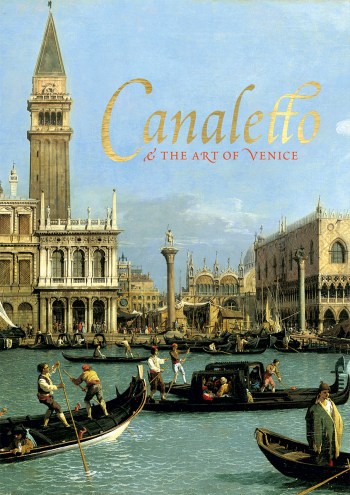 In 1762 the young monarch George III purchased virtually the entire collection of Joseph Smith, the greatest patron of art in Venice at the time. Thanks to this single acquisition, the Royal Collection contains one of the finest groups of 18th-century Venetian art in the world, including the largest collection of works by Giovanni Antonio Canal, better known as Canaletto.
Through over 200 paintings, drawings, and prints from the Royal Collection’s exceptional holdings, Canaletto and the Art of Venice presents the work of Venice’s most famous view-painter alongside that of his contemporaries, including Sebastiano and Marco Ricci, Rosalba Carriera, Francesco Zuccarelli, Giovanni Battista Piazzetta, and Pietro Longhi and explores how they captured the essence and allure of Venice for their 18th-century audience, as they still do today.
Joseph Smith (c.1674−1770) was an English merchant and later British Consul in Venice, a post dealing with Britain’s maritime, commercial, and trading interests. He had moved to Italy in around 1700 and over several decades built up an outstanding art collection, acting as both patron and dealer to many contemporary Venetian artists. Smith was Canaletto’s principal agent, selling his paintings to the wealthy Grand Tourists who were drawn to Venice’s cultural attractions. His palazzo on the Grand Canal became a meeting place for collectors, patrons, scholars, and tourists, where visitors could admire his vast collection and commission their own versions of Canaletto’s views to take home.
One of the most important of Smith’s commissions from Canaletto was the series of 12 paintings of the Grand Canal, which together create a near complete journey down the waterway. Canaletto’s sharp-eyed precision makes these views seem powerfully real; yet he rearranged and altered elements of each composition to create ideal impressions of the city. Two larger paintings are of festivals, including the ‘Sposalizio del Mar’, or ‘Wedding of the Sea’, which took place on Ascension Day and attracted crowds of British visitors. The Grand Canal was a subject frequently captured by Canaletto, including in a series of six drawings, among them Venice: The central stretch of the Grand Canal, c.1734. Intended as works of art in their own right, rather than as preparatory studies for paintings, the drawings are carefully constructed and rich in tone and detail.
Alongside the grand public entertainments, Venice boasted a thriving opera and theatre scene, especially during carnival season. The need to create stage sets within a very short period of time provided plentiful employment for Venetian artists. Both Marco Ricci and Canaletto worked for the theatre, where they learned how to manipulate perspective to heighten drama. The exhibition includes several of Ricci’s designs for the Venetian stage, such as A room with a balcony supported by Atlantes, c.1726. Marco Ricci also produced caricatures of opera singers, such as the drawing of the internationally famed castrato Farinelli, which were circulated among Joseph Smith and his fellow Venetian collectors and opera aficionados.
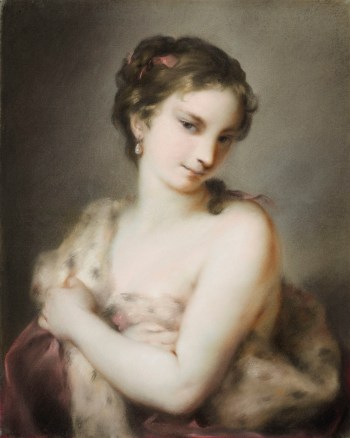
Rosalba Giovanna Carriera, A Personification of Winter, ca. 1726, pastel on paper (London: Royal Collection Trust, 400647).
On display together for the first time are personifications of the Four Seasons by Rosalba Carriera, whose pastels were highly prized by European collectors. They were intended to be hung in private domestic spaces, such as dressing rooms, bedrooms, or small antechambers. Carriera was one of the first artists to develop a commercial relationship with Joseph Smith, and her sensual pastel of Winter, c.1726, an allegorical female figure wrapped in furs, was one of the most admired works in Smith’s collection.
Canaletto, Marco Ricci, and Francesco Zuccarelli all contributed to the development of the genre known as the capriccio—scenes combining real and imaginary architecture, often set in an invented landscape, to create poetically evocative works. Ruins of ancient Rome in both Ricci’s Caprice View with Roman Ruins, c.1729, and Zuccarelli’s pastoral Landscape with Classical Ruins, Cattle and Figures, c.1741–42, convey a sense of the irrevocable loss of a great age.
There was a major revival in printmaking in Venice in the 18th century, with many publishers recruiting established artists, such as Giovanni Battista Piazzetta and Antonio Visentini, to provide designs for their publications. Joseph Smith was an enthusiastic print collector and one of the major supporters of contemporary printmaking in Venice. Smith financed and directed the Pasquali press, which contributed to the circulation of Enlightenment ideas, such as those of Isaac Newton, and imported banned foreign texts into Venice, including the work of Voltaire. Visentini was the chief draughtsman for the press, providing many hundreds of pen and ink drawings of initials and tailpieces, several of which will be on display in the exhibition.
The catalogue is distributed by The University of Chicago Press:
Lucy Whitaker and Rosie Razzall, Canaletto and the Art of Venice (London: Royal Collection Trust, 2017), 320 pages, ISBN: 978 190974 1409, $60.
Note (added 22 November 2018) — The posting was updated to include dates for Edinburgh and Dublin.
Exhibition | La Serenissima: Celebrating Venice
From the press release for the exhibition:
Sérénissime! Venise en fête, de Tiepolo à Guardi
La Serenissima: Celebrating Venice, from Tiepelo to Guardi
Musée Cognacq-Jay, Paris, 25 February — 25 June 2017
Curated by Rose-Marie Herda-Mousseaux and Benjamin Couilleaux
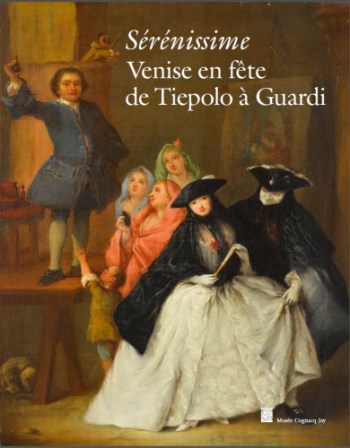 In the eighteenth century, the political and economic stability of the Serenissima Repubblica di Venezia gave rise to the last golden age of Venice, which would end with the Napoleonic conquest of 1797. This last chapter of a millenary history was marked by an unprecedented deployment of public and private events. Festivities, celebrations, regattas, and other spectacles set the tempo of city life and attracted the curious from all over Europe. Much more than simple amusements, these festivities were part of a political and religious pageant designed to promote Venice. Immortalized by some of the great names in painting—Tiepolo, Guardi, Longhi—they created a lasting impression and made known the charms of the City of the Doges throughout Europe. Over forty paintings, engravings, and drawings from prestigious French and European collections are presented to the public, bringing to life once again, for the duration of the exhibition, the opulence of the Most Serene Republic of Venice in the Age of Enlightenment.
The exhibition layout focuses on four themes related to Venetian celebrations:
Festivities Large and Small
Dance and music were highly esteemed by Venetian society, among both the aristocracy and the people.
From City to Stage
In the eighteenth century, the commedia dell’arte achieved unprecedented popularity, in particular with playwright Carlo Goldoni. Opera also benefited from majestic settings, the most famous of which is still La Fenice.
Power as Spectacle
Both secular and sacred institutions in the Most Serene Republic encouraged the crowds to attend major festivities that crystallized the image of Venice as a powerful and sumptuous city. Receptions for foreign princes, notably French, also provided an opportunity to organize extraordinary celebrations on Piazza San Marco or the Grand Canal.
At the Carnival
What would Venice be without its carnival? Dating from the Middle Ages, this colorful masked festival brought together an eighteenth-century cosmopolitan crowd that loved the open-air fairground attractions as much as it did the more discreet amusements of the Ridotto, the ancestor of the casino.
Rose-Marie Herda-Mousseaux and Benjamin Couilleaux, Sérénissime: Venise en fête, de Tiepolo à Guardi (Paris: Editions Paris Musées, 2017), 176 pages, ISBN: 978 27596 03428, 30€.
Exhibition | Gilded Interiors: French Masterpieces of Gilt Bronze

Jean-Baptiste Lepaute, Mantel clock, detail, 1781
(London: The Wallace Collection)
◊ ◊ ◊ ◊ ◊
From the press release for the exhibition:
Gilded Interiors: French Masterpieces of Gilt Bronze
The Wallace Collection, London, 4 May — 30 July 2017
Curated by Helen Jacobsen
Often designed by leading architects and modeled by important sculptors, gilt bronze was used to create beautiful yet functional objects such as clocks, candelabras, and firedogs and to decorate and embellish highly refined furniture and porcelain. This exhibition showcases luxurious artworks commissioned and owned by the wealthiest patrons and collectors, including leading figures of pre-revolutionary France like Marie-Antoinette, the duc d’Aumont, and the comte d’Artois as well international patrons such as the Prince of Wales (later George IV). Artists such as Pierre Gouthière, François Rémond, and Claude Pition, who ran the finest chasing and gilding workshops, created beautiful works, equal in expense and craftsmanship to some of the greatest paintings and sculpture of the period.
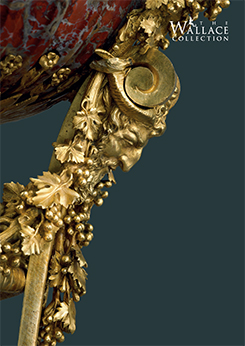 Largely drawn from The Wallace Collection, home to one of the world’s most important collections of French eighteenth-century gilt bronze, these exceptional objects include the exquisite perfume burner by Gouthière once owned by Marie-Antoinette and a pair of candlesticks made for the French Queen to celebrate the birth of her son. The Wallace Collection works will be shown alongside loans from other world-class collections including drawings from the Bibliothèque Municipale in Besançon.
The exhibition will feature drawings by Pierre-Adrien Pâris, one of the foremost architects and interior designers of the period. His highly-detailed works, never before seen in the UK, illustrate how buildings from ancient Rome were used as a fertile source of design for gilt-bronze masterpieces and reveal how the antique world provided artists with contemporary ideas for architecture and decorative art. Architects and designers who travelled to Rome took inspiration from the classical ruins with which they were surrounded and their drawings of architecture and Antique monuments provided the basis for some of the greatest gilt-bronze works ever created.
Gilded Interiors: French Masterpieces of Gilt Bronze will be an opportunity for visitors to engage more fully with these magnificent works, which will be given centre stage in the special exhibition galleries. Well-lit and with the works fully visible ‘in the round’, the exhibition will enable the viewer to experience these works of art in a different way, allowing the exquisite beauty and technical accomplishments of these pieces to be properly admired and enjoyed.
◊ ◊ ◊ ◊ ◊
From I. B. Tauris:
Helen Jacobsen, Gilded Interiors: Parisian Luxury and the Influence of Rome, 1770–1790 (London: Philip Wilson, 2017), 112 pages, ISBN: 978 178130 0589, £20 / $30.
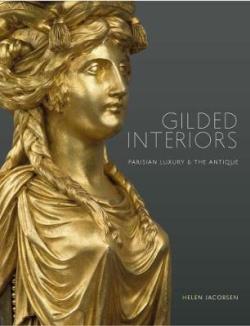 The Wallace Collection has an internationally-renowned collection of French eighteenth-century art but perhaps lesser known today is their stunning collection of gilt-bronze objects. These bronzes d’ameublement—from clocks and mounted Sevres porcelain to wall lights and candelabra—epitomise the levels of luxury achieved in Parisian interiors. Highly expensive and expertly wrought, they illustrate the heights of skilled craftsmanship achieved by French bronze workers in the eighteenth century as well as showcasing the wealth and connoisseurship of their owners. Lavishly illustrated with new photography, this publication will be a book of ‘highlights’ to include the very best of what the Wallace Collection has to offer in this field.
Helen Jacobsen is senior curator and curator of French eighteenth-century decorative arts at the Wallace Collection.










leave a comment