Exhibition | Silent Partners: Artist and Mannequin
Press release (4 August) from The Fitzwilliam:
Silent Partners: Artist and Mannequin from Function to Fetish
The Fitzwilliam Museum, Cambridge, 14 October 2014 — 25 January 2015
Musée Bourdelle, Paris, 31 March — 12 July 2015
Curated by Jane Munro
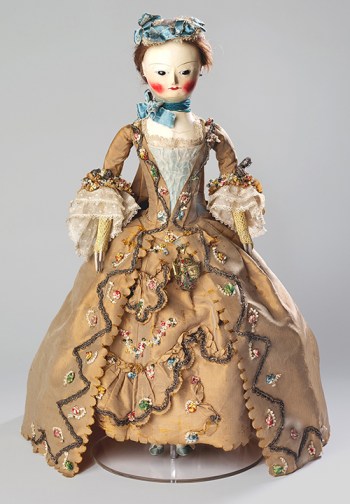
Fashion doll with costume and accessories, 1755–60; wood, gesso, paint, glass, human hair, knitted cotton, satin, silk, gilt braid, wire, silk gauze, linen, cotton, and silk satin, 60 x 42 x 43 cm (London: V&A Museum)
Every picture tells a story … but it does not always give away its secrets. For much of its existence, the artist’s mannequin, or lay figure, was one of art’s best-kept.
Now, for the first time, Silent Partners will unveil the mannequin’s secret life to show how, from being an inconspicuous studio tool, a piece of equipment as necessary as easel, pigments and brushes, the lay figure became the fetishised subject of the artist’s painting, and eventually, in the twentieth century, a work of art in its own right.
A common figure in the studios of painters and sculptors from the Renaissance onwards, this ‘artful implement’ was used to study perspective, arrange compositions, ‘rehearse’ the fall of light and shade and, especially, to paint drapery and clothing. But, while even the very greatest artists condoned its use, the mannequin best served its purpose by remaining ‘silent’: too present or visible in the finished picture, the mannequin could make figures appear stiff and unnatural, and so betray the tricks of the artist’s trade.
The nineteenth century was a turning point. Mannequin-making became a profession in its own right and Paris, especially, became a leading centre of production. Competition was fierce to create and perfect the ‘naturalistic’ mannequin, one that was life-size with an articulated skeleton that could move in realistic ways and an exterior finish that was painted and padded to look—sometimes eerily—human.
And as the mannequins became an increasingly sophisticated human replica, so they emerged from the anonymity of the studio to take their place, centre stage, on the canvas. At first the mannequin featured humorously, in witty visual games of ‘hide and seek’ and double entendre. However, throughout the course of the nineteenth century, painters such as Degas began to represent it in more troubling ways, playing on the unnerving psychological presence of a figure that was realistic, yet unreal, lifelike, yet lifeless. Others—photographers especially—explored in more voyeuristic terms how the relationship between male painter and female mannequin played out behind closed doors, revealing the studio as a place of potent erotic encounter.

Paul Huot, Female Mannequin, ca. 1816; wood, metal, horsehair, wax, silk, cotton and painted papier-mâché head, 163 x 65 cm, (Museumslandschaft Hessen Kassel, Sammlung Angewandte Kunst)
By the end of the century, innovations in the manufacture of mannequins shifted to the shop window dummy, the lay figure’s closest kin. Again, Paris led the way, and the fashion mannequin was transformed by firms such as Pierre Imans and Siégel from a schematic approximation of the human form into an uncannily realistic surrogate that inspired both consumerist longing and sexual fantasy.
This distinctively modern mannequin—one that reflected the life and elegance of its era—set a new challenge for twentieth-century painters and photographers. Featureless and expressionless, they haunted the paintings of the Italian metaphysical painters Giorgio de Chirico and Carlo Carrà, while the Surrealists celebrated the ‘modern’ mannequin as a manifestation of the ‘marvellous’, an object that could reveal the artist’s—and our—secret unconscious desires.
One of the most wide-ranging and ambitious shows ever hosted at the Fitzwilliam, the exhibition will feature over 180 paintings, drawings, books and photographs as well as fashion dolls, trade catalogues, a series of extraordinary patent documents and videos that will surprise and at times disturb. There will be paintings and drawings by Fra Bartolommeo, Cézanne, Poussin, Gainsborough, Millais, Ford Madox Brown, Courbet, Wilhelm Trübner, Kokoschka and Degas as well as photographs by and of Surrealist artists such as Bellmer, Raoul Ubac, Dalì and Man Ray; two works by Jake and Dinos Chapman will form a twenty-first-century coda. But among the most striking and fascinating exhibits will be the mannequins themselves: from beautifully carved sixteenth-century figures to haunting wooden effigies once belonging to Sickert (and maybe Hogarth) and painted dolls of full human height, top-of-the range models that were highly sought after by artists throughout Europe.
◊ ◊ ◊ ◊ ◊
From Yale UP:
Jane Munro, Silent Partners: Artist and Mannequin from Function to Fetish (New Haven: Yale University Press, 2014), 280 pages, ISBN: 978-0300208221, $65.
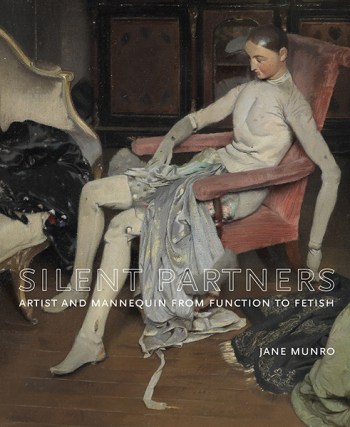 The articulated human figure made of wax or wood has been a common tool in artistic practice since the 16th century. Its mobile limbs enable the artist to study anatomical proportion, fix a pose at will, and perfect the depiction of drapery and clothing. Over the course of the 19th century, the mannequin gradually emerged from the studio to become the artist’s subject, at first humorously, then in more complicated ways, playing on the unnerving psychological presence of a figure that was realistic, yet unreal—lifelike, yet lifeless.
Silent Partners locates the artist’s mannequin within the context of an expanding universe of effigies, avatars, dolls, and shop window dummies. Generously illustrated, this book features works by such artists as Poussin, Gainsborough, Degas, Courbet, Cézanne, Kokoschka, Dalí, Man Ray, and others; the astute, perceptive text examines their range of responses to the uncanny and highly suggestive potential of the mannequin.
Jane Munro is a curator in the Department of Paintings, Drawings and Prints at the Fitzwilliam Museum and director of studies in history of art at Christ’s College at the University of Cambridge.
Exhibition | Picturing Mary: Woman, Mother, Idea
From the NMWA:
Picturing Mary: Woman, Mother, Idea
National Museum of Women in the Arts, Washington, D.C., 5 December 2014 — 12 April 2015
Curated by Timothy Verdon
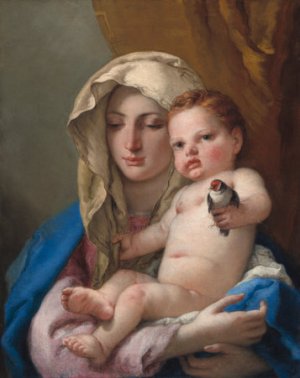
Giovanni Battista Tiepolo, Madonna of the Goldfinch, ca. 1767–70 (National Gallery of Art, Washington, D.C., Samuel H. Kress Collection #1943.4.40)
Appearing throughout the entire world, her image is immediately recognizable. In the history of Western art, she was one of the most popular subjects for centuries. Picturing Mary: Woman, Mother, Idea is a landmark exhibition at the National Museum of Women in the Arts (NMWA), bringing together masterworks from major museums, churches and private collections in Europe and the United States. Iconic and devotional, but also laden with social and political meaning, the image of the Virgin Mary has influenced Western sensibility since the sixth century.
Picturing Mary examines how the image of Mary was portrayed by well-known Renaissance and Baroque artists, including Botticelli, Dürer, Michelangelo, Pontormo, Gentileschi and Sirani. More than 60 paintings, sculptures and textiles are on loan from the Vatican Museums, Musée du Louvre, Galleria degli Uffizi, Palazzo Pitti and other public and private collections—many exhibited for the first time in the United States.
“Among the most important subjects in Western art for more than a millennium was a young woman: Mary, the mother of Jesus. Her name was given to cathedrals, her face imagined by painters and her feelings explored by poets,” said exhibition curator and Marian scholar Monsignor Timothy Verdon, director, Museo dell’Opera del Duomo, Florence, Italy. “This exhibition will explore the concept of womanhood as represented by the Virgin Mary, and the power her image has exerted through time, serving both sacred and social functions during the Renaissance and Baroque periods.”
Picturing Mary is the newest project in an ongoing program of major historical loan exhibitions organized by NMWA, including An Imperial Collection: Women Artists from the State Hermitage Museum (2003) and Royalists to Romantics: Women Artists from the Louvre, Versailles, and other French National Collections (2012). In addition to illustrating the work of women artists, NMWA also presents exhibitions and programs about feminine identity and women’s broader contributions to culture. Picturing Mary extends, in particular, the humanist focus of Divine and Human: Women in Ancient Mexico and Peru, a large-scale exhibition organized by NMWA in 2006.
The full press release (16 July 2014) is available as a PDF file here»
◊ ◊ ◊ ◊ ◊
From ACC Distrbution:
Timothy Verdon, Melissa R. Katz, Amy Remensnyder, Miri Rubin, Kathryn Wat, Picturing Mary Woman, Mother, Idea (New York: Scala Arts Publishers, 2014), 160 pages, ISBN: 978-1857598957, $45 / £30.
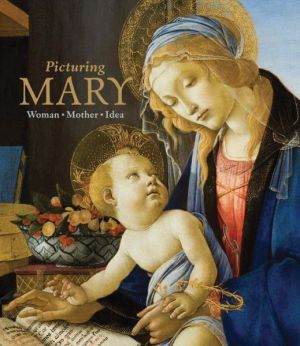 Iconic and devotional, but also fraught with social and political significance, the image of the Virgin Mary has shaped Western art since the sixth century. Depictions of the Virgin Mary in art through the ages are examined from a unique combination of Christian, Jewish, Muslim and contemporary art-historical perspectives. The thought-provoking texts examine Mary’s image as an enthroned queen, a tender young mother and a pious woman, demonstrating how her personification of womanhood has resonated throughout history to the present day.
Timothy Verdon is director of Museo dell Opera di Santa Maria del Fiore. Melissa R. Katz is Luther Gregg Sullivan Fellow in Art History, Wesleyan University. Amy Remensnyder is associate professor, Department of History at Brown University. Miri Rubin is Professor of Medieval and Early Modern History, Queen Mary University of London. Kathryn Wat is Chief Curator,
National Museum of Women in the Arts.
Exhibition | Body and Soul: Munich Rococo from Asam to Günther
◊ ◊ ◊ ◊ ◊
the Kunsthalle Munich:
Body and Soul: Munich Rococo from Asam to Günther
Mit Leib und Seele: Münchner Rokoko von Asam bis Günther
Kunsthalle der Hypo-Kulturstiftung, Munich, 12 December 2014 – 12 April 2015
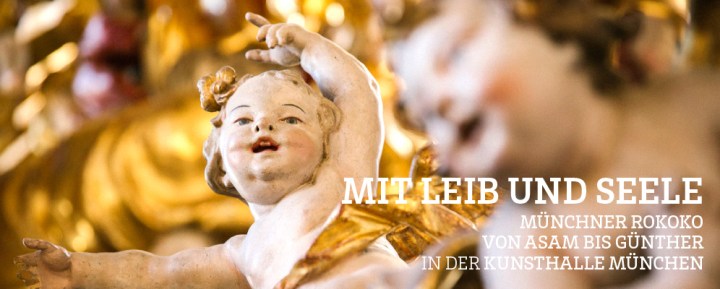
The Kunsthalle Munich and the Diocesan Museum Freising are organising a joint exhibition on Munich rococo—a golden age of Bavarian art, unparalleled even by international standards.
The exhibition presents numerous outstanding artists who lived in Munich between 1720 and 1770, like the Asam brothers, Cosmas Damian (1686–1739) and Egid Quirin (1692–1750), along with Johann Baptist Straub (1704–1784), Anton Bustelli (1723–1763) and Ignaz Günther (1725–1775). On the one hand, their exceptionally aesthetic language is characterised by an almost unprecedented jocular vitality, then again it is pervaded with a refined elegance. Visitors will be treated to a unique exhibition experience as numerous significant works from Bavaria and Germany’s wealth of churches, museums and castles come together in a fascinating journey. Thanks to the cooperation with the diocesan, many of the works have been loaned by churches and monasteries for the very first time and are being presented in the rooms of the Kunsthalle in this unique exhibition. Rarely in the past have visitors been given the opportunity to behold these otherwise almost inaccessible works in such proximity, allowing their artistic and technical qualities to be unveiled.
The Many Faces of Rococo
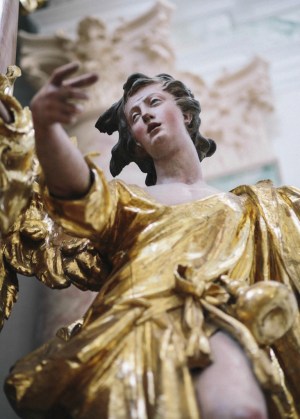
Johann Baptist Straub, Raphael the Archangel from the high altar, 1767, gilt and polyhcrome wood, 200 cm (Munich: Parish Church of St. Michael, © Thomas Dashuber).
The exhibition is showing approximately 160 rococo masterpieces, particularly sculptures in wood and other materials like stucco, clay, porcelain and silver, together with paintings, drawings and graphic prints. The starting point of the exhibition is the baroque artwork combining architecture, painting, stucco and sculpture, which reached its final, particularly impressive culmination in the hands of the Asam brothers. Contextualised by Bozzetti (sculptural designs) and drawings, the sculptures of Johann Baptist Straub and Ignaz Günther are at the very heart of the exhibition. Straub is considered to be the founding father of rococo sculpture, while Günther marks the pinnacle, and yet also the grand finale, of the epoch. Christian Jorhan the Elder (1727–1804) and Franz Xaver Schmädl (1705–1777) represent the generation of students who propagated Munich’s rococo beyond the city walls and out into the surrounding areas. Anton Bustelli introduces a mundane aspect: the effortless sophistication and playfulness of his renowned porcelain figures, which were popular table decorations at court, symbolise the entire era. The final chapter of the exhibition is dedicated to the sculptor Roman Anton Boos (1733–1810). Although his works are clearly rooted in the tradition of his predecessors, at the same
time they presage the emerging art of classicism.
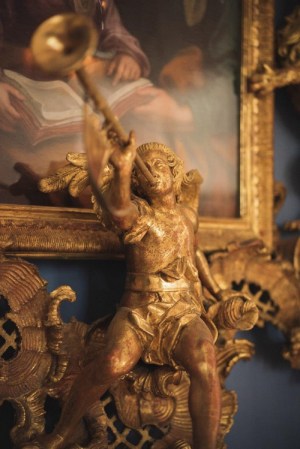
François Cuvilliés, detail of the decorative frame from the St Anne Altar, 1742–44 (Munich: Wallfahrts-kirche St. Anna, © Thomas Dashuber)
Between Play and Earnest
The exhibition aims to offer fresh insight with an unadulterated look at the epoch and, in so doing, not merely showcase the high artistic quality of the works but also to integrate them in the zeitgeist and the spiritual world. In the process, rococo art is taken literally in its specificity and its characteristics—the playful, delicate elements—turn out to be its inherent strengths. Far-reaching issues, relating to the mounting of the sculptures, their architectural integration or workshop practice for example, are also addressed.
The art of Munich rococo interfuses sacrality and profanity, the ecclesiastical and courtly worlds, but also play and earnest. Thus, an aesthetic language emerges that is unique in Europe, yet entirely its own.
A lavishly illustrated catalogue with further essays and detailed information on all the exhibits has been published by Sieveking Verlag to accompany the exhibition.
◊ ◊ ◊ ◊ ◊
From the publisher:
Christoph Kürzeder, Ariane Mensger, Peter Volk, et al. Mit Leib und Seele: Münchner Rokoko von Asam bis Günther (Sieveking Verlag, 2014), 384 pages, ISBN 978-3944874159, 50€.
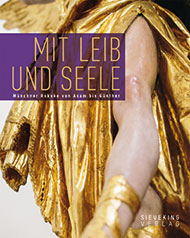 The exhibition Mit Leib und Seele (Body and Soul) aims to shed new light on the astounding stylistic diversity of the Munich Rococo between the years 1720 and 1770. The accompanying publication illustrates how a fresh consideration of the era provides illuminating insights into works by a range of artists, including the Asam brothers, Johann Baptist Straub, Franz Anton Bustelli, and Ignaz Günther. While the focus is on sculpture, the exhibition also features porcelain, silverwork, paintings, and drawings. The high art of the Rococo is presented in the context of its zeitgeist and religious milieu and appears more vibrant and more spectacular than ever: with their elegant, refined physicality and profound spirituality the artworks of this important period enter into a dialogue with viewers—and engage both body and soul.
The Kunsthalle of the Hypo Cultural Foundation in Munich is exhibiting these epochal works in partnership with the Diözesanmuseum Freising. The result of this collaboration is a unique exhibition in which the Munich Rococo will be seen in a presentation unprecedented in its magnitude and quality.
Exhibition | Picture Talking: James Northcote and the Fables
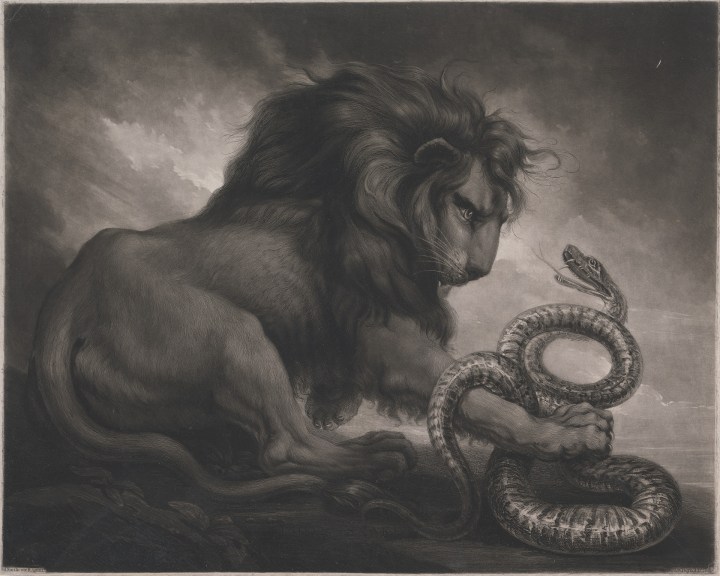
Samuel William Reynolds, after James Northcote, Lion and Snake (detail), 1799, mixed method engraving (New Haven: Yale Center for British Art, Paul Mellon Collection)
◊ ◊ ◊ ◊ ◊
The prints Northcote used in the collages date from the eighteenth century. Press release from the YCBA:
Picture Talking: James Northcote and the Fables
Yale Center for British Art, New Haven, 2 October — 14 December 2014
Curated by Mark Ledbury and A. Cassandra Albinson
The first exhibition solely dedicated to James Northcote’s art and career, Picture Talking: James Northcote and the Fables will present a fascinating look at one of Britain’s most imaginative and eccentric painters.

William Daniell, after George Dance, James Northcote, between 1798 and 1819, graphite and red chalk on medium, slightly textured, cream wove paper mounted on moderately thick, moderately textured, beige laid paper (New Haven: Yale Center for British Art, Paul Mellon Collection)
Northcote (1746–1831) has been remembered primarily as a memoirist, a writer on art and artists, and a conversationalist whose strong opinions on diverse topics were often repeated in print. A pupil of Sir Joshua Reynolds, the first president of the Royal Academy, Northcote enjoyed a popular reputation in his time for painting portraits of historical subjects, scenes from Shakespeare’s plays, and animals. This subsequently was overshadowed by his prominence as a source of information on his contemporaries. This exhibition, drawn exclusively from the rich holdings of the Yale Center for British Art, will redress that imbalance by presenting an array of Northcote’s art: paintings, drawings, prints, and, at its center, a practically unknown manuscript for Northcote’s One Hundred Fables, Original and Selected (1828).
Northcote wrote and illustrated these fables for adults during the last twenty years of his life. They convey moral lessons, often with themes comparing the similarities of humans to animals. Using techniques well ahead of his time, Northcote created collaged illustrations for the Fables by cutting humans, other animals, and background details from his collection of historical engravings, then reassembling them into chimerical scenes. This exhibition will explore the translation of Northcote’s highly original designs from collages to their ultimate form as wood engravings for two series of Fables, the first published in 1828, the second, posthumously, in 1833. The wood engravings provided simplified, but highly popular, interpretations of the original fables for mass production and consumption. Picture Talking will consider the questions of originality versus pastiche and image versus text through careful consideration of Northcote’s art. It will argue that in his earlier work as a history painter and print designer, Northcote worked through the process of borrowing and collage. Thus, the fables represent a culmination of his career.
Picture Talking: James Northcote and the Fables has been organized by the Yale Center for British Art. The co-curators are Mark Ledbury (Power Professor of Art History and Visual Culture and Director of the Power Institute at the University of Sydney) and A. Cassandra Albinson (Curator of Paintings and Sculpture at the Yale Center for British Art).
Opening Lecture
Mark Ledbury | Inspiration and Eccentricity: The Ups and Downs of James Northcote
Yale Center for British Art, New Haven, 1 October 2014, 5:30
◊ ◊ ◊ ◊ ◊
From Yale UP:
Mark Ledbury, James Northcote, History Painting, and the Fables (New Haven: Yale Center for British Art, 2014), 256 pages, ISBN: 978-0300208139, $65.
 The artistic accomplishments of James Northcote (1746–1831) have tended to be overshadowed by his role as a biographer of Joshua Reynolds, first president of the Royal Academy of Arts, with whom Northcote apprenticed. Here, Mark Ledbury constructs a very different image of Northcote: that of a prolific member of the Royal Academy and an active participant in the cultural and political circles of the Romantic era, as well as a portrait and history painter in his own right. This book focuses on Northcote’s One Hundred Fables (1828), a masterpiece of wood engraving, and the unconventional, collaged manuscripts for the volume. The Fables, extensively published here for the first time, were an early experiment in what is now a familiar multimedia practice. Idiosyncratic, personal, and visionary, One Hundred Fables serves as a lens through which to examine Northcote’s long, complex, and fruitful artistic career.
Mark Ledbury is Power Professor of Art History and director of the Power Institute at the University of Sydney.
Reviewed | Judith Bonner on ‘The Coast and the Sea’
Linda S. Ferber, The Coast and the Sea: Marine and Maritime Art in America (New York and London: New-York Historical Society in association with D. Giles Limited, 2014), 104 pages, ISBN 978-1907804311, $30 / £20.
Reviewed for Enfilade by Judith H. Bonner
 The New-York Historical Society, that city’s oldest museum, is celebrating its recent reopening after its lengthy renovation with a traveling exhibition and accompanying catalogue by Linda S. Ferber.1 The exhibition features more than 60 artworks and artifacts, primarily paintings, including portraits, genre scenes, and marine and maritime scenes. Overall, the images document the development of the New York area with its harbor and its close relationship with the Atlantic Ocean, the great maritime highway for trade and immigration.
Works selected for the exhibition have their origins in the eighteenth century, beginning in 1728 and ending in 1904. Maritime-related artifacts include a vintage spyglass, scrimshaw, snuff boxes, and an 1816 silver presentation soup tureen commemorating acts of bravery during the War of 1812. The provenance of each artwork documents the development of the New-York Historical Society, as well as the city’s art collectors, their tastes, and their interests.
The exhibition features work by artists whose names are familiar, as well as those who are unfamiliar. The painters include Thomas Birch, Thomas Buttersworth, Carlton Theodore Chapman, Thomas Cole, Jasper Francis Cropsey, Julian Oliver Davidson, Mauritz Frederick Hendrick De Haas, James Guy Evans, Robert Havell Jr., John Frederick Kensett, Rembrandt Peale, Francis Augustus Silva, and John Vanderlyn.
Several artists had nautical experience that informed their art in subject, rigging, and construction of the vessels. Buttersworth served in the British navy, while De Haas held an artist’s commission in the Dutch navy. James Guy Evans possibly served in the American navy. Chapman ran away to sea as a teenager; and Davidson sailed the globe, making sketches that provided visual sources for many years. Evident in these artists’ works is their understanding of the action of waves and atmospheric effects over the seas at different times of the day or season.
The marine subjects include frigates engaged in famous sea battles, working vessels and bustling port scenes, marine recreation scenes, portraits of heroic sea captains, and pioneering merchants. Marine scenes focus on recreation, shipwrecks, disasters, and military encounters, particularly those in the War of 1812 and Civil War. The exhibition spreads its reach down the East Coast, swinging farther south to the Battle of Mobile Bay in the Gulf of Mexico and the Battle of Port Hudson up the Mississippi River about 100 miles above New Orleans.
Portraitists range from eighteenth-century painter John Wollaston to early nineteenth-century painters John Vanderlyn and Rembrandt Peale, the latter of whom executed a portrait of naval hero Commodore Stephen Decatur in dress uniform and set against a dramatic stormy sky. Wollaston’s circa-1750 portrait of wealthy colonial merchant-shipbuilder Captain John Waddell, who owned a fleet of ships, sets the stage for the succession of ships’ portraits seen throughout the catalogue. Early portraits include personages having distinguished careers or an association with maritime enterprises. The sitter is often shown near an open window through which one views a conventionalized seascape or harbor scene with masted vessels. Other sitters are shown with maps, globes, compass, a spyglass, or other maritime instruments.
The catalogue is well researched and documented with a select bibliography. Explanations of the marine scenes are succinct yet vivid; the prose is fluid and often poetic. Ferber distinguishes between marine scenes—which focus on the pure seascape, its coast and environs—and maritime paintings. The latter, Ferber explains, emphasize human activity and other enterprises on shore or at sea. Her knowledge of nautical terminology and national history is evident throughout. She traces visual conventions from their development in seventeenth-century Holland, their passage into the British school of marine painting, and subsequent introduction into English colonies in the New World.
Ferber consistently places artworks within a broader historical context and, when appropriate, within a cultural narrative. Brief biographical sketches of artists trace their artistic development within the maritime tradition. Ferber discusses allegorical themes in paintings, as well as the effect that nostalgic longing for historically simpler times had upon the proliferation and re-creation of popular scenes celebrating heroic national victories and spirited naval encounters.
The book invites readers to the repeated examination of the images, some of which, like those illustrating the America’s Cup, are iconic. Truly memorable is a painting by Howard Pyle, A Privateersman Ashore (1893), shown in historically correct clothing and accouterments. The privateer stands near the Battery and Castle Clinton at the time of the War of 1812, posed and preening, with smoke from his cigar curling upward from the corner of his mouth as townspeople in the distance look toward him with disdain. The latter is a comment about the disapprobation citizens held for such freebooters, who preyed upon British ships.
Closing this maritime jaunt through history are two paintings. The first, by Andrew Meyer, shows President Grover Cleveland reviewing a naval parade in New York Harbor as the setting for opening ceremonies of Chicago’s Columbian Exposition in 1893, with the Statue of Liberty clearly visible, as though she also stands in review of the parade. Lastly, in 1904 Chapman portrays the Great East River Bridge (now Brooklyn Bridge) over the East River, celebrating New York’s location on the rim of the Atlantic, the gateway to America.
1. Venues for exhibition include: The Society of the Four Arts, Palm Beach, Florida (25 January — 9 March 2014); The Baker Museum of Art, Naples, Florida (19 April — 6 July 2014); Portland Museum of Art, Portland, Maine (January — May 2015); The Mattatuck Museum, Waterbury, Connecticut (6 June — 13 September 2015); and The New York State Museum, Albany, New York (24 October 2015 — 22 February 2016).
◊ ◊ ◊ ◊ ◊
Judith H. Bonner is Senior Curator and Curator of Art at The Historic New Orleans Collection.
Exhibition | William Blake: Apprentice and Master
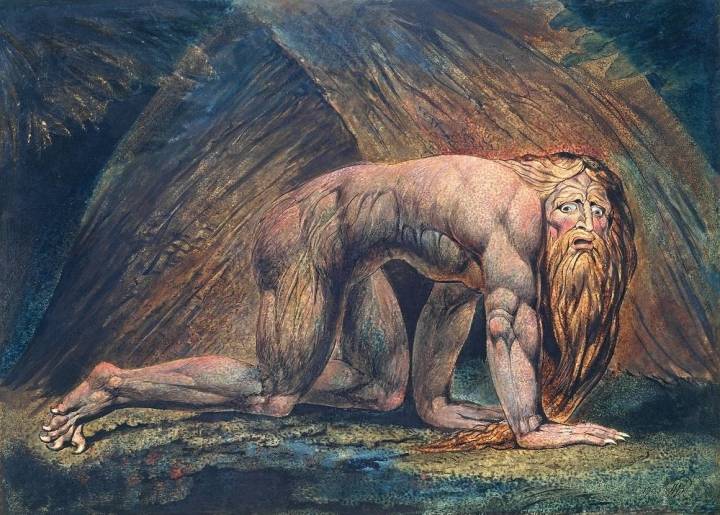
William Blake, Nebuchadnezzar, ca. 1795–1805, colour print,
ink, and watercolour on paper, 54.3 x 72.5 cm (London: Tate)
◊ ◊ ◊ ◊ ◊
From the Ashmolean:
William Blake: Apprentice and Master
Ashmolean, Oxford, 4 December 2014 — 1 March 2015
Curated by Michael Phillips and Colin Harrison
This major exhibition focuses on the extraordinary life and work of William Blake (1757–1827), printmaker, painter and revolutionary poet of the prophetic books. It examines his formation as an artist, apprenticeship as an engraver, and his maturity during the 1790s when he was at the height of his powers as both an artist and revolutionary poet. We also explore his influence on the young artist-printmakers who gathered around him in the last years of his life, including Samuel Palmer, George Richmond and Edward Calvert.
One of the most popular English artists, William Blake is still one of the least understood. His radical politics were reflected in his extraordinary technical innovations, especially in the field of printmaking and the illuminated book. This exhibition brings together more than 90 of Blake’s most celebrated works and offers new insights into his remarkable originality and influence.
At a young age William Blake showed artistic promise and, at the age of 15, was apprenticed to James Basire, the official engraver to the Society of Antiquaries. Under Basire’s tutelage, Blake was sent out to study London’s gothic churches and, most particularly, the monuments and decorations in Westminster Abbey—an experience which was to prove formative for his later style and imagery. The first section of the exhibition looks at Blake’s early work, exemplifying his already unorthodox approach.
After studying at the Antique School of the Royal Academy, Blake opened a print shop with his former apprentice colleague, James Parker, and from this point he began to associate with the leading writers and intellectuals of radical politics such as Mary Wollstonecraft and Thomas Paine, who gathered at the house of publisher, Joseph Johnson. Blake was soon producing prints of startling originality, which anticipate by nearly a century the monotypes made by artists such as Edgar Degas from the 1880s onwards. The exhibition examines Blake’s technical innovations in the creation of his illuminated books, which brought a new sophistication to colour printing. Among the works on display are several of the most extraordinary illuminated books, including The Marriage of Heaven and Hell, and a complete set of the plates from Europe: A Prophecy, together with some of the finest separate plates, among them Nebuchadnezzar and Newton.
Apprentice and Master will also look at Blake’s later career when, encouraged by his friendship with the young artist, John Linnell, he developed an interest in the great artist-printmakers of the Renaissance such as Albrecht Dürer and Lucas van Leyden. It was Linnell who commissioned the last of Blake’s great series of watercolours, the illustrations to the Book of Job and to Dante. It was these works, and above all the small woodcut illustrations to Virgil’s Pastorals, which inspired the young artists Samuel Palmer, George Richmond, and Edward Calvert, known as the Ancients. During the last three years of his life, they visited Blake and his wife in their two-room flat off the Strand. This exhibition juxtaposes many of the works the Ancients would have seen on these visits, with their own early works. Among the most notable are Palmer’s greatest creations, the six sepia drawings of 1825; and Calvert’s exquisite woodcuts of the late 1820s.
William Blake: Apprentice and Master has been curated by Dr Michael Phillips (Centre for Eighteenth Century Studies, University of York) and Mr Colin Harrison (Senior Curator of European Art, Ashmolean Museum).
Michael Phillips is currently writing a biography of William Blake in Lambeth during the anti-Jacobin Terror in Britain, entitled Blake and the Terror. His edition in facsimile of Blake’s The Marriage of Heaven and Hell was published by the Bodleian Library and the University of Chicago Press in 2011. He was guest curator of the William Blake Exhibition that opened in Paris at the Petit Palais from 1 April to 28 June 2009 and editor of the catalogue. He was also guest curator of the major Blake exhibition at Tate Britain and the Metropolitan Museum of Art, New York, 2000–2001, and is currently guest curator of the Blake exhibition opening in December 2014 in the new galleries of the Ashmolean Museum of the University of Oxford, William Blake: Apprentice & Master, where Blake’s printmaking studio at No. 13 Hercules Buildings, Lambeth, will be recreated.
◊ ◊ ◊ ◊ ◊
Michael Phillips, William Blake: Apprentice and Master (Oxford: Ashmolean Museum, 2015), 200 pages, ISBN: 978-1854442888, £21 / $40.
Exhibition | Marie-Gabrielle Capet: Une Virtuose de la Miniature
From the Musée des Beaux-Arts de Caen:
Marie-Gabrielle Capet: Une Virtuose de la Miniature
Musée des Beaux-Arts de Caen, 14 June — 21 September 2014
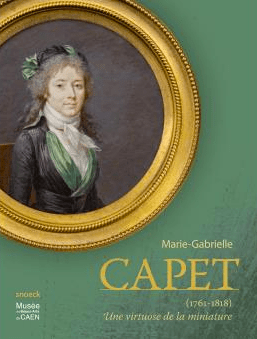 L’exposition d’été du musée des Beaux-Arts de Caen dépend étroitement du chiffre 3 : 3 artistes (deux portraitistes et un paysagiste), 3 siècles (les XVIIIe, XIXe et XXe), 3 époques, 3 temps de l’histoire de l’art mais aussi de l’histoire du musée des Beaux-Arts de Caen.
Robert Le Vrac Tournières (1667–1752) et Marie-Gabrielle Capet (1761–1818) furent de ramarquables portraitistes, chacun dans leur genre : Tournières fut un des grands maîtres du portrait au temps de Louis XV et Capet porta le genre de la miniature (précieux portraits peints sur ivoire) à un point éblouissant. Joan Mitchell (1925–1992), quant à elle, demeure l’un des grands peintres abstraits de la seconde moitié du XXe siècle.
La muséographie des trois salles est spécialement conçue pour chaque artistes : elle met en valeur les compositions de Tournières, suggére l’atmosphère d’un cabinet d’amateur pour les miniatures de Capet et joue des vastes espaces lumineux pour les paysages de Mitchell. Il se trouve aussi que chacun de ces artistes tient une place importante dans l’histoire du musée pour des raisons très différentes. Tournières, car des oeuvres insignes de ce maître sont récemment entrées dans les collections. Capet, car ce qui est probablement son chef-d’oeuvre est conservé au musée après y avoir été volé puis restitué. Joan Mitchell est un temps fort des collections contemporaines de Caen. Ces trois peintres sont le point de départ de trois expositions au cours desquelles sont évoqués leur histoire, leur oeuvre, leur art. Une façon de réconcilier le hasard et la raison.
Marie-Gabrielle Capet: Une Virtuose de la Miniature
L’an dernier, le musée a pu retrouver, presque par miracle, une miniature volée en 1925 : le Portrait de Jean-Antoine Houdon sculptant le buste de Voltaire, chef-d’oeuvre de la grande miniaturiste Marie-Gabrielle Capet (1761–1818). Avec comme prétexte cet heureux évènement, l’exposition se propose de rassembler le meilleur de la production de l’artiste ; des miniatures, mais aussi des tableaux issus de collections publiques et privées, françaises et étrangères, qui permettront d’illustrer un style qui fascina son époque, exactitude illusionniste de la touche et rendu vibrant de la lumière. L’ensemble permet d’évoquer l’influence capitale de ses maîtres, Adélaïde Labille-Guiard et son époux François-André Vincent.
Marie-Gabrielle Capet (1761–1818): Une Virtuose de la Miniature (Cologne: Snoeck Verlagsgesellschaft, 2014), 2014) 104 pages, ISBN: 978-9461611659, 18€.
New Book | Start with a House, Finish with a Collection
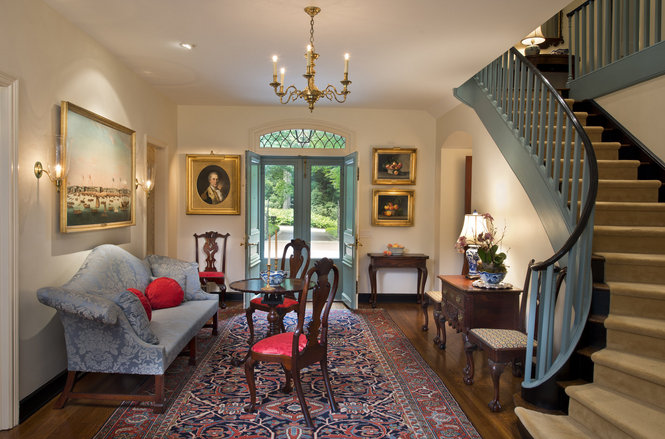 Home of Leslie Ann Miller and her husband, Richard Worley, photo from The Patriot News
◊ ◊ ◊ ◊ ◊
From Scala:
Leslie Anne Miller and Alexandra Kirtley, Start with a House, Finish with a Collection (New York: Scala Arts Publishers, 2014), 272 pages, ISBN: 978-1857599190, $75.
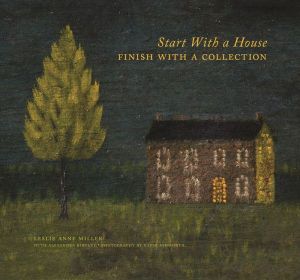 Start with a House, Finish with a Collection is the story of how a couple’s use of American art and antiques evolved from furnishing a house into a full-blown passion for collecting. Featuring exquisite examples of Hollingsworth and Morris family furniture, Weber boxes, Pennsylvania clocks and Kirk-Stieff silver, as well as American paintings by the Peale family, Edward Hicks, Edward Redfield and Horace Pippin, this museum-caliber collection reveals a pride in the early American sensibility. The combination of text and extraordinary photographs traces this remarkable journey and demonstrates that life can be more than comfortable living among these collections. The compendium catalogues the diversified and important collection, making this a valuable scholarly reference as well as a reading pleasure.
Leslie Anne Miller, a Philadelphia attorney and community leader, has been collecting American art and antiques with her husband Richard Worley for more than 25 years. Alexandra Kirtley is The Montgomery-Garvan Associate Curator of American Decorative Arts at the Philadelphia Museum of Art.
Exhibition | A Royal Collecting Passion: Wilhelm I of Württemberg
From the Staatsgalerie Stuttgart:
A Royal Collecting Passion: Wilhelm I of Württemberg
Staatsgalerie Stuttgart, 18 July — 26 October 2014

Gottlieb Schick, Apollo among the Shepherds, 1806–08, (Staatsgalerie Stuttgart)
As a regent, Wilhelm Friedrich Karl von Württemberg (1781–1864) gave the young kingdom of Württemberg a historical identity; his multifarious initiatives as a collector and patron, however, have all but sunk into oblivion. The holdings of the Staatsgalerie, which opened in 1843, were expanded by artworks in royal ownership as well as by personal gifts. Wilhelm I moreover initiated the acquisition of the Barbini-Breganze collection, which today forms the core of the Staatsgalerie Stuttgart’s holdings in the area of Italian Baroque painting. The royal gifts, still present in our museum’s collection in their near entirety, are now to be presented to the public for the first time in many decades. Numerous furnishings from Wilhelm I’s private residences as well as masterpieces from his private painting collection—disbanded after 1918—will be on view. On the basis of the records at the Staatsarchiv Baden-Württemberg, which have been preserved almost in full, light will also be shed on the history of the royal purchases. The exhibition is being realized in cooperation with the Staatliche Schlösser und Gärten Baden-Württemberg.
More information (in German) is available here»
◊ ◊ ◊ ◊ ◊
The catalogue, published by Nicolai Verlag, is available from ArtBooks.com:
Königliche Sammellust: Wilhelm I. von Württemberg als Sammler und Förderer der Künste (Berlin: Nicolai, 2014), 208 pages, ISBN: 978-3894798727, 35€ / $68.
Exhibition | Masks, Masquerades, and Mascarons

Claude Gillot , The Two Coaches, 1712–16
(Paris: Musée du Louvre)
From the Louvre:
Masques, Mascarades, Mascarons
Musée du Louvre, Paris, 19 June — 22 September 2014
Organized by Françoise Viatte, Dominique Cordellier, and Violaine Jeammet
The exhibition presents approximately one hundred artworks showing the paradoxical function of the mask, an emblem of illusion that consists of “disguising and producing a double.” Masked men have existed in the West since ancient times. The mask hides the face in favor of its double, concealing one to reveal the other, in an act that gives shape to mystery. It belongs to the sacred and the profane, truth and vanity, reality and fiction. It horrifies and seduces, imitates and misleads.
Drawings, sculptures, paintings, and engravings demonstrate its religious role in Greek theater, its playful and rather diabolical force of expression in feasts, balls, and Italian comedies, its funereal presence on the deathbed, and its lasting and protective force on the tombstone. The duplicity of the mask in the world of allegory will also be explored, along with its presence in decoration through the mascaron which appears to be simply an avatar of Medusa’s head cut off by Perseus and placed on Athena’s shield to retain its astonishing power.
◊ ◊ ◊ ◊ ◊
The catalogue is published by Officina Libraria:
Françoise Viatte, Dominique Cordellier, and Violaine Jeammet, Masques, Mascarades, Mascarons (Milan: Officina Libraria, 2014), 272 pages, ISBN: 978-8897737377, 32€.
 L’exposition évoque, à travers une centaine d’oeuvres, la fonction paradoxale du masque, emblème de l’illusion, qui consiste à « dérober et produire un double ».Dessins, sculptures, peintures, gravures montreront son rôle religieux dans le théâtre grec, sa force expressive, ludique et quelque peu diabolique dans la fête, le bal ou la comédie italienne, son empreinte funèbre au lit de mort et sa force pérenne et protectrice au tombeau. Seront aussi abordées la duplicité du masque dans le monde de l’allégorie, sa présence dans l’ornement sous la forme du mascaron qui ne semble rien d’autre qu’un avatar de la tête de la Gorgone coupée par Persée et placée sur les armes d’Athéna pour y conserver son pouvoir sidérant.










leave a comment