Exhibition | The Tapestry Collection of the Petit Palais
Now on view in Nancy, as noted at Arachné, a research group blog dedicated to tapestries:
Chefs-d’œuvre de la tapisserie: La collection du Petit Palais, Paris
Nancy, Musée des Beaux-Arts, 25 October 2013 — 27 January 2014
Curated by Charles Villeneuve de Janti and Patrick Lemasson
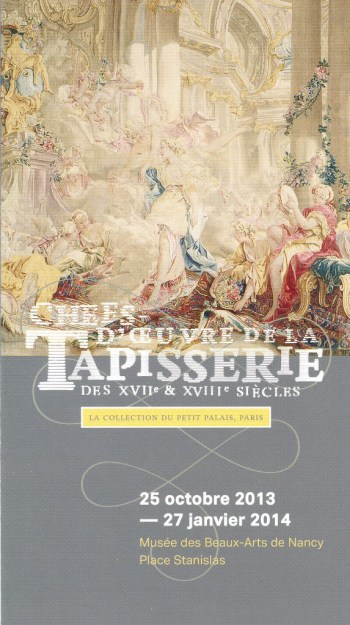 Le Petit Palais, Musée des Beaux-Arts de la Ville de Paris, possède l’une des plus belles collections de tapisseries des XVIIe et XVIIIe siècles. Issues de grandes manufactures européennes, elles furent élaborées et tissées en matériaux précieux d’après les cartons de peintres majeurs tels que Le Brun, Champaigne, Boucher, à l’instar du carton pour La Destruction du Palais d’Armide par Charles Coypel, l’un des chefs-d’œuvre du Musée des Beaux-Arts de Nancy.
Ces œuvres, pouvant mesurer jusqu’à 5 mètres de hauteur, permettront aux visiteurs de découvrir un art de cour spectaculaire faisant écho à celui dévoilé dans l’exposition L’Automne de la Renaissance : d’Arcimboldo à Caravage. Pour des raisons de conservation, ces pièces sont très rarement présentées au public. Ce prêt du Petit Palais constitue donc une faveur exceptionnelle.
Didier Rykner provides a review at La Tribune de l’Art (4 November 2013).
◊ ◊ ◊ ◊ ◊
The catalogue is available from Artbooks.com:
Patrick Lemasson, Chefs d’oeuvres de la Tapisserie: La collection du Petit Palais, Paris (Milan: Silvana, 2013), 72 pages, ISBN: 978-8836627257, $29.
Display | Gainsborough and the Landscape of Refinement
As noted at ArtDaily (2 December 2013) . . .
Master Drawings New York | Gainsborough and the Landscape of Refinement
Lowell Libson at Mitchell-Innes & Nash, New York, 24 January — 1 February 2014

Thomas Gainsborough, Figures Resting in Woodland Landscape, signed 1784, 232 x 291 (Lowell Libson)
The exhibition is centered round a group of landscape drawings made by Gainsborough in the last two decades of his life but includes twelve drawings by Gainsborough spanning the full length of his career, from Gainsborough’s earliest recorded landscape study—completed when the artist was only 18—to a preparatory drawing for one of his last ‘Fancy pictures’ A Boy with a Cat, now in the Metropolitan Museum of Art in New York, which was completed the year before his death. Three of the drawings are previously unpublished and exhibited to the public for the first time here.
Thomas Gainsborough (1727–1788) was one of the Britain’s greatest artists, famed for his engaging portraits and evocative landscape paintings, he is also universally acknowledged as one of the finest European draughtsman of the eighteenth century. Despite this reputation, there have been very few exhibitions dedicated to Gainsborough’s drawings. These are not topographical works but imagined landscapes which Gainsborough created by drawing models he created using rocks and wood found in his garden and, as one writer noted, ‘distant woods of broccoli.’
Gainsborough was fascinated by a limited number of landscape features—herds of cattle, serpentine roads, clumps of trees and hilly horizons—often obsessively playing with these features time and time again, each time creating completely new works. This creative repetition—or refinement—was given expression in Gainsborough’s fascination with different techniques.
No two drawings in the exhibition are handled in the same way as Gainsborough explored different combinations of chalks, pencil, ink washes and watercolour in each work. Many of the drawings in the exhibition have provenances stretching back to the eighteenth century, one is inscribed as a present from ‘the ingenious artist’ to the daughter of a friend, another was in the collection of the celebrated surgeon, Dr John Hunter, who treated Gainsborough in his final illness. This group is the largest concentration of Gainsborough drawings to be offered by an art gallery since the celebrated exhibition mounted by Knoedler in 1914. It is accompanied by a fully illustrated catalogue with scholarly entries written by the leading Gainsborough authority, Hugh Belsey.
The exhibition is free and open daily from Friday 24 January to Saturday 1 February, 2014 Mitchell-Innes & Nash, 1018 Madison Avenue, New York. Monday to Saturday, 11–6; Sunday, January 26, 2–6; Tuesday, 28 and Thursday, 30 January, 11–8.
◊ ◊ ◊ ◊ ◊
Press release (15 August 2013) from Master Drawings New York:
Master Drawings New York
New York, 25 January — 1 February 2014

◊ ◊ ◊ ◊ ◊
In a fifteen block stretch of the Upper East Side’s ‘Gold Coast’ in New York, close to 30 of the most acclaimed international dealers in master drawings will show the latest artworks entering the market during the eighth edition of Master Drawings New York, January 25th through February 1, 2014 with a Preview Friday January 24th from 4 to 8pm. Timed to coincide with New York’s major January art-buying events, including the Old Master auctions and The Winter Antiques Show, Master Drawings New York includes top dealers from the US as well as the UK, France, Germany, Spain, and Italy. Originally conceived as an annual walkthrough, Master Drawings New York has grown into a ‘must see’ event with a number of New York dealers making their galleries available to their overseas colleagues for the week. (more…)
Exhibition | Precious Antiquities: The Profane Museum
From the Vatican Museums:
Precious Antiquities: The Profane Museum at the Time of Pius VI
Room of the Aldobrandini Wedding, Vatican Museums, Rome, 2 October 2013 — 4 January 2014
Curated by Guido Cornini and Claudia Lega
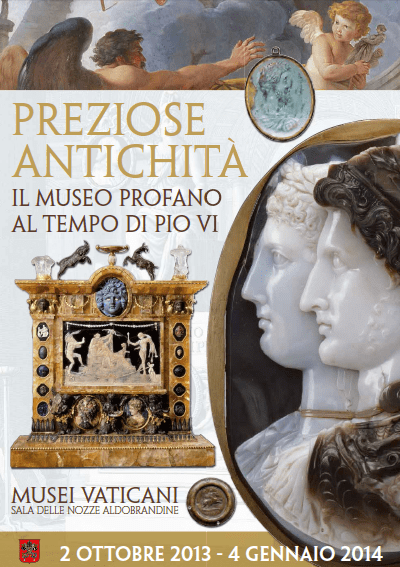 For the first time in over two hundred years, an exhibition will bring back to life in the Vatican the charm of the eighteenth-century collections of the Profane Museums at the time of Pius VI, before the Napoleonic requisitions. It offers a unique opportunity to see reunited, in their original museum context, works previously exhibited in the Museum and now conserved in prestigious international cultural institutions. The exhibition will open simultaneously with the new display of the historical collections of the Profane Museum.
The Profane Museum, the original nucleus of the collections of profane antiquities in the future complex of the Vatican Museums, was created by Clement XIII (Rezzonico, 1758–1769) and enriched with further collections and furnishings under Pius VI (Braschi, 1775–1799). The conclusion of this demanding restoration project, which involved the entire collection and its context, is an opportunity to imagine a momentary “homecoming” of a nucleus of antique gems and cameos, mounted in elaborate Neoclassical settings at the end of the eighteenth century, and a valuable numismatic collection of Greek, Etruscan and Roman exemplars. Involved in the dramatic wartime events of the Napoleonic period, these works were transported to France as a war indemnity following the assassination of General Mathurin-Léonard Duphot in Rome in 1798.
Curated by Guido Cornini and Claudia Lega, curator and assistant in the Department of Decorative Arts of the Vatican Museums, the exhibition Precious Antiquities: The Profane Museum at the Time of Pius VI – presented in the evocative surroundings of the Room of the Aldobrandini Wedding – displays for the first time in over two hundred years works such as the Augustus Group, with its splendid portrait of the emperor in chalcedony, the famous Carpegna Cameo of magnificently engraved onyx depicting the Triumph of Bacchus, the “Delle Paste” Group, with a glass cameo pinax depicting the loves of Bacchus and Ariadne, and other Groups and cameos masterfully reinterpreted and infused with new life by Luigi Valadier, celebrated silversmith in Rome at the time of Pius VI. (more…)
Exhibition | Antonio Canova: The Seven Last Works
From The Met:
Antonio Canova: The Seven Last Works
Gallerie d’Italia, Milan, 4 October 2013 — 6 January 2014
The Metropolitan Museum of Art, New York, 22 January — 27 April 2014
Curated by Fernando Mazzocca and Matteo Ceriana
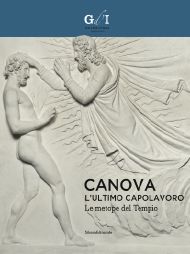 Antonio Canova (1757–1822), the greatest of all neoclassical sculptors, remains famous above all for the elegant nude mythological subjects that he carved exquisitely in marble. But he also worked in a deeply serious, deceptively simple style. This less familiar Canova is revealed in an extraordinary series of full-scale plaster models illustrating episodes from the Old and New Testaments. Such models, used to review his compositions before they were transferred into stone, were a distinctive feature of his sculptural practice. These Biblical scenes were made in connection with a project for 32 low reliefs that were to adorn the Tempio Canoviano, the church in his home town Possagno, which later became the artist’s mausoleum. He completed only seven models before his death. Six come from the Gallerie dell’Accademia in Venice, and one from the Gipsoteca in Possagno. Newly restored, they will all be lent for the first time to the United States. Drawing inspiration from ancient sculpture and early Renaissance masters, the models are striking for the marked linearity of the figures, arranged in brilliantly syncopated compositions. They constitute Canova’s last, profoundly moving masterworks.
◊ ◊ ◊ ◊ ◊
From the Gallerie d’Italia:
Canova. L’ultimo capolavoro. Le metope del Tempio
Gallerie d’Italia, Milan, 4 October 2013 — 6 January 2014
The Metropolitan Museum of Art, New York, 22 January — 27 April 2014
a cura di Fernando Mazzocca e Matteo Ceriana
L’esposizione è organizzata da Intesa Sanpaolo in partnership con la Soprintendenza Speciale PSAE e per il Polo Museale della città di Venezia e dei Comuni della Gronda lagunare e in collaborazione con la Fondazione Cariplo. Aperta al pubblico nella sede milanese fino al 6 gennaio 2014, la mostra sarà ospitata al Metropolitan Museum of Art di New York dal 20 gennaio al 27 aprile 2014.
Il recente restauro di sei bassorilievi in gesso conservati presso le Gallerie dell’Accademia di Venezia, ispirati a episodi dell’Antico e del Nuovo Testamento, e lo studio dei documenti ad essi relativi hanno portato alla luce opere di grande valore storico. Sono infatti state identificate nelle opere restaurate i modelli originali per le prime delle trentadue metope – i pannelli decorativi destinati a ritmare il fregio dorico – che Antonio Canova, moderno Fidia, intendeva realizzare per il pronao del Tempio della natia Possagno, l’edificio maestoso da lui stesso progettato ispirandosi all’architettura del Partenone e del Pantheon.
Lo scultore iniziò a lavorare ai modelli delle metope nel dicembre del 1821; ai primi di aprile del 1822 ne erano stati eseguiti sette, subito inviati dallo studio di Roma all’Accademia di Venezia, perché altrettanti scultori, scelti tra i migliori allievi dell’Accademia stessa, iniziassero a realizzarne la versione in marmo. La morte, sopraggiunta il 13 ottobre 1822, impedì allo scultore di portare a compimento il progetto. Insieme ai sei bassorilievi del Tempio, sono in mostra sette disegni preparatori, provenienti dal Museo Civico di Bassano del Grappa, in stretta relazione alle metope stesse, che testimoniano il costante interesse di Canova per i temi biblici e cristiani, così come il suo studio dei Primitivi.
Completano l’esposizione due esemplari, provenienti dalla Biblioteca Braidense, dell’Atlante illustrato della Storia della scultura (1813–1818 e 1822–1824) di Leopoldo Cicognara, storico dell’arte e amico di Canova: una fonte importante che permette di contestualizzare meglio il confronto con il Medioevo e il primo Rinascimento. Uno dei sette modelli delle metope, andato purtroppo perduto, viene rappresentato in mostra dal bassorilievo proveniente dalla Gipsoteca Antonio Canova di Possagno, appartenente ad una serie eseguita dai seguaci dell’opera del Maestro.
La mostra trova una sede ideale nelle sale della sezione Da Canova a Boccioni delle Gallerie di Piazza Scala, nelle quali sono esposti i bassorilievi Rezzonico di Collezione Fondazione Cariplo. Tale collocazione consente un confronto diretto – nell’ambito delle opere di Canova con la tecnica del bassorilievo in gesso – tra la produzione giovanile dell’ultimo decennio del Settecento, ispirata all’antichità classica, e opere realizzate prima della morte.
Reviewed | Crossing Borders: Hebrew Manuscripts
While the manuscripts included in this exhibition date from the Middle Ages, there is material pertinent to eighteenth-century collectors, as noted below. And to everyone celebrating Hanukkah (which, of course, most unusually coincides this year with the American Thanksgiving), a very happy holiday! -CH
From caa.reviews:
Piet van Boxel and Sabine Arndt, eds. Crossing Borders: Hebrew Manuscripts as a Meeting-place of Cultures, exhibition catalogue (Oxford: Bodleian Library, University of Oxford, 2010), 128 pages, ISBN: 978-1851243136, £25.
Exhibition schedule: Jewish Museum, New York, 14 September 2012 — 3 February 2013
Reviewed by Barbara Drake Boehm and Melanie Holcomb; posted 20 November 2013.
Illuminated manuscripts offer the best-surviving evidence of Jewish artistic production in the Middle Ages, bearing witness to the tastes of their Jewish patrons, the skills of Jewish scribes, and the aesthetic acuity of Jewish readers and viewers. Jews did not live in isolation, and the artists responsible for the decoration of their books—who were not necessarily Jewish but may have been—both drew from and contributed to the artistic conventions of the dominant culture. ‘Crossing Borders: Manuscripts from the Bodleian Libraries’, an exhibition held at the Jewish Museum in New York in 2012–13 and online via the Jewish museum website, provided an opportunity not only to see important, often beautiful examples of rarely shown Hebrew manuscripts, but also to explore the fascinating, complex intellectual and cultural relations between Jews and non-Jews of medieval Europe.
The full review is available here» (CAA membership required)
◊ ◊ ◊ ◊ ◊
From the exhibition website:
Jan Jiri Baltzer (1738–99), Posthumous Portrait of David Ben Abraham Oppenheimer, Chief Rabbi of Prague, 1773
Engraving after Johann Kleinhard, 7 3/4 x 4 3/8 in. (19.5 x 11.1 cm), The Jewish Museum, New York Gift of Dr. Harry G. Friedman, F 4143
 The collection of Rabbi David Oppenheimer (1664–1736) is his most significant legacy. His more than 780 manuscripts and 4,200 printed books in Hebrew, Yiddish, and Aramaic form perhaps the most important private Jewish library ever assembled. For most of his life he was unable to enjoy this treasure, keeping the works at his father-in-law’s home in Hanover to avoid the censorship imposed on Hebrew texts in Prague. After his death, the collection was inherited by a succession of relatives. It was appraised by the Jewish luminary Moses Mendelssohn and ultimately acquired by the Bodleian in 1829.
◊ ◊ ◊ ◊ ◊
A recently discovered Passover Haggadah commissioned in 1726 by one of David Oppenheimer’s relatives sold, incidentally, last week (22 November 2013) for £210,000.
Exhibition | Giacomo Ceruti: On the Eve of the Enlightenment
Press release from Robilant-Voena:
Giacomo Ceruti (1698–1767): Popolo e nobiltà alla vigilia dell’età dei lumi
Robilant-Voena, Milan, 30 October — 13 December 2013
Curated by Francesco Frangi and Alessandro Morandotti
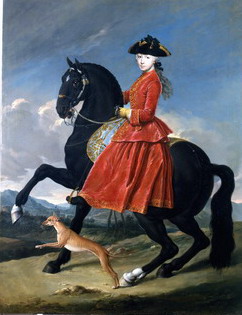 Robilant-Voena presenta nella sua sede milanese una mostra che indaga uno dei più grandi artisti del Settecento italiano: Giacomo Ceruti. Nell’occasione sarà possibile apprezzare un cospicuo nucleo di opere di questo protagonista della “pittura della realtà” lombarda, riscoperto a partire dagli anni venti del Novecento per merito degli studi di Roberto Longhi, Giuseppe Delogu, Giovanni Testori e Mina Gregori. Grazie ai prestiti di importanti collezioni private di formazione antica o recente, la mostra affiancherà a dipinti già noti da tempo, alcune tele finora sconosciute, che contribuiranno a mettere a fuoco i diversi aspetti del linguaggio di questo formidabile pittore.
Nato a Milano e precocemente trasferitosi a Brescia, Ceruti è infatti una personalità dal percorso articolato, che in una prima fase della sua carriera seppe imporsi come ritrattista dai vigorosi accenti realistici e soprattutto come attento indagatore della vita quotidiana delle classi sociali più disagiate. Molto spesso, infatti, le opere che l’artista realizza tra gli anni venti e i primi anni trenta del Settecento per la nobiltà bresciana hanno come protagonisti i cosiddetti pitocchi: mendicanti, vagabondi, filatrici, contadini e artigiani. Un mondo di emarginati e di umili lavoratori che, a differenza di quanto era avvenuto nella pittura dei decenni precedenti, Ceruti mette in scena senza ironia, conferendo anzi ai protagonisti una solenne dignità, cui contribuisce il formato monumentale dei dipinti. Questa propensione raggiunge i più alti risultati nel famoso ciclo di Padernello, la serie di tele pauperistiche che sancì la riscoperta dell’artista a partire dagli anni venti del Novecento.
Verso la metà degli anni trenta del Settecento Ceruti si sposta in terra veneta, lavorando tra Padova e Venezia dove ottenne importanti commissioni da uno dei più illustri collezionisti del tempo, il maresciallo Matthias von der Schulenburg. Il confronto con la cultura figurativa lagunare segna una cesura nel percorso di Ceruti, le cui conseguenze si faranno sentire per tutto il seguito della carriera dell’artista che, fatta eccezione per un soggiorno a Piacenza nel corso degli anni quaranta, si svolgerà in prevalenza a Milano, dove Ceruti morirà nel 1767.
In questa sua seconda stagione il pittore dimostra di privilegiare un linguaggio più elegante e raffinato, aggiornato sulle mode della coeva cultura figurativa europea. Così i suoi ritratti perdono la ruvida dimensione naturalistica degli anni giovanili per acquisire un tono mondano e internazionale, bene esemplificato in mostra dal Ritratto del Marchese Orsini a cavallo, proveniente dalla villa Orsini di Mombello di Imbersago. Lo stesso avviene per le scene di tema popolare, che sostituiscono ai toni drammatici degli esordi un registro più rasserenato, di cui è testimonianza l’idillio sentimentale rappresentato nell’Incontro al pozzo già parte della decorazione di palazzo Busseti a Tortona. Notevole è poi la serie di teste di carattere (Ritratto di fumatore in costume orientale; Vecchio con gatto; Vecchio con colbacco e cane) che fanno di Ceruti un grande interprete di quel genere pittorico mondano (e tipicamente settecentesco) molto amato a Venezia e in Francia. Questi trapassi stilistici lasciano comunque inalterato il dato saliente della poetica cerutiana, da riconoscere nella capacità di restituire le diverse realtà del proprio mondo con uno sguardo schietto e disincantato; una lucida razionalità di osservazione che rende Ceruti perfettamente in linea con la sensibilità dell’età dei lumi che si andava allora diffondendo in tutta Europa.
◊ ◊ ◊ ◊ ◊
Published by Skira, the catalogue is available from Artbooks.com:
Francesco Frangi and Alessandro Morandotti, Giacomo Ceruti (1698–1767): Popolo e nobiltà alla vigilia dell’età dei lumi (Milan: Skira, 2013), 96 pages, ISBN: 978-8857222547, $75. Italian text with English insert.
 Artista di spicco del Settecento italiano, Giacomo Ceruti detto “il Pitocchetto” è un importante protagonista della “pittura della realtà” lombarda, riscoperto a partire dagli anni venti del Novecento per merito degli studi di Roberto Longhi, Giuseppe Delogu, Giovanni Testori e Mina Gregori. Questo catalogo, che accompagna l’esposizione milanese, ripercorre la carriera artistica di Ceruti, a partire dagli anni bresciani, spesi sul binario di una ricerca realista, fino agli anni veneti e milanesi, quando il suo linguaggio diventa internazionale, e i pitocchi lasciano spazio ai ritratti nobiliari e alle teste di fantasia. Attraverso ventiquattro opere provenienti da prestigiose collezioni private oltre che dal patrimonio della galleria (alcune delle quali completamente sconosciute al pubblico e riscoperte in occasione della mostra), si vuole indagare questa dicotomia dell’opera di Ceruti, dove la realtà declinata nei suoi aspetti più poveri, fatta di storpi e mendicanti, stracci e polvere, si contrappone a un’eleganza di gusto internazionale, nella quale trionfano velluti e marsine.
Exhibition | Historias Naturales: A Project by Miguel Ángel Blanco
Press release from The Prado:
Historias Naturales: Un Proyecto de Miguel Ángel Blanco
Museo Nacional del Prado, Madrid, 19 November 2013 — 27 April 2014
Curated by Miguel Ángel Blanco; coordinated by Javier Portús

Miguel Ángel Blanco, A Leviathan Swallows a Goddess (Room 74)
Roman workshop, Venus with a Dolphin, MN; Dolphin skeleton, MNCN- CSIC.
Photo: Pedro Albornoz / Museo Nacional del Prado
◊ ◊ ◊ ◊ ◊
The Museo del Prado is presenting the exhibition Historias Naturales: A Project by Miguel Ángel Blanco, organised with the collaboration of the Higher Council for Scientific Research (CSIC) and the support of the Region of Madrid. 150 objects from the natural world make up the twenty-two interventions installed in the Museum’s galleries by this Madrid-born artist. Most of the objects — animals, plants and minerals — have been loaned by the Museo Nacional de Ciencias Naturales of the CSIC, displayed alongside 25 works from the Museum’s own collection. The result is a close dialogue with these 25 works of art and also with the building itself and the urban setting of the Paseo del Prado.
Through this exhibition the Prado is paying tribute to its own history and to the origins of its building, originally designed as a Natural History museum. On 19 November 1819 the Prado opened its doors to the public for the first time as the Museo Nacional de Pinturas y Esculturas (National Museum of Paintings and Sculptures). However, the Neo-classical building designed by Juan de Villanueva that now houses the Prado was originally designed as the Royal Natural History Cabinet on the orders of Charles III in 1785.

Miguel Ángel Blanco, The Anteater’s Cruel Winter (Room 90)
Antón Mengs worskshop (?), His Majesty’s Anteater, MNP; Anteater skeleton, MNCN-CSIC (Photo: Pedro Albornoz / Prado).
To celebrate the anniversary of the Museum’s first opening to the public on 19 November 1819, the Prado will be introducing visitors to a lesser known aspect of its history, namely that of its origins as a natural history museum prior to its inauguration as the Museo de Pintura y Escultura. The building that now houses the Museum was designed by the architect Juan de Villanueva in 1785 as the Natural History Cabinet on the orders of Charles III. Now, for a period of almost six months the galleries of the Permanent Collection will display objects including some of those that the monarch acquired from the collector and naturalist Pedro Franco Dávila for his new natural history museum, which was previously located in the Palacio de Goyaneche (now the headquarters of the Academia de Bellas Artes de San Fernando).
The Exhibition
Natural Histories: A Project by Miguel Ángel Blanco consists of twenty-two interventions in the Prado’s galleries, made up of 150 objects from the natural world (minerals, stuffed or preserved animals, skeletons and insects), the majority from the Museo Nacional de Ciencias Naturales, shown alongside twenty-five works from the Museum’s collection. The result is to establish a close relationship between them and also with the building itself and the surrounding urban context of the Paseo del Prado. Visitors will thus be able to see the realisation of Charles III’s desire to house a Natural History museum in the Villanueva Building. Due to the circumstances of history, the arts and sciences coexisted under the same roof on two occasions: in 1827 and during the Civil War when objects from the collections of the Real Jardín Botánico and the Museo de Ciencias were moved to the Prado for greater safety.
In order to bring about this reencounter with the Museum’s history and origins, the artist Miguel Ángel Blanco has not set out to reconstruct the Natural History Cabinet three hundred years later. Rather, as he explains, “What I have done in the Museo del Prado is to evoke that collection, the ghost of which inhabits the Villanueva Building. The twenty-two artistic interventions create a collection for the future, incorporating a creative viewpoint, interacting with the Permanent Collection and encouraging a new way of looking at the works which helps to increase the significance of the images.”
The first intervention is to be seen in the Ariadne Rotunda in the Museum, in which the preeminent work is the large-scale, recently restored sculpture of the Sleeping Ariadne (anonymous sculptor, 150–175AD). Next to it is the sculpture of Venus with a Dolphin (anonymous sculptor, 140–150AD), who now becomes the principal focus of this space. From the room’s ceiling Blanco has suspended a dolphin’s skeleton from the Museo Nacional de Ciencias Naturales, explaining that “the marble-like bones of the skeleton resemble the ivory-like marble of the sculptures.” The skeleton projects its shadow over Venus, “leaping like a Leviathan to swallow up the goddess ….”
Another of the works that sums up Blanco’s work in the Museum is his intervention based on Joachim Patinir’s celebrated painting Charon Crossing the Styx. Patinir’s work, which is among those that has most fascinated Blanco, ceases to be a painting and becomes an extension of the lake. It is transformed into pigment by the placement immediately in front of it of a giant piece of azurite (Museo Nacional de Ciencias Naturales), the source of the copper carbonate that Patinir used as a pigment in his painting, “which we can imagine as the result of the lake drying up, assisted by the similarity between the shape of its outline and that of the stone.”
Room 55B in the Prado is another space transformed into a natural history collection by Blanco through his introduction of the skeleton of a snake wound round itself, located next to Dürer’s two panels of Adam and Eve. The skeleton is one of the most beautiful objects in the Museo de Ciencias Naturales’ reptile collection. Through this juxtaposition, Dürer’s two nude studies remind us even more forcefully of the subject of human proportions, which Blanco considers “a scientific endeavour.” Here he reveals an aesthetic intent in his placement of the skeleton, while “the snake’s flexibility resulting from its numerous vertebrae echoes the sinuosity of Dürer’s figures.”
Blanco’s twenty-two installations are completed with one of his own works, Book-box no. 1072, which is part of the work for which he is best known, the Forest Library. It consists of 1131 book-boxes housing natural elements, each one forming a micro-landscape. The book-box that he has chosen for this intervention acquires meaning in front of Lucas van Valckenborch’s Landscape with an Iron Works of 1595. According to Blanco, this is one of his boxes most oriented towards landscape and can be visually related to the landscape paintings in the Room 57 of the Museum: “Among these Flemish painters I feel close to Lucas van Valckenborch, who depicted himself in some of his works with a sketchbook on his lap, reflecting the practice of observing the landscape at first hand … Of all natural environments, the forest is my place and the tree my equal.” (www.bibliotecadelbosque.net)
Miguel Ángel Blanco (born Madrid, 1958)
Miguel Ángel Blanco is among the best known of Spanish artists associated directly with nature. For some years he lived in the Sierra de Guadarrama, which has been his preferred artistic terrain and was the subject of an exhibition he held at La Casa Encendida in Madrid in 2006 entitled Visions of Guadarrama: Miguel Ángel Blanco and the pioneering artists of the Sierra. In that event his book-boxes established a dialogue with works by the leading Spanish landscape painters who visited this mountainous area in the 19th century with the aim of depicting it in their works.
Miguel Ángel Blanco has exhibited different selections from the Forest Library, his most important project, at the Biblioteca Nacional de España, the Museo Nacional de la Estampa in Mexico City, the Fundación César Manrique in Lanzarote, the Calcografía Nacional, Madrid, and the Abbey of Santo Domingo de Silos (Museo Nacional Centro de Arte Reina Sofía), among other venues. In 2008 the Ministry of Culture commissioned a project from him in memory of the dead beech tree in the garden of the Fundación Lázaro Galdiano, which presented the temporary exhibition Fallen Tree, focusing on the relationship between the tree and time.
The Catalogue
The catalogue that accompanies the exhibition includes a text by Miguel Ángel Blanco, the creator of this project, entitled “The Call of the Bird of Paradise” and another, entitled “From Wunderkammern to Enlightenment Collections,” by Javier Ignacio Sánchez Almazán, curator of the collection of invertebrates at the Museo Nacional de Ciencias Naturales. The catalogue also includes a portfolio with photographs and texts by the artist of each of the exhibition’s twenty-two interventions with technical details on all the works on display, in addition to the artist’s biography
Exhibition | America: Painting a Nation
The exhibition, organized by several American institutions including the Terra Foundation for American Art, debuted as Art Across America at the National Museum of Korea, in Seoul, and then traveled to Korea’s Daejeon Museum of Art. From the press materials of the Art Gallery of New South Wales:
America: Painting a Nation
Art Gallery of New South Wales, Sydney, 8 November 2013 — 9 February 2014

Portrait of a Black Sailor (Paul Cuffe?), ca. 1800 (LACMA)
This exhibition is a voyage through American history, across the American landscape and into the minds of the American people. It begins in the 18th century, among pious farmers and republican merchants. It traverses the continent, alongside Native Americans and frontiersman. It explores the great cities, and the lives of workers and bohemian artists. Answering the question, ‘What makes Americans American?’ is complex, but these paintings are a guide, revealing the self-reliance and communal beliefs, optimism and anxieties, that makes America tick.
Chris McAuliffe, Curatorial consultant
America: Painting a Nation is the most expansive survey of American painting ever presented in Australia. It is part of the Sydney International Art Series which brings the world’s outstanding exhibitions to Australia, exclusive to Sydney, and has been made possible with the support of the NSW Government through Destination NSW. Over 80 works, ranging from 1750 to 1966, cover more than 200 years of American art, history and experience. The exhibition sets a course from New England to the Western frontier, from the Grand Canyon to the burlesque theatres of New York, from the aristocratic elegance of colonial society to the gritty realism of the modern metropolis. This exhibition will reveal the breadth of American history, the hardy morality of the frontier, the intimacy of family life, the intensity of the 20th-century city, the epic scale of its landscape and the diversity of its people. The works being presented – many by American masters – are the works Americans love and works that represent the stories they have grown up with.
◊ ◊ ◊ ◊ ◊
From the Art Gallery of NSW:
Angela Miller and Chris McAuliffe, America: Painting a Nation (Sydney: Art Gallery of New South Wales, 2013), 264 pages, ISBN 978-1741741018, $45.
Spectacular landscapes, epic stories and diverse peoples feature in this expansive historical survey of American painting. The 89 artworks by some 74 artists traverse over 200 years of rich history, from the colonial era to the mid 20th century. Readers will encounter the sublime poetry and drama of the land, the ambition and optimism of the country’s pioneers, the challenges of the frontier, the intimacy of family life and the intensity of the modern city. The roots of the American character and nation will be revealed through images ranging from the Grand Canyon to the Brooklyn Bridge, from classic portraits to modern abstraction.
America: Painting a Nation includes works by artists such as Mary Cassatt, Winslow Homer, Edward Hopper, Georgia O’Keeffe, Jackson Pollock, Mark Rothko, John Singer Sargent and James McNeill Whistler from the collections of some of the finest art museums in the USA: The Terra Foundation, Chicago; the Philadelphia Museum of Art; the Museum of Fine Arts, Houston; the Los Angeles County Museum of Art; and The Virginia Museum of Fine Arts.
Essays by Angela Miller and Chris McAuliffe, combined with entries on each of the artworks and biographies on each artist, illuminate this fascinating survey of American painting from 1750 to 1967.
Exhibition | Napoleon’s Three Sisters in Italy
Now on view in Paris (with thanks to Hélène Bremer for noting it) . . .
Les Soeurs de Napoléon: Trois Destins Italiens
Musée Marmottan Monet, Paris, 3 October 2013 — 26 January 2014
Curated by Maria Teresa Caracciolo
 Le musée Marmottan Monet consacre, du 3 octobre 2013 au 26 janvier 2014, une exposition exceptionnelle et inédite à Elisa, Pauline et Caroline, soeurs de Napoléon Ier, princesses et reines d’Italie. Grâce à des prêts d’exception provenant des plus grands musées d’Europe et des collections des descendants de la famille, italiens et français, 140 oeuvres sont réunies pour recréer l’univers prestigieux de la vie privée et publique des soeurs Bonaparte. Leurs trois destins hors du commun sont présentés pour la première fois, de leur genèse dans le Paris consulaire à leurs règnes italiens sous l’Empire.
Tableaux, sculptures, mobilier, accessoires, bijoux et parures de cour matérialisent sous nos yeux les destins extraordinaires d’Elisa (1777–1820), princesse de Piombino et de Lucques, puis grande-duchesse de Toscane, de Pauline (1780–1825) épouse du prince romain Camille Borghèse et de Caroline (1782–1839), mariée au général Joachim Murat et qui régna avec lui sur Naples avec un faste inégalé : trois femmes, trois personnalités différentes, l’une primant par la beauté, les deux autres par l’énergie, le charme et l’intelligence. Elles ont été les témoins privilégiés et les actrices de leur époque.
Autour de l’événement-charnière du sacre de Napoléon renaissent à la fois l’intime : leurs rôles de mères et d’épouses, comme l’officiel : leurs vies de princesses et reines d’Italie, dans les cours de Florence, Rome et Naples qui feront des trois soeurs des symboles de l’Europe en construction.
Cette exposition qui bénéficie de l’engouement remarquable de nombreuses institutions, collections particulières et musées prestigieux voit le jour aujourd’hui dans l’écrin idéal du musée Marmottan Monet, coeur de l’univers de Paul Marmottan (1856–1932) son fondateur, collectionneur passionné par le Premier Empire. Sont réunies, entre autres, des pièces des musées nationaux des châteaux de Versailles, Fontainebleau, Malmaison, du musée Fesch d’Ajaccio, du musée Fabre de Montpellier, de l’Ambassade de Grande-Bretagne à Paris, du Musée de l’armée, de celui de la Légion d’honneur, des Fondations Napoléon et Dosne-Thiers, du Musée des Beaux-Arts de Liège, du Palazzo Pitti de Florence, du Museo Napoleonico, du Museo Praz, des Musei di Arte Medievale e Moderna de Rome, des musées de Turin, Naples, Lucques, Caserte et de l’Ile d’Elbe, sans omettre les fonds propres de la bibliothèque Marmottan et du musée Marmottan Monet.
◊ ◊ ◊ ◊ ◊
The catalogue, in French and English, is published by Hazan:
Maria Teresa Caracciolo, ed., Les soeurs de Napoléon: Trois Destins Italiens (Paris: Hazan, 2013), 216 pages, ISBN: 978-2754107112, 29€.
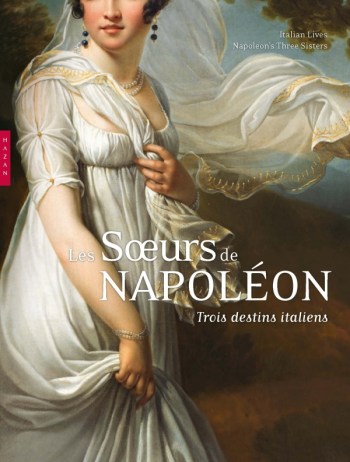 Exposition « Les sœurs de Napoléon. Trois destins italiens », au musée Marmottan Monet à Paris, du 03 octobre 2013 au 02 février 2014. Les sœurs de Napoléon Ier, Élisa, Pauline et Caroline, eurent toutes trois un destin italien : la première fut élevée par son frère au rang de princesse de Lucques, puis de grande-duchesse de Toscane, représentante de l’Empereur en Italie. La deuxième épousa un prince romain, Camille Borghèse, et vécut avec lui entre Paris et Rome, en s’attirant dans les deux villes le titre de reine de la beauté. Enfin la cadette, mariée au général Joachim Murat, régna avec lui sur Naples avec un faste inégalé. L’exposition évoque les trois destins des sœurs Bonaparte, forgés dans le Paris consulaire et brillamment parachevés en Italie sous l’Empire. Comme les autres membres de la famille Bonaparte, les sœurs de Napoléon appréciaient les belles résidences et pratiquèrent un mécénat éclairé. A Paris et en Italie, elles laissèrent la marque de leur passage par la création de décors, de peintures, de sculptures et d’objets d’art. La grande-duchesse de Toscane et la reine de Naples stimulèrent la production des manufactures de leurs Etats et encouragèrent dans leurs cours le théâtre, la musique et les arts de la mode, en menant en Italie une politique de conquête pacifique, la conquête par la culture et les idées. L’exposition réunit des portraits des trois sœurs, seules ou en groupe, avec leurs familles et leurs amis, dans les lieux où elles vécurent et qui furent métamorphosés par leur goût. Elle rassemble des œuvres d’art créées sous leur impulsion, des objets et des accessoires de leur vie quotidienne, des bijoux qui relevaient leurs somptueuses tenues de cour. Ces œuvres sont aujourd’hui partagées entre les plus grands musées d’Europe et les collections des descendants de la famille, italiens et français. Leur réunion dans les salles de l’ancien hôtel de Paul Marmottan, devenu musée Marmottan Monet, ressuscite une page d’histoire et la splendeur d’une époque. Elle nous fait entrer dans la vie privée d’une famille qui partagea le destin exceptionnel de l’empereur Napoléon Ier. Version bilngue français/anglais.
Commissaire de l’exposition et auteur du catalogue, Maria Teresa Caracciolo est Historienne de l’art, chargée de recherche au CNRS, spécialiste de la peinture européenne du XVIIIe et du XIXe siècle et des relations franco-italiennes sous la Révolution et l’Empire. Elle est l’auteur, parmi d’autres ouvrages, de Giuseppe Cades (1750–1799) et la Rome de son temps (Paris, Arthena, 1992, ouvrage issu d’une thèse de doctorat); du Romantisme (Citadelles et Mazenod, 2013); du catalogue de l’exposition Jean-Baptiste Wicar: Ritratti della famiglia Bonaparte (Roma, Museo Napoleonico-Napoli, Museo Diego Aragona Pignatelli Cortes, 2004); et du catalogue de l’exposition Lucien Bonaparte (1775–1840): un homme libre, (Ajaccio, Musée Fesch, 2010).
Exhibition | Yoga: The Art of Transformation
From the exhibition press release:
Yoga: The Art of Transformation
Smithsonian’s Arthur M. Sackler Gallery, Washington, D.C., 19 October 2013 — 26 January 2014
San Francisco Asian Art Museum, 21 February — 25 May 2014
Cleveland Museum of Art, 22 June — 7 September 2014

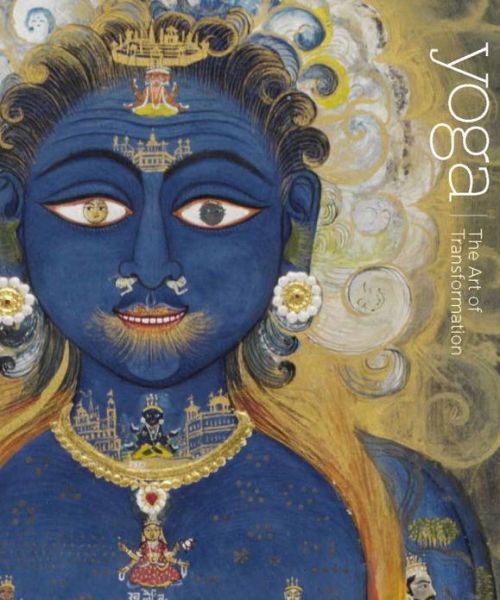
Krishna Vishvarupa (detail), ca. 1740. India, Himachal Pradesh, Bilaspur. Collection of Catherine and Ralph Benkaim.
◊ ◊ ◊ ◊ ◊
Yoga: The Art of Transformation, the first exhibition about the visual history of yoga explores yoga’s rich diversity and historical transformations during the past 2,000 years.
On view through January 26, 2014, The Art of Transformation examines yoga’s fascinating meanings and histories through more than 130 objects from 25 museums and private collections in India, Europe and the U.S. Highlights include three monumental stone yogini goddesses from a 10th-century south Indian temple, reunited for the first time, 10 folios from the first illustrated compilation of asanas (yogic postures) making their U.S. debut, and a Thomas Edison film, Hindoo Fakir (1906), the first movie produced about India.
“This exhibition looks at yoga’s ancient roots, and how people have been trying to master body and spirit for millennia,” said Julian Raby, The Dame Jillian Sackler Director of the Arthur M. Sackler Gallery and Freer Gallery of Art. “By applying new scholarship to both rarely seen artworks and recognized masterpieces, we’re able to shed light on practices that evolved over time—from yoga’s ancient origins to its more modern emergence in India, which set the stage for today’s global phenomenon.
 A free public festival, Diwali and the Art of Yoga, Saturday, October 26, will mark both the opening of the exhibition and Diwali, the Indian festival of lights. Visitors can discover exhibition highlights through spotlight tours, play games from across Asia, attempt intricate rangoli (rice powder) drawings and make their own yoga-inspired art in hands-on workshops. Indian classical musician K. Sridhar will demonstrate the yoga of sound, and storyteller Louise Omoto Kessel will share tales of Indian deities. Free yoga classes will be offered throughout, and the day will conclude with a traditional lamp-lighting ceremony and a classical Indian music concert.
In conjunction with The Art of Transformation, the Freer and Sackler galleries will also host Yoga and Visual Culture, a free interdisciplinary symposium for scholars and yoga enthusiasts November 21–23. Seventeen scholars from a range of disciplines will present cutting-edge research on diverse aspects of yoga’s visual culture, organized around such topics as “Yoga and Place” and “Yoga and Print Culture.” A full schedule and registration is available at asia.si.edu/events/yoga-symposium/.
Yoga classes in the galleries will be offered through “Art in Context,” an interactive 90-minute workshop combining tours of the exhibition with the practice of yoga. Led by a teaching team of a museum docent and guest yoga teachers, the workshops will be held on Wednesdays and Sundays throughout the exhibition, with special sessions offered for ages 50-plus, teens and families. Advance registration is required, and visitors can find a full schedule at asia.si.edu/events/workshops.asp.
These programs are made possible in part due to the Smithsonian’s first major crowdfunding campaign, “Together We’re One.” Launched in May 2013, the campaign raised more than $174,000 over 6 weeks to support public programs, yoga classes in the galleries, and an exhibition catalogue, as well as the behind—the—scenes aspects of the exhibition. Campaign donors and exhibition ambassadors, called “Yoga Messengers,” are invited to be special guests during the October 26 “Art of Yoga” festival, and will be featured in exhibition signage.
Following its Washington, D.C., debut, The Art of Transformation will travel to the San Francisco Asian Art Museum and the Cleveland Museum of Art.
Support for the exhibition is provided by the Friends of the Freer|Sackler, Whole Foods Market, Art Mentor Foundation Lucerne, the Alec Baldwin Foundation, the Ebrahimi Family Foundation, IndiaTourism, Catherine Glynn Benkaim, media partner Yoga Journal, and “Together We’re One” donors.
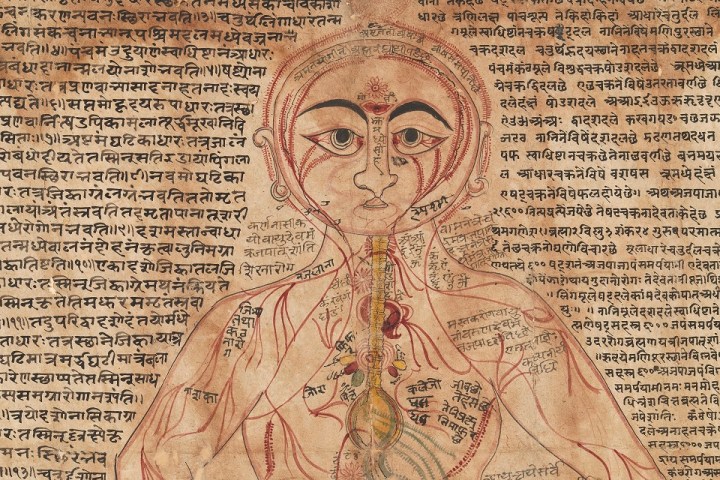
Anatomical Body, 18th century, India, Gujarat (Wellcome Library, London, Asian Collections, MS Indic Delta 74).
◊ ◊ ◊ ◊ ◊
Debra Diamond, ed., Yoga: The Art of Transformation (Washington, D.C.: Smithsonian Books, 2013), 360 pages, ISBN-13: 978-1588344595, $55.
An exploration of yoga’s meanings and transformations over time; the discipline’s goals of spiritual enlightenment, worldly power, and health and well-being; and the beauty and profundity of Indian art.
Debra Diamond is Associate curator of South and Southeast Asian art, Freer Gallery of Art and Arthur M. Sackler Gallery. Her exhibition catalogue for Garden and Cosmos (fall 2008) received two major awards for scholarship: the College Art Association’s Alfred H. Barr award and the Smithsonian Secretary’s Award for Research. She has published on yoga imagery, new methods in Indian art history, contemporary Asian art, and various aspects of the Freer|Sackler collections.










 Enfilade
leave a comment