Exhibition | Interwoven Globe: The Worldwide Textile Trade, 1500–1800
As noted at Style Court, Interwoven Globe opens this month at The Met; from the press release:
Interwoven Globe: The Worldwide Textile Trade, 1500–1800
The Metropolitan Museum of Art, New York, 16 September 2013 — 5 January 2014
Curated by Amelia Peck
 Interwoven Globe: The Worldwide Textile Trade is the first major exhibition to explore the international transmittal of design from the 16th to the early 19th century through the medium of textiles. It highlights an important design story that has never before been told from a truly global perspective. Beginning in the 16th century, the golden age of European maritime navigation in search of spice routes to the east brought about the flowering of an abundant textile trade, causing a breathtaking variety of textiles in a multiplicity of designs and techniques to travel across the globe. Textiles, which often acted as currency for spices and other goods, made their way from India and Asia to Europe, between India and Asia and Southeast Asia, from Europe to the east, and eventually to the west to North and South America. Trade textiles blended the designs, skills, and tastes of the cultures that produced them, resulting in objects both intrinsically beautiful and historically fascinating.
The exhibition is made possible by The Andrew W. Mellon Foundation, the Diane W. and James E. Burke Fund, The Coby Foundation, Ltd., The Favrot Fund, the Gail and Parker Gilbert Fund, and the Quinque Foundation.
While previous studies have focused on this story from the viewpoint of trade, Interwoven Globe is the first exhibition to explore it as a history of design—and to approach it from a perspective that emphasizes the beauty and sophistication of these often overlooked objects. It will explore the interrelationship of textiles, commerce, and taste from the Age of Discovery to the 19th century. From India and its renowned, ancient mastery of painted and dyed cotton to the sumptuous silks of China and Japan, Turkey and Iran, the paths of influence are traced westward to Europe and the Americas. Shaped by an emerging worldwide visual culture, the resulting fashion for the “exotic” in textiles, as well as in other goods and art forms, gave rise to what can be recognized as the first truly global style.
Interwoven Globe will feature 134 works, about two-thirds of which are drawn from the Metropolitan Museum’s own rich, encyclopedic collection. These objects will be augmented by important domestic and international loans in order to make worldwide visual connections. Works from the Metropolitan will come from the following departments: American Decorative Arts, Asian Art, Islamic Art, European Sculpture and Decorative Arts, The Costume Institute, European Paintings, Drawings and Prints, and Arts of Africa, Oceania, and the Americas. They will include numerous flat textiles (lengths of fabric, curtains, wall hangings, bedcovers,) tapestries, costumes, church vestments, pieces of seating furniture, and paintings and drawings. (more…)
New Book | Of Elephants & Roses: French Natural History, 1790–1830

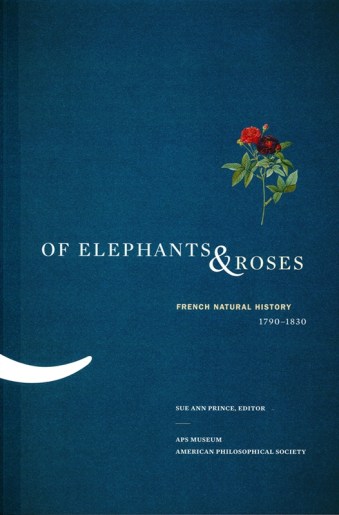
Design by Marc Blaustein
◊ ◊ ◊ ◊ ◊
Published by APS and available from Diane Publishing:
Sue Ann Prince, ed., Of Elephants & Roses: French Natural History, 1790–1830 (Philadelphia: American Philosophical Society, 2013), 294 pages, ISBN: 9780871692672, $50.
Of Elephants & Roses explores the fascinating history of the natural sciences in the turbulent years of post-revolutionary and Restoration France, from Empress Josephine’s black swans and rare Franklin tree to a giraffe that walked 480 miles across France to greet the king. This illustrated book is the catalogue for an international loan exhibition held in 2011 at the APS Museum in Philadelphia and the record of an associated interdisciplinary symposium. It presents new perspectives on French natural history, its influence on French culture, and its ties to the natural sciences in North America.

From J. P. Hoüel, Histoire naturelle des deux éléphans (Paris, 1803)
Edited by APS Museum director and curator Sue Ann Prince, the catalogue contains all sixteen talks, the keynote and concluding addresses, the session commentaries, edited transcripts of the audience discussions, and a checklist of the exhibition. Contributors include art historians, historians of science, and scholars of French literature, history, and culture. The book is illustrated throughout in full color. Both the symposium and the publication have been made possible by generous funding from the Richard Lounsbery Foundation.
About the APS
An eminent scholarly organization of international reputation, the American Philosophical Society promotes useful knowledge in the sciences and humanities through excellence in scholarly research, professional meetings, support of young scholars, publications, library resources, and a museum. This country’s first learned society, the APS has played an important role in American cultural and intellectual life for more than 250 years.
Exhibition | William Kent: Designing Georgian Britain
From the Bard Graduate Center:
William Kent: Designing Georgian Britain
Bard Graduate Center, New York City, 20 September 2013 — 9 February 2014
Victoria & Albert Museum, London, 22 March — 13 July 2014
Curated by Susan Weber and Julius Bryant
 William Kent: Designing Georgian Britain, on view at the Bard Graduate Center: Decorative Arts, Design History, Material Culture from September 20, 2013 to February 9, 2014, is the first major exhibition to examine the life and career of one of the most influential designers in eighteenth-century Britain. Visitors will discover Kent’s genius, through nearly 200 examples of his elaborate drawings for architecture, gardens, and sculpture, along with furniture, silver, paintings, illustrated books, and through new documentary films. As most of his best-known surviving works are in Britain’s great country houses, the exhibition is rich in loans from private as well as public collections. Organized by the Bard Graduate Center in collaboration with the Victoria & Albert Museum in London, the exhibition is curated by Susan Weber (BGC) and Julius Bryant (V&A). It will travel to the V&A where it will be on view from March 22 to July 13, 2014.
Background
William Kent: Designing Georgian Britain explores Kent’s work over three decades (1719–48)—a period when Britain was defining itself as a new nation and overtaking France as a leading world power. Like Robert Adam a generation later, Kent is identified not only with his own prolific and diverse output but also with an entire period style. At a time when most patrons and collectors looked to Italy for their art and design, Kent’s versatility and artistic inventiveness set the style of his age and asserted the status of the modern British artist. From a time when no refined education was complete without the Grand Tour to Italy, the word ‘Kentian’ has come to denote rich, Italianate palatial interiors furnished with gilded sculptural tables, mirrors, and Old Master paintings, elaborately presented on walls lined with the richest silk damasks and velvets, and beneath painted ceilings. Kent devised a style that catered to the Grand Tour alumni, recreating the splendors of Roman palazzi. A jovial house guest of his patrons, ‘Kentino’ (as he was affectionately known) and his creations reminded them of the best days of their lives, before they returned, inherited, and dutifully managed their old family estates.
Many of the ideas we take for granted today about visual education, good design, and national style were established by Kent’s generation. At the start of the eighteenth century, the United Kingdom of Great Britain was established through the Act of Union between England and Scotland (1707). Great expectations of new public buildings followed, especially for a new parliament and royal palace to replace those destroyed by the Whitehall Palace fire of 1698. From the accession of George I in 1714 through the death of Queen Victoria in 1901, the Royal House of Hanover reigned over Britain. With Kent’s help, this German family reinvented themselves. The new nation needed a new sense of style, both to define itself through design (in contrast to the Stuarts and the French) and to improve society at large. Responding to a challenge articulated in the Earl of Shaftesbury’s Letter Concerning the Art, or Science of Design (1712), Lord Burlington is the best- known today of several patrons who took on this responsibility. Kent lived in his London townhouse, Burlington House (today the home of the Royal Academy) for most of his life and was also, in effect, artist-in-residence at Burlington’s new Italianate villa at Chiswick. Essentially, Kent saw that good design is about visual experience, not only dependent on the erudite eye of the connoisseur or the knowledge of architecture’s ancient rules, but also reliant on the emotional response as one moved through and around houses, offices, streets, and gardens.
◊ ◊ ◊ ◊ ◊
The Exhibition
William Kent: Designing Georgian Britain is divided into ten sections that introduce specific aspects of Kent’s work, including signature private and royal commissions, and important periods in his career. William Kent’s life and the historical age in which he worked is the subject of the first section. A highlight is William Aikman’s portrait of Kent that hung over the mantelpiece at Wanstead House, and is now in the National Portrait Gallery, London. The second section focuses on Kent’s formative years on the Grand Tour in Italy where he was sent to hone his painting skills by copying the Old Masters, and to act as a purchasing agent for British collectors. Italian Baroque art, interiors, and furnishings made a lasting impression on Kent. Featured are seldom seen paintings and drawings, including Kent’s copies after Agostino Carracci, Domenichino, and Carlo Maratti, and drawings of Italianate interiors by fellow Grand Tourist John Talman, that document this inspiring period in Kent’s life. While in Italy, Kent met Lord Burlington who became his mentor and collaborator for the next several decades. Together they became early exponents of the designs of the late Renaissance architect, Andrea Palladio, which they eventually incorporated into their own Anglo-Palladian style that came to define the Georgian era.
Kent is best known for the interiors he designed for several grand country estates in Britain, and for his approach in taking responsibility for the design of the entire interior from the painting and furniture to the sculpture and decoration. Visitors to the exhibition will have the opportunity to explore a few of Kent’s best-known early interiors, such as Chiswick House, Wanstead House, and Houghton Hall, Kent’s most important early commission for the grand estate of Sir Robert Walpole, and one of the key buildings in the history of Palladian architecture in England. In addition to drawings and plans of these interiors, the exhibition features rare examples of Kent’s furniture designed specifically for these commissions.
In time, Kent began to receive important royal commissions, particularly from King George II and his son, Frederick, Prince of Wales. A section of the exhibition is devoted to designs for the new monarchy. In 1722, Kent was given a major commission to design the Cupola Room at Kensington Palace, where he was in charge of painting the ceiling and designing the furniture and chimneypieces. One of Kent’s best known and somewhat unusual works was a state barge designed for Frederick. Although the barge is too large to travel, the exhibition will feature Kent’s beautifully rendered designs, along with a detailed model. Other notable royal commissions explored include those for Queen Caroline’s Library and Hermitage in Richmond Garden. Also on view will be several extraordinary pieces of silver, made after designs by Kent. Among these are a chandelier commissioned by George II for the Leineschloss, Hanover, made by Balthasar Behrens, on loan from the Museum of Fine Arts, Boston, and a large centerpiece (or epergne) for Frederick made by silversmith George Wickes.
Another section looks specifically at the work Kent produced in London, both in private residences as well as in public buildings. Among the most prestigious of these commissions was the design of Devonshire House, the residence of the Duke of Devonshire. Although the palatial home was demolished in the 1920s, objects from and related to it survive, and the exhibition will feature drawings and a door designed by Kent. Of his public works, the exhibition examines 10 Downing Street, the Houses of Parliament, the Horse Guards at Whitehall, and the Royal Mews. Also explored are Kent’s contributions to sculpture. Among the works shown are drawings for tomb monuments for Isaac Newton, William Shakespeare, and James Stanhope in Westminister Abbey, and Michael Rysbrack’s terracotta model of Newton.
One section is devoted to Holkham Hall, designed with the assistance of Lord Burlington for Thomas Coke, 1st Earl of Leicester, who was among Kent’s most important patrons. Now considered to be one of the finest examples of the Palladian revival style of architecture in Britain, Holkham Hall is shown through a number of important works that the BGC is fortunate to borrow, including a gilded and elaborately carved settee, drawings of the interior, and Francesco Trevisani’s portrait of Thomas Coke, who built Holkham.
Although known today almost exclusively for his Palladian style, Kent worked in other idioms depending on the wishes of the patron. The exhibition looks at his Gothic works, including projects at Hampton Court and Esher Place, and his illustrations for books, most notably an edition of Edmund Spenser’s The Faerie Queene.
The final section examines Kent’s contributions to the history of landscape and garden design. Through drawings, furniture, and video, visitors will discover how Kent revolutionized garden design and helped usher in a style of natural gardening that came to characterize the English landscape garden. Two of Kent’s most important gardens, at Rousham and Stowe, remain today close to Kent’s original designs. A BGC produced video will offer a virtual journey through these gardens so that visitors will gain a better understanding of his landscape designs.
The Book
William Kent: Designing Georgian Britain, edited by Susan Weber, and published with Yale University Press, presents twenty-one essays by leading scholars of eighteenth-century British art and design, including Julius Bryant (co-curator), Geoffrey Beard, John Harris, John Dixon Hunt, Frank Salmon, and David Watkin. The book is richly illustrated with over 600 color images, including the pieces featured in the exhibition. A chronology of Kent’s projects, an exhibition checklist, and an extensive bibliography round out this scholarly publication.
Support
William Kent: Designing Georgian Britain has been generously supported by The Rothschild Foundation, Edward Lee Cave, Dr. H. Woody Brock, Christie’s, Philip Hewat-Jaboor, John A. Werwaiss, Patricia and Martin Levy, The Paul Mellon Centre for Studies in British Art, Friends of the BADA Trust, Ronald Phillips, Ltd., and two donors who wish to remain anonymous.
Exhibition | François-André Vincent
From Le musée des Beaux-Arts de Tours:
François-André Vincent
Musée des Beaux-arts, Tours, 18 October 2013 — 19 January 2014
Musée Fabre de Montpellier Agglomération, 8 February — 11 May 2014

François André Vincent, Portrait Presumed to be Madame Jeanne-Justine Boyer-Fonfrede and Her Son, Henri (Paris: Louvre)
Le musée des Beaux-Arts de Tours et le musée Fabre de Montpellier s’associent pour concevoir et organiser d’octobre 2013 à mai 2014 la première exposition consacrée au peintre François-André Vincent (1746–1816), à l’occasion de la publication du catalogue raisonné de l’œuvre de l’artiste publié chez Arthéna par Jean-Pierre Cuzin, ancien conservateur général du département des peintures du musée du Louvre.
Le commissariat de l’exposition est constitué, aux côtés de Jean-Pierre Cuzin qui a sélectionné peintures et dessins, de Sophie Join-Lambert et Michel Hilaire, directeurs des deux musées, et de deux conservateurs, Olivier Zeder, conservateur en chef à Montpellier et Véronique Moreau, conservateur en chef au musée des Beaux-Arts de Tours.
Les publications récentes ont montré l’importance d’un artiste, aussi bien pour la peinture que pour le dessin, dont les œuvres, entre deux mondes stylistiques, ont pu être confondues avec celles de Fragonard comme avec celles de David. Il tient une place essentielle dans la peinture française comme promoteur des sujets pris à l’Antiquité comme de ceux pris à l’Histoire de France et peut apparaître, à beaucoup d’égards, comme un “préromantique”. Son rôle dans le domaine du portrait et particulièrement dans celui du portrait-charge apparaît capital.
L’exposition devrait apporter la révélation d’un grand artiste jusqu’ici méconnu et dont les œuvres enrichissent des collections publiques et privées des plus prestigieuses, tant en Europe qu’à l’étranger. Un tel projet ne peut se concevoir sans faire appel aux musées et collectionneurs français et étrangers. Parmi les collections publiques, plusieurs appartiennent au réseau FRAME (French Regional American Museums Exchange, France et Etats-Unis).
◊ ◊ ◊ ◊ ◊
From Art Media Agency:
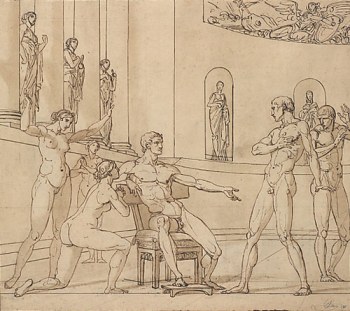
François André Vincent, The Clemency of Augustus (Corneille, Cinna, V, 3) (recto); Knight Restraining a Female Figure (verso), 1788
(New York: Metropolitan Museum of Art)
An exhibition of works by François-André Vincent (1745–1816) is to take place between 19 October 2013 and 19 January 2014 at the Musée des Beaux-Arts in Tours. The exhibitions is to coincide with the publication by Arthéna of a catalogue raisonné devoted to the artist François-André Vincent produced by Jean-Pierre Cuzin, former curator of painting at the Louvre.
Stylistically, Vincent’s works have been compared to those by Fragonard and David, and are sometimes described as pre-Romantic. Inspired by antiquity, the artist’s pieces often return to explore moments in France’s history. The exhibition features over 100 works, gathered from collections in both France and further afield. It is organised with the support of the French state, in collaboration with the Ministry of Culture and Communication, the French Heritage Management association, and the French Museums Service.
Following its close at Tours, the exhibition is to travel to the Musée Fabre in Montpellier, where is is to be on display between 8 February to 11 May 2014. A selection of drawings by Vincent will then be display at the Cognacq-Jay museum from 26 March to 30 June 2014.
Exhibition | Exuberance of Meaning: Catherine the Great’s Patronage
Press release (1 July 2013) from the Georgia Museum of Art:
Exuberance of Meaning: The Art Patronage of Catherine the Great
Georgia Museum of Art, The University of Georgia at Athens, 21 September 2013 — 5 January 2014
Hillwood Museum and Gardens, Washington, D.C., 1 February — 7 June 2014
Curated by Asen Kirin
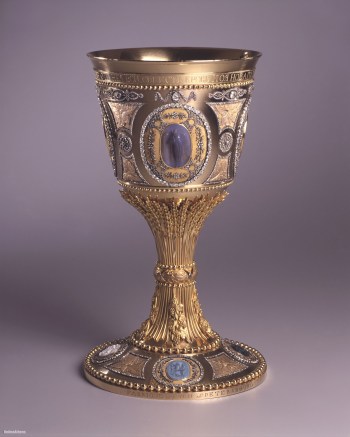
Chalice, Iver Windfeldt Buch (1749-1811), St. Petersburg, 1791, gold, diamonds, chalcedony, bloodstone, nephrite, carnelian, cast glass, height: 33 cm, diameter: 18 cm (Hillwood Museum and Gardens)
The Georgia Museum of Art at the University of Georgia presents Exuberance of Meaning: The Art Patronage of Catherine the Great September 21, 2013 to January 5, 2014. This exhibition features works of decorative art the Russian empress Catherine the Great commissioned for her own use or as gifts for courtiers, including a large chalice created by noted goldsmith Iver Winfeldt Buch.
The Buch chalice, which belongs to Hillwood Museum and Gardens in Washington, D.C., serves as the centerpiece of the exhibition. Adorned with precious gems and eight carved cameos, it demonstrates how Catherine combined Byzantine and classical influences to forge a new direction for Russian culture. Other objects establish the background for the empress’s choices or represent major currents in 17th- and 18th-century Russian art. Dr. Asen Kirin, associate professor of art and associate director of UGA’s Lamar Dodd School of Art, is curator of this exhibition, which borrows objects from the Metropolitan Museum of Art, the Chipstone Foundation, the Walters Museum and private collections, as well as Hillwood.
Marjorie Merriweather Post, the sole heir to the multimillion-dollar Post Cereal Company, purchased the works that formed Hillwood’s Russian collection. Many of the works she purchased while in Russia in the 1930s are on display in this exhibition. Kirin invites audiences “to contemplate the art collections of two extraordinary women, who lived at different times and could not have come from more dissimilar environments. One is Europe’s Old Regime of absolute hereditary monarchies, the other—the modern, industrialized America of free enterprise.”
The exhibition presents a comparison of dazzling and masterful objects that exemplify both medieval Byzantine culture, of which Russia was the successor and guardian, and the Western, neoclassical style that was the hallmark of the Enlightenment. It focuses on the manner in which Catherine applied her knowledge of ancient and medieval glyptic art and incorporated her collection of carved gems in the commission of new works of art, a deliberate continuation of the centuries-old tradition of placing pagan, Greek, and Roman carved stones onto sacred Christian liturgical and devotional objects.
During her reign, the empress worked to reconcile her contemporary scientific and historical frame of mind with the devotional ways of the Orthodox Church, which had long been sanctified by tradition. The title Exuberance of Meaning refers to the crucial characteristic that distinguishes her endeavors in the arts: she conceived her projects in a manner that allowed for multiple complementary interpretations covering a wide spectrum of meanings.
Kirin is particularly interested in the comparison of the two collectors, Catherine and Post, as both women were powerful, accomplished and elevated their respective domains despite a tradition of male dominance. Kirin suggests that audiences contemplate “how the arts enabled them to present themselves to society and to control the perception of their images.”
Kirin has worked with the museum before, perhaps most notably on the exhibition Sacred Art, Secular Context, which examined Byzantine works of art from the collection of Dumbarton Oaks, Washington, D.C.
The museum will publish a catalogue to accompany the exhibition, featuring full-page, full-color illustrations of the objects it includes and scholarly essays on Catherine’s art patronage, the Buch chalice and the empress’ proto-feminist use of vessels to make a statement about gender and power.
Events associated with the exhibition include films, a family day, and a two-day symposium scheduled for November 1–2 featuring noted scholars of Russian art. The museum’s Collectors Group, an upper-level membership group within the Friends of the Georgia Museum of Art, will host an opening for the exhibition September 21 in conjunction with the UGA Performing Arts Center’s presentation of a concert of music the empress favored.
Exhibition | Souvenir Nation: Relics, Keepsakes, and Curios
From the Smithsonian’s National Museum of American History:
Souvenir Nation: Relics, Keepsakes, and Curios
Smithsonian Castle, Washington, D.C., 9 August 2013 — 17 August 2014
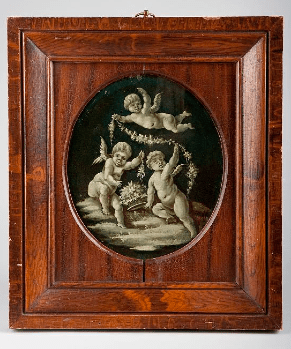
Panel from George Washington’s Coach, 17 x 15 inches. President Washington’s state coach featured four side panels representing the seasons; this panel, encased in an oak frame, depicts ‘Spring’ (Smithsonian)
Souvenir Nation: Relics, Keepsakes and Curios features a selection of diminutive and personal objects that Americans have taken, made and saved as historical mementos from the Early Republic up to the present day. Many of the postcards, structural fragments such as a brick from George Washington’s childhood home, consumer goods, locks of hair and other keepsakes on display are part of the earliest Smithsonian collections now in the museum’s Division of Political History. Highlights include a fragment of Plymouth Rock, presidential hair, wood from George Washington’s coffin and pieces from Joan of Arc’s dungeon, the Bastille, and the Berlin Wall.
◊ ◊ ◊ ◊ ◊
From Princeton Architectural Press:
William Bird, Souvenir Nation: Relics, Keepsakes, and Curios from the Smithsonian’s National Museum of American History (Princeton: Princeton Architectural Press, 2013), 176 pages, ISBN: 978-1616891350, $25.
 Buried within the collection of the Smithsonian Institution’s National Museum of American History exists an astonishing group of historical relics from the pre-Revolutionary War era to the present day, many of which have never been on display. Donated to the museum by generations of souvenir collectors, these ordinary objects of extraordinary circumstance all have amazing tales to tell about their roles in American history. Souvenir Nation presents fifty of the museum’s most eccentric items. Objects include a chunk broken off Plymouth Rock; a lock of Andrew Jackson’s hair; a dish towel used as the flag of truce to end the Civil War; the microphones used by FDR for his Fireside Chats; and the chairs that seated Nixon and Kennedy in their 1960 television debate. This fascinating collection of Americana includes an introductory essay on this nation’s passion for souvenir collecting, as well as a brief history and a glimpse behind the scenes of the Smithsonian.
Exhibition | Artists & Amateurs: Etching in Eighteenth-Century France
Press release (3 June 2013) from The Met:
Artists and Amateurs: Etching in Eighteenth-Century France
The Metropolitan Museum of Art, New York, 1 October 2013 — 5 January 2014
Curated by Perrin Stein
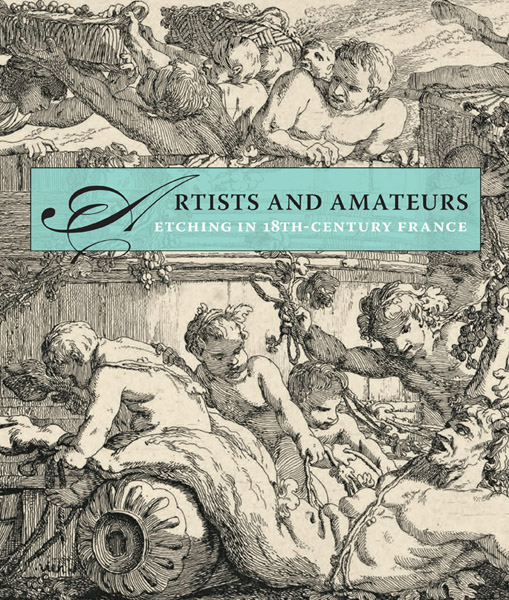 During the eighteenth century in France, a great number of artists—painters, sculptors, draftsmen, and amateurs—experimented with etching, a highly accessible printmaking technique akin to drawing. Featuring 130 works by such artists as Watteau, Boucher, Fragonard, Hubert Robert, and many others, Artists and Amateurs: Etching in Eighteenth-Century France will be the first exhibition to focus on the original etchings created by painters and amateurs in eighteenth-century France. It will present a fresh exploration of how etching flourished in ancien régime France, shedding new light on artistic practice and patronage at that time. In a period when artists strained to navigate the highly regulated Académie Royale and the increasingly discordant public spheres of the marketplace and the Salon, etching afforded them stylistic freedom and allowed them to produce exquisite works of art in a spirit of collaboration and experimentation. The exhibition will present etchings, plus a few drawings and preparatory sketches, from the Metropolitan Museum’s rich holdings, as well as loans from North American museums and private collections. The selection of prints includes a number of rare or unique examples.
While printmaking was dominated by professionals for much of its early history, the technique of soft-ground etching—where a plate was coated in varnish and could then be drawn on with a metal stylus—transformed the practice from a specialized technique practiced by an exclusive group with extensive training, to a highly accessible art form. Some artists, like Antoine Watteau and François Boucher, encountered the process within the thriving commerce of the Paris print trade, where a painter would sometimes be asked to make a preliminary sketch on a prepared copper plate to guide the professional printmaker who would later reinforce the design with engraving. Others, like Jean-Honoré Fragonard and Hubert Robert, first experimented with the technique during their student years in Rome, where Piranesi’s studio was in close proximity to the French Academy. For some, like Jean-Baptiste-Marie Pierre, etching formed a bridge with amateurs, wealthy members of the court or aristocracy who wanted to learn etching as a cultured, leisure pursuit. Because of these relationships, the making of the prints became intermingled with the collecting and studying of prints, creating an environment of cross-fertilization which led to a flourishing of the art form.
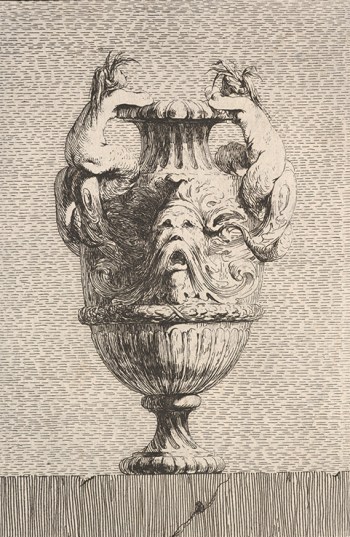
Jacques François Joseph Saly, Design for a Vase with Two Mermaids, from the “Vases” series, 1746 (NY: The Metropolitan Museum of Art)
Artists and Amateurs will highlight the freedom, spontaneity, and creativity of the medium of etching in the hands of artists and collectors. Over the course of the century, etching came to be viewed not solely as a reproduction medium, but also, as one capable of original artistic expression. As the free and improvisational aesthetic of the etching process increasingly was embraced, French artists looked to seventeenth-century masters—such as Rembrandt in the North and Salvator Rosa and Giovanni Benedetto Castiglione to the South—for inspiration. The expressive potential of the technique was also explored in a more experimental manner by artists like Gabriel de Saint-Aubin and Louis Jean Desprez, who harnessed the inky tonalities of the medium to their personal and idiosyncratic vision. The painters who felt the urge to pick up the etching needle were drawn to the freedom and accessibility of the technique, and not necessarily focused on exploiting commercial potential. Their prints tend to be rare and are valued for their qualities of expressiveness and experimentation—in many ways the opposite of the mass production and technical expertise of professional printmakers like Demarteau and Bonnet.
The exhibition will also focus on the French Academy in Rome as a setting that provided the means and freedom to explore this medium; the etchings made by amateurs, both in Rome and in Paris; and, finally, the increasing stylistic engagement with past masters. Overall there will be a balance between works of the most successful painters of the period and lesser known, but equally accomplished figures, including the work of amateurs and the working relationships between them where the influence went both ways.
The exhibition will be organized thematically and will explore how, where, and why artists first learned to etch, their occasional experimentation with marketing their prints for sale, and their technical innovations as they found new ways to manipulate the medium for individual expression. Highlights include Watteau’s Recruits Going to Join the Regiment (ca. 1715-16), Fragonard’s The Satyr’s Family (1763) and The Armoire (1778), Liotard’s Self-Portrait, Boucher’s Andromeda (1734), Gabriel de Saint-Aubin’s View of the Salon of 1753, de Boissieu’s Study of Thirteen Heads (ca.1770), and amateur Ange-Laurent de la Live de Jully’s etching after a drawing by Jacques-François-Joseph Saly of Nicolas Bremont, Cook at the French Academy in Rome (ca. 1754).
From Yale UP:
Perrin Stein, ed., Artists and Amateurs: Etching in Eighteenth-Century France (New York: The Metropolitan Museum of Art, 2013), 240 pages, ISBN: 978-0300197006, $60. With essay by Charlotte Guichard, Rena M. Hoisington, Elizabeth Rudy, and Perrin Stein.
Exhibition | Picturing America
In addition to the exhibition, the Dixon has devised a truly-inspired plan to lure visitors to the museums on Fridays: food trucks in the parking lot!
Picturing America: Signature Works from the Westmoreland Museum of American Art
Dixon Gallery and Gardens, Memphis, 4 August — 6 October 2013
Vero Beach Museum of Art, Vero Beach, Florida, 15 February — 25 May 2014
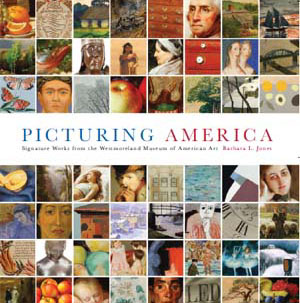 Over the past fifty years, the Westmoreland Museum of American Art, in Greensburg, Pennsylvania, has assembled a collection of works by significant American artists, concentrating on the mid-18th through the mid-20th centuries. Featuring works by John Singleton Copley, Charles Wilson Peale, and Mary Cassatt, Picturing America showcases the signature works from the museum’s collections, from preeminent American artists of the Hudson River School to modernists such as Milton Avery and Doris Lee.
Barbara Jones, Picturing America: Signature Works from the Westmoreland Museum of American Art (Greensburg, PA: Westmoreland Museum of American Art, 2010), 256 pages, ISBN: 978-0931241376, $45.
Exhibition | Charakterköpfe: Portrait Busts in the Enlightenment
From the museum’s 2013-14 exhibition schedule:
Charakterköpfe: Die Bildnisbüste in der Epoche der Aufklärung
Germanisches Nationalmuseum, Nuremberg, 6 June — 6 October 2013
Curated by Frank Matthias Kammel and Anna Pawlik
 The portrait bust is one of the most fascinating genres of sculpture. It was particularly adaptable to the varieties of concurrent artistic styles prevalent at the end of the 18th century. Portraits of rulers, burghers, artists and intellectuals were oriented towards idealized images, towards the antique, or presented the subject in unidealized, haunting realism. Often they show consideration of the interconnectedness between physiognomy and personality. Through the presentation of sculptural masterpieces, this exhibition illuminates a major facet of a politically and spiritually fascinating era, and not least will convey a lively image of the Enlightenment’s novel interest in the individual.
◊ ◊ ◊ ◊ ◊
From the Germanisches Nationalmuseumm:
Die Porträtbüste ist eine der faszinierendsten Gattungen der Bildhauerkunst. Ende des 18. Jahrhunderts war sie von der Gleichzeitigkeit gegensätzlicher Stile bestimmt wie in kaum einer anderen Epoche zuvor. Bildnisse von Regenten, Bürgern, Künstlern und Gelehrten orientieren sich an Idealbildern, an der Antike oder stellen den Porträtierten ungeschönt, in einem packendem Realismus dar. Nicht selten spiegeln sie Überlegungen zur Abhängigkeit von Gesichtzügen und Charakter wider. Die Ausstellung präsentiert dieses breite Spektrum anhand plastischer Meisterwerke zahlreicher bedeutender Künstler wie Johann Heinrich Dannecker, Franz Xaver Messerschmidt, Johann Valentin Sonnenschein oder Johann Gottfried Schadow. Namhafte Geistesgrößen der Zeit, wie Goethe, Herder, Pestalozzi oder Winckelmann, erscheinen in Glanzleistungen früher realistischer und klassizistischer Strömungen der Bildhauerei. Flankiert von zeitgenössischer Graphik und Malerei vermittelt die Ausstellung eine lebhafte Vorstellung von einem damals neuartigen Interesse am Bild des Menschen.
Frank Matthias Kammel, Charakterköpfe: Die Bildnisbüste in der Epoche der Aufklärung (Nürnberg: Germanisches Nationalmuseum, 2013), 244 pages, ISBN: 978-3936688757, €33.
Exhibition | Quilts 1700–1945
From the QAG press release (14 June 2013) . . .
Quilts 1700–1945
Queensland Art Gallery, Brisbane, 15 June — 22 September 2013
Curated by Sue Prichard

Coverlet with sundial, cotton, 1797
(London: Victoria and Albert Museum)
An exhibition of historic British quilts from London’s Victoria and Albert Museum (V&A) is now on view at the Queensland Art Gallery, presenting enthralling social histories and personal stories of more than 200 years of quiltmaking and patchwork. The exhibition includes more than 35 hand-crafted textiles created to provide comfort and commemorate historical events and family occasions between 1690 and 1945, plus a host of associated material such as pin cushions, needlework tools and sewing baskets.
The works come primarily from the esteemed collection of the V&A, the world’s leading decorative arts and design museum. Select pieces have travelled from British regional museums and private collections, and there is the special addition of the much-admired Rajah quilt of 1841, sewn by convict women during transportation to Van Diemen’s Land, on loan from the National Gallery of Australia.
Divided into four thematic sections, the exhibition explores the domestic landscape of the wealthy bedrooms of 18th-century Britain; the private thoughts and political debates that emerged as patchwork spread to aspirational middle class homes in the early 19th century; the movement of quilts to the public sphere for exhibition and display in Victorian England; and the survival of quiltmaking in economically deprived areas in the face of the emergence of mass production in the early 20th century.
“The exhibition has been curated for QAG by Sue Prichard, Curator of Contemporary Textiles at the V&A, based on the popular exhibition Quilts 1700–2010: Hidden Histories, Untold Stories, presented in 2010 at the V&A,” explained Director Chris Saines.
The exhibition is accompanied by the 196-page publication Quilts 1700–1945, a co-edition from QAGOMA and the V&A.










 Enfilade
leave a comment