New Book | Guide to the Sculpture in the Mansion House
From Paul Holberton Publishing:
Julius Bryant, ‘Magnificent Marble Statues’: A Guide to the Sculpture in the Mansion House (London: Paul Holberton Publishing, 2013), 144 pages, ISBN: 978-1907372551, £20.
 The Mansion House, the palatial city residence of the Lord Mayor of London, is home to one of the capital’s finest collections of British sculpture from the 18th and 19th centuries. Forming part of the spectacular setting for official functions, as well as the background to busy offices and the home of the Lord Mayor and his family, the sculpture ranges from handsome chimneypieces and elaborate stuccowork wall decorations to heroic single statues of figures from British literature and history.
Described by the architectural historian Nicolaus Pevsner as “magnificent marble statues,” the sculptures are almost unknown to the general public. Their significance, however, is much greater than as an example of the changing fortunes of Victorian sculpture and of the fluctuating attitudes of the Corporation of London to art patronage. Taken as a whole, the sheer range and variety is exceptional. After the monuments in Westminster Abbey and St Paul’s Cathedral and the galleries of the Victoria and Albert Museum, Mansion House presents the most extensive permanent exhibition of British sculpture in London. It differs from these rival collections in the range of its sculpture, from Palladian chimneypieces carved by City stonemasons and virtuoso Rococo plasterwork by anonymous stuccadors to heroic ideal statues made to rival the greatest works from antiquity and the Renaissance.
The time has come for a fresh appreciation of these “magnificent marble statues.” The first book on the sculpture ever published, this beautifully illustrated study reveals the subjects of the sculptures, the stories behind the commissions and the importance of the artists themselves. New photography highlights the qualities of the individual sculptures in their historic settings. A unique insight to the challenges and delights of living, working and raising a family in Mansion House is given in an introductory essay by the Lady Mayoress, Clare Gifford. The sculptures and architecture are described by Julius Bryant, Keeper of Word and Image at the Victoria and Albert Museum. This beautifully produced new handbook provides a companion volume to The Harold Samuel Collection, Dutch and Flemish Pictures at the Mansion House (Paul Holberton Publishing, 2012) by Michael Hall and Clare Gifford.
Exhibition | Behind Closed Doors: Art in the Spanish American Home
Now on view at the Brooklyn Museum:
Behind Closed Doors: Art in the Spanish American Home, 1492–1898
Brooklyn Museum, New York, 10 September 2013 — 12 January 2014
Albuquerque Museum of Art and History, New Mexico, 16 February — 18 May 2014
New Orleans Museum of Art, 20 June — 21 September 2014
The John and Mable Ringling Museum of Art, Sarasota, Florida, 17 October 2014 — 11 January 2015
Curated by Richard Aste
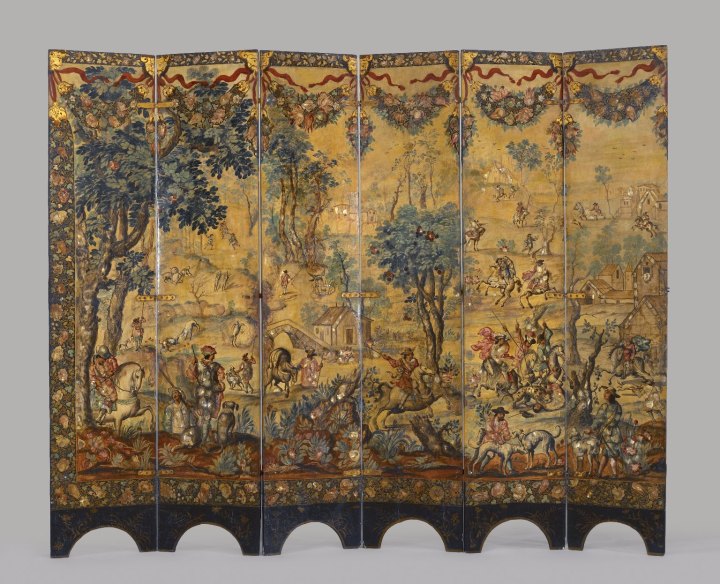
Screen with the Siege of Belgrade (front) and Hunting Scene (reverse,
as shown above). Mexico, ca. 1697–1701. Oil on wood, inlaid
with mother-of-pearl, 90 x 108 inches (Brooklyn Museum)
◊ ◊ ◊ ◊ ◊
The first major exhibition in the United States to explore the private lives, power struggles, and collecting practices of Spain’s New World elite brings together approximately 160 exceptional works in a wide range of media that illuminate conspicuous consumption and domestic display in the colonial era. Behind Closed Doors: Art in the Spanish American Home, 1492–1898 debuted at the Brooklyn Museum, where it will be on view through January 12, 2014, before traveling to three additional venues.
Included are paintings, manuscripts, prints, sculpture, decorative-arts objects, and textiles. The material demonstrates how colonial Spanish America’s new moneyed classes—including Spaniards, Creoles (Spaniards born in the New World), individuals of mixed race, and indigenous people—secured their social status through the spectacular private display of luxury goods from all over the world. The exhibition invites the visitor into an elite Spanish colonial home, beginning with more public reception rooms, hung with elaborately costumed family portraits and filled with fine imported and locally produced luxury goods, and ending with more private rooms, displaying objects that also spoke to the racial and social identity of their owners.
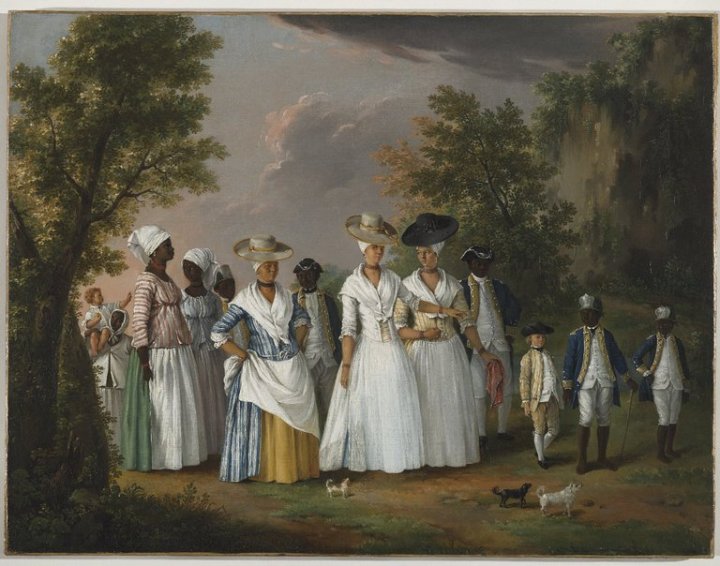
Agostino Brunias, Free Women of Color with Their Children
and Servants in a Landscape, ca. 1770–96. Oil on canvas,
20 x 26 inches (Brooklyn Museum)
◊ ◊ ◊ ◊ ◊
When the Spanish empire first expanded its borders into the Americas, the early conquistadors brought with them a rich artistic tradition, along with a monotheistic religion and an obsession with racial purity. Within a hundred years, fabulous fortunes had been amassed in the New World, thanks to the region’s abundant natural resources and robust market economy. Although Spanish America’s newly privileged class consisted of some of the wealthiest people in the world, the crown consistently favored those born in Spain for prominent local government and church positions, and political reforms in the eighteenth century further limited Creole power. In defiance, American-born elites responded by acquiring and ostentatiously displaying luxury goods from around the world in their dress and in their homes as pointed reminders of the crown’s reliance on New World resources. Their collections became more eclectic, including works by local artists and indigenous craftsmen as well as European masters.
Most of the objects in the exhibition are drawn from the Brooklyn Museum’s superb Spanish colonial holdings, supplemented by additional selections from the American, European, Asian, and Islamic collections as well as loans from public and private collections. For the first time in an exhibition in this country, Spanish colonial objects destined for the home will be paired with British American counterparts for purposes of comparison. The exhibition, which encompasses all of the New World under Spanish domination, calls attention to the Caribbean’s pivotal but, surprisingly, often overlooked role in Spanish American history.

José Joaquín Bermejo, Doña Mariana Belsunse y Salasar, ca. 1780 (Brooklyn Museum)
Among the exhibition highlights is a group of luxury objects from the viceroyalty of New Spain, which comprised present-day Mexico and Central America. One is a shell-inlaid and painted folding screen, or biombo enconchado, commissioned expressly for Mexico City’s viceregal palace about 1700 by Viceroy José Sarmiento de Valladares. This extremely rare, massive six-panel screen will be a focal point of the exhibition, along with a newly discovered late eighteenth-century neoclassical portrait by the mixed-race Puerto Rican painter José Campeche. Depicting twenty-one-year-old Doña Maria de los Dolores Gutiérrez del Mazo y Pérez, the painting commemorated her marriage to the future viceroy of New Granada.
Other objects in the exhibition include a pair of painted leather Peruvian chests from about 1690 decorated with allegories of the four elements, symbols of the zodiac, and a scene of a merry company dining outdoors; eighteenth-century Chinese export porcelain bearing the coat of arms of one of colonial Mexico’s leading families; an early sixteenth-century medallion Ushak carpet from Turkey of the type recorded in South American women’s sitting rooms; a late eighteenth-century polychromed wood portable tabernacle, adorned with the Virgin Mary and mirrors to reflect candlelight; Free Women of Color with Their Children and Servants in a Landscape, a portrait from about 1764–96 of members of the mixed-race elite in the British colony of Dominica by Italian painter Agostino Brunias; and Francisco de Goya’s monumental portrait of Peruvian-born Don Tadeo Bravo de Rivero, painted in Madrid in 1806.
The Brooklyn Museum began acquiring domestic Spanish colonial art in earnest in 1941 when Herbert J. Spinden, Curator of American Indian Art and Primitive Cultures, purchased approximately fourteen hundred art works from eight Latin American countries. The collection, which now ranks among the country’s finest, has been augmented with important recent acquisitions that are included in the exhibition.
◊ ◊ ◊ ◊ ◊
Programming at the Brooklyn Museum includes an afternoon roundtable:
Roundtable Discussion: Behind Closed Doors
Brooklyn Museum, Saturday, 16 November 2013, 11:30 a.m.–4 p.m.

Water Heater (Pava). Bolivia, 18th century, silver (Brooklyn Museum)
Join us for a day-long, bilingual roundtable discussion about calculated collecting practices in the colonial Americas, in celebration of the exhibition Behind Closed Doors: Art in the Spanish American Home, 1492–1898. The program begins with a morning session, in Spanish, on collecting for the home, moderated by Jorge F. Rivas Pérez, Curator of Colonial Art at the Colección Patricia Phelps de Cisneros. The afternoon session, in English, explores adorning the colonial body and will be moderated by Richard Aste, Curator of European Art at the Brooklyn Museum.
Collecting and signaling status through dress also connect with our fall exhibition The Fashion World of Jean Paul Gaultier: From the Sidewalk to the Catwalk.
Speakers include:
· Gustavo Curiel, Research Fellow, Instituto de Investigaciones Estéticas, Universidad Nacional Autónoma de México
· Maria Del Pilar Lopez Perez de Bejarano, Associate Professor, Instituto de Investigaciones Estéticas, Universidad Nacional de Colombia
· Barbara E. Mundy, Associate Professor of Art History, Fordham University
· Linda Rodríguez, Postdoctoral Fellow, Art History Department, New York University
· Caroline Weber, Associate Professor of French, Barnard College
· Luis Eduardo Wuffarden, independent Lima scholar and curator
This event is co-sponsored by the Brooklyn Museum and the Colección Patricia Phelps de Cisneros. Additional support provided by PAMAR’s eighth annual Latin American Cultural Week.
A box lunch will be available on the day of the event for $15. Museum Members receive free admission; call the Membership Hotline at (718) 501-6326 or email us for reservations.
◊ ◊ ◊ ◊ ◊
From Monacelli Press:
Richard Aste, ed., Behind Closed Doors: Art in the Spanish American Home, 1492–1898 (Monacelli Press, 2013), 224 pages, ISBN: 978-1580933650, $50.
 A critical contribution to the burgeoning field of Spanish colonial art, Behind Closed Doors reveals how art and luxury goods together signaled the identity and status of Spanish Americans struggling to claim their place in a fluid New World hierarchy.
By the early sixteenth century, the Spanish practice of defining status through conspicuous consumption and domestic display was established in the Americas by Spaniards who had made the transatlantic crossing in search of their fortunes. Within a hundred years, Spanish Americans of all heritages had amassed great wealth and had acquired luxury goods from around the globe. Nevertheless, the Spanish crown denied the region’s new moneyed class the same political and economic opportunities as their European-born counterparts. New World elites responded by asserting their social status through the display of spectacular objects at home as pointed reminders of the empire’s
dependence on silver and other New World resources.
The private residences of elite Spaniards, Creoles (American-born white Spaniards), mestizos, and indigenous people rivaled churches as principal repositories for the fine and decorative arts. Drawing principally on the Brooklyn Museum’s renowned colonial holdings, among the country’s finest, this book presents magnificent domestic works in a broad New World (Spanish and British) context. In the essays within, the authors lead the reader through the elite Spanish American home, illuminating along the way a dazzling array of both imported and domestic household goods. There, visitors would encounter European-inspired portraiture, religious paintings used for private devotion and also as signifiers of status, and objects that spoke to the owner’s social and racial identity.
◊ ◊ ◊ ◊ ◊
Karen Rosenberg reviewed the exhibition for The New York Times (19 September 2013)
Exhibition | A Queer History of Fashion
From The Museum at FIT:
A Queer History of Fashion: From the Closet to the Catwalk
The Museum at FIT, New York, 13 September 2013 — 4 January 2014
Curated by Fred Dennis and Valerie Steele

Man’s three piece silk velvet suit, 1790–1800, France
Museum purchase, 2010.98.1. Photo by Eileen Costa
A Queer History of Fashion: From the Closet to the Catwalk features approximately 100 ensembles, from 18th-century menswear styles associated with an emerging gay subculture to 21st-century high fashion. This is the first museum exhibition to explore in depth the significant contributions to fashion made by LGBTQ (lesbian-gay-bisexual-transgender-queer) individuals over the past 300 years.
Exhibition curators Fred Dennis, senior curator of costume, and Valerie Steele, director and chief curator of The Museum at FIT, spent two years researching and curating the exhibition. They worked with an advisory committee of eminent scholars, including professors George Chauncey (author of Gay New York), Shaun Cole (author of Don We Now Our Gay Apparel), Jonathan Katz (author/curator of Hide and Seek), Peter McNeil (co-editor of The Men’s Fashion Reader), and Vicki Karaminas (co-editor of the forthcoming Queer Style), as well as FIT faculty and fashion professionals.
“This is about honoring the gay and lesbian designers of the past and present,” said Dennis. “By acknowledging their contributions to fashion, we want to encourage people to embrace diversity.”
“We also hope that this exhibition will transform our understanding of fashion history,” added Steele. “For many years, gays and lesbians were hidden from history. By acknowledging the historic influence of gay designers, and by emphasizing the important role that fashion and style have played within the LGBTQ community, we see how central gay culture has been to the creation of modern fashion.”
From Cristobal Balenciaga and Christian Dior to Yves Saint Laurent and Alexander McQueen, many of the greatest fashion designers of the past century have been gay. Organized in roughly chronological order, the exhibition explores the history of modern fashion through the lens of gay and lesbian life and culture, addressing subjects including androgyny, dandyism, idealizing and transgressive aesthetic styles, and the influence of subcultural and street styles, including drag, leather, and uniforms.
The exhibition will trace how the gay vernacular styles changed after Stonewall, becoming increasingly “butch.” Lesbian style also evolved, moving from the ‘butch-femme’ paradigm toward an androgynous, anti-fashion look, which was, in turn, followed by various diversified styles that often referenced subcultures like punk. The AIDS crisis marks a pivotal mid-point in the exhibition. Clothing by a number of designers who died of AIDS, including Perry Ellis, Halston, and Bill Robinson, will be featured, as will a wide range of activist T-shirts for ACT UP, Queer Nation, the Lesbian and Gay Rights March in Washington and the iconic Read My Lips. Emphasizing that gay rights are human rights, the exhibition concludes with a section on gay wedding fashions as the sartorial expression of the issue of marriage equality.
Exhibition design is by Joel Sanders, well-known architect and author of Stud: The Architecture of Masculinity.
◊ ◊ ◊ ◊ ◊
From Yale UP:
Valerie Steele, ed., A Queer History of Fashion: From the Closet to the Catwalk (New Haven: Yale University Press, 2013), 248 pages, ISBN: 978-0300196702, $50.
 From Christian Dior to Yves Saint Laurent and Alexander McQueen, many of the greatest fashion designers of the past century have been gay. Fashion and style have played an important role within the LGBTQ community, as well, even as early as the 18th century. This provocative book looks at the history of fashion through a queer lens, examining high fashion as a site of gay cultural production and exploring the aesthetic sensibilities and unconventional dress of LGBTQ people, especially since the 1950s, to demonstrate the centrality of gay culture to the creation of modern fashion.
Contributions by some of the world’s most acclaimed scholars of gay history and fashion – including Christopher Breward, Shaun Cole, Vicki Karaminas, Jonathan D. Katz, Peter McNeil, and Elizabeth Wilson – investigate topics such as the context in which key designers’ lives and works form part of a broader ‘gay’ history; the ‘archeology’ of queer attire back to the homosexual underworld of 18th-century Europe; and the influence of LGBTQ subcultural styles from the trouser suits worn by Marlene Dietrich (which inspired Yves Saint Laurent’s ‘Le Smoking’) to the iconography of leather. Sumptuous illustrations include both fashion photography and archival imagery.
Valerie Steele is director and chief curator of The Museum at the Fashion Institute of Technology, New York.
Exhibition | The Nude Male in Art
Press release masculin (1 July 2013) from the Musée d’Orsay:
Masculin / Masculin: L’homme nu dans l’art de 1800 à nos jours
Musée d’Orsay, Paris, 24 September 2013 — 2 January 2014
Curated by Ophélie Ferlier, Xavier Rey, Ulrich Pohlmann, and Tobias G. Natter

Pierre et Gilles, Mercury, 2001 © Pierre et Gilles (Courtesy Galerie Jérôme de Noirmont, Paris)
Jean-Baptiste Frédéric Desmarais, The Shepherd Paris, 1787 (Ottawa, National Gallery of Canada)
While it has been quite natural for the female nude to be regularly exhibited, the male nude has not been accorded the same treatment. It is highly significant that until the show at the Leopold Museum in Vienna in the autumn of 2012, no exhibition had opted to take a fresh approach, over a long historical perspective, to the representation of the male nude. However, male nudity was for a long time, from the 17th to 19th centuries, the basis of traditional Academic art training and a key element in Western creative art. Therefore when presenting the exhibition Masculine / Masculine, the Musée d’Orsay, drawing on the wealth of its own collections (with several hitherto unknown sculptures) and on other French public collections, aims to take an interpretive, playful, sociological and philosophical approach to exploring all aspects and meanings of the male nude in art. Given that the 19th century took its inspiration from 18th-century classical art and that this influence still resonates today, the Musée d’Orsay is extending its traditional historical range in order to draw a continuous arc of creation through two centuries down to the present day. The exhibition will include the whole range of techniques: painting, sculpture, graphic arts and, of course, photography, which will have an equal place in the exhibition.
To convey the specifically masculine nature of the body, the exhibition, in preference to a dull chronological presentation, takes the visitor on a journey through a succession of thematic focuses, including the aesthetic canons inherited from Antiquity, their reinterpretation in the Neo-Classical, Symbolist and contemporary eras where the hero is increasingly glorified, the Realist fascination for truthful representation of the body, nudity as the body’s natural state, the suffering of the body and the expression of pain, and finally its eroticisation. The aim is to establish a genuine dialogue between different eras in order to reveal how certain artists have been prompted to reinterpret earlier works. In the mid-18th century, Winckelmann examined the legacy of the divine proporzioni of the body inherited from Antiquity, which, in spite of radical challenges, still apply today having mysteriously come down through the history of art as the accepted definition of beauty. From Jacques-Louis David to George Platt-Lynes, LaChapelle and Pierre et Gilles, and including Gustave Moreau, a whole series of connections is revealed, based around issues of power, censorship, modesty, the boundaries of public expectation and changes in social mores.
Winckelmann’s glorification of Greek beauty reveals an implicit carnal desire, relating to men as well as women, which certainly comes down through two centuries from the “Barbus” group and from David’s studio, to David Hockney and the film director James Bidgood. This sensibility also permeates the turn of the 19th and 20th centuries as it questions its own identity, as we see in the extraordinary painting École de Platon [School of Plato], inexplicably purchased by the French state in 1912 from the Belgian artist Delville. Similarly, the exhibition will reveal other visual and intellectual relationships through the works of artists as renowned as Georges de La Tour, Pierre Puget, Abilgaard, Paul Flandrin, Bouguereau, Hodler, Schiele, Munch, Picasso, Bacon, Mapplethorpe, Freud and Mueck, while lining up some surprises like the Mexican Angel Zarraga’s Saint Sébastien [Saint Sebastian], De Chirico’s Les Bains mystérieux [Mysterious Baths] and the erotica of Americans Charles Demuth and Paul Cadmus.
This autumn therefore, the Musée d’Orsay will invite the visitor to an exhibition that challenges the continuity of a theme that has always interested artists, through unexpected yet productive confrontations between the various revivals of the nude man in art. The exhibition has been organised by the Musée d’Orsay in collaboration with the Leopold Museum in Vienna.
◊ ◊ ◊ ◊ ◊
The catalogue is published jointly by by the Musée d’Orsay and Flammarion:
Guy Cogeval, Claude Arnaud, Philippe Comar, Damien Delille, Ophélie Ferlier, Ulrich Pohlmann, Xavier Rey, Masculin / Masculin: L’homme nu dans l’art de 1800 à nos jours (Paris: Musée d’Orsay / Flammarion, 2013), 304 pages, ISBN: 978-2081310094, 40€.
 Masculin/Masculin montre combien les professions de foi esthétiques, dogmes et prises de position plastiques du XIXe siècle en matière de nudité masculine puisent leurs origines au classicisme du XVIIIe siècle et demeurent encore présents aujourd’hui. Les oeuvres y sont envisagées sous l’angle de l’histoire sociale et culturelle, ou des enjeux de politique actuelle concernant la redéfinition de la perception du corps, la permissivité dans sa représentation et son usage, son pouvoir et son intimité, ou encore du rapport entre les sexes et de l’évolution de la masculinité.
Véritable dialogue entre peintures, sculptures, arts graphiques et photographies, le catalogue tisse des liens entre les époques grâce à d’inattendues et fécondes confrontations, les oeuvres contemporaines apportant un éclairage nouveau sur les siècles précédents. L’éclectisme revendiqué dans le choix des oeuvres, sans pour autant occulter les représentations les plus douloureuses de l’homme nu, aboutit à une célébration de la beauté qui ne dissimule pas sa joie et à un plaisir trop longtemps passé sous silence alors même qu’il est indissociable du genre. L’originalité n’est donc pas recherchée pour elle-même, mais davantage érigée en sésame ouvrant à un renouvellement du regard porté sur des oeuvres parfois extrêmement célèbres, visant à bousculer des lectures et à créer des correspondances.
◊ ◊ ◊ ◊ ◊
Note (added 12 October 2013) — Doreen Carvajal, “With Money Tight, Museums Embrace Nudes,” The New York Times (11 October 2013).
. . . the crowds are coming [to the Musée d’Orsay], averaging more than 4,500 people a day, triple the amount for a show at the same time last year, according to museum figures. The exhibition — which includes works by Picasso and Edvard Munch as well as more contemporary nudes by David Hockney, Andy Warhol and Robert Mapplethorpe — has provoked a wide range of responses inside and outside France. “A confused show” the French daily newspaper Le Monde weighed in, “devoid of any historical reflection.” But the show still was the buzz of Paris Fashion Week. And Marie Claire, a women’s beauty magazine, anointed it the “hottest event” of autumn. And sizzle is what a number of major European institutions seek this fall, hoping that a focus on sex will entice visitors and broaden their appeal to younger generations and a demographic who are more likely to read Marie Claire than Le Monde. . .
The full article is available here»
Exhibition | American Adversaries: West and Copley
Press release (19 June 2013) from the MFAH:
American Adversaries: West and Copley in a Transatlantic World
Museum of Fine Art, Houston, 6 October 2013 — 5 January 2014
 This October, the Museum of Fine Arts, Houston, presents American Adversaries: West and Copley in a Transatlantic World, an extensive exhibition charting the rise and spectacular success of contemporary history painting in the 18th century through the lives and experiences of two colonial American innovators: Benjamin West (1738–1820) and John Singleton Copley (1738–1815). West and Copley—initially friends and eventually bitter rivals—gained phenomenal fame from their theatrical paintings that romanticized current events and captured the imaginations of the art-viewing public. American Adversaries is on view from October 6, 2013, to January 20, 2014.
American Adversaries: West and Copley in a Transatlantic World traces the ambitious, competitive and highly successful lives of West and Copley through oil paintings, works on paper, sculptures and artifacts. At the core of the exhibition are two paintings that catapulted West and Copley into international fame: West’s The Death of General Wolfe (1770; 1779 version) and Copley’s Watson and the Shark (1778). The paintings have not been presented together in more than 60 years and never before in this context.
“This is a remarkable opportunity for Museum visitors to see in the same exhibition these two iconic paintings in the history of art, The Death of General Wolfe and Watson and the Shark,” said MFAH director Gary Tinterow. “Painted nearly 250 years ago and considered strikingly modern in their day, the issues addressed with such dramatic flair have the power to still resonate with viewers today.”
“Long before Jackson Pollock drew international acclaim for his innovative Abstract Expressionist paintings in the mid-twentieth century, West and Copley held center stage in the international art world of the 18th century centered in London,” said Emily Ballew Neff, MFAH curator of American painting and sculpture. “The exhibition addresses how it is that these two colonial artists on the margins of empire come to have such phenomenal success.”
Both born in the same year (1738) in the American Colonies of Pennsylvania and Massachusetts, Benjamin West and John Singleton Copley crossed the Atlantic in pursuit of international fame and fortune. London, the cultural and political capital of the empire, attracted and swayed both artists to stay to develop their careers as history painters and neither returned home to America.
West and Copley established a new genre of painting known as contemporary history painting with The Death of General Wolfe and Watson and the Shark. These dramatic large-scale canvases featured compositional elements derived from antique and Old Master sources, yet instead of portraying biblical, mythological or literary heroes, they depicted real people from contemporary life. This exhibition examines these paintings and the period in which they were painted to animate a past that is unfamiliar to many today. It restores the dynamism and modernity of this particular artistic moment as it happened, rather than through the lens of what we later have come to know. These works point to a world informed by the powerful agency of the Iroquois (Haudenosaunee) Confederacy in the Great Lakes region; the scientific and imperial exploration of the seas; the rising role of the media and its relationship to history painting; and the stagecraft involved in managing the perception of a successful artistic career in 18th-century London. In the exhibition, the two key paintings are joined by works of art from all over the Atlantic World, which give them greater context and meaning.
A fully illustrated catalogue, published by the Museum of Fine Arts, Houston, distributed by Yale University Press and designed by Studio Blue, accompanies the exhibition and features essays by international scholars. The catalogue for this exhibition receives generous funding from Furthermore: a program of the J. M. Kaplan Fund.
American Adversaries: West and Copley in a Transatlantic World is organized by the Museum of Fine Arts, Houston. An indemnity has been granted by the Federal Council on the Arts and the Humanities. The exhibition is made possible through support from the Terra Foundation for American Art.
◊ ◊ ◊ ◊ ◊
38th Annual Ruth K. Shartle Symposium
American Adversaries: West and Copley in a Transatlantic World
Museum of Fine Art, Houston, 5 October 2013
This one-day symposium includes talks by prominent scholars addressing themes developed in the exhibition. Following the symposium, guests are invited to a reception and a viewing of the exhibition. More information is forthcoming. Visit www.mfah.org/calendar for updates.
◊ ◊ ◊ ◊ ◊
From Yale UP:
Emily Ballew Neff with Kaylin H. Weber, American Adversaries: West and Copley in a Transatlantic World (New Haven: Yale University Press, 2013), 272 pages, ISBN: 978-0300196467, $75.
American artists and innovators Benjamin West (1738–1820) and John Singleton Copley (1738–1815) changed the way history was recorded in the 18th century and became America’s first transatlantic art superstars. Initially friends but eventually bitter rivals, the artists painted contemporary events as they happened, illustrating the transformation of imperial power through diplomacy between British Americans and the Iroquois, and through transatlantic trade, exploration, and the natural history of the West Indies.
Focusing on two iconic works, West’s The Death of General Wolfe (1770) and Copley’s Watson and the Shark (1778), American Adversaries charts the rise of contemporary history painting, and offers a compelling examination of American history and New World exploration. Featuring more than two hundred color reproductions of paintings, works on paper, and objects that informed the artists, this handsome volume also includes essays that shed new light on, among other subjects, West and Copley within the context of the Royal Academy and the use of Western and Native American objects in cultural diplomacy.
Emily Ballew Neff is curator of American painting and sculpture, and Kaylin H. Weber is assistant curator of American painting and sculpture, both at the Museum of Fine Arts, Houston.
New Book | Turner and the Sea
The exhibition opens at the National Maritime Museum in November; proposals for the related conference are due by September 6.
Christine Riding and Richard Johns, Turner and the Sea (London: Thames & Hudson, 2013), 288 pages, ISBN: 978-0500239056, $60.
 This is the first publication to focus on J. M. W. Turner’s lifelong fascination with the sea, from his Royal Academy debut in 1796, Fishermen at Sea, to his iconic maritime subjects of the 1830s and 1840s such as Staffa, Fingal’s Cave. It places Turner and his work firmly in the broader field of maritime painting that flourished in nineteenth-century Britain, France, Germany, Holland, and America.
The majority of the works illustrated here—paintings, watercolors, sketches, sketchbooks, and engravings—are by Turner, but there are also comparative works by some forty other artists including Winslow Homer, James McNeill Whistler, John Constable, Benjamin West, and Gustave Courbet. The book is organized thematically and chronologically, and the subjects range from “Contested Waters,” which examines what was at stake for marine painting during the Napoleonic Wars, to “New Wave,” an exploration of Turner’s international and often surprising legacy for the art of the sea.
Christine Riding is senior curator of paintings and head of the arts department at the National Maritime Museum. Richard Johns is curator of prints and drawings at the National Maritime Museum.
Exhibition | Splendore a Venezia: Art and Music
Press release (6 June 2013) from the MMFA:
Splendore a Venezia: Art and Music from the Renaisance to Baroque in the Serenissima
Montreal Museum of Fine Arts, 12 October 2013 — 19 January 2014
Portland Art Museum, 15 February — 11 May 2014
Curated by Hilliard T. Goldfarb
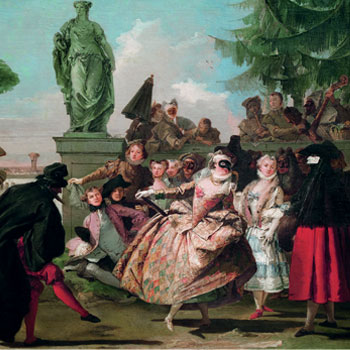
Giovanni Domenico Tiepolo, Minuet (detail), 1756 (Barcelona: Museu Nacional d’Art de Catalunya)
This fall the Montreal Museum of Fine Arts will present an innovative interdisciplinary exhibition, exploring for the first time the important interrelationships between the visual arts and music in the Venetian Republic, from the early sixteenth century to the fall of the Serenissima at the close of the eighteenth century, a period during which these art forms served the political ambitions of the state and civic institutions and became increasingly central to the economy of the Republic.
Thanks to outstanding loans from prestigious museums and collectors, visitors to the exhibition Splendore a Venezia: Art and Music from the Renaissance to Baroque in the Serenissima will discover the splendours of Venice through the musical scene: salons, the elaborate carnevale, the theatre, street performances and the festive, costumed commedia dell’arte.
Featuring approximately 120 paintings, prints and drawings, as well as historical instruments, musical manuscripts and texts, Splendore a Venezia paints a portrait of extraordinary artistic and musical creativity. This exhibition organized by the Museum brings together masterworks by many of the most renowned names associated with the city on the lagoon: visual artists directly associated with the musical life of the city include Titian, Tintoretto, Bassano, Giovanni Battista and Domenico Tiepolo, and Francesco Guardi, many of whom were also amateur musicians, as well as Bernardo Strozzi, Pietro Longhi and Canaletto, whose paintings record the role of music in Venetian life. The exhibition also includes manuscripts and publications by Venetian composers like the Gabrieli, Monteverdi, Albinoni, Lotti and Vivaldi.
Nathalie Bondil, Director and Chief Curator of the MMFA, said, “In keeping with the original exhibition programming we began with Warhol Live, Imagine, Miles Davis and Lyonel Feininger, music takes its place front and centre with this new MMFA production. As D’Annunzio said: “In Venice, in the same way that one cannot feel except in music, one cannot think if not in images.” That’s how it is at the MMFA, too: it is impossible to see without listening or to listen without seeing.” In a presentation that resembles the Museum’s previous multidisciplinary exhibitions, Splendore a Venezia will give visitors an opportunity to enjoy musical accompaniment related to each theme in the galleries, thus enhancing the exploration of each of these works.
Exhibition curator Hilliard T. Goldfarb, Associate Chief Curator and Curator of Old Masters at the MMFA and a specialist of the Italian Renaissance, developed the concept of this original exhibition produced by the MMFA, by gaining inspiration from an idea put forward by the Musée de la musique in Paris. This exhibition will be circulated by the MMFA to the Portland Art Museum in Oregon from March 7 to June 8, 2014. The exhibition’s musical accompaniment is being overseen by musicologist François Filiatrault.
The works, on loan from prominent international collections like the Metropolitan Museum of Art, the Morgan Library & Museum, the New York Public Library, the Wadsworth Atheneum, the Cleveland Museum of Art, the National Gallery of Art (Washington), the Palatine Gallery, Uffizi, Capitoline, Cini Foundation, Accademia, Museo Correr, Kunsthistorisches Museum, Thyssen-Bornemisza, the Dulwich Picture Gallery, the National Gallery (London) and the National Gallery of Canada (Ottawa), and the Cité de la musique in Paris, among others. Extensive associated programming includes a series of concerts with period instruments in the MMFA’s Bourgie Hall, as well as related activities throughout the city.
The visual arts and musical scenes during the extraordinarily creative period from Titian to Guardi and Willaert to Vivaldi were profoundly interconnected. The world’s first public opera house (1639) opened in Venice, which boasted no fewer than nine commercial opera houses in the seventeenth and eighteenth centuries. Modern music typography was invented in Venice, and it was there that the most important musical presses in Europe were located. Public musical concerts were crucial to the economic strength of Venice’s scuole (rich, powerful brotherhoods) and ospedali (establishments for the poor and orphans). Each year, a variety of processions were held in celebration of special occasions. These were recorded in the visual arts and celebrated in music, in turn serving its government, which sponsored the arts. Music and the visual arts also became central to state propaganda and the Republic’s state receptions and international profile.
The exhibition is organized along three broad conceptual themes reflecting specific, parallel and interrelated characteristics of art and music during this critical period of Venetian history: 1) Art and Music in the Public Sphere 2) Art and Music in the Private Realm 3) Art, Music and Mythology [more information about each theme is available in the press release]
To accompany the exhibition, the MMFA’s Publishing Department is co-publishing a full-colour exhibition catalogue, in English and French editions, with Hazan, Paris [Art and Music in Venice: From the Renaissance to Baroque]. The catalogue features essays by leading international experts in Venetian art, culture and music, under the general editorship of Dr. Hilliard T. Goldfarb. He is joined by a distinguished team of international cultural and musicological experts, including Tiziana Bottecchia, Dawson Carr, Francesca del Torre, Joël Dugot, Iain Fenlon, Caroline Giron, Jonathan Glixon, Sergio Guarino, Eugene Johnson, Piero Lucchi and Ellen Rosand. This publication will serve as a reference work that will make an ongoing contribution to the body of knowledge on music and the visual arts in the private and public realms of the Venetian Republic. It will be distributed internationally by Hazan (French edition) and Yale University Press (English edition). (more…)
Exhibition | Interwoven Globe: The Worldwide Textile Trade, 1500–1800
As noted at Style Court, Interwoven Globe opens this month at The Met; from the press release:
Interwoven Globe: The Worldwide Textile Trade, 1500–1800
The Metropolitan Museum of Art, New York, 16 September 2013 — 5 January 2014
Curated by Amelia Peck
 Interwoven Globe: The Worldwide Textile Trade is the first major exhibition to explore the international transmittal of design from the 16th to the early 19th century through the medium of textiles. It highlights an important design story that has never before been told from a truly global perspective. Beginning in the 16th century, the golden age of European maritime navigation in search of spice routes to the east brought about the flowering of an abundant textile trade, causing a breathtaking variety of textiles in a multiplicity of designs and techniques to travel across the globe. Textiles, which often acted as currency for spices and other goods, made their way from India and Asia to Europe, between India and Asia and Southeast Asia, from Europe to the east, and eventually to the west to North and South America. Trade textiles blended the designs, skills, and tastes of the cultures that produced them, resulting in objects both intrinsically beautiful and historically fascinating.
The exhibition is made possible by The Andrew W. Mellon Foundation, the Diane W. and James E. Burke Fund, The Coby Foundation, Ltd., The Favrot Fund, the Gail and Parker Gilbert Fund, and the Quinque Foundation.
While previous studies have focused on this story from the viewpoint of trade, Interwoven Globe is the first exhibition to explore it as a history of design—and to approach it from a perspective that emphasizes the beauty and sophistication of these often overlooked objects. It will explore the interrelationship of textiles, commerce, and taste from the Age of Discovery to the 19th century. From India and its renowned, ancient mastery of painted and dyed cotton to the sumptuous silks of China and Japan, Turkey and Iran, the paths of influence are traced westward to Europe and the Americas. Shaped by an emerging worldwide visual culture, the resulting fashion for the “exotic” in textiles, as well as in other goods and art forms, gave rise to what can be recognized as the first truly global style.
Interwoven Globe will feature 134 works, about two-thirds of which are drawn from the Metropolitan Museum’s own rich, encyclopedic collection. These objects will be augmented by important domestic and international loans in order to make worldwide visual connections. Works from the Metropolitan will come from the following departments: American Decorative Arts, Asian Art, Islamic Art, European Sculpture and Decorative Arts, The Costume Institute, European Paintings, Drawings and Prints, and Arts of Africa, Oceania, and the Americas. They will include numerous flat textiles (lengths of fabric, curtains, wall hangings, bedcovers,) tapestries, costumes, church vestments, pieces of seating furniture, and paintings and drawings. (more…)
New Book | Of Elephants & Roses: French Natural History, 1790–1830

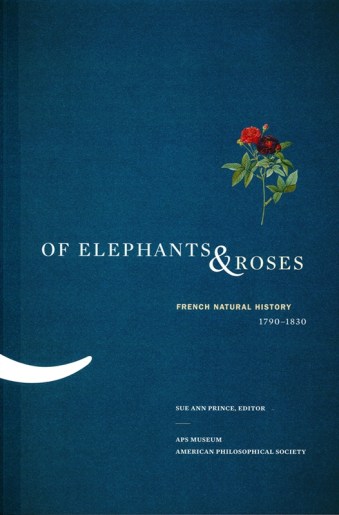
Design by Marc Blaustein
◊ ◊ ◊ ◊ ◊
Published by APS and available from Diane Publishing:
Sue Ann Prince, ed., Of Elephants & Roses: French Natural History, 1790–1830 (Philadelphia: American Philosophical Society, 2013), 294 pages, ISBN: 9780871692672, $50.
Of Elephants & Roses explores the fascinating history of the natural sciences in the turbulent years of post-revolutionary and Restoration France, from Empress Josephine’s black swans and rare Franklin tree to a giraffe that walked 480 miles across France to greet the king. This illustrated book is the catalogue for an international loan exhibition held in 2011 at the APS Museum in Philadelphia and the record of an associated interdisciplinary symposium. It presents new perspectives on French natural history, its influence on French culture, and its ties to the natural sciences in North America.

From J. P. Hoüel, Histoire naturelle des deux éléphans (Paris, 1803)
Edited by APS Museum director and curator Sue Ann Prince, the catalogue contains all sixteen talks, the keynote and concluding addresses, the session commentaries, edited transcripts of the audience discussions, and a checklist of the exhibition. Contributors include art historians, historians of science, and scholars of French literature, history, and culture. The book is illustrated throughout in full color. Both the symposium and the publication have been made possible by generous funding from the Richard Lounsbery Foundation.
About the APS
An eminent scholarly organization of international reputation, the American Philosophical Society promotes useful knowledge in the sciences and humanities through excellence in scholarly research, professional meetings, support of young scholars, publications, library resources, and a museum. This country’s first learned society, the APS has played an important role in American cultural and intellectual life for more than 250 years.
Exhibition | William Kent: Designing Georgian Britain
From the Bard Graduate Center:
William Kent: Designing Georgian Britain
Bard Graduate Center, New York City, 20 September 2013 — 9 February 2014
Victoria & Albert Museum, London, 22 March — 13 July 2014
Curated by Susan Weber and Julius Bryant
 William Kent: Designing Georgian Britain, on view at the Bard Graduate Center: Decorative Arts, Design History, Material Culture from September 20, 2013 to February 9, 2014, is the first major exhibition to examine the life and career of one of the most influential designers in eighteenth-century Britain. Visitors will discover Kent’s genius, through nearly 200 examples of his elaborate drawings for architecture, gardens, and sculpture, along with furniture, silver, paintings, illustrated books, and through new documentary films. As most of his best-known surviving works are in Britain’s great country houses, the exhibition is rich in loans from private as well as public collections. Organized by the Bard Graduate Center in collaboration with the Victoria & Albert Museum in London, the exhibition is curated by Susan Weber (BGC) and Julius Bryant (V&A). It will travel to the V&A where it will be on view from March 22 to July 13, 2014.
Background
William Kent: Designing Georgian Britain explores Kent’s work over three decades (1719–48)—a period when Britain was defining itself as a new nation and overtaking France as a leading world power. Like Robert Adam a generation later, Kent is identified not only with his own prolific and diverse output but also with an entire period style. At a time when most patrons and collectors looked to Italy for their art and design, Kent’s versatility and artistic inventiveness set the style of his age and asserted the status of the modern British artist. From a time when no refined education was complete without the Grand Tour to Italy, the word ‘Kentian’ has come to denote rich, Italianate palatial interiors furnished with gilded sculptural tables, mirrors, and Old Master paintings, elaborately presented on walls lined with the richest silk damasks and velvets, and beneath painted ceilings. Kent devised a style that catered to the Grand Tour alumni, recreating the splendors of Roman palazzi. A jovial house guest of his patrons, ‘Kentino’ (as he was affectionately known) and his creations reminded them of the best days of their lives, before they returned, inherited, and dutifully managed their old family estates.
Many of the ideas we take for granted today about visual education, good design, and national style were established by Kent’s generation. At the start of the eighteenth century, the United Kingdom of Great Britain was established through the Act of Union between England and Scotland (1707). Great expectations of new public buildings followed, especially for a new parliament and royal palace to replace those destroyed by the Whitehall Palace fire of 1698. From the accession of George I in 1714 through the death of Queen Victoria in 1901, the Royal House of Hanover reigned over Britain. With Kent’s help, this German family reinvented themselves. The new nation needed a new sense of style, both to define itself through design (in contrast to the Stuarts and the French) and to improve society at large. Responding to a challenge articulated in the Earl of Shaftesbury’s Letter Concerning the Art, or Science of Design (1712), Lord Burlington is the best- known today of several patrons who took on this responsibility. Kent lived in his London townhouse, Burlington House (today the home of the Royal Academy) for most of his life and was also, in effect, artist-in-residence at Burlington’s new Italianate villa at Chiswick. Essentially, Kent saw that good design is about visual experience, not only dependent on the erudite eye of the connoisseur or the knowledge of architecture’s ancient rules, but also reliant on the emotional response as one moved through and around houses, offices, streets, and gardens.
◊ ◊ ◊ ◊ ◊
The Exhibition
William Kent: Designing Georgian Britain is divided into ten sections that introduce specific aspects of Kent’s work, including signature private and royal commissions, and important periods in his career. William Kent’s life and the historical age in which he worked is the subject of the first section. A highlight is William Aikman’s portrait of Kent that hung over the mantelpiece at Wanstead House, and is now in the National Portrait Gallery, London. The second section focuses on Kent’s formative years on the Grand Tour in Italy where he was sent to hone his painting skills by copying the Old Masters, and to act as a purchasing agent for British collectors. Italian Baroque art, interiors, and furnishings made a lasting impression on Kent. Featured are seldom seen paintings and drawings, including Kent’s copies after Agostino Carracci, Domenichino, and Carlo Maratti, and drawings of Italianate interiors by fellow Grand Tourist John Talman, that document this inspiring period in Kent’s life. While in Italy, Kent met Lord Burlington who became his mentor and collaborator for the next several decades. Together they became early exponents of the designs of the late Renaissance architect, Andrea Palladio, which they eventually incorporated into their own Anglo-Palladian style that came to define the Georgian era.
Kent is best known for the interiors he designed for several grand country estates in Britain, and for his approach in taking responsibility for the design of the entire interior from the painting and furniture to the sculpture and decoration. Visitors to the exhibition will have the opportunity to explore a few of Kent’s best-known early interiors, such as Chiswick House, Wanstead House, and Houghton Hall, Kent’s most important early commission for the grand estate of Sir Robert Walpole, and one of the key buildings in the history of Palladian architecture in England. In addition to drawings and plans of these interiors, the exhibition features rare examples of Kent’s furniture designed specifically for these commissions.
In time, Kent began to receive important royal commissions, particularly from King George II and his son, Frederick, Prince of Wales. A section of the exhibition is devoted to designs for the new monarchy. In 1722, Kent was given a major commission to design the Cupola Room at Kensington Palace, where he was in charge of painting the ceiling and designing the furniture and chimneypieces. One of Kent’s best known and somewhat unusual works was a state barge designed for Frederick. Although the barge is too large to travel, the exhibition will feature Kent’s beautifully rendered designs, along with a detailed model. Other notable royal commissions explored include those for Queen Caroline’s Library and Hermitage in Richmond Garden. Also on view will be several extraordinary pieces of silver, made after designs by Kent. Among these are a chandelier commissioned by George II for the Leineschloss, Hanover, made by Balthasar Behrens, on loan from the Museum of Fine Arts, Boston, and a large centerpiece (or epergne) for Frederick made by silversmith George Wickes.
Another section looks specifically at the work Kent produced in London, both in private residences as well as in public buildings. Among the most prestigious of these commissions was the design of Devonshire House, the residence of the Duke of Devonshire. Although the palatial home was demolished in the 1920s, objects from and related to it survive, and the exhibition will feature drawings and a door designed by Kent. Of his public works, the exhibition examines 10 Downing Street, the Houses of Parliament, the Horse Guards at Whitehall, and the Royal Mews. Also explored are Kent’s contributions to sculpture. Among the works shown are drawings for tomb monuments for Isaac Newton, William Shakespeare, and James Stanhope in Westminister Abbey, and Michael Rysbrack’s terracotta model of Newton.
One section is devoted to Holkham Hall, designed with the assistance of Lord Burlington for Thomas Coke, 1st Earl of Leicester, who was among Kent’s most important patrons. Now considered to be one of the finest examples of the Palladian revival style of architecture in Britain, Holkham Hall is shown through a number of important works that the BGC is fortunate to borrow, including a gilded and elaborately carved settee, drawings of the interior, and Francesco Trevisani’s portrait of Thomas Coke, who built Holkham.
Although known today almost exclusively for his Palladian style, Kent worked in other idioms depending on the wishes of the patron. The exhibition looks at his Gothic works, including projects at Hampton Court and Esher Place, and his illustrations for books, most notably an edition of Edmund Spenser’s The Faerie Queene.
The final section examines Kent’s contributions to the history of landscape and garden design. Through drawings, furniture, and video, visitors will discover how Kent revolutionized garden design and helped usher in a style of natural gardening that came to characterize the English landscape garden. Two of Kent’s most important gardens, at Rousham and Stowe, remain today close to Kent’s original designs. A BGC produced video will offer a virtual journey through these gardens so that visitors will gain a better understanding of his landscape designs.
The Book
William Kent: Designing Georgian Britain, edited by Susan Weber, and published with Yale University Press, presents twenty-one essays by leading scholars of eighteenth-century British art and design, including Julius Bryant (co-curator), Geoffrey Beard, John Harris, John Dixon Hunt, Frank Salmon, and David Watkin. The book is richly illustrated with over 600 color images, including the pieces featured in the exhibition. A chronology of Kent’s projects, an exhibition checklist, and an extensive bibliography round out this scholarly publication.
Support
William Kent: Designing Georgian Britain has been generously supported by The Rothschild Foundation, Edward Lee Cave, Dr. H. Woody Brock, Christie’s, Philip Hewat-Jaboor, John A. Werwaiss, Patricia and Martin Levy, The Paul Mellon Centre for Studies in British Art, Friends of the BADA Trust, Ronald Phillips, Ltd., and two donors who wish to remain anonymous.










leave a comment