Exhibition | Treasures of Kenwood House
Press release (9 December 2011) from the MFAH:
Rembrandt, Van Dyck, Gainsborough: The Treasures of Kenwood House, London
Museum of Fine Arts, Houston, 3 June — 3 September 2012
Milwaukee Art Museum, 4 October 2012 — 6 January 2013
Seattle Art Museum, 14 February — 19 May 2013
Arkansas Arts Center, Little Rock, 6 June — 8 September 2013
Curated by Susan Jenkins

Thomas Gainsborough, "Portrait of Mary, Countess Howe," ca. 1764 (London: Kenwood House, English Heritage, Iveagh Bequest)
On June 3, 2012, the Museum of Fine Arts, Houston, will debut the exhibition Rembrandt, Van Dyck, Gainsborough: The Treasures of Kenwood House, London, whose four-venue national tour was announced today by the American Federation of Arts in New York. An exhibition of forty-eight masterpieces, this will be the first tour of this important group of works from the Iveagh Bequest and will provide a unique opportunity to see these superb paintings outside the United Kingdom. Most of these paintings have never traveled to the States before, and many of them have rarely been seen outside Kenwood.
Donated to the nation by Edward Cecil Guinness (1847–1927), 1st Earl of Iveagh and heir to the world’s most successful brewery, the Iveagh Bequest resides at Kenwood House, a neoclassical villa in London that was remodeled by Robert Adam in the eighteenth century. The collection was shaped by the tastes of the Belle Epoque—Europe’s equivalent to America’s Gilded Age—when the earl shared the cultural stage and art market with other industry titans such as the Rothschilds, J. Pierpont Morgan and Henry Clay Frick. Acquired mainly from 1887 to 1891, the earl’s purchases reveal a penchant for the portraiture, landscape and seventeenth-century Dutch and Flemish works typically found in English aristocratic collections. While the majority of the paintings in the exhibition are from the Iveagh Bequest, several are drawn from the works acquired specifically for display at Kenwood. Pauline Willis, AFA’s Director, remarked, “We are extremely proud to be able to give greater exposure to this magnificent selection of paintings while Kenwood undergoes a major refurbishment.” Simon Thurley, Chief Executive for English Heritage, commented, “The collection of works of art on display at Kenwood is one of the most important in England, and we are thrilled that works from this collection will travel across the Atlantic for the first time and find new audiences in the United States.”
The collection is particularly strong in works by such Golden Age eighteenth-century English portraitists as Sir Joshua Reynolds, Thomas Gainsborough and George Romney, whose depictions of society beauties of the Georgian era, also known as England’s “Age of Aristocracy,” held a great appeal for Lord Iveagh. Among the several fine Gainsboroughs in the exhibition is the sumptuous full-length portrait Mary, Countess Howe (c. 1764), an image of both aristocratic elegance and of a landowner among her properties. Such full-length portraits of ladies in nature were very popular during this period, owing to a great admiration for the aristocratic portraits of Van Dyck. Along with such aristocratic women, the collection’s “virtual harem” of English portraits features celebrity demimondes, among them Emma Hart—later Lady Hamilton—who served as Romney’s muse, and Kitty Fisher—one of the most celebrated courtesans in London society. (more…)
New Gallery at Greenwich | Traders: The East India Company and Asia
From the National Maritime Museum:
Traders: the East India Company and Asia
National Maritime Museum, Greenwich, gallery opened in September 2011

◊ ◊ ◊ ◊ ◊
Established by a group of London merchants, the East India Company was given its first royal charter by Elizabeth I. By the time it was abolished 250 years later, Queen Victoria was on the throne. The East India Company took on pirates, princes and rival traders in its pursuit of profit – changing the world in the process. This new gallery at the National Maritime Museum explores the history and continuing relevance of Britain’s trade with Asia, looking at this compelling story through the lens of the East India Company. Traders: the East India Company and Asia examines the commodities that the company traded, the people that shaped its tumultuous career and the conflicts and rebellions that were its ultimate undoing.
The exotic spices the company imported brought exciting flavours to Britain. The calicos, muslins and silks carried on its ships shaped fashions, clothing rich and poor alike. But its greatest success was tea, which it helped transform from an expensive luxury to a national pastime. However, the British cup of tea had a darker side: opium. This illegal drug trade was interwoven with the company’s business, resulting in war with China on two separate occasions.

ISBN: 9781857596755, $60
The company can be seen as a forerunner of the modern multinational. But its power and global reach were unique. At its height, the company minted its own currency and ruled over a sixth of humanity. It had its own navy, the Bombay Marine, and had 250,000 soldiers at its command. Regarded by the British establishment as too big to fail, the Company was repeatedly bailed out and ended its days shrouded in controversy.
Traders: the East India Company and Asia showcases the museum’s world-famous collection of objects relating to Asia and the Indian Ocean, including: Japanese, Chinese and Burmese swords; beautifully crafted ship models and navigational instruments; Nelson’s Japan-pattern breakfast service; Victoria Crosses awarded during the Indian Mutiny; and journals kept by Company sailors.
The gallery also contains portraits of key figures from throughout the East India Company’s history including: Sir James Lancaster, commander of the first Company voyage; Jamsetjee Bomanjee Wadia, master shipbuilder at Bombay Dockyard; the ship-wrecked and imprisoned Robert Knox, said to be the inspiration for Defoe’s Robinson Crusoe; the appropriately named Money brothers, who made their fortunes in Asia; and Commodore Sir William James, a poor Welsh miller’s son who ran away to sea, and rose to become commodore of the Bombay Marine and Chairman of the Company.
To celebrate the opening of Traders the National Maritime Museum staged a festival of events throughout autumn and winter 2011. Traders Unpacked, sponsored by Sharwood’s, explored the complex legacy of the EIC and its contemporary significance though events including a textile-themed walking tour of London’s East End; an alternative East India Company pub quiz; an evening of Japanese psychedelia; Singaporean deep house and sea shanties; the Curry and a Pint nights, which explored the origins of the great British curry; a series of international tea parties; and a night of nautical games for grown-ups.
The gallery is accompanied by an illustrated history of the Company, which draws extensively on the collections of the Museum. Monsoon Traders: the Maritime World of the East India Company is published by Scala and written by Robert J. Blyth and John McAleer, curators of Imperial and Maritime History at the National Maritime Museum and H. V. Bowen, Professor of Modern History, Swansea University.
◊ ◊ ◊ ◊ ◊
Writing for The New York Times (4 November 2011), Roderick Conway Morris provides a review of the exhibition.
Exhibition | Goya: Lights and Shadows
From ArtDaily.com (16 March 2012):
Goya: Lights and Shadows / Luces y Sombras
The National Museum of Western Art, Tokyo, 22 October 2011 — 29 January 2012
CaixaForum Barcelona, 15 March — 24 June 2012
Curated by Manuela B. Mena and José Manuel Matilla

Francisco de Goya, The Clothed Maja, ca. 1800
(Madrid: Museo Nacional del Prado)
◊ ◊ ◊ ◊ ◊
Nearly two hundred years after his death, Francisco de Goya continues to exercise a universal attraction that very few others in the history of art have equalled. Not only is Goya enveloped in the greatness of his art and his genius, he is also shrouded in mystery and popular legend in a way that makes him doubly attractive and accessible. Now, almost thirty-five years after the last major exhibition devoted to the Spanish master in Barcelona, Goya. Lights and Shadows brings a large selection of great works the collection of El Prado National Museum, the most important in the world. The show features nearly one hundred pieces – oils, drawings, prints and letters – in a chronological journey through the main periods in the career of this Aragón-born artist. From the early years, in which Goya’s realism contrasted with the over-refined Rococo style favoured by his contemporaries, to the intimate works he produced towards the end of his life in Bordeaux, not forgetting the drama of the Peninsular War, which marked a turning-point in his artistic development. The exhibition is the fruit of a cooperation agreement signed between ”la Caixa” Foundation and the Prado National Museum 2011 under which the Catalan organisation became a Benefactor of the museum. Under the terms of the agreement, three more joint exhibitions will be organised in the coming years. Goya. Lights and Shadows is the first show planned as part of the joint exhibition programme established by ”la Caixa” Foundation and the Prado National Museum, the result of an agreement made between the two institutions in July 2011, under which ”la Caixa” becomes a Benefactor of the Spanish art gallery. . .
The full press release (which includes programming and lectures) is available here»
◊ ◊ ◊ ◊ ◊
Exhibition | Mantegna to Matisse: Master Drawings
Press release from Sue Bond:
Mantegna to Matisse: Master Drawings from The Courtauld Gallery
The Courtauld Gallery, London, 14 June — 9 September 2012
The Frick Collection, New York, 2 October 2012 — 27 January 2013
Curated by Stephanie Buck and Colin B. Bailey
 The Courtauld Gallery holds one of the most important collections of drawings in Britain. Organised in collaboration with the Frick Collection in New York, this exhibition presents a magnificent selection of some sixty of its finest works. It offers a rare opportunity to consider the art of drawing in the hands of its greatest masters, including Dürer, Leonardo da Vinci, Michelangelo, Rembrandt, Goya, Manet, Cézanne and Matisse. The Courtauld last displayed a comparable selection of its masterpieces more than twenty years ago and this exhibition will bring the collection to new audiences nationally and internationally.
The exhibition opens with a group of works dating from the 15th century, from both Northern and Southern Europe. An exquisite and extremely rare early Netherlandish drawing of a seated female saint from around 1475-85 is rooted in late medieval workshop traditions. It was also at this time that drawing assumed a new central role in nourishing individual creativity, exemplified by two rapid pen and ink sketches by Leonardo da Vinci. These remarkably free and exploratory sketches show the artist experimenting with the dynamic twisting pose of a female figure for a painting of Mary Magdalene. For Renaissance artists such as Leonardo, drawing or disegno was the fundamental basis of all the arts: the expression not just of manual dexterity but of the artist’s mind and intellect.
These ideas about the nature of drawing achieved their full expression in the flowering of draughtsmanship in the 16th century. At the heart of this section of the exhibition is Michelangelo’s magisterial The Dream. Created in 1533, this highly complex allegory was made by Michelangelo as a gift for a close friend and it was one of the earliest drawings to be produced as an independent work of art. More typically, drawings were made in preparation for other works, including paintings, sculptures and prints. Pieter Bruegel the Elder’s engaging scene of drunken peasants cavorting at a festival in the Flemish village of Hoboken was drawn in 1559 in preparation for a print. Whereas Michelangelo sought ideal divinely inspired beauty in the human figure, Bruegel here revels in the disorder of everyday life.

Charles Joseph Natoire, "Life Class at the Académie Royale," 1746, watercolour, chalk (black) on paper, 454 x 323 mm, © The Courtauld Gallery, London
Despite the important preparatory function of drawing, many of the most appealing works in the exhibition were unplanned and resulted from artists reaching for their sketchbooks to capture a scene for their own pleasure. Parmigianino’s Seated woman asleep is a wonderful example of such an informal study surviving from the early 16th century. Drawn approximately 100 years later in around 1625, Guercino’s Child seen from behind retains the remarkable freshness and immediacy of momentary observation. Guercino was a compulsive and brilliantly gifted draughtsman. Here the red chalk lends itself perfectly to the play of light on the soft flesh of the child sheltering in its mother’s lap. No less appealing in its informality is Rembrandt’s spontaneous and affectionate sketch of his wife, Saskia, sitting in bed cradling one of her children. The exhibition offers a striking contrast between this modest domestic image and Peter Paul Rubens’s contemporaneous depiction of his own wife, the beautiful young Helena Fourment. Celebrated as one of the great drawings of the 17th century, this unusually large work shows the richly dressed Helena – who was then about 17 – moving aside her veil to look directly at the viewer. Created with a dazzling combination of red, black and white chalks, this drawing was made as an independent work of art and was not intended for sale or public display. In its imposing presence, mesmerising skill and subtle characterisation, it is the equal of any painted portrait.
The central role of drawing in artistic training is underlined in a remarkable sheet by Charles Joseph Natoire from 1746. It shows the artist, seated in the left foreground, instructing students during a life class at the prestigious Académie royale in Paris. Drawing after the life model and antique sculpture was considered essential in the 18th and 19th centuries. One of the great champions of this academic tradition was Jean Auguste Dominique Ingres. The beautiful elongated forms of the reclining nude in his Study for the ‘Grand Odalisque’, 1813-14, represents the highest refinement of a precise yet expressive linear drawing style rooted in the academy. Outside the academy, drawing could offer the artist a means of liberating creativity. Goya’s Cantar y bailar (Singing and dancing), 1819-20, comes from one of the private drawing albums which the artist used to inhabit the world of his dreams and imagination.
Canaletto’s expansive and meticulously composed View from Somerset Gardens, looking towards London Bridge is one of several highlights of a section exploring the relationship between drawing and the landscape. This group stretches back as early as Fra Bartolomeo’s Sweep of a river with fishermen drawn in around 1505-09, and also includes a particularly strong selection of landscapes from the golden age of the British watercolour. The interest in landscape is nowhere more powerfully combined with the expressive possibilities of watercolour than in the work of J.M.W. Turner. His late Dawn after the Wreck of around 1841 was immortalised by the critic John Ruskin, who imagined the solitary dog shown howling on a deserted beach to be mourning its owner, lost at sea. For Ruskin, this was one of Turner’s ‘saddest and most tender works’. (more…)
Exhibition | Taking Time: Chardin’s ‘Boy Building a House of Cards’
From Waddesdon Manor:
Taking Time: Chardin’s Boy Building a House of Cards and Other Paintings
Waddesdon Manor, Buckinghamshire, 28 March — 15 July 2012
Curated by Juliet Carey
 This exhibition brings together some of the greatest works to come out of eighteenth-century France. Prompted by Waddesdon’s recent acquisition of Boy Building a House of Cards (1735) by Jean-Siméon Chardin (1699-1779), the exhibition will unite all four of the artist’s paintings of the subject for the first time ever.
Loans from the UK, France and the USA will demonstrate how Chardin paired these works with other compositions to explore themes of childhood, adolescence and play. A group of Chardin’s images of servants – again, never seen together before – will provide a contrast with these images of children playing.
◊ ◊ ◊ ◊ ◊
From Paul Holberton Publishing:
Juliet Carey, with essays by Pauline Prévost-Marcilhacy, Pierre Rosenberg and Katie Scott, Taking Time: Chardin’s Boy Building House of Cards and Other Paintings (London: Paul Holberton, 2012), 160 pages, ISBN: 9781907372339, £30.
Recently acquired by Waddesdon Manor, Jean-Siméon Chardin’s early masterpiece Boy Building a House of Cards has a self-contained stillness that contrasts with the splendour of its new setting. Yet, it resonates with existing apspects of the collection from games and the representation of childhood to the influence of North European genre painting on French art. A child playing – with cards, bubbles, spinning-top or shuttlecock – was a favourite subject of Chardin’s. Such scenes, with their intimations of the transitory nature of human life, were derived from 16th- and 17th-century Dutch and Flemish vanitas, but display a delight in childhood for its own sake.
 Full of repetition, pendants and series, this catalogue allows the reader to scrutinize some of Chardin’s greatest works, and to follow the artist’s exploration of some of his most arresting subjects. Prints by Pierre Filloeul, Antoine Marcenay de Ghuy and others demonstrate the shifts in appearance and meaning that Chardin’s card-house compositions underwent through transposition from painting to engraving. The prints also help reconstruct some of the occasional pairings in which Chardin’s figure paintings were staged, whether on the walls of the Salon or in the cabinets of private collectors. The pendants include two of the most famous of all Chardin’s figure paintings, Lady Taking Tea and Girl with a Shuttlecock. Essays in self-containment and stillness, these works invite us to consider the nature of attention – the attention of the painter, his human subjects and ourselves.
This richly illustrated catalogue accompanies the exhibition at Waddesdon Manor, Buckinghamshire (28 March – 15 July 2012) that will unite Chardin’s four paintings of a boy with a house of cards for the first time (loans come from the Musée du Louvre, Paris; the National Gallery, London; the National Gallery of Art, Washington), allowing us to examine Chardin’s treatment of the subject in the context of his fascination with themes of play, childhood and adolescence. Pierre Rosenberg, former director of the Musée du Louvre and the pre-eminent scholar of Chardin’s work, considers the Rothchilds as collectors of Chardin; Pauline Prévost-Marcilhacy, an independent scholar and Rothschild specialist, gives an insight into Charlotte de Rothschild’s collecting; Katie Scott, lecturer at The Courtauld Institute of Art, specializing in French art and architecture of the early modern period, explores Chardin’s paintings of games; and Juliet Carey, Curator of Paintings, Drawings and Sculpture at Waddesdon Manor and curator of the exhibition, writes on repetition and meaning in Chardin’s houses of cards and their pendants.
Exhibition | Princes and Painters in Mughal Delhi

Press release from the Asia Society Museum:
Princes and Painters in Mughal Delhi, 1707–1857
Asia Society Museum, New York, 7 February — 6 May 2012
Curated by William Dalrymple and Yuthika Sharma
Princes and Painters in Mughal Delhi, 1707–1857 brings together 100 masterpieces created during an artistically rich period in India’s history. This major international loan exhibition provides a new look at an era of significant change during which the Mughal capital in Delhi shifted from being the heart of the late Mughal Empire to becoming the jewel in the crown of the British Raj. The exhibition includes jewel-like portrait paintings, striking panoramas, and exquisite decorative arts crafted for Mughal emperors and European residents alike, as well as historical photographs. The exhibition is curated by William Dalrymple and Yuthika Sharma. It is accompanied by a 264-page illustrated book with essays by William Dalrymple, Yuthika Sharma, Jean Marie Lafont, Malini Roy, Sunil Sharma, and J.P. Losty, published by Asia Society Museum in association with Yale University Press, New Haven and London.

(Yale University Press, 2012), ISBN: 9780300176667, $60
“Princes and Painters in Mughal Delhi, 1707–1857 is a reappraisal of a transitional era in India that provided unprecedented impetus for artistic innovation and experimentation,” says Melissa Chiu, Asia Society Museum Director and Vice President for Global Art Programs. “We’re pleased to be taking a new approach to this magnificent and vibrant work with notable author William Dalrymple and art historian Yuthika Sharma as curators.”
The exhibition focuses on the reigns of the last four Mughal emperors: Muhammad Shah (reigned 1719–1748), Shah Alam II (reigned 1759–1806), Akbar Shah II (reigned 1806–1837) and Bahadur Shah II Zafar (reigned 1837–1857). Having lost military, political and economic power to the newlyarrived British in Calcutta, Delhi continued to maintain its extraordinary cultural, literary, and artistic patronage networks. Artists were supported by the Mughal court in Delhi and the city’s ascendant European residents, creating an environment of extraordinary interaction and influence between them and the new world of the British East India Company.
As the British took over the reign of a dispersed empire from the Mughals in 1803, they were enamored of its courtly elegance and sought to participate in its culture as patrons and enthusiasts. Company painting, involving artistic commissions undertaken by Indian artists for officers of the British East India Company, was practiced alongside Mughal court painting, with both patrons utilizing the services of a common group of artists.
The exhibition looks at recognized works by Delhi-based court artists Nidha Mal and Chitarman, and less familiar works by artists such as Ghulam Murtaza Khan, Ghulam Ali Khan, and Mazhar Ali Khan. In addition to Mughal miniatures produced under later emperors, this exhibition highlights a selection of so-called Company School paintings produced for Delhi-based personalities such as William Fraser, James Skinner, and Thomas Metcalfe. The exhibition also chronicles the rise in genre portraiture during this era, epitomized by character studies of urban and rural residents of Delhi.
◊ ◊ ◊ ◊ ◊
From Yale UP:
William Dalrymple and Yuthika Sharma, Princes and Painters in Mughal Delhi, 1707–1857 (New Haven: Yale University Press, 2012), 224 pages, ISBN: 9780300176667, $60.
. . . Sumptuous color illustrations of such works illuminate the pages of this book, painting a vivid portrait of this important city and its art, artists, and patrons. Masterworks by major Mughal artists, such as Nidha Mal and Ghulam Ali Khan, and works by non-Mughal artists demonstrate the dynamic interplay of artistic production at this time. This largely overlooked period is explored in thought-provoking essays by a panel of distinguished scholars of Indian art, history, and literature to present an engaging look at this dynamic artistic culture in the midst of rapid change.
William Dalrymple is an award-winning writer, historian, and co-director of the Jaipur Literature Festival. Yuthika Sharma received a PhD in South Asian art and architecture from Columbia University and a doctorate in design from Harvard University.
Exhibition | ‘Waxing Eloquent: Italian Portraits in Wax’
From the Fondazaione Musei Civici Venezia:
Avere una Bella Cera: Le Figure in Cera a Venezia e in Italia
Fortuny Museum, Venice, 10 March – 25 June 2012
Curated by Andrea Daninos
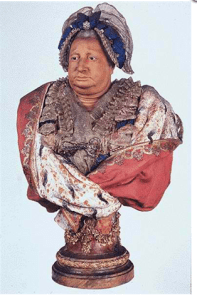
Francesco Orso, "Vittoria di Savoia Soisson," ca. 1785 (Castello di Agliè)
The exhibition aims to analyse a field that is little explored in the history of art, that of life-size wax figures; it is a fascinating subject and one that in recent years has stimulated interest from many contemporary artists, but until now no exhibition had been dedicated to this theme. The exhibition project arises from two fortunate coincidences: the existence of a series of wax portraits in the public collections and churches of Venice, and the centenary of the first study dedicated to the history of waxwork portraiture, Geschichte der Porträtbildnerei in Wachs, written by the famous Viennese art historian, Julius von Schlosser. The first Italian edition of this work has recently been published, edited by Andrea Daninos.
The exhibition will for the first time bring together the few existing examples of this genre in Italy, presenting them in an itinerary that begins with the theme of the cast and funeral mask. The first section will display a series of wax funeral masks of Venetian doges (eighteenth century), an all but unique example of the use of wax “doubles” in funeral ceremonies. The visitor will then be able to admire the only visual example to have survived of life-size votive figures, Vincenzo Panicale’s Libro dei miracoli, an early seventeenth-century manuscript documenting the votive figures in the Sanctuary of S. Maria della Quercia in Viterbo.
This is followed by the faces of saints and criminals, two recurrent subjects in the tradition of wax portraiture. The former are represented by 12 busts of Franciscan saints dating from the eighteenth century; made of wax, with glass eyes and real hair, these works constitute a complete group in this unusual religious iconography. In contrast, the visitor will also come face to face with a series of portraits of criminals made at the end of the nineteenth century by the pupil of Cesare Lombroso, Lorenzo Tenchini.
The central section of the exhibition is dedicated to the tradition of wax portraiture in Italy. It is introduced by two life-size portrait figures of eighteenth-century Venetian children. These two works, mentioned by Schlosser and Mario Praz, who compared them to the protagonists in Henry James’s Turn of the Screw, are kept in the storerooms of Palazzo Mocenigo and have not been put on public display for decades. They will certainly astonish the visitor for the quality of the execution and their disturbing realism.
The school of Bologna, the only town in Italy in which the art of life-size wax portraiture became widespread, will be represented by some of the specialists in the genre, including Anna Morandi Manzolini, Luigi Dardani and Angelo Gabriello Piò. In its last section, the exhibition will present the works of two artists who worked outside Italy, and who specialised in waxwork exhibitions. The first of these is Joseph Müller-Deym, a mysterious Austrian aristocrat who owned a famous waxworks museum in Vienna in the eighteenth century, and who will be represented here by his portrait of Maria Carolina of Austria. The other is a Piedmontese artist, Francesco Orso, who opened an analogous waxworks show in Paris during the years of the French Revolution. The present exhibition will display the works he produced for the Savoy court.
The rich and exceptional nature of the works on show is the result of the generosity of the loans from churches, scientific universities and museums, including the Museo del Dipartimento di Anatomia Umana, Farmacologia e Scienze Medico-Forensi of the Università di Parma, and the Palazzo Reale in Naples.
◊ ◊ ◊ ◊ ◊
From ACC Distribution:
Catalogue: Andrea Daninos, ed., Waxing Eloquent Italian Portraits in Wax (Officina Libraria, 2012), 160 pages, ISBN: 9788889854839, $28.
 This catalogue analyses a field of art history that only recently has been given renewed attention with the translation in French (1997), English (2008) and Italian (2011) of Julius von Schlosser’s History of Portraiture in Wax, originally published in German a century ago. The exhibit and the catalogue will present all life-size figures in wax present in Italy starting with the death masks in wax of the Venetian dogi (XVIII century), which were used as funeral effigies. The Book of Miracles, a XVII century manuscript illustrated in watercolours, documents the use of wax statues as ex-voto in churches. The heads of saints (12 Franciscan saints from the church of the Redentore in Venice) and criminals (8 manufactured in the late XIX century in Turin) will constitute another section. But the main section is dedicated to portraiture in wax and will see the presence of 7 busts and 2 full-size portraits of children, all from the XVIII and XIX century.
C O N T E N T S
Andrea Daninos, Wax Figures in Italy: A Brief History
Guido Guerzoni, Aureae Cerae: Production, Distribution and Consumption of Wax Artefacts in Modern Europe
Giovanni Ricci, Masks of Power: Funeral Effigies in Early Modern Europe
Emanuele Trevi, Written Waxes: Figures in Wax as Inspiration in Modern Literature
Catalogue Entries
Index of Names
Andrea Daninos has studied ceroplastic – the art of modelling in wax – for many years. He recently held a course on the subject at the University of Milan and he has edited and annotated the Italian translation of Julius von Schlosser’s History of Portraiture in Wax (Milan: Officina Libraria 2011), the seminal book on the argument.
Guido Guerzoni teaches Cultural Heritage and Art Markets at the Università Lugi Bocconi in Milan. His research interests are focused on the cultural and arts markets and his latest book has been translated into English in 2011 (Apollo and Vulcan: The Art Markets in Italy, 1400-1700, Michigan State University Press).
Giovanni Ricci is professor of Modern History at the University of Ferrara. He is the author of several books on urban history, the real and perceived presence of the Turks in Europe, marginal strata of society and social mobility, and funereal rites and their political use.
Emanuele Trevi is a literary critic and writer. He writes on a number of daily newspapers and has collaborated with RAI-3 Radio, one of Italy’s national radio stations. He lives in Rome.
The Burlington Magazine, February 2012
The eighteenth century in The Burlington:
The Burlington Magazine 154 (February 2012)
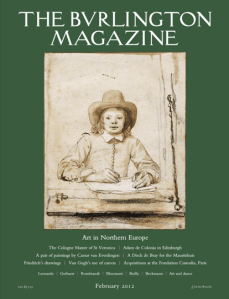 • Sophie Raux, “Carel Fabritius in Eighteenth-Century Paris,” pp. 103-06. This article establishes, among other things, that Carel Fabritius’s Mercury and Argus (c.1645–47; Los Angeles County Museum of Art) was in the collection of François Boucher, where it was seen by Fragonard.
Reviews
• Christian Tico Seifert, Review of Vadim Sadkov, The Pushkin State Museum of Fine Arts: Netherlandish, Flemish, and Dutch Drawings of the XVI-XVIII Centuries. Belgian and Dutch Drawings of the XIX-XX Centuries (Amsterdam: Foundation for Cultural Inventory, 2010), pp. 128-29.
• Xander Van Eck, Review of Lyckle de Vries, How to Create Beauty: De Lairesse on the Theory and Practice of Making Art (Leiden: Primavera Pers, 2011), pp. 129-30.
• Kate Retford, Review of the exhibition The First Actresses: Nell Gwyn to
Sarah Siddons (London: National Portrait Gallery), pp. 134-35.
• Xavier F. Salomon, Review of the exhibition Il Settecento a Verona: Tiepolo,
Cignaroli, Rotari — La Nobilità della Pittura (Verona: Palazzo della Gran
Guardia), pp. 146-48.
Exhibition: The Look of Love, Eye Miniatures
From the Birmingham Museum of Art:
The Look of Love: Eye Miniatures from the Skier Collection
Birmingham Museum of Art, Birmingham, Alabama, 7 February — 10 June 2012
University of Georgia, Athens, 6 October 2012 — 6 January 2013
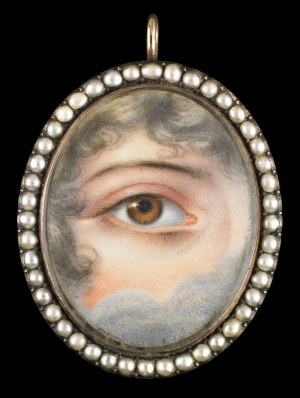 This stunning exhibition explores the little-known subject of “lover’s eyes,” hand-painted miniatures of single human eyes set in jewelry and given as tokens of affection or remembrance. In 1785, when the Prince of Wales secretly proposed to Mrs. Maria Fitzherbert with a miniature of his own eye, he inspired an aristocratic fad for exchanging eye portraits mounted in a wide variety of settings including brooches, rings, lockets, and toothpick cases. With over 100 examples, the collection of Dr. and Mrs. David A. Skier of Birmingham is the largest in the world. This exhibition offers an unprecedented look at these unusual and intriguing works of art.
Visitors can also interact with the exhibition in a new way: the Museum’s very first iPad app! The Look of Love app allows visitors to see these tiny, intricate objects at up to twenty times their actual size. They can also see images of the backs of objects or short videos of how the objects open. Twenty iPad devices are available for check-out and use in the Arrington Gallery, and
volunteers are on hand to show how the devices and the app
work.

ISBN: 9781907804014, $35
The exhibition is accompanied by a full color, hardbound catalogue of the same name, edited by Dr. Graham C. Boettcher, The William Cary Hulsey Curator of American Art, and published by D Giles Ltd., London. An essay by Elle Shushan sets the historical scene and examines the role of lover’s eyes in the broader context of Georgian and early Victorian portrait miniatures. Boettcher looks at the language and symbolism of these tokens and their jeweled settings. Additionally, novelist and biographer Jo Manning offers five fictional vignettes imagining the circumstances surrounding the creation of these extraordinary objects.
◊ ◊ ◊ ◊ ◊
N.B. — Notice of the exhibition at the Georgia Museum of Art in Athens was added on 24 October 2012
Exhibition: Colorful Realm in Washington
Thanks to Courtney Barnes at Style Court for noting this one. From the National Gallery of Art:
◊ ◊ ◊ ◊ ◊
Colorful Realm: Japanese Bird-and-Flower Paintings by Itō Jakuchū (1716–1800)
National Gallery of Art, Washington, D.C., 30 March — 29 April 2012
 Celebrating the centennial of Japan’s gift of cherry trees to the nation’s capital, this exhibition features one of Japan’s most renowned cultural treasures, the 30-scroll set of bird-and-flower paintings by Itō Jakuchū. Titled Colorful Realm of Living Beings (J. Dōshoku sai-e; c. 1757–1766), these extraordinary scrolls are being lent to the National Gallery of Art by the Imperial Household. Their exhibition here—for one month only—provides a unique, once-in-a-lifetime opportunity: not only is it the first time all 30 paintings will be on view in the United States, but it is also the first time any of the works will be seen here after their six-year-long restoration.
Colorful Realm stands as the most dynamic and comprehensive—yet meditative and distilled—expression of the natural world in all of Japanese art. Synthesizing numerous East Asian traditions of bird-and-flower painting, the set depicts each of its 30 subjects in wondrously meticulous detail, but in such a way as to transcend surface appearances and capture the otherwise ineffable, vital essence of the cosmos, the Buddha nature itself. To present the full significance of Colorful Realm, the exhibition and its catalogue reunite this masterpiece with Jakuchū’s triptych of the Buddha Śākyamuni from the Zen monastery Shōkokuji in Kyoto. Jakuchū had donated both works to the monastery, which displayed them in a large temple room during Buddhist rituals.
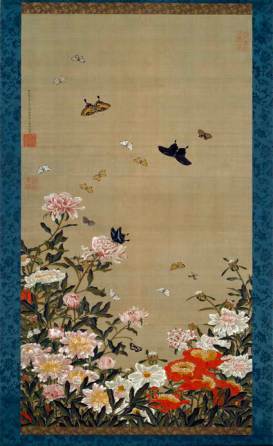 Recent conservation of Colorful Realm has generated an entirely new awareness of the material profile of the set and the technical means by which Jakuchū created each scroll. Drawing upon these findings as well as the most recent research on Jakuchū’s life and cultural environment, this exhibition offers a multifaceted understanding of the artist’s virtuosity and experimentalism as a painter—one who not only applied sophisticated chromatic effects but also masterfully rendered the richly symbolic world in which he moved.
The earliest of the 30 scrolls, Peonies and Butterflies, combines two subjects that enjoyed great popularity in East Asian pictorial traditions. On the one hand, the peony flower was likened to both feminine beauty and prosperity. It became the preferred garden flower of the imperial and aristocratic elite during China’s Tang dynasty (618–907) and at the court of Emperor Xuanzong in particular; in East Asian literary traditions Li Bai’s verse likening the beauty of Xuanzong’s favorite consort Yang Guifei (719–756) to a peony cemented the flower’s association with feminine beauty. Meanwhile, its full and gorgeous appearance lent itself to uncomplicated associations with affluence and good fortune. The butterfly also served as an auspicious symbol, though its popularity was equally attributable to its appearance in one of the most famous parables in early Chinese thought: Zhuangzi’s dream of a butterfly. According to this parable, the legendary sage Zhuangzi dreams that he is a carefree yellow butterfly. Upon awakening, however, “he didn’t know if he was Zhuangzi who had dreamt he was a butterfly, or a butterfly dreaming he was Zhuangzi.” Paintings of butterflies inevitably invoked the oneiric setting and queried selfhood of the Zhuangzi anecdote in most East Asian contexts and particularly in Jakuchū’s circle of erudite Sinophile monks, scholars, and merchants. While visually opulent, Peonies and Butterflies also suggests the uncertainty of a just-awoken dreamer who momentarily confuses reverie with reality.
Careful study of the painting’s pigmentation points to Jakuchū’s remarkable distillation and intensification of traditional East Asian coloration techniques. Different grades of opacity and transparency are achieved in the butterflies, flowers, stems, and leaves by varying the use of mineral and vegetal pigments, occasionally layering them one on top of another and adding a sublayer of color on the back of the silk. This complex stratigraphy of colors results in a convincing imbrication of the motifs in their surroundings. Indeed, when Jakuchū’s cultural and spiritual mentor Daiten (1719–1801) encountered the painting in 1760, he titled it “Beautiful Mist and Fragrant Wind” (Enka kōfū), suggesting that the real subject here was not the peonies and butterflies, but the conceptual atmosphere that enveloped them, the invisible ether within which they swayed and glided.
◊ ◊ ◊ ◊ ◊
Exhibition catalogue: Yukio Lippit, with Ota Aya, Oka Yasuhiro, and Hayakawa Yasuhiro, Colorful Realm: Japanese Bird-and-Flower Paintings by Itō Jakuchū (Chicago: University of Chicago Press, 2012), 224 pages, ISBN: 9780226484600, $50.
◊ ◊ ◊ ◊ ◊
Public Conference: The Art of Itō Jakuchū
National Gallery, East Building Concourse, Auditorium, 30 March 2012, 10:00 to 5:00
Illustrated lectures by noted scholars and conservators of Japanese art. This program is co-organized by the Center for Advanced Study in the Visual Arts, National Gallery of Art, and the Freer Gallery of Art and the Arthur M. Sackler Gallery, Smithsonian Institution. Presented in honor of the National Cherry Blossom Festival.










 Enfilade
leave a comment