Symposium | Diplomatic Gifts
Today and tomorrow at the Villa Medici, from the conference programme:
Diplomatic Gifts in the Modern and Contemporary Periods
L’Académie de France à Rome, 2–3 March 2026
Organized by Alessandro Gallicchio, Valentina Hristova, and Natacha Pernac
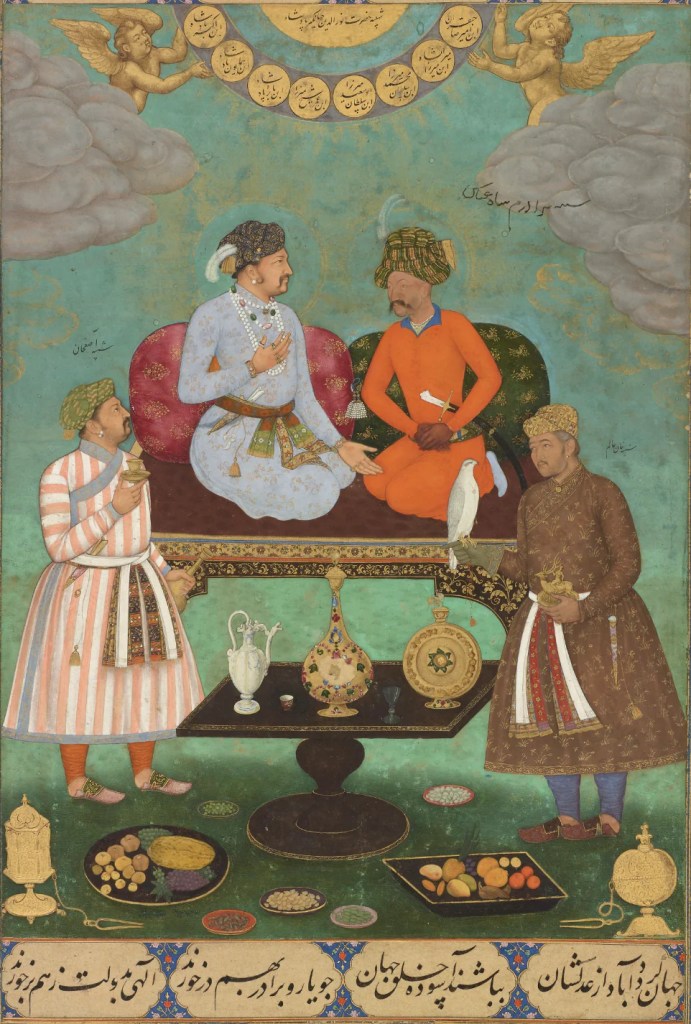
Attributed to Bishandas, Jahangir Entertains Shah Abbas, from the St. Petersburg Album, ca. 1618 (Washington DC, Freer Gallery of Art).
On March 2–3, 2026, the French Academy in Rome – Villa Medici will host an international symposium dedicated to diplomatic gifts in the modern and contemporary periods, examined in terms of their definitions, transformations, and processes of heritage-making on a global scale. These ‘ambassador objects’ will be studied in their material, political, and symbolic dimensions, as well as in their role in shaping international relations and ritualizing exchanges. Adopting polycentric perspectives, the conference encourages cross-views and bilateral or multilateral analysis of the sources.
Organizing Committee
• Alessandro Gallicchio, Director of the Department of Art History, Académie de France à Rome – Villa Médicis
• Valentina Hristova, senior lecturer in History of Modern Art, Université de Picardie Jules Verne, Amiens
• Natacha Pernac, senior lecturer in History of Modern Art, Université Paris-Nanterre
Scientific Committee
• Lucien Bély, professor emeritus of modern history, Paris, Sorbonne University, member of the Institut, Académie des sciences morales et politiques
• Francesco Freddolini, Associate professor of modern art history, Rome, Sapienza – University of Rome
• Serge Gruzinski, Director Emeritus of Historical Research, Paris, CNRS / EHESS
• Guido Guerzoni, historian and economist, Milan, Luigi Bocconi University
• Mei Mei Rado, assistant professor of Textile and Dress History, New York, Bard Graduate Center
m o n d a y , 2 m a r c h
9:00 Accueil
9.30 Ouverture — Sam Stourdzé et Alessandro Gallicchio (Académie de France à Rome – Villa Médicis)
Introduction — Valentina Hristova (Université de Picardie Jules-Verne, Amiens) et Natacha Pernac (Université Paris-Nanterre)
10.00 Les Définitions en Question
Présidence de session: Valentina Hristova
• Sur les dons (réels ou imaginaires) d’Uzun Hasan à l’État vénitien — Matthew Gillman (Columbia University, NY)
• Une collection des tranchées: Les œuvres découvertes par l’Armée française d’Orient au Louvre. Don diplomatique
ou butin de guerre? — Violette Gautier (Université de Picardie Jules-Verne, Amiens)
• Between Transnational Production and Cultural Diplomacy: Making and Managing Chinese Gardens Overseas — Zeming Taro Cai (University of Toronto)
11.30 Pause café
11.45 Récits Croisés, Sources et Représentations en Regard
Présidence de session: Francesco Freddolini
• Les cadeaux diplomatiques entre Empire ottoman et souverains occidentaux au XVIe siècle. Peut-on parler de réciprocité? — Frédéric Hitzel (EHESS, CETOBaC, Paris)
• The Geography of Diplomatic Gifts: Gift Giving and the Diverse Gift Profiles of State Ambassadors in 18th-Century Ottoman Diplomatic Ceremonial — Hümeyra Şahin Oktay (İstanbul Üniversitesi / Tobb Üniversitesi, Ankara)
12.40 Pause déjeuner
14.15 Les Vies de l’Objet: Fabrication, Reception, Display
Présidence de session: Guido Guerzoni
• « Que lui avions-nous apporté ? » : Les déboires des cadeaux diplomatiques du Portugal au souverain éthiopien Lebna Dengel, 1515–20 — Alain Mathilde (Université de Grenoble Alpes)
• Versailles et le monde: Les présents de Louis XV, 1715–74 — Marie-Laure Buku Pongo (Frick Collection, NY)
• Crafting Diplomacy: Extraordinary Embassies’ Visits to the Gobelins Manufacture and the Garde-Meuble de la Couronne, 1662–1789 — Barbara Lasic (Sotheby’s Institute of Art, Londres)
15.45 Pause café
16.00 Les Vies de l’Objet: Patrimonialisation
Présidence de session: Natacha Pernac
• Représentation et patrimonialisation des visites et dons diplomatiques en un haut lieu militaire, de l’Hôtel des Invalides au musée de l’Armée, 1675–2025 — Sylvie Le Ray-Burimi (Musée de l’Armée, Paris)
• The Qing Empire’s Gift to the Permanent Court of Arbitration: Transforming the Logic of Gift-Giving in Late Qing Diplomacy, 1907–11 — Yuxuan Zhou (Université de Genève)
• Le musée Senghor, une vitrine de la diplomatie culturelle du Sénégal, 1960–80 — Mohamadou M. Dieye (Musée d’art africain Théodore Monod, École doctorale ETHOS, Dakar)
17.30 Pause café
17.45 Special Lecture
• French Diplomatic Gifts in the Shaping of Qing Imperial Arts during the Long 18th Century — Mei Mei Rado (Bard Graduate Center, NY)
t u e s d a y , 3 m a r c h
9.00 Accueil
9.30 Stratégies et Politique des Dons Diplomatiques (Temps Long / Sérialité)
Présidence de session: Lucien Bély
• Entre jeux d’échelles et variété des typologies: Les cadeaux diplomatiques des Médicis et des Este au second Cinquecento — André Rocco (Université de Liège)
• Les dons cycliques de « pietra dura » entre l’Inde et l’Italie, 1620–2020: Entre charge historique et enjeux de supériorité — Lola Cindric (EHESS, Paris)
• Giulio Rospigliosi and Pascual de Aragón: The Role of Gifts in Relations between Madrid and Rome and Their American Projection — Carrio Invernizzi Diana (UNED, Madrid)
• Dono Dedimus Sacrum Corpus Christi Martyris, Corpisanti as Diplomatic Gifts from the Holy See to Mexico, 1833–60 — Montserrat A. Báez Hernández (Università di Teramo, KU Leuven)
11:45 Pause café
12:00 Special Lecture
• Du Japon à Madrid via México: Mondialisation, chocs des cultures et dons diplomatiques au sein de la Monarchie catholique, 1580–1640 — Serge Gruzinski (CNRS, EHESS, Paris)
12.45 Pause déjeuner
CAA 2026, Chicago

HECAA events at this year’s CAA conference, with a full listing of panels available here. And please feel free to add additional talks and sessions in the comments section below. –CH
114th Annual Conference of the College Art Association
Hilton Chicago, 18–21 February 2026
t h u r s d a y , 1 9 f e b r u a r y
9:00–10:30am | Hilton Chicago—3rd Floor—Marquette Room
Hybridity, Adaptability, and Exchange during the Long Eighteenth Century: Producing Global Aesthetics in Decorative Art and Design (HECAA session)
Chaired by Zifeng Zhao and Alisha Ma
• From Senegal to Parisian Salons: The Shiny Invisibility of Gum Arabic — Carole Nataf (Courtauld Institute)
• Versailles in Beijing: French ‘Cabinet du Roi’ Prints in Late Seventeenth-Century Qing Court and Society — Niko Ruijia Ma (KU Leuven)
• Sugarcoating Colonial Violence: Material Culture and Courtly Displays of Sugar in Ancien Régime France, 1670–1730 — Loïc Derrien (Cooper Hewitt, Smithsonian Design Museum)
• Global Encounters: Imported Chintz in Early Modern Japan — Vidhita Raina (Colorado State University)
f r i d a y , 2 0 f e b r u a r y
Join HECAA members for lunch on Friday! Catch up with other HECAA members over a buy-your-own lunch at a nearby restaurant. The group will meet at the lobby of the Hilton Chicago between 12:45 and 1:00. Please be in touch with Sarah Lund (hecaa.emergingscholarsrep@gmail.com) so we can know how many people to expect.
s a t u r d a y , 2 1 f e b r u a r y
2:30–4:00pm | Hilton Chicago—3rd Floor—Waldorf Room
Bad Government: Art and Politics in the Eighteenth Century (ASECS session)
Chaired by Amy Freund
• Liberty and Death — David Ehrenpreis (James Madison University)
• Risky Business: Female Artists and High-Stakes Print during the French Revolution — Sarah Lund (Harvard University)
• Sketching Fragile Authority: Pierre Eugène du Simitière and Revolutionary Visual Culture — Megan Baker (University of Delaware)
• The Art of Revolutionary Colonialism: Drawing and the Orientalist Guillotine in French-Occupied Egypt — Thadeus Dowad (Northwestern University)
◊ ◊ ◊ ◊ ◊
Note (added 10 February 2026) — There are plenty of other talks and panels worth noting (and please feel free to add them below!), but I especially want to highlight this session sponsored by the Historians of British Art. –CH
Thursday, 19 February, 9:00–10:30am | Hilton Chicago—8th Floor— Lake Erie
Let’s Get Metaphysical: Rethinking the Empiricism of British Art (HBA session)
Chaired by Douglas Fordham
• C. Oliver O’Donnell (University of California, Berkeley) — Contingently Enigmatic Pictures and the Metaphysics of British Empiricism
• Meredith J. Gamer (Columbia University) — Taken from Life: Hunter, Rymsdyck, and the Anatomical Portrait
• Susie Beckham (Yale Center for British Art) — Illusion of Truth: The Im/materiality of Cayley Robinson’s The Close of the Day (1896)
• Clarissa Pereira de Almeida (USP Universidade de São Paulo) — Metaphysical Metaforms: Roy Ascott’s Love–Code–Cloud–Change
◊ ◊ ◊ ◊ ◊
Note (added 15 February 2026) — The original posting included a mistake the HECAA email address, I’m sorry about that, and it’s now been corrected above. –CH
Symposium | El Prado en femenino III: Queen Isabel de Farnesio
Next month from The Prado, with some simultaneous translation planned:
Key Women in the Creation of the Collections of the
Museo del Prado III: Isabel de Farnesio
Online and in-person, Museo Nacional del Prado, Madrid, 9–10 March 2026
Organized by Noelia García Pérez
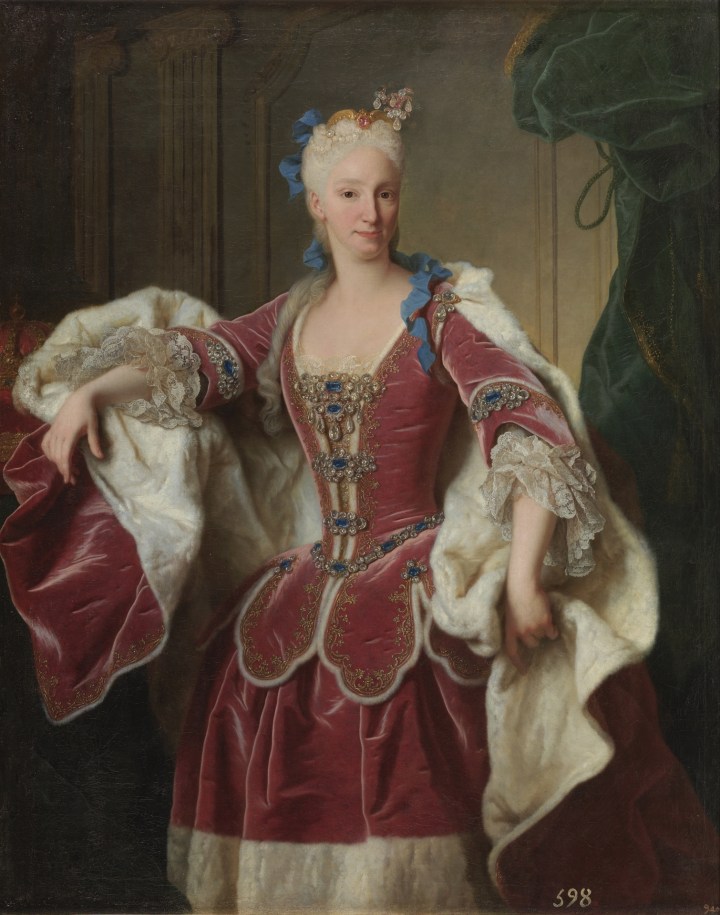
Jean Ranc, Isabel de Farnesio, 1723, oil on canvas, 144 × 115 cm (Madrid: Museo Nacional del Prado).
It was probably Queen Isabel de Farnesio (1692–1766), patron of the arts, who most decisively contributed to giving shape to the Museo del Prado’s collections. This third edition of the series Protagonistas femeninas en la formación de las colecciones del Museo del Prado invites us to reconsider the significance of her patronage and her pivotal contribution to the artistic collection that the Museum now preserves. As in previous editions, this scientific meeting was designed with the intention of recovering, studying, and disseminating the cultural agency of the women of Europe’s royal houses, whose collections and artistic decisions have left a profound imprint on the identity of the Museum.
Throughout the sessions, a group of notable national and international specialists will examine the political, cultural, and dynastic context in which Elisabeth Farnese advanced her patronage; the mechanisms through which she built her public image as queen consort in the exercise of her power; the complex network of mediators that made the realization of her collections possible; and her extraordinary relevance in the fields both of painting and classical sculpture. From an initial analysis of the interests of other queenly European patrons—for instance, Maria Theresa of Austria, Catherine II, and Sophia Charlotte of Mecklenburg-Strelitz—to a specific consideration of Isabel de Farnesio’s own collecting activities, this symposium invites reflection on female artistic agency in the Modern Age and its impact on the circulation of works, the promotion of artists, and the consolidation of new narratives of power.
As complementary activities, the meeting will include the screening of a documentary dedicated to Isabel de Farnesio and a visit to the exhibition El Prado en femenino III. The exhibition explores the legacy this queen passed on, underscoring how her work in the field of artistic promotion definitively contributed to enriching the Museum’s collection. With this initiative, the Museo del Prado consolidates an essential line of work that explores the actions of these queens who made possible an essential part of the legacy that we are fortunate to continue to admire today.
m o n d a y , 9 m a r c h
9.30 Registration
10.00 Introductions
• Alfonso Palacio (Museo del Prado)
• Cristina Hernández Martín (Women’s Institute)
• Noelia García Pérez (University of Murcia)
10.30 Empress Maria Theresa and the Politics of Habsburg Imperial Art — Michael Yonan (University of California)
11.15 Power and Paint: The Patronage of Women Artists at the Court of Catherine II — Rosalind Polly Blakesley (University of Cambridge)
12.30 Sophia Charlotte of Mecklenburg-Strelitz: How a Queen Promoted Both Art and Female Artists in English Society — Heidi A. Strobel (University of North Texas)
16.00 Round table | Isabel de Farnesio: A Queen Consort in the Exercise of Power
Moderator: Carlos González Navarro (Museo del Prado)
• María de los Ángeles Semper (University of Barcelona)
• Giulio Sodano (Università della Campania Luigi Vanvitelli)
• Pablo Gestal (Sorbonne Université, Centre Roland Mousnier)
17.00 Round table | The Patronage of Isabel de Farnesio: State of the Art
Moderator: Ana González Mozo (Museo del Prado)
• Ángel Aterido (Complutense University of Madrid)
• Antonio Iommelli (Farnese Palace Museums)
t u e s d a y , 1 0 m a r c h
10.00 Isabel de Farnesio en las colecciones del Museo del Prado — Noelia García Pérez (University of Murcia)
10.45 Round table | The Construct of the Image of the Queen: From Molinaretto to Van Loo
Moderator: Noelia García Pérez
• Sandra Antúnez (Complutense University of Madrid)
• Andrés Úbeda (Museo del Prado)
• Mercedes Simal (University of Jaén)
12.00 Round table | From Christina of Sweden to Isabel de Farnesio: Collections of Classical Sculpture
Moderator: Ana Martín (Museo del Prado)
• Manuel Arias (Museo del Prado)
• Juan Ramón Sánchez del Peral (Museo del Prado)
• Mercedes Simal (University of Jaén)
16.00 El boceto de Santa Ana enseñando a leer a la Virgen: La sustracción y retorno del boceto de Murillo del Museo del Prado — Benito Navarrete (Complutense University of Madrid)
16.45 Screening of the documentary
17.15 Viewing of the exhibition The Female Perspective III
Symposium | Women at Work
From AWARE (Archives of Women Artists, Research, and Exhibitions):
Women at Work: Collections in Museums of
Historical Art through the Lens of Gender
École du Louvre, Amphithéâtre Michel-Ange, Paris, 16–17 February 2026

Sandra Gamarra, Milagros, ca. 2008 (Courtesy of the artist).
In 2014, the Musée du Louvre held a lecture series, entitled Women Artists at the Museum? Current Perspectives. Building on this line of thought, the present symposium moves beyond acknowledging the under-representation of women artists in permanent collections: through a combination of theoretical approaches and real-world case studies, this symposium aims to explore the epistemological shift that must occur for women artists to take their rightful place in museum collections.
Museums play a key role in society as spaces of knowledge and, by extension, of power. By rendering objects visible and inscribing them within cultural narratives, museums contribute to creating dominant frameworks and, through them, collective imaginaries. Scholarship in art history, museology and, in particular, gender studies, challenges the existing hierarchies among artists, artworks and techniques, and critically examines the conditions under which artists trained and worked. This feminist approach, which also draws on postcolonial theory, is driving change in museum practices. By focusing on the permanent collections of historical art, an area still less studied from this angle than temporary exhibitions and modern or contemporary collections, this symposium will explore museum initiatives that generate new ways of seeing and understanding. Many historical art museums have launched research programmes, experimented with innovative display strategies, and developed new narratives and modes of transmission.
Such work challenges evaluation criteria grounded in the established canon and pushes back on the enduring myths and misconceptions that continue to shape art history. This naturally gives rise to pressing questions: Can gender studies play a role in fundamentally reconfiguring museums? Does a radical approach necessarily lose its force when articulated within an institutional setting? What initiatives of this kind, both past and present, have already been carried out, and with what outcomes?
Organised jointly by the non-profit organisation AWARE (Archives of Women Artists, Research and Exhibitions) and the Musée du Louvre Museum Studies and Research Support Department, this international symposium (Elles sont à l’œuvre: Les collections des musées d’art ancien au prisme du genre) will bring together curators, academics, and artists working at the intersection of art history, museology, and gender studies, to harness the transformative potential that this interdisciplinary space holds for building the museums of tomorrow.
m o n d a y , 1 6 f e b r u a r y 2 0 2 6
9.30 Welcome by Françoise Mardrus, Musée du Louvre, and Camille Morineau, AWARE, MNAM-Centre Pompidou
9.45 Introduction by Griselda Pollock, Feminist Art Historian, Professor Emerita, University of Leeds
10.30 Session 1 | Mapping Presence: Revisiting Permanent Collections
Moderator: Chương-Đài VÕ, Curator, Writer, Editor and Professor, ENSAPC
• Annabelle Ténèze, Director, Louvre-Lens Museum
• Ilaria Miarelli Mariani, Director, Museum of Rome and the Municipal Museums of the City of Rome, and Ilaria Arcangeli, Researcher
• Fabienne Dumont, Art Historian, Art Critic and Professor at Jean-Monnet-Saint-Etienne University
• Gloria Cortes, Heritage Curator at the Fine Arts Museum of Chile, in Spanish with consecutive translation into English
13.15 Lunch break
14.30 Session 2 | Beyond the Fine Arts: Hierarchies of Genre and Gender
Moderator: Stéphanie Deschamps-Tan, Heritage Curator, Musée du Louvre
• Andaleeb Badie Banta, Andrew W. Mellon Senior Curator of Prints and Drawings, National Gallery of Art, Washington DC
• Manon Lacaplain, Director and Heritage Curator, and Camille Belvèze, Heritage Curator, Musée Sainte-Croix, Poitiers
• Liliane Cuesta Davignon, Heritage Curator, González Martí National Museum of Ceramics and Decorative Arts
• Iris Moon, Associate Curator, European Sculpture and Decorative Arts, Metropolitan Museum of Art
17.15 End of the first day
t u e s d a y , 1 7 f e b r u a r y 2 0 2 6
9.30 Welcome by Carolina Hernández Muñoz, International networks project manager and coordinator, AWARE, and Matylda Taszycka, Head of Research Programmes, AWARE, MNAM-Centre Pompidou
9.45 Session 3 | Collections as Polysemous Spaces: Narrating Multiple Histories
Moderator: Clovis Maillet, Performance Artist and Medieval Historian
• Isabella Rjeille, Curator, Museu de Arte de São Paulo Assis Chateaubriand
• Stephanie Sparling Williams, Andrew W. Mellon Curator of American Art at the Brooklyn Museum
• Sandra Gamarra Heshiki, artist
• Pawel Leszkowicz, Art Historian and Professor of Contemporary Art and Curatorial Studies, Academy of Art, Szczecin
• Zorian Clayton, Curator of Prints, Victoria & Albert Museum
13.00 Lunch break
14.30 Session 4 | Networks and Transmission: Working Collectively
Moderator: Julie Botte, Musée du Louvre
• Charlotte Foucher Zarmanian, Art Historian and Research Director, CNRS (National Centre for Scientific Research)
• Laurien van der Werff and Magdalena Roosje Anker, Heritage Curators and Co-Chairs of ‘Women of the Rijksmuseum’, Rijksmuseum, Amsterdam
• Noelia Perez Garcia, Research Director of El Prado en femenino, Prado Museum and Professor of Art History, University of Murcia, and Carlos González Navarro, Heritage Curator of 19th-Century Painting, Prado Museum
• Susanna Avery Quash, Senior Research Lead and Head of ‘Women in the Arts Forum’, National Gallery, London
17.15 Conclusion by Anne Lafont, Art Historian and Research Director at EHESS (School of Advanced Studies in the Social Sciences)
Conference | Kunst um 1800
In connection with the exhibition Art around 1800: An Exhibition about Exhibitions in Hamburg, as noted at ArtHist.net:
Kunst um 1800
Hamburger Kunsthalle, 29–30 January 2026
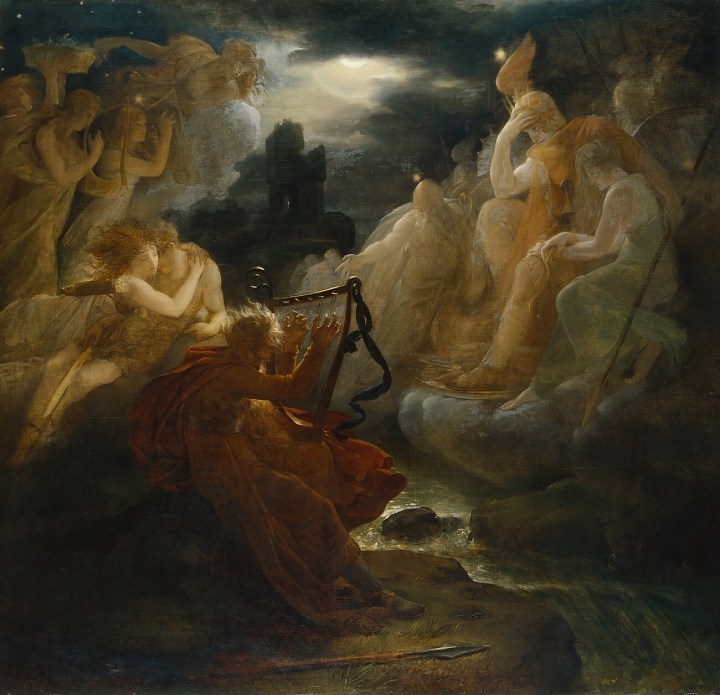
François Gérard, Ossian am Ufer der Lora beschwört die Geister beim Klang der Harfeum, 1810, oil on canvas, 211 × 221 cm (Hamburger Kunsthalle; photo by Elke Walford).
Der Workshop findet im Rahmen der Ausstellung Kunst um 1800. Eine Ausstellung über Ausstellungen statt, die den gleichnamigen Zyklus der Hamburger Kunsthalle in den Mittelpunkt stellt: Von 1974 bis 1981 widmete sich die legendäre Ausstellungsreihe in neun Teilen der Wirkmacht von Kunstwerken im „Zeitalter der Revolutionen“ und prägte Debatten über die gesellschaftliche Relevanz von Kunst, die bis heute nachwirken. Die Ausstellungen revidierten Narrative der europäischen Kunstgeschichte, indem sie Themen und Künstler ins Zentrum stellten, die mit den Konventionen ihrer Zeit brachen: Ossian, Caspar David Friedrich, Johann Heinrich Füssli, William Blake, Johan Tobias Sergel, William Turner, Philipp Otto Runge, John Flaxman und Francisco Goya. Die gegenwärtige Ausstellung Kunst um 1800 kommentiert und aktualisiert aus einer heutigen Perspektive die historischen Ordnungen und Präsentationen der Dinge, die unter der Regie des damaligen Direktors Werner Hofmann entstanden. Dazu werden über 50 Gemälde, Bücher und graphische Arbeiten der Sammlung der Kunsthalle aus der Zeit um 1800 in ein Zusammenspiel mit über 70 ausgewählten Leihgaben und Werken zeitgenössischer Künstler:innen gebracht. Das komplexe Gefüge im Kuppelsaal versteht sich als eine kritische Edition der Ausstellungen der 1970er Jahren und unternimmt zugleich einen Remix der künstlerischen Formen und Formate um 1800.
Bis zum 29. März 2026 entfaltet Kunst um 1800 in zehn Stationen mit damals gezeigten Werken ein Panorama der Epoche und widmet sich Themen wie Aufklärung, Gewalt, Träumen, politischer Landschaft, Industrialisierung sowie Revolution und Freiheit – stets aus heutiger Perspektive. Diesen Fragen geht auch der interdisziplinäre Workshop nach. In dieser Veranstaltung setzen sich Künstler- und Wissenschaftler:innen mit dem historischen Zyklus, der Musik um 1800, forschendem Kuratieren und historischen Leerstellen auseinander. So werden punktuell Aspekte betont, die im Zyklus der 1970er Jahre fehlten oder nur ansatzweise zum Vorschein kamen, jedoch für die Zeit um 1800 relevant sind: Der Kampf um Frauenrechte, die jüdische Aufklärung, Kolonialismus, Sklaverei, Abolitionismus und die Haitianische Revolution.
Eine Veranstaltung von Petra Lange-Berndt, Kunstgeschichtliches Seminar der Universität Hamburg, und Dietmar Rübel, Akademie der Bildenden Künste München, in Zusammenarbeit mit und der Hochschule für Musik und Theater sowie der Hamburger Kunsthalle. Der Eintritt zum Liederabend und zur Tagung ist frei.
Mit freundlicher Unterstützung der Hamburgischen Wissenschaftlichen Stiftung, der Franz Wirth-Gedächtnis-Stiftung und der Liebelt-Stiftung, Hamburg.
d o n n e r s t a g
19.00 Begrüßung — Alexander Klar (Direktor der Hamburger Kunsthalle)
Ossian und die Musik um 1800
Lieder u. a. von Franz Schubert, Joseph Haydn und Nan-Chang Chien nach Texten von u. a. James Macpherson, Matthäus von Collin, Anne Hunter, Johann Wolfgang Goethe, Friedrich Gottlieb Klopstock und Ludwig Rellstab; Konzept: Burkhard Kehring (Hochschule für Musik und Theater Hamburg)
Einführung — Ivana Rentsch (Institut für Historische Musikwissenschaft, Universität Hamburg)
Musikerinnen, Studierende der Hochschule für Musik und Theater: Anna Bottlinger (Sopran), Yi-Wen Chen (Klavier), Chen-Han Lin (Countertenor), Rita Rolo Morais (Sopran), João Sousa (Klavier)
f r e i t a g
10.15 Begrüßung — Petra Lange-Berndt (Kunstgeschichtliches Seminar, Universität Hamburg) & Dietmar Rübel (Akademie der Bildenden Künste München)
10.30 Hans Hönes (History of Art, University of Aberdeen) — Blick auf die Insel: Deutsch-britische Dialoge
11.15 Elisabeth Ansel (Institut für Kunstwissenschaften, Friedrich-Schiller-Universität Jena) — „Gälische Überreste“: Ossian, Kolonialismus und die Schattenseiten der Romantik
12.00 Marten Schech (Künstler, Berlin) — Eine Innenwelt der Außenwelt der Innenwelt. Die An-, Ein- und Umbauten für die Ausstellung Kunst um 1800
12.45 Mittagspause
14.00 Lucas Stübbe (Kunstgeschichtliches Seminar, Universität Hamburg) — Körper, Kolonialismus und Kunst um 1800. Eine kritische Impulsführung
14.45 Uta Lohmann (Institut für Judaistik, Universität Hamburg) — Moses Samuel Lowe und Benedict Heinrich Bendix. Zwei jüdische Künstler um 1800
15.30 Kaffeepause
16.00 Lea Kuhn (Zentralinstitut für Kunstgeschichte München) — Marie-Gabrielle Capet: Kunst der Konstellation
17.00 Ende der Tagung
Conference | Reflections at Work
From ArtHist.net:
Reflections at Work / Le reflet à l’oeuvre
Institut national d’histoire de l’art (INHA), Paris, 22–23 January 2026
Organized by Anne Pillonnet, Marie Thébaut-Sorger, and Romain Thomas
How do reflections (both physical and depicted) and lighting influence our perception of artworks and their presentation? Art historians, physicists, digital specialists and experts in perceptual phenomena will gather to discuss this question at the international conference ‘Reflections at Work’. Jointly organised by the teams of AORUM project (Analyse de l’Or et de ses Usages comme Matériau pictural, XVIe–XVIIe siècles) and FabLight project (La fabrique de l’éclairage dans les arts visuels au temps des Lumières, 1760–1820), this event is part of an interdisciplinary research initiative that aims to promote a collective exploration of reflections, light, and their role in past and present aesthetic experience.
t h u r s d a y , 2 2 j a n u a r y
9.00 Accueil des participants
9.10 Mot de bienvenue — Anne-Solène Rolland (INHA)
9.15 Introduction — Anne Pillonnet (Institut Lumière Matière, université Lyon 1), Marie Thébaud-Sorger (Centre Alexandre-Koyré CAK-CNRS, Paris) et Romain Thomas (INHA)
9.40 Session 1 | Reflection of Matter, Matter of Reflection
Présidence: Christophe Renaud (Laboratoire d’Informatique Signal et Image LISIC, université du Littoral Côte d’Opale) et Romain Thomas (INHA)
• ‘Alle de verwen van een regenboog vertoonend’ (« Montrant toutes les couleurs d’un arc-en-ciel ») : peindre l’iridescence de la nacre dans la nature morte néerlandaise du XVIIe siècle — Clara Langer (Laboratoire de Recherche Historique Rhône-Alpes LARHRA, université Lyon 2 /université de Constance)
• Reflets de matière, ce qu’ils révèlent — Anne Pillonnet (Institut Lumière Matière, université Lyon 1)
• La perception visuelle du brillant et des reflets — Pascal Mamassian (Laboratoire des Systèmes Percerptifs LSP, École normale supérieure PSL)
• Rendu des surfaces brillantes : entre réalisme physique et réalisme perceptuel — Samuel Delepoulle (Laboratoire d’Informatique Signal et Image LISIC, Université du Littoral Côte d’Opale)
• Peindre la lumière : les femmes, le portrait et la luminosité matérielle dans la Gênes du début de l’époque moderne / Painting Light: Women, Portraiture, and Material Luminosity in Early Modern Genoa — Ana Howie (Département d’histoire de l’art et d’études visuelles, université Cornell, Ithaca) (Intervention en anglais)
12.45 Pause déjeuner
14.00 Session 2 | Reflection on the Artwork: The Lighting Atmosphere
Présidence: Christine Andraud (Centre de Recherche sur la Conservation CRC, Muséum national d’Histoire naturelle) et Ralph Dekoninck (Faculté de philosophie, arts et lettres, université catholique de Louvain)
• Du bruit à l’extase, en quête de contemplation — Viviana Gobbato (Département Culture et Education Arc de Triomphe – CMN / Centre d’Histoire Culturelle des Sociétés Contemporaines CHCSC, université Paris-Saclay)
• L’art aux mains de la fée Électricité. Visiter le Salon la nuit (1879–1880) — Agathe Ménétrier (INHA)
• Capter le reflet, sonder la matière : dispositifs d’imagerie pour l’œuvre d’art et le corps humain — Mathieu Hébert (Institut d’Optique, université Jean Monnet Saint-Étienne)
• La lumière du jour comme source lisible pour les contextes spatiaux et visuels de la fin du Moyen Âge : la nef de la cathédrale Notre-Dame de Freiberg (Saxe) / Daylight as a readable Source for Late Medieval Spatial and Visual Contexts: The Hall Nave of St. Mary’s Cathedral, Freiberg (Saxony) (Intervention en anglais) — Lia Bertram (École des Beaux-Arts, Dresde)
• Le calcul des reflets — Christophe Renaud (Laboratoire d’Informatique Signal et Image LISIC, université du Littoral Côte d’Opale)
17.00 Conclusion de la journée
f r i d a y , 2 3 j a n u a r y
9.00 Accueil des participants
9.20 Session 3 | Reflection in the Artwork: Symbol and ‘Off-screen’
Présidence: Martial Guédron (Laboratoire Arts, civilisation et histoire de l’europe ARCHE, université de Strasbourg) et Marie Thébaud-Sorger (Centre Alexandre-Koyré CAK-CNRS, Paris)
• Au miroir de l’armure — Diane Bodart (Département d’histoire de l’art et d’archéologie, université Columbia, New York)
• Quelques dispositifs réflexifs chez Philippe de Champaigne à Port-Royal de Paris : retour sur « une hypothèse saugrenue » de Louis Marin — Frédéric Cousinié (Groupement de Recherche en Histoire GRHis, université de Rouen-Normandie)
• Usages du reflet chez Clara Peeters, Pieter Janssens Elinga et Jean Siméon Chardin — Matthieu Somon (Institut de recherche Religions, Spiritualités, Cultures, Sociétés RSCS, université catholique de Louvain)
• Réfléchir les reflets dans l’emblématique du XVIIe siècle — Ralph Dekoninck (Faculté de philosophie, arts et lettres, université catholique de Louvain)
• « Une journée au XVIIIe siècle. Chronique d’un hôtel particulier » : Lumière sur une exposition — Ariane James-Sarrazin (Musée des Arts décoratifs)
11.55 Discussion
Conference | Archives Unbound
From ArtHist.net and KHI:
Archives Unbound: Time and Memory in Romantic Visual Culture
Palazzo Grifoni Budini Gattai, Florence, 2–3 February 2026

The Sarcophagus of Seti I at Sir John Soane’s Museum, engraved by Mason Jackson (Illustrated London News, 1864).
In the Romantic period, the archive was more than a repository of the past: it was a living site of imagination, reconstruction, and desire. Today, archives are again central to debates on memory, preservation, and the recovery of histories. In an age of information overload, media excess, and destabilising fake news, the archive has become a hotly contested field: as verifiable record (resisting distortion) and as partial repository (erasing as much as it preserves). Archives Unbound: Time and Memory in Romantic Visual Culture seizes this moment to discuss Romanticism in dialogue with European and global perspectives, asking how art historians can engage the past with rigour, ethical awareness, and creative scope.
The workshop is a collaboration between the University of Jena’s research group European Romanticism or Romanticisms in Europe?, the University of York’s Department of History of Art, and the Kunsthistorisches Institut in Florenz (KHI). Set against the backdrop of Florence—itself a city-as-archive—the event will examine the archive as both repository and dynamic system of knowledge, memory and power. The workshop coincides with The City as Archive, a major KHI exhibition juxtaposing historical photographs with contemporary works by Armin Linke.
Organisers
Elisabeth Ansel, Hannah Baader, Christin Bates, Costanza Caraffa, Johannes Grave, and Richard Johns
Organising Institutions
University of Jena, University of York, and the Kunsthistorisches Institut in Florenz – Max-Planck-Institut
m o n d a y , 2 f e b r u a r y
9.30 Introduction, Elisabeth Ansel and Christin Bates
10.00 Exhibition | The City as Archive
• Hannah Baader and Costanza Caraffa (exhibition curators)
13.30 Lunch Break
14.30 Session 1
• Michael Smith (York), John Flaxman’s Roman Archive
• Gemma Shearwood (York), Westminster Abbey and St Paul’s Cathedral as Archives of National and Imperial Memory
16:00 Tea Break
16.30 Session 2
• Mira Claire Zadrozny (Jena), The Archival City in Distress: Time and Memory in Images of Paris’ Ephemeral Ruins
• John Norrman (Jena), The Image of the Barricade: Illustrated Periodicals as Archives of a Social Practice of Imagining Crisis, 1848
t u e s d a y , 3 f e b r u a r y
9.30 Greeting
9.45 Session 3
• Andrin Albrecht (Jena), Ludic Romanticism, or, the Five-Color Archive of Magic: The Gathering
• Kohta Nakajima (York), Metaphor as Fragment: Visualising Shakespeare in William Blake’s ‘Pity’ within Eighteenth-Century Reading Culture
11.15 Tea Break
11.45 Session 4
• Selina Kusche (Jena), Stories of a Single Figure? How Understanding History Paintings Requires a Mental Archive
• Jacob Bolda (York), Archives of Intimacy: The Portrait Miniature and the Romantic Subject
13.15 Lunch Break
14.15 Session 5
• Elisabeth Ansel (Jena), Fragmented Archives: The Manifold Aesthetics of Memory, Time, and Ecology in Ossianic Landscapes
• Christin Bates (Jena), Memories in Stone: Ruskinian Ecologies and Images as Climate Archives
• Kate Nankervis (York), ‘The Air Itself Is One Vast Library’: Atmosphere as Archive in British Romanticism
17.00 Final Discussion
Symposium | New Discoveries in Furniture and Historic Interiors
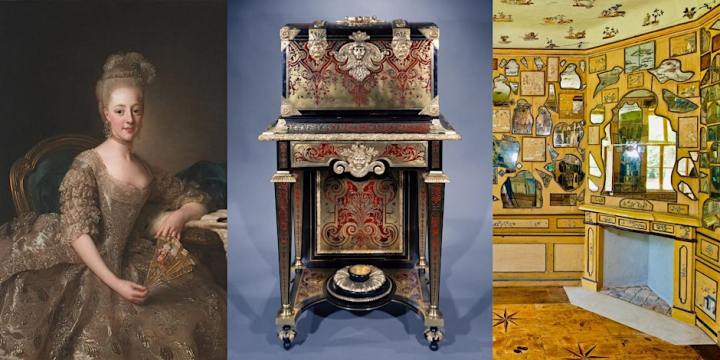
Left: Alexander Roslin, Portrait of Hedvig Elisabet Charlotta, Princess of Sweden, detail, 1775 (Nationalmuseum, Sweden). Center: André-Charles Boulle, Coffer-on-stand (Chatsworth House Trust). Right: Mirror shard cabinet, Apartment of Margravine Wilhelmine of Bayreuth, ca. 1750 (Old Palace of the Hermitage in Bayreuth; photo by Achim Bunz).
◊ ◊ ◊ ◊ ◊
From the reservation page at Eventbrite:
New Discoveries in Furniture and Historic Interiors
University of Buckingham, London Campus, 23 January 2026
Registration due by 19 January 2026
The Furniture History Society invites you to its eighth Early Career Research Symposium, to be held at the University of Buckingham’s London campus, 51 Gower Street, from 9.30am to 5pm on Friday, 23 January. Part of the Society’s Early Career Group (ECG) programme, the symposium features current research by emerging scholars in furniture history, the decorative arts, and historic interiors. The programme reflects the wide range of interests among early-career researchers, with speakers from Britain, Sweden, France, Italy, Germany, and the United States. The event is free to attend, but advance registration via Eventbrite is required by midnight (GMT) on Monday, 19 January. The limited number of places are allocated on a first-come, first-served basis. The symposium will be recorded and made available for one month to registered participants. Any enquiries about this event or the Early Career programme should be directed to grants@furniturehistorysociety.org.
The day is made possible thanks to the generous support of the University of Buckingham, the Della Howard Fund, and the Oliver Ford Trust.
p r e s e n t a t i o n s
• Mary Algood (V&A/RCD History of Design Programme, UK) — Makers of Funeral Furniture in 17th-Century England
• Tristan Fourmy (Institut National du Patrimoine, France) — Hercules in the Decorative Arts in 18th-Century France
• Laini Farrare (University of Delaware, USA) — Atlantic Mahogany: Enslavement, Labor, and the Early American Windsor Chair
• Francesco Montuori (European University Institute, Italy) — Beyond Chinoiserie: The Gabinetto di Porcellana and its Floor
• Anne Weiss (University of Cologne, Germany) — Status and Space: Dynastic References in the Furnishings of Wilhelmine von Bayreuth’s Apartments in the New Palace and Old Palace of the Hermitage in Bayreuth, 1735–1758
• Karolina Laszczukowska (University of Uppsala, Sweden) — The Material Hierarchies in the Furnishings and Interiors of the Private Apartments of Princess Sofia Magdalena and Duchess Hedvig Elisabet Charlotta at Stockholm Palace in 1766 and 1774
• Katherine Hardwick (Chatsworth House, UK) — Garrets Full of the Commodity? Collecting Boulle at Chatsworth
• Paul Giraud (Institut National du Patrimoine, France) — Collecting Italian 18th-Century Furniture at the Belle Epoque: The Origins of Interior Design
• Justine Lecuyer (Sorbonne, France) — Crafting Comfort: Upholstery and Textile Aesthetics in 19th-Century Interiors
• Eleonora Drago (Civic Museums of Treviso, Italy) — Paul Albert Bernard and the Decoration of the French Room at the Biennale in 1905: An Homage to Venice and France from a Decorative Skylight
Study Day | Relevance and Reception of Anton Raphael Mengs
From ArtHist.net and Zentralinstitut für Kunstgeschichte:
Die ‘allgemeine Erwartung besserer künstlerischer Zustände’:
Relevanz und Rezeption von Anton Raphael Mengs
Online and in-person, Zentralinstitut für Kunstgeschichte, Munich, 28 January 2026
Organized by Steffi Roettgen and Ulrich Pfisterer

Anton Raphael Mengs, Self-Portrait, 1773, oil on panel 28 × 22 inches (Munich: Bayerische Staatsgemäldesammlungen, Neue Pinakothek).
Dem steilen Aufstieg von Anton Raphael Mengs (1728–1779) zu einem der, wenn nicht dem berühmtesten Maler Europas ab der Mitte des 18. Jahrhunderts entsprach der nicht minder steile Absturz in der allgemeinen Wertschätzung bereits wenige Jahre nach seinem Tod. Das Kolloquium untersucht die Faktoren, die sowohl die Relevanz als auch die wechselhafte Rezeption von Mengs zu verstehen helfen. Für eine differenzierte Einschätzung scheint es dabei wichtig, deutlicher als bislang geschehen zwischen den Wirkungsbereichen von Ästhetik, Antike(nrezeption), Akademie und Kunsttheorie zu unterscheiden.
Die Teilnahme ist kostenlos. Die Veranstaltung wird parallel via Zoom übertragen. Dem Zoom-Meeting können Sie unter folgendem Link beitreten. Das Mitschneiden der Veranstaltung oder von Teilen der Veranstaltung sowie Screenshots sind nicht gestattet. Mit der Teilnahme akzeptieren Sie diese Nutzungsbedingung.
Konzeption
Steffi Roettgen (LMU München)
Ulrich Pfisterer (Zentralinstitut für Kunstgeschichte)
p r o g r a m m
14.00 Ulrich Pfisterer (ZI) — Begrüßung und Einführung
14.15 Session 1
Moderation: Steffi Roettgen (LMU München)
• Gernot Mayer (Universität Wien) — Auf der Jagd nach Mengs: Die Rezeption von Anton Raphael Mengs im Spiegel transnationaler Netzwerke
• Susanne Adina Meyer (Università di Macerata) — Zwischen Malerei und Philosophie: Anton Raphael Mengs im Spiegel römischer Kunstzeitschriften des 18. Jahrhunderts
• Andrés Úbeda de los Cobos (Museo del Prado, Madrid) — Mengsianus Methodus, or the Limits of a Strict System of Thought
15.45 Kaffee
16.15 Session 2
Moderation: Hubertus Kohle (LMU München)
• Susanne Müller-Bechtel (Julius-Maximilians-Universität Würzburg) — Antike – Rezeption – Modell: Anton Raphael Mengs’ Studien des menschlichen Körpers
• Roland Kanz (Rheinische Friedrich-Wilhelms-Universität Bonn) — Casanova als Mengs-Adept
• Steffi Roettgen (LMU München) — ‘Ikonen‘ mit Verfallsdatum: Zum Einfluss der Kopien auf Mengs’ Nachruhm
17.45 Pause
18.00 Session 3
Moderation: Ulrich Pfisterer (ZI)
• Tilman Schreiber (Friedrich-Schiller-Universität Jena) — Anton Raphael Mengs als ‘(Neo)Klassizist’: Überlegungen aus heuristischer Perspektive
• Michael Thimann (Georg-August-Universität Göttingen) — Der kalte Weg: Mengs unter den Romantikern
19.00 Abschlussdiskussion
Conference | Legacies: Why Museum Histories Matter
From ArtHist.net and the conference website (which includes abstracts) . . .
Legacies: Why Museum Histories Matter
Leiden, 13–15 January 2026
Organized by Laurie Kalb Cosmo, Marika Keblusek, Susanne Boersma, Raphaël Gerssen, and Margot Stoppels
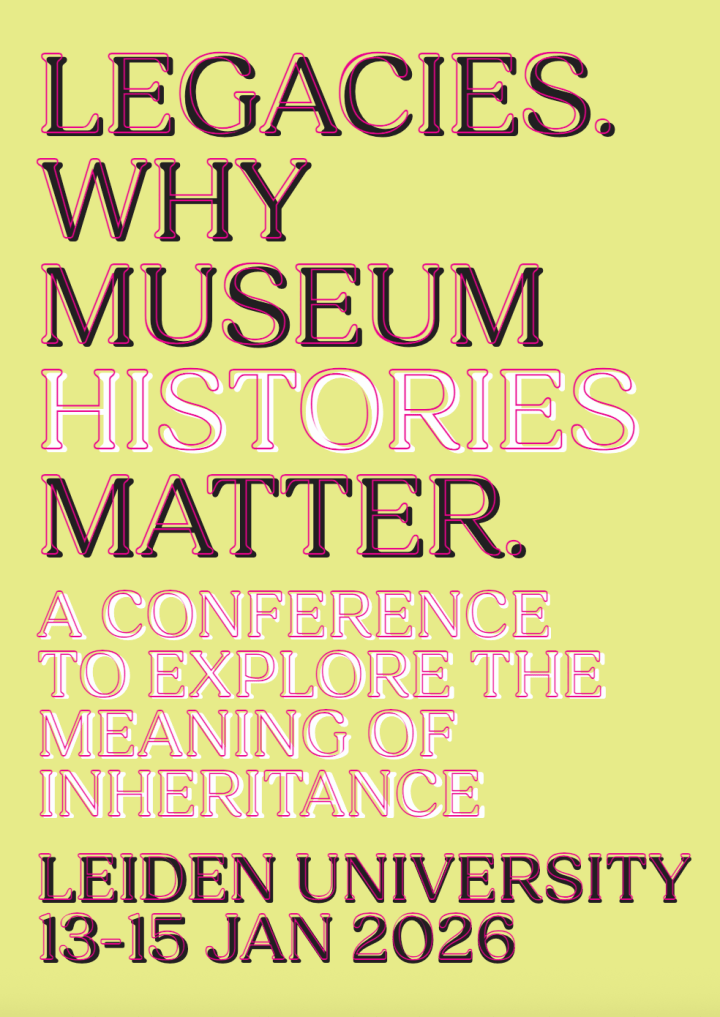 In January 2026, Leiden University’s Museum Lab will host the international conference Legacies: Why Museum Histories Matter. The conference reflects on museums with significant founding histories, broadly defined by their buildings, collections, commemorative functions, collectors or founders, that are currently engaged in some manner of institutional introspection, by way of exhibitions, acquisitions, restitutions, or renovations. International researchers and museum professionals from a range of institutions present their research and museum practices tied to museum legacies.
The three-day programme consists of twelve panels and four keynote speeches by Dr. Carole Paul (University of California, Santa Barbara), Monsignor Dr. Timothy Verdon (Museo dell’Opera del Duomo, Florence), Prof. Dr. Emile Schrijver (Jewish Cultural Quarter and National Holocaust Museum, Amsterdam), and Prof. Dr. Andrew McClellan (Tufts University, Boston).
Registration is available here»
t u e s d a y, 1 3 j a n u a r y
9.00 Registration
9.30 Welcome and Introduction
• Welcome — Stijn Bussels (Academic Director, Leiden University Centre for the Arts in Society)
• Introduction — Laurie Kalb Cosmo (University Lecturer and Project Director, Museum Lab, Leiden University)
9:50 Keynote
• Reflections on the History of the Public Art Museum — Carole Paul (Director of Museum Studies, University of California, Santa Barbara)
10.30 Coffee Break
11.00 Panel 1 | Monumental Legacies
Chair: Pieter ter Keurs (Emeritus, Leiden University)
• The Glyptotheque as a Site of Memory, Monumentality, and Transformation: Historical Identity and Contemporary Reflection of a Museum Institution in Croatia — Magdalena Getaldić (Glyptotheque of the Croatian Academy of Sciences and Arts)
• Obelisks and Totems: On Reframing Ethnographic Museums and Why Artistic Practice Matters — Irene Quarantini (Sapienza University, Rome)
• The Palatine Gallery: How Residents of the Pitti Palace Shaped Today’s Museum — Ilya Markov (Leiden University)
12.20 Lunch break
13.20 Panel 2 | Reshaping Legacies: Italian Museums
Chair: Irene Baldriga (Sapienza University)
• Reshaping the Oldest Italian National Museum — Paola D’Agostino, (Musei Reali Torino)
• Legacies Now: The Renewal of Institutional Inheritances at Five Museums in Rome — Laurie Kalb Cosmo (Leiden University)
• Two Centuries of Legacy, One Decade of Inclusion. Political Backlash and Strategic Reframing of Outreach at the Museo Egizio — Costanza Paolillo (New York University)
14.40 Panel 3 | Founders’ Legacies
Chair: Susanne Boersma (Leiden University)
• The Long Shadow of the Founder. Hero-Worship and the Construction of Continuity for a ‘National Museum’ — Joachim Berger and Darja Jesse (Germanisches Nationalmuseum, Nuremberg)
• National Gallery in Prague throughout the 20th Century: The Case of the Morawetz Collection — Lucie Němečková (Documentation Centre for Property Transfers of the Cultural Assets of WWII Victims, Prague)
• Leache & Wood: Rediscovering the Chrysler Museum’s Lost Founders — Mia Laufer and Drew Lusher (Chrysler Museum of Art, Norfolk)
16.00 Tea Break
16.30 Panel 4 | Unseen Legacies: Belgian Museum Buildings
Chair: Annemarie de Wildt (Former Curator at the Amsterdam Museum, Board Member of CAMOC, ICOM)
• Inherited Workspaces: Rethinking Creative Practice at the Constantin Meunier Museum — Ulrike Müller (University of Antwerp/Royal Museums of Fine Arts of Belgium, Brussels)
• Haunted Halls: Reclaiming Hidden Histories of the Royal Museums of Art and History in Brussels — Gerrit Verhoeven (University of Antwerp/Royal Museums of Art and History, Brussels)
• Between Immersion and Reflection. Old Antwerp and Museum Mayer van den Bergh Performing the Past — Stijn Bussels (Leiden University) and Bram van Oostveldt (Ghent University)
17.50 Day Closing — Laurie Kalb Cosmo
w e d n e s d a y , 1 4 j a n u a r y
9.00 Introduction — Laurie Kalb Cosmo
9.10 Keynote
• Legacies: Gifts of Love, Sacred Trusts, Investments — Timothy Verdon (Director of the Museo dell’Opera del Duomo/Museum of the Workshop of the Cathedral of Santa Maria del Fiore, Florence)
9.50 Keynote
• Developing and Opening Amsterdam’s National Holocaust Museum in a Politicized Era: Curatorial Challenges and Critical Choices — Emile Schrijver (Director of the Jewish Cultural Quarter and National Holocaust Museum, Amsterdam)
10.30 Coffee Break
11.00 Panel 5 | Revealing Histories and Reclaiming Heritage
Chair: Laurie Kalb Cosmo
• ‘My Heritage, Your Heritage?!’ Places of Jewish Heritage in Germany — Christiane Dätsch (Merseburg University of Applied Sciences
• POLIN Museum i Warsaw: A Place Where Memory Meets Responsibility — Joanna Fikus (POLIN, Warsaw)
• How to Celebrate the 75th Anniversary of the Museum Rietberg? Reflections on Researching and Curating the Institution’s History — Esther Tisa Francini (Museum Rietberg, Zurich)
12.20 Lunch break
13.20 Panel 6 | Eastern Europe: War and Recuperation
Chair: Seraina Renz (Leiden University)
• UNESCO and Museum Diplomacy: Geographies and Balances of Cultural Policy during the Cold War — Irene Baldriga (Sapienza University, Rome)
• Cultural Losses of Museums: The Polish Respond to World War II —Bartłomiej Sierzputowski and Elżbieta Przyłuska (Polish Ministry of Culture and National Heritage, Warsaw)
14.40 Panel 7 | Eastern Europe: (Post-)socialist Museums
Chair: Seraina Renz
• Shaping the Contemporary Art Museum Identity through its Complex Heritage. The Example of the Museum of Fine Arts in Split, Croatia —Jasminka Babić (Museum of Fine Arts, Split) and Dalibor Prančević (University of Split)
• Collecting to Forget: The Legacy of the Museum of Atheism in Vilnius — Karolina Bukovskytė (Lithuanian Culture Research Institute/National Museum of Lithuania, Vilnius)
• Whose Ethnography? Ethnographic Collections and Museums in Central Europe — Marika Keblusek (Leiden University)
16.00 Tea Break
16.30 Panel 8 | Revisiting Institutional Narratives
Chair: Wonu Veys, Leiden University/Wereldmuseum
• The Imperial Gaze Materialised: The Ten Thousand Chinese Things Museum as Archive — Yuansheng Luo (KU Leuven)
• Museum Histories in a Postcolonial Age: Collecting and Curating Netherlandish Art Legacies in the Global South — Laia Anguix-Vilches (Utrecht University)
• ‘You’re usually wrong’: Looking Back at the Anti-racism of the Past at One Museum — Deirdre Madeleine Smith (University of Pittsburgh/Carnegie Museum of Natural History)
17.50 Day Closing — Susanne Boersma
t h u r s d a y , 1 5 j a n u a r y
9.00 Panel 9 | Modernist Legacies in the Americas
Chair: Stephanie Noach (Leiden University)
• Lourival Gomes Machado and the Legacy of a Certain Brazilian Modernism at MAM-SP — Ana Avelar (University of Brasília)
• Legitimating Modernism: Art History and the Formation of Museum Authority in the United States — Laura Braden (Erasmus University Rotterdam)
• (Re)Making the San Francisco Museum of Art Modern — Berit Potter (California State Polytechnic University Humboldt, Arcata)
10.20 Coffee Break
10.50 Panel 10 | Crafts and Material Legacies
Chair: Lieske Huits (Leiden University)
• Donating Lace and Knowledge: Women and Early 20th-Century Historic Lace Acquisitions in the Belgian Royal Museums for Art and History — Julie Landuyt (Ghent University/Free University of Brussels)
• Crafts’ Networks and the National Museum of Capodimonte in Naples — Francesco Montuori (European University Institute, Florence)
• Preserving Heritage through Museums: The Case of the Kurdistan Region of Iraq — Chang Farhan Tahir (University of Duhok)
12.10 Lunch break
13.30 Panel 11 | Colonial Legacies
Chair: Wonu Veys (Leiden University/Wereldmuseum)
• Founding Myths and Colonial Entanglements: The Japan Folk Crafts Museum and the Politics of Mingei — Anna Stewart-Yates (University of Oxford)
• A Forgotten History: The Former Colonial Collection of the Royal Museums of Art and History, Belgium — Anke Hellebuyck (University of Antwerp)
• Rethinking Narratives: The ‘Animals of Africa’ in Bern — Sarah Csernay (Nordamerica Native Museum, Zurich)
14.50 Panel 12 | Prominent Figures and Entangled Histories
Chair: Susanne Boersma
• A Contested Museum History: Scenography and the Placement of the Islamic Collection at the Berlin Museums — Zehra Tonbul (Ozyegin University, Istanbul)
• Entangled Objects and Memory Sites in the Museum: Re-imagining the ‘Modern’ Collection — Juliet Simpson (Coventry University)
• The Museum as a Battleground: Political Art at the Israel Museum, 1967–1977 — Meital Raz (University of Amsterdam)
16.10 Tea Break
16.40 Keynote
• The Museum of Fine Arts, Boston, 1909: Towards a Machine for Looking — Andrew McClellan (Tufts University, Boston)
17.25 Closing Remarks — Marika Keblusek (Leiden University)










 Enfilade
leave a comment