Conference | Memory and Meaning in Southern Silver
From MESDA:
Memory and Meaning in Southern Silver
Online and in-person, Museum of Early Southern Decorative Arts, Winston-Salem, NC, 20–21 September 2024
 Silver and memory are deeply linked as individuals often commission pieces to mark significant moments in their lives and then pass those objects along to future generations. Please plan to join us on September 20th and 21st as we delve into the lives of southern silver makers and patrons who used silver to create memory and meaning in the early American South.
Featured speakers include Ben Miller of Shrubsole and the Magazine Antique’s Curious Objects podcast, author and scholar Catherine Hollan, and Colonial Williamsburg’s Erik Goldstein. In addition to an opening keynote and a day of dynamic lectures, attendees will also have an opportunity to examine MESDA’s silver collection up close during an open house in the MESDA study rooms.
Virtual registration is available for a suggested donation. In-person registration ($325, or $315 for Frank L. Horton Society Members) includes the keynote lecture and reception, one pastry breakfast, one coffee break, one lunch, all lectures proposed on the agenda, and an admission ticket to Old Salem Museums & Gardens. Attendees will also receive exclusive access to the recordings of the lectures for a limited period of time after the program concludes.
f r i d a y , 2 0 s e p t e m b e r
5.00 Opening Reception and Keynote by Ben Miller
s a t u r d a y , 2 1 s e p t e m b e r
9.15 Welcome
9.30 Catherine Hollan — Why Reassess Southern Silver Scholarship
10.15 Alexandra MacDonald — ‘To Brighten Every Painful Hour’: The Follet Family Sampler
10.35 Coffee Break
11.00 Erik Goldstein — Williamsburg’s ‘Madison’ Horse Racing Trophy
11.30 Cynthia Jenkins — Historic Beaufort’s ‘Hamar Cup’
12.00 Lunch
1.00 Charlotte Crabtree — Put the Lime in the Coconut: Silver and Coconut Drinking Vessels in the South
1.45 Emily Whitted — Wealth from the Water: Murky Metal in the Shadow of the Santee River, 1785–2003
2.10 Emily Campbell — Thomas Campbell, Winchester, Virginia Silversmith
3.00 Collection Open House in the MESDA Galleries
4.00 Closing Reception
Symposium | Anna Dorothea Therbusch in Context
From the Staatliche Museen zu Berlin, and noted at ArtHist.net:
Anna Dorothea Therbusch in Context: 18th-Century (Women) Artists in Berlin and Europe
Anna Dorothea Therbusch im Kontext: Künstlerinnen und Künstler des 18. Jahrhunderts in Berlin und Europa
Berlin, Gemäldegalerie, Kulturforum, 26–27 September 2024
Registration due by 4 August 2024
 The Berlin painter Anna Dorothea Therbusch (1721–1782) enjoyed a remarkable international career in the eighteenth century, travelling to Stuttgart, Mannheim, and Paris. Here, she was accepted into the Académie royale and she exhibited at the Salon. Back in her native city in 1769, Therbusch became a sought-after portraitist of Berlin society and worked for the Russian Tsar’s court and the Prussian royal family. The symposium marks the conclusion of a two-year art-historical and art-technological research and publication project by the Berlin Gemäldegalerie on Therbusch’s works in the public collections in Berlin and Brandenburg. It serves to bring researchers together, share the results obtained, and highlight further research perspectives.
Registration is possible until 4 August 2024. Please send an email with your contact details to a.groeger@smb.spk-berlin.de. You will receive a registration confirmation. The number of participants is limited for organisational reasons; early registration is recommended.
t h u r s d a y , 2 6 s e p t e m b e r
18.00 Begrüßung | Welcome
• Dagmar Hirschfelder (Direktorin der Gemäldegalerie, Staatliche Museen zu Berlin)
18.15 Buchvorstellung | Book Presentation
• Anna Dorothea Therbusch in Berlin und Brandenburg: Werke, Technik, Kontext, Nuria Jetter, Sarah Salomon, Anja Wolf (Gemäldegalerie, Staatliche Museen zu Berlin)
18.45 Abendvortrag | Evening Lecture
• Ein ,Meteor‘ am süddeutschen Himmel: Anna Dorothea Therbuschs Netzwerke und Karrierestrategie —Katharina Küster (Landesmuseum Württemberg, Stuttgart)
f r i d a y , 2 7 s e p t e m b e r
9.00 Registrierung | Registration
9.15 Begrüßung | Welcome
Dagmar Hirschfelder (Direktorin der Gemäldegalerie, Staatliche Museen zu Berlin)
9.30 Morning Session 1
• Anna Dorothea Therbusch und der ,weibliche Pinsel‘: Karrierestrategien einer Malerin im Europa des 18. Jahrhunderts — Gernot Mayer (Universität Wien)
• Therbuschs Künstlerporträts: Künstlerische Weiterentwicklung und kollegiale Anerkennung — Léonie Paula Kortmann (Julius-Maximilians-Universität Würzburg)
• ,Mit einer Rembrandt’schen Kraft und van Dyck’schen Wahrheit‘: Anna Dorothea Therbuschs Stuttgarter Selbstporträt (1761) — Sanja Hilscher (Akademie der Bildenden Künste Stuttgart)
11.00 Kaffeepause | Coffee Break
11.30 Morning Session 2
• Gemalte Leben: Selbstbildnisse der Lisiewska-Schwestern — Sarah Salomon (Gemäldegalerie, Staatliche Museen zu Berlin)
• Therbusch unter der Lupe: Ergebnisse der maltechnischen Untersuchungen — Anja Wolf (Gemäldegalerie, Staatliche Museen zu Berlin) und Jens Bartoll (Stiftung Preußische Schlösser und Gärten Berlin-Brandenburg)
• Beobachtungen zur Maltechnik Christoph Friedrich Reinhold Lisiewskys im Spiegel der Arbeitsweise seiner Schwester Anna Dorothea Therbusch — Maria Zielke (Kulturstiftung Dessau-Wörlitz)
13.00 Mittagspause | Lunch Break
14.30 Afternoon Session 1
• Diderot’s ‚Mystification‘: Anna Dorothea Therbusch and Prince Dmitry Alexandrovich Golitsyn in Paris and Brussels — Catherine Phillips (Norwich)
• Schadow vs. Therbusch? Porträts der Henriette Herz als Seismografen für die Wandlungen des (jüdischen) Frauenbildes um 1800 — Claudia Czok und Hannah Lotte Lund (Berlin)
15.30 Kaffeepause | Coffee Break
16:00 Afternoon Session 2
• How Dare She: Fleshing Out Therbusch’s Female Nudes — Christina Lindeman (University of South Alabama)
• Therbuschs Historien — Nuria Jetter (Gemäldegalerie, Staatliche Museen zu Berlin)
Image: The conference programme reproduces Anna Dorothea Therbusch’s Self-Portrait with Monocle, 1776 (Berlin: Gemäldegalerie).
Symposium | A la Ronde: Female Expression through Craft and Design
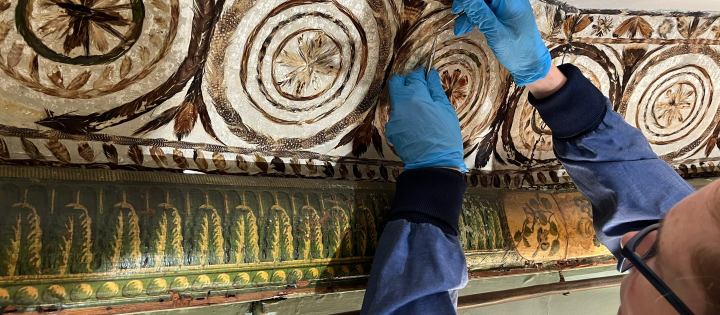
Conservation of the feather frieze in the Drawing Room at A la Ronde in Devon
◊ ◊ ◊ ◊ ◊
From the National Trust:
Female Expression through Craft and Design in the 18th and Early 19th Centuries
Online and in-person, Reed Hall, University of Exeter, 11 July 2024
The National Trust is delighted to announce this hybrid conference inspired by the conservation, outreach, and interpretation project A la Ronde: Conserving the Past, Creating the Future. Intended to forge new bonds with researchers and academic professionals, find synergies with similar projects and properties, and to share stories and discoveries from our recent conservation work in a broader context, the symposium will be offered in hybrid form, with presentations both in-person and online. Booking is available here»
About A la Ronde — A small estate in Lympstone, Devon, this 16-sided house and chapel were built, and perhaps designed, by Jane Parminter and her young cousin and ward, Mary, around 1796, following their return from several Grand Tours of Europe. The house is now owned by the National Trust and contains the extraordinary decorative interiors designed by the Parminters. These include over 27 metres of friezes formed from feathers in the drawing room, patterned wall painting in the central Octagon room, and a Shell Gallery sitting at the top of the house encrusted with over 26,000 individual components, accessed by a narrow Grotto Staircase from below. The wider estate also contained a chapel, alms houses, and school room for local unmarried women and girls, a manse, vegetable gardens, and small picturesque landscape in the context of a ferme ornée. Mary’s will records that the grounds originally contained decorative features including a shellery, fountain, obelisks, and seating. The Shell Gallery, Grotto Staircase, Drawing Room feather frieze, and Octagon have been recently conserved as part of a two-year multi-strand project, A la Ronde: Conserving the Past, Creating the Future, which culminates in 2024.
p r o g r a m m e
9.30 Welcome and Opening Remarks
• Jonathan Fisher (General Manager South East Devon Portfolio, National Trust)
• Emma Mee (Project Lead, National Trust)
9.45 Keynote Presentation
• Daniel Maudlin (University of Plymouth), Making Cottages: Rural Retreat and the Appropriation of the Vernacular in the 18th Century
10.10 Panel 1 | Female-Designed and Commissioned Domestic Spaces
• Rosemary Baird Andrae FSA, The Architectural Patronage of Mrs Montagu, Queen of the Bluestockings
• Tom Coombe (Collections and House Manager, National Trust), The Ornamental Dairy at Croome: Ceramics, Crafting, and Performance
• Jyoti Pandey Sharma (School of Planning and Architecture, New Delhi), Transculturalism in 19th-Century Mofussil India: Begam Samru and Her Architecturally Hybrid Sardhana Palace
• Saniya Siddiqui (School of Planning and Architecture, New Delhi), Taj Mahal Palace: A Royal Residence Commissioned by Nawab Shah Jahan Begum (r.1868–1901), Ruler of Bhopal Princely State in the British-ruled Indian Subcontinent
11.30 Coffee Break
11:45 Panel 2 | A la Ronde and National Trust Conservation Work
Convenor: Nigel Blades (Head of Conservation, National Trust)
• Daniel Cull (Conservator, National Trust), Conserving the Past, Creating the Future: A Summary of the Conservation Project at A la Ronde
• Nicola Shreeve (Remedial Conservator, National Trust), The Technical Investigation and Conservation of the Octagonal Chairs from A la Ronde
• Nicola Walker (Senior National Conservator, Paper and Photography, National Trust), Shells, Curtains, and a Doll’s House: Conservation and Collaboration
1.00 Lunch
1.45 Panel 3 | Decorative Historic Interiors and Material Histories
• Lucy Powell (Leverhulme Early Career Research Fellow, University of Oxford), ‘The Feather’d Fair’: Women, Femininity, and Feathers in the 1790s
• Clare Taylor (The Open University), ‘Our New Paper Hangings’: Women and Wallpaper in 18th-Century Britain
• Libby Horsfield (PhD student, Birkbeck University), The Centre of Attention: Women’s Crafted Fire Screens and the Country House Interior in the 19th Century
• Emily Deal (Digital Curator, National Trust), The Material Biography of Molly Lepell: Material Culture and Collection as a Form of Life Writing in the 18th Century
3.00 Coffee Break
3.10 Panel 4 | Georgian Period Embellished Decorative Interiors Using Natural Materials
Convenor: Rachel Conroy (Senior National Curator, Decorative Arts, National Trust)
• Wenyu Dong (MA student, Central Academy of Fine Arts), From Chinese Chambre to Feather Room: Elizabeth Montagu’s Interiors in the 1760s and 1780s London
• Kyriaki Hadjiafxendi (Senior Lecturer, Victorian Literature and Culture, Bath Spa University), The Eventfulness of Nature: Women and the Seashore in the Long 19th Century
• Beth Howell (Business Services Coordinator, National Trust), ‘Call Us Not Weeds!’: Examining the Aesthetics of Upcycling and Anonymity in Victorian Depictions of Seaweed
• Laura Keim (Stenton Curator), Kaila Temple (Stenton Curatorial Assistant), and Lara Kaplan (Objects Conservator Winterthur Museum), ‘Place to Cultivate Her Mind in by Musing’: Anne Reckless Emlen’s 1757 Shellwork Grotto
4.50 Closing Remarks
• Sarah Lloyd (Research Fellow, Institute of Historical Research, University of London)
Conference | Commerce and Circulation of Decorative Arts, 1792–1914

Ignacio de León y Escosura, Auction Sale in Clinton Hall, New York, detail, 1876
(New York: The Metropolitan Museum of Art, Gift of the Artist, 1883, 83.11)
◊ ◊ ◊ ◊ ◊
From the conference programme:
The Commerce and Circulation of Decorative Arts, 1792–1914:
Auctions, Dealers, Collectors, and Museums
Le commerce et la circulation des objets d’art, 1792–1914:
Ventes aux enchères, marchands/es, collectionneurs/ses et musées
Musée des Beaux-Arts de Lyon, 25–27 September 2024
This international three-day colloquium, to be held in Lyon, France, from 25 to 27 September 2024, will investigate the role played by auctions, dealers, collectors, and museums in the circulation of the decorative arts from 1792 until 1914. Beginning with the ‘ventes des biens des émigrés’ in Revolutionary France and ending with the onset of World War I, these were years of seismic political and socio-economic change that revolutionised the art market. Day 1 will start with an introduction by Daniel Alcouffe and an opening lecture by Tom Stammers. Three sessions will follow on the role of auctions, antique dealers, and dealer-decorators in the circulation of the decorative arts. Day 2 will be devoted to the museums, collectors, and networks of exchange across borders. Day 3 will discuss the interplay between the market, expertise, and the tailoring of objects, ending in the afternoon with a round-table discussion on research in the digital age, showcasing several projects, with short presentations by Mark Westgarth, Lynn Catterson, Koenraad Brosens, and Anne-Sophie Radermecker. The conference is free to attend but registration is essential. Your registration will be effective for any session you wish to attend throughout the conference. Accommodation in Lyon is limited; so we suggest that you arrange this as soon as possible. Please see the conference page for updates.
This colloquium forms part of a wider project on the market for decorative arts: OBJECTive – ANR ACCESS ERC / Université Lumière Lyon-2, LARHRA : OBJECTive – ANR Objects through the Art Market : A Global Perspective – LARHRA.
w e d n e s d a y , 2 5 s e p t e m b e r
10.30 Introduction
• Welcome — Camille Mestdagh and Diana Davis (organisers)
• Introductory Comments — Daniel Alcouffe (Conservateur général honoraire au musée du Louvre), Les arts décoratifs : Une ressource pour l’avenir de l’histoire de l’art
• Opening Lecture — Tom Stammers (Reader in the history of the art market, The Courtauld Institute of Art), Dealing with the Decorative Arts: Sources, Paradigms, and Problems
11.30 Session 1 | The Auction: A Window on the Decorative Arts Market
Moderator: Suzanne Higgott (independent scholar, formerly the Wallace Collection)
• Helen Jacobsen (PhD, University of Oxford, Executive Director, The Attingham Trust), The Anatomy of an Auctioneer: Harry Phillips and the Growth of the Decorative Art Market in London, 1796–1839
• Stuart Moss (PhD candidate, University College London), ‘Schöne Kunstsachen aller Art’: Decorative Art at the Munich Secularisation Sales, 1803–1807
• Sabine Lubliner-Mattatia (PhD, Sorbonne Université, independent lecturer), From the Limelight to the Spotlight: The Jewellery Sales of Actresses in 19th-Century Paris (in French)
13.00 Lunch
14.00 Session 2 | Fluid Boundaries: Defining the Antique Dealer
Moderator: Paola Cordera (Associate Professor, Politecnico Milano, School of Design)
• Lucie Chopard (PhD, Ecole Pratique des Hautes Etudes, Saprat), The Sichel Brothers and the Parisian Art Market: Commercial Networks and Strategies
• Servane Rodié-Dumon (PhD candidate, Université d’Artois), Objects in Motion: Emile Peyre’s Collection of Decorative Art and the South Kensington Museum
• Nathalie Neumann (provenance researcher, formerly Johannes Gutenberg-Universität, Mainz), Reconstructing the Art Collection of Felix Ganz (1869–1944): From Constantinople to Northern Europe
15.30 Break
16.00 Session 3 | Dealer Decorators in the Gilded Age: Shaping Taste in the New World
Moderator: Adriana Turpin (Professor, IESA Arts and Culture)
• Justine Lécuyer (PhD, Sorbonne Université), Tapissiers: Interior Decorators as Experts, Antique Dealers, and Collectors: The Example of Rémon and Alavoine
• Flaminia Ferlito (PhD candidate, Scuola Alti Studi Lucca), Stanford White: Italian Baroque Elegance and the Decorative Art Market
• Aniel Guxholli (Lecturer, McGill University, School of Architecture), The Culture Market: American Firms and French Decorative Arts in Montreal
t h u r s d a y , 2 6 s e p t e m b e r
9.00 Session 4 | The Art Market and the Museum: Collecting, Display, and Knowledge
Moderator: Caroline McCaffrey-Howarth (PhD, Lecturer, University of Edinburgh)
• Françoise Barbe (Conservatrice en chef du patrimoine) and Fernando Filipponi (PhD, Chargé de recherche, musée du Louvre), The Commerce and Circulation of Maiolica between Italy and France, 1850–1902: A Case Study of the Argnani Collection in the Musée du Louvre (in French)
• Félix Zorzo (Assistant Curator, National Museums Scotland), The Public Collecting of Spanish Ceramics in 19th-Century Edinburgh
• Maialen Maugars (PhD candidate, University of Warwick), Collecting Italian Renaissance Decorative Arts for the Birmingham Museum and Art Gallery, 1881–1889
• Mirjam Dénes (Curator, Museum of Fine Arts, Ferenc Hopp Museum of Asiatic Arts, Budapest), Crafting Connections, Making Meanings, and Sealing Deals: Jenő Radisics and the International Network of the Budapest Museum of Applied Arts, 1897–1914
11.00 Break
11.30 Session 5 | Collectors and Their Networks of Acquisition
Moderator: Elodie Baillot (Maîtresse de conférences, Université Lumière Lyon-2)
• Armandine Malbois (PhD candidate, Ecole Pratique des Hautes Etudes, Saprat, Ecole du Louvre), The Schlichting Taste: Collecting 18th-Century French Decorative Arts for the Louvre, 1880–1914
• Agnès Bos (Déléguée générale, Comité des Travaux Historiques et Scientifiques, École nationale des chartes-PSL), A Very Special Collection: The Marquise Arconati Visconti (1840–1923), Her Network, and Personal Choices
• Paula Maria de la Fuente Polo (PhD candidate, Universidad Rey Juan Carlos, Madrid), The Formation of the Hispano-Moresque Ceramic Collection of Don Guillermo de Osma y Scull
13.00 Lunch
14.30 Session 6 | Networks and Cultural Exchange across the Oceans
Moderator: Florencia Rodríguez Giavarini (PhD Fellow, Centro de Investigaciones en Arte y Patrimonio, Buenos Aires)
• Gustavo Brognara (PhD candidate, Universidade de São Paulo), Cultural Exchanges: The Circulation of European Decorative Arts in Brazil
• Paolo Coen (Professor of Museology, Università di Teramo), The Export of Art Objects from Rome to Australia and New Zealand, 1884–1904
15.30 Break
16.00 Session 7 | The Middle East and Asia in Europe: Inventing Genres and Forming Taste
Moderator: Elizabeth Emery (Professor, Montclair University)
• Mercedes Volait (Emeritus Research Professor, CNRS), ‘Arab Antiques?’: Scrutinising an Egyptian Collection of Middle Eastern Artefacts Dispersed in the Wake of the Paris 1867 Exposition Universelle
• Akane Nishii (PhD, CRJ-EHESS, CY Cergy Paris Université), The Export of Japanese Decorative Arts from Yokohama in the 1870s
• Maria Metoikidou (PhD candidate, University of Glasgow), Shifting Perspectives on Japonisme Collecting: Exploring the Case of Gregorios Manos in the Market for Japanese Objects
f r i d a y , 2 7 s e p t e m b e r
9.00 Session 8 | Connoisseurship: Framing Objects for the Market
Moderator: Damien Delille (Maître de conférences, Université Lumière Lyon-2)
• Inès Maechler (Master, Ecole Pratique des Hautes Etudes, Saprat), The Paris 1876 Retrospective Exhibition of Tapestries: Institutions, Collectors, and the Development of a Market (in French)
• Pauline d’Abrigeon (Conservatrice, Fondation Baur/ PhD candidate, Ecole Pratique des Hautes Études), Pathways of the ‘Famille Rose’ in the Parisian Art Market during the Second Half of the 19th Century: From the Success of a Term to the Success of the Object
• Nick Pearce (Professor, Richmond Chair of Fine Art, University of Glasgow), A New Taste for the Old: Collecting Chinese Ceramics, 1910
10.30 Break
11.00 Session 9 | From Floor to Ceiling: Reconfiguring Objects for the Market
Moderator: Jérémie Cerman (Professeur, Université d’Artois)
• Kassiani Kagouridi (PhD candidate, University of Ioannina), Tailoring the ‘Baluchistan’ Carpets: Art Market and Art Historiography Interplay in Late 19th- and Early 20th-Century Europe
• Mei Mei Rado (Assistant Professor, Bard Graduate Center), Fragments, Encyclopedia, and Industry: Japanese Silk Samples Collected and Sold by Siegfried Bing and Hayashi Tadamasa
• Roberta Aglio (PhD candidate, Universitat Rovira i Virgili, Tarragona), The Dispersion, Circulation, and Reuse of Ceiling Panels in France in the 19th and 20th Centuries
12.30 Lunch
13.30 Session 10 | Rethinking Research Approaches for the Digital Age
Moderator: Sandra van Ginhoven (Head, Getty Provenance Index, Getty Research Institute)
• Camille Mestdagh (Chercheure, Université Lumière Lyon-2) and Morgane Pica (Ingénieure d’études, ENS Lyon), A Presentation of Project OBJECTive: Objects through the Art Market
Round Table
• Lynn Catterson (Lecturer, University of Columbia, NY), Stefano Bardini: Mapping a Dealer’s Transnational Network
• Mark Westgarth (Professor, University of Leeds), Antique Dealer Archives in the Digital Age
• Anne-Sophie Radermecker (Assistant Professor, Université Libre de Bruxelles), Price-Related Sources in Historical Contexts: The Case of the Val Saint Lambert Crystal Glassware Manufactory
• Koenraad Brosens (Professor, KU Leuven University), Project Cornelia and Slow Digital Art History: A New Path in the Study of Flemish Tapestries
• Pierre Vernus (Maître de conférences, Université Lumière Lyon-2, LARHRA, Head of Project SILKNOW), Concluding Remarks
16.00 Final Words — Natacha Coquery, Igor Moullier, and Paola Cordera
Organising Committee
Natacha Coquery (Professeure, Université Lumière Lyon 2, LARHRA), Camille Mestdagh (Post-doctoral researcher, Université Lumière Lyon 2, LARHRA), Igor Moullier (Maître de conférences, ENS Lyon, LARHRA), Rossella Froissart (Directrice d’études, Ecole Pratique des Hautes Études-PSL, SAPRAT), Diana Davis (Independent researcher, PhD, University of Buckingham)
Scientific Committee
Arnaud Bertinet (Maître de Conférences, Paris 1 Panthéon Sorbonne), Jérémie Cerman (Professeur, Université d’Artois, Arras), Paola Cordera (Associate Professor, Politecnico di Milano), Elizabeth Emery (Professor, Montclair State University, New Jersey), Sandra van Ginhoven (Head, Getty Provenance Index, Getty Research Institute, Los Angeles), Anne Helmreich (Director, Archives of American Art, Smithsonian Institution, Washington), Caroline McCaffrey-Howarth (Lecturer, University of Edinburgh), Johannes Nathan (co-founder of the Centre of Art Market Studies, Technische Universität, Berlin), Anne Perrin-Khelissa (Maître de conferences HDR, Université Toulouse-Jean Jaurès), Florencia Rodríguez Giavarini (Doctoral fellow, UNSAM-CONICET, Buenos Aires), Adriana Turpin (Head of Research, IESA, Paris)
Conference | The Study of the Book Trade since Peter Isaac
From the Centre for Printing History and Culture:
Unfinished Business: Progress, Stasis, and New Directions in the Study of the Book Trade since Peter Isaac
Annual Print Networks Conference
University of Newcastle-upon-Tyne, 9–10 July 2024
Organised by the University of Newcastle and sponsored by Print Networks and the Centre for Printing History and Culture, this conference considers the British and Irish book trades locally, nationally, and in their global perspective, including comparative perspectives. It addresses questions such as how has research on these trades’ histories developed and advanced, or not, in the past two decades? How has an emphasis on valuing the local, the specific or the seemingly minor been taken up in studies of the book trade? How do such interests sit with the expansion of book trade research into ever larger data-sets and/or within national and global print histories? What are the key social, political, and technological questions scholars of the book trade are now grappling with? In what fresh directions must the study of the trades now strike out? The fee for this two-day conference is £80.
Peter Isaac (1921–2002) investigated numerous strands of the British book trade. A distinguished professor of civil and public health engineering at Newcastle University, he also enjoyed a highly regarded career as a print historian and bibliographer. The working group that he founded, The History of the Book Trade in the North, was immensely influential in moving the study of the British book trade beyond the confines of London. More broadly, his work insisted on the value of the local for our national and global understandings of the book trade. He considered the internationally famous engravings of Thomas Bewick, the ornament stocks of the Alnwick pharmacist and printer William Davison, and the inventory of books sold by a Penrith grocer in the seventeenth century to be equally worthy of scholarly attention and careful study.
t u e s d a y , 9 j u l y
9.30 Panel 1 | Politics and the Print Trade
• Kate de Rycker (Newcastle), ‘Danter’s Gentleman’: Thomas Nashe and the Precarity of Cheap Print
• Maria Zukovs, (St Andrews), Beyond the United Irishmen: A View of the French Revolution from the Dublin Press, 1789–94
10.45 Panel 2 | Radical Work
• Fionnghuala Sweeney (Newcastle), The Unfinished Business of Freedom: Slave Narratives, Surfeit, and the British Northeast in Antebellum Black Atlantic Print Culture
• Andrea Lloyd (BCU), ‘An Indissoluble Unity’: Considering the Relationship between outward Influences and the Design of Birmingham’s Radical Newspapers, 1815–36
12.15 Panel 3 | The Marketplace of Print: Advertising, Promotion, Demand
• Bethan Elliott (York), ‘None… Took any Notice of It’: Publication and the Promotion of Romantic Drama in Print
• Karen McAulay (Royal Conservatoire of Scotland), ‘Music for All’: The Rise and Fall of Scottish Music Publishing, 1880–1964
13.15 Lunch break
14.15 Panel 4 | Advancing the Study of Women in the Book Trade
• Emma Sibbald (Queens’ College, Cambridge), ‘A Servant’s Receipt for the World’: Women Wagoners and the Antiquarian Book Trade at the Bodleian Library, 1690–1720 [online]
• Joanne Butler (Keele), Locating Women Booksellers in 18th-Century Regional England
• Charley Matthews (Edinburgh), Geraldine Jewsbury’s Labour as a 19th-Century ‘Publisher’s Reader’
16.15 Keynote 1
• Ruth Frendo (Stationers’ Company)
w e d n e s d a y , 1 0 j u l y
9.30 Panel 5 | The Networks and Power Structures of the Early Modern Book Trade
• Sam Bailey, Sorority, Spycraft, and Sodomy: Collaboration and the Erotic Book Trade in 18th-Century London
• Beth DeBold, A House Divided: The Internal Conflict of the Stationers’ Company
• Matt Ryan, ‘Unquiet Spyrittes’: Martin Marprelate and Communal Strategies of Resistance
11.00 Lunch break
13.30 Keynote 2
• Joseph Hone (Newcastle), How to Smuggle Books into 18th-Century Britain
14.45 Panel 6 | Unconsidered Forms
• Roseanna Smith (BCU), A Book by Any Other Name? 19th-Century Trade Catalogues as a Unique Format of Print
• Holly Day (York), Selling the Memorandum Book in 18th-Century Britain: Bibliographic Trends and the Mechanics of the Trade
16.15 Panel 7 | Technology and the Print Trades
• Ian Dooley (Institute of English Studies, UCL), Cheap Colour Ink and the Creation of Mass Print Culture
• Helen Williams (Edinburgh Napier), Newspapers, Timetables, and the ‘World’s First Comic’: The 19th-Century Print Trade in Glasgow
Roundtable | Advancing the Study of North East Print
Helen Williams (Northumbria), Barbara Crosbie (Durham), and Kirsten Gibson (Newcastle)
Conference | Congress of Historical Botanical Gardens
From ArtHist.net and the conference website:
Prevention of Historical Botanical Gardens and Their Heritage from the Major Threats of Our Time
2nd International Congress of Historical Botanical Gardens
HBLFA für Gartenbau / College of Horticulture, Wien, 29–31 July 2024
Registration due by 30 June 2024
 Historical botanical gardens and historical plant collections embedded in a larger context are often a neglected topic. Especially in the field of garden history, landscape architecture, botany, history of science, and even art history, their importance cannot be overestimated. In recent years, there has been a growing interest in these fields of research. In 2021, the 1st International Congress of Historical Botanical Gardens was held in Lisbon.
The initial impulse to communicating the issues and importance of botanic gardens to a broader public, highlighting their history and importance, and building a common network will be continued at the 2nd International Congress of Historical Botanical Gardens. The second meeting will expand the focus to include conservation and preservation of plants and gardens. How can we protect historical botanical gardens and their heritage from the major threats of our time, such as lack of resources, climate change, war, and conflicts of all kinds? What can we learn from the often turbulent past?
The three organizing institutions (Austrian Federal Gardens, Natural History Museum, Botanical Garden of the University of Vienna) were founded by the Habsburg emperors for scientific and representative reasons. For more than 450 years, these institutions have collected, cultivated, studied and exhibited plants in Vienna. This long and continuous tradition makes Vienna one of the most important locations for current and historic plant research and conservation. Building on this tradition and moving forth together, we look forward to welcoming you to Vienna for the Second International Congress of Historical Botanical Gardens.
m o n d a y , 2 9 j u l y
9:00 Welcome Addresses
• Norbert Totschnig (Austrian Federal Minister of Agriculture, Forestry, Regions and Water Management)
• Dalila Espírito Santo (Head of Organization of the 1st ICHBG 2021, University Lisbon)
• Tim Entwisle (International Association of Botanic Gardens, IABG)
• Gerd Koch (College of Horticulture and Austrian Federal Gardens
• Katrin Vohland (Natural History Museum, Vienna)
• Michael Kiehn (Botanical Garden, University of Vienna)
10:00 Keynote
• Botany, History, and Biodiversity: New Horizons for the Jardin des Plantes de Paris — Isabelle Glais (Jardin des Plantes de Paris)
10:30 Coffee Break
10.50 Session 1 | The Transition of Historical Botanical Collections
• A Phoenix from the Ashes: The Transition of the Court Gardens to the Austrian Federal Gardens — Claudia Gröschel (Austrian Federal Gardens)
• Paleis Het Loo: From Royal Showcase towards a Decolonized Botanical Garden — Renske Ek (Palais Het Loo)
• The Role of Curation in Botanic Gardens: Platforms for Environmental and Social Transition — Kevin Frediani (Botanic Garden, University of Dundee)
• Art and Art Projects at the Historic Botanical Garden of the University of Vienna — Barbara Knickmann (Botanical Garden, University of Vienna)
12.10 Lunch
13.45 Afternoon Sessions
• Restoration Saga of the Only Croatian Public Greenhouse — Vanja Stamenkovic (Botanical Garden, University of Zagreb)
• The Impact of Climate Change on the Living Collections of the Botanic Garden of the University of Pisa — Marco D‘Antraccoli (Botanic Garden, University of Pisa)
• The Botanical Garden in Halle (Saale) through the Ages — Heike Tenzer (State Office for Heritage Management and Archaeology Saxony Anhalt)
• Decolonizing the Dutch Botanical Gardens — Sarina Veldman (Hortus Botanicus Amsterdam)
• A Healing Place: The Modern Botanic Garden as a Reimagined Physic Garden — Tim Entwisle (International Association of Botanic Gardens, Australia)
16.00 Natural History Museum — Visit of archive and collection of botanical illustrations, herbarium, and rooftop
18.00 Natural History Museum — Poster session and cocktail reception
t u e s d a y , 3 0 j u l y
9.00 Keynote
• Horticulture in the Age of Globalization, Biological Invasions, and Climate Change — Franz Essl (University of Vienna, Austria)
9.30 Session 2 | Horticulture: Challenges in Daily Horticulture Practice
• The Transfer towards Working with the Environment in a Historical Garden — Willem Zieleman (Palais Het Loo, Netherlands)
• Theory and Practice of Recreating Exotic Plant Collections in European Historic Gardens — Jacek Kuśmierski (Museum of King Jan III’s Palace at Wilanów, Poland) and Katarzyna Hodor (Cracow University of Technology)
• Charm and Harm of the Indian Lotus (Nelumbo nucifera) in a Historic Landscape Garden — Vince Zsigmond (National Botanic Garden Vácrátót, Hungary)
10.20 Coffee Break
10.40 Keynote
• Zagreb University Botanical Garden: 135 Years of Sharing Botanical Knowledge, High Hopes, and Practical Challenges — Sanja Kovacic ́(University of Zagreb)
11.10 Session 3 | Science: Sharing of Knowledge
• Heritage Skills in Historic Gardens: Conserving for the Future — Kate Nicoll (gardenconservation.eu, Norway) and Christian Grüßen (European Garden Heritage Network, Germany)
• Herbaria: Essays for a Material and Postnaturalist Memory of Botany and Film — Paula Bertúa (Leuphania University, Germany)
• A Park with Paths of Knowledge in the 18th Century: Challenges and Manifestations — Martina Sitt (University of Kassel)
12.10 Lunch
13.30 Afternoon Sessions
• Cultivation of Sensitive Plants at Belvedere Garden — Michael Knaack (Austrian Federal Gardens)
• The Hungarian Plant Names in Carolus Clusius’s Works in the Context of His Botanical Program — Áron Orbán (Tokaj University)
14.10 Coffee Break
14.45 Back-up collection at Schönbrunn Palace Garden
16.00 Palmhouse Schönbrunn
19.30 Conference Dinner, Palmhouse Burggarten
w e d n e s d a y , 3 1 j u l y
9.00 Keynote
• The Making of a Historical Botanical Garden — Santiago Madriñán (University of Bogotá and Botanic Garden Cartagena, Colombia)
9.30 Session 4 | Historical Botanical Gardens
• The Puccini Garden in Tuscany: A Celebratory Landscape Park and Its 19th-Century Botanical Cultivations — Costantino Ceccanti (Musei del Bargello, Florence)
• Arboretum Trsteno of the Croatian Academy of Sciences and Arts: The Garden with the Historically Longest Continuity on the Territory of the Republic of Croatia — Ivan Šimić (Croatian Academy of Sciences and Arts) and Mara Marić (University of Dubrovnik)
• How Botanical Gardens Helped To Shape International Trade Law — Elena Falletti (Carlo Cattaneo University, Castellanza)
10.30 Coffee Break
• Luca Ghini and the Origin of Modern Botany: An Italian History of Academic Botanic Gardens — Marco D‘Antraccoli (Botanic Garden, University of Pisa)
• Methods of Visually Experiencing Lost Historical Botanical Gardens — Dominik Lengyel (Brandenburg University of Technology Cottbus-Senftenberg)
• The Historical Botanical Gardens in Algiers, Kiev, and Tunis and Their Cooperation Projects with the Republic of Austria — Brigitte Mang (University College for Agricultural and Environmental Education, Vienna)
• Building the Botanical Garden for Roma Capitale: History, Architecture, Characters — Giulia Ceriani Sebregondi (University of Campania ‘Luigi Vanvitelli’)
12.00 Lunch
13.00 Afternoon Session
• The Botanic Garden and Museum of the University of Pisa: Five Centuries of Botanical Research, from Simples to New Frontiers — Marco D‘Antraccoli (Botanic Garden, University of Pisa)
13.20 Concluding Remarks by Michael Kiehn
13.50 Coffee Break
15.15 Botanical Garden University of Vienna
16.45 Back-up collection Belvedere Garden
18.00 Farewell
Conference | New Perspectives on Life Drawing
From The Courtauld (and note the two virtual sessions, June 17 and June 18):
Pose, Power, Practice: New Perspectives on Life Drawing
The Courtauld Institute of Art, Vernon Square, London, 20 June 2024
Organised by Zoë Dostal and Isabel Bird
From the 16th century to the present, drawing the human body from life has remained a mainstay of Western institutional art practice. Despite significant shifts in the aesthetics, media, and purpose of art over the last five hundred years, life drawing endures in both the studio and the classroom.
Pose, Power, Practice is a one-day symposium that seeks to reassess the state of the field on life drawing and apply new critical frameworks to this sustained practice. It aims to better understand life drawing in all its complexity, from its presumed advantages to its consequences. This is a practice deeply intertwined with concerns central to the discipline of art history, including but not limited to: the power dynamics of the gaze; the politics of representation; recognition of multiple forms of artistic labour; formulations of race, dis/ability, gender, and sexuality; and critiques of institutions. How has life drawing changed across time and place? How and why has it endured as a pedagogical practice, despite repeated dismissals of its “academicism”? What uses does it hold today, for artists and art historians alike?
Our re-evaluation of life drawing will start with two virtual panels earlier in the week, hosted in collaboration with The Drawing Foundation. At Life Drawing After Death on Monday, 17 June, 16:00 BST and Life Model as Laborer and Artist on Tuesday, 18 June, 13:00 BST, we will dive into topics that will resonate with and inform our in-person discussions on the varied perspectives, ethical considerations, and diverse practices that make up life drawing. Visit The Drawing Foundation’s event webpage for further details.
Organised by Dr Zoë Dostal (Kress Fellow, The Courtauld) and Isabel Bird (PhD candidate, Harvard University)
p r o g r a m m e
10.00 Registration, with coffee and tea
10.30 Welcome
• Professor Alixe Bovey (The Courtauld)
• Zoë Dostal (The Courtauld) and Isabel Bird (Harvard University)
10.50 Session 1 | Life Drawing as an Enduring Practice
Chaired by Tara Versey (Royal Drawing School)
• Antje Southern (The King’s Foundation Diploma Year), The Creative Impact of Life Drawing at Fine Art Foundation Level: A Case Study
• Susanne Müller-Bechtel (Saxon Academy of Sciences and Humanities in Leipzig – Young Forum), The Experimental Arrangement in the ‘Aktsaal’ at the Early Modern Academies and the Effects on the Artistic Practice
• John Fagg (University of Birmingham), ‘Take the pose of the model, yourself’: Empathy in Robert Henri’s Pedagogy and Practice
12.15 Lunch Break
13.45 Session 2 | Exposure and Expression: Life Modelling
Chaired by Carole Nataf (The Courtauld)
• Fra Beecher (Director of United Models Life Drawing CIC), The Body, Captured: Photography and the Life Room
• Tomáš Valeš (Institute of Art History, Czech Academy of Sciences, Prague / Department of Art History, Masaryk University, Brno), Employed, Exposed, Captured: Life Model Praxis in 18th-Century Vienna
• Yanyun Chen (School of the Museum of Fine Arts, Tufts University), Skinning Nudity: Life Modelling Practice in Singapore
15.10 Coffee and tea
15.40 Session 3 | Beyond the Life Room: Unexpected Practices
Chaired by Professor Joanna Woodall (The Courtauld)
• Suri Li (University of Cambridge), A Renaissance Nun’s Drawing Practices: Suor Plautilla Nelli (1524–1588) and Her Drawing of a Young Woman
• Oriane Poret (Université Lyon 2, LARHRA), Beyond Human: Drawing from Non-Human Life during the 19th Century
• Nick Robbins (University College London), The Life Academy and the Origins of Landscape
17.00 Drinks Reception
Symposium | Angelica Kauffman

Angelica Kauffman, Self-portrait with Bust of Minerva, detail, ca. 1780–84, oil on canvas, 93 × 76 cm
(Chur: Grisons Museum of Fine Arts, on deposit from the Gottfried Keller Foundation, Federal Office of Culture, Bern)
◊ ◊ ◊ ◊ ◊
I posted this a couple of weeks ago, but without the schedule, which is now added below. –CH
From the Royal Academy:
Angelica Kauffman
Royal Academy of Arts, London, 7 June 2024
As part of the Royal Academy’s retrospective exhibition of the work of Angelica Kauffman (1741–1807), this one-day symposium will provide an in-depth look at the work of one of the RA’s founding members. Known for her society portraits and pioneering history paintings, Kauffman painted some of the most influential figures of her day—queens, countesses, actors, and socialites. Her history paintings often focused on female protagonists from classical history and mythology. Organised in partnership with the Paul Mellon Centre for Studies in British Art, this symposium will address Kauffman’s international career and her time in London, her inspirations and subjects, and her place in the art world at the time and her position now in the broader context of art history.
Speakers include Emma Barker, Rosalind Polly Blakesley, Bettina Baumgartel, Rebecca Cypess, Ellen Hanspach-Bernal, Yuriko Jackall, Chi-Chi Nwanoku, Wendy Wassyng Roworth, Jane Simpkiss, and Annette Wickham. The day will conclude with a special artist in-conversation between Sutapa Biswas and Griselda Pollock.
If you have any accessibility needs, please contact public.programmes@royalacademy.org.uk.
p r o g r a m m e
8.30 Private View of the Exhibition
10.00 Welcome and Opening Remarks
• Rebecca Lyons
10.10 Session 1 | Angelica Kauffman and the Royal Academy of Arts
Chair: Rebecca Lyons
• Annette Wickham — Angelica Kauffman at the Royal Academy: From a Face on the Wall to Painting the Walls
• Bettina Baumgärtel — Angelica Kauffman in Context
• Jane Simpkiss — An Artist among Equals: A Comparative Analysis of Angelica Kauffman’s Self-Portraits with Those of Her Male Contemporaries
11.35 Break
12.00 Session 2 | Performance and Self-Fashioning in 18th-Century London
Chair: Marie Tavinor
• Chi-chi Nwanoku — 18th-Century Musical Prodigies
• Rebecca Cypess — Music and the Self-Fashioning of Angelica Kauffman
• Emma Barker — Figuring the Sibyl: Angelica Kauffman and the Image of Female Genius
1.25 Lunch Break
2.40 Session 3 | The International Business of Art
Chair: Sarah Victoria Turner
• Yuriko Jackall and Ellen Hanspach-Bernal — The Connections between Style, Reputation, and Business Acumen
• Rosalind Polly Blakesley — Kauffman in the Reign of Catherine the Great
• Wendy Wassyng Roworth — An Enterprising Artist: Angelica Kauffman and the Business of Art
4.10 Break
4.30 Artist Talk / In-Conversation
• Griselda Pollock and Sutapa Biswas
5.30 Concluding Remarks
• Sarah Victoria Turner
Colloquium | The Bottle, 17th- and 18th-C. Representations of Alcohol
From the conference programme:
The The Culture of the Bottle: Uses and Visual Representations of Alcoholic Drinks in the 17th and 18th Centuries
La culture du flacon: Usages et représentations visuelles des boissons alcoolisées aux XVIIe et XVIIIe siècles
Online and in-person, Institut national d’histoire de l’art, Paris, 13–14 June 2024
 Pour tout renseignement ou pour l’inscription Zoom : asso.grham@gmail.com
Organisation scientifique par le bureau du GRHAM avec le soutien financier et logistique de l’HiCSA et du Collège des écoles doctorales de l’Université Paris 1 Panthéon-Sorbonne.
t h u r s d a y , 1 3 j u n e
14.00 Accueil des participants
14.30 Conférence d’ouverture
• Boissons enivrantes et société française du XVIe au XVIIIe siècle — Matthieu Lecoutre, professeur agrégé d’histoire / chercheur associé à l’équipe Alimentation de l’université de Tours François-Rabelais et au centre George Chevrier de l’université de Bourgogne
15.45 Session 1 | Du chais au verre. Contenir l’ivresse
Modération : Maxime Bray, doctorant en histoire de l’art moderne, Sorbonne Université
• Avant le flacon, un contenant nécessaire, la barrique — Marguerite Figeac-Monthus, professeure des universités d’histoire moderne, Université de Bordeaux
• Une bouteille à succès : l’âge d’or de la bouteille couverte d’osier en France au XVIIe siècle — Elise Vanriest-Dabek, conservatrice du patrimoine, musée archéologique d’Istres / docteure en histoire de l’art moderne, EPHE
• Servir des alcools frappés : usages, formes et motifs des récipients en porcelaine au XVIIIe siècle — Défendin Détard, professeur agrégé d’histoire / doctorant en histoire de l’art moderne, Sorbonne Université
17.15 Présentation de notre partenaire Gallia et dégustation
19.00 Visite du musée des Arts décoratifs — Ariane James-Sarazin, conservatrice générale du patrimoine, Musée des Arts Décoratifs – Musée Nissim de Camondo
20.30 Dîner (réservé aux intervenants)
f r i d a y , 1 4 j u n e
9.30 Accueil des participants
10.00 Conférence
• Verser le vin, tenir le verre. Réflexions sur la gestuelle du vin dans la peinture européenne (XVIe–XVIIe siècles) — Philippe Morel, professeur émérite des universités d’histoire de l’art moderne, Paris 1 Panthéon Sorbonne
11.15 Session 2 | Artistes & regardeurs. L’émulation par l’ivresse
Modération : Maël Tauziède-Espariat, docteur en histoire de l’art, UBFC
• Toasting and Drinking in Dutch Golden Age Art — Benjamin Binstock, Assistant Professor, The Cooper Union
• Usages et mythologie de l’alcool chez les Bentvueghels : de la pratique à la théorie — Suzanne Baverez, docteure en histoire de l’art moderne, EPHE
12.30 Déjeuner des participants
14.30 Conférence
• Les portraits en buveur : une tradition iconographique de la peinture européenne aux XVIIe et XVIIIe siècles ? — Christine Gouzi, professeure des universités d’histoire de l’art moderne, Sorbonne Université
15.30 Session 3 | « Le goût des lumières ». Vins et images épicuriennes au XVIIIe siècle
Modération : Alice Ottazzi, docteure en histoire de l’art moderne, Université de Turin / Université Paris 1 Panthéon-Sorbonne
• Héraclite et Démocrite sous la Régence : Peinture, chansons à boire et sociétés parisiennes à l’aube des Lumières — Ulysse Jardat, conservateur du patrimoine, musée Carnavalet – Histoire de Paris
• Sculpteur Satyrs: Art, Alcohol and Materiality in 18th-Century Paris — Ashley Hannebrink, doctorante en histoire de l’art et de l’architecture, Harvard University
16.30 Pause-café
16.45 Session | Speed Talking
Modération : Justine Cardoletti, doctorante en histoire de l’art moderne, Paris 1 Panthéon-Sorbonne
• Les étiquettes de bouteilles au XVIIIe siècle — Maxime Georges Métraux, chercheur, Galerie Hubert Duchemin
• Les interprétations biblique et antique de « L’automne » de Nicolas Poussin — Chao Ying Lee, maîtresse de conférences en relations et cultures ethniques, Université nationale de Don Hwa, Taïwan
• La représentation du vin dans la nature morte italienne vers 1700 — Claudia Salvi, docteure en histoire de l’art, Université d’Aix-Marseille et experte en peinture ancienne
• « Les liqueurs estoient en quantité » : consommation de liqueurs lors des fêtes à la cour sous le règne de Louis XIV — Clémence Pau, docteure en histoire de l’architecture moderne et ATER, Sorbonne Université
• L’ivresse du décor : représenter le buveur dans le dessin de plafond. Le cas de la salle à manger du château de Chantilly ornée par Claude III Audran, 1692–1709 — Hugo Guibert, étudiant en Master 2 à l’École du Louvre
• Réflexion autour des lieux de consommation du Palais-Égalité à la fin du XVIIIe siècle — Charlotte Duvette, docteure en histoire de l’art et de l’architecture, Université Paris 1 Panthéon-Sorbonne et cheffe de projet à l’Institut national d’histoire de l’art
• « Cachez ce vin que je ne saurais boire. » Comment ressert-on son vin à Paris au XVIIe siècle ? — Jean Potel, doctorant en histoire de l’architecture moderne, Sorbonne Université
• Alcool et sexe : un mélange iconographique inexistant dans la France du XVIIIe siècle ? — Maël Tauziède-Espariat, docteur en histoire de l’art, UBFC
18.00 Mots de fin et pot de l’amitié
Conference | Enslavement and Art: Forced Labor
From ArtHist.net:
Enslavement and Art: Forced Labor in the History of Art
Online and in-person, Humboldt Labor at the Humboldt Forum, Berlin, 17–18 June 2024
Organized by Eva Ehninger and Ittai Weinryb
Registration due by 15 June 2024
Forced labor is a broad category all too often taken to comprise a human condition whose only shared feature is broadly defined as the control over another human, especially in regards to their labor and reproductive capacities (categories of ‘slavery’, ‘forced labor’ as well as ‘unfree’, ‘enslaved’, and ‘indentured human condition’ are still poorly defined in this context). Forced labor was and continues to play a central role in the intimate entanglement of aesthetics and commerce. Art production and patronage were part of networks that unfree humans aided in financing. These networks continue to echo in the collections, libraries, and museums, many built through the profit of unfree humans, that hold premodern and modern art today. This conference seeks to expand our current understanding of the role forced labor played in the world of art making and consumption. It challenges concepts of heritage and their corresponding attributions of identity, representation, and ownership, and looks at transformations of value, from the perspective of forced labor. Hopefully, this conference will therefore prompt comparative thinking to uncover the foundations, the structures, the practices, as well as the sustained consequences and current realities of forced labor in relations to art.
Admission is by registration only. To participate on-site or via Zoom, please register here»
m o n d a y , 1 7 j u n e
9.00 Coffee
9.30 Introduction by Eva Ehninger (Berlin) and Ittai Weinryb (New York)
10.00 Space
Moderation and Response: Elisaveta Dvorakk (Berlin)
• Valika Smeulders (Amsterdam) — ‘… Placing a Moor Next to Young Girls’: The Colonial World Order in Dutch Art
• Meredith Martin (New York) — Neoclassicism and Pro-Slavery Ideology in Paris and Saint-Domingue
• Burcu Dogramaci (Munich) — Remembering Forced Labor: DP Artist Exhibitions in Munich in 1947 and 1948
12.15 Lunch Break
14.15 Capital
Moderation and Response: Johanna Függer-Vagts (Berlin)
• Anna Arabindan-Kesson (Princeton) — Mobile Enclosures: Cultivating Plantation Life across the British Empire
• Carrie Pilto (Amsterdam) — Someone Is Getting Rich
18.00 Other Women Stopped Work and Joined Us: Filmic Re-imagination of Work in Yugantar‘s Molkarin
Film Screening and Conversation with Pallavi Paul (New Delhi) and Nicole Wolf (London)
Organization and Moderation: Aisha Allakhverdieva, Franziska Blume, Justine Ney, and Hanna Steinert (Berlin)
Kino Central (Rosenthaler Str. 39, 10178 Berlin)
t u e s d a y , 1 8 j u n e
10.00 Materiality
Moderation and Response: Juliette Calvarin (Berlin)
• Jennifer Chuong (Cambridge, MA) — An Unforced Production: Dox Thrash and the Invention of Carborundum Engraving
• Elizabeth Dospel Williams (Washington, DC) — Concealing / Revealing: Depictions of the Enslaved in Late Antique Furnishing Textiles
• Matthew Rampley (Brno) — Modern Architecture and Global Material Extraction
12.15 Lunch Break
13.45 Body
Moderation and Response: Katja Müller-Helle (Berlin)
• Ana Lucia Araujo (Washington, DC) — Iron: The World Enslaved Blacksmiths Made in the Americas
• Mahalakshmi Rakesh (New Delhi) and Sneha Ganguly (New Delhi) — Artisanal Production and Agency: Regulations and Control in Early India
• David Joselit (Cambridge, MA) — Disfiguration and Survivance
16.00 Closing Remarks










 Enfilade
leave a comment