Conference | Elizabeth Montagu and the Bluestocking Corpus Online
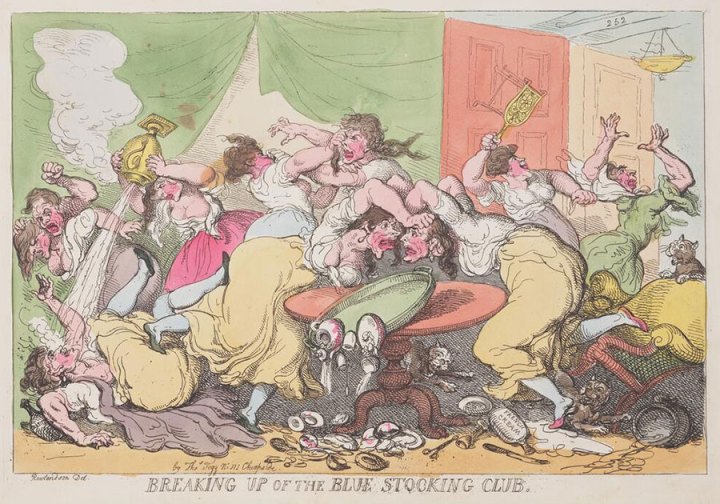
Thomas Rowlandson, Breaking Up of the Blue Stocking Club, 1815, hand-colored etching
(San Marino: Huntington Library, Art Museum, and Botanical Gardens)
◊ ◊ ◊ ◊ ◊
Next month at The Huntington:
Correspondence and Embodiment: The Bluestocking Corpus Online
The Huntington Library, Art Museum, and Botanical Gardens, San Marino, 8–9 December 2023
Organized by Elizabeth Eger and Nicole Pohl
This conference, organized in collaboration with the Elizabeth Montagu’s Correspondence Online (EMCO) project, explores themes related to The Huntington’s Elizabeth Montagu Papers. Topics include the letter as object, historical document, linguistic artifact, as well as a carrier of objects and messages about friendship, health, the mind and body, and politics. The Huntington’s collection of Elizabeth Montagu’s extensive correspondence has provided a rich source—as well as a practical challenge—for scholars working in a variety of fields, from social and economic history to histories of medicine, aesthetics, authorial selfhood, and literary genres.
Elizabeth Robinson Montagu (1718–1800) combined many roles: pioneering Shakespeare critic, businesswoman, manager of coalmines and agricultural estates, philanthropist, and patron of artists and writers. She pivoted between several important social, political, religious, and intellectual networks. Her letters connect people, places and concepts with graphic immediacy.
In 2017, the registered charity Elizabeth Montagu Correspondence Online (EMCO) was founded to fund the digitization of her 8000 extant manuscript letters, most of which are curated by The Huntington Library. This conference will explore themes connected to the archive, the letter as object, historical document, linguistic artifact, as well as a carrier of objects and messages about friendship, health, the mind and body, and politics.
This conference is organized by Elizabeth Eger (King’s College, London) and Nicole Pohl (Oxford Brookes, Oxford). Funding is provided by The Homer Crotty Lecture Endowment and the Edward A. Mayers Fellowship Endowment.
f r i d a y , 8 d e c e m b e r 2 0 2 3
8.45 Registration and Coffee
9.15 Welcome by Susan Juster (The Huntington Library) and Conveners
9.30 Session 1 | A History of the Montagu Collection at The Huntington
• Vanessa Wilkie (The Huntington Library)
• Karla Nielsen (The Huntington Library)
10.00 Break
10.30 Session 2 | EMCO: The Physical Archive and Its Virtual Other
Moderator: Joanna Barker (Durham and EMCO Senior Editor)
• Alexander Roberts (Swansea University)
• Daniel Archambault (Swansea University)
• Nicole Pohl (Oxford Brookes and EMCO Editor in Chief)
Noon Lunch
1.00 Session 3 | Gender and Knowledge
Moderator: Emily Anderson (University of Southern California)
• Rachael Scarborough King (UC Santa Barbara), Improving Letters: Self- and Literary Improvement in Women’s Epistolary Genres
• Nataliia Voloshkova, (Kazimierz Wielki University), Bluestockings and Science: Acquiring, Sharing, and Employing Knowledge, read by Nicole Pohl
2.30 Break
3.00 Session 4 | Absence and Presence
Moderator: Susan Carlile (Cal State Long Beach)
• Elizabeth Eger (King’s College London and EMCO Consultant Editor), Embodying Mind: Portraits of Elizabeth Montagu
• Felicity Nussbaum (UCLA), The Beloved Absent: The Correspondence between Elizabeth Montagu and Hester Thrale Piozzi
s a t u r d a y , 9 d e c e m b e r 2 0 2 3
8.30 Registration and Coffee
9.00 Session 5 | Embodying Language: The Letter and Creative and Critical Modes of Writing
Moderator: Nicole Pohl (Oxford Brookes)
• Betty A. Schellenberg (Simon Fraser University), Unclothed Bodies: The Problem of Enclosures in the Montagu Collection
• Mike Cousins (Historian), Keeping Track of Mrs. Montagu: Challenges in Dating Her Correspondence with Lord Lyttelton, and a Comparison with Unpublished Letter Collections of Some Other Contemporary Women Writers
10.30 Tours of the Library and Gallery
Noon Lunch
1.00 Session 6 | Bodies in Letters, Letters as Bodies
Moderator: Dena Goodman (University of Michigan)
• Lisa Forman Cody (Claremont McKenna College), Pregnant Pauses: Reproduction in—and as—Letter Writing
• Karen Harvey (University of Birmingham), ʽWe Must Chat about Invalids’: The Lived Body in British Women’s Letters, 1730–1800
2.30 Break
3.00 Session 7 | In Sickness and in Health: Bluestocking Friendship
Moderator: Karla Nielsen (The Huntington Library)
• Anna Senkiw (Oxford Brookes), ʽSeveral Weeks Indisposition, a Little Dastardly Fever Lurking about Me, Has Hinderd My Coming to the Adelphi’: Friendship with the Garricks, in Sickness and in Health
• Helen Deutsch (UCLA), Symptomatic Correspondences, Female Complaints: Authorship, Friendship and Illness in the Montagu Letters
4.30 Concluding Remarks
Colloquium | Léopold Robert and Aurèle Robert
From the conference programme:
Frères d’art: Léopold et Aurèle Robert
Neuchâtel / La Chaux-de-Fonds, 9–10 November 2023
 Dans le cadre de l’exposition Léopold et Aurèle Robert présentée conjointement au Musée des beaux-arts de La Chaux-de-Fonds et au Musée d’art et d’histoire de Neuchâtel du 14 mai au 12 novembre 2023, l’Institut d’histoire de l’art et de muséologie de l’Université de Neuchâtel souhaite encourager la réflexion et l’échange d’idées à propos de ces deux figures artistiques à l’occasion d’un colloque international. Celui-ci se tiendra en présentiel le jeudi 9 novembre 2023 au Musée d’art et d’histoire de Neuchâtel, et le vendredi 10 novembre 2023 au Musée des beaux-arts de La Chaux-de-Fonds.
j e u d i , 9 n o v e m b r e 2 0 2 3
10.00 Accueil et café
10.30 La fabrique de l’œuvre: Léopold Robert au travail
• Léopold Robert au prisme de la conservation-restauration: État des lieux, nouvelles investigations et perspectives — Léa Gentil (Musée des beaux-arts de La Chaux-de-Fonds)
• La notion d’« œuvres de jeunesse » touchant Léopold Robert: Un réexamen des premières orientations de l’artiste — Cecilia Hurley (École du Louvre / Université de Neuchâtel)
• Les Brigands de Robert, ou l’art d’accommoder les restes de l’histoire de l’art — Pascal Griener (Université de Cambridge / École du Louvre)
12.30 Pause déjeuner
14.00 La fabrique de l’œuvre: Aurèle Robert au travail
• Un sens aigu de l’observation: Corpus d’études d’après nature d’Aurèle Robert conservé au Musée des beaux-arts du Locle — Anaëlle Hirschi (Chargée de projet de recherche en collaboration avec le Musée des beaux-arts du Locle)
• Les hors-champs de l’image: L’Atelier de Léopold Robert à Rome en 1829 par Aurèle Robert — Lucie Girardin Cestone (Musée d’art et d’histoire de Neuchâtel)
15.30 Pause café
16.00 Conférence
• Quand le folklore devient désirable: La mise en scène de la vie populaire entre représentation, collection et recherche — Federica Tamarozzi (Musée d’ethnographie de Genève)
v e n d r e d i , 1 0 n o v e m b r e 2 0 2 3
10.00 Accueil et café
10.30 Les stratégies de Léopold Robert, ou comment prendre sa place sur la scène artistique
• Une histoire de regards — Walter Tschopp (Fondation Ateliers d’Artistes)
• Léopold Robert et l’apparition de la grande scène de genre italienne en France — Laurent Langer (Musée d’art de Pully)
• Petit genre et grand format: Quelle grandeur pour représenter le peuple ? — Olivier Bonfait (Université de Bourgogne Franche-Comté, LIR3S)
12.30 Pause déjeuner
14.00 Regards contemporains sur Léopold Robert
• Léopold Robert et les écrivains de son temps (suite) — Alain Corbellari (Universités de Lausanne et de Neuchâtel)
• The legacy of Léopold Robert in 19th-century cosmopolitan Rome — Giovanna Capitelli (Università degli Studi Roma Tre)
15.30 Pause café
16.00 Conférence
• Et in Italia ego: Le voyage des peintres femmes à Rome et en Italie au XIXe siècle — Martine Lacas (Auteure, chercheuse et commissaire d’exposition indépendante)
Conference | A Mundane History of Collecting, 1600–1918
From ArtHist.net:
The Backstage View: A Mundane History of Collecting, 1600–1918
Collegium Maius, Adam Mickiewicz University, Poznań, 26–27 October 2023
Organized by Michał Mencfel and Camilla Murgia
 After more than half a century of intense scientific exploration, resulting in hundreds of in-depth studies, the history of collections has established itself as one of the privileged fields of research in the humanities. Various issues such as the provenance of objects in collections; ways in which these objects have been ordered, arranged, and displayed; rooms and buildings in which they have been kept and exhibited; narratives beyond objects and collections; biographies of collectors; social practices connected with collections, etc. have been versatilely investigated. Consequently, collecting—fascinating in its own right—has proved also to be a sensitive indicator of broad cultural and social phenomena connected with artistic, scientific, philosophical, societal, and political movements.
Indeed, recent research has shown how the art market has been crucial to the history of collections in specific cultural contexts that have undergone a series of exchanges and openings linking different economic elements and realities (Brill’s Studies in the History of Collecting & Art Markets). Furthermore, particular attention has been paid to both the circulation of works of art from the perspective of collecting strategies (Art Markets, Agents and Collectors: Collecting Strategies in Europe and the United States 1550–1950, ed. by Adriana Turpin and Susan Bracken, 2021), and of provenances (Study of Collecting and Provenance and the Getty Provenance Index).
Collecting, however, also relies on a great number of less noble and less sophisticated but nevertheless indispensable practices. These include negotiating with artists and dealers, observing (or escaping) the formalities, paying (or avoiding paying) customs fees, transporting and securing the collectibles, restoring and framing the pieces of art, etc. The present call for contributions aims to invite proposals for papers focusing on this everyday—somewhat down-to-earth and mundane—side of collecting. What about this background, consisting of daily actions, practical skills, and made-to-measure resolutions, that contributes to the constitution of collections and the act of collecting itself? How does this meticulous, essential and somehow ‘invisible’ infrastructure enable the purchase, conditioning, sale, and exchange of artwork?
This conference aims to explore the various aspects regarding the mundane site of the history of collecting. We intend to question the multitude of logistic, administrative, organisational, and managerial practices that contribute to the act of collecting and how they affect selling and buying artwork. We are interested in identifying and studying the elements that mark out the diverse and versatile apparatuses of collecting in specific cultural, social, and economic realities, both private and public. Changes in issues, paradigms, and availability are at the heart of our study.
Conference Organizers
Michał Mencfel (Adam Mickiewicz University), mmencfel@amu.edu.pl
Camilla Murgia (Université de Lausanne), camilla.murgia@unil.ch
t h u r s d a y , 2 6 o c t o b e r 2 0 2 3
9.00 Registration
9.30 Welcome by Michał Mencfel (Adam Mickiewicz University) and Camilla Murgia (Université de Lausanne)
1000 Panel 1 | References
• Katharina Januschewski (Universität Paderborn) — Selling Italian Landscapes to the Russian Empire: Sylvester Shchedrin’s Letters from Italy (1818–30) as a Source for International Art Transport Logistics and Sales Strategies
• Malena Rotter (Gemäldegalerie Alte Meister, Kassel) — ‘I Am Gradually Acquiring the Necessary Material for a Gallery of Italian Pieces’: Landgrave William VIII of Hesse-Kassel (1682–1760) and His Italian Collection
11.10 Coffee
11.30 Panel 2 | Mundanity
• Ulrike Müller (Antwerp University and Royal Museums of Fine Arts of Belgium) and Davy Depelchin (Royal Museums of Fine Arts of Belgium) — Staging Privately-Owned Artworks: Private Collectors and the Exhibitions for Living Masters in Brussels, 1830–1860
• Maria Chiara Scuderi (University of Leicester) — Missionary Exhibitions as Mundane Sites for Private Collections: The Case of Dryad ‘Handicrafts’
12:40 Lunch
14.15 Panel 3 | Curating
• Arianna Candeago (Ca’ Foscari University Venice) — On the Art Market in Late 18th-Century Venice: Everyday Practices from the Letters of Collectors and Intermediaries
• Michelle Huang (University of St Andrews) — Curatorial Considerations and Practices behind the Acquisitions of the George Eumorfopoulos Collection of Chinese Art by the British Museum and the V&A
15.20 Coffee
15.40 Panel 4 | Practices
• Dorothee Haffner (Hochschule für Technik und Wirtschaft Berlin) — Organising and Visualising Collections: Changing Principles and Functions
• Laia Anguix-Vilches (Radboud University Nijmegen) — Women in the Backstage: Gender-Related Challenges in Institutional Collecting Practices
f r i d a y , 2 7 o c t o b e r 2 0 2 3
9.30 Welcome by Michał Mencfel (Adam Mickiewicz University) and Camilla Murgia (Université de Lausanne)
9.45 Keynote Lecture
• Erin Thompson (City University of New York) — Backstage, Viewed from the Archives: Researching Illicit Trafficking in Cultural Property
10.45 Coffee
11.00 Panel 5 | Trading and Cataloguing
• Nadia Rizzo (Scuola Normale Superiore, Pisa) — The Unfortunate Vicissitudes of Jean Gossaert’s Malvagna Triptych
• Bénédicte Miyamoto (Université Sorbonne Nouvelle) — Auction Clerks and Paper Trails: The Bureaucracy of Collection Transfers in 18th-Century Britain
• Elizabeth Pergam (Society for the History of Collecting) — Trading Art History: Art Dealer Archives and Day-To-Day Business of Collecting
12.45 Lunch
14.30 Panel 6 | Shaping Collections
• Martyna Łukasiewicz (Adam Mickiewicz University) — Fortune and Vision: The Art Market and the Emergence of Major Art Collections in Copenhagen, 1850–1900
• Silvia Marin Barutcieff (University of Bucharest) — Collecting Art in Modern Romania: Social Circumstances and Economic Endeavors, 1881–1918
15.40 Closing Notes and Coffee
Colloquium | Matières du Décor Architectural
From ArtHist.net:
Matières du Décor Architectural: XVIe–XVIIIe Siècles
Université de Franche-Comté, Besançon, 19–20 October 2023
Dans la continuité du Material Turn, de nombreux travaux ont été entrepris ces dernières années afin d’envisager le décor sous l’angle de la matière, souvent en privilégiant un matériau en particulier ou certains de ses acteurs. En croisant et en mettant en perspective les résultats des recherches récentes menées sur le bois, le stuc, le marbre, le verre, la céramique ou encore le cuir en tant que revêtement mural à l’époque moderne, le présent colloque a pour ambition de renouveler ces approches, parfois cloisonnées. L’objectif de ces deux journées est de réunir des spécialistes de ces matières, en fédérant une communauté de chercheurs autour de questionnements communs qui touchent aussi bien à l’histoire des techniques, qu’à celle du décor architectural ou des transferts artistiques en Europe. Les échanges permettront de confronter les méthodologies, les sources exploitées et les résultats des différents travaux afin de dresser un bilan, mais aussi de faire émerger de nouvelles idées à partir de l’actualité des recherches en cours, en prenant aussi en compte les chantiers de restauration et le rôle des humanités numériques dans la restitution et la compréhension des différentes matières du décor. Aucune inscription n’est nécessaire.
Organisation scientifique
Sandra Bazin-Henry (Université de Franche-Comté)
Matthieu Lett (Université de Bourgogne)
j e u d i , 1 9 o c t o b r e 2 0 2 3
9.15 Accueil des participants
9.30 Introduction
• Sandra Bazin-Henry et Matthieu Lett, Les matières du décor à l’épreuve du projet architectural
10.00 Expérimentation des Matières entre Magnificence et Intimité
• Pascal Julien (Université Toulouse – Jean Jaurès – FRAMESPA), Une majesté d’apparat: Couleurs marmoréennes dans les édifices en France, XVIe–XVIIe siècles
• Jean-François Belhoste (École pratique des Hautes Études), Le Grand Trianon: Un laboratoire pour les techniques du décor
• Sandra Bazin-Henry (Université de Franche-Comté – Centre Lucien Febvre), «Cabinets enchantés» : Réceptacles privilégiés d’une histoire des matières et du goût à l’époque moderne
12.30 Déjeuner
13.30 Matérialité de l’Ornement
• Céline Bonnot-Diconne (2CRC, Moirans), Les «cuirs de Cordoue», un art décoratif oublié
• Damien Tellas (Sorbonne Université – La Manufacture du Patrimoine), Jean Cotelle, Charles Errard et le plafond ornemental au milieu du XVIIe siècle
15.00 Pause
15.15 Bilan, Perspectives et Actualités de la Recherche
• Matthieu Lett (Université de Bourgogne – LIR3S), Virtualiser la matière: Que peuvent les outils numériques pour l’étude du décor architectural?
• Romain Thomas (INHA – Université Paris Nanterre), Présentation du projet ANR AORUM: Analyse de l’Or et de ses Usages comme Matériau pictural en Europe occidentale aux XVIe et XVIIe siècles
• Lionel Arsac (Musée national des châteaux de Versailles et de Trianon), Présentation d’un nouveau groupe de recherche sur le stuc dans les grandes demeures françaises, XVIe–XIXe siècles
v e n d r e d i , 2 0 o c t o b r e 2 0 2 3
9.00 Effets de Matières
• Nicolas Cordon (Université Paris 1 Panthéon-Sorbonne), Le blanc dans l’architecture religieuse de la première modernité
• Bérangère Poulain (Université de Genève), La couleur comme matière «agissante»: Perception et imaginaire de la peinture d’impression sur boiseries au XVIIIe siècle
10.30 Chantiers Franc-Comtois
• Christiane Roussel (Inventaire général du patrimoine), Besançon, palais Granvelle: Le décor de « tapisseries en cuir » dans l’inventaire après décès du comte de Cantecroix en 1607
• Mickaël Zito (Musée des Beaux-Arts et d’Archéologie de Besançon), Le stuc, une affaire de famille: Plongée au cœur de l’atelier des Marca, stucateurs de la Valsesia actifs en Franche-Comté, 1700–1850
12.00 Déjeuner
13.00 Chantiers Franc-Comtois
• Matthieu Fantoni (DRAC Bourgogne-Franche-Comté), La polychromie du décor du XVIIIe siècle à l’épreuve de sa restauration: Quelques études de cas sur le territoire franc-comtois
13.45 Conclusion
Conference | Decorative Arts of the Middle East and North Africa
From ArtHist.net:
Interiors Reconfigured: Changing Materiality and Craftsmanship in the Decorative Arts of the Middle East and North Africa, 18th–20th Centuries
Vitrocentre Romont, Switzerland, 3–4 November 2023
Organized by Francine Giese, Sarah Keller and Mercedes Volait
This international conference is dedicated to the decorative arts of the Middle East and North Africa with a special focus on material aspects and local practices. In the course of profound changes since the 18th century, local tastes and craftmanship began to mutate under Ottoman and Western influence. The conference will address these changes and emphasise the growing importance of material-based analysis in the field of Middle Eastern and Maghrebi décors. Participation is free of charge; registration is required by 30 October 2023 at claudine.demierre@vitrocentre.ch.
f r i d a y , 3 n o v e m b e r 2 0 2 3
9.30 Opening Remarks
• Francine Giese (Vitrocentre Romont) and Mercedes Volait (CNRS/InVisu)
9.45 Keynote Lecture
• The Manifold Dynamics of Domestic Space and Architectural Fashion: Glimpses from Beirut, Sidon, and Cairo between the 18th and 20th Centuries — Ralph Bodenstein (German Archaeological Institute Cairo)
10.45 Coffee
11.15 Transformations
Chair: Francine Giese (Vitrocentre Romont)
• Cairene Interiors as Dynamic Spaces: The Successive Refurbishments of Manzil al-Sadat in the 19th Century — Mercedes Volait (CNRS/InVisu)
• Réorientaliser l’architecture « mauresque »: Intérieurs algériens recomposés aux XIXe et XXe siècles — Claudine Piaton (CNRS/InVisu)
• Ramsès Wissa Wassef et la rénovation de la kamariya — Leïla el-Wakil (University of Geneva)
13.00 Lunch
14.15 Materiality
Chair: Doris Behrens-Abouseif (SOAS University of London)
• A Changing Preference for Textile in Ottoman Interiors, 1705–1755 — Nazlı Songülen (Kadir Has University)
• Furnishing Fabrics: The Qalamkar Textiles in the Domestic Interiors of the Qajar, Iran — Fahimeh Ghorbani (University of Toronto)
• The Materiality of Stucco-Glass Windows in 19th-Century Egypt — Francine Giese, Sarah Keller, and Sophie Wolf (Vitrocentre Romont)
• Technical Heritage of Making Stucco and Glass Lattice Works in Iran — Amir-Hossein Karimy and Afsaneh Sobhani (Art University of Isfahan)
16.15 Coffee
16.45 Reconstructions
Chair: Sarah Keller (Vitrocentre Romont)
• František Schmoranz in Budapest: Reconstructing the Interior of the Oriental Pavilion at the 1885 National Exhibition in Budapest — Péter Nagy (Qatar Museums, Doha) and Ajla Bajramović (University of Vienna)
• The Railway Station of Bosanski Brod: A Historical and Visual Reconstruction of a Major Work of Orientalist Design in the Balkans — Maximilian Hartmuth (University of Vienna) and Malka Dizdarević (Vienna University of Technology)
• 3D Restitution of Saint-Maurice Residence in Cairo: 3D as a Tool to Monitor and Study Architectural Reuses — Vincent Baillet (Archeosciences Bordeaux)
s a t u r d a y , 4 n o v e m b e r 2 0 2 3
9.00 Nationalism, Part I
Chair: Nadia Radwan (University of Bern)
• The Reception of Glass Stucco Windows as Vernacular Element of «Turkish» Interior Decoration — Franziska Niemand (Vitrocentre Romont/University of Fribourg)
• The Bait Al-Naboodah in Sharjah, United Arab Emirates: A 19th-Century Pearl Merchant’s House between Tradition and Globalisation — Martin Nixon (Zayed University, Dubai)
10.00 Coffee
10.30 Nationalism, Part II
Chair: Ralph Bodenstein (German Archaeological Institute Cairo)
• Variations sur céramiques bleues: Concevoir l’intérieur oriental — Nadia Radwan (University of Bern)
• A Tale of Three Perspectives: Local Authenticity, Colonial Interference, and Hybridity within the Construction Methods of at-Tastīr – Moroccan Geometric Arts — El Fasiki (Craft Draft)
• Back to the Future? The 1927 ‹Arab Style› Interior of Hoda Shaarawy’s ‹House of the Egyptian Woman› as a Display of the Nation — Philipp Zobel (University of Regensburg)
12.15 Lunch
13.00 Presentation of Original Documents at Vitromusée Romont
• La Maison Tarazi: A Family-Run Furnishing Company from Beirut — Camille Tarazi (Maison Tarazi)
Workshop | Images in Comparative Anatomy, 1500–1900
Next month at the Bibliotheca Hertziana, as noted at ArtHist.net:
Drawing Comparisons: Images in Comparative Anatomy, 1500–1900
In-person and online, Bibliotheca Hertziana, Villino Stroganoff, Rome, 20 October 2023

Comparison of the skeleton of a bird and a man; from Pierre Belon, Histoire de la nature des oyseaux (Paris: Guillaume Cavellat, 1555).
The history of art and the practice of anatomy have long depended upon similar acts of comparison: identifying, visualizing, and describing likenesses. This workshop investigates the role of images in developing comparative anatomy—the study of anatomy across species—in early modern Europe.
Visual or formal analysis entails a search not only for forms but for likenesses. To look closely is, in other words, to look across. Anatomy, likewise, depends upon comparison. From Leonardo to Linnaeus, early modern anatomical knowledge materialized through bodies conceived as similar. The discipline of comparative anatomy emerged, specifically, as generalizations occurred across the human/nonhuman divide. The history of the anatomical image is also a history of violence, as those anatomical procedures allowing comparison (dissection and vivisection) often proceeded through the forceful manipulation, observation and depiction of the (non)human body. Scholars from various disciplines (history of art, history of science and medicine, philosophy, fine arts, paleontology) will consider the use of images in generating comparison and in both formulating and challenging comparative anatomical knowledge.
p r o g r a m m e
10.30 Introduction
• Alejandro Nodarse (Bibliotheca Hertziana / Harvard University) A Guide to Looking Across
11.00 Session One | Drawing Order
• Martin Clayton (Royal Collection Trust, Windsor Castle), ‘Describe the Jaw of a Crocodile’: Leonardo da Vinci’s Animal Anatomies
• Katrina van Grouw (University of Cambridge) Linnaeus Organized: Illustrating Convergence in Comparative Anatomy
12.30 Lunch Break
13.30 Session Two | Languages of Likeness
• Maria Conforti (Sapienza Università di Roma), Fruits, Mushrooms, and Trees: Botanical Imagery in Early Modern Surgery and Anatomy
• Paul North (Yale University), Likeness Looks Both Ways
15.00 Coffee Break
15.30 Session Three | Violence in the Comparative
• Thomas Balfe (Courtauld Institute), Skin Deep? Visualizing Human and Animal Violence in Early Modern Still Life Painting
• Rose Marie San Juan (University College London), Anatomical Violence and the Pain of Resemblance
17.00 Pause
17.15 Roundtable Discussion
Online Symposium | J. M. W. Turner: State of the Field
From ArtHist.net and YCBA:
J. M. W. Turner: State of the Field
Online, 22–23 September 2023

J.M.W. Turner, Staffa, Fingal’s Cave, 1831–32, oil on canvas, 91 × 121 cm (New Haven: Yale Center for British Art, Paul Mellon Collection).
This symposium will consider the state and meaning of scholarship on J. M. W. Turner (1775–1851), one of Britain’s most celebrated artists. Thinking through the extensive Turner historiography, this symposium will explore some of the key ideas, underlying assumptions, and future directions of research. Panelists will consider the place of their research within the broader field of British studies.
To join us on September 22, please register here»
To join us on September 23, please register here»
f r i d a y , 2 2 s e p t e m b e r 2 0 2 3
All times Eastern Standard Time
9.00 Welcome by Courtney J. Martin (Yale Center for British Art)
9.10 Introduction: Turner in 2025 at the Yale Center for British Art — Lucinda Lax (Yale Center for British Art)
9.25 Keynote Conversation
• Amy Concannon (Tate Britain) in conversation with Richard Johns (University of York), moderated by Tim Barringer (Yale University)
10.25 Break
10.35 Panel 1 | Works on Paper and in the Environment
• Turner’s Pencil: Graphite Landscapes and Extractive Industry — Tobah Aukland-Peck (The Graduate Center, CUNY)
• ‘To Be Broken Up’: Turner, English Landscape, and the Anthropo(s)cenic — Frédéric Ogée (Université Paris Cité)
• A Historiographical Lacuna: Turner’s Prints — Gillian Forrester (independent scholar)
11.55 Break
12.05 Panel 2 | Sharing Turner
• Technical Studies for Turner: How Well Do We Share Knowledge? — Joyce Townsend (Tate Britain)
• The J. M. W. Turner Database: New Approaches to Documenting Turner for the 21st Century — Ian Warrell (independent scholar) and David Hill (University of Leeds)
• Cataloging Turner’s Sketchbooks, Drawings, and Watercolours — Turner Cataloging staff (Tate Britain)
s a t u r d a y , 2 3 s e p t e m b e r 2 0 2 3
9.00 Panel 3 | Early Turner
• Whither Early Turner? — Leo Costello (Rice University)
• Turner and the Landed Estate — John Bonehill (University of Glasgow)
10.05 Break
10.15 Panel 4 | Curating Turner
• Turner at Petworth: Past Approaches and Future Directions — Emily Knight (National Trust)
• The Young Turner: Ambitions in Architecture and the Art of Perspective — Helen Cobby (Bath Spa University)
11.15 Break
11.25 Panel 5 | Varied Approaches: Language, Economy, and Ecology
• The Ecological Turn(er) — Sarah Gould (Université Paris 1, Panthéon Sorbonne)
• ‘The Sun is God’: Turner, Angerstein, and Insurance — Matthew Hunter (McGill University)
• Translating Turner: The French Edition of the Correspondence — Aurélie Petiot (Université Paris Nanterre)
Printmaking for Change: Past and Present

Thomas Rowlandson, The Contrast (detail), 1793, hand-coloured etching and letterpress, 25 × 35 cm
(London: The British Museum)
◊ ◊ ◊ ◊ ◊
From the Paul Mellon Centre:
Printmaking for Change: Past and Present
In-person and online, London, 2–12 October 2023
Join us for a festival of free events exploring how different communities have used, and continue to use, printmaking to enact change, share knowledge, and challenge ideas. With talks, workshops, and behind-the-scenes visits, the two-week festival will explore the potential of printmaking as both a means of mass communication and a radical art form. From the fifteenth century to the present day, the programme will cover a broad range of topics from gender, sexuality and race, to politics, activism, and health. The programme is an introduction to the subject and is open to all. Talks and workshops will take place at the Paul Mellon Centre, the British Museum, PageMasters, and the Royal College of Physicians. Talks at the Paul Mellon Centre will be streamed live via Zoom. Off-site workshops will be in person only.
Registration (required) via Eventbrite opens 8 September.
◊ ◊ ◊ ◊ ◊
Monday, 2 October, 6–8pm
Introductory Session | Printmaking for Change, with Ben Thomas and Marcelle Hanselaar at the Paul Mellon Centre
Prints are multiple yet individual, unpredictable and hard to regulate, often critical, funny, ephemeral, frightening, irreverent, angry or just plain weird. They can be popular or obscure, sophisticated or clumsy, beautiful or ugly or, when responding to market demand, repetitive and dull. They are hard to define and categorise and for that reason tend to be ignored by curators in their displays, yet every national art collection will have far more prints than paintings. Prints are also cheap by comparison with other artworks and can be collected by ordinary people, disseminating their message widely. In this introductory session, art historian Ben Thomas and painter and printmaker Marcelle Hanselaar will discuss the properties of prints that challenge our expectations, and how as an artform they can be democratic, undisciplined and consequently forces for change.
Wednesday, 4 October, 2–4pm
Collections Visit | Printmaking and Politics, with Esther Chadwick and Richard Taws at the Prints and Drawings Study Room of The British Museum
Go behind the scenes at the British Museum to experience a selection of prints from the eighteenth and nineteenth centuries that explore the varied and complex relationships between printmaking and politics. We will look at prints designed to persuade and effect political change and consider printmaking as a link between politics and ‘high art’. Ranging from woodcut to lithography, line engraving to aquatint, our selection will also highlight how print was used around the world at a time of social, political, and economic unrest.
Saturday, 7 October, 10am–12.30pm or 1.30–4pm
Risograph Workshop | Printmaking and Protest at PageMasters, Lewisham
This workshop will introduce you to risograph printing—a technique often described as a cross between screen printing and photocopying, which uses spot colours and stencils to create multiple prints. Taking place at PageMasters in Lewisham, the session will begin with an introduction to risograph and tour of the studio. This will be followed by an exploration of PageMasters’ archive of protest prints and the opportunity to create your own two-colour A4 print to take home.
Monday, 9 October, 10.30am–noon and 1–2.30pm
Collections Visit | Printmaking and Health, with Jack Hartnell and Katie Birkwood at the Royal College of Physicians
Using the fascinating early print collections of the Royal College of Physicians, this session will explore the roles played by printing, printers and print technology in the world of health. From diagrams in surgical manuals to moveable flap books demonstrating the body’s inner anatomical workings, printed objects have long helped medics debate how to care for changing bodies. The Royal College of Physician’s materials will provide us with a window into how bodies past were understood by artists, physicians, midwives and surgeons alike.
Tuesday, 10 October, 6–8pm
Talk | Mezzotint Engraving and the Making of Race, with Jennifer Chuong, Martin Myrone, and Mechthild Fend at the Paul Mellon Centre
How have prints shaped our understanding of bodies and, specifically, our understanding of race as a bodily attribute? In this session we will explore how a particular print technique, mezzotint engraving, contributed to racial theories between the sixteenth and eighteenth centuries. The mezzotint, which can produce smooth tonal areas with dots or lines, became hugely popular in Britain in the second half of the eighteenth century as a means of reproducing portraits. We will discuss how this technique resonated with new anatomical and racial ideas in this period and subsequently how we can better understand print’s role in developing ideas of race and the body.
Thursday, 12 October, 6–8pm
Talk | Printmaking and LGBTQIA+ Communities, with Zorian Clayton at the Paul Mellon Centre
Join V&A curator of prints, Zorian Clayton, to explore LGBTQIA+ liberty and visibility through the varied history of printmaking. Via seventeenth-century radicals, eighteenth-century flamboyance, and nineteenth-century scandal, to contemporary understandings around diverse gender and sexuality, prints and ephemera, Zorian will provide a unique snapshot into a rich and radical history. Through looking at portraits and zines celebrating pioneering activists, writers and artists, as well as highlighting significant Queer spaces in Britain through the centuries, this session will provide an overview of the considerable contribution to printmaking made by the LGBTQIA+ community and its many ancestors.
Conference | Rethinking British and European Romanticisms, Part II
From ArtHist.net and the University of York:
Rethinking British and European Romanticisms in Transnational Dimensions, Part II
University of York, King’s Manor, 19–21 September 2023
Organized by Elisabeth Ansel, Johannes Grave, Richard Johns, Christin Neubauer, and Elizabeth Prettejohn
 The event is the second part of a cooperative two-part workshop between the History of Art Departments of the University of York and the Friedrich Schiller University Jena. Considering the institution’s main research areas, the event aims to discuss the different concepts of Europe present in the art and culture of Romanticism.
In recent years, national tendencies have challenged the European idea, exemplified by the wake of Brexit and its aftermath. In this context, the question arises to what extent European and national identity concepts can be reconciled. Today’s debate between Britain and Europe still roots in the divergent notions of national identity that manifested in several European countries in the 1800s.
Therefore, the workshop addresses the relationship between visual images and constructions of nationality and questions how European Romanticism can be understood. In contrast to literary studies, investigating transnational transfer processes of Romantic movements has been a desideratum in art historical research. Considering transcultural methods, the participants will reflect national patterns of thought and Romantic identities not as fixed but as processual and hybrid phenomena within the framework of the binational exchange. Based on individual case studies, the event aims to reevaluate the complex interplay of alterity and reciprocity of the relations between cultural spaces.
Funded by University of York and Deutsche Forschungsgemeinschaft (German Research Foundation)
t u e s d a y , 1 9 s e p t e m b e r 2 0 2 3
9.45 Welcome and Introduction — Richard Johns
10.15 Morning Papers
• Marte Stinis (York) — ‘Sound Resounded from All the Treetops’: The Musical Landscape
• Sammi Lukic-Scott (York) — The Language of the Copy
• David Grube-Palzer (Jena) — Copy and Self-Repetition in the Age of Genius: Using the Example of Caspar David Friedrich
13.00 Lunch
14.30 Afternoon Papers
• Christin Neubauer (Jena) — Debts to German Romanticism in Joseph Noel Paton’s Luther: Dawn at Erfurt (1861)
• Miguel Angel Gaete Cáceres (York) — Johann Moritz Rugendas’ Picturesque Slavery: Denounce or Morbid Sublime Pleasure?
17.00 Evening Presentation
• Elizabeth Prettejohn (York) — Romanticism and Renaissance: Ideas for an Exhibition
18.30 Reception at King’s Manor
w e d n e s d a y , 2 0 s e p t e m b e r 2 0 2 3
10.00 Greeting
10.15 Morning Papers
• Richard Johns (York) — Further Thoughts on the Artist’s Bequest as a Romantic Phenomenon
• Elisabeth Ansel (Jena) — Heroic Femininity and the ‘Joy of Grief’ in Elizabeth Harvey’s Malvina Lamenting the Death of Oscar (1806)
• Mira Claire Zadrozny (Jena) — Emergent Pictoriality: Images of Ruins in 19th-Century France
13.00 Lunch
14.30 Afternoon Papers
• Helena Cox (York) — The Mánes Family: Bohemian Romanticism and (Inter)National Belonging
• Kayleigh Williams (York) — ‘Her Eyes Were Wild’: Transmediation of Gender and Gaze in Rossetti’s La Belle Dame Sans Merci
16.45 York Museum Garden
18.00 Evening Presentation
• Johannes Grave (Jena) — Duality and Temporality: Evocations of the Sublime in Romantic Paintings
20.00 Dinner at House of Trembling Madness
t h u r s d a y , 2 1 s e p t e m b e r 2 0 2 3
9.15 Greeting
9.30 Morning Papers
• Johannes Rössler (Jena) — An Imagined Journey? Caspar David Friedrich and Switzerland
• Wanda Sue Warning (Jena) — Romanticising Youth: Sir Henry Raeburn’s Boy and Rabbit (1814) and the Portraiture of Anonymous Children
• Justus Hierlmeier (Jena) — Ligne et couleur in Théophile Thoré’s Des envois de Rome
12.15 Concluding Discussion
14.30 Afternoon Field Trip
• York Art Gallery
• Stroll through York
20.00 Dinner at Côte Brasserie
Conference | Garden Artist Friedrich Ludwig von Sckell (1750–1823)

Carl von Zimmermann, Portrait Friedrich Ludwig von Sckell, detail, ca. 1810 (Münchner Stadtmuseum)
From the website marking the 200th anniversary of the landscape gardener’s death: www.sckell2023.de
◊ ◊ ◊ ◊ ◊
From ArtHist.net:
Der Gartenkünstler Friedrich Ludwig von Sckell und seine Werke: Geschichte und Aktualität
Zentralinstitut für Kunstgeschichte, Munich, 13–14 October 2023
Organized by Jost Albert and Iris Lauterbach
Registration due by 8 October 2023
Friedrich Ludwig von Sckell war der bedeutendste deutsche Gartenkünstler seiner Generation. Seine Ausbildung in Schwetzingen, in Frankreich und in England verhalf ihm zu einem internationalen Netzwerk. Als kurfürstlicher Hofgärtner und seit 1804 bayerischer Hofgartenintendant sowie in privatem Auftrag realisierte Sckell zahlreiche und bedeutende Gartenanlagen. Als weitsichtiger Stadtplaner legte er die Grundlage für die Erweiterung Münchens zur königlichen Residenzstadt. Der Englische Garten und die Umgestaltung des Nymphenburger Schlossgartens sind die Hauptwerke seiner Münchner Phase. Mit klassisch schönen „Bildern der Natur“ entwarf Sckell Landschaftsgärten, die sich durch große Dimensionen, ausgefeilte räumliche Gestaltungen und einen respektvollen Umgang mit dem Vorhandenen auszeichnen. Die Tagung nimmt das Sckell-Jubiläum zu seinem 200. Todestag zum Anlass, um neue gartenhistorische Forschungsaspekte sowie aktuelle gartendenkmalpflegerische Herausforderungen vorzustellen. Anmeldung zur Tagung bitte bis 8. Oktober 2023 unter: sckell@zikg.eu. Die Teilnahme ist kostenfrei.
Konzeption: Jost Albert und Iris Lauterbach, in Kooperation mit dem AK Historische Gärten der Deutschen Gesellschaft für Gartenkunst und Landschaftskultur (DGGL)
Partnerinstitutionen des Webauftritts www.sckell2023.de:
Natur wird Kunst: Auf den Spuren des Gartenkünstlers Friedrich Ludwig von Sckell (1750–1823)
f r e i t a g , 1 3 o k t o b e r 2 0 2 3
8.30 Anmeldung zur Tagung
9.00 Iris Lauterbach, München — Begrüßung und Einführung
9.15 Friedrich Ludwig von Sckell: Gartenkünstler, Verwalter, Organisator
Moderation: Iris Lauterbach
• Rainer Herzog, München — Friedrich Ludwig von Sckell als königlicher Beamter: Die Hofgarten-Intendanz unter organisatorischen, personellen und finanziellen Aspekten
• Gabriele Ehberger, München — Corporate Identity für die Hofgartenintendanz: Sckells Entwurf einer Gärtneruniform
• Thorsten Marr, München — Der Publikumsverkehr im Nymphenburger Garten zur Zeit Sckells
• Brigitte Huber, München — Eine Stadt im Umbruch: München 1795 bis 1825
• Heike Palm, Hannover — „Überhaupt ist diese Parthie noch zu erweitern und unter die Gruppen me[h]r Deutlichkeit zu bringen.“ Sckells Begleittexte zu seinen Entwürfen
12.30 Mittagspause
14.00 Zu Sckells Pflanzenverwendung
Moderation: Jost Albert
• Clemens Alexander Wimmer, Potsdam — Die Pflanzenverwendung Sckells in ihrer Zeit und ihre Rezeption
• Hans Joachim Klemmt, München — Sckells Baumartenwahl: Eine forstliche Einwertung aus heutiger Sicht vor dem Hintergrund des Klimawandels
15.00 Kaffeepause
15.30 Gartenkunst in der Nachfolge von Friedrich Ludwig von Sckell
• Michael Schwahn, München — Carl August Sckell und der Englische Garten in Neuburg an der Donau
• Peter Lack, Güstrow — Ein Gärtner auf Grand Tour: Die zweijährige Reise des Fritz Sckell von 1826 bis 1828
• Dietger Hagner, Rudolstadt — Wilhelmsthal bei Eisenach: Die Transformation zum Landschaftsgarten und das Wirken der Thüringer Hofgärtnerfamilie Sckell
17.00 Pause und Ortswechsel
19.00 Abendveranstaltung (Max-Joseph-Saal der Residenz)
• Bernd Schreiber, Präsident der Bayerischen Verwaltung der staatlichen Schlösser, Gärten und Seen — Begrüßung
• Jost Albert, München — Sckells Arbeitsschwerpunkte in den letzten Lebensjahren
• Iris Lauterbach, München — Der Zauberstab des Gartenkünstlers: Sckells „Methode, in der Natur zu zeichnen“
• Udo Weilacher, Freising/München — Die Landschaft von Morgen: Impulse von Sckell
s a m s t a g , 1 4 o k t o b e r 2 0 2 3
Sckells Gärten heute: Herausforderungen und Ziele der Gartendenkmalpflege
Exkursionen mit Mitarbeiter:innen der Gärtenabteilung der Bayerischen Schlösserverwaltung. Teilnahme nur für angemeldete Teilnehmer:innen der Tagung
◊ ◊ ◊ ◊ ◊
d o n n e r s t a g , 1 2 o k t o b e r 2 0 2 3
12.00–16.00 Mitgliederversammlung des AK Historische Gärten der Deutschen Gesellschaft für Gartenkunst und Landschaftskultur (DGGL), nicht öffentlich
19.00 Öffentliche Abendveranstaltung (Bayerische Akademie der Schönen Künste)
Vergabe des Sckell-Rings durch die Bayerische Akademie der Schönen Künste und Laudatio
Vergabe der Sckell Students Awards, Preisvergabe durch Udo Weilacher, Technische Universität München










 Enfilade
leave a comment