Symposium | Architecture and Health, 1660–1830
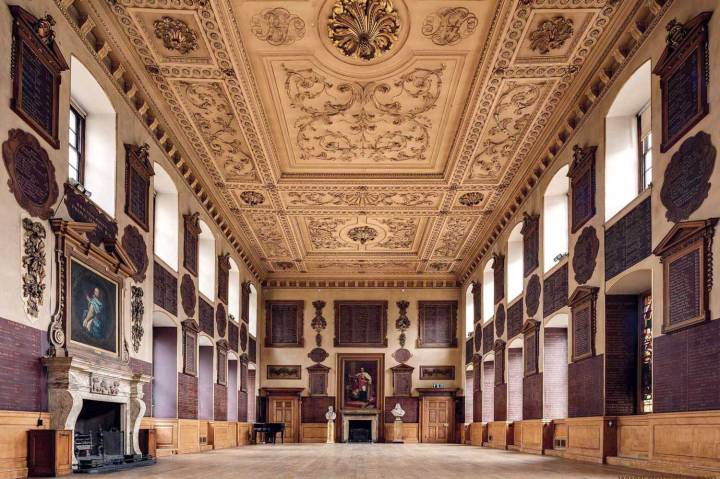
James Gibbs, The Great Hall of St Bart’s, London, 1730s (Photo by David Butler). Situated on the first floor of the hospital’s North Wing, the Great Hall is approached by way of a grand staircase, the walls of which were decorated by William Hogarth. At the top of the stairs, the Great Hall is accessed by a dominating doorway opening into the large hall, decorated with portraits and dedications to the early contributors to the redevelopment of the hospital. More information is available here»
◊ ◊ ◊ ◊ ◊
From The Georgian Group:
Architecture and Health, 1660–1830
Georgian Group Symposium, St Bartholomew’s Hospital, London, 3 November 2022
Rescheduled for 27 February 2023
Following successful symposia held by the Georgian Group in previous years—on the Adam Brothers, James Gibbs, Women and Architecture, and Georgian London Revisited (online)—this year’s symposium will address Architecture & Health in the long eighteenth century. Appropriately, it will be held in James Gibbs’s Great Hall at St Bartholomew’s, an institution celebrating its 900th anniversary. A series of short papers by both established and younger scholars, and from a range of disciplines, will examine how and where medicine was studied and debated, how knowledge was disseminated, and how healthcare was provided in what spaces and through what mechanisms. The symposium will be held from 10am to 5pm and will be led by Ann Marie Akehurst. Tickets (£70) include a buffet lunch and reception; a limited number of student tickets (£35 ) are also available. Please read the Terms and Conditions before booking. If tickets have sold out for this event, please email members@georgiangroup.org.uk to be added to the waiting list.
P R O G R A M M E
9.30 Registration
10.00 Welcome
Session 1: Transmission of Medico-Scientific Knowledge
• Matthew Walker — The Architecture of English Anatomy Theatres 1660–1800
• Janet Stiles Tyson — Elizabeth Blackwell’s A Curious Herbal and Bart’s
• Danielle Wilkens — Health in the Academy: Jefferson’s University of Virginia and Landscapes of Inequity
Session 2: Outside the Institutions: Health and Environment
• Joana Balsa de Pinho — Health, Architecture and Urbanism in the Early Modern Era: From Prevention to Treatment
• Allan Brodie — Georgian Margate: A Landscape and Townscape of Health
• India Knight — The Spa at Hampstead
Session 3: Places of Confinement
• Anna Jamieson — ‘Bedlam’s Picture Gallery’: Health, Performance, and the Built Environment at Bethlem
• Leslie Topp — Early Asylums and the Curious Appeal of Prison Designs
• Marina Ini — John Howard and the Quarantine Centres of the Eighteenth-Century Mediterranean
• Sarah Akibogun — The (Other) Woman in The Attic: Considering Post-Colonial Lenses on the Treatment of Madness in Georgian England
Session 4: Enduring Hospital Spaces
• Tessa Murdoch — French Protestant Hospital in Clerkenwell, 1742
• Elisabeth Einberg — Hogarth’s Use of Architectural Space to Bring Home the Message
• Dan Cruickshank — Bart’s Great Hall
• Will Palin — Bart’s Heritage
5.00 Drinks Reception
◊ ◊ ◊ ◊ ◊
N.B. — (note added 22 February 2023) — The symposium was postponed from November to February due to train strikes; the schedule has also been adjusted with an 11am start time; please see the Georgian Society website for details.
Call for Panel Proposals | HECAA at 30

Hannah Otis, View of Boston Common, about 1750
(Museum of Fine Arts, Boston, 1996.26)
◊ ◊ ◊ ◊ ◊
HECAA@30: Environments, Materials, and Futures of the Eighteenth Century
Boston, 12–15 October 2023
Proposald due by 1 September 2022
The Historians of Eighteenth-Century Art and Architecture (HECAA) announce an open call for panel proposals for our quinquennial conference, to be held in Boston, 12–15 October 2023.
On the land of the Massachusett and neighboring Wampanoag and Nipmuc peoples, Boston developed in the eighteenth century as a major colonized and colonizing site. Its status today as a cultural and intellectual hub is shaped by that context, making it a critical location to trace the cultural legacies of racism and social injustice between the eighteenth century and today. For whom is ‘eighteenth-century art and architecture’ a useful category? What eighteenth-century materials, spaces, and images offer tools or concepts for shaping our collective futures? In considering these questions, we aim to be deliberate about expanding HECAA’s traditional focus on Western European art and architecture and specifically encourage proposals from scholars working on Asia, Africa and the African diaspora, Indigenous cultures, and the Islamic world.
We invite proposals for panel topics that engage with any of the above questions from various cultural perspectives. Topics could focus on ‘environments’ (e.g., workshops, urban spaces, oceans, religious spaces, domestic spaces), ‘materials’ (e.g., silver, sugar, canvas, wood, paper), ‘futures’ (e.g., period visions of the future or new directions in the field); or ‘actors’ (e.g., artists, workers, makers, patrons). We encourage creative and expansive ways of thinking about these topics. We also welcome panel proposals addressing other questions and approaches that are vital to eighteenth-century art and architecture.
Selected organizers will be asked to form panels of 3–4 speakers delivering 15-minute papers, or a roundtable session, from a separate open call for papers that will be publicized widely in Fall 2022.
In addition to plenary sessions, the conference will feature visits to area museums and architectural sites; panels that connect to collections or places in or around Boston, Cambridge, Salem, and Providence are welcome. Panel organizers should expect to attend the conference in person.
Interested panel organizers should submit a one-page abstract describing the topic and proposed format to Stacey Sloboda (stacey.sloboda@umb.edu) and Susan Wager (susan.wager@unh.edu) by 1 September 2022. Organizers of successful panels will be asked to join HECAA if they are not already members.
Conference | Portrait Miniatures
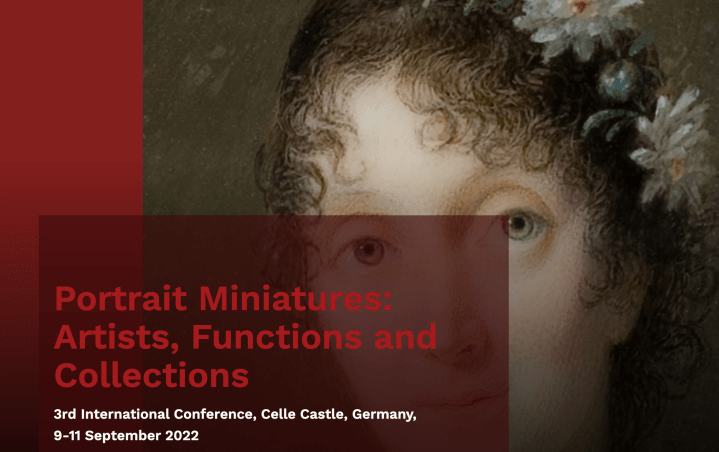
From the Tansey Miniatures Foundation and the conference programme:
Portrait Miniatures: Artists, Functions, and Collections
Celle Castle, Tansey Miniatures Foundation, Celle Castle (near Hanover), 9–11 September 2022
This conference will take place in conjunction with the seventh exhibition of the Tansey Miniatures Foundation and the publication of the accompanying catalogue Miniatures from the Time of Napoleon in the Tansey Collection. 23 speakers from 11 different countries will address a range of topics related to portrait miniatures:
• Individual miniaturists, specific workshop contexts, and places of production
• Use and functions of both court and private types and their protagonists
• Iconographic aspects in the context of representation or intimacy
• Evolution of techniques and materials
• Private and public collections
The conference will be in English. The presentations will subsequently be published in a richly illustrated book. Admission is free. Both conference venues are within walking distance (20 minutes) from the railway station. Trains from Hannover take approximately 25 to 45 minutes (Deutsche Bahn, Metronom, and S-Bahn). For registration, please contact Juliane Schmieglitz-Otten, The Tansey Miniatures Foundation, juliane.schmieglitz-otten@tansey-miniatures.com. For more information, please contact Bernd Pappe, The Tansey Miniatures Foundation, bernd.pappe@tansey-miniatures.com.
F R I D A Y , 9 S E P T E M B E R 2 0 2 2
16.00 Registration
18.00 Welcome and Opening Lectures
• Juliane Schmieglitz-Otten, Realism and Modernism in the Likenesses of a New Epoch: Highlights of the Exhibition Miniatures from the Time of Napoleon
• Bernd Pappe, Making a Small Man Great: Miniatures of Napoleon I
• Birgitt Schmedding, Two Views: The Power of Seeing
S A T U R D A Y , 1 0 S E P T E M B E R 2 0 2 2
9.00 Objects, Agencies, and Social Practices
• Gerrit Walczak (Berlin), Icons of Intimacy: Sex, Agency, and the Portrait Miniature
• André and Anne-Marie Regnard-Denis (Belgium), Gestures and Their Meaning in Portrait Miniatures
• Karin Schrader (Bad Nauheim), ‘Telling Objects’: Miniatures in 18th-Century Courtly Portraits
• Lea C. Stephenson (Philadelphia), Racial Capital: Peter Marié’s Miniatures and Gilded Age Whiteness
• Jann Matlock (London), The Museum of Lost Portraits: Paris, 1794–1805
• Damiët Schneeweisz (London), Shipped, Worn, or Carried: Portrait Miniatures in the Atlantic Ocean World
13.00 Lunch
14.15 Politics and Representation
• Juliane Schmieglitz-Otten (Celle), Pictorial Family Ties: Series of Portrait Miniatures Serving Political Networks
• Martin Miersch (Ulm), Fashion and Political Statement: Portrait Miniatures from the Time of the French Revolution
• Maxime Charron (Paris), Examples of Intimate Portraits from the Royal and Imperial Courts of France during the First Half of the 19th Century
• Agnieszka Fulińska (Krakow), A Reputed Portrait Miniature of the King of Rome and Images of Children from Napoleon’s Entourage
• Marina Vidas (Copenhagen), Portrait Miniatures Set in Jewellery and Objects of Personal Adornment Connected to Queen Louise of Denmark and Her Daughter, Maria Feodorovna, Empress of Russia
17.30 Special Techniques and Materials
• David Hradil, Janka Hradilová, and Olga Trmalová (Prague), Benefits of Non-Invasive Macro X-Ray Fluorescence Scanning for the Analysis of Materials in Portrait Miniatures
S U N D A Y , 1 1 S E P T E M B E R 2 0 2 2
9.00 Special Techniques and Materials
• Christine Slottved Kimbriel, Paola Ricciardi, and Flavia Fiorillo (London), Unlocking the English Portrait Miniature: The Materiality of Isaac Oliver’s Oeuvre
• Alan Derbyshire and Lucia Burgio (London), The William Wood Manuscripts
10.00 Miniature Painters
• Martin Spies (Giessen), In Search of Charles Townley, Painter of Miniatures and Engraver to the King of Prussia
• Luise Schreiber Knaus and Peter Knaus (Bodelshausen), The Miniature Painter Jeremiah Meyer: His Life and Career during the Reign of King George III
• Sonja Remensberger (Winterthur), Pierre-Louis Bouvier (1765–1836): Life and Work of a Geneva Miniature Painter whilst Working Abroad
• Nathalie Lemoine-Bouchard (Paris), Ambroise Charlemagne Victor Le Chenetier: When a 19th-Century Artist Hides Another One
13.00 Lunch
14.15 Collections of Portrait Miniatures
• Stephen Lloyd (Liverpool), Horace Walpole’s Recently Discovered Plan for Displaying His Miniatures and Enamels in the Cabinet of the Tribuna at Strawberry Hill
• Maria Dunina (Moscow), The Collection of Miniatures of the State Pushkin Museum of Fine Arts, Moscow
• Tatiana Udras (Moscow), Portrait Miniatures of the Romanoff Family in Russian and Foreign Collections
• Cecilia Rönnerstam (Stockholm), On Origins and Originals: The History of a Collection
• Blythe Sobol (Kansas City), An Outsized Passion for Miniatures: The Starr Collection of Portrait Miniatures at the Nelson-Atkins Museum of Art
Symposium | Everyday Rococo
From the FPS:
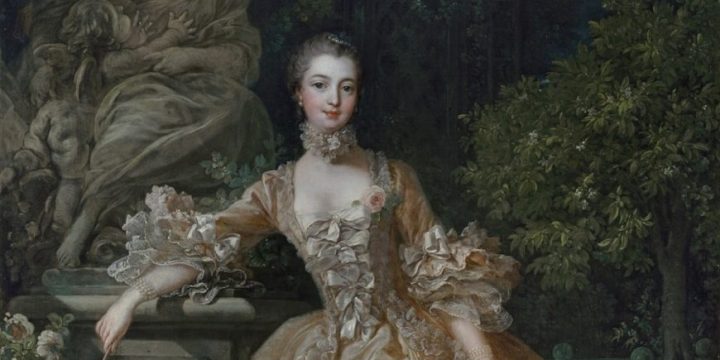
Everyday Rococo: Madame de Pompadour and the Arts
Victoria and Albert Museum, London, 1–2 July 2022
Organised by Mia Jackson and Caroline McCaffrey-Howarth
The French Porcelain Society is pleased to announce the rescheduling of the symposium Everyday Rococo: Madame de Pompadour and the Arts to be held at the Gorvy Lecture Theatre, Victoria and Albert Museum, London, on the 1st and 2nd July 2022. With two days of papers, this will be the first reassessment of Jeanne-Antoinette Poisson’s artistic patronage since the landmark exhibition, Madame de Pompadour et les Arts of 2002. Commemorating the tercentenary of her birth and marking the publication of Rosalind Savill’s book Everyday Rococo: Madame de Pompadour and Sèvres Porcelain, this conference will welcome international experts discussing her interests in the fine and decorative arts. Speakers’ biographies and paper abstracts are available here. The symposium is organised by Dr Mia Jackson (Waddesdon Manor) and Dr Caroline McCaffrey-Howarth (DAS Department, V&A Museum).
To book tickets, please visit the French Porcelain Society’s website»
F R I D A Y , 1 J U L Y 2 0 2 2
10.20 Welcome and Introduction by Dame Rosalind Savill (moderator of Day One)
10.35 Morning Session
• John Whitehead (Independent Scholar), The Crisis of 1745: New Thoughts on Madame de Pompadour, the Orry Brothers, and the Vincennes Porcelain Factory
• Kristel Smentek (Associate Professor of Art History, Massachusetts Institute of Technology), Asia at Home: Madame de Pompadour’s Mounted Chinese Porcelain
• Susan Wager (Assistant Professor of Art and Art History, University of New Hampshire), Pompadour Sculpsit: Gems, Prints, and Authorship
13.20 Lunch Break
14.20 Afternoon Session
• Aileen Ribeiro (Professor Emeritus, Courtauld Institute of Art), Madame de Pompadour and the Goddess of Appearances
• Joana Mylek (PhD Candidate, Ludwig Maximilian University of Munich), Madame de Pompadour’s Collection of Meissen Porcelain
• Bertrand Rondot (Conservateur en chef, Château de Versailles), A Rococo Rupture: Or Madame de Pompadour’s Taste in Furniture
16.30 Discussion
18.00 Drinks at the Savile Club (generously sponsored by Christie’s and Bonhams)
19.30 Dinner at the Savile Club (reservation only)
S A T U R D A Y , 2 J U L Y 2 0 2 2
10.20 Opening Remarks by Helen Jacobsen (moderator of Day Two)
10.25 Morning Session
• Rosalind Savill (Former Director of the Wallace Collection), Madame de Pompadour’s Sèvres Porcelain for Everyday Use
• Mia Jackson (Curator of Decorative Arts, Waddesdon Manor), Pampered and Adored: Madame de Pompadour’s Pets
• Alexandre Gady (Professor of the History of Art, Sorbonne Université), Madame de Pompadour as a Patron of Architecture: Some Reflections
13.00 Lunch Break
14.00 Afternoon Session
• Rachel Jacobs (Curator of Books and Manuscripts, Waddesdon Manor), Madame de Pompadour’s Library
• Alden Gordon (Professor of Fine Arts, Trinity College, Hartford), The Language of Gifts: Madame de Pompadour’s Hierarchy of Giving and Receiving
15.15 Discussion
15.45 Closing Remarks
Masterpiece London Programming | Serious Fun / Stones of Rome
In conjunction with this year’s Masterpiece London, which runs from 30 June to 6 July:
Serious Fun: The Masterpiece Museum Symposium
Royal Hospital Chelsea, London, Saturday, 2 July 2022

Unknown maker, candlestick, France, ca. 1745–49, gilt bronze and silvered bronze, 25 cm high (London: The Wallace Collection, F79).
Masterpiece London is delighted to host a morning of debate and discussion, co-organised by the Fair and the writer and critic Thomas Marks, to bring together preeminent museum curators and conservators with the leading figures in the art and antiques trade, with the aim of encouraging constructive discussion, networking and the exchange of knowledge and practical advice. Serious Fun is the seventh in a series of events that Masterpiece London launched in 2018—with recent online events focusing on conservation, artistic materials and the role of research in museums. This summer the Masterpiece Symposium returns to an in-person format at the Fair in London for the first time since 2019, with the focus turning to museums of places of pleasure, wonder, surprise—and even fun. The subject has been chosen to pay tribute to the late Philip Hewat-Jaboor, Chairman of Masterpiece London from 2012 to 2022, who consistently took delight in museum collections around the world and generously shared that joy with friends, colleagues, and the wider public.
It is a truism to describe museums as places of education but perhaps less common to celebrate how they ought to provide diversion too. Certainly, many great civic museums, and particularly those founded during the 19th century, once shared with the popular spectacles of the time the desire to entertain their audiences while pursuing their educational purposes (some Victorian museums had an ‘almost carnival atmosphere’, the late Giles Waterfield wrote). It is now sometimes assumed, however, that seriousness and levity cannot coexist in museums. But whyever not?
Over the course of a morning at Masterpiece London, experts will offer a range of perspectives on the role of leisure and pleasure in museums, exploring historical attempts to associate learning with enjoyment and considering what might be gained by doing so today. How have museums historically had fun? Could enjoyment be more central to how we discuss, design, and experience museums, and to what purpose? How can wonder or pleasure be fostered through collection displays, exhibitions, and other museum activities? As ever at the Masterpiece Symposium, attendees will be invited to participate in the discussion in Q&As with panellists and in break-out sessions during the course of the event—with the aim of sharing knowledge and ideas.
P R O G R A M M E
10.00 Registration and coffee
10.15. Panel Discussion: The Museum at Play
Moderated by Thomas Marks
• Dinah Casson | Museum and exhibition designer, and co-founder, Casson Mann
• Jane Munro | Keeper of Paintings, Prints, and Drawings, the Fitzwilliam Museum, Cambridge
• Ben Street | Art historian, lecturer, and writer (How to Enjoy Art; How to Be an Art Rebel)
This discussion will focus on the current situation in museums, exploring how they might enable and harness enjoyment among their audiences. The conversation will explore how museum architecture, exhibitions, and displays succeed in kindling imaginative wonder; surprise, wit, even comedy (or comic art) as modes of engagement; how artist interventions might provoke meaningful diversion; and the balance between encouraging delight and offering interpretation in the display of works of art.
11.15 Coffee Break
11.30 Break-out Sessions
Attendees will be invited to join small discussion groups (6–8 people) for conversation, drawing on their own ideas and experience, and prompted by the first panel discussion and wider theme of the symposium.
12.00 Panel Discussion: Historical Entertainments
Moderated by Thomas Marks
• Helen Dorey | Deputy Director and Inspectress, Sir John Soane’s Museum
• Ella Ravilious | Architecture and Design, Victoria & Albert Museum
• Mark Westgarth | Associate Professor in Art History and Museum Studies, University of Leeds
This discussion will explore how museums have historically sought to enlist types of enjoyment as a mode of fulfilling their wider mission. It will encompass the relationship between leisure and education in Victorian civic museums, including the South Kensington Museum; how surprise and wonder have historically played a role in museum architecture and display, such as at Sir John Soane’s Museum; early attempts to ‘activate’ collections; and the emergence of displays, tours and other activities aimed at children. How might we borrow from such institutional legacies to the benefit of the 21st-century museum?

Many Enfilade readers will also find this session on Friday, 1 July interesting:
Stones of Rome
Royal Hospital Chelsea, London, 1 July 2022, 12.30
Adriano Aymonino is Programme Director of the MA in the Art Market and the History of Collecting at the University of Buckingham. He has curated several exhibitions, including Drawn from the Antique: Artists and the Classical Ideal. His book Enlightened Eclecticism was published by Yale University Press in June 2021, and he is currently working on a revised edition of Francis Haskell and Nicholas Penny’s Taste and the Antique (2022). He is also associate editor of the Journal of the History of Collections.
Silvia Davoli specializes in the history of collections and patronage with particular focus on the eighteenth and nineteenth centuries. She is a research associate at Oxford University and Curator at Strawberry Hill House (the Horace Walpole Collection). Silvia is also associate editor of the Journal of the History of Collections.
Fabio Barry studied architecture at the University of Cambridge (MA, Dip Arch), and briefly practiced before receiving his PhD in art history from Columbia University. He has taught at the University of St. Andrews and Stanford University, and is currently Samuel H. Kress Senior Fellow at The Centre for Advanced Study in the Visual Arts at The National Gallery of Art in Washington, D.C. His research has often concentrated on art in Rome, particularly Baroque architecture, but recent publications have ranged farther afield and dwell on medieval and antique art, especially sculpture. An ongoing concern has been the imagery of marble in the visual arts and literature, especially the evocative qualities of the medium before the era of mass production distanced it from the realm of nature and myth. His book Painting in Stone Architecture and the Poetics of Marble from Antiquity to the Enlightenment was published by Yale University Press in 2020, awarded the 2021 PROSE Award in Architecture and Urban Studies by the Association of American Publishers, and is currently shortlisted for the Alice Davis Hitchcock Medallion of the Society of Architectural Historians of Great Britain.
Conference | Grinling Gibbons and the Story of Carving

From the V&A:
Grinling Gibbons and the Story of Carving
Victoria and Albert Museum, London, 24–25 June 2022
Organized by Jenny Saunt, Kira d’Alburquerque, and Ada de Wit
Grinling Gibbons (1648–1721) is the most celebrated carver in British history. His closely observed depictions of full-bodied natural forms, executed in hyperreal detail, captivated audiences of his own time as much as they captivate audiences today. But how much is really known about this man, his work, and its implications in terms of the way we think about carving now? As part of the year-long Gibbons tercentenary celebrations of 2021/22, the V&A is hosting a two-day conference to explore the story of Gibbons and to investigate broader themes around the subject of carving in late seventeenth- and early eighteenth-century Britain and Europe. On day one of the conference, an invited panel of speakers will present the latest research on Grinling Gibbons and his work. On the second day, international scholars, across disciplines, will consider the broader story of carving in this period, exploring themes of design, production, materials, and techniques, and how these interacted to create the type of physical forms so recognizable as the product of Gibbons’s world. Registration £15–35.
F R I D A Y , 2 4 J U N E 2 0 2 2
10.00 Registration
10.30 Welcome and Introduction
10.40 Session 1: Introducing Mr Gibbons
• Ada de Wit, Gibbons’s Dutch Roots and Early Career
• David Luard, Development of a Style
• Alan Lamb, An Extension of his Hand: Gibbons’s Technique and Workshop Practice
12.25 Lunch
14.00 Session 2: Processes and Commissions
• Frances Sands, Gibbons as a Master of Two Dimensions
• Gordon Higgott, Gibbons and the Choir of St Paul’s Cathedral
15.20 Break
15.50 Session 3: Wood and Stone
• Kira d’Alburquerque, Gibbons’s Stone Monuments and Bronze Sculptures
• Lee Prosser, The Transition from Wood to Stone: Gibbons’s Work for the Crown after 1706
S A T U R D A Y , 2 5 J U N E 2 0 2 2
10.00 Registration
10.30 Welcome
10.35 Screening of V&A film: How It Was Made: Grinling Gibbons’s Cravat
10.45 Session 4: Investigating Mr Gibbons
• Nick Humphrey, ‘Even unto deception’: Re-examining Gibbons’s Cravat
• Jonathan Taveres and Lisa Akerman, Retracing the Master’s Gouge: Recovering the Art Institute of Chicago’s Gibbons Overmantel
• Sandra Rossi and Maria Cristina Gigli, Two Masterpieces by Gibbons: Notes on Restoration Work
12.30 Lunch
14.00 Session 5: Gibbons from Other Perspectives
• Ada de Wit, Floating Splendour: Dutch and English Ship Carving, 1650–1700
• Lauren R. Cannady, Gibbons, Naturally
15.20 Break
15.50 Session 6: Beyond Gibbons
• Wendy Frère, In the Shadow of Grinling Gibbons: Arnold Quellinus and His Stay in Britain, 1678–1686
• Tessa Murdoch, Carvers at Court: Gibbons’s Huguenot Contemporaries
Speaker biographies are available on the full programme. Also, please note that the schedule is subject to change.
Symposium | Thinking Europe Visually
From ArtHist.net, where the posting also includes the French version:
Thinking Europe Visually
Centre IMAGO / École normale supérieure, Paris / Musée du Jeu de Paume, Paris, 9–10 June 2022
“If I had to do it again, I would start with culture.” This statement, often erroneously attributed to Jean Monnet, suggests that in the absence of a shared culture, Europe as a political and economic construct remains nothing but a hollow shell. This conference aims to question the disillusioned position which holds that there is no meaningful common European culture, and to do so through images. One way to visualize the potential existence and limits of a European cultural base is indeed to trace the circulation of images—be they works of art, press images, posters, photographs, or even motifs and patterns—in the region, from antiquity through to the present day. What are the images that have circulated most widely in Europe? Are they specific to Europe or are they already globalized? What was their visual and symbolic impact? Is there a ‘visual culture’ specific to Europe and, if so, what might be its distinctive ‘patterns’?
The symposium will take place on June 9 and 10, 2022 in Paris at the Ecole normale supérieure, 45 rue d’Ulm. It is hosted by European Excellence Center Jean Monnet IMAGO (ENS), in collaboration with the project VISUAL CONTAGIONS at the University of Geneva (Switzerland). If is supported by the European agency Erasmus + and by the Swiss national Fund for research.
The symposium is also structured around three exhibitions:
• Contagions visuelles, an exhibition for the Espace de Création numérique du Jeu de Paume (10 May — 31 December 2022, curated by Béatrice Joyeux-Prunel with Nicola Carboni).
• Ces images qui ont fait l’Europe / Those Images That Made Europe, a digital exhibition hosted by Europeana.eu (forthcoming June 2022)
• Correspondances, a ‘real’ exhibition at the University of Geneva (16–30 May 2022) on the circulation of images, with works and texts by students from the chair in digital humanities at UNIGE (Prof. Béatrice Joyeux-Prunel) and the Atelier de Photographie at the Beaux-Arts de Paris led by Marie José Burki.
Organisation
• Béatrice Joyeux-Prunel, Professeure à l’université de Genève, chaire des humanités numériques
• Léa Saint-Raymond, postdoctorante, ENS-PSL / IMAGO
• Centre d’excellence Jean Monnet IMAGO, ENS-PSL (https://www.imago.ens.fr), en partenariat avec le projet FNS VISUAL CONTAGIONS, Université de Genève (https://visualcontagions.unige.ch)
◊ ◊ ◊ ◊ ◊
T H U R S D A Y , 9 J U N E 2 0 2 2
8.30 Welcome and Coffee
9.30 Béatrice Joyeux-Prunel (UNIGE) and Léa Saint-Raymond (ENS-PSL), Introduction
9.45 Keynote
• Adeline Rispal, L’Étoffe de l’Europe®, une œuvre pour tisser l’avenir [The Fabric of Europe, A Work to Weave the Future]
10.45 Pause
11.00 Morning Session
• Areti Adamopoulou (University of Ioannina), The Pediment and the Column: The Persistence of Values
• Fabienne Gallaire (INP), A Stable Continent: On the Horse and the Other Animal Attributes of Europe in Early Modern Allegories, 16th–18th c.
• Eveline Deneer (University of Utrecht), A Light on Europe: The International and Intermedial Trajectory of a Medieval Chandelier at the Turn of the 19th Century
12.30 Lunch
14.00 Afternoon Session
• Sylvain-Karl Gosselet (CNRS, Université de Paris Cité, LARCA), Fashionable Europe: Iconological Wonders à la Bonnart
• Emilia Olechnowicz (Institute of Art of the Polish Academy of Sciences), Fabrication of Europe: Europe as the Space and the Myth in Early Modern Costume Books
• Béatrice Joyeux-Prunel (UNIGE), What Images Made Europe in the Era of Illustrated Print? The Imago/Visual Contagions Project
• Nicola Carboni (UNIGE), The Rise of Machines: A Data-Driven Approach to the Study of Image Circulations
• Marie Barras (UNIGE), Visual Hits from the Past: Tracing the Global Circulation of Art Images from 1890 until 1990
17.00 Pause
17.30 Grégory Chatonsky (artist) – Réalisme contrefactuel : l’introduction des images possibles dans l’histoire de l’art [Counterfactual Realism: The Introduction of Possible Images in Art History]
18.30 Roundtable — Europe between Its Vision and Its Images / Vision et images de l’Europe
• Thomas Serrier (Université Lille III), Béatrice Joyeux-Prunel (UNIGE), Léa Saint-Raymond (ENS-PSL) and the team of the journal Le Grand Continent
19.30 Cocktail Reception
F R I D A Y , 1 0 J U N E 2 0 2 2
9.00 Coffee
10.00 Keynote
• Christophe Charle (Université Paris 1 Panthéon-Sorbonne), The Cultural Spaces of Europe in the 19th Century
11.00 Pause
11.15 Morning Session
• Emmelyn Butterfield-Rosen (Williams College Graduate Program in the History of Art, Clark Art Institute), Posture and the Invention of European Art
• Léa Saint-Raymond (ENS-PSL) and Quentin Bernet (Ecole du Louvre), The ‘Madonna of Humility’: A Pattern That Made Europe, 14th–16th c.
12.15 Lunch
13.45 Coffee
14.00 Afternoon Session
• Marie Blanc (Université Grenoble Alpes), An Image of Europe for and by Its Tourists during the Cold War: The Example of Czechoslovakia
• Paolo Villa (University of Udine), War and Peace: The Film « iconeme » of the Urban Square as Mirror of Europe in Translation, 1944–1948
• Lefteris Spyrou (Institute for Mediterranean Studies-FORTH), Promoting a Shared European Cultural Heritage: The Council of Europe’s Art Exhibitions in the 1950s
• Antje Kramer (Université Rennes 2), T 1956-9 by Hans Hartung: A Line Drawn between Europe and Africa?
• Matteo Bertele (Ca’Foscari University of Venice), Defining European Art through International Exhibitions, 1955–1958
18.30 Evening at Jeu de Paume Museum (Auditorium)
à propos the exhibition Visual Contagions / Contagions visuelles; les images dans la mondialisation – Jeu de Paume, Espace de Création numérique — with Marta Ponsa (Jeu de Paume), Béatrice Joyeux-Prunel and Nicola Carboni (UNIGE), and the artists Valentine Bernasconi, Robin Champenois, Nora Fatehi, Thomas Gauffroy-Naudin, Anim Jeon, Rui-Long Monico
Online Symposium | Women and Religion in 18th-C France

After Magdeleine Horthemels, Burial of Nuns at the Abbey of Port-Royal-des-Champs (Musée de Port-Royal des Champs).
◊ ◊ ◊ ◊ ◊
From the conference website:
Women and Religion in Eighteenth-Century France: Ideas, Controversies, Representations
Online, Queen Mary, University of London, 24 June 2022
Organized by Marie Giraud and Cathleen Mair
From Catholics to Protestants, abbesses to lay sisters, or even artists and salonnières, religious women played an important role in the social, cultural, and political life of France during the eighteenth century. Drawing on new approaches and sources, this interdisciplinary symposium will consider the identities, controversies, ideas, experiences, and representations of religious women in the period. It will explore how women of faith navigated, adopted, challenged, or subverted the religious canon, cultural norms, and social conventions as the understanding of religion, politics, and power shifted rapidly throughout the eighteenth century.
The keynote address will be delivered by Professor Mita Choudhury (Vassar College), whose work on gender, sexuality, and the place of nuns within the larger political and intellectual world of pre-revolutionary France lays the groundwork for further studies of women religious in the period.
The symposium will take place online via Zoom and is free to attend. All times in BST. Please click here to register to attend. The Zoom link will be circulated with registered attendees 24 hours in advance. A PDF version of the programme is available to download here.
This event is generously supported by London Arts and Humanities Partnership and the Doctoral College Initiative Fund at Queen Mary University of London.
P R O G R A M M E
9.30 Welcome and Housekeeping
• Marie Giraud (QMUL) and Cathleen Mair (QMUL)
9.45 Panel 1 — Living Faith: Everyday Religion in Women’s Letters
Chair: Ben Jackson (Birmingham)
• Cormac Begadon (Durham University), Nuns and Their Confessors: Appeals, Emotions, and Gender in the English Convents
• Gemma Betros (Australian National University), Marie de Botidoux: Religion in the Life of a Young Woman in Late-Eighteenth-Century Paris
10.45 Panel 2 — Recovering Voices: Women Religious in Print Culture
Chair: Gemma Tidman (QMUL)
• Rebecca Short (University of Oxford), Posthumous Presence: Religious Authority in the Lettres à une illustre morte (1770)
• Sean Heath (Independent Scholar), Je ne suis qu’une femme: Madame de Lionne’s Intervention in the Chinese Rites Controversy, 1700–1705
11.45 Break
12.00 Panel 3 — Faith on Trial: Religious Sects and the State
Chair: Liesbeth Corens (QMUL)
• Sarah Barthélemy (Durham University / Université Saint-Louis – Bruxelles), Gender, Catholicism, and Dissimulation: The Trial of Adélaïde Champion de Cicé
• Otto Selles (Calvin University), Prophétesses de Sion: Women and the Multipliant Sect (Montpellier, 1720–1723)
13.00 Lunch Break
14.00 Panel 4 — Contested Meanings: Women Religious and Revolutionary Politics
Chair: Ben James (KCL)
• Corinne Gressang (Erskine College), What Does Liberty Mean to a Nun?
• Richard Yoder (Pennsylvania State University), Jacqueline-Aimée Brohon: Victim-Soul and Revolutionary Prophet
15.00 Panel 5 — Representing Faith: Spaces and Objects of Devotion
Chair: Hannah Williams (QMUL)
• Killian Harrer (University of Munich), Wellsprings of Devotion: Marian Apparitions and Female Pilgrims in Revolutionary France
• Samuel Weber (EHESS), Handmaids of the Sacred Heart: Nuns’ Production of Paraphernalia and the Making of Sentimental Catholicism in Eighteenth-Century France
16.00 Break
16.15 Keynote Lecture
Chair: Miri Rubin (QMUL)
• Mita Choudhury (Vassar College), Reflecting on Gender, Religion, and the Historian’s Craft
Conference | The Jesuits and the Arts
From UDIMA:
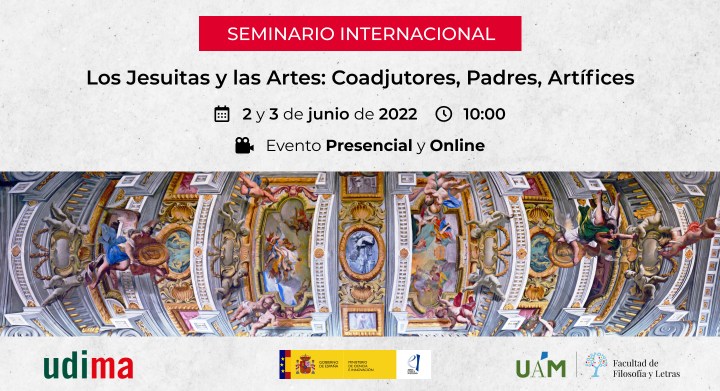
Los jesuitas y las artes: coadjutores, padres, artífices
Online and in-person, Universidad a distancia de Madrid, 2–3 June 2022
Coadjutores: artistas e ideas migrantes en la globalización ibérica estudia las redes de circulación de los artistas de la Compañía de Jesús durante la Edad Moderna, incluyendo tanto a los sacerdotes como a los miembros legos de la Orden o coadjutores. La obra de estos artistas (pintores, escultores y grabadores) y la recepción de las ideas que con ellos se extendieron a través de la docencia, la tratadística y la cultura visual, revela el alcance y complejidad de los movimientos migratorios que protagonizaron y va más allá de la mera difusión desde la Europa católica hasta los dominios hispano-portugueses a orillas del Atlántico, el Índico y el Pacífico. Frente al modelo centro-periferia, el proyecto analiza un amplio número de estudios de caso que permiten evidenciar cómo se llevaron a cabo los procesos de transculturación, negociación y mestizaje que dieron lugar a escuelas artísticas relevantes como las establecidas en Cuzco, Quito, Calera de Tango (Chile), Salvador de Bahía, Beijing, Macao o Nagasaki.
En esta primera actividad del proyecto CoMArtis, consistente en un Seminario Internacional titulado «Los jesuitas y las artes: coadjutores, padres, artífices» se presentan algunos de los rasgos característicos de la producción artística de la Compañía de Jesús. Exploraremos la identidad de los hermanos coadjutores y de los sacerdotes jesuitas dentro de la estructura de la Orden y su consideración, en tanto artífices, a la luz de la prosopografía; presentaremos una primera valoración de su labor como educadores de artistas y científicos y de su agencia en el sistema de las artes europeo y colonial; y avanzaremos su grado de intervención en las dinámicas de elaboración, difusión y consumo de cultura material. Este evento está dirigido a estudiantes universitarios, académicos y público culto interesado en la Compañía de Jesús y en el arte de la Edad Moderna.
J U E V E S , 2 J U N I O 2 0 2 2
10.00 Presentación
JUAN LUIS GONZÁLEZ GARCÍA, UAM / SARA FUENTES LÁZARO, UDIMA
10.15 SESIÓN 1
Modera: SARA FUENTES LÁZARO, UDIMA
• Los “coadjutores temporales” de la misión de la Compañía de Jesús, WENCESLAO SOTO ARTUÑEDO, ARSI
• Prosopografía: la construcción del relato sobre los coadjutores dentro y fuera de la Compañía, SARA FUENTES LÁZARO, UDIMA
• I collegi dei Gesuiti e la formazione dei pittori di architettura, FAUZIA FARNETI, Università degli Studi di Firenze
12.15 Pausa
12.45 SESIÓN 2
Modera: ESCARDIEL GONZÁLEZ ESTÉVEZ, Universidad de Sevilla
• Los biombos namban: jesuitas, arte y educación en Japón, ESTHER JIMÉNEZ PABLO, Universidad Complutense de Madrid
Procuradores Generales de las Indias Orientales: Francisco Sarmento (1637–1706) y Francisco da Fonseca (1668–1738). Dos jesuitas al servicio del arte, MARIA JOÃO PEREIRA COUTINHO, Universidad de Nova de Lisboa
14.15 Pausa
16.00 SESIÓN 3
Modera: LUISA ELENA ALCALÁ, UAM
• Sacerdotes y hermanos coadjutores jesuitas en las fronteras ibéricas: agentes de circulación y consumo de productos en Macao y Paraguay (ss. XVII–XVIII), PEDRO OMAR SVRIZ WUCHERER, Universidad de Sevilla
• “Que sea pintor para hacer los retablos de las Iglesias”. Actividad artística de los coadjutores jesuitas en la provincia de Paraguay, CORINNA GRAMATKE, Investigadora Independiente, Düsseldorf
V I E R N E S , 3 J U N I O 2 0 2 2
9:45 Desayuno de bienvenida para todos los asistentes
10:20 Apertura de la sesión de trabajo a cargo de la Decana de la Facultad de Ciencias Sociales y Humanidades ESTHER PASCUA ECHEGARAY, UDIMA
10.30 SESIÓN 4
Modera: JUAN LUIS GONZÁLEZ GARCÍA, UAM
• “La devoción en la mirada impulsa el fervor del corazón”: la pintura sagrada en la literatura artística de los jesuitas (ss. XVI–XVII), MACARENA MORALEJO ORTEGA, Universidad Complutense de Madrid
• El resplandor de san Ignacio de Loyola y el simbolismo de la luz en la Compañía de Jesús. De la génesis de su iconografía a los programas visuales en la Roma del siglo XVII, ENEKO ORTEGA MENTXAKA, Universidad del País Vasco / Euskal Herriko Unibertsitatea
• La identidad devocional de raíz italiana en la Compañía: imágenes desde Roma para la globalización ibérica, ESCARDIEL GONZÁLEZ ESTÉVEZ, Universidad de Sevilla
12.30 Presentación de la monografía Arte y localización de un culto global. La Virgen de Loreto en México (Madrid: Abada, 2022), LUISA ELENA ALCALÁ, UAM
13.00 Conclusiones y cierre, JUAN LUIS GONZÁLEZ GARCÍA, UAM
13.30 Almuerzo para todos los asistentes
Online Conference | Periodization of the History of Art
From ArtHist.net:
Le parole della periodizzazione della storia dell’arte: Epoche, stili, maniere nei testi di guidistica e storiografia del Seicento e del Settecento
Online / Palazzo Barberini, Roma, 25–27 May 2022
Le giornate di studio Le parole della periodizzazione della storia dell’arte: epoche, stili, maniere nei testi di guidistica e storiografia del Seicento e del Settecento si inseriscono all’interno delle attività di ricerca sulla storiografia artistica e sul lessico dell’arte che da molti anni sono condotte presso il Dipartimento di studi letterari, filosofici e di storia dell’arte dell’Università degli studi di Roma “Tor Vergata” sotto il coordinamento del prof. Carmelo Occhipinti. Questi incontri sono incentrati sull’esame di una o più parole, attestate negli scritti d’arte tra XVII e XVIII secolo, con particolare riguardo alla focalizzazione delle epoche della storia della pittura, scultura e architettura, ovvero alla percezione delle maniere e delle rispettive fasi di sviluppo, e alla caratterizzazione stilistica delle opere ad essa riferite.
Alle giornate di studio seguirà una tavola rotonda conclusiva e per l’occasione sarà presentato il progetto «Titi Online», edizione digitale delle guide romane di Filippo Titi (1639–1702) incluse nello scaffale elettronico di Horti Hesperidum, unitamente ad altri testi tra i quali si segnalano quelli di Francesco Scannelli, Luigi Scaramuccia, Giovan Battista Passeri e Lione Pascoli.
L’accesso è regolamentato nel rispetto delle norme di prevenzione del contagio disposte dalla legge. Per accedere è necessario indossare la mascherina. Per partecipare via TEAMS: https://bit.ly/3vKiQBe
2 5 M A G G I O 2 0 2 2
9.30 Carmelo Occhipinti (Università degli Studi di Roma Tor Vergata’), Saluti e introduzione alla giornata di studi
9.40 Damiano Delle Fave (Università degli Studi di Roma ‛Tor Vergata’), Presentazione
9.50 Carmelo Occhipinti (Università degli Studi di Roma Tor Vergata’), Periodizzazione e prospettive storiografiche tra Sei e Settecento
10.10 Session 1
Chair Maria Giulia Aurigemma
• Paolo Pastres (Storico dell’arte), Scuola pittorica: un concetto ambiguo
• Chiara Dominioni (Università degli studi di ‛Roma Tre’), Il lessico d’arte nel Discorso sopra la pittura (1776) di Giovanni Battista Giovio
• Daniela Caracciolo (Università degli Studi del Salento), «Le varie maniere de’ Pittori, o antichi, o moderni». Concetti di storia, origine e progresso nelle Vite di De Dominici
• Ilaria Serati (Fondazione 1563 per l’Arte e la Cultura della Compagnia di San Paolo), La periodizzazione storiografica delle Vite de’ pittori, scultori e architetti bergamaschi (1793) di Francesco Maria Tassi: cause metodologiche di un’assenza
• Francesca Daniele (Università degli Studi di Padova), Il concetto di “patina” pittorica nella letteratura artistica veneziana del Seicento
12.10 Pausa pranzo
13.10 Session 2
Chair Cristiano Giometti
• Mariaceleste Di Meo (Università degli Studi di Udine), Il concetto di “ordine” per Baldinucci: cronologia e storiografia nei primitivi delle Notizie
• Francesco Freddolini (Università degli Studi di Roma ‘La Sapienza’), Filippo Baldinucci, Gian Lorenzo Bernini e la “tenerezza” del marmo
• Chiara Carpentieri (Università degli Studi di Firenze), Il concetto di “pittoresque”: sfumature e usi nella letteratura artistica francese del XVIII secolo
• Violeta Kovalenko (Università degli Studi di Roma ‘La Sapienza’), “Vigor piccante da fissar lo sguardo”. Riflessioni sulla ricezione del rilievo in pittura nel Settecento
14.50 Coffee Break
15.10 Session 3
Chair Carmelo Occhipinti
• Eliana Monaca (Università degli Studi di Roma ‛Tor Vergata’), La nozione di “riforma” nella letteratura artistica di Sei e Settecento. Alcuni esempi a partire dal Microcosmo della pittura di Francesco Scannelli
• Maria Giulia Cervelli (Università degli Studi di Roma ‛Tor Vergata’), Un «mirabile giardino fiorito»: le epoche della storia dell’arte ne Le Finezze de’ pennelli italiani di Luigi Scaramuccia
• Marina Cafà (Università degli Studi di Roma ‛Tor Vergata’), La nozione del “ben inteso misto” nelle Vite di Lione Pascoli, con uno sguardo al passato
• Emanuela Marino (Università degli Studi di Roma ‛Tor Vergata’), Attestazioni e uso dei termini “barbaro” e “gotico” nella letteratura artistica di Sei e Settecento. Alcuni esempi
• Lucrezia Lucchetti (Università degli Studi di Roma ‛Tor Vergata’), Il “Gotico” nella storiografia inglese del Settecento tra Hogarth, Reynolds e Ramsay
2 6 M A G G I O 2 0 2 2
14.10 Session 4
Chair Francesco Grisolia
• Floriana Conte (Università degli Studi di Foggia), “Età”: la storia dell’arte in volgare coincide con la vita delle opere
• Marco Massoni (Scuola Normale Superiore di Pisa), Il lessico artistico nelle fonti giuridico-agiografiche: il caso delle Positiones dei Servi di Maria
• Nadia Raimo (Università degli Studi di Genova), L’evoluzione del linguaggio dell’arte nel patrimonio genovese: analisi delle guide e diari di viaggio
• Luca Pezzuto (Università degli Studi dell’Aquila), Stefania Ventra (Università ‘Ca’ Foscari’ di Venezia), Fachinademie e capoccioni «innalzati con non più intese iperboli alle stelle». La Roma di primo Settecento negli scritti polemici di Lodovico Antonio David pittore ticinese
15.50 Coffee Break
16.10 Session 5
Chair Claudio Castelletti
• Paolo Bertoncini Sabatini (Università degli Studi di Pisa), Il “carattere” dell’architettura secondo Quatremère de Quincy: il “più, il meno e il medio” dell’ordre nell’Encyclopédie Méthodique Architecture (1788)
• Elisa Bastianello (Bibliotheca Hertziana), «Della Basilica di Vicenza Opera moderna non inferiore all’antiche romane»: Vicenza romana e palladiana negli scritti di Ortensio Zago (1654–1737)
• Elena Granuzzo (Università ‘Ca’ Foscari’ di Venezia), “Gusto”, “manierismo” e “natura” nella periodizzazione della storia dell’architettura: Le Vite di Tommaso Temanza
2 7 M A G G I O 2 0 2 2
15.00 Tavola rotonda aperta al pubblico
Palazzo Barberini, Sala conferenze
Introduce
• Carmelo Occhipinti (Università degli Studi di Roma ‛Tor Vergata’)
Intervengono
• Damiano Delle Fave (Università degli Studi di Roma ‛Tor Vergata’)
• Eliana Monaca (Università degli Studi di Roma ‛Tor Vergata’)
• Maria Giulia Cervelli (Università degli Studi di Roma ‛Tor Vergata’)
• Stefano Pierguidi (Università degli Studi di Roma ‘La Sapienza’)
• Raffaella Morselli (Università degli Studi di Teramo)
• Maria Giulia Aurigemma (Università degli Studi ‛Gabriele d’Annunzio’ di Chieti-Pescara)
• Alessandro Zuccari (Università degli Studi di Roma ‘La Sapienza’)
• Marzia Faietti (Kunsthistorisches Institut in Florenz – Max-Planck-Institut)
Convegno promosso da
• Horti Hesperidum
• Università degli Studi di Roma ‛Tor Vergata’
• Gallerie Nazionali Barberini Corsini
• MANT (Nuove tecnologie per la comunicazione, il cultural management e la didattica della storia dell’arte: per una fruizione immersiva e multisensoriale dei Beni Culturali)
Curatela scientifica
• Damiano Delle Fave (Università degli Studi di Roma ‛Tor Vergata’)
Comitato scientifico
• Carmelo Occhipinti (Università degli Studi di Roma Tor Vergata’)
• Barbara Agosti (Università degli Studi di Roma Tor Vergata’)
• Eliana Carrara (Università degli Studi di Genova)
• Alessandro Zuccari (Università degli Studi di Roma ‘La Sapienza’)
• Marzia Faietti (Kunsthistorisches Institut in Florenz – Max-Planck-Institut)










 Enfilade
leave a comment