Online Lecture | Women Artists at the Court of Catherine the Great
From the lecture series Collecting Art in Imperial Russia, organized by Princeton’s REEES program:
Polly Blakesley, Power and Paint: The Patronage of Women Artists at the Court of Catherine II
Online, Thursday, 18 March 2021, 12.00–1.30pm (ET)
 Catherine the Great’s passion for the arts served a vital role in her efforts to position herself as a paragon of the Enlightenment. With avaricious focus she snaffled celebrated art collections from under the noses of other European rulers, while the quest to establish professional artists led her to champion Russia’s new Academy of Arts. This lecture considers the role that women artists played in Catherine’s pursuit of her artistic ambitions, and the dynamic ways in which they energized Russian cultural life.
Catherine’s far-sighted patronage propelled renowned painters such as Angelica Kauffman to new heights. Just as important were the empress’s relations with lesser-known artists, among them the troubled painter Anna Dorothea Therbusch-Lisiewska and Catherine’s daughter-in-law Maria Fedorovna, who sculpted accomplished cameos and objets de vertu. With stories of extraordinary artistic endeavour, this lecture places these and other artists centre stage at one of Europe’s most thrilling courts.
Registration is available here»
Rosalind Polly Blakesley is Professor of Russian and European Art at the University of Cambridge and co-founder of the Cambridge Courtauld Russian Art Centre. She has served on the boards of various museums and galleries, among them the National Portrait Gallery in London, where she curated the acclaimed exhibition Russia and the Arts and advised on its partner exhibition at the State Tretyakov Gallery in Moscow. Other collaborations around the world include an exhibition of works by women artists from the Hermitage that took place at the National Museum of Women in the Arts in Washington, D.C. in 2003. Blakesley’s many books include The Russian Canvas: Painting in Imperial Russia (2016), which was awarded the Pushkin House Russian Book Prize and The Art Newspaper Russia Best Book Award. She currently holds a Leverhulme Major Research Fellowship for her new project, Russia, Empire and the Baltic Imagination. In 2017 Blakesley was awarded the Pushkin Medal by the Russian Federation for services to Anglo-Russian relations and Russian art. Blakesley is a Trustee of the National Portrait Gallery, London; a Syndic of the Fitzwilliam Museum, Cambridge; and serves on the advisory councils of the Hamilton Kerr Institute and Kettle’s Yard Gallery, as well as the advisory boards of academic journals and professional associations.
The French Porcelain Society’s Online Spring Symposium, 2021
From The French Porcelain Society:
Ceramics & Wanderlust: Curators & Castles
The French Porcelain Society’s Online Spring Symposium, 13–14 March 2021
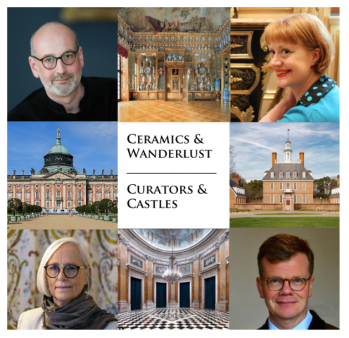 Wanderlust, our need to travel to study ceramic collections in museums and castles throughout Europe and Britain, is at the heart of the French Porcelain Society’s educational activities. It has been over a year since our last visit to France and our next visit may not be for several months. In order to share the pleasure of exploration, comradery, and discovery associated with these trips, Patricia Ferguson with the help of Félix Zorzo and other members of the French Porcelain Society committee have organised a two-day virtual symposium on the 13th and 14th of March. From the recently installed porcelain cabinet at the Château de Versailles to the stunning Porzellankabinett in Schloss Charlottenburg, as well as state, royal, and aristocratic collections from Lisbon, Kassel, and Colonial Williamsburg, their directors and curators have enthusiastically agreed to be part of our programme. We are extremely grateful to the knowledgeable custodians of some of our favourite castles and country houses, who have captured private tours for our global audience on video. Each unique and very personal tour has been pre-recorded, but there will be a live Q&A panel at the end of each day led by Dr. Caroline McCaffrey-Howarth.
Please do join us; the two-day symposium is free and open to all. For any questions, contact FPSenquiries@gmail.com. Please note that the programme is subject to change. Free links to the webinar are available here.
S A T U R D A Y , 1 3 M A R C H 2 0 2 1
16:00–18:30, UK GMT
Introduction — Caroline McCaffrey-Howarth
• Palácio Nacional da Ajuda, Lisbon — Cristina Neiva Correia, Conservadora
• Château de Versailles — Marie-Laure de Rochebrune, Conservateur en chef
• Schloss Wilhelmshöhe — Martin Eberle, Direktor, Museumslandschaft Hessen Kassel
• Museumslandschaft Hessen Kassel — Xenia Schürmann, Curatorial Assistant
Panel discussion
S U N D A Y , 1 4 M A R C H 2 0 2 1
16:00–18:30, UK GMT
Introduction — Caroline McCaffrey-Howarth
• Governor’s Palace in Colonial Williamsburg, Virginia — Angelika R. Kuettner, Associate Curator of Ceramics and Glass, and Janine Skerry, Senior Curator of Metals
• Waddesdon Manor — Mia Jackson, Curator of Decorative Arts
• Charlottenburg, Neues Palais and Belvedere — Samuel Wittwer, Direktor der Schlösser und Sammlungen, Stiftung Preußische Schlösser und Gärten Berlin-Brandenburg
Panel discussion
Online Seminars | O Gosto neoclássico: A Dimensão americana
I’m sorry for not posting news of these seminars much sooner. –CH
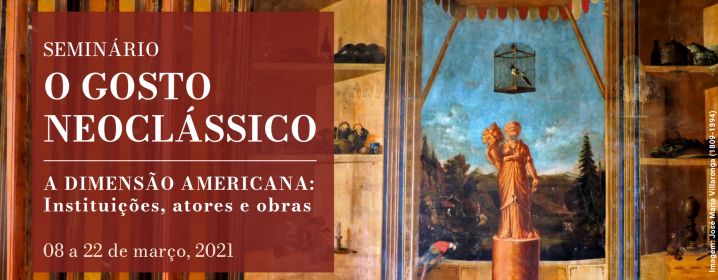
O Gosto neoclássico — A Dimensão americana: instituições, atores e obras
Online, 8–22 March 2021
O seminário O Gosto neoclássico — A Dimensão americana: instituições, atores e obras será realizado de 8 a 22 de março de 2021, às 2ª-feiras e 4ª-feiras, às 15h, em transmissão remota. É promoção do grupo de pesquisa “O gosto neoclássico”, conduzido pela Fundação Casa de Rui Barbosa e o leU/Prourb/FAU/UFRJ, com o apoio do Instituto Rui Barbosa de Altos Estudos – IRbae.
O evento dá continuidade a uma agenda sistemática de discussões públicas sobre arte, arquitetura, cidade e cultura sob o impacto da circulação das ideias neoclássicas no período compreendido entre o final do século XVIII e meados do XIX. Já foram discutidas temáticas relativas aos contextos brasileiro, português e francês. Em 2021, propõe-se uma pauta ainda inédita e que permita uma visão articulada e comparada sobre o fenômeno também nas Américas.
O Gosto neoclássico — A dimensão americana, se organiza em cinco sessões compostas por palestras e mesas redondas com especialistas brasileiros e estrangeiros. As palestras serão voltadas para aspectos da questão no México, França, Brasil, Portugal, Estados Unidos e Caribe. As mesas-redondas irão enfocar quatro eixos principais: as questões de ensino das artes nas academias: visões estéticas, padrões de gosto e formas de transmissão; mudanças e permanências nas culturas acadêmicas; as práticas projetuais e construtivas e o campo das visualidades, suas inovações e continuidades. O encerramento se dará com uma palestra concerto em torno das questões da música no período.
O evento será coordenado por Ana Pessoa (FCRB) e Margareth Pereira (leU/Prourb/UFRJ) e organizado por Ana Lúcia V. Santos (EAU/UFF), Karolyna Koppke (PROARQ-UFRJ/Ibmec RJ), Luiza Xavier (leU/Prourb/UFRJ), Ornella Savini (PIC-FCRB/CNPq). Arte e diagramação: Luiza Xavier (leU/Prourb/UFRJ). Fotografia: Ana Claudia P. Torem.
O seminário ocorrerá através da plataforma Zoom.
8 M A R C H 2 0 2 1
15.00 (BRT) Palestra
• Kelly Donahue-Wallace (CVAD-UNT, EUA), Good Taste within Reach: The Mexican Medals of Jerónimo Antonio Gil
16.00 (BRT) Mesa Redonda
• Renata Baesso (PUC-Campinas), O lugar do gosto, do gênio e da invenção nas preceptivas arquitetônicas
• Elaine Dias (UNIFESP), François-René Moreaux na Galeria e Escola de Pintura: a exposição da coleção italiana e a afirmação do artista
• Sonia Gomes Pereira (EBA-UFRJ), A Academia Imperial de Belas Artes e a longa duração da tradição clássica
1 0 M A R C H 2 0 2 1
15.00 (BRT) Palestra
• Jean Philippe Garric (Univ.Paris 1-França), Grandjean de Montigny et la polychromie architecturale à l’école de Percier
16.00 (BRT) Mesa Redonda
• Maria Luiza Zanatta (UFSM), O “tratado das ordens” de Vignola em S. Paulo: do Neoclassicismo ao Ecletismo
• Gustavo Rocha-Peixoto (PROARQ-UFRJ), Uma questão de gosto
• Karolyna Koppke (PROARQ-UFRJ/Ibmec RJ), A urbe imaginada: a Academia e o projeto para os paços Imperial e do Senado
1 5 M A R C H 2 0 2 1
15.00 (BRT) Palestra
• Margareth da Silva Pereira (PROURB-UFRJ), A ressignificação da ideia de arquitetura: A cena americana e a educação dos sentidos
16.00 (BRT) Mesa Redonda
• Ana Lucia V. dos Santos (EAU-UFF), A casa do Passeio – estudo de um edifício residencial de Grandjean de Montigny
• José Pessôa (PPGAU-UFF), A Praça Municipal de Grandjean de Montigny
• Nelson Pôrto (DAU/UFES), Os engenheiros e o neoclassicismo
1 7 M A R C H 2 0 2 1
15.00 (BRT) Palestra
• Helder Carita (FCSH-UNL), Neoclassicismo tardio em Portugal: da arquitectura às artes decorativas
16.00 (BRT) Mesa Redonda
• Paulo Knauss (UFF), O desafio da pedra: o gosto neoclássico e a escultura no Brasil
• Ana Pessoa (PPGMA/FCRB) e Ornella Savini (PIC/FCRB), Uma arcádia tropical? Vassouras, RJ, sec. XIX
• Júlio Bandeira (BN/MTur), Do Capitão Carlos Julião a Mauricio Rugendas, a camisola neoclássica no Brasil
2 2 M A R C H 2 0 2 1
15.00 (BRT) Palestras
• Dell Upton (AH-UCLA, CASVA/NGA), Politics of Neoclassicism in the United States
• Paul Niell (AH-FSU, USA), No Taste for Thatching: Value, Aesthetics, and Urban Reform in the Bohíos of Nineteenth-Century Puerto Rico
16.20 (BRT) Palestra-Concerto
• Rosana Lanzelotte (Musica Brasilis), Clássica: a nova música
Online Workshop | Analysis of Reverse Paintings on Glass
From ArtHist.net:
Possibilities and Limits of (Non-destructive) Analysis of Reverse Paintings on Glass
Online, Vitrocentre Romont, Switzerland, 12 March 2021
Organized by Sophie Wolf and Francesco Caruso
Registration due by 7 March 2021
As part of the SNSF research project on the travel and recipe book of Ulrich Daniel Metzger (1671), reverse glass paintings by the artist and by his close friend and master Gerhard Janssen are being examined. The investigation has two aims: first, a technical and material characterisation of the artworks and secondly, a comparison of the results with the recipes and painting instructions noted in the book. The analysis of materials and techniques, however, is associated with difficulties that are based on the technical specificity of the works, namely so-called ‘églomisé’. The paintings are backed with leaf metals and sometimes also protected by an additional cover of paper, which cannot always be easily removed. There is therefore no direct access to the painting layers. In this workshop, we would like to discuss the limits and possibilities of (non-destructive) analysis of reverse glass paintings and stained glass. Short presentations will give insights into the analytical practice of various research groups active in the field and provide the opportunity to discuss specific issues of analytical techniques and procedures.
The workshop is open to the public, but registration is required as the number of places is limited. If you are interested in participating as a listener, please register via email by 7 March 2021: sophie.wolf@vitrocentre.ch. The video-conference will start at 9.00am. Please start joining the meeting at 8.45am. We regret that latecomers cannot be admitted until a suitable break.
P R O G R A M M E
9.00 Sophie WOLF (Vitrocentre Romont), Welcome and introduction
9.15 Uta BERGMANN (Vitrocentre Romont), Das Reise- und Rezeptbuch Ulrich Daniel Metzgers
9.30 Francesco CARUSO (SIK-ISEA, Zürich) and Sophie WOLF (Vitrocentre Romont), Non-destructive study of early 18th-century reverse glass paintings
10.00 Simon STEGER (Staatliche Akademie der Künste, Stuttgart), Non-invasive spectroscopic investigation of cultural artefacts: shedding light on modern reverse glass paintings (1905–1955)
10.30 Break
11.00 Patrick DIETEMANN (Doerner Institut, München), Challenges and limits of (non-destructive) modern binding medium analysis
11.30 Katharina SCHMIDT-OTT (Swiss National Museum, Collection Centre, Affoltern a. Albis), Comparability of two XRF analyzers on sanguine in stained glass paintings by H. J. Güder (1630–1691)
12.00 Panel Discussion
• Patrick DIETEMANN (Doerner Institut, München)
• Susanne GREIFF (Römisch-Germanisches Zentralmuseum, Mainz)
• Maite MAGUREGUI HERNANDO (Universidad del País Vasco, Bilbao)
• Simon STEGER (Staatliche Akademie der Künste, Stuttgart)
Organisation
Sophie Wolf (Vitrocentre Romont), sophie.wolf@vitrocentre.ch
Francesco Caruso (Schweizerisches Institut für Kunstwissenschaft SIK-ISEA), francesco.caruso@sik-isea.ch
Online Conference | Building an Engaged Art History
From ArtHist.net:
Building an Engaged Art History
Online, Case Western Reserve University and Indiana University IUPUI, 22–23 April 2021
Registration due by 1 March 2021
A virtual convening about public scholarship, civic engagement, and community-based practices in the study and teaching of art history and visual culture.
How can art historians honor ways of seeing and knowing that have been historically marginalized in the art worlds and the academy? How can we work in ways that serve communities beyond our institutions? How can we learn from the methods of engagement that are well-established in other disciplines? How can we build structures within our institutions that support this kind of work? Where are we now, and where do we go from here? Experienced scholars in the public humanities will share their perspectives on the methods, ethics, and value of engaged approaches. Through a series of facilitated conversations, participants will reflect on their own engaged work and create a plan for making engaged art history more robust and more feasible in our institutions and our communities. The symposium is free of charge for all. Please send any questions to the symposium organizers, Erin Benay (eeb50@case.edu) and Laura Holzman (HolzmanL@iu.edu). Click here to register by March 1.
T H U R S D A Y , 2 2 A P R I L 2 0 2 1
10.00 Opening Remarks
Building a More Inclusive and Equitable Art History with Erin Benay (Case Western Reserve University) and Laura Holzman (Indiana University IUPUI)
10.30 Public Humanities, Public Art History
Panel Discussion with Susan Smulyan (Brown University), Renée Ater (Brown University), and Larry Zimmerman (Indiana University IUPUI)
Art history arguably lags behind other fields in the humanities, such as public history (which has an established professional organization and scholarly journal of the same name) with established publicly engaged trajectories. What can we learn from these disciplines about our own?
11.30 Lunch break
12.30 Discussion Session One: Toward an Engaged Art History
With Laura Holzman (Indiana University IUPUI)
Drawing first from disciplinary training and practice, participants will identify key values, awareness, skills, and abilities that can shape our engaged work.
1.30 Coffee break
2.00 Discussion Session Two: What Can Art History Learn from the Community?
With Erin Benay (Case Western Reserve University)
Building a more engaged art history means moving beyond classrooms and museums; this session asks what art history (and art historians) can learn from our community partners and experts outside the academy.
F R I D A Y , 2 3 A P R I L 2 0 2 1
10.00 Opening Remarks
Erin Benay (Case Western Reserve University) and Laura Holzman (Indiana University IUPUI)
10.30 Discussion Session One: Museums and Methods
With Key Jo Lee (Cleveland Museum of Art)
How can engaged practices and the philosophies behind them help make art museums more equitable institutions and how can museums’ methods of sharing knowledge shape engaged research and teaching?
11.30 Lunch break
12.30 Discussion Session Two: Teaching with Engaged Art History
With Jennifer Borland and Louise Siddons (Oklahoma State University)
What is the place of engaged art history in our classrooms and curricula? We will consider philosophies of teaching and learning as well as our experiences with activities such as applied projects service learning, and structuring degree programs.
1.30 Coffee break
2.00 Discussion Session Three: Engaged Art History in the Academy
With Carolyn Butler-Palmer (University of Victoria), Cynthia Persinger (California University of Pennsylvania), and Azar Rejaie (University of Houston-Downtown)
In breakout sessions dedicated to issues such as tenure and promotion and academic publishing, we discuss how to evaluate excellence in engaged art history and how to navigate systems of power that may not yet include its actions in policy or practice.
3.30 Concluding Discussion: Synthesizing the Priorities for Engaged Art History
With Mary Price (Indiana University IUPUI)
Participants will identify next steps for building an engaged art history and produce a Directory of Engaged Art History practitioners.
Conference | The Salon and the Senses

Johan Zoffany, The Gore Family with George, 3rd Earl Cowper, ca. 1775, oil on canvas, 31 × 39 inches
(New Haven: Yale Center for British Art, Paul Mellon Collection, B1977.14.87)
◊ ◊ ◊ ◊ ◊
From the conference website:
The Salon and the Senses in the Long 18th Century: Interdisciplinary Perspectives
Online, Rutgers University, New Brunswick, New Jersey, 4–5 March 2021
The conference The Salon and the Senses in the Long 18th Century: Interdisciplinary Perspectives, seeks to join the intellectual heritage of the salons with their multidisciplinary, multisensory natures. We will explore the sights, sounds, smells, tastes, and tactile aspects of the salon, considering the arts and sensory pleasures of the salon alongside the verbal arts—the poetry, literature, theater, and conversation—that were cultivated there.
Salons of the 17th, 18th, and early 19th centuries knew no disciplinary boundaries. More than other institutions of the age, salons offered their habitués opportunities to engage with a wide range of social, cultural, artistic, literary, and verbal practices. A multidisciplinary approach requires that we—like salon hostesses and guests before us—open our minds across modern intellectual boundaries and reanimate the embodied practices of the institution. By bringing together scholars from numerous fields, we hope to shed new light on salons in all of their complexity. Above all, we seek to understand the multi-sensory nature of the salon: its sights, sounds, tastes, and smells; its conversations, texts, and subtexts.
4 M A R C H 2 0 2 1
1.00 Session 1: Welcome and 18th-Century Drama Workshop
• Jennifer Jones (History-SAS) and Rebecca Cypess (Music-Mason Gross) Welcome
• Christopher Cartmill (Rutgers University, Mason Gross School of the Arts), ‘The Chironomia’: Interactive workshop on 18th-century English and French dramatic practices
2.15 Session 2: The Senses of Smell, Touch, and Humor
• Iris Moon (The Metropolitan Museum of Art), Open, Shut Them: A Capodimonte Snuffbox and the Sense of Touch in the Salon
• Érika Wicky (Université Lumière Lyon 2), Olfaction and the Salon: The Smell of Paint from Mansion House to Art Critique
• Marjanne Elaine Goozé (University of Georgia), A Sense of Humor and Antisemitism in the Berlin Jewish Salons, ca. 1800
4.00 Session 3: Keynote Address
• Melanie Conroy (University of Memphis), On Networking: Enlightenment-Era French Salons
7.00 Session 4: Lecture-Recital
The Raritan Players, directed by Rebecca Cypess — ‘In the Salon of Elizabeth Graeme’, a program exploring the musical practices of a salon hostess in 1760s–70s Philadelphia; played on period instrument
5 M A R C H 2 0 2 1
9.00 Session 5: Music in the Salon
• Michael Bane (Indiana University, Jacobs School of Music), Amateur Musicians and their Audiences in French Salons around 1700, or, How to Compliment a Musical Friend
• Floris Meens (Radbound University), The ‘Other’ Languages of Private Sociability: Music and Emotion in Dutch Late 18th- and Early 19th-Century Salons
• Nicole Vilkner (Duquesne University), Opera prêt-à-porter: Gallope d’Onquaire and the Commercialization of Salon opéra, 1850–1870
10.45 Session 6: Music, Gender, and Politics
• Markus Rathey (Yale University), The Subversion of Gender Expectations in Bach’s Dramatic Cantatas
• Callum Blackmore (Columbia University), Hyacinthe Jadin and the Noise of Revolution: Recovering French String Quartet Aesthetics in 1790s Paris
• Lindsay Jones (University of Toronto), Mauro Giuliani and the Congress of Vienna: Musical Representations of Power and Politics
1.00 Session 7: Paris ca. 1760: How to Make a Pop-Up Salon
Concluding discussion
Online Conference | Discovering Dalmatia VI
From the Exposition project website:
Discovering Dalmatia VI — Watching, Waiting: Empty Spaces and the Representation of Isolation
Online, 3–5 December 2020
This year, the annual Discovering Dalmatia conference will take place virtually, over the course of three days. Watching, Waiting: Empty Spaces and the Representation of Isolation is inspired by the Institute of Art History’s project Exposition [Ekspozicija]: Themes and Aspects of Croatian Photography from the 19th Century until Today, financed by the Croatian Science Foundation. It represents the sixth annual Discovering Dalmatia conference, a programme offering a week of events in scholarship and research.
Inspired by the current situation, this interdisciplinary conference will be dedicated to the history and theory of representing empty space through the media of photography, film, and other artistic practices. The conference is likewise open to the themes of empty spaces, isolation, and loneliness from the perspective of other scholarly disciplines.
In addition to the conference, and as part of this year’s Discovering Dalmatia, an exhibition curated by Joško Belamarić will be launched at the Split City Museum, entitled Split and Diocletian’s Palace in the Work of Danish Painter Johan Peter Kornbeck.
This year’s programme will conclude with an online presentation of the book Discovering Dalmatia: Dalmatia in Travelogues, Images, and Photographs, edited by Katrina O’Loughlin, Ana Šverko and Elke Katharina Wittich (Zagreb 2019), which brings together articles that emerged from earlier Discovering Dalmatia conferences.
Please join us via Zoom:
Thursday, 3 December 2020
https://us02web.zoom.us/j/81939301537?pwd=dENUcEdKdXpmaG54Tk9Sd205amprZz09
Friday, 4 December 2020
https://us02web.zoom.us/j/81752813627?pwd=RVJOd2o5S0tnck5SdW1VckJ6dUliZz09
Saturday, 5 December 2020
https://us02web.zoom.us/j/83531036592?pwd=Q20ydUI5VDFSd2ZNM1E2N1Y1cWxGdz09
T H U R S D A Y , 3 D E C E M B E R 2 0 2 0
9.00 Introduction by Sandra Križić Roban and Ana Šverko
9.15 Session 1
Moderated by Sandra Križić Roban
• Stuart Moore and Kayla Parker, Separation Anxiety: Filming the Nicosia Buffer Zone, with projection of the film, Father-land
• Isabelle Catucci, A Land of Collective Solitude
• Marina Milito and Maria Angélica da Silva, Visualizing Emptiness over Emptiness: Leaving Home in Pandemic Times (Maceió, Brazil)
• Cristina Moraru, Empty Spaces, Illuminated Minds: Towards a Time Withdrawn from the Capital
• Luca Nostri, Existential Topography: Photographs of Lugo During the Lockdown / 6–18 April 2020
11.45 Break
12.15 Session 2
Moderated by Lana Lovrenčić
• Anna Schober de Graaf, Occupying Empty Spaces: Political Protest and Public Solidarity in Times of Social Distancing
• Bec Rengel, The Empty Plinth and the Politics of Emptiness
F R I D A Y , 4 D E C E M B E R 2 0 2 0
9.30 Session 3
Moderated by Lana Lovrenčić and Ana Šverko
• Elke Katharina Wittich, Silent Ruins
• Emily Burns, Emptying Paris: Edward Hopper in Paris, 1910 / 2020
• Marija Barović, Ston’s Voids
• Jessie Martin, Deconstructing Understandings of Emptiness: An Examination of Representations of Transitory Space and ‘Non-place’ in Photography
• Ruth Baumeister, The Power of Emptiness
• Dominik Lengyel and Catherine Toulouse, The Representation of Empty Spaces in Architecture
11.45 Break
12.35 Session 4
Moderated by Mirko Sardelić
• Asija Ismailovski, Empty Space as Artistic Strategy
• Marta Chiara Olimpia Nicosia, Species of Spaces, Species of Emptiness: Idleness and Boredom
• Anči Leburić and Laura John, Visualization as a Qualitative Procedure in the Representation of the Meanings of What We Are Researching in Space
S A T U R D A Y , 5 D E C E M B E R 2 0 2 0
9.00 Session 5
Moderated by Mirko Sardelić
• Martin Kuhar and Stella Fatović-Ferenčić, Empty Spaces in Photographs of Public Health Remnants in Dalmatia
• Klaudija Sabo, Representations of Quarantine and Space in Visual Culture
9.45 Break
10.00 Session 6
Moderated by Liz Wells
• Catlin Langford, Staging Isolation: Images of Seclusion and Separation
• Tihana Rubić, Ethnographies of Waiting, Ethnographies of Emptiness: Time and Space through Photography
• Meg Wellington-Barratt, Hierarchy of History: Curation of Photography during the Covid-19 Lockdown Period
Conference | Working Wood in the 18th Century
From Colonial Williamsburg:
Back to Work: Functional Furniture for Home and Shop
23rd Annual Working Wood in the 18th Century Conference
(Online), Williamsburg, Virginia, 14–17 January 2021
 The 23rd annual Working Wood in the 18th Century conference is going virtual. Join our expert woodworking tradespeople as well as a distinguished lineup of guests for live-streamed, on-demand, and Q&A sessions.
Work, in the 18th century, took many forms from gentry avocations to the daily vocations and labors of most people regardless of race, gender, or age. This year’s conference theme Back to Work: Functional Furniture for Home and Shop invites you to join us virtually as we explore furnishings, fixtures, and tools designed for work at home and in the shop.
Christopher Schwarz, renowned woodworker, author, and founder of Lost Art Press, joins us to explore period work holding techniques drawn from years of research into historical workbenches. He will also demonstrate techniques used for building the staked seating furniture that is nearly ubiquitous in images of early work environments. From out of the shop and into the home, Bob Van Dyke (woodworker, teacher, and founder of the Connecticut Valley School of Woodworking) will guide attendees through the construction and decoration of a Federal era lady’s work table for needlecrafts. Colonial Williamsburg’s master cabinetmaker, Bill Pavlak, demonstrates a mahogany writing table with a ratcheting top and a drawer that includes its own ratcheting writing surface—the perfect piece for writing, reading, and drawing. Apprentice cabinetmakers John Peeler and Jeremy Tritchler will straddle the line of fine furniture and workaday utility with an intricate mahogany apothecary’s chest from the London shop of Philip Bell.
Meanwhile, back in the shop Brian Weldy, journeyman-supervisor joiner, demonstrates the construction and use of a treadle lathe based on numerous period illustrations and surviving examples. Apprentice joiners Amanda Doggett, Scott Krogh, and Peter Hudson explore a handful of shop-made woodworking tools and fixtures. As to the people working within these long-ago shops, the significant presence and role of skilled black craftspeople (enslaved and free) has often been left out of the literature. Carpenters Ayinde Martin and Harold Caldwell along with coachman Adam Canaday will lead a panel discussion on black tradespeople from the past, how we can learn about them, and how we can interpret their stories today.
Architectural historian Jeffrey Klee will tie these disparate subjects together in an opening keynote that explores how we can understand work in the 18th century from the design, use, and evolution of buildings from within the Historic Area and beyond. In this same spirit, master carpenter Garland Wood and orientation supervisor Janice Canaday will look at the Randolph House Kitchen from the perspective of the enslaved carpenters who would have participated in its construction and the enslaved people who worked and lived within its walls.
Should you have questions regarding our Educational Conferences, Forums & Symposiums, please give us a call at 1.800.603.0948, or send us an email at educationalconferences@cwf.org. Registration for the 2021 Working Wood conference is now open.
Online Conference | Décoration intérieure et plaisir des sens, 1700–1850

From the conference programme:
Décoration intérieure et plaisir des sens, 1700–1850
Online Colloquium, 3-4 December 2020
Organisé par l’Université de Genève (Unité d’histoire de l’art) et l’Université Paris 1 Panthéon-Sorbonne (Equipe de recherche HiCSA et Ecole doctorale d’histoire de l’art)
Lien pour l’inscription – jeudi 3 décembre :
https://unige.zoom.us/webinar/register/WN_6uqfcGYcTPKviyDc7H_sQA
Lien pour l’inscription – vendredi 4 décembre :
https://unige.zoom.us/webinar/register/WN_oe2wR8RUSAe1DNOS34S9EQ
Colloque organisé par Noémi Duperron (Université de Genève), Barbara Jouves-Hann (Université Paris 1 Panthéon-Sorbonne), Maxime Georges Métraux (Université Paris-Sorbonne/Galerie Hubert Duchemin), Bérangère Poulain (Université de Genève) et Marc-André Paulin (Université de Lille/Centre de Recherche et de Restauration des Musées de France).
Informations et contact : decoration.et.plaisir@gmail.com
◊ ◊ ◊ ◊ ◊
J E U D I , 3 D E C E M B R E 2 0 2 0
14.00 Introduction, Bérangère Poulain (Université de Genève) et Barbara Jouves-Hann (Université Paris 1 Panthéon-Sorbonne)
14.30 Session 1A: Mobilier
Modérée par Jean-Jacques Gautier (Mobilier national)
• Thibaut Wolvesperges (Université Paris-Sorbonne), Dessin d’ornemaniste et création du meuble
• Daniel Alcouffe (Musée du Louvre), La naissance du bureau et de la commode au XVIIe siècle
• Élisabeth Caude (Château de Versailles) et Frédéric Leblanc (C2RMF), Le cabinet particulier du roi Louis XIV à Versailles secrets autour des transformations d’un bureau
16.00 Pause
16.30 Session 1B: Mobilier
Modérée par Jean-Jacques Gautier (Mobilier national)
• Muriel Barbier (Mobilier national), « Une tente sous laquelle on dort » : l’alcôve et le lit d’alcôve dans la chambre au XVIIIe
• Ulrich Leben (Indépendant), Formes, matérialité et usages du mobilier
17.30 Conclusion, Marc-André Paulin (Université de Lille/C2RMF)
V E N D R E D I , 4 D E C E M B R E 2 0 2 0
9.00 Introduction, Noémi Duperron (Université de Genève) et Maxime Georges Métraux (Université Paris-Sorbonne/Galerie Hubert Duchemin)
9.30 Session 2A: Théorie
Modérée par Carl Magnusson (Université de Lausanne)
• Desmond-Bryan Kraege (Université de Lausanne), Fraîcheur, odeurs et procédés narratifs : Le génie de l’architecture de Le Camus de Mézières à la lumière de la théorie des jardins
• Aurélien Davrius (École nationale supérieure d’architecture Paris-Malaquais), Nouvelles typologies d’habitation au XVIIIe siècle
10.30 Pause
11.00 Session 2B: Théorie
Modérée par Carl Magnusson (Université de Lausanne)
• Joséphine Grimm (École nationale des Chartes), Construire le boudoir idéal : état de l’influence réciproque de la littérature sur les traités d’architecture au XVIIIe siècle
• Christina Contandriopoulos (Université du Québec à Montréal), Une spatialité intérieure, Madame de Maisonneuve et le Dôme des Invalides
14.30 Session 3A: Techniques
Modérée par Jan blanc (Université de Genève)
• Johanna Ilmakunnas (Åbo Akademi University), Thermal comfort, spatial order, and objects in country houses, Sweden c.1740–1800
• Olivier Jandot (Université Artois), Le feu caché. Introduction du confort thermique et métamorphoses de l’économie des sens, France, 1700–1850
15.30 Pause
16.30 Session 3B: Techniques
Modérée par Jan blanc (Université de Genève)
• Erika Wicky (Université Lumière Lyon 2), L’odeur des vernis ou la toxicité du confort au XVIIIe siècle
• Carine Desrondiers (Université Rennes 2), Les effets magnifiques ou les agréments de la serrurerie dans la décoration intérieure française de la fin du règne de Louis XIV à la Monarchie de Juillet
17.30 Conclusion générale et pistes de réflexion, Christian Michel (Université de Lausanne)
Online Conference | Hayley2020
From The Fitzwilliam:
Hayley2020: A Fitzwilliam Museum Conference
Online, 12–13 November 2020

George Romney, John Flaxman Modeling the Bust of William Hayley, 1795–96, oil on canvas, 89 × 57 inches (New Haven: Yale Center for British Art, Paul Mellon Collection, B1981.25.538).
Convened to mark the bicentenary of his death, Hayley2020 is the first ever conference dedicated to writer, scholar, and amateur doctor William Hayley (1745–1820). Hugely influential in his time, Hayley is now mostly remembered for persuading William Blake to move to the Sussex coast, commissioning illustrations and prints from him, and driving him to distraction. But there is much more to the man who wrote (in verse) a runaway bestseller advising young women on how to attract and keep a husband, refused the poet laureateship for political reasons, and was the first person to publish an English translation of a long extract from Dante’s Inferno. Join us online on November 12 and 13 for a series of presentations and discussions about Hayley and his world (listed times are GMT). All are welcome.
T H U R S D A Y , 1 2 N O V E M B E R 2 0 2 0
14.45 Welcome
Suzanne Reynolds, Lisa Gee, Naomi Billingsley, and Mark Crosby welcome you to virtual Eartham, but promise not to write you an adulatory sonnet.
15.00 On Romney, His Relationship with Hayley, and Works Arising
Alex Kidson talks about how Romney and Hayley’s relationship changed over the years, discussing works including the Cupid and Psyche cartoons, Flaxman Modelling the Bust of Hayley, and Romney’s illustrations for Hayley’s Essay on Old Maids (series of short videos). Parallel discussion in the chat with Alex present, followed by discussion. Video available for viewing beforehand and afterwards.
15.40 Coffee Break
You’ll have to bring your own hot beverage, but feel free to hang out, catch up with friends, and network like it’s 1795 in Hayley’s Library.
16.05 Hayley in His Contexts
Lisa Gee: Hayley – Essay on Sculpture, Mary Cockerell & the decline & death of Tom.; Alexandra Harris; Susan Matthews: Amina Wright: ‘Artist and Bard in Sweet Alliance: Joseph Wright of Derby and the Hermit of Eartham.’. Chaired by Mark Crosby.
16.45 Tea Break
17.00 Object-Oriented Session
Demo/test of the AMoR (A Museum of Relationships) pilot + discussion, with Lisa Gee and Suzanne Reynolds.
17.40 Plenary Discussions
F R I D A Y , 1 3 N O V E M B E R 2 0 2 0
13.00 Virtual Conference Picnic
Find us in the windswept (virtual) grounds of Eartham where, because it’s mid-November, we’re happy this is online rather than IRL.
15.00 On Hayley, Flaxman, and Blake
David Bindman discusses the memorials on which Flaxman and Hayley collaborated, one that Hayley tried to interfere in, and explains why Hayley’s relationship with Blake was so different to those with Flaxman and Romney.
15.40 Coffee Break
16.05 Hayley and Blake
Mark Crosby, Sarah Haggarty, Jason Whittaker: Hayley in Blake biographies. Chaired by Naomi Billingsley.
16.40 Tea Break
17.05 Future Scholarship
New collaborations, action planning. Chaired by Lisa Gee.
17.50 Concluding Remarks










 Enfilade
leave a comment