Symposium | Rosetsu in Context
From H-ArtHist:
Rosetsu in Context
Museum Rietberg, Zurich, 7 October 2018

Nagasawa Rosetsu, Scholars Crossing a Bridge, 1788–89, ink and color on paper, hanging scroll, 47 × 21 inches (San Diego Museum of Art).
Eighteenth-century Japan witnessed an unprecedented diversity in artistic expression, nourished by the flourishing of a sophisticated urban culture and the increased affluence of the population in provincial areas. This symposium presents an array of fresh perspectives on issues of art production and consumption as well as leading figures of the art scene that constitute the environment in which Nagasawa Rosetsu (1754–1799) lived and worked.
Organised with the support of the Mary Griggs Burke Center for Japanese Art, Columbia University, in conjunction with the special exhibition Rosetsu: Ferocious Brush, on view at the Museum Rietberg Zurich, 6 September — 4 November 2018. While participation in the symposium is free of charge, a registration is required.
P R O G R A M M E
9.30 Doors open
10.00 Welcome by Albert Lutz (Director, Museum Rietberg)
10.10 Introduction by Khanh Trinh (Curator of Japanese and Korean Art, Museum Rietberg)
10.30 Noguchi Takeshi (Chief Curator, Nezu Museum), The Tiger and Departure from Realistic Representation: Nagasawa Rosetsu in Comparison to his Master Maruyama Ōkyo
11.10 Break
11.30 Alexander Hofmann (Curator for Japanese Art, Asian Art Museum, State Museums Berlin), The Genius and the Bores – Or: Whatever Happened to Rosetsu’s Contemporary Academic Painters?
12.10 Lunch and exhibition viewing
14.00 Yukio Lippit (Professor, Harvard University), From Kisō to Kijin: Reconsidering Eccentricity through Ike no Taiga’s Two Chinese Poets
14.40 Kadowaki Mutsumi (Visiting Professor, Osaka University), Itō Jakuchū and Zen
15.20 Break
15.40 Matthew McKelway (Professor, Columbia University), Nagasawa Rosetsu and Zen
16.30 Questions and panel discussion
Symposium | Rethinking the Life and Work of Rosetsu
From H-ArtHist:
Rethinking the Life and Work of Nagasawa Rosetsu
University of Zurich, 20–21 October 2018
The Japanese painter Nagasawa Rosetsu (1754–1799) has increasingly been a source of interest during the last years from popular and academic audiences with numerous exhibitions in Japan and in the West. Rosetsu has long been a name in Western studies of Japanese art, starting with a groundbreaking exhibition at the Denver Art Museum in 1973 and the publication by Robert Moes from the same year. Presently he is represented at an outstanding exhibition at the Museum Rietberg, Zurich, that feature key works of the artists, seldom seen outside of Japan.
Rosetsu has been the center of controversy over a long time, from the different versions of his contested biography to the questions of how to interpret the artist and his work. For decades he has been relegated to a list of eccentric artists, which serves little but to obscure a serious discussion of the artist and his remarkable works. At this time of great popularity and exposure to the public in the East and the West, a rethinking of the artist and his works seems highly overdue.
For this purpose, the University of Zurich has invited the top Japanese scholars who have been working on Rosetsu over the last years. We have planned a two-day conference with presentations and discussions and are inviting both younger and more established scholars, including Professors Yasuhiro Satō and Motoaki Kōno, who has been working on Rosetsu since the 1970s. Among the younger stars in the field, we are inviting Momo Miyazaki and Hideyuki Okada who have recently changed Rosetsu scholarship in significant ways.
The aim is to gather these scholars and to have them engage with each other and pool their knowledge into meaningful discussions. The expected result of the conference is to spread wider knowledge of this outstanding artist among the scholarly community and among the public. We also hope that discoveries in the life and works of the artist will be a lasting result of this conference.
The symposium is free and open to the public. No prior registration is required. Presentations will be in Japanese and in English. Texts in English will be supplied for presentations held in Japanese. For questions, please contact the Section for East Asian Art: kgoa@khist.uzh.ch.
The symposium is organized by the Section for East Asian Art, University of Zurich, and is funded by the Swiss National Science Foundation, the Swiss-Japanese Society, and the University of Zurich Foundation (Hochschulstiftung).
S A T U R D A Y , 2 0 O C T O B E R 2 0 1 8
10:15
佐藤康宏 Satō Yasuhiro, University of Tokyo
「長澤蘆雪における〈反動〉― 應舉の氷を破る」/ Rosetsu’s Backlash: Breaking the Ice of Ōkyo
11:15
野口剛 Noguchi Takeshi, 根津美術館 Nezu Art Museum
「月光」と詩情の回復:師・円山応挙との比較による長沢芦雪に関する考察 / Moonlight and the Return of Sentiment: Nagasawa Rosetsu in Comparison to His Master Maruyama Ōkyo
14:15
岡田秀之 Okada Hideyuki, 嵯峨嵐山日本美術研究所 Saga-Arashiyama Institute for Japanese Art
「芦雪の初期作品について」/ On the Early Works by Rosetsu
15:45
河野元昭 Kōno Motoaki, 静嘉堂文庫 Seikadō Bunko Art Museum
「私が見てきた長澤蘆雪受容の変化」/ Changes in Rosetsu Reception That I Have Observed Over the Years
16:45
中谷伸生 Nakatani Nobuo, Kansai University
「芦雪と大坂画壇」/ Osaka Painters and Rosetsu
S U N D A Y , 2 1 O C T O B E R 2 0 1 8
14:00
宮崎ももMiyazaki Momo, 大和文華館 Yamato Bunkakan
「芦雪の指頭画をめぐって」/ On the Finger Paintings of Rosetsu
15:00
Hans Bjarne Thomsen, University of Zurich
The Kansai Eccentric
16:30
筒井忠仁 Tsutsui Tadahito, 文化庁Agency for Cultural Affairs
「南紀から広島へ―長澤蘆雪の画風の変遷と精神の変容―」/ From Nanki to Hiroshima: The Transition of the Nagasawa Rosetsu’s Style and the Transformation of his Spirit
Conference | Hadrian’s Villa and Its Reception
From Munich’s Zentralinstitut für Kunstgeschichte:
Villa Adriana: Die kaiserliche Residenz und ihre Rezeption
Zentralinstitut für Kunstgeschichte, Munich, 17 October 2018
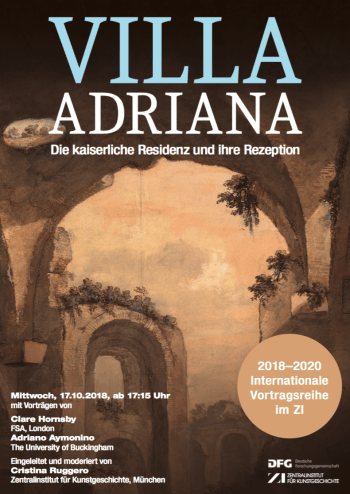 17:15 Cristina Ruggero (ZI, München), Bares für Rares: Antike aus der Hadriansvilla und der römische Kunstmarkt
17:45 Clare Hornsby (London), Man of Spirit, Man of Taste, Man of Fashion: Deciphering Identities of the British Collectors of Ancient Marbles
This talk will examine some examples of motivations for collecting: art as investment, response to peer pressure or fashion, ambition to form taste or to improve national standards; rarely were the motivations clear cut. The collectors included here will range from the politically ambitious commoner Bubb Dodington and his highly-placed dealer Cardinal Albani in the late 1740s, to the archetype of the nobleman collector the Earl of Shelburne, who acquired several pieces from Hadrian’s Villa in the 1760s and 70s. Others considered are the obsessively acquisitive gentleman-scholar Charles Townley and the banker-collector Lyde Browne, their activities furnishing us with a look at the role of the secondary market and the expansion of the mania for collecting. For all of these collectors, Hadrian’s Villa was the provenance par excellence for any ancient statue; reference will be made in this talk to some of the sculptures discovered there and how the British excavators and dealers used that provenance to add even further value to the perennial glamour of the ancient work of art.
18:30 Adriano Aymonino (The University of Buckingham), The Reception of Ancient Painting in the Eighteenth Century: Theoretical Debate, Antiquarian Publications, and the Visual Arts
This talk focuses on the nature of the relationship between the reception of ancient painting and the humanistic theory of art. It argues that this relationship was twofold: on the one hand, surviving textual evidence on Greek and Roman painting provided examples, tropes and principles that were instrumental in shaping art theory, from Leon Battista Alberti to Giovanni Pietro Bellori and the theoreticians of eighteenth-century classicism. On the other hand, the almost complete lack of physical remains of these artworks contributed to an idealised vision of ancient painting that was equally influential in defining some of the essential tendencies that shaped this theoretical tradition. Specifically, my paper will investigate how the relationship between theory and object evolved in the face of those new discoveries, publications and antiquarian ideas that proliferated over the course of the eighteenth century—with a particular focus on Hadrian’s Villa.
Additional information is available here»
Workshop | Digitising the Paul Mellon Centre’s Photo Archive
From the Paul Mellon Centre:
Digitising the Paul Mellon Centre’s Photo Archive
Paul Mellon Centre, London, 13 November 2018
Registration due by 12 October 2018
 The Paul Mellon Centre (PMC) is currently in the process of digitising its institutional photographic archive collection. Since 1964, the Centre has amassed a collection of approximately 150,000 images of British paintings, decorative painting, sculpture and prints. The resulting images will be made available for research through a new online collections website. The key aims of this project are:
• the preservation of an important resource that has been a core part of the Centre’s activity since its foundation
• provide enhanced access to this material as a digital resource, both on- and off-site
• enable new research projects and discoveries
• produce high quality images for researchers to use free of charge in teaching, study and publication
The purpose of this workshop is to explore the potentials and challenges of using digitised photo archive materials and we invite academics, researchers, curators, conservators, collection managers, educators, arts professionals, photographic experts and digital technologists to take part in this roundtable discussion about the digital future of the PMC’s photo archive.
Topics that might be covered include:
• How are photo archive materials used in 2018? How will they be relevant to researchers in the future? How do researchers use photo archives? What are they looking for? How might digitisation help them to search the collections?
• What tools (e. g. image comparison tools) and search facilities would be useful for researchers consulting the photo archive online?
• What are the benefits and/or losses of viewing this collection online?
• How should this material be presented on a digital platform?
• What extra material might the PMC provide alongside the digitised images to facilitate research?
• What can this collection tell us about the historiography of British art and the development of the study of British art and architecture?
• Is this material of interest to those outside of the field of British art history, i.e. photographic historians or practicing artists?
• Could digitisation enhance how this collection might be used by conservators?
This will be an interactive workshop, and all participants will be expected to contribute to the discussion.
To register your interest in participating in this event, please email events@paul-mellon-centre.ac.uk by 12th October. We envisage that the workshop will run across a day from 10am until 4pm. Lunch, refreshments, and some travel expenses will be provided. Places are limited, so please register your interest in attending and provide a short paragraph outlining your interest in this project or photo archives more generally.
Seminar | Stone Face
From H-ArtHist:
Stone Face: The Psychology of the Face, the Phenomenology of the Bust
University of Copenhagen, 1–2 October 2018
Registration due by 20 September 2018
 This seminar explores the portrait from a phenomenological and psychological approach, looking at how it affects the viewer and what kinds of reactions it prompts. We will be discussing the significance of the bust format, primary sources describing encounters with portraits and busts as well as the significance of the face and the psychology of face perception. The seminar is a preparatory work for understanding the Neoclassical artist Bertel Thorvaldsen (1770–1844) as a portrait sculptor within a broader context of sculpture theory and art history.
The seminar is the second in a series of seminars under the cross-disciplinary project research and dissemination Powerful Presences: The Sculptural Portrait between Absence and Presence, Group and Individual. The seminar is free and open to everyone. Additional programme and registration details are available here. For more information, please contact Lejla Mrgan, lejla@hum.ku.dk.
M O N D A Y , 1 O C T O B E R 2 0 1 8
8.45 Arrival and coffee
9.00 Welcome (Jane Fejfer)
9.15 Session 1 | Imagination and Attachment
• Melissa Percival, The Painted and Sculptural Imagination: Short Cuts
• Lejla Mrgan, Perception and imagination: Busts as Objects of Attachment
• Tomas Macsotay, Women and Sculptural Resignification: The Cases of Catherine the Great and the Countess of Albany
• Andreas Grüner, Strike! Diderot and the Reproduction of Immediacy in Ancient Portraits
12.45 Lunch
13.45 Session 2 | Bust and Body
• Jeanette Kohl, The Silence of Busts: Phenomenology, Ontology, Presence?
• Joris van Gastel, The Coat of Arms and the Portrait Bust: Sculpted Presence in Late Renaissance Florence
• Helen Ackers, Networks of interaction: The Roman portrait bust in its familial context
• Josefine Baark, ‘The Originals’: Commemorative Clay Likenesses and Portrait Sculpture in Qing China
17.15 Drinks
19.00 Dinner (speakers only)
T U E S D A Y , 2 O C T O B E R 2 0 1 8
9.30 Session 3 | Portraits and Faces
• Malcolm Baker, Busts and Faces: Aesthetic Theory and Perceptual Difference
• Alexander Todorov, The Inherent Ambiguity of Facial Expressions
• Anna Schram Vejlby, The Inner Gaze
• Rubina Raja, The Palmyrene More-Than-Bust Funerary Portraits
• Michael Yonan, Messerschmidt, Thorvaldsen, and the Specious Surfaces of the Self
13:30 Lunch
14:00 Summary and perspectives, Whitney Davis and Rolf Schneider
16:00 Portrait talk between artist Trine Søndergaard (Copenhagen) and professor of Art History Jeanette Kohl (University of California Riverside). This special event at Thorvaldsens Museum requires a ticket.
17:00 Closing Reception at Thorvaldsens Museum
Conference | British Art and the Global
Next week at UC Berkeley:
British Art and the Global
University of California, Berkeley, 17–18 September 2018
Organized by Imogen Hart and David Peters Corbett
What is the role of art history in the Brexit era? In the wake of the UK’s decision to leave the European Union, the history of Britain’s relationships with the rest of the world takes on renewed significance. This conference explores how art history today can shed light on the history of Britain’s interaction with other countries and cultures. Papers illuminate global contexts for the history of British art by considering works of art as sites and tools of international cooperation, conflict, and exchange.
Keynote speakers: Tim Barringer (Yale University), Dorothy Price (University of Bristol), and Mary Roberts (University of Sydney).
The event is co-sponsored by the Center for British Studies, the History of Art Department, and the Townsend Center for the Humanities at the University of California, Berkeley, and the Centre for American Art at the Courtauld Institute of Art. Space in the conference venue is limited. Advance registration is recommended. View abstracts of the conference papers here.
Note: On Sunday, September 16, the day before the conference, the Legion of Honor Museum will host a panel conversation on British Art in a Global Context in connection with their current exhibition Truth and Beauty: The Pre-Raphaelites and the Old Masters.
M O N D A Y , 1 7 S E P T E M B E R 2 0 1 8
9:30 Opening remarks
9:40 Panel 1
• Jocelyn Anderson (University of Toronto), Timely and Expressive: Global Turmoil and Eighteenth-Century British Magazine Frontispieces
• Julie Codell (Arizona State University), Multiple Versions, Multiple Markets, Multiple Meanings: The Global Trade in British Autograph Replicas
10:40 Coffee break
11:00 Panel 2
• Eleonora Pistis (Columbia University), How the Temple of Bacchus at Baalbek Travelled to Britain
• Douglas Fordham (University of Virginia), Methodological Approaches to the Illustrated Travel Book
12:00 Lunch break
1:00 Keynote 1
• Mary Roberts (University of Sydney), Traversing the Frontiers of Empire
2:30 Break
2:45 Panel 3
• Nika Elder (American University), A Taste for Flesh: John Singleton Copley and the Racial Politics of Colonial Portraiture
• Catherine Roach (Virginia Commonwealth University), Hybrid Exhibits: Race, Empire, and Genre at the British Institution in 1806
3:45 Tea break
4:15 Keynote 2
• Tim Barringer (Yale University), Global Landscape in the Age of Empire
T U E S D A Y , 1 8 S E P T E M B E R 2 0 1 8
9:30 Panel 4
• Sam Rose (University of St Andrews), Post-Impressionism: British, Universal, Global
• Jiyi Ryu (University of York), Imperial Object Lessons: Playing Games and Touring the British Imperial World
10:30 Coffee break
11:00 Panel 5
• Alexander Bigman (Institute of Fine Arts at New York University), Reconfiguring the Microcosmic View: Gilbert and George in Postcolonial London
Jackson Davidow (MIT), A Diasporic Virus: AIDS and the British Black Arts Movement
12:00 Lunch break
1:00 Keynote 3
• Dorothy Price (University of Bristol), Dreaming Has a Share in History: Thinking around Black British Art
2:30 Break
2:45 Panel 6
• Margaret Schmitz (Milwaukee Institute of Art and Design), Wyndham Lewis and Charles Sheeler: Cities in the ‘Vortex’ and the ‘Vacuum’
• Richard Johns (University of York), Riley in Cairo
3:45 Tea break
4:15 Panel 7
• Sayantan Mukhopadhyay (University of California, Los Angeles), Fighting while Dreaming: Rasheed Araeen’s Radical Utopianism
• Catherine Spencer (University of St Andrews), The Violence of Representation: Northern Ireland, Abstraction, and the Documentary Trace
5:15 Closing discussion
Conference | Re-framing Chinese Objects
From H-ArtHist:
Reframing Chinese Objects: Collecting and Displaying in Europe and the Islamic World, 1400–1800
Heidelberg University, 7–8 December 2018
To attend the symposium, pre-registration is required. Please send your registration by to Mr. Yusen Yu: yusen.yu@asia-europe.uni-heidelberg.de.
Organizers: Sarah E. Fraser (Project P.I.), Lianming Wang, Yusen Yu, Institute of East Asian Art History, Heidelberg University
Supported by the Field of Focus 3: Cultural Dynamics in Globalized Worlds, Excellence Initiative II, Heidelberg University
F R I D A Y , 7 D E C E M B E R 2 0 1 8
2:00 Welcome by Sarah Fraser
2:15 Session I
• Feng He, From Theatrical to Monumental: Social Spaces and Porcelain Display in Eighteenth-Century Dresden
• Muyu Zhou, The Origin of ‘Golden’: Analysis of Guangcai Porcelain through the Meissen Kiln
• Xue Yu, From Fantasy to ‘Authenticity’: The Changing Taste of the Chinese Collection in the Eighteenth-Century French Court and Its Entourage
3:30 Coffee break
3:45 Session II
• Dingwei Yin, Reframing the Antique: Gustav Klimt’s Asian Collection and His Figure Paintings in the 1910s
• Wenzhuo Qiu, Cabinet of Curiosities: Wandering and Wondering in Modern Cities as the Flâneurs
• Hua Wang, Interiority and the Female Figure: North African, French and Chinese Textiles in the Painting of Henry Matisse (1869–1954) and Chang Shuhong (1869–1954)
5:15 Roundtable discussion
5:45 Reception
S A T U R D A Y , 8 D E C E M B E R 2 0 1 8
9:15 Keynote Address
• Stacey Pierson (History of Art and Archaeology Department, SOAS London), Framing ‘China’: Architecture, Collecting, and the Spatial Aesthetics of Chinese Porcelain in Global Display Contexts
10:00 Panel I: Perceiving Chinese Art in the Islamic World
Chair: Susanne Enderwitz (Department of Languages and Cultures of the Near East, Heidelberg University) and Ebba Koch (Institute of Art History, University of Vienna)
• Javad Abbasi (Department of History, Ferdowsi University, Mashhad), Perception of Chinese Art in Iranian Historiography, 15th–18th Centuries
• Sarah Kiyanrad (Department of Languages and Cultures of the Near East, Heidelberg University), Travelling China: Perceptions of Chīn va Māchīn in Early Modern Iran
• Yusen Yu (Institute of East Asian Art History / Cluster of Excellence ‘Asia and Europe in a Global Context’, Heidelberg University), Chinese Painting in Persianate Workshop: Practices of Remounting in the Fifteenth Century
Discussant: Susanne Enderwitz (Department of Languages and Cultures of the Near East, Heidelberg University)
11:30 Coffee break
11:45 Panel II: Objects as Site of Knowledge Production
Chair: Sarah Kiyanrad (Department of Languages and Cultures of the Near East, Heidelberg University)
• Nathalie Monnet (Département des manuscrits orientaux, Bibliothèque nationale de France, Paris), The Lion-Bull Symplegma across Time and Space
• Lianming Wang (Institute of East Asian Art History, Heidelberg University), Enframing Chinese Plants: Jesuit Botany and the Eighteenth-Century Physiocraticism
• Annette Bügener (Institute of East Asian Art History, Heidelberg University), Mirroring the Imperial Face in Western Art: The Case of the Qianlong Emperor (r. 1736–1795)
Discussant: Nathalie Monnet (Département des manuscrits orientaux, Bibliothèque nationale de France, Paris)
1:15 Lunch break
2:15 Panel III: Porcelain in Islamic Displaying Context
Chair: Julia Weber (Porzellansammlung, Staatliche Kunstsammlungen Dresden)
• Akbar Khakimov (Academy of Sciences of the Republic of Uzbekistan, Tashkent), The Traditions of Chinese Porcelain in Central Asia
• Elena Paskaleva (Institute of Area Studies, Leiden University, Leiden), The Chini-khana of Ulugh Beg in Samarqand: Tracing Archaeological Artefacts and Fabricated Fables
• Ebba Koch (Institute of Art History, University of Vienna), The Chini Khana in India: Collecting, Using, and Displaying Porcelain at the Mughal Court
Discussant: Tülay Artan (Faculty of Arts and Social Sciences, Sabanci University, Istanbul)
3:45 Panel IV: Porcelain in European Courtly Context
Chair: Sarah Fraser (Institute of East Asian Art History, Heidelberg University)
• Ruth Sonja Simonis (Porzellansammlung, Staatliche Kunstsammlungen Dresden), The Amsterdam-Dresden Porcelain Trade: Count Lagnasco’s Purchases for Augustus the Strong, 1716–17
• Cora Würmell (Porzellansammlung, Staatliche Kunstsammlungen Dresden), A Venue for Porcelain: The Japanese Palace from 1717 until 1727
• Julia Weber (Porzellansammlung, Staatliche Kunstsammlungen Dresden), ‘This Gallery is destin’d for the Porcelain of Meissen only’: Staging the Contest with the East Asian Imports in the Japanese Palace
Discussant: Stacy Pierson (History of Art and Archaeology Department, SOAS London)
5:15 Final remarks by Monica Juneja (HCTS Professor ‘Global Art History’, Cluster of Excellence Asia and Europe in a Global Context, Heidelberg University)
Workshop | Heritage Revisited: Objects from Islamic Lands in Europe
As many of you will already know, H-ArtHist has returned from summer break:
Heritage Revisited: Rediscovering Objects from Islamic Lands in Enlightenment Europe
Kunsthistorisches Institut, University of Vienna, 20–21 September 2018
Registration due by 15 September 2018
Organized by Isabelle Dolezalek and Mattia Guidett
For centuries, objects from Islamic lands were unquestioned parts of the material and visual culture of pre-modern Latinate Europe. A textile from Fatimid Egypt, for instance, the so-called ‘Veil of Sainte Anne’, was kept in the cathedral treasury of Apt and venerated as a Christian relic.
The workshop Heritage Revisited: Rediscovering Objects from Islamic Lands in Enlightenment Europe is dedicated to the long eighteenth century, a period in which, so we believe, an important shift in the perception of such objects took place. Islamic provenances were rediscovered, objects were studied, drawn and discussed. Finally, they were subjected to the classificatory scheme of European modernity, which leaves little space for conceptions of a historically entangled heritage.
Object case-studies shed light on the networks of scholars and institutions involved in the rediscoveries and will be framed in the discussions within broader discourses on (European) cultural heritage. Ultimately, we wish to offer new perspectives on the history of scholarship, notably Islamic art history, but also on perceptions of cultural belonging, of ‘Europeanness’ and ‘Otherness’, which deeply resonate with current societal concerns.
Attendance is free. Please register by 15 September 2018, mattia.guidetti@univie.ac.uk. The workshop is kindly supported by the Fritz-Thyssen Foundation, the Chair of Islamic Art History and the Historisch-Kulturwissenschaftliche Fakultät of the University of Vienna.
T H U R S D A Y , 2 0 S E P T E M B E R 2 0 1 8
10:00 Visit to the Dom Museum Wien with Gregor Pirgie (Universität Wien), Pia Razenberger (Tabadul Project), and Markus Ritter (Universität Wien). Places for the visit are limited; please register by 15 September 2018, mattia.guidetti@univie.ac.uk.
13:30 Welcome and Introduction — Isabelle Dolezalek (Technische Universität Berlin/SFB ‘Episteme in Bewegung’ Freie Universität Berlin) and Mattia Guidetti (Universität Wien)
14:00 Collections
Chair: Ebba Koch (Universität Wien)
• Elisabeth Rodini (Johns Hopkins University Baltimore), The Redaldi Inventory: A Prologue to Enlightenment Collecting
• Federica Gigante (Ashmolean Museum Oxford), Objects of a ‘Certain Antiquity’ and the Quest for Their Cultural Context
15:20 Coffee
15.50 Rediscovering Objects from Islamic Lands
Chair: Barbara Karl (Textilmuseum St. Gallen)
• Claire Dillon (Columbia University New York), The Many Dimensions of a Work of Art: The Mantle of Roger II as a Case Study in Imperial Representation, Origin Stories, and the Formation of Specific Others
• Michelina di Cesare (Sapienza Università di Roma), Four Eleventh and Twelfth-Century Islamic Tombstones Discovered in Pozzuoli in the Seventeenth Century
• Carine Juvin (Musée du Louvre Paris), The ‘Baptistère de Saint-Louis’ through the Seventeenth and Eighteenth Centuries: The Making of a ‘Historical Monument’
• Anna Contadini (School of African and Oriental Studies London), Changing Perceptions of the Pisa Griffin and Other Objects
19:00 Dinner
F R I D A Y , 2 1 S E P T E M B E R 2 0 1 8
9:30 Protagonists of the Rediscoveries
Chair: Johannes Wieninger (MAK Österreichisches Museum für angewandte Kunst Wien)
• Mattia Guidetti (Universität Wien), Reading Ottoman Flags in the Marches Region, 1684–1838
• Markus Ritter (Universität Wien), A Documentary Encounter with Medieval (Islamic) Art in Eighteenth-Century Vienna
• Tobias Mörike (Museum für Kunst und Gewerbe Hamburg), Knowledge-Brokers and Object-Interpreters: Maronite Christians and the Redefinition of ‘Islamicate Objects’ by the 1800s
11:30 Coffee
12:00 Discussion Tables
Table 1 with Isabelle Dolezalek (TU/FU, Berlin), On the Concept of Cultural Heritage: What Is European and What Is Not?
Table 2 with Tobias Mörike (Museum für Kunst und Gewerbe Hamburg), Art Market Networks and Their Role in Constituting ‘Islamic Art’ Objects
Table 3 with Barbara Karl (Textilmuseum St. Gallen), Object Biographies and Dynamics of Collecting
12:45 Plenum Discussion
13:30 Lunch
14:30 Classifiying, Framing, Exhibiting
Chair: Markus Ritter (Universität Wien)
• Sabine Du Crest (Université de Bordeaux), Islamic Border Objects in Seventeenth-Century Europe
• Gül Kale (McGill University Montreal), Image as Text: Fischer von Erlach’s Take on Guillaume Grelot’s Drawings of Islamic Monuments in the Eighteenth Century
• Ebba Koch (Universität Wien), Mughal Miniatures at Habsburg Vienna
16:30 Final Discussion
Conference | Portraiture and Biography
From the Paul Mellon Centre:
Portraiture and Biography Conference
National Portrait Gallery, London, 29–30 November 2018

Thomas Gainsborough, Self-Portrait, ca. 1758–59 (London: National Portrait Gallery).
An international conference collaborative organised by the Paul Mellon Centre for Studies in British Art and the National Portrait Gallery
Biography has always haunted the study of portraiture. Although in recent decades art-historians may have developed a healthy scepticism for the intuitive practice of interpreting portraits with straightforward reference to what is known about the lives of their subjects, the temptation to do so remains strong. These tendencies often appear in their most untrammelled form in analyses of artists’ likenesses of themselves, or of their most intimate acquaintances. Taking the current major exhibition Gainsborough’s Family Album at the National Portrait Gallery as a starting point, leading academics will explore the how the biographical archive might play in this field of study going forward.
Tickets: £30 General Admission and £25 Concessions and Gallery Supporters. The first day ends with an out-of-hours view of the exhibition and drinks reception. Unlimited entry to the exhibition on the second day of the conference is also included in the ticket price. Tea and coffee are provided on both days. Book online, or visit the National Portrait Gallery in person.
T H U R S D A Y , 2 9 N O V E M B E R 2 0 1 8
13.30 Registration
14.00 Introduction and welcome by Lucy Peltz (National Portrait Gallery) and Sarah Turner (Paul Mellon Centre)
14.15 Session One: Heads and Tales
Chaired by Lucy Peltz
• Meredith Gamer (Columbia University), Of Sitters and Subjects: William Hunter and the Anatomical Portrait
• Lejla Mrgan (University of Copenhagen), The Bewildering Silence of Bertel Thorvaldsen’s Portrait Busts
15.30 Tea Break
16.00 Session Two: Parallel Lives
Chaired by Martin Postle (Paul Mellon Centre)
• Rosemary Keep (University of Birmingham), ‘… masculine in all save her body and her sexe’: Lady Jane Burdett, Portrait and Biography
• Kerstin Maria Pahl (Humboldt University and King’s College London), Back-Ups: Portraiture, Life-Writing, and the Art of Information in Long-Eighteenth-Century England
17.15 Break
17.30 Session Three
• David Solkin (Courtauld Institute of Art) and Mark Hallett (Paul Mellon Centre) in conversation: Gainsborough’s Family Album
18.30 Exhibition view and drinks
F R I D A Y , 3 0 N O V E M B E R 2 0 1 8
10.30 Session Four
Chaired by by Mark Hallett
• Ludmilla Jordanova (Durham University), Portraiture, Biography, and Occupational Identities
11.15 Coffee Break
11.45 Session Five: Love and Likeness
• Marlen Schneider (Université Grenoble Alpes), Portraiture as Cultural Practice: Displaying Social Identity in French ‘Portraits Historiés’
• Katherine Fein (Columbia University), Indexical Portraiture and Embodied Biography in Harriet Hosmer’s ‘Clasped Hands of Robert and Elizabeth Barrett Browning’
13.00 Lunch Break
14.00 Session Six: Circulating Lives
Chaired by David Solkin
• Georgia Haseldine (Queen Mary University of London and National Portrait Gallery), Competing Likenesses: Portraits and Biographies of Radical Reformers
• Claudine van Hensbergen (Northumbria University), Portraits, Mezzotint, and Public Lives: The Image of the Royal Mistress, 1660–1700
15.15 Tea Break
15.45 Session Seven: Space and Status
Chaired by Sarah Turner
• Niharika Dinkar (Boise State University), Portrait of the Artist as a ‘Gifted Highborn’: Ravi Varma and Artistic Personhood in India
• Hannah Williams (Queen Mary University of London), Lived Space: Portraits, Studios, and the Life of the Artist
• Olivia Tait (University College London), ‘Neutralising’ Biography? Georg Baselitz’s Bedroom Portraits
Symposium | Resurrecting the Dead
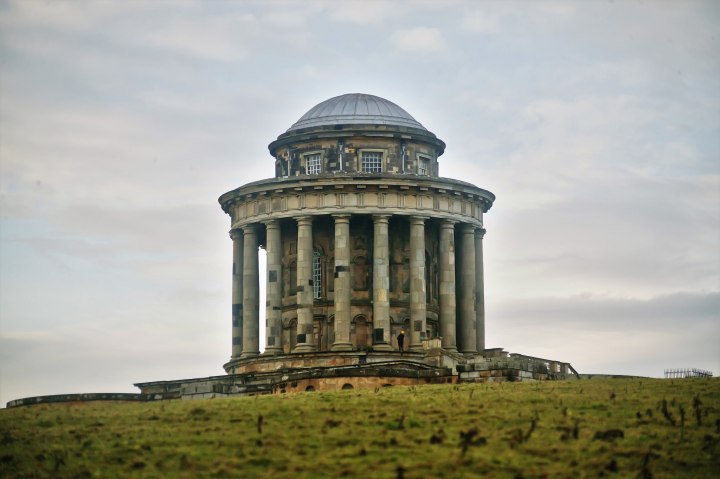
Nicholas Hawksmoor, Howard Mausoleum at Castle Howard, North Yorkshire, 1729.
◊ ◊ ◊ ◊ ◊
From The Mausolea and Monuments Trust:
Resurrecting the Dead: The Mausolea and Monuments Trust 2018 Symposium
The Gallery, London, 13 October 2018
The theme of the symposium is the maintenance and restoration of funerary architecture and sculpture. We will explore the field through a range of approaches, with papers from some of the country’s leading curatorial and architectural professionals, showcasing a variety of significant subjects from their differing perspectives. The registration fee is £25. Thanks to generous support from the Society of Architectural Historians of Great Britain, we are able to offer eight free places to current university students (at any point in their education); to apply please send a short explanation of your current studies to fsands@soane.org.uk.
P R O G R A M M E
10.30 Coffee
11.00 Session One
• Bernadette Gillow (National Trust, Ightham Mote Portfolio), Darnley Mausoleum, Cobham: A Phoenix from the Ashes
• Paul Harrison (Harrison Design Development Ltd), Restoration at West Norwood Cemetery
• Amy Frost (Museum of Bath Architecture and Beckford’s Tower, Bath Preservation Trust), Landscape as Monument: The Suffragettes Wood in Bath
13.15 Lunch
14.15 Session Two
• Charles Wagner (Built Heritage Consultancy), Tom Drysdale (Historic Royal Palaces), and Gabriel Byng (Cambridge University), Just How Important Is That Pile of Stones? Or How Do You Convince Charitable Funders That It Is Worth Spending £¼Million on the Ruins of a Building of Absolutely No Practical Use?
• Christopher Ridgway (Castle Howard), The Castle Howard Mausoleum: Form, Function and Future
15.45 Tea










 Enfilade
leave a comment