Conference | Moving Landscapes: Gardens
From The Huntington:
Moving Landscapes: Gardens and Gardening in the Transatlantic World, 1670–1830
The Huntington Library, Art Collections, and Botanical Gardens, San Marino, 7–8 December 2018
Both as physical locations and as fantasies of selfhood, gardens always speak of where and how we see ourselves in the world. Focusing on the imagination and creation of gardens in the disparate geographies of 18th-century Europe, the Caribbean, and North America, this conference explores transatlantic ideas of nation, location, and self, and asks how the experience of gardens might be shared across nations, oceans, and cultures.
Funding provided by The Huntington’s William French Smith Endowment and The USC-Huntington Early Modern Studies Institute
F R I D A Y , 7 D E C E M B E R 2 0 1 8
8:30 Registration and coffee
9:30 Welcome by Steve Hindle (The Huntington) and opening remarks by Stephen Bending (University of Southampton)
Session 1 | Making Places in the Atlantic World
Moderator: Stephen Bending
• John Dixon Hunt (University of Pennsylvania), Raising the Veils of Isis, Then What?
• Tom Williamson (University of East Anglia), Production, Power and the Natural: Explaining the Differences between English and American Gardens in the Eighteenth Century
12:00 Lunch
1:00 Curatorial tours of the botanical collections
3:00 Session 2 | New World Landscapes and Transatlantic Imaginings
Moderator: Jennifer Milam (University of Melbourne)
• Therese O’Malley (NGA CASVA, Washington, D.C.), The Garden in the Wilderness
• Joseph Manca (Rice University), The Human Presence in George Washington’s Gardens at Mount Vernon
S A T U R D A Y , 8 D E C E M B E R 2 0 1 8
9:00 Registration and coffee
9:30 Session 3 | Planting the Transatlantic Garden
Moderator: Stephen Bending
• Finola O’Kane Crimmins (University College Dublin), Improving the Atlantic World: Transatlantic Tourists and their Landscape Designs, Comparisons and Route
• Elizabeth Hyde (Kean University), A Reciprocal Exchange of the Productions of Nature: Plants and Place in France and America
11:00 Session 4 | Transatlantic Designs
Moderator: Jennifer Milam
• Emily Cooperman (ARCH Preservation Consulting), The Last Polish of a Refined Nation: Philadelphia and Garden Art in the Atlantic World
• Jonathan Finch (University of York), The Estate Landscape: A Transatlantic Dialogue
1:00 Lunch
2:00 Session 5 | Experiencing the Transatlantic Landscape
Moderator: Stephen Bending
• Jill Casid (University of Wisconsin-Madison), Landscape Vertigo
• Rachel Crawford (University of San Francisco), Fragmented Gardens
4:00 Roundtable
4:30 Closing remarks by Jennifer Milam
Conference | HECAA at 25
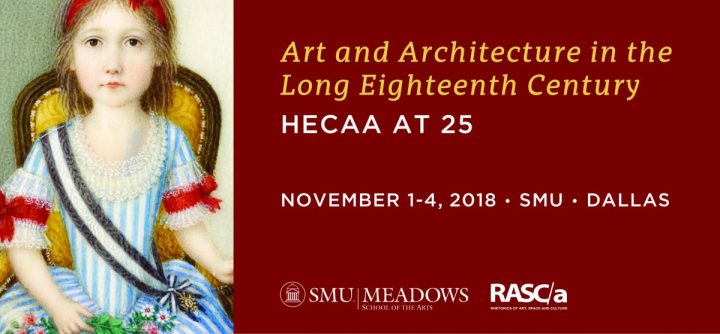
Francisca Efigenia Meléndez y Durazzo, Portrait of a Girl, ca. 1795, tempera on ivory, 5 × 5 cm (Dallas: Meadows Museum, SMU, Museum Purchase with funds from The Meadows Foundation, MM.08.01.20)
Happening now at SMU!
Art and Architecture in the Long Eighteenth Century: HECAA at 25
Southern Methodist University, Dallas, 1–4 November 201
Organized by Amy Freund
The Art History Department, its graduate program in the Rhetorics of Art, Space, and Culture (RASC/a), and the Meadows School of the Arts at Southern Methodist University are proud to announce the program for Art and Architecture in the Long Eighteenth Century: HECAA at 25, a conference to be held 1–4 November 2018 in celebration of the twenty-fifth anniversary of the founding of the Historians of Eighteenth-Century Art and Architecture.
T H U R S D A Y , 1 N O V E M B E R 2 0 1 8
9:00 Welcome and HECAA Business Meeting
10:15 Roundtable: The History of Studying Eighteenth-Century Art, the Belgium of Art History
Chair: Michael Yonan, (University of Missouri)
• Wendy Wassyng Roworth (University of Rhode Island)
• Malcolm Baker (University of California, Riverside)
• Heather McPherson (University of Alabama at Birmingham)
• Meredith Gamer (Columbia University)
• Kevin Chua (Texas Tech University)
• Sarah Betzer (University of Virginia)
1:15 Research Session: Apprehending the Spatial: Methods and Approaches
Chair: Christopher Drew Armstrong (University of Pittsburgh)
• Lauren Cannady (Clark Art Institute), The Garden in a Curiosity Cabinet
• Laurel O. Peterson (The Morgan Library & Museum), Making Spaces: Immersive Politics and the Murals at Chatsworth
• Stacey Sloboda (University of Massachusetts, Boston), St. Martin’s Lane: Neighborhood as Art World in Eighteenth-Century London
2:45 Coffee Break
3:00 Research Session: Carte Blanche
Chair: Denise Baxter (University of North Texas)
• Nina Dubin (University of Illinois at Chicago), Master of the World: Love and Other Inconstancies in Eighteenth-Century French Art
• Jessica Priebe (University of Sydney), Assembling Ambition: Leroy de Barde and the Reimagining of the Artist’s Museum in the Long Eighteenth Century
• Andrew Graciano (University of South Carolina), An Eighteenth-Century Electrical Machine and the Re-Identification of a Portrait Subject in the National Portrait Gallery, London
4:45 Buses Depart to Dallas Museum of Art
5:30 Cocktail Reception
Hosted by the Edith O’Donnell Institute of Art History, University of Texas at Dallas
7:00 Keynote Address / Michael L. Rosenberg Lecture
Horchow Auditorium, DMA
• Melissa Hyde (University of Florida), Knowing Their Place? Women Artists in Eighteenth-Century France
F R I D A Y , 2 N O V E M B E R 2 0 1 8
9:00 Research Session: People, Places, and Things in the Global Eighteenth Century
Chair: Nancy Um (Binghamton University)
• Elisabeth Fraser (University of South Florida), The Ottoman Costume Album as Agent of Contact in the Global Eighteenth Century
• Irene Choi (University of British Columbia), ‘The Principle of Things’: Materiality and Morality from Dutch Still Life to Korean Chaekgeori
• Dipti Khera (New York University), Connected, Yet Dispersed: Pictures, Places and Histories of Art, ca. 1700
• Dawn Odell (Lewis and Clark College), Chinese Art and a South Carolina Rice Plantation
10:45 Coffee Break
11:00 Roundtable: Innovation in Teaching, Advising, Exhibiting, and Curating
Chair: Amelia Rauser (Franklin & Marshall College)
• Lilit Sadoyan (J. Paul Getty Museum)
• Kelsey Brosnan (New Orleans Museum of Art)
• Wendy Bellion (University of Delaware)
• David Pullins (Frick Collection) )
• Amelia Rauser (Franklin & Marshall College)
12:30 Lunch
2:00 Research Session: Emerging Scholars 1
Chair: Christopher Johns (Vanderbilt University)
• Danielle Ezor (Southern Methodist University), A Restaurant at the Salon: Consuming Chardin’s Still Lifes
• Ashley Bruckbauer (University of North Carolina, Chapel Hill), Dangerous Liaisons: Ambassadors and Embassies in Eighteenth-Century French Art
• Delanie Linden (Massachusetts Institute of Technology), Silver, Flesh, and Holy Water: Colonial Conversions in the French Enlightenment
• Thea Goldring (Harvard University), The Imagined Machine of the Encyclopédie Planches
3:15 Coffee Break
3:30 Research Session: Emerging Scholars 2
Chair: Christopher Johns (Vanderbilt University)
• Katherine Calvin (University of North Carolina, Chapel Hill), Merchants, Markets, and Cultural Contact in Early Modern Aleppo
• Vincent Pham (University of California, San Diego), Self-Made Men: Lord Chesterfield and His Library Portraits
• Ji Eun You (University of North Carolina, Chapel Hill), Interpretation of Neoclassical Designs in Decorative Art through Winckelmann
• Hyejin Lee (University of North Carolina, Chapel Hill), Perfumed Flights of Imagination: Reverie, Ornaments, and Elite Female Identity in Late Eighteenth-Century Boudoirs
4:45 Meadows Gallery Visit
5:15 Research Session: Things Change
Chairs: Wendy Bellion (University of Delaware) and Kristel Smentek (Massachusetts Institute of Technology)
• Jeffrey Collins (Bard Graduate Center), Repair or Reinvention? Recreating the Red Faun
• Tara Zanardi (Hunter College), Artful Nature and Material Splendor: The Dauphin’s Collection at the Royal Cabinet of Natural History
• Susan Wager (University of New Hampshire, Durham), The Sweet Hereafter: The Multiple Lives of Boucher’s Biscuit Porcelain Figures
• Jennifer Chuong (Harvard University), Wood in Transition: Veneer Furniture in the Early American Republic
7:15 Buses depart Meadows Museum for Bolsa
7:30 Dinner at Bolsa, 614 West Davis Street, 75208
S A T U R D A Y , 3 N O V E M B E R 2 0 1 8
9:00 Keynote Address
• Daniela Bleichmar (University of Southern California), Painting and the Time and Place of History
10:30 Recent Acquisitions in Eighteenth-Century Menswear from the Texas Fashion Collection
• Annette Becker (Director, Texas Fashion Collection at University of North Texas)
11:00 Breakout Sessions
Participants will convene in small pre-assigned groups for discussion.
12:30 Roundtable: How to Art History: A Workshop for Emerging Scholars
Chair: Elizabeth Bacon Eager (Southern Methodist University)
• Michael Yonan (University of Missouri)
• Nicole Myers (Dallas Museum of Art)
• Kimberly Chrisman-Campbell (Independent Scholar)
Come with questions about job hunting, professional networking, publishing, and balancing life and work. Boxed lunches provided for preregistered guests.
2:00 Research Session: Art and Political Authority in the Long Eighteenth Century
• Meredith Martin (New York University) and Aaron Wile (University of Southern California)
• Sarah Grandin (Harvard University), Font Fit for a King: The Romain du Roi, Print, and the Mechanical Arts under Louis XIV
• Douglas Fordham (University of Virginia), Free Market Patriotism
• Ünver Rüstem (Johns Hopkins University), Ottoman Baroque Architecture and the Aesthetics of Power
• Jennifer Van Horn (University of Delaware), Slavery and Portraiture in a New Nation
3:45 Coffee Break
4:00 Roundtable: The Future of Studying Eighteenth-Century Art: HECAA at 50
Chair: Amy Freund (Southern Methodist University)
• Ewa Lajer-Burcharth (Harvard University)
• Cassie Mansfield (Penn State University)
• Catherine Girard (Eastern Washington University)
• Paris Spies-Gans (Harvard Society of Fellows)
• Andrei Pop (University of Chicago)
5:45 Closing Cocktail Reception
S U N D A Y , 4 N O V E M B E R 2 0 1 8
Afternoon at the Kimbell Art Museum, Fort Worth.
Organizing Committee
Denise Baxter (University of North Texas)
Kelly Donahue-Wallace (University of North Texas)
Lindsay Dunn (Texas Christian University)
Elizabeth Bacon Eager (Southern Methodist University)
Daniella Ezor (Southern Methodist University)
Amy Freund (Southern Methodist University)
Jessica Fripp (Texas Christian University)
Nicole Myers (Dallas Museum of Art)
Alexandra Perez (Southern Methodist University)
Beth S. Wright (University of Texas at Arlington)
Symposium | Art, History, and Sinology
From the University of Michigan:
Art, History, and Sinology
University of Michigan, Ann Arbor, 9–10 October 2018
Martin J. Powers, Sally Michelson Davidson Professor of Chinese Arts and Cultures at the University of Michigan, has been a towering beacon in the field, trailblazing fresh methodologies and breaking down academic stereotypes on Chinese culture. In celebration of his well-deserved retirement from teaching, Professor Powers’s graduate advisees and colleagues from around the world will convene an international conference on Chinese art and history on November 9 and 10, 2018 at the University of Michigan. This academic gathering will reflect upon ways the field of sinology has changed over the course of Powers’s long academic career and the new directions it is developing, or should develop, in the future. Tenth Floor at Weiser Hall, University of Michigan, Ann Arbor.
This event is sponsored by Lieberthal-Rogel Center for Chinese Studies at the University of Michigan, Ann Arbor. Additional support is provided by the Department of the History Art, University of Michigan and the University of Michigan Museum of Art (UMMA) as well as by Liu Jiuzhou and Qian Ying.
F R I D A Y , 9 N O V E M B E R 2 0 1 8
10:30 Painting Viewing Session
With Natsu Oyobe (Curator of Asian Art, UMMA) in the Ernestine and Herbert Ruben Study Center for Works on Paper and the Object Study Room, University of Michigan Museum of Art
1:00 Welcome and Opening Remarks
J.P. Park (University of California, Riverside) and Mary Gallagher (Director, LRCCS)
1:15 Panel 1 | Art, Trade, and Early Modern Cultural Contact
Moderator: David Porter (University of Michigan, Ann Arbor)
• Tamara Bentley (Colorado College), Tribute and Tropes of Foreignness in Some Chinese Qing-Dynasty Lacquer Screens Picturing Europeans
• Richard Vinograd (Stanford University), Global Gardens: Descriptions, Views, Collections
• Katharine Burnett (University of California, Davis), Art History without the Art: The Curious Case of Sino-Vietnamese Teapots before 1700
3:00 Coffee Break
3:15 Panel 2 | Of and By the Women
Moderator: Wang Zheng (University of Michigan, Ann Arbor)
• Wen-Chien Cheng (Royal Ontario Museum), Boundary Crossing: Portraiture or Paintings of Beautiful Women?
• Liu Bo (John Carroll University), Images of Women in Northern Song Tomb Murals
• Lara C. W. Blanchard (Hobart and William Smith Colleges), Women as Collators in Chinese Art History: Some Notes on Reading Tang Shuyu’s Jade Terrace History of Painting
5:15 Public Reception
S A T U R D A Y , 1 0 N O V E M B E R 2 0 1 8
9:00 Panel 3 | Painting as Political Maneuvering
Moderator: Li Min (UCLA)
• Roslyn Hammers (University of Hong Kong), Multiple Personalities at Work: Wang Meng’s Spring Tilling at the Mouth of a Valley
• Gerui Wang (University of Michigan, Ann Arbor), Round Fans in Markets: From Personal Item to Public Expression
• Olivia Mendelson (University of Michigan, Ann Arbor), A Pictorial Commentary on Rural Conditions in Imperial China
10:45 Coffee Break
11:00 Panel 4 | Fakery, Fiction, and History
Moderator: Christian de Pee (University of Michigan, Ann Arbor)
• J. P. Park (University of California, Riverside), Re-inventing Art History: Forgeries and Counter-Forgeries in Early Modern Chinese Art
• Timothy Brook (University of British Columbia), State Power as Consensual Hallucination: Emperor Yongle’s Tooth Relic
12:15 Lunch Break
1:30 Panel 5 | State of the Field
Moderator: Alex Potts (University of Michigan, Ann Arbor)
• Lothar von Falkenhausen (University of California, Los Angeles), How East Asian Art History Grew into an Academic Discipline
• John Onians (University of East Anglia), Towards a Neuroarthistory of Chinese Art
• Wu Hung (University of Chicago), A Short History of ‘Black Painting’ (hei hua), A Counter Tradition in Chinese Art
3:30 Coffee Break
3:45 Panel 6 | China Studies beyond Borders: Connective and Comparative Histories
Moderator: Tamara Bentley (Colorado College)
Participants: Martin Powers, Lydia H. Liu (Columbia University), David Porter, Katharine Burnett, Richard Vinograd, and Timothy Brook
5:00 Keynote Speech
• Martin Powers, Privacy in Song China and Georgian England
Conference | Public and Private Commissions in the Northern Adriatic
From H-ArtHist:
Public and Private Commissions: Donors and Works of Art in the Northern Adriatic
University of Rijeka, Croatia, 25–26 October 2018
T H U R S D A Y , 2 5 O C T O B E R 2 0 1 8
10:00 Welcoming Addresses
• Ines Srdoč Konestra, Dean of the Faculty of Humanities and Social Sciences
• Barbara Španjol-Pandelo, Head of the Department of Art History
• Nina Kudiš, Project leader ET TIBI DABO: Commissions and Donors in Istria, Croatian Littoral, and North Dalmatia from 1300 to 1800
10:30 Session 1
Chair: Renata Novak Klemenčič
• Nina Kudiš, Il pittore Giovanni Pietro de Pomis e il Capitano di Fiume Stefano della Rovere: Contesto di una commissione
• Simone Guerriero, Non solo Le Court: Melchior Barthel, tra committenza pubblica e collezionismo nella Venezia barocca
11:10 Coffee break
11:40 Session 2
Chair: Nina Kudiš
• Massimo Favilla, Ruggero Rugolo, Venezia, i pregi di una famiglia: Gli Zane di San Stin fra arte e storia
• Damir Tulić, Between Private and Public: Three Cases of Art Commissions in Venice and Istria around 1700
13.00 Lunch break
15:00 Session 3
Chair: Massimo Favilla
• Maichol Clemente, Tommaso Rues tra Udine e Venezia: Un’opera, qualche documento e altri appunti di scultura veneta
• Monica De Vincenti, Dalla Serenissima all’Europa: Commissioni pubbliche e private per i Marinali ‘illustri Scultori nella città di Venezia’
15:40 Coffee break
16:10 Session 4
Chair: Damir Tulić
• Katra Meke, Making Business for Eternal Glory: The Merchant Jakob Schell von Schellenburg as Patron and Collector
• Massimo Favilla, Ruggero Rugolo, Venezia – San Marino: Francesco Zugno e la Madonna della misericordia nella chiesa di Montegiardino
• Matej Klemenčič, Antonio Corradini and Public Presentations of Sculpture in Early 18th-Century Venice
17:10 Discussion
F R I D A Y , 2 6 O C T O B E R 2 0 1 8
10:00 Session 5
Chair: Nina Kudiš
• Renata Novak Klemenčič, Progetti edilizi della Repubblica di Ragusa nella prima metà del Quattrocento
• Ivan Braut, Krasnka Majer Jurišić, Nobilis sir Petrus de Zaro, et viri Arbi, Donor of the Franciscan Church of St. Bernardin in Kampor
• Željko Bistrović, The Pićan Bishops and Their Role in the Public and Cultural Life of Carniola and Its Provinces
• Josip Višnjić, Early Modern Transformation of the Pazin Fort during the Administration of Mosconi and Swetkovitch Families
12:00 Coffee Break
12:20 Session 6
Chair: Ruggero Rugolo
• Danijel Ciković, Iva Jazbec Tomaić, Tutti li sudetti paramenti hanno l’arma de Sua Signoria Illustrissima et Reverendissima…: Donazioni pubbliche e private del vescovo di Veglia, Giovanni della Torre
• Mateja Jerman, The Silver Sculpture of Our Lady of Sorrows from the Church of St. Vitus in Rijeka: Authors and Donors
13.30 Lunch break
15.30 Session 7
Chair: Danijel Ciković
• Petar Puhmajer, Introduction to the History of Baroque Gardens in Rijeka: Investors, Origins, and Design
• Ana Šitina, Đenis Torić, Commissions of Urban Fenzi and Lorenzo Fondra for the Church of St. Lawrence in Šibenik
16:10 Coffee break
16.40 Session 8
Chair: Katra Meke
• Mario Pintarić, Giuseppe Minolli: The Donor of the Monumental High Altar in the Former Augustinian Church of St. Jerome in Rijeka
• Marin Bolić, Collecting Paintings in the 18th-Century Rijeka: The Case of Francesco Saverio de Marburg
17:20 Discussion and concluding remarks
S A T U R D A Y , 2 7 O C T O B E R 2 0 1 8
Field trip to Zagreb (for speakers only).
Please direct any questions about the conference to Nina Kudiš, nina.kudis@gmail.com.
Symposium | Les nomenclatures stylistiques
From H-ArtHist:
Les nomenclatures stylistiques à l’épreuve de l’objet:
Construction et déconstruction du langage de l’histoire de l’art
Rome, 24–26 October 2018
2 4 O C T O B R E 2 0 1 8
Institut suisse à Rome
Via Ludovisi 48
9.30 Accueil des participants et Introduction
10.00 Gabriel Batalla-Lagleyre (Université de Bourgogne), L’invention du « Grand Siècle », période et style: La République et l’art français sous Louis XIV, 1871–1958
Pause café
11.30 Laura Moure Cecchini (Colgate University), Can the Baroque Be Classical? The Seicento and the Return-To-Order in 1920s Italian Painting
12.30 Isaline Deléderray-Oguey (Universités de Neuchâtel et d’Aix-Marseille), Le Liberty, entre historicisme et modernisme: la difficile définition d’un style
15.30 Discussions in situ
19.00 Conférence inaugurale — Institut suisse à Rome, avec le Koninklijk Nederlands Instituut Rome
Stijn Bussels (Leiden University) and Bram van Oostveldt (Universiteit van Amsterdam), What Does Style Do? Classification and Impact of Neoclassical Ensembles, 1750–1820
2 5 O C T O B R E 2 0 1 8
Académie de France à Rome – Villa Médicis
Viale Trinità dei Monti 1
9.15 Accueil des participants
9.30 Michèle-Caroline Heck (Université Paul-Valéry-Montpellier), Entre manière et goût: l’émergence de la notion de style
Pause café
11.00 Christian Michel (Université de Lausanne), « Beau comme l’antique », une conception du temps historique
12.00 Maude Bass Krueger (Leiden University), Historicism as a Site of Transfer between Past and Present: Architecture, Decorative Arts, and Fashion
14.30 Sarah Linford (Accademia di Belle Arti di Roma), « Comme si » : rationalité et fiction de la nomenclature stylistique
16.00 Discussions in situ
2 6 O C T O B R E 2 0 1 8
Bibliotheca Hertziana
Via Gregoriana 22
9.00 Accueil des participants
9.15 Olivier Bonfait (Université de Bourgogne), La peinture de réalité: quelle réalité ?
10.15 Giovanna Targia et Karolina Zgraja (Universität Zürich), Le categorie stilistiche wölffliniane in Renaissance und Barock: genealogia e applicazioni
Pause café
11.45 Matthew Critchley (ETH Zürich), Wittkower’s Ricetto and Blunt’s Baroque: Mutual Dependency of Object and Percept in the Rhetoric of Architectural History
14.00 Claudia Conforti (Università degli Studi di Roma « Tor Vergata »), Le parole per dirlo: descrivere l’architettura del secondo Novecento
15.30 Discussions in situ
19.00 Conférence de clôture — Académie de France à Rome – Villa Médicis (Viale Trinità dei Monti 1)
Caroline van Eck (University of Cambridge), Style Formation in the Age of Neo-Classicism: From Animism to Zoomorphy
Atelier de recherche en histoire de l’art organisé par
Istituto svizzero di Roma
Académie de France à Rome – Villa Médici
En collaboration avec
Bibliotheca Hertziana, Max-Planck-Institut für Kunstgeschichte
Koninklijk Nederlands Instituut Rome
Comité scientifique
Simon Baier (Universität Basel), Claudia Conforti (Università degli Studi di Roma « Tor Vergata »), Jérôme Delaplanche (Académie de France à Rome – Villa Médicis), Maarten Delbeke (ETH Zürich), Michèle-Caroline Heck (Université Paul-Valéry-Montpellier), Valérie Kobi (Istituto Svizzero di Roma), Sarah Linford (Accademia di Belle Arti di Roma), Christian Michel (Université de Lausanne), Caroline van Eck (University of Cambridge), Tristan Weddigen (Bibliotheca Hertziana, Max-Planck-Institut für Kunstgeschichte)
Contact
Patrizia Celli, patrizia.celli@villamedici.it
Valérie Kobi, valerie.kobi@istitutosvizzero.it
Symposium | Perceiving Processions
Next month at The Courtauld:
Perceiving Processions: Eighth Early Modern Postgraduate Symposium
The Courtauld Institute of Art, London, 24 November 2018
Organised by Talitha Schepers and Alice Zamboni
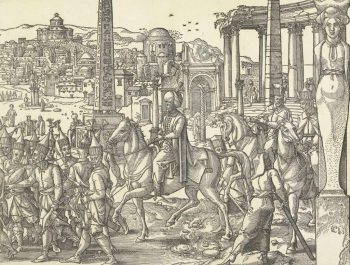
Procession of Süleyman I, from ‘Customs and Fashions of the Turks’, Pieter Coecke van Aelst, woodcut print, 30 × 39 cm, 1553 (Amsterdam: Rijksmuseum, RP-P-OB-2304L).
In recent years, a renewed interest in early modern rituals, festivals, and performances has prompted a reconsideration of ceremonious processions with a particular focus on their impact on social, cultural, artistic, and political structures and practices. Simultaneously, scholars have increasingly acknowledged the mobility of early modern artists across geographical, religious, and cultural borders. Although processions were witnessed by natives and visitors alike and were therefore prime instances of cross-cultural encounters, their depictions by artists both local and foreign remain a lesser-studied body of visual material. This symposium proposes to explore the visual representations of processions that took place within cross-cultural encounters both within and outside of Europe.
A procession was an act of movement that was particularly charged with meaning; an ambulatory mode of celebration, it had a global resonance in the early modern period. Processionals impressed foreign dignitaries, established modes of rule, communicated traditions, and negotiated power balances and were highly sensory occasions—as such they lent themselves readily to visual representation and were enthusiastically recorded in literature. Pageantries, military processions, and Joyous Entries (Blijde Inkomsten) were recorded in a variety of media, as exemplified by the festival books celebrating the ephemeral constructions orchestrated for Cardinal-Infante Ferdinand’s arrival in Antwerp (1635) or the eighteenth-century paintings depicting Venice’s dazzling boat parades in honour of foreign dignitaries. Furthermore, ceremonial processions conceived for births, weddings, circumcision feasts, and funerals occasioned visual representations such as the colourful Mughal miniature Wedding Procession of Dara Shikoh in Presence of Shah Jahan (1740). In addition, the notion of procession can be expanded to encompass various expressions of mobility that could be understood and were often depicted as a procession. Both Jan van Scorel’s frieze-like painting of the knightly brotherhood commemorating their Holy Land pilgrimage (c. 1530) and the depiction of ambassadors travelling with their retinue to foreign courts and cities can be perceived as a form of procession. Thus, the structure of a procession was increasingly adopted in the Early Modern period to depict moments of exchange and motion propelled by the quest for knowledge, as much as diplomatic concerns and religious piety. Well-known examples include The Voyage to Calicut tapestry series (1504) as well as the highly detailed printed frieze of a merchant endeavour by Hans Burgkmair (The King of Cochin, 1508).
Free admission, all welcome. Advance booking requested.
P R O G R A M M E
9.00 Registration
9.30 Welcome
9.45 Session 1: Royal Encounters
• Bianca Schor (Independent Scholar, London), Albert Eckhout’s Tapestry Le Roi Porté in Malta: A Diplomatic Encounter
• Travis Seifman (University of California), Displaying Foreignness for Prestige: Luchuan Embassy Processions in Edo, 1644–1850
• Matthew Gin (Harvard University), Rites of Passage: Re-Tracing Princess Maria Teresa Rafaela’s Entry into France (1745)
11.00 Coffee break
11.35 Session 2: Beyond the Documentary
• Gemma Cornetti (The Warburg Institute, University of London), Stefano della Bella and the Triumphal Entry of the Polish Ambassador in Rome (1633)
• Sabrina Lind (Ghent University), A Book without Readers? Or the Audience and the Importance of the Festival Book(s) of the Joyous Entry into Antwerp in 1635
• Gaylen Vankan (University of Liège), Imagine Orient: A Military Procession by Jan Swart van Groningen
12.50 Lunch break
13.50 Session 3: Performing Processions
• Laila Dandachi (University of Vienna), ‘The Triumphal Exotic from the East’: The Display of Diplomatic Performances of Early Modern Islamic Empires Shaped by the Iconic and Emblematic Nature of Islamic Military Arms and Armour
• Borja Franco Llopis and Francisco Orts-Ruiz (UNED, Madrid), Muslims and Moriscos in the Processions and Royal Entries in Iberia (14–16th Centuries): Beyond Their Visual Representation
• Esther Pramschiefer (University of Cologne), Travelling Theatres in Germany: Audiences and Actors Proceeding outwards of Walled Cities
15.05 Tea and coffee break
15.40 Session 4: Religious Processions
• Ashley Patton (University of Minnesota), St Rose of Lima: Identity, Performance, and Surrogacy
• Massoumeh Assemi (The Courtauld Institute of Art), Muharram Processions
16.30 Short break
16.40 Session 5: Itinerant Processions
• Raoul DuBois (University of Zurich), Temporality and Mediality of the Processions in Travelogues of the 15th and 16th Centuries
• Nicholas Mazer Crummey (Independent Scholar, Budapest), Observing a City in Motion: An Englishman’s Account of the 1675 Ottoman Imperial Circumcision Festival in Edirne
17.30 Closing remarks
18.00 Reception
Symposium | Rosetsu in Context
From H-ArtHist:
Rosetsu in Context
Museum Rietberg, Zurich, 7 October 2018

Nagasawa Rosetsu, Scholars Crossing a Bridge, 1788–89, ink and color on paper, hanging scroll, 47 × 21 inches (San Diego Museum of Art).
Eighteenth-century Japan witnessed an unprecedented diversity in artistic expression, nourished by the flourishing of a sophisticated urban culture and the increased affluence of the population in provincial areas. This symposium presents an array of fresh perspectives on issues of art production and consumption as well as leading figures of the art scene that constitute the environment in which Nagasawa Rosetsu (1754–1799) lived and worked.
Organised with the support of the Mary Griggs Burke Center for Japanese Art, Columbia University, in conjunction with the special exhibition Rosetsu: Ferocious Brush, on view at the Museum Rietberg Zurich, 6 September — 4 November 2018. While participation in the symposium is free of charge, a registration is required.
P R O G R A M M E
9.30 Doors open
10.00 Welcome by Albert Lutz (Director, Museum Rietberg)
10.10 Introduction by Khanh Trinh (Curator of Japanese and Korean Art, Museum Rietberg)
10.30 Noguchi Takeshi (Chief Curator, Nezu Museum), The Tiger and Departure from Realistic Representation: Nagasawa Rosetsu in Comparison to his Master Maruyama Ōkyo
11.10 Break
11.30 Alexander Hofmann (Curator for Japanese Art, Asian Art Museum, State Museums Berlin), The Genius and the Bores – Or: Whatever Happened to Rosetsu’s Contemporary Academic Painters?
12.10 Lunch and exhibition viewing
14.00 Yukio Lippit (Professor, Harvard University), From Kisō to Kijin: Reconsidering Eccentricity through Ike no Taiga’s Two Chinese Poets
14.40 Kadowaki Mutsumi (Visiting Professor, Osaka University), Itō Jakuchū and Zen
15.20 Break
15.40 Matthew McKelway (Professor, Columbia University), Nagasawa Rosetsu and Zen
16.30 Questions and panel discussion
Symposium | Rethinking the Life and Work of Rosetsu
From H-ArtHist:
Rethinking the Life and Work of Nagasawa Rosetsu
University of Zurich, 20–21 October 2018
The Japanese painter Nagasawa Rosetsu (1754–1799) has increasingly been a source of interest during the last years from popular and academic audiences with numerous exhibitions in Japan and in the West. Rosetsu has long been a name in Western studies of Japanese art, starting with a groundbreaking exhibition at the Denver Art Museum in 1973 and the publication by Robert Moes from the same year. Presently he is represented at an outstanding exhibition at the Museum Rietberg, Zurich, that feature key works of the artists, seldom seen outside of Japan.
Rosetsu has been the center of controversy over a long time, from the different versions of his contested biography to the questions of how to interpret the artist and his work. For decades he has been relegated to a list of eccentric artists, which serves little but to obscure a serious discussion of the artist and his remarkable works. At this time of great popularity and exposure to the public in the East and the West, a rethinking of the artist and his works seems highly overdue.
For this purpose, the University of Zurich has invited the top Japanese scholars who have been working on Rosetsu over the last years. We have planned a two-day conference with presentations and discussions and are inviting both younger and more established scholars, including Professors Yasuhiro Satō and Motoaki Kōno, who has been working on Rosetsu since the 1970s. Among the younger stars in the field, we are inviting Momo Miyazaki and Hideyuki Okada who have recently changed Rosetsu scholarship in significant ways.
The aim is to gather these scholars and to have them engage with each other and pool their knowledge into meaningful discussions. The expected result of the conference is to spread wider knowledge of this outstanding artist among the scholarly community and among the public. We also hope that discoveries in the life and works of the artist will be a lasting result of this conference.
The symposium is free and open to the public. No prior registration is required. Presentations will be in Japanese and in English. Texts in English will be supplied for presentations held in Japanese. For questions, please contact the Section for East Asian Art: kgoa@khist.uzh.ch.
The symposium is organized by the Section for East Asian Art, University of Zurich, and is funded by the Swiss National Science Foundation, the Swiss-Japanese Society, and the University of Zurich Foundation (Hochschulstiftung).
S A T U R D A Y , 2 0 O C T O B E R 2 0 1 8
10:15
佐藤康宏 Satō Yasuhiro, University of Tokyo
「長澤蘆雪における〈反動〉― 應舉の氷を破る」/ Rosetsu’s Backlash: Breaking the Ice of Ōkyo
11:15
野口剛 Noguchi Takeshi, 根津美術館 Nezu Art Museum
「月光」と詩情の回復:師・円山応挙との比較による長沢芦雪に関する考察 / Moonlight and the Return of Sentiment: Nagasawa Rosetsu in Comparison to His Master Maruyama Ōkyo
14:15
岡田秀之 Okada Hideyuki, 嵯峨嵐山日本美術研究所 Saga-Arashiyama Institute for Japanese Art
「芦雪の初期作品について」/ On the Early Works by Rosetsu
15:45
河野元昭 Kōno Motoaki, 静嘉堂文庫 Seikadō Bunko Art Museum
「私が見てきた長澤蘆雪受容の変化」/ Changes in Rosetsu Reception That I Have Observed Over the Years
16:45
中谷伸生 Nakatani Nobuo, Kansai University
「芦雪と大坂画壇」/ Osaka Painters and Rosetsu
S U N D A Y , 2 1 O C T O B E R 2 0 1 8
14:00
宮崎ももMiyazaki Momo, 大和文華館 Yamato Bunkakan
「芦雪の指頭画をめぐって」/ On the Finger Paintings of Rosetsu
15:00
Hans Bjarne Thomsen, University of Zurich
The Kansai Eccentric
16:30
筒井忠仁 Tsutsui Tadahito, 文化庁Agency for Cultural Affairs
「南紀から広島へ―長澤蘆雪の画風の変遷と精神の変容―」/ From Nanki to Hiroshima: The Transition of the Nagasawa Rosetsu’s Style and the Transformation of his Spirit
Conference | Hadrian’s Villa and Its Reception
From Munich’s Zentralinstitut für Kunstgeschichte:
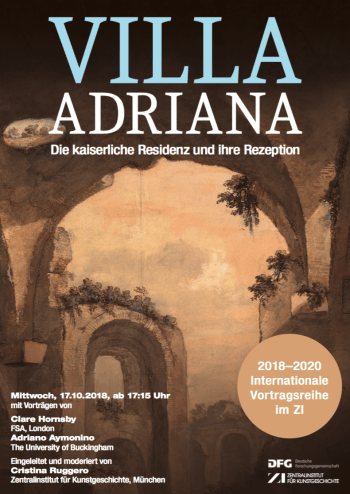
Villa Adriana: Die kaiserliche Residenz und ihre Rezeption
Zentralinstitut für Kunstgeschichte, Munich, 17 October 2018
 17:15 Cristina Ruggero (ZI, München), Bares für Rares: Antike aus der Hadriansvilla und der römische Kunstmarkt
17:45 Clare Hornsby (London), Man of Spirit, Man of Taste, Man of Fashion: Deciphering Identities of the British Collectors of Ancient Marbles
This talk will examine some examples of motivations for collecting: art as investment, response to peer pressure or fashion, ambition to form taste or to improve national standards; rarely were the motivations clear cut. The collectors included here will range from the politically ambitious commoner Bubb Dodington and his highly-placed dealer Cardinal Albani in the late 1740s, to the archetype of the nobleman collector the Earl of Shelburne, who acquired several pieces from Hadrian’s Villa in the 1760s and 70s. Others considered are the obsessively acquisitive gentleman-scholar Charles Townley and the banker-collector Lyde Browne, their activities furnishing us with a look at the role of the secondary market and the expansion of the mania for collecting. For all of these collectors, Hadrian’s Villa was the provenance par excellence for any ancient statue; reference will be made in this talk to some of the sculptures discovered there and how the British excavators and dealers used that provenance to add even further value to the perennial glamour of the ancient work of art.
18:30 Adriano Aymonino (The University of Buckingham), The Reception of Ancient Painting in the Eighteenth Century: Theoretical Debate, Antiquarian Publications, and the Visual Arts
This talk focuses on the nature of the relationship between the reception of ancient painting and the humanistic theory of art. It argues that this relationship was twofold: on the one hand, surviving textual evidence on Greek and Roman painting provided examples, tropes and principles that were instrumental in shaping art theory, from Leon Battista Alberti to Giovanni Pietro Bellori and the theoreticians of eighteenth-century classicism. On the other hand, the almost complete lack of physical remains of these artworks contributed to an idealised vision of ancient painting that was equally influential in defining some of the essential tendencies that shaped this theoretical tradition. Specifically, my paper will investigate how the relationship between theory and object evolved in the face of those new discoveries, publications and antiquarian ideas that proliferated over the course of the eighteenth century—with a particular focus on Hadrian’s Villa.
Additional information is available here»
Workshop | Digitising the Paul Mellon Centre’s Photo Archive
From the Paul Mellon Centre:
Digitising the Paul Mellon Centre’s Photo Archive
Paul Mellon Centre, London, 13 November 2018
Registration due by 12 October 2018
 The Paul Mellon Centre (PMC) is currently in the process of digitising its institutional photographic archive collection. Since 1964, the Centre has amassed a collection of approximately 150,000 images of British paintings, decorative painting, sculpture and prints. The resulting images will be made available for research through a new online collections website. The key aims of this project are:
• the preservation of an important resource that has been a core part of the Centre’s activity since its foundation
• provide enhanced access to this material as a digital resource, both on- and off-site
• enable new research projects and discoveries
• produce high quality images for researchers to use free of charge in teaching, study and publication
The purpose of this workshop is to explore the potentials and challenges of using digitised photo archive materials and we invite academics, researchers, curators, conservators, collection managers, educators, arts professionals, photographic experts and digital technologists to take part in this roundtable discussion about the digital future of the PMC’s photo archive.
Topics that might be covered include:
• How are photo archive materials used in 2018? How will they be relevant to researchers in the future? How do researchers use photo archives? What are they looking for? How might digitisation help them to search the collections?
• What tools (e. g. image comparison tools) and search facilities would be useful for researchers consulting the photo archive online?
• What are the benefits and/or losses of viewing this collection online?
• How should this material be presented on a digital platform?
• What extra material might the PMC provide alongside the digitised images to facilitate research?
• What can this collection tell us about the historiography of British art and the development of the study of British art and architecture?
• Is this material of interest to those outside of the field of British art history, i.e. photographic historians or practicing artists?
• Could digitisation enhance how this collection might be used by conservators?
This will be an interactive workshop, and all participants will be expected to contribute to the discussion.
To register your interest in participating in this event, please email events@paul-mellon-centre.ac.uk by 12th October. We envisage that the workshop will run across a day from 10am until 4pm. Lunch, refreshments, and some travel expenses will be provided. Places are limited, so please register your interest in attending and provide a short paragraph outlining your interest in this project or photo archives more generally.










leave a comment