Symposium | Opus Architectonicum
From ArtHist.net:
Opus Architectonicum: A Symposium Honoring Joseph Connors
Online and in-person, Notre Dame Rome, Roma, 12 May 2025
Organized by Silvia Dall’Olio and Susan Klaiber
This international symposium marks the eightieth birthday of the distinguished architectural historian Joseph Connors and his retirement from active teaching. Currently the Michael C. Duda Visiting Professor at the University of Notre Dame School of Architecture, Connors has shaped the study of Baroque art, architecture, and urbanism—particularly of Borromini and the city of Rome—as a scholar, teacher, and mentor for half a century. In his role as a visionary institutional leader, Connors has fostered innovative work in early modern Italian studies, the wider humanities, and the visual and performing arts.
The symposium gathers European colleagues and former students to celebrate this cherished friend. Presentations will explore issues in the history of art and architecture, their methodologies, and historiography, all using Joe’s personal ‘Opus Architectonicum’ as a point of departure. Attendance is free, but registration required at this link. The symposium will also be live streamed; those interested in following the symposium online should register at the same link on the symposium webpage, checking the box for the video link rather than in-person attendance.
p r o g r a m
9.00 Welcome — Silvia Dall’Olio (Director, Notre Dame Rome), David Mayernik (Notre Dame Architecture), and Susan Klaiber (co-organizer)
9.20 Session 1 | Celebrating Joseph Connors
Chair: Susan Klaiber (independent, Switzerland)
• Ingrid D. Rowland (University of Notre Dame) — Laudatio
• Barbara Jatta (Musei Vaticani) — Lievin Cruyl and the Rome of Alexander VII
10.30 Coffee
11.00 Session 2 | The Rome of Borromini
Chair: Sabina de Cavi (Universidade Nova, Lisboa)
• Augusto Roca De Amicis (Università di Roma La Sapienza) —Rivedendo i Santi Luca e Martina: Architettura come sintassi
• Alberto Bianco (Archivio della Congregazione dell’Oratorio di San Filippo Neri) — Virgilio Spada: Il progetto della Casa dei Filippini e l’identità oratoriana
• Fabio Barry (Warburg Institute) — St. Teresa in Ecstasy: Sacred or Profane Love?
12.45 Lunch break
14.00 Session 3 | Encounters with Joe and Borromini
Chair: Heather Hyde Minor (University of Notre Dame)
• Helen Hills (University of York) — Meeting Joe, via video
• Susan Klaiber (independent, Switzerland) — Borromini and Guarini: Master and Pupil?
• Sabina de Cavi (Universidade Nova, Lisboa) — ‘Borrominismi’ a Lisbona: Osservazioni preliminari sull’impatto dell’Opus Architectonicum in Portogallo
15.45 Break
16.15 Session 4 | Oltre Borromini
Chair: Fabio Barry (Warburg Institute)
• Elisabeth Kieven (Bibliotheca Hertziana) — About a Drawing by Carlo Marchionni: Delight and Despair
• Heather Hyde Minor (University of Notre Dame) — Piranesi’s Imaginary Prisons
• Susanna Pasquali (Università di Roma La Sapienza) — Qualche domanda intorno a un caffè preso nel bar nel Cortile della Biblioteca, Palazzo del Belvedere Vaticano
18.00 Reception
Conference | Watercolour and Weather, 1750–1850
From ArtHist.net:
Watercolour and Weather, 1750–1850
Musée cantonal des Beaux-Arts de Lausanne, Switzerland, 4–6 June 2025
Organized by Bérangère Poulain and Desmond Kraege
Registration due by 3 June 2025
Simultaneously with a resurgence of landscape painting, the period 1750–1850 in European art witnessed an increased interest in the weather, not only as concerns its momentary states (clouded skies, lightning), but also the broader study of meteorological phenomena and of their unfolding over time. Besides the more radical events—such as storms—that were frequently represented, this period thus developed a keen observation of subtle moments of changing weather, allowing artists to combine varied effects of light. This is true not only of the most famous British painters (Joseph Mallord William Turner, John Constable, Alexander and John Robert Cozens) but also of figures from further afield, such as Giovanni Battista Lusieri, Caspar David Friedrich, and Abraham Louis Rodolphe Ducros.
In close connection to this artistic evolution, the period under scrutiny also witnessed the development of meteorology and climatology as scientific disciplines. This led both to Luke Howard’s classification of clouds (1804) that remains in use to this day, and to the theorisation of the greenhouse effect by Joseph Fourier in 1824. A new consciousness of the atmosphere and of its complexities, leading directly to present concerns regarding climate change, can thus be traced back to this cultural environment.
This conference forms part of a broader research and teaching project at the Universities of Lausanne and Geneva concerning Swiss watercolor artist Abraham Louis Rodolphe Ducros, whose personal collection forms the original nucleus of the Lausanne MCBA Museum. The conference will include a viewing of a selection of his works. Please register for this free event by 3 June 2025 by emailing berangere.poulain@unige.ch.
w e d n e s d a y , 4 j u n e
14.00 Institutional Greetings — Juri Steiner (MCBA)
14.15 Introduction — Bérangère Poulain (Université de Genève) and Desmond Kraege (Université de Lausanne)
14.45 Session 1 | Prelude
• Ulrike Gehring (Universität Trier)
15.15 Session 2 | Discovering Weather
Chair: Camille Lévêque-Claudet
• John Robert Cozens: The ‘man of clouds’ — Timothy Wilcox (Independent Curator, Oxford; Former Curator, British Museum and Victoria & Albert Museum)
• The Depiction of Atmospheric Changes in Piedmontese Watercolour Painting between the 18th and 19th Centuries: Artists, Approaches, and Techniques — Matteo Cappellotto (PhD Student, Università degli Studi di Siena)
16.15 Pause
16.45 Session 3 | Architecture and Weather
Chair: Basile Baudez
• Water, Weather, and Colour in the Roman Architectural Academy — Tracy Ehrlich (Parsons School of Design/The New School, New York)
• Le tonnerre et le pinceau: à propos de quelques orages dans les projets d’architecture de l’Académie royale de Paris — Adrián Fernández Almoguera (Universidad Nacional de Educación a Distancia)
t h u r s d a y , 5 j u n e
10.15 Session 4 | Watercolour and Other Media
Chair: Philippe Kaenel
• Painting the Sky in Hand-Coloured Prints — Basile Baudez (Princeton University)
• The Theatre and the Easel: The Depiction of Meteorological Effects in Watercolour Painting and Stage Productions in Georgian England — Segundo J. Fernandez (Independent Scholar and Curator, Tallahassee, Florida)
11.15 Session 5 | Abraham-Louis-Rodolphe Ducros
Chair: Christian Michel
• Viewing of a selection of watercolours by A.L.R. Ducros from the MCBA
• Clouds in the Sea: A.L.R. Ducros, Weather, and Pictorial Texture — Bérangère Poulain (Université de Genève) and Desmond Kraege (Université de Lausanne)
12:30 Lunch
14.00 Session 6 | Charting Colonial Weather
Chair: Nicolas Bock
• Verdant Landscapes: Art, Observation, and Sustainability — Mari-Tere Álvarez (J. Paul Getty Museum, Los Angeles)
• Atmosphères des contrées canadiennes 1790–1820: De l’esquisse à l’œuvre achevée, l’art de dépeindre les horizons nouveaux par quelques amateurs britanniques — Marie-Claude Beaulieu (Independent Scholar, Montréal; Associate Researcher, CRIHAM – Université de Poitiers)
• Watercolour and the ‘melancholy darkness’ of Caribbean Weather in the 18th Century — Joseph D. Litts (PhD Student, Princeton University)
• Ciels en scène: Les aquarelles brésiliennes d’Hercule Florence (autour de 1830) — Martine Tabeaud (Université Paris I Panthéon Sorbonne)
16:30 Pause
16:45 Doctoral workshop
f r i d a y , 6 j u n e
10.15 Session 7 | Watercolour and Science
Chair: Nathalie Dietschy
• Les planches de Luke Howard: l’eau et les « modifications » des nuages — Anouchka Vasak (Université de Poitiers)
• Ecology and Aesthetics in Carus and Friedrich: Two Approaches to Meteorology — Elisabeth Ansel (Friedrich-Schiller-Universität Jena)
• Can Colours in Watercolour Paintings be Considered a Quantitative Climate Archive? — Christian von Savigny (Institute of Physics, Universität Greifswald)
• Volcanic Weather, 1816–1818: Tambora, Turner, and Friedrich — Dewey Hall (California State Polytechnic University, Pomona)
• Painting the Invisible: Representations of Wind Force in Watercolour — Nicola Moorby (Tate Britain, London)
13:00 Lunch
14.15 Session 8 | Revisiting the Masters
Chair: Jan Blanc
• J.M.W. Turner: Storm Chaser — Ian Warrell (Independent Curator, Brighton; Former Curator, Tate Britain)
• ‘A view unequalled in Europe’: John Constable’s Watercolours of Skies Looking over London Painted from his House in Well Walk, Hampstead in the Early 1830s — Anne Lyles (Independent Curator, London; Former Curator, Tate Britain)
Conference | Sculpture between Britain and Italy, 1728–1854
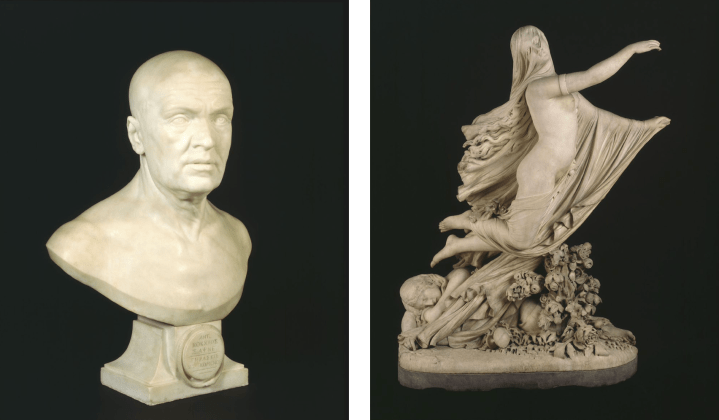
Left: Joseph Wilton, Dr Antonio Cocchi, 1755 (London: V&A: A.9‐1966). Right: Raffaele Monti, The Sleep of Sorrow and the Dream of Joy, 1861 (London: V&A: A.3-1964).
◊ ◊ ◊ ◊ ◊
From the conference programme:
Academy, Market, Industry
Sculptural Models, Themes, and Genres between Britain and Italy, 1728–1854
Online and in-person, Victoria and Albert Museum, London, 16–17 May 2025
Organized by Adriano Aymonino, Kira d’Alburquerque, Albertina Ciani Sciolla, and Andrea Bacchi
This two‐day interdisciplinary conference, organised by the University of Buckingham, the Victoria and Albert Museum, and the Fondazione Federico Zeri, investigates the role played by British‐Italian artistic exchanges in shaping sculptural models, themes, and genres between the eighteenth and nineteenth centuries. The conference adopts a longue durée approach, focusing on the century when these exchanges were most intense: from 1728, when the anglicised Flemish sculptors Laurent Delvaux and Peter Scheemakers travelled to Italy “to form and improve their studies,” to the 1854 opening of the Crystal Palace in Sydenham, whose sculptural decoration was directed by the Milanese Raffaele Monti. Throughout this period, the two traditions became interdependent, developing an artistic dialogue that influenced sculptural models, themes, and genres not only in Italy and Britain but also across Europe and the territories of the expanding British Empire, from the Indian subcontinent to the Americas.
This conference adopts a typological approach, analysing how academic frameworks and patronage networks influenced the diffusion of sculptural models, themes, and genres, and how market dynamics—along with the industrial production of new materials—either reinforced or challenged these aspects. Papers will explore the evolution of established genres such as busts, ideal sculptures, funerary and public monuments, copies and adaptations after the Antique, as well as the diffusion of models and themes in decorative figurative sculpture, including reliefs, medallions, chimneypieces, and in smaller artworks such as gems, cameos, impressions, ivories, or in objects produced in porcelain, earthenware, and various new artificial ‘stones’. While concentrating on sculpture, the conference embraces an interdisciplinary approach to evaluate how the development of new models, themes, and genres reflected or shaped cultural and national identities, social values, evolving canons, and shifting audiences in the different contexts of Italy and the Anglophone world. Recent years have witnessed a surge in monographic publications and PhD dissertations by art historians, social historians, and scholars focused on material culture, examining individual artists and themes connected to this trans‐national movement. This conference aims to assess the current state of research and explore future directions in the discipline.
The conference is part of a series of events organised to celebrate the launch of a new edition of Francis Haskell and Nicholas Penny’s Taste and the Antique in December 2024. A further conference focused on the “Future of the Antique” will take place at the Warburg Institute and Institute of Classical Studies on 10–12 December 2025 (see the call for papers here).
Registration for online attendance is available here»
Registration for in-person attendance is available here»
f r i d a y , 1 6 m a y
10.00 Registration
10.30 Welcome and Introduction — Adriano Aymonino, Kira d’Alburquerque, and Albertina Ciani Sciolla
10.45 Session 1 | New Approaches to Old Genres and Themes
Moderator: Andrea Bacchi (Fondazione Federico Zeri‐Università di Bologna)
• Italy, By Way of Flanders: John Michael Rysbrack and Peter Scheemakers the Younger in England, ca. 1720–1750 — Emily Hirsch (Brown University)
• The Impact of British Collecting on Italian Artistic Trends: The Case of Filippo della Valle (1698–1768) — Camilla Parisi (Università Roma Tre)
• Antonio Cocchi and Joseph Wilton: The Charm of Antiquity and the ‘True Catholic Air’ — Mattia Ciani (Università degli Studi di Siena)
• ‘The insolence of this puppy!’: Evidence for the Complexities of Commissioning Models between England and Rome in the Mid-Eighteenth Century — Susan Jenkins (Westminster Abbey)
• Christopher Hewetson and the Evolution of the Portrait Bust in Late Eighteenth‐Century Rome — Matteo Maggiolo (Independent Scholar)
13.15 Lunch
14.45 Session 2 | Models, Themes, Genres, and Media Transfer
Moderator: Malcolm Baker (University of California, Riverside)
• Media Transfers and Transnational Exchange in Edme Bouchardon’s Roman Portraits, 1727–1732 — Karl Brose (University of Virginia)
• Giles Hussey and the Revival of Gem Engraving in Georgian Britain — Dominic Bate (Brown University)
• Antiquity in Dialogue: Eleanor Coade’s Artificial Stone and Global Exchanges — Miriam Al Jamil (Independent Scholar)
• Flaxman Models and Wedgwood Design Process — Catrin Jones (V&A Wedgwood Collection)
16.55 Session 3 | Book Presentations
• Introducing the New Edition of Francis Haskell and Nicholas Penny, Taste and the Antique (Brepols/Harvey Miller, 3 vols, December 2024) — Adriano Aymonino
• Introducing the European Sculpture in the Collection of His Majesty The King (Modern Art Press and Royal Collection Trust, 4 vols, Autumn 2025) — Jonathan Marsden
17.15 Closing Remarks
s a t u r d a y , 1 7 m a y
10.00 Registration
10.30 Welcome and Introduction — Adriano Aymonino, Kira d’Alburquerque, and Albertina Ciani Sciolla
10.45 Session 4 | New Genres, New Subjects
Moderator: Anne‐Lise Desmas (The J. Paul Getty Museum)
• Cockerell’s ‘Progetto’ and the Transformation of the Sculpted Pediment — Max Bryant (Minneapolis Institute of Art)
• Outside Mythology: Religious and Historical Themes in Anglo‐Roman Sculpture (Late Eighteenth to Early Nineteenth Century) — Tiziano Casola (Independent Scholar)
• The Wounded Ideal: New Iconographies in Roman Sculpture around 1848 — Anna Frasca‐Rath (Universität Wien)
• Between Art and Industry: Raffaele Monti’s ‘Veiled Women’ — Albertina Ciani Sciolla (University of Buckingham)
13.00 Lunch
14.30 Session 5 | Patronage, Industry, and the Dissemination of Renaissance and Modern Models
Moderator: Alison Yarrington (Loughborough University)
• The British Glory of Thorvaldsen and His School — Alessio Costarelli (Università degli Studi di Messina)
• The Sutherlands’ Patronage and Copies of ‘Renaissance’ Statues in Britain: from Florence to Trentham Hall and Sydenham — Giuseppe Rizzo (Gallerie degli Uffizi)
• Exhibiting Italian Neo‐Renaissance Sculpture in Great Britain: The Commissions of the 3rd Marquess of Londonderry to Lorenzo Bartolini — Francesco Zagnoni (Università di Bologna)
• Genoese Casts from ‘Professor Varny’: Sculptural Exchanges between Genoa and England through the Work of Santo Varni — Matteo Salomone (Università degli Studi di Roma Tor Vergata)
16.30 Closing Remarks — Nicholas Penny (former Director, National Gallery, London)
Seminar | African Ivory: Past and Present
From the seminar flyer:
African Ivory: Past and Present
Huguenot Museum, Rochester, 4 June 2025
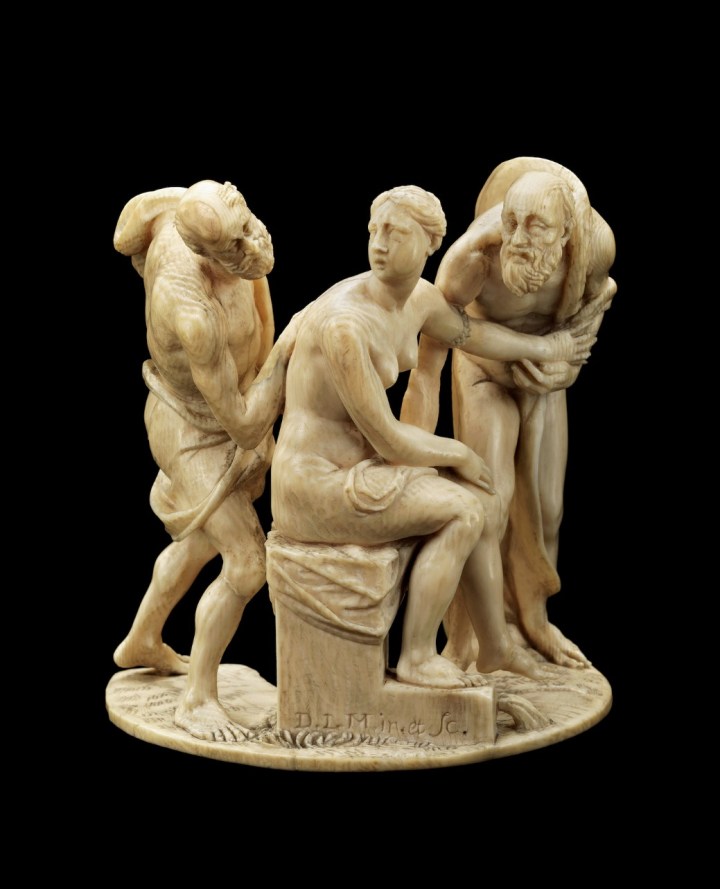
David Le Marchand, Susanna and the Elders, ca. 1720, African ivory (Rochester: Huguenot Museum). More information is available here.
Recent UK legislation—the Ivory Act of 2018 and the January 2025 amendment—makes the acquisition and loan of objects containing antique ivory challenging for regional and independent museums. This seminar hosted by the Huguenot Museum—following the acquisition, loan, and display of three ivory carvings by Huguenot sculptors—will share case studies, discuss best procedure in negotiating recent legislation, and consider approaches to press and marketing. To register, please send your name, email address, and institutional affiliation to Tessa Murdoch, chair@huguenotmuseum.org. The fee of £15 per person will include a buffet lunch. Payment can be made on the day in cash or card, or in advance by BACS transfer. Please note any dietary requirements.
p r o g r a m m e
11.00 Lucy Vigne (Independent Consultant) — Illicit Trade in African Ivory Today
11.40 Martin Levy, FSA — Ivory, the Antique Trade, and the Impact of Recent International Legislation
12.45 Lunch
1.35 Leanne Manfredi (V&A Purchase Grant Fund) and Mariam Rosser-Owen (Curator Middle East, Asia Department, V&A) — The Ivory Act of 2018 and Recent Amendments
Meeting the Challenges of the Ivory Act is a network led by the Pitt Rivers Museum and the Victoria and Albert Museum to support curators at Prescribed Institutions who are required to assess applications for exemption to the Ivory Act.
2.15 Nigel Israel (Independent Scholar) — Identifying Ivories
3.30 Tea
Conference | Textiles in Early Modern Venice
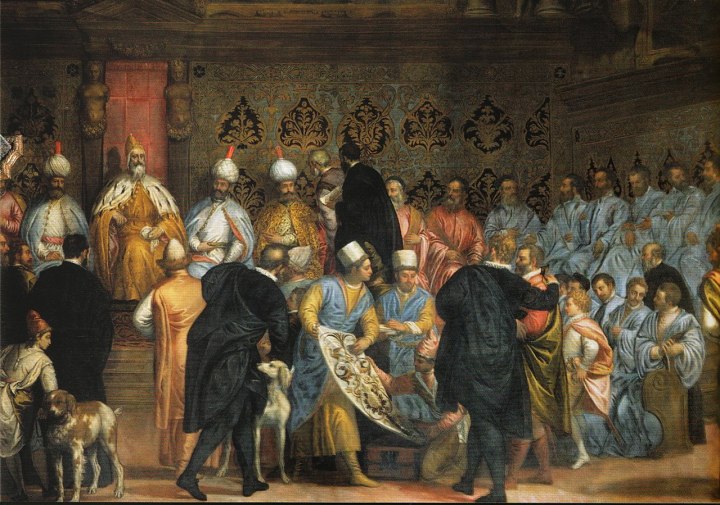
Carlo Caliari, Embassy of Shah ‘Abbas I to Venice, 1595
(Venice: Doge’s Palace)
◊ ◊ ◊ ◊ ◊
From ArtHist.net:
Trade, Production, and Consumption of Textiles and Dress in Early Modern Venice
Centro Tedesco di Studi Veneziani, Venice, 28–29 May 2025
Organized by Jola Pellumbi, Sara van Dijk, and Torsten Korte
Registration due by 25 May 2025
Venice in the early modern period flourished as a centre of textile production and trade, shaping and fostering global networks of connections that directly impacted dress in Europe and elsewhere. Due to Venice’s impenetrable location, its proximity to the centre of Europe, and a long-standing tradition of merchants and seafarers, Venice had positioned itself as a principal gateway between Europe and the East. Whether it was through the importation of luxury goods such as textiles and carpets, exports of beauty products and perfumes, or exchanges of ambassadorial gifts, Venice aided in the dissemination and infiltration of ideas, styles, and designs between Europe and the East. Furthermore, due to the flourishing art production and the thriving printing press in 16th-century Venice, textile patterns and dress styles were able to spread throughout Europe and the rest of Venice’s trading posts around the world influencing fashions, designs, methods of production, and patterns of consumption. Apart from the unaffected patrician government attire, infiltrations of new styles were particularly noticeable in Venice itself, throughout Carnival festivities, dogal and ambassadorial processions, operas and theatres, gambling dens, and in everyday life where both spaces and bodies were adorned.
This conference aims to generate a discussion about the role of Venice as a centre of a global network of connections as seen through its trade, production, and consumption of textiles and dress as well as carpets, haberdashery, beauty products, perfumes, dyes, feathers, jewellery, and design. Registration (€15 + €2 administrative costs) can be booked here until 25 May.
Organised by Jola Pellumbi and Sara van Dijk (Dressing the Early Modern Network) and Torsten Korte (University of Bern), in collaboration with the Centro Tedesco di Studi Veneziani and the University of Bern, and generously supported by the Fritz Thyssen Foundation.
w e d n e s d a y , 2 8 m a y
18.00 Evening Lecture
The Mysterious Blue in Dürer’s Feast of the Rosary (1506): On the Problem of Interpreting Textile Colours in the Painting — Philipp Zitzlsperger (University of Innsbruck)
19.00 Ricevimento at the Centro Tedesco di Studi Veneziani
t h u r s d a y , 2 9 m a y
9.30 Registration and coffee
10.00 Welcome
10.10 Session 1 | Luxury and Trade
Chair: Luca Molà
• From Venice to Lyon and Vice Versa: The Road to a New Trade in Fashionable Silk Fabrics, 17th to 18th Century — Moïra Dato (University of Bern)
• Francesco Zen: Luxury Trade and Technological Innovation between Venice and Constantinople in the Early 16th Century — Elisa Puppi (Università Ca’ Foscari Venezia)
• Venetian Trade of Italian Textiles in Hungary until the End of the 16th Century — Maxim Mordovin (Eötvös Loránd University, Budapest)
• Beyond Luxury: The Circulation of Silk Waste in Early Modern Venice (1500–1650) — Sofia Gullino (Università degli Studi di Padova)
12.00 Lunch break
14.00 Session 2 | Global Connections
Chair: Catherine Kovesi
• Circulating Civilisation: Venetian Glass Beads as Agents of Global (Ex)Change — Sandrine Welte (Università Ca’ Foscari Venezia)
• ‘Sempre Magnifico’: Catherine de’ Medici through the Eyes of Venetian Ambassadors — Emily Averiss (Warburg Institute, University of London)
• Under the Radar or over the Top? Clothing of Jerusalem Pilgrims in the Late 15th Century — Alicia Wolff (University of Heidelberg)
15.30 Coffee and tea break
16.00 Session 3 | The Politics of Dress
Chair: Jola Pellumbi
• Sartorial Rhetoric: Dress and Anglo-Venetian Relations in the Early 16th Century — Grace Waye-Harris (University of Adelaide)
• The Collective Wig: Political Power and Periwigs in 18th-Century Venice — Liz Horodowich (New Mexico State University)
17.00 Closing remarks
17.15 Farewell and aperitivo
◊ ◊ ◊ ◊ ◊
Note (added 23 April 2025) — This posting originally appeared April 22; it was moved back to April 19th for improved continuity with other posts.
Conference | Traveling Marble, 18th–20th Centuries
From ArtHist.net:
Traveling Marble: Agents, Networks, Technologies, 18th–20th Centuries
Thorvaldsen’s Museum, Copenhagen, 10 April 2025
Organized by Amalie Skovmøller and Ariane Varela Braga
Through thousands of years, white marble stones have been quarried and circulated to be consumed for architectural and artistic purposes worldwide. The stones are known from ancient Greek and Roman cultures, but during the 18th, 19th, and 20th centuries, white marble assumed a central role in the formation of European and Western art- and cultural history reaching far beyond the boundaries of antiquity. As a material signifying cultural prestige, white marble became a popular material for building and decorative projects, and the Imperial powers of Europe established new quarry facilities all over the world. These growing marble networks circulated white stones in far-reaching patterns of distribution from central Europe to the USA and from the Mediterranean to Scandinavia. Moving large quantities of solid stone requires a complex infrastructure, developed and maintained to support the increasing consumption. Yet scholars of art history and architectural studies have traditionally addressed white marble through the lens of aesthetics, leaving its omnipresence and global condition largely unexplored.
This seminar explores the distribution patterns of white marble, with particular emphasis on the 18th, 19th, and 20th centuries, but with perspectives on antiquity. Framing white marble as both a local and global phenomenon, the seminar shifts focus from the traditional emphasis on artists and their materials towards unseen networks of quarry owners, extractors and trading agents. In doing so, the seminar probes questions related to how quarries have been organized through time and the role played by marble consortiums, associations and federations, who have regulated labour, transportation, and distribution over time. The seminar thus targets patterns of distribution, such as trading routes by land and sea, and the technical improvements realized over time, bringing scholars together to discuss how to gather and share data on the extraction and circulation of marble to lay the first foundations for a future global archive of white marble distribution for this period. Please note that registration is required for attendance.
Organized by Institut for Kunst- og Kulturvidenskab / Amalie Skovmøller. In collaboration with Ariane Varela Braga / UNED, Madrid
p r o g r a m m e
9.30 Registration and coffee
10.00 Welcome by Amalie Skovmøller and Ariane Varela Braga
10:15 Morning Talks
• A World in Marble — Amalie Skovmøller
• Materials That Connect: The Circulation of White Marble in the Ancient Mediterranean — Alessandro Poggio
• Ancient Naxian Marble Quarries and Dedications: Documentation and Study from the 18th Century to Today — Rebecca Levitan
13.15 Afternoon Talks
• 18th-Century Norwegian Marble in Copenhagen — Kent Alstrup
• The Workshop of Antonio Caniparoli & Figli in Carrara 1850 to 1930 — Sandra Beresford
• Reading into Greenland Marble: ‘A Noble Danish Material’ — Jonathan Foote
• Marble for the Duce: The Networks of Agents, Merchants, and Marble Workers at Foro Mussolini — Ariane Varela Braga
• The ‘Archivi del Marmor Project (AMP)’ — Cristiana Barandoni and Luca Borghini
16.15 Final discussion
Symposium | Balkan and Aegean Artistic Identities in the 18th Century

◊ ◊ ◊ ◊ ◊
From ArtHist.net and the conference programme:
Balkan and Aegean Artistic Identities in the 18th Century: Between East and West
Online and in-person, Athens, 8–9 April 2025
Organized by Maria Georgopoulou and Alper Metin
This symposium aims to shed light on the intricate artistic and cultural identities that flourished in the eighteenth-century Ottoman Balkans and Aegean, regions positioned at the confluence of ‘Eastern’ and ‘Western’ historiographical conventions. The event encourages scholars to engage in a comprehensive examination of artistic production, architectural development, and socio-political dynamics during this transformative period.
Central to the symposium is the reassessment of the historiographical terms post-Byzantine art and Ottoman Baroque. Are these designations still relevant? If post-Byzantine art predominantly refers to religious works, how should we classify secular creations, such as the richly decorated interiors of Balkan and Anatolian mansions? How authentically Baroque was the so-called Ottoman Baroque, and does this term effectively convey the unique synthesis embodied in Ottoman architecture? Furthermore, how should we approach the non-Baroque elements within this period—features rooted in Byzantine, Western medieval, and Renaissance traditions—that complicate the conventional understanding of the Ottoman Baroque? The aim is to explore how these varied influences merged into hybrid forms that challenge conventional categorization.
The symposium will address the following themes:
1 The impact of political and cultural rivalries between the Ottomans and Venice in the Aegean and the Habsburgs in the Balkans, which not only redefined power structures but also shaped cross-cultural artistic and architectural identities. The manifestation of these rivalries in the built environment and material culture, such as building that bear testimony to shifts of power, conflict, and transformation.
2 The rich network of technical expertise of itinerant artists, architects, master builders, naval builders and artisans that fostered the exchange of knowledge and artistry. The fusion of local traditions in crafts (woodcarving, silverwork, textiles etc.) in areas such as Mount Athos and the Peloponnese. The influential interactions between the Archipelago and the coastal cities of mainland Greece and Anatolia, including Constantinople/Istanbul.
3 The interactions between Catholic, Orthodox, and Muslim communities in centers such as Crete, Chios, Constantinople/Istanbul, and Smyrna/Izmir, that shaped and transformed urban and architectural spaces.
4 The role of Orthodox merchants, whose economic influence and cultural mediation bridged the Ottoman Empire and Western Europe, fostering significant cross-cultural exchanges.
5 The mediation of Greek communities between the Venetian and Ottoman realms. The dual status of Greeks, as subjects of Venice and the Porte, in shaping of the artistic and architectural heritage they cultivated, with its broader implications for the region’s cultural fabric.
t u e s d a y , 8 a p r i l
16.00 Registration and coffee
16.15 Introduction — Maria Georgopoulou (Director of the Gennadius Library) and Alper Metin (University of Bologna and 2024–25 Cotsen Traveling Fellow at the Gennadius Library)
16.30 Session 1 | Mapping Architectural Connections
• Nikos Magouliotis (Institute for the History and Theory of Architecture, ETH Zurich) — The Printed Page and the Painted Column: An Architectural Microhistory of a Church in Ottoman Thessaly, ca. 1800
• Alper Metin (Department of the Arts, University of Bologna) — Warming Up to Change: Heating Appliances in the Gradual Transformation of Eighteenth-Century Ottoman Interiors
• Deniz Türker (Department of Art History, Rutgers University) — ‘Carvers of Chios’: Imperial Patrons, Ottoman Greek Kalfas, and Nimble Building in the Eighteenth Century
18.00 Coffee break
18.15 Session 2 | Domestic Spaces: History and Conservation
• Theocharis Tsampouras (Ephorate of Antiquities of Kozani, Hellenic Ministry of Culture) — The Political Character of Eighteenth-Century Christian Orthodox Art in the Ottoman Balkans
• Amalia Gkimourtzina (Ephorate of Antiquities of Kastoria, Hellenic Ministry of Culture) — The Secular Decoration in the Eighteenth-Century Mansions of Western Macedonia: The Example of the Conservation Works Carried Out in Tsiatsiapa Mansion in Kastoria
• Omniya Abdel Barr (Victoria and Albert Museum, London) — Eighteenth-Century Painted Ceilings in Cairo: Bayt al-Razzaz in the Context of Ottoman Architectural Networks
20.00 Reception
w e d n e s d a y , 9 a p r i l
9.30 Session 3 | ‘Post-Byzantine’ Sculpture, Textiles, Material Culture
• Anna Ballian (Benaki Museum, Athens) — From Art of the Empire to Art in the Empire: The Case of Ottoman and ‘Post-Byzantine’ Art
• Nikolaos Vryzidis (School of Applied Arts and Culture, University of West Attica) — Networks of Pluriversality: Trade, Diasporas, and ‘Baroque’ Textile Culture in Ottoman Greece
• Dimitrios Liakos (Ephorate of Antiquities of Chalkidike and Mount Athos, Hellenic Ministry of Culture) — Observations on Eighteenth-Century Sculpture in Mainland Greece: The Cases of Thessaly and Mount Athos
11.15 Coffee break
11.30 Sessions 4 | Relations with Antiquity
• Elizabeth Key Fowden (Faculty of Classics, University of Cambridge) — Pharos, Tower, Temple and Tent: Visualizing the Horologion in Eighteenth-Century Athens
• Paolo Girardelli (Department of History, Boğaziçi University) — A ‘Rotunda’ on the Aegean Shores: The Franciscan Church of Santa Maria in Bornova, 1797–1831
Symposium | Turner Today

J.M.W. Turner, Inverary Pier, Loch Fyne: Morning, detail, ca. 1845, oil on canvas
(New Haven: Yale Center for British Art, Paul Mellon Collection)
◊ ◊ ◊ ◊ ◊
Upcoming at YCBA:
Turner Today
Online and in-person, Yale Center for British Art, New Haven, 9 May 2025
The dramatic landscapes of J. M. W. Turner continue to enthrall audiences across the globe, more than two centuries after the artist’s birth. Organized in conjunction with the Yale Center for British Art’s exhibition J. M. W. Turner: Romance and Reality, this symposium invites scholars and curators from Canada, the United States, and the United Kingdom to explore the multiple ways that Turner’s oeuvre speaks to our present moment, from its relationship to contemporary visual art to its role in framing conversations about climate change and resource extraction. What exciting and new possibilities exist for interpreting and sharing Turner’s work in 2025?
The symposium is free and open to the public. It will be held in the Lecture Hall at the Yale Center for British Art and will be livestreamed. Registration is recommended but not required for this event.
s c h e d u l e
10.15 Welcome and opening remarks by Martina Droth (Paul Mellon Director, YCBA)
10.30 Panel One | Transatlantic Turner: Reputation and Reception
Moderator: Tim Barringer (Paul Mellon Professor of the History of Art, Yale University)
Turner established a significant reputation in North America in his lifetime and still draws considerable attention from American museums. This panel brings together curators from the Frick Collection, J. Paul Getty Museum, and Metropolitan Museum of Art to explore Turner’s transatlantic appeal in the past and present. How has Turner been introduced to, and understood by, American audiences? What factors cemented Turner’s reputation in the United States and how does his storied reputation affect the way we present and represent his work today?
• Julian Brooks (Senior Curator and Head of the Department of Drawings, J. Paul Getty Museum)
• Alison Hokanson (Curator, Metropolitan Museum of Art)
• Aimee Ng (John Updike Curator, Frick Collection)
11.30 Break
11.45 Panel Two | Turner’s Atmospheric Topography
Chair: Lucinda Lax (Curator of Paintings and Sculpture, YCBA)
How are Turner’s paintings being reinterpreted amid current ecological crises? This panel situates Turner’s interest in particular locations, and the specifics of place, within the broader sociopolitical and environmental context of industrialization and natural resource extraction. Curators based in the United States and United Kingdom will discuss how exhibitions of Turner’s work can address contemporary environmental issues and consider how museums can put contemporary works with environmental themes in dialogue with Turner’s paintings.
• John Chu (Senior Curator of Pictures and Sculpture / Senior Curator for Midlands, National Trust)
• Lizzie Jacklin (Keeper of Art, Tyne and Wear Archives and Museums)
• Jennifer Tonkovich (Eugene and Clare Thaw Curator of Drawings and Prints, Morgan Library and Museum)
12.45 Lunch
2.00 Panel Three | Turner, Tradition, and Modern Painting
Chair: Martin Myrone (Head of Research Support and Pathways, Paul Mellon Centre for Studies in British Art, and Convenor, British Art Network)
This panel considers a paradox: Turner is often portrayed as a harbinger of late nineteenth- and early twentieth-century Impressionism and abstraction, yet he made constant and overt reference in his art to major artists of the past. How is Turner being embraced and interpreted as an artist who both self-consciously worked within a longstanding tradition and broke radically with traditional painting practices? How are curators engaging with Turner’s elusive relationship to modernity and tradition? What is Turner’s relevance to contemporary artistic practice?
• Amy Concannon (Manton Senior Curator of Historic British Art, Tate)
• Anni Pullagura (Margaret and Terry Stent Associate Curator of American Art, High Museum of Art)
• Nicholas Bell (President and CEO, Glenbow)
3.00 Closing Remarks and Reflections on J. M. W. Turner: Romance and Reality
• Lucinda Lax (Curator of Paintings and Sculpture, YCBA)
• Tim Barringer (Paul Mellon Professor of the History of Art, Yale University)
Symposium | Art, Museum, Nation
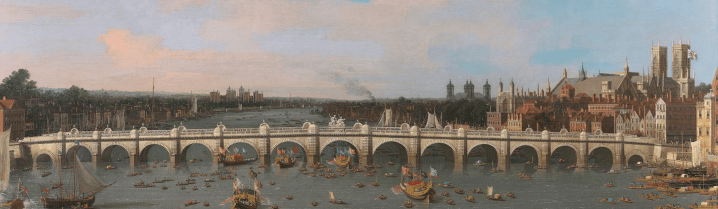
Canaletto, Westminster Bridge, with the Lord Mayor’s Procession on the Thames, 1747, oil on canvas
(New Haven: Yale Center for British Art, Paul Mellon Collection).
◊ ◊ ◊ ◊ ◊
From YCBA:
Art, Museum, Nation
Online and in-person, Yale Center for British Art, New Haven, 25 April 2025
What does it mean to display art through the lens of national identity and history? To mark its reopening, the Yale Center for British Art convenes Art, Museum, Nation, a symposium to critically interrogate the concept of nationhood in contemporary practices of art exhibition, interpretation, and acquisition. In roundtable discussions, leading art historians, curators, and directors from the Art Gallery of Ontario, Metropolitan Museum of Art, and National Gallery, London, among others, will explore how art museums can revise, think beyond, and reinvigorate national frameworks. Among many questions, the symposium will ask: How have expressions of national identity influenced the civic and public role of art museums in both explicit and implicit ways? How might art museums contend with the fluidity of borders and foreground ideas of migration and diaspora? What can art museums do to better acknowledge the traces of colonialism and empire embedded in national collections?
The symposium is free and open to the public. It will be held in the Lecture Hall at the Yale Center for British Art and will be livestreamed. Registration is recommended but not required for this event.
The Yale Center for British Art is pleased to offer a travel stipend for curators and museum professionals who wish to attend this symposium in person and are traveling from within the Boston–New York rail corridor or an equivalent driving distance (approximately 125 miles). If you are facing particular financial barriers to participating and wish to take advantage of this funding, please email your name, position, and travel details to ycba.research@yale.edu before Monday, April 21. Funding is limited and applications will be reviewed on a rolling basis, so apply early!
s c h e d u l e
9.30 Welcome — Rachel Chatalbash (Deputy Director for Academic Affairs, Education, and Research, YCBA)
9.35 Introduction: Reopening the Yale Center for British Art — Martina Droth (Paul Mellon Director, YCBA)
9.45 Keynote Conversation | Art, Museum, Nation: Building Collections Today
Moderator: Lucinda Lax (Curator of Paintings and Sculpture, YCBA)
How can museums serve the needs of both local and international constituents? What does it mean to present a global collection in a national context? Conversely, what should the mission of a national museum be in a globalized world? YCBA curator Lucinda Lax leads a discussion on building and stewarding heritage art collections in the twenty-first century.
• Andrea Bayer (Deputy Director for Collections and Administration at the Metropolitan Museum of Art)
• Christine Riding (Director of Collections and Research at the National Gallery, London)
10.45 Break
11.00 Session 1 | Art, Museum, Nation in Exhibitions and Display
Moderator: Tim Barringer (Paul Mellon Professor of the History of Art, Yale University)
Curators based in Canada, the United Kingdom, and the United States reflect on the potential of exhibitions to advance inclusive and critical definitions of national artistic canons. How are curators using museum display to alter or challenge established ideas of Canadian, British, and American art?
• Patricia Allerston (Deputy Director and Chief Curator, National Galleries of Scotland)
• Horace Ballard (Theodore E. Stebbins, Jr., Curator of American Art, Harvard Art Museums)
• Julie Crooks, Curator (Arts of Global Africa and the Diaspora, Art Gallery of Ontario)
12.00 Lunch Break
1.30 Session 2 | Art, Museum, Nation in the History of Art and Museums
Moderator: Sria Chatterjee (Head of Research Initiatives, Paul Mellon Centre for Studies in British Art)
This conversation looks to the past, addressing how Enlightenment-era ideas of progress and race shaped the construction of public museums in North America and Europe. Discussants will consider the impact of imperialism and scientific racism on modern museum practice and ask what institutions can do to acknowledge and combat these forces.
• Nana Adusei-Poku (Assistant Professor of History of Art and African American Studies, Yale University)
• Andrew McClellan (Professor of History of Art and Architecture, Tufts University)
• Marina Tyquiengco (Ellyn McColgan Associate Curator of Native American Art, Museum of Fine Arts, Boston)
2.30 Break
2.45 Session 3 | Art, Museum, Nation: New Futures
Moderator: Anni Pullagura (Margaret and Terry Stent Associate Curator of American Art, High Museum of Art)
Building on the previous session, the symposium’s closing discussion looks to the future of ‘the nation’ in the art museum. How can the lenses of national identity and history be mobilized toward new and productive ends? What other interpretive frameworks can museums use to complement and complicate ideas of nationality and nationhood?
• Mark Mitchell (Holcombe T. Green Curator of American Paintings and Sculpture, Yale University Art Gallery)
• Stephanie Sparling Williams (Andrew W. Mellon Curator of American Art, Brooklyn Museum)
• Linsey Young (Independent Curator and PhD Candidate, Royal College of Art)
3.45 Closing Remarks — Kishwar Rizvi (Robert Lehman Professor in the History of Art, Islamic Art and Architecture, Yale University)
4.00 Reception
Study Day | The Evolving Life of Country House Display
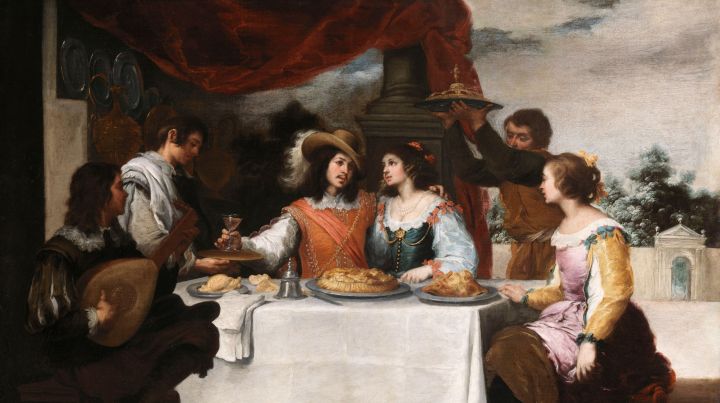
Bartolomé Esteban Murillo, The Prodigal Son Feasting, 1660s. The painting is one of a series of six, all of which are on display at Russborough from March 1 until May 31.
◊ ◊ ◊ ◊ ◊
From ArtHist.net and Russborough:
The Evolving Life of Country House Display
Russborough House & Park, County Wicklow, 10 April 2025
To celebrate the unique history of Russborough, on the occasion of the ‘return home’ of the Prodigal Son series by Bartolomé Esteban Murillo (1617–1682), this study day explores the interplay among houses, collections, and collectors, in a cross-disciplinary attempt to celebrate the richness and diversity of Irish and British country houses.
The historic houses ICOM’s sub-committee (DEMHIST) has identified three main elements that characterise historic houses that are open to the public, and that were formerly owned by collectors—as in the case of Russborough. These are: the container (the house), the content (the collection), and the creator (the collector). All three elements are profoundly intertwined; however, over time, their relationship can evolve, interrupt, or re-bond, thus altering and creating new narratives of collecting, display, and afterlife, often at the intersection of the private and the public.
This is certainly the case for Russborough, where two families and their collections in particular, the Milltowns and the Beits, and two important donations to the National Gallery of Ireland at both ends of the 20th century, have impacted the present history of Russborough and shaped the nature of Ireland’s national collections. The legacy of these donations is commemorated through the naming of the Milltown and Beit wings at the National Gallery of Ireland, and that of the Alfred Beit Foundation at Russborough.
While Russborough offers a significant case study, country houses across Ireland and Britain equally illustrate the evolving nature of historic interiors and display. The architectural design of these properties, their decorative schemes, and the methodologies used to interpret their contents have developed significantly over time, with ongoing research shedding new light on these complex histories. Drawing on Anne Higonnet’s concept of the ‘collection museum’, one may view the relationship between houses, their collections, and their former owners as one that transcends the physical displacement of objects. Despite relocation, such collections often continue to evoke the memory of their original settings and custodians, commemorated through names, foundations, or reimagined displays.
This study day will examine continuities and changes in historic display practices and architectural design, with insights drawn from country houses across Ireland and Britain. Speakers will consider the methodologies and sources that inform such research. The day will also offer participants the opportunity to reflect on Russborough itself, the Beits’ collecting activities, and their connection to Murillo’s Prodigal Son series, which participants will have the opportunity to view in its historic setting. Tickets are €60 and include lunch and refreshments.
The Return of the Prodigal Son exhibition, presented in partnership with the National Gallery of Ireland, runs until May 31st.
p r o g r a m m e
9.45 Registration with tea and coffee
10.15 Welcome and Introduction
10:30 John Goodall (Country Life) — Keynote Speech
11.20 Session 1 | The Architecture of Display
Chair: Mary Heffernan (Office of Public Works)
• Alec Cobbe (Alec Cobbe Design) — Inside Matters
• Frances Bailey (National Trust NI) — Bringing Mount Stewart Back to Life
• James Rothwell (FSA, National Trust) — Restoring Baroque Pomp and Circumstance: The Beauty Room at Petworth, Sussex
12.30 Lunch and Free Flow Tours of the Murillo Display
13.30 Session 2 | Sources for Studying Collecting and Display
Chair: Audrey Whitty (National Library of Ireland)
• David Sheehan (Castletown Foundation) — Castletown: ‘The Epitome of the Kingdom and All the Rarities She Can Afford’
• Adrian Tinniswood (University of Buckingham) — A Madness to Gaze at Trifles
• Seán O’Reilly (Institute of Historic Building Conservation) — Sociological and Psychological, Artistic and Architectural Aspects of Country House Display and Prospective Impacts for Management
14.40 Break and Free Flow Tours of the Murillo Display
15.00 Session 3 | Russborough, the Beits, and Murillo’s Return of the Prodigal Son
Chair: Fionnuala Croke (Chester Beatty)
• Aidan O’Boyle (Office of Public Works) — The Reconstruction of an 18th-Century Picture-hang at Russborough
• John Hilary (University of Nottingham) — The Beit Collection: Murillo’s Prodigal Son Series in Context
• Leah Benson and Muirne Lydon (National Gallery of Ireland) — From Russborough to the National Gallery: The Beit Gift and the Conservation of Murillo’s Prodigal Son Series
16.20 Drinks Reception










 Enfilade
leave a comment