Exhibition | Like Life: Sculpture, Color, and the Body
Press release from The Met:
Like Life: Sculpture, Color, and the Body, 1300–Now
The Met Breuer, New York, 21 March — 22 July 2018
Curated by Luke Syson and Sheena Wagstaff, with Brinda Kumar, Emerson Bowyer, and Elyse Nelson
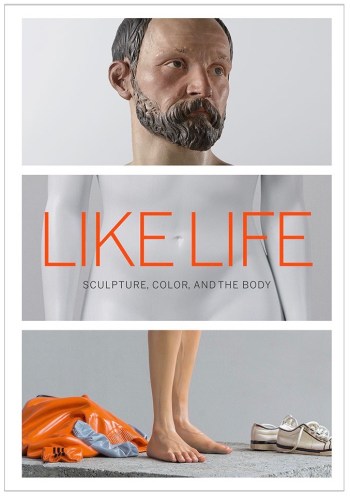 Seven hundred years of sculptural practice—from 14th-century Europe to the global present—will be examined anew in the groundbreaking exhibition Like Life: Sculpture, Color, and the Body (1300–Now). On view at The Met Breuer from March 21 through July 22, 2018, the exhibition will explore expanded narratives of sculpture through works in which artists have sought to replicate the literal, living presence of the human body. A major international loan exhibition of approximately 120 works, Like Life will draw on The Metropolitan Museum of Art’s rich collection of European sculpture and modern and contemporary art, while also featuring a selection of important works from national and international museums and private collections.
Just how perfectly should figurative sculpture resemble the human body? Histories and theories of Western sculpture have typically favored idealized representations, as exemplified by the austere, white marble statuary of the classical tradition. Such works create the fiction of bodies existing outside time, space, and personal or cultural experience. This exhibition, by contrast, will place key sculptures from different eras in conversation with each other in order to examine the age-old problem of realism and the different strategies deployed by artists to blur the distinctions between original and copy, and life and art. Foremost among these is the application of color to imitate skin and flesh. Other tactics include the use of casts taken from real bodies, dressing sculpted figures in clothing, constructing movable limbs and automated bodies, even incorporating human blood, hair, teeth, and bones. Uncanny in their approximation of life, such works have the potential to unsettle and disarm observers, forcing us to consider how we see ourselves and others, and to think deeply about our shared humanity.

Thomas Southwood Smith and Jacques Talrich, ‘Auto-Icon’ of Jeremy Bentham (1748–1832), wax figure built around Bentham’s own skeleton, with human hair, wool, cotton, linen textiles, straw hat, glasses, wood walking stick, table, and chair (London: UCL).
Juxtaposing well-known masterpieces with surprising and little-seen works, the exhibition brings together sculptures by artists from Donatello, El Greco, Jean-Léon Gérôme, Antonio Canova, Auguste Rodin, and Edgar Degas to Louise Bourgeois, Meret Oppenheim, Isa Genzken, Charles Ray, Fred Wilson, Robert Gober, Bharti Kher, Duane Hanson, Jeff Koons, and Yinka Shonibare MBE, as well as wax effigies, reliquaries, mannequins, and anatomical models. Together these works will highlight the continuing anxieties and pleasures attendant upon the three-dimensional simulation of the human body.
Like Life: Sculpture, Color, and the Body (1300–Now) is curated by Luke Syson, Iris and B. Gerald Cantor Chairman of European Sculpture and Decorative Arts, and Sheena Wagstaff, Leonard A. Lauder Chairman of Modern and Contemporary Art, both at The Met, with Brinda Kumar, Assistant Curator of Modern and Contemporary Art, The Met, and Emerson Bowyer, Searle Associate Curator of European Painting and Sculpture at the Art Institute of Chicago, with the assistance of Elyse Nelson, Research Associate, European Sculpture and Decorative Arts, The Met. The catalogue is made possible by the Mary C. and James W. Fosburgh Publications Fund.
Luke Syson and Sheena Wagstaff, with Emerson Bowyer, Brinda Kumar, Barti Kher, Jeff Koons, Schwartz Hillel, Marina Warner, and Fred Wilson, Like Life: Sculpture, Color, and the Body (New York: The Metroplitan Museum of Art, 2018), 312 pages, ISBN: 978 1588396440, $65.
A symposium explores themes raised by the exhibition on Saturday, 14 April 2018, from 10:30am until 6:30pm.
Exhibition | Thomas Gainsborough: Experiments in Drawing
From The Morgan:
Thomas Gainsborough: Experiments in Drawing
The Morgan Library & Museum, New York, 11 May — 19 August 2018
Curated by Marco Simone Bolzoni
 The eighteenth-century British master Thomas Gainsborough (1727–1788) is celebrated for his portraiture and for his depictions of rural landscapes. Although he was best known as a painter, he was also a draftsman of rare ability. Gainsborough experimented with various media to sketch preparatory studies, finished works, and in some cases exercises for his own enjoyment. Thomas Gainsborough: Experiments in Drawing brings together more than twenty works primarily from the Morgan’s collection that reveal the artist’s technical innovations, his mastery of materials, and his development of a new and original mode of drawing.
The exhibition is sponsored by Lowell Libson and Jonny Yarker Ltd. and generously supported by Mr. and Mrs. Clement C. Moore II and the Eugene V. and Clare E. Thaw Charitable Trust.
Marco Simone Bolzoni, Thomas Gainsborough: Experiments in Drawing (London: Holberton, 2018), 84 pages, ISBN: 9781911300458, $25.
Exhibition | Royal and Imperial Clocks
From the press release, via Art Daily, for the exhibition:
Royal and Imperial Clocks: Romantic and Scientific
The David Roche Collection, Adelaide, 27 February — 19 August 2018
Curated by Martyn Cook
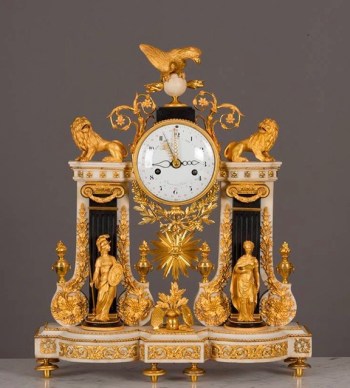
Louis XVI Portico Mantel Clock, ca. 1787–93 (Adelaide: The David Roche Collection).
The David Roche Collection will stage a new exhibition of 34 exquisite French and English clocks, dating from the late 17th century to the early 20th century. Imperial & Royal Clocks: Romantic & Scientific is the first time these rare and opulent clocks have been on public display together.
David Roche (1930–2013)—who left his entire collection of more than 3,500 decorative arts to the people of Adelaide—had, during his long life, been immersed in the intricacies of clocks for their decorative appeal. No matter the horological significance of the movement within the clocks, Roche was only interested in the clock’s decorative façade. He was obsessed with time though struggled to be on time said Martyn Cook, Museum Director of The David Roche Collection and curator of the exhibition.
Roche focused his collection on the French Empire and the Regency period in England. When he acquired an item for his collection, he had in mind exactly where it should be placed in his home—it was no different with his clocks. Roche called Fermoy House—the house in which he spent most of his life—Australia’s ‘Bermuda Triangle’ for clocks because very few worked for more than two weeks, largely through movement in the ground, which made it unstable for the clocks. Though it annoyed him intensely, he learned to live with it, said Cook.
With loans of seven rare clocks from private collections, the exhibition showcases some of the world’s most opulent clocks. Included are the rare Automata Smoking African Clock from The Johnston Collection; a Henry Hindley Table clock c.1760–65, made for the 8th Duke of Norfolk; and a very rare John Shelton Floor-standing Regulator c.1760. Shelton made this type of astronomical clock for the Royal Society of London, and Captain James Cook used Shelton’s regulators to observe the 1769 transit of Venus in Tahiti.
Provenance was always of interest to Roche. He acquired a Laurent Ridel Trophies of War mantel clock c.1780, from the sale of Mrs. Robert Lehman in 2010, following the collapse of the Lehman Bank. His Robert Adam style Long case clock c.1780, belonged to Mildred Hilson, a New York grande dame, while his Balthazar Martinot Boulle mantle clock c.1690, came from Kym Bonython, Adelaide identity and motor racing driver. Although Roche loved all his clocks, two favourites were the jewel-like Joseph Coteau Mantel clock 1796 and the Louis Moinet Prince of Hanover urn clock c.1810, from the Hanover estate at Schloss Marienburg, in Germany. The exhibition is accompanied by a fully illustrated catalogue.
Exhibition | High Society
Press release (1 December 2017) from the Rijksmuseum:
High Society: Four Centuries of Glamour
Rijksmuseum, Amsterdam, 8 March — 3 June 2018

Sir Joshua Reynolds, Jane Fleming, later Countess of Harrington, ca. 1778–79 (San Marino, The Huntington Library, Art Collections and Botanical Gardens).
The Dutch national museum, the Rijksmuseum, is presenting High Society with over thirty-five life-size portraits of powerful princes, eccentric aristocrats, and fabulously wealthy citizens by the great masters of art history, including Cranach, Veronese, Velázquez, Reynolds, Gainsborough, Sargent, Munch, and Manet. The centrepiece are Rembrandt’s spectacular wedding portraits, Marten Soolmans and Oopjen Coppit, which will be shown for the first time following their restoration.
Never before has there been an exhibition dedicated to this most glamorous type of portrait: life-size, standing, and full length. Loans have come from museums and private collections from all over the world including Paris, London, Florence, Vienna, and Los Angeles. High Society also gives a glimpse into the informal life of the well-to-do. More than eighty prints and drawings from the Rijksmuseum’s own collection show what went on behind closed doors: parties, drinks, gambling, and amorous encounters.
International Masterpieces
The works vary from the early sixteenth to the start of the twentieth century. Masterpieces include the impressive portraits of Henry the Pious, Duke of Saxony and Catharina, Countess of Mecklenburg by Lucas Cranach the Elder (1514), the married couple Iseppo da Porto and Livia da Porto Thiene with Their Children by Veronese (1555), Don Pedro de Barberana y Aparregui by Velázquez (ca. 1631–33), Portrait Jane Fleming by Sir Joshua Reynolds (1778/79), The Artist by Edouard Manet (1875), and of course Marten Soolmans and Oopjen Coppit by Rembrandt (1634).
Four Centuries of Fashion
Most of the people portrayed are very lavishly dressed, giving the exhibition an overview of four centuries of fashion: from the tightly cut trousers and doublet from 1514 to the haute couture of the late nineteenth century. Some of the subjects portrayed, however, are wearing fancy garments in an antique style. Another is wearing a kilt, yet another is not wearing trousers and one is almost completely naked. Remarkably, those portrayed often have dogs with them. One man is accompanied by a lion. One couple have their children with them. The backgrounds can be richly decorated interiors, often with columns and/or curtains, or a summer or winter landscape. One man is standing in front of an imaginary landscape with palm trees, while another is adopting a flamboyant pose in front of the Colosseum in Rome.
Vices
Whereas the life-size portraits show the well-to-do in their Sunday best, three rooms in the exhibition are devoted to activities that take place for the most part behind closed doors: parties, drinks, gambling, amorous encounters, and brothel visits. Based on the vices of Gluttony, Greed, and Lust, more than eighty prints and drawings from the collection of the Rijksmuseum have been assembled, many showing humorous and satirical scenes, often with a strong moralizing message in the inscriptions.

Photo: Rijksmuseum/David van Dam.
◊ ◊ ◊ ◊ ◊
The catalogue by Jonathan Bikker (Curator of Research at the Rijksmuseum) will be available at the Rijksmuseum Shop from March 2018. An edition of the journal Kunstschrift entitled Ten Voeten Uit (Full Length) will also be published to accompany the exhibition.
Jonathan Bikker, High Society (Rotterdam: NAI Publishers, 2018), 136 pages, ISBN: 978-9462084261, 25€.
Exhibition | Salazar: Portraits of Influence in Spanish New Orleans
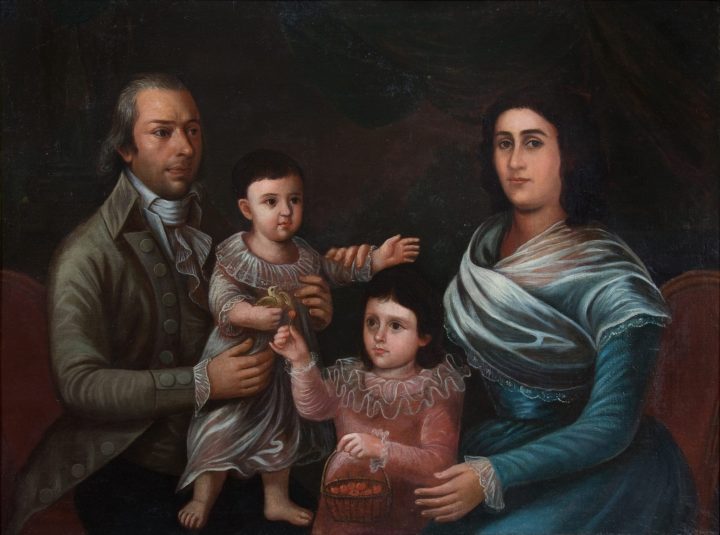
Josef Salazar y Mendoza, Portrait of Don Antonio Mendez (1750–1829) and His Family, 1795, oil on canvas, 36 × 49 inches (Collection of Mr. and Mrs. Robert J. Patrick).
◊ ◊ ◊ ◊ ◊
Now on view at the Ogden Museum of Southern Art:
Salazar: Portraits of Influence in Spanish New Orleans, 1785–1802
Ogden Museum of Southern Art, New Orleans, 8 March — 2 September 2018
Curated by Cybele Gontar
In conjunction with the tricentennial celebration of New Orleans, Salazar: Portraits of Influence in Spanish New Orleans tells the story of Yucatán-born Josef Francisco Xavier de Salazar y Mendoza (ca. 1750–1802), whose career spanned most of the Spanish administration of New Orleans. The exhibition offers a view of Spanish colonial New Orleans through a re-examination of about 30 of Salazar’s portraits. His oeuvre is contextualized in relation to works and other historical artifacts reflective of the city as a site of mobility and transatlantic artistic exchange.
The catalogue is available from ArtBooks.com:
Cybele Gontar, ed., Salazar: Portraits of Influence in Spanish New Orleans, 1785–1802 (New Orleans: University of New Orleans Press, 2018), 240 pages, ISBN: 9781608011544, $65.
The catalogue includes a comprehensive collection of Salazar’s portraits and essays that explore the historical and artistic implications of the era. The oeuvre of this Mexican artist is contextualized in relation to works by other early New Orleans portraitists including Antonio Meucci, Francois M. Guyol de Guiran (1775–1849), and Louis Collas (1775–1856).
Exhibition | New Orleans, the Founding Era

François Chéreau, Le Missisipi ou la Louisiane dans l’Amérique Septentrionale, ca. 1720, hand-colored engraving (The Historic New Orleans Collection, 1959.210).
◊ ◊ ◊ ◊ ◊
Now on view at THNOC:
New Orleans, the Founding Era
The Historic New Orleans Collection, 27 February — 27 May 2018
Curated by Erin Greenwald
In commemoration of the city’s 300th anniversary in 2018, The Historic New Orleans Collection provides a multifaceted exploration of the city’s first few decades and its earliest inhabitants with New Orleans, the Founding Era, an original exhibition and bilingual companion catalog. The exhibition brings together a vast array of rare artifacts from THNOC’s holdings and from institutions across Europe and North America to tell the stories of the city’s early days, when the city consisted of little more than hastily assembled huts and buildings.
Beginning with the region’s Native American tribes, through the waves of European arrival and the forced migration of enslaved African people, the exhibition reflects on the complicated and often conflicted meanings the settlement’s development held for individuals, empires, and indigenous nations. It features works on paper, ethnographic and archaeological artifacts, scientific and religious instruments, paintings, maps and charts, manuscripts and rare books. These original objects are complemented by large-scale reproductions and interactive items. More than 75 objects are on loan from organizations in Spain, France, Canada, and around the United States. A number of items, like a pair of 18th-century Native American bear-paw moccasins from the Musée du quai Branly in Paris and pieces of 15th-century Mississippian pottery from the University of Mississippi, have rarely traveled beyond their home institutions.
Digital interactives will include a gallery of photographs from archaeological digs at a variety of French Quarter sites, a game quizzing visitors on supplies needed for a new home in the settlement and a 1731 inventory of enslaved Africans and African-descended people living on a West Bank plantation.
Erin Greenwald, ed., New Orleans, the Founding Era / La Nouvelle-Orléans, les années fondatrices, translated by Henry Colomer (New Orleans: The Historic New Orleans Collection, 2018), 176 pages, ISBN 978-0917860744, $50.
The companion catalog—a bilingual edition, in English and French—will feature essays describing the different populations who inhabited precolonial New Orleans and the surrounding areas, as well as the forces driving the settlement’s growth. Essayists include exhibition curator Erin M. Greenwald and historians Emily Clark, Shannon Lee Dawdy, Robbie Ethridge, Gilles-Antoine Langlois, Yevan Terrien, Daniel Usner, and Cécile Vidal. Gérard Araud, ambassador of France to the United States, contributed the book’s foreword.
Erin M. Greenwald is curator of programs at the New Orleans Museum of Art. Formerly, as curator at The Historic New Orleans Collection, she was project director of the National Endowment for the Humanities-funded traveling exhibition Purchased Lives: The American Slave Trade from 1808 to 1865. Greenwald holds a PhD in history from the Ohio State University.
Henry Colomer is a French documentary filmmaker and translator. He has directed some thirty films, including various portraits of artists and writers (L’exilé, Iddu, Ricercar, Vies métalliques), as well as a number of documentaries about the upheavals of the twentieth century (Monte Verità, Sous les drapeaux). Colomer has won several awards (Best Historic Documentary, Festival of History Films, Pessac, 1998, 2008; Focal International Award, London, 2010).
Exhibition | Shockingly Mad: Henry Fuseli
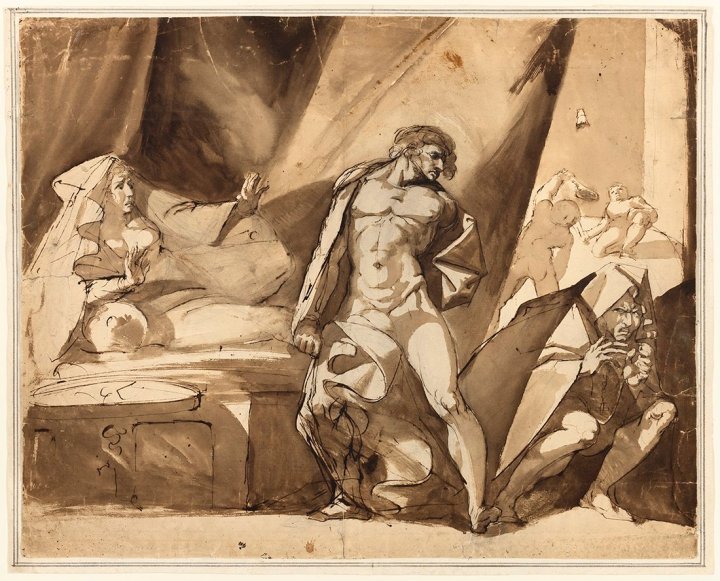
Henry Fuseli, The Discovery, 1767/69, pen and brown ink and brush and brown wash, over graphite with traces of opaque brown paint, on cream laid paper, tipped onto ivory laid paper, 53 × 66 cm (Art Institute of Chicago, 1956.33). From the AIC notes, “This powerful drawing—a bravura exercise in virtuoso line and tonal washes—illustrates a story from Swiss theologian Ludwig Lavater’s book De Spectris (On Ghosts), published in 1569. It describes a priest who, dressed in a sheet, haunts his wealthy niece who is living in his house, in an attempt to rape her and cheat her of her fortune. Terrified, the niece enlists the aid of a friend who exposes the repentant priest. The curious badminton match visible in the background—not in the story, but added by Fuseli as a critical commentary—is a reference to a proverb composed in Latin by the Dutch poet Jacob Cats (1577–1660): ‘Amor ut pila vices exiget’, ‘Love, like a ball, demands reciprocation’.”
◊ ◊ ◊ ◊ ◊
From the AIC:
Shockingly Mad: Henry Fuseli and the Art of Drawing
Art Institute of Chicago, 18 November 2017 — 1 April 2018
Curated by Kevin Salatino
A witness to political revolutions and radical aesthetic shifts, Henry Fuseli (1741–1825) forged a pictorial sensibility of his own, characterized by anatomical, gestural, and psychological extremes. Bizarre, exaggerated, theatrical, and often melodramatic, his drawings embraced obscure literary and historical subjects intended to elicit profound emotional response.
Fuseli was born in Switzerland but traveled to Germany and Italy early in his career, eventually settling in London, where he played a prominent role in the newly established Royal Academy. While he worked in various media, Fuseli excelled at drawing. This medium was central to his practice, evidenced by the extraordinary number of drawings he made—ranging from quick sketches to watercolors that often exceeded the ambitions of his oil paintings.
The Art Institute is home to a remarkably rich collection of Fuseli’s surviving works, including large-scale drawings; smaller, less-finished sketches; and significant paintings and prints. Shockingly Mad: Henry Fuseli and the Art of Drawing considers drawing as an expressive means unto itself, paralleling the broader arc of Fuseli’s career as writer, painter, critic, and teacher. As comparisons to the work of his contemporaries reveal, Fuseli can be said to have forged a radical new drawing style. With roots in Classical antiquity and Renaissance Italy, Fuseli’s passionate, unrestrained approach reflects the revolutionary spirit of his age, which was marked by social and political upheaval. The Art Institute’s holdings are complemented by a number of important local, national, and international loans, and the exhibition itself is accompanied by the adjacent installation Gods and (Super)heroes: Drawing in an Age of Revolution—a selection of drawings by Jacques-Louis David, Théodore Géricault, Francisco Goya, and others that further contextualizes Fuseli as a draftsman.
Exhibition | Fresh Goods: Shopping for Clothing
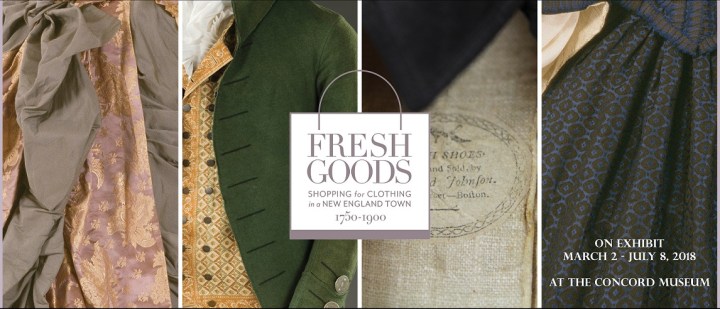
Now on view at the Concord Museum:
Fresh Goods: Shopping for Clothing in a New England Town, 1750–1900
Concord Museum, 2 March — 8 July 2018
Curated by Jane Nylander and Richard Nylander with David Wood
The Concord Museum unveils a portion of its extensive historic clothing collection for the first time, along with textiles and decorative arts in a new exhibition, Fresh Goods: Shopping for Clothing in a New England Town, 1750–1900, on view from March 2 until July 8, 2018.
 As part of the state-wide MASS Fashion collaborative project, the exhibition examines questions about the sources and context of small-town Massachusetts fashion through the Museum’s extensive historic clothing, textile, and decorative arts collection, as well as probate inventories, account books, advertisements, photographs, and letters and diaries of the period. Material culture historians Jane and Richard Nylander are the consulting curators for the exhibition. In careers spent reconstructing New England’s material past, the Nylanders have unearthed remarkable historical evidence and developed fresh and original interpretations on a wide variety of subjects.
Clothing conveys information about the wearer’s gender, age, rank, and wealth, as well as clues about subtler categories, such as taste, education, marital status, and aspiration. Through twenty evocative documented outfits, the exhibition will consider the shopping habits of Concordians in the 18th and 19th centuries. Included in the exhibition are pieces made at home with fabric purchased at shops on Concord’s main street, or made at the local workplaces of seamstresses, tailors, and milliners; or purchased in Boston, New York, London, or Paris. Through close looking at these rare and rarely-displayed artifacts, visitors will be encouraged to compare their own conventions for consuming clothing to people’s practices in the past.
The accessories and services available through the 18th- and 19th-century shops on Concord’s Milldam (the main street of the town), including mantua (dress) makers, tailors, hatters, and boot and shoe makers, will also be explored. In addition, visitors will be able to virtually ‘shop’ the Museum’s historic clothing collection through a specially designed interactive experience that utilizes an online shopping platform.
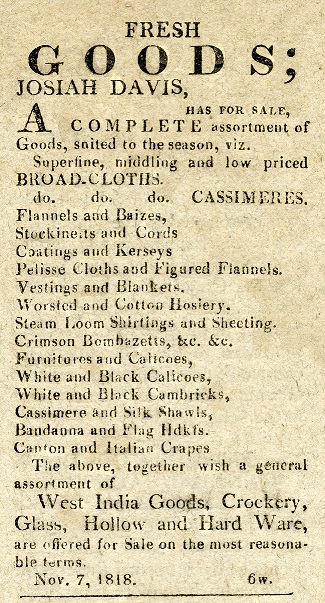
The title, Fresh Goods, is taken from a November 1816 newspaper ad for the Concord shop of Josiah Davis announcing the sale of fabrics such as figured flannels, crimson bombazettes, and white and black cambricks. The exhibition will be accompanied by a broad range of engaging public programs for both adults and children.
S E L E C T E D P R O G R A M M I N G
The Indigenous Look: Attire in 18th-Century Massachusetts
Thursday, 3 May 2018, 7:00pm
Aquinnah Wampanoag artist and designer Elizabeth James-Perry will discuss the period from 1750 to 1900 in terms of Indigenous Massachusetts attire and jewelry. While preferences often continued for use of soft smoked deerskin, elk and textured moose for clothing and sturdy footwear, along with a variety of furs and indigenous textiles, decreasing availability of some materials—especially in the 18th century—led to interesting combinations and substitutions of Native and Euro-American styles and materials. Click here for more information.
Transgressing the Color Line: Depictions of Free Blacks in the Popular Press
Thursday, 10 May 2018, 7:00pm
Join writer and historian Jonathan Michael Square as he analyzes images of free Africans Americans in New York City, Philadelphia, and Boston that appeared in the popular press. Specifically, a series of cartoons published in the early nineteenth century used to arouse Northern anti-black fears that free blacks might be threatening the racial, sexual, and class hierarchies. Fashion will be the central analytic as free blacks were often depicted as dandified buffoons. He will show how the overly fashioned bodies of the free blacks in northern metropolises transgressed and threatened the, until then, established slavocratic order. In partnership with the Robbins House. Click here for more information.
Shift, Stays, and Pannier
Thursday, 31 May 2018, 7:00pm
Join historians and living history interpreters Linda Greene and Michele Gabrielson for an in depth look at how women got dressed every day in the 1700s. They will explore the ‘ins’ and ‘outs’ of a typical 18th-century woman’s dress from a common, lower to middling class status to an upper class persona. Each layer of clothing will be discussed with a focus on fabric, style, and purpose. Perfect for anyone interested in colonial era costume or the lives of women in the 18th century. Click here for more information.
Exhibition | A Stitch in Time at Ham House
Now on view at Ham House near London:
A Stitch in Time
Ham House, Richmond, 10 February — 29 April 2018
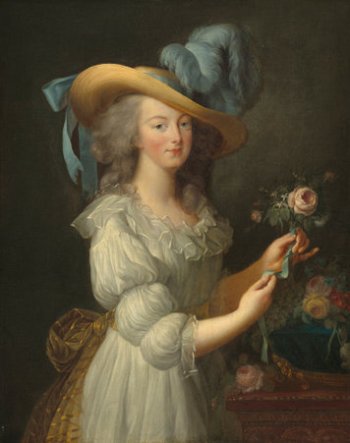
Anonymous artist, after Élisabeth-Louise Vigée Le Brun, Portrait of Marie-Antoinette in a Chemise Dress, after 1783, oil on canvas (Washington, DC: National Gallery of Art).
Earlier this year, BBC Four broadcasted the documentary A Stitch in Time. Presenter Amber Butchart and a team of expert tailors headed by Ninya Mikhaila, took inspiration from works of art and recreated historical clothing using only authentic methods. The six costumes created come to Ham House this spring, allowing visitors to see the intricate work of costumier Ninya Mikhaila and her team up close.
The six costumes include:
• Charles II from a painting at Ham House by Thomas Stewart (from the collection at Ham House)
• The dress from the Arnolfini Portrait by Jan van Eyck at the National Gallery
• The Hedge Cutter leather jacket from a portrait at Broughton Castle
• The dress of Dido Elizabeth Belle from a painting at Scone Palace
• The Jupon of the Black Prince from the effigy at Canterbury Cathedral
• Marie Antoinette’s Chemise à la Reine from a painting by Élisabeth Louise Vigée Le Brun

From left to right: Harriet Waterhouse, Ninya Mikhaila, Amber Butchart, Hannah Marples
A Stitch in Time can be viewed in the UK via the BBC iPlayer. The show is not available in the US, but some episodes have been uploaded to YouTube.
Exhibition | Peacock in the Desert: The Royal Arts of Jodhpur
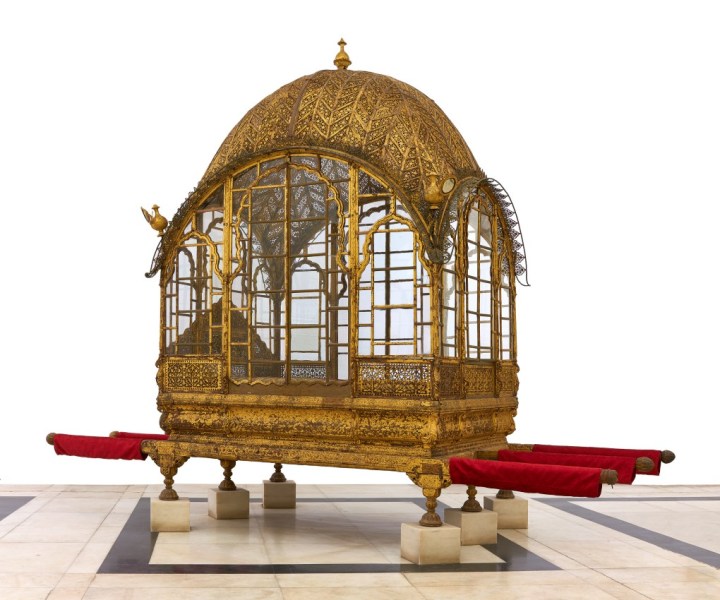
Palanquin (Mahadol), Gujarat, ca. 1700–30, gilded wood, glass, copper and ferrous alloy (Mehrangarh Museum Trust; photograph by Neil Greentree).
◊ ◊ ◊ ◊ ◊
Press release (8 January 2018) from the MFAH:
Peacock in the Desert: The Royal Arts of Jodhpur, India
Museum of Fine Arts, Houston, 4 March — 19 August 2018
Seattle Art Museum, 18 October 2018 — 21 January 2019
Royal Ontario Museum, Toronto, 9 March — 2 September 2019
Curated by Mahrukh Tarapor, Karni Singh Jasol, Martand Singh, and Angma Dey Jhala
A major collaboration brings a groundbreaking exhibition of royal treasures from India to Houston in March. Organized by the Museum of Fine Arts, Houston, in partnership with the Mehrangarh Museum Trust of Jodhpur, Peacock in the Desert: The Royal Arts of Jodhpur, India showcases nearly four centuries of artistic creation from the kingdom of Marwar-Jodhpur, one of the largest princely states in India, in the northwestern state of Rajasthan.
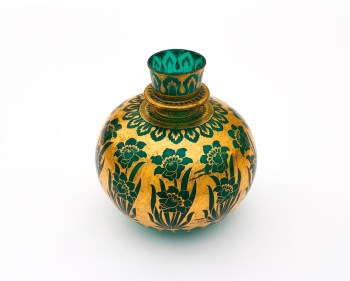
Mughal, Huqqa Vase, early 18th century, glass and gold paint (Umaid Bhawan Palace; photograph by Neil Greentree).
Through lavishly made ceremonial objects, finely crafted arms and armor, sumptuous jewels, intricately carved furnishings, and more, the exhibition outlines the dynamic history of the Marwar-Jodhpur region and the Rathore dynasty that ruled it for over seven centuries. Established in the 15th century, the city of Jodhpur was once the powerful capital of Marwar, a vast desert kingdom ruled by the Rathores, who were descendants of a hereditary social caste of Hindu warriors and kings (known as ‘kshatriyas’). Over the course of several centuries, the prosperity of Jodhpur attracted the attention of two successive empires who ruled India: the Mughals and the British. Both encounters reshaped Jodhpur’s cultural landscape, introducing objects, artists, languages, architectural styles and systems of administration that influenced the royal identity of the Rathore dynasty. Through some 250 objects from Indian courtly life, most never before seen outside of Jodphur, the exhibition illuminates how the Rathores acquired and commissioned objects amidst these cross-cultural exchanges to leverage patronage, diplomacy, matrimonial alliances, trade, and conquest.
Drawn primarily from the collections of the Mehrangarh Museum Trust and the private collections of the royal family of Jodhpur, the exhibition marks the first time that most of these treasures—including paintings, decorative arts and furniture, tents, canopies, carpets, textiles, and weapons—will be seen outside of their palace setting at Mehrangarh Fort and the first time they will travel abroad. The foundations of the Fort, carved out of a rocky hillside 400 feet above Jodhpur, were laid by the Rathores in 1459 as a military stronghold. The Fort, famously described by Rudyard Kipling as “a palace that might have been built by Titans and colored by the morning sun,” has been the seat of the Rathore dynasty since then, serving as a royal residence, a center of cultural patronage, and a place of worship for the royal clan. Today, it houses the collection of the Mehrangarh Museum Trust, which was established in 1972 by the current dynastic head of the Rathore clan, His Highness Maharaja GajSingh II of Marwar-Jodhpur, and remains one of the most important and best-preserved collections of fine and applied arts from the Mughal period of Indian history. A handful of carefully chosen objects from other notable collections, including The al-Sabah Collection, Kuwait, complete the presentation, while large-scale photomurals will evoke the stunning setting of the Mehrangarh Museum, where H. H. Maharaja Gaj Singh II continues to preserve the living heritage of Jodhpur.
“Peacock in the Desert is the result of a landmark partnership, marking the first time the Mehrangarh Museum Trust has shared so many of the treasured objects of their collection,” commented Gary Tinterow, MFAH director. “We are deeply honored and grateful to be the first U.S. organization to present this show, and for the opportunity to provide visitors this unprecedented experience of India’s rich cultural history.”
“The fort of Jodhpur-Mehrangarh has been preserved as a record of the lives and legacy of the Rathores,” added His Highness Maharaja GajSingh II. “I look forward to sharing the artistic and cultural heritage of my country, India, and the city of Jodhpur and its people, with new audiences across North America.”
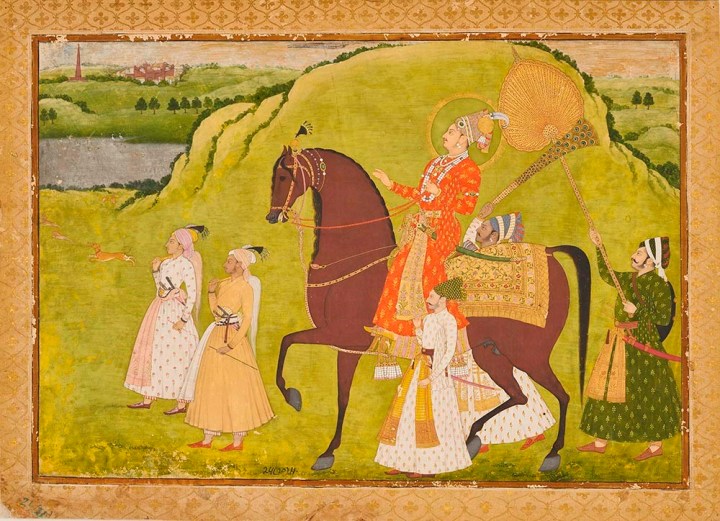
Dalchand, Maharaja Abhai Singh on Horseback, Jodhpur, ca. 1725, opaque watercolor and gold on paper (Mehrangarh Museum Trust; photograph by Neil Greentree).
◊ ◊ ◊ ◊ ◊
Three central, underlying themes woven throughout Peacock in the Desert build upon recent and emerging scholarship to deepen visitors’ understanding of the multifaceted character of a traditional Indian kingdom:
• Interconnections: The relationships between palace and town, urban and rural, central empire and subsidiary kingdom, as well as those that resulted from migratory trade routes, marital alliances, and military partnerships/confrontations, all led to a dynamic crosspollination of new ideas and belief systems, which found brilliant expression in fine and decorative arts, architecture, design, performing arts, and more.
• The role of women and artisans: Contrary to the popular assumption that royal women were quietly hidden away, the exhibition explores the crucial role they played as agents of cultural change and patrons of the arts, showcasing how the gender roles, social etiquette, and aesthetic practices employed by women influenced the identity of Indian courts.
• Royal patronage and the continuity of tradition: An exploration of the royal courts and the ways they were able to preserve India’s cultural traditions, while at the same time absorbing and incorporating external influences.
These themes offer a new perspective on the cosmopolitan culture of the royal courts of the Marwar–Jodhpur region, communicated through the careful juxtaposition of objects, interpretive materials, and immersive installation within the exhibition’s six interlinked sections.
Tradition and Continuity: The Royal Wedding Procession
The exhibition opens with a dramatic recreation of a royal wedding procession with video projections of actual footage from royal weddings performed in the 20th century. Featuring elephant howdahs (seats), horse and elephant mannequins adorned with traditional wedding regalia, and royal insignia, this immersive environment introduces visitors to the role that marital alliances played in the lives of the citizens of Marwar-Jodhpur and in the development of the region’s aesthetic traditions.
The Rathores of Marwar
This section introduces the desert landscape of Marwar-Jodhpur, its diverse peoples, and the exhibition’s central protagonists: the Rathore clan that ruled the region from the 13th to the mid-20th century. Highlights include illuminated manuscript pages that illustrate the scenery of the region and detail the history of the dynasty; an exquisite wood and glass Mahadol (palanquin); textiles, such as turbans worn by various members of the desert community; and a model of the Mehrangarh Fort, in silver.
Conquest and Alliance: The Rathores and the Mughals
The arrival of, and eventual takeover by, the Mughal Empire in 1561 began centuries of political and military alliances brokered between the Mughals and the Rathore clan. This section examines the movement of objects throughout these alliances in the 16th and 17th centuries, presenting ornate sabers, daggers, and rifles alongside 17th- and 18th-century paintings and illustrations of court and war scenes. The section culminates in the extraordinary 17th-century Lal Dera tent, one of the oldest, if not the only, intact Indian court tent of its time.
Zenana: Cross-cultural Encounters
In this section, paintings, carpets, textiles, jewelry, along with intricately-carved sandstone jalis (screens), from behind which women viewed courtly activities, evoke the setting of a royal zenana, the womens’ wing of a Rathore palace. Here, the zenana is explored as a dynamic cosmopolitan space that not only housed women and objects, but also functioned as a preserver of intangible cultural traditions through the propagation of heirlooms, rituals, and dress throughout the centuries. Among the furnishings shown in this section is an exceptional wood baradari (pavilion).
Durbar: The Rathore Court
As Mughal influence began to decline in the late 18th century, the Rathore durbar (royal reception) capitalized on its diminished power by attracting artists and craftsmen from their weakened court. This, in addition to the growing trend of exchanging artworks as gifts, led to a period of intense creativity in artistic and decorative production and a cross-fertilization of Mughal and Rathore styles, as indicated by the woven canopy and textiles, finely crafted arms and armor, and 18th- and 19th-century paintings on view.
The Raj
Extravagant, large-scale objects immediately convey the tone of the last section of the exhibition, which explores the most dramatic period of transformation in Jodhpur’s history, triggered by the arrival of the British in 1818. Garments, paintings, decorative arts, and a 1944 Stinson L-5 Sentinel aircraft illustrate the influence of the British on the region and the unprecedented scale on which Jodhpur royalty began to embrace modernity and western culture as the movement for Indian independence—eventually granted in 1947—gained traction.
Peacock in the Desert is curated by a team of scholars and professionals from India: Dr. Mahrukh Tarapor, senior advisor for international initiatives at the Museum of Fine Arts, Houston; Dr. Karni Singh Jasol, director of the Mehrangarh Museum Trust, Jodhpur; the late Martand Singh, chief consultant from the Mehrangarh Museum Trust; and Dr. Angma Dey Jhala, associate professor at Bentley University, who serves as project advisor and volume editor for the accompanying catalogue.
Distributed by Yale UP:
Karni Jasol, with contributions by Peter Alford Andrews, Robert Elgood, Catherine Glynn, Karni Jasol, Angma Jhala, Shailka Mishra, and Giles Tillotson, and edited by Angma D. Jhala, Peacock in the Desert: The Royal Arts of Jodhpur, India (Houston: Museum of Fine Arts, Houston, 2018), 296 pages, ISBN: 9780300232967, $85.
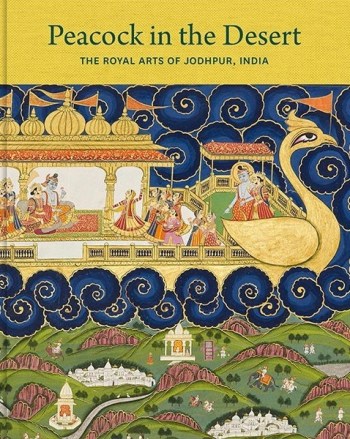 Peacock in the Desert traces the evolution of royal identity in the kingdom of Marwar-Jodhpur in southwestern Rajasthan from the 17th century to the establishment of independence after 1947, presenting the area as a microcosm of India’s extraordinarily vibrant culture. An international team of contributors has contextualized these regional narratives in relation to external—and even global—forces. The book thus offers a new perspective on the acquisition and commissioning of objects through patronage, diplomacy, matrimonial alliances, trade, and conquest. It sheds fresh light on the influential role of women at the royal courts and examines monarchies as lenses onto cross-cultural relationships, the unrecognized roles of groups marginalized in earlier accounts, cultural heterodoxy, and large-scale multicultural exchange. Exploring these webs of connection, Peacock in the Desert makes a transformative contribution to scholarship. Its multidisciplinary approach to artistic and cultural exchange offers pathbreaking insights, adding crucial chapters to the story of India’s royal visual splendor.










leave a comment